

Crim. Con. Actions and Trials and Other Proceedings Relating …
http://www.lawbookexchange.
com
First, permit me to say that in the Regency period, divorces were few. They were expensive. The Church of England opposed divorce as vehemently as did the Roman Catholic church. The Church of England only permitted a “legal separation,” which was termed a “divorce,” a fact that blows the mind of the modern reader. To claim a divorce (the right to marry another), the man first had to seek the “legal separation” on the ground of adultery on the part of his wife. He also had to sue the wife’s lover for “criminal conversation” (alienation of affection) in a different court. The “lover” would be found guilty of “illegal intercourse,” and the court would award the husband damages. The next step would be to petition Parliament to end his marriage. Testimony would be taken regarding the circumstances. This testimony would be published in the newspapers, which meant a quiet end to a marriage was not possible. At length, the bill/petition would be agreed upon, and the couple were free to marry others.

CRIMINAL CONVERSATION — [Trials for Adultery: or, the History of Divorces. London: S. Bladon, 1780.] | Books & Manuscripts Auction | Books & Manuscripts, printed books | Christie’s
http://www.christies.com
CRIMINAL CONVERSATION — [Trials for Adultery: or, the History of Divorces. London: S. Bladon, 1780.]
Generally annulments were hard to obtain, and, more than likely, involved either the court system or the House of Lords, if one was a peer. The exception would be a void marriage. For example, a minor who married by special license without the guardian’s permission or a marriage through an elopement to Scotland that was not consummated would not require an annulment, but rather be declared “void.” Even so, the courts could potentially become involved, especially if one required “legal proof” of the marriage’s end. [I used a variation of this situation in freeing Lydia Bennet from Mr. Wickham in my Pride and Prejudice vagary, A Dance with Mr. Darcy.]

marriage.jpg
sharonlathanauthor.com
A common plot in Regency based novels is a temporary marriage between the hero and heroine, with the assumption of an annulment based on non-consummation of the marriage after six months to a year. The issue is that not consummating the marriage was not grounds for an annulment in this historical period. Consummation could strengthen a claim of marriage in Scotland and could throw doubt in a claim of being forced into marriage, but non consummation was not grounds to annul a marriage. The church always assumed that the couple would get around to it sooner or later if able.
Now impotence and real frigidity were grounds, as was a physical incapacity due to some deformity of the parts, for an annulment. An impenetrable hymen was also grounds though that could be fixed by a surgeon. However, few men would submit to such an examination, one designed to prove they could not consummate the marriage. If a person were insane at the time of the marriage that could earn the spouse an annulment. Also, an annulment would be granted if there was proof of a living spouse or proof of a blood relationship to the spouse (father, mother, or sibling of the spouse) or a marriage connection such as was addressed in my post on voidable marriages (in laws, etc.) Collins Hemingway in “Brotherly Love,” tells us, “Therefore, the marriage of Jane’s brother Charles to Harriet Palmer after the death of his first wife was “voidable” because Harriet was Fanny’s sister. As explained in Martha Bailey’s article in The Marriage Law of Jane Austen’s World (Persuasions, Winter 2015), this sisterhood created a prohibition by ‘affinity’ (marriage) as strong as one by blood. The logic was: Because Fanny and Harriet were related by blood, and because husband and wife became one flesh upon consummation, then Charles would also be related to Harriet by blood. This thinking applied equally for a woman who married the brother of her dead husband.
“‘Voidable’ in Charles’ case did not necessarily mean ‘voided.’ Someone—most likely a relative seeking to grab an inheritance—would have to sue to have the marriage voided and any children declared illegitimate. Charles never had enough money for anyone to bother trying to disinherit his four children by Harriet.”
Also, in the Regency period an annulment based on fraud was customarily found in the question of parental permission.

Number One London. Join us as we explore Regency, Georgian and …
onelondonone.blogspot.
com ~ Fleet Prison Marriages
Permit me to stray a bit from the Regency period, but to address “annulment” and “fraud” across the board. “The history of the law involving annulments based on fraud is instructive. Even going quite far back in…history, annulment laws… have generally included “fraud” as one of the available grounds. But not every proven case of deception results in a decree of annulment. Courts have often refused to nullify marriages for fraud if the innocent party was willfully blind to the truth or too easily fooled by statements made during courtship.
“Courts also require that the fraud induce the marriage: The duped spouse had to show that he or she genuinely relied on the misrepresentation in deciding to go through with the marriage. An appellate court in Missouri denied an annulment in Blair v. Blair in 2004, even though the wife fraudulently misrepresented to her husband, before he agreed to marry her, that he was the father of her child. The court concluded that he had other reasons for marrying her and thus did not rely on the misrepresentation in making his decision.
“Even when a solid case of fraud is proven, courts might decide that it is outweighed by countervailing factors. A long marriage is harder to annul than a short one; a consummated marriage is harder to annul than an unconsummated one; and a marriage that has produced children was harder to annul than one with an empty nest.
“Perhaps the most important limitation built in to the traditional approach to fraud-based annulments is the requirement that the misrepresentation relate to an essential aspect of marriage. Courts did not, for the most part, apply traditional contract principles when defining fraud in the marriage context. (Those principles would allow rescission of a contract for fraud that is material — i.e., an intentional misstatement but for which the defrauded party would have refused to enter into the agreement.) But “fraud” in the annulment context was generally construed more strictly, to include only those misrepresentations that went to the heart of marriage – and not just the particular marriage in question, but any marriage.” (FindLaw) Lying about circumstances was not fraud.
Annulments were not granted simply for someone claiming he/she was forced into the marriage. At first force was considered only as more than a reasonable man could withstand. Over the period of time the laws acknowledged that women were weaker and less force was necessary. The court did not take into consideration such things as a threats. There was no “shotgun weddings.” Being drunk at the wedding was not a reason for an annulment, as long as one knew one what one was doing.
 Insanity, an accepted reason for an annulment, had to be present previous to the wedding. Simplemindedness came under that category as well. The age at which a person could consent to a marriage was 12, but there were instances of children married at 7. However, when the girl reached age 12 she could get out of it. The boy do the same at age 14. Marriages could be annulled if the spouse was a previous in law or if one was impotent. Invalid marriages were those by minors by license without proper permission or was bigamous. Also not conducted in proper form.
“Examples in which annulments were granted by the Anglican Church included being under age, having committed fraud, using force, and lunacy.” (Nyanglish) Even so, the fraud, force, or lunacy had to have occurred during the wedding ceremony (or before, if it pertained to the permission granted to a minor), not after the couple were lawfully wed. Even wealthy peers were stuck with a spouse if problems arose after the ceremony. For example, both the 11th Duke of Norfolk and the 4th Earl of Sandwich were stuck in unfortunate marriages when their wives went insane. In the Duke of Norfolk’s case, his wife was locked up before giving him an heir, so that the dukedom eventually passed to his cousin.
English law did not require consummation. Scottish law used it as proof in clandestine marriages, but only if the other forms were not followed. The Consistory court of the Church of England handled annulments. This was located in London. The Courts within Doctors Commons were very much associated in the public mind with the making and unmaking of marriage from the 17th Centuries.
Gradually, the London Consistory Court assumed a virtual monopoly in matrimonial suits and became the most important matrimonial court for the whole of the country. It became the court of first instance for most matrimonial cases http://www.origins.net/help/aboutbo-churchcourts.aspx
Most people who had void marriage but who appeared as married for sometime or who had a public wedding went through the court system to have the marriage declared officially void.
From a basic litigant perspective, it probably does not matter if the petitioner is a peer or not, but one had to possess money to complete the process. It was expensive. It required an investigation, Canon lawyers, etc. Annulments did not come cheap if the cases were complicated.
What of marriage at sea? As of 1894, according to the Encyclopedia Britannica, Captains of British ships DID NOT have the right to marry people at sea. People have always been able to marry at sea on an English ship if an Anglican clergyman was aboard. After civil marriages and certificates were introduced, one of the officers of the ship, who might be a captain, could be appointed a marriage officer with the authority to conduct a civil marriage ceremony. Passengers and crew on the high seas in a ship under another flag could marry according to the rules of that country’s flag.
Nor could a marriage be annulled after one of the pair passed. [This was the variation I mentioned above as part of the plot for A Dance with Mr. Darcy.] The only grounds for annulment or declaring a marriage void, even after a person has died, is when the marriage was never valid in the first place. This usually comes up after the death of the man when heirs presumptive want to declare the supposed son illegitimate and unable to inherit. If the ground on which they planned to claim an annulment was valid, they were not ever legally married.
Many of these issues play out in the Plot of “The Heartless Earl”
 The Heartless Earl: A Common Elements Romance Project Novel
STERLING BAXTER, the Earl of Merritt, has married the woman his father has chosen for him, but the marriage has been everything but comfortable. Sterling’s wife, Lady Claire, came to the marriage bed with a wanton’s experience. She dutifully provides Merritt his heir, but within a fortnight, she deserts father and son for a baron, Lord Lyall Sutherland. In the eyes of the ton, Lady Claire has cuckolded Merritt.
EBBA MAYER, longs for love and adventure. Unfortunately, she’s likely to find neither. As a squire’s daughter, Ebba holds no sway in Society; but she’s a true diamond of the first water. Yet, when she meets Merritt’s grandmother, the Dowager Countess of Merritt creates a “story” for the girl, claiming if Ebba is presented to the ton as a war widow with a small dowry, the girl will find a suitable match.
LORD LYALL SUTHERLAND remains a thorn in Merritt’s side, but when the baron makes Mrs. Mayer a pawn in his crazy game of control, Merritt offers the woman his protection. However, the earl has never faced a man who holds little strength of title, but who wields great power; and he finds himself always a step behind the enigmatic baron. When someone frames Merritt for Lady Claire’s sudden disappearance, Merritt must quickly learn the baron’s secrets or face a death sentence.
The Common Elements Romance Project includes a variety of authors and genres, as well as settings, each including the same FIVE elements hidden within their novels. Those elements (in no particular order) are…
a Lightning Storm
a Set of Lost Keys
a Haunted House (or the Rumor of Its Being Haunted)
a Stack of Thick Books
a Character Called “Max”
Kindle Unlimited https://www.amazon.com/kindle-dbs/hz/subscribe/ku?passThroughAsin=B08NCW1GHW&_encoding=UTF8&shoppingPortalEnabled=true
Excerpt: (Sterling and his wife appear at the same social function.)
Sterling stood at the portal leading to the card room. He had watched closely as Mr. Reed had claimed Mrs. Mayer’s hand for the opening set, and how Brayton had obviously claimed more of her time. Sterling would have enjoyed escorting the lady through, at least, one of the evening’s sets. He could not remember the last time he had danced—likely before he had courted Claire.
Yet, he had remained in the shadows, naming himself the coward. He had purposely remained in the country these past two years, only returning to Town when Parliament required his influence or his vote on key issues. Often he had wondered on the sanity of permitting Claire free rein, but his only alternative would be a very public divorce. “Perhaps after Gram passes,” he had told himself on more than one occasion. “Then, only I would know the controversy.”
However, since accepting Mrs. Mayer into his household, Sterling had considered a different life from the one he had constructed after Claire’s desertion. “I deserve a wife and other children,” he had said to his father’s portrait in the gallery only yesterday afternoon. When in residence at Baxter Hall, he had often held “discussions” with his late father’s image. “I am not saying Mrs. Mayer would make the perfect mate.” He recognized his father’s likely disapproval of the widow. “Yet, I would enjoy a relationship with the woman I have married, and I want Jamie to know the attentions of a generous heart.”
Now, as he continued to watch, Mrs. Mayer good-naturedly laughed her way through a raucous country-dance with Mr. Reed before summoning a stately attitude to match the gentleman during the minuet. Sterling had marveled at her ability to adapt to any situation. As he watched her from his place beside a large palm, a smile crept across his face. She brought life to those about her.
“Do not sulk in the shadows,” his grandmother ordered.
“Who says I am sulking?”
“If you allow that woman to ruin this evening for Ebba and for yourself,” she charged, “I shall disinherit you.”
Sterling laughed softly. “I do not require your money, Gram. I am a rich man.”
“Even a rich man requires more in life than his fortune and his own company. I grow weary of seeing you alone, Sterling James.”
Her use of his full name Sterling James Baxter told him she meant her words. “Would you have me take a mistress, your ladyship?”
She stepped before him. “I would have you free yourself from that common tart. You are a good man, Sterling. Seize the opportunity—no matter what the cost.”
He kept his eyes on the dance floor, ashamed to meet the eyes of the woman who had raised him. “A divorce is an unprecedented move. It would drown the family name in scandal.”
“Do you think at my age a bit of scandal would ruffle my feathers?” The countess took a step closer to him. “You are what matters, Sterling. You were always what was important in my life.”
However, before he could respond, his face reddened with anger. “What does he want?” he hissed.
The countess turned to see Sutherland bowing before Ebba. “Stop him,” she ordered. “Claire is behind this.”


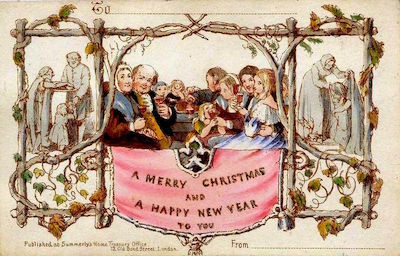
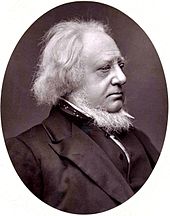 Sir Henry Cole was the first to send out a

 Mistletoe





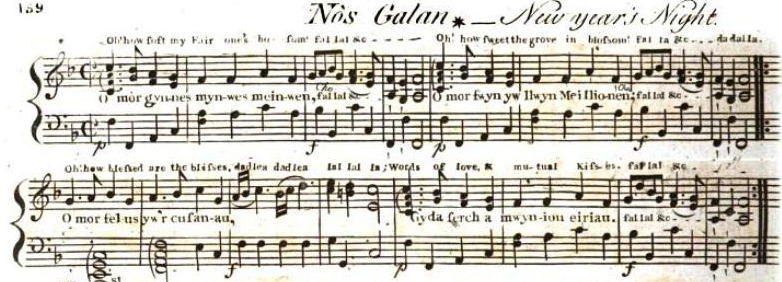
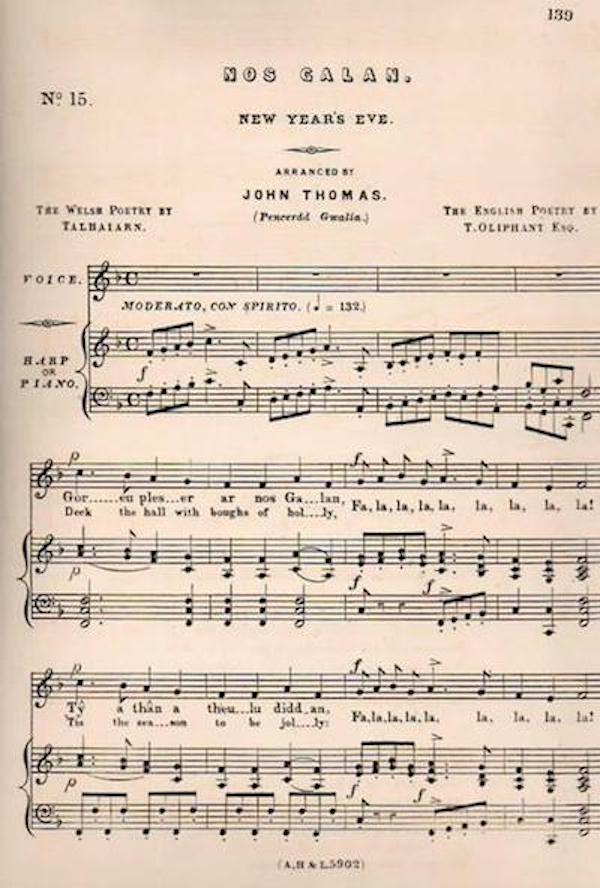
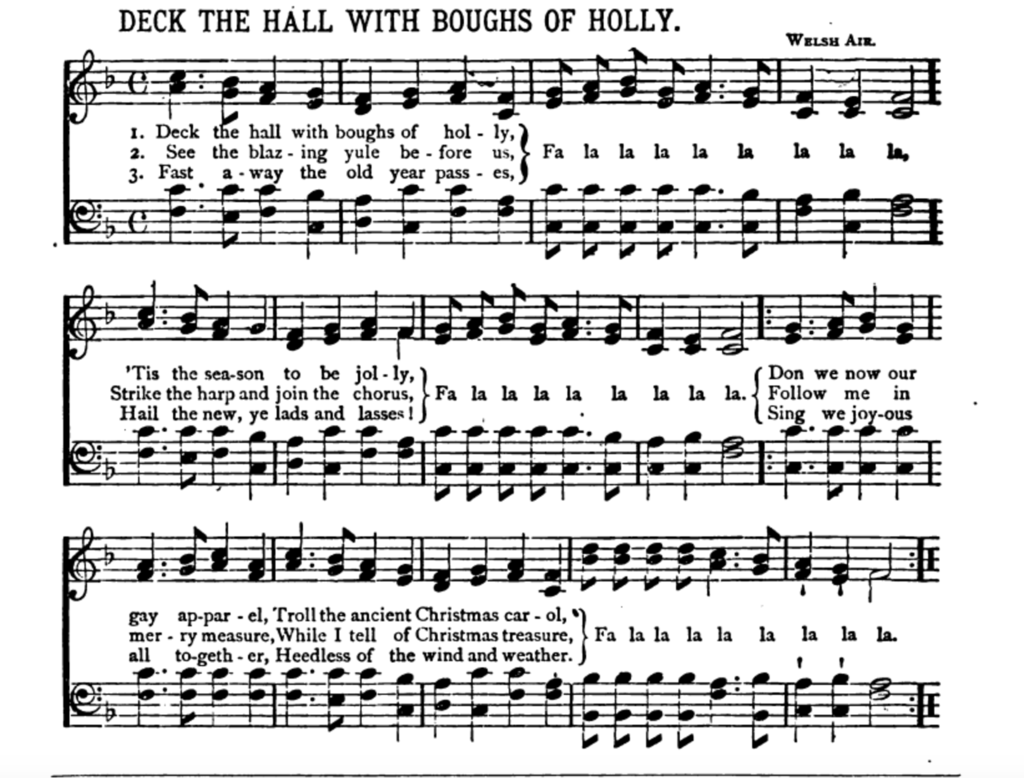
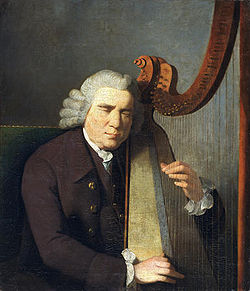 “Deck the Hall” comes to us via a Welsh melody from the 16th Century. The melody is taken from “Nos Galan,” a traditional New Year’s Eve carol, published in 1794, although it is likely much older. [Goldstein, Jack (12 Nov 2013). 10 Amazing Christmas Carols, Volume 2.] John Parry (known as Parri Ddall, Rhiwabon (or, in English, Blind Parry of Ruabon) was the first to record the Welsh air in a musical manuscript of the 1700s. Parry, who is said to have inspired Thomas Gray’s 1757 poem “The Bard,” dictated the air to his fellow-compiler, Evan Williams, his manuscript Antient British Music, published in 1741). In it was an unnamed ‘aria’ which is now called “Deck the Halls with Boughs of Holly.” Later, the song was published and named “Nos Galan.” It was found in Musical and Poetical Relicks of the Welsh Bards (1784) by Edward Jones. The melody is Welsh, but the lyrics come to us via the Scottish musician Thomas Oliphant, dating the piece to 1862.



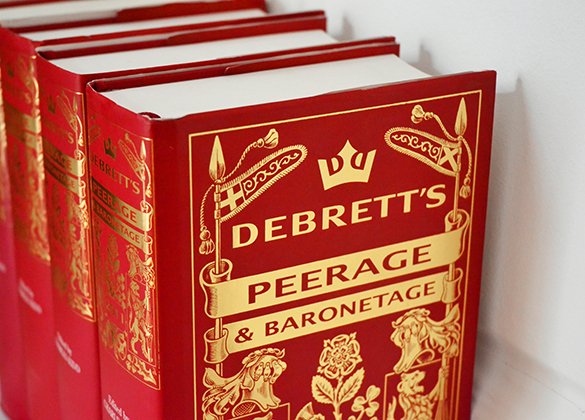
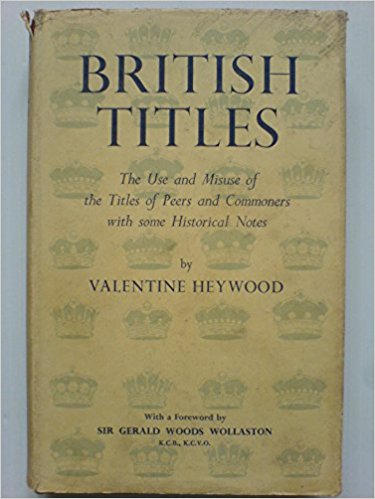 In Valentine Heywood’s British Titles: the Use and Misuse of the Titles of Peers and Commoners (page 113), Heywood addresses what happens with courtesy titles when the heir is not in the direct line of succession. If a nephew, cousin, or other distant relative NOT in the direct line of succession to a peerage becomes the new peer, the Sovereign can accord the new peer’s brothers and sisters with the customary styling, which would have been theirs had their father held the title. Such would be conferred by Royal Warrant.



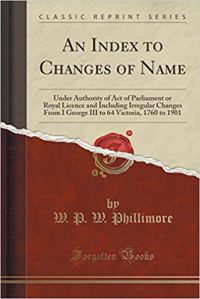 I recently purchased
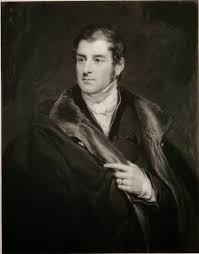 The Earl of Jersey’s title was created in 1697 for the statesman Edward Villiers, 1st Viscount Villiers, Ambassador to France from 1698 to 1699 and Secretary of State for the Southern Department from 1699 to 1700. He had already been created Baron Villiers, of Hoo in the County of Kent, and Viscount Villiers, of Dartford in the County of Kent, in 1691, also in the Peerage of England. George Child-Villers, 5th Earl of Jersey, was a Tory politician and served as Lord Chamberlain of the Household and as Master of the Horse. Lord Jersey married Sarah Sophia (died 1867), daughter of John Fane, 10th Earl of Westmorland, and his wife Sarah Anne (died 1793), daughter of Robert Child. Through this marriage the private bank Child & Co. came into the Villiers family. On account of the considerable wealth brought to the family through this marriage, in 1819, Lord Jersey assumed by Royal licence the surname and arms of Child, and since then the branch of the family has been known as Child-Villiers.
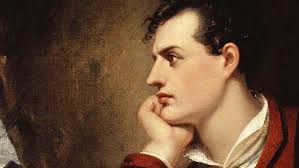 “He was addressed as The Right Honourable Lord Byron (by strangers and on the outside of letters) and as Byron (the title, not the name) by friends. Intimates seem to have actually called him ‘B’, but this may just be the convention of the time to abbreviate names to initials in writing, but possibly not in fact. Servants would have said ‘My Lord’ but an intimately beloved housemaid, Susan Vaughn, addressed her letters to ‘My Dearest Friend’ and his wife addressed a letter to him, ‘My Dearest Duck’.


