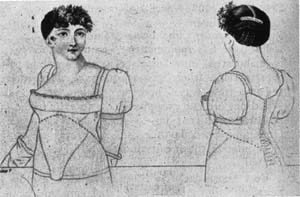
Entails and Common Recovery

As always happens, I received a number of questions on Wednesday’s post on A Debt-Ridden Inheritance about the legality of all this.

Back in feudal times, land was given from lord to tenant in exchange for services. This “service” could be a number of things from serving in the lord’s army to delivering a bouquet of flowers to a woman who had caught the lord’s eye. Naturally, the man who had served in the lord’s army and had sons who could follow in the man’s footsteps, likely received more land and more favors than did the fellow who carried a bouquet of flowers to the lord’s new lady love.

Most assuredly, the system was no longer practiced by the time the Regency rolled around, but the basis of the Georgian era entail found its groundwork in these feudal dealings. It was true that if the man owning the estate had no heir, then it could revert back to the Crown.

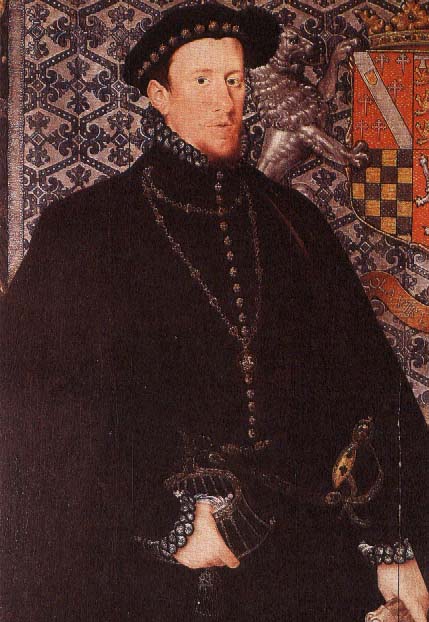
Take the case of the Duke of Norfolk. The Howard dynasty is known to be staunch Catholics, which often resulted in conflict with the reigning monarch, particularly during and after the reign of Henry VIII. In 1546, Thomas Howard, the third Duke, fell out of favor with the dying Henry and was eventually attainted on 27 January 1547. [In English criminal law, attainder was the metaphorical “stain” or “corruption of blood” which arose from being condemned for a serious capital crime. It entailed losing not only one’s life, property and hereditary titles, but typically also the right to pass them on to one’s heirs.] Stripped of his titles and his lands reverted to the Crown, Howard was imprisoned in the Tower of London, where he narrowly escaped execution through Henry’s death the following day, but remained imprisoned until the death of Edward VI and the accession of the Catholic Queen Mary to the English throne in 1553, upon which his lands and titles were restored to him. However, the Duke died the following year and was succeeded by his grandson Thomas as the fourth Duke of Norfolk.

Thomas Howard, 4th Duke of Norfolk, grandson of the preceding duke, executed for treason against Elizabeth I, forfeiting the dukedom

Following Mary’s death in 1558 and the accession of her sister Elizabeth I, the new Duke was imprisoned for scheming to marry Elizabeth’s cousin Mary, Queen of Scots. After his release under house arrest in 1570 and subsequent participation in the Ridolfi plot to enthrone Mary and Catholicism in England, he was executed in 1572 for treason and his lands and titles again became forfeit.

In 1660, the fourth Duke’s great-great-grandson, the 23rd Earl of Arundel, was restored to the family lands and dukedom. Mentally infirm, the fifth Duke never married and died in 1677. He was succeeded by his younger brother Henry as the 6th Duke, through whom the 7th Duke, 8th Duke and 9th Duke of Norfolk were descended in the male-line.

Exactly, who could be considered an heir. We, generally, speak of the eldest son being the heir and inheriting all the property. It is true he would under primogeniture inherit the estate associated with the peerage, but not necessarily ALL the property. If the father died without a will, the eldest son got it all, lock, stock, and barrel, so to speak.

In truth, a man might give land to his other sons and even his daughters. He could leave some of it to his wife. To his other relations, say an aunt or cousin, or even to a favored servant. Only the “entailed” land stayed with the eldest son. As long as the property had no restrictions, which, customarily, those associated with a peerage did have, the land could be dispensed with as the man wished. So, if he loved his second son better than his eldest, the eldest could receive the estate associated with the peerage, while the second son could receive all the other property. It breaks down to ownership. The peer did not “own” the land associated with the peerage; therefore, he can not turn it over to anyone except the eldest son (heir apparent and heir presumptive in practice, etc.)

The way it works is the legal entail (a fee tail) on the land is a restriction document. It restricts to whom the land can be transferred. We have all read in some historical novel how the land was to go to “Said Member of the Family and the heirs of his body” (meaning even the females could inherit), but, more likely to “Said Member of the Family and the male heirs of his body.” Only the children of the man can inherit, and it went to the male heirs, a fee tail male.

In a Regency-based book coming out later in the year, I am using the idea of Common Recovery. Many Jane Austen readers/writers have explored this idea as a means for Mr. Collins to be the heir to Longbourn.

The University of Nottingham tells us this: “Like a final concord, a common recovery looks impressive and important, but does not really provide much useful information. It was the product of a ‘collusive action’ – a fake legal procedure in the courts. The court was usually the Court of Common Pleas, but manorial courts could also deal with common recoveries. Common recoveries were used to break entails (conditions stipulated in wills or settlements which limited the descent of freehold land to certain individuals) and transfer land. Once the common recovery had been achieved (‘suffered’ in legal language), the land reverted to fee simple. This enabled it to be sold to somebody else, mortgaged, or settled in a new way.

“Common recoveries were abolished by the Fines and Recoveries Act 1833. After that date, a simple deed of disentailment was all that was required to break an entail. Purpose: Transfer of real property (freehold or copyhold land by judgement of a court. The main purpose was to bar entails, remainders and reversions.

“Features of Common Recoveries:

  • 15th century-1833
  • very large
  • written on parchment
  • written in archaic court hand up to the mid-eighteenth century
  • written in Latin until 1733
  • vague description of land, e.g. 2 messuages and 150 acres of land in the parish of X
  • Often appears in the form of an ‘Exemplification of a Common Recovery’. This is very attractive official copy of the record from the Court of Common Pleas, produced after the details were enrolled and examined. Includes a portrait of the monarch, and the Great Seal

“The main people involved were:

  • the ‘tenant in tail’. The person actually in possession of the land, who could not sell it because of an entail
  • the ‘tenant to the praecipe’, or the ‘tenant to the freehold’. This was normally a lawyer, agent or other associate of the tenant in tail
  • the ‘demandant’. The person who would own the land at the end of the court procedure. This would be the purchaser if the land was being sold, or a trustee for the tenant in tail if the intention was to create a new settlement”
OLYMPUS DIGITAL CAMERA – Exemplification of Common Recovery by William Brown of Ravensden, Bedfordshire at Court of Common Pleas, Westminster, 1803 ~ Robert Simmons ~ https://en.wikipedia.org/wiki/Common_recovery#/media/File:ExemplificationCommonRecovery1803.jpg

Posted in British history, estates, family, Georgian England, Georgian Era, Great Britain, historical fiction, history, Inheritance, Jane Austen, Living in the Regency, Living in the UK, medieval, Pride and Prejudice, primogenture, real life tales, Regency era, research | Tagged , , , , , , , , , , , | Comments Off on Entails and Common Recovery

A Debt-Ridden Inheritance During the Regency Era

Those of us who write JAFF are very familiar with Mrs. Bennet’s fears of being driven into the hedgerows after Mr. Collins takes over Longbourn in Jane Austen’s Pride and Prejudice. Though Mr. Bennet had not left behind a debt-ridden estate, he could have, and such would have been Mr. Collins’s lot. Total we will speak of property. On Friday, we will look at wills.

In many Regency novels, either the hero inherits an estate/title that is deep in debt, not of his making, or the heroine’s father has died and left his family destitute, due to his gaming debts or his poor investments. Both situations play well into the hands of a skilled author of Regencies, and, although they are somewhat cliché, that does not mean a reader will not enjoy the twists and turns all over again. However, of late, I have noted on several of the Facebook groups that people are confused about a particular plot point that mentions a debt-ridden inheritance. Therefore, I am taking on the topic today. 

Property could be tied up by entails, previous wills, marriage settlements, deeds, and other conditions accompanying a deed—we usually speak of all of these as being “entailed” property, but each could have a different line of descent. For quite a long time real property could not be devised by a person’s last will and testament, but had to be done by deeds or other means of transfer.

As a general rule for fiction writers, if property was not otherwise tied, it could be left to someone by a will. If there was no will, all the property would either be disposed of according to the various deeds and settlements and entails tying it. The rest would be disposed of according to the laws of distribution in intestacy.

First, one must realize that there is actually a rule against perpetuity law (a restriction saying the estate cannot be taken away from or given away by the possessor for a period beyond certain limits fixed by law) which addresses an entail that lasting more than the three lives (generally the grandfather who is the holder of the entailed property, his first born son, and his first born grandson) plus twenty-one years. Keep in mind that an entail can be renewed when the original owner’s son (meaning the first born son), as described above, becomes the grandfather, the original grandson becomes the father, and there is a new grandson.

The common rule against perpetuities forbids instruments (contracts, wills, and so forth) from tying up property for too long a time beyond the lives of people living at the time the instrument was written. For instance, willing property to one’s great-great-great-great grandchildren (to be held in trust for them, but not fully owned, by the intervening generations) would normally violate the rule against perpetuities. The law is applied differently or not at all, and even contravened, in various jurisdictions and circumstances. Black’s Law Dictionary defines the rule against perpetuities as “[t]he common-law rule prohibiting a grant of an estate unless the interest must vest, if at all, no later than 21 years (plus a period of gestation to cover a posthumous birth) after the death of some person alive when the interest was created.” At common law, the length of time was fixed at 21 years after the death of an identifiable person alive at the time the interest was created. This is often expressed as “lives in being plus twenty-one years.” (Wells Law Blog http://wellslawoffice.com/2011/05/remember-the-rule-against-perpetuities/)

Another point to keep in mind is that property and peerages followed different rules of inheritance, so customarily matters were set up so that the family seat went along with the title.

Property was disposed of through deeds, marriage settlements, and wills. Trusts were established to hold property for the benefit of the real owners. The rules of descent and distribution of these trusts could be set up any way one wanted-—within reason, of course. If property was disposed of by a settlement that was in force for the three lives in being + 21 years (as described above), at the end of that time it would need to be resettled by creating a new entail. That is what many did. If the property was not resettled, or dealt with in a will, it descended by through PROPERTY LAWS, not by LAWS GOVERNING PEERAGES. As long as the  property went from father to son or from grandfather to grandson along with the title, all was well. However, if there suddenly was no male heir in the direct line, other provisions were established for disposing of the property. The title might go to a cousin twice removed, but the property could even go to a daughter or the offspring of a daughter.
Male heirs were preferred only because males, especially of the gentleman class, did not want the property to go to another family. Though daughters have as much family blood as a son, when a daughter married (at least, up until the 1870’s) her property came under the control of her husband. Her son would belong to a different family then.

The laws of descent and distribution and inheritance of real estate are complex. It should be remembered that property and peerage have different rules of descent. The family seat can be separated from the title. Property cannot be extinct though titles could be. Property was rarely forfeited to the Crown due to lack of heirs. Usually it was due to a criminal action.

The entail prevented a wastrel from selling off the family estate to pay his debts. An entail was defined by a deed of settlement (or) a strict settlement. The heir customarily received the land for his use ONLY in his lifetime. His rights ceased to exist upon his death.

Originally, many attempted to entail their properties until the end of the world, so to speak. However, the law would not permit infinity to stand. In practice, an entailed property only remained so until the grandson of the land owner making the settlement became of age at 21 years. Then, the heir could sell or give away the property. So, theoretically, the entail only held the land through the first and second generation of land owners. However, a little coercion often secured the land for future generations.

Most land owners (and their sons) held no other financial employment. If the property owners son wished to keep his allowance, he agreed to sign a new deed of settlement, which would assure the property remained in the family for the next two generations, etc., etc. This legal practice offered the landowner to see his property remain in tact for the “infinity” his family duties required. 

Sometimes we read where the aristocrat decides he does not want the property, but the law says otherwise. The title and the property are his. He can leave the country and never claim them, but they are his, and no one else has the right to have them as long as he is alive. If the property is entailed, it usually has trustees who hold it until the gentleman dies or he decides to claim it. They and the executors could deal with the debts. However, usually, the debts to the small shopkeepers are not so great that they cannot be paid from the estate coffers. 

The executor was supposed to see about paying all the legitimate debts. These were debts on which the stamps  were affixed and fees paid. If the deceased had mortgaged the property,  the company could continue the mortgage. If the property were entailed, it took something like an act of Parliament to foreclose and sell it. Gambling debts could not be legally enforced unless they were processed as legal loans and stamped and all fees paid.

Only registered debts like  mortgages  and those on which the stamps and fees had been paid were legally enforceable. The law of the time said an heir was only liable for  debts to the sum of the assets he inherited. Most mortgages could be continued,  just by paying the interest. As I said above, much of this depends on whether the land was settled or not— deeded to another, entailed, passed by settlements—as to what happened to it. If the man inherited by entail, then he was stuck with the property and the debt. If by will and deed, he could refuse to accept the inheritance and let it be as though the man had died intestate. Then the solicitors would be involved and  go looking for the heir while the executor dealt with the creditors.

If the man discards the gambling debts, he could work out a payment to the small creditors and work with the major ones. Most debts will not be signed and sealed ones. Usually it was only some debts, such as mortgages which were so considered. On the other hand, some mortgages of the time ran for a century. It depends on the time of year—rents and such will usually be paid at Michaelmas, which is income.
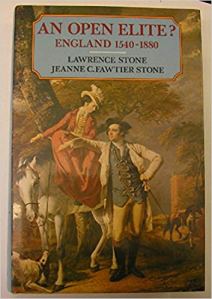
The book An Open Elite: England 1540 – 1880, by Lawrence and Jeanne Stone, contains a bit of information on debt-ridden estates. 

An Open Elite? sets out to test the traditional view that for centuries English landed society has been open to new families made rich by business or public office. From a detailed examination of the landed elites of three counties between 1540 and 1880, the authors come to radical new conclusions about the landed classes. They describe the strategies of marriage and inheritance evolved by older families to preserve their position, and establish that the number of newcomers was always relatively small. The resulting work is a major reassessment of the social, economic, and political history of England since the Reformation.
***This abridged edition of what was immediately recognized as a major work of historical scholarship was first published in 1986 and is now available in Clarendon Paperback with a new foreword by Lawrence Stone.

Mr. Joshua Williams, a barrister at Lincoln Inn (1845) in his Principles of the Law of Real Property says, “In families where the estates are kept up from one generation to another, settlements are made every few years for this purpose; thus, in the event of a marriage, a life-estate merely is given to the husband; the wife has an allowance for pin-money during the marriage, and a rent-charge or annuity by way of jointure for her life, in case she should survive her husband. Subject to this jointure, and to the payment of such sums as may be agreed on for the portions of the daughters and the younger sons of the marriage, the eldest son who may be born of the marriage is made by the settlement tenant-in-tail. In case of his decease without issue, it is provided that the second son, and then the third, should in like manner be tenant-in-tail; and so on to the others; and in default of sons, the estate is usually given to the daughters; not successively, however, but as ‘tenants in common in tail,’ with ‘cross remainders’ in tail. By this means the estate is tied up till some tenant-in-tail attains the age of twenty-one years; when he is able, with the consent of his father, who is tenant for life, to bar the entail with all the remainders. Dominion is thus again acquired over the property, which dominion is usually exercised in a re-settlement on the next generation; and thus the property is preserved in the family. Primogeniture, therefore, as it obtains among the landed gentry of England is as customonly, and not a right; though there can be no doubt that the custom has originated in the right which was enjoyed by the eldest son, as heir to his father, in those days when estates-tail could not be barred.” 

A person could not inherit gambling debts. Those are debts of honor incurred by the person doing the gambling, so basically a vowel being held by a gentleman who passes is no longer collected. A son might feel he wants to clear his father’s debts of honor to preserve his father’s name, but a more distant relation might not feel the same urge.

Also, a title cannot be debt-ridden, meaning a barony, earldom, marquisate, etc., does not include the debts. The estates might be encumbered by mortgages or might have been drained of resources so that they need cash in order to become productive again, but that fact does not affect the inheritance of a title. There is also the possibility that the title might show up without estates to support it. No land, during the Regency era, meant “the gentleman” had no way of making money, other than his going into trade or investing…or gambling.
If you want to read up on entailed property and mortgages (and fee tail), I might suggest The Practice of Conveyancing from William Hughes. You can read it at this link [Note this series has more than one volume.]: 

https://books.google.com/books?id=2VFDAAAAcAAJ&pg=PA362&lpg=PA362&dq=entailed+estates+mortgages&source=bl&ots=0rN98VXd6g&sig=jzN5AteOMtU5dafw_PWs-e1CSmI&hl=en&sa=X&ved=0ahUKEwjByI-Kx__KAhURx2MKHcUtDQ0Q6AEIPzAH#v=onepage&q=entailed%20estates%20mortgages&f=false

Other Posts on My Blog Regarding Inheritance That Might Prove Helpful: 

Bride Inheritance? A Cultural Allowance for a Widow or a Means to Control Property?

The Common Practice of Primogeniture in Regency England

Discussion of Land Inheritance

The Effects of Primogeniture on Family Dynamics

Gavelkind, Inheritance in Opposition to Primogeniture

Inheritance and Illegitimate Heirs

Oh, Give Me Land, Lots of Land (or) the 19th Century Entail

Peerage, Abdication, Inheritance, and Questions of Legality

Primogeniture? Collateral Relatives? The First Laws of Inheritance…

Primogeniture and Inheritance and the Need for a Widow’s Pension in Jane Austen’s Novels

The Roots of Primogeniture and Entailments

Statute of Wills, Henry VIII’s Answer to Primogeniture

Posted in British history, customs and tradiitons, family, Georgian England, Georgian Era, Inheritance, Living in the Regency, Living in the UK, primogenture, real life tales, Regency era, Regency romance, titles of aristocracy | Tagged , , , , , , , , , , , | 4 Comments

George Thomson, Savior of British Traditional Music

“The Maid of Llanwellyn” is a Welsh song of love in which the girl admits she has no care for whether her lover is rich or not. From Contemplator [You may listen to the music on this site.] we learn, “This [song] was published by George Thomson of Edinburgh (1757-1851). Thomson paid F. J. Haydn in Vienna 2 ducats each for 200 tunes. He also paid Beethoven for tunes, but he quit, disgusted with the pay.

“The lyrics are by Joanna Baillie [1762-1851]. In the tune she speaks of lakes in Wales. When Thomson remarked that Wales had no lakes, Miss Baillie replied that she would not alter the line and they would have to ‘hope their readers were just as ignorant as she had been when she wrote it.'”

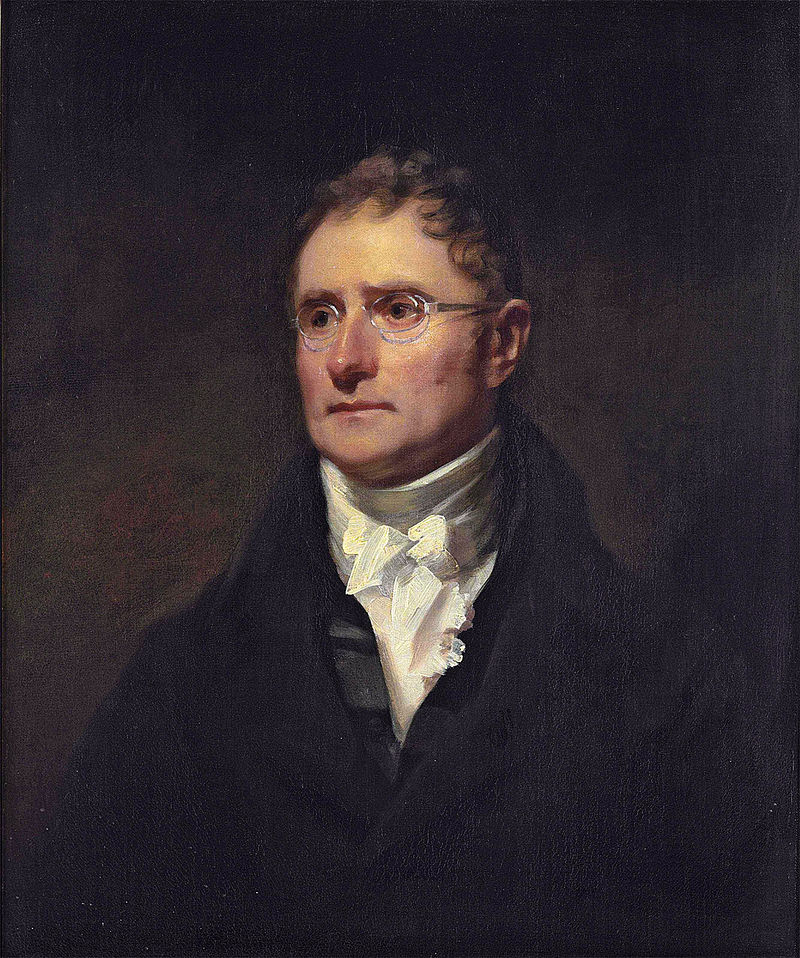
800px-George_Thomson_(1757–1851)_by_Henry_Raeburn_(1756-1823)

George Thomson by Henry Raeburn ~ via Wikipedia ~ Public Domain

What do we know of George Thomson? First, Thomson was the original director of the famed Edinburgh Music Festival. He was also an avid collector to Britain’s national folk songs. Thomson came to Edinburgh at the age of 16, where he became a junior clerk to the Board of Trustees for the Encouragement of Arts and Manufactures in Scotland. When his boss passed, Thomson assumed the position. He was in his early 20s at the time and held the job for 59 years. 

Because of his love of music, and especially of the violin, Thomson chose to publish a collection of Scottish tunes accompanied by the traditional lyrics. However, in his research, Thomson found most of the published songs were flawed and not the original tunes. To suit them for concert use and to appeal to persons ‘of taste’, he decided to furnish the old tunes with new instrumental accompaniments.

Believing that no one in Edinburgh or London had sufficient talent to write the music, Thomson applied to several foreign composers. In 1799 he sent some Scottish melodies to Franz Joseph Haydn in Vienna, offering the eminent composer two ducats for each air. In June of 1800, Haydn forwarded to Edinburgh more than 30 airs he had arranged. Altogether Haydn worked on some 200 airs, including ‘The Blue Bells of Scotland.’

215px-Haydn.jpg “Haydn, however, was up in years, so Thomson applied to Ludwig van Beethoven, a much younger man. In 1810 Beethoven sent to Edinburgh a number of Scottish airs he had composed ‘con amore’ by way of doing homage to the national songs of Scotland and England. But Thomson and the composer constantly argued over money. In Beethoven’s last letter, dated 25th May, 1819, he exploded over the pay he had received for his work.
robert-burns-portrait-150x150.jpg “Thomson felt that a number of charming old songs suffered from lyrics that were ‘mere nonsense and doggerel’ while others had rhymes ‘too loose and indelicate’ to be sung in decent company. In 1792 Thomson applied to Robert Burns, the greatest of Scottish poets, to provide new words for 25 melodies that he, Thomson, would select. Burns agreed, provided his muse not be hurried. He also asked to include at least a sprinkling of Scottish dialect, but Thomson insisted that he avoid the vernacular as much as possible, since English was becoming increasingly the language of Scotland and young people were being taught to consider the Scots dialect vulgar. Burns contributed about 100 songs, both original and revised, before his death in 1796. These included ‘Scots, Wha Hae,’ ‘John Anderson, My Jo,’ and ‘Highland Mary’.

“In addition to Burns, who suggested expanding the collection to include Welsh and Irish airs, Thomson sought the help of various English writers. He wished to provide a number of Gaelic airs with alternative English lyrics that Southrons would understand. He rounded up a number of both Scottish and English writers to assist him, including Byron, Thomas Campbell, Walter Scott, James Hogg, John Gibson Lockhart, Joanna Bailllie, and Mrs. Anne Grant of Laggan.

If the songs failed in their intentions, the writers were not always to blame. Thomson delighted in presenting local colour, and if he could introduce Snowdon or Llangollen into a song, it might at once pass for Welsh.” 

“Thomson edited three separate editions of national songs–Scottish, Welsh, and Irish. The Scottish songs were published in six volumes under the general title of A Select Collection of Original Scottish Airs for the Voice, with Introductory and Concluding Symphonies for the Pianoforte, Violin, and Violincello.

Thomson died in 1851, leaving two sons and six daughters. One daughter, Georgina, married George Hogarth, the Edinburgh music critic, historian, and Writer to the Signet. In 1836 the Hogarths’ daughter Catherine married Charles Dickens. So Dickens’ ten offspring were the great-grandchildren of George Thomson, the ‘clean-brushed’ old gentleman whose collections of traditional national songs are still sung around the world.”

 JW Pepper tells us, “In this folksong-style original, the guys are smitten when The Maid of Llanwellyn smiles on them! The robust choral parts are just right for young male voices, and a few optional three-part chords add to the bravado.” (British Heritage Travel)

Kate Rusby’s version of the song on You Tube

The Maid of Llanwellyn

I’ve no sheep on the mountains, nor boat on the lake,
Nor coin in my coffer to keep me awake.
Nor corn in my garner, nor fruit on my tree,
Yet the maid of Llanwellyn smiles sweetly on me.

Rich Owen will tell you, with eyes full of scorn,
Threadbare is my coat, and my hosen are torn.
Scoff on, my rich Owen, for faint is thy glee
When the maid of Llanwellyn smiles sweetly on me.

The farmer rides proudly to market and fair,
And the clerk at the ale house still claims the great chair.
But of all our proud fellows, the proudest I’ll be
While the maid of Llanwellyn smiles sweetly on me.

Peter, Paul and Mary have a song that sounds very similar. It is called “Pretty Mary.” You can hear it HERE

Posted in ballads, British history, Georgian Era, music, Uncategorized | Tagged , , , , | 2 Comments

Controlling a Carriage During the Regency

“In Jane Austin’s Northanger Abbey, Mr. Thorpe enthuses over his new carriage, boasting, “Curricle-hung, you see; seat, trunk, sword-case, splashing-board, lamps, silver moulding, all you see complete; the iron work as good as new or better” — and all for fifty guineas.

“Pray, pray, stop, Mr Thorpe!” ~ C E Brock illustration for Jane Austen’s Northanger Abbey

“Chandros Leigh, a distant cousin of Jane Austen, obtained an estimate for a fashionable laundau in 1829. The price of the basic carriage was 250 pounds, which included: ‘plate glass and mahogany shutters to the lights, and plated or brass bead to the leather, lined with best second cloth, cloth squabs, and worsted lace….’ The ‘extras’ ordered including footman’s cushions, morocco sleeping cushions, steps, silk spring curtains, his crest on the door, embossed door handles and full plated lamps. These brought the cost to 417 pounds, 11 shillings and 6 pence, but he was given 60 pounds in exchange for his old carriage.” [The Regency Horse World]

What was the difference between a Town carriage and one in the country? They were different in build and purpose. Getting about in Town might included a gig, a phaeton, a curricle or a Town coach. Traveling might involve a Landau or a Barouche.

Carriages for country and for town were generally quite different in build, for they served different purposes. And since carriages were custom built, almost every carriage could be a unique design. Common types of carriages, however, included:

The Phaeton – a four-wheeled, owner-driven vehicle fitted with forward facing seats, usually an open carriage.

The Gig – A gig was a small, lightweight, two-wheeled, cart that seated one or two people. It was usually pulled by a single horse and was known for speed and convenience. It was a common vehicle on the road (definition and photo credit courtesy of Horse and Buggy]

The Curricle – the “gig” of the quality, built to hold two, which could be two or four-wheels, and which sometimes had a top that could fold down

A Town Coach – a closed coach that could be drawn by one horse or a pair.

Landau – a four-wheeled vehicle that held four, which was drawn by a pair and built with a removable or folding top.

Barouche – a four-wheeled vehicle drawn by a pair, or by four or even six horses, with an option for a driver, or for post boys to ride and control the horses. Sometimes built with a fold-down top.

NOTE: Visit Horse and Buggy for more example and images of these carriages.

From what I can tell, few carriages were driven with a team of four horses in the city. 

In researching the management of teams of horses, I came across an interesting real-life tidbit of information which may be of interest. If the coach in question is drawn by a team of four horses, meaning out on the open roads of England, rather than a pair, a knowledgeable and experienced horseman would go to the heads of the wheelers, which is the pair closest to the carriage, rather than to the leaders, who are in front.

Though this may sound against reason, it absolutely makes a lot of sense. If the leaders are spooked and bolt, the wheelers will probably follow them, resulting in four horses running wild because they will be too much even for several men to control. But, if the wheelers are kept calm and stand their ground, the leaders are pretty much held in place, since in many cases, the wheel horses were larger and stronger. In addition, if the wheelers stay calm, and horses being “herd” animals, the leaders will typically calm down fairly quickly.

Now, what if there is a wreck. Is it possible to free the team of horses from the carriage but have them still wearing some sort of harness, or is it all attached to the carriage in some way so the only way to free the team is to remove it all?

As to detaching it, it depends. If one is speaking of job horses on a hired carriage, and something simple like a broken wheel or axle, yes, they could be detached and attached to a similar type of carriage. A harness is specific to the carriage and there are different types of harnesses, depending on the carriage.

If you’re talking a private carriage, keep in mind this is the age of custom, and one is not likely to find a carriage that will match the team unless it is a common type of carriage, and one must have a match (ie, a gig to a gig, a phaeton to another phaeton, etc.). Again, harness is specific to the type of carriage. For example, do you have shafts or a single middle pole?. If one is talking overturned or wrecked carriage, that is such a mess the horses must be cut away, you’ll have bridle, bit and reins intact and not much more. If one is talking the Royal Mail, the guard was instructed to cut away one of the horses and ride on with the mail pouch, leaving coach and passengers behind, so those horses were trained to drive and ride.

What happens with a wreck or a broken part depends on the coach, and is it open or closed? Is it older or  newer? Newer coaches tended for a lighter body and design. Also, typically, a broken axel is not going to leave the coach on its side–the broken axel will leave it tilted.

Source!!! One can find multiple images of broken axels and carriages at HERE.

Now, in describing a wrecked carriage, if one adds in a ditch or great speed, such might put the carriage onto its side. Yet, remember, we are not likely to discover a Town coach out where there might be ditches or traveling so fast? If one is talking a traveling chase, that is a different matter.

Here is a good account (if somewhat exaggerated) of an axel breaking at speed from Jane Austen’s London Curricle Crashes and Dennet Disasters – The Dangers of the Regency Road https://janeaustenslondon.com/tag/carriages/ (And the leader here is looking back as if to ask what the devil is happening.)

For a closed carriage, if it gets on its side, folks are going to have to climb out the door–and it’s unlikely that 2-3 guys can right it, unless they’re really strong or have the help of some mules. But one can note that in the drawing, folks are falling out the door and such is going to end badly for them, for the carriage is going to crush bones.

For an open carriage, if it ends up on its side, folks are going to be thrown out of it, and there are no seat belts to secure them in place. Moreover, there would be a high center of gravity involved. It would be very unlikely, those involved will be able to harness the team to pull the carriage upright if it’s overturned, for the horses are going to be regarding it like a monster and may well be injured and certainly are going to be badly spooked. A much better option would be a local farmer with plough horses or mules. Now, all that said, there have been stories of moms picking up cars after an accident–panic and adrenalin can allow a person to do amazing things! Such heroic feats are rare, but possible, so write that carriage crash scene with a little realism and a large dose of “poppycock,” as George Darling in Peter Pan would say.

Posted in Always Austen, British history, Georgian England, Georgian Era, history, Jane Austen, Living in the Regency, Northanger Abbey, Regency era, travel | Tagged , , , , , , , , | 4 Comments

Sappy and Romantic Movie Quotes to Celebrate Valentine’s Day

Let’s start with something related to Jane Austen. You’ve Got Mail is a modern day Pride and Prejudice, or so we are led to believe. “I wanted it to be you, I wanted it to be you so badly.”

This one always makes me cry—from The Notebook. “So it’s not gonna be easy. It’s gonna be really hard. We’re gonna have to work at this every day, but I want to do that because I want you. I want all of you, forever, you and me, every day.”

“To me, you are perfect,” from Love Actually is one of my favorite scenes in the movie. Is Mark’s profession of love to Juliet, his best friend’s wife, sweet or problematic? As a viewer, you do not wish see Kiera Knightley’s character break up her marriage; yet, . . .

Another heartbreaker of a tale is Casablanca. Do you recall: “Kiss me. Kiss me as if it were the last time.”

This one from The Princess Bride is romantic in an odd sort of way: “Death cannot stop true love. All it can do is delay it for a while.”

I always repeat these lines when I rewatch When Harry Met Sally. “I came here tonight because when you realize you want to spend the rest of your life with somebody, you want the rest of your life to start as soon as possible.”

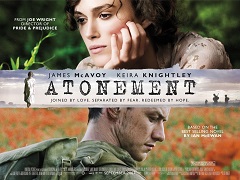
This movie is so sad. Yet, as I have a signed poster from Keira Knightley and James Mcavoy in Atonement hanging on my wall, I had to include this one. “I will return. I will find you. Love you. Marry you. And live without shame.”

All Austen fans can likely recognize this scene from Bridget Jones’s Diary. “No, I like you very much. Just as you are.”

I have not watched Shakespeare in Love in a VERY long time, but, perhaps, I should revisit it. “You will never age for me, nor fade, nor die.”

As I have gotten older, these words from On Golden Pond between Katherine Hepburn and Henry Fonda have taken on a more poignant response.  “Listen to me, mister. You’re my knight in shining armor. Don’t you forget it.” 

This quote from Forrest Gump speak of an undying love—a love that lasts beyond the grave. “I don’t know if we each have a destiny, or if we’re all just floating around accidental—like on a breeze—but I think maybe it’s both. Maybe both is happening at the same time. I miss you, Jenny. If there’s anything you need, I won’t be far away.”

This quote from The Wedding Date is a keeper. “I think I’d miss you even if we’d never met.”

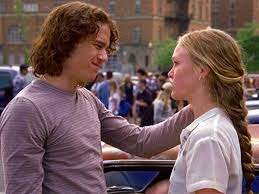
Taming of the Shrew is one of my favorite Shakespeare’s plays, so, naturally, I would adore a young Julia Stiles and Heath Ledger in the modern day roles of Catarina and Petruchio. I absolutely stop all I am doing to watch Heath singing “You’re Just to Good to Be True” with the marching band on the football field. Cracks me up every time. This is the poem Julia’s character Kat right before the end of 10 Things I Hate About You.

“I hate the way you talk to me and the way you cut your hair. I hate the way you drive my car. I hate the way you stare. I hate your big dumb combat boots and the way you read my mind. I hate you so much it makes me sic; it even makes me rhyme.

I hate it, I hate the way you’re always right. I hate it when you lie. I hate it when you make me laugh, even worse when you make me cry. I hate it when you’re not around, and the fact that you didn’t call.

But mostly I hate the way I don’t hate you. Not even close, not even a little bit, not even at all.”

From Sleepless in Seattle, we come across Tom Hanks’s description of falling in love with his first wife. The words make Meg Ryan’s character sigh, for she wants the same type of love. The description makes most women sigh. “It was a million tiny little things that, when you added them all up, they meant we were supposed to be together … and I knew it. I knew it the very first time I touched her. It was like coming home. .. only to no home I’d ever known … I was just taking her hand to help her out of a car and I knew. It was like … magic.”

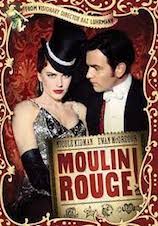
Moulin Rouge had its quirky moments, but the love story holds true. “The greatest thing you’ll ever learn is just to love, and be loved in return.”

Okay, I will admit it. I am a sucker for anything in which Robert Redford appears. Since his Butch Cassidy and the Sundance Kid, I have watched nearly everything in which he has a appeared. Although Up Close and Personal does not have the ending I would like, it has some great lines, such as:

Tally Atwater: Do you want to be with me?

Warren Justice: So much it hurts.

(and)

Tally: When I asked you how long you could stay and you said, ‘Long enough,’ how long is that? When we’re not together…

Warren: … Everything shuts down.

(and)

Warren Justice: Every day we have is one more than we deserve.

Any list of romance quotes must have something from Julia Roberts. I love Notting Hill. I have seen it often enough to repeat the lives along with the actors. “I’m also just a girl, standing in front of a boy, asking him to love her.”

Again, the movie does not need to start out as a romance to have romantic elements. Gone With the Wind has more tales than the romance between Rhett and Scarlet, most of them very serious issues, but I adore this line:  “You should be kissed and often, and by someone who knows how.”

Again, this quote comes from an nontraditional love story, City of Angels. “I would rather have had one breath of her hair, one kiss of her mouth, one touch of her hand, than eternity without it. One.”

As I create this list, I am beginning to think I adore tearjerker movies. The last scenes of the blockbuster Titanic gave us this line: “Winning that ticket, Rose, was the best thing that ever happened to me… it brought me to you.”

In Serendipity, it seems the whole universe is keeping Sara and Jonathan apart, but this quote says otherwise: “It’s like in that moment the whole universe existed just to bring us together.”

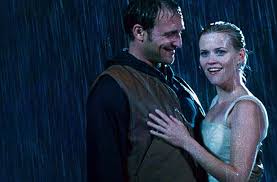
I must include something with a Southern twang. This quote from the end of Sweet Home Alabama will fill the slot perfectly. “You’re the first boy I ever kissed, Jake, and I want you to be the last.”

As is only fitting, I must end my list with a couple of Austen favorites. This first comes from Sense and Sensibility, part of Edward’s proposal to Eleanor. “I’ve come here with no expectations, only to profess, now that I am at liberty to do so, that my heart is, and always will be, yours.” 

And although the quote below is not found in Jane Austen’s Pride and Prejudice, it signifies how Mr. Darcy has come to love Elizabeth Bennet: You must know… surely, you must know it was all for you. You are too generous to trifle with me. I believe you spoke with my aunt last night, and it has taught me to hope as I’d scarcely allowed myself before. If your feelings are still what they were last April, tell me so at once. My affections and wishes have not changed, but one word from you will silence me forever. If, however, your feelings have changed, I will have to tell you: you have bewitched me, body and soul, and I love–I love–I love you. I never wish to be parted from you from this day on.

All right, dear readers. Hit me with some of your favorites. I would love to know which romance plots struck a chord with you. Which romances do you mean to watch for Valentine’s Day?

Posted in acting, contemporary romance, film, historical fiction, Jane Austen, love quotes, romance | Tagged , , , , , , , , | 4 Comments

Color My World With . . .

I received another question recently from a follower of this blog regarding the use of color in the Regency era. The question dealt with the idea of young women in the Regency making their society debuts in white gowns and then questioning how much “color” might be found in a Regency ballroom if such was true. She had just read a passage about the swirl of colors as the couples waltzed. Naturally, the young ladies making their come outs would not be waltzing until they received permission to do so by the patronesses of Almack’s Assembly Rooms or some other such plot twist. [For more on Almack’s check out Rachel Knowles’s piece HERE.]

In reality, the Regency era employed a variety of colors with (excuse the pun) very “colorful” names. Some of these colors were only around a social season or two. At this point, I might recommend Emily Hendrickson’s The Regency Reference Book, but as it is out of publication, I am not certain it is still available any where. However, she does offer a CD-ROM for $18.00 on her website. According to Ms Hendrickson, some colors were dictated by events of the day (i.e., battles won, which allies assisted in the cause, etc.)

A lovely source which is still available is Sarah Waldock’s post on her blog, Renaissance and Regency Ruminations. She provides a list of colors used across the Regency and the longer Georgian era, accompanied by swatches.

You can find the post here: 

http://sarahs-history-place.blogspot.com/2011/09/colours-used-in-regency-and-georgian.html

This color list was primarily prepared by Sarah, who also dyes fabrics using old techniques and formulas, augmented by information provided to her by Charles Bazalgette, who recently published a biography of his ancestor, Louis Bazalgette, entitled Prinny’s Taylor. It is important to keep in mind most of the colors on this list came primarily from colors used for garments and accessories, rather than interior decor. Which is not to say such colors were not used for interior design purposes, just that the sources of these color names are based upon garment colors.

The earliest reference I’ve found to navy blue is 1814. (from the OED). Navy blue might have been already in use at the time because the reference refers to a vat of dye.

Forest Green dates to 1810. Forest Green was used by Sir Walter Scott in reference to a color called “Lincoln green.”

Some of the names of colors used in house paint were very odd. 

Farrow and Ball (founded in 1946) used to have a sample cards for historic colors with names such as “dead salmon” and “mouseback”. If one is interested and requires inspiration for the correct color , they have archived paint colours HERE.

A person may also discover color names in the descriptions of fashion prints in the magazines. Some color terms, such as “mauve” date from after the Regency. Colors and fashion details were also named after events. A fashion color was “stone.” I never could quite decide if it were Bath stone, field stone, or  flagstone. Fruits and flowers were also often used. Navy blue, obviously, was the color of the British naval uniform. “Navy bean” attested from 1856, so called because they were grown to be used by the Navy. However, I do not know when the term became a color rather than a noun. Those are the type of things which can have an author pulling out his or her hair in frustration.

There were common Regency/Georgian terms for various hues within each color.

Greens for instance were:

Bottle green

Bronze Green

Corbeau coloured

Emerald green

Olive (green)

Parrot green

Pomona green

Rifle green

Saxon green

Spring (green)

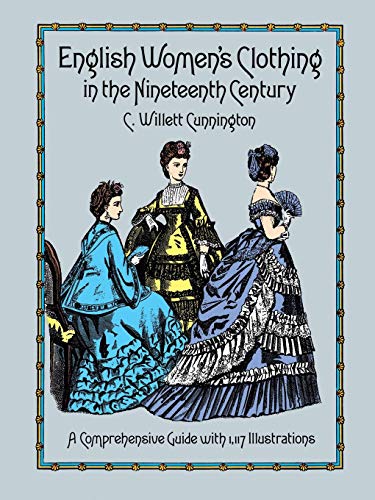
Another excellent source is C. Willett Cunnington’s English Women’s Clothing in the Nineteenth Century. There is a Glossary of Obsolete Colour Names on pages 439-440. The table provides the obsolete name and a date (the approximate year the term was first year) opposite a second column which provides the corresponding modern name in the Dictionary of Colours, issued by the British Colour Council.

Here are a few of my favorites.

Aurora (1809) – Chilli 98

Morone (1811) – Peony Red 37

Naccarat (1800) – Tangerine 55

Pomona (1811) – Sea Green 102

Spring Green (1810) – Cossack Green 105

Navarino Smoke (1828) – a shade lighter than London smoke

Pensee (1829) – a dark purple

Adelaide (1831) – Steel Blue 44

Clarence (1811) – Saxe 45.

Maria Louise (1812) – Calamine 167

Devonshire Brown (1812) – Mastic 167

Egyptian Brown (1809) – Mace 73

In the Regency period, there certainly are more colors for white/cream/shades thereof than for red/pink/orange.

It is a doorstopper of a book, but has hair styles, hats, prices on yardage, undergarments, pix and more! If you require assistance in knowing what was worn in a particular time period, this book is an excellent source.

Posted in British history, fashion, Georgian England, Georgian Era, history, Living in the Regency, real life tales, Regency era, research, writing | Tagged , , , , , , , , | Comments Off on Color My World With . . .

Cavalry Trumpet/Bugle Calls in the 18th and 19th Centuries

Recently, I had an author friend seeking information on cavalry trumpets calls, for she was writing a battle scene. The hero of her tale is in the mounted infantry, and he is on the American front during the War of 1812.. She wanted to know whether the troops would have some sort of trumpet signal for when to charge? When to retreat? Etc. Etc.

Truthfully, I cannot recall where I collected this information. Most likely, it came from Bill Haggart, a man I call upon when I need to know some sort of tidbit for writing a battle scene. The man is a walking encyclopedia on such facts.

Here are bits and pieces I shared with my author friend (in no particular order):

  • If the unit is militia, they might not have a bugler or might not have the training to follow bugle instructions.
  • The type of signal might be difficult to determine. For example, if there was a mixed unit of cavalry and mounted infantry, they most likely would not respond to the same bugle signals, for the mounted infantry, traditionally, did not carry out mounted charges.
  • With a hundred and fifty men, it could be a raised hand, the commander’s voice. French General Louis Friant, who fought in both the French Revolutionary Wars and the Napoleonic Wars, stated that 600 men for a battalion in close formation was optimal because that was the size where everyone could hear a command called out by the battalion chief.
  • It was also normal for every officer to repeat the order down the line once they heard it, just in case. [If you have ever read Arthur Guiterman’s poem “Pershing at the Front,” you will understand what I mean. If you have not, you may find it HERE. My late mother and I were often delighted by this one.]
  • Most cavalry charges required the unit to ‘shake out into a line’ before the charge, so everyone knew what was coming next so calling out ‘charge’ wasn’t all that problematical.  A single line of 150 horsemen would cover about 150 yards across. [1.5 football fields]  
  • More typical would be a double line of cavalry [particularly in wooded areas where there wasn’t 150 yards of open terrain] or about 75 yard front. [3/4 of a football field]
  • A human voice could carry that far, particularly if all officers repeated the order. Here is a video of 150 cavalrymen [two squadrons] of the French Republican Guard]. You will see them call out several orders in preparation for the charge, before they actually move.  Of course, American cavalry in the American Revolution would not have been that disciplined. Even so, but the time the French charge is at a full gallop, the lines are coming apart… seen from above at the end of the video.
  • Often seen in paintings is the officer pointing with his sword. That was a signal that every trooper down the line could see as it poked out from the line.
  • Here is the bugle call for sounding “Charge.” If you have ever watched an old Western movie, you likely have heard it. https://www.youtube.com/watch?v=VY58inWev0E  
  • One can find ALL the bugle calls customarily used by soldiers HERE. The musical notes are also displayed.
  • The mounted infantry developed into a “versatile cavalry” during this time period. Those using actual pensioners’ accounts when researching different battle, as well as in the battle summaries written by officers, will soon discover the terms “dragoons” and “cavalry” appear to be used indiscriminately, making it all the more confusing for the researcher.
  • One might take a look at p. 30 of the Trevor Herbert & Helen Barlow book, Music and the British Military in the Long Nineteenth Century, which reprints the bugle calls (in musical notes) given in Regulations for the Exercise of Rifleman and Light Infantry, 1798. See on Google books (the trumpet/bugle pages are free to look at). The authors cite several sources from the 18th and 19th centuries. They mention that bugle calls were not formalized however, until after my friend’s battle in question? 

Amazon Book Blurb:

Although military music was among the most widespread forms of music making during the nineteenth-century, it has been almost totally overlooked by music historians. Music & the British Military in the Long Nineteenth Century however, shows that military bands reached far beyond the official ceremonial duties they are often primarily associated with and had a significant impact on wider spheres of musical and cultural life.


Beginning with a discussion of the place of the military in civilian and social life, authors Trevor Herbert and Helen Barlow plot the story of military music from its sponsorship by military officers to its role as an expression of imperial force, which it took on by the end of the nineteenth century. Herbert and Barlow organize their study around three themes: the use of military status to extend musical patronage by the officer class; the influence of the military on the civilian music establishments; and an incremental movement towards central control of military music making by governments throughout the world. In so doing, they show that military music impacted everything from the configuration of the music profession in the major metropolitan centers, to the development of wind instruments throughout the century, to the emergence of organized amateur music making. A much needed addition to the scholarship on nineteenth century music, Music & the British Military in the Long
Nineteenth Century is an essential reference for music, cultural and military historians, the social history of music and nineteenth century studies.

Posted in British history, customs and tradiitons, Georgian England, Georgian Era, history, Napoleonic Wars, Regency era, research, war, War of 1812, weaponry | Tagged , , , , , , , , , , | Comments Off on Cavalry Trumpet/Bugle Calls in the 18th and 19th Centuries

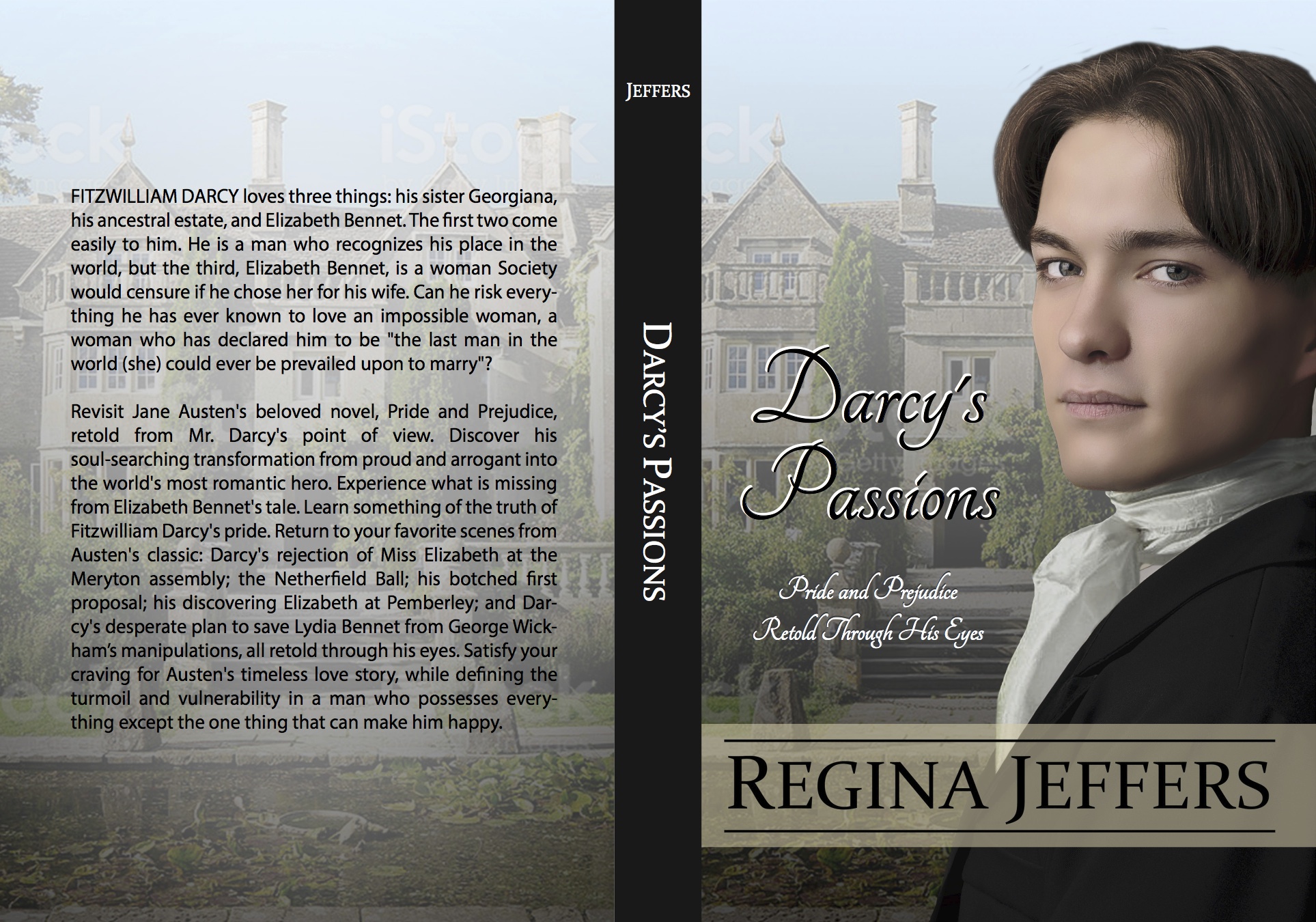
Happy 14th Book Birthday to “Darcy’s Passions,” the Book Which Made Me a “Fiction Author”

During the 2007-2008 school year, I complained to my Advanced Placement Language class about a particular novel I had been reading for “pleasure,” what we would now call Jane Austen Fan Fiction (JAFF), a genre just building in popularity for readers seeking a Happily Ever After (HEA) to end the tale. The story, although well written, was historically inaccurate in the situations presented. It was not a true reflection of Austen’s period. As the AP Language class was taught to examine the language and the situation to identify the time period of a piece of literature, this novel would be misleading. Many of the students in the class had been in my honors classes previously, or in my elective classes, such as Journalism. They were accustomed to how I challenged them, and so one student said, “If you know how to do this, do it yourself.” Therefore, I took on the role of fiction writer. I had written much in the academic realm, especially on multicultural literature and media literacy, but not novels. I decided to rewrite Jane Austen’s Pride and Prejudice from Mr. Darcy’s point of view.

To make a long story short, I self-published the book at a time when self-publishing was not a popular means to see one’s book in print. All I wanted at the time was to answer the challenge presented me . . . to be a good sport. I permitted one of my students to draw the cover of the book so she might put the experience upon her college application, listing herself as a “published artist.” I purchased copies for those in the class and quickly forgot about it until my son sent me an email informing me the book was #8 on the Amazon sales list. Even then, I considered it a fluke. At length, however, Ulysses Press contacted me asking about traditionally publishing the book. This was the time when several of the traditional publishers were buying up the rights to JAFF pieces. Ulysses had 3 other Austen-inspired writers, while Sourcebooks scooped up a dozen or more.

In February 2009, Darcy’s Passions was published by Ulysses Press, and my publishing career began. I retired from teaching in 2010, after some 40 years, and have supplemented my retirement with the publication of 60 novels to date. Yet, Darcy’s Passions remains a favorite for it started me down this path. Moreover, it remains my best seller, having entered into multiple printings. 

When Ulysses Press moved all their operations from fiction to nonfiction, I received my rights to all my stories (9 novels) with them. Therefore, I decided to rerelease Darcy’s Passions with a new cover and a reworking of the story (Gosh, I cannot believe neither the editor or I caught some of those errors found in the first printing!) So, please enjoy from Mr. Darcy’s point of view, the scene where Elizabeth Bennet comes to Netherfield to tend her sister.

__________________________________

Darcy’s Passions: Pride and Prejudice Retold Through His Eyes

FITZWILLIAM DARCY loves three things: his sister Georgiana, his ancestral estate, and Elizabeth Bennet. The first two come easily to him. He is a man who recognizes his place in the world, but the third, Elizabeth Bennet, is a woman Society would censure if he chose her for his wife. Can he risk everything he has ever known to love an impossible woman, a woman who has declared him to be “the last man in the world (she) could ever be prevailed upon to marry”?

Revisit Jane Austen’s beloved novel, Pride and Prejudice, retold from Mr. Darcy’s point of view. Discover his soul-searching transformation from proud and arrogant into the world’s most romantic hero. Experience what is missing from Elizabeth Bennet’s tale. Learn something of the truth of Fitzwilliam Darcy’s pride. Return to your favorite scenes from Austen’s classic: Darcy’s rejection of Miss Elizabeth at the Meryton assembly; the Netherfield Ball; his botched first proposal; his discovering Elizabeth at Pemberley; and Darcy’s desperate plan to save Lydia Bennet from George Wickham’s manipulations, all retold through his eyes. Satisfy your craving for Austen’s timeless love story, while defining the turmoil and vulnerability in a man who possesses everything except the one thing that can make him happy.

**************************

Chapter 3

“…to be really in love without encouragement . . .”

LITTLE DISTRACTED DARCY from his growing obsession with Miss Elizabeth except the opportunity to dine with the officers of the Derbyshire militia. Much to his friend’s dismay, his sisters chose to engage Miss Bennet to Netherfield on the same evening. Bingley had not enjoyed Jane Bennet’s company for several days, and the man’s countenance showed the irony of the situation. “That beautiful angel dines at my own table, while you and I have the duty of dining with the local militia.”

For Darcy’s part, being away from Elizabeth Bennet had solidified his resolve to ignore her and to squash any aspirations she might have. “It is only one evening, Bingley.” His response did little to allay his friend’s desire to cancel their engagement with the officers. After the meal, the smooth brandy and the interesting conversation entertained Darcy. His interest in military history served him well. However, a continual downpour dampened his spirits some, but not enough to ruin the evening, while the rain and the travesty of the situation dramatically increased Bingley’s discomposure.

Upon their return to Netherfield, they were met at the door by Miss Bingley. “That foolish chit rode a horse in the rain,” she declared with a snit. “She is down with the ague. I had no choice but to offer lodging for the night. The apothecary has come and gone. Miss Bennet has a fever.”

“Should we send to London for a physician?” Bingley paced the floor.

“The lady has a cold, Charles. Sending for a physician would be preposterous! I warrant Miss Bennet shall be better on the morrow.” The whole matter fatigued Caroline. Although not thoroughly content with the answer, Bingley did not press his sister further. Privately, he told Darcy that he would wait until the morning to assess whether Miss Bennet required more learned care.

Satisfied he could do nothing to relieve his friend’s tumult and seeing no other need for his service, Darcy retired to his rooms. Sitting before the mirror in his dressing room, he spoke aloud to the image he found there. “So, Miss Bennet is at Netherfield and ill. How convenient! I wonder who planned such an astute venture. Mrs. Bennet, naturally. She sent her daughter out in the rain to snag a husband. Can one imagine such a mother—such connections—poor Elizabeth?” As quickly as he said her name, a reverie of images claimed his senses. Every time he thought he rid himself of his desire to see and talk to Elizabeth Bennet, reminders resurfaced. She would never agree to such a clearly manipulated plot as this one, he mused. Should he warn Bingley? His friend had become more entangled each day. Could he permit Bingley to create an alliance with such a family?

Darcy undressed and prepared for bed. Leaning over to blow out the candle, another thought dawned. If Miss Bennet fell very ill, Elizabeth Bennet would likely come to Netherfield to care for her sister. Darcy groaned with the realization. Elizabeth would be in the house with him. He would be forced to spend time with her. Was his groan from pain or pleasure? He was not certain.

As if predicted by Fate, Jane Bennet’s fever worsened. In the morning the Bingleys dispatched a note to Longbourn to secure approval to send for a physician. Despite not agreeing with propriety, Bingley realized he had no right to order a physician for Jane Bennet. “Please, you must calm down, Bingley. Everything which can be done for Miss Bennet is being done,” Darcy cautioned.

“I am aware of my insensibility, Darcy, but I feel I should be doing more for her.”

“Please, Charles, you are doing your best for Miss Bennet. She will recover soon; you will see. Let us join your family in the morning room. Your sisters are concerned for your well-being also.”

Darcy’s words lessened Bingley’s anxiety, and Bingley allowed himself to be led to the morning room. Although the rainstorm had ended, and the land had dried, remnants of the downpour remained. Darcy knew they could not ride out, so he, too, remained in a state of disorder; a ride on Cerberus would do him well. Consequently, there they sat, partaking of the morning repast, making niceties, and each of them lost in his or her own thoughts. Bingley worried for Miss Bennet’s well-being; Caroline and Louisa wished to rid themselves of the duty of caring for someone they only pretended to admire; and Darcy needed to be free of the unexplained energy which thoughts of Elizabeth Bennet created in him.

Suddenly, the door swung wide, and a servant announced, “Miss Elizabeth Bennet,” and there she stood framed in the doorway. Her appearance had taken all of them by surprise. Mud steeped her petticoat, her hair was windswept, and her clothes, disheveled. The Bingley party sat in shock–-in momentary suspension-–at an unannounced visit so early. Both he and Bingley sprang to their feet to acknowledge the entrance of a lady. Mesmerized by her image, Darcy stood dumbfounded; in all his nightly musings, he had never envisioned Elizabeth to look as such; she was lovelier than ever.

Bingley, thankfully, had the good sense to leave the table to approach her. “Miss Elizabeth,” he began, “please, join us.”

She motioned his plea away. “I did not wish to disturb you, but your butler insisted I be presented before . . .”

“You have come to see your sister. I am so glad. Miss Bennet will benefit by having her loved ones close.”

Sarcastically, Caroline said, “Miss Elizabeth, did you walk here?”

“I did, Miss Bingley. I was worried for Jane,” Elizabeth reasoned.

“Three miles?” Louisa added incredulously.

Elizabeth smiled at their astonishment. “I believe so.” Then turning to Mr. Bingley she asked, “Would it be too much trouble for me to see Jane?”

“We will have someone show you to Miss Bennet’s room,” Bingley chimed in. “When you are able, please advise us on her condition; our apprehension grows. If Miss Bennet requires anything, we are your servants.” Bingley turned to the footman and indicated for him to escort Miss Elizabeth to her sister. During this exchange, Darcy did not move. He possessed yet another image of Elizabeth Bennet, which he would add to his mental gallery of her. A thrill of anticipation skittered up his spine. 

When Miss Elizabeth was safely from earshot, Caroline could not contain her distaste for the lady’s display. “Did you ever?” she began, but Darcy cut her short by removing her immediate audience.

“Bingley, it appears we will be unable to ride out today to examine your holdings, but we may address expenses for the renovations you have considered.” Bingley looked relieved at the possibility. They removed quickly to Bingley’s study.

“Darcy, would it be inappropriate to bring a physician from London to attend to Miss Bennet?” Bingley asked when they were from earshot.

“It would be a break in propriety,” Darcy responded. “May I suggest if Miss Bennet’s progress is delayed, her sister should also be given accommodations so she may attend to the lady. From what I have observed of Miss Elizabeth, she is very sensible. She would never allow decorum to stand in the way of her sister’s health; Miss Elizabeth would ask, mayhap demand, you do more if need be.”

“Naturally, why did I not think of such? When Miss Elizabeth joins us later, I will ask her to stay. Your good counsel never fails me, Darcy.”

As Darcy turned to the plans for Netherfield, he wondered if he had erred in favor of insensibility.

***

At three in the afternoon, Elizabeth entered the sitting room; she had attended Miss Bennet all day, with the occasional assistance of the ladies of the house. The apothecary declared Miss Bennet to have a violent cold and requiring additional care. “I must depart,” she said tentatively. “Evening approaches, and I must be to Longbourn.”

“Allow me to offer you the use of my coach,” Caroline declared in tones that sounded too sweet.

“I thank you for the consideration,” Elizabeth said.

Bingley hesitated, but Darcy nodded his encouragement. “I will not hear of it, Miss Elizabeth. You must stay and tend your sister,” his friend declared. “I insist. Miss Bennet will recover much faster if you are in attendance.”

“Mr. Bingley,” Elizabeth gushed with gratitude. “Your kindness is most appreciated. I do desire to stay with Jane if your offer is sincere.”

“Then it is settled,” Bingley added quickly. “We will send a servant to Longbourn to acquaint your family with our plan and to bring back clothes for your stay.”

“I am in your debt, Mr. Bingley.” Elizabeth curtsied and happily returned to her sister’s room. This satisfied Bingley, but if his friend had taken note of his sister’s face, Bingley would have seen displeasure. Caroline had made it no secret she wanted the Bennet family removed from Netherfield. She recognized her brother’s interest in Miss Bennet. Darcy suspected the woman also recognized his growing interest in Elizabeth Bennet.

Having been summoned to supper, it was half past six before Elizabeth rejoined the party. “I am afraid, Mr. Bingley, I cannot give you a favorable response to your inquiry. My sister shows no improvement.”

Although she quickly returned to the needlework she held, Caroline intoned, “That is dreadful to hear, Miss Elizabeth.”

During supper Darcy hoped for an opportunity to speak with Elizabeth, but Caroline strategically placed Miss Elizabeth beside Mr. Hurst. Darcy made conversation with Caroline. He split his attention, however, hoping for gems of Elizabeth’s conversation, which he could use later.

She returned to her sister’s care after the meal, and Miss Bingley immediately abused her. “Miss Elizabeth’s manners, I find, are lacking indeed; they are a mix of pride and impertinence. Did you notice, Louisa, she cannot hold a civil conversation; she has no style, no taste, and no beauty of which to speak. Country ideas of such appealing qualities must be far below those of refined societies.” Darcy wondered at how little he knew of Miss Bingley. He once found her to be dignified, but her “luster,” of late, had dulled.

Louisa Hurst joined in her sister’s aspersions. “Elizabeth Bennet has nothing, in short, to recommend her but being an excellent walker. I shall never forget her appearance this morning. She really looked almost wild.”

Caroline cackled, “She did, indeed. I could hardly keep my countenance. Very nonsensical to come at all! Why must she be scampering about the country because her sister had a cold? Her hair so untidy, so blowzy!”

“Yes, and her petticoat. I hope you noted her petticoat, six inches deep in mud!”

Bingley came to Elizabeth’s defense. “I thought Miss Elizabeth looked remarkably well when she came into the room this morning. Her dirty petticoat quite escaped my notice.” Bless him, thought Darcy. Mayhap he will one day be able to handle Caroline.

Caroline turned to Darcy. “You observed it, Mr. Darcy, I am certain, and I am inclined to think you would not wish to see your sister make such an exhibition. To walk three miles or whatever it is, above her ankles in dirt and quite alone—what can she mean by it? It seems to me to show an abominable sort of conceited independence, a most country-town indifference to decorum.”

Caroline’s references to the boorish behavior of the locals wore on Darcy’s patience. “Her sister was ill. It shows an affection that is very pleasing.”

“Mr. Darcy, you must agree, however, this adventure has rather affected your admiration of her fine eyes.” Caroline’s voice displayed her desperation.

“Again you are mistaken, Miss Bingley. I found them brightened by the exercise.”

Darcy hoped his comment would stifle Miss Bingley’s criticism of Elizabeth, but she ignored his censorious tone. “Did you know, Louisa, the Bennet family has an uncle who is a country attorney and an uncle who owns a warehouse in Cheapside?” 

“I do not understand all this emphasis on material wealth when one judges a person’s merit; even if the Bennets had enough uncles to fill all of Cheapside, I would not think less of the family.”

Bingley felt the need to defend his preference for Jane Bennet, and in many ways Darcy sympathized with his friend, but the truth remained unchanged. “Unfortunately, Bingley, other people will judge differently. It must very materially lessen their chance of marrying men of any consideration in the world.” He hated to acknowledge the facts. Men of fine Society would not consider the Bennet sisters as probable mates, and although he found Elizabeth Bennet to be more than desirable, he knew he could not marry her.

Darcy’s speech had given the Bingley sisters permission to continue their condemnation of the Bennet family’s vulgar relations. Bingley, on the other hand, had no response. Darcy, too, could not shake the uneasiness he felt each time Caroline mentioned Elizabeth in a negative light. Eventually, the sisters ceased their humorous attack and removed to Miss Bennet’s room to offer their concerned advice. It was late in the evening before Elizabeth rejoined the Bingley household. The party sat at loo when she returned; Darcy anxiously observed her again.

After the Bingley sisters’ attacks, he spent several hours in quiet contemplation. During the day he had decided he once more wished for Elizabeth’s company. Moreover, he reasoned having her at Netherfield would provide him time to know more of Elizabeth Bennet. Darcy looked forward to engaging her in a verbal battle. She would view him differently; she would increase her regard. That idea played to Darcy’s sense of pride. What woman would not desire his attention? No one Darcy met previously had refused his consideration.

DP Cover Concept copy.jpg

Amazon https://www.amazon.com/Darcys-Passions-Prejudice-Retold-Through/dp/1544677057/ref=sr_1_5?ie=UTF8&qid=1492107629&sr=8-5&keywords=darcy%27s+passions

Kindle https://www.amazon.com/dp/B06ZY33384/ref=sr_1_5?ie=UTF8&qid=1492173037&sr=8-5&keywords=DARCY%27S+PASSIONS

Kobo https://www.kobo.com/us/en/ebook/darcy-s-passions-1

Nook http://www.barnesandnoble.com/w/darcys-passions-regina-jeffers/1014948929?ean=2940148227243

Book Bub https://www.bookbub.com/books/darcy-s-passions-pride-and-prejudice-retold-through-his-eyes-by-regina-jeffers-and-a-lady

Posted in Always Austen, Austen Authors, book excerpts, book release, books, eBooks, Georgian England, Georgian Era, historical fiction, Jane Austen, marriage, Pride and Prejudice, publishing, reading, reading habits, real life tales, Regency era, Regency romance, romance, Ulysses Press, Vagary, writing | Tagged , , , , , , , , , , , , , | 33 Comments

History of Shifts, Chemises, and Corsets Through the Regency Era

To protect their outer wear (gowns, day dresses, etc.) from sweat and body oils, women of the Regency era wore shifts or chemises. These were simple garments, much like a man of today might wear an undershirt to protect his dress shirt or a woman might wear a “teddy” to protect her blouse. Chemises and shifts were made of cotton, but women who could afford the cost would choose something more luxurious – something like silk. Thin and tightly woven, the shift was smooth to the touch. This type of cotton actually cost more than silk did. These cotton shifts lasted longer than did the silk ones. There is some speculation that part of the duties of a lady’s maid was to make certain the shift did not bunch up.

The chemise became popular in Europe in the Middle Ages. Women wore shifts/chemises under their gowns, while men wore them with their trousers or braies to be covered with doublets, robes, etc. A chemise was the only underwear worn by women by the end of the Regency Period. Although women did not wash their outer garments after each use, they did wash the shifts/chemises regularly. Washing was harsh on the clothing. Shifts and chemises were dried in the sun so that the sun would bleach the fabric, but those dyed had a tendency to fade. Those in charge of the laundry would hang the dyed garments in the shade after they turned the item inside out to help prevent fading. 

“Men’s chemises may be said to have survived as the common T-shirt, which still serves as an undergarment. The chemise also morphed into the smock-frock, a garment worn by English laborers until the early 20th century. Its loose cut and wide sleeves were well adapted to heavy labor. The name smock is nowadays still used for military combat jackets in the UK, whereas in the Belgian army the term has been corrupted to smoke-vest.

“A chemise, shift, or smock was usually sewn at home, by the women of a household. It was assembled from rectangles and triangles cut from one piece of cloth so as to leave no waste. The poor would wear skimpy chemises pieced from a narrow piece of rough cloth; while the rich might have voluminous chemises pieced from thin, smooth fine linen.” (Chemise)

That being said, during the winter, the Victorians were known to wear flannel or wool pantalets, under petticoats and stockings but the chemise remained cotton. 

Cloth was measured in ells. “An ell (from Old Germanic *alinâ cognate with Latin ulna) is a unit of measurement, originally a cubit, i.e., approximating the length of a man’s arm from the elbow (“elbow” means the bend or bow of the ell or arm) to the tip of the middle finger, or about 18 inches (457 mm); in later usage, any of several longer units. In English-speaking countries, these included (until the 19th century) the Flemish ell (34 of a yard), English ell (54 yard) and French ell (64 yard), some of which are thought to derive from a “double ell”. Several national forms existed, with different lengths, including the Scottish ell (≈37 inches or 94 centimetres), the Flemish ell [el] (≈27 in or 68.6 cm), the French ell [aune](≈54 in or 137.2 cm) the Polish ell (≈31 in or 78.7 cm), the Danish ell (≈25 in or 63.5 cm), the Swedish aln (2 Swedish fot ≈59 cm) and the German ell [elle] (Hamburg, Frankfurt, Cologne, Leipzig: 57,9 cm)

“Select customs were observed by English importers of Dutch textiles: although all cloths were bought by the Flemish ell, linen was sold by the English ell, but tapestry was sold by the Flemish ell. In England, the ell was usually 45 in (1.143 m), or a yard and a quarter. It was mainly used in the tailoring business but is now obsolete. Although the exact length was never defined in English law, standards were kept; the brass ell examined at the Exchequer by Graham in the 1740s had been in use ‘since the time of Queen Elizabeth.'” (Ell)

By the mid 1850s, dresses had 7-9 yards of material, and so it became common practice to disassemble the dress – bodice from skirt, sleeves from bodice – easier to wash & quicker to dry. Afterward, the pieces were reassembled. 

kbarock

1660s stays with sleeves http://www.marquise. de/en/themes/korsett/ korsett.shtml

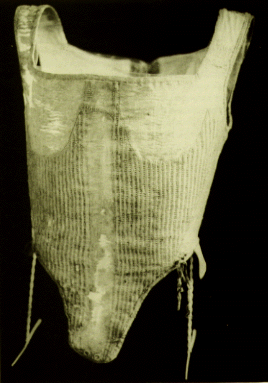
The word corset did not come into use until the 19th Century. Before that time, people used the words bodice or stays. In French 18th century texts (e.g. Garsault, Diderot), one may find the term corset as referring to a lightly stiffened bodice with tie-on sleeves, whereas proper stays are called corps. Until the 17th Century, the custom was to stiffen the bodice of the dress rather than to have a separate corset. 

“The first and best known example of a 16th century corset is the German pair of bodies buried with Pfaltzgrafin Dorothea Sabine von Neuberg in 1598. This corset is shown in detail on page 47 and 112-113 of Janet Arnold’s Patterns of Fashion 1560-1620 and in Jutta Zander-Seidel’s book Textiler Hausrat. It is made of three layers of cream-colored fabric, the outer layer being silk backed with linen and the inner lining of linen, and has channels backstitched between the two layers into which whalebone was inserted. It has tabs at the waist, as well as small eyelets at the waistline through which the farthingale (stiffened hoop skirt) or petticoat could be fastened to the corset.” (History of the Corset)

jd47

Costume Parisians, 1808-9, “Hair in braids, Corset a la Ninon.” This corset laces in back is and much more “structural,” clearly attempting to increase the bust and draw in the waist. Unlike Victorian corsets, this one doesn’t seem focused on drawing in the natural waist, an unnecessary feature when fashions have the waist under the bust. Notice that no effort is made to move the breasts together–the two breasts very separated was fashionable. Later corsets that even more clearly divide the breasts were called “divorce corsets.” The Underwear Page http://regencyfashion. org/dress/und.html

The Robe á l’Allemand, a the stiff bodice, survived until about 1730 in England. Stays are conical in shape, and they press “the breast up and together, with tabs over the hips. The tabs are formed by cuts from the lower edge up to the waistline that spread when the stays are worn, giving the hips room. They prevent the waistband of the skirt from crawling under the stays, and the waistline of the stays from digging into the flesh.

“There are stays that lace at the back (Diderot calls them corps fermé, closed stays) and those that lace across a stiff stomacher in front (corps ouvert, or open stays). Examples that lace both back and front (but not over a stomacher) are quite rare. Stays that lace in front only are even rarer and so far only known to me from the region of Southern Germany. In all these cases, spiral lacing is used. Although 18th century stays were not meant to be seen, they are often quite decorative, with finely stitched tunnels for the boning, precious silk brocade and possibly gold trim. 

“The basic shape of stays didn’t change the whole century long. Towards the end, around 1790, when dress waists begin to wander upwards, the stays become slightly shorter. Since paniers were not worn anymore, the skirt is supported by small pads sewn to the tabs. At the same time, physicians made themselves heard, warning against the harm done by tight-lacing. While lacing wasn’t usually overdone as much as one century later, it often started earlier: It started with tightly wrapping babies and included children’s corsets, forcing the still soft skeleton into a fashionable shape.” (A Short History of the Corset)

As the 19th Century turned, the corset changed somewhat to match the empire line of the gowns worn by the fashionable set.Frankly, clothes were not so form fitting as in previous decades. The newer style allowed for a woman’s gaining weight or for her pregnancy. Therefore, it was no longer necessary to define the waistline, but it was still in fashion to lift the breasts higher (but with a definite separation). Cups were used for the first time as part of the stays/corsets. The busk, which was used in the early 17th Century to keep the front of the stays straight, returned to keep the cups separated. 

“Since slender figures could keep the bust in shape with the help of only a firm bodice lining, it is mainly stout and over-endowed ones who wear corsets or short stays which already looked like early bras. Therefore, not many corsets from that time have been preserved. Unlike the earlier ones, they tend to be plain and functional. Maybe the fact that they contained less boning led people to refer to them by the (French) term for lightly boned bodices, corset. This is just a theory, but it would explain why the earlier term corps/stays had been replaced with corset by the 1820s.” (A Short History of the Corset)

In the late 1820s, the fashion again accentuated the waist; therefore a need for a corset returned. Stitched in grommets for laced eyelets on corsets were replaced by hammered-in metal eyelets in the late 1820s. This was followed by the planchet, which is two metal strips that are designed to hook together so the woman could open the corset from the front without unlacing it. “This busk, as it is called in English, makes it possible to change the lacing completely: Both ends of the cord are threaded through the eyelets crosswise and knotted together at the end. At waist level, one loop is formed on either side and used to pull the lacing tight. This kind of lacing is still used today.” (A Short History of the Corset)

The hourglass figure we think of when corsets are the subject became more prominent by the mid 1800s. “From about 1860, when some patterns have caught on, more emphasis is placed on beautiful fabrics and elegant lines again. From the years around 1870-90, a large number of meticulously made corsets has been preserved, partially embroidered and with satin top fabric in various of colours.

Until c. 1870, the crinoline hid anything from the waist down, so corsets ended not much below the waist. Later, dresses closely hug the figure at least in front, so corsets become longer. This development reached a peak around 1880, when the fashionable silhouette hugged the hips on all sides. The belly is tamed, but not flattened, by a new kind of busk: The pear-shaped spoon busk (see right corset in the picture above) bends inwards to compress the stomach region, then outwards over the belly, an in again over the lower abdomen. If laced tightly, a spoon busk forces the soft bits (i.e. fat as well as inner organs) downwards – and during the 1890s, tight-lacing becomes so popular that physicians sound the alarm again.” (A Short History of the Corset)

Women did not want the stays cutting into the skin. In cool weather, the chemise and stays were additional layers to keep the female warm. With layers of natural fibers, shifts repel the perspiration, called “glistening” at the time. 

Posted in British history, fashion, Georgian England, Georgian Era, Great Britain, Living in the Regency, Victorian era | Tagged , , , , , , , | 2 Comments

Button, Button, Who’s Got the Button?

For the holidays, I received a copy of the book pictured below, and it had me thinking about the use of buttons in the Regency era.

Amazon describes this book, thusly: The button, both functional and decorative, can be deservingly considered an art form on a small scale. This book is a dazzling color array of outstanding examples. Thousands of buttons are featured in over 300 color plates. Debra Wisniewski, an avid collector, has chosen the most beautiful and fascinating buttons to represent the vast variety available. They are displayed in this gorgeous hardcover book which provides invaluable information to the collector – complete descriptions, dates, and of course, current values. The realistic price ranges given reflect actual prices paid and considerable discussion with other collectors. All ages, styles and materials are represented in this fascinating reference and value guide. It’s a perfect book for anyone who appreciates the art, craft, beauty, and skill apparent in these buttons. 

Okay, I admit I was telling someone about a book I had consulted previously about buttons in Regency era. I did not expect the person to send me the book pictured above. I was simply attempting to answer a question and could not recall the book written about a history of buttons. Although the one above is fabulous with its many examples, it is not the one I came across years ago.

Buttons, at least, multiple buttons on a garment was more a Victorian decoration, and it was late Victorian. In fact, there were few buttons on a woman’s clothes until the late Victorian period. That being said, women’s dresses did have some buttons, but nothing like those used for men’s coats. Men, however, had buttons on their breeches, pantaloons, trousers, waistcoats, and coats. They had them on the sleeves of their coats as well. Women’s clothes mostly tied on or used straight pins. Women were not supposed to be so active that they needed someway to keep clothes on when working. The women who worked had clothes that were sturdy and wrapped, tied, and laced.Buttons during the Regency were expensive and were on a woman’s dress as a decorative accent, rather than to hold two pieces of material together.

The History of Buttons tells us, “The Indus Valley Civilisation are credited with the invention of the button and the earliest one we have in existence today dates from around 2000 BCE and is made from a curved shell. The first buttons were used as ornamental embellishments to a person’s attire and signified wealth or status. They had small holes drilled into their surfaces and were attached to clothing by thread, often forming geometric patterns rather than the straight lines we know today. As the centuries progressed, the button became used more and more as a fastener for clothes, with the ancient Romans using them to fix clothing in place with pins. Over the centuries, the button evolved from an embellishment, to a more practical item. The middle ages brought with them the invention of the all-important buttonhole, which was to quietly revolutionise clothing. A stunningly-simple but elegant design, the geometrics allowed for the button to pass through the opening and be slotted firmly in place.  Fashion would never be the same again.”

Some illustrations for the time period show a garment with small buttons at the nape of the neck in women’s clothes or at the small of the back. Some replaced pins on an apron-like front with small buttons. A spencer or pelisse would probably have buttons.

A man’s shirt might have two buttons. Men’s shirts did NOT open all the way down the front. I came across this issue when I decided on a particular image for one of my new books. The guy was fabulous, but he had a buttoned down collar. Not possible in the Regency era!!! Which meant I had to move the story forward into the late Georgian and early Victorian period to come close to the style, for Button-down collars, or “sport collars,” have points fastened down by buttons on the front of the shirt. They were introduced by Brooks Brothers in the late 1800s. In the first book cover, one can still see the buttoned-down collar, but I am hoping most romance readers are looking at the male model instead. When I finally release this title by itself (It is now part of an anthology), I will revisit the issue then.

Drawstrings, hooks and eyes, and thread buttons were commonly used. A woman’s dress might be fastened with pins as well. 

Look at fashion pictures for half a century and you will not see many buttons. There are some, but not many. They tended to be more for decoration than have any utility purposes. Some years they were more fashionable than others.

Thread buttons are also called “Dorset buttons.” They were something of a cottage industry. The thread is wrapped around a thin ring of sheep’s horn. (Nothing wasted!) These weren’t expensive and were used for things like shirts and nightgowns. You can find out more on How to Make Dorset Buttons.

Another Resource:

A Brief History of Buttons Through the Ages

Posted in Uncategorized | 7 Comments