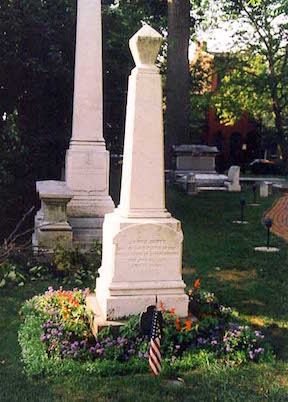
Though born in Boston, William Hooper represented North Carolina at the assembly for writing of the Declaration of Independence. He was a 34 years of age at the time and was a lawyer. Father of three children, Hooper died at the young age of 48 in 1790.
William Hooper, one of North Carolina’s three signers of the Declaration of Independence, was the oldest of five children of the Scots divine, the Reverend William Hooper (1704–14 Apr. 1767), second rector of Trinity Episcopal Church, Boston, Mass., and Mary Dennie Hooper (b. ca. 1720), daughter of Boston merchant John Dennie. He was the grandson of Robert and Mary Jaffray Hooper of the Parish of Ednam, near Kelso, Scotland. An unusually delicate, nervous child, until the age of seven, William was at first painstakingly taught at home by his father, himself a classicist and orator of some note, educated at the University of Edinburgh. At length, the boy was sent to the Boston Public Latin School where he worked so hard under headmaster John Lovell, a celebrated disciplinarian and staunch Loyalist, that at age fifteen Hooper entered the sophomore class of Harvard College on 7 Oct. 1757. He was graduated A.B. in 1760 with marked distinction in oratory, surpassing, it is said, even his father in that field.
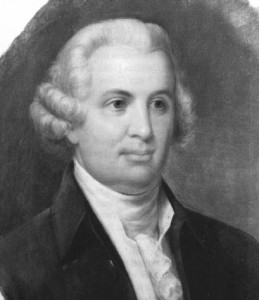 Mr. Hooper had destined his son for the ministerial office. But young William’s inclination turned instead towards the law. Once he obtained his father’s consent to pursue the studies of that profession, in 1761, William began his tenure in the office of the celebrated James Otis, a man famed for his knowledge of common, civil, and admiralty law. Various Hooper biographers have stated that Otis’s fiery stands for colonial rights indoctrinated the young Hooper.
In 1763 Harvard College conferred an M.A. on Hooper, and in 1764 he settled temporarily in Wilmington, North Carolina, to begin the practice of law. Hooper, who was handsome, well-bred and well-educated, with courtly manners and a pleasing personality, was warmly accepted by the planters and lawyers of the lower Cape Fear. By June 1766 he was unanimously elected recorder of the borough. Yet, after spending a year or two in that province, his father became exceedingly desirous that young William should return home. The health of his son had greatly suffered, in consequence of an excessive application to the duties of his profession. He was seriously considering leaving New Hanover County when his father died without warning. William’s education was to be his chief inheritance, although his father’s will also left to him “all my Books and Manuscripts,” a legacy that he treasured.
Notwithstanding the wishes of his father, in regard to his favorite son, the latter, at length, in the autumn of 1767, fixed his residence permanently in North Carolina. On 16 Aug. 1767, Hooper married Anne Clark, of New Hanover, the daughter of Barbara Murray and Thomas Clark, Sr., late high sheriff of New Hanover County.
He early enjoyed the confidence of his fellow citizens, and was highly respected by his brethren at the bar, among whom he occupied an enviable rank. In the year 1773, he was appointed to represent the town of Wilmington in the general assembly. In the following year, he was called upon to assist in opposing a most tyrannical act of the British government, in respect to the laws regulating the courts of justice in the province.
In 1769 he was appointed deputy attorney general of the Salisbury District and inevitably ran afoul of the Regulators, incurring their lasting enmity. The Regulator Movement (or the War of Regulation) grew steadily during the 1760s. Simple North Carolina settlers became more outspoken against what they called corruption, excessive fees, and taxation by the ruling class and their “henchmen,” usually in the form of sheriffs and the courts. The Regulators saw Hooper as part of the problem, after all, Hooper was a young attorney general. A 1768 incident in Anson County was followed by another at the Hillsborough riots of September 1770, when Hooper reportedly was dragged through the streets by the Regulators. The experience caused Hooper to look upon the masses as would an “aristocrat.” He was against mob rule and of democracy, in general, for the remainder of his days.
Even so, Hooper wrote letters supporting the American cause. In a letter to his friend James Iredell, Hooper wrote how the colonies “are striding fast to independence, and will, ere long, build an empire upon the ruins of Great Britain – will adopt its constitution, purged of its impurities; and from an experience of its defects, will guard against those evils which have wasted its vigor and brought it to an untimely end.” From this embolden speech, Hooper was dubbed the “prophet of independence.”
When it was necessary to update the laws of North Carolina, the advocates of the British government took occasion to introduce a clause into the bill, which was intended to exempt from attachment all species of property in North Carolina, which belonged to non-residents. “This bill having passed the senate and approved of by the governor, was sent to the house of representatives, where it met with opposition. In this opposition Mr. Hooper took the lead. In strong and animated language, he set forth the injustice of this part of the bill, and remonstrated against its passage by the house. In consequence of the measures which were pursued by the respective houses composing the general assembly, the province was left for more than a year without a single court of law. Personally to Mr. Hooper, the issue of this business was highly injurious, since he was thus deprived of the practice of his profession, upon which he depended for his support. Conscious, however, of having discharged his duty, he bowed in submission to the pecuniary sacrifices to which he was thus called, preferring honorable poverty to the greatest pecuniary acquisitions, if the latter must he made at the expense of principle.” (GENi)
His formal entry into political life came on 25 Jan. 1773, when he sat for the first time in the Provincial Assembly as representative for the Scots settlement of Campbellton (later Fayetteville.) In the same year, Hooper made the first purchase of land for his future home on Masonboro Sound eight miles below Wilmington—108 acres of Caleb Grainger’s old Masonborough Plantation. In 1774 he bought 30 adjoining acres on which he built his house, Finian. His three children – William (b. 1768), Elizabeth (“Betsy”) (b. 1770), and Thomas (b. ca. 1772) – were born there.
On the twenty-fifth of August, 1774, Mr. Hooper was elected a delegate to the general congress, to be held at Philadelphia. In the following year, Mr. Hooper was again appointed a delegate to serve in the Second General Congress, during whose session he was selected as the chairman of a committee appointed to report an address to the inhabitants of Jamaica. The draught was the production of his pen. It was characterized for great boldness, and was eminently adapted to produce a strong impression upon the people for whom it was designed.
During the Revolution, Hooper’s brothers Thomas and George were wealthy merchants in both Wilmington, North Carolina, and Charleston, South Carolina. Thomas became suspect as a British merchant and some of his goods were seized by Patriot committees. The brothers were labeled as Tories, with the confiscation of some of their properties. It is hard to imagine the concern this might have given Hooper. With the ratification of the Definitive Treaty in 1786-87, Thomas and his brother George were free from the threat of banishment and their property was restored to them.
In Philadelphia, Hooper served on Hewes’ marine committee with Benjamin Franklin on the highly important committee of secret intelligence which had broad powers to hire secret agents abroad, make agreements, and even to conceal information from the Congress itself. Before the close of 1776 Hooper had attended three Continental Congresses, five Provincial Congresses and Four Provincial Assemblies besides meetings of the Wilmington Committee of Safety. Almost invariably he was made chairman or member of any committee with important resolutions or addresses to compose, and some of the most significant statements of the Revolution crystalizing public opinion came from his pen. Although Hooper was absent when independence was actually voted and declared on 4 July 1776, he, like most of the other delegates, affixed his name to the amended Declaration on 2 August.
In January, 1776, Mr. Hooper was appointed, with Dr. Franklin and Mr. Livingston, a committee to report to congress a proper method of honoring the memory of General Montgomery, who had then recently fallen beneath the walls of Quebec. This committee, in their report, recommended the erection of a monument, which, while it expressed the respect and affection of the colonies, might record, for the benefit of future ages, the patriotic zeal and fidelity, enterprise and perseverance of the hero, whose memory the monument was designed to celebrate. In compliance with the recommendation of this committee, a monument was afterwards erected by congress in the city of New York.
In the spring, 1776, the private business of Mr. Hooper so greatly required his attention in North Carolina, that he did not attend upon the sitting of Congress. He returned, however, in season to share in the honor of passing and publishing to the world the immortal Declaration Of Independence.
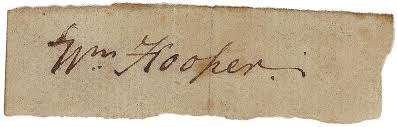 Early in 1777, Hooper and numerous other delegates were stricken with yellow fever. On 4 February he secured permission to return to Wilmington to attend the General Assembly on 8 April, and on 29 April he formally resigned his seat in the U. S. Congress. “The situation of my own private affairs . . . did not leave me a moment in suspense whether I should decline the honour intended me,” he wrote to Robert Morris.
Hooper resumed his residence at Finian and his law practice in the newly opened courts, again riding the circuits with his friend Iredell as he had done before the Revolution. He attended the General Assembly of 1777, 1778, 1779, 1780, and 1781 as member for the borough of Wilmington, serving on numerous committees. When it appeared that Finian would not be safe from British men-of-war in Masonboro Sound (a house owned by Hooper three miles below Wilmington was burned and Finian was shelled), Hooper moved his family into the town. He himself, at times seriously ill with malaria and his right arm badly swollen, became a fugitive from the British, going from friend’s house to friend’s house in the Windsor-Edenton area.
On 29 January 1781, Major James H. Craig’s men took Wilmington, although the town was not evacuated until November. Then, an ailing Mrs. Hooper and two of her children were forced to flee by wagon to Hillsborough where her brother, General Clark, found shelter for them. Finally, on 10 April 1782, the reunited Hoopers purchased General Francis Nash’s former home on West Tryon Street (still standing and in 1972 named a National Historic Landmark). Hooper’s preserved Memorandum Book, 1780–1783 provides valuable records of this period.
With his permanent removal to the backcountry, Hooper was now entirely out of the mainstream of current events, both state and national. His election to the 1782 General Assembly as member for Wilmington was declared invalid, and in 1783 he suffered the first political loss of his career at the hands of Hillsborough tavern keeper Thomas Farmer, who defeated him for a seat in the General Assembly. One absorbing new interest developed, however. Some years before, in 1778, Hooper had been named first on a committee of nine prominent men to begin an academy, “Science Hall,” in the vicinity of Hillsborough. The school had made a brave start on Colonel Thomas Hart’s Hartford Plantation, but it had been swept aside by Revolutionary activity. Now, Hooper pushed a new academy bill through the 1784 Assembly, to which he was elected, and almost single-handedly began a second venture, a new “Hillsborough Academy,” which prospered for a few years. Unfortunately, the November 1786 Assembly at Fayetteville, the last that he attended, tabled a bill to raise funds for the school and thereby ensured its demise.
Hooper’s law practice was still a considerable one, owing to steady litigation concerning Loyalists’ estates, confiscated lands, treason, and all the legal backwash of the Revolution. Like Iredell and other conservative men, Hooper lamented unreasonable severity and vengefulness against Loyalists and absentees and urged moderation in their treatment. In consequence, he found himself at painful odds with some of his old friends and acquaintances. On 22 Sept. 1786 Hooper was appointed by Congress as one of the Judges of a Federal Court formed for the purpose of settling a Massachusetts, New York territorial dispute, but the matter was resolved locally and the court never met.
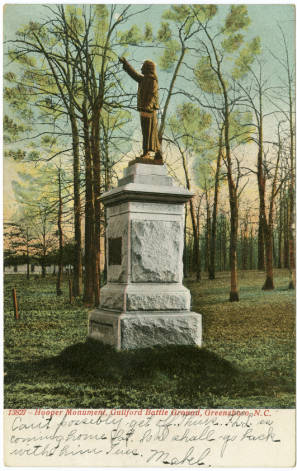 William Hooper died after five months of complications associated with his previous health problems. The date of his death, 4 October 1790, was the day before the planned marriage of his daughter, Elizabeth. He was buried in a corner of his garden in Hillsborough, North Carolina. The brick-walled plot was later incorporated into the adjoining Old Town Cemetery on 25 April 1894. That same year the grave was opened at dawn before various family representatives, and a few discernible relics, together with the sandstone slab, were sent to the Guilford Courthouse National Military Park in Greensboro. There, an imposing 19 foot high monument, surmounted by a statue of Hooper in colonial dress and in orator’s pose, honors the patriotic services of William Hooper and his friend and colleague, John Penn. The sandstone slab, with six additional words deeply incised, ” Signer of the Declaration of Independence,” was later returned to the original Hillsborough grave site. The monument to the three signers was erected over the new graves of Hooper, Penn, and Hewes and was dedicated on July 3, 1897.
Sources:
Blatteau, John and Paul Hirshorn, The Illuminated Declaration of Independence, 1976.
Edwin Anderson Alderman, Address on the Life of William Hooper, “The Prophet of American Independence ” (Guilford Battle Ground, 4 July 1894).
The Famous People
The Society for the Descendants of the Signers of the Declaration of Independence
NCpeida
Rev. Charles A. Goodrich, Lives of the Signers to the Declaration of Independence. New York: William Reed & Co., 1856. Pages 422-427. (via GENi)
William Hooper Papers (Southern Historical Collection, University of North Carolina Library, Chapel Hill).


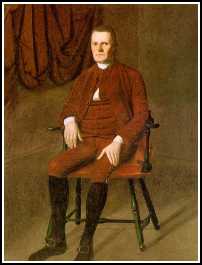 Because the subject was complex, Roger had written some fairly detailed notes to assist his memory. When he arrived at the attorney’s office, he stated the case while referring to the notes he had written. The attorney was impressed with the clarity and style of Roger’s manuscript, and said that, with just a few minor changes, it would be equal to any statement of the case he could write himself. The attorney then encouraged young Roger to seriously consider becoming an attorney. At about that time, Roger began a personal study of the law, though he was still very much occupied with the responsibilities of caring for his mother and younger siblings. Not long after, he thought it advisable to leave the shoemaking trade and enter into a business partnership with his older brother, who ran a general store, the first store in the town. Sherman quickly became one of the town’s leading citizens after introducing himself to both civil and religious affairs. Eventually, he became New Milford’s clerk. In 1745, he became a surveyor due to his excellent mathematical skills. At the age of 24 he was appointed to the position of county surveyor for Litchfield county. As an avid astronomer, he made astronomical calculations for an almanac that was published in New York.In 1748, he was a provider of astronomical calculations for almanacs of the day.
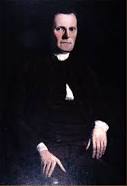 A local lawyer urged Sherman to read for the bar exam even though he did not have any formal training. Sherman was later admitted to the Litchfield bar in 1754 and acted as a representative of New Milford in the General assembly of Connecticut between 1755 and 1758 and again from 1760 to 1761. Sherman was elected to the Upper House of the Connecticut General Assembly and served there until 1785.

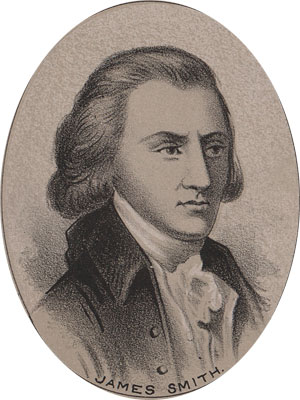
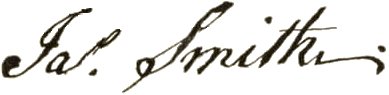 In January, 1775, the convention for the province of Pennsylvania was assembled. Of this convention, Mr. Smith was a member, and concurred in the spirited declaration made by that convention, that “if the British administration should determine by force to effect a submission to the late arbitrary acts of the British parliament, in such a situation, we hold it our indispensable duty to resist such force, and at every hazard to defend the rights and liberties of America.” Notwithstanding this declaration by the convention, a great proportion of the Pennsylvanians, particularly the numerous body of Quakers, were strongly opposed, not only to war, but even to a declaration of independence.
 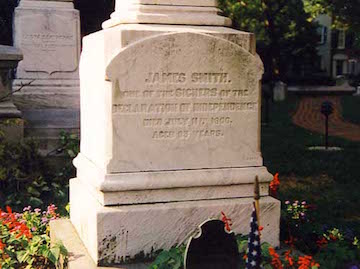 James Smith retired from the Congress in 1777, and served in few public offices after: one term in the State assembly, a few months as a judge of the state High Court of Appeals, etc. He was reelected to Congress in 1785, but declined to attend due to advancing age. James Smith died in York, Pennsylvania, on 11 July 1806, and is interred in the First Presbyterian Churchyard there. Little is known about his work, because a fire destroyed his office and papers shortly before he died. Most experts believe he was 86 or 87 years of age when he passed, but his grave marker lists him as 93 years of age, making him one of the top three oldest of the signers of the Declaration of Independence.