Recently, I again had a writer ask me about the use of dance cards in the Regency.
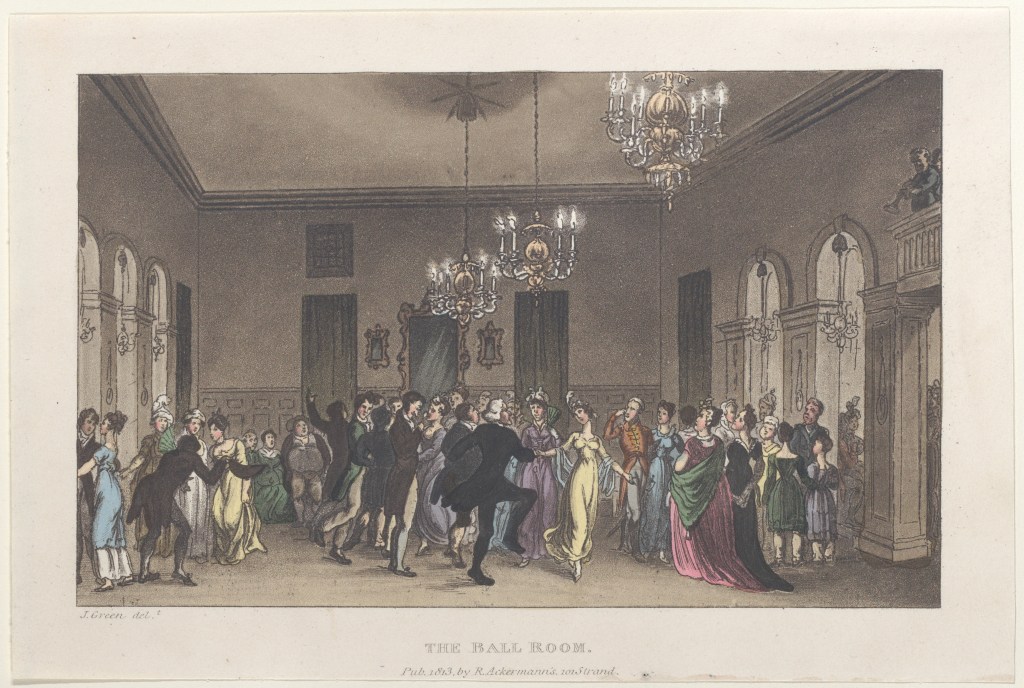
Thomas Rowlandson, 1813
In truth, I have not found any period references to hostesses having dance cards for her guests. Thomas Wilson never mentions them in his Etiquette of the Ballroom. They are ubiquitous in novels of our day.
General Etiquette and Ballroom Culture website tells us, “Thomas Wilson, in The Complete System of Country Dancing, includes a section titled, “The Etiquette of the Ball Room as it Particularly Relates to Country Dancing” in which he outlines the rules of etiquette for public and private Balls. One of the first points that Wilson includes is the drawing of numbers to assign places in the dance or to take place according to precedence. He also states that a minuet is the most appropriate opening for a ball. Bows and curtsies were observed at the beginning and end of each dance.
“He also includes a number of points about what not to do. Ladies could not dance together, nor could gentlemen, unless given permission by the Master of Ceremonies, which could only occur when there were uneven numbers. Couples had to stand when a dance was called because refusing to showed disrespect to the lady calling it. During a country dance, making noise, such as clapping, hissing, snapping, or yelling, was not permitted. Most importantly, the final point Wilson makes is that, to preserve the order and prevent disputes, the points of etiquette relating to the guests should be written down and displayed prominently at assemblies.”
These are some key points of Wilson’s book.
Thomas Wilson’s The Etiquette of the Ballroom (first published in 1812) provided a guide to conduct during dances, emphasizing decorum, orderly conduct, and graceful movement. Key rules included gentlemen wearing appropriate attire (no boots, spurs, or canes), avoiding disruptive noises like clapping or hissing, and respecting the established order of the dance and the room. It also covered specific dance protocols, such as the beginning and end of dances and the proper way to handle sets.
Specific etiquette rules …
- Attire: Gentlemen were prohibited from wearing boots, spurs, gaiters, or trousers, and loose pantaloons were not considered appropriate for a formal ball.
- Conduct: Hissing, clapping, snapping fingers, or making other noises to disturb the company were strictly forbidden.
- Dance order: No dance should be performed twice in one evening. If a couple stopped or repeated a figure, they were expected to drop out or stand aside so as not to interrupt those following.
- Set composition: When sets were split, they should contain an equal number of dancers.
- Respect and permission: Couples should observe the usual bows and courtesies at the beginning and end of each dance. No two ladies should dance together without the Master of the Ceremonies’ permission, which was sometimes granted due to a shortage of men.
- Professionalism: The rules aimed to prevent disputes and ensure the smooth running of the assembly, even suggesting that the etiquette rules be displayed prominently.
- Graceful movement: Dancers were advised to move with a relaxed, upright carriage and an easy sway, with nothing seeming “studied” or labored. Hands should be raised gently when joining a partner, and feet should be pointed downwards and slightly turned outward.
For one thing, Thomas Wilson does not mention is dance cards at all in his Companion to the Ballroom, published in 1816. Of course, as he also says that he doesn’t speak for the practices at the high society balls, the Haut Ton might have different practices.
Wilson also says that the practice in many places was for the highest ranking lady at a public assembly to choose the dance when it was time to take to the floor.
Jane Austen mentions this in The Watsons.
Still, I would not think that there would be much need for dance cards until after 1818 when the waltz and other dances from the Continent had been introduced and balls no longer consisted of 4 sets of two country or contra dances plus a boulanger or reel to change the pace.
Dance cards were in use in Vienna and other places on the Continent where there was a greater variety of dances.
I know many authors do have dance cards in their novels. I have even tried it once or twice, but I never made the dance cards a major point in the story line, just a passing fancy, so to speak.
During the Regency, the nature of the dances made a dance card as an accessory truly unnecessary. However, some have mentioned reading about the ladies writing on the ivory sticks of a fan or on a small note pad.
I have seen references in works on fans to fans printed with dance steps and fans with ivory sticks on which people could write a name. Also, small little pads of paper and pencil were mentioned in which ladies could write down the name of the man requesting set 5.
According to Thomas Wilson, director of dance at King’s Theatre, proprietor of a dance studio, and author of several books on dance in the time period, the honor of choosing the next dance fell to the highest ranking woman present and the next one to the next highest–a headache for a MC!!! or hostess!! Surely any female could remember that she was to dance the 3rd set with Jones; 4th set, Miller; 5th set, Stevens, and Lord Carlton for last set.
Wilson does say that he does not presume to speak for balls given by aristocracy, but he had not heard of any vast differences between what he said and what was practiced among the TON. The aristocrats were more likely to do what they wanted.
Dances were usually in sets of 2. Sometimes a single dance with a change of pace like a Boulanger or Jig would be interposed between 3rd and 4th sets or after 2nd and 4th sets.
We do not really know the history of dance cards in England. I have a couple of 19th century etiquette books and none mention dance cards. Moreover, there is no writer of the period, like Fanny Burney or Jane Austen, who mention balls using dance cards.


Being uncertain as to whether dance cards were used, I don’t mention them in my only dance scene. Not much of a problem, the trilogy “The Marriage of Miss Jane Austen” involves a ball in Bath when Jane is older and doesn’t get many offers. In the opening, the hero good-naturedly pushes his way into the Upper Rooms despite wearing muddy Hessian boots from a long ride. The scene includes a line from the famous MC Beau Nash (uttered in reality a generation earlier) that the fellow ought to have brought in his horse, as his steed would have been as well shod as his master.
You made me laugh.