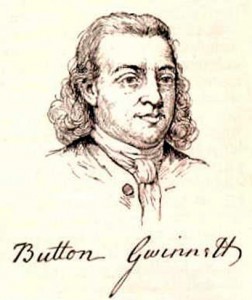
 Button Gwinnett was a Gloucester, England, born signer of the Declaration of Independence. At the time of the American Revolution he was a 41 years old merchant and plantation owner. He was the father of three. Tragically, he died before viewing what he helped to create, for he passed in May 1777.
Button Gwinnett was one of three Georgia signers of the Declaration of Independence. He served in Georgia’s colonial legislature in the Second Continental Congress, and as president of Georgia’s Revolutionary Council of Safety. Born in April 1735 in Down Hatherly, Gloucestershire, England (baptized in Gloucester in 1735), the son of Anne and the Reverend Samuel Gwinnett, Button Gwinnett came to America, first briefly residing in Charleston, South Carolina, a route frequently traveled by Georgia settlers in the 1760’s, but in 1765, Gwinnett acquired a large tract of land in Savannah, Georgia.While still in England (in 1757), he married and began a career in trading. Ann Bourne presented him three children—Amelia, Ann, and Elizabeth Ann. Unfortunately in his new American venture, he knew little success in farming or business, but found a footing in the revolutionary politics of his adopted colony.
Gwinnett arrived in Savannah in 1765 and became a merchant, but soon became disillusioned while running a store in town. After this venture failed, he purchased St. Catherine’s Island and set himself up as a planter. When Gwinnett purchased the island (actually a thirty-six sq. mile tract of land including St. Catherine’s) he tried to raise cattle and farm with limited success. He became active in local politics, winning election to the Commons House of Assembly in 1769. His politics were deeply influenced by his contempt for the wealthy and powerful city Whigs of Savannah. Gwinnett’s political base of country Whigs consisted of less prosperous coastal dwellers like himself and backcountry farmers. By 1773 Gwinnett was again in financial straits; he sold most of his personal property and possessions and withdrew from the political scene.
The Revolutionary crisis brought him back into politics. Over the next two years Gwinnett rose quickly and played a pivotal role in Georgia politics, although he was disliked by a number of factions within the state. When Lyman Hall journeyed to the Second Continental Congress, Gwinnett became the de facto leader of the radical faction. Button saw two enemies to battle: England and the so-called “city party,” a more conservative element of the radicals that represented the wealthier merchants and shipping interests in Savannah including Lachlan McIntosh and his brother George. Gwinnett rallied the opponents of the Christ Church Parish–led Whig Party, which until that time had dominated the leadership in the emerging dispute with the British crown.
On 23 January 1777, South Carolina representatives made public a long-whispered rumor — South Carolina wanted to annex the state of Georgia for the common welfare of both states. Gwinnett organized and led the opposition to the proposal, voting it down in the Assembly. It then became apparent that merely voting down the proposal was not enough. Georgia needed a constitution, not the Rules and Regulations it had been governed under for almost a year.
Borrowing heavily from John Adams, Gwinnett and others drew up the state constitution and presented it to the assembly, which adopted it on 5 February 1777. One of the most critical of the new state constitution was Lachlan McIntosh, who complained that it gave “power…to irresponsible and avaricious individuals and groups.” Two weeks later Archibald Bulloch was elected governor and commander-in-chief under this document, but he died under suspicious circumstances on the day he became head of the executive branch. Gwinnett was tapped to finish Bulloch’s term until a new election could be held.
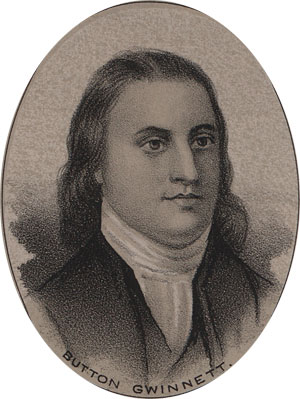 Disappointed in his military ambitions, Gwinnett continued to lead the opposition to the Christ Church Parish coalition, and when his followers gained control of Georgia’s Provincial Congress, they succeeded in electing him Speaker. He played a key role in the passage of the Georgia Constitution of 1777 and began to purge the military of officers whom he and his followers deemed less than zealous in their enthusiasm for the Whig cause. This brought him into conflict with Lachlan McIntosh. After the death of Georgia’s president and commander-in-chief, Archibald Bulloch, in February 1777, the Council of Safety appointed Gwinnett to succeed him.
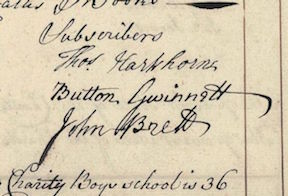 Gwinnett’s signature is one of the rarest and most valuable of the signers of the Declaration of Independence. In 1979 a letter signed by Gwinnett brought $100,000 at a New York auction; its value was estimated in 1983 to be up to $250,000.


This is great, Regina! Thank you.
As a “Georgia” girl, I was hoping you would see it.
If you cover Josiah Bryant let me know. 🍷🌟❤️🌟🌟🌟
Do you mean Josiah Bartlett? I have him scheduled in November for I am doing each of the 56 signers according to the month of his birth.
Got it! I thought maybe you were doing an early settlers series. I look forward to reading more!
My last book was set in the 1780s, and so I am doing lots of research in the times. I have another idea with which I am “toying.”