When I first wrote my vampiric tale which will re-release on Wednesday, one of the techniques I used was the folk song “Fair Ellender and the Brown Girl.”
“Fair Ellender” is a folk song based on the English Child Ballad 73, “Lord Thomas and Fair Annet,” which tells the tragic story of a love triangle, double murder, and suicide. The song’s narrative centers on Lord Thomas, who is torn between marrying the wealthy “brown girl” and his true love, Fair Ellender, who is poor. Ultimately, Lord Thomas chooses the brown girl for her wealth, but the story ends in tragedy when the brown girl murders Fair Ellender, and Lord Thomas then kills the brown girl before killing himself.
Plot: The ballad is a tragic love story where a man is pressured by his mother to marry a woman with land and money (the “brown girl”) over his true love (Fair Ellender), who is poor but has been loyal to him.
Some believe Lord Thomas and Fair Elinor is meant to be about Elizabeth I.
- Origins: The earliest known printed version of the ballad, “A tragical Story of Lord Thomas and Fair Ellinor,” appeared in London in 1677, long after Elizabeth I’s reign (1558–1603). It is considered a late 17th-century broadside ballad, though it likely existed in oral tradition earlier.
Similarities to Elizabethan History (General Themes):
- Thomas Seymour Scandal: The 1548 scandal involving Lord Thomas Seymour and the young Princess Elizabeth involved reckless behavior and unwanted advances.
- Politics vs. Love: Elizabeth I famously navigated the pressure to marry a foreign prince (a “political” match) versus her affection for Robert Dudley (a personal choice), similar to Thomas choosing land over love.
While some might see thematic, coincidental overlaps with the tumultuous, romance-shadowed life of Elizabeth I, Lord Thomas and Fair Ellender is recognized as a traditional folk song rather than a veiled account of her reign.
Tragic ending: The brown girl murders Fair Ellender out of jealousy. In some versions, Lord Thomas then kills the brown girl and himself, while in others, he kills himself with his own dagger.
Variations and titles: The song is known by several variations and titles, including “Lord Thomas and Fair Annet,” “Lord Thomas and Fair Elinor,” and “The Brown Girl”.
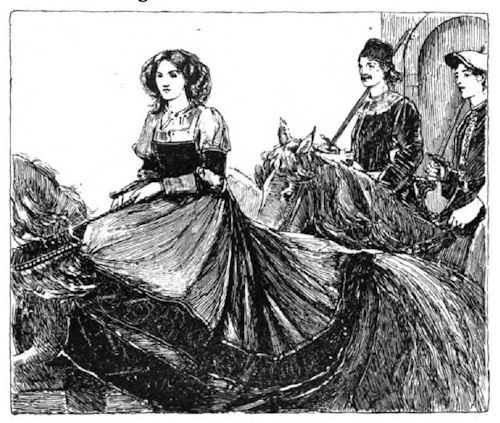
In Appalachia, the song is known as “The Brown Girl.” I was in my teens before I knew it had additional titles.
“Lord Thomas (or Sweet Willie) is in love with Fair Annet, or Annie, or Elinor, but she has little property. He asks for advice. His father, mother, and brother (or some of them) advise that he should instead marry the nut-brown maid with a rich dowry. His mother promises to curse him if he marries Annet and bless him if he marries the nut-brown maid. His sister warns her that her dowry may be lost and then he will be stuck with nothing but a hideous bride. Nevertheless, he takes his mother’s advice.
“Fair Annet dresses as splendidly as she can and goes to the wedding. The nut-brown maid is so jealous that she stabs Annet to death. Lord Thomas stabs both the nut-brown maid and himself to death. A rose grows from Fair Annet’s grave, a brier from Lord Thomas’s, and they grow together.” [Lord Thomas and Fair Annet]
Lord Thomas and Fair Ellender
O Mother, O Mother, come riddle it down,
Come riddle two hearts as one.
O must I marry fair Ellender
Or bring the brown girl home?
The brown girl she has houses and lands,
Fair Ellender she has none,
So the best advice I can give you, my son,
Is go bring me the brown girl home.
He rode till he come to fair Ellender’s gate
He tinkled the bell with his cane,
No one so ready as fair Ellender herself
To arise and bid him come in.
O what’s the news Lord Thomas, she cried,
What’s the news you brung to me?
I’ve come to ask you to my wedding
Now what do you think of me?
O Mother, O Mother, come riddle it down
Come riddle two hearts as one,
O must I go to Lord Thomas’s wedding
Or stay at home and mourn?
The brown girl she’s got business there
You know you have got none
So the best advice I can give you my daughter,
Is to stay at home and mourn.
She dressed herself in a snow white dress,
Her maids they dressed in green,
And every town that they rode through
They took her to be some queen.
She rode till she came to Lord Thomas’s gate,
She pulled all in her reins,
No one so ready as Lord Thomas himself
To arise and bid her come in.
He took her by her lily white hand
He led her through the hall,
He seated her down in a rockin’ chair
Amongst those ladies all.
Is this your bride, Lord Thomas, she cried?
She looks so wonderful brown!
You once could have married a maiden as fair
As ever the sun shone on.
Dispraise her not, fair Ellender, he cried,
Dispraise her not to me,
For I think more of your little finger
Than of her whole body.
The brown girl had a little pen knife
It being both keen and sharp,
Betwixt the long ribs and the short
Pierced fair Ellender to the heart.
O what’s the matter Lord Thomas, he cried,
You look so pale and wan,
You used to have as rosy a color
As ever the sun shone on.
O are you blind, Lord Thomas, she cried,
Or is it you cannot see?
And can’t you see my own heart’s blood
Come trinkling down to my knee?
Lord Thomas he drew his sword from his side
He ran all through the hall,
He cut off the head of his bonny brown bride
And kicked it against the wall.
Then placing the handle a-towards the wall,
And the blade a-towards his heart,
Saying did you ever see three true lovers meet
That had so soon to part?
O Mother, O Mother, go dig my grave
Go dig it both wide and deep,
And bury fair Ellender in my arms
And the brown girl at my feet.
The grave plants that grow together are a motif to express true love, also found in many variants of Barbara Allen and of Tristan and Iseult, and in the legend of Baucis and Philemon.
Also note, what exactly “he twirled at the pin” mean? First, the phrase appears in numerous songs. It invariably occurs when the protaganist is approaching a ‘maiden’s bower’ and can obviously be updated to “he rang the doorbell.” In the DT database, a modernisation is given for the song “Glenkindie” and the meaning being explained as ‘turning the latch.’ However, in most songs, twirling the pin, seems to be an attempt to be heard rather than a way of sneaking in.


I always enjoyed this tale and actually have the song in one of my books, not to mention I had one of the CDs with the narrative. Best wishes with your re-release. Looking forward to it!
I have used this song in 3 different books now. Most recently, I used it in “Lyon on the Inside.”
I know what you mean since I have had Lizzy sing 2-3 of my favorite songs in 3 of my books. Ha Ha!