A reader recently wrote to ask me what I knew of expunging criminal records during the Regency Era. In truth, I knew some, but not all of the ins and out of this process.
Question from a Reader: Was expungement (erasing the criminal conviction from records) possible during the Regency? Could a conviction be overturned? Alleged crime occurred in the northern part of England. Any ideas on the process? I have a character falsely convicted. Do you know how they would get it done? Was it even possible? Any resources you can recommend would be greatly appreciated.
Response: The concept of expunging or formally erasing a criminal record as understood in modern law did not exist during the British Regency era (roughly 1811–1820). Criminal records from that time are permanent historical documents. Instead of being imprisoned, most sought a pardon or mitigation of the circumstances. One plot point that could be used in such a story is there was no centralized record keeping, meaning the man who was pardoned or who made the injured “whole” by repayment or some other sort of mitigation could up and move from say Yorkshire to Cornwall and likely no one would be the wiser of his previous brush with the law.
Pardons Meant: Convicted criminals, their families, or friends could submit petitions to the Home Secretary requesting a reduction in sentence or a full pardon. Judges’ reports, witness testimonies, and information about the prisoner’s character and behavior in prison were all taken into consideration. A pardon, if granted, could spare an individual from severe punishment (such as execution or transportation), but, as I said above, it did not erase the historical record of the trial and conviction itself.
There was not a record of all the cases though, so if one sought a pardon, a record had to be made.
If the case was interesting or the person one of interest the pampleteers would write it up.
Where the aristocracy and the gentry were concerned, convictions could be sent to the king for a pardon. Other cases could be sent to the House of Lords as the appeals court. One thing is certain: The man’s attorneys had to have had a record made and appeal it immediately to the House of Lords to review it. They could also ask the king for a pardon, but that usually means the person was guilty, but was spared by the King’s mercy. There usually was not much time between the conviction and the execution. Transportation took longer to arrange.
All of the processes would be VERY public.
Mitigation of Sentence: Juries often used mechanisms such as “partial verdicts” or “benefit of clergy” to reduce the charge to a non-capital offense, thereby avoiding the death penalty. The original sentence might be withdrawn if the prisoner agreed to serve in the army or navy, or if responsible members of the community could provide “sureties” (a bond to guarantee future good behavior).
No Centralized Records (Early in the Era): While records of court cases (such as the Old Bailey Proceedings) were kept, detailed, centralized personal records about criminals were not routinely collected until later in the 19th century. This meant that once a person had served their sentence or received a pardon, they might be able to start a new life elsewhere without their past following them, although their local reputation would certainly precede them in their immediate community.
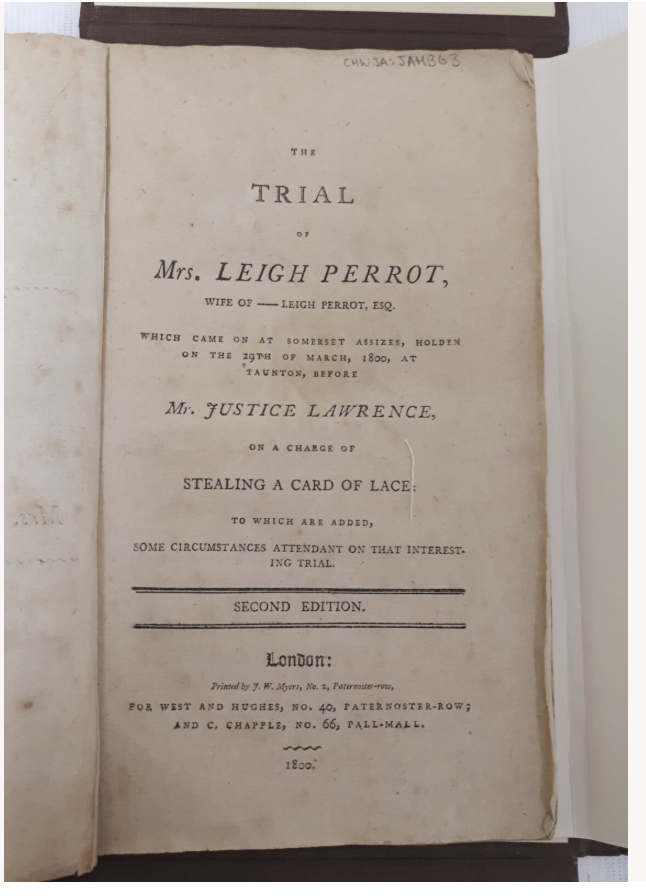
You who follow me know that I bring almost every post back to Jane Austen. Though Jane Austen’s aunt was acquitted of theft at the Tauton assize, the case was known and she was forever labeled a shoplifter because one of the publishers wrote a pamphlet about the case. Austen’s aunt, Jane Leigh Perrot, was arrested for shoplifting in 1799. She was accused of stealing white lace from a haberdashery in Bath, England, but was acquitted at trial. The jury, who deliberated for only about fifteen minutes. Some speculate she was framed or that her prominent family status helped her case. However, she had been held in prison for seven months before being brought to trail on the charges against her.
.
In one documented case inYork, a man was accused of shoplifting a piece of fruit from a shopkeeper. There was no record as a friend paid the fine, but the whole town knew about it. So, though there was no criminal record, there was a stigma following the man around, nevertheless.
In truth, something as simple as shoplifting a piece of fruit would be a difficult crime to prosecute and convict. If the man just picked up an apple and started munching, he would be asked to pay for it. If he was away from the shop when he was apprehended, the shopkeeper had to show that the man had actually been in his shop and that the piece of fruit was taken from his shop. Moreover, the actual apple had to be entered in evidence. There had to be a means. for the shopkeeper to prove that the piece of fruit was from his shop and not from some other vendor.
If everything could be established, the case would usually just be tried by the local Justice of the Peace. If convicted the man would pay for the fruit and the costs of the courts. He might also be sent to the stocks. It is also possible that he would plead benefit of clergy and just be branded on the thumb.


