Lady Freya Cunningham, the heroine of book 5 in this series, “accidentally” encounters Lady Emma Orson (Richard’s wife), Miss Victoria Whitchurch (Benjamin Thompson’s betrothed), and Lady Annalise Beaufort (Navan’s wife) leaving Madame Emmeline’s modiste. The ladies ask Freya to accompany them to a nearby tearoom. Freya is hoping to enlist the ladies in assisting her in drawing Lord Aaran Graham’s attention. But what would they be served?
A Regency-era (1811–1820) tearoom in England likely served Chinese green and black teas, often accompanied by thin bread and butter, toast, muffins, crumpets, Sally Lunn buns, or seed cake. Sweet options included biscuits (macaroons), fruit-filled jellies, and gingerbread, while lighter, elegant refreshments like lemon ices were also popular.
Key Refreshments Served:
Tea: Commonly imported black and green teas from China, served with milk or lemon.
Breads & Spreads: Thinly sliced white or brown bread, Sally Lunn buns/bread, toast, and crumpets, often with fresh butter, jam, or marmalade.
Other Delicacies: Lemon ices, jellies, potted meats or fish (salmon), and fruit.
Savouries: Sandwiches or bites (though the formal, multi-tiered afternoon tea service was actually a later Victorian invention, light bites were common).
These items were often served as a social, light, mid-afternoon meal designed to bridge the gap between luncheon and a late dinner.
While they discuss other things, they make plans to escort Lady Freya to the Lyon’s Den and permit Mrs. Dove-Lyon to arrange a marriage between Freya and Aaran. This is a transition scene to where we bring Mrs. Dove-Lyon back into the tale.
All of you have likely read a marriage scene in a Regency era novel where the script is taken from the Book of Common Prayer, part of the Church of England’s traditions.
Regency-era marriages (1811–1820) were deeply formal, binding, and strictly governed by the 1662 Book of Common Prayer, typically taking place in a parish church between 8 a.m. and noon. The ceremony focused on solemn vows, the “giving away” of the bride, exchange of rings, and mandatory registry signing.
Key Aspects of the Ceremony:
The Book of Common Prayer: The liturgy for “The Solemnization of Matrimony” was mandatory and uniform across England.
Vows: Couples pledged to have and to hold from that day forward, “for better for worse, for richer for poorer, in sickness and in health,” to love, cherish, and obey.
Requirements: A clergyman, a parish clerk, and at least two witnesses were required.
Restrictions: Weddings could not take place during certain holy days (like Lent).
No Kiss/No Hug: Contrary to modern tradition, the 1662 service did not include a kiss, a public introduction of the couple, or a sermon.
The Ring: A single, plain gold ring was given by the groom, who said, “With this Ring I thee wed, and with all my worldly goods I thee endow”.
Marriage Logistics:
Banns: Unless a license was obtained, the banns (intention to marry) had to be read in church for three consecutive Sundays.
Licenses: A “common license” allowed for a quicker, quieter, but more expensive (10 shillings) ceremony.
Special Licenses: These were rare, expensive (£4-£5), and only for the aristocracy, allowing weddings to be held at home.
Post-Ceremony: Following the service, the couple signed the parish register, and a wedding breakfast, involving cake, was customary.
*******************************************
First the Banns of all that are to be married together must be published in the Church three several Sundays, during the time of Morning Service, or of Evening Service, (if there be no Morning Service,) immediately after the second Lesson; the Curate saying after the accustomed manner,
I PUBLISH the Banns of Marriage between M. of _____ and N. of _____. If any of you know cause, or just impediment, why these two persons should not be joined together in holy Matrimony, ye are to declare it. This is the first [second, or third] time of asking.
And if the persons that are to be married dwell in divers Parishes, the Banns must be asked in both Parishes; and the Curate of the one Parish shall not solemnize Matrimony betwixt them, without a Certificate of the Banns being thrice asked, from the Curate of the other Parish.
At the day and time appointed for solemnization of Matrimony, the persons to be married shall come into the body of the Church with their friends and neighbours: and there standing together, the Man on the right hand, and the Woman on the left, the Priest shall say,
DEARLY beloved, we are gathered together here in the sight of God, and in the face of this congregation, to join together this Man and this Woman in holy Matrimony; which is an honourable estate, instituted of God in the time of man’s innocency, signifying unto us the mystical union that is betwixt Christ and his Church; which holy estate Christ adorned and beautified with his presence, and first miracle that he wrought, in Cana of Galilee; and is commended of Saint Paul to be honourable among all men: and therefore is not by any to be enterprised, nor taken in hand, unadvisedly, lightly, or wantonly, to satisfy men’s carnal lusts and appetites, like brute beasts that have no understanding; but reverently, discreetly, advisedly, soberly, and in the fear of God; duly considering the causes for which Matrimony was ordained.
First, It was ordained for the procreation of children, to be brought up in the fear and nurture of the Lord, and to the praise of his holy Name.
Secondly, It was ordained for a remedy against sin, and to avoid fornication; that such persons as have not the gift of continency might marry, and keep themselves undefiled members of Christ’s body.
Thirdly, It was ordained for the mutual society, help, and comfort, that the one ought to have of the other, both in prosperity and adversity. Into which holy estate these two persons present come now to be joined. Therefore if any man can shew any just cause, why they may not lawfully be joined together, let him now speak, or else hereafter for ever hold his peace.
And also, speaking unto the persons that shall be married, he shall say,
I REQUIRE and charge you both, as ye will answer at the dreadful day of judgement when the secrets of all hearts shall be disclosed, that if either of you know any impediment, why ye may not be lawfully joined together in Matrimony, ye do now confess it. For be ye well assured, that so many as are coupled together otherwise than God’s Word doth allow are not joined together by God; neither is their Matrimony lawful.
At which day of Marriage, if any man do alledge and declare any impediment, why they may not be coupled together in Matrimony, by God’s Law, or the Laws of this Realm; and will be bound, and sufficient sureties with him, to the parties; or else put in a Caution (to the full value of such charges as the persons to be married do thereby sustain) to prove his allegation: then the solemnization must be deferred, until such time as the truth be tried.
If no impediment be alledged, then shall the Curate say unto the Man,
M.WILT thou have this Woman to thy wedded Wife, to live together after God’s ordinance in the holy estate of Matrimony? Wilt thou love her, comfort her, honour, and keep her in sickness and in health; and, forsaking all other, keep thee only unto her, so long as ye both shall live?
The Man shall answer, I will.
Then shall the Priest say unto the Woman,
N.WILT thou have this Man to thy wedded Husband, to live together after God’s ordinance in the holy estate of Matrimony? Wilt thou obey him, and serve him, love, honour, and keep him in sickness and in health; and, forsaking all other, keep thee only unto him, so long as ye both shall live?
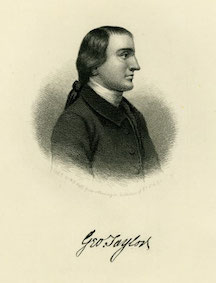
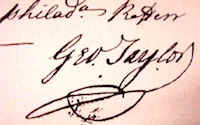
George Taylor was one of two Irish born signers of the Declaration of Independence. He was a 60 years old merchant by trade and father of two when he signed the document. He died at the age of 65 in 1781.
Born in northern Ireland in 1716, Taylor arrived on American shores in 1736 as an indentured servant to an ironmaster in Coventry Forge, near Philadelphia. Originally, Taylor was a “filler” for the iron furnaces, but because he had some formal education, he was appointed a counting room clerk by his employer Samuel Nutt. Nutt died soon after, in 1737, and in accordance with his will, left his iron and furnace properties to Samuel Savage, Jr., and Savage’s mother, Anna Rutter Savage Nutt. Mrs. Nutt and her sons from her first marriage founded Warwick Furnace, and George performed the role of clerk for the new establishment. Samuel Savage, Jr., died in 1741, and George Taylor married Savage’s widow the following year. Under his control, the Warwick Furnace prospered. Taylor and his wife had two children, James and Ann (who died in childhood).
In 1747, Taylor joined a militia group organized by Benjamin Franklin. When Samuel Savage III became of age, Warwick Furnace was turned over to him (according to the original will). In 1753, Taylor and Samuel Flower leased the Durham Iron Works. The Taylors moved into the mansion house on the property. The iron works produced ammunition for the Provincial Pennsylvania government during the French and Indian War.
When the lease on the iron works ended, Taylor he bought a small stone house in Easton, PA at a sheriff’s sale on December 23, 1761 for £117, 15 s, 10d. Taylor often served as a justice of the peace and he helped in the construction of the new courthouse in Easton.
“In March 1767, Taylor purchased a 331 acre tract known as the ‘Manor of Chawton’ located approximately 15 miles west of Easton. There he built an impressive two-story Georgian stone house on a bluff overlooking the Lehigh River. He hired carpenters from Philadelphia to erect the home in 1768. This home still stands, identified as the George Taylor Mansion. Tragically, his wife Ann died that year. It is not known where she was buried. Among the possibilities suggested by historians are the new property, in Easton, and the Gallows Hill Cemetery. Taylor leased most of the property out in 1771 and in 1772 appears to have been living with his son, James, who had moved to what is now Allentown, PA.
“Taylor returned to Durham in 1774, having entered into a five-year lease with Joseph Galloway, the owner of the Durham Iron Works, leasing mines, quarries, forges, and blast furnaces in PA and NJ. At the time Galloway was a prominent Philadelphia attorney and speaker of the Pennsylvania Assembly. The production of the Iron Works included pig iron and bar iron made at the forges in New Jersey, castings, and stoves, including Franklin stoves. In August 1775 Taylor secured a contract from the Pennsylvania Committee of Safety for cannonballs. From 1775 to 1778 Durham Furnace produced grape shot, cannon balls, bar shot and cannon for the Continental Army. Taylor received limited compensation for his contribution to the war effort, and his wealth diminished as a result. At the July 1775 meeting of the Assembly, a month after the Battle of Bunker Hill, Taylor was commissioned as a Colonel of the 3rd battalion of Militia. This meeting represented the first step in the county arming for conflict with England. He reportedly took part in drilling and in the organization of the battalion.” (The Society of the Descendants of the Signers of the Declaration of Independence)
“In 1775, he was part of the Pennsylvania delegation. Originally, the delegations were instructed to vote against separation. “When several delegates, including John Dickinson, chose not to vote in favor of the Declaration of Independence on July 4, the Assembly chose five replacements on July 20. They were George Taylor, George Ross, George Clymer, Dr. Benjamin Rush and James Smith, all of whom joined Congress and subsequently signed the Declaration of Independence when the engrossed copy of the document was ready for signatures on August 2, 1776.
“Taylor’s lease of the Durham Iron Works continued through 1779. The property was then seized because Joseph Galloway, the owner, had been attainted of treason for siding with the British. An attempt was made to evict Taylor but the Supreme Executive Council allowed him to remain until the end of the first 5-year term of the lease. The Durham property was then sold by the Commissioners of Forfeited Estates and purchased by four colonels: George Taylor, Richard Backhouse, Isaac Sidman and Robert Hooper Jr. Backhouse took over management of the Works, and Taylor moved to Greenwich Township, NJ to lease and operate the Greenwich Forge in Warren County, New Jersey.
“In early 1780, Taylor moved back to Easton, PA. He had sold his estate along the Lehigh River in February 1776 and his house and stable on Northampton Street in Easton in 1779. He leased a stone house at the corner of Fourth and Ferry Streets.
“George Taylor died in February 1781, His estate included two slaves, Tom, who was sold for 280 bushels of wheat valued at £77 and crippled Sam who fetch £15, one horse and three cows, and a 24-hour eight day clock with a walnut case valued at £24. After bequests to his executors and housekeeper he left in his will dated January 1781 half of his estate to his five grandchildren, George, Thomas, James, Ann and Mary, his son James having died in 1775. The second half of his estate was left to the five children Taylor fathered with his housekeeper, Naomi Smith: Sarah Smith, Rebecca Smith, Naomi Smith, Elizabeth Smith and Edward Smith. “(The Society of the Descendants of the Signers of the Declaration of Independence)
Posted inUncategorized|Comments Off on Traitor Tuesday ~ Celebrating 250 Years of the United States as a Separate Nation: George Taylor, From Indentured Servant to Signer of the Declaration of Independence
In 2011, the Brighton Pavillion had a display of Regency fashion as part of their annual Jane Austen celebration. It was magnificent. One of the items on display was a quilted chintz banyan, what a gentleman might wear in the evening hours before going to bed.
The word comes through Portuguese banian and Arabic بنيان, banyān, from the Gujarati વાણિયો, vāṇiyo, meaning “merchant”.
European women wore banyans in the 18th century as dressing gowns in the morning, before robing for the day, or in the evening before bed over undergarments, as described by the Victoria and Albert Museum in London, England. Despite the name “nightgown”, the banyan was not worn for sleeping. [“Banyan – Victoria & Albert Museum – Search the Collections”]
Also called a morning gown, wrapper, robe de chambre or nightgown, the banyan was a loose, T-shaped gown or kimono-like garment, made of cotton, linen, or silk and worn at home as a sort of dressing gown or informal coat over the shirt and breeches. The typical banyan was cut en chemise, with the sleeves and body cut as one piece. It was usually paired with a soft, turban-like cap worn in place of the formal periwig. An alternative style of banyan was cut like a coat, fitted, with set-in sleeves, and was closed with buttons and buttonholes. [Waugh, Norah (1987). The Cut of Men’s Clothes, 1600–1900. New York: Routledge.]
The hero of Lyon on the Inside has a leg that has been twisted out of place and a scar on his face. For those of you new to the series, Lord Aaran Graham’s mother dropped him when he was just a toddler. She was trying to escape Scotland for American, and he was squirming in her arms for she was handing him off to a young couple who had “bought” him to assist on their tenant farm. She rushes away and leaves him crying for her return. Her actions cause him more pain than does the injuries. Aaran has learned to live with a slight limp and ignore the scar on his cheek and lip, but he cannot forget his mother’s betrayal. Her actions defines him.
The injuries, though, provide him a way to serve Lord Macdonald Duncan, the man who saved him. Aaran is unassuming enough to be the one who is “arrested” and placed in the various prisons to learn more about what the Luddites plan, something of those forging fake bank notes, etc. He spends a week or two in the prisons, charged with the crime of pickpocketing, etc., and long enough for others to see him in the prisons or the poor house regularly and to trust him with their secrets. What were the prisons like for him and the others?
Regency era (1811–1820) prisons in England were often filthy, overcrowded, and unregulated, serving primarily as holding centers for those awaiting trial, punishment (hanging/transportation), or debtors rather than rehabilitation. Conditions were desperate, with diseases like “jail fever” (typhus) common, while inmates had to pay “garnish” fees for food, bedding, and to avoid being chained.
Key Characteristics and Types of Prisons
Conditions: Cells were dark, damp, and vermin-infested, with minimal ventilation or sanitation. Prisoners often slept on straw on stone floors, frequently packed together regardless of gender or crime.
Debtors’ Prisons: Institutions like the Fleet, Marshalsea, and King’s Bench held those who could not pay debts, often allowing families to live with them if they could afford to pay the warden for rooms.
Prison Hulks: Overcrowded, decommissioned warships (hulks) were used as floating prisons, particularly for those awaiting transportation to Australia.
Emerging Reforms: Following earlier efforts by John Howard, reformers began pushing for cleaner, more secure, and organized facilities, culminating in the first major, 7 national penitentiary at Millbank (opened 1816).
Management: Many jails were managed for private profit by wardens who extorted fees for necessities.
Punishment: Hard labor was common, such as “coir” picking (teasing apart tarred rope) or using the treadmill, even before modern prison sentences became standard.
Notable London Prisons
Newgate Prison: The primary, infamous city jail, known for extreme overcrowding.
Fleet Prison & Marshalsea: The most well-known debtors’ prisons.
Coldbath Fields: A “House of Correction” for petty criminals.
While the era is often remembered for elegance, the prison system was archaic, with reform only just beginning to take hold towards the end of the period, paving the way for the Victorian prison model.
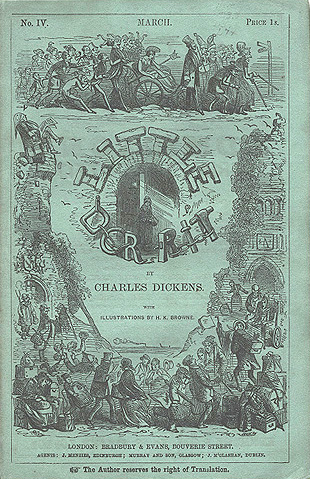
If you have ever seen the miniseries of Charles Dickens’s Little Dorrit, you have an image of the conditions in the debtors’ prison. Though written in serial form in the mid 1850s, not the Regency, the book and series give a person a view into the horrible conditions found in London. Moreover, it stars the ever-fabulous Matthew Macfadyen, and those of you who follow this blog with any regularity know how much I adore the actor. The story features Amy Dorrit, youngest child of her family, born and raised in the Marshalsea prison for debt in London. Arthur Clennam encounters her after returning home from a 20-year absence, ready to begin his life anew.
The novel satirises some shortcomings of British society and government at the time, including the institution of debtors’ prisons, where debtors were imprisoned, unable to work and yet incarcerated until they had repaid their debts. The prison in this case is the Marshalsea, where Dickens’s own father had been imprisoned. Dickens is also critical of the inert bureaucracy of the British government, in this novel in the form of the fictional “Circumlocution Office”. In addition, Dickens satirises the stratification of society that results from the British class system.
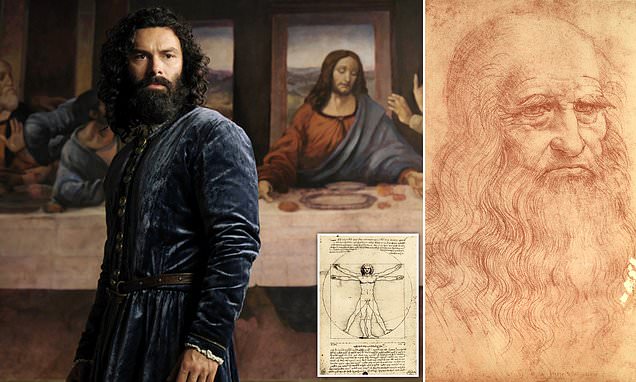
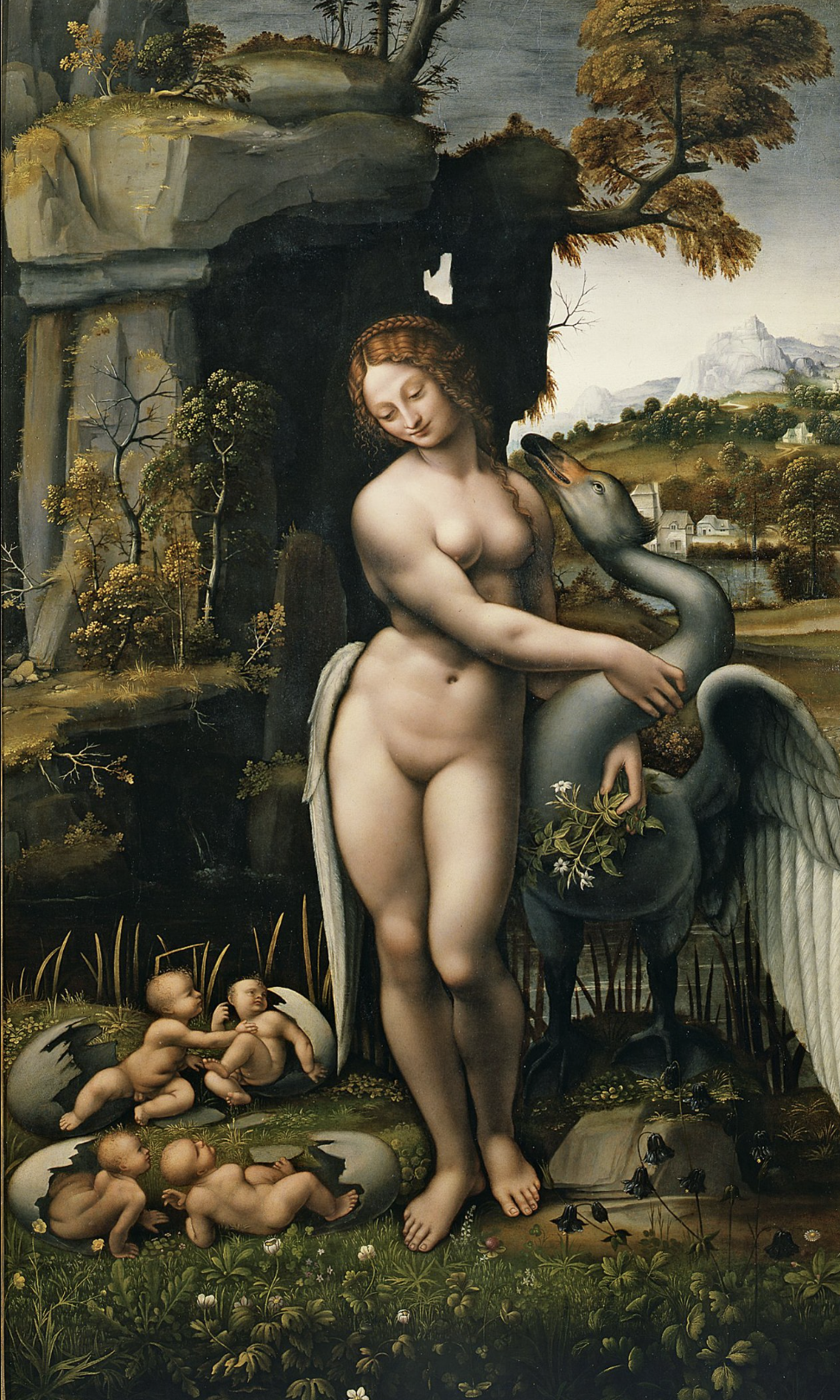
Many of the authors of books in either the Lyon’s Den books or the Lyon’s Den Connected World books mention the somewhat shocking, especially to young ladies, artwork on the walls of the Lyon’s Den. More than one of us have mentioned “Leda and the Swan,” originally by a painter in Leonardo da Vinci’s circle. If you are a fan of Aidan Turner, as am I, you will recall the number of “clinger ons” who followed Da Vinci about. [See “Leonardo” a 2021 series – Aidan Turner portrays Leonardo da Vinci in the historical drama series titled Leonardo, which explores the life, genius, and personal struggles of the Renaissance master, weaving in fictional elements like a murder mystery to frame the narrative. The show, produced by Lux Vide and Sony Pictures Television, follows his artistic journey, from his apprenticeship to creating masterpieces like The Last Supper, while dealing with perfectionism and intense observation.]
I do not know the inspiration for the others to choose “Leda and the Swan” by name, but I used it because it would likely be shocking to a young lady seeking out Mrs. Dove-Lyon to find her a suitor and because I knew the original had been destroyed LONG before the Regency era and that there was a number of “replicas” available.
In fact, “Leda and the Swan” refers to a painting depicting the Greek myth where Zeus, disguised as a swan, seduces Leda, leading to the birth of Helen of Troy; famous versions exist by Leonardo da Vinci (lost original, known through copies like Uffizi & Wilton House), Correggio, Cézanne, and Cy Twombly, and exploring themes of desire, transformation, and violence, with significant interpretations across Renaissance, Baroque, and Modern art.
Public Domain
“Leda and the Swan is a c.1505-1507 oil and resin on panel painting by a painter in the circle of Leonardo da Vinci. It may have originated in the Gualtieri Collection in L’Aquila and passed through various others before being acquired from the Spiridon Collection in 1989 by its present owner, the Uffizi. [Gloria Fossi, Uffizi, Giunti, Firenze 2004.]
“It and the versions in the Galleria Borghese and Wilton House are considered the three closest copies after Leonardo’s own lost work on the same subject. Bernard Berenson even argued the Uffizi work was an autograph work by Leonardo himself, but this is rejected by modern art historians in favour of one of Leonardo’s students, possibly Francesco Melzi [Hoogewerff, 1952] with some assistance on the landscape background from Joos van Cleve. It is usually dated to the end of Melzi’s stay in Milan before leaving for France with Leonardo. Other suggestions include Cesare da Sesto or Fernando Yáñez de la Almedina – the latter assisted Leonardo in 1505 on The Battle of Anghiari.”
George Ross was a 46 years old when he signed the Declaration of Independence. He was a lawyer and the father of three. He died three years later in 1779.
“George Ross’s father was born at Balblair, Scotland, in 1679 or 1680. Rev. George Aeneas, the 5th Laird Balblair Ross (b.1679, d.1754), had 2 wives and 16 children, and was an Anglican clergyman who had immigrated from Scotland. The paternal line goes back to Farquhar O’Beolan (b.1173, d.1251), who became royalty when King Alexander II founded an Earldom, and made Farquhar the 1st Earl of Ross in 1226, at age 53, after great wins in battle.”(George Ross) The elder Ross graduated from the University of Edinburgh in 1700, and from the Divinity School in 1703. After graduating he decided to leave the Presbyterian Church and connect himself with the Church of England, to which he was ordained in London shortly afterwards. He was then appointed Chaplain in the British Navy, but soon resigned and was sent by the Society for the Propagation of the Gospel in Foreign Parts, in 1705, as missionary to New Castle, Delaware, where he assumed charge of the work there out of which grew the Immanuel Church in June of that year.
George was born in May 1730. From his father, young George received a sound classical education. “George’s sister Gertrude married Thomas Till, the son of William Till, a prominent judge and politician; after his death, she married George Read, another signer of the Declaration. Betsy Ross (born Elizabeth Phoebe Griscom in 1752) only had her famous last name “Ross” for 4-years, which she obtained by marrying John Ross (b.1752, d.1776) in 1773. John was a nephew of George Ross. John was the son of Rev. Aeneas Ross (b.1716, d.1782) and Sarah Leach. George and Aeneas were brothers. John and Betsy had a sewing business, but John died 1/10/1776 in Philadelphia by explosion while guarding a munitions building during the Revolutionary War. Betsy would often tell her children, grandchildren, relatives, and friends of the fateful day when three members of a secret committee from the Continental Congress came to call upon her. Those representatives, George Washington, Robert Morris, and George Ross, asked her to sew the first flag. This meeting occurred in her home some time late in May 1776. The Stars and Stripes design Ross may have designed was officially adopted by the congress on June 14, 1777. The next day, June 15, 1777, Betsy married Joseph Ashburn, thus becoming Betsy Ashburn.” (George Ross)
With the assistance of his older brother John, Ross read law as part of his education. At the age of 20 he was admitted to the Bar and eventually opened his own practice in Lancaster, Pennsylvania. He considered his politics as a Tory. He was elected as Crown Prosecutor (nowadays, Attorney General) for Carlisle. He served in this position for twelve years. In 1768, he was elected to the provincial legislature, where he received another “education,” this time in the strife the colonies faced with the British Parliament.
“In 1774 he was elected to the provincial conference that would select delegates to attend the General Congress and was selected as a representative of Pennsylvania that same year. Ross continued to serve his provincial legislature and was a member of the Committee of Safety for his colony in 1775. In 1776 he was again elected to the Continental Congress, while serving as a provincial legislator and a Colonel in the Continental Army. His strong stance for the Colonists’ freedom led to his greatest contribution by being one of nine signers of the Declaration of Independence from Pennsylvania. He also undertook negotiations with the Northwestern Indian on behalf of his colony, and took a seat as vice-president of the first constitutional convention for Pennsylvania. He was re-elected to the Continental Congress once more in 1777, but resigned the seat before the close due to poor health. In March, 1779, he was appointed to a judgeship in the Pennsylvania Court of Admiralty. He died in that office in July 1779.” (Society for the Descendants of the Signers of the Declaration of Independence) He is buried at Christ Church Cemetery in Philadelphia.
When I first learned something about the difference between rectors and vicars, I accepted the definition as rectors received the greater tithes, vicars received the smaller tithes, and curates received wages. I used this concept in previous stories. For example, in writing myAusten-inspired tale, Amending the Shades of Pemberley, I created a character related to the Bennets’ Aunt Gardiner, a younger brother who is a clergyman and Mary’s “love” interest in the tale. I originally thought to make him a rector, so he might be richer, but then I chose to make him a vicar, where he would receive part of the tithes, but not all of them.
A fortunate chance had recommended him [Mr. Collins] to Lady Catherine de Bourgh when the living of Hunsford was vacant; and the respect which he felt for her high rank, and his veneration for her as his patroness, mingling with a very good opinion of himself, of his authority as a clergyman, and his right as a rector, made him altogether a mixture of pride and obsequiousness, self-importance and humility.—Pride and Prejudice, chapter 15
from C. E. Brock
***********************************************
In my new series from Dragonblade Publishing, the heroine’s Uncle Philip is a vicar on an estate in Kent, close to where Lord Benjamin Thompson lives. Lady Freya Cunningham means to place herself purposely in the way of Lord Aaran Graham, a Scottish lord who her father despises, but that is another facet of the tale. From book 4 of the series, Lost in the Lyon’s Garden, we learn that Miss Victoria Whitchurch’s father was also a vicar, but what was the benefit of being a curate, a vicar, or a rector in the Regency?
A church living was accepted to be a respectable occupation among the gentry and the aristocracy. It was a “job” which came with an income, house, and, often, farmland. It was not an occupation, such as than of a surgeon, where the man actually collected his wages for his services. Generally speaking, in a country parish, those living within the parish were required by law to pay the clergyman 10% of their income. Those “tithes” were not often paid in cash. The man might receive a percentage of the crops, the eggs, the animals, etc. The clergyman could “earn” fees for performing weddings, funerals, baptisms, etc.
In addition, there was something called “glebe,” not a word we often hear nowadays, but part of the everyday language in Jane Austen’s England. Glebe referred to a piece of land serving as part of a clergyman’s benefice and providing income.
In Jane Austen’s Sense and Sensibility, Colonel Brandon offers a rectory to Edward Ferrars. “It is a rectory, but a small one”—Sense and Sensibility, chapter 39
from C.E. Brock
An essay in Persuasion 16 of Jane Austen Society of North America, it says often the documents setting up each living set out who received what. Of course, a living in Kent, where Lady Catherine resided, would have different produce and tithable products from those in Derbyshire, where Mr. Darcy lived.
“The tenth part of all profits or fruits, both praedial, personal, and mixed, allotted to the clergy for their maintenance. Of tithes there are three kinds, viz., personal, predial, and mixed. Personal tithes are those duo or accruing from the profits of labour, art, trade, navigation, and industry of man. Pradial tithes, those which arise either from the fruits of the ground, as corn, hay, underwood, flax, hemp, &c.; or from the fruits of trees, as apples, pears, plums, cherries ; or from the produce of the garden. Mixed tithes arc such as arise from beasts, and other animals fed with the fruits of the earth, as cheese, milk, wool, lambs, calves, fowls, &c . Preadial tithes, again, are either great or small. Great tithes are those of corn, hay, and wood. Small tithes are those of flax, &c., which are prsedial; and those of wool, milk, cheese, lambs, ferrets, &c., which are mixed . The tithes of grounds newly broken up and cultivated are called decimce novates, and always belong to the vicar, as well as the small tithes. ” Dictionary of the English Church Ancient and Modern.
A Companion to the English Parish Church says of tithes: There are three types of tithes: praedial tithes (calculated on income produce), mixed tithes (calculated on income from stock and labour) and personal tithes (based on income derived entirely from labour).
Where a rector was not the incumbent, the tithes were divided between the rector and the vicar. They were the Great or Rectorial and small or Vicarial tithes. Vicarial tithes were generally those raised from labour and minor produce and as such were most difficult to raise.
“He [Mr. Elton] had a comfortable home for her [Harriet], and Emma imagined a very sufficient income; for though the vicarage of Highbury was not large, he was known to have some independent property”—Emma, chapter 4
from C. E. Brock
Greater tithes:
1. corn and other grain as beans, pease, tares, vetches. These are to be put into shocks.
2. hay and other herbs and feeds like clover, rape, woad, broom, heath, furze– and even grass.
3. Wood
Wood included hazel, birch, willow, whitethorn, holly, alder, maple, hornbeam.
Note:Trees such as oak which are used for timber are wood if less than twenty years old. Over twenty years of age, they are timber and not subject to the tithe. An exception was made of cherry wood in Buckinghamshire and the willows in Southampton.
Lesser tithes:
pasturage for sheep or cattle
flax
hemp
madder (a scrambling or prostrate Eurasian plant of the bedstraw family)
hops
potatoes
turnips
cabbage
parsley
fruit of trees including acorns
calves, colts, kids, sucklings
wool and lamb
milk
cheese
fowl
bees— no tithe on bees but tithe on beeswax and honey
Nothing that comes from a mine or a quarry is tithed. No new stone or lead grows.
Lots of Regency based books feature a wedding scene, but what all does that include: Here’s a quick checklist of the idea of marriage licenses, do’s and don’t’s in the actual ceremony, etc. Yes, Lyon on the Inside has two weddings. Lord Benjamin Thompson and Miss Victoria Whitchurch finally have their wedding after Miss Whitchurch came out of mourning the death of her sister, which you learned in book 4, Lost in the Lyon’s Garden. Book 5, Lyon on the Inside, as this is a “romantic” suspense, also features a wedding near the end of the book. Trust me, Lord Aaran Graham and Lady Freya Cunningham deserved a beautiful wedding after all I put them through in the climax of the series. So, what exactly should you, as a reader, know about Regency weddings?
Hardwicke’s Marriage Act of 1753
After this act, it was much more difficult for a couple to marry in England and Wales. First, parental consent was required for anyone to marry under the age of 21, which is a problem for my heroine in this tale, for she is a few weeks short of the monumental date as the story progresses. After 1753, in order to get married, a couple needed to have a license or the reading of the Banns to be legally married in England or Wales.
The Reading of the Banns went something like this: “I publish the Banns of marriage between [Groom’s Name] of [his local parish] and [Bride’s Name] of [her local parish]. If any of you know cause or just impediment why these two persons should not be joined together in Holy matrimony, ye are to declare it. This is the first [second, third] time of asking.”
These banns were read on three consecutive Sundays or Holy Days during Divine Service, immediately after the Offertory. As mentioned above, if one was below the age of 21, he or she or both required parental permission to marry. At least one of the marrying couple had to be a resident in the parish in which they wish to marry. [I did a little fancy two step in this rule because the heroine actually lived in the adjoining parish for a week, but as that parish no longer had a vicar by the end of the novel, I stretched the meaning of residency just a bit.] If the persons came from separate parishes, the Banns were read in both and the curate of one parish could not solemnize the wedding without a certificate from the curate of both, stating the Banns had been “thrice asked.”
Banns were only good for three months, and wedding ceremonies had to take place between 8 A.M. and noon, and they required two witnesses to sign off on the certificate.
A Common/Ordinary/Bishop License was obtained from any bishop or archbishop. With such a license, no banns were necessary and the three Sundays [2-3 weeks’ rule] was reduced to a waiting period of 7 days. Minors still required parental permission, along with a sworn statement of no impediment. That meant the groom and bride were not related to each other in the prohibited degrees, meaning proof of a deceased spouse was provided. One of those marrying had to live in the parish for 4 weeks. Again, the ceremony took place between 8 and noon and required 2 witnesses. A bishop’s license could cost somewhere between 10 shillings and one pound to purchase.
A Special License could be obtained from Doctors Commons and the office of the Archbishop of Canterbury or his representative. This meant the couple could marry at any convenient time or place, but it still required a clergy of the Church of England, an application with the names of both parties [cannot be filled in later as some Regency authors like to say], proof of age, etc. There were NO provisions for marrying by proxy in England, so forget that as a plot point also. A special license was available to peers, their children, baronets, knights, members of Parliament, Westminster Court Judges, and Privy Councillors. They cost somewhere around 20 guineas. To that, in 1808, was the cost of the actual paper used for the license due to the Stamp Act, meaning an additional 4 pounds. By 1815, the Stamp Act declared one would require 5 pounds for the vellum or parchment upon which the license was printed.
The Act also put a stop to Fleet Marriages, legally binding marriages (under both Common and Ecclesiastical Law), that took advantage of a Common Law loophole which allowed couples to marry by a simple exchange of vows. Fleet Prison, a debtor’s prison in London, was the best known place where these marriages could be performed, hence the name. Jewish and Quaker ceremonies were exempt. Clergymen conducting clandestine marriages risked transportation.
Scottish Weddings were had for those brave enough to make a run to the Scottish border. One must recall these were “over the anvil” style weddings, not the Church of England churches that enforced the Hardwicke Act rules. Many visited Gretna Green or Lamberton or Mordington or Coldstream Bridge, just to name a few. As long as one was on the Scottish side of the border, a “hand-fasting” style ceremony which required, at least, two witnesses.
First, I should say, I have created a modiste who appears in many of my Regency based stories. Her back story says that the name of “Madame Emmeline” has nothing to do with her being French. Like many of my fellow authors, I have a woman in this position presenting the reader a “history” of a different sort. If you were astute, you might have learned something of the woman in my “Lyon in Disguise” when Lady Annalise learns of her husband’s previous mistress. Anyway, what do we know a “modiste” in the Regency?
In the Regency era, a modiste was a fashionable, often French-influenced, female dressmaker or fashion merchant who designed, made, and styled women’s high-end clothing, serving as both couturier and stylist, creating gowns for balls, daywear, and bridal wear, and holding significant influence over fashion trends.
Key Aspects of a Modiste:
Fashion Authority: They were key figures in disseminating fashion, advising ladies on what was appropriate and stylish, and having designs featured in magazines like Ackermann’s Repository.
Skilled Craftswomen: Modistes ran businesses with teams of seamstresses, creating complex garments from scratch, often working long hours to meet client demands for new dresses.
French Connection: The term itself is French, and many prominent modistes had French origins or adopted French styles, adding to their allure and exclusivity.
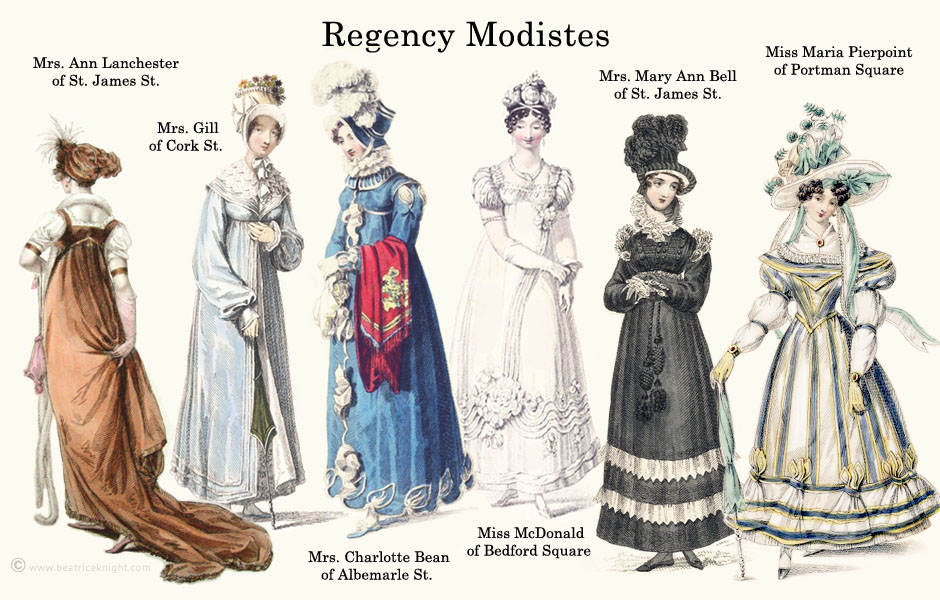
High-End Clientele: They catered to the ton (high society) and wealthy middle-class women seeking the latest styles, with some building famous brands like Madame Lanchester or Miss Pierpoint.
Business & Influence: Successful modistes were savvy entrepreneurs who used fashion plates and magazines to build their brand, though they often faced financial risks from clients.
In essence, a modiste was the Regency equivalent of today’s high-fashion designer and personal stylist, crucial for any woman wanting to be seen as fashionable.
Beatrice Knight in a piece entitled “Fascinating Regency Modistes” tells us, “Fashion was a tough business in Regency London. Most dressmakers labored in anonymity, but a few entrepreneurial women built brands synonymous with high fashion. Success could be a mixed blessing, however.
“Just as today’s A-listers gad about in clothing and jewelry loaned by designers eager for exposure, ladies of the beau monde were the influencers of their era, and many kept up appearances at the expense of the tradespeople who served them. Cutting back was inconceivable to the aristocratic fashionable who fell on hard times, and their unpaid bills could be ruinous. Two of the most celebrated modistes of the era, Madame Lanchester and Miss Pierpoint, were in and out of bankruptcy; others, like Court dressmaker Miss Letitia Collins, simply closed up shop.
“Anyone interested in 19th century fashion will have seen plates published by La Belle Assemblée, Ackermann’s Repository of Arts, the Lady’s Magazine, and Lady’s Monthly Museum, among others. If you were an entrepreneurial modiste running a magazin des modes in London, you might kill to have a design featured in one of these avidly-devoured publications. Who can say if Mrs. Mary Ann Bell would have spent 20 years as a top Regency modiste without her continuous exposure in La Belle Assemblée, which was owned by her father-in-law. “

 “In March 1767, Taylor purchased a 331 acre tract known as the ‘Manor of Chawton’ located approximately 15 miles west of Easton. There he built an impressive two-story Georgian stone house on a bluff overlooking the Lehigh River. He hired carpenters from Philadelphia to erect the home in 1768. This home still stands, identified as the George Taylor Mansion. Tragically, his wife Ann died that year. It is not known where she was buried. Among the possibilities suggested by historians are the new property, in Easton, and the Gallows Hill Cemetery. Taylor leased most of the property out in 1771 and in 1772 appears to have been living with his son, James, who had moved to what is now Allentown, PA.
 “In 1775, he was part of the Pennsylvania delegation. Originally, the delegations were instructed to vote against separation. “When several delegates, including John Dickinson, chose not to vote in favor of the Declaration of Independence on July 4, the Assembly chose five replacements on July 20. They were George Taylor, George Ross, George Clymer, Dr. Benjamin Rush and James Smith, all of whom joined Congress and subsequently signed the Declaration of Independence when the engrossed copy of the document was ready for signatures on August 2, 1776.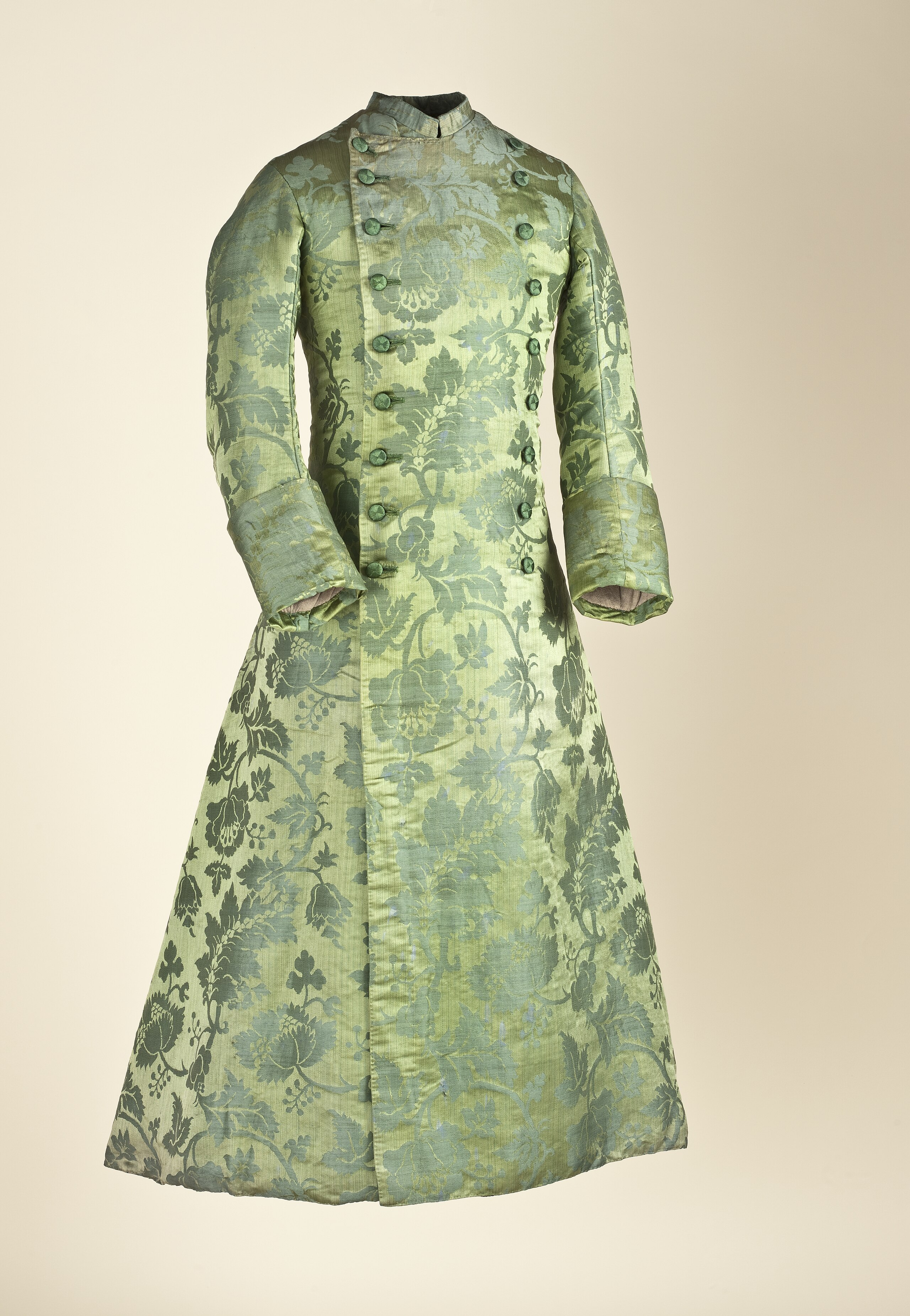
 George was born in May 1730. From his father, young George received a sound classical education. “George’s sister Gertrude married Thomas Till, the son of William Till, a prominent judge and politician; after his death, she married George Read, another signer of the Declaration. Betsy Ross (born Elizabeth Phoebe Griscom in 1752) only had her famous last name “Ross” for 4-years, which she obtained by marrying John Ross (b.1752, d.1776) in 1773. John was a nephew of George Ross. John was the son of Rev. Aeneas Ross (b.1716, d.1782) and Sarah Leach. George and Aeneas were brothers. John and Betsy had a sewing business, but John died 1/10/1776 in Philadelphia by explosion while guarding a munitions building during the Revolutionary War. Betsy would often tell her children, grandchildren, relatives, and friends of the fateful day when three members of a secret committee from the Continental Congress came to call upon her. Those representatives, George Washington, Robert Morris, and George Ross, asked her to sew the first flag. This meeting occurred in her home some time late in May 1776. The Stars and Stripes design Ross may have designed was officially adopted by the congress on June 14, 1777. The next day, June 15, 1777, Betsy married Joseph Ashburn, thus becoming Betsy Ashburn.” (
 “In 1774 he was elected to the provincial conference that would select delegates to attend the General Congress and was selected as a representative of Pennsylvania that same year. Ross continued to serve his provincial legislature and was a member of the Committee of Safety for his colony in 1775. In 1776 he was again elected to the Continental Congress, while serving as a provincial legislator and a Colonel in the Continental Army. His strong stance for the Colonists’ freedom led to his greatest contribution by being one of nine signers of the Declaration of Independence from Pennsylvania. He also undertook negotiations with the Northwestern Indian on behalf of his colony, and took a seat as vice-president of the first constitutional convention for Pennsylvania. He was re-elected to the Continental Congress once more in 1777, but resigned the seat before the close due to poor health. In March, 1779, he was appointed to a judgeship in the Pennsylvania Court of Admiralty. He died in that office in July 1779.”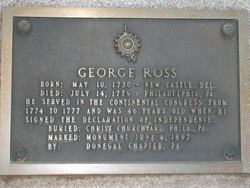
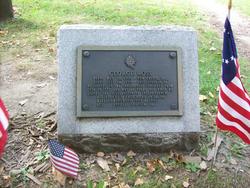 According to Signing Their Lives Away (Denis Kiernan and Joseph D’Agnest, ©2009, page 125), Ross suffered greatly from gout and left politics in 1777. However, his public service did not end. He became a judge of the admiralty court. One of his more interesting cases involved the extent of state rights and federal rights. The case involved the prize money awarded for the capture of the British sloop Active in 1778. Gideon Olmstead led the capture of the Active. Afterward, two privateers joined in the capture to escort the Active to port. When the reward money was paid out, Olmstead only received one-fourth of the funds. The state of Pennsylvania and the two privateers claimed the other portions. Olmstead applied to Congress to right what he thought was a wrong. Congress agreed with Olmstead and ordered Pennsylvania to reimburse Olmstead. George Ross was to see to the outcome, but he disagreed with the Congressional ruling. He refused to overturn his and the state’s decision. This was one of the first cases involving states’ rights, and it occurred even before the British accepted defeat and the U. S. Constitution was signed. In fact, Pennsylvania was not yet a state. Ironically, the final ruling did not come until 1809 when the Supreme Court ruled in Olmstead’s favor.