After Monday’s post on expunging a criminal court record, I had several question on what I meant at the end of the piece, where I mentioned “the benefit of clergy.”
Premit me to first give a brief overview of the situation.
The benefit of clergy was a historical legal practice that allowed clergymen, and later first-time offenders, to escape severe secular punishment by being tried in a church court under more lenient canon law. The primary benefit was avoiding the death penalty, as ecclesiastical courts were less likely to impose it. Over time, it evolved into a way to offer a reduced sentence or a lesser punishment for specific crimes.
Britannica defines Benefit of Clery as benefit of clergy, formerly a useful device for avoiding the death penalty in English and American criminal law. In England, in the late 12th century, the church succeeded in compelling Henry II and the royal courts to grant every clericus, or “clerk” (i.e., a member of the clergy below a priest), accused of a capital offense immunity from trial or punishment in the secular courts. On producing letters of ordination, the accused clerk was turned over to the local bishop for trial in the bishop’s court, which never inflicted the death penalty and frequently moved for acquittal. Later, anyone having the remotest relationship to the church could also claim benefit of clergy. In the 14th century, the royal judges turned this clerical immunity into a discretionary device for mitigating the harsh criminal law by holding that a layman, convicted of a capital offense, might be deemed a clerk and obtain clerical immunity if he could show that he could read, usually the 51st Psalm. Later, a layman was allowed to claim benefit of clergy only once.
The historical context of Psalm 51 is King David’s deep repentance after committing adultery with Bathsheba and orchestrating the murder of her husband, Uriah the Hittite. The psalm is his personal confession to God, written after the prophet Nathan confronted him with his sins, which are detailed in the books of 2 Samuel chapters 11 and 12.
Psalm 51 is a prayer of repentance. The most well-known verses include the opening line, “Have mercy upon me, O God, according to thy lovingkindness,” and the famous request, “Create in me a clean heart, O God; and renew a right spirit within me”. The full text is a prayer of confession and a plea for cleansing and restoration from sin.
Initially, the benefit of clergy was an immunity for church officials accused of a crime, allowing them to be tried in an ecclesiastical court instead of a secular one.
Church courts were generally more lenient and would not sentence an individual to death.
The privilege expanded to any man who could read, and he would read a passage from the Bible, such as Psalm 51, to claim the benefit.
The process eventually evolved into a legal fiction, allowing a first-time offender convicted of a “clergyable” crime to receive a lesser sentence, such as branding or imprisonment, instead of execution.
The privilege was not absolute. It had its limitations. Certain heinous crimes, such as arson, burglary, and later, horse stealing, were specifically made “unclergyable” through acts of Parliament.
The practice was gradually limited and finally abolished in the United Kingdom in 1827. However, it continued to be used in some American states even after its abolition in England.
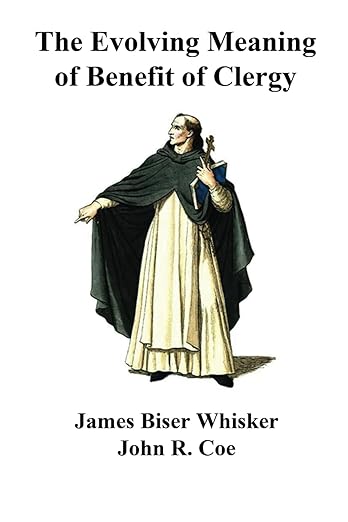
If you wish to know more, you might try The Evolving Meaning of Benefit of Clergy by James Biser Whisker and John R. Coe.