PreOrder Today!!! LEAVE HER WILD: A PRIDE AND PREJUDICE VAGARY + a Giveaway

Today, my latest Jane Austen Fan Fiction story is up for PreOrder for the Kindle release, but it is already available in the print format. In Leave Her Wild, Mr. Darcy has foolishly proposed to Miss Jane Bennet, not realizing the lady is the elder sister of a woman he had met years ago in London, shortly after he had exited his mourning period for his father. The timing of the meeting was all wrong! Darcy was not prepared to marry. And, in truth, Elizabeth was too young at the time ever to have been successful as the mistress of Pemberley. However, that does not stop the “chemistry” between them when they first encounter each other again.

Enjoy this short excerpt from Chapter One, setting up the reason Mr. Darcy has proposed to the wrong Bennet sister.

Darcy stepped down from his coach before Matlock House. It was not often that his uncle summoned Darcy to the estate. After all, Darcy had been master of Pemberley Estate for some six years, but a knot had arrived two days earlier. “Urgent, it had said,” he murmured as he crossed to the entrance to greet the earl’s butler, Mr. Percevale. 

“Welcome, sir,” Percevale said with a bow. 

“I assume his lordship still requires my attendance,” Darcy said with a smile as he handed off his hat and gloves. 

“Yes, sir. I am to show you through to the earl’s study as quickly as you arrived.” 

Darcy smiled easily. His uncle always wished to be done with business quickly. “Then lay on, Macduff, and damned be him that first cries, ‘Hold, enough!’”

“Shakespeare. Very good, sir.” 

He followed the servant up the wide staircase marked with oak balustrades and trimmed with gold plate—so very stately; yet, also so familiar. How often had he and his cousins, the earl’s sons, run up and down these steps? Perhaps more often than Darcy had at Pemberley, at least, as a child. Classical-styles archways marked recessed areas, which sported statues and suits of armor. “History of the family and this part of England,” he thought.

With a knock and a short wait until a voice called, “Come,” his attendance before the earl was executed with ease, as well as familiarity. Seated in a sturdy wooden chair behind an equally sturdy, as well as formidable, desk sat a man who had crafted Darcy’s future, equally as well as had his father, George Darcy. 

His uncle did not look up from the much-crossed letter which rested upon the highly polished mahogany desk. 

At length, Matlock sat back and gestured Darcy to a nearby chair. “Good to see you, boy.” 

As Darcy was the master of one of the largest estates in England, he no longer considered himself a “boy,” but he made no comment. The man before him was the earl who held both George Darcy’s hand, as well as young Fitzwilliam Darcy’s person, when the Darcy family had lost Lady Anne Darcy. Darcy’s mother had passed from complications associated with multiple efforts at childbirth. 

Lady Anne meant to present her husband with another son, but, after a series of miscarriages, she had finally given birth again. Not another son, but a daughter. Darcy’s sister. Georgiana was twelve years Darcy’s junior, and he adored her, but he often found himself the “parent,” rather than Georgiana’s brother. Anyway, Lady Anne had hung on for nearly two years after giving birth to Georgiana, but his mother had never been the same. Weak. Basically bed ridden. No energy. The “light” of Pemberley passed in her sleep before any of them could pronounce a proper farewell, a fact that had haunted both him and his father. 

In those first few years after Lady Anne’s death, the Darcys would all have faltered without the steady hand of the Earl of Matlock on each of their shoulders. It was only after the grief had worked its way through various stages that Darcy had considered how the earl, too, was also in mourning and required someone to support him. Lord Matlock had lost his youngest sister. In that manner, Darcy often felt he had failed the man he greatly admired. 

“A Darcy,” the earl began without further preamble, “has been at the realm of Pemberley for centuries. From father to son throughout your father’s family’s bloodlines. Even when Pemberley was but a small castle guarding this part of Derbyshire.” 

“Should I be prepared to recite a list of ancestors, my lord?” Darcy asked, half in jest and half in confusion, for he was not confident he understood the purpose of his uncle’s statement nor the necessity of this meeting. 

“You were always a superior student,” the earl said. “There is no need for your performance. I hold no doubt you could go back to France with a long list of your ancestors. Instead, read this.” The earl handed over the last page of the paper before him.

“What am I holding?” Darcy asked casually, though casualness was no longer part of his state. 

“A letter from your Cousin Samuel Darcy’s son by Samuel’s second wife. One Bertram Darcy. Do you recall him?”

Darcy read what the earl had shared with him. “I do not understand. Per the original documents, Pemberley is to pass through my father’s line, not Samuel’s. The only way Samuel and his children inherit is if I do not produce a male heir. And later the continuation of male heirs from my son to his and so forth.” 

“This Bertram Darcy assuredly knows that the line of succession passes through you, but he also comprehends that if you do not produce a child to inherit by your thirtieth birthday, Mr. Bertram Darcy may claim one-fourth of Pemberley Estate. He is making his intentions known now, per your father’s will and the original land grant.”

Darcy continued to read and reread the paper he held. “Samuel Darcy produced only daughters by his first wife and only Bertram Darcy by his second. Samuel presented my father with a signed agreement never to claim any of Pemberley. Samuel has been paid an annual annuity in lieu of his claim to the estate, which Samuel uses to finance his archaeological expeditions. This is prime land to which this man aspires, and it sets where we have developed the roads to Lambton and beyond. It would cripple the rest of the estate if we lost that land. Set us back a decade or more.” 

“I do not wish to ask, but is there a female who has caught your eye? A quicker than what you would prefer courtship could cut off Bertram Darcy before you must fight him in court. Even if you produced a female child first, you could prove your wife fertile and that an heir was possible. In my opinion, your agreement with Samuel supersedes this claim by Bertram. However, we must remember, if you produce a male heir, then any minor agreements with Samuel Darcy are no longer in effect. Samuel will lose his annual payment if that is so. Perhaps, he has encouraged Bertram. Moreover, one never knows how the courts will rule in such matters, especially with an estate as large as Pemberley. There is some criticism of late in both Houses of Parliament regarding how the estates have paralyzed all of England beyond the aristocracy and the gentry.” 

Darcy assuredly had planned to marry. Pemberley would require a mistress, but he had always thought he would wait until he was thirty before he sought a match. He would admit, but only to himself, he wanted a love match, just as had been the one shared by his parents. Lady Anne and George Darcy had held each other in deep affection, and, although their love story ended too soon, George Darcy had never considered remarrying. For his father, no other could have been the mistress of Pemberley House, other than Lady Anne. 

“I suppose you are suggesting that I should go to London.”

“At least I was not required to order you to London,” the earl remarked. “You are always quick to recognize a solution.” 

“Hopefully, there are a few potential brides taking in the Short Season. I shall send word ahead to Darcy House. Is either the colonel or Lindale in London? I am a miserable failure without someone to open doors.” 

“You underestimate yourself, my boy.”

“I am assuredly ill-qualified to recommend myself to strangers,” Darcy argued.

Book Blurb and Purchase Links:

Leave Her Wild: A Pride and Prejudice Vagary

A Mandate from His Uncle 

The only reason Fitzwilliam Darcy has come to London for the Short Season is to save his beloved Pemberley. He requires a bride fast. Unfortunately, only a man’s of Darcy’s prideful nature would laggardly think one female is the same as another. Quickly, he realizes he is in love with his betrothed’s hazel-eyed and highly-opinionated sister, and he has proposed to the wrong sister, but propriety demands he must not abandon Miss Jane Bennet. 

Sitting on the Shelf 

After Lydia’s elopement with Mr. Wickham and the family’s ruin, Elizabeth Bennet understands the need for her sister Jane to marry well, but why must Jane bring home the one man Elizabeth both despises and loves? Elizabeth’s one ball…one dance…had been ruined by the man her sister means to marry. Unfortunately for Elizabeth, Mr. Darcy’s opinion remains the marker by which she looks upon all others. Can she deny the tender feelings she carries for the gentleman and silence her traitorous heart? 

Note: The title comes from a quote from the poet Atticus on Instagram. 

Kindle – https://www.amazon.com/dp/B0DQL8CJ2R

BookBub – https://www.bookbub.com/books/leave-her-wild-a-pride-and-prejudice-vagary-by-regina-jeffers?_gl=1*6o8zot*_gcl_au*MTcwMTM0ODc0OS4xNzM1MDUyNzA3

Amazon https://www.amazon.com/Leave-Her-Wild-Prejudice-Vagary/dp/B0DQVFFDQD/ref=tmm_pap_swatch_0?_encoding=UTF8&qid=

Comment below for a chance to win one of FIVE eBook copies available for the giveaway of Leave Her Wild. Winners will be chosen on Saturday, February 8, with the books delivered on February 10, 2025, when the tale goes live as an eBook on Amazon and Kindle Unlimited. Regina will contact the winners by email. Good Luck!

Posted in blog hop, book excerpts, book release, eBooks, excerpt, Georgian England, Georgian Era, giveaway, historical fiction, marriage, Pride and Prejudice, publishing, reading, reading habits, Regency era, Regency romance, Vagary, writing | Tagged , , , , , , , , , , , , , , | 14 Comments

Courtesy Title or Not

Courtesy titles are the bane of all writers dealing with the aristocracy. First and foremost, if you are one of those who cannot keep it straight, I would suggest this link https://www.chinet.com/~laura/html/titles05.html as it contains a good summary, along with the exceptions.

For those of you I have already lost, a courtesy title is a title that does not have legal significance but rather is used through custom or courtesy, particularly, in the context of nobility, the titles used by children of members of the nobility. A courtesy title is used for children, former wives and other close relatives of a peer, as well as certain officials such as some judges and members of the Scottish gentry. This manner of styling a person are used “by courtesy” in the sense that person referred to by these titles do not themselves hold substantive titles. The British peerage system uses a variety of courtesy titles.

For those who write in the JAFF (Jane Austen fan fiction) venue, we consistently find authors who do not understand how Lady Catherine de Bourgh is not addressed as Lady de Bourgh. From the story in Pride and Prejudice, we know Lady Catherine is the daughter of an earl, for her brother (Colonel Fitzwilliam’s father) is an earl. Most JAFF writers refer to Lady Catherine’s brother as the Earl of Matlock because such is what he is called in the 1995 TV serialized version of Pride and Prejudice, but Austen never presents the character this title.

On a side note, it is likely Miss Austen was modeling the family on that of the real-life William Fitzwilliam, the fourth Earl Fitzwilliam, and one of the richest men in the UK. His splendid estate, Wentworth-Woodhouse, was likely to have been one of the models for Pemberley. William Fitzwilliam was known as a kind and just man. He was an influential member of the House of Lords and served for a short time as the Lord Lieutenant of Ireland where he tried, unsuccessfully, to enact an early form of Catholic emancipation.

Now, back to the issue at hand. As the daughter of an earl, Lady Catherine can be styled as Lady + first name. Her husband was a baronet. We know this because he is addressed as “sir.” With Lady Catherine’s obvious demand for rank and one keeping to one’s sphere and polluting the shades of Pemberley, etc., she would not wish to be known by the lesser rank of Lady de Bourgh and the wife of a baronet. After all, a baronet is a “commoner,” not part of the aristocracy. The daughter of an earl is addressed by Lady + first name + last name. The actual rule is: Daughters of dukes outrank all ladies except duchesses, marchionesses, and royalty. Therefore, unless a duke’s daughter marries an actual peer or another duke’s eldest son, she would be able to maintain the courtesy title derived from her father, and be known as “Lady <Firstname> <Husband’sSurname>” or “Lady <Firstname><Husband’sTitle>” (if he is not an actual peer but has a courtesy title). Thus, Lady Catherine, the daughter of an earl, may, in society, be addressed as Lady + Catherine + (husband’s last name) de Bourgh. She is never Lady de Bourgh (although such is certainly her name); yet, the higher title, the one of being the daughter of an earl is chosen to keep her influence in society.

What really messes with some JAFF writers’ minds is “Lady Lucas.” The Lucases are friends of the Bennets. Sir William Lucas is a “sir” because he has been knighted at St James for his service as mayor to the Meryton (We assume it is Meryton, but Austen never tells the reader this.) Having the title of “knight” is not a title which can be inherited by the man’s children. They are more frequently conferred, compared to the grades of the peerage.

The wife of a knight may use the courtesy title of “Lady” before her surname, provided she uses her husband’s surname. For example, the wife of Sir John Smith is Lady Smith.

Now to a number of questions people have sent me of late.

Question #1: I have a grandson of a marquess in my story. He is the younger son of the heir to the marquess. At the time of my story, the marquess has been dead for some years; his eldest son (this character’s father) predeceased him, and the title passed to the older son of the heir, this character’s half brother. In this situation, would the younger son take a courtesy title (Lord Firstname?) I know he would have if the title had passed in the normal way, father to son to son, but his father would have only had the courtesy use of a lesser title of his father, probably an earldom, at his death. I hope this is not too convoluted! I am thinking he wouldn’t be Lord Firstname in this case, but I just was not certain.

Response: Debrett’s peerage has a section on siblings of peers who have special grants of precedency. In all of these cases, a sibling inherited because the father died before the grandfather—before the father himself could inherit.

When the eldest brother succeeds to the peerage, he can request that his siblings be granted the  precedency they would have had if the father had inherited. Though it is called a grant of precedency it really gives the person all the privileges of such rank such as courtesy titles. So, yes, if the younger brother is a half brother on the father’s side, he would have the title of Lord First name.

Valentine Heywood’s book, British Titles: The Use and Misuse of Titles of Peers and Commoners, with Some Historical Notes (1951), tell us when a nephew, a cousin, or other relative not in the direct line succeeds to a peerage, it is customary for  the Sovereign to accord the new peer’s brothers and sisters the style which would have been theirs had their father held the title. There is no certainty about it but, other things being equal, it is the practice generally adopted. It is conferred by a Royal Warrant.

Heywood mentions only ones not in the direct line, but it is often a case a marquess’s son is an earl, and the earl’s oldest son is a viscountcy, but the siblings are plain honourables. If the father dies and the viscount becomes an earl, the brothers remain the same but the sisters can be upped to Lady First name, however, all the siblings generally would be raised to the higher ranks when the brother succeeds as marquess. The children’s mother’s rank and precedence doesn’t change.

Question #2: Once a person had a rank, he/she did not lose it. Correct? Example: Peer has daughters, so they are Lady first name. No sons. So when he dies and the title goes to some cousin, a young woman would not be a Lady anything if she were only a cousin to a peer.  She keeps her title because she was a daughter to a peer, even if he has passed away, right?

Response: Correct. Just because a father died and a cousin inherited, the children of the deceased do not lose their titles. In the mindset of the day, why would anyone not want to show the birth rank of the bride, if he himself does not have a peerage title?

 A duchess who married a tutor when widowed, kept the title of duchess, though such was not strictly legal and was not her legal name at that time. However, socially and in all dealings except with the royal and legal courts, she was a duchess. A man who proposed to the daughter of an earl, marquess, or duke knew what he was getting. It could be a source of pride for the man to show off his wife’s status. Moreover, such was her legal name.

Question #3: I have a character who is being elevated from Earl to Marquess [Marquis, Marquess, etc.], who has an unmarried sister with a dowager countess mother. Now under the earl’s title her address would be Lady Anne. If he is elevated, would that leave the mother still a countess under the earl title? And would the sister, now the only female related to the new title be Lady last name, or still Lady Anne?

Response: Although it is true the sister’s status would not be affected by his elevation, a daughter of an earl and a daughter of a marquis are addressed the same, as Lady First name, with the surname added, depending on the situation. The only way her name would change would be through her marriage to a peer, in which case she becomes Lady Husband’s peerage name.

Posted in British history, customs and tradiitons, England, Georgian England, Georgian Era, Great Britain, history, Jane Austen, Living in the UK, marriage, Pride and Prejudice, real life tales, Regency era, research, titles of aristocracy, tradtions, writing | Tagged , , , , , , , , , , , , , , , , | 6 Comments

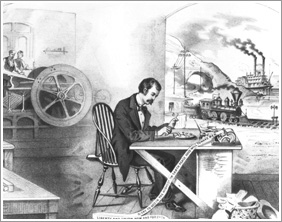
Rapid Growth of Industrialization in America and Britain

See Monday’s post on why Britain and American led the Industrial Revolution.

Freedom: A History of US. Webisode 4: Wake up, America | PBS www.pbs.org Inventions of the Industrial Revolution

Freedom: A History of US. Webisode 4: Wake up, America | PBS
http://www.pbs.org
Inventions of the Industrial Revolution

The cultural differences among America and Britain and many other European nations led to a rapid industrial growth. One thing we saw in America (and not in the other countries) was the well educated upper classes promoted the delving into the sciences. They financed and supported many early advancements, such as the steamboats. 

Business improved in America, not only because of improvements in products, but also in the way correspondence, transportation, finance, and marking were developed. The American workforce created an atmosphere where the business dealings were faster and more financially sound than what was occurring on the European continent in the early 1800s. The key was the fast delivery of products from maker to purchaser. 

Both American and Britain were graced by craftsmen who knew their trades well. However, there was a distinct difference in how these craftsmen performed. In Europe, the craftsmen were highly skilled in only one area. With the American migration and the need for every item in a house or a community to be built from scratch, the craftsmen in the “new world” were more of a jack of all trades than a master. This “mobility” presented the workforce with more options. Instead of only being a furniture maker, a man might build a mill or a watershed or a house. The Americans were not as well educated or trained in their skills, but they knew how to place “a square peg in a round hole.” The built effective (although likely crude) machinery. 

No. 2694: The Second Industrial Revolution www.uh.edu Inspired invention led the charge during the industrial revolution. But science and invention go hand in hand. When intellectually curious inventors discover something by trial and error, they’re led to ask “why?”

No. 2694: The Second Industrial Revolution
http://www.uh.edu
Inspired invention led the charge during the industrial revolution. But science and invention go hand in hand. When intellectually curious inventors discover something by trial and error, they’re led to ask “why?”

Another characteristic which sped the improvement of the industrial outlook was how the American court system favored business enterprises. According to Morton J. Horwitz in The Transformation of American Law 1780-1860 (Harvard University Press, 1979), the initial change came in the form of land deals. The law system did not favor the absentee investors (mainly from England) or the traditional rights of land owners. English and European law was steeped in the idea of primogeniture and inheritance, while American law rested upon the idea of expansion and improvements to the land. In addition, in America guilds and artisan craftsmen associations never found the kind of footing they did in England. Journeymen and apprentices had more freedom to develop their skills. After the Revolutionary War, there was greater protection of investments and less interference accepted as a State right over contracts. 

An connection between business and technical skills grew quickly in the late 1700s with the expansion of America’s western borders into Kentucky, Tennessee, and the like. Urban centers grew because there was a need for men to interact with those who could provide the necessary services. The only thing that could slow the progress was the threat of war and the loss of resources. 

Posted in American History, British history, commerce, Great Britain, real life tales | Tagged , , , , , , , | 1 Comment

America’s and Great Britain’s Impact on The Industrial Revolution

Who would think that at the beginning of the 18th Century that either America or Great Britain would take the lead in industrializing the world? Yet, during the 1700s and 1800s, it was those two nations which sprang forward to claim the roles of leaders. Some authorities believe that Britain was able to achieve what most Europe could not because the feudal system was more entrenched on the Continent than it was in Britain. Others hold with the idea that the geographical locations of the England and the United States created natural lines of transportation. Needless to say, neither the U.S. or Britain was marked by the devastation of war that we found upon the Continent. More believe the two countries had a jump start on France and other European countries with the smelting of iron ore in America and Britain’s coal metallurgy. Perhaps it is a bit of each reason listed above. 

Pix For > Spinning Mule Industrial Revolution pixgood.com

Pix For > Spinning Mule Industrial Revolution
pixgood.com

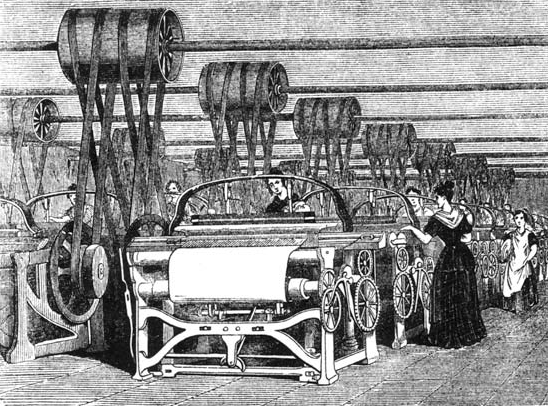
In Great Britain, there is the idea that the mechanization of textile manufacturing created an atmosphere conducive to general industrialization. Yet, history shows us that many other countries mechanized textile manufacturing and then went nowhere fast. The spinning jenny (patented by James Hargreaves in 1770) was a machine for spinning more than one spindle at a time an well used in both America and Britain. While Britain used steam power, in the United States, the mills were located closer to rivers to take advantage of much cheaper water power. 

Yet, it was the prevailing idea in both Britain and the northern coastal states of the U.S. that there was strong traditions shared by both countries and a customary acceptance of innovation in craftsmanship that likely fueled the progress of both countries. “In addition, the necessities of the developing colonies and states enforced a continued emphasis on utilitarian ways of ‘organizing and interpreting…experience,’ one generation after another.” [Thomas C. Cochran, Frontiers of Change, Oxford University Press, 1981]

 File:TM158 Strong Calico Loom with Planed Framing and Catlow's Patent Dobby.png - Wikimedia Commons commons.wikimedia.org


File:TM158 Strong Calico Loom with Planed Framing and Catlow’s Patent Dobby.png – Wikimedia Commons
commons.wikimedia.org

have been crucial. The technological innovations that started the upsurge of industrialization, that is, were congenial to the existing culture and not, as in the case of less-developed nations, exotic imports. While the later Japanese experience might argue that ‘high technology’ industries can be introduced by experienced artisans who have studied foreign machinery, this observation merely adds the corollary that, even if rapidly enlarged, a traditional, indigenous metalworking industry, like Japan’s, was essential to bringing in the age of iron and steel. Since later industrial machines continued to be made of metal, history assures us by hindsight that the metalworking industry was the essential of advanced technology in 1800. The particular needs of future development in an age of chemistry and electronics may not be so clear. Furthermore, the early industrial nations progressed chiefly in response to consumer demands, not by government acquisition of exotic equipment belonging to more developed societies.” [Cochran, page 8]

Posted in America, American History, British history, commerce, Great Britain, Industrial Revolution, Living in the Regency, Regency era | Tagged , , , , | 5 Comments

Marrying During the Regency

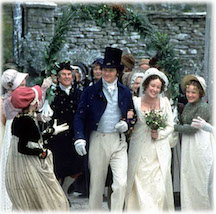
pridewedding1For most of Western history, marriage was a private contract between two families. Until the 16th-century, Christian churches accepted the validity of a marriage on the basis of a couple’s declarations. If two people claimed that they had exchanged marital vows—even without witnesses—the Catholic Church accepted that they were validly married. During the Regency, couples who chose to marry could be joined by several means. Many chose to purchase what was known as an ordinary, common or standard license. Others chose to have what was known as a calling of the banns.  
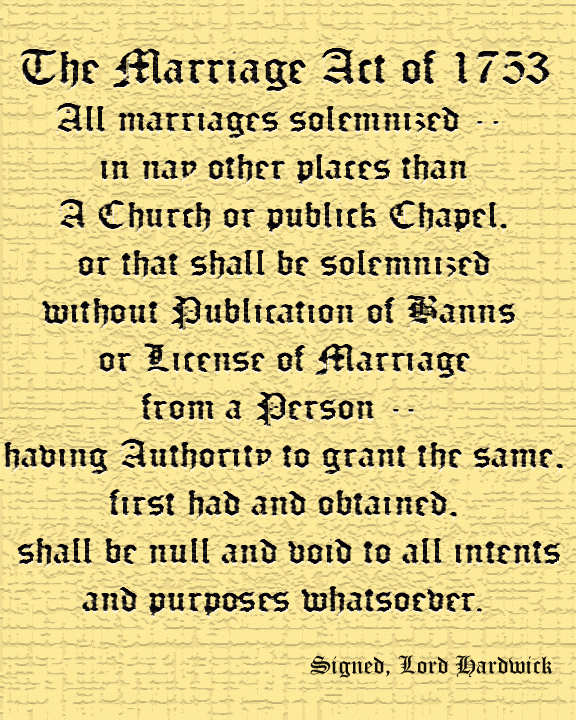
Sharon Lathan tells us, “A wedding could take place on any day of the week. All weddings took place in the parish chapel where at least one of the two persons lived. Per Hardwicke’s Marriage Act of 1753, weddings occurred during canonical hours of eight AM to noon.

“Since most members of the ton could claim London as their residence, and lived in the fashionable districts such as Mayfair, Grosvenor, and St. James, many Regency weddings took place at Saint George’s Church in Hanover Square. From 1725 when St. George’s was established, thousands of weddings were conducted there. In 1816 alone there were 1063 weddings!”

A requirement for  banns of marriage was introduced to England and Wales by the Church in 1215. The banns were a public announcement in the parish church of an upcoming marriage. The banns permitted anyone who objected to the marriage to raise a canonical or civil legal impediment. Such impediments could include a preexisting marriage that was not annulled or dissolved, a vow of celibacy, lack of consent, or the couple’s being related within the prohibited degrees of kinship. 

The banns would be read for three consecutive Sundays and posted in a public place, customarily outside the church door, before the ceremony could take place. The couple would have three months to claim marriage. If they did not marry within that time, another round of banns would be required. 

Marriage licenses were introduced in the 14th century, to permit the usual notice period under banns to be waived, on payment of a fee and accompanied by a sworn declaration, that there was no canonical impediments to the marriage existed.  Originally, licenses were only granted by an archbishop, bishop, or archdeacon. 

The standard or common license did not require a calling of the banns, but the stipulation of marrying within three months still needed to occur. The banns or the license had to come before the service. Everyone who was not a Jew marrying a Jew or a Quaker marrying a Quaker were required to be married in the local parish church of the Church of England. Roman Catholics were supposed to be married first by an Anglican priest before marrying in the Catholic church, but in practice many married in Catholic rites first. However, the marriage was not valid until and unless they married according to the law by a clergyman of the Church of England. All marriages had to be registered in the parish register even if the couple married in a private house by special license. If no one protested the marriage when the banns were read, or at the ceremony when it is asked if any one knows why the two people should not be married, then the marriage could proceed.

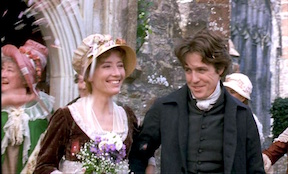
wedding-8-2 “There were two kinds of marriage licences that could be issued: the usual was known as a common licence and named one or two parishes where the wedding could take place, within the jurisdiction of the person who issued the license. The clergyman who administered the ceremony had to be associated with the Church of England. He would issue the licence as a cost of a few shillings to a pound, depending upon the wealth of those applying. The license was valid for 15 days. The couple had the option of marrying in either the parish of the bride or that of the groom. They must be a resident of the parish in which they were to marry. (Do you recall Wickham had to wait to marry to Lydia Bennet until he could establish residency. “We were married, you know, at St. Clement’s, because Wickham’s lodgings were in that parish. And it was settled that we should all be there by eleven o’clock.”) Both the groom and the bride had to make sworn statements that no impediments existed that would cancel their marriage vows.
The other was the special licence, which could ONLY be granted by the Archbishop of Canterbury or his officials and allowed the marriage to take place in any church or even at home. A special licence was more expensive than the common licence: over 20 guineas plus a £4 to £5 Stamp Duty for the paper. As mentioned above,  the couple could be married at any time of the day and anywhere they wanted. All the other requirements were the same.

“To obtain a marriage licence, the couple, or more usually the bridegroom, had to swear that there was no just cause or impediment why they should not marry. This was the marriage allegation. A bond was also lodged with the church authorities for a sum of money to be paid if it turned out that the marriage was contrary to Canon Law. The bishop kept the allegation and bond and issued the licence to the groom, who then gave it to the vicar of the church where they were to get married. There was no obligation for the vicar to keep the licence and many were simply destroyed. Hence, few historical examples of marriage licences, in England and Wales, survive. However, the allegations and bonds were usually retained and are an important source for English genealogy.” (Marriage License)

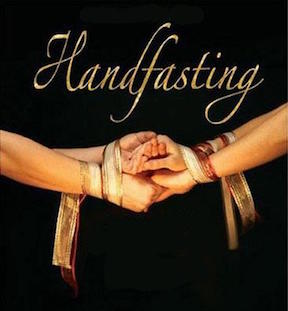
hfThe poor often married without benefit of clergy or ceremony–they just called themselves married and that was that (made divorce a lot easier and possible, too). Needless to say, the Church of England heartily disapproved. The old custom–marriage by cohabitation had been legal before the Hardwick Act of 1753, and there was the even older custom of handfasting–often held with the very poor, particularly since marriage was more about a legal agreement as to the disposition of property and inheritance from a legal alliance. Handfasting is a historical term for  “betrothal” or “wedding.” Handfasting is a history term for “betrothal” or “wedding.” ” In Scottish history of the 16th and 17th centuries, especially in the Hebrides, the term could also refer to a temporary marriage. The verb to handfast in the sense of “to formally promise, to make a contract” is recorded for Late Old English, especially in the context of a contract of marriage. The derived handfasting is for a ceremony of engagement or betrothal is recorded in Early Modern English. [ “handfasting, n.” and “handfast, v.” OED Online. November 2010. Oxford University Press. “Old Norse hand-festa to strike a bargain by joining hands, to pledge, betroth” The earliest cited English use in connection with marital status is from a manuscript of c. 1200, when Mary is described as “handfast (to) a good man called Joseph“. “?c1200 Ormulum (Burchfield transcript) l. 2389 “Ȝho wass hanndfesst an god mann Þatt iosæp wass ȝehatenn.”]

The practice was supposedly common in 16th and 17th centuries Scotland. 

And there is always the distinction between the respectable poor, for whom a proper legal marriage was very important, and the less respectable poor, who would either ignore the law or be ignorant of it. Marriage was never only about property. It was also about morality and respectability, which mattered to the middle class and the respectable poor far more than it did to some of the aristocracy.

In Regency England, one was supposed to use one’s correct name for banns and the license to marry. The interpretation of correct name varied in that one marriage was annulled because, among other things, the banns were called in a boy’s baptismal name, though he was always called by his middle name. When banns were called, clarity and identity were most important. Everyone, especially parents and guardians had to be made aware of the names of those marrying. 

Other Resources: 

BBC.co.uk 

Gretna Green.com 

Historical Handfasting

ThoughtCo

Posted in British history, Church of England, customs and tradiitons, Georgian England, Living in the Regency, marriage, marriage customs, marriage licenses | Tagged , , , , , | 4 Comments

Height in the Early 1800s (or) How Tall Was Mr. Darcy?

Colin Firth is 6’2″

First, let us take a quick look at “height,” in general.

In the early phase of anthropometric research history, questions about height measuring techniques for measuring nutritional status often concerned genetic differences.[“Stadiometers and Height Measurement Devices”stadiometer.com.] 

Height is also important because it is closely correlated with other health components, such as life expectancy. Studies show that there is a correlation between small stature and a longer life expectancy. Individuals of small stature are also more likely to have lower blood pressure and are less likely to acquire cancer. The University of Hawaii has found that the “longevity gene” FOXO3 that reduces the effects of aging is more commonly found in individuals of small body size. Short stature decreases the risk of venous insufficiency.

In the eighteenth and nineteenth centuries, people of European descent in North America were far taller than those in Europe and were one of the tallest in the world. The original indigenous population of Plains Native Americans was also among the tallest populations of the world at the time. Some studies also suggest that there existed the correlation between the height and the real wage, moreover, the correlation was higher among the less developed countries. The difference in height between children from different social classes was already observed by the age of two.

The average height of Americans and Europeans decreased during periods of rapid industrialization, possibly due to rapid population growth and broad decreases in economic status. This has become known as the early-industrial growth puzzle (in the U.S. context the Antebellum Puzzle). In England during the early nineteenth century, the difference between the average height of English upper-class youth (students of Sandhurst Military Academy) and English working-class youth (Marine Society boys) reached 22 cm (8.7 in), the highest that has been observed.

In general, there were no significant differences in regional height levels throughout the nineteenth century. The only exceptions of this rather uniform height distribution were people in the Anglo-Saxon settlement regions who were taller than the average and people from Southeast Asia with below-average heights. However, at the end of the nineteenth century and in the middle of the first globalization period, heights between rich and poor countries began to diverge.These differences did not disappear in the deglobalization period of the two World wars. In 2014, Baten and Blum found that in the nineteenth century, important determinants of height were the local availability of cattle, meat and milk as well as the local disease environment.In the late twentieth century, however, technologies and trade became more important, decreasing the impact of local availability of agricultural products.

Resources for the Above Information Summarized from Other Sources:

Stock, Jay (Summer 2006). “Skeleton key” (PDF). Planet Earth: 26. 

Komlos, J.; Baur, M. (2004). “From the tallest to (one of) the fattest: The enigmatic fate of the American population in the 20th century”. Economics & Human Biology2 (1): 57–74.

Prince, Joseph M.; Steckel, Richard H. (December 1998). “The Tallest in the World: Native Americans of the Great Plains in the Nineteenth Century”NBER Historical Working Paper No. 112

Baten, Jörg (June 2000). “Heights and Real Wages in the 18th and 19th Centuries: An International Overview”. Economic History Yearbook41 (1). doi:10.1524/jbwg.2000.41.1.61

Komlos, John (1998). “Shrinking in a growing economy? The mystery of physical stature during the industrial revolution”. Journal of Economic History58 (3): 779–802. doi:10.1017/S0022050700021161

Komlos, J. (2007). On English Pygmies and Giants: The physical stature of English youth in the late 18th and early 19th centuries. Research in Economic History. Vol. 25. pp. 149–168. CiteSeerX 10.1.1.539.620doi:10.1016/S0363-3268(07)25003-7

Baten, Joerg; Blum, Matthias (2012). “Growing tall but unequal: new findings and new background evidence on anthropometric welfare in 156 countries, 1810-1989”. Economic History of Developing Regions27: 566–585. doi:10.1080/20780389.2012.657489

Baten, Joerg (2006). “Global Height Trends in Industrial and Developing Countries, 1810-1984: An Overview”. Recuperado el20.

Baten, Joerg; Blum, Matthias (2014). “Why are you tall while others are short? Agricultural production and other proximate determinants of global heights”European Review of Economic History18 (2): 144–165.

Matthew Macfadyen is 6’3″

So, how tall was Mr. Darcy? Most authors write him as around six feet in height, with Elizabeth Bennet being a bit on the short side. Perhaps, such has to do with the 1995 PBS series staring Colin Firth (6’2″) and Jennifer Ehle (5’7″), as well as the 2005 film with Matthew Macfadyen (6’3″) and Keira Knightley (also 5’7″).

Bazaar tells us the following:

“When we think of Jane Austen’s Mr Darcy we tend to think of Colin Firth emerging from a lake with a wet white shirt.

“And yet new academic research, commissioned by the television channel Drama ahead of its Austen season, shows that this image of Darcy is likely to be very different from the reality. Unlike the muscular, square-jawed actors who have played him, the character would have been pale with a long face, pointy chin and small mouth.

“The study, led by John Sutherland (Lord Northcliffe professor emeritus of modern English literature at University College London) and Amanda Vickery (professor of early modern history at Queen Mary University of London), looked at Austen’s personal life and relationships to work out who might have been the inspiration for Fitzwilliam Darcy. They then explored the socioeconomic and cultural factors that would have influenced his appearance.

“When Pride and Prejudice was written in the 1790s, square jaws, broad shoulders and muscles would have been associated with labourers, while dainty, refined features were the preserve of the wealthy. So Darcy would have had sloping shoulders, a narrow chest, shapely calves and thighs, pale, powdered hair and a fair complexion. In terms of facial features, he is likely to have had a long nose and a pointy chin. He also wouldn’t have been very tall – around 5’11”, rather than Firth’s 6’2″.

“Mr Darcy is an iconic literary character, renowned for his good looks, charm and mystery. As Austen wrote Pride and Prejudice in the 1790s, our Mr Darcy portrayal reflects the male physique and common features at the time,” Professor Vickery told iNews.

“Men sported powdered hair, had narrow jaws, and muscular, defined legs were considered very attractive. A stark contrast to the chiselled, dark, brooding Colin Firth portrayal we associate the character with today.”

Okay, so I have danced about this subject quite a bit. I love the idea of height, for my father was 6’1′, while my mother was only 5’1″. I was 5’8″ in the 7th grade. All my cousins were short, around 5 foot tall. My uncle was short. My son wanted to be, at least, 6′, but his dad was only 5’11”. Therefore, he is comparable. In professional photos where my husband and I sat side-by-side, they would also ask him to sit on a pillow. I was taller from the waist up than him. LOL!

So here are the facts as we know them for the Regency Period and the late Georgian era.

According to multiple sources on growth studies, the average 18th century male was 5 ft. 5 inches. The English male seems to have stayed at this for the early part of the 1800s.  For some reason, in Ireland, the average was 5’6″. My sources also put Napoleon at 5’6″ or 5’7″ by modern measurement.

Like a lot of different measurements, from inches to miles and leagues, different countries had different numbers. There was no standardization. For instance, a German mile was four British miles. A Spanish League could be a third to half the distance of a British league, depending on the area of the country. French inches were longer than British inches. The British military had a height requirement of 5’6” at the start of the Napoleonic Wars. That became reduced to 5’5” and then 5’4” as the wars went on, which is also true of the France and other nations. 

So…  The armies would not have made 5’6” the first standard if they were going to have any trouble finding men of that height. The average American Civil War soldier was also 5’6”.  As my DNA is composed heavily of Scotland, England and NW Europe, Ireland, Norway, Wales, and Germanic Europe, all I have shared above makes perfect sense. As to Mr. Darcy, well, you must decide for yourself.

Posted in British history, Georgian England, Georgian Era, historical fiction, history, Jane Austen, Living in the Regency, Pride and Prejudice, reading, real life tales, Regency era, Regency romance | Tagged , , , , , , , , , , , | Comments Off on Height in the Early 1800s (or) How Tall Was Mr. Darcy?

A Hodgepodge of Thoughts on What It Meant to Be the “Heir” in Regency England

Regularly, I have a number of people who ask me questions regarding points in the story he/she is writing. Heck, I have a handful of those of whom I ask my questions also. On Facebook, I belong to a group called Regency Kisses: Lady Catherine’s Salon, where questions are the normal, as well as sharing Regency stories and authors.

Keeping that in mind, here goes . . .

Investopedia tells us, “An heir is defined as an individual who is legally entitled to inherit some or all of the estate of another person who dies intestate. Dying intestate means the deceased person failed to establish a legal last will and testament during their living years. In such a scenario, the heir receives property according to the laws of the state in which the property is probated. Heirs who inherit property are typically children, descendants, or other close relatives of the decedent. Spouses typically are not legally considered to be heirs, as they are instead entitled to properties via marital or community property laws.”

Meanwhile, The Law Dictionary tells us, “At common law. A person who succeeds, by the rules of law, to an estate in lands, tenements, or hereditaments, upon the death of his ancestor, by descent and right of relationship. The term “heir” has a very different signification at common law from what it has in those states and countries which have adopted the civil law. In the latter, the term is indiscriminately applied to all persons who are called to the succession, whether by the act of the party or by operation of law. The person who is created universal successor by a will is called the “testamentary heir;” and the next of kin by blood is, in cases of intestacy, called the “heir at law,” or “heir by intestacy.” The executor of the common law in many respects corresponds to the testamentary heir of the civil law. Again, the administrator in many respects corresponds with the heir by intestacy. By the common law, executors and administrators have no right except to the personal estate of the deceased; whereas the heir by the civil law is authorized to administer both the personal and real estate.”

Bayeux Tapestry – Scene 23: Harold swearing oath on holy relics to William, Duke of Normandy. Titulus: UBI HAROLD SACRAMENTUM FECIT WILLELMO DUCI (Where Harold made an oath to Duke William) ~ Public Domain

That is the legal mumbo-jumbo. Below are points to keep in mind when writing about heirs in the Georgian era.

The first boy is usually called the heir though a more legal term might be heir apparent.

Birth notices were something similar to: “The Duchess of Devonshire a son and heir.”

I read somewhere (wish I could remember where) that the male heir could be up to the third cousin.  After that it gets a bit murky. And do not even start on rights of inheritance in Wales and Scotland. 

Monument at Swanscombe commemorating the legend of how Kent successfully managed to protect their rights from subjugation by the Duke of Normandy ~ Wikipedia ~ CC BY-SA 3.0


In stories we usually have the heir or newly minted peer being pressed to marry and have children. The supposition is that if they married, they would have children.

As for why some peers did not marry~another reason was venereal disease, including such situations as his parents were afflicted, and he was born sterile (many had mistresses, but did they have children by these liaisons, or they had contracted it themselves and did not want to pass it on to an unsuspecting bride. [Plot bunnies just raised their ugly heads, did they not?]

The rights of inheritance to peerage of England, Great Britain or the United Kingdom had to follow the rules of England.

Rules of inheritance to other property varied from place to place even within England. There were different rules in Kent for instance.  In Kent the dominant inheritance code was ‘gavelkind’, by which all sons inherited equally. However, the predominant inheritance rule throughout the rest of England in the medieval period and afterwards was male-preference primogeniture, whereby estates passed in total to the eldest son. However, these rules of inheritance were only applied if there was no will, deed, settlement or other document disposing of property. All peerages by patent descended according to the patent. Peerages by writ were dispense by common law heirs general.  If a man with much property died, the various pieces of property could all descend to different people.

If a peerage was 400 years old the hunt for an heir could go back to the younger sons of the original peer.

The peerages were supposed to go straight down the line from father to son. In reality, I would say that a peerages always going directly father to oldest son only happened slightly more than half the time.

It was not at all uncommon for peers who were in the navy to die either without children or without sons.

One would think that a peerage held by a man who had ten children with four or more boys included would be safe from extinction, but that was not always the case.

More than one peerage has descended from uncle to nephew and then to cousins.

I am also surprised at the number of peers who never married. The young man who became the Duke of Devonshire in 1811 was one of them. I have not read any real reason why he never married, though some reasons have been presented:

***One Wikipedia page says that he was devastated when his cousin Lady Caroline married another so never married himself. As he was 21 in 1811 and she married in 1805 or so, such an attraction could be called calf love for a lovely older cousin.

***Another Wikipedia page suggests that he stayed single because he liked the young cousin and his wife who was the  heir. As the heir was in line to succeed to an earldom he would not actually be sending a man into poverty if he had married and fathered a son.

Other reasons given:

***He felt that he was not the son of the Duke of Devonshire so not entitled to the dukedom–though he treated it as his and used the money while he lived so that does not hold water.

***He never felt enough interest in a woman to marry her. There are letters to his mistresses which I have not seen, but that does not preclude him not having a desire to marry.

Reading the peerage or even Wikipedia pages about peers shows that the peers were generally closely related to each other and the aristocracy could be called “the cousins,” providing some stories that could rival my beloved Appalachia.

Question: Can he sit in the House of Lords in place of his sick father? Not unless he is given a writ of acceleration and sent to the House of Lords in one of his father’s baronies. In that case he will sit with the barons and use the baron’s title in the House, but still be a Marquess outside of it and for most questions of precedence.

All heirs have to prove that their pedigree and legitimacy.

When called before the House of Lords, the man has to have the pedigree going back to the ancestor from whom he descends and show all the marriages and legal births in his line. He has to show that the line of the late peer ended and how he is the only legitimate heir around.

The Committee on Privilege of the House of Lords hears all cases of contested claims.

The College of heralds, Bibles, letters, parish registers and living people’s memories can be accepted as “evidence” in such cases.

An American could assume the title. However, if he were an American citizen he did not assume a seat in the House of Lords and at various periods there were laws against aliens owning property, so what property could go to him would probably be fought over.

He could, however, ask to be naturalized.

Americans could always inherit the titles. The peerage law made the point that whoever was next in line was the absolute owner of the title. However, the American either took up the title or it went dormant and no one could have it in his place unless he or his father had been attainted for treason of something. (think “The American Revolutionary War”).

Some Australians have been eligible for a title for nearly a century. The title is still dormant, no one else can have it, but the property has long since been handled by others. 

US law said no citizen could be granted a title by a foreign government without permission of Congress but succession to it was not the same thing.

It didn’t much matter if any one took up the title or not as a title was not real property.

What mattered was the property and that was a more complicated story.

One story I read had an American captain who had fought against Great Britain succeeding to a title and walking into the House of Lords. If he was English enough to be entitled to sit in the House of Lords he was a traitor for fighting against the country. If he was American and therefore not a traitor, then he could not be brought before the House of Lords as the heir.. 

Having the title without the land was just being able to be called “My lord” instead of “Mr.” It was a social title and position. The title without anything else was to what Americans could succeed.

The seat in the House of Lords and property went to natural citizens and some naturalized ones.

Dual Citizenship did not exist in those days as far as I have been able to discover. Correction welcome. Except for USA which allows citizenship to any born inside its borders. For the most part diplomatic corps took their nationality with them and a child born to a diplomat in a foreign country was considered as born at home. The father’s domicile was still England, though his residence was in a different country.

A man could live for decades outside of England and yet have his main domicile be England as long as he did not become involved in politics against England or apply for naturalization.

Could those who come to this side of the pond live and work or do otherwise in Canada or some of the British possessions? Yes. There would be no problems with Canadians.

The US and Great Britain fought a couple of wars against each other and people of the US were considered aliens. If a subject of the king stayed on after the revolution and took part in the new country he was considered as having changed his allegiance. It cost several an inheritance. Naturalization took what ever time it took for a private Act of Parliament when it was in session.

Arms of the Lords Fairfax of Cameron, also adopted as the arms of Fairfax County, Virginia ~ Public Domain

A quick read of how it all came to pass on Wikipedia.

Americans could hold British titles — the title of Lord Fairfax of Cameron was held by Americans for several generations starting in 1798.

The title was somewhat forgotten by the family except as a curiosity until one of the heirs returned to England and was confirmed in the title in 1908:

The man in 1798 had not renounced his British citizenship so was not really an American. The one in 1900, became a  British subject. However, despite the fact that the men did not claim the peerage while it was forgotten by their heirs, it remained dormant  as no one else could claim it. When the man in 1900 decided to claim it, he had to prove he was next in line as did everyone else who claimed a peerage. Sons succeeding fathers merely had to prove that they were born after the parents married. 

They had to trace their legitimate lineage back to the last known peer or to the first one if not a direct descendant of the last one.

When it came to property, it could go back to the female line. Most estates were made up of several small pieces of land as well as the major one. Some had secondary peerages as well. The marriage settlement of the  next to last countess might have said that her property went back to their family if no direct descendant lived, or it could go to a female.

They could NOT, however, sit in the House of Lords. I think they probably managed to take the entailed property that went with the title because that only gave the man a life interest in it. If so, he would be required to marry quickly and have a son born in England.

Citizenship was also complicated by the fact that once a woman married, she assumed the citizenship of her husband. That was the case in the US until sometime in the 20th century. My great-great grandmother’s US passport application in the late 19th century stated she was a US citizen by virtue of her marriage to her husband who had been born in the States.

Posted in Act of Parliament, American History, British history, customs and tradiitons, England, family, Georgian England, Georgian Era, history, laws of the land, Living in the Regency, Living in the UK, peerage, primogenture, Regency era, research, Victorian era | Tagged , , , , , , , , , , , , , , , , , | 2 Comments

What Did a Child of the Aristocracy and Gentry Eat During the Regency Era?

One thing I think ti is important to remember is English children of the aristocracy and gentry classes were traditionally fed their main meal, meaning, usually the meal with meat, in the middle of the day. Such is when most households had dinner, the idea dating back to the time Henry VIII or, perhaps, before. Henry VIII is said to have had his dinner at 11:30 A.M. Children’s meals remained settled at this time of day, even as the adult meal shifted into the afternoon and evening.

During the medieval period dinner was eaten at midday, but this meal was slowly moved up to 3 in the afternoon, then pushed up to five. These meals became elaborate affairs of at least two or three courses, which Louis Simond, a French/American traveler to London, described in wondrous detail in his travel diary. During Jane Austen’s time tea would be served an hour or so after the meal, or from 3-6 o’clock, depending on when dinner was served. Suppers became light snacks, except in the case of a grand ball, where elaborate buffets might be served. From Jane Austen’s World, we learn . . .

“At Chawton, Jane Austen’s own especial duty concerned breakfast. We can imagine her insisting on sharing at least some of the housekeeping duty with Cassandra, and Cassandra’s giving way over breakfast but insisting that Jane had the rest of day free for writing. Breakfast in Austen’s era was very different from the cold meat, coarse bread and ale of earlier ages, or the abundance of eggs, kidneys, bacon and so forth under which Victorian sideboards groaned. Rather it was an an elegant light meal of toast and rolls with tea, coffee or chocolate to drink, all taken off a handsome set of china. Jane’s job would have been to make the toast and boil the kettle at the dining room fire. Like many ladies, not trusting to clumsy servants, she may even have washed and dried the china, and put it away, together with the precious tea and sugar, in a dinning room closet.

In 1798 Jane Austen writes of half past three being the customary dinner hour at Steventon, but by 1808 they are dining at five o’clock in Southampton. There are many mentions of the timing of dinner in the novels, but none is so explicit as in the fragment The Watsons. Tom Musgrave knows perfectly well that the unpretentious Watson family dine at three, and times his visit to embarrass them, arriving just as their servant is bringing in the tray of cutlery. Tom compounds his rudeness by boasting that he dines at eight: the latest dinner hour of any character. At Mansfield Parsonage they dine at half past four and at Northanger Abbey at five. The effect of London fashion can be seen in the difference between the half past four dinner at Longbourn and that at half past six at Netherfield.” – Jane Austen in Context, Janet Todd, p. 264

Children, at least, the ones in one of the typical Regency upper classes, did not typically eat with adults. They were fed by nannies or nursemaids in the nursery. Their meals remained stable, probably because it was just easier that way. A nursery tea, therefore, was the children’s meal just before bath and bed–or just bed in the earlier periods when a daily bath was not considered next to godliness. Whether they called it “tea” or not in Regency times, I do not know—perhaps originally it was “supper.” Although Etymology.com attests to the use of the word earlier, I have never seen any reference to the children’s meal being a “snack” at any time, and, it seems to me, using “snack” might bring out the reviewers who love to ding an author for using a modern word in a historical story. (Just saying . . .) The English use the word ‘”tea” for a meal, as well as a simple noun for a beverage.

Use of “snack” is in period – http://www.etymonline.com/index.php?term=snack

verb – The meaning “have a mere bite or morsel, eat a light meal” is first attested 1807.

noun – Main modern meaning “a bite or morsel to eat hastily” is attested from 1757.

On the American continent we had what was called “cambric tea.” It is said cambric tea was first noted in the Scottish settlers, but we all know it could have been from any hard-working group settling a new country. According to CulinaryLore, “Cambric tea, sometimes called ‘nursery tea’ was hot water and milk, was an American slang term referring to a drink of hot water, milk, and a dash of tea, sometimes sweetened. It is also described as hot water with a little milk or cream and sugar, without any tea at all. It was given to children, supposedly to give them energy, or to help them feel grown up during tea time. It was also often served to the elderly. Cambric tea got its name from cambric fabric, which was white and thin, just like the tea. Cambric fabric gets its name from the French town of Cambrai, a textile center. Cambric tea was popular during the late 19th to early 20th centuries. It was also known as white tea, or hot water tea.” (Culinary Lore) As a small child, I recall have cambric tea with my great-grandmother, who also swore the tea was a way of fighting off the afternoon hunger every child experiences. She would sit with me, and we would have cambric tea together. Children were given cambric tea, which consisted of a scant spoon of sugar, a teaspoon or so of tea (poured from the pot, just like an adult’s) and then filled to the brim with warm milk. 

For more information on English meals, there is a good overview of the history of “tea” as a social function here – http://www.foodtimeline.org/teatime.html

Tea as a social even (as in tea time) really start off more in the 1830’s and becomes the more formal affair in Victorian and Edwardian times. During that later era “tea” became the working class meal as well.

You can find recipes for “nursery tea” online with lots of milk, sugar, and vanilla–basically a way to add a little more nutrition to a child’s tea. In Regency era, children often took their meals in the nursery and not with the family–so they might have nursery tea with their dinner. However, remember tea in Georgian and Regency time tea was still more of a beverage to be served as a possible refreshment to callers–or a beverage for late in the evening along with possibly some cakes or a light snack type meal before bed, but not so much a social event as in afternoon tea.

Also, if you’re looking for the children in a household to have something, it would not be too out of the ordinary for cook to have a treat for them–hot pastries or biscuits (the English version of cookies) or cakes. A child might well eat in the kitchen in a household that is not too formal.

Generally, in England, according to one of my close British friends, who tells me something of raising her children in England, “Nursery tea was the final meal for children during the day. They had a proper meal, dinner, at what we call lunch time. Nursery tea was half tea/half milk, bread and milk, and usually some cake for afters. I couldn’t restrain comment on my opinion of sending children to bed on nothing but milk and starch, and discovered that when my children were invited for tea at someone else’s house I was always assured that it would be an “egg tea,” meaning the children would have a boiled egg as well.

“This was of course long after the Regency and even the Victorians! But I would expect it was one of the meals that changed little. Probably since tea was so expensive it would be only a taste of tea or perhaps none at all–or some herbal tea. But I would believe that the base would most likely be bread and butter for the comfortable middle class and much the same for the wealthy–except perhaps in the north of England, Ireland, and Scotland, where oats were more commonly available than wheat, and then it would be a dish of porridge.”

Nursery tea” would then, in my opinion, most likely refer to a very simple meal, and it would probably be Victorian or possibly late Regency period, because it was only then that the grownups–the ladies!–started drinking tea in the afternoon. At that period, as I understand it, people routinely went from breakfast to dinner without eating in the meantime, except for “snacks” that eventually became known as elevenses and tea (as a time to eat, not a beverage). It was the advancing hour of dinner, from 5-6, which it was generally in the 18th century, to later in the day that gradually re-established the mid-day meal which had been called dinner before it moved later and later. In the days when dinner as the main meal was mid-day, there was supper in the evening.  Nursery tea, therefore, could be considered an adaptation of supper for children!

https://englishhistoryauthors.blogspot.com/2018/06/life-in-regency-era-nursery.html

Regency Redingote tells us, “Breakfast had been introduced into the beginning of the English day in the first decades of the eighteenth century. It was exactly what its name would suggest, the meal by which the fasting of the nighttime was broken. By the decade of the Regency, breakfast was well-established as a light morning meal. It usually consisted of bread, often toasted, or rolls with jam, preserves or marmalade, eggs and perhaps ham or bacon. Tea, coffee and chocolate were common beverages served with this meal, but ale was also part of many a gentlemen’s breakfast.

“. . . since up to the years of the Regency, lunch, or luncheon, was not a regular meal in England. The words “lunch” and “luncheon” entered the English language at the end of the sixteenth century, but with the meaning of a lump of bread or cheese. The words “nunch” and “nuncheon” are much older words which entered the language in the fourteenth century, when they had the meaning of a light snack between meals, usually accompanied by a drink. But none of these words had yet been chosen as the name for a meal which was taken between breakfast and dinner.

“As you might imagine, many people, particularly ladies, found it difficult to go from breakfast to dinner without sustenance. In the decade prior to the Regency, ladies of the leisure classes began to take a light meal around 1 o’clock, usually alone or with immediate family. Typically, this was a repast of cold dishes, usually bread, meat, cheese and fruit. Wine, tea or coffee were the most common beverages served at the meal, but seldom were beer or ale on the table. By the Regency, many ladies of the beau monde in the cities were sharing this meal as a social occasion, men seldom partook. It was during these years that this midday meal was christened lunch or luncheon, luncheon being the more upper-class and socially-acceptable term. Nuncheon was a term for the mid-day meal of the lower classes.”

Yet, I have again digressed. From The Cook’s Complete Guide on the Principles of Frugality, Comfort, and Elegance (1810), we learn . . .

For more of what was used for some receipts for different infant food, as well as some other interesting pointers for infant and children diets, check this article on Regency Reader.

Posted in America, British history, family, food, Georgian England, Georgian Era, history, Jane Austen, Living in the Regency, Living in the UK, real life tales, Regency era, research | Tagged , , , , , , , , , , , , , | 3 Comments

The Hanging of Minors in the Regency Era

I recently received a question from a reader who had seen something in another book about a young child being hanged for a crime, and the person wondered if such was true.

Unfortunately, such was true, but it was not as widespread as one might think. I do know that right before the Regency began there were an inordinate number of hangings in 1802 and 1803. In the uneasy peace between 1802-1803, when the Navy was half-decommissioned and even the old, rotting hulks in the Thames were full of ‘criminals’, there were more hangings than normal. Navy ships were being used to protect privateers from the French and in Egypt still to stop French takeover, as well as, in Ireland to put down the Emmet rebellion. So with the prisons overflowing and not enough ships to transport convicts here to Australia, there was a greater tendency to hang people for minor crimes – even children, though the trials were presided over by judges and all was not simply a riot itself.

On a side note, for those of you unfamiliar with the Emmett Rebellion, or better known as the Irish rebellion of 1803, it was an attempt by Irish republicans to seize the seat of the British government in Ireland, Dublin Castle, and triggered a nationwide insurrection. Renewing the struggle of 1798, they were organized under a reconstituted United Irish directorate. Hopes of French aid, of a diversionary rising by radical militants in England, and of Presbyterians in the north-east rallying once more to the cause of a republic were disappointed. The rising in Dublin misfired, and after a series of street skirmishes, the rebels dispersed. Their principal leader, Robert Emmet, was executed, while many simply went into exile.

Hanging was a very pubic and very gruesome practice. Quite often a person would be brought before the jury and charged with the theft of an item worth more than 40 shillings. The grand jury would indict for a lesser value and the trial jury would often convict of a still lesser sum. If someone took a dress or cloak off a line, the value would probably be cut down to something like 10 shillings so the criminal would be transported or spend a few months in prison rather than to be hanged.

However, there were no real public prosecutors so if a shop keeper or a homeowner wanted to make an example of a child or a man he could press forward with his claim more diligently. Many just wanted that person stopped from stealing and an example made, but they were particularly anxious to have anyone hanged.

Many of the children brought to trial were not of the London underworld, but were just poor wretches caught up in something they did not truly understand.

Children were expected to know right from wrong by age SEVEN. However, while a child of seven could be executed for a crime, a child of that age was seldom allowed to be a witness because of lack of credibility.

Thinking themselves merciful, those accused were made to “read” Psalm 51:1 to be saved from hanging, that is, if the offense still provided for the benefit of clergy. The illiterate class often taught the verse to those who could not read in order to save someone from hanging. Even small children could be made to “recite” it.

 Psalm 51:1 – “Have mercy upon me, O God, according to thy loving kindness; according to the multitude of thy tender mercies, blot out my transgressions.”

Many of the adults were not at all stoic when it came to be hanged. Grown men broke down and cursed, sobbed, and in other ways made a scene. Some of the children might have been too frightened to move. Children often were not heavy enough to break their necks with the jerk. It was hard to hang children because the rope was too think and the children were too light. Quite a few were  sent off to Australia instead or had their sentences made lighter by an appeal to the King (really to the Home Secretary)  if there was anyone to care. Though the number of people hanged was high, it was only a percentage of those sentenced to death. The Benefit of Clergy privilege (all those who could read  or quote the “neck verse”) plus pardons, and commutations of sentences reduced the number of those actually hanged. 

Quite often a person would be brought before the jury charged with the theft of an item worth more than 40 shillings. The grand jury would indict for a lesser value, and the trial jury would  often convict of a still  lesser sum. If someone took a dress or cloak off a line, the value would probably be cut down to  something like 10 shillings so the criminal would be transported or spend a few months in prison rather than be hanged.

However, there were  no real public prosecutors so if a shop keeper or a homeowner wanted to make an example of a child or a man he could  press forward with his claim more diligently. Many just wanted that person stopped from stealing and an example made but weren’t particularly anxious to have anyone hanged.

An excellent source is http://www.daviddfriedman.com/Academic/England_18thc./England_18thc.html

Other Resources:

Jane Austen World has an excellent article on the “spectacle” of a public hanging, which included vendors selling wares to the gathering crowd, as well as the adverts announcing events. Check out: Regency Crime

Georgian and Regency Britain provides us a Regency Guide on How to Behave When Being Hanged

Geri Walton provides us with a piece on Georgian Era Executions: What They Were Really Like

Historic UK provides us A History of Hanging

An excellent source on the private prosecution of crime can be found at this link: http://www.daviddfriedman.com/Academic/England_18thc./England_18thc.html

Posted in British history, Georgian England, Georgian Era, history, Living in the Regency, real life tales, Regency era, research | Tagged , , , , , , , , | 2 Comments

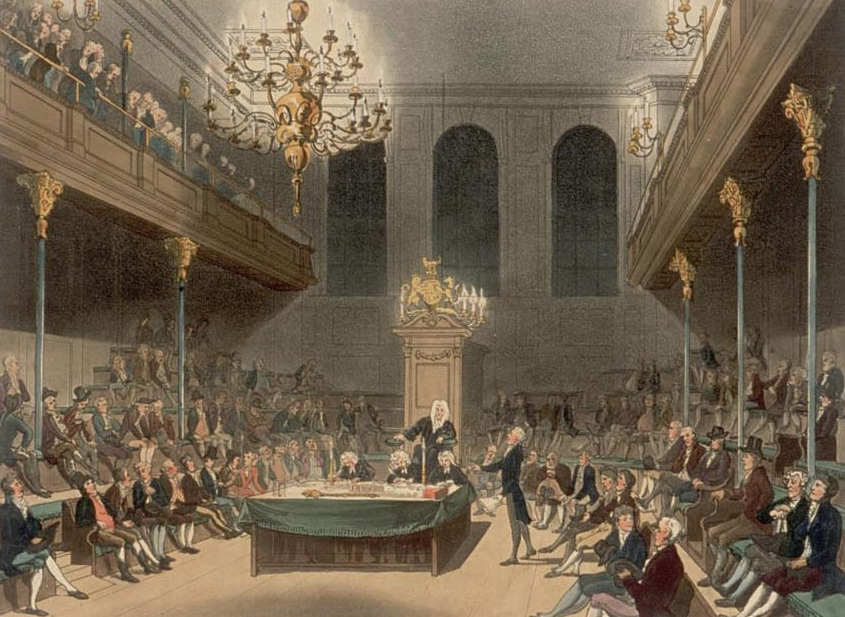
The House of Commons During the Regency Era

Often when one reads a Regency tale, the hero is a “lord” of some kind and sits in Parliament in the House of Lords, but what happens if the hero is, say, a younger son or a man like Mr. Fitzwilliam Darcy, who has a fortune and owns a great deal of land, but has no title? That is where the House of Commons comes in. Where the House of Lords was filled by a men with titles, the House of Commons could be filled with younger sons of said lords, or gentlemen, or members of the gentry.

The House of Commons is the lower house of the Parliament of the United Kingdom. Like the upper house, the House of Lords, it meets in the Palace of Westminster in London, England. The House of Commons is an elected body consisting of 650 members known as members of Parliament (MPs), who are elected to represent constituencies by the first-past-the-post system and hold their seats until Parliament is dissolved.

The House of Commons of England began to evolve in the 13th and 14th centuries. In 1707 it became the House of Commons of Great Britain after the political union with Scotland, and from 1801 it also became the House of Commons for Ireland after the political union of Great Britain and Ireland.

Although the House of Commons does not formally elect the prime minister, by convention and in practice, the prime minister is answerable to the House, and therefore must maintain its support. In this way, the position of the parties in the House is an overriding importance. Thus, whenever the office of prime minister falls vacant, the monarch appoints the person who has the support of the house, or who is most likely to command the support of the house—normally the leader of the largest party in the house—while the leader of the second-largest party becomes the leader of the Opposition.

The Commons may indicate its lack of support for the government by rejecting a motion of confidence or by passing a motion of no confidence. Confidence and no confidence motions are phrased explicitly: for instance, “That this House has no confidence in His Majesty’s Government.” Many other motions were until recent decades considered confidence issues, even though not explicitly phrased as such: in particular, important bills that were part of the government’s agenda. The annual Budget is still considered a matter of confidence. When a government has lost the confidence of the House of Commons, the prime minister is expected either to resign, making way for another MP who can command confidence, or request the monarch to dissolve Parliament, thereby precipitating a general election.

The British parliament of today largely descends, in practice, from the Parliament of England, although the 1706 Treaty of Union, and the Acts of Union that ratified the Treaty, created a new Parliament of Great Britain to replace the Parliament of England and the Parliament of Scotland, with the addition of 45 MPs and sixteen Scottish representative peers. Later still the Acts of Union 1800 brought about the abolition of the Parliament of Ireland and enlarged the Commons at Westminster with 100 Irish members, creating the Parliament of the United Kingdom of Great Britain and Ireland.

The Middle English word common or commune, which is derived from the Anglo-Norman commune, meant “of general, public, or non-private nature” as an adjective and, as a substantive, “the common body of the people of any place; the community or commonalty” in the singular; “the common people, the commonalty; the lower order, as distinguished from those of noble or knight or gentle rank”, or “the burgers of a town; the body of free citizens, bearing common burdens, and exercising common rights; (hence) the third estate in the English constitution; the body of people, not ennobled, and represented by the Lower House of Parliament” in the plural. [Oxford English Dictionary. Second edition, volume III: Cham – Creeky. Clarendon, Oxford 1989, pp. 564–567]. The word has survived to this day in the original Anglo-Norman phrase soit baillé aux communes, with which a bill is transmitted from the House of Lords to the House of Commons. [Companion to Standing Orders UK Parliament]

Observations on the House of Commons During the Regency:

**I do not believe the MPs had offices, but I would be happy if someone else could prove me wrong. Remember, most of the MPs were aristocratic younger sons. Most members of the House of Commons were gentlemen. They might go en mass to Parliament from their club with their chums, almost all of whom served. For most, serving was more of a hobby than a responsibility to their country.

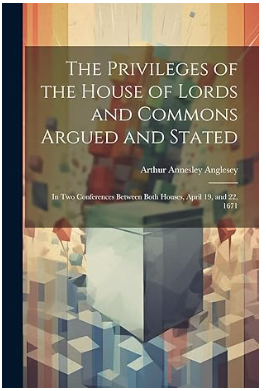
As a point of reference, I found this book had some merit in answering my questions on the House of Commons, but there are not any I have discovered that would provide me the information I might need as a writer of historicals set in the early 1800s.

This is a historical account of two important conferences held between the House of Lords and the House of Commons in April 1671. The book examines the privileges and rights of both houses of parliament, and provides a fascinating insight into the political and legal structures of seventeenth-century England.
This work has been selected by scholars as being culturally important, and is part of the knowledge base of civilization as we know it. ~ It is in the public domain.

**You did know that because these were, for the most part, idle rich who slept so late that Parliament did not begin until late afternoon?

**A parliamentary borough was a town or former town that had been incorporated under a royal charter, giving it the right to send two elected burgesses as Members of Parliament (MPs) to the House of Commons. It was not unusual for the physical boundary of the settlement to change as the town developed or contracted over time, for example due to changes in its trade and industry, so that the boundaries of the parliamentary borough and of the physical settlement were no longer the same.

**For centuries, constituencies electing members to the House of Commons did not change to reflect population shifts, and in some places the number of electors became so few that they could be bribed or otherwise influenced by a single wealthy patron. In the early 19th century, reformists scornfully called these boroughs “rotten boroughs” because they had so few inhabitants left, or “pocket boroughs”, because their MPs were elected by the whim of the patron, thereby being “in his pocket”; the actual votes of the electors were a mere formality since all or most of them voted as the patron instructed them, with or without bribery. These were often referred to as “rotten boroughs” or “pocket buroughs.”

**Among the most notorious of these “rotten boroughs” were Old Sarum, which had only six voters for two MPs, and Dunwich, which had largely collapsed into the sea from coastal erosion. At the same time, large cities such as Manchester received no separate representation (although their eligible residents were entitled to vote in the corresponding county seat). Also notable were the pocket boroughs, small constituencies controlled by wealthy landowners and aristocrats, whose “nominees” were invariably elected.

**In the 17th century Members of Parliament (MPs) were often elected against their will. On 2 March 1624, a resolution was passed by the House of Commons making it illegal for an MP to quit or willfully give up his seat, though I have had others tell me this was an incorrect assumption, so if you wish to know yea or nay, then check the specific time period. However, under the constitutional Act, the Act of Settlement of 1701, and subsequent legislation, any Member of Parliament accepting an office of profit under the Crown would be disqualified from his or her seat. This became the basis for the current legal practice of using sinecure posts such as the Chiltern Hundred to effect resignation.

**It did not matter if the borough is full of corrupt politics or not. All elections were official and set by the government. A parliament was generally about 7 years, but sometimes there needed to be an election between those dates because the prime minister died, the king died, or the member from a county or borough died. A member could nor resign his seat. Voting took several days and was in the open—no secret ballot. Before taking his seat in the House of Commons — or House of Lords  for that matter– the member had to take an oath of allegiance to the king and opposing the Pope and Roman Catholic religion.

The House of Commons in the early 19th century by Augustus Pugin and Thomas Rowlandson.~ Public Domain

**There were some by-elections when a man died or succeeded to a peerage. William Pitt the younger might even have been a minor when he was first elected to the House of Commons. In any event he was young and was prime minister at 24. 

**The young man’s father or his uncle or his mother’s brother or his mother’s uncle probably had a borough under his control. There were quite a few of these in Cornwall alone. These rotten boroughs were safe seats for sprigs of the aristocracy.

**Earl Spencer sent his oldest son into politics in the House of Commons. The father could be on some committees and hire the son to be a clerk. Some young men preferred learning to manage the estates to playing politics.

**Would he be geographically restricted in running for a seat? Like Congress? No. They were not restricted to the county in which they lived.

** Unless one is dead or is made a peer, one could not resign from the House of Commons. One had to say one was taking the Chiltern Hundreds to resign from the House of Commons between elections. 

**First off, a seat in the House of Commons was a lifetime position, and there were MPs who found themselves therein against their will and until the early 1700s, they could not resign.

**Things changed in 1701 with the Act of Settlement (and some subsequent legislation) which made it illegal for any MP who accepted an office of the Crown for profit to remain in the House of Commons. I think it was John Pitt who first used this mechanism to resign – i.e., taking the Chiltern Hundreds. Pitt used the Place Act of 1742.

**The Chiltern Hundreds refers to the three ‘hundreds’ (administrative areas in Buckinghamshire) of Burnham, Desborough and Stoke. These ‘hundreds’ (the whole country was divided into ‘hundreds’ for administrative purposes), are located around the geographical area known as the Chiltern Hills. Note that only Desborough was actually in the Chiltern Hills. Anyway, the Crown office for profit involved in the Chiltern Hills instance was the (by then) nominal post of Crown Steward and Bailiff of the three Chiltern Hundreds of Stoke, Desborough and Burnham. But at this time, an MP could also resign from the House of Commons if he was given the Stewardship of the Manor of Old Shoreham (about a dozen MPs used this one in the latter half of the 18th century), and in the mid 19th century, the Stewardship of the Manor of Hempholme was used, as have a number of offer Crown offices from time to time. 

**A ‘Parliament’ refers to the full term served by an elected government (after a national election to fill all seats in the House of Commons).  

**A new Parliament does not commence if a sitting member dies (or a member succeeds to a title and leaves the House of Commons to take his seat in the House of Lords). In those cases, a by-election is held to fill the casual vacancy, but it does not ‘re-start’ the life or term of the Parliament.  

Posted in Act of Parliament, British history, customs and tradiitons, Georgian England, Georgian Era, history, Living in the Regency, Living in the UK, research | Tagged , , , , , | Comments Off on The House of Commons During the Regency Era