What Does Your eBook Reader Tell Publisher About Your Reading Habits?

What Does Your eBook Reader Tell Publishers About Your Reading Habits?

IT TAKES THE AVERAGE READER JUST SEVEN HOURS TO READ THE FINAL BOOK IN SUZANNE COLLINS’S “HUNGER GAMES” TRILOGY ON THE KOBO E-READER—ABOUT 57 PAGES AN HOUR. NEARLY 18,000 KINDLE READERS HAVE HIGHLIGHTED THE SAME LINE FROM THE SECOND BOOK IN THE SERIES: “BECAUSE SOMETIMES THINGS HAPPEN TO PEOPLE AND THEY’RE NOT EQUIPPED TO DEAL WITH THEM.” AND ON BARNES & NOBLE’S NOOK, THE FIRST THING THAT MOST READERS DO UPON FINISHING THE FIRST “HUNGER GAMES” BOOK IS TO DOWNLOAD THE NEXT ONE.

18mk9bcjcf1qtjpgFor centuries, reading has largely been seen as a solitary and private act, an intimate exchange between the reader and the words on the page. But the rise of digital books has prompted a profound shift in the way we read, transforming the activity into something measurable and quasi-public.

In the past, publishers and authors had no way of knowing what happens when a reader sits down with a book. Does the reader quit after three pages, or finish it in a sitting? Do most readers skip over the introduction, or read it closely, underlining passages and scrawling notes in the margins? Now, e-books are providing a glimpse into the story behind the sales figures, revealing not only how many people buy particular books, but how intensely they read them.

The perfect man, according to data collected by digital publisher Coliloquy from romance-novel readers, has a European accent and is in his 30s with black hair and green eyes.

To learn more about how “Big Brother” is watching another facet of our lives, please visit Alexandra Alter’s article on The Wall Street Journal at http://online.wsj.com/article_email/SB10001424052702304870304577490950051438304-lMyQjAxMTAyMDIwODEyNDgyWj.html

Posted in eBooks, reading, reading habits | Tagged , , | 6 Comments

Do You Speak Jane Austen? Part One

I have run this series previously, but it never hurts to revisit a “good thing.”

MTE1ODA0OTcxNTQ2ODcxMzA5Part I: Do You Speak Jane Austen?

When my son was about three years of age, he shocked several onlookers at the mall by saying, “I have a splendid idea, if you would acquiesce.” You see, his mother is an avid Jane Austen fan, and he had heard me use such words in every day conversation. Of course, his “splendid” idea was to visit Kaybee Toys, but that is not the point. At that time, he “spoke Jane Austen.” Unfortunately, over the years, he has unlearned those phrases that were once so common. Now, he says “you know” to the point where his often-irrational mother has considered strangling him. (He is a coach, and athletes use the phrase to distraction. Yet, never fear. His mother is on the prowl, and I have banned the phrase “you know” from his speak while he is in my presence.)

So, I ask dear Readers, do you speak Jane Austen?

A
abhorrence – hatred and disgust

The sight of Miss Lucas was odious to her. As her successor in that house, she regarded her with jealous abhorrence. (Chapter 23)

acquiesce – to comply passively; to consent

Elizabeth was exceedingly pleased with this proposal, and felt persuaded of her sister’s ready acquiescence. (Chapter 25)

B
barouche-box – a luggage compartment at the front of a mid-sized carriage

“And if you will stay another month complete, it will be in my power to take one of you as far as London, for I am going there early in June, for a week; and as Dawson does not object to the barouche-box, there will be very good room for one of you—and indeed, if the weather should happen to be cool, I should not object to taking you both, as you are neither of you large.” (Chapter 37)

brooking – tolerating

I have not been used to submit to any person’s whims. I have not been in the habit of brooking disappointment.” (Chapter 56)

C
caprice – an inclination to change one’s mind impulsively; a whim

Mr. Bennet was so odd a mixture of quick parts, sarcastic humour, reserve, and caprice, that the experience of three-and-twenty years had been insufficient to make his wife understand his character. (Chapter 1)

0e7486econdescension – a superior behavior and attitude

The subject elevated him to more than usual solemnity of manner, and with a most important aspect he protested that “he had never in his life witnessed such behaviour in a person of rank—such affability and condescension, as he had himself experienced from Lady Catherine. (Chapter 14)

D
dilatory – slow; tending to delay

His family knew him to be, on all common occasions, a most negligent and dilatory correspondent; but at such a time they had hoped for exertion. (Chapter 48)

E
exigence – a circumstance; a dilemma; a pressing situation

“In such an exigence, my uncle’s advice and assistance would be everything in the world; he will immediately comprehend what I must feel, and I rely upon his goodness.” (Chapter 46)

effusions – outpourings of emotion in writing or speech

“Let our first effusions be less insupportable than those of the generality of travelers.” (Chapter 27)

F
Fordyce’s Sermons – a popular manual of instruction for young women, which was written by James Fordye in 1766

Other books were produced, and after some deliberation he chose Fordyce’s Sermons. (Chapter 14)

felicity – great happiness

After a week spent in professions of love and schemes of felicity, Mr. Collins was called from his amiable Charlotte by the arrival of Saturday. (Chapter 25)

G
Gretna Green – a Scottish village on the English border; a famous place for runaways to get married; reportedly by the local blacksmith (over the anvil)

I am going to Gretna Green, and if you cannot guess with whom, I shall think you a simpleton, for there is but one man in the world I love, and he is an angel. (Chapter 47)

genteel – refined; cultured; well-bred

So much the man of fashion! So genteel and easy! (Chapter 9)

H
hauteur – arrogance; overbearing pride

A deeper shade of hauteur overspread his features, but he said not a word, and Elizabeth, though blaming herself for her own weakness, could not go on. (Chapter 18)

heinous – shockingly wicked; abominable

Let me then advise you, dear sir, to console yourself as much as possible, to throw off your unworthy child from your affection for ever, and leave her to reap the fruits of her own heinous offense. (Chapter 48)

I
invectives – abusive expressions

Mrs. Bennet, to whose apartment they all repaired, after a few minutes’ conversation together, received them exactly as might be expected; with tears and lamentations of regret, invectives against the villainous conduct of Wickham, and complaints of her own sufferings and ill-usage; blaming everybody but the person to whose ill-judging indulgence the errors of her daughter must principally be owing. (Chapter 47)

intercourse – conversation

Lady Catherine was extremely indignant on the marriage of her nephew; and as she gave way to all the genuine frankness of her character in her reply to the letter which announced its arrangement, she sent him language so very abusive, especially of Elizabeth, that for some time all intercourse was at an end. (Chapter 61)

(Over the next few days, the alphabetical list will continue. These choices are a few of my preferences. What are some of your favorite Regency words?)

Posted in British history, customs and tradiitons, Great Britain, Jane Austen, Living in the Regency, Regency era | Tagged , , | 10 Comments

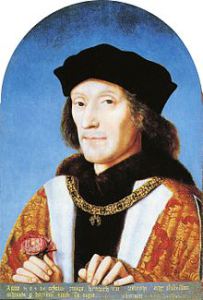
Henry VII, the First of the Tudors

Henry VII, the First of the Tudors

220px-king_henry_viiHenry VII came to the throne of England after defeating Richard III at Bosworth in 1485. With his accedence, England came into a long period of “National Pride.” The War of the Roses had weakened the nobility to the point where the Tudors could wield more power than had their predecessors, the Plantagenets. When Henry VII took the throne he broke the power of the barons by bringing back into favor the Court of the Star Chamber, to put on trial those who opposed Henry’s rule.

Henry married Elizabeth of York (uniting the houses of York and Lancaster) at Westminster Abbey on 18 January 1486. Together, they had seven children. He died at Richmond Palace in Surrey on 21 April 1509 at age 52. During his reign, Henry crushed a revolt at Stoke by the Earl of Lincoln on behalf of Lambert Simnel, a claimant to the throne. His invasion of France ended quickly when he withdrew his forces in return for a substantial payment from the French crown. In 1492, Henry managed to squash a second attempt to overthrow his rule. Perkin Warbeck made a claim to the throne; Warbeck was put to death in 1499.

Let us outline the Tudor dynasty.

Henry VII (1485-1509) marries Elizabeth of York (d 1503)

Their children were

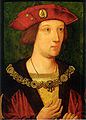
86px-arthur_prince_of_wales_c_1500(1) Arthur, Prince of Wales (19 September 1486 to 2 April 1502) marries Catherine of Aragon in 1501. (When Arthur dies, Prince Henry becomes heir to the throne. Henry later marries Arthur’s widow.)

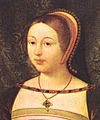
(2) Margaret Tudor (28 November 1489 to 18 October 1541) marries James IV, King of Scotland (1473 – 1513) in 1503. Their child was James V of Scotland (1513 – 1542). James V married Mary of Guise. Their marriage gave the land Mary, Queen of Scots (1542-1567). Mary first married Francis II of France (who died in 1560); then Henry Lord Darnley (who died in 1567); and, finally, James, Earl of Bothwell (who died in 1578).

Margaret Tudor

Margaret Tudor

(3) Henry VIII, who was born on 28 June 1491, (1509 -1547) marries Catherine of Aragon (divorced 1533). Their child Mary I ruled England from 1553-1558. Mary I married Philip II of Spain.

Henry VIII marries Anne Boleyn (beheaded in 1536). Their child, Elizabeth I, ruled England from 1558 to 1603.

Henry VIII marries Jane Seymour, who died from complications of child birth in 1537. Their son, Edward VI, ruled from 1547-1553.

Henry VIII marries Anne of Cleves (married and divorced within 7 months in 1540).

Henry VIII marries Catherine Howard (beheaded on grounds of adultery in 1542).

Henry VIII marries Catherine Parr (who died in 1548). Catherine outlived Henry. She married again shortly after his death.

(4) Elizabeth Tudor was born on 2 July 1492 and died 14 September 1495.

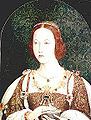
Mary Tudor

Mary Tudor

(5) Mary Tudor was born on 18 March 1496. Mary married Louis XII of France in 1514. Unfortunately, Louis passed in 1515. Mary then married Charles Brandon, 1st Duke of Suffolk. Their child, Francis, married Henry Grey, Duke of Suffolk. Francis and Henry’s child was Lady Jane Grey.

(6) Edmund Tudor, Duke of Somerset, was born on 21 February 1499 and died on 19 June 1500.

(7) Katherine Tudor was born on 2 February 1503 and died the same day. Elizabeth of York died as a result of Katherine’s birth.

(8) An illegitimate son was born to a “Breton Lady.” Sir Roland de Velville was born in 1474. He was knighted in 1497 and was Constable of Beaumaris Castle.

Posted in British history, Great Britain, real life tales | Tagged , | 5 Comments

Ed Gein: The Real-Life Norman Bates

Ed Gein: The Real-Life Norman Bates

Of late, I’ve spent a lot of research hours on grave robbing and serial killers, especially as mayhem was practiced during the early 1800s. The need for medical schools to rob graves of “fresh” corpses to use as cadavers is common knowledge, but I had not thought to stumble across a modern-day grave robber, a man with a fetish for bowls made of human skulls; a wastebasket made of human skin; a full breastplate made of a skinned woman’s torso; ten female heads with the tops sawed off; skulls on his bedposts; human skin covering several chairs; a pair of lips on a drawstring for a window shades; and a belt made of different women’s nipples.

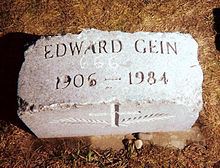
Ed Gein was the model for the Norman Bates character in Robert Bloch’s novel, Psycho. Bloch’s tale of murder and mayhem became the basis of the famous Alfred Hitchcock film. Some experts claim Gein’s story also inspired the Texas Chainsaw Massacre and the Buffalo Bill character in Thomas Harris’s The Silence of the Lambsedgein

The son of Augusta and George Gein, Ed Gein early on moved to a remote farm outside of Plainfield, Wisconsin. His father was a drunkard, but his mother was highly religious. Augusta reportedly instilled strict rules of sexuality in the household. Both Ed and his brother Henry were told repeatedly about the “sinfulness of women” and of the utter evil of premarital sex.

Ed’s sexual confusion escalated after George Gein died in 1940. His father’s death forced Ed and Henry to seek odd jobs in the nearby town. Ed, generally, worked as a handyman. In 1944, Henry died under suspicious circumstances. He and Ed were fighting a nearby fire in the marshes; later, Henry’s body was found. He had several bruises about his head, and he was lying in an unburned area. However, authorities ruled the death as accidental: smoke asphyxiation.

psycho-psycho-31575399-600-450Barely a year later, Augusta died of a stroke, leaving Ed all alone. Ed nailed her bedroom door closed, preserving the room in immaculate condition. After his mother’s death, Ed became fascinated by human anatomy: absolutely devouring any information about Christine Jorgensen and the first sex-change operation. Ed considered such an operation for himself. Later, he took up with a drifter, and the two of them began robbing graves for “souvenirs.” Reportedly, Ed Gein would scour the obituaries for information on female grave sites.

The grave robbing, eventually, no longer satisfied Gein’s fascination with the macabre. In December 1954, a woman named Mary Hogan disappeared from the bar she managed in Pine Grove, Wisconsin. Gein was a suspect, but no hard evidence could be linked to him at the time.

Three years later, another 50-something year old woman disappeared. Like Mary Hogan, Bernice Worden resembled Augusta Gein. The woman was abducted from the hardware store she owned. This time there was a more concrete connection to Gein. Worden’s son told authorities Gein had approached Bernice about a date. A Plainfield resident told the police of how Gein bought antifreeze from Worden’s store on the day of the incident.

Arriving at Gein’s home, the police found a decapitated body hanging from the rafters. Bernice’s torso was slit and gutted. Her genitalia removed. Her head had been turned into an ornament, and her heart sat in a saucepan on the stove. A search of the house produced a gun that matched the cartridge found at the scene of Mary Hogan’s murder. Gein confessed to the murder of both women and was committed to a secure mental institution, where he died of respiratory failure on July 26, 1984. 220px-ed_gein_headstone

Posted in real life tales | Tagged , , , , | 3 Comments

The Etiquette of “Visiting” and How Jane Austen Used the Tradition as a Plot Device

The Etiquette of “Visiting” and How Jane Austen Used It as a Plot Device

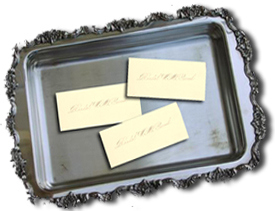
In the 1800s, morning calls or visiting upon a household developed a certain protocol, and those who broke protocol were often shunned. First a calling card was presented to the household’s servant. It was common for those who came to London for the Season to drive about with a footman in tow to present one’s cards to acquaintances. Do you recall Mrs. Jennings doing so in Sense and Sensibility? “The morning was chiefly spent in leaving cards at the houses of Mrs. Jennings’s acquaintance to inform them of her being in town.”

One would leave three cards with the servant: one from the lady for the house’s mistress; one from the caller’s husband for the house’s mistress and another for the house’s master. Displaying cards of those who had called was commonplace. It gave one social status to display cards from those of the nobility. In Persuasion, the Elliots took care to display “…the cards of the Dowager Viscountess Dalrymple and the Hon. Miss Carteret, to be arranged where they might be most visible.”callingcards1

If one came without a card, he may receive a snub. From her drawing room on the second floor, the house’s mistress could see who called upon her home, and she could make a decision whether to receive the caller or not. In Northanger Abbey, Catherine Morland calls on Miss Tilney and is sent packing. “She reached the house without any impediment, looked at the number and inquired for Miss Tilney. The man believed Miss Tilney to be at home, but was not quite certain. Would she be pleased to send up her name? She gave her card. In a few minutes, the servant returned, and with a look which did not quite confirm his words, said he had been mistaken, for she was walked out.”

Gentlemen did make calls, but they did not receive them from ladies. It would be a major breech in etiquette. Conversation remained light during the call, and one did not stay more than a quarter hour. One called between three and four in the afternoon if the house’s mistress was a casual acquaintance: Between four and five for a better acquaintance, and between five and six for a good friend. NO ONE called before one in the afternoon.
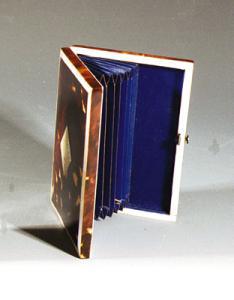
ccardcVisiting with one’s neighbors and acquaintances was a popular activity for those in the country and in Town. It was a common means to social mobility to be accepted by those above one’s social status. Visiting is a wonderful plot device in all of Jane Austen’s novels. Remember that Austen wrote of what she experienced. So, when in Pride and Prejudice is “visiting” an important plot ploy? Notice how key points in the story pivot around the event of a “visit” or an “invitation.”

How about Mrs. Bennet’s disappointment at not having Mr. Bingley’s acquaintance? “We are not in a way to know what Mr. Bingley likes,’ said her mother resentfully. ‘Since we are not to visit.’”

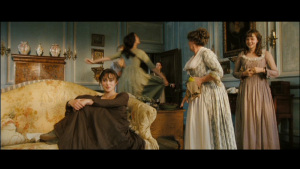
pride_and_prejudice_0028Mr. Bennet pleases his wife when he says, “It is very unlucky; but as I have actually paid the visit, we cannot escape the acquaintance now.”

Miss Bingley asks Jane Bennet for an evening at Netherfield by sending this message: “My Dear Friend: If you are not so compassionate as to dine today with Louisa and me, we shall be in danger of hating each other for the rest of our lives; for a whole day’s tete-a-tete between two women can never end without quarrel. Come as soon as you can on receipt of this. My brother and the gentlemen are to dine with the officers.”

Colonel Fitzwilliam feels “at home” at Hunsford and calls often. “Colonel Fitzwilliam had called at the Parsonage more than once during the time, but Mr. Darcy they had only seen at church. The invitation was accepted, of course, and at a proper hour, they joined the party in Lady Catherine’s drawing room.”

Mrs. Gardiner writes of Mr. Darcy’s unexpected call at Gracechurch Street. “On the very day of my coming home from Longbourn, you uncle had a most unexpected visitor. Mr. Darcy called, and was shut up with him several hours.”

Mr. Collins glories in his invitation from Lady Catherine De Bourgh. “Mr. Collins’s triumph, in consequence of this invitation, was complete. The power of displaying the grandeur of his patroness to his wondering visitors, and of letting them see her civility toward himself and his wife was exactly what he had wished for; and that an opportunity of doing it should be given so soon, was such an instance of Lady Catherine’s condescension, as he knew not how to admire enough.”

The Bennet sisters learn of the militia’s coming to Meryton. “Their visits to Mrs Phillips were now productive of the most interesting intelligence. Every day added something to their knowledge of the officers’ names and connections.”

Darcy brings Georgiana to Lambton to visit with Elizabeth Bennet. “Elizabeth had settled it that Mr Darcy would bring his sister to visit her the very day after her reaching Pemberley, and was, consequently, resolved not to be out of sight of the inn the whole of that morning. But her conclusion was false; for on the very morning after their arrival at Lambton their visitors came.”

Elizabeth Bennet deflects Miss Binley’s barbs while returning Georgiana’s call. “In this room they were received by Miss Darcy, who was sitting there with Mrs Hurst and Miss Bingley, and the lady with whom she lived in London.”

Elizabeth arrives at Netherfield to attend the ailing Jane Bennet. “Elizabeth was glad to be taken to her immediately, and Jane, who had only been withheld by the fear of giving alarm or inconvenience from expressing in her note how much she longed for such a visit, was delighted at her entrance.”

Mr. Collins invites himself to Longbourn. “If you should have no objection to receive me into your house, I propose myself the satisfaction of waiting on you and your family, Monday, November 18th, by four o’clock, and shall probably trespass on your hospitality till the Saturday sennight following, which I can do without any inconvenience…”

Jane explains to Elizabeth how Caroline Bingley has snubbed her. “Caroline did not return my visit till yesterday; and not a note, not a line, did I receive in the meantime.”

The Bennets and the Lucases hold a post mortem of the Meryton Assembly. “That the Miss Lucases and the Miss Bennets should meet to talk over a ball was absolutely necessary, and the morning after the assembly brought the former to Longbourn to hear and to communicate.”

The Gardiners spend Christmastide at Longbourn. “On the following Monday, Mrs. Bennet had the pleasure of receiving her brother and his wife, who came, as usual, to spend the Christmas at Longbourn.”

Lady Catherine encourages Elizabeth to extend her stay at Hunsford. “Why, at that rate, you will have been here only six weeks. I expected you to stay two months. I told Mrs. Collins so before you came.”

Lady Catherine barges in on the Longbourn household. “They both set off, and the conjectures of the remaining three continued, though with little satisfaction till the door was thrown open and their visitor entered. It was Lady Catherine De Bourgh.”

Mr. Bennet reluctantly agrees to accept the unrepentant Lydia into his home, but his wife relishes in having a married daughter. “But Jane and Elizabeth, who agreed in wishing, for the sake of their sister’s feelings and consequence, that she should be noticed on her marriage by her parents, urged him so earnestly, yet so rationally and so mildly, to receive her and her husband at Longbourn as soon as they were married, that he was prevailed on to think as they thought and act as they wished. And their mother had the satisfaction of knowing that she should be able to show her married daughter in the neighborhood, before she was banished to the North.”

Bingley returns to Longbourn. “Mr Bingley arrived. Mrs Bennet, through the assistance of servants, contrived to have the earliest tidings of it, that the period of anxiety and fretfulness on her side might be as long as it could. She counted the days that must intervene before their invitation could be sent–hopeless of seeing him before. But on the third morning after his arrival in Hertfordshire she saw him, from her dressing-room window, enter the paddock and ride toward the house.”
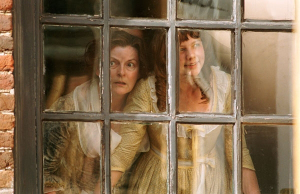
pride-and-prejudice-2005-pride-and-prejudice-2005-16538188-600-3881Are there other scenes in Pride and Prejudice or any of Austen’s novels that are pivotal moments and are associated with “visits”? I can think of several dozen without much effort. How about you?


Posted in British history, customs and tradiitons, Jane Austen, Living in the Regency, Regency era | Tagged , , , , , , , , | 7 Comments

Celebrating the Release of Jen Corkill’s “Season of Mists” + an Enticing Excerpt

It is my great pleasure to welcome Jen Corkill to my blog today. Her latest release appears quite enticing: a mixture of late Victorian mayhem and a bit of the supernatural. Please enjoy the excerpt of Season of Mists below.

Season of Mists

Season of Mists by Jen Corkill

Season of Mists by Jen Corkill

Justine Holloway prepares for her debut into Society, compliments of her godparents, while the underworld of London groans with unfettered abhorrence. The Varius are refugees from a parallel universe, who shift their form while others channel the forces of magic, an element that once flowed freely between both worlds. They seek refuge in Victorian London, hidden in the slums, easily forgotten until a human ends up incinerated or sucked dry. It is the job of the Council, created for the protection of humanity, to step in and eliminate the threat.

What Justine does not realize is her godfather runs the Council right under the nose of polite society, much to the dismay of his genteel sister. Justine suspects something mysterious is brewing when the handsome Egyptian Ambassador heals before her eyes. It’s an image she can forget and a mystery she wants to solve.

When a deadly vampire makes his devious intentions known, her survival might depend on this strange Egyptian. Unfortunately, he can’t figure out why he’s so drawn to her, or whether he must kill her to save humanity.

Exquisite Excerpt…
A lanky man wearing the livery of a deckhand strode to the side of the captain’s cabin and peered into one of the portholes. He licked his lips and dug inside his pockets. At first, Justine contemplated going to her cabin, but his gaze did not alter as he stood, eyes fixated on the room she’d just left.

“Excuse me…may I help you?” Justine ventured. “Is there someone inside to whom you wish to speak? The captain perhaps?”

The man did not respond. He acted as if she was invisible. Whatever drew him to the cabin smothered any sense of life or breath. Without looking down to see what he brought from his pocket, Justine noticed a metal necklace, a medallion of sorts, clutched in his grasp. He brought the trinket to his face near the porthole, hot breath fogging the glass. His long fingers rubbed the shiny metal, twisting it this way and that, as if ready to smash it through the window.

“The Master said this’d find him…” His words came out in an elated whisper. The young man’s attention darted from the necklace to the window and back. He licked his lips again and blinked in rapid succession. Then, he smiled. The expression of delight brought a childlike innocence to his intense errand, but the expression did not last. As before, he twitched, his hands trembling. “Why is it not working?”

Justine stepped back, fearing he’d throw the necklace to the floor in a rage. Snarling, saliva seething from his mouth, he beat the medallion. Was the man mad?

“Excuse me?” Justine repeated. “Are you all right?”

Whatever haze clouding the deckhand’s mind cleared. He jumped and stared at her, no doubt startled by her appearance. There was nothing between her and his pale eyes, which were so empty and devoid of color. It was as if she looked through a window into an empty room where nothing lived. Something vile animated his corpse, legs and arms moving towards her like a marionette. The railing was the only thing separating her from the frozen water below. Cold metal burned through her gloves. Justine shivered wishing she’d had run away when she had the chance. His breath brushed against her exposed skin, a putrid smell that made Justine feel compromised and unclean.

“Stop…you’re frightening me,” Justine whined. Nothing wanted to move. Her legs had turned to stone beneath her. All she could do was stand there, desperately wanting to escape, to put as much distance between herself and the vile creature as she could. He was close enough to reach out and wrap his hands around her throat.

Oh God, please, let this not be Jack the Ripper. Justine had read the headlines of the murderer stalking London.

The deckhand never touched her, yet she still felt his body. “Tell him to fear me for I know his secret.”

“Wh…what? What secret?”

Raised voices echoed from the cabin. Shoving whatever necklace he held back into his jacket, the deckhand ran down the length of the ship and disappeared.
Justine wasn’t quite certain what had just occurred. Had the man been speaking about someone in the cabin? Mr. Tinnen or the captain? Of course the easiest answer could easily have been the man was mad, but that did little to ease her panic. Her hands trembled and not from the cold. Justine grabbed the ends of her shawl and wrapped them tight around her. Every time she blinked, she saw his eyes burning into hers. Without thinking, she instinctively fled to her cabin and locked the door behind her.

About the Author: 

headshotJen Corkill is a stay at home geek in rural Nevada where she gardens, sews, paints, and weaves magic into the daily lives of her three beautiful children and amazing husband. Every day is a blessing. Sometimes, she even finds enough calm moments to write…sometimes. Her interests include Star Wars, Victorian Literature, Bioware, power metal, and enough coffee to float her to Helstone.
JenCorkill.com

Release for Season of Mists: December 2014

Posted in book excerpts, book release, British history | Tagged , , , , | 8 Comments

Being Punk’d Regency Style

Being Punk’d Regency Style

This is a repeat post, back by popular demand. I was asked by several to add it again because their friends did not believe them.

Theodore Hook

Theodore Hook

In mid August I shared this information on my own blog, and it was such a “hit” I thought I would share it here also. I would like to introduce you to Theodore Hook, a man from whom Ashton Kutcher could take a few lessons. “How so?” you ask. Have you ever heard of the Berners Street Hoax? If not, enjoy the scenario and imagine how delightful it would have been if Theodore Hook had had a series of hidden cameras to capture the action to replay on You Tube.

Ashton Kutcher

Ashton Kutcher

Our “hero” Theodore Hook made an not-so-innocent bet with his friend Samuel Beazley. Hook swore he could transform any house in London into the most talked-about address in a week. The chosen house was 54 Berners Street in the City of Westminster, London. The time was 1810. Hook began by sending out thousands of letters requesting deliveries, visitors, and assistance, all in the name of Mrs Tottenham.

The action began at 5 of the clock when a sweep arrived to clean Mrs Tottenham’s chimney. The maid efficiently sent the poor sweep away, but then another appeared. And another. A total of 12 called and were dispatched from the “lady’s” home. The sweeps were followed by several carts full of coal to be delivered to the home. Then a series of bakers, delivering large wedding cakes.

Next, came those who thought themselves summoned to minister to someone in the house, who was reportedly dying: doctors, surgeons, lawyers, vicars, and priests.

Those efforts in humanity preceded another round of deliveries. Fishmongers. Shoemakers. A dozen pianos. Six stout men bearing an organ.

Dignitaries came also. They included the Governor of the Bank of England, the Duke of York, the Archbishop of Canterbury, and the Lord Mayor of the City of London.

The narrow street became congested with tradesmen and onlookers. Deliveries and visits, which began with the first sweep at 5 in the morning, continued until early evening. The hoax brought much of London to a standstill.

Hook and Beazley stationed themselves in a house directly opposite 54 Berners Street, where they could watch the chaos unfold. Although the authorities searched high and low for the perpetrator of the chaos, Hook evaded arrest. “It was reported he felt it prudent to be ‘laid up for a week or two’ before embarking on a tour of the country, supposedly to convalesce.” (FYI: The site at 54 Berners Street is now occupied by the Sanderson Hotel.)

I wonder if our dear Jane knew of these events. Would it not have been wonderful if she had added a bit of chaos based on this event into one of her stories. “For what do we live but to laugh at our neighbors and make fun of them in our turn?” –Pride and Prejudice

This work is released under CC-BY-SA

http://creativecommons.org/licenses/by-sa/3.0/

Posted in British history, buildings and structures, Great Britain, Living in the Regency, real life tales, Regency era, Regency personalities | Tagged , , | Comments Off on Being Punk’d Regency Style

Are You Smarter Than a Sixty Year Old? A Fun Quiz…

I was listening recently to Emmy Rossum from Showtimes’s “Shameless.” She was talking about being older than the other members of the cast. Rossum is 28 and the next oldest “sibling” in the show’s dysfunctional family is 15. Rossum remarked how the young ones on set have never heard a dial tone. They know nothing of rewinding a movie to watch it again. Heaven forbid they would recognize an eight track. With that in mind, I thought we could do something fun before the work of Thanksgiving dinners, endless football games, and Black Friday shopping consume all our energies, as well as our brain cells. Try this test of your knowledge of pop culture.

Are You Smarter Than a 60 Year Old?
DON’T LOOK BELOW FOR THE ANSWERS UNTIL YOU HAVE TRIED TO ANSWER THE QUESTIONS! IF YOU ARE NOT ASHAMED TO SHARE, TELL ME HOW MANY YOU GOT RIGHT IN THE COMMENT SECTION. 

A TEST FOR OLD KIDS
This is designed for those who might actually remember a bit history, simply because they lived through it or their parents have spoken of these events often enough that they have second-hand knowledge of the events. Have some fun my sharp-witted friends. This is a test for us ‘old kids’! The answers are printed below, but don’t cheat.

06-11--The Lone Ranger Unsmasked01. After the Lone Ranger saved the day and rode off into the sunset, the grateful citizens would ask, Who was that masked man? Invariably, someone would answer, I don’t know, but he left this behind. What did he leave behind?________________.

02. When the Beatles first came to the U.S. .In early 1964, we all watched them on The _______________ Show.

03 ’Get your kicks, __________________.’

04. ’The story you are about to see is true. The names have been changed to ___________________.’

05. ’In the jungle, the mighty jungle, ________________.’

06. After the Twist, The Mashed Potato, and the Watusi, we ‘danced’ under a stick that was lowered as low as we could go in a dance called the ‘_____________.’

07. Nestle’s makes the very best . .. . . _______________.’

08. Satchmo was America ‘s ‘Ambassador of Goodwill.’ Our parents shared this great jazz trumpet player with us. His name was _________________.

09. What takes a licking and keeps on ticking? _______________.

freddie-244x30010. Red Skeleton’s hobo character was named __________________ and Red always ended his television show by saying, ‘Good Night, and ‘________ ________.’

11. Some Americans who protested the Vietnam War did so by burning their______________.

12. The cute little car with the engine in the back and the trunk in the front was called the VW. What other names did it go by? ____________ &_______________.

13. In 1971, singer Don MacLean sang a song about, ‘the day the music died.’ This was a tribute to ___________________.

14. We can remember the first satellite placed into orbit.The Russians did it. It was called ___________________.

15. One of the big fads of the late 50’s and 60’s was a large plastic ring that we twirled around our waist. It was called the ________________.


ANSWERS :
01..The Lone Ranger left behind a silver bullet.
02.The Ed Sullivan Show
03.On Route 66
04.To protect the innocent.
05.The Lion Sleeps Tonight
06.The limbo
07.Chocolate
08.Louis Armstrong
09.The Timex watch
10.Freddy, The Freeloader and ‘Good Night and God Bless.’
11.Draft cards (Bras were also burned. Not flags, as some have guessed)
12.Beetle or Bug
13.Buddy Holly
14.Sputnik
15.Hoola-hoop

Posted in Do You Remember?, holidays | Tagged , , | 7 Comments

John Ketch, Infamous Executioner

An infamous English executioner employed by King Charles II, John Ketch was an Irish immigrant who became famous through the way he performed his duties during the tumultuous 1680s. He was mentioned in the broadsheets of the time. Appointed in 1663, he executed the death sentences of William Russell in Lincoln’s Inn Fields on 21 July 1683 and that of James Scott, the First Duke of Monmouth on 15 July 1685, after the Monmouth Rebellion. Ketch’s notoriety grew from what was termed his barbarity. Because of Ketch’s botched executions, the name “Jack Ketch” is used for all executioners, especially those who saw to the hangings at Newgate Prison. “Jack Ketch” is also a proverbial name for Death or Satan.

Ketch is first mentioned in the Proceedings of the Old Bailey for 14 January 1676, although no printed notice of the new hangman occurred until 2 December 1678, when a broadside appeared called The Plotters Ballad, being Jack Ketch’s incomparable Receipt for the Cure of Traytorous Recusants and Wholesome Physick for a Popish Contagion. Ketch reportedly wrote a second pamphlet himself. It was entitled The Man of Destiny’s Hard Fortune. It claimed the hangman was confined for a time in the Marshalsea Prison.

A short entry in the autobiography of Anthony á Wood for 31 August 1681 describes how Stephen College was hanged in the Castle Yard, Oxford, says “and when he had hanged about half an hour, was cut down by Catch or Ketch and quartered under the gallows, his entrails were burnt in a fire made by the gallows.”

Lord Russell’s Execution:

Ketch’s execution of Lord Russell at Lincoln’s Fields Inn on 21 July 1683 was performed clumsily; in a pamphlet entitled The Apologie of John Ketch, Esquire he alleged that the prisoner did not “dispose himself as was most suitable” and that he was interrupted while taking aim.

On that occasion, Ketch wielded the instrument of death either with such sadistically nuanced skill or with such lack of simple dexterity—nobody could tell which—that the victim suffered horrifically under blow after blow, each excruciating but not in itself lethal. Even among the bloodthirsty throngs that habitually attended English beheadings, the gory and agonizing display had created such outrage that Ketch felt moved to write and publish a pamphlet title Apologie, in which he excused his performance with the claim that Lord Russell had failed to “dispose himself as was most suitable” and that he was therefore distracted while taking aim on his neck.

Monmouth’s execution on Tower Hill by Jack Ketch on 15 July 1685

Monmouth’s execution on Tower Hill by Jack Ketch on 15 July 1685

James Scott, First Duke of Monmouth’s Execution:

On the scaffold on July 15, 1685, James Scott, the First Duke of Monmouth, addressing Ketch, referred to his treatment of Lord Russell, thus disconcerting him, stating “Here are six guineas for you. Do not hack me as you did my Lord Russell. I have heard that you struck him three or four times. My servant will give you some more gold if you do the work well.” The duke subsequently undressed and felt the edge of the axe expressing some fear that it was not sharp enough, and laid his head on the block.” The first blow dealt by Ketch inflicted only a slight wound after which the Duke struggled, rose from the block, and looked reproachfully at the executioner before sinking down once more. Ketch struck the duke twice more, but still the neck was not severed, and the body continued to move. Yells of rage and horror rose from the onlooking crowd to which Ketch flung down the axe with a curse and stated that “I cannot do it, my heart fails me.” The sheriff present asked Ketch to “Take up the axe, man” to which Ketch responded by once more taking up the axe and dealing two more blows to the duke, killing him. Still, the head remained attached and Ketch used a butcher’s knife from the sheath on his hip to cut the last sinew and flesh that prevented the head from dropping. The crowd was so enraged that Ketch had to be escorted away under strong guard.

Monmouth’s reminder of Russell’s execution either unnerved or angered Ketch. Even as the first blow fell upon the duke, those who counted themselves connoisseurs of the headman’s art knew the axe had missed its mark. Ketch stood back, regarding his botched handiwork, and dealt another blow, then another, as Monmouth writhed, screamed, and moaned. According to the official record of the Tower of London, there were five blows in all, though some onlookers counted seven and others eight. Whether five, seven, or eight, none proved sufficient to sever the man’s head from his suffering body, and Ketch pulled a butcher’s knife from the sheath on his hip, which he drew across the last cords of sinew and flesh that prevented the head from dropping to the scaffold floor. With that, the life of James Scott, 1st Duke of Monmouth, ended on July 15, 1685.

In his Diary, John Evelyn wrote of the duke’s execution that:

He [the duke] would not make use of a cap or other circumstance, but lying down, bid the fellow to do his office better than to the late Lord Russell, and gave him gold; but the wretch made five chops before he had his head off; which so incensed the people, that had he not been guarded and got away, they would have torn him to pieces.

The execution of the duke was considered to be worse than that of Lord Russell. In 1686, Ketch was deposed and imprisoned at Bridewell.

Later Life:

In 1686 Ketch was sent to prison for “affronting” a sheriff. His job was taken by his assistant, Paskah Rose, formerly a butcher. Rose was arrested after only four months in his office for robbery. Ketch was reappointed in his place and hanged his own assistant at Tyburn.

He died towards the close of 1686.


This work is released under CC-BY-SA

http://creativecommons.org/licenses/by-sa/3.0/

Some facts come from http://en.wikipedia.org/wiki/Jack_Ketch

Posted in British history, Great Britain, history, legends and myths, Living in the UK, political stance, real life tales | Tagged , , , , | Comments Off on John Ketch, Infamous Executioner

Celebrating with Jacki Delecki: A Well-Dressed Man of the Ages + an Excerpt from her Latest Release of “A Christmas Code,” + an Audiobook Giveaway

Through the Ages: The Well-Dressed Man

Fun facts on men’s fashion over time from Jacki Delecki, author of the Code Breakers series: A Code of Love, A Christmas Code (now available) and Cantata of Love (Spring 2015).

Delecki: Fashion and clothing styles have changed over the centuries, due in equal measures to societal customs, functional needs and cultural values. As a historical romantic suspense author, I often discover fascinating tidbits while doing research. Here are a few gems I’ve gathered about men’s fashion over the ages.

During the Renaissance period (14th to 17th centuries), it was required that hats were worn in public and violators were fined up to a week’s worth of wages! Poorer classes typically wore flat hats, while nobility wore taller hats.

Rococo Style for Men

Rococo Style for Men

During the early 18th century Enlightenment period, French influence on fashion led to the Rococo style, which is easily recognizable from its tendency toward lavish, excessive adornment. Men typically wore a coat, waistcoat, breeches, stockings and heeled shoes. Waistcoats were elaborately embroidered or comprised of patterned fabric and coats were worn open to show off waistcoats. Tricorne hats decorated with braid and feathers were also popular during this period.

Beau Brummell was the arbiter of men’s Regency fashion, abandoning overly ornate garments for understated tailored coats, trousers, and knotted cravats. Many credit him with introducing the men’s suit, a big jump from knee breeches and stockings.

Belts were not a common fashion accessory in the 19th century. Instead, pants had fitted, adjustable waists and fall fronts (with an option of narrow or broad). These flaps were secured by buttons.

Flat front opening for britches; Beau Brummell; high heeled shoes for men

Flat front opening for britches; Beau Brummell; high heeled shoes for men

For hundreds of years, men wore high heels out of necessity, not vanity…for a while. In Persia and other countries of that region, men wore heels to secure his stance in riding stirrups so he could more accurately aim his bow and arrow. In the 17th century, aristocracy wore heels because of their inherent impracticality—such shoes were a sign of privilege and luxury.

Regency Era Fashion for Men

Regency Era Fashion for Men

I have to admit, as outlandish as some of the men’s fashion customs were, there’s nothing like a well-dressed Regency gentleman! What is your favorite historical fashion statement?


JackiDelecki_AChristmasCode_HRHeart-pounding adventure filled with danger, intrigue and romance from Jacki Delecki, award-winning author of the Regency suspense series “The Code Breakers” and the contemporary mystery series “Grayce Walters.” Enjoy her latest release “A Christmas Code.”

Excerpt:

Hot and breathless from performing the newly imported French dance steps of the Quadrille, Gwyneth paused during the break in the music. She fanned her heated cheeks repeatedly attempting to cool herself. Lord Henley glanced down at her. His lips were tight; his eyes beaded with need. She had seen the same look on the faces of many men, but never on the face of the only man who mattered.
She wanted to see the same burning desire and possessiveness in the eyes of her childhood infatuation like she knew blazed in her eyes when she looked at the impossible but dazzling Viscount Ashworth.

The gentleman, newly arrived, had barely glanced at her despite the new gown made especially to entice the hard-headed rake. Her friend and dress designer, Amelia, obsessed with the simplicity of Greek togas, had crisscrossed sky blue silk across Gwyneth’s ample chest with a revealing décolletage. The back of the gown was draped in the same manner with a revealing “V”. It was simple design, but sensual in the way the fabric clung to her body.

She felt enticing and hopeful that tonight Ash would finally throw off all the restraints. She had felt his eyes on her back, knowing he watched her as she gaily danced the intricate pattern she had just learned from her French dance master.

Lord Henley offered his arm as the quadrille ended. “May I take you to the refreshment table for a glass of punch? This new French dance is very demanding.”

“Thank you. I’m not thirsty. Can you please take me to my dear friend, Miss Bonnington?”

Lord Henley’s eyes clouded with emotion. Gwyneth couldn’t refuse the dance, but she needed to escape the gentleman before he embarrassed himself. She wanted to spare the gentleman the pain of rejection. After her five marriage proposals this season, she had become somewhat of an expert in recognizing the signs of imminent declaration.

Lord Henley escorted Gwyneth to Amelia, who also had finished dancing and now stood alone.

“Thank you, sir for the dance.” Gwyneth did a brief curtsy.

Lord Henley bowed. “It was my pleasure.” He hesitated, then sharply nodded his head. She didn’t want to be unkind, but there was no reason to pretend interest and encourage hope when there was none.

They watched Lord Henley circle to the other side of the room.

Amelia hid her face behind her fan. Her bright eyes dancing in merriment. “Another stricken gentleman.”

“I believe he was about to ask if he could call on my brother tomorrow. I think I did an excellent job of extricating myself before the gentleman declared his feelings.”

“Lord Henley is quite a catch. He’s heir to a vast fortune. His interest can’t be limited only to your dowry.”

“Thank you. I’m glad it isn’t only money that makes me attractive.” Gwyneth liked to believe it was her wit, her sparkling eyes, but she knew her position as sister to an earl and heiress to a hefty inheritance gave her a definite cache with the gentleman. And it was just like Amelia to joke about her wealth.

“Your following of swains has nothing to do with your luscious figure, your dramatic looks, or your amiable personality. My unique skill as designer has brought all these gentleman to swoon at your feet.” Amelia snickered, which set off Gwyneth to laugh.

Tears were running down Gwyneth’s cheeks. “You do know how to level a woman’s confidence.”

The comment drove both to louder laughter.

Ash had turned to gaze at Gwyneth when she was laughing. He smiled.

Lost in the merriment, she smiled back before she realized she had resolved not to appear as a puppy, waiting at his feet for a pat on the head. She could hide her feelings as well as he did. Forbidden by some unwritten gentleman’s code, Ash, considered her off limits. She wasn’t sure if it was the age difference of eight years, his rakish past, or her position as his best friend’s younger sister.

He still kept her at a distance, maintaining she was a mere youngster, and they were simply childhood friends. She had spent the entire season trying to convince him otherwise, but she was tiring of the game.

GIVEAWAY: LEAVE A COMMENT BELOW AND/OR PROMOTE THIS POST IN SOCIAL MEDIA (FACEBOOK, TWITTER, ETC.) TO BE ENTERED INTO A DRAWING FOR AN AUDIOBOOK VERSION OF JACKI DELECKI’S “A CODE OF LOVE.” THE WINNER WILL BE CHOSEN AT TWELVE NOON (EST) ON SUNDAY, NOVEMBER 23. 

Picture 001Connect with Jacki Delecki online!
Website: http://jackidelecki.com/
Facebook: http://www.facebook.com/Jacki.Deleck
Twitter: http://twitter.com/jackidelecki

Posted in book excerpts, book release, British history, Living in the Regency, Regency era | Tagged , , , , , | 11 Comments