Merry Christmas!

merry-christmas-nativity-imagesgallery-for-merry-christmas-nativity-images-tfpdpujvmerry-christmas-images

Posted in Uncategorized | Tagged , | 4 Comments

The Christmas Eve Truce of 1914

 A. C. Michael - The Guardian  Originally published in The Illustrated London News, January 9, 1915. The Illustrated London News's illustration of the Christmas Truce: "British and German Soldiers Arm-in-Arm Exchanging Headgear: A Christmas Truce between Opposing Trenches" The subcaption reads "Saxons and Anglo-Saxons fraternising on the field of battle at the season of peace and goodwill: Officers and men from the German and British trenches meet and greet one another—A German officer photographing a group of foes and friends." (via Wikipedia)

A. C. Michael – The Guardian Originally published in The Illustrated London News, January 9, 1915.
The Illustrated London News’s illustration of the Christmas Truce: “British and German Soldiers Arm-in-Arm Exchanging Headgear: A Christmas Truce between Opposing Trenches” The subcaption reads “Saxons and Anglo-Saxons fraternising on the field of battle at the season of peace and goodwill: Officers and men from the German and British trenches meet and greet one another—A German officer photographing a group of foes and friends.” (via Wikipedia)

The Christmas truce (German: Weihnachtsfrieden; French: Trêve de Noël) was a series of widespread but unofficial ceasefires along the Western Front around Christmas 1914. In the week leading up to the holiday, German and British soldiers crossed trenches to exchange seasonal greetings and talk. Men from both sides ventured into no man’s land on Christmas Eve and Christmas Day to mingle and exchange food and souvenirs. There were joint burial ceremonies and prisoner swaps, while several meetings ended in carol-singing. Men played games of football with one another, giving one of the most enduring images of the truce. However, the peaceful behaviour was not ubiquitous; fighting continued in some sectors, while in others the sides settled on little more than arrangements to recover bodies. The following year, a few units arranged ceasefires, but the truces were not nearly as widespread as in 1914; this was, in part, due to strongly worded orders from the high commands of both sides prohibiting fraternisation. Soldiers were no longer amenable to truce by 1916. The war had become increasingly bitter after devastating human losses suffered during the battles of the Somme and Verdun, and the incorporation of poison gas.

The truces were not unique to the Christmas period, and reflected a growing mood of “live and let live,” where infantry in close proximity would stop overtly aggressive behavior and often engage in small-scale fraternisation, engaging in conversation or bartering for cigarettes. In some sectors, there would be occasional ceasefires to allow soldiers to go between the lines and recover wounded or dead comrades, while in others, there would be a tacit agreement not to shoot while men rested, exercised, or worked in full view of the enemy. The Christmas truces were particularly significant due to the number of men involved and the level of their participation – even in very peaceful sectors, dozens of men openly congregating in daylight was remarkable – and are often seen as a symbolic moment of peace and humanity amidst one of the most violent events of human history.

Background
The first five months of World War I had seen an initial German attack through Belgium into France, which had been repulsed outside Paris by French and British troops at the Battle of the Marne in early September 1914. The Germans fell back to the Aisne valley, where they prepared defensive positions. In the subsequent Battle of the Aisne, the Allied forces were unable to push through the German line, and the fighting quickly degenerated into a stalemate; neither side was willing to give ground, and both started to develop fortified systems of trenches. To the north, on the right of the German army, there had been no defined front line, and both sides quickly began to try to use this gap to outflank one another; in the ensuing “Race to the Sea”, the two sides repeatedly clashed, each trying to push forward and threaten the end of the other’s line. After several months of fighting, during which the British forces were withdrawn from the Aisne and sent north into Flanders, the northern flank had developed into a similar stalemate. By November, there was a continuous front line running from the North Sea to the Swiss frontier, occupied on both sides by armies in prepared defensive positions.

The approach to Christmas
In the lead up to Christmas 1914, there were several peace initiatives. The Open Christmas Letter was a public message for peace addressed “To the Women of Germany and Austria”, signed by a group of 101 British women suffragettes at the end of 1914 as the first Christmas of World War I approached. Pope Benedict XV, on 7 December 1914, had begged for an official truce between the warring governments. He asked “that the guns may fall silent at least upon the night the angels sang.” This attempt was officially rebuffed.

Christmas 1914

British and German troops meeting in no man’s land during the unofficial truce (British troops from the Northumberland Hussars, 7th Division, Bridoux-Rouge Banc Sector)

Roughly 100,000 British and German troops were involved in the unofficial cessations of hostility along the Western Front. The first truce started on Christmas Eve 1914, when German troops decorated the area around their trenches in the region of Ypres, Belgium and particularly in Saint-Yvon (called Saint-Yves, in Plugstreet/Ploegsteert – Comines-Warneton), where Capt. Bruce Bairnsfather described the truce.

The Germans placed candles on their trenches and on Christmas trees, then continued the celebration by singing Christmas carols. The British responded by singing carols of their own. The two sides continued by shouting Christmas greetings to each other. Soon thereafter, there were excursions across No Man’s Land, where small gifts were exchanged, such as food, tobacco and alcohol, and souvenirs such as buttons and hats. The artillery in the region fell silent. The truce also allowed a breathing spell where recently killed soldiers could be brought back behind their lines by burial parties. Joint services were held. The fraternisation carried risks; some soldiers were shot by opposing forces. In many sectors, the truce lasted through Christmas night, continuing until New Year’s Day in others.

On the day itself, Brigadier-General Walter Congreve, then commanding 18 Infantry Brigade, stationed near Neuve Chapelle, wrote a letter recalling the Germans initiated by calling a truce for the day. One of his brigade’s men bravely lifted his head above the parapet and others from both sides walked onto no man’s land. Officers and men shook hands and exchanged cigarettes and cigars, one of his Captains “smoked a cigar with the best shot in the German army,” the latter no more than 18 years old. Congreve admitted he was reluctant to personally witness the scene of the truce for fear he would be a prime target for German snipers.

Bruce Bairnsfather, who served throughout the war, wrote: “I wouldn’t have missed that unique and weird Christmas Day for anything. … I spotted a German officer, some sort of lieutenant I should think, and being a bit of a collector, I intimated to him that I had taken a fancy to some of his buttons. … I brought out my wire clippers and, with a few deft snips, removed a couple of his buttons and put them in my pocket. I then gave him two of mine in exchange. … The last I saw was one of my machine gunners, who was a bit of an amateur hairdresser in civil life, cutting the unnaturally long hair of a docile Boche, who was patiently kneeling on the ground whilst the automatic clippers crept up the back of his neck.”

Future nature writer Henry Williamson, then a nineteen-year-old private in the London Rifle Brigade, wrote to his mother on Boxing Day: “Dear Mother, I am writing from the trenches. It is 11 o’clock in the morning. Beside me is a coke fire, opposite me a ‘dug-out’ (wet) with straw in it. The ground is sloppy in the actual trench, but frozen elsewhere. In my mouth is a pipe presented by the Princess Mary. In the pipe is tobacco. Of course, you say. But wait. In the pipe is German tobacco. Haha, you say, from a prisoner or found in a captured trench. Oh dear, no! From a German soldier. Yes a live German soldier from his own trench. Yesterday the British & Germans met & shook hands in the Ground between the trenches, & exchanged souvenirs, & shook hands. Yes, all day Xmas day, & as I write. Marvellous, isn’t it?”

Captain Sir Edward Hulse reported how the first interpreter he met from the German lines was from Suffolk where he had left his girlfriend and a 3.5 hp motorcycle. Hulse went on to describe a sing-song which “ended up with ‘Auld lang syne’ which we all, English, Scots, Irish, Prussians, Wurttenbergers, etc, joined in. It was absolutely astounding, and if I had seen it on a cinematograph film I should have sworn that it was faked!”[23]

Nor were the observations confined to the British. Leutnant Johannes Niemann: “grabbed my binoculars and looking cautiously over the parapet saw the incredible sight of our soldiers exchanging cigarettes, schnapps and chocolate with the enemy.” [24]

General Sir Horace Smith-Dorrien, commander of the British II Corps, issued orders forbidding friendly communication with the opposing German troops. Adolf Hitler, then a young corporal of the 16th Bavarian Reserve Infantry, was also an opponent of the truce. In the Comines sector of the front there was an early fraternisation between German and French soldiers in December 1914, during a short truce,and there are at least two other testimonials of similar behaviours in sectors where German and French companies opposed each other. In sections of the front where German and Belgian troops faced each other in December 1914, there was at least one such instance when a truce was achieved at the request of Belgian soldiers who wished to send letters back to their families, over the German-occupied territory of their own country. Richard Schirrmann, who was in a German regiment holding a position on the Bernhardstein, one of the mountains of the Vosges, wrote an account of events in December 1915: “When the Christmas bells sounded in the villages of the Vosges behind the lines ….. something fantastically unmilitary occurred. German and French troops spontaneously made peace and ceased hostilities; they visited each other through disused trench tunnels, and exchanged wine, cognac and cigarettes for Westphalian black bread, biscuits and ham. This suited them so well that they remained good friends even after Christmas was over.” He was separated from the French troops by a narrow No Man’s Land and described the landscape as: “Strewn with shattered trees, the ground ploughed up by shellfire, a wilderness of earth, tree-roots and tattered uniforms.” Military discipline was soon restored, but Schirrmann pondered over the incident, and whether “thoughtful young people of all countries could be provided with suitable meeting places where they could get to know each other.” He went on to found the German Youth Hostel Association in 1919.

Much of the information for this post came from http://en.wikipedia.org/wiki/Christmas_truce

Posted in British history, customs and tradiitons, Great Britain, war | Tagged , , , | Comments Off on The Christmas Eve Truce of 1914

UK “Real” Estate: The Isle of Portland and Nanny Diamond Fairies

The Isle of Portland and Nanny Diamond Fairies
Isle-Of-Portland.10The Isle of Portland is a limestone tied island, 6 kilometres (4 mi) long by 2.4 kilometres (1.5 mi) wide, in the English Channel. Portland is 8 kilometres (5 mi) south of the resort of Weymouth, forming the southernmost point of the county of Dorset, England. A tombolo, over which runs the A354 Road, connects it to Chesil Island and the mainland.

Portland is a central part of the Jurassic Coast, a World Heritage Site on the Dorset and east Devon coast, important for its geology and landforms. Portland stone, famous for its use in British and world architecture, including St Paul’s Cathedral and the United Nations Headquarters, continues to be quarried.

Portland Harbour, in the bay between Portland and Weymouth, is one of the largest man-made harbours in the world. Building of stone breakwaters between 1848 and 1905 formed the harbour. From its inception it was a Royal Navy base, and played prominent roles during the First and Second World Wars; ships of the Royal Navy and NATO countries exercised in its waters until 1995. The harbour is now a civilian port and popular recreation area, which will be used for the 2012 Olympic Games.

The Isle of Portland, Dorset, contains eight settlements, the largest being Fortuneswell in Underhill and Easton in Tophill. Castletown and Chiswell are the other villages in Underhill, and Weston, Southwell, Wakeham and the Grove occupy Tophill.

On the isle, near Southwell, fairies, known as “Nanny Diamonds” reportedly haunt the road. Likely, the name comes from “Nanoid,” meaning dwarf like and “Diana,” the Goddess of the Moon.

Dorset, itself, has numerous earthworks and barrows. It is believed that fairies inhabit these burial mounds. Six hillocks from the Bronze Age

The Dorset landscape would not be complete without is numerous ancient earthworks and barrows. In the past, these burial mounds were believed to be inhabited by fairies. Six hillocks, dating to the Bronze Age, can be seen from Bincombe Hill overlooking the port of Weymouth. These hills are known as the “Music Barrows.” Legend says that if one puts his ear to the top of one of the barrows at noon, he can hear the plaintive tones of fairy music.

The Isle of Portland was once a popular fairy haunt, but according to local legend; when the first church bell rang out over the island, all the fairies were seen fleeing in terror along the Chesil Beach and were said to have never returned. However, small fairies known as ‘Nanny Diamonds’ are still said to haunt Southwell, along the road that leads to Cheyne.

They wear short white dresses and white Phrygian hats and though they seem quite cute and friendly, they are not to be trusted, for they have the power to bring the ‘Evil Eye’ upon anyone who crosses them. They offer people forbidden fruits and promises of love and riches.

However, between noon and one of the afternoon, legends say that the Nanny Diamonds can be bribed into granting wishes. One must hide a silver coin among the nooks and crannies in the dry stone walls on either side of the road.

Isle of Portland from Ringstead Bay with Weymouth in the background

Isle of Portland from Ringstead Bay with Weymouth in the background


Parts of this post come from information found on Wikipedia and other parts on Britain Express.

Posted in British history, customs and tradiitons, Dorset, Living in the Regency, real life tales, spooky tales | Tagged , , | 2 Comments

Celebrating a Regency Era Christmas on the Christmas Party Blog Hop + a Giveaway of “Christmas at Pemberley”

2014-ChristmasPartyBlogHop
The Christmas Season is the time for merry-making and parties… So come and join some wonderful authors (and their characters) for an Online Virtual Party! 

Browse through a variety of Blogs for a veritable feast of entertainment!
(And as with any good party, you’ll find a few giveaway prizes along the way!) The links are below…

Here is my contribution to the Blog Hop

Celebrating a Regency Christmas

fezziwigWhen most people consider a Regency Christmas, they envision a Victorian one. During the Regency Period (1811-1820), Christmastide began on Christmas Day and ended with a Twelfth Night celebration. There are few references to Christmas traditions in Regency literature other than the occasional wish for a “Happy Christmas” among story characters and real-life accounts. Even Jane Austen made few references to the day as anything other than an acknowledgement of Jesus’ birth.

scene-from-emma

Religious observances remained the foundation of English Christmases of the time. One must remember that in the 17th Century, to prevent subversion, the government banned Christmas celebrations. According to the Jane Austen Centre Magazine, “We have accounts from early 19th Century journals of Christmas days where the writer mentions the holiday, but makes absolutely no fuss about it. Likewise, there are records of newspapers, published on December 25th that do not even contain the word Christmas.”

In Chapter 14 of Austen’s Persuasion, we see how the schoolboys’ return home for the holidays is the most important event, not the celebration of Christmas itself. “Immediately surrounding Mrs. Musgrave were the little Harvilles, whom she was sedulously guarding from the tyranny of the two children from the Cottage, expressly arrived to amuse them. On one side was a table occupied by some chattering girls, cutting up silk and gold paper; and on the other were trestles and trays, bending under the weight of brawn and cold pies, where riotous boys were holding high revel; the whole completed by a roaring Christmas fire, which seemed determined to be heard in spite of the noise of the others.” cruikshank-christmas-pudding-served-at-dinner-party-life-magazine-image

stir_upThe Christmas pudding is traditionally made on Stir Up Day, the last Sunday before Advent. All family members of a household take a turn in the stirring with a special wooden spoon, which represents the Christ Child’s crib and the stable. Stirring in a clockwise direction with his eyes closed, each person makes a secret wish during his turn at the spoon – very much as one might do before blowing out the candles on a birthday cake.

In country houses, the occupants hung decorations on Christmas Eve. These remained in place until the Epiphany on January 6, when they were removed. One might hang holly, ivy, rosemary, evergreen, hawthorn and hellebore (Christmas rose). As for the mistletoe/kissing ball, it became quite elaborate during the Victorian Period. However, many believe the tradition remained below stairs in the servants’ quarters during the Regency Period. Yet, the kissing ball and the removal of the berries for each kiss “stolen” from a lovely heroine is often found in Regency-based romances. pudding3

ye-old-yule-logA Yule Log to burn throughout the festive days would have been common, as well as a Christmas candle. The kindling from the previous year’s Yule Log would be used to light the current year’s find. Groups – mummers whose origins date back to the Middle Ages – sang and performed short plays, customarily on Boxing Day (December 26). The actors often mixed bits of history with the heroes of the British Napoleonic Wars in their tales. Of course, Saint George remained a staple of the plays.

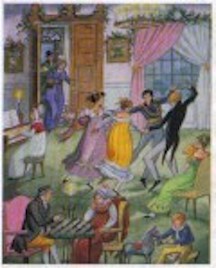
Parlor games entertained houseguests, but  caroling (except possibly in Wales), decorated trees, stockings hung by the chimney with care, and  Christmas cards were not part of the celebrations. Gifts were few and often took the form of charitable acts by the aristocracy. A landowner’s cottagers might bestow a gift symbolizing their devotion to his generosity or representing the bounty of the estate’s harvest on the main house. A Regency Christmas was a time to reflect upon one’s religious beliefs and to enjoy the companionship of friends and family. It was not the commercialized holiday we of this century would expect.regency-christmas-4
In creating my Austenesque novel, Christmas at Pemberley, the challenge was to tell a tale of “Christmas” for a modern audience, but to stay true to the Regency Period’s practices. In the novel, Christmas arrives on a Sunday. It is 25 December 1814, the time period between Napoleon’s arrival on Elba and his escape in March 1815. I shifted the story’s emphasis from the expected symbols of Christmas (gifts, carols, trees, etc.) to the birth of two children and how each child’s entrance into this world changes the family into which he is introduced. I used the holiday’s practices as the framework through which the story is told. [Leaving a comment below will enter you into a giveaway of a signed copy of “Christmas at Pemberley.” – Deadline midnight 26 December 2014]

Christmas at Pemberley
A Pride and Prejudice Holiday Sequel
By Regina Jeffers
9781569759912-011A festive holiday novel in which personal rivalries are resolved, generosity rediscovered, and family bonds renewed.

It’s Christmastime at Pemberley and the Darcys and Bennets have gathered to celebrate. With such a mix of eclectic characters under one roof, bitter feuds, old jealousies, and intimate secrets quickly rise to the surface. Stubborn Lady Catherine seeks forgiveness, shallow Caroline Bingley finds love, and immature Kitty pursues a vicar. Forced into playing hostess, Georgiana Darcy tries desperately to manage the chaos while wishing Darcy and Elizabeth would return from their journey.

Enroute home, Darcy and Elizabeth are waylaid by blizzard-like conditions that forces them to take shelter in a nearby inn. Elizabeth is tormented with the prospect of their spending Christmas away from their families, but when a young couple arrives at the inn in need of a place for the night, Elizabeth’s concern turns to the pregnant girl. As Elizabeth and Darcy comfort and soothe the stranger through a long and painful labor, they’re reminded of the love, family spirit, and generosity that lie at the heart of Christmas and which serve as the basis of what they have built at Pemberley.

Excerpt: 

“A small gift from Nan,” Elizabeth said as she handed the hastily-made dressing gown to Mary. With Mrs. Washington’s assistance, Elizabeth had assisted Mary into fresh clothes. Now, the new mother rested once more in the bed. She held the sleeping child in the bend of her arm.

“I will thank the girl properly,” Mrs. Joseph assured.

Elizabeth patted the back of the lady’s hand. “Why do you not rest?”

“You require your rest  as much as I,” Mrs. Joseph protested.

Elizabeth shook off the suggestion. “First, I believe I shall go downstairs and have a proper supper with Mr. Darcy. My back is tight.” She stretched her arms over her head. “I shall send Mr. Joseph to sit with you.”

“It is not necessary for someone to watch me sleep.” Mary’s eyelids closed, but then sprung open again. “That is unless you require private time with Mr. Darcy.’

Elizabeth smiled knowingly. “I never tire of the man’s company. Even after two years.”

“Then by all means send Mr. Joseph up. A woman of your great heart should have her every wish.” She caught Elizabeth’s hand in a tight grasp.

Elizabeth  touched the sleeping child’s hair with her fingertip. “My wish is to possess what you have, Mary,” she whispered.

“You will, Elizabeth,” Mrs. Joseph insisted. “You shall have your own special happiness…you and Mr. Darcy.” The woman paused to suck in what appeared to be a deep steadying breath. “My child’s birth…I was never afraid, because God placed the incomparable Elizabeth Darcy in my life. My prayers, those I recited before Matthew and I departed Stoke-on-Trent, were for God to send an angel to protect my child, and on the third day of our journey, I walked into this out-of-the-way inn; and there you were. My own angel!”

Elizabeth snorted. “I have been called many things, but ‘angel’ has rarely been used in the same sentence as my Christian name.”

“That is where the world remains in error, Elizabeth. They see the defenses you erect to protect yourself from those who would think to know you. They do not see your magnificent heart…your indomitable spirit…the purity of your soul.”

Elizabeth laughed self-consciously. “Do not bestow too many exemplary qualities upon my shoulders. If I am to be known as an ‘angel,’ I shall be forced to find something of merit to say of Miss Bingley.”

Mary’s eyebrow rose in curiosity. “Miss Bingley?”

Elizabeth chuckled. “My sister Jane is married to Mr. Charles Bingley. Miss Bingley is the youngest of the gentleman’s sisters. Before Jane and Bingley were married, Miss Bingley did my poor, sweet Jane a major disservice, and the lady once had her sights set on Mr. Darcy. I am often at my wit’s end when I am called upon to be civil to the woman.”

“Angels may feel jealousy, Elizabeth.” Mary squeezed the back of Elizabeth’s hand in companionship.

“So, you believe there are ‘shades’ of angelic behavior?” Her voice rose in bemusement.

Mary smiled, a twist of her lips turning upward. “Absolutely,” she declared without a telling blink of her eyes. “God’s love is pure, but mankind’s benevolence may vary.” An appreciative leap of sardonic humor flashed in Mary’s eyes. “An ‘angel’ may have moments of weakness.”

Elizabeth puzzled over the point Mary Joseph meant to make. “You believe I have God’s attention?” The woman’s rather cryptic utterances had mystified Elizabeth.

“We all possess God’s attention, and it is up to each of us to determine how best to serve Him. That being said, it is my opinion our Maker has chosen you among His favorites.”

Before she could stifle the words, Elizabeth defensively asked, “Then how could a loving God permit my children to die before I could know them? Before I could tell them of my love?” Tears trickled from her eyes to cascade down her cheeks.

Mrs. Joseph swallowed hard. “That is the question which most frightens you, is it not? You wonder how, if you serve God faithfully, He could not honor you with a child of your own. How the rest of the world can know the happiness you have been denied? How no one other than Mr. Darcy understands the depth of your fears?”

“Yes.”

“I have no answer which will satisfy your heart: God gives us what we require when we require it. My husband holds different ideas on such matters, but I believe that when the Bible says God created man in His image, the passage means God has His foibles, as well. He, for example, is a bit selfish. God wishes to surround himself with the most magical sound in the world, the sound of a child’s freely-given laugh. Therfore, sometimes He acts upon his selfishness and calls the child home early. It is the only explanation which makes any sense.”

Elizabeth brushed away her tears. “I shall endeavor to accept your explanation, Mary. It will serve me as well as any other.”

“You cannot argue with a woman named ‘Mary’ on the occasion of the anniversary of the Lord’s birth,” the woman teasingly reasoned.

“No. I suppose, I cannot.”

Thank you for joining my party; now, have a look at equally enjoyable entertainments…

1. Helen Hollick: “You are Cordially Invited to a Ball” (plus a giveaway prize) 
http://ofhistoryandkings.blogspot.co.uk/2014/12/you-are-invited-to-party_17.html

2. Andrea Zuvich: “No Christmas For You! The Holiday Under Cromwell”  http://www.andreazuvich.com/history/no-christmas-for-you-the-holiday-under-cromwell

3. Debbie Young:  “Good Christmas Housekeeping” + a Giveaway of a Virtual Party Bag Giveaway  http://authordebbieyoung.com/2014/12/20/christmas/

4. Lauren Johnson:  ‘”Farewell Advent, Christmas is come” – Early Tudor Festive Feasts’  http://laurenjohnson1.wordpress.com/2014/12/19/farewell-advent-christmas-is-come-early-tudor-festive-feasting-christmas-party-blog-hop/

5. Ann Swinfen: Christmas 1586 – Burbage’s Company of Players Celebrate  http://annswinfen.com/2014/12/christmas-party/

 6. Richard Abbott: The Hunt – Feasting at Ugarit
http://richardabbott.authorsxpress.com/2014/12/19/the-hunt-feasting-at-ugarit/

 7. Edward James: AN ACCIDENTAL VIRGIN  https://busywords.wordpress.com/an-accidental-virgin/

and 

AN UNINVITED GUEST  https://busywords.wordpress.com/the-birthday-party/

8.  Derek Birks: The Lord of Misrule – A Medieval Christmas Recipe for Trouble https://dodgingarrows.wordpress.com/2014/12/19/christmas-blog-hop-the-lord-of-misrule-a-medieval-christmas-recipe-for-trouble/

9. Jude Knight: Christmas at Avery Hall in the Year of Our Lord 1804 + Giveaway of “Candle’s Christmas Chair” (novella)  http://judeknightauthor.com/2014/12/20/christmas-at-avery-hall-in-the-year-of-our-lord-1804/

10. Nancy Bilyeau: “Christmas After the Priory”    http://nancybilyeau.blogspot.com/2014/12/blog-hop-christmas-after-priory.html

11. Fenella J. Miller:  ‘Christmas on the Home front + GIVEAWAY of “Barbara’s War.”
http://fenellamiller.blogspot.co.uk/2014/12/christmas-on-home-front-and-giveaway.html

12. Clare Flynn: A German American Christmas http://www.clareflynn.co.uk/blog/a-german-american-christmas

13. Sarah Etter: Christmas Pudding — Part of the Christmas Feast!  http://saraleeetter.wordpress.com/2014/12/19/christmas-pudding-part-of-the-christmas-feast/

14. Suzanne Adair: “The British Legion Parties Down for Yule 1780” + Giveaway of “Camp Follower: A Mystery of the American Revolution.” http://www.suzanneadair.net/2014/12/19/the-british-legion-parties-down-for-yule-1780/

15. J L Oakley: Christmas Time in the Mountains 1907 + Giveaway of an audioboook of “Tree Soldier” (US and UK)
https://historyweaver.wordpress.com/2014/12/19/christmas-time-in-the-mountains-1907/

16. Anna Belfrage:  All I want for Christmas + Giveaway  https://annabelfrage.wordpress.com/2014/12/20/all-i-want-for-christmas-the-christmas-party-blog-hop/

17. Carol Cooper: How To Be A Party Animal  http://pillsandpillowtalk.com/2014/12/19/how-to-be-a-party-animal/

18. Julian Stockwin: Join the Party   http://tinyurl.com/n8xk946  

19. Juliet Greenwood: Christmas 1914 on the Home Front (plus a giveaway)   http://julietgreenwoodauthor.wordpress.com/2014/12/19/christmas-1914-on-the-home-front/

20. Lucienne Boyce:  A Victory Celebration   http://tinyurl.com/ovl4sus

21. Nicola Moxey: The Feast of the Epiphany, 1182  http://nickymoxey.com/2014/12/19/the-feast-of-the-epiphany-1182/

22. Peter St John:  Dummy’s Birthday   http://jennospot.blogspot.fr/2014/12/dummys-party.html

23. Stephen Oram : Living in your dystopia: you need a festival of enhancement… (plus a giveaway prize)  http://stephenoram.wordpress.com/2014/12/19/living-in-your-dystopia-13-you-need-a-festival-of-enhancement/

24.  Alison Morton: “Saturnalia surprise – a winter party tale” + Giveaway of “Perfiditas” – http://alison-morton.com/2014/12/20/saturnalia-surprise-a-winter-party-tale-and-giveaway/

25. Lindsay Downs : O Christmas Tree, O Christmas Tree + Giveaway 
http://lindsaydowns-romanceauthor.weebly.com/lindsay-downs-romance-author/o-christmas-tree-o-christmas-tree

26. A Bonus Post from Ann Swinfen: The Real Richard (Dick) Whittington               http://the-history-girls.blogspot.co.uk/2014/12/turn-again-whittington-by-ann-swinfen.html

Posted in book excerpts, British history, Great Britain, Jane Austen, Living in the Regency, Regency era | Tagged , , , , , | 59 Comments

Celebrating Christmastide

Celebrating Christmastideye-old-yule-log

Christmastide (also Christmas or the Christmas season) is one of the seasons of the liturgical year of most Christian churches. It tends to be defined (with slight variations) as the period from Christmas Eve to the Epiphany. This period is also commonly known as the Twelve Days of Christmas, as referred to in the Christmas carol of the same name, or Yuletide, as in “Deck the Halls.”

Many Protestant churches add an Epiphany season after the Christmas season, extending the celebration of Christmas for forty days until the feast of the Presentation of Christ in the Temple (Candlemas) on 2 February (or a nearby Sunday). In the Missal and Breviary of the Roman rite, since 1970, the Christmas season runs a shorter period, from Christmas Eve to the Baptism of the Lord, which depending on the place and the year can occur between 7 January and 13 January. In the Little Office of the Blessed Virgin Mary, the season runs from Vespers on 24 December till Compline on 2 February.

scene-from-emmaDuring the season, various festivities are traditionally enjoyed and buildings decorated. In some countries the superstition has arisen that it is bad luck to leave the decorations up after Twelfth Night.

Advent, anglicized from the Latin word adventus meaning “coming”, is a season observed in many Western Christian churches, a time of expectant waiting and preparation for the celebration of the Nativity of Jesus at Christmas. It is the beginning of the Western liturgical year and commences on Advent Sunday, called Levavi. The Eastern churches’ equivalent of Advent is called the Nativity Fast, but it differs both in length and observances and does not begin the church year, which starts instead on September 1.

The progression of the season may be marked with an Advent calendar, a practice introduced by German Lutherans. At least in the Roman Catholic, Anglican, Lutheran, Moravian, Presbyterian, and Methodist calendars, Advent starts on the fourth Sunday before December 25, the Sunday from November 27 to December 3 inclusive.

Latin adventus is the translation of the Greek word parousia, commonly used in reference to the Second Coming of Christ . For Christians, the season of Advent anticipates the coming of Christ from two different perspectives. The season offers the opportunity to share in the ancient longing for the coming of the Messiah, and to be alert for his Second Coming.

Posted in British history, customs and tradiitons, Great Britain, Jane Austen, Living in the Regency, Regency era | Tagged , , , , | 2 Comments

A Jane Austen Time Line

A Jane Austen Time Line

239 years ago today, Jane Austen was born. I thought we might take a quick survey of her life.

MTE1ODA0OTcxNTQ2ODcxMzA51764-The Reverend George Austen marries Cassandra Leigh. They take up residence at Deane Parsonage in Hampshire.
1765-Brother James was born. Like his sister, James had literary aspirations, but he never knew success.
1766-George Austen was born. Mentally challenged, George was boarded out for most of his life.
1767-Edward Austen was born. Later, he was adopted by Thomas Knight. Because the Knight family had no children, Edward inherited all their property.
1767-The Austens move to Steventon Rectory.
1771-Jane’s brother Henry was born. It was with Henry’s influence that Jane found her publisher.
1773-Cassandra Austen is born.
1774-The first of Jane’s sea-faring brothers, Frank, was born.
1775-On December 16, Jane Austen is born.
1779-Charles Austen was born. Charles spent seven years in the British navy’s efforts in the West Indies.
1783-Jane nearly dies from typhoid fever, which she contracted while attending a boarding school in Oxford.
1787-Jane’s formal education ends, and she begins to write. She preserves scraps of her early writing in Volume the First.
1793-The last pieces are added to Volume the Third. Jane’s nieces Anna and Fanny Austen are born.
1795-Jane writes Elinor and Marianne.
1796-The first of the letters, which were preserved, are dated from this year. For example, in a January letter, Jane writes of flirting with Tom Lefroy, and in an October one, she tells of beginning First Impressions.
1797-Jane finishes First Impressions. It is offered to the publisher, Cadell, who declines Rev. Austen’s presentation of the manuscript.
Jane also begins Sense and Sensibility in 1797.
1798-Jane begins writing Susan. Her nephew (and future biographer), James Edward Austen is born.
1799-Jane finishes Susan. She stays for some time in Queen Square in Bath.
1800-Jane’s parents decide to retire in Bath.
1801-Jane’s parents take a lease on 4 Sydney Place in Bath.
1802-Harris Bigg-Wither proposes.
1803Susan is sold to publisher Crosby.
1804-Jane’s family moves to Green Park Buildings, Bath.
1805-Rev. George Austen dies. Jane begins The Watsons, which she soon abandons. Her family moves to Gay Street in the spring and then to Trim Street in the autumn.
1807-The Austen women (mother, Jane, and Cassandra) take a house with brother Frank and his wife in Castle Square, Southampton.
1808-Brother Edward offers the Chawton cottage to his mother and sisters.
1809-In July, the women move into the Chawton cottage.
1811-Jane begins writing Mansfield Park. In November, Egerton publishes Sense and Sensibility.
1813-In January, Jane releases Pride and Prejudice. By July, Mansfield Park is finished.
1814-Austen begins Emma in the early part of the year. In May, Mansfield Park is published.
1815-Jane begins Persuasion. Emma is published in December.
1816-Sir Walter Scott gives Emma favorable notice in Quarterly Reviews. In August, Jane finishes Persuasion. She takes ill shortly afterwards.
1817-She begins Sanditon, but abandons it due to her health issues. In July, Jane Austen dies. She is buried in Winchester Cathedral. Persuasion and Northanger Abbey are published posthumously with a Biographical Notice written by Henry.

Posted in Great Britain, Jane Austen, Living in the Regency, real life tales, Regency era | Tagged , | 2 Comments

The Open Christmas Letter 1914

In the lead up to Christmas 1914, there were several peace initiatives. The Open Christmas Letter was a public message for peace addressed “To the Women of Germany and Austria,” signed by a group of 101 British women suffragettes at the end of 1914 as the first Christmas of World War I approached.

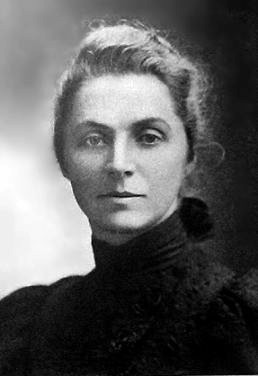
Emily Hobhouse authored the Open Christmas Letter and circulated it for signatures. License details This image (or other media file) is in the public domain because its copyright has expired.

Emily Hobhouse authored the Open Christmas Letter and circulated it for signatures.
License details
This image (or other media file) is in the public domain because its copyright has expired.

The Open Christmas Letter was written in acknowledgment of the mounting horror of modern war and as a direct response to letters written to American feminist Carrie Chapman Catt, the president of the International Woman Suffrage Alliance (IWSA), by a small group of German women’s rights activists. Published in January 1915 in Jus Suffragii, the journal of the IWSA, the Open Christmas Letter was answered two months later by a group of 155 prominent German and Austrian women who were pacifists. The exchange of letters between women of nations at war helped promote the aims of peace, and helped prevent the fracturing of the unity, which lay in the common goal they shared: suffrage for women.

The decision by some suffragists to speak out against the war split the women’s suffrage movement in the United Kingdom. Most British women were in favour of a quick solution to the conflict and were inclined to work toward that end in any way such as by helping fill positions abandoned by men off at war. Others were nationalistic and sought to make certain that British women were seen as patriotic, as doing their part, so that the men in power would think more highly of them and subsequently pass woman suffrage legislation. A minority of women advocated peace vociferously and worked with international peace organisations or with refugee aid societies. All suffragists from the most strikingly militant to the most actively pacifist agreed not to disrupt the nation at war in their promotion of women’s suffrage. Toward the end of the war, British politicians rewarded them with a partial victory: suffrage for property-holding women aged 30 and older.

From 1906 until mid-1914, the Labour Party in the United Kingdom was the party seen as most supportive of women’s suffrage—the right of women to vote. Suffragettes and other women’s rights activists organised to elect Labour candidates and to push for legislation that expanded the rights of women. In August 1914 when the world became embroiled in war, the British women activists were sharply divided into two camps: the majority who wished to work with their country’s war effort, and a minority who opposed the conflict. Millicent Garrett Fawcett of the National Union of Women’s Suffrage Societies (NUWSS) wished to have the NUWSS members work for the war so that the men in politics would view the women with greater respect and would thus be more amenable to granting them the right to vote. However, the NUWSS membership included those who were against war. When Fawcett turned the NUWSS to war work, eleven pacifist members resigned, later to join the Women’s International League for Peace and Freedom (WILPF).

Like the NUWSS, the more militant Women’s Social and Political Union (WSPU) led by Emmeline and Christabel Pankhurst chose to cease their obstructive activism for women’s votes and instead advocated the alignment of British women to the cause of war. However, in October 1914, Sylvia Pankhurst travelled to Glasgow and spoke out against the war, becoming one of the first suffragettes to do so. She said that “peace must be made by the people and not by the diplomats.” Though pacifist, Pankhurst held with her mother and sister to the general agreement that suffragettes would abstain from militant activism for the duration—she arranged for activist women to join with the War Emergency Worker’s Committee and fill some of the positions that had been abandoned by men leaving for war.

In Jus Suffragii in December 1914, Carrie Chapman Catt published a letter that she had received earlier from Anita Augspurg, Lida Gustava Heymann, and several other German women activists including presidents of woman suffrage societies in Germany. The letter was entitled “To the International Woman Suffrage Alliance, through its president, Mrs. Chapman Catt.”[5] It began, “To the women of all nations warm and hearty greetings in these wretched and bloody times.” The German women expressed that the “criminally rekindled war” should not separate women from all countries who had previously been united “by the common striving for the highest object—personal and political freedom.” They stated that “True humanity knows no national hatred, no national contempt. Women are nearer to true humanity than men.”

Catt published another letter from German women’s rights activist Clara Zetkin, one that expressed the desire for all women not to let “the thunder of guns and the shouts of the jingoes” make them forget that the rise of civilisation amongst the European countries held much in common. Zetkin wrote that the women of the world should guard their children against the “hollow din” of “cheap racial pride” which filled the streets, and that “the blood of dead and wounded must not become a stream to divide what present need and future hope unite.”

n response to the letters from Germany, Emily Hobhouse organised the writing and signing of a peace-promoting letter from British women: the Open Christmas Letter. In the 1900s, Hobhouse campaigned against and worked to change the appalling conditions inside the British concentration camps in South Africa built for Boer women and children during the Second Boer War. She saw in the German letters the opportunity for maintaining vital international relations among women who could help mitigate the damage that war would bring. She wrote what she called a “Letter of Christmas Greeting” in November 1914 and circulated it for signatures of women who wished for peace. Pankhurst and Helen Bright Clark were among the first to sign Hobhouse’s plea for continued sisterhood among the women of the world.

Others among the 101 signers were Margaret Ashton, Margaret Bondfield, Eva Gore-Booth, Esther Roper, Maude Royden, Helena Swanwick, and a wide range of women united by the wish for “undiminished sisterly relations” and a swift end to hostilities. Included among the women were some who were members of the Women’s Labour League, and some of the Independent Labour Party. One of the listed women was “Mrs. M. K. Gandhi” but it is unknown whether Kasturba Gandhi, the wife of Mohandas Karamchand Gandhi, asked that her name be included. At least one of the signers was an American: Florence Edgar Hobson was the New York-born wife of English Liberal social theorist and economist John A. Hobson.

The Message
Under the heading “On Earth Peace, Goodwill towards Men,” the letter’s salutation addressed “Sisters” and began, “Some of us wish to send you a word at this sad Christmastide, though we can but speak through the Press…” The women of the UK were prevented from direct communication with the women of Germany because of the war. Instead, they sent their missive to America, which was at that time a neutral nation. The letter continued, “The Christmas message sounds like mockery to a world at war, but those of us who wished and still wish for peace may surely offer a solemn greeting to such of you who feel as we do.” The letter mentioned that, as in South Africa during the Second Boer War (1899–1902) and in the Balkan Wars of 1912–1913, “the brunt of modern war falls upon non-combatants, and the conscience of the world cannot bear the sight.”

“Is it not our mission to preserve life? Do not humanity and common sense alike prompt us to join hands with the women of neutral countries, and urge our rulers to stay further bloodshed? …
Even through the clash of arms, we treasure our poet’s vision, and already seem to hear

“A hundred nations swear that there shall be
Pity and Peace and Love among the good and free.”

May Christmas hasten that day..

The Response
In the spring of 1915, the letter was answered in kind by 155 Germanic feminists including Augspurg and Heymann, who had sent the earlier letter from Germany. Margarethe Lenore Selenka, Minna Cauer, and Helene Stöcker were among the German signers; Rosa Mayreder, Marianne Fickert, Ernestine Federn, and Ernestine von Fürth were in the group of Austrian signers. The response was entitled “Open Letter in Reply to the Open Christmas Letter from Englishwomen to German and Austrian Women” and was published in Jus Suffragii on 1 March 1915. The letter began:

“To our English sisters, sisters of the same race, we express in the name of many German women our warm and heartfelt thanks for their Christmas greetings, which we only heard of lately.

This message was a confirmation of what we foresaw—that women of the belligerent countries, with all faithfulness, devotion, and love to their country, can go beyond it and maintain true solidarity with the women of other belligerent nations, and that really civilised women never lose their humanity..

For more information on this event, visit

Diana Overby’s Presently in the Past – https://dianaoverbey.wordpress.com/2012/12/21/open-christmas-letter-december-1914/

Many of these details can be found at http://en.wikipedia.org/wiki/Open_Christmas_Letter

Posted in British history, customs and tradiitons, Great Britain | Tagged , , | 3 Comments

A Resurgence of “St. Jane,” the Never-Ending Reverence to All Things Austen

A Resurgence of Jane Austen

Several people believe Colin Firth’s stellar two-year “flirt” with Oscar – first with a spectacular performance in “A Single Man” and then in “The King’s Speech” – led to a resurgence of Jane Austen’s popularity. In the 1995 BBC mini-series, Firth played the enigmatic Mr. Darcy from Austen’s Pride and Prejudice, and a legion of Austen fans cheered on his most recent successes. Obviously, I am one of those fanatics, and although I have never noted the total absence of Jane Austen mania, I have seen the rise and fall of her popularity in modern culture. I write Jane Austen adaptations, as well as Regency era romances, and have seen firsthand the scramble of traditional publishers to snap up Jane Austen fan fiction (known as JAFF) for publication. I did not come to the publishing world in such a manner, but I have many Austenesque friends who have known a bit of notoriety as an Austen-inspired author.

Recently, I received a note on Facebook from a former student, who I would say “fought” me tooth and nail when I insisted upon teaching the beloved Pride and Prejudice to his AP class. He attended a film production school at the university level, and upon his first post graduation interview, the 20s something production staff described a screenplay they were considering. My student said, “Oh, that is just like Pride and Prejudice.” When the others were not as informed on Austen as my student, he explained the basic plot of P&P and earned the job. I laughed at his message for I always told him that he needed to know something of Jane Austen for some day he would be on “Jeopardy” and the final question to win all would be “Who is Jane Austen?” I was half right.

For a more detailed analysis of this “new” phenomena – this Austen mania – read the article below from The Star.

Kristin Rushowy
Education Reporter
Almost 200 years after her death, it is a truth universally acknowledged that Jane Austen and her works have found new life in the online world.
But these days, there’s another, real-world reason for all the interest in the 19th-century novelist: English actor Colin Firth.

Beloved among fans for his portrayal of Mr. Darcy in the famed 1995 BBC production of Pride and Prejudice.

aa8747014254b8bb8ac5c2e6362cFirth was the reason “a lot of people got hooked on the novels,” said Deidre Lynch, an English professor at the University of Toronto, whose Austen classes typically have as big a wait list as the classes themselves.

But, she added, that’s too simple an explanation for Austen’s ever-growing legion of fans. Social media, too, have given Austen a second life.

Austen is on Twitter — well, fans tweeting in her name — and is the subject of countless Facebook fan pages that grow daily, one with almost 850,000 “likes.” Devotees have created aFacebook newsfeed version of P&P, and others post videos to Youtube in Austen’s honour, from serious scene recreations to hilarious send-ups.

“It’s like votive offerings to Jane Austen, as if she were a saint,” said Lynch, editor of Janeites: Austen’s Disciples and Devotees.

In her current undergraduate class on romantic poetry and prose “Austen makes a few appearances,” she said. “The students would probably prefer more.”

Publishers often have trouble keeping up with demand for Pride and Prejudice.

There has been “a pretty steadily increasing Austen presence in popular culture — but not much of that really connected to the books Austen wrote,” noted Elaine Bander, president of the Canadian chapter of the Jane Austen Society of North America.

To read the complete article, please visit, http://www.thestar.com/entertainment/books/article/934803–jane-austen-is-back-thanks-to-colin-firth


Austen-inspired titles by Regina Jeffers (Visit www.rjeffers.com for excerpts, events, etc.)

Darcy’s Passions: Pride and Prejudice Retold from His Point of View

Darcy’s Temptations: A Sequel to Pride and Prejudice 

Captain Frederick Wentworth’s Persuasion: Austen’s Classic Retold from His Point of View

Vampire Darcy’s Desire: A Paranormal Pride and Prejudice

The Phantom of Pemberley: A Pride and Prejudice Mystery

Christmas at Pemberley: A Holiday Sequel 

The Disappearance of Georgiana Darcy: A Pride and Prejudice Mystery

The Mysterious Death of Mr. Darcy: A Pride and Prejudice Mystery

Honor and Hope: A Contemporary Romantica Based on Pride and Prejudice

(releasing in 2015) The Prosecution of Mr. Darcy’s Cousin: A Pride and Prejudice Mystery


Posted in book excerpts, book release, British history, Jane Austen | Tagged , , | 9 Comments

Do You Speak Jane Austen? Part Two

MTE1ODA0OTcxNTQ2ODcxMzA5Do You Speak Jane Austen? Part 2

A laugh, a fist pounding on a desk top, a raised eyebrow – these are all signals to punctuation of the spoken word, but what of the written word? We start with the assumption that we each wish to avoid language that is insensitive, stereotypical, or in any other way derogatory. But was that true for Jane Austen’s time? Look below. Are there words that you particularly like? Ones you find useless in our modern world?

J
jilt – to deceive a lover

“Let Wickham be your man. He is a pleasant fellow, and would jilt you creditably.” (Chapter 24)

St. James
St. James’s Palace is one of London’s oldest palaces. It is situated in Pall Mall, just north of St. James’s Park. Although no sovereign has resided there for almost two centuries, it has remained the official residence of the Sovereign and the most senior royal palace in the UK

Such formidable accounts of her ladyship, and her manner of living, quite frightened Maria Lucas who had been little used to company, and she looked forward to her introduction at Rosings with as much apprehension as her father had done to his presentation at St. James’s. (Chapter 29)

judged – to form an opinion or conclusion about

“Perhaps,” said Darcy, “I should have judged better, had I sought an introduction; but I am ill-qualified to recommend myself to strangers.” (Chapter 31)

K
kindred – family; similar people

“Can you possibly guess, Lizzy, who is meant by this?” ‘This young gentleman is blessed, in a peculiar way, with every thing the heart of mortal can most desire—splendid property, noble kindred, and extensive patronage. Yet in spite of all these temptations, let me warn my cousin Elizabeth, and yourself, of what evils you may incur by a precipitate closure with this gentleman’s proposals, which, of course, you will be inclined to take immediate advantage of.’ (Chapter 57)

kindness – an act intended to show kindness or good will; benevolence

“I can no longer help thanking you for your unexampled kindness to my poor sister.” (Chapter 58)

L
licentiousness – lack of moral discipline

“And it is the more to be lamented, because there is reason to suppose as my dear Charlotte informs me, that this licentiousness of behaviour in your daughter has proceeded from a faulty degree of indulgence; though, at the same time, for the consolation of yourself and Mrs. Bennet, I am inclined to think that her own disposition must be naturally bad, or she could not be guilty of such an enormity, at so early an age.” (Chapter 48)

livery – clothing marked for a particular member of the aristocracy

The horses were post; and neither the carriage, nor the livery of the servant who preceded it, were familiar to them. (Chapter 56)

loo – a betting card game

On entering the drawing room she found the whole party at loo, and was immediately invited to join them; but suspecting them to be playing high she declined it, and making her sister the excuse, said she would amuse herself for the short time she could stay below, with a book. (Chapter 8)

M
missish – prim and sentimental

“You are not going to be missish, I hope, and pretend to be affronted at an idle report. For what do we live, but to make sport for our neighbours, and laugh at them in our turn?” (Chapter 57)

Michaelmas – the feast day of the archangel Michael, celebrated on September 29

“Why, my dear, you must know, Mrs. Long says that Netherfield is taken by a young man of large fortune from the north of England; that he came down on Monday in a chaise and four to see the place, and was so much delighted with it, that he agreed with Mr. Morris immediately; that he is to take possession before Michaelmas, and some of his servants are to be in the house by the end of next week.” (Chapter 1)

mortifications – humiliation; shame

“Let me thank you again and again, in the name of all my family, for that generous compassion which induced you to take so much trouble, and bear so many mortifications, for the sake of discovering them.” (Chapter 58)

N
Netherfield – the fictionalized estate that Mr. Bingley rents in Hertfordshire

“Was there no good in your affectionate behaviour to Jane while she was ill at Netherfield?” (Chapter 60)

noble – dignified; gallant; aristocratic; gracious

“Had you not been really amiable, you would have hated me for it; but in spite of the pains you took to disguise yourself, your feelings were always noble and just; and in your heart, you thoroughly despised the persons who so assiduously courted you.” (Chapter 60)

novelty – freshness; uniqueness; something new, original, and different that is interesting or exciting, though often for only a short time

He was as much awake to the novelty of attention in that quarter as Elizabeth herself could be, and unconsciously closed his book. (Chapter 11)

O
odious – horrible; loathsome; abhorrent

“How many letters you must have occasion to write in the course of a year! Letters of business, too! How odious I should think them!” (Chapter 10)

obeisance – a gesture of respect, such as a bow or a curtsy; honor; loyalty

The two gentlemen left Rosings the next morning, and Mr. Collins having been in waiting near the lodges, to make them his parting obeisance, was able to bring home the pleasing intelligence, of their appearing in very good health, and in as tolerable spirits as could be expected, after the melancholy scene so lately gone through at Rosings. (Chapter 37)

P
penance – remorse; a hardship endured to compensate for wrongdoing

It seemed like wilful ill-nature, or a voluntary penance, for on these occasions it was not merely a few formal inquiries and an awkward pause and then away, but he actually thought it necessary to turn back and walk with her. (Chapter 33)

0e7486epreferment – promotion; advancement; elevation; upgrading;

pecuniary – financial; relating to money

His own father did not long survive mine, and within half a year from these events, Mr. Wickham wrote to inform me that, having finally resolved against taking orders, he hoped I should not think it unreasonable for him to expect some more immediate pecuniary advantage, in lieu of the preferment, by which he could not be benefited. (Chapter 35)

Note! Yes, I know that I added a few extra words in this mix. I had originally thought to have two words for each letter of the alphabet. However, I am anticipating some problems when I reach x and z. The extras are to make up for my latter deficiencies. Part 3 will follow on Wednesday next. 

Posted in Uncategorized | 7 Comments

Of Water Nymphs and Mermaids? Are You Familiar with These British Legends?

Of Water Nymphs and Mermaids – Have You Heard of These UK Legends?

Fairy maidens inhabiting the oceans, rivers, springs, meadows, woods, and wells are collectively known as nymphs. Nymphs resemble humans in height and overall appearance, but they are known for their enchanting beauty and seductive charms. According to most legends, water nymphs are the most dangerous of the “sisterhood.” Many in the UK are surrounded by legends of water nymphs. Of late, I have been researching legends and myths surrounding the south central UK, but I have enjoyed reading many of those found elsewhere in England.

In all countries, “water” is the source of life, and, therefore, it holds a veneration in the world’s various cultures. Sources of water in each small village and thriving metropolis holds the potential for legends and traditions to find root. These are often extremely local, and therefore little known.

Loup Scar Burnsall: Loup scar on the river Wharfe at Burnsall is a popular venue with climbers, and the river below is popular with canoeists.

Loup Scar Burnsall:
Loup scar on the river Wharfe at Burnsall is a popular venue with climbers, and the river below is popular with canoeists.

With wells, the names alone suggest much. The memory of the mythical gods, satyrs, and nymphs of the ancient times lingers in a few, as in Thors-kil or Thors-well, in the parish of Burnsall; and in the almost universal declaration — by which not over-wise parents seek to deter children from playing in dangerous proximity to a well — that at the bottom, under the water, dwells a mysterious being, usually named Jenny Green-teeth or Peg-o’-the-Well, who will certainly drag into the water any child who approaches too near to it.

The tokens of medieval reverence for wells are abundant. The names of the saints to whom the wells were dedicated yet cling to them. “There is scarcely a well of consequence in the United Kingdom,” says the editor of Lancashire Folk-lore, “which has not been solemnly dedicated to some saint in the Roman calendar.”

Thus in Yorkshire one finds Our Lady’s Well or Lady Well; St. Helen’s Well; St. Margaret’s Well at Burnsall; St. Bridget’s Well near Ripon; St. Mungo’s Well at Copgrove; St. John’s Well at Beverley; St. Alkelda’s Well at Middleham, etc.

Thomas Hardy's Cottage

Thomas Hardy’s Cottage

In Dorset, one may find a circular pool called Rushy Pond. It is a quarter mile southeast of Thomas Hardy’s cottage at Thorncombe Wood. Reportedly, unwary travelers are lured into the pond, never to seen again.


“I Said And Sang Her Excellence”
by Thomas Hardy

(Fickle Lover’s Song)

I said and sang her excellence:
They called it laud undue.
(Have your way, my heart, O!)
Yet what was homage far above
The plain deserts of my olden Love
Proved verity of my new.

“She moves a sylph in picture-land,
Where nothing frosts the air:”
(Have your way, my heart, O!)
“To all winged pipers overhead
She is known by shape and song,” I said,
Conscious of licence there.

I sang of her in a dim old hall
Dream-built too fancifully,
(Have your way, my heart, O!)
But lo, the ripe months chanced to lead
My feet to such a hall indeed,
Where stood the very She.

Strange, startling, was it then to learn
I had glanced down unborn time,
(Have your way, my heart, O!)
And prophesied, whereby I knew
That which the years had planned to do
In warranty of my rhyme.

BY RUSHY-POND.

Rushy Pond

Rushy Pond

At Old Harry Rocks at Studland in Dorset, there is a mystery of sorts. The water level never changes, whether by storms or droughts. Again, water nymphs are said to inhabit the pool and practice their magic within the pool’s depths.

Black Mere Pond

Old Harry Rocks

Surprisingly, Staffordshire, which has no coastline, has the Legend of the Mermaid of Black Mere Pool. The small, remote, hilltop lake, around 50 metres wide, creates the perfect haunting site. Set on the craggy and barren southern edge of the Peak District, it is said that the dark, peat-stained waters of the pool are bottomless. Cattle refuse to drink from the water and birds never fly above it. A number of mysterious drownings are attributed to the waters, as well as one murder. In 1679, a woman pedlar was dumped into the pool by a local serial killer.

Tradition holds that the mermaid rises from the pool at midnight to lure unwary travellers to their deaths in the dark watery depths – but only single men, apparently. There are various legends concerning the origin of the mermaid. In one, a sailor from nearby Thorncliff fell in love with her and brought her back from sea, and in another she was originally a witch who transformed herself into a water nymph after been thrown into the pool during the Middle Ages.

mys2b1

Posted in legends | Tagged , , , , | 10 Comments