Gavelkind, Inheritance in Opposition to Primogeniture

CompleteEnglishLawyer-185x300

http://www.legalgenealogist.com/ 2012/07/06/gavelkind-and- borough-english/

In the past on Every Woman Dreams, I discussed the 19th Century Entail and the legalities of primogeniture during the Regency period.  Today, I am adding the exceptions to the practice of the eldest son inheriting everything. Customs throughout the world vary. Some peoples divide their land and moveable property equally among all the sons, or among all the children, present it to the eldest, to the youngest, to the daughter(s), or to the child who cares for his/her parents until their deaths, or deal it out to each child when he/she marries.

800px-Kent_Invicta_Monument

More details Monument at Swanscombe recording the legend of how Kent managed to extract concessions from William the Conqueror. Wikipedia

However, in the county of Kent (yes, the Kent that is Lady Catherine De Bourgh’s home shire in Pride and Prejudice), Ireland, and Wales there was a system of land tenure referred to as “Gavelkind.” Gavelkind is a system of partible inheritance, which resembles Salic patrimony. [Salic patrimony, or inheritance or land property, after the legal term Terra salica used in the Salian code, refers to clan-based possession of real estate property.] Gavelkind appears to have its roots in some sort of ancient Germanic tradition. Under Gavelkind, land was divided equally among sons or other heirs.

These practices were in place until the Administration of Estates Act of 1925. Until then, there were a number of estates “degaveled.”

“All land in Kent was presumed to be held in gavelkind until the contrary was proved. It was more correctly described as socage tenure (or Borough English), subject to the custom of gavelkind. The chief peculiarities of the custom were the following:

**A tenant could pass on part or all of his lands as a fiefdom from fifteen years of age.

**On conviction of a felony, the lands were not confiscated by The Crown.

**Generally the tenant could always dispose of his lands in his will.

**In case of intestacy [Intestacy is the condition of the estate of a person who dies without having made a valid will or other binding declaration. Alternatively this may also apply where a will or declaration has been made, but only applies to part of the estate; the remaining estate forms the “intestate estate”.], the estate was passed on to all the sons, or their representatives, in equal shares, leaving all the sons equally a gentleman. Although females claiming in their own right were given second preference, they could still inherit through representation. [Hello, Anne De Bourgh!!! Plot Point!!!! It seems Miss De Bourgh could inherit Sir Lewis’s estate!]

**A dowager was entitled to one half of the land. [Another plot point! Lady Catherine De Bourgh could own half of her Rosings Park.]

**A widow who had no children was entitled to inherit half the estate, as a tenant, as long as she remained unmarried.

“Gavelkind, an example of customary law in England, was thought to have existed before the Norman Conquest of 1066, but generally was superseded by the feudal law of primogeniture. Its survival in one part of the country, is regarded as a concession by the William the Conqueror to the people of Kent.” [R. J. Smith, “The Swanscombe Legend and the Historiography of Kentish Gavelkind,” in Medievalism in the Modern World. Essays in Honour of Leslie J. Workman, ed. Richard Utz and Tom Shippey (Turnhout: Brepols, 1998), pp. 85-103.]

Wales held a similar custom to gavelkind. It was known as cyfran. Under cyfran, upon the landowner’s death, the property was divided equally among all the man’s sons, including any illegitimate sons. This dividing of ever smaller pieces of land by successive generations of sons created a sort of “Theban war” among brothers, according to Welsh historian, Philip Yorke. The Welsh eventually took up the idea of primogeniture, but the custom of gavelkind was not replaced completely. Like those in Kent, there were pockets of resistance.

The Irish system was closer to the tradition of tribal succession. Unlike the Welsh system of dividing the land among all the sons, the Irish placed the property into “common stock,” where the property was redivided among the surviving member of the sept. [Sept comes from Síol, a Gaelic word meaning “progeny” or “seed” that is used in the context of a family or clan with members who bear the same surname and inhabit the same territory.] Under Irish law, the land was divided among the landowner’s sons. It was the Norman conquerors who gave this Irish inheritance law the name Gavelkind for its apparent similarity to the Saxon Gavelkind inheritance found in Kent.

AnAngelComes_LargeSo what does all this have to do with my recent Regency romantic suspense release? In Angel Comes to the Devil’s Keep, there are multiple questions of inheritance. The hero, Huntington McLaughlin, cannot fulfill his duties to the dukedom because of a debilitating accident. The heroine’s father learns he is the new heir apparent to the Earl of Sandahl, a brother who despises him and will do anything (including murder) to prevent his younger brother from inheriting.

“Angel” is the first book in a new trilogy: The Twins. It is a “sweet” romantic suspense set in the Regency, which will appeal to a general audience.

Book Excerpt:

Another hour passed before Angel could speak privately with her father. “What did the duke say?”

Horace Lovelace frowned, and the chiseled hardness upon his lips took Angel by surprise. “It was an odd conversation. Devilfoard appeared both mollified and concerned over my reunion with Sandahl. Even so, the duke did not demand my withdrawal. In fact, Devilfoard summoned his duchess to his study and explained the situation. The duchess expressed a like determination to act in a responsible manner. It was as if I played a role in an intricate dance. As crass as it sounds to say so, I felt as if my appearance brought the duke and duchess to a new understanding.”

“But, Papa,” Angel protested. “The duke and duchess chose Sandahl’s daughter as Lord Malvern’s future mate. If the situation deteriorates, we shall be asked to leave. Would it not be better to depart upon our terms, rather than to be driven from the duchess’s festivities?”

Her father’s steady gaze made Angel uneasy, but she remained in place. “What is the truth of your objections, Angel? Is Lord Malvern your concern in this madness?”

“No, sir.” She dropped her eyes in submission. “But I would not have you humiliated. Mama would not wish it.”

“What do you know of your mother’s wishes?” he asked harshly, and Angel flinched. “Victoria suffered every day of our married years because our impetuous joining robbed both of us of the blessings of family. If Lady Victoria Lovelace were here at this moment, she would demand I face Carpenter again. My brother did all he could to destroy my marriage felicity. It will be good for him to know his disdain only served to strengthen Victoria’s commitment to my success. To our success.”

Angel’s bottom lip trembled. “What if my uncle chooses to challenge you to a long overdue duel? I could not bear to lose you, Papa.”

Her father gathered her into his embrace. “What, ho?” he said teasingly. “You think your papa too old to defend his family?” He chucked her chin lovingly. “Have you forgotten I am the youngest of Jonathan Lovelace’s sons?”

“No—o—o,” she sobbed.

Horace gave an uncharacteristic snort of disapproval. “If Carpenter would be so foolish, my brother would lose. I would have the choice of weapons, and although I have lost my touch with a sword, I am still quite accurate with a gun.”

It bothered Angel to hear her father speak with such coldness. This was a side of him she never knew. “You could not kill your brother.”

“In a duel, death is not necessary,” he assured. “Surrender is all that is required.”

“But if you would accidentally kill Lord Sandahl?” she pleaded.

Her father smiled with irony. “I would be forced to flee to the Continent or even go to America.”

“Do not jest.”

Her father embraced her more tightly. “Trust me, Angel. I find no humor in this situation. However, nothing worth possessing comes easily.”

She clutched his lapels. “Please promise me you will take care in this matter. If you did not consider it previously, you are now Sandahl’s heir apparent. He has no male heirs, and at Lady Sandahl’s age, she is not likely to present him with one.”

“I did not think upon the title in that respect. You opened my eyes, Angel.”

Angel Comes to the Devil’s Keep

Huntington McLaughlin, the Marquess of Malvern, wakes in a farmhouse, after a head injury, being tended by an ethereal “angel,” who claims to be his wife. However, reality is often deceptive, and Angelica Lovelace is far from innocent in Hunt’s difficulties. Yet, there is something about the woman that calls to him as no other ever has. When she attends his mother’s annual summer house party, their lives are intertwined in a series of mistaken identities, assaults, kidnappings, overlapping relations, and murders, which will either bring them together forever or tear them irretrievably apart. As Hunt attempts to right his world from problems caused by the head injury that has robbed him of parts of his memory, his best friend, the Earl of Remmington, makes it clear that he intends to claim Angelica as his wife. Hunt must decide whether to permit her to align herself with the earldom or claim the only woman who stirs his heart–and if he does the latter, can he still serve the dukedom with a hoydenish American heiress at his side?

Early Reviews

The story is charming, with interesting and realistic characters, a complex plot with plenty of surprises, and a sweet romance woven through it all. The author has a good command of what it was like to be a woman in nineteenth-century England–almost as if she had been there.

Angel Comes to Devil’s Keep is a well-written tale of courage and sacrifice and what women went through in order to marry well in Regency England. The author did her homework and it shows in an authenticity that we don’t often see in Regency romances.

2x6_bookmark - side 1

Nook            Kobo           Smashwords          Kindle           Amazon 

Black Opal Books (both eBooks and Print copies available ~ Print copies include an autographed bookplate)

iTunes         All Romance            Barnes & Noble 

GIVEAWAY: I have 2 eBOOK COPIES OF Angel Comes to the Devil’s Keep available to those who comment on the post. The giveaway ends at midnight EDST on August 25.

Posted in Anglo-Normans, Anglo-Saxons, Black Opal Books, book excerpts, book release, estates, excerpt, Georgian England, historical fiction, history, Inheritance, Living in the Regency, primogenture, Regency era | Tagged , , , , , , | 5 Comments

Author’s Voice

Years ago, when I was still beating my head against the wall while teaching English in the public classrooms of three different states, I attempted repeatedly to explain “author voice” to my students. I encouraged my students to write with clarity and directness, but most of them chose to open up the nearest thesaurus and choose a “plethora of linguistic samples that accentuated their meaning, including long Latinate words and involved syntax.” The appropriate voice is the one that is direct, clear, and unstrained. To explain this point further, I will “borrow” an example from Jo Ray McCuen and Anthony C. Winkler’s Readings for Writers, a personal favorite of mine from some 40+ years back.

What if Patrick Henry had said, “It would be difficult, if not impossible, to predict on the basis of my limited information as to the predilections of the public, what the citizenry at large will regard as action commensurate with the present provocation, but after arduous consideration I personally feel so intensely and irrevocably committed to the position of social, political, and economic independence, that rather than submit to foreign and despotic control which is anathema to me. I will make the ultimate sacrifice of which man is capable – under the aegis of personal honor, ideological conviction, and existential commitment, I will sacrifice my own mortal existence.”  or

“Liberty is a very important thing for a man to have. Most people – at least the people I have talked to or that other people have told me about – know this and therefore are very anxious to preserve their liberty. Of course I cannot be absolutely sure about what other folks are going to do in this present crisis, what with all these threats and everything, but I have made up my mind that I am going to fight because liberty is really a very important thing to me, at least that is the way I feel about it.” 

instead of

“I know not what course others may take, but as for me, give me liberty or give me death.”

9780205309023_p0_v4_s192x300Another favorite of my teaching days was William Strunk and E. B. White’s Elements of Style. It was a standard in many college classrooms of the later half of the 20th Century. In it, Strunk and White make a case for economy in word choices [something that drives me crazy when I am writing for the Regency period]. “A sentence should have no unnecessary words, a paragraph no unnecessary sentences, for the same reason that a drawing should have no unnecessary lines and a machine no unnecessary parts. This requires not that the writer make all his sentences short or that he avoid all detail…but that every word tell.” 

Cervantes said, “All affectation is bad.” In other words, avoid embellishment. A natural unpretentious style is best. 

“A voice in literature is the form or a format through which narrators tell their stories. It is prominent when a writer places himself / herself into words and provides a sense the character is real person conveying a specific message the writer intends to convey.” (Defining Voice from Literary Terms)

Sydney Bauer on Sophia Learning says, 

The author’s voice is expressed through:

  • word choice
  • sentence structure/rhythm
  • the figures of speech that the author uses (such as simile or metaphor)
  • the author’s use of humor and irony

It is the personality of the writer shining through the characters, narrator, and descriptions.

Resources:

Defining Voice

What is Writer’s Voice? 

What is “Voice” in Fiction Writing?

Posted in vocabulary, word origins, writing | Tagged , , , , | Comments Off on Author’s Voice

Discussion of Land Inheritance and a Celebration of the Release of “Angel Comes to the Devil’s Keep”

AnAngelComes_LargeMost of us who have studied British history know something of the concept of Primogeniture, which is the right of succession belonging to the firstborn child, with its roots in the feudal rule by which the whole real estate of an intestate passed to the eldest son. I cannot write a Regency romance without knowledge of this process. As it was for centuries, a mans status in 19th Century British Society rested in the land he held. Land was a symbol of wealth and social rank. Therefore, the need to pass ones wealth to future generations increased with the number of acres of land that he owned. Land was influence, as well as affluence. To ensure ones descendants received what had been incurred, a system known as primogeniture was put in place. Primogeniture meant that all the land in each generations possession was left to the eldest son in the family rather than being divided equally among off the offspring. An entail assured that said eldest son could not mortgage or divide or sell said inheritance. It was to be held for his eldest son, etc., etc., etc.
 
Primogeniture developed during the Norman reign. By leaving the land to the eldest son, the estate would remain intact for future generations. It would also be economically capable of supporting a military force, which could assist the king. By the 19th Century, the King George III, King George IV, King William IV, and Queen Victoria had other means to field a military presence, and social status became the basis of the practice. Customarily, primogeniture was part of a gentlemans will or deeds of settlement. This practice remained intact until 1925, when it was changed by law.
 
The entail prevented a wastrel from selling off the family estate to pay his debts. An entail was defined by a deed of settlement (or) a strict settlement. The heir customarily received the land for his use ONLY in his lifetime. His rights ceased to exist upon his death.
 
Originally, many attempted to entail their properties until the end of the world, so to speak. However, the law would not permit infinity to stand. In practice, an entailed property only remained so until the grandson of the land owner making the settlement became of age at 21 years. Then, the heir could sell or give away the property. So, theoretically, the entail only held the land through the first and second generation of land owners. However, a little coercion often secured the land for future generations.
 
Most land owners (and their sons) held no other financial employment. If the property owners son wished to keep his allowance, he agreed to sign a new deed of settlement, which would assure the property remained in the family for the next two generations, etc., etc. This legal practice offered the landowner to see his property remain in tact for the “infinity” his family duties required. 
 
So what does this legal mumbo jumbo have to do with my latest romantic suspense release? More than you may suspect. In Angel Comes to the Devils Keep, the Duke of Devilfoard worries for the future of the dukedom when his eldest son, the Marquess of Malvern, suffers an accident which robs the marquess of parts of his memory. In addition, there is the issue of Viscount Moses assuming an earldom when no direct heir is available. The problem is once Moses is named the Earl of Sandahl he goes missing upon hishoneymoon. Has he produced an heir to the earldom and the viscounty? If not, which of his two brothers will inherit the titles? Reason says the elder of the two, but if you know anything of my writing, reason often becomes quite twisted.
2x6_bookmark - side 1

Angel Comes to the Devil’s Keep

Huntington McLaughlin, the Marquess of Malvern, wakes in a farmhouse, after a head injury, being tended by an ethereal “angel,” who claims to be his wife. However, reality is often deceptive, and Angelica Lovelace is far from innocent in Hunt’s difficulties. Yet, there is something about the woman that calls to him as no other ever has. When she attends his mother’s annual summer house party, their lives are intertwined in a series of mistaken identities, assaults, kidnappings, overlapping relations, and murders, which will either bring them together forever or tear them irretrievably apart. As Hunt attempts to right his world from problems caused by the head injury that has robbed him of parts of his memory, his best friend, the Earl of Remmington, makes it clear that he intends to claim Angelica as his wife. Hunt must decide whether to permit her to align herself with the earldom or claim the only woman who stirs his heart–and if he does the latter, can he still serve the dukedom with a hoydenish American heiress at his side?

Reviewers Say…

The story is charming, with interesting and realistic characters, a complex plot with plenty of surprises, and a sweet romance woven through it all. The author has a good command of what it was like to be a woman in nineteenth-century England–almost as if she had been there. She really did her research for this one.

Angel Comes to Devil’s Keep is a well-written tale of courage and sacrifice and what women went through in order to marry well in Regency England. The author did her homework and it shows in an authenticity that we don’t often see in Regency romances.

Purchase Links: 

Nook            Kobo           Smashwords          Amazon           Kindle     iTunes 

All Romance         Barnes & Noble 

Black Opal Books (eBook and Print copies available ~ Print copies include an autographed bookplate.)

Posted in Black Opal Books, book release, eBooks, historical fiction, Living in the Regency, primogenture, Regency era, Regency romance, suspense, William IV | Tagged , , , , , , | Comments Off on Discussion of Land Inheritance and a Celebration of the Release of “Angel Comes to the Devil’s Keep”

A Simple Overview of the English Courts During the Regency Period

PoMDC Cover-3 copyOne of the surprising things upon which many readers of the courtroom scene in The Prosecution of Mr. Darcy’s Cousin commented was the lack of a “defense attorney” for the accused. A prosecutor served the British courts, but the accused was often only permitted a barrister’s advice for points of law. 
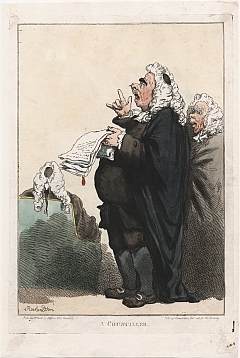
Prior to the last decades of the 18th C, lawyers were rarely present in ordinary criminal trials. Most lawyers who appeared at Old Bailey in the 18th C were not top-notch legal minds. They were considered ignorant of the law and of general incivility. Until the 1730s, the presence of lawyers in the courtroom were the exception to the rule. Their use was encouraged by the growing government practice, from the late 1690s, of funding prosecutions for the most serious offences, such as cases of seditious words and libel, treason, coining, and violent offences such as murder, rape, and robbery. Once their presence as government prosecutors had been accepted, their services were gradually exploited by prosecutors in other cases.

The growth of commerce increased the need for more lawyers in the courtroom. Prosecuting counsel were employed by merchants and shopkeepers. Moreover, a 1752 statue allowed courts to reimburse some prosecutors for expenses incurred if they earned a conviction. By 1778, another statute extended payment to all prosecutors of successful cases.

Defense counsel was excluded in felony cases (except for points of law) until the 1730s, although a defense was expected in treason cases. It was thought if a man were honest, he required no defense. But with the increase of prosecutors in the courtroom, defense lawyers were employed to balance the scales of justice. Even so, a defense lawyer could not summarize the points of his case until the mid 1830s. In the early 1800s less than a third of the cases had a defense counsel. 

“Over the course of the eighteenth and early nineteenth centuries the balance of power in the courtroom, which had been heavily weighted against defendants, shifted marginally back in their direction. With the exception of cases of murder, however, this shift occurred only for those who could afford the cost of a lawyer. In the 1820s, judges began to assign lawyers to speak on behalf of prisoners accused of serious offences. It was also possible for poor prisoners to secure legal representation by applying to defend in forma pauperis or to find funding for legal assistance through a benefactor. The sheriffs of London provided a fund for such assistance from the early nineteenth century. However, relatively few defendants benefitted from these provisions. It was not until the Poor Prisoner’s Defence Act of 1903 that an effective form of legal aid was introduced.” (Old Bailey)

English Law or Common Law is heavily based on legal precedence. This created a stratified judicial system were judges were very biased making it necessary for lawyers in the Regency to gain acceptance at court because of their rank in society. We must recall that in the Regency, peers of the realm (the aristocrats) could claim privilege of avoiding arrest in civil matters. We have often read story lines where the aristocrat leaves a line of debts behind him and receives no recriminations from the law. It was 1870 before the aristocracy could be sent to prison for incurred debts. Other than in case of murder or treason, peers and peeresses could plead “privilege of peerage” if convicted of a crime (and was their first offense). The law was abolished in 1847.

“Circuit Courts” were based on the traveling judges of the period. This practice created a pool of lawyers who were “called to the bar” for the judges saw many of the same lawyers within their courtrooms. These men were known as “barristers.” According to Wikipedia, “A barrister, who can be considered as a jurist, is a lawyer who represents a litigant as advocate before a court of appropriate jurisdiction. A barrister speaks in court and presents the case before a judge or jury. In some jurisdictions, a barrister receives additional training in evidence law, ethics, and court practice and procedure. In contrast, a solicitor generally meets with clients, does preparatory and administrative work and provides legal advice. In this role, he or she may draft and review legal documents, interact with the client as necessary, prepare evidence, and generally manage the day-to-day administration of a lawsuit. A solicitor can provide a crucial support role to a barrister when in court, such as managing large volumes of documents in the case or even negotiating a settlement outside the courtroom while the trial continues inside.

“There are other essential differences. A barrister will usually have rights of audience in the higher courts, whereas other legal professionals will often have more limited access, or will need to acquire additional qualifications to have such access. In countries where there is a split between the roles of barrister and solicitor; whereas, the barrister in civil law  jurisdictions is responsible for appearing in trials or pleading cases before the courts.

“Barristers usually have particular knowledge of case law, precedent, and the skills to ‘build’ a case. When a solicitor in general practice is confronted with an unusual point of law, they may seek the ‘opinion of counsel’ on the issue. In contrast, solicitors and attorneys work directly with the clients and are responsible for engaging a barrister with the appropriate expertise for the case. Barristers generally have little or no direct contact with their ‘lay clients’, particularly without the presence or involvement of the solicitor. All correspondence, inquiries, invoices, and so on, will be addressed to the solicitor, who is primarily responsible for the barrister’s fees.” (Middleton Chambers)

A young man who had money, but was solidly from the merchant/business class could decide to “change careers” and become a barrister. To do so, he would he simply pay his money, go to one of the inns of court to study, and just do it, or would there be more obstacles in his way? In truth, though the  inns of court had once been regular law schools, they really were not so prominent by the mid 1800s. The men who wanted to be lawyers worked in a lawyer’s office, read law, and ate their dinners with their mentor’s family. In my series on the signers of the Declaration of Independence, many of the founding fathers studied law with other lawyers. Attending a university generally cut the time a young man had to study the law, but few universities provided courses addressing common law. Reading cases and listening to barristers was the only way to learn the points of law.

The universities did, however, teach civil law, and those who graduated from university and held experience in these courses could practice in the church courts,  the admiralty, and probate courts. Some young professionals cross trained ,and others specialized in either civil or common law.

Posted in British history, Georgian England, Great Britain, history, Living in the Regency, Pride and Prejudice, real life tales, Regency era, titles of aristocracy | Tagged , , , , , , , , , , , | 8 Comments

Are You Familiar with These Words and Phrases?

The words and phrases below are ones I can across in a “more traditional” Regency romance I was reading leisurely, and thought I would share some of the less common ones. Enjoy!

Here and Thereian is one who has no settled place of residence. (Definition taken from The 1811 Dictionary of the Vulgar Tongue, originally by Francis Grose.)

nevvy(colloquial, Britain, dialectal) A nephew ~ (Britain dialectal) A grandson; From  Middle English neve, nevi, from Old English nefa ‎(nephew, grandson), and  Old Norse nefi ‎(nephew, kinsman); both from Proto-Germanic *nefô ‎(nephew), from  Proto-Indo-European *nepoter-, &nepo- ‎(grandchild, sister’s son). Meanwhile neve  means ‎(plural neves) 1. (rare or obsolete) Nephew [as in, 1920’s, Wilhelm Robert Richard Pinger, Laurence Sterne and Goethe: Iwein considers it his right and duty to avenge his neve, and is much exercised when Artûs proposes to go to the well with his full strength, for he apprehends that the king will give the distinction of the combat to his sister’s son Gâwein. 2. (rare or obsolete) A male cousin. As in, 1988’s , Michael Tepper, New World immigrants: Still another passenger on the same ship was Gysbert Philips from Velthuysen, 24 years old, a “neve” ( nephew or cousin) of Cornelia Wynkoop. 3. (rare or obsolete) A grandson.  4. (rare) A  spendthrift. (Wikitonary)

quinquereme ~ Pronunciation: /ˈkwɪŋkwɪˌriːm/ An ancient Roman or Greek galley of a kind believed to have had three banks of oars, the oars in the top two banks being rowed by pairs of oarsmen and the oars in the bottom bank being rowed by a single oarsmen. (Origin: Mid 16th century: from Latin quinqueremis, fromquinque ‘five’ + remus ‘oar’) {Entry from British & World English Dictionary}

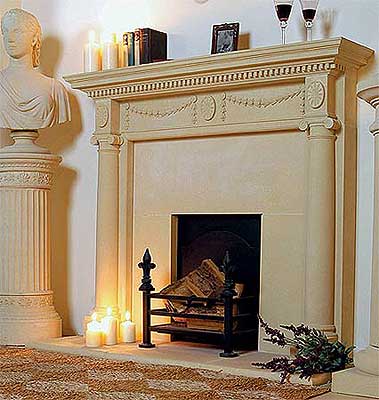
Adam Fireplace_0

Adam Fireplace rebated including Slips and Hearth | Haddonstone http://www.haddonstone.com

Adam Fireplace ~ The Adam style (or Adamesque and “Style of the Brothers Adam“) is an 18th-century neoclassical style of  interior design  and architecture, as practised by three Scottish brothers, of whom Robert Adam  (1728–1792) and James Adam (1732–1794) were the most widely known. The Adam brothers were the first to advocate an integrated style for architecture and interiors; with walls, ceilings, fireplaces, furniture, fixtures, fittings and carpets all being designed by the Adams as a single uniform scheme. Commonly and mistakenly known as “Adams Style,” the proper term for this style of architecture and furniture is the “Style of the Adam Brothers.” The Adam style found its niche from the late 1760s in upper-class and middle-class residences in 18th-century England, Scotland, Russia (where it was introduced by Scottish architect Charles Cameron), and post- Revolutionary War in the United States (where it became known as Federal style and took on a variation of its own). The style was superseded from around 1795 onwards by the Regency style and the French Empire style. (Wikipedia)

Smithfield Bargain ~ 1. A bargain whereby the purchaser is taken in. This is likewise frequently used to express matches or marriages contracted solely on the score of interest, on one or both sides, where the fair sex are bought and sold like cattle in Smithfield.(Definition taken from The 1811 Dictionary of the Vulgar Tongue, originally by Francis Grose.) 2. a marriage of convenience in which the size of the marriage settlement is the determining factor (Origin and Etymology of smithfield bargain from Smithfield, area in London, England where fairs were formerly held (Merriam-Webster)

A Classical Dictionary of the Vulgar Tongue provides us with a breakdown of crew, which is a knot or gang; also a boat or ship’s company. The canting crew are thus divided into twenty-three orders, which under the different words:

MEN. 1 Rufflers 2 Upright Men 3 Hookers or Anglers 4 Rogues 5 Wild Rogues 6 Priggers of Prancers 7 Palliardes 8 Fraters 9 Jarkmen, or Patricoes 10 Fresh Water Mariners, or Whip Jackets 11 Drummerers 12 Drunken Tinkers 13 Swadders, or Pedlars 14 Abrams.

WOMEN. 1 Demanders for Glimmer or Fire 2 Bawdy Baskets 3 Morts 4 Autem Morts 5 Walking Morts 6 Doxies 7 Delles 8 Kinching Morts 9 Kinching Coes

(Definition taken from The 1811 Dictionary of the Vulgar Tongue, originally by Francis Grose.)

Kinching Morts & Coes: refers to child pickpockets, beggars or other criminal/mendicant professions. Ca. 1800. (Urban Dictionary)

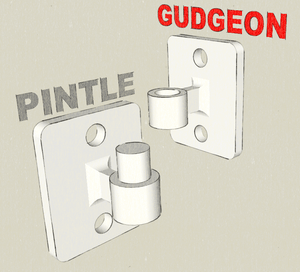
300px-Image_depicitng_a_gudgeon_with_a_pintleA gudgeon is a socket-like, cylindrical (i.e., female) fitting attached to one component to enable a pivoting or hinging connection to a second component. The second component carries a pintle fitting, the male counterpart to the gudgeon, enabling an interpivoting connection that can be easily separated. Designs that may use gudgeon and pintle connections include hinges, shutters and boat rudders. The gudgeon derives from the Middle English gojoun, which originated from the Middle French goujon. Its first known use was in the 15th century. (Wikipedia)

Bibelot – a small household ornament or decorative object, often referred to as a trinket; sometimes called gewgaw and gimcrack. But bibelot, which English speakers borrowed from French in the late 1800s, has uses beyond wordplay. In addition to its general use as a synonym of trinket, it can refer specifically to a miniature book of elegant design (such as those made by Tiffany and Faberge). It also appears regularly in the names of things as diverse as restaurants and show dogs. (Merriam Webster)

Trumpery ~ 1. worthless nonsense; 2.  trivial or useless articles, i.e.,  junk <a wagon loaded with household trumpery — Washington Irving> 3. archaic:  tawdry finery. Trumpery derives from the Middle English trompery and ultimately from the Middle French tromper, meaning “to deceive.” (You can see the meaning of this root reflected in the French phrase trompe-l’oeil-literally, “deceives the eye”- which in English refers to a style of painting with photographically realistic detail.) Trumpery first appeared in English in the mid-15th century with the meanings “deceit or fraud” (a sense that is now obsolete) and “worthless nonsense.” Less than 100 years later, it was being applied to material objects of little or no value. The verb phrase trump up means “to concoct with the intent to deceive,” but there is most likely no etymological connection between this phrase and trumpery. (Merriam Webster) 

Lickpennyarchaic: something that uses up money <law is a lickpenny — Sir Walter Scott> (OriginMiddle English lickpeny, from licken to lick + peny penny); from Wiktionary, Creative Commons Attribution/Share-Alike License n. A devourer or absorber of money; from the GNU version of the Collaborative International Dictionary of English n. A devourer or absorber of money; from The Century Dictionary and Cyclopedia n. A greedy or covetous person; a grasper. (Wordnik)

London Lickpenny is the tale of a poor Kentish husbandman’s trip to the courts at Westminster to present his case.  Though his claim apparently has merit, he cannot obtain action or justice without bribing the various lawyers, judges and clerks.  A mixture of complaint, parody and pathos, the poem also takes the reader on a lively tour of Westminster and London.  It is an engaging piece written in a relatively easy dialect and published often in anthologies, so it might be a good starting point for those tempted to read some Middle English texts in the original. [Skeat cites the explanation that “Lickpenny” is an epithet for London, since it “licks up the pence that comes near it.”  Walter W. Skeat, ed.,  Specimens of  English Literature from the ‘Ploughmans Crede’ to the ‘Shepheardes Calendar’ A.D. 1394-A.D. 1579  (London:  Clarendon Press, 1892) 373.] Read the full text of “London Lickpenny” at Medieval Forum.

O. Henry also wrote a short story called “A Lickpenny Lover.” O.Henry`s short story, ‘A Lickpenny Lover’,  follows the O. Henry-esque style. Most of O.Henry`s creations contain a surprise ending or plot twist. When reading ‘A LickPenny Lover,’ you would expect Masie to say ‘yes’ once Irving proposes, and they would get married and live ‘happily ever after’. However, this is not the case in O.Henry`s short story. Masie is accustomed to guys not being rich enough to take her to places she really wanted to go and thought Irving was the same as the other guys. “Nit; he’s too cheap a guy for that. He me to marry him and go down to Coney Island a wedding tour!” Her misinterpretation caused her to leave Irving, a young man who could have given her the things she really wanted. Read O. Henry’s story HERE. 

Enervation ~ lacking physical, mental, or moral vigor (first known use 1603); Enervate is a word that some people use without really knowing what it means. They seem to believe that because “enervate” looks a little bit like “energize” and “invigorate” it must share their meaning – but it is actually their antonym. “Enervate” comes from the Latin word enervare, which was formed from the prefix e-, meaning “out of,” and “-nervare” (from nervus, meaning “sinew or nerve”). So, etymologically at least, someone who is enervated is “out of nerve.”  Synonyms: unnerve, enervate, unman, emasculate mean to deprive of strength or vigor and the capacity for effective action.  unnerve implies marked often temporary loss of courage, self-control, or power to act <unnerved by the near collision>enerate suggests a gradual physical or moral weakening (as through luxury or indolence) until one is too feeble to make an effort <a nation’s youth enervated by affluence and leisure>. unman implies a loss of manly vigor, fortitude, or spirit <a soldier unmanned by the terrors of battle>.  emasculate stresses a depriving of characteristic force by removing something essential <an amendment that emasculates existing safeguards>. (Merriam Webster)

098d96620f081cb1474ecec6ecf0cac1Pomatum ~ pomade (Origin: 1555-65; New Latin, Latinization of pomade; neuter(for feminine) to agree with Latin pōmum fruit); from pome, which is the characteristic fruit of the apple family, as an apple, pear, or quince, in which the edible flesh arises from the greatly swollen receptacle and not from the carpels.    Historical Examples:

  • Go in with us; don’t potter with pomatum and perfumes,—rubbish! from Rise and Fall of Cesar Birotteau by  Honore de Balzac

  • A footman and a groom came next, leaving trails of pomatum in the air. from The Country House by John Galsworthy. (Dictionary.com)

From “Georgian Hair” from Unique Histories of the 18th and 19th Centuries, we find, “By the late Georgian era, gone were the towering headdresses. In its place was a woman’s natural hair, considered her crowning glory. With a more natural look and styles taken from the Egyptians, Greeks, and Romans, women attempted to achieve a gorgeous head of hair. Hair color was one of the most important aspects, and, fortunately, if a women did not like the color of her hair, she could change it. Once a woman had the right hair color numerous tips existed for washing it. One writer advised it should be “occasionally well washed with soap-and-water,” although there were also critics who opposed hair washing all together. To keep the hair glossy and shiny, combing and brushing came next, and, according to one nineteenth century writer, “the oftener the comb and brush are subsequently used in the day, the better it will be for the luxuriance, smoothness, and set of the hair.” But brushing was not the only prerequisite to luxurious hair. Sometimes oil or pomade was added, and, if the hair was styled, there were curling tongs, crisping irons, or papillotes, small pieces of paper that curled the hair and were humorously called paper shackles by one writer. To preserve the hairstyle and ensure it lasted for more than a day, women often wore nightcaps.”


Posted in vocabulary, word origins, word play, writing | Tagged , , , , , , , , , , , , , , , | 2 Comments

“Angel Comes to the Devil’s Keep,” a new Romantic Suspense from Regina Jeffers + Excerpt + Giveaway

AnAngelComes_LargeIt went live over the weekend!!! My latest Regency-based romantic suspense is available from Black Opal Books. Angel Comes to the Devil’s Keep is the first book in the Twins’ Trilogy. The Earl Claims His Comfort and Lady Chandler’s Sister will follow. You will not want to miss this one!!!

Back Cover…

HUNTINGTON McLAUGHLIN, the Marquess of Malvern, wakes in a farmhouse, after a head injury, and being tended by an ethereal “angel,” who claims to be his wife. However, reality is often deceptive, and ANGELICA LOVELACE is far from innocent in Hunt’s difficulties. Yet, there is something about the woman that calls to him as no other ever has. When she attends his mother’s annual summer house party, their lives are intertwined ins a series of mistaken identities, assaults, kidnappings, overlapping relations, and murders, which will either bring them together forever or tear them irretrievably apart.

As Hunt attempts to right his world from problems caused by the head injury that has robbed him of parts of his memory, his best friend, the Earl of Remmington, makes it clear that he intends to claim Miss Lovelace as his wife. Hunt must decide whether to permit Angelica to align herself with the earldom or to claim the only woman who stirs his heart – and if he does the latter, can he still serve the dukedom with a hoydenish American heiress as his wife?

We have an excerpt of when Huntington McLaughlin and Angelica Lovelace first notice each other. Chapter 1 

Excerpt from Chapter 3 (The first time Huntington and Angelica meet, but it is far from auspicious…)

Angel cursed the Fates with every soggy step she took. Her half boots sank into the quick-forming mud as she attempted to climb the steep slope. Her cloak caught upon every bramble and every twig, but the rain was too heavy and too cold to abandon the outer garment.

She caught at one of the rough-shaped bushes clinging to the side of the slope, pawing for a finger hold that would prevent her leather soles from sliding down the way she just came. As the rain swelled the river into which her coach had pitched, she refused to turn her head and look upon Lord Mannington’s second coachman, whose body rested against the back of the coach’s box, his life long removed. The broken left side of the coach sat upon Mr. Brothers’s chest, and the man’s neck was bent at an odd angle. Angel had offered prayers of deliverance for the man’s soul as she knelt beside him while searching for a sign of life before she made the choice to leave the man in God’s benevolence.

When the coach dipped over the road’s edge to turn upon its side, she did not scream. Instead, she braced herself against the coach’s backbench to keep from tumbling head first into the air.

With the sound of tumult drowning out her heartbeat, Angel made a resolution to survive, for she knew word of her demise would kill her father. All he would have remaining in the world would be her younger brother Carson, and Car remained in America with Papa’s business partner. So, Angel fought for her entire family.

She knew Horace Lovelace’s nature. He would blame himself for not accompanying her, as if his presence would have prevented the disaster. Her father remained at Fordham Hall because he contracted the sniffles and a slight cough with a low fever.

“I will wait with you,” Angel had insisted.

“No,” her father protested. “To be invited to the Duchess of Devilfoard’s house party will translate into your acceptance among the beau monde. You cannot give insult by not arriving when expected. I will follow in a few days. I sent a note to your mother’s dear friend, Countess Gunnimore, to explain my delay. Lady Gunnimore will assume your chaperoning until I arrive. Lord Harrison showed us a great service in procuring an invitation for his family’s fête. We must not disappoint.”

As the Manningtons were invited elsewhere, Angel set out for Warwickshire with only a maid in tow. Unfortunately, at the last stop, Mari claimed a like illness as to what struck Angel’s father, and so she had sent the girl home with the single footman to escort her.

“Thank Goodness only Mr. Brothers suffered,” she grunted as she clawed her way up the hill, bit by bit. “This situation could be much worse. Mari and Dono could also have been killed.”



Hunt cursed his decision to send Etch and his carriage ahead. The rain came down so violently, he could no longer see the road. He was now riding purely from instinct. There was not a dry thread upon his body, but he meant to reach The Yellow Hen, which was less than three miles if he guessed correctly. He thought himself near Halford, still some ten miles to Shakespeare’s reported home of Stratford-on-Avon and many more to his home outside of Bedworth. From the corner of his eye, Hunt could make out the muddy approach of the River Stour flowing over its banks. The Stour to the Avon to the Severn, he thought, but that would take him to the west, when he needed to reach the River Anker instead.

Fingers of watery rivulets joined the standing water upon the stone road. He began to wonder if, while racing the approaching storms, he had made a wrong turn. The sheets of water streaming over Alibi’s neck convinced him to act without caution, and although Hunt thought himself still in Oxfordshire when the rain caught him, perhaps he had achieved Warwickshire. If so, The Yellow Hen was long since forgotten.

He gave his head a good shake to clear both his vision and his thinking, and Alibi mimicked Hunt’s actions. As if entranced by the mighty horse’s movements, Hunt did not see the attacker’s approach until it was too late!



Angel pulled herself over the lip of the stone roadway before collapsing into a cold muddy puddle. Several inches of water stood upon the odd-shaped stones while the excess cascaded over the edges sliding down the slope to meet the rising stream crawling its way upward. If the rain continued for much longer, one would not be able to tell where the road ended and the water began. Pulling herself to her knees, Angel rose slowly, exhaustion claiming its due. She did not hear the stranger’s approach over the rumble of the thunder and the beating of her heart pounding in her ears.

It was only afterward that she realized her sudden appearance frightened the man’s horse. The beautifully powerful animal rose up on his hind legs to paw the air above Angel’s head. On impulse, she covered her head with her arms. She heard the man attempting to calm the animal and the shrill cries of the beast in counterpoint to the continued war with nature. She shuddered, but before she could respond, a hard thump announced one of the battles was lost.

Without considering the consequences, she bolted into action. Accustomed to being around horses, Angel caught the animal’s reins before it ran off into the shadowy mist.

“Easy, boy,” she pleaded as the animal jerked its head to free her grip. “Easy.” She stroked the stallion’s neck to quiet its fear. “I shan’t hurt you.” The horse showed its teeth, but it did not bite her. Her hand traced the animal’s neck to its shoulder. “Permit me to see to your rider.” Gently, Angel patted the steed’s neck before dropping the loose reins and praying the animal was trained to remain in place when the reins went slack.

Lifting her rain soaked cloak and gown, Angel sloshed her way toward where the man lay upon his side in the muddy water.

“Sir?” she said with true regret. “How badly are you injured?”

Angel prayed this stranger did not share Mr. Brothers’s fate. She could not bear another innocent’s death upon her conscience. The thought of the kindly coachman brought tears to Angel’s eyes, but she had no time for grief. The stranger offered no response nor did he move beyond a single breath escaping his lungs.

Carefully, she edged the man onto his back before running her hands up and down his legs and arms. She realized he could have an injured ankle, but removing his boots was not an option at the moment. It was imperative for her to assist him to his horse before he, literally, drowned in the muddy waters rushing across the road.

“Sir.” Angel placed her hand upon his shoulder to give it a good shake.

Immediately his eyes sprang open, and a string of curse words announced that she had discovered his injury.

The man grabbed at his shoulder. “Bloody hell!”

Angel jumped away, not wishing to touch him again. “I apologize, sir. I did not mean to bring you pain. Are you able to stand?” She shot a glance at the rising water sloshing against his side. “We are in a tenuous situation. We must seek higher ground.” In hesitation, she knelt beside him. “Have you suffered injuries beyond your shoulder?”



Hunt looked up into the most mesmerizing eyes that he ever beheld: A bluish green, the shade of the ocean upon a sunny day. For a moment, he could not think. His head hummed a song Hunt did not recognize.

“Where am I?” He was aware of a cold rain dripping from her worn bonnet to splash upon his chest.

She watched him with an indefinable emotion. “We are somewhere in Warwickshire.” A quick glance to the right preceded her frown. “At least, I think we are.” Her scowl deepened. “We are in a steady rain, and the water is rising quickly. I insist upon supporting you to your horse. I doubt I could lift you to the saddle, but I would endeavor to do so if your injury prevents your mounting on your own.”

Her words amused him. Unless Hunt underestimated her stature, she would not reach his shoulder. “Assist me to sit, instead.”

He noted how the water sloshed against his jacket’s sleeve as she made her way behind him. He was lying in a stream of water!

Her fingers crawled beneath his shoulders and nudged him upward. Despite lying in a pool of cold rainwater, heat shot straight to his chest. Hunt never experienced anything like it in his eight and twenty years. He used the hand, which did not throb with shooting pains, to shove himself to a seated position. Everything about him swirled into a mixture of gray and green and brown. He felt his stomach turn over, but he breathed through the darkness that sought to consume him. The woman did not err in her estimation. They were in danger, and he must reach Alibi if they were to survive.

Hunt did not know when “he” became a “they,” but it had. The moment his eyes rested upon hers, he claimed himself her protector. Surely the woman lived nearby. He would assist her home and beg for a physician to be called.

Crawling to his knees and then to his feet, Hunt bit into his bottom lip to keep from calling out in pain. He swayed in place, and the woman hurried to brace his weight. Although she was beautiful enough—her skin pearly white—to be a fine lady, Hunt could not imagine her so. What lady of Society would wallow through the mud to tend him?

“Can you cross to the horse or should I bring him to you?” She shoved her wet body underneath his arm to keep Hunt from tipping forward.

With a deep steadying breath, Hunt again clenched his teeth. “Lead on,” he gritted through tight lips. With a knee-buckling lurch, he took a dozen steps to reach Alibi’s rump. “Easy,” he cautioned as he used the horse to brace his weight.

Muddy tracks of water streamed down from his hair, and Hunt used his free hand to sweep it back from his forehead. His hat had long-since drifted away in the narrow stream of water carving a deeper rut in the road.

“Hold his reins,” he instructed the woman, a woman whose name he had yet to learn. All in good time, he thought.

The lady lifted his arm so he might catch the rise of the saddle before she moved away to hold Alibi’s head still. When she nodded her preparedness, Hunt captured a deep breath, placed a foot in the stirrup, and lifted his frame to swing a leg over his horse. His settling heavily into the saddle made Alibi skittish again, but the woman’s melodic voice—one that reminded him of God’s angels—coaxed the stallion to stillness. Even so, in spite of his best efforts, Hunt thought the ground rose up to greet his descent. Desperately, he wrapped his arm about Alibi’s neck and slumped forward.



“Oh, no. Oh, no. Oh, no,” she reprimanded as she rushed to secure the man to the horse. He rested against the animal’s neck, his face buried in the horse’s wet mane. Angel thought again of those dratted Fates who meant to vex her. Jerking the ruined bonnet from her head, she ripped the ribbons from their fastenings. Tearing them loose, she tied the two pieces together, lapped one end around the carbine bucket and the other around the stranger’s wrist, and tightened the makeshift rope to balance the man in place.

Self-consciously, Angel looked around before hiking her skirt to her knees.

“Papa would be furious,” she chastised, as she put her booted foot upon the stranger’s, caught the tails of the man’s jacket, and pulled her weight into the saddle behind him.

The stranger did not move, and again Angel placed her hand upon his back to feel the rise and fall of his chest before noting the red mark of dried blood upon the back of his head. The water continued to rise—likely some two inches deeper.

“We cannot wait any longer,” she said as she caught the reins from the stranger’s loose grip, wrapped her arms about his waist, and kicked the stallion’s side to set the horse in motion.

“I pray we find assistance soon,” she said as the animal walked smartly through the running water. “I fear my…” Angel did not know what to call the man. They had not even exchanged names. “I fear my acquaintance hit his head on the road’s stones.”

GIVEAWAY: I have 2 eBook copies of Angel Comes to the Devil’s Keep to be presented to those who comment below. The giveaway ends at midnight EDST on August 11, 2016.

PURCHASE LINKS: 

Kindle            Kobo             Amazon 

Nook              Smashwords 

Black Opal Books (eBook and Print copies available ~ Print copies include an autographed book plate)

2x6_bookmark - side 1

Posted in Black Opal Books, book excerpts, book release, excerpt, Georgian England, Georgian Era, historical fiction, Living in the Regency, Regency era, Regency romance, romance, suspense, writing | Tagged , , , , , , | 7 Comments

August Birthdays for Some of Our Favorite “Austen” Actors!!


party-clip-art-balloons-different-coloursIn August, these fine thespians are celebrating birthdays! 


Unknown-3August 5Mark Strong, who portrayed Mr. Knightley in the 1996Unknown-3 TV version of Emma


August 6Romola Garai, who portrayed Emma Woodhouse in the 2009 version of Emma


images-1August 8Lochlann O’Mearáin, who portrayed Lord Manwaring in Love and Friendship


Unknown-4August 8Rosanna Lavelle, who portrayed Lady Middleton in 2008’s Sense and Sensibility

7654August 9Denys Hawthorne (9 August 1932 to 16 October 2009), who portrayed Mr. Woodhouse in 1996’s Emma


Unknown-3August 11Embeth Davidtz, who portrayed Mary Crawford in 1999’s Mansfield Park, as well as Natasha in 2001’s Bridget Jones Diary Unknown-4

August 11Maia Petee, who portrayed Elizabeth Bennet in 2011’s A Modern Pride and Prejudice


43620-15188August 12Edward Ashley (12 August 1904 to 5 May 2000), whoMV5BMTU5NDEzODA4NV5BMl5BanBnXkFtZTcwNzUyMzQ5Mg@@._V1_ portrayed Mr. Wickham in 1940’s Pride and Prejudice 

August 15Samuel Roukin, who portrayed Harris Bigg in Miss Austen Regrets


152070.1August 19Lucy Briers, who portrayed Mary Bennet in 1995’s Pride and PrejudiceUnknown-3

August 20André Morrell (20 August 1909 to 28 November 1978), who portrayed Mr. Wickham in 1938’s Pride and Prejudice


images-2August 24Stephen Fry, who portrayed Mr. Johnson in Love and Friendship


imagesAugust 24James D’Arcy, who portrayed Tom Bertram in 2007TomHollander‘s Mansfield Park

August 25Tom Hollander, who portrayed Mr. Collins in 2005’s Pride and Prejudice


Unknown-3August 26Alison Stedman, who portrayspanx_spanked-300x300ed Mrs. Bennet in 1995’s Pride and Prejudice

August 28Jennifer Coolidge, who portrayed Miss Elizabeth Charming in Austenland


Unknown-4August 31
Derek Blomfield (31 August 1920 to 23 July 1964), imageswho portrayed Mr. Elliot in 1960’s Persuasion 
August 31Leo Bill, who portrayed John Warren in Becoming Jane, as well as Robert Ferrars in 2008’s Sense and Sensibility


Posted in acting, birthdays, Jane Austen | Tagged , , , , , , , , , , , , , , , , , , , , , , , , , | Comments Off on August Birthdays for Some of Our Favorite “Austen” Actors!!

Life Below Stairs: Servants as a Status Symbol

Book_of_Snobs-Première_de_couverture

Book of Snobs

A trend we incur during the Victorian era was the obsession to have more servants than one’s neighbors or comparable members of one’s social circles. It was “Keeping up with the Joneses” with servants, rather than with expansive homes and expensive cars. It was said that some mistresses of the house did without essentials such as food in order to employ a larger staff than her associates. The idea reminds me of William Thackeray’s The Book of Snobs in which his fictional Lady Susan Scarper, with her “jobbed” horses and her young daughters, who were always assuaging their constant hunger pains by eating buns. [The Book of Snobs is a collection of satirical  works by William Makepeace Thackeray, first published in the magazine Punch as The Snobs of England, By One of Themselves. Published in 1848 the book was serialised in 1846/1847 around the same time as Vanity Fair. While the word “snob” had been in use since the end of the 18th century Thackeray’s adoption of the term to refer to people who look down on others who are “socially inferior” quickly gained popularity.] Accumulating a large number of servants was the best way to rise in social circles. 41DpNy4+hML._SX331_BO1,204,203,200_

According to Frank Huggett in Life Below Stairs (page 54), “In 1844 one writer on domestic economy published a table of recommended establishments of servants for various incomes. Only noblemen of of high rank and great wealth could afford to maintain first-rate establishments…. People with much smaller incomes of £4500 to £5000 a year should have an establishment of the second rate, consisting of a butler, who also doubled as house-steward, and four other male and nine women servants. In third-rate establishments, suitable for those with incomes of £3500 to £4000 a year, the butler also had to act as valet, and there should be only one footman, one under-footman and seven women. Establishments of the fourth rate, where the income was £1500 to £2500, should be composed of two men and four women; while the fifth-rate (£1000 to £1200) should have only one man-of-all-work and three women. People with a sixth-rate establishment of a cook, a housemaid and a footboy, while those with only £450 to £500 a year would have to do without the footboy. An eighth-rate establishment (£250 to £300) should consist of one maidservant and a girl; and the ninth (£150 to £200) of a solitary maid-of-all-work. ‘Incomes still less,’ the writer added, ‘will admit of a girl only, or with the occasional use of a charwoman.'” 

Families of the lower “rates” saved by going without the ultimate status seeker, that of the services of a male servant. We must recall that “butlers,” for example, not only were regarded as the prized servant, but were expensive. Beyond the butler’s salary, many made demands for excellence in food and drink, assistants, etc. For this reason, many middle-class households relied upon female help and only hired men as gardeners, coachmen, grooms, tigers, etc. 

8a9c3a7c88b62513d2e71fb5a1ab3da5

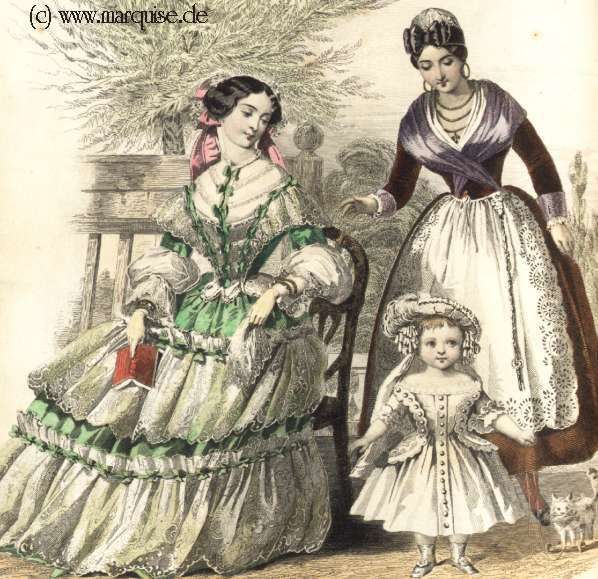
Servants’ clothes are rarely shown in fashion plates. A nurse is pictured in this 1852 image only because she and the child are both status symbols.

Huggett goes on to say, “By present-day standards, the middling middle classes lived in more than ample accommodation. When Alice Pollock married a lawyer  in the Land Registry towards the end of Queen Victoria’s reign, they could afford to move on his salary of £750 a year (plus an allowance of £200 from his mother into a house in Belgrave Road, London, with five bedrooms, a bathroom, a double drawing room, a dining room, a study and a workroom. Mrs Pollock employed the customary trio of servants for such a home: a cook at £20 to £26 a year: a parlour maid at £16 to £18: and a housemaid at £12 to £14 which was cheap enough as their total wages only consumed 5 to 6 per cent of the Pollocks’ total income. [Alice Pollock, Portrait of My Victorian Youth, page 122] To this essential triumvirate, there could be added as the exigencies of birth demanded, or as na increase in income permitted, other servants such as nursemaids, nurses, ladies’ maid, kitchenmaids, tweenies (who assisted the housemaid in the morning and the cook in the afternoon) and governesses. The latter, who were very often German girls or the daughters of impoverished clergymen like Charlotte Brontë, mix easily with the other servants and invariably too poor to be accepted as equals by the daughters of the household.”


Posted in British history, family, fashion, Georgian Era, Great Britain, Living in the Regency, servant life, Victorian era | Tagged , , , , , , | 5 Comments

Henry Howard, Earl of Surrey ~ Tudor Poet

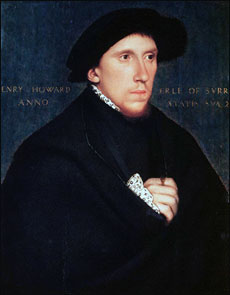
henryhBorn in Hunsdon, Hertfordshire, in 1517, Henry Howard, Earl of Surrey, was the eldest of Thomas Howard and Lady Elizabeth Stafford’s children. Surrey was of royal descent on both the paternal and the maternal sides of his family. He received an excellent education under John Clark. He learned Latin, Italian, Spanish, and French. Earl of Surrey was his courtesy title, bestowed when his father became the 3rd Duke of Norfolk. He was an early companion to Henry VIII’s illegitimate son, Henry Fitzroy, Duke of Richmond.

Surrey accompanied his first cousin Anne Boleyn, Henry VIII, and Fitzroy to France as part of a consultation between England and Francis I, King of France. He returned to England for the marriage of Richmond to Surrey’s sister. He was present in 1533 for the coronation of Anne Boleyn.

At the age of 15, Surrey married Lady Frances de Vere (daughter of the Earl of Oxford) in 1532, but they did not live together until 1535 because they were too young. His first son, Thomas, was born in March 1536. In the same year, his cousin Anne Boleyn was tried for treason and executed. Tragedy struck again when Henry Fitzroy died in July at the age of seventeen. Fitzroy was not only Surrey’s friend, but also his brother in marriage, having married Mary Howard. October of 1536 saw his father subduing the Pilgrimage of Grace rebellion, which protested against the King’s dissolution of the monasteries. Surrey served with his father in this action.

The Howards were strong supports of the Tudors, but the knew difficulties at court when Jane Seymour became queen in 1536. In 1537, the Seymours, a rival faction at court, accused the Howards of holding sympathies with those involved in the Pilgrimage of Grace. Surrey was imprisoned at Windsor when he struck a member of the court for repeating the slander expressed against his family. Surrey’s poem, “Prisoned in Windsor,” relates his boyhood days at Windsor with Fitzroy. He was released later in the year, and served as a mourner in Jane Seymour’s funeral.

Surrey was back in court favor by 1540. He reportedly sported well in the jousts held in honor of Anne of Cleves marriage to Henry VIII.  He was made Knight of the Garter in May 1541 and steward of the University of Cambridge in September. Being honored so was not enough to keep his reputation spotless. He was twice imprisoned in Fleet Prison, once for quarreling with another of Henry’s courtiers and another time for a drunken riot that destroyed property. While in Fleet Prison, he composed his “Satire Against the Citizens of London.”

Finally released from Fleet, he served Henry VII in Flanders in an effort to take control of the Netherlands with the English army on the side of the Holy Roman Emperor Charles V.
In a letter to Henry VIII, the emperor commended Surreys “gentil cueur.” In  1544, Surrey return to England with a wound suffered at the siege of Montreuil  but was back in France at the head of a company of 5,000 men in Calais. In 1545 he became Commander of Guisnes and Commander of the garrison of Boulogne. After several skirmishes and a defeat at the battle at St. Etienne in 1546, Surrey was replaced in the post by his longtime adversary Edward Seymour, Lord Hertford (later Duke of Somerset).

215px-Henry_Howard_Earl_of_Surrey_1546_detailSurrey erred greatly by promoting his father’s position as Protector to young Prince Edward when Henry VIII’s health was failing in 1546. “The Seymours finally had their day, when Surrey ill-advisedly displayed royal quarterings on his shield. Arrested along with his father on charges of treason, he was imprisoned in the Tower. Several additional claims were made against him, including that he was secretly a papist. Surrey was indicted of high treason in January 1547, despite the lack of any real evidence, condemned, and executed (beheaded) on January 19, 1547, on Tower Hill. He was buried in the church of All Hallows Barking, but was later reinterred in the church of Framlingham, Suffolk. His second son Henry, Earl of Northampton, erected a magnificent tomb for him there in 1614. Surrey’s father, the Duke of Norfolk, remained in prison throughout the reign of King Edward VI, but was released when Queen Mary took the throne. Henry Howard’s first son, Thomas Howard, succeeded his grandfather to the title of Duke of Norfolk in 1553.

“Surrey continued in Sir Thomas Wyatt’s footsteps on the English sonnet form.  Wyatt and Surrey, both often titled “father of the English sonnet”, established the form that was later used by Shakespeare and others: three quatrains and a couplet, with a rhyme scheme of abab cdcd efef gg. Surrey was also the first English poet to publish in blank verse, in his translation of part of Virgil’s Aeneid. Book 4 was published in 1554 and Book 2 in 1557.

“Surrey’s poetry circulated in manuscript form at court. He published his  “Epitaph on Sir Thomas Wyatt, but most of his poetry first appeared in 1557, ten years after his death, in printer Richard Tottel’s Songs and Sonnets written by the Right Honorable Lord Henry Howard late Earl of Surrey and other. Until modern times it was called simply Songs and Sonnets; but now it is generally known as Tottel’s Miscellany. Of the 271 poems in the collection, 40 were by Surrey, 96 by Wyatt, and the rest by various courtier poets. Sir  Philip Sidney lauded Surrey’s lyrics for “many things tasting of a noble birth, and worthy of a noble mind.” (Luminarium)

DESCRIPTION OF SPRING,

WHEREIN EVERY THING RENEWS, SAVE ONLY THE LOVER.

THE soote season, that bud and bloom forth brings,
With green hath clad the hill, and eke the vale.
The nightingale with feathers new she sings ;
The turtle to her make hath told her tale.

Summer is come, for every spray now springs,
The hart hath hung his old head on the pale;
The buck in brake his winter coat he slings ;
The fishes flete with new repairèd scale ;
The adder all her slough away she slings ;
The swift swallow pursueth the fliës smale ;
The busy bee her honey now she mings ;
Winter is worn that was the flowers’ bale.

And thus I see among these pleasant things
Each care decays, and yet my sorrow springs !

[In spring everything comes to life, says the poet, and “each care decays and yet my sorrow springs.”]

______________________


“Set me whereas the sun doth parch the green…”

Set me whereas the sun doth parch the green
Or where his beams do not dissolve the ice,
In temperate heat where he is felt and seen;
In presence prest of people, mad or wise;
Set me in high or yet in low degree,
In longest night or in the shortest day,
In clearest sky or where clouds thickest be,
In lusty youth or when my hairs are gray.
Set me in heaven, in earth, or else in hell;
In hill, or dale, or in the foaming flood;
Thrall or at large, alive whereso I dwell,
Sick or in health, in evil fame or good:
Hers will I be, and only with this thought
Content myself although my chance be nought.

[A woman bemoans her lover at sea, says that those who have their lovers at home are fortunate; and when the storm is over, she still worries as to whether he will visit her.]

____________________________

Criticism: Almost all the verses left by Surrey are regular and harmonious and though his nature was less energetic than Wyatt’s he was the better artist. He was dominated by the Petrarchan convention much more than was Sir Thomas Wyatt and sang in sonnets his imaginary love for Geraldine. Less directly influenced by the Italians than his master, he had a sure sense of what best befitted the poetry of his nation For the sonnet form used by Wyatt – two quatrains followed by two tercets, he substituted the form used later by Shakespeare. He introduced blank verse to English literature in his translation of the second and fourth books of the Aeneid

Resources:

The Anne Boleyn Files 

Classic Poems 

Poetry Foundation

Poets.org 

Sonnets.org 

Tudor Place 

Wikpedia 


Posted in British history, Great Britain, history, Tudors | Tagged , , , , , , | 2 Comments

Pre-Order “Angel Comes to the Devil’s Keep,” a New Regency Suspense from Regina Jeffers

AnAngelComes_LargeAngel Comes to the Devil’s Keep is now available for preorder. It is a romantic suspense from Black Opal Books, which is set in the Regency Period, and it is loaded with the twists and turns you expect from Regina Jeffers. Angel Comes to the Devil’s Keep is book one of the Twins’ Trilogy, to be followed by The Earl Claims His Comfort and Lady Chandler’s Sister

Back Cover: 

HUNTINGTON McLAUGHLIN, the Marquess of Malvern, wakes in a farmhouse, after a head injury, and being tended by an ethereal “angel,” who claims to be his wife. However, reality is often deceptive, and ANGELICA LOVELACE is far from innocent in Hunt’s difficulties. Yet, there is something about the woman that calls to him as no other ever has. When she attends his mother’s annual summer house party, their lives are intertwined ins a series of mistaken identities, assaults, kidnappings, overlapping relations, and murders, which will either bring them together forever or tear them irretrievably apart.

As Hunt attempts to right his world from problems caused by the head injury that has robbed him of parts of his memory, his best friend, the Earl of Remmington, makes it clear that he intends to claim Miss Lovelace as his wife. Hunt must decide whether to permit Angelica to align herself with the earldom or to claim the only woman who stirs his heart – and if he does the latter, can he still serve the dukedom with a hoydenish American heiress as his wife?

Excerpt: (Huntington McLaughlin and Angelica Lovelace’s first glance of each other)

Chapter 1

London 1819

The odor of the Thames as it wafted over the area beyond Greenland Docks caused Hunt’s nose to snarl, but Sir Alexander had declared that someone paid large sums of money for the privilege of a blind eye to unloaded contraband, and it was Hunt’s duty to learn more of the people involved. The wig Hunt wore itched, and he fought the urge to remove the offending item, and it did not slip his notice how his coachman, Etch, swallowed his amusement.

“Jist relax, sir. It shan’t be long,” Etch cautioned.

Hunt grunted his response, attempting to disguise his own mirth. He slouched lazily against the back of the chair, just as the baronet had taught him. It was not much, this bit of public duty he performed, but Hunt took a certain pride in doing more than being the Duke of Devilfoard’s heir apparent—more than being the Devil’s cub. His ears perked with interest at the conversation, taking place nearby.

“I tells you,” said the dark-haired man Hunt had followed into the tavern. “The viscounty means to learn more of the earl. Then we be makin’ a call upon his lordship.”

“And this Town lord knows of the earl?” the shorter of the two asked.

“That’s wat the viscounty says. Says he’s got an arr’ngement with the highest. He also say we be keepin’ the high lord company fer awhile ’til we’s know fer certain he be easy pickin’s. The viscounty be wantin’ information on who the high lord shows his attentions.”

The men rose to depart, and Hunt made to leave, but Etch placed a hand upon his sleeve.

“Wait.” The coachman nodded to the door. “Is that not Lord Newsome? Doing business in this part of London?”

Hunt’s expression screwed up in disbelief.

“The viscounty?” he wondered aloud. “This just became interesting.”



“You are pure evil,” she declared as he chased her through the intricate maze.

Dressed all in black, he stalked her, and Angel’s body heated from the brief brush of his fingertips upon her wrist. Catching her skirt tail, she skittered away from his slow pursuit.

“A copper for your thoughts,” she taunted with a nervous giggle.

“I was considering the pure pleasure of possessing my own personal angel.” His deep, resonant voice spoke of desire, but also of contentment.

“Am I that angel?” she rasped when he caught her shoulders and spun her to him.

“Forever.”



“Miss Angelica.” Her maid shook Angel’s shoulder. “Wake up, miss.”

Angelica Lovelace rolled to her back and stretched. She despised leaving the dream behind. It was one of her favorites, and she particularly enjoyed how it always ended with her in the dark stranger’s very masculine embrace.

“What is amiss?” she murmured.

Angelica kept her eyes closed, watching the scene’s details playing out behind her lids. She could not remember a time when she did not dream of her dark lover. Even as a very young girl, she enjoyed his company. When she was a child, he was her best friend, but when she turned to womanhood, he became her secret lover, and although she had never met him, he remained the man by which she judged all others. To her, he was her “dearest Devil,” always dressed in black, his shaggy coal-colored hair streaked with hints of mahogany. Over the years, Angelica blamed her oft-spoken-of irreverent attitude on the mystery man with a wicked wit and a splash of deviltry. If my critics knew of my sultry musings, they would agree I am quite beyond the pale. The thought brought a smile to her lips.

“Your father, miss,” the maid encouraged. “Mr. Lovelace requests you attend him in the small drawing room. Lord Arden has called.”

Angelica forced her eyes open. “Lord Arden?” She pushed herself to a seated position. “What might the baron require?”

“Mrs. Watson be thinking the baron will make himself known as a suitor.” The maid braced Angelica on the steps beside the bed.

“Do you suppose the baron consulted Mrs. Watson?” Angelica asked, with a bit of a tease.

The maid rarely understood Angel’s light sarcasm.

“Oh, no, miss. Mrs. Watson be creatin’ a guess.”

A chuckle slipped from Angelica’s lips. “And I thought an English upper servant worth her salt prided herself on knowing everything within the household.”

“Mrs. Watson knows enough.” The maid unlaced the ties on Angelica’s night rail. “I thought the silver muslin, miss.”

Angelica fought the urge to roll her eyes.

“Another virginal gown. Why is it English ladies announce their marital state with their gown’s color? What could be the harm in wearing a bright red or a royal blue?”

“You may choose whatever color most pleases you once you marry,” the maid observed in severe tones. “Lady Peterson wears only shades of purple. Can you imagine, miss? Purple dresses every day?”

Angelica frowned her disapproval.

“I am not certain I could tolerate the monotony. Needless to say, it would simplify the need for accessories. A few pairs of slippers and gloves would match one’s attire.”

“You’re so practical, miss,” the young girl observed.

Twenty minutes later and without breaking her fast, Angelica swept into the room. She and her father had imposed upon the earl and her mother’s sister Sarah by imploring upon her maternal relatives to open the earl’s Town house for the Season and for Lady Mannington to assume the position of Angelica’s sponsor in Society. Her mother’s older sister married Lord Mannington some five and twenty years prior. This was long before Angelica’s birth and before Lady Victoria Copley married Horace Lovelace and traveled to America.

“You sent for me, sir?” Angelica paused as her mother had taught her. ‘Allow the man to take your full measure.’ The words rang clear in Angel’s mind. It was comforting to have a bit of her mother with her.

Her father struggled to his feet. “There you are, my dear.”

Each day, Angelica became more aware of the man’s mortality. That particular fact was one of the reasons she had agreed to this venture. Her mother had passed two years prior, and her father insisted on carrying out his wife’s dying wishes. For years, Victoria Lovelace spoke of bringing her only daughter to England for a proper debut, but Lady Victoria succumbed to consumption before her wish knew fruition. Therefore, without the love of his life, Angel’s father made the journey.

“Please come in.” He gestured her forward. “You are acquainted with Lord Arden, I believe.”

“Yes, sir.” She curtsied to the man standing aristocratically beside the hearth. “The baron and I stood up together at the Breesons’ ball on Tuesday last.”

Arden executed a respectful bow.

“It is singular you have such perfect recall, Miss Lovelace.”

“Angelica has a quick mind,” her father remarked with pride, but then blustered. “Of course, my Victoria would say a learned lady was not a virtue by English standards.” He winced when shock crossed the baron’s features. “I apologize, Arden. I offer no censure. My late wife always accused me of acting a cake when speaking of our daughter. So many years away from my homeland must make me appear quite the heathen. I am accustomed to a freer-speaking society.”

“It is quite acceptable, Lovelace.” The baron grasped the hand Angelica extended in his direction and offered the obligatory air kiss. “Despite the consensus to the contrary, many Englishmen prefer their wives to possess a sensible nature.”

Angelica gestured to a nearby chair. “But the author of Pride and Prejudice proved in her first novel that sense and sensibility are different from intelligence, my lord,” she countered.

“I am surprised you have read the lady’s novels,” Arden remarked.

Angelica seated herself on the edge of the cushion and straightened her dress’s seam.

“Would your surprise be because the author is British rather than American or because the author is a lady, and women should not trespass upon the male dominated world of authorship?” She did not wait for his response before adding, “Perhaps your astonishment rests in the fact Sense and Sensibility is a novel rather than a serious tome?”

She smiled prettily at the man. Her mother may have determined Angelica required an English aristocrat for a husband. However, Angel had decided only a partner who could accept her flaws, as well as her substantial dowry, would do.

Arden frowned in what appeared to be confusion. He clearly did not expect a challenge to his opinions. “I suppose all three, Miss Lovelace.”

“But you hold no objection, my lord, to a woman who develops her mind through extensive reading?” Angel chuckled internally at the familiar line from the British author’s books. She was certain Arden possessed no idea of the remark’s source.

“I would imagine my wife would oversee our children’s educations. Therefore, I would expect a certain rationality—”

“Which brings us to the reason for Lord Arden’s visit, my dear,” her father interrupted. “Arden has requested my permission to call upon you with the intention of a courtship. That is, if you are agreeable.”

“A time to learn if we would suit?” Angel took a closer look at the baron. His thick dark brown hair had a tendency to curl about his collar. Barely six feet, the man struggled to appear more than a walking block of wood, but he possessed a pleasant countenance.

The baron bristled. “Customarily, such details are not discussed before the lady.”

Angel forced her mouth into a straight line. Since making her debut a month prior, she had delighted in ruffling the feathers of a number of gentlemen who saw her dowry as an inducement to marriage, even though it would be to a hoydenish American. When her father suggested this journey, Angel reminded him, as she had often reminded her dear mother, Angel’s ways would not sit well among the English elite for she spent too much time studying her father’s book on antiquities, tending to Horace Lovelace’s growing string of thoroughbreds, and overseeing the health and happiness of her father’s workers. Those were the things that brought her contentment in her Virginia home, but they were not qualities most men of the English peerage sought in a wife.

“We Americans often take a divergent course. I pray that fact does not present a difficulty to our future felicity, my lord,” she said with a practiced smile.

“Certainly not.” Despite his words of assurance, Arden frowned. “I welcome your frankness, Miss Lovelace.”

Angel heard the man’s insincerity, but she had promised her Aunt Sarah not to make predisposed judgments.

“Then how should we proceed, sir?”

“I thought I might escort you on daily outings,” he began. “If it is agreeable, we could drive today during the fashionable hour. I also hoped you would consider accompanying me to the theater tomorrow. My sister and her husband will join us.”

Angel stood to end the conversation. “I am amenable, Lord Arden.”

He followed her to his feet. “Then I will call for you this afternoon.”

“I shall anticipate it.” She directed him from the room, but before Angel opened the door to the main hallway, she paused. With her hand resting on the latch, she smiled innocently up at the man. “Might I ask one question before you leave us, my lord?”

He appeared surprised and then assumed a cynical expression. “By all means.”

Angel hesitated, undecided, but, in truth, she meant to set guidelines before their courtship began. “During this time where we determine whether we might suit, am I to limit my interactions with other gentlemen callers? I would prefer to understand our agreement.”

The baron’s eyes narrowed. “I would expect your undivided attention, Miss Lovelace.”

She smiled sweetly. “Then I would expect the same from you, my lord.”

“Of what do you accuse me, Miss Lovelace?” he huffed.

Angel withheld a glare of disgust. “I meant no offense, sir.” She schooled her features to portray politeness. With that, she opened the door and turned the baron over to the waiting footman.

“Was that necessary?” her father grumbled as he poured himself a glass of claret.

She resumed her seat. “I studied the list of potential candidates Uncle Lancelot provided us. Arden has a long-standing title, but he is deeply in debt. My dowry must appear quite tempting. The baron would accept a woman lacking in effeminate ways to salvage his estate. I mean to keep the baron off balance until I am certain of his motivations. Who knows? Perhaps we shall suit, but I shan’t be his subject. When I marry, I wish a relationship as loving as yours and mother’s.”

“Lady Victoria Copley was one of a kind,” her father said wistfully. “Your mother possessed a magnanimous heart. My Victoria deserved better than a minor son, but I am more than grateful she chose me from among her many suitors. You will find it difficult to discover a man of even half Lady Victoria’s merit.”

Angel thought of her devilish dreams. A man of passion and compassion would do well for her. “I require a man of vision, like my father,” she said in earnest.



The slow carriage procession drove Angel nearly to Bedlam, but she kept the smile upon her lips. She had agreed to the craziness of the “Marriage Mart,” as her Uncle Lancelot termed it, but she preferred to be anywhere else. The baron’s gig crawled along behind a Stanhope. Every few feet, the man would slow the carriage to acknowledge another member of the beau monde before introducing her to his acquaintances. The ton practiced their pompousness with prescribed efficiency, and Angel found it blatantly boring. With amusement, she wondered what her devil would say to such pretentiousness. Mayhap he would use it as a prime argument in defense of passion ruling the world. Not that Angel knew anything of passion. In fact, she had never known even the most faithful of kisses.

“Woolgathering, Miss Lovelace?” a brittle voice broke through her thoughts.

Angel flushed as she looked up into the countenance of a frowning earl. “I beg your pardon, Lord Townsend, I was simply enjoying the park’s splendor on a spring day.”

“You should always carry a parasol, Miss Lovelace,” Lady Townsend warned. “We would not wish to see you become too brown from the sun.”

Angel doubted the woman’s sincerity. She was certain the ton would celebrate any flaw Angel sported. She despised the British standard for unblemished skin. White pasty skin. Virginal white gowns. Proper manners, which hid prejudice and censure. A bland lifestyle wrapped in formality. She missed her American friends and her home in the picturesque Virginia mountains, and she missed riding at break neck speed across her father’s land.

“I am grateful for the suggestion, ma’am, and honored by your attention.” The carriage nudged forward, and Angel prepared to greet the baron’s next acquaintance. “What a crazy tradition!” she observed. “Would it not be wonderful to give the horses their heads?”

“A proper gentleman would never place his cattle in danger,” Arden said in chastisement.

Angel stiffened. His tone increased her often-quick ire. The baron’s first thought was of his team. Should he not think of the park goers or of her position in the high backed gig if safety was his true concern?

“I never suggested you turn your team free. I simply made the observation it would be a pleasant experience to feel the wind upon one’s cheeks.”

“Acting such would age a woman,” he said with another scowl.

Angel considered arguing, but she stifled her words. It was useless to think she might find a mate who spoke to her soul. Dutifully, she apologized. This was her first outing with Arden, and she would not leave the man with a poor impression of her manners. She ignored his declaration, and instead focused on the families enjoying the park. I wish for family, she thought. Children and a husband, who knows pleasure in me and in my devotion. A marriage where love rules our reason.

In resignation of what may never be, Angel turned her head and watched a tall figure toss a ball to a boy hefting a cricket bat. Even from a distance, she could tell he cut a fine figure. It was brazen of her to study one man when riding out with another, yet, she could not turn her gaze. Without realizing the reason, she extended her gloved hand in his direction, as if she wished to turn him toward her so she might look upon his features. It was the oddest sensations, and Angel swallowed hard against the rising constriction in her chest.



Huntington McLaughlin, Marquess of Malvern, ignored the continual line of carriages tooling its way along the lane leading to and from the Serpentine, as well as the Society mamas, who attempted to catch his attention. He never understood the ton’s desire to be on display. In fact, Hunt could not recall the last time he suffered a drive through the park during the fashionable hour. Today, he had brought Logan and Lucas, his sister’s twins, to the park. Earlier, he spent what felt like hours pacifying his father’s high dudgeon regarding Hunt’s refusal of Lord Sandahl’s virginal daughter, Lady Mathild.

“I want nothing of an innocent,” he declared.

If his father forced him to marry, Hunt would consider a widow, but no green girl straight from the schoolroom. He wished for a woman to place her love for him above all others—a woman who shared his passions for life and adventure and learning.

“What is amiss, Uncle Hunt?” Logan called as he took a few practice swings.

Hunt escorted his nephews to the park to remove them from Henrietta’s way. His twin sister was heavy with another child, and with Viscount Stoke away on governmental business, Hunt promised to see to the twins’ safeties, while permitting the boys to expend some of their unbridled energy.

“Nothing,” he mumbled, but he brought his forearm across his eyes to block the sun. Despite standing in an open field and surrounded by many of Society’s best, his loins tightened. From the long equipage line, he watched a slow-moving carriage turning toward Rotten Row. A golden-haired beauty clung to the gig’s side, the wisps of her hair alive with light, and she turned in the seat to stare at him. Too young, his mind argued, but his body reacted nonetheless. He hardened, and although he knew it a foolish act, as the distance between them was too far apart to distinguish each other’s features, he lowered his arm so she might look upon him. “Bloody hell,” he mumbled as the gig moved away.

“Come on, Uncle Hunt,” Logan encouraged.

Hunt withdrew his eyes from the departing carriage, but not before he spotted what he thought was the woman reaching out to him. It was like nothing he had ever experienced, and the movement set his body on alert.

“Right away,” he said with little conviction. With the girl no longer in sight, Hunt turned to the seven-year-olds. “Are you prepared?” He tossed the ball in the air to catch it again.

“It will be a fiver,” Logan bragged.

Hunt laughed at his nephew’s puffed-out chest. “No boasting until after you produce.” Yet, while he tossed the ball to Logan, Hunt thought only of the pleasure of greeting the unknown girl with an embrace she would never forget.

Pre-Order Links: 

Nook

Kobo

Smashwords

Black Opal Books (Both eBook and Print copies are available for a discount.)

Posted in America, Black Opal Books, book excerpts, book release, eBooks, Georgian England, Georgian Era, historical fiction, Living in the Regency, primogenture, Regency era, Regency romance, romance, suspense | Tagged , , , , , | Comments Off on Pre-Order “Angel Comes to the Devil’s Keep,” a New Regency Suspense from Regina Jeffers