
When the Hardwick Act for the Prevention of Clandestine Marriages went into effect in March of 1754, the rules for marrying in England changed dramatically. Prior to that time, all the couple had to do was to pronounce their vows before a clergyman of the Church of England. Heck, it did not even have to be one’s local clergyman or even one’s local church. In fact, the Fleet Street prison saw quite a few marriages in those days. “A Fleet Marriage was a common example of an irregular or a clandestine marriage. An “irregular” marriage was one that took place either away from the home parish of the spouses (but after banns or licence), or at an improper time. “Clandestine” marriages were those that had an element of secrecy to them: perhaps they took place away from a home parish, and without either banns or marriage licence.
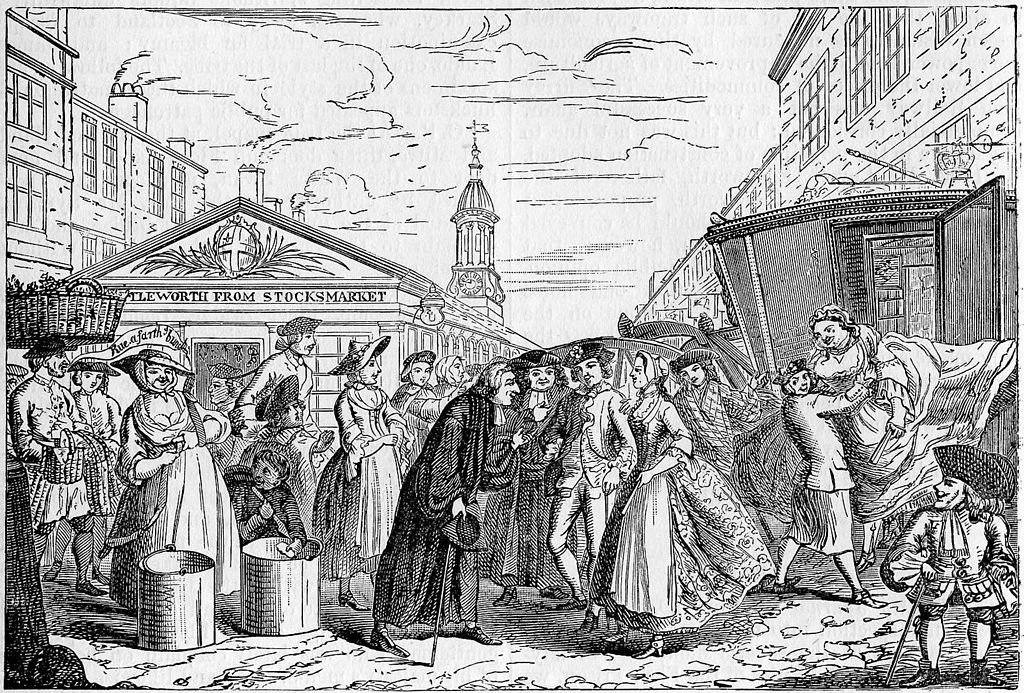
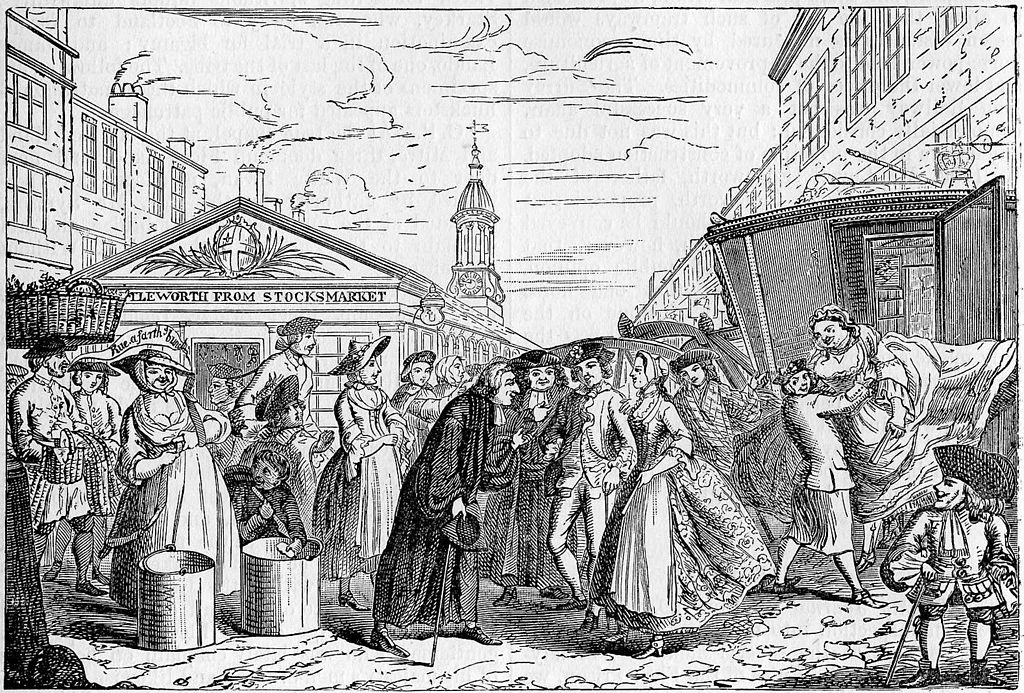
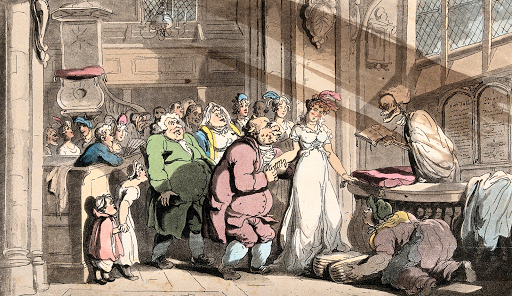
Image scanned from Robert Chambers’ Book of Days, 1st edition. Chambers’ died in 1871, so the work is in the Public Domain ~ a Victorian depiction of Fleet Marriages, likely derived from an earlier, contemporary un-named source.
“It is often asserted, mistakenly, that under English law of this period a marriage could be recognized as valid if each spouse had simply expressed (to each other) an unconditional consent to their marriage. While, with few local exceptions, earlier Christian marriages across Europe were by mutual consent, declaration of intention to marry and upon the subsequent physical union of the parties,[3][4] in 1563 the Council of Trent, twenty-fourth session, required that a valid marriage must be performed by a priest before two witnesses. By the 18th century, the earlier form of consent-based marriages (“common-law marriages” in modern terms) were the exception. Nearly all marriages in England, including the “irregular” and “clandestine” ones, were performed by ordained clergy. [Fleet Marriage]
Meanwhile, Nancy Researcher tells us, “The new act was meant to make marriages more public and regular. Though people had always been encouraged to have the banns called, it now became a requirement that they do so unless the couple obtained a license from the local bishop or the Archbishop of Canterbury. By 1811 the cost of a special license was £5. It was mostly used by the aristocracy and men in the public eye. The standard license from a bishop required a bond for £100 to be forfeit if the couple lied about any allegation as well as a slight fee. This license named the parish in which the wedding would be held. This license entailed a wait of seven days.”
According to many sources, no provisions existed for proxy marriages in the British Isles. HOWEVER, if a marriage by proxy took place in a country where they were permitted, then such a marriage would be valid in England. Supposedly, none of the cases which were brought before the court involved men or women who had been born and baptized in England. YET, WHAT IF NO ONE QUESTIONED THE MARRIAGE? WHAT IF ITS LEGALITY WAS NEVER UNDER DEBATE BY THE COURT SYSTEM?
After all, Royal brides who were married by proxy in their country of origin–more as a protective measure than a legal marriage–but were married in a Church of England ceremony on arrival in England.
And that being said, there is just enough of an opening in law to make the possibility believable. Under English Common Law, if a proxy marriage is valid by the law of the place where the marriage took place (lex loci celebrations), then it is recognized in England and Wales. “Recognition of Marriages by Proxy Abroad” from the Yale Law Review, tells us, “At common law the mutual consent of both parties per verba de praesenti sufficed without more to create the marital status. . . . Since the mutual consent need not be expressed by the parties in the presence of each other, . . . the English courts had early adopted the provisions of the canon law recognizing the validity of marriages by proxy.”
There upon is what I latched my plot twist in Amending the Shades of Pemberley.

You will also be able to Read the book on Kindle Unlimited, beginning April 26.
Amazon Print Copy https://www.amazon.com/dp/B0C1J2GT3F/ref=tmm_pap_swatch_0?_encoding=UTF8&qid=&sr=
“You have willfully misunderstood me, Miss Bennet. You have no worry of my releasing you, for I do not wish you to perform as a governess to my daughter, but rather as my wife and the mistress of my hereditary estate.”
Elizabeth Bennet had thought the stranger quite handsome; yet, she had ignored those first tendrils of interest, for she was in no position for the gentleman to pursue her. She and her sister Mary were all who remained of their family. Moreover, Longbourn and its furnishings were to be sold. They were destitute, and, if fortunate, headed for service in some stranger’s household.
Fitzwilliam Darcy’s proposal of marriage would save both Mary and her, for her sister had agreed to assist with the gentleman’s young daughter. But what of the man’s tale of having corresponded with her father and of Mr. Bennet having purported a marriage between this stranger and her? Elizabeth knew nothing of the arrangement nor of the man’s existence. Though their marriage would solve all her troubles, what if the man’s tale was not completely truthful? Would Mr. Darcy become her enemy or a man she could learn to love?
Enjoy this short excerpt from Chapter Three:
“Yes, sir,” the servant said, “may I be of assistance?”
“Mr. Darcy to speak to Mr. Phillips. His niece, Miss Elizabeth, asked me to speak to him on a matter of importance.”
“Step in, sir. I’ll fetch Mr. Phillips.”
Darcy waited in the foyer but a handful of moments before a middle-aged man, perhaps a few years older than Mr. Bennet, appeared. “Come in, sir. I recognized your name from my wife’s tale of how much of her late sister’s life you purchased at the auction. My office away from my actual office is just along this hall.”
Darcy was a bit impressed by the size of Mr. Phillips’s house. Many country solicitors lived well, but Mr. Phillips appeared to be doing quite well. When they entered the man’s office, Phillips closed the door behind him. “Claim a seat, sir. The servant said you came on behalf of my niece Elizabeth.”
“Miss Elizabeth asked me to call on you and secure your attendance at her wedding, rather, I should say ‘our’ wedding.”
“Most assuredly, Mrs. Phillips and I will be happy to attend, although I admit Elizabeth could have given us the happy news when she and Mary arrived today to stay with us while things are settled with the estate. I would much prefer our girl knew a home of her own rather than the prospects of service.”
Darcy recognized Elizabeth’s honor would not permit her to become a “poor relation” instead of a servant in another’s home. In that manner, he and she were much alike. He toiled alongside the men he had hired to work the mine, though they thought him a bit daft for doing so.
“When is the wedding?” Phillips asked.
“Today. In an hour when Mr. Williamson comes to Longbourn. I brought a special license with me today.”
“A special license?” Phillips asked. “Those are reserved for the aristocracy. Should I be addressing you as ‘my lord’ rather than ‘sir.’”
My late mother was the daughter of an earl.” Darcy grinned. “The Archbishop is my godfather.”
“Does Elizabeth know this?”
“I mentioned it when I explained about the special license; however, I do not think it completely registered with my betrothed, though I expect several questions on the subject when Miss Elizabeth has time to consider what I said. I believe, today, your niece was more concerned with whether I would accept Miss Mary into my household,” Darcy explained.
“And you agreed?” Phillips asked suspiciously.
Darcy unwrapped the strings from the satchel he carried. “Mr. Bennet and I corresponded for nearly six years. This is the copy of the marriage settlements we agreed upon a little over five years back.” He placed the papers on the desk. “Before you ask, Miss Elizabeth knows nothing of these negotiations between her father and me. She does know Mr. Bennet and I held a friendship and her father thought she would make me a good wife.”
“I knew something of Thomas Bennet’s correspondence with a young fellow in India, but I did not know you two began negotiations for a marriage between you and Elizabeth. Bennet must have thought highly of you if he took it upon himself to make such an arrangement. Elizabeth is of her grandmother’s nature and was something of a favorite of Mr. Bennet’s, but I assume you know all this. Yet, I must say, this arrangement is all quite odd,” Phillips declared. He read the first few lines of the paper. “Mr. Bennet openly states you hold no obligation to act upon the agreement if you do not find Elizabeth to your liking.” The man’s eyebrow rose in question. “I assume you believe my niece acceptable.”
Darcy cut through the series of questions. “Miss Elizabeth Bennet is handsome enough to tempt any number of men, and you may count me among them. However, more importantly, she possesses other qualities I admire and actually require in a wife. Your niece has demonstrated the care she takes with all she encounters. I watched her at the auction with Mr. Bingley and her neighbors, and even calculated her interactions with me, a complete stranger. Moreover, thanks to Mr. Bennet’s letters, I know much about Miss Elizabeth’s exemplary character and even some of her faults. My family legacy is in tatters, the estate, though grand, suffers, which means I must spend a great deal of time out of my house to set it aright. I have a five-year-old daughter who requires a strong woman with a caring heart to make a home for her, something my Alice has never known, for, in India, I was often away earning a living. Alice is frightened and requires a stable influence in her life, something other than her doll upon which clings for comfort. I also require a capable mistress for my estate, and, naturally, I will eventually require an heir for all my labors.”
“And you can afford to keep Elizabeth as she deserves to be kept?” Phillips demanded.
“Before I departed England, the family estate easily brought in ten thousand a year. We will not be looking at such amounts for some time, but, within a few years, your niece will be one of England’s most revered women. I made a fortune in India, which I will use to set it all aright. If you require more information, Mr. Bingley can speak to my family’s position in society.
“Mr. Bennet’s personal papers should have a copy of this agreement among them. I am certain you may read it more thoroughly among his will and so forth, at your leisure, and find it legally binding if Elizabeth and I wish it. Your niece is of age and can choose where she may. We both understand, I could demand Miss Elizabeth marry me, and she would have little recourse but to agree. Denying me could place her back in the ranks of poverty or even in debtor’s prison. However, I would prefer she enter our marriage on her own stated conditions. It would serve neither of us well to be on contentious ground, for there is much to be done and little time to do it.”
Other Sources:



 The Lord Chancellor, Lord Hardwicke thought to close those loopholes. The Marriage Act 1753, full title “An Act for the Better Preventing of ClandestineMarriage“, popularly known as Lord Hardwicke’s Marriage Act (citation 26 Geo. II. c. 33), was the first statutory legislation in England and Wales to require a formal ceremony of marriage. It came into force on 25 March 1754. “The legislation stipulated that marriage must take place in a licensed Anglican parish church in the bride or bridegroom’s own parish and be recorded in a special book with a numbered space for each entry, to prevent fraud. Banns were read publicly on three separate Sundays, which allowed for objections to be raised possibly by parents of children under the age of 21 or previous spouses to call a halt to the proposed wedding. The legislation also allowed marriage by licence in a different parish to that of the couple’s residence. The only exceptions allowed were for Quakers and Jews, so all other non conformists including Roman Catholics had to marry in an Anglican church.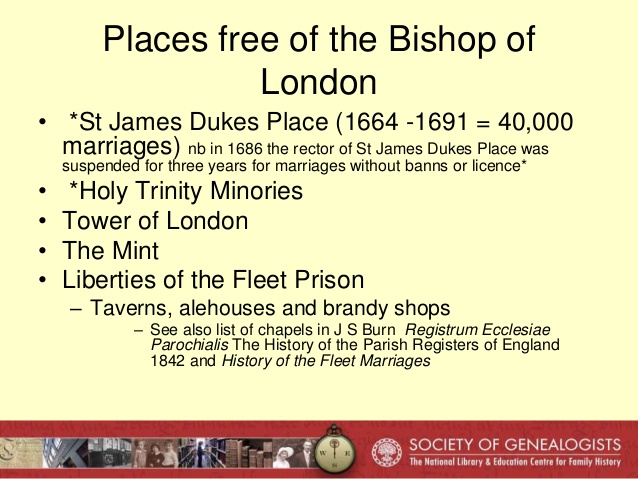










!["The Old Bailey, Known Also as the Central Criminal Court" Date 1808 SourceAckermann, Rudolph; Pyne, William Henry; Combe, William (1904) [1808] "Old Bailey" in The Microcosm of London: or, London in Miniature, Volume 2, London: Methuen and Company Retrieved on 9 January 2009. Public Domain](https://reginajeffers.blog/wp-content/uploads/2015/01/images2.jpeg)





 Every Woman Dreams...
