There are several versions of how the term “Black Friday” originated. Some say “Black Friday” came about because to the chaos in Philadelphia in the 1950s at the traditional Army-Navy football game. This was a game we always watched in our family for there are more than a few members who had served in the U.S. Navy among us.
Anyway, people flooded into the city on Friday for the game on Saturday. Reportedly, this created a burden for what we now call the “infrastructure” and the “foundation” of the city. It became an “all hands on deck” situation, especially for the city’s police with traffic and additional crowds in restaurants, hotels, stores, etc. Shoplifting, especially, became an issue, as there were not enough staff in stores to oversee the merchandise nor was there enough law enforcement officers available to either prevent the acts or to locate and arrest the thieves.
Over the next decade, the Philadelphia merchants began to take advantage of the situation, by adding more security of their own and setting up sales. They also attempted to change the image of the event by calling it “Big Friday,” but those efforts were for nought. In truth, the term “Black Friday” was still not used consistently throughout the U.S. even into the 1980s, until some big named retailers took up the term to make their own sales pitch. The idea of turning the chaos into from a “red to black” sales point came about in the 1980s. By the time I was rushing about at 4 and 5 A.M. looking for Power Ranger hard to find Power Ranger items in the 1990s, the term “Black Friday” had lost it Philadelphia chaos and taken up its own chaos (not saying there was not still some chaos in Philadelphia, but it no longer dealt with the Army-Navy game as it once did). The choice of the day after Thanksgiving as “Black Friday” was, generally, accepted for in business such is when America’s stores supposedly began to turn a profit for the year.
Since then, we now have Small Business Saturday/Sunday (depending on where one lives) and Cyber Monday. Up until the pandemic, stores started offering hours earlier and earlier, some even opening by 5 P. M. on Thanksgiving Day to capture the dollars of shoppers ready to fight for what they thought were deals. Since my child is now a young man in his 30s and a family of his own, I no longer fight the madness. As is customary for me, I began my Christmas shopping in September and have been finished for nearly a month now. In that manner, I can spread the payments out over several months and not be hit with what I call the “no I didn’t” moment when my credit card bills arrive.
To counter some of these tales, History.com tells us “The first recorded use of the term ‘Black Friday’ was applied not to post-Thanksgiving holiday shopping but to financial crisis: specifically, the crash of the U. S. gold market on September 24, 1869. Two notoriously ruthless Wall Street financiers, Jay Gould and Jim Fisk, worked together to buy up as much as they could of the nation’s gold, hoping to drive the price sky-high and sell it for astonishing profits. On that Friday in September, the conspiracy finally unraveled, sending the stock market into free-fall and bankrupting everyone from Wall Street barons to farmers.
“The most commonly repeated story behind the Thanksgiving shopping-related Black Friday tradition links it to retailers. As the story goes, after an entire year of operating at a loss (‘in the red’) stores would supposedly earn a profit (‘went into the black’) on the day after Thanksgiving, because holiday shoppers blew so much money on discounted merchandise. Though it’s true that retail companies used to record losses in red and profits in black when doing their accounting, this version of Black Friday’s origin is the officially sanctioned—but inaccurate—story behind the tradition.”
By federal law, since 1942, Americans have celebrated Thanksgiving on the fourth Thursday in November since 1942, but numerous other dates were designated in the past.
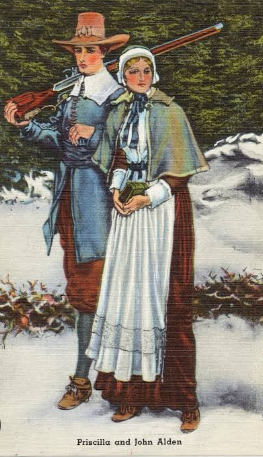
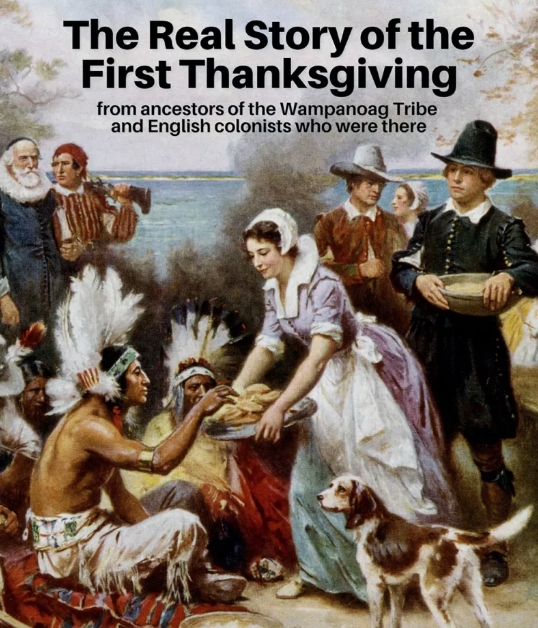
Most believe that the origin of Thanksgiving came to us via the 53 Pilgrims and the 90 Native Americans in the fall of 1621. As a descendant of John Alden and Priscilla Mullins (my 10th Great Grandparents), whether it is true or not, I love this idea.
However, I must give other sources equal credit. The Partnership With Native Americans tells us, “As the story goes, the English sailed from England on the Mayflower, landed at Plymouth Rock, and had a good harvest in 1621. So, the governor (William Bradford) held a feast to celebrate and invited a group of friendly Native Americans, including the Wampanoag chief Massasoit, and they feasted on fowl and deer…
“But “not exactly,” says Ramona Peters, the Tribal Historic Preservation Officer for the Mashpee Wampanoag Tribe.
“Did you know:
“The holiday wasn’t even proclaimed until 1777.
“The English did not even land at Plymouth Rock.
“The English did not find an empty land.
“The original feast lasted for three days.”
However, in 1668, the holiday we know as Thanksgiving was set to be celebrated every year on November 25. However, that was only true for a few short years.
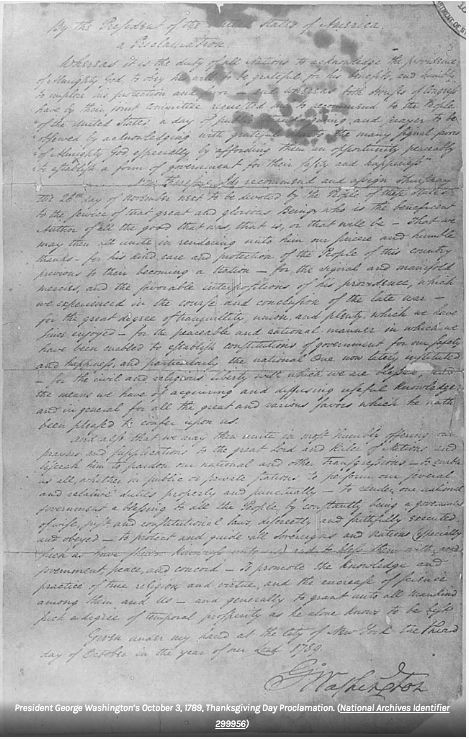
The National Archives’ “Pieces of History” tells us, “One of the last actions of the first Congress while meeting in New York City was to pass a resolution asking the President to recommend a day of thanksgiving. On October 3, President George Washington issued a proclamation naming Thursday, November 26, 1789, as a day of public thanksgiving and prayer, and that year Thanksgiving was celebrated for the first time under the new Constitution.” Yet, in the years that followed, the holiday bounced informally from month to month and date to date. The last Thursday in November became the norm in 1863 with a declaration by President Abraham Lincoln.
Pieces of History goes on to tell us, “Subsequent Thanksgiving proclamations from Washington, and later James Madison, varied in dates—and even months—with celebrations in February (1795) and April (1815). But it wasn’t until Abraham Lincoln’s October 3, 1863, proclamation that a President proclaimed Thanksgiving to be celebrated on the last Thursday of November.
Even so, “After Lincoln’s death in 1865, Andrew Johnson’s first Thanksgiving proclamation designated the first Thursday in December as a national day of thanksgiving. But for the remainder of his Presidency, he chose the last Thursday in November to celebrate.
“In 1870, Congress passed legislation making Thanksgiving, in addition to Christmas Day, New Year’s Day, and Independence Day, as holidays within the District of Columbia. All other holidays in the legislation had fixed dates—December 25, January 1, and July 4, respectively—but for Thanksgiving the President was given discretion to set the date. For the most part, each President declared the last Thursday of November a Thanksgiving.
“During Franklin D. Roosevelt’s Presidency, the last Thursday in November fell on the last day of the month twice, in 1933 and 1939. Concerned that the shortened Christmas shopping season might dampen the economic recovery, large business owners lobbied Roosevelt to move the holiday up a week. Roosevelt, however, decided to stick with precedence in 1933.”
As mentioned above, in 1939 some Americans had the option of celebrating Thanksgiving on two different dates. Because that year had five Thursdays in November, retailers asked President Franklin D. Roosevelt to push the holiday back a week in order to give people more time for holiday shopping. Roosevelt agreed, but many saw the move as nothing but a money grab by retailers, and several governors declared that the holiday would be celebrated in their states on the traditional last Thursday. The battle was finally settled when Congress passed a law in December 1941 that made Thanksgiving the fourth Thursday of November.
What was the difference between the militia officers found in Regency-based novels such as Mr. Wickham in Pride and Prejudice and the Regulars, such as Colonel Fitzwilliam, in the same book?
At the time of the war with Napoleon, Great Britain did not employ a standing militia. They were only recruited when the Regulars were required to engage the enemy. The militia assumed the “policing” of the country in the absence of the Regulars. They served on home land. They were dispensed to squash riots and seditious actions. They protected British soil while the Regulars engaged the enemy outside of the home land. The militia was often dispatched to shires away from their homes to avoid their sympathizing with those they were charged to dispatch. In Pride and Prejudice, the militia which Mr. Wickham joins in Hertfordshire, is supposedly peppered with Derbyshire volunteers.
“In the novel the anonymous regiment of – shires caused a considerable stir on its arrival in the quiet country town of Meryton – and among the Bennet family of five unmarried daughters. “. . . They were well supplied both with news and happiness by the recent arrival of a militia regiment in the neighborhood; it was to remain the whole winter, and Meryton was the head quarters.” (P&P 28). The regiment and its officers figure prominently in the fortunes of the Bennet family for the remainder of the novel. Jane Austen’s own experience of the militia was probably not too different from that of the Bennet sisters. From about the age of sixteen she began to attend the monthly assembly at the town of Basingstoke, about seven miles distant from her home village of Steventon. Here, during the winter of 1794-95, the assemblies would have been graced by officers of the South Devon Militia: three of their eight companies were quartered in Basingstoke. Their colonel was John Tolle, Member of Parliament for Devonshire since 1780, whose support for William Pitt, the Prime Minister, had made him the butt of the opposition Whigs in the mock-epic Rolliad. The officers of the South Devonshires would have enlivened local society just as the -shires did at Meryton. As they all came from the neighborhood of Exeter, it is likely that Jane Austen heard a great deal about that area from them, and it is probably not coincidence that when she wrote the beginnings of her first mature novel in the summer of 1795 about two girls called Elinor and Marianne, she set their new home, Barton, in South Devon “within four miles northward of Exeter” (SAS 25).” (Breihan and Caplan: Jane Austen and the Militia)
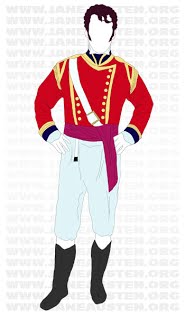
Wickham costume The Militia in Pride and Prejudice – WHS HBL Jane Austen sites.google.com
“Pride and Prejudice takes place in Regency England during the French Revolution, which began in 1789. To combat the threat of Napoleon’s conquest of Europe, militia forces were moved across the countryside to lie in wait of an attack at camps where they were involved in training sessions. Landowning aristocrats generally led the militia of their locality, although the soldiers of each regiment came from various places. Though the militia was made up of volunteers, a commission was needed to enroll. With the Militia Act of 1757, which created a more professional force with proper uniforms and better weapons, the militia became seen as a more respectable occupation, especially for younger sons who would not inherit land.” (The Militia in “Pride and Prejudice”)
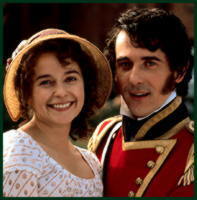
Few members of the militia were trained in military tactics, such as shooting, horsemanship, or use of a sword. They were required to have their own guns to be a member of the militia. Those picked or volunteering for militia duty in the rank and file served five years, while some served for seven years. Officer commissions were not available (as opposed to those in the Regulars). Those who held rank in the militia received that rank based on how much land the family held. Captain Denny in Pride and Prejudice would need either to be the heir of land worth at least £400 per year or actually own land worth at least £200 per year. Although we are given nothing of Denny’s background in Austen’s novel, we are told that George Wickham becomes a lieutenant in the Meryton militia. This is a bit confusing to many who know something of military history, for a lieutenant in the militia would be required to hold land worth £50 per year. If Wickham had nothing of his own upon which to depend, how did he receive his lieutenancy? Most experts speak of a lowering of the standards for the few who would qualify as a junior officer otherwise, meaning Wickham held a gentleman’s education, making him “qualify as a junior officer.” The wages presented to the officers was only to cover their expenses, not replace their income from their land.
All Protestant males were required to be available for the militia. There was a quota for each area. A local nobleman (customarily referred to as the Lord Lieutenant) was charged “by the King” (or rather by the King’s spokesman) to gather a force of able-bodied men between the ages of 18 – 45 to serve as part of the country’s militia. A local landowner was appointed as the “colonel” in charge of the men of the unit. These men were “guaranteed” not to know service outside of the homeland, meaning they would not know the battlefield frequented by professional soldiers. They also experienced a steady social life provided by the local gentry. Only clergymen were exempt from this duty.
There were substantial signing bonuses during the wars as the militia, Regulars and volunteers competed for the same pool of men, so anyone from outside the county would and did join the militia for the bonus and pay. Parishes were fined if they did not raise the required numbers of militiamen, so they were happy to have anyone fill the rosters, paying a bonus that was far less than the fine. And of course, sooner or later the parishes and Regular army learned not to pay the bonuses before the men were marched away. More than a few made a living by receiving the bonuses and then skipping out, only to ‘enlist’ again someplace else for bonuses there. A man who did not wish to serve could pay another to serve in his stead. They were offered between £25 and £60, which was equivalent to a year’s wage for many in the Regency.
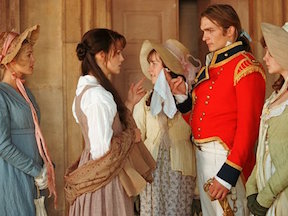
As part of the community, as well as the neighborhood, there was a certain sense of pomp and circumstance as part of the militia. They would conduct military reviews (much as we see in reenactments today). This would include close order marching, marksmanship contests, and even staged “fights” for the entertainment of the neighborhood.
In any case, when Napoleon returned from Elba, the militia were called up and regular army volunteers were asked for from the militia, both officers and men. A number went to Belgium, but the militias were held in readiness on the coasts during and after Waterloo. After Waterloo, there was an effort to stop the surge in smugglers and ex-patriots trying to escape a now Monarchial France, landing along the English coasts.
Because of the militia riots of 1813, militias were more often kept in the county of origin in small groups across the countryside. Most Regular Army units were not disbanded or reduced until the fall of 1816, so the militia would not have been sent to their homes until about the same time, depending on the mood of the county folks and the coastal activity.
We must recall that what we term as the “Napoleonic Wars” is a twenty year period, 1792-1815. There were several kinds of militia during this time, including yeomanry, fensible, and volunteer organizations. The threat of invasion and the desperate need for manpower in the Regular army also affected how and where militia were used. There were very few barracks at all at the start of the Napoleonic wars, better than 85% of the ones existing for militia and Regular troops in 1815 were built during the wars. And then there are the various militia revolts which colored the way militia was deployed in later years.
Austen began Pride and Prejudice about 1796 and did not publish it until 1813, sixteen years later, so the when of the book and the militia being stationed in her area likely changed quite often based on training for several different reasons… and types of militia.
“Reading Pride and Prejudice, one may notice that there is a conspicuous lack of war in the text despite the historical context of the Napoleonic Wars and the near-constant presence of the militia. The soldiers Austen depicts are more likely to play card games or dance rather than tell tales of bloodshed, partly because the militia received few chances to fight. The aristocrats that led each local militia tended to be corrupt as well, handing out promotions in exchange for money or sexual bribes. Lydia’s fantasies exemplify the moral laxity of the militia; she imagines ‘the streets of that gay bathing place covered with officers… She saw all the glories of the camp; its tents stretched forth in beauteous uniformity of lines, crowded with the young and the gay, and dazzling with scarlet; and to complete the view, she saw herself seated beneath a tent, tenderly flirting with at least six officers at once’ (262). Lydia’s description reveals the militia’s superficial attractions, one of which is novelty–the militia are still a new enough presence in England to appear young and gay and dazzling in their uniforms rather than war-weary. Undercurrents of sexuality run through Lydia’s fantasy in her image of “herself seated… tenderly flirting with at least six officers at once.” Although Lydia’s vision seems romantic enough, sexual deviance was a prominent spectacle of military life. Soldiers invited their mistresses into their tents at night and several prominent aristocrats such as the Duke of York were involved in highly publicized sex scandals.
“Added to the immorality that a military life offered was the anonymity and respectable status, which allowed men to climb social ranks easily. Due to the constant movement of the militia across the country, the new regimentals a man wore, and his new title as an officer, he could escape the hold of his past. Tim Fulford explores this idea in his essay ‘Sighing for a Soldier,’ writing that ‘[a soldier’s] dress and rank might well have been earned not by experience on the battlefield or parade ground but by influence, and the shiny uniforms masked a variety of characters and origins” (Fulford 157). The idea that ‘influence’ can earn a man status is not new to England, a country in which the aristocracy thrive off of patronage, and in the militia ‘influence’ took the form of underhanded bribes and secret deals among officers. ‘[S]hiny uniforms” and the opulence and novelty of militia camps mostly covered up this corruption from the public; however, corruption on such large a scale could never be wholly hidden.” (The Militia in “Pride and Prejudice”)
I had a question from one of my readers recently. She had read a book set in the Regency era, and, in it, an ambulance was called for to fetch a patient to a hospital. Naturally, she wanted to know if this was possible for the early 1800s.
The answer is both yes and no. Ambulances, of sorts, were available for battlefield injuries, but not for civilian cases. An ambulance was necessary on a battlefield because the fighting (and, therefore, the injuries) was often a mile or more from the actual tents set up as as a field hospital. Obviously, some form of “transportation” for the injured had been used for centuries. We are aware that men who fell in battle during the Crusades, which were fought between 1095 and 1291, were transported by horse-drawn wagons for treatment.
Some say, ambulances were first used for emergency transport in 1487 by the Spanish forces during the siege of Málaga by the Catholic monarchs against the Emirate of Granada, and civilian variants were put into operation in the 1830s.
“The modern ambulance—at least the horse-driven version—was cre-ated by Frenchman Dominique-Jean Larrey (1766-1842) in 1792. Larrey, Napoleon’s private surgeon, wanted to improve battlefield treatment of wounded soldiers. He designed a horse-drawn “flying ambulance” to carry surgeons and medical supplies onto the field of battle during the Rhine campaign of 1792.
“For the Italian campaign of 1794, Larrey used light ambulance carriages with stretchers to carry the wounded. In Egypt in 1799, local camels powered Larrey’s ambulances. With fellow surgeon Pierre Percy (1754-1825), Larrey formed a battalion of ambulance soldiers, including stretcher bearers and surgeons. Larrey’s ambulances and the swift medical attention they brought significantly boosted the morale of Napoleon’s troops.
“Ambulance service was expanded from the military to the civilian world in 1869 by Bellevue Hospital in New York City. The Larrey “flying ambulance” remained standard until the first motorized ambulances appeared around the turn of the century. These motorized vehicles were pioneered by the Panhard-Levassor partnership of France.” (Medical Discoveries)
In the city, they would retrieve a cart and take the injured to a person’s home for treatment. The only people who went to hospitals were the very, very VERY poor and only in the major cities. Everyone else was treated at home no matter what the injury. Also, a doctor would not be summoned. A surgeon would be summoned. Doctors only gave out medicine (more in the nature of what we now think of as a pharmacist). Surgeons were the ones who dealt with wounds, cuts, etc. ,anything which had to do with “getting dirty” or doing “work” on a patient.
Larrey was made a Commander of the Légion d’honneur on 12 May 1807. He joined in the Battle of Aspern-Essling, where he operated on Marshall Jean Lannes and amputated one of his legs in two minutes. He became the favorite of the Emperor, who commented, “If the army ever erects a monument to express its gratitude, it should do so in honor of Larrey”, he was ennobled as a Baron on the field of Wagram in 1809. In 1811, Baron Larrey co-led the surgical team that performed a pre-anesthetic mastectomy on Frances Burney in Paris. Her detailed account of this operation gives insight into early 19th century doctor-patient relationships, and early surgical methods in the home of the patient. Larrey was involved in the French invasion of Russia.
When Napoleon was sent to Elba, Larrey proposed to join him, but the former Emperor refused. At Waterloo in 1815 his courage under fire was noticed by the Duke of Wellington who ordered his soldiers not to fire in his direction so as to “give the brave man time to gather up the wounded” and saluted “the courage and devotion of an age that is no longer ours”. Trying to escape to the French border, Larrey was taken prisoner by the Prussians who wanted to execute him on the spot. Larrey was recognized by one of the German surgeons, who pleaded for his life. Perhaps partly because he had saved the life of Blücher’s son when he was wounded near Dresden and taken prisoner by the French, he was pardoned, invited to Blücher’s dinner table as a guest and sent back to France with money and proper clothes.
QUESTION FROM A READER/WRITER: I am curious about ink used for writing, especially how indelible it was when spilled or splashed on someone. If it gets on skin or cloth, how easy was it to remove? I think there might have been a difference in ink used for writing and that for printing, but I am not sure. The ink I want to use is actually in an inkwell, but I am sure I could make other arrangements if this wouldn’t work.
ANSWER: Okay, before we get into ink, we must remember also, that the paper of the time was not paper as we know it today. The vast majority of paper then was rag paper, literally made from shredded, pulled and pressed rags of cloth. So the rate at which it absorbed both ink and water was different from today’s papers.
It quite possibly would be more durable on vellum, simply because, whilst the vellum would absorb water (like a chamois cloth) it would not tend to disintegrate, which would be a risk with rag paper, depending on the quality of the paper manufacture.
I have a dear friend who is somewhat of a pen “aficionado”expert,” and he tells me that the ink used at the time is what is called “iron gall ink (made from oak galls).
“Wikipedia” written with self-made iron gall ink, and photographed at different times. (First image immediately, second after 8 seconds. third after 40 seconds, fourth after 3 minutes.) ~ Public Domain
“Iron gall ink (also known as common ink, standard ink, oak gall ink or iron gall nut ink) is a purple-black or brown-black ink made from iron salts and tannic acids from vegetable sources. It was the standard ink formulation used in Europe for the 1400-year period between the 5th and 19th centuries, remained in widespread use well into the 20th century, and is still sold today. The ink was traditionally prepared by adding some iron sulfate to a solution of tannic acid, but any iron ion donor can be used. The gallotannic acid was usually extracted from oak galls or galls of other trees, hence the name. Fermentation or hydrolysis of the extract releases glucose and gallic acid, which yields a darker purple-black ink, due to the formation of iron gallate. [Diringer, David (1 March 1982). The Book Before Printing: Ancient, Medieval and Oriental. Dover Publications. pp. 551–2.]
“The fermented extract was combined with the iron(II) sulfate. After filtering, the resulting pale-grey solution had a binder added to it (most commonly gum arabic) and was used to write on paper or parchment. A well-prepared ink would gradually darken to an intense purplish black. The resulting marks would adhere firmly to the parchment or vellum, and (unlike india ink or other formulas) could not be erased by rubbing or washing. The marks could only be erased by scraping a thin layer off the writing surface.” [Flemay, Marie (21 March 2013). “Iron Gall Ink”. Traveling Scriptorium.]
My friend says that there were some variety of inks available at the time. Iron gall inks were common and were sometimes referred to as “registrar” inks. They were used for official documents because they were significantly more permanent than the water-soluble inks that were beginning to appear on the market. (For example, in 1832 Carl Hornemann founded a color and ink factory in Hanover, Germany; although it is tradition to consider 28th of April 1838 as the founding date. That was the Pelikan pen, which is still around.)
Iron gall inks are very old and very hearty, this is the same ink that was used in medieval palimpsests that are often still legible today after having been erased and written over multiple times, sometimes going all the way back to the 6th century (although those tended to be written on vellum, rather than paper, which would have made a difference in terms of water resistance.)
As to whether the ink would come out of clothes, etc., like fountain pens today, I believe getting the ink out of clothes would be nearly impossible. If he was able to wash his face immediately, the staining to the skin might not be too bad, but if it has any time to absorb, he would have a significant ink stain on his face for quite a few days. As to the clothes, I would think that anything white would certainly be ruined, if I am not able to wash ink out with modern laundry detergents and machines, I imagine it must have been very difficult indeed back in the day.The short answer is, he thinks that there is a chance you could make something out if it was written in iron gall ink or another registrar ink. With a water-soluble ink, there would be no chance. It is actually possible to buy iron gall ink today, should you like to experiment to be sure!
‘Did You Know? Sources:
Some of my friends have tried calf-skin, but I have not tried writing on it yet. I am basically a vegetarian and got a little grossed-out by the calfskin part. I am confident some of you know about this, but the British Parliament just recently (2017 I think?) decided to stop printing new laws on vellum, which naturally upset Britain’s last producer of vellum. [Vellum: UK’s last producer of calf-skin parchment fights on after losing Parliament’s business https://www.independent.co.uk/news/uk/home-news/vellum-uks-last-producer-of-calf-skin-parchment-fights-on-after-losing-parliaments-business-a6870966.html].
Here’s a nice mini-history of some ink companies if anyone is interested: Exploring the late 19th-century landscape of ink manufacturing via a collection of 90 bottles
A friend of mine who studies Shakespeare did a seminar at the Folger library in DC and one of the things they made everyone do was make their own ink because it was such a routine task in the Renaissance.
William Wordsworth’s sister and wife made his ink, and I have come across accounts of boys in Wordsworth’s time learning to make their own ink in grammar schools.
In the Regency, the worddowagerwas used in newspapers, letters, the Gazette, and on letters. One was never addressed as a “Dowager.” One does not say, “Good day, Dowager Countess.” The woman is simply addressed as a “Lady So-and-So.”
The word “dowager” eventually began to attract negative emotions, and widows began avoiding the use of the word. However, it was in use in the Regency for widows of landed and usually titled men. Though today, widows prefer not to use Dowager, at the time, a widow of a man of property was a dowager, meaning entitled to “dower,” a widow’s share for life of her husband’s estate.
The grandmother usually became the Dowager Countess of Somewhere as soon as she was widowed. Until the woman’s son marries, it is her prerogative to leave off the Dowager and just be Lady Somewhere.
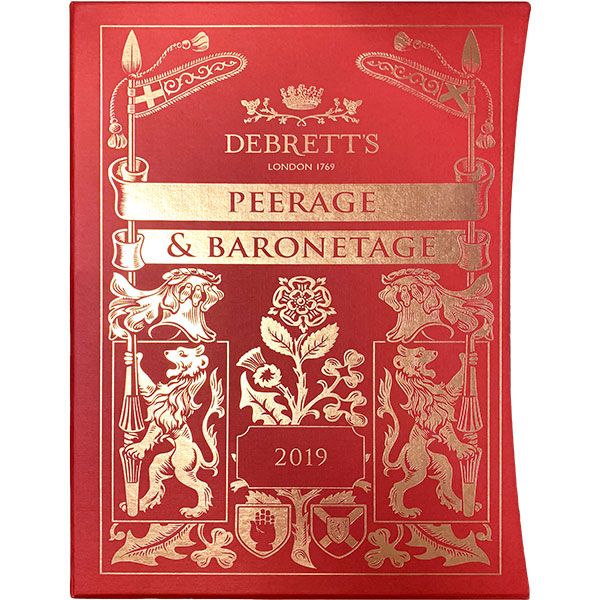
According to Debrett’s Correct Form:
“Officially the widow of a peer is known as the Dowager Countess (or whatever) of X, unless there is already a dowager peeress of the family still living. In the latter event, the widow of the senior peer of the family retains the title of Dowager for life, and the widow of the junior peer in that family is known by her Christian name, e.g., Mary, Countess of X, until she becomes the senior widow. . . . When the present peer is unmarried, by custom the widow of the late peer continues to call herself as she did when her husband was living, i.e., without the prefix of (a) dowager, or (b) her Christian name. Should the present peer marry, it is usual for the widowed peeress to announce the style by which she wishes to be know in future.” (Titles) This last bit is 20th century, and Black’s agrees: most widows do not use “dowager” at all anymore, and simply use the Mary, Countess of X option, announcing in the press the style they will be using.
Invitations to court and the lady’s name in the newspaper or on formal lists (as in the list of those who attended a Queen’s birthday bash) would use dowager if there was another one with her same title. If there was more than one widow, the first widow is the dowager and the others are Mary Countess of X. The main purpose was to avoid confusion between or among ladies. One never addressed the lady as a dowager in person. One only spoke of her as the dowager when it was necessary to distinguish her from any other living Countess of Someplace. As a twelve-year-old girl (Think how girls as young as 12 could marry) could actually be a dowager, the term was not connected to age. However, because older women were usually dowagers (in the upper crust) and people spoke slightingly of sitting among the dowagers and chaperones, the widows decided they did not like the word. If a woman wanted to present her granddaughter at court, or her new daughter-in-law, she would have to describe herself as a DowagerCountess, for instance. Ordinarily, though, she would not use the term, at all.
Technically, the definition according to the Oxford English Dictionary applies to: “A widow with a title or property derived from her late husband.” As in a widow who has estate or property left to her by her right ofdower.In usage, it can be applied to any elder woman of status (a widow who has rank).
The more proper use is that: “…the widow of apeermay continue to use the style she had during her husband’s lifetime, provided that his successor, has no wife to bear the plain title. Otherwise, she more properly prefixes either herforenameor the word Dowager,e.g. “Jane, Countess of Loamshire” or “Dowager Countess of Loamshire”. “As with a lot of styling, it is up to the lady to set how she wishes to be addressed: She may not want to become a dowager just yet and so may resist that push.
There are many words in the English language which are routinely interchanged. Whether one accepts these “switches” depends upon whether the person is a semanticist or a grammarian. Semanticists normally are concerned with the word’s meaning, while the grammarian deals in proper usage. I suspect as the world has now moved to the 140-characters message the differences appear impractical and perhaps a bit nonsensical. However, there are those who “toe the line.” For example…
A person should use can meaning the “ability to complete”; whereas, may indicates “permission.”
Because is used to indicate a “reason/cause”; whereas, since refers to “time, meaning between then and now.”
In behalf of means “for the benefit of another”; whereas, on behalf of means “in place of.”
Use between when “two people/places/things are involved.” Use among for “three or more.”
From the MasterClass Articles we learn that “Diction is the careful selection of words to communicate a message or establish a particular voice or writing style. For example, flowy, figurative language creates colorful prose, while a more formal vocabulary with concise and direct language can help drive home a point.
“Different styles of diction impact how different ideas are expressed. There are eight common types of diction:
Formal diction. Formal diction is the use of sophisticated language, without slang or colloquialisms. Formal diction sticks to grammatical rules and uses complicated syntax—the structure of sentences. This elevated type of language is often found in professional texts, business documents, and legal papers.
Informal diction. Informal diction is more conversational and often used in narrative literature. This casual vernacular is representative of how people communicate in real life, which gives an author freedom to depict more realistic characters. Most short stories and novels use informal diction.
Pedantic diction. This is when a writer is highly detailed or academic in their writing. Words are chosen specifically to convey only one meaning. It is sometimes used in literature when characters speak in a highly educated manner, as in F. Scott Fitzgerald’s The Great Gatsby.
Colloquial diction. Colloquial words or expressions are informal in nature and generally represent a certain region or time. “Ain’t” and “y’all” are examples of colloquial expressions, born in rural areas of the United States. Colloquialisms add color and realism to writing.
Slang diction. These are words that originated within a specific culture or subgroup but gained traction. Slang can be a new word, a shortened or modified word, or words that take on a new meaning. Examples of common contemporary slang words are “aggro” instead of “aggravated”; “hip,” which means trendy; and “throw shade,” which is to lob an insult at someone.
Abstract diction. This is when a writer uses words to express something intangible, like an idea or an emotion. Abstract phrases often lack physical detail and specificity because they are things the reader cannot experience through their five senses.
Concrete diction. Concrete diction is the use of words for their literal meanings and often refer to things that appeal to the senses. The meaning is not open to interpretation because the writer is specific and detailed in their phrasing. For example, the sentence: “I ate an apple.”
Poetic diction. Poetic diction is driven by lyrical words that relate to a specific theme reflected in a poem, and create a euphonious, or harmonious, sound. Poetic diction usually involves the use of descriptive language, sometimes set to a beat or rhyme.”
Choosing the precise word or phrase remains a challenge for all authors, whether they write professionally or for their own pleasure. The majority of those who make a living from writing have knowledge of words they never use in their creations. I write novels based in the Regency Period (1811-1820). Contemporary words/phrases such as Google, HD, iPad, and mouse are never used, but one easily finds acquiesce,obeisance, imprudence, and forbearance. From this quick example, one can easily observe the number of words which a person uses in his writing falls short of the number of which he is familiar. Add to that fact, how quickly the English language changes, and an author/poet will find it difficult to keep up with the flexibility of the language. Yet, some basics persist. It is the writer’s responsibility to use the best word(s) for a particular situation. Instead of choosing a word, it is important to choose the word that expresses the exact meaning he intends. (For the examples below, I give credit to my college journalism professor. These examples remain in my spiral notebook even after all these years.)
Institute for Humane Education • 31 weeks ago “Defining Moments” (article) (via Teaching Tolerance) (Spring 2012) Explores the evolving definitions and meanings of many words used in children’s dictionaries and the challenges of dealing with complex issues related to words such as “feminism,” “gender,” “race,” and “ethnicity” — as well as even “simple” definitions, like “tan.” (From The Power of Language on Pinterest)
Affect, Effect Affect is a verb meaning to influence. Effect is a noun meaning result.
Influence, Impact (two words often associated with affect/effect) Influence refers to the ability to cause desired effects. Impact means to strike or to collide; to wedge in.
Acute, Chronic Acute indicates intenseness; that something has become immediately critical. Chronic means recurring or continuing over a considerable time.
Adapt, Adopt, Adept Adapt means to adjust to a changing situation. Adopt means to accept something as one’s own.
Adept means having skills.
Adverse, Averse Adverse means unfavorable. Averse means having a distaste for something.
Aggravate, Annoy, Irritate Aggravate means to make worse or more troublesome. It is used to refer to things. Annoy means to make angry, usually through repetition. Use it to refer to people. Irritate means to provoke to impatience or anger.
Agree To, Agree With Agreeto is used to refer to things. Agreewith is used to refer to people.
Character, Reputation Character is the sum of a person’s behavior and his moral standards. Reputation is other people’s perception of the person.
Each Other, One Another Each other is used when two people, places or things are involved. One another is used for three or more.
Cynic, Skeptic Cynic refers to a person who doubts or denies the goodness of human nature and does so in a sarcastic manner. Skeptic refers to a person who has a doubting, questioning attitude. He wants evidence to prove his ideas.
Allusion, Delusion, Illusion Allusion is an indirect mention. Delusion is to believe in something even when evidence shows otherwise. Illusion is a false or misleading idea or image.
Expect, Anticipate Expect is used when no preparation is made. Anticipate is used when preparation has been made for something that will occur.
Smell, Odor, Aroma Smell is a neutral word depending on the surrounding words. Odor refers to something unpleasant. Aroma refers to something pleasant.
Appraise, Apprise Appraise means to determine the value. Apprise means to notify or inform.
Cement, Concrete Cement is the powder used as an adhesive ingredient in concrete. (Note! Cement is not a verb.)
Doctor Doctor is a title, not a profession. It should be used generically. Use physician, minister, professor, etc., for more specific descriptions. [Heck, I am a “doctor,” but you do not wish me in the operating room.]
Pretense, Pretext Pretense refers to a false appearance or action used purposely for deception. Pretext is a false or fabricated reason, developed to hide the truth.
Because, Since Most writers make no distinction in use between these two words. However, there are certain differences that should be addressed. Because is used to indicate a cause or a reason. Since refers to time, meaning between then and now.
To be fair, English is full of such traps. After all, I can deposit my paycheck in a bank, I can sit on the river bank to fish, or I can bank a basketball off the backboard. English is a language where one’s nose runs and his feet smell. It possesses a deceptively complex structure, but it is well worth knowing English’s subtleties.
Christmas at Pemberley: A Pride and Prejudice Christmas Sequel
To bring a renewed sense joy to his wife’s countenance, Fitzwilliam Darcy has secretly invited the Bennets and the Bingleys to spend the Christmastide festive days at Pemberley. But as he and Elizabeth journey to their estate to join the gathered families, a blizzard blankets the English countryside. The Darcys find themselves stranded at a small out-of-the-way inn with another couple preparing for the immediate delivery of their first child, while Pemberley is inundated with friends and relations seeking shelter from the storm.
Without her brother’s strong presence, Georgiana Darcy desperately attempts to manage the chaos surrounding the arrival of six invited guests and eleven unscheduled visitors. But bitter feuds, old jealousies, and intimate secrets quickly rise to the surface. Has Lady Catherine returned to Pemberley for forgiveness or revenge? Will the manipulative Caroline Bingley find a soul mate? Shall Kitty Bennet and Georgiana Darcy know happiness?
Written in Regency style and including Austen’s romantic entanglements and sardonic humor, Christmas at Pemberley places Jane Austen’s most beloved characters in an exciting yuletide story that speaks to the love, the family spirit, and the generosity that remain as the heart of Christmas.
Before writing romance, Regina Jeffers wore many hats, including that of a tax preparer, journalist, choreographer, Broadway dancer, theatre director, history buff, teacher, grant writer, and media literacy consultant for school districts and public television. Now, “supposedly” retired, she writes full-time, skillfully enveloping her readers in the hearts and minds of her characters.
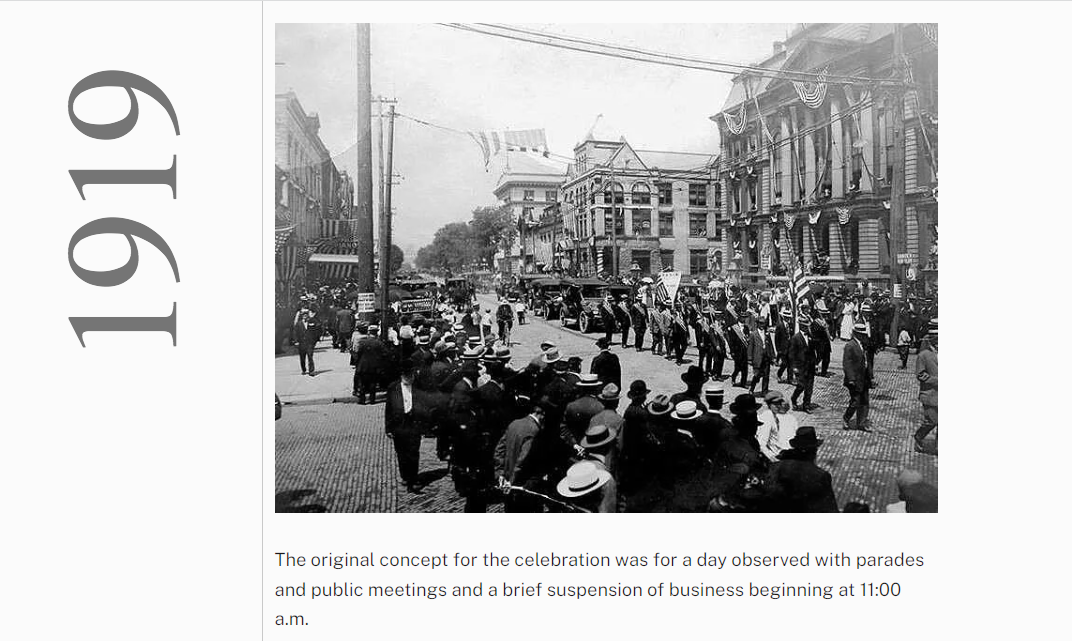
Today, we have a celebration of Veterans’ Day, a day originally called Armistice Day.
The Department of Veterans Affairs Website tells us, “In November 1919, President Wilson proclaimed November 11 as the first commemoration of Armistice Day with the following words: “To us in America, the reflections of Armistice Day will be filled with solemn pride in the heroism of those who died in the country’s service and with gratitude for the victory, both because of the thing from which it has freed us and because of the opportunity it has given America to show her sympathy with peace and justice in the councils of the nations…”
“World War I – known at the time as ‘The Great War’ – officially ended when the Treaty of Versailles was signed on June 28, 1919, in the Palace of Versailles outside the town of Versailles, France. However, fighting ceased seven months earlier when an armistice, or temporary cessation of hostilities, between the Allied nations and Germany went into effect on the eleventh hour of the eleventh day of the eleventh month. For that reason, November 11, 1918, is generally regarded as the end of ‘the war to end all wars.’”
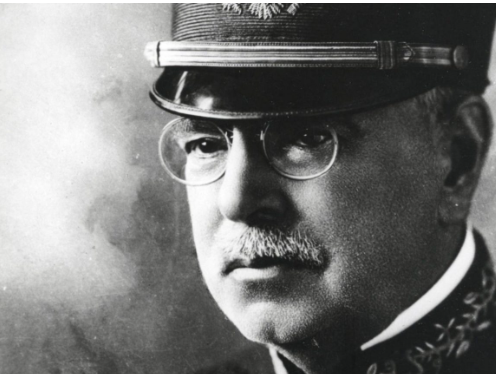
Though I am as patriotic as one might expect of someone from my generation, this post is not on Veterans Day, but rather about the man known as The March King. If you have ever been a part of a marching band or the military, you will recognize John Philip Sousa’s influence on the tradition.
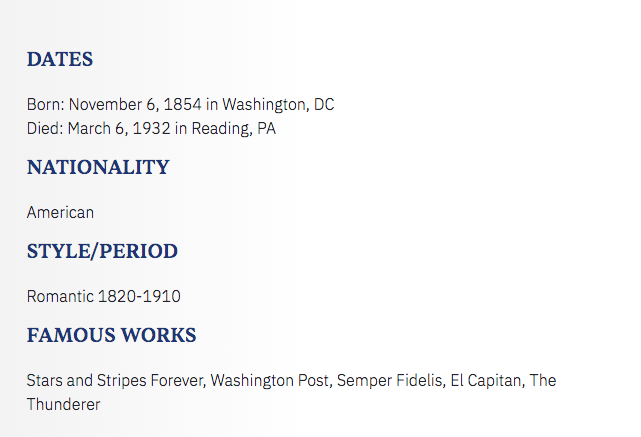
John Philip Sousa was born 6 November 1854 in Washington, DC, near the Marine Barracks at that time, for his father Antonio was a musician in the Marine Band. After grammar school, he enrolled in a private conservatory of music. There, he studied piano and orchestral instruments, but the violin was his favorite. His father later insisted that John enlist as an apprentice musician with the Marine Band. He was 13 at the time, and he stayed with the band until he was 20.
In addition to his musical training in the Marine Band, he studied music theory and composition with George Felix Benkert, a noted Washington orchestra leader and teacher.
After being discharged from the Marine Corps, he toured with several traveling orchestras. During that time he also worked as a composer, arranger, and proofreader for publishing houses. He wrote the incidental music and the march for the musical “Our Flirtation” and toured with the company. While on tour in St. Louis, he received a telegram offering him the leadership of the Marine Band in Washington. He accepted and reported for duty on Oct. 1, 1880, becoming the band’s 17th Leader.
His time with the Marine Band was unlike any other leaders before him. “He replaced much of the music in the library with symphonic transcriptions and changed the instrumentation to meet his needs. Rehearsals became exceptionally strict, and he shaped his musicians into the country’s premier military band. Marine Band concerts began to attract discriminating audiences, and the band’s reputation began to spread widely.
“Sousa first received acclaim in military band circles with the writing of his march “The Gladiator” in 1886. From that time on he received ever-increasing attention and respect as a composer. In 1888, he wrote “Semper Fidelis.” Dedicated to “the officers and men of the Marine Corps,” it is traditionally known as the “official” march of the Marine Corps.
“In 1889, Sousa wrote the “Washington Post” march to promote an essay contest sponsored by the newspaper; the march was soon adapted and identified with the new dance called the two-step. The ‘Washington Post” became the most popular tune in America and Europe, and critical response was overwhelming. A British band journalist remarked that since Johann Strauss, Jr., was called the “Waltz King” that American bandmaster Sousa should be called the ‘March King.’ With this, Sousa’s regal title was coined and has remained ever since.” [Marines]
When writing British Regencies and other historicals set in the 1700s and 1800s, one must know something of inheritance laws, as well as how Parliament operated during those times. Below, you will find a mishmash of facts I have learned, especially as an American who is writing about British history. Hopefully, it will help someone else not make the same mistakes as I did.
According to this site (https://en.wikipedia.org/wiki/House_of_Lords), in 2014 the House of Lords passed a Reform Act which allowed peers to retire or resign from the chamber. Prior to this act, only hereditary peers could disclaim their peerages, which implies they could in the Regency era. I do not know the process but I am confident someone else does and will point the way just as I am pointing out the tidbits I have picked up over the years..
Question: In 1818, could a peer ever resign his seat in the House of Lords? What would that entail if so? If not, could he refuse to attend Parliament when summoned for the annual session? I’m sure illness, etc., prevented some peers from attending.
Answer: No, he could not resign. However, he need not accept it when he first succeeds to the title, just as Maurice Berkeley did when he was named Earl of Berkeley. The earldom remained dormant during his life.
Born the illegitimate son of Frederick Berkeley, 5th Earl of Berkeley, and his wife Mary Berkeley (née Cole), Berkeley entered the Royal Navy in June 1802. Entering politics, Berkeley became Whig Member of Parliament for Gloucester in the 1831 general election. He resigned his seat in April 1833 following his appointment as Fourth Naval Lord in the Grey ministry that month and remained in office until December 1834. He successfully became Member of Parliament for Gloucester again at the 1835 general election but, although he secured his old job as Fourth Naval Lord back again in the Second Melbourne ministry in July 1837, he was defeated at the 1837 general election. He remained in office as Fourth Sea Lord but became concerned over reductions in manning and resigned in March 1839.
Lord Byron left the country and just never returned so never answered his writ of summons and never took the oath again so he could not name a proxy.
Catholics, minors, females and the deranged could not attend, but others were supposed to go for a time or two to take the oath at the beginning of a new parliament (after an election).
Once they came in and took the oath, they could name a proxy and give him permission to vote for him. Usually the man then retired to the country. That was done due to illness of the man or to circumstances at home or various such legitimate excuses. It was considered an obligation of peerage to go to parliament at least to take the oath so that a party member could be given the proxy. Quite a few stayed away unless an important vote was pending. At that time “whippers in” would go out to corral all they could to attend and vote.
Even when a peerage was disclaimed, the heir was still the heir. The heir could not inherit until the holder died. The usual reason for disclaiming a peerage was to stay in the House of Commons. A bill was passed to allow the heir who sat in the House of Commons to continue to do so when he succeeded to the peerage. If this occurred, usually the man was PM or had some other important position in the House.
The proxy to vote could not be given to the son (heir), because he is not entitled to sit in the House of Lords until he succeeds to the title and is summoned to Parliament. The proxy can only be given to someone who is already sitting in the House of Lords.
During the Regency, many viscounts served in the House of Commons, especially ones with Irish titles.
In Scotland, there was not such a big hoopla of a child being legitimate or not based on the date of marriage. A Scot was considered legitimate by the subsequent marriage of his parents in Scotland, but under English law, he was not heir to any English property or titles and honors. Only a child born after his parents married could inherit English property and titles.
All the Irish and Scottish peers were not given seats in the House of Lords. Only a representative number of each were elected by other peers to attend the House of Lords. The Irish peers were elected for life while the Scottish peers were elected for the parliament (from one general election to the next).
The Irish peers who were not elected as representative peers could sit in the House of Commons. Scottish peers could not. These were peers without English titles. Of course, because there are often no absolutes in these matters, by the Regency Period, those with English titles were entitled to a seat in the House of Lords.
Those Irish peers who did sit in the House of Commons lost privileges of Peerage, but did have privilege of Parliament. It is hard to know, offhand, whether a viscount was a peer or an heir.
Here are some book recommendations for learning more on this process:
The Unreformed House of Commons by Edward and Anne Porritt. Two separate volumes. Available on Amazon and Google Books.
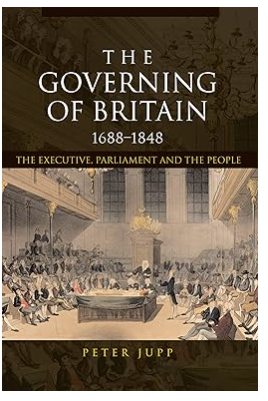
If your hero is a Tory and member of the government’s party, I recommend The Governing of Britain, 1688-1848: The Executive, Parliament and the People, by Peter Jupp. Detailed explanation of the workings of Parliament, cabinet, the monarchy, etc. It is a huge book but it is separated by time period so you should not be required to read the whole thing to find the relevant information.
Focusing on the institutions and players of central and local government during an era of great transformation, Peter Jupp examines the cohesive nature of the British state, and how Britain was governed between 1688 and 1848. Divided into two parts, bisected by the accession of George III in 1760, this study: examines the changes to the framework and function of executive government presents an analysis of its achievements, the composition and functions of Parliament, explores Parliament’s role in government looks at the interaction between the executive, Parliament and the public. Providing new insights into the formulation of notions and traditions of legislation, the public sphere and popular politics, The Governing of Britain is an essential guide to a formative era in political life.
If your character is a Whig and member of the Opposition, I would choose The Whigs in Opposition: 1815-1830, by Austin Mitchell. It contains very detailed explorations of the inner workings of the Whig party, with discussions of specific bills and votes in Parliament.
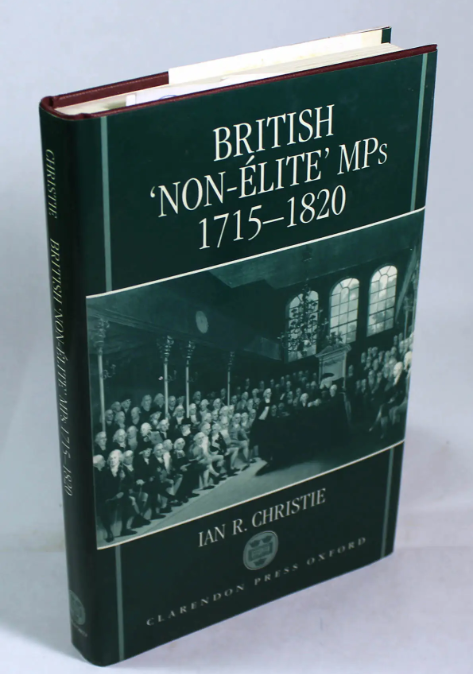
If he is not part of the aristocracy, check out British ‘Non-Elite’ MPs: 1715-1820, by Ian R. Christie. I have not actually read this book; yet, but it looks awesome!
In the eighteenth century the considerable degree of social mobility in British society, especially between the upper and middling ranks, was arguably one of the important factors contributing to political and social stability. The extent of that mobility among the members of the nation’s legislature was particularly important in this regard. In the first detailed analysis of its kind, Ian R. Christie examines how far the House of Commons reflected and was itself affected by such social mobility. Enquiry is directed at the growth in number of `non-élite’ members of parliament; men without land. This is a fascinating study which every historian of 18th-century Britain will want to read.
Here are some other books I might also recommend to the serious writer.
The Great Reform Act of 1832, by Eric J. Evans. Very short and concise, with an excellent section on the Unreformed system.
Regency England: the Age of Lord Liverpool, by John Plowright. Another short one, a great overview of the political currents of the time and major issues, politicians and legislation.
The English Town 1680-1840: Government, Society, and Culture, by Rosemary Sweet. Invaluable for writing provincial England, with a good section on local politics.


 Few members of the militia were trained in military tactics, such as shooting, horsemanship, or use of a sword. They were required to have their own guns to be a member of the militia. Those picked or volunteering for militia duty in the rank and file served five years, while some served for seven years. Officer commissions were not available (as opposed to those in the Regulars). Those who held rank in the militia received that rank based on how much land the family held. Captain Denny in Pride and Prejudice would need either to be the heir of land worth at least £400 per year or actually own land worth at least £200 per year. Although we are given nothing of Denny’s background in Austen’s novel, we are told that George Wickham becomes a lieutenant in the Meryton militia. This is a bit confusing to many who know something of military history, for a lieutenant in the militia would be required to hold land worth £50 per year. If Wickham had nothing of his own upon which to depend, how did he receive his lieutenancy? Most experts speak of a lowering of the standards for the few who would qualify as a junior officer otherwise, meaning Wickham held a gentleman’s education, making him “qualify as a junior officer.” The wages presented to the officers was only to cover their expenses, not replace their income from their land.
 As part of the community, as well as the neighborhood, there was a certain sense of pomp and circumstance as part of the militia. They would conduct military reviews (much as we see in reenactments today). This would include close order marching, marksmanship contests, and even staged “fights” for the entertainment of the neighborhood.