The Etiquette of “Visiting” and How Jane Austen Used the Tradition as a Plot Device

The Etiquette of “Visiting” and How Jane Austen Used It as a Plot Device

In the 1800s, morning calls or visiting upon a household developed a certain protocol, and those who broke protocol were often shunned. First a calling card was presented to the household’s servant. It was common for those who came to London for the Season to drive about with a footman in tow to present one’s cards to acquaintances. Do you recall Mrs. Jennings doing so in Sense and Sensibility? “The morning was chiefly spent in leaving cards at the houses of Mrs. Jennings’s acquaintance to inform them of her being in town.”

One would leave three cards with the servant: one from the lady for the house’s mistress; one from the caller’s husband for the house’s mistress and another for the house’s master. Displaying cards of those who had called was commonplace. It gave one social status to display cards from those of the nobility. In Persuasion, the Elliots took care to display “…the cards of the Dowager Viscountess Dalrymple and the Hon. Miss Carteret, to be arranged where they might be most visible.”callingcards1

If one came without a card, he may receive a snub. From her drawing room on the second floor, the house’s mistress could see who called upon her home, and she could make a decision whether to receive the caller or not. In Northanger Abbey, Catherine Morland calls on Miss Tilney and is sent packing. “She reached the house without any impediment, looked at the number and inquired for Miss Tilney. The man believed Miss Tilney to be at home, but was not quite certain. Would she be pleased to send up her name? She gave her card. In a few minutes, the servant returned, and with a look which did not quite confirm his words, said he had been mistaken, for she was walked out.”

Gentlemen did make calls, but they did not receive them from ladies. It would be a major breech in etiquette. Conversation remained light during the call, and one did not stay more than a quarter hour. One called between three and four in the afternoon if the house’s mistress was a casual acquaintance: Between four and five for a better acquaintance, and between five and six for a good friend. NO ONE called before one in the afternoon.

ccardcVisiting with one’s neighbors and acquaintances was a popular activity for those in the country and in Town. It was a common means to social mobility to be accepted by those above one’s social status. Visiting is a wonderful plot device in all of Jane Austen’s novels. Remember that Austen wrote of what she experienced. So, when in Pride and Prejudice is “visiting” an important plot ploy? Notice how key points in the story pivot around the event of a “visit” or an “invitation.”

How about Mrs. Bennet’s disappointment at not having Mr. Bingley’s acquaintance? “We are not in a way to know what Mr. Bingley likes,’ said her mother resentfully. ‘Since we are not to visit.’”

pride_and_prejudice_0028Mr. Bennet pleases his wife when he says, “It is very unlucky; but as I have actually paid the visit, we cannot escape the acquaintance now.”

Miss Bingley asks Jane Bennet for an evening at Netherfield by sending this message: “My Dear Friend: If you are not so compassionate as to dine today with Louisa and me, we shall be in danger of hating each other for the rest of our lives; for a whole day’s tete-a-tete between two women can never end without quarrel. Come as soon as you can on receipt of this. My brother and the gentlemen are to dine with the officers.”

Colonel Fitzwilliam feels “at home” at Hunsford and calls often. “Colonel Fitzwilliam had called at the Parsonage more than once during the time, but Mr. Darcy they had only seen at church. The invitation was accepted, of course, and at a proper hour, they joined the party in Lady Catherine’s drawing room.”

Mrs. Gardiner writes of Mr. Darcy’s unexpected call at Gracechurch Street. “On the very day of my coming home from Longbourn, you uncle had a most unexpected visitor. Mr. Darcy called, and was shut up with him several hours.”

Mr. Collins glories in his invitation from Lady Catherine De Bourgh. “Mr. Collins’s triumph, in consequence of this invitation, was complete. The power of displaying the grandeur of his patroness to his wondering visitors, and of letting them see her civility toward himself and his wife was exactly what he had wished for; and that an opportunity of doing it should be given so soon, was such an instance of Lady Catherine’s condescension, as he knew not how to admire enough.”

The Bennet sisters learn of the militia’s coming to Meryton. “Their visits to Mrs Phillips were now productive of the most interesting intelligence. Every day added something to their knowledge of the officers’ names and connections.”

Darcy brings Georgiana to Lambton to visit with Elizabeth Bennet. “Elizabeth had settled it that Mr Darcy would bring his sister to visit her the very day after her reaching Pemberley, and was, consequently, resolved not to be out of sight of the inn the whole of that morning. But her conclusion was false; for on the very morning after their arrival at Lambton their visitors came.”

Elizabeth Bennet deflects Miss Binley’s barbs while returning Georgiana’s call. “In this room they were received by Miss Darcy, who was sitting there with Mrs Hurst and Miss Bingley, and the lady with whom she lived in London.”

Elizabeth arrives at Netherfield to attend the ailing Jane Bennet. “Elizabeth was glad to be taken to her immediately, and Jane, who had only been withheld by the fear of giving alarm or inconvenience from expressing in her note how much she longed for such a visit, was delighted at her entrance.”

Mr. Collins invites himself to Longbourn. “If you should have no objection to receive me into your house, I propose myself the satisfaction of waiting on you and your family, Monday, November 18th, by four o’clock, and shall probably trespass on your hospitality till the Saturday sennight following, which I can do without any inconvenience…”

Jane explains to Elizabeth how Caroline Bingley has snubbed her. “Caroline did not return my visit till yesterday; and not a note, not a line, did I receive in the meantime.”

The Bennets and the Lucases hold a post mortem of the Meryton Assembly. “That the Miss Lucases and the Miss Bennets should meet to talk over a ball was absolutely necessary, and the morning after the assembly brought the former to Longbourn to hear and to communicate.”

The Gardiners spend Christmastide at Longbourn. “On the following Monday, Mrs. Bennet had the pleasure of receiving her brother and his wife, who came, as usual, to spend the Christmas at Longbourn.”

Lady Catherine encourages Elizabeth to extend her stay at Hunsford. “Why, at that rate, you will have been here only six weeks. I expected you to stay two months. I told Mrs. Collins so before you came.”

Lady Catherine barges in on the Longbourn household. “They both set off, and the conjectures of the remaining three continued, though with little satisfaction till the door was thrown open and their visitor entered. It was Lady Catherine De Bourgh.”

Mr. Bennet reluctantly agrees to accept the unrepentant Lydia into his home, but his wife relishes in having a married daughter. “But Jane and Elizabeth, who agreed in wishing, for the sake of their sister’s feelings and consequence, that she should be noticed on her marriage by her parents, urged him so earnestly, yet so rationally and so mildly, to receive her and her husband at Longbourn as soon as they were married, that he was prevailed on to think as they thought and act as they wished. And their mother had the satisfaction of knowing that she should be able to show her married daughter in the neighborhood, before she was banished to the North.”

Bingley returns to Longbourn. “Mr Bingley arrived. Mrs Bennet, through the assistance of servants, contrived to have the earliest tidings of it, that the period of anxiety and fretfulness on her side might be as long as it could. She counted the days that must intervene before their invitation could be sent–hopeless of seeing him before. But on the third morning after his arrival in Hertfordshire she saw him, from her dressing-room window, enter the paddock and ride toward the house.”

pride-and-prejudice-2005-pride-and-prejudice-2005-16538188-600-3881Are there other scenes in Pride and Prejudice or any of Austen’s novels that are pivotal moments and are associated with “visits”? I can think of several dozen without much effort. How about you?

Posted in British history, customs and tradiitons, Jane Austen, Living in the Regency, Regency era | Tagged , , , , , , , , | 7 Comments

Celebrating the Release of Jen Corkill’s “Season of Mists” + an Enticing Excerpt

It is my great pleasure to welcome Jen Corkill to my blog today. Her latest release appears quite enticing: a mixture of late Victorian mayhem and a bit of the supernatural. Please enjoy the excerpt of Season of Mists below.

Season of Mists

Season of Mists by Jen Corkill

Season of Mists by Jen Corkill

Justine Holloway prepares for her debut into Society, compliments of her godparents, while the underworld of London groans with unfettered abhorrence. The Varius are refugees from a parallel universe, who shift their form while others channel the forces of magic, an element that once flowed freely between both worlds. They seek refuge in Victorian London, hidden in the slums, easily forgotten until a human ends up incinerated or sucked dry. It is the job of the Council, created for the protection of humanity, to step in and eliminate the threat.

What Justine does not realize is her godfather runs the Council right under the nose of polite society, much to the dismay of his genteel sister. Justine suspects something mysterious is brewing when the handsome Egyptian Ambassador heals before her eyes. It’s an image she can forget and a mystery she wants to solve.

When a deadly vampire makes his devious intentions known, her survival might depend on this strange Egyptian. Unfortunately, he can’t figure out why he’s so drawn to her, or whether he must kill her to save humanity.

Exquisite Excerpt…
A lanky man wearing the livery of a deckhand strode to the side of the captain’s cabin and peered into one of the portholes. He licked his lips and dug inside his pockets. At first, Justine contemplated going to her cabin, but his gaze did not alter as he stood, eyes fixated on the room she’d just left.

“Excuse me…may I help you?” Justine ventured. “Is there someone inside to whom you wish to speak? The captain perhaps?”

The man did not respond. He acted as if she was invisible. Whatever drew him to the cabin smothered any sense of life or breath. Without looking down to see what he brought from his pocket, Justine noticed a metal necklace, a medallion of sorts, clutched in his grasp. He brought the trinket to his face near the porthole, hot breath fogging the glass. His long fingers rubbed the shiny metal, twisting it this way and that, as if ready to smash it through the window.

“The Master said this’d find him…” His words came out in an elated whisper. The young man’s attention darted from the necklace to the window and back. He licked his lips again and blinked in rapid succession. Then, he smiled. The expression of delight brought a childlike innocence to his intense errand, but the expression did not last. As before, he twitched, his hands trembling. “Why is it not working?”

Justine stepped back, fearing he’d throw the necklace to the floor in a rage. Snarling, saliva seething from his mouth, he beat the medallion. Was the man mad?

“Excuse me?” Justine repeated. “Are you all right?”

Whatever haze clouding the deckhand’s mind cleared. He jumped and stared at her, no doubt startled by her appearance. There was nothing between her and his pale eyes, which were so empty and devoid of color. It was as if she looked through a window into an empty room where nothing lived. Something vile animated his corpse, legs and arms moving towards her like a marionette. The railing was the only thing separating her from the frozen water below. Cold metal burned through her gloves. Justine shivered wishing she’d had run away when she had the chance. His breath brushed against her exposed skin, a putrid smell that made Justine feel compromised and unclean.

“Stop…you’re frightening me,” Justine whined. Nothing wanted to move. Her legs had turned to stone beneath her. All she could do was stand there, desperately wanting to escape, to put as much distance between herself and the vile creature as she could. He was close enough to reach out and wrap his hands around her throat.

Oh God, please, let this not be Jack the Ripper. Justine had read the headlines of the murderer stalking London.

The deckhand never touched her, yet she still felt his body. “Tell him to fear me for I know his secret.”

“Wh…what? What secret?”

Raised voices echoed from the cabin. Shoving whatever necklace he held back into his jacket, the deckhand ran down the length of the ship and disappeared.
Justine wasn’t quite certain what had just occurred. Had the man been speaking about someone in the cabin? Mr. Tinnen or the captain? Of course the easiest answer could easily have been the man was mad, but that did little to ease her panic. Her hands trembled and not from the cold. Justine grabbed the ends of her shawl and wrapped them tight around her. Every time she blinked, she saw his eyes burning into hers. Without thinking, she instinctively fled to her cabin and locked the door behind her.

About the Author: 

headshotJen Corkill is a stay at home geek in rural Nevada where she gardens, sews, paints, and weaves magic into the daily lives of her three beautiful children and amazing husband. Every day is a blessing. Sometimes, she even finds enough calm moments to write…sometimes. Her interests include Star Wars, Victorian Literature, Bioware, power metal, and enough coffee to float her to Helstone.
JenCorkill.com

Release for Season of Mists: December 2014

Posted in book excerpts, book release, British history | Tagged , , , , | 8 Comments

Being Punk’d Regency Style

Being Punk’d Regency Style

This is a repeat post, back by popular demand. I was asked by several to add it again because their friends did not believe them.

Theodore Hook

Theodore Hook

In mid August I shared this information on my own blog, and it was such a “hit” I thought I would share it here also. I would like to introduce you to Theodore Hook, a man from whom Ashton Kutcher could take a few lessons. “How so?” you ask. Have you ever heard of the Berners Street Hoax? If not, enjoy the scenario and imagine how delightful it would have been if Theodore Hook had had a series of hidden cameras to capture the action to replay on You Tube.

Ashton Kutcher

Ashton Kutcher

Our “hero” Theodore Hook made an not-so-innocent bet with his friend Samuel Beazley. Hook swore he could transform any house in London into the most talked-about address in a week. The chosen house was 54 Berners Street in the City of Westminster, London. The time was 1810. Hook began by sending out thousands of letters requesting deliveries, visitors, and assistance, all in the name of Mrs Tottenham.

The action began at 5 of the clock when a sweep arrived to clean Mrs Tottenham’s chimney. The maid efficiently sent the poor sweep away, but then another appeared. And another. A total of 12 called and were dispatched from the “lady’s” home. The sweeps were followed by several carts full of coal to be delivered to the home. Then a series of bakers, delivering large wedding cakes.

Next, came those who thought themselves summoned to minister to someone in the house, who was reportedly dying: doctors, surgeons, lawyers, vicars, and priests.

Those efforts in humanity preceded another round of deliveries. Fishmongers. Shoemakers. A dozen pianos. Six stout men bearing an organ.

Dignitaries came also. They included the Governor of the Bank of England, the Duke of York, the Archbishop of Canterbury, and the Lord Mayor of the City of London.

The narrow street became congested with tradesmen and onlookers. Deliveries and visits, which began with the first sweep at 5 in the morning, continued until early evening. The hoax brought much of London to a standstill.

Hook and Beazley stationed themselves in a house directly opposite 54 Berners Street, where they could watch the chaos unfold. Although the authorities searched high and low for the perpetrator of the chaos, Hook evaded arrest. “It was reported he felt it prudent to be ‘laid up for a week or two’ before embarking on a tour of the country, supposedly to convalesce.” (FYI: The site at 54 Berners Street is now occupied by the Sanderson Hotel.)

I wonder if our dear Jane knew of these events. Would it not have been wonderful if she had added a bit of chaos based on this event into one of her stories. “For what do we live but to laugh at our neighbors and make fun of them in our turn?” –Pride and Prejudice

This work is released under CC-BY-SA

http://creativecommons.org/licenses/by-sa/3.0/

Posted in British history, buildings and structures, Great Britain, Living in the Regency, real life tales, Regency era, Regency personalities | Tagged , , | Comments Off on Being Punk’d Regency Style

Are You Smarter Than a Sixty Year Old? A Fun Quiz…

I was listening recently to Emmy Rossum from Showtimes’s “Shameless.” She was talking about being older than the other members of the cast. Rossum is 28 and the next oldest “sibling” in the show’s dysfunctional family is 15. Rossum remarked how the young ones on set have never heard a dial tone. They know nothing of rewinding a movie to watch it again. Heaven forbid they would recognize an eight track. With that in mind, I thought we could do something fun before the work of Thanksgiving dinners, endless football games, and Black Friday shopping consume all our energies, as well as our brain cells. Try this test of your knowledge of pop culture.

Are You Smarter Than a 60 Year Old?
DON’T LOOK BELOW FOR THE ANSWERS UNTIL YOU HAVE TRIED TO ANSWER THE QUESTIONS! IF YOU ARE NOT ASHAMED TO SHARE, TELL ME HOW MANY YOU GOT RIGHT IN THE COMMENT SECTION. 

A TEST FOR OLD KIDS
This is designed for those who might actually remember a bit history, simply because they lived through it or their parents have spoken of these events often enough that they have second-hand knowledge of the events. Have some fun my sharp-witted friends. This is a test for us ‘old kids’! The answers are printed below, but don’t cheat.

06-11--The Lone Ranger Unsmasked01. After the Lone Ranger saved the day and rode off into the sunset, the grateful citizens would ask, Who was that masked man? Invariably, someone would answer, I don’t know, but he left this behind. What did he leave behind?________________.

02. When the Beatles first came to the U.S. .In early 1964, we all watched them on The _______________ Show.

03 ’Get your kicks, __________________.’

04. ’The story you are about to see is true. The names have been changed to ___________________.’

05. ’In the jungle, the mighty jungle, ________________.’

06. After the Twist, The Mashed Potato, and the Watusi, we ‘danced’ under a stick that was lowered as low as we could go in a dance called the ‘_____________.’

07. Nestle’s makes the very best . .. . . _______________.’

08. Satchmo was America ‘s ‘Ambassador of Goodwill.’ Our parents shared this great jazz trumpet player with us. His name was _________________.

09. What takes a licking and keeps on ticking? _______________.

freddie-244x30010. Red Skeleton’s hobo character was named __________________ and Red always ended his television show by saying, ‘Good Night, and ‘________ ________.’

11. Some Americans who protested the Vietnam War did so by burning their______________.

12. The cute little car with the engine in the back and the trunk in the front was called the VW. What other names did it go by? ____________ &_______________.

13. In 1971, singer Don MacLean sang a song about, ‘the day the music died.’ This was a tribute to ___________________.

14. We can remember the first satellite placed into orbit.The Russians did it. It was called ___________________.

15. One of the big fads of the late 50’s and 60’s was a large plastic ring that we twirled around our waist. It was called the ________________.


ANSWERS :
01..The Lone Ranger left behind a silver bullet.
02.The Ed Sullivan Show
03.On Route 66
04.To protect the innocent.
05.The Lion Sleeps Tonight
06.The limbo
07.Chocolate
08.Louis Armstrong
09.The Timex watch
10.Freddy, The Freeloader and ‘Good Night and God Bless.’
11.Draft cards (Bras were also burned. Not flags, as some have guessed)
12.Beetle or Bug
13.Buddy Holly
14.Sputnik
15.Hoola-hoop

Posted in Do You Remember?, holidays | Tagged , , | 7 Comments

John Ketch, Infamous Executioner

An infamous English executioner employed by King Charles II, John Ketch was an Irish immigrant who became famous through the way he performed his duties during the tumultuous 1680s. He was mentioned in the broadsheets of the time. Appointed in 1663, he executed the death sentences of William Russell in Lincoln’s Inn Fields on 21 July 1683 and that of James Scott, the First Duke of Monmouth on 15 July 1685, after the Monmouth Rebellion. Ketch’s notoriety grew from what was termed his barbarity. Because of Ketch’s botched executions, the name “Jack Ketch” is used for all executioners, especially those who saw to the hangings at Newgate Prison. “Jack Ketch” is also a proverbial name for Death or Satan.

Ketch is first mentioned in the Proceedings of the Old Bailey for 14 January 1676, although no printed notice of the new hangman occurred until 2 December 1678, when a broadside appeared called The Plotters Ballad, being Jack Ketch’s incomparable Receipt for the Cure of Traytorous Recusants and Wholesome Physick for a Popish Contagion. Ketch reportedly wrote a second pamphlet himself. It was entitled The Man of Destiny’s Hard Fortune. It claimed the hangman was confined for a time in the Marshalsea Prison.

A short entry in the autobiography of Anthony á Wood for 31 August 1681 describes how Stephen College was hanged in the Castle Yard, Oxford, says “and when he had hanged about half an hour, was cut down by Catch or Ketch and quartered under the gallows, his entrails were burnt in a fire made by the gallows.”

Lord Russell’s Execution:

Ketch’s execution of Lord Russell at Lincoln’s Fields Inn on 21 July 1683 was performed clumsily; in a pamphlet entitled The Apologie of John Ketch, Esquire he alleged that the prisoner did not “dispose himself as was most suitable” and that he was interrupted while taking aim.

On that occasion, Ketch wielded the instrument of death either with such sadistically nuanced skill or with such lack of simple dexterity—nobody could tell which—that the victim suffered horrifically under blow after blow, each excruciating but not in itself lethal. Even among the bloodthirsty throngs that habitually attended English beheadings, the gory and agonizing display had created such outrage that Ketch felt moved to write and publish a pamphlet title Apologie, in which he excused his performance with the claim that Lord Russell had failed to “dispose himself as was most suitable” and that he was therefore distracted while taking aim on his neck.

Monmouth’s execution on Tower Hill by Jack Ketch on 15 July 1685

Monmouth’s execution on Tower Hill by Jack Ketch on 15 July 1685

James Scott, First Duke of Monmouth’s Execution:

On the scaffold on July 15, 1685, James Scott, the First Duke of Monmouth, addressing Ketch, referred to his treatment of Lord Russell, thus disconcerting him, stating “Here are six guineas for you. Do not hack me as you did my Lord Russell. I have heard that you struck him three or four times. My servant will give you some more gold if you do the work well.” The duke subsequently undressed and felt the edge of the axe expressing some fear that it was not sharp enough, and laid his head on the block.” The first blow dealt by Ketch inflicted only a slight wound after which the Duke struggled, rose from the block, and looked reproachfully at the executioner before sinking down once more. Ketch struck the duke twice more, but still the neck was not severed, and the body continued to move. Yells of rage and horror rose from the onlooking crowd to which Ketch flung down the axe with a curse and stated that “I cannot do it, my heart fails me.” The sheriff present asked Ketch to “Take up the axe, man” to which Ketch responded by once more taking up the axe and dealing two more blows to the duke, killing him. Still, the head remained attached and Ketch used a butcher’s knife from the sheath on his hip to cut the last sinew and flesh that prevented the head from dropping. The crowd was so enraged that Ketch had to be escorted away under strong guard.

Monmouth’s reminder of Russell’s execution either unnerved or angered Ketch. Even as the first blow fell upon the duke, those who counted themselves connoisseurs of the headman’s art knew the axe had missed its mark. Ketch stood back, regarding his botched handiwork, and dealt another blow, then another, as Monmouth writhed, screamed, and moaned. According to the official record of the Tower of London, there were five blows in all, though some onlookers counted seven and others eight. Whether five, seven, or eight, none proved sufficient to sever the man’s head from his suffering body, and Ketch pulled a butcher’s knife from the sheath on his hip, which he drew across the last cords of sinew and flesh that prevented the head from dropping to the scaffold floor. With that, the life of James Scott, 1st Duke of Monmouth, ended on July 15, 1685.

In his Diary, John Evelyn wrote of the duke’s execution that:

He [the duke] would not make use of a cap or other circumstance, but lying down, bid the fellow to do his office better than to the late Lord Russell, and gave him gold; but the wretch made five chops before he had his head off; which so incensed the people, that had he not been guarded and got away, they would have torn him to pieces.

The execution of the duke was considered to be worse than that of Lord Russell. In 1686, Ketch was deposed and imprisoned at Bridewell.

Later Life:

In 1686 Ketch was sent to prison for “affronting” a sheriff. His job was taken by his assistant, Paskah Rose, formerly a butcher. Rose was arrested after only four months in his office for robbery. Ketch was reappointed in his place and hanged his own assistant at Tyburn.

He died towards the close of 1686.


This work is released under CC-BY-SA

http://creativecommons.org/licenses/by-sa/3.0/

Some facts come from http://en.wikipedia.org/wiki/Jack_Ketch

Posted in British history, Great Britain, history, legends and myths, Living in the UK, political stance, real life tales | Tagged , , , , | Comments Off on John Ketch, Infamous Executioner

Celebrating with Jacki Delecki: A Well-Dressed Man of the Ages + an Excerpt from her Latest Release of “A Christmas Code,” + an Audiobook Giveaway

Through the Ages: The Well-Dressed Man

Fun facts on men’s fashion over time from Jacki Delecki, author of the Code Breakers series: A Code of Love, A Christmas Code (now available) and Cantata of Love (Spring 2015).

Delecki: Fashion and clothing styles have changed over the centuries, due in equal measures to societal customs, functional needs and cultural values. As a historical romantic suspense author, I often discover fascinating tidbits while doing research. Here are a few gems I’ve gathered about men’s fashion over the ages.

During the Renaissance period (14th to 17th centuries), it was required that hats were worn in public and violators were fined up to a week’s worth of wages! Poorer classes typically wore flat hats, while nobility wore taller hats.

Rococo Style for Men

Rococo Style for Men

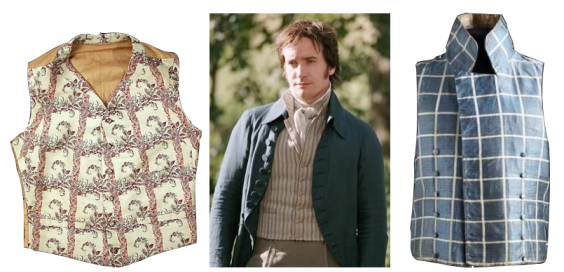
During the early 18th century Enlightenment period, French influence on fashion led to the Rococo style, which is easily recognizable from its tendency toward lavish, excessive adornment. Men typically wore a coat, waistcoat, breeches, stockings and heeled shoes. Waistcoats were elaborately embroidered or comprised of patterned fabric and coats were worn open to show off waistcoats. Tricorne hats decorated with braid and feathers were also popular during this period.

Beau Brummell was the arbiter of men’s Regency fashion, abandoning overly ornate garments for understated tailored coats, trousers, and knotted cravats. Many credit him with introducing the men’s suit, a big jump from knee breeches and stockings.

Belts were not a common fashion accessory in the 19th century. Instead, pants had fitted, adjustable waists and fall fronts (with an option of narrow or broad). These flaps were secured by buttons.

Flat front opening for britches; Beau Brummell; high heeled shoes for men

Flat front opening for britches; Beau Brummell; high heeled shoes for men

For hundreds of years, men wore high heels out of necessity, not vanity…for a while. In Persia and other countries of that region, men wore heels to secure his stance in riding stirrups so he could more accurately aim his bow and arrow. In the 17th century, aristocracy wore heels because of their inherent impracticality—such shoes were a sign of privilege and luxury.

Regency Era Fashion for Men

Regency Era Fashion for Men

I have to admit, as outlandish as some of the men’s fashion customs were, there’s nothing like a well-dressed Regency gentleman! What is your favorite historical fashion statement?


JackiDelecki_AChristmasCode_HRHeart-pounding adventure filled with danger, intrigue and romance from Jacki Delecki, award-winning author of the Regency suspense series “The Code Breakers” and the contemporary mystery series “Grayce Walters.” Enjoy her latest release “A Christmas Code.”

Excerpt:

Hot and breathless from performing the newly imported French dance steps of the Quadrille, Gwyneth paused during the break in the music. She fanned her heated cheeks repeatedly attempting to cool herself. Lord Henley glanced down at her. His lips were tight; his eyes beaded with need. She had seen the same look on the faces of many men, but never on the face of the only man who mattered.
She wanted to see the same burning desire and possessiveness in the eyes of her childhood infatuation like she knew blazed in her eyes when she looked at the impossible but dazzling Viscount Ashworth.

The gentleman, newly arrived, had barely glanced at her despite the new gown made especially to entice the hard-headed rake. Her friend and dress designer, Amelia, obsessed with the simplicity of Greek togas, had crisscrossed sky blue silk across Gwyneth’s ample chest with a revealing décolletage. The back of the gown was draped in the same manner with a revealing “V”. It was simple design, but sensual in the way the fabric clung to her body.

She felt enticing and hopeful that tonight Ash would finally throw off all the restraints. She had felt his eyes on her back, knowing he watched her as she gaily danced the intricate pattern she had just learned from her French dance master.

Lord Henley offered his arm as the quadrille ended. “May I take you to the refreshment table for a glass of punch? This new French dance is very demanding.”

“Thank you. I’m not thirsty. Can you please take me to my dear friend, Miss Bonnington?”

Lord Henley’s eyes clouded with emotion. Gwyneth couldn’t refuse the dance, but she needed to escape the gentleman before he embarrassed himself. She wanted to spare the gentleman the pain of rejection. After her five marriage proposals this season, she had become somewhat of an expert in recognizing the signs of imminent declaration.

Lord Henley escorted Gwyneth to Amelia, who also had finished dancing and now stood alone.

“Thank you, sir for the dance.” Gwyneth did a brief curtsy.

Lord Henley bowed. “It was my pleasure.” He hesitated, then sharply nodded his head. She didn’t want to be unkind, but there was no reason to pretend interest and encourage hope when there was none.

They watched Lord Henley circle to the other side of the room.

Amelia hid her face behind her fan. Her bright eyes dancing in merriment. “Another stricken gentleman.”

“I believe he was about to ask if he could call on my brother tomorrow. I think I did an excellent job of extricating myself before the gentleman declared his feelings.”

“Lord Henley is quite a catch. He’s heir to a vast fortune. His interest can’t be limited only to your dowry.”

“Thank you. I’m glad it isn’t only money that makes me attractive.” Gwyneth liked to believe it was her wit, her sparkling eyes, but she knew her position as sister to an earl and heiress to a hefty inheritance gave her a definite cache with the gentleman. And it was just like Amelia to joke about her wealth.

“Your following of swains has nothing to do with your luscious figure, your dramatic looks, or your amiable personality. My unique skill as designer has brought all these gentleman to swoon at your feet.” Amelia snickered, which set off Gwyneth to laugh.

Tears were running down Gwyneth’s cheeks. “You do know how to level a woman’s confidence.”

The comment drove both to louder laughter.

Ash had turned to gaze at Gwyneth when she was laughing. He smiled.

Lost in the merriment, she smiled back before she realized she had resolved not to appear as a puppy, waiting at his feet for a pat on the head. She could hide her feelings as well as he did. Forbidden by some unwritten gentleman’s code, Ash, considered her off limits. She wasn’t sure if it was the age difference of eight years, his rakish past, or her position as his best friend’s younger sister.

He still kept her at a distance, maintaining she was a mere youngster, and they were simply childhood friends. She had spent the entire season trying to convince him otherwise, but she was tiring of the game.

GIVEAWAY: LEAVE A COMMENT BELOW AND/OR PROMOTE THIS POST IN SOCIAL MEDIA (FACEBOOK, TWITTER, ETC.) TO BE ENTERED INTO A DRAWING FOR AN AUDIOBOOK VERSION OF JACKI DELECKI’S “A CODE OF LOVE.” THE WINNER WILL BE CHOSEN AT TWELVE NOON (EST) ON SUNDAY, NOVEMBER 23. 

Picture 001Connect with Jacki Delecki online!
Website: http://jackidelecki.com/
Facebook: http://www.facebook.com/Jacki.Deleck
Twitter: http://twitter.com/jackidelecki

Posted in book excerpts, book release, British history, Living in the Regency, Regency era | Tagged , , , , , | 11 Comments

From Where Does That Phrase Come?

This first one is for Brian, who spoke of a preference for the word in one of my recent posts.

idioms
Codswallop
~ Unknown, attested from 1959 episode of UK TV series Hancock’s Half Hour. The writers (Galton and Simpson) state that the phrase was in general use when the show was broadcast. A national TV appeal in the UK in 2006 failed to find earlier references. Originally written (1963) codswallop, spelling cod’s wallop is later.

Various etymologies are proposed from some sense o(as in codpiece), from cod (“joke, imitation”) + wallop (“beer (slang)”), hence cod + wallop “imitation beer” (with interconsonantal -s- to ease pronunciation of -dw-), or from cod (“fish”) (some part of the fish, as from fishing industry).

A frequently given etymology, rejected as a folk etymology, derives it from Hiram Codd, British soft drink maker of the 1870s, known for the eponymous Codd-neck bottle, with the suggestion that codswallop is a derisive term for soft drinks by beer drinkers, from Codd’s + wallop (“beer (slang)”) “Codd’s beer (sarcastic).” This is widely rejected – there is no evidence that early uses had this sense, the slang wallop (“beer”) comes later than Codd’s lifetime, initial spellings (1963 in print) do not reflect such a derivation (*Codd’s wallop and *coddswallop with -dd- are not found), and there is an 80 year gap between proposed coinage and attestation.

This is also the name given to the wooden device placed over the neck of a codd bottle and given a push (wallop) to dislodge the marble in the neck of the bottle. The word has also been used to describe the process of opening a codd bottle.

Kentish Fire is vehement and prolonged derisive cheering. The practice is so called from indulgence in it in Kent at meetings to oppose the Catholic Emancipation Bill (when passed, the Catholic Emancipation Act of 1829).

Reference: Cobham Brewer 1810–1897. Dictionary of Phrase and Fable, 1898.

Kentish Fire. Rapturous applause, or three times three and one more. The expression originated with Lord Winchelsea, who proposed the health of the Earl of Roden, on 15 August 1834, and added, “Let it be given with the ‘Kentish Fire.’” In proposing another toast he asked permission to bring his “Kentish Artillery” again into action. Chambers, in his Encyclopædia, says it arose from the protracted cheers given in Kent to the No-Popery orators in 1828–1829.

Dutch comfort – Frances Grose in The Dictionary of the Vulgar Tongue (1811) says this in comfort derived from a situation not being any worse than it is. From E. Cobham Brewer (1810-1897) in the Dictionary of Phrase and Fable (1898) we find, “‘Tis a comfort it was no worse. The comfort derivable from the consideration that how bad soever the evil which has befallen you, a worse evil is at least conceivable.”

Dutch uncle is a term for a person who issues frank, harsh, and severe comments and criticism to educate, encourage, or admonish someone. Thus, a “Dutch uncle” is a person who is rather the reverse of what is normally thought of as avuncular or uncle-like (which would be indulgent and permissive)

Origins ~ During the Anglo-Dutch Wars between England and the Netherlands in the 17th century, the English language gained an array of insults (including “Dutch uncle”), such as:

“Dutch courage” (booze-induced bravery)
“Double Dutch” (incomprehensible, nonsense)
“Dutch cap” (contraceptive diaphragm)
“Dutch wife” (prostitute; sex doll)
“Dutch widow” (prostitute)
“Dutch comfort” (saying that “Things could be worse!”)
“Dutch metal” or “Dutch gold” (cheap alloy resembling gold)
“Dutch treat” (social date where the invitee pays for himself/herself)
“Dutch concert” (noise and uproar, as from a drunken crowd)
“Dutch-bottomed” (empty)
“Dutch nightingale” (frog)
These terms also gained prominence in 17th century New England — during their rivalry with New Holland, which was captured (and later recaptured by the Dutch) during the Second Anglo-Dutch War.

These colorful (though now incongruous) phrases became part of English usage worldwide, and some are still in use.

Alternative Explanations ~ One other proposed explanation is that the term, often expressed as “talk to one like a Dutch uncle,” originated in the early 19th century as an allusion to the sternness and sobriety attributed to the Dutch. Dutch behaviour is defined in the book Culture Shock! Netherlands: A Survival Guide To Customs and Etiquette as “practical, direct, outspoken, stubborn, well-organised, blunt and thinking they are always right.” According to that particular source, these are the alleged reasons behind the English term “Dutch uncle.” Another book that advocates this theory is The UnDutchables, which assigns comparable characteristics to Dutch people: “not lacking in self-esteem … caught up in a cycle of endless envy … always speak their mind … frank, obstinate, blunt,” basically summed up by the phrase “the natives thrive on shaking their fingers at and scolding each other.”

images“Your currency was Spanish coins.” From the Online Etymology Dictionary, we find “small Spanish silver coin,” 1580s, from Spanish real, noun use of real (adj.) “regal,” from Latin regalis “regal.” Especially in reference to the real de plata, which circulated in the U.S. until c.1850 and in Mexico until 1897. The same word was used in Middle English in reference to various coins, from Old French real, cognate of the Spanish word.
The old system of reckoning by shillings and pence is continued by retail dealers generally; and will continue, as long as the Spanish coins remain in circulation. [Bartlett, “Dictionary of Americanisms,” 1848]
He adds that, due to different exchange rates of metal to paper money in the different states, the Spanish money had varying names from place to place. The Spanish real of one-eighth of a dollar or 12 and a half cents was a ninepence in New England, one shilling in New York, elevenpence or a levy in Pennsylvania, “and in many of the Southern States, a bit.” The half-real was in New York a sixpence, in New England a fourpence, in Pennsylvania a fip, in the South a picayune.

From Money, Pirates of the Caribbean, in Fact and Fiction, we discover, “During the Golden Age of Piracy, Spain minted coins in silver and gold. The silver coins were known as Reales (Reals) and the gold coins, Escudos (Escudo) The chart below shows the denomination of each coins minted. The famous ‘Piece of Eight’ was an 8 reale silver coin that had a distinctive “8” stamped into it. It was the largest of the silver coins weighing approximately one ounce. …By comparison the British Shilling was 1/20 ounce of silver. Thus 20 shillings made up the British Pound ( £ ). The British pound was the equivalent worth of the Colonial dollar ($) or piece of eight. (at least in weight) However, the British Crown frowned up foreign currency being used in its colonies and would often give a much lower rate of exchange on official transactions. By the time of the American revolution, Spanish or ‘Miller Dollars’ as they became known were being exchanged at the rate of 4-8 shillings to the dollar. This is between 1/4 to 1/2 their actual value in silver! Also by comparison there were 240 British pennies (240 pence) to £1.00 Stirling. Because of this the smaller British coins were often used interchangeably with the Spanish coins, 6 pence being worth slightly less than a 1/4 reale. The English 1/2 penny (pronounced hay-penny) was one of the smaller coins in common usage.”

Come to Loggerheads (or) At LoggerheadsFrom Dictionary.com, we discover, “n.
1580s, “stupid person, blockhead,” perhaps from dialectal logger “heavy block of wood” + head (n.). Later it meant “a thick-headed iron tool” (1680s), a type of cannon shot, a type of turtle (1650s). Loggerheads “fighting, fisticuffs” is from 1670s, but the exact notion is uncertain, perhaps it suggests the heavy tools used as weapons. The phrase at loggerheads “in disagreement” is first recorded 1670s.

From Phrase Finder, we learn, “‘At loggerheads’ is of UK origin. The singular ‘loggerhead’ occurs as a name in several contexts – as a species of turtle, a bird and as a place name. Originally, a loggerhead was none of these, but was used with the meaning of ‘a stupid person – a blockhead’. Shakespeare used it that way in Love’s Labours Lost, 1588:

“Ah you whoreson logger-head, you were borne to doe me shame.”

A ‘logger-head’ was literally a ‘block-head.’ A logger was a thick block of timber which was fastened to a horse’s leg to prevent it from running away. In the 17th century, a loggerhead was also recorded as ‘an iron instrument with a long handle used for melting pitch and for heating liquids.’ It is likely that the use of these tools as weapons was what was being referred to when rivals were first said to be ‘at loggerheads’.

The first known use of the phrase in print is in Francis Kirkman’s, The English Rogue, 1680:

“They frequently quarrell’d about their Sicilian wenches, and indeed… they seem… to be worth the going to Logger-heads for.”

The next year saw the printing of The Arraignment, Trial, and Condemnation of Stephen Colledge. In that text the author makes a clear link between loggerheads and fighting:

“So we went to loggerheads together, I think that was the word, or Fisty-cuffs.”

Incidentally, ‘fisticuffs’ is another two-word term from around the same date that was later amalgamated into a single word. A cuff was a blow with the open hand. A fisty cuff was a cuff using the fist, that is, a punch.

Following the departure of the clown William Kemp from The Lord Chamberlain’s Men, the troupe of actors with whom William Shakespeare worked for most of his writing and acting career, his place was taken by Robert Armin. In 1605, the diminutive clown Armin, a.k.a. ‘Snuff, the Clown of the Globe,’ had a stab at writing and came up with Foole upon Foole. In this piece he makes the first recorded reference to ‘fisty cuffs’:

“The foole… falls at fisty cuffes with him.”

‘Loggerheads’ is also the name of three small towns in the UK – in Staffordshire, in Lancashire and in Mold, North Wales. As is ‘de rigueur’ when a town might have reason to claim to be associated with some phrase or another, each town’s residents claim ‘at loggerheads’ originated in their home-town. Alas, despite the early citations referring to ‘going to’ loggerheads, this isn’t the case. The towns were named after the term, not the other way about. Nevertheless, the use of ‘loggerheads’ as a place name has been a boon to stand-up comedians of the ‘take my wife…’ fraternity. They have been trotting out this classic for years:

‘I’m going on holiday – a fortnight at Loggerheads with the wife’.”

Plain as a Pikestaff ~ Oxford Dictionary says the phrase means “ordinary or unattractive in appearance” or use as a simile to mean “extremely clear and plain to see.” We also find the phrase written “as plain as a packstaff,” the staff being that of a pedlar, on which he rested his pack of wares. From Brewer’s Dictionary of Phrase and Fable, we have “Plain as a pikestaff. Quite obvious and unmistakable. The pikestaff was the staff carried by pilgrims, which plainly and somewhat ostentatiously announced their “devotion.” It has been suggested that “pikestaff” is a corruption of “pack-staff,” meaning the staff on which a pedlar carries his pack, but there is no need for the change.


Posted in British history, language choices, legends and myths, Uncategorized, word play | Tagged , , , , , , , , , , | 3 Comments

Exquisite Excerpt from “Christmas at Pemberley”

C-E-L-E-B-R-A-T-E!!! Christmas at Pemberley


Christmas at Pemberley was my twelfth novel (my seven Austen-inspired work). It is an inspirational tale that occurs two years into the Darcys’ marriage.

JeffersC@PemberleyChristmas at Pemberley: A Pride and Prejudice Christmas Sequel

To bring a renewed sense joy to his wife’s countenance, Fitzwilliam Darcy has secretly invited the Bennets and the Bingleys to spend the Christmastide festive days at Pemberley. But as he and Elizabeth journey to their estate to join the gathered families, a blizzard blankets the English countryside. The Darcys find themselves stranded at a small out-of-the-way inn with another couple preparing for the immediate delivery of their first child, while Pemberley is inundated with friends and relations seeking shelter from the storm.

Without her brother’s strong presence, Georgiana Darcy desperately attempts to manage the chaos surrounding the arrival of six invited guests and eleven unscheduled visitors. But bitter feuds, old jealousies, and intimate secrets quickly rise to the surface. Has Lady Catherine returned to Pemberley for forgiveness or revenge? Will the manipulative Caroline Bingley find a soul mate? Shall Kitty Bennet and Georgiana Darcy know happiness?

Written in Regency style and including Austen’s romantic entanglements and sardonic humor, Christmas at Pemberley places Jane Austen’s most beloved characters in an exciting yuletide story that speaks to the love, the family spirit, and the generosity that remain as the heart of Christmas.

Excerpt: To pacify Elizabeth’s need to assist Mr. and Mrs. Joseph, Darcy has agreed to share their cramped quarters in an overly crowded inn with the couple. Mrs. Joseph is enceinte.

She kept an eye on Mrs. Joseph’s restless slumber. Elizabeth did not remember her sister Jane having such a fretful time, and Jane had carried twins. Yet, Mrs. Joseph was quite large, and Elizabeth supposed it affected the woman’s sleep.

Having sent Darcy and Mr. Joseph away so Mary could rest, Elizabeth had spent time reading a collection of poetry she’d bought at a small bookstore in Newcastle. Now, she returned to the stack of letters. The previous evening she had not read the two that Darcy had composed upon the loss of their children, but today, she felt compelled to revisit them. She had acknowledged her pregnancy to Darcy. Obviously, her husband knew of her condition, but he had accepted Elizabeth’s fears and made them his own. Somehow, Mrs. Joseph’s appearance at Prestwick’s had changed everything. As nonsensical as it sounded, Elizabeth no longer dreaded what might happen. If she lost this child, she would try again and again until she delivered a healthy Darcy heir. She possessed no other alternative: Because of Darcy, she could smile; her life was worthwhile, and she owed him her constant devotion.

First checking Mrs. Joseph’s blankets, Elizabeth settled in a chair near the window. Outside, she could hear the water’s steady drip from the roof to the ground. The rhythmic pattern reminded her of the Maelzel’s metronome model, which sat on Georgiana’s pianoforte. Hopefully, by tomorrow, she and Darcy would be on their way to Pemberley.

Untying the ribbon, Elizabeth removed the two letters from the bottom. She normally kept the notes in order by the date Darcy had written them, but she had shuffled these two special letters to the stack’s bottom when she had read from the missives two nights prior. She removed the one her husband had composed after the first disaster and unfolded the pages. Shifting her weight so she might see better, Elizabeth read…

2 February
My dearest, darling Elizabeth,

I sit in this semidarkness watching the rise and fall of your shoulders. I recognize your pain and am helpless to drive it away. You pretend not to know that I write this note, and I pretend that you sleep at last. I will not minimize your loss by repeating what you have already heard. What I will say is that although it may seem that you face this loss alone, please remember that I am here—standing beside you. Love—the truth of love—lies between us. I live only for the honor and the love you have given me.

Inside each of us grows a faith in a new day. So, put away the rage. From this we will learn how precious life can be—something I would not freely recognize if I had never held you in my arms.
All my love and devotion,
D

Her poor husband had suffered as much as she; but for her sake, Darcy had hidden his misery. Elizabeth had seen the lines deepen around his eyes and across his forehead. Had Darcy shed tears? She was certain that he had. Elizabeth knew his anguish—how the sunshine had disappeared from his smile.

Carefully, she refolded the first letter and replaced it where the note belonged within the bundle and then removed the second one. It held more tender memories than did the first. She had grieved briefly after the initial incident, but hadn’t felt the full loss until the second. Actually, Elizabeth prefaced that. She had experienced the total impact when her sister Jane cradled a small babe in each arm. Her most beloved sister had delivered twins when she could not give Darcy even one child. She had thought herself a failure and had refused to go through that emptiness again.

Elizabeth shot a glance at the resting Mary Joseph. The woman’s face betrayed the essence of her dreams—as if an angel had kissed the woman’s cheek. Permit me to reach eight full months, she thought. Even with my own imminent mortality, she prayed, give Mr. Darcy his child.
Unfolding the letter she read her favorite part first.

Had I never known you, my Elizabeth, I would have never realized what was missing from my life. I am no longer lost: I can emerge from the rain. Living outside your love is not living at all.
You are the light in my darkness.

“What do you read, Mrs. Darcy?” a sleepy voice broke through Elizabeth’s thoughts.

Elizabeth blushed and refolded the letter. “Nothing important. Only some letters.”

With difficulty, Mrs. Joseph rolled onto her side, “From Mr. Darcy, I suspect,” she said teasingly.

Elizabeth’s color deepened. “I shall admit to nothing except that they came from a most handsome gentleman.”

Mrs. Joseph smiled indulgently. “Mr. Darcy then. He is an intriguing-looking man. Was your husband the most exciting man of your acquaintance, Mrs. Darcy?”

Elizabeth thought immediately of her first impression of George Wickham, whose appearance was greatly in his favor; he had all the best parts of beauty—a fine countenance, a good figure, and a pleasing address. “A pleasing face doesn’t define a man’s true character, but I admit to preferring Mr. Darcy’s countenance above all others.” Elizabeth scrambled to her feet. “Permit me to put these away, and I shall help you to straighten your dress. Perhaps we could go below and join our husbands for tea.”

Elizabeth dutifully replaced the letter and retied the outside ribbon. Then she carefully placed the bundle in the bottom of her portmanteau. “Now,” she moved to the bed, “allow me to support your stance. You really must exercise more caution, Mrs. Joseph. You have God’s most priceless gift to attend.”

The woman swung her legs over the bed’s edge and sat with Elizabeth’s assistance. “I don’t understand it,” she observed. “When we departed Stoke-upon-Trent, I was quite a bit smaller. I feel as if I have gained weight each day we were on the road. I imagine myself quite heavy.” She gently massaged her enlarged abdomen.

“Women, generally, gain their most weight during the last six weeks of their gestation,” Elizabeth said absentmindedly as she braced Mrs. Joseph’s weight with her own.

Taking several deep breaths, the lady rose slowly. “And how would a gentlewoman know such details?” Mrs. Joseph lightly taunted.

“This gentlewoman’s sister’s weight doubled with her confinement.”

Mrs. Joseph countered, “Maybe that was because your sister delivered twins.”

Elizabeth laughed lightly. “There’s that possibility.” She stepped away from the woman. “I sent Mr. Joseph and Mr. Darcy away so you might rest.” She checked her own appearance in the mirror.

Mrs. Joseph shook out her skirts. “How long did I sleep?”

Elizabeth glanced at the small clock on the mantelpiece. “Nearly two hours.”

“Two hours!” Mrs. Joseph gasped. “I never sleep so long.”

“Your body must have needed the rest,” Elizabeth asserted.

Mrs. Joseph began to repair her chignon. “Mr. Joseph must be terribly worried. We definitely should join the gentlemen, or Matthew will storm the door shortly.” She pinched her cheeks. “I look so pale.” She straightened her shoulders and turned to Elizabeth. “And don’t tell me being pale is part of being with child,” she warned.

Elizabeth smiled widely. “I shan’t speak of it as you know the obvious.” She reached for the door, but a grunt of discomfort from behind her brought Elizabeth up short. As she pivoted to the sound, Mrs. Joseph’s grimace spoke Elizabeth’s worst nightmares. “What is it?” she demanded as she rushed to the woman’s side.

Mrs. Joseph swayed in place. Complete fear crossed the woman’s countenance. “I…I,” she stammered. Then she raised her skirt’s hem, and Elizabeth could see the woman’s underskirt’s dampness.

“Oh, my, you poor dear,” Elizabeth sympathized. “Permit me to assist you from those soiled garments. I’ll order some warm water so you might wash, and we’ll soak the items afterwards.” Elizabeth guided Mrs. Joseph to a plain wooden chair. “I should have considered your personal needs.” Elizabeth flushed with embarrassment.

Mrs. Joseph sank heavily to the chair. “No!” she rasped. “You don’t understand. The baby…the baby is coming.”
______________________

If you enjoy, Christmas at Pemberley, you will meet many of the same characters in my Lucky 13th novel, The Disappearance of Georgiana Darcy, a cozy mystery set three months after Christmas at Pemberley closes. It had a March 2012 release, The Disappearance of Georgiana Darcy. Currently I am writing a sequel to Disappearance. It begins some twelve months after Disappearance ends. DofGD-150x203

Posted in book excerpts, British history, excerpt, Great Britain, holidays, Jane Austen, Living in the Regency, Napoleonic Wars | Tagged , , , , , | 7 Comments

George William Finch-Hatton, 10th Earl of Winchilsea, Advocate for Protestant Principles

Creation date(Winchilsea) 1628 (Nottingham) (1681) Created byCharles I (Winchilsea) Charles II (Nottingham) First holder:	Elizabeth Finch, 1st Countess of Winchilsea Present holder:	Daniel Finch-Hatton, 17th Earl of Winchilsea, 12th Earl of Nottingham

Creation date (Winchilsea) 1628
(Nottingham) (1681)
Created by Charles I (Winchilsea)
Charles II (Nottingham)
First holder: Elizabeth Finch, 1st Countess of Winchilsea
Present holder: Daniel Finch-Hatton, 17th Earl of Winchilsea, 12th Earl of Nottingham

George William Finch-Hatton, 10th Earl of Winchilsea, 5th Earl of Nottingham (1791–1858) was an English politician known for duelling with Prime Minister Wellington.

Hatton, born at Kirby Hall, Northamptonshire, on 19 May 1791, was grandson of Edward Finch-Hatton, and son of George Finch-Hatton (1747–1823) of Eastwell Park, near Ashford, Kent, M.P. for Rochester 1772–84, by his wife whom he married in 1785, Lady Elizabeth Murray, eldest daughter of David Murray, 2nd Earl of Mansfield. She died 1 June 1825.

George William, the elder son, was educated at Westminster School and Christ’s College, Cambridge, where he proceeded B.A. in 1812. On 13 October 1809, he became a captain in the Ashford regiment of Kentish local militia, on 14 December 1819 commenced acting as a lieutenant of the Northamptonshire regiment of yeomanry, and on 7 September 1820 was named a deputy-lieutenant for the county of Kent. His cousin, George Finch, 9th Earl of Winchilsea and fourth earl of Nottingham, having died on 2 August 1826, he succeeded to these peerages.

He presided at a very large and influential meeting held on Penenden Heath, Kent, on 10 October 1828, when strongly worded resolutions in favour of Protestant principles were carried. In his place in the House of Lords, he violently opposed almost every liberal measure which was brought forward. He was particularly noted as being almost the only English nobleman who was willing to identify himself with the Orange party in Ireland, and he was accustomed to denounce in frantic terms Daniel O’Connell, Maynooth, and the system of education carried out in that college.

Occasionally he took the chair at May meetings at Exeter Hall, but his intemperate language prevented him from becoming a leader in evangelical politics. The Catholic Relief Bill of 1829 encountered his most vehement hostility, and ultimately led to a duel with the Duke of Wellington. Lord Winchilsea, in a letter to the secretary of King’s College London, wrote that the duke, “under the cloak of some coloured show of zeal for the Protestant religion, carried on an insidious design for the infringement of our liberties and the introduction of popery into every department of the state.”

The duke replied with a challenge. The meeting took place in Battersea Fields on 21 March 1829, the duke being attended by Sir Henry Hardinge, and his opponent by Edward Boscawen, 4th Viscount Falmouth. The duke fired and missed; he claimed he did so on purpose. However, the duke was known as a poor shot and accounts differ as to whether he purposefully missed. Winchilsea kept his arm by his side at the command to “fire” then quite deliberately raised his arm in the air and fired. He then apologised for the language of his letter. It is almost certain that Winchilsea and Falmouth had agreed on their course of action, as the letter of apology was already prepared.

He was a very frequent speaker in the Lords, and strenuously opposed the Reform Bill and other Whig measures. He was gazetted lieutenant-colonel commandant of the East Kent regiment of yeomanry 20 December 1830, named a deputy-lieutenant for the county of Lincoln 26 September 1831, and created a D.C.L. of Oxford 10 June 1834.

He died at Haverholme Priory, near Sleaford, Lincolnshire, 8 January 1858.

He was the writer of a pamphlet entitled Earl of Winchilsea’s Letter to the “Times,” calling upon the Protestants of Great Britain to unite heart and soul in addressing the Throne for a Dissolution of Parliament, 1851.

He was responsible for the phrase Kentish Fire meaning prolonged derisive cheering.

Winchilsea was married three times:

first, on 26 July 1814, to Georgiana Charlotte, eldest daughter of James Graham, 3rd Duke of Montrose, she died at Haverholme Priory 13 February 1835;
secondly, on 15 February 1837, to Emily Georgiana, second daughter of Sir Charles Bagot, G.C.B., she died at Haverholme Priory 10 July 1848;
thirdly, on 17 October 1849, to Fanny Margaretta, eldest daughter of Edward Royd Rice of Dane Court, Kent.

Posted in British history, customs and tradiitons, dueling, George IV, Great Britain, Living in the Regency, Living in the UK, military, real life tales, religion | Tagged , , | 4 Comments

Douglas Jerrold, Playwright and Midshipman Serving Under Jane Austen’s Brother, Francis

220px-Douglas_William_Jerrold_by_Sir_Daniel_MacneeDouglas William Jerrold (London 3 January 1803 – 8 June 1857 London) was an English dramatist and writer.

Biography
Jerrold’s father, Samuel Jerrold, was an actor and lessee of the little theatre of Wilsby near Cranbrook in Kent. In 1807 Douglas moved to Sheerness, where he spent his childhood. He occasionally took a child part on the stage, but his father’s profession held little attraction for him. In December 1813, he joined the guardship Namur, where he had Jane Austen’s brother Francis as captain, and served as a midshipman until the peace of 1815. He saw nothing of the war save a number of wounded soldiers from Waterloo, but he retained an affection for the sea.

The peace of 1815 ruined Jerrold’s father; on 1 January 1816 he took his family to London, where Douglas began work as a printer’s apprentice, and in 1819 he became a compositor in the printing-office of the Sunday Monitor. Several short papers and copies of verses by him had already appeared in the sixpenny magazines, and a criticism of the opera Der Freischütz was admired by the editor, who requested further contributions. Thus Jerrold became a professional journalist.

Jerrold’s figure was small and spare, and in later years bowed almost to deformity. His features were strongly marked and expressive, from the thin humorous lips to the keen blue eyes, gleaming from beneath the shaggy eyebrows. He was brisk and active, with the careless bluffness of a sailor. Open and sincere, he concealed neither his anger nor his pleasure; to his sailor’s frankness all polite duplicity was distasteful. The cynical side of his nature he kept for his writings; in private life his hand was always open. In politics Jerrold was a Liberal, and he gave eager sympathy to Lajos Kossuth, Giuseppe Mazzini, and Louis Blanc. In social politics, especially, he took an eager part; he never tired of declaiming against the horrors of war, the luxury of bishops, or the iniquity of capital punishment.

Douglas Jerrold is now perhaps better known from his reputation as a brilliant wit in conversation than from his writings. As a dramatist, he was very popular, though his plays have not kept the stage. He dealt with rather humbler forms of social world than had commonly been represented on the boards. He was one of the first and certainly one of the most successful of the men who in defence of the native English drama endeavoured to stem the tide of translation from the French, which threatened early in the 19th century to drown original native talent. His skill in construction and his mastery of epigram and brilliant dialogue are well exemplified in his comedy, Time Works Wonders (Haymarket, 26 April 1845). The tales and sketches which form the bulk of Jerrold’s collected works vary much in skill and interest; but, although there are evident traces of their having been composed from week to week, they are always marked by keen satirical observation and pungent wit.

Career in the Theatre
In 1821, a comedy that Jerrold had written at the age of fourteen was brought out at Sadler’s Wells theatre under the title More Frightened than Hurt. Other plays followed, and in 1825 he was employed for a few pounds weekly to produce dramas and farces to order for Davidge of the Coburg theatre. In the autumn of 1824, the “little Shakespeare in a camlet cloak,” as he was nicknamed, married Mary Swan and continued to work as both dramatist and journalist. For a short while, he was part proprietor of a small Sunday newspaper. In 1822, through a quarrel with the exacting Davidge, Jerrold left for Coburg.

In 1829, a three-act melodrama about corrupt personnel and press gangs of the Navy launched his fame. Black-Eyed Susan; or, All in the Downs, was brought out by manager Robert William Elliston at the Surrey Theatre. Britain at the time was recovering from the fallout of the Napoleonic Wars and was in the midst of a class war involving the Corn laws, and a reform movement, which resulted in the Reform Act of 1832 aimed at reducing corruption. Black-Eyed Susan consisted of various extreme stereotypes representing the forces of good, evil, the innocent and the corrupt, the poor and the rich, woven into a serious plot with comic sub-plots to keep the audience entertained. Its subject was very topical and its success was enormous. It took the town by storm, and all London crossed the river to see it. Elliston made a fortune from the piece; TP Cooke, who played William, made his reputation; Jerrold received about £60 and was engaged as dramatic author at five pounds a week, but his reputation as a dramatist was established.

It was proposed in 1830 that he should adapt something from the French language for Drury Lane. He declined, preferring to produce original work. The Bride of Ludgate (8 December 1832) was the first of a number of his plays produced at Drury Lane. The other patent houses also threw their doors open to him (the Adelphi had already done so); and in 1836 Jerrold became the manager of the Strand Theatre with WJ Hammond, his brother-in-law. The venture was not successful, and the partnership was dissolved. While it lasted, Jerrold wrote his only tragedy, The Painter of Ghent, and himself appeared in the title role, without much success.

Jerrold acted in the 1851 production of Not So Bad As We Seem, a play written by Edward Bulwer, starring many notable Victorians (including Charles Dickens) and attended by Queen Victoria. He continued to write sparkling comedies until 1854, the date of his last piece, The Heart of Gold.

Career as a Journalist
Jerrold wrote for numerous periodicals, and gradually became a contributor to the Monthly Magazine, Blackwood’s, the New Monthly, and the Athenaeum. To Punch, the publication which of all others is associated with his name, he contributed from its second number in 1841 until within a few days of his death. Punch was a humorous and liberal publication. Jerrold’s liberal and radical perspective was portrayed in the magazine under the pseudonym ‘Q,’ which used satire to attack institutions of the day. Punch was also the forum in which he published in the 1840s his comic series Mrs Caudle’s Curtain Lectures, which was later published in book form.

He contributed many articles for Punch under different pseudonyms. On 13 July 1850 he wrote as ‘Mrs Amelia Mouser’ about the forthcoming Great Exhibition of 1851, coining the phrase the palace of very crystal. From that day forward, the Crystal Palace, at that time still a proposal from his friend Joseph Paxton, gained the name from which it would henceforth be known.

He founded and edited for some time, with indifferent success, the Illuminated Magazine, Jerrold’s Shilling Magazine, and Douglas Jerrold’s Weekly Newspaper; and under his editorship Lloyd’s Weekly Newspaper rose from almost nonentity to a circulation of 582,000. The history of his later years is little more than a catalogue of his literary productions, interrupted now and again by brief visits to the Continent or to the country. Douglas Jerrold died at his house, Kilburn Priory, in London on 8 June 1857 and was buried at West Norwood Cemetery, where Charles Dickens was a pall-bearer. Dickens gave a public reading and performances of the drama The Frozen Deep to raise money for Jerrold’s widow.

Works
Among the best known of his numerous works are…

Black-Eyed Susan (1829) play / melodrama
The Rent Day (1832) play / melodrama
Men of Character (1838), including “Job Pippin: The man who couldn’t help it,” and other sketches of the same kind
Cakes and Ale (2 vols., 1842), a collection of short papers and whimsical stories
The Story of a Feather (1844) novel
The Chronicles of Clovernook (1846) novel
A Man made of Money (1849) novel
St Giles and St James (1851) novel
various series of papers reprinted from Punch’s Letters to his Son (1843)
Punch’s Complete Letter-writer (1845)
the famous Mrs Caudle’s Curtain Lectures (1846).

See his eldest son William Blanchard Jerrold’s Life and Remains of Douglas Jerrold (1859). A collected edition of Jerrold’s writings appeared between 1851–54, and The Works of Douglas Jerrold, with a memoir by his son, W. B. Jerrold, in 1863–64, but neither is complete.

The first article of the first issue of the Atlantic Monthly (November 1857) is a lengthy obituary for Jerrold. Among the numerous selections from his tales and witticisms are two edited by his grandson, Walter Jerrold, Bons Mots of Charles Dickens and Douglas Jerrold (new ed. 1904), and The Essays of Douglas Jerrold (1903), illustrated by H. M. Brock. See also The Wit and Opinions of Douglas Jerrold (1858), edited by WB Jerrold.

Douglas Jerrold was the great-grandfather of Audrey Mayhew Allen (b. 1870), author of a number of children’s stories published in various periodicals, and of a book Gladys in Grammarland, an imitation of Lewis Carroll’s Wonderland books.

Posted in acting, British history, George IV, Great Britain, Jane Austen, Living in the UK, playwrights, theatre | Tagged , , , , | 3 Comments