Historical Fiction Author, Sheila Dalton, and Her New Release “Stolen”

I am pleased to welcome to my blog multi-talented author, Sheila Dalton. 

31pyz7kh5HL._UX250_Sheila Dalton was born in England, and now lives in Canada. She has published novels and poetry for adults, and picture books for children. 51srX0s0tOL._BO2,204,203,200_PIsitb-sticker-v3-big,TopRight,0,-55_SX278_SY278_PIkin4,BottomRight,1,22_AA300_SH20_OU01_Her YA mystery, Trial by Fire, from Napoleon Press, was shortlisted for the Crime Writers of Canada Arthur Ellis Award. Her literary mystery, The Girl in the Box, published by Dundurn, reached the semi-finals in the Amazon Breakthrough Novel Award Contest, and was voted a Giller People’s Choice Top Ten. UnknownStolen is her first book of historical fiction.


Introduction to Stolen:

Lizbet Warren’s parents are captured by Barbary Corsairs off the coast of Devon, England. How can she discover what has happened to them? How will she even survive as a woman alone in 17th century England?

Lizbet sets off for London with the only other survivor of the raid, Elinor, a girl from The Home for Abandoned and Unwanted Children. Bonds form, but the young women are separated when Lizbet is arrested for vagrancy. Rescued by Jeanne Vallée, a French merchant and privateer, she helps him with his language skills, and with the extensive library he has no time to read, but must study in order to further his ambitions at the English court. Later, Lizbet sails with Captain “Gentleman Jake” Norris, a pirate and black slaver, who endeavors to learn, through her, what happened to his missing sister, as Lizbet endeavors to free her mother, with his help, from slavery in Morocco.

And Now for an Excerpt from Chapter 1 of Stolen

Oh, to be sure, I was aware that young men found me at least somewhat pleasing to the eye; I was not blind to their glances and smiles. Nor was I above a little flirtation. But Mother made it sound as though I could not walk a yard without attracting a horde of eager swains; worse, ones whose intentions were dishonorable.

Yet I was tempted by Newton Abbot. Torn between a love of village life, and a growing restlessness to discover more of the world, I knew I must soon arrive at a decision.

However, scarce did I know that less than three hours later, the decision would be made for me, in the cruelest manner imaginable.

When I returned to the village on foot, proudly shod in my new shoes, that pinched but a little despite the long trek, I stared ahead of me at Teignmouth, puzzled. I walked nearer, and was worried; closer yet, and my heart began to pound. People should be in view, and horses, carts, cattle. I saw nothing but a few cows running loose at the outskirts, back and forth and back again, as though lost, swinging their great heads aimlessly.

I called out. Only silence answered. The miller’s dog came hurtling towards me, barking as it ran. I reached down to pat it; it collapsed panting at my feet. When I stroked its head, it howled, got up and raced away from the village that had always been its home.

My breath now coming in sharp gasps that hurt, I broke into a run until I reached Teignmouth, where I stopped as suddenly as I had started, and stared ahead of me, transfixed. Doors swung on their hinges, broken chairs and barrels spilled across the lanes, an empty cradle rocked up and down on a mound of refuse, rustling the ghostly silence. A hatchet poked, blade up, out of a pile of hay.

A sudden gust of a wind, and a tin pot rattled down the street, coming to rest against my feet. I kicked it away, and sat down hard upon the ground. A lone sheep stood amidst the wreckage and stared at me out of a blank, black face. By its open mouth, I knew it bleated, but I heard nothing save a roar that came in equal measure from the sea behind me and the devastation of my heart.

What in God’s good name had happened? Where was everyone?

On the beach, I found them, strewn like broken dolls, each one a villager I had known, who had known me. It wasn’t until I recognized the back of little Thomas’s head, his long blond curls, his cheek resting on his arm as though sleeping, a rope of blood running from his head to his waist, that I screamed. He was only four years old. I’d taught him how to button his shirt just the morning previous.

My feet felt heavy as though my new shoes were cast in lead or stone. I forced myself amongst the bodies, crouching down beside those who bore even the remotest resemblance to my mother, or my father, who may have come back early from the sea. I turned some over with the toes of my new shoes. The heaviness, the staring eyes, the flesh like candle wax made me swallow bile and shudder. Twice, I sat down amongst the dead, and cried into my hands. Many I cared for lay lifeless on the sand. Many others were gone I knew not where.

As I stumbled away, a girl stepped from behind a pile of stones, her face as white as those of the corpses. It was Elinor from the Workhouse for Abandoned and Unwanted Children. I often called her, in my mind, the Red-Haired Fury, for her temper and wild ways. To see her, such a spirited little thing, so pale and subdued struck such fear in me, I very nearly ran from her.

She fell towards me. I had no choice but to fold her into my arms and let her cry, though I was in sore need of comfort myself. I begged her to tell me what had happened. At first she could not speak for tears.

“Two great ships come in,” she said at last, in a voice like dark brown ale, unusual in such a tiny girl, even one a deal older than she looked. The Red-Haired Fury was then about fifteen years of age, though if I had not known better, I might have guessed her to be twelve. For though the huge eyes in her small sharp face had a knowing look about them, I’d seen that look in beggar children, grown old before their time.

“Them ships was all bristly with oars.” She smeared the tears across her cheeks with both grubby hands at once. “Hordes of awful men spilled off ‘em and spread across the beach like … oh, oh, I dunno … summat you knew were going to swallow you up.” She held her hands to her ears. “It were awful. They was shouting and yelling, our folk screaming and running and everything were so awful, I didn’t know what to do.

“They …” she choked out, “cut folks down with these huge great swords. I ent never seen swords so big and wide. I ran for my life, tripped up behind them rocks and stayed where I fell. I saw ‘em chaining people up and dragging them onto their ship. Then they sailed away. Oh, dear God.”

“Who where they?” My mouth was dry; I had to run my tongue under my lips to free them from my teeth. “Where did they come from?” Where is my mother? I thought, in anguish. Had Elinor seen her killed? I dare not ask, for details of her treatment at the hands of these fierce villains would be more than I could bear.

“I ent never seen men like ‘em before.” She was twisting her hands in the apron of her homespun dress, and scrunching up her face like a raisin. “They had on robes like clergy almost, but their arms was bare. Dark-skinned they was, and ugly, their faces horrible and mean.” Her eyes grew wider. It was as if her words came at me from far away, I heard them but did not grasp them. “They wasn’t speaking English, I don’t what they was speaking. Whatever else about ‘em, there’s one thing sure—they had no hearts. The smithy …” She gulped and took a big breath. “… the smithy were screaming that his legs was broke. They tried to make him walk all the same. Till someone picked up a rock and bashed his head in. Oh, they was terrible!”

“Is there no one left at all?” I said.

“After the coast was clear of ‘em, I come out from the rocks, and looked round everywhere. I did not find a single soul. Them that got in the way was killed, and them that was wounded, once they got ‘em on the beach, they killed them, too.”

“Babies? Old folk?”

“They killed the old, and took the babies along with their mams.”

I fought the rising panic that would take away my reason if I did not push it down. “What about our fishermen?” Though they were not due till nightfall, oftentimes they sailed home early. “Had they come back?”

“No.” She shook her head so vigorously her hair flew out like rusty water from a pail. “The only boats I seen were those them heathens sailed.”

My heart near stopping in my chest, my head pounding so hard I could barely hear my own words, I whispered, “My mother, Elinor …?”

She threw herself into my arms once more, and curled like a fist against me. “They took her.” Her words were muffled in my bodice; still they rang clear as day over the noises in my head. “A monster of a fellow picked her up and threw her over his shoulder. He carried her out into the water to the ship. She was crying and calling on God. They did hit her once or twice to tame her, then carted her off like she were a sheep or a goat.”

Purchase Links:

Stolen is available on Amazon U.K., Amazon Canada and Amazon U.S. It is also available for Kobo, Nook, and iTunes. In addition, readers who subscribe to Scribd will find it there.
Stolen eBook: Sheila Dalton: Amazon.co.uk: Books

Posted in Guest Blog | Tagged , , | 3 Comments

A Birthday Salute to Alan Rickman

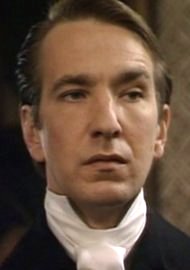
At the beginning of his career, Rickman played Tybalt in a 1978 TV movie of "Romeo and Juliet"

At the beginning of his career, Rickman played Tybalt in a 1978 TV movie of “Romeo and Juliet”

Tomorrow, February 21, is Alan Rickman’s birthday. He will be 68 years of age.

Bio (via imdb.com) Alan Rickman was born on a council estate in Acton, West London, to Margaret Doreen Rose (Bartlett) and Bernard Rickman, who worked at a factory. He has English, Irish, and Welsh ancestry. Alan has an older brother David, a younger brother Michael and a younger sister Sheila. When Alan was 8 years old, his father died. He attended Latymer Upper School on a scholarship. He studied Graphic Design at Chelsea College of Art and Design, where he met Rima Horton, who would later become his life partner. After three years at Chelsea College, Rickman did graduate studies at the Royal College of Art. He opened a successful graphics design business, Graphiti, with friends and ran it for several years before his love of theatre led him to seek an audition with the Royal Academy of Dramatic Art (RADA). At the relatively late age of 26, Rickman received a scholarship to RADA, which started a professional acting career that has lasted nearly 40 years, with no signs of stopping, a career which has spanned stage, screen and television and has lapped over into directing, as well.

Rickman first came to the attention of American audiences as “Vicomte de Valmont” in “Les Liaisons Dangereuses” on Broadway in 1987. He was nominated for a Tony Award for his performance in the role. Denied the role in the film version of the show, Rickman instead made his first movie appearance opposite Bruce Willis in Die Hard (1988) as the villain, “Hans Gruber.” Rickman’s take on the urbane villain set the standard for screen villains for decades to come. Though often cited as being a master of playing villains, Rickman has actually played a wide variety of characters, such as the romantic cello-playing ghost “Jamie” in Anthony Minghella’s Truly Madly Deeply (1990) and the noble Colonel Brandon of Sense and Sensibility (1995). He’s treated audiences to his comedic abilities with films like Dogma (1999), Galaxy Quest (1999) and The Hitchhiker’s Guide to the Galaxy (2005), and roles like “Dr. Alfred Blalock” in Something the Lord Made (2004) and “Alex Hughes” in Snow Cake (2006), showcase his ability to play ordinary men in extraordinary situations. Rickman even conquered the daunting task of singing a part in a Stephen Sondheim musical as he took on the part of “Judge Turpin” in the movie adaptation of Sweeney Todd: The Demon Barber of Fleet Street (2007).

In 2001, Rickman introduced himself to a whole new, and younger, generation of fans by taking on the role of “Severus Snape” in the movie versions of J.K. Rowling’s Harry Potter and the Sorcerer’s Stone (2001). He has continued to play the role through the eighth and last movie Harry Potter and the Deathly Hallows: Part 2 (2011).

In 1982, Rickman portrayed Obadiah Slope in "The Barchester Chronicles."

In 1982, Rickman portrayed Obadiah Slope in “The Barchester Chronicles.”

In 1990, Rickman played Elliott Marston in "Quigley Down Under."

In 1990, Rickman played Elliott Marston in “Quigley Down Under.”

(1994) Rickman starred in a biography of the eighteenth century Viennese physician, Franz Anton Mesmer, who used unorthodox healing practices based on his theory of "animal magnetism."

(1994) Rickman starred in a biography of the eighteenth century Viennese physician, Franz Anton Mesmer, who used unorthodox healing practices based on his theory of “animal magnetism.”

In 1991, Rickman took on the role of the vile Sheriff George of Nottingham in "Robin Hood: Prince of Thieves."

In 1991, Rickman took on the role of the vile Sheriff George of Nottingham in “Robin Hood: Prince of Thieves.”

Rickman took on the role of Colonel Brandon in 1995's "Sense and Sensibility."

Rickman took on the role of Colonel Brandon in 1995’s “Sense and Sensibility.”

In 1996, he was Rasputin in the TV movie by the same name.

In 1996, he was Rasputin in the TV movie by the same name.

Rickman has been Severus Snape in the Harry Potter series of films.

Rickman has been Severus Snape in the Harry Potter series of films.

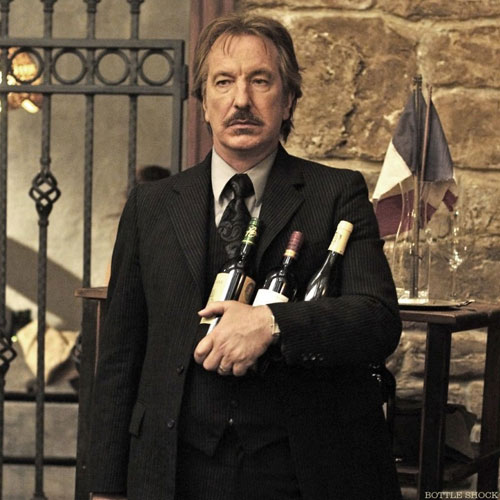
In 2008, he took on the role of Steven Spurrier in "Bottle Shock."

In 2008, he took on the role of Steven Spurrier in “Bottle Shock.”

In 2014, he took on the role of King Louis XIV in "A Little Chaos."

In 2014, he took on the role of King Louis XIV in “A Little Chaos.”

Do you have a favorite Alan Rickman film or tidbit to share? Add it to the comments below.

Posted in acting | Tagged , | 20 Comments

A Regency Era Breakfast: Various Times to Eat

foodHow did those in Regency London begin their days? The answer is not so simple. The various social classes went about their days in their distinct ways. They rose and ate at different times depending on their class structure. There was also distinct differences between the social habits of those who lived in London proper, usually referred to as the City or Town, and those who lived in the surrounding villages/towns (i.e., Winchester in Hampshire) or those in the country. As different as were the architectural structures for these two adjoining cities, so were there differences in the residents daily lives.

Bankers, merchants, etc., considered nine of the clock as the “breakfast hour.” The whole family gathered about the table. The said “breakfast” did not fit what we now think of the morning meal. Instead, it consisted of bread and tea. Karl Moritz in his Travels in England (1782) described a typical breakfast: “The slices of bread and butter, which they give you with your tea, are as thin as poppy-leaves – But there is another kind of bread and butter usually eaten with tea, which is toasted by the fire, and is incomparably good. You take one slice after the other and hold it to the fire on a fork till the butter is melted, so that it penetrates a number of the slices all at one; this is called toast.”

M.Grosley wrote of his visit to England  in A Tour to London, published in 1772: “The Butter and Tea which the Londoners live upon from morning until three or four in the afternoon, occasions the chief consumption of bread, which is cut in slices, and so thin, that it does as much honour to the address of the person that cuts it, as to the sharpness of the knife.”

Robert Southey in Letters from England {using the pseudonym Don Manuel Alvarez Espriella (1807)} described the breakfast table as holding a sporting a tea pot of silver of of fine porcelain, a smaller coffee vase.

The journeyman would take his breakfast at about eight of the clock. Normally, he would have been at work for 2-3 hours before breaking his fast. He, too, partook of bread and tea, which was available for sale at public houses. He could purchase it at the public house or the establishment would have it delivered to him.

The working man could also purchase a breakfast with tea from a street stall. Benjamin Franklin described his 1725 breakfast as one of “warm gruel, in which was a small slice of butter, with toasted bread and nutmeg.”

From Time and Work in England 1750-1830, by Hans-Joachim Voth, we discover, “Individuals would rise early, at around 6:00 in the morning. Within the next half-hour or so, people would start work. Breakfast would be taken later, at around 9:00 and afterwards. The morning’s work would finish with ‘dinner’–probably taken between 12:30 and 14:00. Work continued until late. For some, there was tea in the late afternoon, between 17:00 and 18:00. It would be common not to leave one’s work before 19:00. After the evening meal, people would go to bed at around 22:00.”

From The Regency Town House, we learn, “After breakfast with the children, the first job of the lady of the house would be to talk to the housekeeper. It would be important for them to communicate about the other servants, making sure they were doing their jobs properly and behaving correctly above and below stairs. They would also discuss the evening meal. If visitors were expected, the lady would choose meals that were lavish and unusual. (They loved showing off.) When these matters were dealt with the wife would then check through the household accounts. Bills for meat, candles and flour would usually be paid weekly. When the early morning activities were finished, the social whirl would begin! High society ladies would either receive calls or visit others. Tea would be drunk and snacks eaten.”

Posted in British history, food, Great Britain, Living in the Regency, Regency era | Tagged , , , | 14 Comments

Regency Era Lexicon – Next Up is the Letter “G”

0e7486eRegency Era Lexicon – We’re Up to “G”

Gaiters – knee-high leggings that buttoned on the side; a master would wear these over his clothing to protect them from mud, dirt, and rain

Gallery – a long narrow room in a country house where ancestral portraits were displayed

Galop – an energetic dance that later became part of the quadrille’s movements

Gaming – gambling

Gamekeeper – oversaw the protection and breeding of game on an estate

Gangway – the passageway about halfway down the House of Commons that connected the rear and the front benches

Garret – an attic

Garter – the Order of the Garters was the highest order of knighthood; members outranked baronets; generally bestowed only on peers

Gated – to be gated was to be confined to the grounds of a college; a punishment for undergraduate students at a university

Gazette – a nickname for the London Gazette; a publication that listed governmental appointments and bankruptcies (“to be gazetted” was to have received a government appointment) (“to be in gazette” was to have gone bankrupt)

Genteel Poverty – usually the state for widowed or single women; being able to associate with the gentry, but living in a second-class manner

General Post – mail going out from the Central London Post Office to the populated rural areas of England

Gentlemen – male members of the landed gentry, along with noblemen and those of lesser titles (knight or baronet)

Gentleman Farmer – a man who farmed a sizable amount of land but less than 300 acres; came below the gentry in social hierarchy

Gentleman’s Gentleman – a valet

Gentry – landowners below the nobility in the social hierarchy; owned at least 300 acres

Gibbet – a corpse hung in chains at a crossroads as a deterrent to passersby

Gig – a one-horse carriage; highly popular with young wealthy men; could carry two passengers; light weight two-wheeled carriage

Glazier – a man who installed window glass

Glebe – also known as “Church furlong” or “parson’s closes”; an area within a manor and parish used to support the parish priest; an area of land belonging to a benefice in both the Roman Catholic and the Anglican church; the property, along with the parsonage house and grounds, assigned to support the priest; granted by the lord of the manor in which the church was situated; the holder of the benefice could retain the glebe for his own use (usually agricultural endeavors) or he could lease it to others and retain the rents as his own income

George III – (4 June 1738 – 29 January 1820) King of Great Britain and King of Ireland beginning on 25 October 1760; later made King of Hanover on 12 October 1814; during his reign, Great Britain defeated the French in the Seven Years’ War; became the dominant European power in both North America and India; lost the American War of Independence to the colonists; and defeated Napoleon at the Battle of Waterloo in June 1815

George IV – (12 August 1762 – 26 June 1830) King of the United Kingdom of Great Britain and Ireland and also King of Hanover after his father’s death; from 1811 until his accession, he served as Prince Regent during his father’s mental illness

Georgian England – a period of British history, which takes its name from, and is normally defined as spanning the reigns of the first four Hanoverian kings of Great Britain: George I, George II, George III, and George IV; covers the period from 1714 to 1830 (with the sub-period of the Regency from 1811 to 1820, when George IV served as the Prince Regent); occasionally, the short reign of William IV (1830-1837) is included in the period; the term “Georgian” is used chiefly in referring to social history and architecture

Gordon Riots – on 2 June 1780, 50,000 rioters marched on Parliament in opposition to the Roman Catholic Relief Act of 1778; the act removed some of the more extreme discriminatory measures officially taken against the Catholics, especially requiring military recruits to swear an oath of allegiance to the Church of England

Gorm – lower-class slang for “goddamn”

Gout – a hereditary disease, which is aggravated by the consumption of too much protein; results in swollen joints

Grand Tour – when a young made graduated from the university or finished his formal education, he often went on a Grand Tour: a journey across Western Europe, which included Italy and France; an opportunity to learn modern languages (French, German, Italian, etc.); associated with wealthy and titled families on the Continent; toured famous cities and sites; attended numerous parties where he learned something of exotic foods and foreign customs; lasted between 2-4 years

Grange – an isolated farmhouse owned by a member of the gentry

Greatcoat – a large overcoat worn outdoors; had several short collars known as capes about the shoulders

Greengrocer – a man who sells fruit and vegetables

Gretna Green – a village in the south of Scotland on the old coaching route from London to Edinburgh; a popular spot for those ignoring English laws of marriage and eloping; “being married over the anvil”

Groat – nickname for a fourpence

Groom – the servant who tended the horses

Grosvenor Square – a fashionable square in London; a part of Mayfair

Gruel – a food staple of the peasant class; made from some sort of cereal (oat, wheat, rye, rice, millet, hemp, barley, chestnut flour, or in the case of the English, corn) boiled in water or milk; often given to invalids and recently-weaned children; used in institutions and workhouses because it was a “hearty” sustenance and cheap to make

Guinea – a coin worth 21 shillings; last issued in 1813

Posted in British history, language choices, Living in the Regency, Regency era | Tagged , , | 3 Comments

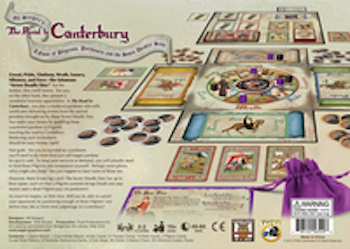
“A Canterbury Tale” Board Game

A Canterbury Tale Board Game

pic965758_tCall me a literary geek, but I got really excited when I saw this on Twitter.
http://www.boardgamegeek.com/boardgame/96792/the-road-to-canterbury

Game description from the publisher:

Greed, Pride, Gluttony, Wrath, Luxury, Idleness, and Envy – the infamous “Seven Deadly Sins”. For the faithful, they instill horror. For you, on the other hand, they present a wonderful business opportunity!

In The Road to Canterbury, you play a medieval pardoner who sells certificates delivering sinners from the eternal penalties brought on by these Seven Deadly Sins. You make your money by peddling these counterfeit pardons to Pilgrims traveling the road to Canterbury. Perhaps you can persuade the Knight that his pride must be forgiven? Surely the Friar’s greed will net you a few coins? The Miller’s wrath and the Monk’s gluttony are on full public display and demand pardoning! The Wife of Bath regales herself in luxury, the Man-of-Law languishes in idleness, and that Prioress has envy written all over her broad forehead. And the naughty stories these Pilgrims tell each other are so full of iniquity they would make a barkeep blush! Pardoning such wickedness should be easy money, right?

Not quite. For you to succeed as a pardoner, you’ll need to do more than just sell forged pardons for quick cash. To keep your services in demand, you will actually need to lead these Pilgrims into temptation yourself! Perhaps some phony relics might help? There is also one big catch. The Seven Deadly Sins live up to their name: each sin that a Pilgrim commits brings Death one step nearer, and a dead Pilgrim pays no pardoners!

So much to forgive, so little time. Will you be able to outwit your opponents by pardoning more of these Pilgrims’ sins before they die or finish their pilgrimage to Canterbury?

What other classic novel would make great board games? Leave your comments below.

Posted in British history, Canterbury tales | Tagged , , | 3 Comments

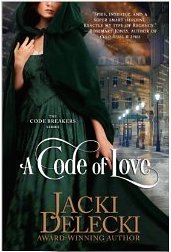
Heroes Require GMC Too! by Jacki Delecki + a Giveaway of “A Code of Love”

Heroes need GMC too.

I am so pleased to welcome back to my blog, the incomparable Jacki Delecki with a new book in her “Code” series. Jacki has a giveaway also; so comment below to be entered in the giveaway. 

Jacki Delecki

Jacki Delecki

I don’t like to make generalizations but it seems like many historical novels focus on the goals, motivation and conflict (GMC) as it relates to the heroine. A marriage of convenience. A compromised reputation. The orphaned miss who seeks gainful employment. It’s important to remember that heroes need GMC too. As authors, we must create emotionally compelling internal and external conflict for both our heroines and heroes.

While working on research for my latest release, A CODE OF THE HEART, I came across some interesting facts about Robert Fulton, an American inventor and engineer who is credited with developing the steamboat. During the course of his life, he travelled around the world, collaborating with other inventors and scientists on naval vessels and weaponry. He designed the first working submarine while in France before switching alliances and moving to England, where he was commissioned to build weapons for the Royal Navy. One of Fulton’s “secret weapons” was the torpedo-catamaran, which the British Navy hoped to use to blow French ships out of the water. Like many inventions, the early model had some functionality issues, but I was intrigued by the concept of French-British espionage.

When I began developing my characters for the story, I started wondering what it would take to redeem a disreputable young rake. Perhaps protecting his country by preventing a secret weapon from falling into the wrong hands would work. So that is exactly the challenge I put in front of Lord Derrick Brinsley, as well as the not-so-small matter of proving his worth to the very proper society miss, Amelia Bonnington.

By using the information I discovered during my research, I was able to create strong GMC for my hero. As for Amelia Bonnington’s GMC, you’ll have to read the book.

Excerpt: 

Edworth’s Christmas Ball
December, 1803

Amelia Bonnington braced herself as the crowd bumped and pushed, straining to get close to His Highness. The crème of society shoved and elbowed, politely, of course, since one would never want to be accused of bad manners.

The Prince Regent stood on a small platform at the front of the ballroom, elaborately decorated for Christmas. Heavy bows of greenery and bells hung on red velvet throughout the room. Hundreds of beeswax candles burned. No expense had been spared for the house party celebrating His Royalty’s visit.

Amelia had no desire to be part of the Prince’s retinue, a ghastly group who were only interested in themselves and their own pleasure.

She sucked in the little air left in the room and pushed, politely, of course, toward the door. The crowd and the heat were unbearable. She never swooned, but with the strong smell of perfume and the hot pressing bodies, she felt tonight might be her first. A maelstrom of sensations and emotions enveloped her. The last days of upheaval must have had a greater effect on her than she had wanted to believe.

Her whole world had been turned upside down and twisted sideways at this house party. In the last two days, her friends had been poisoned and kidnapped, and she had been ensnared in the French villain’s trap.

She needed to escape from this crowded room. She needed fresh air and open space. A gentleman used the chaos in crowded room to take liberties with her person. After spending years in congested ballrooms, she fully recognized the scoundrel’s ploy to press against her. His heavy eyelids didn’t conceal his roving eyes, focused down her décolletage. As his eyes remained fixated on her breasts, he grabbed her elbow pretending to help her when, in fact, he intended to pull her closer against his heavy, malodorous body.

A sick sensation started in her stomach and crawled to her throat. She pulled her arm away from his grasp, repulsive with sweat seeping through his gloves. “Sir, release me this instant.”

She was about to dig her heel into the supposed gentleman’s fat toe when suddenly a space opened around her and a smell of fresh air and lime soap surrounded her.

The perspiring man stared behind her. His slack mouth and the look of fear on his face were priceless.

She recognized Derrick Brinsley’s scent and heat—the impossible, difficult, yet appealing man. His deep, dark voice flitted down her skin like a caress. “Miss Amelia, may I escort you away from this crowd?”

Relief and something much more potent tingled along her skin. She turned quickly and found herself pressed against the broad chest of the man she had been forced to conspire with to save her friend.

“I’ve never thought I’d be happy to see you.” She refused to be like all the other women who’d be grateful to have his attention.

His lifted one eyebrow in a sardonic way that she always found irritating. He was too big, too handsome, and too confident that she’d find him irresistible. She’d never let him have the satisfaction that she did find him…almost irresistible.

unnamedA CODE OF THE HEART coming February 2015!

Miss Amelia Bonnington has been in love with her childhood hero since she was eleven years old… or so she thought until a not-so proper impassioned and unyielding kiss from the not-so honorable and equally disreputable Lord Derrick Brinsley, gave her reason to question the feelings of the heart.

Lord Brinsley, shunned from society for running off with his brother’s fiancée, hasn’t cared about or questioned his lack of acceptance until meeting the beguiling Amelia Bonnington. One passionate moment with the fiery Miss Bonnington has him more than willing to play by society’s rules to possess the breathtaking, red-haired woman.

Amelia unwittingly becomes embroiled in espionage when she stumbles upon a smuggling ring in the modiste shop of her good friend. To prove her French friend’s innocence, she dangerously jumps into the fray, jeopardizing more than her life.

On undercover assignment to prevent the French from stealing the Royal Navy’s deadly weapon, Derrick must fight to protect British secrets from falling into the hands of foreign agents, and the chance at love with the only woman capable of redeeming him.

Share your favorite historical trope for heroes in the comments below for a chance to win a digital copy of A CODE OF LOVE, Book 1 in the Code Breakers series!51V4E45VDcL._BO2,204,203,200_PIsitb-sticker-v3-big,TopRight,0,-55_SX278_SY278_PIkin4,BottomRight,1,22_AA300_SH20_OU01_

Learn More of Author, Jacki Delecki: Descended from a long line of storytellers, Jacki Delecki spins adventures filled with mystery, healing and romance.

Jacki’s love affair with the arts began at a young age and inspired her to train as a jazz singer and dancer. She has performed many acting roles with Seattle Opera Company and Pacific Northwest Ballet. Her travels to London and Paris ignited a deep-seated passion to write the Regency Code Breaker Series. Jacki is certain she spent at least one lifetime dancing in the Moulin Rouge.

Jacki has set her Grayce Walters Mystery Series in Seattle, her long-time home. The city’s unique and colorful locations are a backdrop for her thrilling romantic suspense. Although writing now fills much of her day, she continues to volunteer for Seattle’s Ballet and Opera Companies and leads children’s tours of Pike Street Market. Her volunteer work with Seattle’s homeless shelters influenced one of her main characters in An Inner Fire and Women Under Fire.

Jacki’s two Golden Labs, Gus and Talley, were her constant companions. Their years of devotion and intuition inspired her to write dogs as main characters alongside her strong heroines. A geek at heart, Jacki loves superhero movies—a hero’s battle against insurmountable odds. But her heroines don’t have to wear a unitard to fight injustice and battle for the underdog.

Look for more heart-pounding adventure, intrigue, and romance in Jacki’s Code Breakers Series. A Code of Love is the first book in the series. A Christmas Code—A Regency Novella, is now available at all retail sites. A Code of the Heart was released on Valentine’s Day 2015. 51q8fCHcz0L._BO2,204,203,200_PIsitb-sticker-v3-big,TopRight,0,-55_SX278_SY278_PIkin4,BottomRight,1,22_AA300_SH20_OU01_

To learn more about Jacki and her books and to be the first to hear about contests and giveaways join her newsletter found on her website: www.jackidelecki.com. Follow her on Facebook—Jacki Delecki; Twitter @jackidelecki.

Purchase Links: 

Amazon
Barnes and Noble
iBooks
Kobo 
GooglePlay

Posted in book excerpts, book release, British history, Great Britain, Living in the Regency, Regency era | Tagged , , | 5 Comments

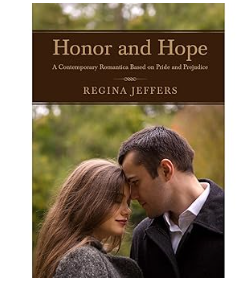
North Carolina Homecoming Bar Soap Paired with My Contemporary Austen, Honor and Hope

Honor and Hope: A Contemporary Romantica Based on “Pride and Prejudice”

Honor and Hope: A Contemporary Pride and Prejudice

[romance; contemporary romance; classics; Austenesque; football; winery]

Liz Bennet’s flirtatious nature acerbates Will Darcy’s controlling tendencies, sending him into despair when she fiercely demands her independence from him. How could she repeatedly turn him down? Darcy has it all: good looks, intelligence, a pro football career, and wealth. Attracted by a passionate desire, which neither time nor distance can quench, they are destined to love each other, while constantly misunderstanding one another until Fate deals them a blow from which their relationship may never recover. Set against the backdrop of professional sports and the North Carolina wine country, Honor and Hope offers a modern romance loosely based on Jane Austen’s Pride and Prejudice.

Kindle  

Amazon  

Kindle Unlimited 

Book Bub

Audible (Virtual Voice Narration)

North Carolina  Homecoming Bar Soap  

Inspired by the works of Regina Jeffers

Set against the backdrop of a professional football career, Will Darcy and Liz Bennet just can’t seem to connect. “Attracted by a passionate desire, which neither time nor distance can quench, they are destined to love each other, while constantly misunderstanding one another until Fate deals them a blow from which their relationship may never recover.”

Review by Evie Cotton: I have to admit that I was skeptical of this book when I first heard about it. I am not a sports fan and generally speaking not a big fan of angst. This book has both of those, but also contains vivid descriptions of the North Carolina Wine Country, and nuances of tobacco farming that I found to be absolutely fascinating. Overall, this book was fantastic and definitely one that I couldn’t put down. I would recommend this novel to anyone looking for a contemporary take on Pride and Prejudice.

11004710_10205865004207221_1135780387_n

North Carolina Homecoming Bar Soap smells of freshly hung tobacco with newly brewed tea to create an intoxicating earthy aroma combined with a fruity floral and finished off with soft baby powder. Its the scent of home for Liz Bennet.

In honor of the launch of North Carolina  Homecoming Bar Soap, Regina Jeffers is giving our fans the opportunity to purchase Honor and Hope at a discounted price through several market places.


To check out other books by Regina Jeffers, please visit her Amazon Author Page!

All of Evie’s soaps are available for purchase at the Etsy Store. If there is something that you might like but don’t see it listed, please feel free to shoot her an email, chances are good, that if she doesn’t have what you want on hand, she can whip it up in a jiff!

Posted in Uncategorized | 1 Comment

“Getting Hitched” During the Regency Era

Regency Era Marriage Customs

As tomorrow is Valentine’s Day, I thought me might have a look at the natural sequence of “love.” You know the old rhyme… “First comes love, then comes marriage…”

Until 1823, a single person under the age of one and twenty could not marry without his/her parent’s permission. (Lydia’s elopement and Georgiana’s aborted elopement were instances of this rule.) After 1823, the minimum age to marry without a parent’s consent dropped to 14 for a boy and 12 for a girl. Other rules of marriage were also in effect, such as one was discouraged from marrying one’s deceased wife’s sister; yet, it was acceptable to marry one’s first cousin (Lady Catherine hopes Darcy will marry his cousin Anne, and Mr. Collins wishes to marry several of his Bennet cousins before settling on Charlotte Lucas.)

The Marriage Act of 1835 eliminated the possibility of marrying one’s deceased wife’s sister. Such marriages were considered “void”able (if one wished an annulment). However, please recall that Jane Austen’s younger brother Charles married his wife’s (Francis Palmer) sister, Harriet. Francis had died in childbirth, and Charles had left his surviving daughters in Harriet’s care while he returned to sea. In 1820, he returned to England for several years, and after three years of “courtship,” he married Harriet. They remained married for 32 years (until his death in 1852). They had four children (3 sons and a daughter).

The law transferred all of a woman’s property to her husband upon their marriage. Marriages were a BUSINESS CONTRACT, not a romantic attachment. When a wife from the wealthier classes entered a marriage, she, generally, brought a generous dowry to the settlement. The financial arrangements for a marriage were rarely a matter of concealment. According to What Jane Austen Are and Charles Dickens Knew (Daniel Pool, Touchstone Books), “a contemporary courtship etiquette manual says very straightforwardly that once you propose ‘your course is to acquaint the parents or guardians of the lady with your intentions, at the same time stating your circumstances and what settlement you would make upon your future wife; and, on their side, they must state what will be her fortune as near as they can estimate to the best of their knowledge at the time you make the enquiry.’”

Men often used their wives’ dowries to shore up their estates and investments. “Keeping up with the Jones” during the Regency was an expensive endeavor. The bride’s family negotiated her financial future as part of the settlements. What happened to her and her children depended upon making a good settlement. At the man’s death, the wife would receive approximately one-third of her husband’s land, but the Dower Act of 1833 abolished this practice. The woman was often given “pin money,” an annual allowance for her personal needs while her husband remained alive. After his death, a “jointure” could provide the widow money and land for her future, while leaving “portions” for her minor children.

prideweddingUnless one was a member of the Royal family (who often married at night), weddings occurred only during canonical hours, between 8 A.M. and noon. Normally, only close family and friends would attend the wedding. After the ceremony, the couple and their guests attended a wedding breakfast, which would hold food choices beyond “breakfast” items. The size of the wedding breakfast often depended upon the season (what was available to serve).

If an engaged person terminated the agreement before the marriage, he/she could face legal action in a “breach of promise” suit. However, assuming the couple meant to meet their obligations, there were four routes to “placing one’s neck in the parson’s ropes.”

(1) Calling of the Banns – If marrying in the Church of England, the couple would “publish the banns.” From his pulpit, the local clergy would announce the upcoming wedding for three consecutive Sundays. If the bride and groom lived in different parishes, the banns were read in both. If there were no objections to their joining, the couple could marry within 90 days of the final call. This was the method that the poorer families used for it cost nothing to have the banns called. Of course, one ran the possibility that an objection would be lodged in a very public manner. If the persons marrying came from separate parishes, the curate of one parish could not solemnize the wedding without a certificate of the other stating the banns had been “thrice called” and no objections had been lodged.

(2) Common/Ordinary License – For approximately 10 shillings, a couple could purchase a license from a clergyman. Then the couple could marry in either the parish of the bride or the groom. The common/ordinary license was good for 15 days. (This is how Lydia and Wickham were married in Pride and Prejudice. If one recalls, Wickham’s lodgings were in St. Clement’s parish, and St. Clement’s was the site of the marriage. One had to be a resident in the parish for 15 days prior to the ceremony.)

The common license could be obtained from any bishop or archbishop. A sworn statement was given that there were no impediments to the marriage. The marriage was to take place within 3 months of the license’s issuance.

(3) Special License – This was the most expensive way to marry. The Archbishop of Canterbury granted a special license. They cost between 4-5 pounds and were at the archbishop’s discretion. With a special license, a couple could marry in any parish and at any time.

(4) Civil License – After 1836, a fourth option appeared: the civil license. This license could be obtained from the superintendent-registrar. Couples who were Catholic, Jewish, or Dissenters obtained this license. The couple could be married at a church or at the registrar’s office.

220px-Grenta_Green
Of course, the couple could foil all plans for marriage by eloping to Gretna Green, a Scottish town on the border with England. Gretna Green is in Dumfries and Galloway, near the mouth of the River Esk and was historically the first village in Scotland, following the old coaching route from London to Edinburgh. The marriage rules were not as strict as those in England. The Scottish Presbyterian Church was more lax in its requirements than the Church of England. Elopement was frowned upon as a “bad” way to begin a marriage. An elopement brought a family a certain amount of shame as it was a very anti-social act. A couple simply had to pledge yourself to your chosen partner and in the presence of another. The act was often referred to marrying “over the anvil” because Scottish law allowed for “irregular marriages,” and anyone could conduct the marriage ceremony. The blacksmiths in Gretna became known as “anvil priests.”

Posted in British history, Regency era | 13 Comments

“Love” Is in the Air

Love is in the Air

With Valentine’s Day coming up this weekend, I thought we might take a look at “love” as it is portrayed in the movies. Below (in no particular order) are some of my favorite scenes from romantic films. Feel free to share your favs below.

pp1-300x225Pride & Prejudice (2005)
“…If, however, your feelings have changed, I will have to tell you: you have bewitched me, body and soul, and I love … I love … I love you. I never wish to be parted from you from this day on.”
—Darcy (Matthew MacFadyen) to Elizabeth (Keira Knightley)

Dirty Dancing (1987)
“Me? I’m scared of everything. I’m scared of what I saw, I’m scared of what I did, of who I am, and most of all I’m scared of walking out of this room and never feeling the rest of my whole life the way I feel when I’m with you.” Baby (Jennifer Grey) to Johnny (Patrick Swayze).

Love Actually (2003)
“But for now, let me say — without hope or agenda, just because it’s Christmas and at Christmas you tell the truth — to me, you are perfect. And my wasted heart will love you. Until you look like this [picture of a mummy]. Merry Christmas.” Mark (Andrew Lincoln) to Juliet (Keira Knightley)

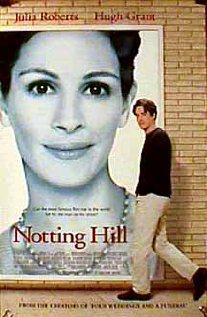
Notting Hill (1999)
“Don’t forget I’m just a girl, standing in front of a boy, asking him to love her.”
— Anna (Julia Roberts) to William (Hugh Grant)

titanicTitanic (1997)
“Winning that ticket, Rose, was the best thing that ever happened to me… it brought me to you … You must do me this honor, Rose. Promise me you’ll survive. That you won’t give up, no matter what happens, no matter how hopeless. Promise me now, Rose, and never let go of that promise.”
— Jack (Leonardo DiCaprio) to Rose (Kate Winslet)

The Last of the Mohicans (1992)
“…You stay alive, no matter what occurs! I will find you. No matter how long it takes, no matter how far, I will find you.”
— Hawkeye (Daniel Day-Lewis) to Cora (Madeleine Stowe)

When Harry Met Sally (1989)
“I love that you get cold when it’s 71 degrees out. I love that it takes you an hour and a half to order a sandwich. I love that you get a little crinkle in your nose when you’re looking at me like I’m nuts. I love that after I spend day with you, I can still smell your perfume on my clothes. And I love that you are the last person I want to talk to before I go to sleep at night. And it’s not because I’m lonely, and it’s not because it’s New Year’s Eve. I came here tonight because when you realize you want to spend the rest of your life with somebody, you want the rest of your life to start as soon as possible.”
— Harry (Billy Crystal) to Sally (Meg Ryan)

The Notebook (2004)
“So it’s not gonna be easy. It’s gonna be really hard. We’re gonna have to work at this every day, but I want to do that because I want you. I want all of you, forever, you and me, every day. Will you do something for me, please? Just picture your life for me? 30 years from now, 40 years from now? What does it look like? If it’s with him, go. Go! I lost you once, I think I can do it again. If I thought that’s what you really wanted. But don’t you take the easy way out.”
— Noah (Ryan Gosling) to Allie (Rachel McAdams)

Sleepless in Seattle (1993)
“It was a million tiny little things that, when you added them all up, they meant we were supposed to be together … and I knew it. I knew it the very first time I touched her. It was like coming home. .. only to no home I’d ever known … I was just taking her hand to help her out of a car and I knew. It was like … magic.”
— Sam (Tom Hanks) speaking of his deceased wife to the radio show

gone-with-the-windGone with the Wind (1939)
“No, I don’t think I will kiss you, although you need kissing, badly. That’s what’s wrong with you. You should be kissed and often, and by someone who knows how.”
— Rhett (Clark Gable) to Scarlett (Vivien Leigh)


Casablanca (1942)
“Here’s looking at you, kid.”
—Rick (Humphrey Bogart) to Ilsa (Ingrid Bergman)

Love Story (1970)
“Love means never having to say you’re sorry.”
—Jennifer (Ali MacGraw) to Oliver (Ryan O’Neal)

Jerry Maguire (1996)
“You had me at hello.”
— Dorothy (Renée Zellweger) to Jerry (Tom Cruise)

Sense and Sensibility (1995)
But wait, there’s more!
“My heart is, and always will be, yours.” — Edward Ferrars (Hugh Grant) to Elinor Dashwood (Emma Thompson)

on-golden-pondOn Golden Pond (1981)
“Listen to me, mister. You’re my knight in shining armor. Don’t forget it.”
— Ethel (Katharine Hepburn) to Norman (Henry Fonda)

An Affair to Remember (1957)
“Oh, it’s nobody’s fault but my own! I was looking up… it was the nearest thing to heaven! You were there…” — Terry McKay (Deborah Kerr) to Nick Ferrante (Cary Grant)

Doctor Zhivago (1965)
Lara (Julie Christie): “Wouldn’t it have been lovely if we had met before?”
Zhivago (Omar Sharif): “Before we did? Yes.”
Lara: “We’d have got married, had a house and children. If we’d had children, Yuri, would you like a boy or girl?”
Zhivago: “I think we may go mad if we think about all that.”
Lara: “I shall always think about it.”

Some Kind of Wonderful (1987)
Watts (Mary Stuart Masterson): [putting on Keith’s diamond earrings] “What do you think?”
Keith (Eric Stoltz): “You look good wearing my future.”

Wuthering Heights (1939)
“Catherine Earnshaw, may you not rest so long as I live on! I killed you. Haunt me, then! Haunt your murderer! I know that ghosts have wandered on the Earth. Be with me always. Take any form, drive me mad, only do not leave me in this dark alone where I cannot find you. I cannot live without my life! I cannot die without my soul.” — Heathcliff (Laurence Olivier)

A Room with a View (1985)
“He’s the sort who can’t know anyone intimately, least of all a woman. He doesn’t know what a woman is. He wants you for a possession, something to look at, like a painting or an ivory box. Something to own and to display. He doesn’t want you to be real, and to think and to live. He doesn’t love you. But I love you. I want you to have your own thoughts and ideas and feelings, even when I hold you in my arms. It’s our last chance.” — George Emerson (Julian Sands)

The Way We Were (1973)
Katie (Barbra Streisand): “Wouldn’t it be lovely if we were old? We’d have survived all this. Everything thing would be easy and uncomplicated; the way it was when we were young.”
Hubbell (Robert Redford): “Katie, it was never uncomplicated.”
The Time Traveler’s Wife (2009)  I want to tell you, again, I love you. Our love has been the thread through the labyrinth, the net under the high-wire walker, the only real thing in this strange life of mine that I could ever trust. Tonight I feel that my love for you has more density in this world than I do, myself: as though it could linger on after me and surround you, keep you, hold you. Henry DeTamble (Eric Bana) to Claire Abshire (Rachel McAdams)

tumblr_mlrodrEpf81qj4315o1_500Ten Things I Hate About You(1996)   I hate the way you talk to me, and the way you cut your hair. I hate the way you drive my car. I hate it when you stare. I hate your big dumb combat boots, and the way you read my mind. I hate you so much it makes me sick; it even makes me rhyme. I hate it, I hate the way you’re always right. I hate it when you lie. I hate it when you make me laugh, even worse when you make me cry. I hate it that you’re not around, and the fact that you didn’t call. But mostly I hate the way I don’t hate you. Not even close, not even a little bit, not even at all.  Kat Stratford (Julia Stiles) speaking of Patrick Verona (Heath Ledger)

The Bridges of Madison County (1995)
Francesca (Meryl Streep): Robert, please. You don’t understand, no-one does. When a woman makes the choice to marry, to have children; in one way her life begins but in another way it stops. You build a life of details. You become a mother, a wife and you stop and stay steady so that your children can move. And when they leave they take your life of details with them. And then you’re expected move again only you don’t remember what moves you because no-one has asked in so long. Not even yourself. You never in your life think that love like this can happen to you.
Robert Kincaid (Clint Eastwood): But now that you have it…
Francesca: I want to keep it forever. I want to love you the way I do now the rest of my life. Don’t you understand… we’ll lose it if we leave. I can’t make an entire life disappear to start a new one. All I can do is try to hold onto to both. Help me. Help me not lose loving you.

The Bridges of Madison County (1995)    Robert Kincaid: This kind of certainty comes but once in a lifetime.

The Bridges of Madison County (1995)
Francesca: And in that moment, everything I knew to be true about myself up until then was gone. I was acting like another woman, yet I was more myself than ever before.

Under the Tuscan Sun (2003)     Frances (Diane Lane): Do you know the most surprising thing about divorce? It doesn’t actually kill you. Like a bullet to the heart or a head-on car wreck. It should. When someone you’ve promised to cherish till death do you part says “I never loved you,” it should kill you instantly. You shouldn’t have to wake up day after day after that, trying to understand how in the world you didn’t know. The light just never went on, you know. I must have known, of course, but I was too scared to see the truth. Then fear just makes you so stupid.

Martini(Vincent Riotta): No, it’s not stupid, Signora Mayes. L’amore e cieco.

Frances: Oh, love is blind. Yeah, we have that saying too.

Martini: Everybody has that saying because it’s true everywhere.

It Happened One Night (1934)
Ellie Andrews (Claudetter Colbert): Have you ever been in love, Peter?
Peter Warne (Clark Gable): Me?
Ellie Andrews: Yes. Haven’t you ever thought about it at all? It seems to me you, you could make some girl wonderfully happy.
Peter Warne: Sure I’ve thought about it. Who hasn’t? If I could ever meet the right sort of girl. Aw, where you gonna find her? Somebody that’s real. Somebody that’s alive. They don’t come that way anymore. Have I ever thought about it? I’ve even been sucker enough to make plans. You know, I saw an island in the Pacific once. I’ve never been able to forget it. That’s where I’d like to take her. She’d have to be the sort of a girl who’d… well, who’d jump in the surf with me and love it as much as I did. You know, nights when you and the moon and the water all become one. You feel you’re part of something big and marvelous. That’s the only place to live… where the stars are so close over your head you feel you could reach up and stir them around. Certainly, I’ve been thinking about it. Boy, if I could ever find a girl who was hungry for those things…
[she comes around the blanket “Walls of Jericho” and kneels by his bed]
Ellie Andrews: Take me with you, Peter. Take me to your island. I want to do all those things you talked about.
Peter Warne: You’d better go back to your bed.
Ellie Andrews: I love you. Nothing else matters. We can run away. Everything will take care of itself. Please, Peter, I can’t let you out of my life now. I couldn’t live without you.
[she cries in his arms]
Peter Warne: [firmly] You’d better go back to your bed.
Ellie Andrews: I’m sorry.
[she returns to her bed still crying]

Up Close & Personal (1996)
Tally Atwater (Michelle Pfeiffer): Do you want to be with me?
Warren Justice (Robert Redford): So much it hurts.

Charade (1963)
Adam Canfield (Cary Grant) Well, what did you expect me to say? That a pretty girl with an outrageous manner means more to an old pro like me than a quarter of a million dollars?
Reggie Lampert (Audrey Hepburn): I don’t suppose so.
Adam Canfield: Well, it’s a toss-up, I can tell you that.
Reggie Lampert: What did you say?
Adam Canfield: Hasn’t it occurred to you that I’m having a tough time keeping my hands off you?
[Regina is stunned]
Adam Canfield: Oh, you should see your face.
Reggie Lampert: What’s the matter with it?
Adam Canfield: It’s lovely.
[Regina drops her knife and fork]
Adam Canfield: What’s the matter now?
Reggie Lampert: I’m not hungry anymore; isn’t it glorious?

Two Weeks’ Notice (2003)

George Wade (Hugh Grant): I need your advice on one last thing, then I promise you will never hear from me again. You see, I’ve just delivered the first speech I’ve written entirely by myself since we met, and I think I may have blown it. I want to ask your thoughts. Okay? Then I will read it to you. I’d like to welcome everyone on this special day. Island Towers will bring glamour and prestige to the neighborhood and become part of Brooklyn’s renaissance. And I’m very pleased and proud to be here. Unfortunately, there is one fly in the ointment. You see, I gave my word to someone that we wouldn’t knock down this building behind me. And normally, and those of you who know me or were married to me can attest to this, my word wouldn’t mean very much. So why does it this time? Well, partly because this building is an architectural gem and deserves to be landmarked and partly because people really do need a place to do senior’s water ballet and CPR. Preferably not together. But mainly because this person, despite being unusually stubborn and unwilling to compromise and a very poor dresser, is… she’s rather like the building she loves so much. A little rough around the edges but, when you look closely, absolutely beautiful. And the only one of her kind. And even though I’ve said cruel things and driven her away, she’s become the voice in my head. And I can’t seem to drown her out. And I don’t want to drown her out. So, we are going to keep the community center. Because I gave my word to her and because we gave our word to the community. And I didn’t sleep with June. That’s not in the speech, that’s just me letting you know that important fact. What do you think?
Lucy Kelson (Sandra Bullock): I have to get back to work.
George Wade: Right. Right, yes. Sorry to disturb you. Congratulations, again, Polly.
[leaves]
Lucy Kelson: Aside from the split infinitive that was somewhere in the middle, that speech was actually quite perfect, wasn’t it?
Polly St. Clair: Yeah. I don’t know what the hell you’re still doing sitting here. And I don’t even like him.
Lucy Kelson: [runs after George]

mv5bmty3nzqznjy1nf5bml5banbnxkftztywntk0mdc4-_v1-_sy317_Notting Hill (1999)
P.R. Chief (John Shrapnel): Next question? Yes. You in the pink shirt.
William (Hugh Grant): Uh, right. Miss Scott, are there any circumstances that you and he might be more than just friends.
Anna Scott (Julia Roberts): I hoped that there would be, but I’ve been assured that there’s not.
William: Yes, but what if…
P.R. Chief: I’m sorry. Just the one question.
Anna Scott: No. It’s all right. You were saying?
William: I was just wondering what if this person…
Journalist: Thacker. His name is Thacker.
William: Right. Thanks. What if, uh, Mr. Thacker realized that he had been a daft prick and got down on his knees and begged you to reconsider if you would… indeed… reconsider.
Anna Scott: [pause] Yes. I believe I would.
William: That’s wonderful news. The readers of Horse and Hound will be relieved.

Posted in film, love quotes | Tagged , , | 10 Comments

UK “Real” Estate: The Locations of Pride and Prejudice 2005

Locations for Pride and Prejudice 2005

Below, one will find the real-like locations for many of my favorite scenes from this film. I have included a bit of history on each historic building. Most of that information comes from http://www.infobritain.co.uk.

Groombridge Place and Enchanted Forest, Kent (Longbourn, the Bennet family home)
In 1662 by architect Philip Packer, with the help of his friend, Christopher Wren, the seventeenth century’s premier architect, built Groombridge Place. Packer’s house was built on the site of a series of former manor houses owned by wealthy nobles, including Richard Waller, who famously kept Charles Duke of Orleans at Groombridge after capturing him at the Battle of Agincourt. Completing his new house in 1662 Packer then started thinking about his garden. Beginning in 1674, Packer began designing the gardens surrounding Groombridge House He was assisted by John Evelyn, a horticulturist and famous diarist. Evelyn was a multi-talented man who showed an unusually modern concern with the problems of urban living, and a reverence for gardens as an escape from them. Evelyn conceived a series of formal gardens arranged as “outside rooms” of the house. Although Evelyn was generally formal in his gardening ideas, the sense of blurring the boundary between indoors and outdoors was actually a theme that would emerge once again in the 20th Century. Some of Evelyn’s garden rooms at Groombridge also preempted modern design in creating an artfully “natural” landscape. The Secret Garden is the best example. It is suggested that this was Packer’s favourite garden. He is supposed to have died here in 1686 while reading a book.

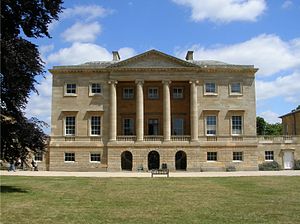
Basildon Park, Berkshire (Netherfield Park)
In many ways Basildon Park in Berkshire is an historical oddity, a house seeking historical grandeur when all it really found was a kind of Blackadder farce. Building of the house began in 1776, for a Francis Sykes. Sykes was originally a farmer’s son, who joined the British East India Company to make his fortune, which supported his political career. He became governor of Kazimbazar. Returning to England in 1771 a rich man, Sykes decided to buy the estate at Basildon, since this was an area where many men who had made good in India tended to settle with their money. He managed to win a baronetcy, and become an MP, but work on the house he commissioned at Basildon was slow, probably reflecting financial difficulty. Sykes struggled on with the building of his grand house, in a palladian style which was already going out of fashion. When Sykes died in London in 1804, Basildon Park remained unfinished. Sykes’ son inherited the property, but he too died within a few weeks, and the new owner, Sykes’ grandson, Francis Sykes the third baronet, was only five years old. With little money, ownership somehow remained with the boy, who at age 14 started entertaining Prince George at the house. Prince George was famously dissolute, and Sykes’ association with him only drained the family fortune further. With the family in a state of financial turmoil, Basildon Park was offered for sale. Just for good measure, personal turmoil was also thrown into the mix, when Sykes’ wife Henrietta started having an affair with future Prime Minister Benjamin Disraeli. Henrietta also had an affair with the painter Daniel Maclise. When her husband denounced Maclise he broke the unwritten rule that such goings on in high society should be kept discreet. As a result, Charles Dickens, a friend of Maclise, decided to use the name Bill Sykes for a villainous character in a new book he was writing. Oliver Twist, complete with Bill Sykes, was published in 1838 and Francis Sykes was humiliated. He finally sold Basildon Park that year.

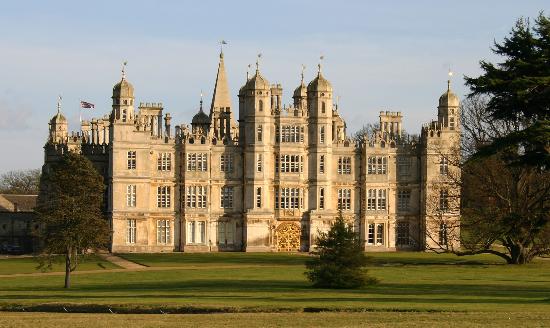
Burghley, Lincolnshire (Rosings Park)
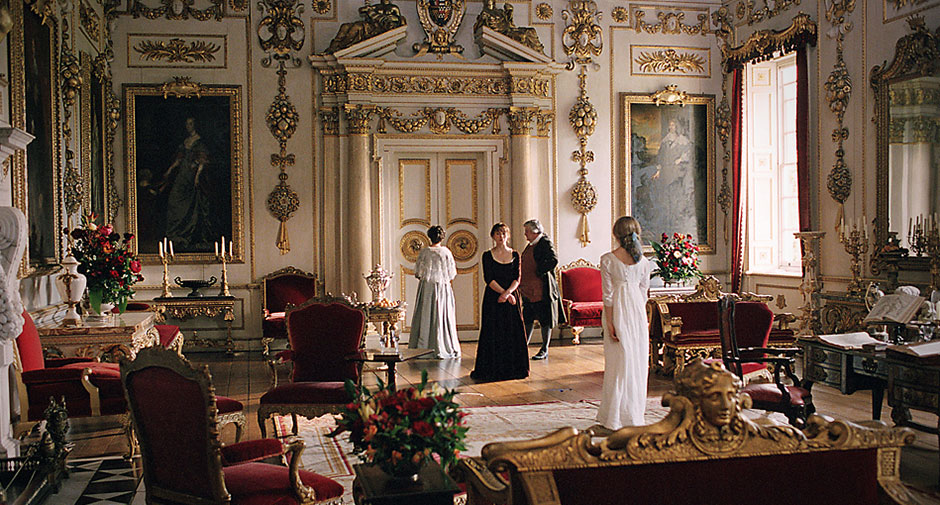
Burghley is perhaps the grandest of all England’s sixteenth century Elizabethan houses, capturing the drama and other-worldly spirit of that time. Lord Burghley, William Cecil, Treasurer to Elizabeth I, and her most influential advisor, directed its structure. His grand house is like others of the period, Longleat or Wollaton Hall for example, except Burghley just had more of everything. In fact it may claim to be the definitive grand house of late Tudor England. Burghley, like most great properties, housed lavish collections of art and valuable objects. The Heaven Room became Lady Catherine’s drawing room in the 2005 film. The fifth Earl, Lord Exeter, commissioned the Italian artist Verrio to paint the murals on the wall and ceiling. There is a Hell Staircase leading to this room. Owned by a family trust, Lady Victoria Leatham, daughter of the Marquis of Exeter, the medal-winning Olympic runner portrayed in Chariots of Fire, manages the estate. (As footnotes the late Ian Charleson, who played Exeter in the film, has a RSC Award named after him. Matthew Macfadyen previously was nominated for the award. Also, Lady Victoria appears regularly on Antiques Roadshow.) Burghley has been used as a location for a number of films including Pride and Prejudice, Elizabeth, the Golden Age, and The DaVinci Code.

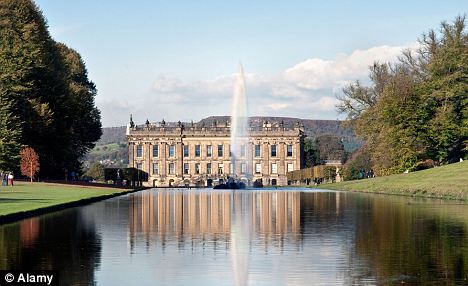
Chatsworth, Derbyshire (Pemberley)
Chatsworth is home to the Duke and Duchess of Devonshire. Since Chatsworth was first built in the early sixteenth century, it has been closely involved with religious disputes that have shaped Britain into modern times. Elizabeth Hardwick, and her husband Sir William Cavendish, treasurer to Henry VIII, built Chatsworth. When the king decided to marry Anne Boleyn, he needed to escape the influence of the pope who refused to grant Henry a divorce from his first wife Catherine of Aragon. In the upheaval of the Reformation that followed, huge amounts of money were taken from dissolved Catholic monasteries. From 1532 onwards a significant amount of this appropriated money went to Sir William Cavendish. He was made First Earl of Devonshire, and Chatsworth benefited from William’s newfound wealth. The Earls of Devonshire remained Protestant champions thereafter. Protestant Elizabeth I held the Catholic Mary Queen of Scots prisoner at Chatsworth on a number of occasions between 1569 and 1584.

Wilton House, Wiltshire (Mr. Darcy’s music room at Pemberley, where Elizabeth first meets Georgiana)
Wilton has been linked to royalty since early Anglo Saxon times. A nunnery was founded here, which figures quite frequently in Anglo Saxon royal history. The twelfth century saw the nunnery at Wilton being replaced by a Benedictine abbey, which was disbanded during Henry VIII’s Dissolution of the Monasteries. In 1542 Henry VIII granted the abbey and its lands to William Herbert, whose descendents, the Earls of Pembroke, still own Wilton. A year after acquiring his new property William Herbert began creating a Tudor house, incorporating parts of the old abbey. This house was famous during Tudor times as the residence of Mary Sidney, sister of Elizabethan poet Sir Philip Sidney. In the 1630s the 4th Earl of Pembroke commissioned Inigo Jones to re-model Wilton House in a Palladian style. The Double Cube Room used in the film is an example of the style. Many films have used Wilton House as a location including The Young Victoria, Pride and Prejudice, Sense and Sensibility, The Madness of King George, Mrs Brown, and The Bounty.

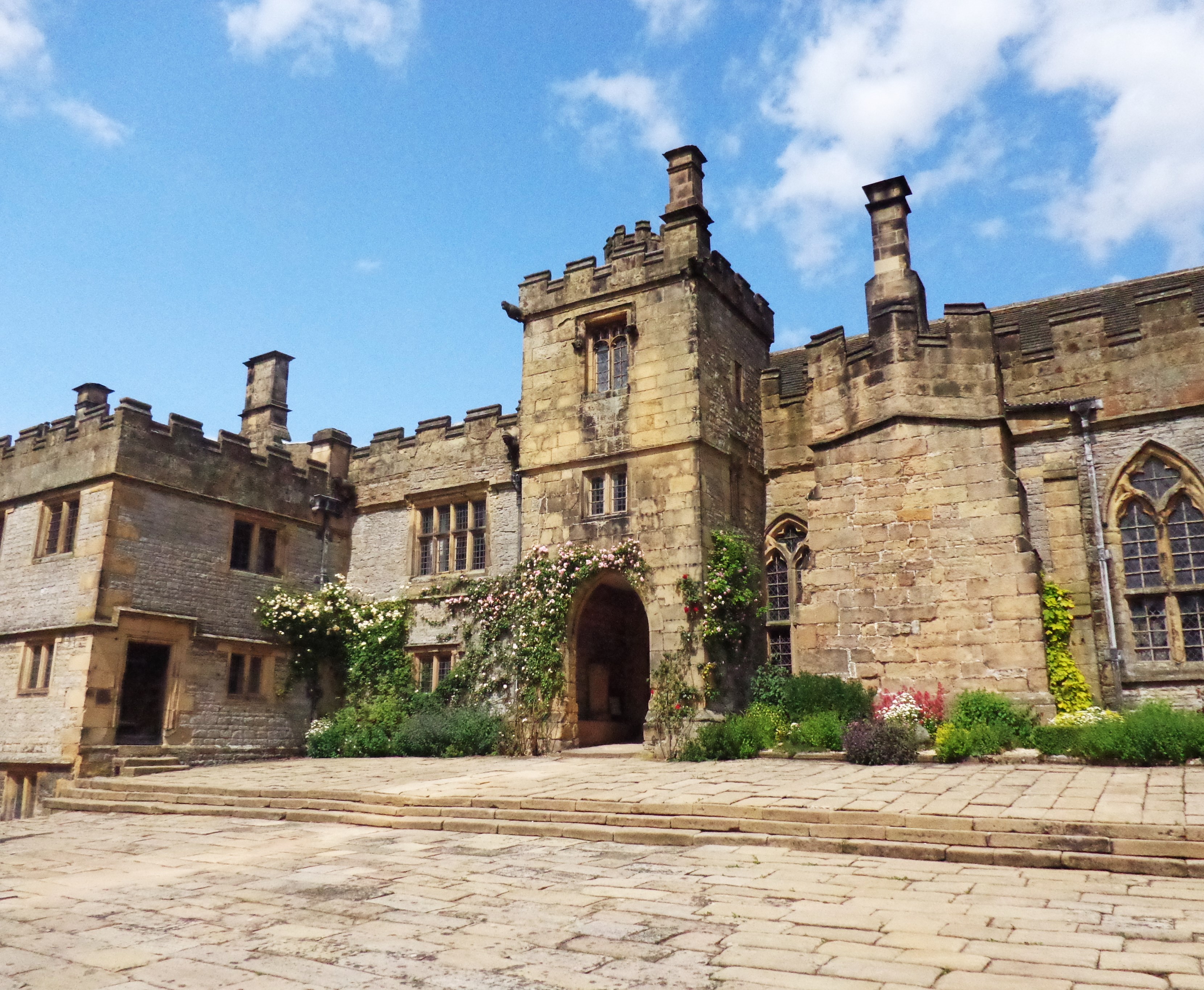
Haddon Hall, Derbyshire (the inn at Lambton)
Originally built as a fortified manor house in the eleventh century, Haddon Hall belonged to the Vernon family, and then passed by marriage to the powerful Manners family. In 1703 John Manners, 9th Earl of Rutland left Haddon Hall, and went to live at the Manners family seat at Belvoir Castle in Leicestershire. A long period of neglect followed for Haddon Hall. For over two hundred years it lay in a kind of suspended animation in an almost unaltered sixteenth century condition. A lesser house would have fallen down, but this was a strong stone built, fortified manor house. The empty house endured through the centuries until the 1920s when the 9th Duke of Rutland visited his long forgotten family property and realised how important it was. With the help of a restoration expert named Harold Brakspear the building was restored, not as a building representing a single time period, but more as a building that had accreted layers like sedimentary rock over long periods of time. There are small sections that date to the eleventh century, but there are also parts of the building which date to rebuilding between the thirteenth and early seventeenth centuries.
With Haddon Hall illustrating a long period in history it is fitting that the house is often used as a film location for historical film and drama. Haddon Hall has been used for The Princess Bride (1986), Jane Eyre (1996), Elizabeth (1998), and Pride and Prejudice (2005).

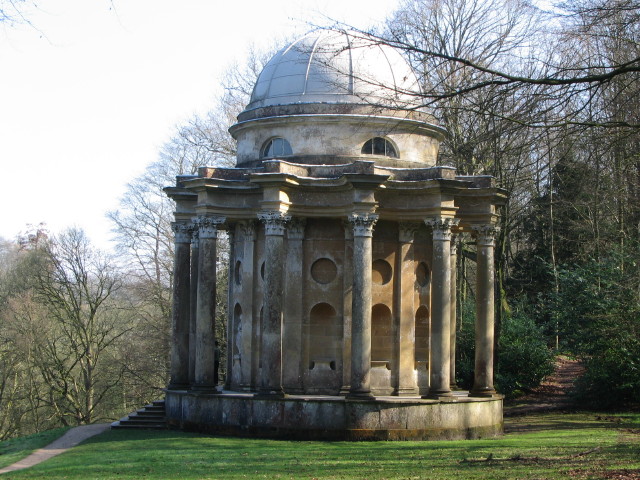
Stourhead, Wiltshire (location of The Temple of Apollo used for the first proposal scene)
Henry Hoare, whose father, Sir Richard Hoare had made his fortune in banking, built Stourhead between 1717 and 1725. Stourhead and the banking fortune, which created it, date from a financial revolution that accompanied the Glorious Revolution of 1688. After 1688, British monarchs were obliged to work within the constitution set out by Parliament. Now debt run up by the country became the “national debt.” Debt became increasingly accepted, and this new attitude was one of the reasons Britain became such a powerful country in the 18th century. The gardens at Stourhead illustrate the worldwide power that Britain began to enjoy following the financial revolution. It became increasingly fashionable to have exotic foreign plants in gardens, brought back from countries under British influence. The estate is huge, and includes King Alfred’s Tower, a folly of monumental proportions. This fifty meter high building lies at the end of a long coach track leading away from the house. It commemorates King Alfred’s victory over the Danes in 878 A.D. Stourhead remained with the Hoare family until 1946. Henry Hoare, the Sixth Baronet lost his only son during World War One, and a year before his own death in 1947, he gave Stourhead to the National Trust.

Although the passages are a mixture of several sources, much of the history of these estates came from Wikipedia.

Posted in British history, estates | 4 Comments