Giraffes in London During the Regency Era

I had a recent question from a reader who came across a book by my fellow North Carolina author, Deb Marlowe, called An Unexpected Encounter. In it, the heroine encounters stuffed giraffes, and she asked me (why she did not ask Deb, I have no idea) if there was some truth in the tale. Perhaps she was too embarrassed to send something to Deb, while she contacts me with some regularity. First off, Deb Marlowe has a promo post about the book. You can find it at the link above. Ms. Marlowe tells us, “In An Unexpected Encounter, our heroine Lisbeth meets a young girl, come to visit the giraffes–and her memories.  She also meets the girl’s guardian, Lord Cotwell, and so begins a story that features laughter, tears, automatons, insect collectors, a tryst in Hyde Park and of course, the subtle matchmaking efforts of Hestia Wright!” She even provides us with an image of the giraffes, which is shown below.

I possess a smattering of information on the giraffes. The reader above wondered if the giraffes would have still been installed at Montague House towards the end of the George IV’s reign.

From my research on this one, this display all started with one giraffe, and it was a diplomatic gift to George IV in 1827 from Mohammed Ali, a pasha and viceroy of Egypt. He presented Charles X of France with a different giraffe, presumably it was a half-sibling of George IV’s giraffe.

Although exotic wild animals and birds had been around in European menageries since the Middle Ages, giraffes proved to be the most elusive and unusual of wild animals. France and England allegedly drew lots as to who would get which giraffe, with the taller one going to France.

The giraffe bound for England was younger, smaller, and had probably suffered greatly on her trek, as it was later noted by vets who carried out a post mortem that she had arrived in England with already deformed limbs. The sibling giraffes parted ways in Alexandria but had two Egyptian milk cows, two Egyptian keepers, several other African mammals and a translator each for company for the rest of their journey.

George’s giraffe, already weaker and crippled, was sent by ship to Malta, where she spent the winter. In May 1827 she boarded the Penelope Malta Trader. A hole was cut into the deck of the ship to accommodate her.

She arrived at London’s Waterloo Bridge, on 11 August 1827 and was put up in a warehouse, before being moved in a large container to Windsor, where George had been eagerly awaiting his new toy.

By 1827, the king had become a recluse, spending most of his time at the Royal Lodge and Virginia Water Fishing Temple in Windsor Great Park, away from the public eye. With his health declining, he devoted himself to his mistress Lady Conyngham and was often seen riding in his pony-chaise to his menagerie of “gentle animals” at Sandpit Gate.

George added the giraffe to this menagerie, and it probably caused him great excitement, given his interest in anything exotic.

Sadly, though, neither the poor giraffe nor George lasted very long thereafter.

The giraffe suffered badly from the injuries sustained on her long journey from deepest Africa to Windsor. Like many of the animals at the Tower of London’s menagerie/zoo, the giraffe was probably given an inappropriate diet in England, and she finally died in 1829. [Tower of London’s Menagerie]

There are a whole raft of satirical prints that tell the story of the demise of the giraffe, clearly associating her with George IV who was greatly ridiculed in these drawings. One print shows Lady Conyngham and George hoisting the giraffe, now unable to stand unaided, up to a specially built frame. The images of the giraffe are mostly satirical, unsparing, and attack her owner through ridiculing the creature.

In this satirical print, William Heath irreverently links the novelty of having a pet giraffe with having a new mistress. King George IV sits on the back of a high stepping giraffe with Lady Conyngham (the King’s mistress) shown with an exaggerated rear-end and feathered headdress, sitting sidewise on the animal behind him. ~ https://emuseum.ringling.org/objects/50076/the-camelopard-or-a-new-hobby

The giraffe appears again in John Doyle’s Le Mort, lying dead, being mourned by George, his mistress and Lord Eldon. And even after George’s death in June 1830 the satirists did not leave the giraffe alone: in Heath’s “Packing Up!!!”, Lady Conyngham is grabbing valuables when she is kicked out of Windsor Castle. Among the treasures is the skeleton of the giraffe.

Royal Collection Trust – https://www.rct.uk/collection/751282/packing-up ~ A satire depicting Lady Conyngham, the mistress of George IV, and her family plundering the possessions of the late King. One object, the skeleton of a giraffe refers to one of George IV’s pets.

There are, though, a number of serious depictions of the English giraffe, mostly commissioned by George and, but sadly they are in private collections. Two of these are in the Royal Collection, of which one, an exquisite oil painting by the animal painter Jacques-Laurent Agasse, is usually on display at the Queen’s Gallery in Buckingham Palace.

After the death the George’s giraffe, the animal was stuffed by a talented taxidermist, John Gould. It is uncertain what happened to the stuffed giraffe and her skeleton – they could well have been used for research purposes by the newly founded Zoological society.

But it was actually in the early 1840s that three stuffed giraffes were first displayed on the landing of the first British Museum in Montagu House. A senior curator of the British Museum shared this information a couple of years ago – but even he said there was no way to be confident whether one of them was George IV’s giraffe.

Other Information on Stuffed Animals, Etc.

1813 The Companion to the Bullocks Museum described a giraffe  in the museum.  

The specimen was a stuffed, as were all of Bullocks’ animals.

<https://books.google.com/books?id=WqJbAAAAQAAJ&printsec=frontcover&dq=bullock%27s+museum&hl=en&sa=X&ei=Tx_vVKbDOIXNgwTmmoHYBg&ved=0CDIQ6AEwAQ#v=onepage&q=giraffe&f=false>

Egyptian Hall or Bullocks Museum

http://www.georgianindex.net/Bullocks/Egyptian_Hall.html

As to the three giraffes pictured above, it depends on when in 1817 they were taken up as a task and how fast taxidermists worked. The male and female giraffe were donated by W. J. Burchell, Esquire (A Visit to the Bristish Museum, 1838), I believe as part of 43 skins given to the museum in 1817; the third, smaller giraffe was given in 1835. I believe the rhinoceros was a later addition, as Burchell first described the white rhinoceros in 1817, but only brought back “teeth, some horns and the horn-bearing epinasal skin” from Africa. Source: William J. Burchell’s South African Mammal Collection, 1810-1815

Source: William J. Burchell’s South African Mammal Collection, 1810-1815

William John Burchell (23 July 1781 – 23 March 1863) was an English explorer, naturalist, traveller, artist, and author. His thousands of plant specimens, as well as field journals from his South African expedition, are held by Kew Gardens, and his insect collection by the Oxford University Museum.

Portrait of Burchell by John Russell (1800).

According to some of the ledgers at the British Museum, Sir George Shaw (Keeper of Zoology 1806-13) sold many of the zoological specimens (larger skeletons and hides. etc.) to the Royal College of Surgeons because the British Museum could not stop them from rotting. and they had so many rotting carcasses in the basements that the place was infested with vermin.

His successor William Elford Leach made periodical bonfires in the grounds of the museum. In 1833. the Annual Report states that of the 5,500 insects alone listed in the Sloane catalogue, none remained.

One lady I read about spoke of a furless giraffe. This would not be uncommon during the early years of the British Museum, for it had an appalling reputation for ill-preserved specimens, with surrounding residents bitterly complaining about the infestation of vermin in the district and the smell of burning carcasses from the bonfires to destroy rotting specimens. Even after 1840s, the inability of the natural history departments to conserve its specimens became so notorious that the Treasury refused to entrust it with specimens collected at the government’s expense. Appointments of staff were sprinkled thoroughly with gentlemanly favoritism. In 1862, a nephew of the mistress of a Trustee was appointed Entomological Assistant despite not knowing the difference between a butterfly and a moth.
Posted in British history, buildings and structures, England, fashion, George IV, Georgian, Georgian England, Georgian Era, kings and queens, Regency era | Tagged , , , , , , , | Comments Off on Giraffes in London During the Regency Era

Regency Romance Plot Point: Betrothal Announcement in the Newspapers ~ Real or NOT!!!

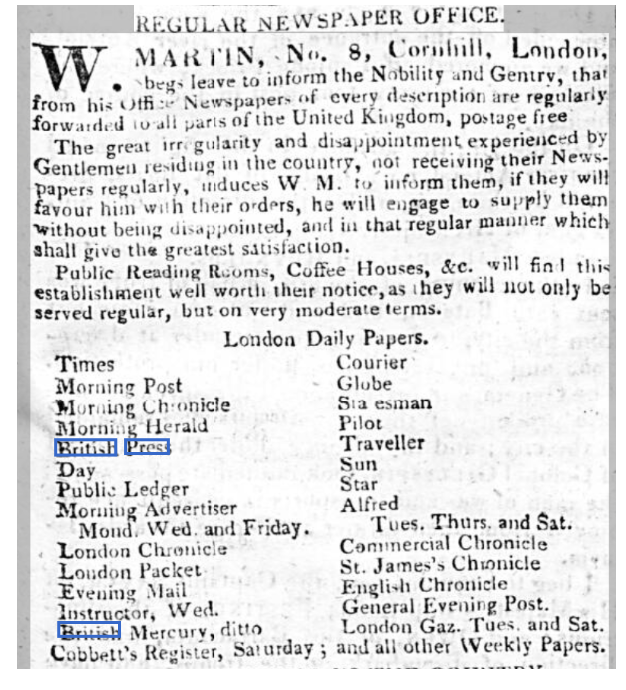
I have seen and read some copies of actual newspapers of the Regency period which had been digitalized. Naturally, it is possible that there were no marriages of importance to share with the public on those particular dates, but I have screen shots of a few copies of the Times, the Morning Chronicle and the Morning Post, with varying dates. In none of them is there a betrothal announcement.

In fact, I have only seen an announcement of a forthcoming wedding three times in all the Georgian era documents I have encountered, and, with each, it was more of gossip section of the paper rather than the a legitimate report. Though I cannot recall the exact wording at this time, it went something like this:

It is said among those at last evening fête that Lord Salanger is to marry Miss Theodora Thompson, who has a fortune of £20,000. Lord T is 42 and Miss T is 21.

Just remember that gossip is just that: GOSSIP. It has a chance of being accurate, but a larger chance of inaccuracy.

Angelyn’s Blog provides us some more humorous ones:

“And now for some various Regency-era nuptial announcements from La Belle Assemblée or, Bell’s Court and Fashionable Magazine Addressed Particularly to the Ladies .

“From the March, 1817 issue of the aforesaid Magazine:

“At Ringwood, Mr. T. Bloomfield, aged 70, to Mrs. Mooren, aged 40. So decrepit and helpless was the old man that it was with the greatest difficulty that he could be taken from the chaise which brought him from the church; and when in the church he was obliged to be drawn to the altar in a cart.”

“Another singular notification appeared in the September issue of that same year:

“At Rothwell Church, Mr. Thomas Craven, of the Leeds Pottery, to Miss Coultare, both of Leeds, after a tedious courtship of twenty-eight years, six months and six days.”

I found this example on a Reddit chat group, so I cannot speak to its legitimacy, but it is interesting, nonetheless.

“I was just reading a historic newspaper from a few years before Austen was born.

“There is this announcement in the paper

“On Thursday last was married, the Rev. Mr Sutcliffe of Halifax* to Miss Garforth, only daughter of Samuel Garforth of Warley, a most amiable and accomplished young lady possessed of every accomplishment to render the marriage state happy, with a fortune of 1000 l” (l standing for pounds here).”

None of the other papers mention forth coming weddings at all. The vital statistics column reported births, death, and weddings but only after they had taken place. These same statistics were reported in the Annual Register.

I know many authors have built plots around having betrothals announced in the newspaper, but I just have not found any except for Princess Charlotte’s.

The ever-fabulous Cheryl Bolen tells us, “Love matches were definitely the norm in the Regency but were not the same as today’s. A significant difference in so-called love matches was that the upper class had to pick potential spouses from a select pool. Aristocrats wed other aristocrats or persons who shared their social sphere.

“A title holder could (but rarely did) marry beneath him. In 1812 the lecherous 42-year-old Lord Berwick married the 15-year-old courtesan who was sister to the famed courtesan Harriette Wilson. And the Duke of St. Albans married a former actress in 1827. Younger aristocratic sons, however, could be cut off completely if they married a woman from the lower classes.

“Genteel young ladies almost never engaged in premarital sex. They were shielded from sex and not permitted to be alone with gentlemen. Even Lady Caroline Lamb, who later became famous for her adultery with Lord Byron (and others), was a complete innocent when she married William Lamb (later Prime Minister Lord Melbourne) at age 19. She was shocked and unhappy over the action that robbed her virginity, and it took her some time to recover.”

Many newspapers had accounts of balls, routs, dinners, and other fashionable gatherings so there was a place where such announcements could appear, BUT did not, at least, with some regularity.

 So, despite the fact that many an announcement of a forthcoming marriage is sent to a fictional newspaper, it did not, generally, happen in real life.

Posted in British history, customs and tradiitons, England, Georgian England, Georgian Era, heroines, historical fiction, Jane Austen, Living in the Regency, marriage, marriage customs, publishing, Regency era, Regency romance, research, romance, tradtions, writing | Tagged , , , , , , , , , , , , , | Comments Off on Regency Romance Plot Point: Betrothal Announcement in the Newspapers ~ Real or NOT!!!

Boot Polish in Regency England + “Never Contradict a Lady” and the Release of “Regency Summer Melodies” + a Giveaway

Those of us who read Regency romances and write Regency romances surely have read of the high polish on a gentleman’s boots, but what exactly did that entail?

First, let us define the terms of “boot polish.” It is a waxy paste, cream, or, nowadays, liquid, used not only to polish but waterproof leather shoes or boots. Many of the techniques and mixtures used have been around since the Middle Ages. Original shoes polish was made with dubbin.

Dubbin is a greasy or waxy product used to soften, condition, and waterproof leather. [Waterer, John William (1981). Leather and the warrior : an account of the importance of leather to the fighting man from the time of the ancient Greeks to World War II. Northampton, England: The Museum of Leathercraft. p. 61.]

It has been used since medieval times to waterproof and soften leather goods. It differs from saddle soap used to clean and lightly condition leather, or shoe polish, which is used to impart shine and color to it. It consists primarily of various waxes and oils. Commercial dubbin contains petroleum jelly (petrolatum), paraffin wax, neatsfoot oil, and naphtha (C10-12 alkane/cycloalkane). More traditional dubbin can be made with beeswax, fish oil and lard. [“Mad Madam Mel: A recipe for Dubbin”madmadammel.com.]

The name dubbin is a contraction of the gerund dubbing, describing the action of applying the wax to leather.

As leather with a high natural veneer became popular in the 18th century, a high glossy finish became important, particularly on shoes and boots. In most cases, homemade polishes were used to provide this finish, often with lanolin or beeswax as a base.[2]

English Army Blacking from 1895 ~ https://en.wikipedia.org/wiki/Shoe_polish

In the late 1700s and early 1800s, the term used was not “shoe polish,” but rather “blacking.” This was true when mixed with lampblack (also called carbon black, lamp black, furnace black, etc., and still used in making tires – Carbon black also helps conduct heat away from the tread and belt area of the tire, reducing thermal damage and increasing tire life. Its low cost makes it a common addition to cathodes and anodes and is considered a safe replacement to lithium metal in lithium-ion batteries). It was still referred to a dubbin. Tallow ws used to manufacture a simple shoe polish used at the time. Such is why Chicago (known for its stock yards and processed meat) became a major shoe polish producing area.

Thomas and Jonathan Warren started making blacking in London around 1795–98. On a side note, Jonathan Warren’s Blacking company is noted as the first employer of Charles Dickens, aged 12 in 1823. [Charles Dickens and the Blacking Factory by Michael Allen. 201] The Warren company’s chief competitor was the Day & Martin company formed in 1801. [Grace’s Guide to British Industrial History]

A site called Blanco and Bill tells us, “Since medieval times dubbin, made from natural wax, oil and tallow, was used to soften and waterproof leather. However, its purpose was not to impart a shine. As leather with a high natural veneer became popular in the 18th century, a high glossy finish cleaner became important, particularly on shoes and boots. In most cases, a variety of homemade polishes were used to provide this finish, often with lanolin or beeswax as a base.

“In the 19th century, many forms of shoe polish became available, yet were rarely referred to as shoe polish or boot polish. Instead, they were often called blacking (usually soot mixed with beeswax or lanolin) or simply continued to be referred to as dubbin. The first commercial shoe polish was a mixture of sugar, vinegar, black dye and water, the problem was that this substance, as with the ‘blacking’, came off on peoples clothes. Tallow, an animal by-product, was used to manufacture a simple form of shoe polish at this time. Chicago, Illinois, where 82 percent of the meat consumed in the United States was processed, became a major shoe polish producing area for this reason.

“Prior to 1903, shoe polish was not well known as a purchasable product, nor was it particularly sophisticated. While sales were not especially high, a few brands, like Nugget, were available in England during the 1800s. The practice of shining people’s shoes gradually caught on and soon many shoeshine boys in the city streets were offering shoe shines using a basic form of shoe polish along with a polishing cloth.”

Story Blurb: Ballerinas were never ladies in Regency London, but Miss Marian Cooper was different. She was a woman of substance, the type of female a miserable example of English “quality” required to make him man enough to inherit the title of Marquess of Coulter.

Giveaway: I have 6 eBook copies of Regency Summer Melodies available to those who comment on theses posts. Winners will be chosen on 7 July 2025 and contacted by email address.

Regency Summer Melodies ~ releasing 5 July 2025 ~ https://www.amazon.com/dp/B0FD8FT6C4/

Posted in aristocracy, blog hop, book release, British history, customs and tradiitons, Dreamstone Publishing, eBooks, Georgian Era, giveaway, Great Britain, hero, heroines, historical fiction, publishing, Regency era, Regency romance, research | Tagged , , , , , , , , , , , , , , , , , | Comments Off on Boot Polish in Regency England + “Never Contradict a Lady” and the Release of “Regency Summer Melodies” + a Giveaway

Dueling in the Georgian Era + “Never Contradict a Lady” and the Release of “Regency Summer Melodies” + a Giveaway

If one reads enough Regency romance, he comes across a scene where a duel is to proceed between two individuals. In the 1600s and early 1700s, duels were fought with, originally a rapier, later with a smallsword, and, later still, with a French foil. “A sword is a lever with a sharp edge. A rapier’s blade is lighter than a longsword’s, making it easier to feint and redirect in the midst of a swing. That’s the tradeoff, mechanically, over the heavier blade’s momentum.

“Even though the slender blade of a rapier enables the user to launch a quick attack at a fairly long and advantaged distance between the user and the opponent, and the protective hilt can deflect the opponent’s blade, the thrust-oriented weapon is weakened by its bated cutting power and relatively low maneuverability at a closer distance, where the opponent has safely passed the reach of the rapier’s deadly point.” [Burgess, Colin; Gerloff, Sabine (1981). The Dirks and Rapiers of Great Britain and Ireland. Beck. pp. 32–33.]

“The small sword or smallsword (also court sword, Gaelic: claidheamh beag or claybeg, French: épée de cour, lit. “Sword of the court”) is a light one-handed sword designed for thrusting which evolved out of the longer and heavier rapier (espada ropera) of the late Renaissance. The height of the small sword’s popularity was during the 18th century, when any civilian or soldier with pretensions to gentlemanly status would have worn a small sword daily. The blade of a small sword is comparatively short at around 0.6 to 0.85 metres (24 to 33 in), though some reach over 1 metre (39 in). It usually tapers to a sharp point but may lack a cutting edge. It is typically triangular in cross-section, although some of the early examples still have the rhombic and spindle-shaped cross-sections inherited from older weapons, like the rapier. This triangular cross-section may be hollow ground for additional lightness. Many small swords of the period between the 17th and 18th centuries were found with colichemarde blades.” [Small Sword]

Sword of Napoléon, carried at the Battle of Austerlitz ~ CC BY-SA 3.0 fr ~ via Wikipedia

The modern foil is the training weapon for the small-sword, the common sidearm of 18th century gentleman. Rapier and even longsword foils are also known to have been used, but their weight and use were very different. [“THE DEVELOPMENT OF FOIL (Part 1) / LeonPaul.com”http://www.leonpaul.com.] The foil is what most of us would imagine if we were to think upon a duel.

In the late 1700s and early 1800s, duels were more commonly fought with pistols, designed for the event. The actions of the duel were based on a code of honour. Duels were not designed to “kill” someone, but to know “satisfaction”- to restore one’s honour by accepting the idea of the duel and going forward with it. Generally, this was a MAN’s way of restoring his self-esteem.

In the Regency, duels in England, as well as many European countries, were illegal. By the early 1800s, duels in England meant pistols, not blades. Another major change was the naming of one’s “second,” who jobs included, first, attempting to come to a reconciliation before the duel took place. If that was not possible, the second examined the weapons and knew confident both guns were equal in cleanliness, trigger action, etc. The person being challenged had his choice of weapons when they were presented to him, as well as the side of the field he would defend. Both men could retain their honour if they deloped, meaning shooting up in the air rather than at each other. “Delope” (a French word meaning “throwing away”) is the practice of deliberately wasting one’s first shot in a pistol duel in an attempt to abort the conflict.

“By this time the values of the duel had spread into the broader and emerging society of gentlemen. Research shows that much the largest group of later duellists were military officers, followed by the young sons of the metropolitan elite. Duelling was also popular for a time amongst doctors and, in particular, amongst the legal professions.

“Quantifying the number of duels in Britain is difficult, but there are about 1,000 attested between 1785 and 1845 with fatality rates running at at least 15% and probably somewhat higher. The last duel in England was fought in 1852. In 1862, in an article entitled Dead (and gone) Shots, Charles Dickens recalled the rules and myths of Irish duelling in his periodical All the Year Round. Under the United Kingdom law, to kill in the course of a duel was formally murder, but for much of the history of the duel the courts were very lax in applying the law, since the legal professions were themselves sympathetic to the culture of honour. The Anglican Church was generally hostile to duelling, although some clergymen duelled, but non-conformist sects were relentlessly hostile. The sovereigns generally opposed duelling but rarely were active in suppressing it.” [ [https://janeausten.co.uk/blogs/regency-history/to-punish-or-defend-the-regency-duel]

Story Blurb: Ballerinas were never ladies in Regency London, but Miss Marian Cooper was different. She was a woman of substance, the type of female a miserable example of English “quality” required to make him man enough to inherit the title of Marquess of Coulter.

Giveaway: I have 6 eBook copies of Regency Summer Melodies for those who comment on any or all of the posts regarding this release. Winners will be chosen on July 7, 2025, and contacted by email.

Regency Summer Melodies ~ releasing 5 July 2025 ~ https://www.amazon.com/dp/B0FD8FT6C4/

Posted in book release, British history, dancing, Dreamstone Publishing, dueling, eBooks, England, Georgian England, Georgian Era, historical fiction, history, laws of the land, Living in the Regency, Realm series, Regency era, Regency romance, research, romance, writing | Tagged , , , , , , , , , , , , , , , , , , | 1 Comment

Use of “Marquess” vs. “Marquis” and My Newest Story, “Never Contradict a Lady” + the Release of “Regency Summer Melodies” + a Giveaway

In Great Britain and historically in Ireland, a marquess ranks below a duke and above an earl. A woman with the rank of wife to a marquess is a marchioness. The dignity, rank, or position of the title is a marquisate or marquessate. In France, they are marquis and marquise.

Wikipedia

In Great Britain, and historically in Ireland, the spelling of this title is marquess. In Scotland, the French spelling marquis is sometimes used.

Until now, I have only written two heroes who were a “marquis” in my 70+ novels. The first was Gabriel Crowden, Marquis of Godown. Gabriel Crowden’s roots were from the French rule of England. He spoke French equally as well as most French men, and he is one of my favorite characters in my Realm series in Book 4, A Touch of Grace. Ironically (assuredly, not purposely), I named the marquess in Never Contradict a Lady “Gabriel” also. He was originally to be called “Andrew,” but “Gabriel” better fit a particular scene I included. The other marquis/marquess found in my books was an heir to a dukedom, not to a marquisate. His name was Huntington McLaughlin, the Marquess of Malvern. More irony here: Angel Comes to the Devil’s Keep, of which Hunt is the hero, is the first book in a trilogy – followed by The Earl Claims His Comfort and Lady Chandler’s Sister. Perhaps, for me, a marquis only fits a series, not a stand alone book.

The British peerage system is a hierarchy of nobility. We who write historical novels often called them the “haut ton.” During the Regency era in England (approximately 1795-1837), “the Ton” referred to the upper echelons of British high society. The Ton was composed of the aristocracy, wealthy landowners, and prominent members of the social elite. Originally used in the context of upper class English society, ton meant the state of being fashionable, a fashionable manner or style, or something for the moment in vogue

The second most senior rank in British peerages is a marquess, who is below a duke and above an earl. He oversees a marquessate. The title originated from the the word “mark” or “marsh.” In Great Britain, the title was first used to designate those who oversaw the “marshes” of Wales and Scotland.

In fact, throughout Europe, a marquess or marquis was to protect the frontier lands of the “march.” It was the duty of the lord to protect the country against enemy invaders. It is true that in some countries a “count” (equivalent to an English “earl”) and the marquess are equal in distinction, but a “count” was not charged with defending the borders, where his land customarily could be found.

Story Blurb: Ballerinas were never ladies in Regency London, but Miss Marian Cooper was different. She was a woman of substance, the type of female a miserable example of English “quality” required to make him man enough to inherit the title of Marquess of Coulter.

Marian and Gabriel’s story is part of the summer release of Regency Summer Melodies. PreOrder now. Releasing July 5, 2025 https://www.amazon.com/dp/B0FD8FT6C4/

Giveaway: I have a total of 6 eBook copies of Regency Summer Melodies available to those who comment on the posts leading up to the July 5 release date. Winners will be chosen on July 7 and contacted by email.

Posted in Act of Parliament, book release, British history, Dreamstone Publishing, eBooks, England, Georgian Era, history, Living in the Regency, Living in the UK, primogenture, publishing, reading, real life tales, Regency era, research, tradtions, writing | Tagged , , , , , , , , , , , , , , , , , | Comments Off on Use of “Marquess” vs. “Marquis” and My Newest Story, “Never Contradict a Lady” + the Release of “Regency Summer Melodies” + a Giveaway

Connection of “Rule Britannia!” to “Never Contradict a Lady” + the Release of “Regency Summer Melodies” + a Giveaway

A British patriotic song, “Rule, Britannia!” first came into print in the 1740 poem “Rule, Britannia” by James Thomson. It was set to music by Thomas Arne in the same year. Originally, the song was to be the final song of Thomas Arne’s masque called “Alfred.” The masque is about Alfred the Great. It makes more sense when one thinks not only about the name of the masque but the song title in the terms of Alfred the Great, King of the West Saxons from 871 to 886 and King of the Anglo-Saxons from 886 until his death in 899.

“Alfred” was first performed at Cliveden, the country home of Frederick, Prince of Wales on 1 August 1740. It was meant to commemorate the accession of Frederick’s grandfather George I and the birthday of the Princess Augusta. It was co-written by Jame Thomson and David Mallet.

This version is taken from The Works of James Thomson by James Thomson, Published 1763, Vol II, p. 191, which includes the entire text of Alfred.

When Britain first, at Heaven’s command
Arose from out the azure main;
This was the charter of the land,
And guardian angels sung this strain:

“Rule, Britannia! rule the waves:
“Britons never will be slaves.”

The nations, not so blest as thee,
Must, in their turns, to tyrants fall;
While thou shalt flourish great and free,
The dread and envy of them all.

“Rule, Britannia! rule the waves:
“Britons never will be slaves.”

Still more majestic shalt thou rise,
More dreadful, from each foreign stroke;
As the loud blast that tears the skies,
Serves but to root thy native oak.

“Rule, Britannia! rule the waves:
“Britons never will be slaves.”

Thee haughty tyrants ne’er shall tame:
All their attempts to bend thee down,
Will but arouse thy generous flame;
But work their woe, and thy renown.

“Rule, Britannia! rule the waves:
“Britons never will be slaves.”

To thee belongs the rural reign;
Thy cities shall with commerce shine:
All thine shall be the subject main,
And every shore it circles thine.

“Rule, Britannia! rule the waves:
“Britons never will be slaves.”

The Muses, still with freedom found,
Shall to thy happy coast repair;
Blest Isle! With matchless beauty crown’d,
And manly hearts to guard the fair.

“Rule, Britannia! rule the waves:
“Britons never will be slaves.”

“Rule, Britannia!” developed a life of its own, separate from the masque where it initially found its footing. When it was first heard in London in 1745, it became instantly popular.

Have a listen:

Thomas Arne – Rule Britannia! – Tenor: Edmund Barham

British Patriot Song: Rule Britannia

‘Rule Britannia’ – Original 1740 Version of the song

Handel quoted it in his Occasional Oratorio in the following year, using the first phrase as part of the Act II soprano aria, “Prophetic visions strike my eye”, when the soprano sings it at the words “War shall cease, welcome peace!” [Scholes, Percy A (1970). The Oxford Companion to Music (tenth ed.). Oxford University Press. p. 898.]. Soon, the Jacobites took up the anthem to suit their own cause. [Pittock, Murray G. H (1994). Poetry and Jacobite Politics in Eighteenth-Century Britain and Ireland. Cambridge University Press. p. 83.]

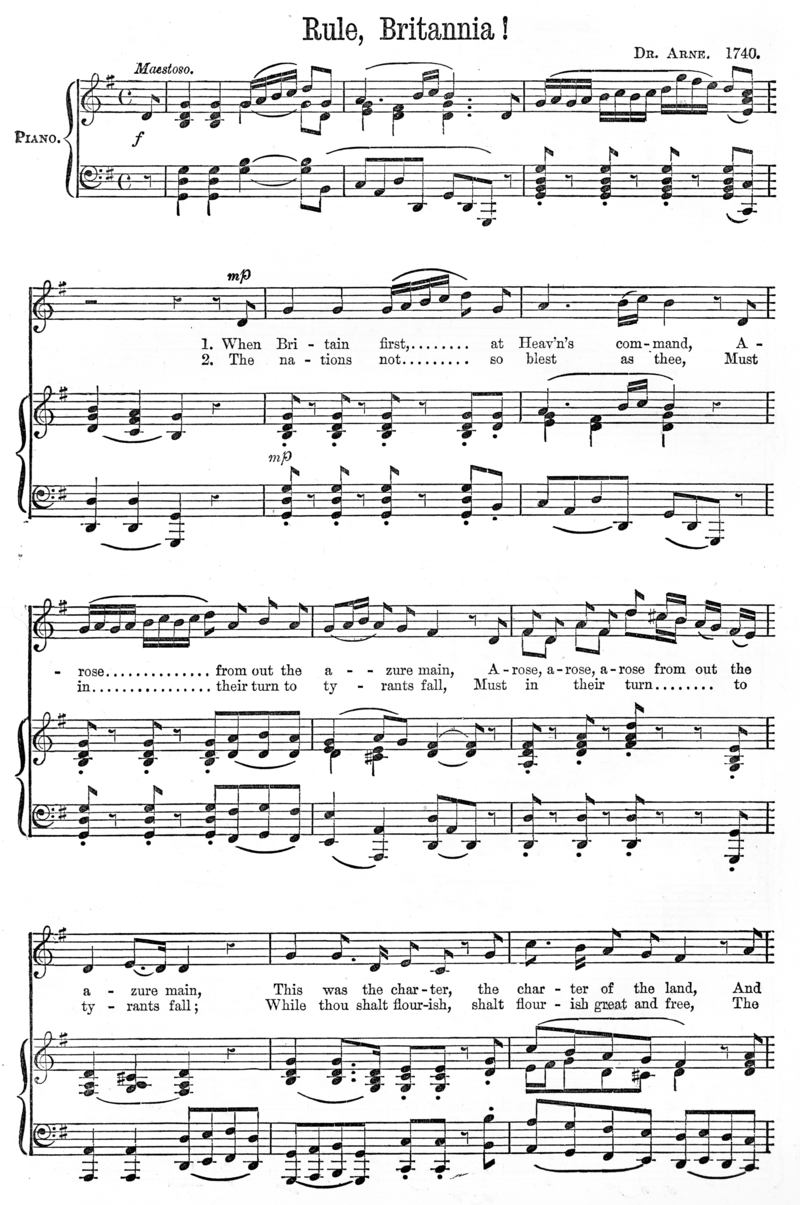
First page of an 1890s edition of the sheet music ~ James Thompson (1700-1748) Thomas Augustine Arne (1710–1778) – The Songs of England, Volume I, Edited by J. L. Hatton, Boosey & Co, London (c. 1890s) ~ Public Domain ~ via Wikipedia

In 2000, David Armitage claimed the the song was a lasting expression of the conception of Britain and the British Empire as we think of it during the 18th and 19th centuries. “He equates the song with Bolingbroke‘s On the Idea of a Patriot King (1738), also written for the private circle of Frederick, Prince of Wales, in which Bolingbroke had “raised the spectre of permanent standing armies that might be turned against the British people rather than their enemies”. [Armitage, David (2000). The Ideological Origins of the British Empire. Cambridge University Press. p. 185.] “Hence British naval power could be equated with civil liberty, since an island nation with a strong navy to defend it could afford to dispense with a standing army which, since the time of Cromwell, was seen as a threat and a source of tyranny.”

“At the time it appeared, the song was not a celebration of an existing state of naval affairs, but an exhortation. Although the Dutch Republic, which in the 17th century presented a major challenge to English sea power, was obviously past its peak by 1745, Britain did not yet “rule the waves”, although, since it was written during the War of Jenkins’ Ear, it could be argued that the words referred to the alleged Spanish aggression against British merchant vessels that caused the war. The time was still to come when the Royal Navy would be an unchallenged dominant force on the oceans. The jesting lyrics of the mid-18th century would assume a material and patriotic significance by the end of the 19th century.” [Wikipedia]

Story Blurb: Ballerinas were never ladies in Regency London, but Miss Marian Cooper was different. She was a woman of substance, the type of female a miserable example of English “quality” required to make him man enough to inherit the title of Marquess of Coulter.

Giveaway: I have 6 eBook copies of Regency Summer Melodies available to those who comment on the posts regarding this release. Winners will be announced on July 7, 2025, and contacted by email.

Regency Summer Melodies – Releasing 5 July 2025 – https://www.amazon.com/dp/B0FD8FT6C4/

Posted in aristocracy, blog hop, book release, books, Dreamstone Publishing, eBooks, Georgian England, Georgian Era, giveaway, historical fiction, history, publishing, Regency era, research, writing | Tagged , , , , , , , , , , , , , , , , , | Comments Off on Connection of “Rule Britannia!” to “Never Contradict a Lady” + the Release of “Regency Summer Melodies” + a Giveaway

Charles Didelot and “Pointe” Ballet Shoes and “Never Contradict a Lady” + the Release of “Regency Summer Melodies” + a Giveaway

My story is the Summer Melodies anthology you may see below is called “Never Contradict a Lady,” and it is about a ballerina in the Royal Theatre during the Regency era. One of the first lesson I had to relearn was that ballerinas in the Regency did not have “pointe shoes.”

The “pointe shoe” is one of the first images that comes to mind when we consider a ballerina. My cover designer for this story and I were looking for something “authentic,” but, in reality, the few images available would not have convinced a modern reader to choose the book.

Images Can Be Found at https://pointemagazine.com/history-of-pointe-shoes/#gsc.tab=0

The long lines dancers attempt to display in the day is assuredly given “notice” when they rise up on their toes. It said that Charles Didelot first invented a pair of pointe shoes in 1795.

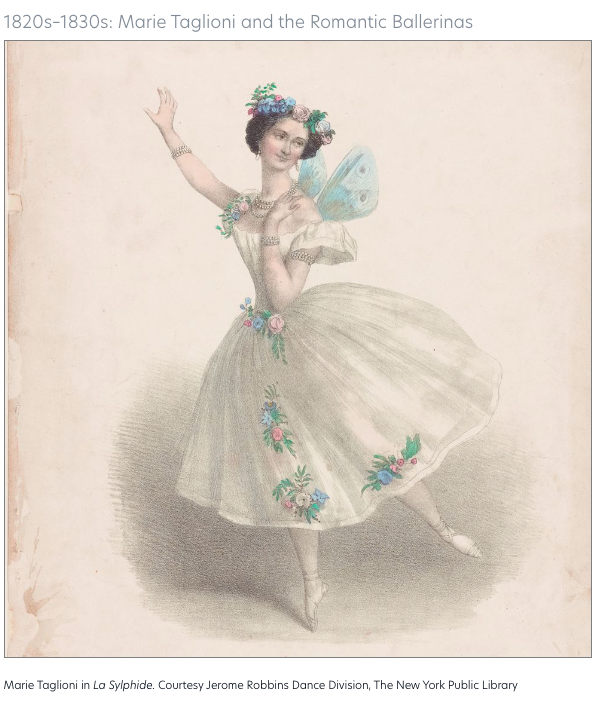
Marie Taglioni is often thought to be one of the first ballerinas to perfect the art of dancing on pointe. Her shoes were nowhere near as strong as today’s pointe shoes. She had to rely solely on the strength of her feet and ankles. The steps she performed on the tips of her toes where few and brief. As dancers strived to do more and more on pointe, the shoe evolved into something much stronger and more supportive. Anna Pavlova, a famous Russian ballerina, took it upon herself to create a better pointe shoe. She made the shank harder and flattened the box to help her balance longer and do more advanced steps on pointe. Her peers accused her of cheating but the audience loved her and her shoe became the basis for today’s pointe shoes. {Dance Talk}

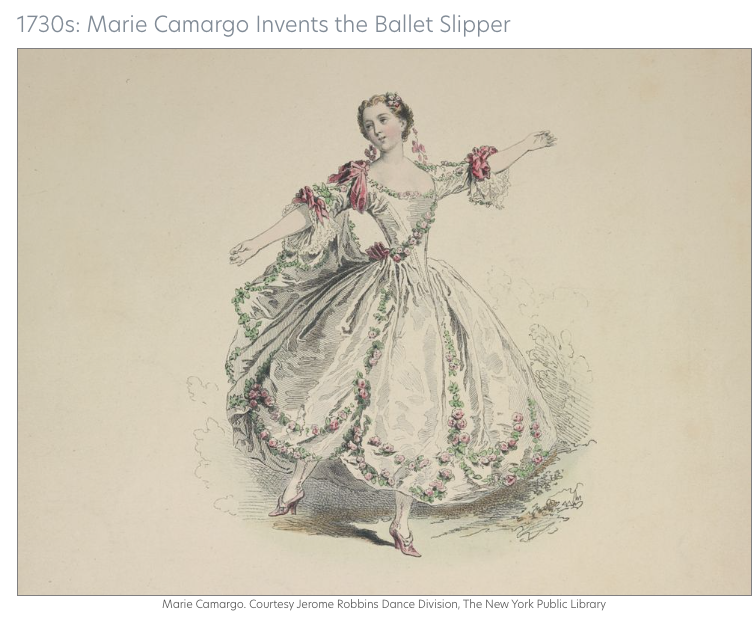
The History of Pointe Shoes provides us this background information that goes with the image of Marie Camargo above. “During ballet’s creation in the courts of Europe, dancers wore heeled shoes in line with the era’s aesthetic. In the 1730s, Paris Opéra Ballet dancer Marie Camargo was the first to remove her shoes’ heels, forging the way for the soft slipper we know today. “Camargo is the transitional point between a heeled shoe and pointe shoe. She is the ballet slipper,” says Linda Murray, curator of the Jerome Robbins Dance Division of the New York Public Library for the Performing Arts. The slipper allowed Camargo to perform leaps and fast allégros that were not possible in heeled shoes, expanding movement vocabulary for ballerinas.”

Heritage Crafts tells us, “In the 1920s Mr Freed (a trained ballet shoe maker) and Mrs Freed (a milliner) developed a new approach to measuring and fitting ballet shoes. They also developed an approach to manufacturing that, by training workers to specialise in a particular technique, enabled the mass production of shoes at a reduced cost.

“Today, Freed of London remains one of the largest pointe shoe making companies in the world. They make all their shoes by hand and both their mass-produced stock shoes and bespoke shoes are made using exactly the same processes, meaning that both a beginner dancer and prima ballerina may be wearing shoes made by the same craftsperson. Each maker has their own cipher that is added to the shoe and many professional dancers will often develop a relationship with a particular maker. Freed has two factories in Hackney and Leicester, both of which make pointe shoes alongside other dance shoes and dancewear products.

“The Suffolk Pointe Shoe factory is located in Leicester. Suffolk is a family owned business operating in the village of Earl Shilton. Mark Suffolk, M.B.E. founded the company in 2000 after being in the pointe shoe industry for 18 years. Mark developed innovative making techniques to elevate a pointe shoe’s design while keeping classic making principles and traditional materials. Suffolk has become a full service ballet brand expanding into dance apparel and accessories, but is a pointe shoe company at heart. Suffolk shoes are best known in the US where they are a market leader. All Suffolk shoes are made by hand. Suffolk offers both stock shoes to dance retailers and bespoke shoes to professional dancers.”

Story Blurb: Ballerinas were never ladies in Regency London, but Miss Marian Cooper was different. She was a woman of substance, the type of female a miserable example of English “quality” required to make him man enough to inherit the title of Marquess of Coulter.

Giveaway: I have 6 eBook copies of Regency Summer Melodies available to those who comment on any or all the promotional posts for this new book. Winners will be chosen on July 7, 2025, and contacted by email.

Regency Summer Melodies releases 5 July 2025. https://www.amazon.com/dp/B0FD8FT6C4/

Posted in aristocracy, blog hop, book release, books, British history, dancing, Dreamstone Publishing, eBooks, Georgian England, Georgian Era, giveaway, hero, heroines, historical fiction, publishing, Regency era, Regency romance, writing | Tagged , , , , , , , , , , , , , , , | Comments Off on Charles Didelot and “Pointe” Ballet Shoes and “Never Contradict a Lady” + the Release of “Regency Summer Melodies” + a Giveaway

“Rosamond” by Thomas Arne in “Never Contradict a Lady” and the Release of “Regency Summer Melodies” + a Giveaway

In my latest story Never Contradict a Lady, my heroine is a ballet dancer in the Opera House in Regency London. Miss Marian Cooper begins as a minor dancer waving large feathers in the chorus, but her natural talent and athleticism leads her to one of the starring roles, along with the prima ballerina, Madame Caroline, and the French composer (what we now call a “choreographer”), Monsieur Rameau. Mademoiselle Marian has also drawn the notice of cousins: Mr. Patrick Isaac, the son of a baron, who is one of the opera’s patrons, as well as Lord Gabriel Bruck, the son of the Marquess of Coulter.

The theme of this summer’s anthology is Summer Melodies, and, in truth, I thought to write about a songstress or a heroine who played the harp or the pianoforte, but, you see, I truly no little about either. I am part of the Sputnik generation where we gave up the fine arts for advanced math and science. However, I do know something of dance, for I was crippled as a young child and dance was part of my therapy, so my heroine is a ballerina.

In my story, the final opera of the season is Thomas Arne’s “Rosamond.” This particular opera was first performed with a libretto by Joseph Addison at the Lincoln’s Inn Fields Theatre in London on 1 March 1733.

Thomas Arne – Wikipedia

“Rosamund” was Arne’s first opera. He was 23 years of age at the time. It was a resetting of an earlier libretto Addison had written for the 1707 opera “Rosamund” by the composer Thomas Clayton. Arne’s sister and brother both made their opera debut in this work, with his sister Susannah playing the title role. The original cast include not only Susannah as Rosamund, but also Richard Leveridge, a singer, but also a composer of Baroque music, as Sir Trusty, Jane Barbier, a contralto best known for her performances of Handel’s operas, along with Isabella Chambers (Grideline) and Richard Arne (page). Its popular airs “Rise, Glory, Rise” was sung regularly for many years afterwards.

As a side note, Thomas Arne is well known in Great Britain for another accomplishment. He set to music James Thomson’s poem “Rule, Britannia”. The song was originally the final number in Arne’s masque, Alfred, about Alfred the Great. It was written to commemorate the accession of Frederick’s grandfather George I and the birthday of Princess Augusta.  “Rule, Britannia” was the most lasting expression of the conception of Britain and the British Empire that emerged in the 1730s.

Page 1 of the music – Wikipedia

Story Blurb: Ballerinas were never ladies in Regency London, but Miss Marian Cooper was different. She was a woman of substance, the type of female a miserable example of English “quality” required to make him man enough to inherit the title of Marquess of Coulter.

Giveaway: I have 6 eBook copies of Regency Summer Melodies for those who comment on the various posts regarding this release. Winners will be chosen on 7 July 2025 and winners will be contacted by email.

Regency Summer Melodies – releasing 5 July 2025 – https://www.amazon.com/dp/B0FD8FT6C4/

Posted in blog hop, book release, books, British history, dancing, Dreamstone Publishing, eBooks, Georgian England, Georgian Era, giveaway, Great Britain, hero, heroines, historical fiction, history, Living in the Regency, Living in the UK, publishing, Regency era, Regency personalities, research, romance, theatre | Tagged , , , , , , , , , , , , , , , , | Comments Off on “Rosamond” by Thomas Arne in “Never Contradict a Lady” and the Release of “Regency Summer Melodies” + a Giveaway

Happy 249th Birthday America!!! Can You Answer the Questions All U.S. Citizens Should Know?

June | 2013 | What's Happening @ ACPL acplwhatshappening.wordpress.com

June | 2013 | What’s Happening @ ACPL
acplwhatshappening.wordpress.com

NEXT YEAR WILL BE 250 YEARS, BUT I THOUGHT I MIGHT RATTLE YOUR BRAIN A BIT BEFORE THEN. 

Below is a sample of the types of questions one must master in order to become a naturalized citizen of the United States. Do you have what it takes??? On a recent survey, only 75% of those asked knew that the U.S. sought its independence from Great Britain. Only 53% knew in what year the U.S. declared its independence. The answerS follow each question, so do not cheat!

* If you are 65 years old or older and have been a legal permanent resident of the United States for 20 or more years, you may study just the questions that are marked with an asterisk.

AMERICAN GOVERNMENT

Principles of American Democracy

1. What is the supreme law of the land?

A: The Constitution

2. What does the Constitution do?

A: sets up the government
A: defines the government
A: protects basic rights of Americans

3. The idea of self-government is in the first three words of the Constitution. What are these words?

A: We the People

4. What is an amendment?

A: a change (to the Constitution)
A: an addition (to the Constitution)

5. What do we call the first ten amendments to the Constitution?

A. The Bill of Rights

6. What is one right or freedom from the First Amendment?*

A: speech
A: religion
A: assembly
A: press
A: petition the government

7. How many amendments does the Constitution have?

A: twenty-seven (27)

8. What did the Declaration of Independence do?

A: declared our independence (from Great Britain)

9. What are two rights in the Declaration of Independence?

A: life
A: liberty
A: pursuit of happiness

10. What is freedom of religion?

A: A citizen may practice any religion, or not practice a religion.

11. What is the economic system in the United States?*

A: capitalist economy
A: market economy

12. What is the “rule of law”?

A: Everyone must follow the law.
A: Leaders must obey the law.
A: Government must obey the law.
A: No one is above the law.

System of Government

13. Name one branch or part of the government.*

A: Congress
A: legislative
A: President
A: executive
A: the courts
A: judicial

14. What stops one branch of government from becoming too powerful?

A: checks and balances
A: separation of powers

15. Who is in charge of the executive branch?

A: the President

16. Who makes federal laws?

A: Congress
A: Senate and House (of Representatives)
A: (U.S. or national) legislature

17. What are the two parts of the U.S. Congress?*

A: the Senate and House (of Representatives)

18. How many U.S. Senators are there?

A: one hundred (100) – 2 per each state

19. We elect a U.S. Senator for how many years?

A: six (6)

20. Who is one of your state’s U.S. Senators?*

A: Answers will vary. [For District of Columbia residents and residents of U.S. territories, the answer is that D.C. (or the territory where the applicant lives) has no U.S. Senators.]

21. The House of Representatives has how many voting members?

A: four hundred thirty-five (435)

22. We elect a U.S. Representative for how many years?

A: two (2)

23. Name your U.S. Representative.

A: Answers will vary. [Residents of territories with nonvoting Delegates or resident Commissioners may provide the name of that Delegate or Commissioner. Also acceptable is any statement that the territory has no (voting) Representatives in Congress.]

24. Who does a U.S. Senator represent?

A: all people of the state

25. Why do some states have more Representatives than other states?

A: Number of representatives is based on the state’s population.

26. We elect a President for how many years?

A: four (4)

27. In what month do we vote for President?*

A: November

28. What is the name of the President of the United States now?*

A: Barack Obama

29. What is the name of the Vice President of the United States now?

A: Joseph R. Biden, Jr.

30. If the President can no longer serve, who becomes President?

A: the Vice President

31. If both the President and the Vice President can no longer serve, who becomes President?

A: the Speaker of the House

32. Who is the Commander in Chief of the military?

A: the President

33. Who signs bills to become laws?

A: the President

34. Who vetoes bills?

A: the President

35. What does the President’s Cabinet do?

A: advises the President

36. What are two Cabinet-level positions?

A: Secretary of Agriculture
A: Secretary of Commerce
A: Secretary of Defense
A: Secretary of Education
A: Secretary of Energy
A: Secretary of Health and Human Services
A: Secretary of Homeland Security
A: Secretary of Housing and Urban Development
A: Secretary of Interior
A: Secretary of State
A: Secretary of Transportation
A: Secretary of Treasury
A: Secretary of Veterans’ Affairs
A: Secretary of Labor
A: Attorney General

37. What does the judicial branch do?

A: reviews laws
A: explains laws
A: resolves disputes (disagreements)
A: decides if a law goes against the Constitution

38. What is the highest court in the United States?

A: the Supreme Court

39. How many justices are on the Supreme Court?

A: nine (9)

40. Who is the Chief Justice of the United States?

A: John Roberts (John G. Roberts, Jr.)

41. Under our Constitution, some powers belong to the federal government. What is one power of the federal government?

A: to print money
A: to declare war
A: to create an army
A: to make treaties

42. Under our Constitution, some powers belong to the states. What is one power of the states?

A: provide schooling and education
A: provide protection (police)
A: provide safety (fire departments)
A: give a driver’s license
A: approve zoning and land use

43. Who is the Governor of your state?

A: Answers will vary. [Residents of the District of Columbia and U.S. territories without a Governor should say “we don’t have a Governor.”]

44. What is the capital of your state?*

A: Answers will vary. [District of Columbia residents should answer that D.C. is not a state and does not have a capital. Residents of U.S. territories should name the capital of the territory.]

45. What are the two major political parties in the United States?*

A: Democratic and Republican

46. What is the political party of the President now?

A: Democratic (Party)

47. What is the name of the Speaker of the House of Representatives now?

A: John Boehner

Rights and Responsibilities

48. There are four amendments to the Constitution regarding who can vote. Describe one of them.

A: Citizens eighteen (18) and older (can vote).
A: You don’t have to pay (a poll tax) to vote.
A: Any citizen can vote. (Women and men can vote.)
A: A male citizen of any race (can vote).

49. What is one responsibility that is only for United States citizens?*

A: serve on a jury
A: vote

50. What are two rights only for United States citizens?

A: apply for a federal job
A: vote
A: run for office
A: carry a U.S. passport

51. What are two rights of everyone living in the United States?

A: freedom of expression
A: freedom of speech
A: freedom of assembly
A: freedom to petition the government
A: freedom of worship
A: the right to bear arms

52. What do we show loyalty to when we say the Pledge of Allegiance?

A: the United States
A: the flag

53. What is one promise you make when you become a United States citizen?

A: give up loyalty to other countries
A: defend the Constitution and laws of the United States
A: obey the laws of the United States
A: serve in the U.S. military (if needed)
A: serve (do important work for) the nation (if needed)
A: be loyal to the United States

54. How old do citizens have to be to vote for President?*

A: eighteen (18) and older

55. What are two ways that Americans can participate in their democracy?

A: vote
A: join a political party
A: help with a campaign
A: join a civic group
A: join a community group
A: give an elected official your opinion on an issue
A: call Senators and Representatives
A: publicly support or oppose an issue or policy
A: run for office
A: write to a newspaper

56. When is the last day you can send in federal income tax forms?*

A: April 15

57. When must all men register for the Selective Service?

A: at age eighteen (18)
A: between eighteen (18) and twenty-six (26)

AMERICAN HISTORY

Colonial Period and Independence

58. What is one reason colonists came to America?

A: personal freedom
A: political liberty
A: religious freedom
A: economic opportunity
A: escape persecution

59. Who lived in America before the Europeans arrived?

A: Native Americans

60. What group of people was taken to America and sold as slaves?

A: Africans

61. Why did the colonists fight the British?

A: because of high taxes (taxation without representation)
A: because the British army stayed in their houses (boarding, quartering)
A: because they didn’t have self-government

62. Who wrote the Declaration of Independence?

A: (Thomas) Jefferson

63. When was the Declaration of Independence adopted?

A: July 4, 1776

64. There were 13 original states. Name three.

A: New Hampshire
A: Massachusetts
A: Rhode Island
A: Connecticut
A: New York
A: New Jersey
A: Pennsylvania
A: Delaware
A: Maryland
A: Virginia
A: North Carolina
A: South Carolina
A: Georgia

65. What happened at the Constitutional Convention?

A: The Founding Fathers wrote the Constitution.

66. When was the Constitution written?

A: 1787

67. The Federalist Papers supported the passage of the U.S. Constitution. Name one of the writers.

A: (James) Madison
A: (Alexander) Hamilton
A: (John) Jay
A: Publius

68. What is one thing Benjamin Franklin is famous for?

A: U.S. diplomat
A: oldest member of the Constitutional Convention
A: first Postmaster General of the United States
A: writer of “Poor Richard’s Almanac”
A: started the first free libraries

69. Who is the “Father of Our Country”?

A: (George) Washington

70. Who was the first President?*

A: (George) Washington

1800s in America

71. What territory did the United States buy from France in 1803?

A: the Louisiana Territory

72. Name one war fought by the United States in the 1800s.

A: War of 1812
A: Mexican-American War
A: Civil War
A: Spanish-American War

73. Name the U.S. war between the North and the South.

A: the Civil War
A: the War between the States

74. Name one problem that led to the Civil War.

A: slavery
A: economic reasons
A: states’ rights

75. What was one important thing that Abraham Lincoln did?*

A: freed the slaves (Emancipation Proclamation)
A: saved (or preserved) the Union
A: led the United States during the Civil War

76. What did the Emancipation Proclamation do?

A: freed slaves in the Confederate states

77. What did Susan B. Anthony do?

A: fought for women’s rights
A: fought for civil rights

Recent American History and Other Important Historical Information

78. Name one war fought by the United States in the 1900s.*

A: World War I
A: World War II
A: Korean War
A: Vietnam War
A: (Persian) Gulf War

79. Who was President during World War I?

A: (Woodrow) Wilson

80. Who was President during the Great Depression and World War II?

A: (Franklin) Roosevelt

81. Who did the United States fight in World War II?

A: Japan, Germany and Italy

82. Before he was President, Eisenhower was a general. What war was he in?

A: World War II

83. During the Cold War, what was the main concern of the United States?

A: Communism

84. What movement tried to end racial discrimination?

A: Civil Rights (movement)

85. What did Martin Luther King, Jr., do?*

A: fought for civil rights
A: worked for equality for all Americans

86. What major event happened on September 11, 2001, in the United States?

A: Terrorists attacked the United States

87. Name one American Indian tribe in the United States.

[Adjudicators will be supplied with a complete list. The one below is no exclusive.]

A: Cherokee
A: Navajo
A: Sioux
A: Chippewa
A: Choctaw
A: Pueblo
A: Apache
A: Iroquois
A: Creek
A: Blackfeet
A: Seminole
A: Cheyenne
A: Arawak
A: Shawnee
A: Mohegan
A: Huron
A: Oneida
A: Lakota
A: Crow
A: Teton
A: Hopi
A: Inuit

INTEGRATED CIVICS

Geography

88. Name one of the two longest rivers in the United States.

A: Missouri (River)
A: Mississippi (River)

89. What ocean is on the West Coast of the United States?

A: Pacific (Ocean)

90. What ocean is on the East Coast of the United States?

A: Atlantic (Ocean)

91. Name one U.S. territory.

A: Puerto Rico
A: U.S. Virgin Islands
A: American Samoa
A: Northern Mariana Islands
A: Guam

92. Name one state that borders Canada.

A: Maine
A: New Hampshire
A: Vermont
A: New York
A: Pennsylvania
A: Ohio
A: Michigan
A: Minnesota
A: North Dakota
A: Montana
A: Idaho
A: Washington
A: Alaska

93. Name one state that borders Mexico.

A: California
A: Arizona
A: New Mexico
A: Texas

94. What is the capital of the United States?*

A: Washington, D.C.

95. Where is the Statue of Liberty?*

A: New York (Harbor)
A: Liberty Island
[Also acceptable are New Jersey, near New York City, and on the Hudson (River).]

Symbols

96. Why does the flag have 13 stripes?

A: because there were 13 original colonies

97. Why does the flag have 50 stars?*

A: because there is one star for each state

98. What is the name of the national anthem?

A: The Star-Spangled Banner

Holidays

99. When do we celebrate Independence Day?*

A: July 4

100. Name two national U.S. holidays.

A: New Year’s Day
A: Martin Luther King, Jr., Day
A: Presidents’ Day
A: Memorial Day
A: Independence Day
A: Labor Day
A: Columbus Day
A: Veterans Day
A: Thanksgiving
A: Christmas

NOTE: The questions above will be asked of applicants who file for naturalization on or after October 1, 2008. 

Posted in America, American History, citizenship test | Tagged , , , , , | Comments Off on Happy 249th Birthday America!!! Can You Answer the Questions All U.S. Citizens Should Know?

Celebrating the Release of “Lyon in the Way,” Book 1 of My New Regency Romantic Suspense/Mystery Series from Dragonblade Publishers

Meet Lord Richard Orson, the oldest of the five “sons” of Lord Macdonald Duncan. None of the men are Lord Duncan’s real sons, for Duncan’s wife, Lady Elsbeth, died in child birth with their son. The two of them readily selected three boys: Lord Richard Orson, Lord Aaran Graham, and Lord Navan Beaufort. After Lady Elsbeth’s passing, Duncan claimed custody of two others: Lord Alexander Dutton (Lord Marksman) and Lord Benjamin Thompson. Each young lord came into Duncan’s household somewhere between the ages of 9 to 13.

Duncan is an elected Scottish lord to the British Parliament and leader of the Scottish delegation. He is also heavily involved in the Home Office for the English government, working to prevent sedition and various other crimes plaguing the populace. All the stories are set in 1812 and the early part of of 1813. He has trained each son to be an agent for the Home Office.

The first we will meet is the oldest, Lord Richard Orson. Remember, each youth who comes to live with Duncan has experience an attack on his person and their family unit. The young lords survive with the assistance of Lord Duncan, who insures that they will not only inherit, but they will be powerful lords of the Realm.

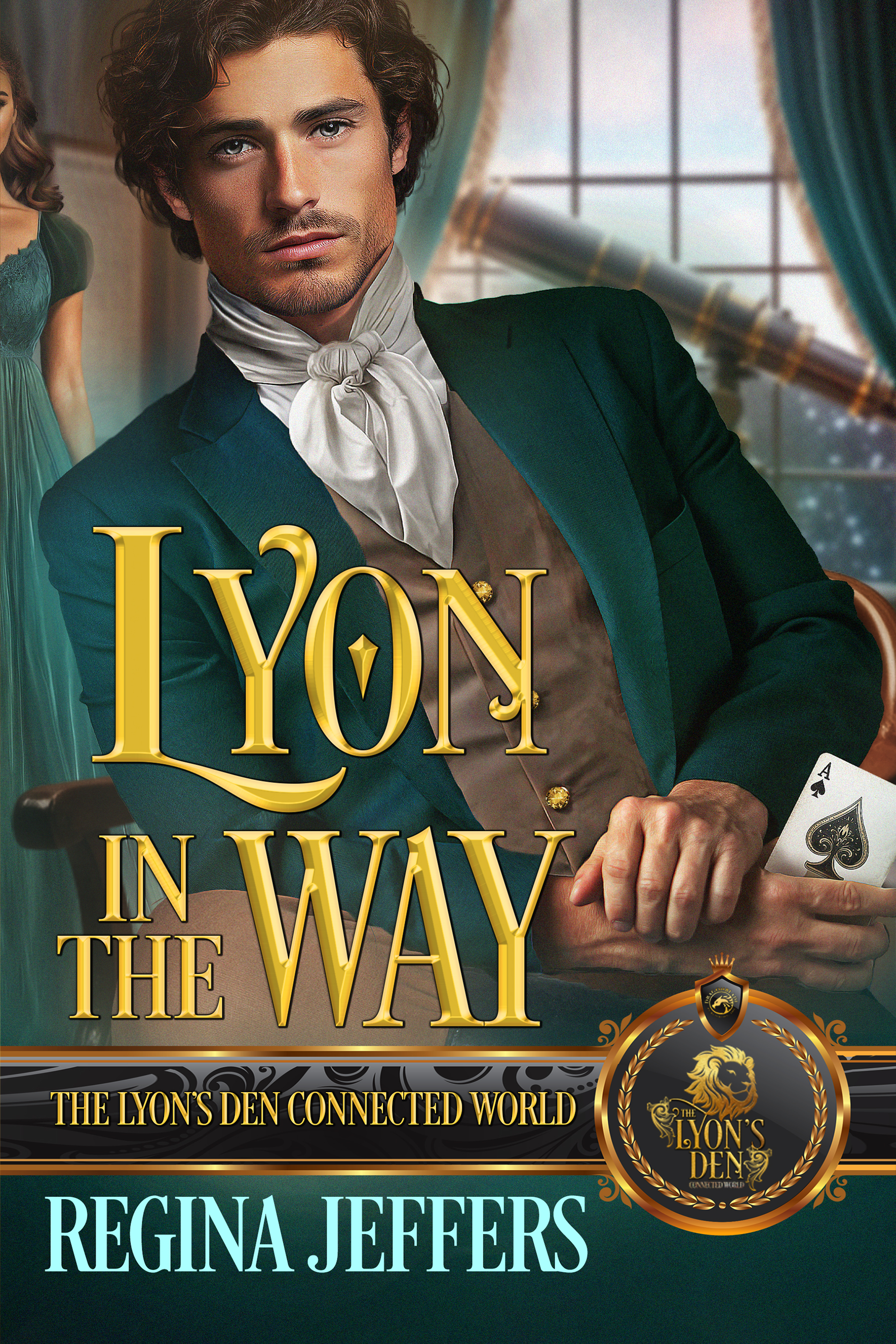
What might I tell you about Lord Orson? First, at age 26, he is the eldest of Duncan’s sons. As you can view for yourself, he is exceedingly handsome. He has an interest in studying the galaxy and the stars. He was very resentful of having been placed under Duncan’s guardianship, but that was because he did not not understand his uncle’s desire to kill him. His parents died within a year of each other, but neither was particularly involved in his life as a child; in fact, it was when he came to stay with Duncan and Lady Elsbeth that he finally recognized the intrinsic value of “family.”

Our Lord Orson holds a distinct interest in Lady Emma Donoghue, even before he actually meets her, not that he will admit it to anyone, not even to himself. Lady Emma’s father is a diplomat on the Continent, and she lives alone in the Donoghue House, with only servants for company. She, along with several other bluestockings, have become quite outspoken in their beliefs regarding female disenfranchisement, going so far as to block gentlemen from entering their social clubs. Lady Emma is ALL that is WRONG for Richard, who holds aspirations of one day holding a prominent place in government, but

Each of the five books of this series begins with the same scene outside of the infamous Lyon’s Den. The scenes are told from the point of view of the hero of that particular book. With each new book, the reader will learn more and more of the details of the attack on Lord Duncan.

Each book in the series can stand alone as a romantic suspense, but there is a mystery that overlaps all five that will culminate in book 5.

The year 1812 was chosen as the backdrop for all these tales, for it is the year in which Prime Minister Spencer Perceval is shot in the halls of Parliament. Moreover, the United Irish Men were active, as well as the Luddites, and a few other less well-known “uproars” were brought to justice, just the kind of thing a group of men associated with the Home Office would wish to see settled.

So, meet Lord Richard Orson!!! Is he not dreamy?

One man wants her dead. Another may love her forever.

For over a year, Lord Richard Orson has been quietly captivated by the unconventional Lady Emma Donoghue. Headstrong, brilliant, and unapologetically involved in causes that rattle Society’s comfort, Emma is nothing like the debutantes he’s expected to court.

But when he finds her bruised, confused, and alone in Covent Garden after midnight, Richard is thrust into a far more dangerous game.

Someone wants Emma silenced. And now, Richard has only moments to uncover the truth, protect her from harm, and keep her out of scandal’s reach. But staying focused is harder than he imagined—especially when every glance, every accidental touch, reminds him how perfectly she fits in his arms.

Tropes you’ll love:
✔ Protective hero / damsel in distress (with a twist)
✔ Bluestocking heroine
✔ Rescue & recovery romance
✔ Unlikely match / opposites attract
✔ Slow burn with rising suspense
✔ One bed (forced proximity)
✔ Hero falls first

As danger closes in and secrets are revealed, Richard must decide whether he’s willing to risk his life—and his heart—for a woman who’s always been worth the fight.

A suspenseful, slow-burn Regency romance where danger ignites desire, and love must outpace the clock.

Purchase Link:

Read in Kindle Unlimited!

Enjoy book one in a new series within The Lyon’s Den Connected world by Regina Jeffers.

Book 1 – Lyon in the Way
Book 2 – Lyon’s Obsession
Book 3 – Lyon in Disguise
Book 4 – Lost in the Lyon’s Garden
Book 5 – Lyon on the Inside

Posted in blog hop, book release, books, British history, Dragonblade Publishers, eBooks, Georgian England, Georgian Era, giveaway, hero, heroines, historical fiction, peerage, publishing, reading, Regency era, suspense, writing | Tagged , , , , , , , , , , , , , , , , | Comments Off on Celebrating the Release of “Lyon in the Way,” Book 1 of My New Regency Romantic Suspense/Mystery Series from Dragonblade Publishers