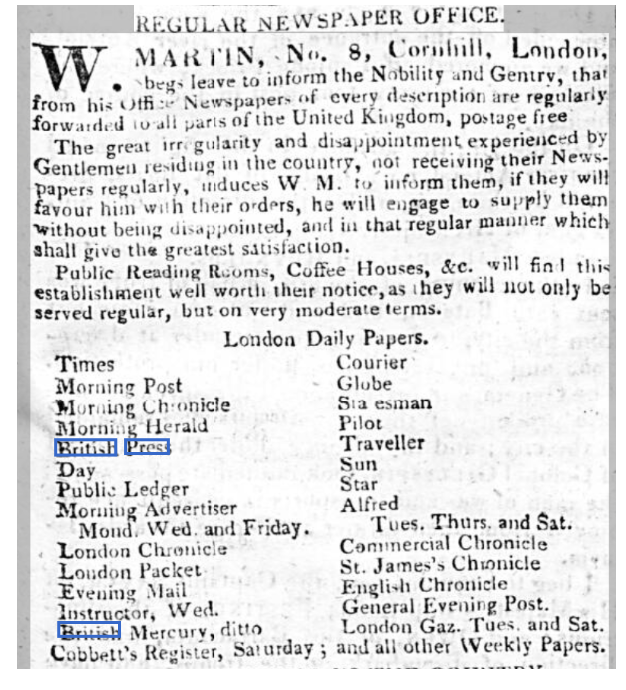
I have seen and read some copies of actual newspapers of the Regency period which had been digitalized. Naturally, it is possible that there were no marriages of importance to share with the public on those particular dates, but I have screen shots of a few copies of the Times, the Morning Chronicle and the Morning Post, with varying dates. In none of them is there a betrothal announcement.
In fact, I have only seen an announcement of a forthcoming wedding three times in all the Georgian era documents I have encountered, and, with each, it was more of gossip section of the paper rather than the a legitimate report. Though I cannot recall the exact wording at this time, it went something like this:
It is said among those at last evening fête that Lord Salanger is to marry Miss Theodora Thompson, who has a fortune of £20,000. Lord T is 42 and Miss T is 21.
Just remember that gossip is just that: GOSSIP. It has a chance of being accurate, but a larger chance of inaccuracy.
Angelyn’s Blog provides us some more humorous ones:
“And now for some various Regency-era nuptial announcements from La Belle Assemblée or, Bell’s Court and Fashionable Magazine Addressed Particularly to the Ladies .
“From the March, 1817 issue of the aforesaid Magazine:
“At Ringwood, Mr. T. Bloomfield, aged 70, to Mrs. Mooren, aged 40. So decrepit and helpless was the old man that it was with the greatest difficulty that he could be taken from the chaise which brought him from the church; and when in the church he was obliged to be drawn to the altar in a cart.”
“Another singular notification appeared in the September issue of that same year:
“At Rothwell Church, Mr. Thomas Craven, of the Leeds Pottery, to Miss Coultare, both of Leeds, after a tedious courtship of twenty-eight years, six months and six days.”
I found this example on a Reddit chat group, so I cannot speak to its legitimacy, but it is interesting, nonetheless.
“I was just reading a historic newspaper from a few years before Austen was born.
“There is this announcement in the paper
“On Thursday last was married, the Rev. Mr Sutcliffe of Halifax* to Miss Garforth, only daughter of Samuel Garforth of Warley, a most amiable and accomplished young lady possessed of every accomplishment to render the marriage state happy, with a fortune of 1000 l” (l standing for pounds here).”
None of the other papers mention forth coming weddings at all. The vital statistics column reported births, death, and weddings but only after they had taken place. These same statistics were reported in the Annual Register.
I know many authors have built plots around having betrothals announced in the newspaper, but I just have not found any except for Princess Charlotte’s.
The ever-fabulous Cheryl Bolen tells us, “Love matches were definitely the norm in the Regency but were not the same as today’s. A significant difference in so-called love matches was that the upper class had to pick potential spouses from a select pool. Aristocrats wed other aristocrats or persons who shared their social sphere.
“A title holder could (but rarely did) marry beneath him. In 1812 the lecherous 42-year-old Lord Berwick married the 15-year-old courtesan who was sister to the famed courtesan Harriette Wilson. And the Duke of St. Albans married a former actress in 1827. Younger aristocratic sons, however, could be cut off completely if they married a woman from the lower classes.
“Genteel young ladies almost never engaged in premarital sex. They were shielded from sex and not permitted to be alone with gentlemen. Even Lady Caroline Lamb, who later became famous for her adultery with Lord Byron (and others), was a complete innocent when she married William Lamb (later Prime Minister Lord Melbourne) at age 19. She was shocked and unhappy over the action that robbed her virginity, and it took her some time to recover.”
Many newspapers had accounts of balls, routs, dinners, and other fashionable gatherings so there was a place where such announcements could appear, BUT did not, at least, with some regularity.
So, despite the fact that many an announcement of a forthcoming marriage is sent to a fictional newspaper, it did not, generally, happen in real life.


