Winners of “His Irish Eve” Giveaway from Regina Jeffers

His Irish EvejpgI am pleased to announce the winners of an eBook copy of “His Irish Eve. ” Hopefully, all listed below received a prize notice from Kindle by now. Enjoy the book. Later this week, I will be releasing a new title and hosting another round of giveaways so come back for more fun. 

winners_areThe winners are…

Beatrice

Lindsay Downs

Glenda

spiritofnlm

Lois Losh 

Posted in Uncategorized | Tagged , , | 3 Comments

Post Traumatic Stress Syndrome: A Plot Point

My upcoming release, The Prosecution of Mr. Darcy’s Cousin: A Pride and Prejudice Mystery, uses Post-Traumatic Stress Disorder as part of the plot line, but as my book is set in the Regency period (1811-1820) in England, when no such distinction was made for the disease, it was important to treat the disorder’s presence in the main character’s life with a large dose of research. There are references to what we now term “PTSD” in the Bible (story of Job comes to mind), the writings of the Greek historian Herotodus (i.e., his description of the Spartan leader Leonidas – the guy from 300), the Mahabharata, Homer’s description of Ajax’s madness, and Shakespeare’s descriptions (via Lady Percy) of Harry Percy’s nightmares and delusions, as well as the accounts of Macbeth. Samuel Pepys’s diary holds references to the trauma many experienced after the Great Fire of London. Charles Dickens wrote of the “weakness” he experienced after a train wreck which killed 10 people and injured nearly 50. [See Yesterday’s Post on the Mention of PTSD in Early Literature]

Over the years, PTSD was known as nostalgia, homesickness, ester root, neurasthenia, hysteria, compensation sickness, railway spine, shell shock, combat exhaustion, soldier’s heart, irritable heart, stress response syndrome, etc. In my story, I use the word “melancholia” for research into the disorder did not occur until well after the Regency period. Needless to say, the many wars of the late 1700s and early 1800s (American Revolution, the War of 1812, and the Napoleonic Wars) in England brought this issue to a head. [For more on the many terms used for PTSD, see “From Irritable Heart to “Shellshock”: How Post-Traumatic Stress Became a Disease,” by Charlie Jane Anders, 4 April 2012.]   

Da Costa http://jeffline. jefferson.edu/sml/ archives/exhibits/ notable_alumni/ jacob_mendes_dacosta. html

Da Costa http://jeffline.
jefferson.edu/sml/
archives/exhibits/
notable_alumni/
jacob_mendes_dacosta.
html

During the American Civil Wart, the study of “soldier’s heart” fell into the lap of Jacob Mendez Da Costa, who took up the study of the condition and advanced what we now know of the disease. Da Costa was a well-trained and observant clinician. He held the reputation of an excellent clinical teacher and served as Chairman of Medicine at the Jefferson Medical College (now Thomas Jefferson University) for 19 years, as well as president of the College of Physicians of Philadelphia in 1884 and again in 1895; Da Costa was one of the original members of the Association of American Physicians and its president in 1897. 

In the years of the Civil War, Da Costa served as assistant surgeon in the U.S. Army and at Turner’s Lane Hospital, Philadelphia. As such, he studied a type of cardiac malady (neurocirculatory asthenia) plaguing soldiers. He described the disorder in his 1871 paper “On Irritable Heart: A Clinical Study of a Form of Functional Cardiac Disorder and Its Consequences,” a landmark study in clinical medicine. The malady was soon to be known as Da Costa’s syndrome – an anxiety disorder combining effort fatigue, left-sided chest pains, breathlessness, dyspnea, a sighing respiration, palpitations, and sweating.

In the mid-20th Century, the syndrome was thought to be a form of neurosis. It is now classified as a “somatoform autonomic dysfunction.” Earl de Grey presented four reports on British soldiers with these symptoms between 1864 and 1868. He attributed the symptoms to the heavy equipment being carried by the soldiers in knapsacks strapped to their chests. Earl de Grey asserted that the constriction of the knapsack affected the heart’s ability to function. Henry Harthorme described the Civil War soldiers who suffered with similar symptoms as being exhausted and poorly nourished. The soldier’s heart complaints were assigned as lack of sleep and bad food. In 1870, Arthur Bowen Myers of the Coldstream Guards (the Foot Guards regiments of the British Army) regarded the accouterments as the source of neurocirculatory asthenia and cardiovascular neurosis.

“J. M. Da Costa’s study of 300 soldiers reported similar findings in 1871 and added that the condition often developed and persisted after a bout of fever or diarrhea. He also noted that the pulse was always greatly and rapidly influenced by position, such as stooping or reclining. A typical case involved a man who was on active duty for several months or more and contracted an annoying bout of diarrhea or fever, and then, after a short stay in the hospital, returned to active service. The soldier soon found that he could not keep up with his comrades in the exertions of a soldier’s life as because he would become out of breath, and would get dizzy, and have palpitations and pains in his chest, yet upon examination some time later he appeared generally healthy. In 1876 surgeon Arthur Davy attributed the symptoms to military drill where ‘over-expanding the chest, caused dilatation of the heart, and so induced irritability.’” [Wikipedia]

Releasing late May 2015

Releasing late May 2015

Fitzwilliam Darcy is enjoying his marital bliss. His wife, the former Elizabeth Bennet, presented him two sons and a world of contentment. All is well until “urgency” rears its head. Darcy receives a note of exigency from his sister Georgiana. In truth, Darcy never fully approved of Georgiana’s joining with their cousin, Major General Edward Fitzwilliam, for Darcy assumed the major general held Georgiana at arm’s length, dooming Darcy’s sister to a life of unhappiness. 

Dutifully, Darcy and Elizabeth rush to Georgiana’s side when the major general leaves his wife and daughter behind, with no word of his whereabouts and no hopes of Edward’s return. Forced to seek his cousin in the slews of London’s underbelly, at length, Darcy discovers the major general and returns Fitzwilliam to his family. 

Even so, the Darcys’ troubles are far from over. During the major general’s absence, witnesses note Fitzwilliam’s presence in the area of two horrific murders. When Edward Fitzwilliam is arrested for the crimes, Darcy must discover the real culprit before his cousin is hanged for the crimes and the Fitzwilliam name marked with shame. 

Posted in American History, British history, Great Britain, Living in the Regency, Regency era | Tagged , , , , , , | 2 Comments

The Mention of “PTSD” in Early Literature

thejointblog.co

thejointblog.co

I have a new release coming soon from Pegasus Books in which the illness we now call PTSD (Post Traumatic Stress Disorder) plays a major role. The main character is accused of a series of violent crimes. Although he holds no memory of the events, the major general possesses the opportunity to commit the acts, and he has been seen in the vicinity of the crimes.

All this sounds quite cut and dry if the events did not happen in 1816, in the midst of King George’s England after the Napoleonic Wars. PTSD did not exist as we know it. So, what do we know of PTSD in history?

GotQuestions.org provides us with a summary of PTSD. “Post traumatic Stress Disorder develops in some people following a traumatic event. The event or “stressor” could be exposure to death or threatened death, actual or threatened serious injury, or actual or threatened sexual violence. The sufferer may be directly exposed, indirectly exposed through a family member or close friend experiencing the event, or extremely or repeatedly indirectly exposed through his or her work (such as first responders, police officers, military personnel, or social workers). Common trauma experiences are combat, car accidents, natural disasters, abuse, rape, and mass violence. After such an event most people will show signs of stress such as feeling on edge, anxiety, fear, anger, feelings of depression, a sense of detachment, desire to avoid trauma-related reminders, flashbacks, difficulty sleeping, headaches, changes in appetite, irritability, self-blame, “survivor’s guilt,” or a sense of numbness. For most people, these reactions lessen and eventually subside with time.”

In the Bible, Job likely suffers from PTSD. Job loses his wealth, family, health, etc. Job says of his suffering: “For my sighing cometh before I eat, and my roarings are poured out like the waters./ I was not in safety, neither had I rest, neither was I quiet; yet trouble came.” (Job 3:25-26) In Job 7: 14-15, we find, “Then thou scariest me with dreams, and terrifies me through vision:/ So that my soul chooseth strangling, and death rather than my life.”

From The History of Post Traumatic Stress Disorder, we learn more of the history of the illness. In “Mahabharata, an epic tale in Indian mythology originally written by Sage Ved Vyas in Sanskrit, Mahabharata illustrates the Great War of Mahabharat between the Pandavas and the Kauravas that happened in 3139 B. C. […] The great epic Mahabharata describes vivid combat stress reactions exhibited by the ancient worriers.” (Sir Lanka Guardian

Below is an excerpt from the horrendous combat events described in Mahabharata (as translated by Dr P. V. Vartak):

“On the 14th day of the Mahabharat War, i.e., on 30th October a similar phenomenon took place. Due to the October heat enhanced with the heat of the fire-weapons liberally used in the War, the ground became so hot that the layers of air near it were rarefied while the layers at the top were denser. Therefore the sun above the horizon ws reflected producing its image beneath. The Sun’s disc which was flattened into an ellipse by a general refraction was also joined to the brilliant streak of reflected image. The last tip of the Sun disappeared not below the true horizon, but some distance above it at the false horizon. Looking at it, Jayadratha came out and was killed. By that time, the same appeared on the true horizon. Naturally there was no refraction because the light rays came parallel to the ground. This revisualized the Sun at the true horizon. Then the sun actually set, but the refraction projected the image above the horizon. The sun was thus visible for a short time, which then set again.” (Sir Lanka Guardian)

Examples in literature abound of the evidence of PTSD. The Illiad describes multiple battles scenes and combat suffering. Could Ajax in Homer’s tale suffer from the disorder? And what of Achilles? Was not Achilles devastated by the death of his comrade Patroklos? And what of the Trojan women who waited for their husbands’ return.

Of Peleus’ son, Achilles, sing, O Muse,
the vengeance, deep and deadly; whence to Greece
unnumbered ills arose; which many a soul
of mighty warriors to the viewless shades
untimely sent; they on the battle plain
unburied lay, a prey to ravening dogs,
and carrion birds; but so had Jove decreed,
from that sad day when first in wordy war,
the mighty Agamemnon, King of men,
confronted stood by Peleus’ godlike son.
(Derby) from Illiad Study Questions
http://www.tc.umn.edu/~briel001/iliadstudyquestsngs%20

Again from The History of Post Traumatic Stress Disorder, we have another incidence of the human suffering of war. “According to archaeological and literary evidence the Jataka stories were compiled in the period, the 3rd Century B.C. to the 5th Century A.D. The Khuddaka Nikaya contains 550 stories the Buddha told of his previous lifetimes as an aspiring Bodhisatta. […] In the Jataka stories there are numerous characters who display hysteria type reactions. For instance in the Maranabheruka Jathaka, one monk shows anxiety based reactions that are similar to modern day PTSD. This monk displays extreme fear, hyper-arousal, avoidance, frightful mental pictures (flashbacks?) and emotional anesthesia.”

In the piece entitled “From ‘Irritable Heart’ to ‘Shellshock’: How Post-Traumatic Stress Became a Disease,” we have, “The Greek historian Herotodus writes a lot about PTSD, according to a presentation by Mylea Charvat to the Veterans Administration. One soldier, fighting in the battle of Marathon in 490 BC, reportedly went blind after the man standing next to him was killed, even though the blinded soldier “was wounded in no part of his body.” Also, Herotodus records that the Spartan leader Leonidas — yes, the guy from 300 — dismissed his men from combat because he realized they were mentally exhausted from too much fighting.” 

In Shakespeare, we find a description of PTSD in Henry IV, Part 2.
Tell me, sweet lord, what is’t that takes from thee
 Thy stomach, pleasure, and thy golden sleep?
Why dost thou bend thine eyes upon the earth,
And start so often when thou sit’st alone?
Why hast thou lost the fresh blood in thy cheeks,
And given my treasures and my rights of thee
To thick-eyed musing and cursed melancholy?

In Act 5, Scene 3 of Macbeth, we are provided:

“Macbeth: How does your patient, doctor?


Doctor: Not so sick, my lord, as she is troubled with thick-coming fancies that keep her from rest.


Macbeth: Cure her of that! Canst thou not minister to a mind diseased, pluck from the memory a rooted sorrow, raze out the written troubles of the brain, and with some sweet oblivious antidote cleanse the stuffed bosom of that perilous stuff which weighs upon her heart.


Doctor: Therein the patient must minister to himself.”

Samuel Pepys describes trauma after the Great Fire of London in a diary entry dated 2 September 1666:

“

Some of our maids sitting up late last night to get things ready against our feast today, Jane called up about three in the morning, to tell us of a great fire they saw in the City. So I rose, and slipped on my night-gown and went to her window, and thought it to be on the back side of Mark Lane at the farthest; but, being unused to such fires as followed, I thought it far enough off, and so went to bed again, and to sleep…. By and by Jane comes and tells me that she hears that above 300 houses have been burned down tonight by the fire we saw, and that it is now burning down all Fish Street, by London Bridge.

“So I made myself ready presently, and walked to the Tower; and there got up upon one of the high places,…and there I did see the houses at the end of the bridge all on fire, and an infinite great fire on this and the other side…of the bridge. .

So down [I went], with my heart full of trouble, to the Lieutenant of the Tower, who tells me that it began this morning in the King’s baker’s house in Pudding Lane, and that it hath burned St. Magnus’s Church and most part of Fish Street already.

“So I rode down to the waterside,…and there saw a lamentable fire…. Everybody endeavouring to remove their goods, and flinging into the river or bringing them into lighters that lay off; poor people staying in their houses as long as till the very fire touched them, and then running into boats, or clambering from one pair of stairs by the waterside to another. And among other things, the poor pigeons, I perceive, were loth to leave their houses, but hovered about the windows and balconies, till they some of them burned their wings and fell down.


“Having stayed, and in an hour’s time seen the fire rage every way, and nobody to my sight endeavouring to quench it,…I [went next] to Whitehall (with a gentleman with me, who desired to go off from the Tower to see the fire in my boat); and there up to the King’s closet in the Chapel, where people came about me, and I did give them an account [that]dismayed them all, and the word was carried into the King. so I was called for, and did tell the King and Duke of York what I saw; and that unless His Majesty did command houses to be pulled down, nothing could stop the fire. They seemed much troubled, and the King commanded me to go to my Lord Mayor from him, and command him to spare no houses….” (Sir Lanka Guardian)

hilobrow.com

hilobrow.com

Charles Dickens speak of how a train accident affected him. He says he was ”curiously weak… as if I were recovering from a long illness,” after a traumatizing railway accident in which the front of the train plunged off a bridge under repair and 10 people died, with another 49 injured. Dickens wrote in letters to people: “I begin to feel it more in my head. I sleep well and eat well; but I write half a dozen notes, and turn faint and sick… I am getting right, though still low in pulse and very nervous.” Dickens admitted to continue to feel anxiety when train travel was necessary, even after the accident described above. (From ‘Irritable Heart’ to ‘Shellshock’)

Although in my story there is no real “word” or “diagnosis” to describe the effects of war, the early literature tells us that some sort of upheaval most assuredly did exist. So wether we call it melancholia, nostalgia, ester root, heimweh, malady du pays, soldier’s heart, neurasthenia, hysteria, compensation sickness, railway spine, shell shock, combat exhaustion, stress response syndrome, situational disorders, or PTSD, physical shock, accompanied by horrifying circumstances have haunted men since the beginning of time.

PoMDC Cover-2-2Look for The Prosecution of Mr. Darcy’s Cousin: A Pride and Prejudice Mystery coming soon to fine book stores.

About Regina Jeffers
Regina Jeffers is an award-winning author of cozy mysteries, Austenesque sequels and retellings, and Regency era romances. A teacher for thirty-nine years, Jeffers often serves as a consultant for Language Arts and Media Literacy programs. With multiple degrees, Regina was a Time Warner Star Teacher, Columbus (OH) Teacher of the Year, and a Martha Holden Jennings Scholar. With 6 new releases coming out in 2015, Jeffers is considered one of publishing’s most prolific authors. Come check out some of her 19 novels: Darcy’s Passions, Captain Frederick Wentworth’s Persuasion, The Mysterious Death of Mr. Darcy, A Touch of Grace, A Touch of Honor, and The First Wives’ Club.

Recently released: Elizabeth Bennet’s Deception: A Pride and Prejudice Vagary; Mr. Darcy’s Fault: A Pride and Prejudice Vagary; His Irish Eve; and His American Heartsong

Coming Soon: Angel Comes to the Devil’s Keep and A Touch of Emerald:The Conclusion to the Realm Series


Posted in American History, British history, Great Britain, Jane Austen, Living in the Regency, real life tales | Tagged , , , , , , , | 1 Comment

Regency Lexicon – The Letters “X,” “Y,” and “Z”

Regency Era Lexicon – We’re Coming to the End – X, Y, and Z

xebec – a small three-masted Mediterranean vessel with both square and lateen sails, originally used by Algerian pirates and later used for commerce

yager – a 19th Century rifle; a muzzle-loading hunting rifle

yam – a posting house along a road

Gallery - Bookbinding, Leather Book Binder, Cloth Book Binding ... www.bookrestorations.com.au

Gallery – Bookbinding, Leather Book Binder, Cloth Book Binding …
http://www.bookrestorations.com.au

yapp – a type of bookbinding in which the leather edges overlap the pages

yarborough – a hand of 13 cards in which no card is higher than a nine; supposed to be named after the second Earl of Yarborough (1809–62), who is said to have bet a thousand to one against the occurrence of such a hand

yardland – an archaic medieval unit of land, between 15 and 40 acres, depending upon the locality; a virgate; a peasant who holds the land

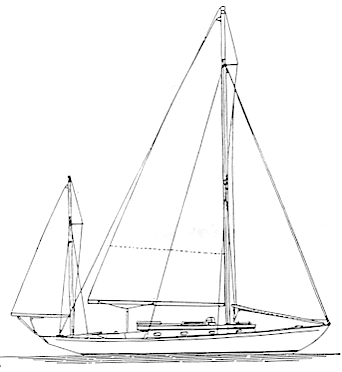
yawl – a two-masted sailing vessel, rigged fore-and-aft, with a large mainmast and a small mizzenmast stepped aft of the rudder post; a ship’s small boat, usually rowed by four or six oars

yellow – the color of the Whigs during elections; the Tories used blue

yellow fever – a tropical disease spread by mosquitoes; those who traveled to the West Indies were exposed to the disease

yeoman – an independent farmer with land of his own, usually 300-1000 acres

yeomanry – the mounted, wealthier faction of the militia

The Archbishop of York – is a high-ranking cleric in the Church of England, second only to the Archbishop of Canterbury. He is the diocesan bishop of the Diocese of York and the metropolitan of the Province of York, which covers the northern portion of England (north of the Trent) as well as the Isle of Man. The archbishop is a member ex officio of the House of Lords, and is styled Primate of England. (The Archbishop of Canterbury is “Primate of All England.”)

Yorkshire Pudding Day | School of Artisan Food – Blog blog.schoolofartisanfood.org

Yorkshire Pudding Day | School of Artisan Food – Blog
blog.schoolofartisanfood.org

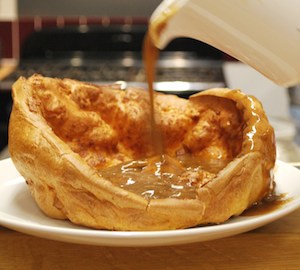
Yorkshire Pudding – Yorkshire Pudding, also known as batter pudding, is a dish named after Yorkshire, England, though there is no evidence it originated from there. It is made from batter and usually served with roast meat and gravy.

Your Grace – the form of address for a duke or duchess when addressed by the nobility or the gentry; also the form of address for an archbishop by everyone

Your Highness – used in direct conversation with the nephews, nieces, and cousins of the sovereign

Your Majesty – used in direct conversation with the king or queen

Your Royal Highness – used in direct conversation with the monarch’s spouse, children, and siblings

Your Worship – the form of address for a magistrate

zemindar – in colonial India, an indigenous revenue collector or landholder

zibeline – a sable; a thick cloth made of wool or other animal hair, having a long nap and a dull sheen

zounds—An oath or swear-word, contracted from God’s wounds. It had about the same degree of offensiveness as the modern “damn.”

Posted in British history, Great Britain, Living in the Regency, real life tales, Regency era | Tagged , , | 1 Comment

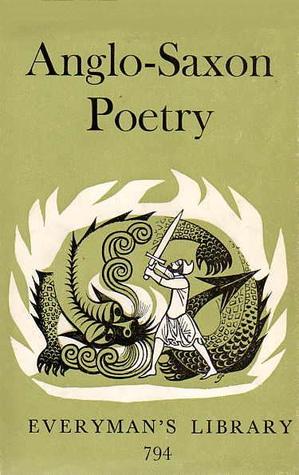
Anglo-Saxon Poetry

Anglo-Saxon Poetry by Robert K. Gordon — www.goodreads.com

Anglo-Saxon Poetry by Robert K. Gordon —
http://www.goodreads.com

As poetry began as song and was easier to memorize because of the rhyme scheme and the rhythmic pattern, Anglo-Saxon poetry outstripped the period’s prose. The poems were passed from one generation to another by word of mouth. 

Customarily, Anglo-Saxon poetry contains three alliterating syllables, two in the first line and one in the second. Most of the poems were created by troupes of musicians called “gleemen,” who traveled about the countryside entertaining nobles and the aristocracy. 

The poems characteristically contained a moral. A tone of brooding melancholy can be found in many. The themes include a love of freedom, a duty to nature, and demonstration of glory as the ruling motivation in the hero’s (the warrior) life. 

“There are two types of Old English poetry: the heroic, the sources of which are pre-Christian Germanic myth, history, and custom; and the Christian. Although nearly all Old English poetry is preserved in only four manuscripts—indicating that what has survived is not necessarily the best or most representative—much of it is of high literary quality. Moreover, Old English heroic poetry is the earliest extant in all of Germanic literature. It is thus the nearest we can come to the oral pagan literature of Germanic culture, and is also of inestimable value as a source of knowledge about many aspects of Germanic society. The 7th-century work known as Widsith is one of the earliest Old English poems, and thus is of particular historic and linguistic interest. [InfoPleaseThe Columbia Electronic Encyclopedia, 6th ed. Copyright © 2012, Columbia University Press.]

Widsith, or the Wanderer is dated to the 6th or 7th Century. This is the song of a wandering minstrel. “‘The Wanderer’ tells of the grief and the hardships of one whose lord’s hall has been overthrown. Over yellow waves, through snow and hail, he plies his oars with weary arms. At times – for the setting is vague – he seems to be living in solitude in a new country. Always in memory or in dreams, his thought returns to the generosity of his lord, the noble deeds of his friends of the comitatus, the content of nights in the mead-hall. He concludes with maxims on the caution and fortitude which this dark world demands.” [History of English Literature: Part I-Early Saxon Through Milton, Hymarx Outline Series, pp. 11-12]

The first English lyric poem was Deor’s Lament. It was found in the late 10th Century collection the Exeter Book. The poem consists of the lament of the scop Deor, although contemporary scholars do not credit Deor as the poem’s author. “A scop was a poet as represented in Old English poetry. The scop is the Anglo-Saxon counterpart of the Old Norse skald, with the important difference that “skald” was applied to historical persons while ‘scop’ is used, for the most part, to designate oral poets within Old English literature.” (Wikipedia)

Deor is a bard at the court of the Heodenings, who laments “his eclipse by a rival poet of a newer school. He compares his plight with other tragic situations well-known to contemporaries. Strophes 1 and 2 touch the story of Weland – his horrible torture by Nithad and the tragic impact of his revenge upon Beadohild. At the end of each strophe comes the Stoic refrain, ‘That (sorrow) passed; so may this.'”[History of English Literature: Part I-Early Saxon Through Milton, Hymarx Outline Series, pg. 12]

Deor holds a place of reference in the Anglo-Saxon lyrics for its use of the strophic form. “Wulf and Eadwacer” is the only other Old English poem displaying these devices. It also examples an attitude typical of our early verse: the moving contrast between courage and dark misfortune. Also, the poem makes references to historical figures commemorated in lays.

Another example of Anglo-Saxon poetry which has survived is The Sea Farer. As with the others, the date and author are unknown. The poem contains a dialogue between an old sailor and a young man eager to set off to sea. It consists of 124 lines followed by the single word “Amen.” It is recorded in the Exeter Book, one of the four surviving manuscripts of Old English poetry. It is considered an elegy.

“The poem begins with a recounting by the old mariner of the hardships he has endured on his various voyages. Nevertheless, he brings out the irresistible desire of a sailor to make new voyages and the pleasures of an adventurous life. He talks of the ease and comfort to be had on land, but then turns to the evils of life. He invokes courage to bear him up whenever the fear of death is upon him. The latter part of the poem is an allegory in which the troubles of the seaman are symbols of the troubles of this life and the call of the ocean are the call of God.” [History of English Literature: Part I-Early Saxon Through Milton, Hymarx Outline Series, pp. 12=13]


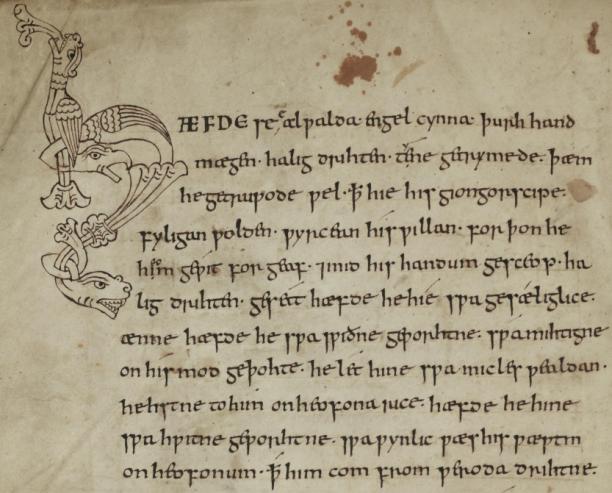
BabelStone Blog : The Long and the Short of the Letter S www.babelstone.co.uk612 × 493Search by image Alfred Fairbank, A Book of Scripts (Penguin Books, 1949) Plate 17

BabelStone Blog : The Long and the Short of the Letter S
http://www.babelstone.co.uk612 × 493Search by image
Alfred Fairbank, A Book of Scripts (Penguin Books, 1949) Plate 17


Posted in Anglo-Saxons, British history, Great Britain, literature, poetry | Tagged , , , , , , , , | 2 Comments

Mansfield Park 1999

BBC/Miramax film
Patricia Rozema, Director
Francis O’Connor ….. Fanny Price
Harold Pinter ….. Sir Thomas Bertram
Jonny Lee Miller …. Edmund Bertram
Embeth Davidtz ….. Mary Crawford
Alessandro Nivola ….. Henry Crawford
Lindsay Duncan ….. Mrs. Price/Lady Bertram
Victoria Hamilton ….. Maria Bertram
Justine Waddell ….. Julia Bertram
Sheila Gish ….. Mrs. Norris
James Purefoy ….. Tom Bertram
Hugh Bonneville ….. Mr. Rushwoth

Cineplex.com | Mansfield Park www.cineplex.com MANSFIELD PARK, Jonny Lee Miller, Frances O'Connor, 1999

Cineplex.com | Mansfield Park
http://www.cineplex.com
MANSFIELD PARK, Jonny Lee Miller, Frances O’Connor, 1999

This version is a “reinterpretation” of Jane Austen’s Mansfield Park. As such, the 112-minutes film emphasizes the issues of slavery and the oppression of women’s rights. It is set in a particular social and political atmosphere, one Austen often glosses over in her novels. The film is set in 1805 and 1806. (See my previous post on Mansfield Park 1983.)

The film begins with a young Fanny being sent from Portsmouth to Mansfield Park. The viewer can see the disheveled Fanny’s uncertainties at being sent away from her family, but he/she can also note the child’s quick intelligence and her mettle. Fanny is portrayed as a precocious child. In fact, Rozema turns Fanny into an aspiring writer, much in the vein of Jane Austen. In many ways, “Austen” becomes the narrator of the film. Fanny, for example, reads to Edmund what she has written. She does likewise in the voiceovers. In both instances, the movie goer hears passages taken from Jane Austen’s juvenilia. In the opening, young Fanny is reading a story to her sister, one Fanny supposedly wrote. It is from Austen’s Love and Freindship (sic). Fanny is shown as having her head full of romance novels.

In the latter part of the film, when Sir Thomas informs Fanny of Henry Crawford’s proposal, Fanny reads aloud to herself what she wrote: “From this period, the intimacy between them daily increased till at length it grew to such a pitch, that hey did not scruple to kick one another out of the window on the highest provocation.” This speech comes from Austen’s Frederic and Elfrida: A Novel, which Austen wrote in her early teens. In this short piece, one of Austen’s Juvenilia, Austen parodies some of the silly sentimental heroic literature of the late 1700s.

Tom Bertram (drinking on a balcony): Do you know it’s 5 o’clock in the morning?
Carriage Driver: Mrs Norris arranged for this girl to be brought here. It’s her niece, or something.
Tom Bertram: Mrs Norris lives in the parsonage over there.
Carriage Driver: I was told most definitely to drop her at the front entrance of Mansfield Park.
Tom Bertram: Then drop her.

When Sir Thomas announces to Mrs. Norris, his wife, and daughters that Fanny is of a second-class status in comparison to his family and children, young Fanny is standing outside the room and overhears his protestations. Fanny’s position in the house is set with these lines. Mrs. Norris assures Sir Thomas that his sons will think of Fanny as nothing more than as “sister.”

To illustrate Fanny’s growing maturity, Rozema has Fanny read from Austen’s The History of England. Fanny looks into the camera to read: “It was in this reign that Joan of Arc lived and made such a row among the English. They should not have burnt her but they did….” This is followed by what is know in film as a dissolve. Fanny continues to read in a voice over: “Henry the 7th. His Majesty died, and was succeeded by his son Henry whose only merit as not his being quite so bad as his daughter Elizabeth.” After another dissolve, Fanny’s character looks again into the camera to say: “And then that disgrace to humanity, the pest of society, Elizabeth, who, Murderess and Wicked Queen that she was, confined her cousin, the lovely Mary Queen of Scots for 19 YEARS and then brought her to an untimely, unmerited, and scandalous Death. Much to eternal shame of the Monarchy and the entire Kingdom.” The camera slides to Edmund (Jonny Lee Miller), who is Fanny’s audience for her reading. It is the viewer’s first look at Edmund Bertram.

Rozema used Kirby Hall in Northhamptonshire for the exterior scenes and some of the interior shots. In the original novel, Mansfield Park is described as such, “Miss Crawford soon felt that he and his situation might do. She looked about her with due consideration, and found almost everything in his favour: a park, a real park, five miles round, a spacious modern-built house, so well placed and well screened as to deserve to be in any collection of engravings of gentlemen’s seats in the kingdom, and wanting only to be completely new furnished–pleasant sisters, a quiet mother, and an agreeable man himself–with the advantage of being tied up from much gaming at present by a promise to his father, and of being Sir Thomas hereafter.” In contrast, Kirby Hall is an Elizabethan mansion. Kirby Hall gives the viewer the idea that the Bertram family fortune wanes. Even the interior scenes add to this impression. The walls are bare and few furniture is evident. Fanny’s first walk through of the house has her climbing bare stone steps to an attic storage room furniture and toys no longer necessary for the house is stored.

One of the best exterior shots in the film is when Fanny and Edmund return to Mansfield Park when Tom Bertram is ill. The house is shrouded in fog providing the viewer a feeling of foreboding.

PeriodDramas.com - Mansfield Park www.perioddramas.com ... Mansfield Park screenshot 10

PeriodDramas.com – Mansfield Park
http://www.perioddramas.com
… Mansfield Park screenshot 10

One of the discrepancies with the novel that struck me is the physicality of Francis O’Connor in the role of Fanny. She rides horse and races across the estate grounds. She is more in the vein of Elizabeth Bennet than the sickly child of Fanny Price from the novel. She is TOO familiar with Edmund Bertram for 19th Century morals. They spend time together in her bedroom and in private walks.

Going against Austen’s original story, this film omits the character of William Price, Fanny’s brother. I found this a bit frustrating for Fanny’s qualms about accepting Henry Crawford’s proposal is abandoned. Crawford’s “kindness” in assisting William Price to a commission in the military plays strongly in Fanny’s decision. This key point of the original story is glossed over in this adaptation. Instead of writing letters to William, Fanny writes to her sister. We hear the content of these letters in voiceovers read by Fanny. Also, William is omitted from the ball given by Sir Thomas in Fanny’s honor.

The political issue of slavery invades this film in a way the book does not. In the novel, slavery is mentioned only once. Fanny tells Edmund that her family ignores her when she asks of the problem of slavery. When Fanny is on her way from Portsmouth to Northhamptonshire slave ships are shown in anchor. Fanny hears men singing, and the coachman says that the captain of the ship is bringing some “darkies” home to his wife. The song is repeated when Fanny returns to Portsmouth and again during the film’s ending credits. Slavery is brought to issue in the film when Edmund tells Fanny that Sir Thomas’s bad humor is a result of problems on the plantation in the Americas.

Edmund: The abolitionists are making inroads.
Fanny: That’s a good thing, isn’t it?
Edmund: We all live off the profits from slavery. Even you, Fanny.

Later, in the film, Edmund rebukes his father for Sir Thomas’s lack of humanity for the loss of lives on the plantation.

Sir Thomas speaks of his slaves, saying, “The mulattos are in general well-shaped and the women especially well-featured. I have one so easy and graceful in her movements as well.” Sir Thomas goes on say he will bring a slave back to Mansfield Park to work as a servant. No part of this scene appears in the novel.

This talk of slavery leads Fanny to tell Edmund “I’ll not be sold off like one of your father’s slaves” when Sir Thomas says he will give ball to help Fanny find a mate. This line is the “theme” of the film. Rozema portrays the lives of women of the time period as equivalent to the slaves of which Sir Thomas so often speaks. Sir Thomas “orders” Fanny to marry Henry Crawford; he dictates to her more so than he does his daughters.

The character of Tom Bertram is also different from the original novel. Tom is this film is not only a spoiled indulgent eldest son who wastes his allowance and other funds on horse racing and gaming hells, but Tom also is self-destructive. Mrs. Norris shows Fanny one of Tom’s “self portraits,” one is which Death has his hand on Tom’s shoulder. In Austen’s novel, Tom Bertram is a minor character. In this film, he becomes the reflection of his father’s sins.

This film leaves out the visit to Sotherton, an important episode in the novel. In this adaptation, when the Crawfords call at Mansfield Park, Rozema has the camera show the reaction of each of the main characters (Maria, Rushwoth, Julia, Lady Bertram, and Fanny) before it pans to the Crawfords, visually describing them by panning from heel to head on first Mary and then Henry.

When Mary asks, “Who is to play Anhalt? What gentleman among you, am I to have the pleasure of making love to.” In the novel, no real notice is given the line. We must recall that in the early 19th Century, “making love” was courtship, not a sexual activity. However, in the film, Embeth Davidtz’s delivery of the line puts special emphasis on the words.

The costumes display Rozema’s view of the time period. Fanny wears jumpers over long-sleeve blouses as her daily wear.

▶ Mansfield Park (1999) - Hold On (One More Time With Feeling) - YouTube www.youtube.com Mansfield Park (1999) - Hold On (One More Time With Feeling)

▶ Mansfield Park (1999) – Hold On (One More Time With Feeling) – YouTube
http://www.youtube.com
Mansfield Park (1999) – Hold On (One More Time With Feeling)

Fanny’s clothes are not fitted in any way. The dress for the ball is a contrast to this “dullness.” Fanny appears in a white, empire style dress with evident décolletage. After the ball, Fanny’s breasts are on display in her clothing. Fanny also rarely wears a hat in the film, especially when she travels back to Portsmouth. As women were very conscious of their skin (as Sir Walter remarks in Persuasion) and being too brown (as Elizabeth is in P&P), this breaks with the time period. The character of Mary Crawford wears tight-fitting clothing and displays lots of décolletage. She never wears pastels, which is unusual for unmarried ladies in the early 1800s. With skirts and form fitting blouses, the costumes appear more modern than period pieces.

In this film, the scenes when the characters perform the play differ from the novel. Fanny does not refuse to take part in the play. Mrs. Norris, fearing Fanny means to move into circles to which she is not relegated, sends Fanny about her work rather than to encourage Fanny to participate in the play. In the novel, it is Mrs. Norris who “shoves” Fanny into a minor role.

Some critics of the film feel that the scene where Mary comes to Fanny’s room to practice her lines is suggestive of lesbianism, especially as Edmund is watching them. Mary places her hands on Fanny’s waist as the camera circles them. Mary is not only practicing her lines, she is also flirting with Edmund, who accepts the role of Anhalt (from Inchbald’s “Lovers’ Vows”) after viewing the rehearsal. Later, Mary removes Fanny’s clothing after Fanny is caught in the rain. It is all so “Not Austen,” in my opinion. I assume because Rozema had two previous films with lesbianism as an issue that critics made the natural jump in conclusions. The scene does not make me uncomfortable, it is just not “Austen.” 

Another time that Rozema uses a circling camera is when Henry Crawford reads Laurence Sterne’s “A Sentimental Journey” to Fanny. Maria spies on the pair, realizing that Henry is courting Fanny.

▶ Mansfield Park (1999) Soundtrack - 17 Tom Leaves - YouTube www.youtube.com Mansfield Park (1999) Soundtrack - 17 Tom Leaves

▶ Mansfield Park (1999) Soundtrack – 17 Tom Leaves – YouTube
http://www.youtube.com
Mansfield Park (1999) Soundtrack – 17 Tom Leaves

At the ball, the dances appear more “intimate” than the customary period dramas. At the end of the ball, Fanny chooses to leave on her own, a wine glass in hand. The dance scenes show her thoroughly enjoying herself.

Posted in film, Great Britain, Jane Austen, Regency era | Tagged , , , | 10 Comments

The Peterloo Massacre

On Friday, I introduce you to my novel, His Irish Eve. The events of that particular novel lead up to the hero and heroine being caught in the melee of the Peterloo Massacre. Adam Lawrence, Viscount Stafford, recognizes the need to leave the old ways of the aristocracy behind; however, his father, the Earl of Greenwall, is not so receptive to the changes sweeping across England after the Napoleonic Wars and on the edge of the Industrial Revolution. So, what exactly happened at St. Peter’s Field in Manchester? 

A depiction of the Peterloo Massacre by Richard Carlile - Public Domain

A depiction of the Peterloo Massacre by Richard Carlile – Public Domain

On August 16, 1819, the Peterloo Massacre occurred at St. Peter’s Field in Manchester. A crowd of 60,000-80,000 had gathered to protest the lack of parliamentary representation for the heavily populated industrialized areas.

With the end of the Napoleonic Wars in 1815, the Corn Laws exacerbated the famine of the Year without Summer (1816) and the growing unemployment problems. By the beginning of 1819 the pressure generated by poor economic conditions, coupled with the lack of suffrage in northern England, had enhanced the appeal of political radicalism. In response, the Manchester Patriotic Union, a group agitating for parliamentary reform, organized a demonstration to be addressed by the well-known radical orator Henry Hunt.

Fearing the worst, local magistrates called on the military to dispense with the crowd. They also demanded the arrest of Hunt and the other featured speakers. The Cavalry charged the crowd with sabers drawn. In the melee, 15 people were killed and some 500+ were injured. The massacre was given the name Peterloo, an ironic comparison to the devastation found at the Battle of Waterloo. The Peterloo Massacre became a defining moment of the age. Unfortunately, the massacre’s immediate effect was the passage of the Six Acts, which labelled any meeting for radical reform as “an overt act” of treasonable conspiracy.”

650px-peterlooredplaque1It also led directly to the foundation of The Manchester Guardian, but had little other effect on the pace of reform. In a survey conducted by The Guardian in 2006, Peterloo came second to the Putney Debates as the event from British history that most deserved a proper monument or a memorial. A plaque close to the site, a replacement for an earlier one that was criticized as being inadequate, as it did not reflect the scale of the massacre, commemorates Peterloo.

Information from Wikipedia 

His Irish Evejpg

When the Earl of Greenwall demands his only son, Viscount Stafford, retrieve the viscount’s by-blow, everything in ADAM LAWRENCE’s life changes. Six years prior, Lawrence released his former mistress Cathleen Donnell from his protection, only to learn in hindsight Cathleen was with child. Stafford arrives in Cheshire to discover not only a son, but also two daughters, along with a strong-minded woman, who fascinates him from the moment of their first encounter.

AOIFE KENNICE, the children’s cousin and caregiver, is a woman impervious to Stafford’s masculine charms, as one of England’s most infamous rakes. In truth, Aoife is not immune as she pretends, but she cannot imagine herself as the object of more than a flirtation on the part of the viscount. On balance, they are world’s apart: Aoife is daughter of a minor Irish baron and the opposite of her beautiful cousin Cathleen, who possessed all the skills to lure in a handsome viscount. To make matters worst, Aoife maintains the family’s a sheep farm to support Stafford’s family. A “lady,” Aoife is not.

A battle begins: A fight Adam must win–a fight for the heart of a woman worth knowing, his Irish “Eve.”

(Leave a comment on Friday’s post to be a part of the giveaway.)

Posted in British history, Great Britain, Living in the Regency, Regency era | Tagged , , , , , | 8 Comments

Regency Lexicon – The Letter “W”

Regency Era Lexicon – Nearing the End: We’re at “W”

wafer – made of flour and gum; one dampened the wafer and then placed it on a letter to seal it

waggonette – a four-wheel lightweight carriage; used for pleasure trips such as picnics, etc.; common mode of transportation for the rural middle-class; could seat 6; very popular after the mid 1800s

Walcot Church – the site of the marriage of George Austen (1731-1805) to Miss Cassandra Leigh (1739-1827) on April 26, 1764; located in Bath

wainscoting – a “fancy” oak imported from Russia, Holland, or Germany; the term “wainscoting” was applied to panels originally made of such oak

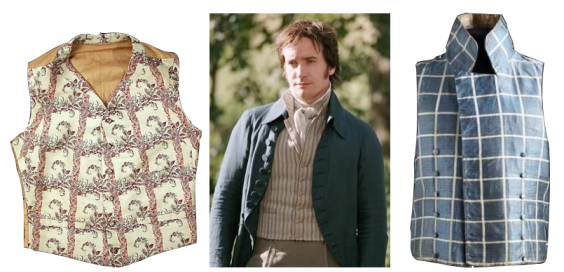
waistcoatswaistcoat – a vest for a gentleman; worn over the shirt and under the coat. Colors, patterns, and fabrics varied and anything was allowed. Could be single- or double-breasted, with or without collars or lapels, but must have a couple small pockets for a man’s accoutrements, such as a pocketwatch or fob.

waistband – the part of a skirt or pants (around the waist) in which money was kept

walking out – long romantic walks were discouraged; there was a “no time alone in private” rule for courtship

wallflower – a young lady repeatedly without a partner at a ball/assembly; gentlemen were expected to ask young ladies who were seated without a partner to dance

waltz – introduced to England from Germany in 1812; was considered scandalous as it required the partners to be in close proximity to each other;a lady required the consent of one of the Patronesses of Almack’s for her first waltz; was finally approved by England’s great dancing arbiter, Thomas Wilson, in 1816; even then, the waltz was only approved for married couples

want—Want means not only desire, but lack, both as a noun and a verb. When Mandeville says that the bees in The Grumbling Hive “wanted Dice,” he means that they lacked them; “lost the opportunity for want of money” means “because of a lack of.” (18th Century Vocabulary)

ward – a child under the care of a guardian and not his parents; wards in Chancery were so assigned by the courts; a Chancery ward could not marry or enter into a contract without the court’s permission

wardrobe – large wooden cupboard used for hanging clothes

warrant officer – an officer in the Royal Navy; usually a boatswain, carpenter, or surgeon; his position was attained by warrant rather than by commission

washhand stand – a small table in the bedroom that held water, soap, towels, etc., for the occupant’s ablutions; changed several times daily by a household maid

Watch – men who policed the streets at night; called out the time and weather at set intervals

watch guard – a chain or ribbon attached to a watch/timepiece to keep it attached to the gentleman’s clothing

water butt – a barrel placed under the eaves to catch rain water for washing, etc.

water cart – used to keep the dust down on dirty streets; water was released through small holes in a barrel as the cart rolled along the streets

watering place – resorts such as Bath and Mudeford where one went to drink or bathe in the “healing” waters

Waterloo – The Battle of Waterloo was fought on Sunday, 18 June 1815, near Waterloo in present-day Belgium, then part of the United Kingdom of the Netherlands. An Imperial French army under the command of Emperor Napoleon was defeated by the armies of the Seventh Coalition, comprising an Anglo-Allied army under the command of the Duke of Wellington combined with a Prussian army under the command of Gebhard von Blucher. It was the culminating battle of the Waterloo Campaign and Napoleon’s last. The defeat at Waterloo ended his rule as Emperor of the French, marking the end of his Hundred Days return from exile.

watermen – rowed people out to boats on the River Thames or across the river for a fee

watermen – stood at hackney stands and gave water to the horses

wedding clothes – a woman’s parents purchased her an entire wardrobe (from ball gowns to riding habits) for the wedding; the bride traditionally wore a formal white bridal gown (the girl had the option of wearing her best dress, which could be any color except black or red); the dress was, generally, a white muslin columnar or tube-shaped dress, which was decorated with fine needlework; serving as underwear, a white chemise was worn beneath the gown; men wore his best clothes; the groom usually spent his money on a new coach

wedding protocol – weddings occurred during the canonical hours (between 8 A.M. and noon), unless the couple had a special license, which allowed them to marry later in the day, if they chose; usually, only friends and family were invited to the ceremony (unless the couple were extremely showy or held a place of importance in Society); the ceremony was followed by a wedding breakfast; at the breakfast the couple would often distribute little gifts to their guests

weeds – mourning clothes

weepers – symbols of mourning easily spied by the public, such as a black band on a man’s hat or a long black veil worn by a lady

welkin—a poetic term for the sky

Wellington, Duke of – Field Marshal Arthur Wellesley, 1st Duke of Wellington, (1 May 1769[1] – 14 September 1852), was a British soldier and statesman, and one of the leading military and political leaders of the 19th Century; defeated Napoleon at the Battle of Waterloo; later became Prime Minister; was responsible for passing the Catholic Emancipation Act in 1829

wet nurse – hired to breast feed a child not her own

West End – the western part of London, reaching from Charing Cross to the western boundary of Hyde Park; included Buckingham Palace, Mayfair, and St. James’s Park

Westminster – a separate city west of London (before London expansion); home of the monarch and Westminster Abbey, the royal palaces of Whitehall and St. James, the Palace of Westminster, the royal courts and Parliament

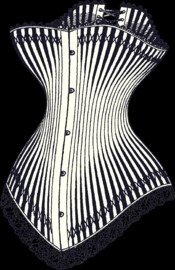
From the Ears of Whales - Part II|Robert Traynor|www. hearinghealthmatters.org ... household of the 19th century might contain several items manufactured from whale products, such as candles and corsets made with whalebone stays.

From the Ears of Whales – Part II|Robert Traynor|www.
hearinghealthmatters.org
… household of the 19th century might contain several items manufactured from whale products, such as candles and corsets made with whalebone stays.

whalebone – used to reinforce the corsets worn by ladies of the day

wheelers – horses harnessed closest to the carriage (“leaders” were the farthest away)

wherry—a small rowboat

Whig Party – the Whig Party was revived by Charles James Fox (1749-1806); the Whigs supported the reformists, religious dissent, and the need for electoral and parliamentary change; keep in mind that during the Regency, only rich landowners could vote

The Kimblewick Hunt > www.kimblewickhunt.co.uk

The Kimblewick Hunt >
http://www.kimblewickhunt.co.uk

whippers-in – assistants of the huntsman during a fox hunt; kept the hounds together (“whips” became the term for party members who kept tabs on others in their Parliamentary party to make them available for crucial votes)

whist – a card game similar to bridge for 2-4 players

wit—One of the most loaded words of the eighteenth century. It means something like “mental faculties” in general, but it also has a more restricted sense—imagination, fancy, quick-wittedness. It can also mean a person who has wit—someone with a fine sense of humor (especially one with a satirical edge), an intellectual, or any writer. Pope’s definition is famous and intriguing, though not especially helpful: “True Wit is Nature to Advantage drest,/What oft was Thought, but ne’er so well Exprest.” Johnson’s definitions are more precise; with their examples, they stretch to several pages, but here are the definitions from his Dictionary: “1. The powers of the mind; the mental faculties; the intellects. 2. Imagination; quickness of fancy. 3. Sentiments produced by quickness of fancy. 4. A man of fancy. 5. A man of genius. 6. Sense; judgment. 7. In the plural. Sound mind; intellect not crazed. 8. Contrivance; stratagem; power of expedients.” (18th Century Vocabulary)

White's Club | Jane Austen's London janeaustenslondon.com

White’s Club | Jane Austen’s London
janeaustenslondon.com

White’s Club – The premier gentleman’s club of the Regency is also the oldest in London, and has its origins in White’s Chocolate House, which opened in 1693. In 1736, White’s began to operate as a private club on St. James’s Street. Four years later it moved across the street to larger premises, which burnt down in 1753. The club then relocated in a building at the top of St. James’s, where it still stands. Shortly after the original club was formed everyone wanted in and the rush for membership became overwhelming. A second club was formed called the Young Club. Vacancies in the original Old Club were filled by members of the Young Club. The two clubs were finally merged into one in 1781. White’s and other exclusive gentlemen’s clubs in London used a method of voting for proposed new members whereby a system of black and white balls were deposited, in secret by each election committee member, into a special box. A single black ball was sufficient to deny membership. Hence the term ‘blackballed.’

white gowns – Most gowns of the period were made from muslin, a fine cotton fabric. White was the favorite color of muslin gowns because it appeared very classical (like the marble statues of Ancient Greece and Rome, which were very much in vogue at the time), and a white gown indicated the wearer was rich enough to employ maids to keep the gown white.

Whitehall – home of the Admiralty, the Treasury, the prime minster’s residence at 10 Downing Street, the Horse Guards, the army headquarters, etc.

Whitsun – the seventh Sunday after Easter; also known as Pentecost

William Wilberforce – an Evangelical reformer (1759-1833) who strongly opposed the slave trade

wilderness – an area in a park or garden where one found many trees, as opposed to the groomed lawns

Windsor – a town on the Thames west of London; housed a palace of the royal family

withdraw – to take back or leave

Mary Wollstonecraft – the most famous champion of women’s rights of the period; she authored A Vindication of the Rights of Women (1792); Wollstonecraft accused Fordyce’s Sermons of creating “artificial grace” in females

woolsack – the Lord Chancellor sat on a sack filled with wool while presiding over the House of Lords; therefore, “elevated to the woolsack,” meant to assume the position as Lord Chancellor

The Wonder – A Woman Keeps a Secret– a comedic play by Susanna Centlivre, which dealt with ladies and gentlemen in love and with the jealousy love can entail

workbox – sewing, embroidery, etc.; women’s “work”

workhouse – the place where those unable to care for themselves went for food and shelter in exchange for work

worsted – a fancy wool yarn; named for the place in Norfolk where the wool was made

wrangler – the name given to those taking top honors in math at Cambridge

Posted in British history, Great Britain, Living in the Regency, Regency era | Tagged , , | 4 Comments

Anglo-Saxon Literature – Part II: Charms and Riddles

The transition from pagan thoughts to the dogma of Christianity was slow to go. Appeasing the populace to look upon a Christian society with acceptance was a difficult task.

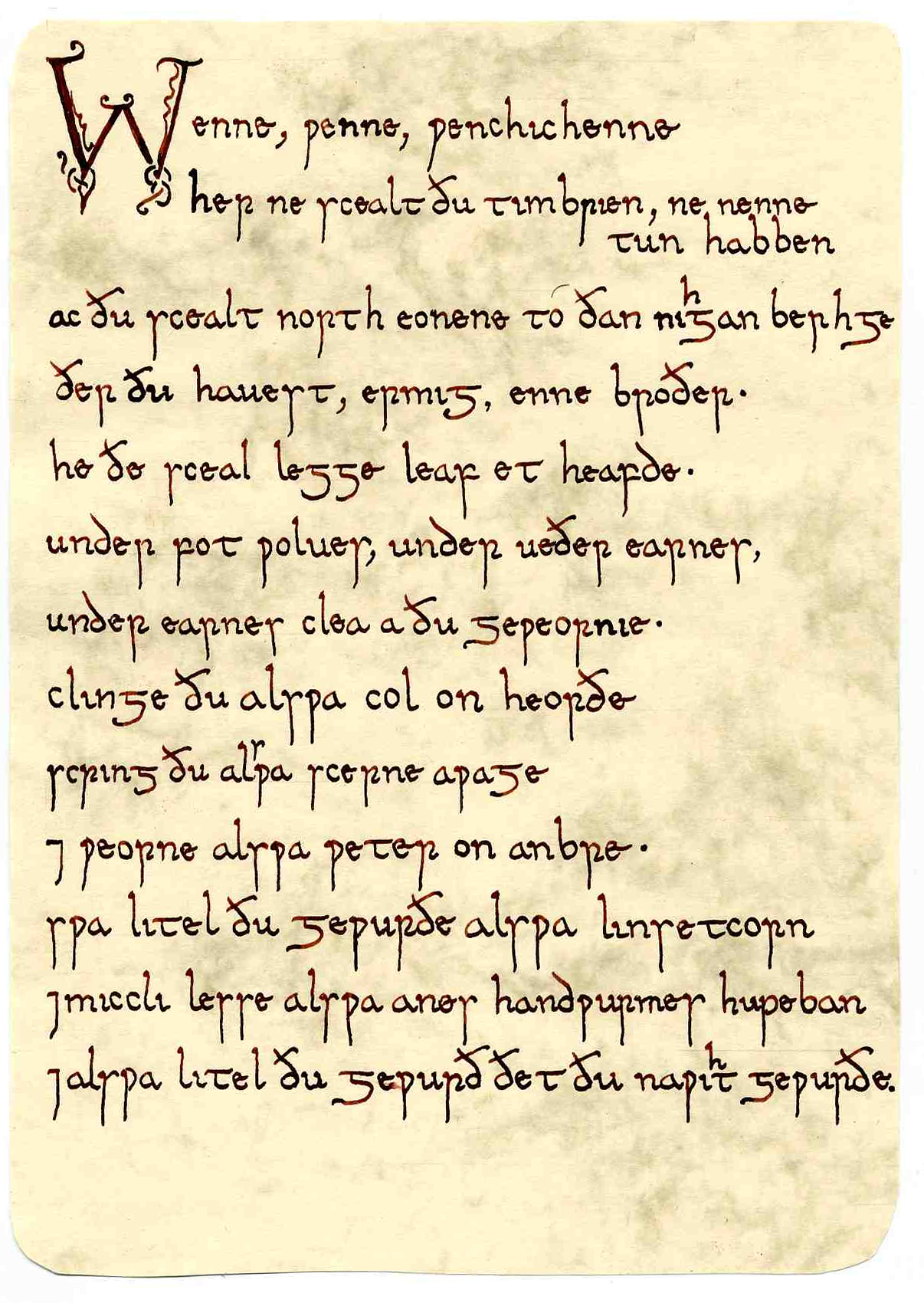
Shelagh's Website | Miscellaneous www.shelaghlewins.com Lord's Prayer in Anglo Saxon A Charm to Cure Warts

Shelagh’s Website | Miscellaneous
http://www.shelaghlewins.com
Lord’s Prayer in Anglo Saxon A Charm to Cure Warts

Charms reflect pagan superstition and folklore. Even so, it was not uncommon for the charm to include an invocation to the Christian God. The charm typically consists of three parts: (1) the naming or description of the means to be used in the implementation of the charm; (2) a short narrative telling how the evil arose or some former occasion on which the remedy worked; and (3) the incantation, wherein was mentioned the technique needed for the alleviation of the problem. This cross-compositions suggest a culture in honest transition from one belief system to another.

“Land Remedy” is a typical blending of the new and old. It is a charm meant to ensure fertile fields. In it, the old Earth goddess Ere is called the “mother of men.” Erce’s image “is described as becoming fruitful when it is in ‘God’s embrace.’ It is only the synergism of the two that assures the bountiful harvest. Other charms were composed to give remedy against sudden stitches, dwarves, swarms of bees, and cattle thieves.” [A Companion to Old and Middle English Literature, edited by Laura C. Lambdin and Robert T. Lambdin, page 10]

“Hail to thee, Earth (the old Earth Goddess), mother of men,/Be fruitful in God’s embrace, /Filled with food for the use of men.”

Charms established a connection between religious elements in the everyday lives of the early inhabitants. They also were a precursor to the riddles which appeared around the 8th Century. “Elton Smith (“Charms” 91) notes that Anglo-Saxon religion must have assumed that piety begets material return – a stark contrast to the usual biblical allusion that the only true treasure is Heaven.” [A Companion to Old and Middle English Literature, page 10]


Wuffing Education for Anglo-Saxon Day Schools at Sutton Oho www.wuffings.co.uk299 ×  Old English Riddles

Wuffing Education for Anglo-Saxon Day Schools at Sutton Oho
http://www.wuffings.co.uk299 ×
Old English Riddles

Riddles, which are dated to the 8th Century, are descriptions of various phenomena and objects. They were composed anonymously and covered a variety of topics. Again, a reference from Elton Smith “Riddles” 439 implies that the riddles were translated from Latin. “These works tend to be more descriptive than literary and served to demonstrate facets of the ordinary life of England. Straight to the point, the riddles display little if any humor, thus demonstrating that these were meant to be intellectual activities. Of particular note is the idea that riddles usually are one of four distinct types. The first described some item in the natural world. A second type could be vehicles to present some elements of folklore or tales. The riddles were also used to describe typical life in England. Finally, there are the charms that are simply brilliant descriptive poetry presented in the form of a game wherein the poet employs description to make readers see and feel unnamed objects. Here the riddles are descriptions of various objects or phenomena.” [A Companion to Old and Middle English Literature, page 10]

Riddle 15 by Anglo-Saxon Riddles translated by Bertha Rogers | poetry translation  www.ablemuse.com

Riddle 15 by Anglo-Saxon Riddles translated by Bertha Rogers | poetry translation
http://www.ablemuse.com

The subject matter is a cross between natural and man-made items.

“Storm on Land” – “Sometimes I move with malice through the land, burn the people’s halls, spoil the houses; the smoke rises up…there is noise on earth, the death pangs of men.”

“Storm at Sea” – “The ocean is roused, the foam tossed, the whalemere roars, it rages loudly; the surges beat the shores…when I, struggling,…stir the vast depths of the sea.”

These two riddles present the same subject, but contain a degree of difference. The storm on land moves with malice, while the storm surge at sea rages loudly and beats the shores. The destruction of the first riddle affects man directly with the loss of homes and life, while the second speaks of the depths of the sea enveloping all that crosses it.

“Sun” – “Often I burn living creatures; close to the earth, I afflict countless races with distress….Sometimes I gladden the minds of many.”

“Fire” – “A woman often binds it in its great strength. It obeys them well. Cruelly it requites him who lets it grow proud.”

The “Sun” riddle displays a preoccupation with the power of heat upon man and crops. This riddle does offer a bit of “hope” in its gladdening of those which it touches with bright rays and warmth. The heat of the “fire” serves as warning to those who do not control its power. 

“Iceberg” – “The monster came sailing, wondrous along the wave,…loud was its din; its laughter was terrible…; its edges were sharp. It stove in the ship’s side, relentless and ravaging.”

The icebergs are wondrous to view, but they hold great destruction for ships in their paths. An oxymoron exists with the reference to the iceberg’s laughter.

“Shield” – “I am a solitary dweller wounded with a knife, stricken with a sword, weary of battle-deeds, tired of blades.”

“Sword” – “I am a wondrous creature, shaped in strife, loved by my lord, fairly adorned….”

We must recall that instruments of war held great value during this early times. In the “Shield” the shield is personified as if it were a person who suffered great harm. The shield has grown weary of battle and the abuse it must take. The riddle emphasizes the brutal lifestyle of the period. The sword receives great adulation, being loved by its holder and elaborately decorated.

“Swan” – “Silent is my garment when I tread the earth or inhabit the dwellings or stir the waters. Sometimes my trappings and this high air raise one above the abodes of men, and the power of clouds then bears me far and wide over the people.”

This one dwells on the natural elements of the animal world. It describes the beauty of the swan’s movement. The riddle centers on the swan’s ability to fly above the man below. 

“The riddles obviously showed a keen desire to manipulate and demonstrate a grasp of the vernacular. This may explain why so many riddles were copied and passed about. This knowledge would also be demonstrated in a vastly different way. As noted, the writings of this period were gradually Christianized for many reasons. Foremost is the fact that Christianity had become the most popular religion in Britain at this time. Further, since the monasteries were the centers of culture, it is only natural that literature that was Christian in tone grew and developed; few new ideas were created, for these were mostly the works of monks and were composed in Latin, the tongue of the church.” [A Companion to Old and Middle English Literature, page 12]

Note: The riddles were found in History of English Literature: Part I – Early Saxon Through Milton, Hymarx Outline Series, page 16.]

Posted in Anglo-Saxons, British history, Great Britain, literature, Uncategorized | Tagged , , , , | 1 Comment

Winners of an eBook Copy of “Mr. Darcy’s Fault: A Pride and Prejudice Vagary”

Last week, I released a new book, Mr. Darcy’s Fault: A Pride and Prejudice Vagary Novella. The following earned copies as part of the giveaway.

MDF Cover copy
kandy

cyn209

Pam Hunter

kirstmac

deborahanne2

sophieandmomma

bevieann61

Please contact me at jeffersregina@gmail.com to claim your prize. In the email contact, indicate the eBook format you prefer (Nook, Kindle, or Kobo) and the email address to which to forward the gift announcement. CONGRATULATIONS!

Posted in giveaway, Jane Austen, Living in the Regency, Regency era | Tagged , , , , , , | Comments Off on Winners of an eBook Copy of “Mr. Darcy’s Fault: A Pride and Prejudice Vagary”