A “Stalker” for Queen Victoria

http://www.historic mysteries.com/boy -stalked-queen-victoria/

http://www.historic
mysteries.com/boy
-stalked-queen-victoria/

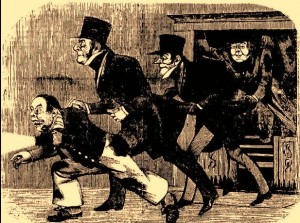
Few outside of Victorian scholars know much of Queen Victoria’s “stalker.” Edward “the Boy” Jones was quite adept at sneaking into Victoria’s most private apartments. Born in 1824, Edward Jones became fascinated with Victoria when she was but a young queen. He often infiltrated Buckingham Palace to observe Queen Victoria going about her daily business. Within five months, Jones’s “fascination” became an “obsession.” He took to breaking into the queen’s quarters, ransacking her bedrooms at Buckingham. Accused of stealing from the Palace, including undergarments, Jones stood trial at the Westminster Sessions; however, he was acquitted.

Buckingham Palace c.  1837 with the Marble  Arch in its original  position. Public Domain - Wikipedia File:Buckingham Palace engraved by J.Woods after Hablot Browne & R.Garland publ 1837 edited.jpg

Buckingham Palace c.
1837 with the Marble
Arch in its original
position. Public Domain – Wikipedia File:Buckingham Palace engraved by J.Woods after Hablot Browne & R.Garland publ 1837 edited.jpg

His brush with the law did not dissuade Jones. In December 1840, the palace guards captured him hiding under a sofa in Victoria’s bedroom, where he spied upon the Queen and Prince Albert. Tried before the Privy Council, Jones was sentenced to three months in prison.

Within days of his release, Jones was caught in the Picture Gallery of the Palace, eating meat and potatoes stolen from the Royal Kitchen. “There was a wild criticism in the press regarding the safety of the Royal Palace of Britain, and while people around the nation theorized multiple conjectures as to how the cunning teen had found his way into the Palace despite the strict guardianship of the security, Boy Jones simply maintained that he had got in through an unguarded basement window.” [Historic Mysteries

Fearing the worst for the Queen, Lord Melbourne had the youth abducted and transferred to Brazil. When Jones attempted a return to England, he was again kidnapped and forced into servitude with the Royal Navy. He twice attempted to escape, but failed, and he was eventually reduced to a mere slave of the Crown. Fearing bad publicity if anyone discovered Jones’ fate, the Queen had him released in 1848.

Even so, Boy Jones did not change his ways. He was arrested for burglary and deported to Freemantle in Australia. He found his way back to England in 1857, where he was arrested again for thievery.

“In 1868, a newspaper reported that the new Minister of Public Works in Victoria, Mr. Jones, was actually the brother of the same notorious Boy Jones, who was arrested for trespassing and theft on multiple occasions. In response to Sir Henry Lucy’s article in a magazine, a civilian came forth with the information that Boy Jones had now found his job as a town crier in Perth, Western Australia.

“On 26 December 1893, a certain Thomas Jones was found dead underneath the Mitchell River Bridge, after falling from the bridge on getting severely drunk. According to the Bairnsdale Advertiser, this was the same Boy Jones.” [Historic Mysteries]

“THE PSYCHOLOGY OF BOY JONES: Among those who had closely spectated Edward Jones, he was the shy, introvert, allergic-to-work kind of fellow, a complete loner and a heartless wretch with no affection even for his own parents. According to writer Jan Bondeson from the Fortean Times Magazine, Jones may have been a sufferer of Schizoid personality, a behavioral disorder which causes someone to become emotionally cold and detached. The victim may also develop a special attraction for someone of the opposite gender, and under the misconception that the said person is giving in to the victim’s advances, the victim may even take up to stalking. Perhaps Boy Jones suffered from this disorder, perhaps not. But one thing is for certain. The mysterious ways one of the first celebrity stalkers is sure to bewilder your minds.” [Historic Mysteries]

Posted in British history, Great Britain, real life tales, Victorian era | Tagged , , , , , | 9 Comments

Benjamin Bathurst: Missing Regency Era Diplomat


NUESTRO MUNDO MISTERIOSO: julio 2014 nuestromundomisterioso. blogspot.com

NUESTRO MUNDO MISTERIOSO: julio 2014
nuestromundomisterioso.
blogspot.com

Benjamin Bathurst (18 March 1784 – 1809?) was a British diplomatic envoy who disappeared in Germany during the Napoleonic Wars. He was the third son of Henry Bathurst, Bishop of Norwich.

Bathurst disappeared on or about 25 November 1809, sparking much debate and speculation about his ultimate fate, especially in science fiction stories, based on a perception (fostered by secondary sources) that his disappearance was a case of particularly sudden, perhaps supernatural, vanishing. Recent research suggests the circumstances of Bathurst’s disappearance were wildly exaggerated, and that he was almost certainly murdered.

Career
Benjamin Bathurst entered the diplomatic service at an early age and was promoted to the post of Secretary of the British Legation at Livorno. In 1805, he married Phillida Call, daughter of Sir John Call, a Cornish landowner and baronet.

In 1809, he was dispatched to Vienna as an envoy by his relative Henry Bathurst, pro tempore Secretary for Foreign Affairs. His mission was to assist in the reconstruction of Britain and Austria’s alliance and to try to encourage Emperor Francis II to declare war on France, which the Emperor did in April.

However, the Austrians were forced to abandon Vienna to the French forces and eventually sued for peace after they were badly defeated by the French at the Battle of Wagram in July 1809. Bathurst was promptly recalled to London and decided that the safest route was to travel north and take ship from Hamburg.

Disappearance
On 25 November 1809, Bathurst and his German courier, a Herr Krause, who were traveling by chaise under the aliases of “Baron de Koch” and “Fischer” respectively, stopped at the town of Perleberg, west of Berlin.

After ordering fresh horses at the post house, Bathurst and his companion walked to a nearby inn, the White Swan. After ordering an early dinner, Bathurst is said to have spent several hours writing in a small room set aside for him at the inn. The travellers’ departure was delayed, and it was not until 9 P.M. that they were told that the horses were about to be harnessed to their carriage. Bathurst immediately left his room, followed shortly afterwards by Krause, who was surprised to find Bathurst was not in the chaise when he reached it and indeed was nowhere to be found.

The disappearance did not create much excitement at the time, since the country was infested with bandits, stragglers from the French army, and German revolutionaries. Additionally, murders and robberies were so common that the loss of one commercial traveller (which Bathurst was travelling as) was barely noticed, especially since at the time there were hardly any legal authorities in Prussia.

News of Bathurst’s disappearance did not reach England for some weeks, until Krause managed to reach Hamburg and take ship for England. In December, Bathurst’s father, the Bishop of Norwich, received a summons from the Foreign Secretary, Richard Wellesley, to attend him at Apsley House, where Wellesley informed the Bishop of his son’s disappearance.

Bathurst’s wife Phillida immediately left for Germany to search for her husband, accompanied by the explorer Heinrich Röntgen. They arrived at Perleberg to find that the authorities had been looking into the affair and that a Captain von Klitzing had been put in charge of the investigation. After Captain Klitzing was notified of Bathurst’s disappearance, he took immediate steps to mobilise his troops and conducted a vigorous search, apparently working on the initial assumption that the missing man had vanished of his own accord. On the 26th the river Stepenitz was dragged, and civilian officials ordered a second search of the village. On 27 November 1809 the Englishman’s valuable fur coat — worth 200 or 300 Prussian thalers — was discovered hidden in an outhouse owned by a family named Schmidt. Then, on 16 December, two old women out scavenging in the woods near Quitzow, three miles north of Perleberg, came across Bathurst’s pantaloons.

Investigation quickly revealed that one Auguste Schmidt had been working as ostler in the courtyard of the White Swan on the night Bathurst disappeared, and that his mother, who also worked at the inn, had taken the Englishman’s coat. Frau Kestern, a woman employed at the German Coffee House, testified years later that immediately after Bathurst had visited the establishment, Auguste Schmidt had come in, asked her where the visitor had gone, then hastened after him and (she supposed) taken some opportunity to destroy him.

A reward of 500 thalers was offered for any news, and money was paid to members of the local police to expedite matters. This, however, caused the waters to be muddied as many false reports and offers of information were made by people seeking a share of the reward.

In March, Mrs. Bathurst had the entire area of Perleberg searched at vast expense, which included the use of trained dogs, but to no avail. She then travelled to Berlin and then Paris to see Napoleon himself, hoping to obtain from him some account of her husband’s fate. However, when she was received by Napoleon, he declared his ignorance of the affair and offered his assistance.

Contemporary Press Reports
By January 1810, the English and French press became aware of the affair and began to discuss it. The Times published a piece in January 1810 which subsequently appeared in other English newspapers:

There is too much reason to fear that the account of the death of Mr. Bathurst, late envoy to the Emperor of Austria, inserted in a Paris journal, is correct as to the principal fact. It was stated, as an article of Berlin news, of the date of December 10, that Mr. Bathurst had evinced symptoms of insanity on his journey through the city, and that he had subsequently fallen by his own hand in the vicinity of Perleberg. Information, however, has been received within these few days, which forcibly tends to fix the guilt of Mr. Bathurst’s death, or disappearance, on the French Government. It appears that Mr. Bathurst left Berlin with passports from the Prussian Government, and in excellent health, both of mind and body. He was to proceed to Hamburg, but Hamburg he never reached. At some town near the French territories he was seized, as is supposed, by a party of French soldiers. What happened afterwards is not accurately known. His pantaloons have been found near the town where he was seized, and a letter in them to his wife; but nothing else. The Prussian Government, upon receiving the intelligence, evinced the deepest regret, and offered a large reward for the discovery of his body. No success, however, has attended the offer.
—The Times, 20 January 1810

The accusation that they kidnapped or murdered Bathurst agitated the French government and replied in their official journal, Le Moniteur Universel:

England alone, among all civilised nations, has renewed the example of paying assassins and encouraging crimes. It appears by the accounts from Berlin, that Mr. Bathurst was deranged in his mind. This is the custom of the British Cabinet – to give their diplomatic missions to the most foolish and senseless persons the nation produces. The English diplomatic corps is the only one in which examples of madness are common.

1852 Discovery
On 15 April 1852, during the demolition of a house on the Hamburg road in Perleberg three hundred paces from the White Swan, a skeleton was discovered under the threshold of the stable. The back of the skull showed a fracture as though from the blow of a heavy instrument. All of the upper teeth were perfect, but one of the lower molars showed signs of having been removed by a dentist. The owner of the house, a mason named Kiesewetter, had purchased the house in 1834 from Christian Mertens, who was a serving man at the White Swan during the period when Bathurst disappeared.

Bathurst’s sister, Mrs. Thistlethwaite, traveled to Perleberg but could not conclusively say whether the skull belonged to her brother or not.

Generally, it is thought that Bathurst fell in with some thieves, who robbed and murdered him for the man’s fine coat and purse. The fact that a member of the Schmidt family worked as a servant at the White Swan gives support for this postulation. Others believe Bathurst left the inn without his coat and Schmidt took the coat AFTER Bathurst vanished. Either way, the fate of Benjamin Bathurst remains unknown. 

Sources: Historic Mysteries  and Wikipedia 

Posted in British history, Great Britain, Living in the Regency, mystery, real life tales, Regency era | Tagged , , , | 1 Comment

Anglo-Saxon Literature ~ Part I Early Epic Poems

UnknownThe Finnesburg — or Finnsburh — Fragment is a portion of an Old English heroic poem about a fight in which Hnæf and his 60 retainers are besieged at “Finn’s fort” and attempt to hold off their attackers. The surviving text is tantalizingly brief and allusive, but comparison with other references in Old English poetry, notably Beowulf (c. 1000 AD), suggests that it deals with a conflict between the Danes and the Frisians in Migration-Age Frisia (400 to 800 AD). It survives only in George Hickes’s Thesaurus (1705). The fragment’s attribution comes from a single leaf of manuscript found in the Lambeth Palace library – either Lambeth Palace MS 487 (a 13th Century collection of English homilies) or Lambeth Palace MS 489 (an 11th Century Old English homily book). The fragment is important for it is tied to Beowulf. In the epic poem of Beowulf, a lay of the Battle of Finnesburh is sung by a gleeman at Hrothgar’s court (Beowulf II.1067-1158). [Beowulf on Sterarume

The fragment opens with Hnaef and his Scylding followers in their hall at night. Someone catches sight of approaching attackers, the forces of the Frisian Finn. Hnaef awakens his men, urges them to valor in the approaching fight. The warriors – Siegeferth, Eaha, Ordlaf, Guthlaf, and Hengest – rush to the doors of the hall. Among the Frisian forces, Guthere urges young Garulf to keep out of the fight. Garulf, who has no intention of missing a good brawl, yells toward the hall: ‘Who is holding the door?’ The reply: ‘Siegeferth is my name…a hero well known…I am ready for you.’ They join in battle; the Frisian Garulf falls. The struggle lasts for five days. Unfortunately, the fragment breaks off without naming the victor. [History of English Literature: Part 1 – Early Saxon to Milton, Hymarx Outline Series, page 13)

“ In Beowulf the recounting of the lay of Finnesburh occurs just before a number of speeches by Wealhtheow in which she attempts to secure her sons’ futures; the poem darkly hints at the future bad faith of Hrothulf, Hrothgar’s nephew, and his treachery towards her sons. The strong emphasis on Hildeburh within the Finnesburh lay invites comparison between the position of Hildeburh, as a ‘powerless’ and unsuccessful peace-weaver and Wealhtheow’s own future failure to avert internecine struggle amongst the Scyldings. Hildeburh’s plight perhaps is an even closer parallel to the plight of Freawaru, Hrothgar’s and Wealhtheow’s daughter, when she is given in marriage to Ingeld in order to attempt to settle a feud between the Heathobards and the Danes. Beowulf predicts (ll.2025-2072) that Freawaru too will suffer in the failure of this peace-weaving, when Ingeld is incited against the Scyldings.” [Beowulf on Steorarum]

From the Anglo-Saxon Chronicle (circa 938), we find The Battle of Bruna’s Burg.The piece relates the tale of Athelstan and Edmund’s (Alfred’s heirs) victory over an army of Scots, Danes, and Britons. The Scottish clans and the men of the Danes fell in large numbers. Five kings die, victims of incredible swordplay. Anlaf, who heads the fleet of the invaders, escapes, while Constantine and his men are forced to a hasty retreat. The poem extolls the victory as the greatest to date. Half the lines come directly from other Anglo-Saxon poems: thus Hagen (“Brunanburgh” 49) notes that this “poem may be one of the earliest forms of an anthology. While the depiction of the battle is tense and seemingly historical, the poem is presented in sparse detail. The poem is strong in its general outline of the events surrounding the battle and exhibits a somber tone. However, what may be most striking about this work is there are no Christian elements found in it. Church clerics who later transcribed it left the text as an action adventure story about fighting and heroes.” [A Companion to Old and Middle English Literature, edited by Laura C. Lambdin and Robert T. Lambdin, page 9].

**Check out this video available on You Tube that explains the battle and and contains a reading of the poem in Old English.  

51-7vL0VlCL._BO2,204,203,200_PIsitb-sticker-v3-big,TopRight,0,-55_SX278_SY278_PIkin4,BottomRight,1,22_AA300_SH20_OU01_From 991, we have The Battle of Maldon, a poem that celebrates the heroic battle of Earl Byrhtnoth against the Norwegians under Anlaf (Olaf Trygvesson). After harrying Stone, Sandwich, and Ipswich, the Vikings came to Maldon on the banks of the River Panta. The stream divides here into two branches; the Danes drew up their forces on the island. The poem displays many of elements of the heroic works, especially that of personal glory coming from the deliverance of selfless acts.

The poem begins with Byrhtnoth exhorting his men to fight with honor. The Vikings offer Byrhtnoth peace if he will pay a tribute, but he urges his men to fight on. When the tide ebbs, Byrhtnoth permits the Vikings to cross the bridge to the mainland. The error provides the Vikings the advantage, and the Athelings are killed. Byrhtnoth is delivered low by a poisoned spear, but even as he lays dying, he urges his men to resist the Vikings. True to the code of “comitatus,” Byrhtnoth’s comrades Aelfnoth and Wulfmaer share his fate.

Comitatus was a Germanic friendship structure that compelled kings to rule in consultation with their warriors, forming a warband. The comitatus, as described in the Roman historian Tacitus’s treatise Germania (98.AD), is the bond existing between a Germanic warrior and his Lord, ensuring that neither leaves the field of battle before the other. The translation is as follows:

Moreover, to survive the leader and retreat from the battlefield is a lifelong disgrace and infamy. (Wikipedia

The English rally for another attack and the poem breaks off with the brave deeds of Godric. [History of English Literature: Part 1 – Early Saxon through Milton, Hymarx Outline Series, page 14].

The Battle of Maldon is a classic composition in the scheme of Old English poetry. “Critics generally agree that the theme of heroism in the face of defeat is expanded here to include the traditional Germanic expectations of loyalty to one’s lord. Much of the criticism of the work centers upon the apparent pride of Byrhtnoth’s decision to allow the Vikings to cross the causeway.” [A Companion to Old and Middle English Literature, edited by Laura C. Lambdin and Robert T. Lambdin, page 10].

Posted in Anglo-Saxons, British history, Great Britain, literature | Tagged , , , , , | 1 Comment

“Mansfield Park” 1983

mansfield-park_1983In 1983, ITV for BBC television produced the Ken Taylor screenplay of Jane Austen’s Mansfield Park. Shown in six episodes, the production was director David Giles second Austen film. He directed the 1971 version of Sense and Sensibility. The series starred Sylvestra Le Touzel as Fanny Price and Nicholas Farrell as Edmund Bertram. (Some of my younger JAFF readers might recognize Ms. Le Touzel as Mrs. Allen in 2007’s “Northanger Abbey.” Farrell was Mr. Musgrove in the 2007 version of “Persuasion.” Ironically, Farrell was Henry Thornton and Le Touzel Marianne Thornton in 2006’s “Amazing Grace.” I love film history!)

The cast included Anna Massey (Mrs. Norris), Angela Pleasence (Lady Bertram), Jackie Smith-Wood (Mary Crawford), Robert Burbage (Henry Crawford), Bernard Hepton (Sir Thomas Bertram), Samantha Bond (Maria Bertram), Christopher Villiers (Tom Bertram), Liz Crowther (Julia Bertram), and an eleven-year-old Jonny Lee Miller as Charles Price. {Later Miller would portray Edmund Bertram in 1999, as well as Mr. Knightley in 2009’s “Emma.”}hqdefault

One of the frequent criticisms of the film is in the casting of Sylvestra Le Touzel as Fanny Price. One of the most complicated characters in Mansfiled Park, Fanny is typically described as passive. She certainly is not of the same nature Austen’s more charming heroines. Fanny’s excessive shyness prevents her from participating socially. Fanny’s self-imposed exclusion results in headaches and emotional turmoil. With little of Fanny’s character to endear her to the viewing audience, the casting of Ms. Le Touzel, who is not classically attractive, is sometimes blamed for the lack of success of the adaptation. 

imagesThe Jane Austen Centre says of the adaptation, ” Mansfield Park may be the hardest of any of Austen’s novels to film. Despite recent efforts, there has not yet been an entirely satisfactory filming of it. Part of this difficulty may arise from the heavy nature of the plot substance (immorality, seduction, adultery)- especially in light of the friendly atmospheres of Pride and Prejudice and Emma. Mansfield Park lacks their spunky, if slightly cheeky heroines. Fanny Price is very moral and kind, but not altogether exciting. In short, very much unlike anything Jane Austen had written before. While the 1999 version of Mansfield Park ‘improves’ upon Fanny and adds to her character, this 1983 adaptation tries to remain faithful to the original. Perhaps they try too hard. Fanny ends up coming across as nervous and flighty. fannyAs one viewer put it: ‘If you can get past Le Touzel’s odd mannerism of making little chopping movements with her open-palmed hand for emphasis, this is a faithful adaptation of the novel.'”

In fact, the overall casting of the series was not well touted by the critics. Sue Parrill in Jane Austen on Film and Television: A Critical Study of the Adaptations (McFarland, 2002) says of the casting: “The choice of Sylvestra Le Touzel for the role of Fanny was fatal to the success of this adaptation. Ironically, the child who played Fanny as a ten year old (Katy Durham-Matthews) was pretty, and it is unlikely that she would have grown up to look like Le Touzel. The other characters are generally well-cast; but with no really outstanding performances. Nicholas Farrell plays Edmund Bertram with a kind of strong-jawed resoluteness.[…] His character us actually more appealing on film than it is in the novel. Robert Burbage plays Henry Crawford appropriately as a Regency dandy. At one point he wears a pink top hat and a pink waistcoats under a pale gray suit. He is affected in manner and does a lot of posing. Anna Massey is convincingly obnoxious as Fanny’s Aunt Norris. Bernard Hepton plays a rather young looking Sir Thomas Bertram. (Hepton may be recalled as playing Emma’s hypochondriac father in the BBC’s 1995 ‘Emma.’) The witty Mary Crawford is well portrayed by Jackie Smith-Wood, who is far easier to look at than Le Touzel. Maria Bertram is played by another actress familiar in Austen adaptations – Samantha Bond – who plays Miss Taylor, Emma’s former governess, in the 1996 A&E ‘Emma.'” [Note: For you “Downtown Abbey” fans, Samantha Bond is Lady Rosamund Painswick, as well as Moneypenny in “Goldeneye” (1995), “Tomorrow Never Dies” (1997) and “The World is Not Enough” (1999).]

Most Janeites do appreciate this adaptation more than some of the others for it follows the book very closely. Serialized, this adaptation runs some 261 minutes. 

Laurel Ann at Austenprose says of this adaptation, “At 312 minutes over six episodes, we are privy to almost all of the novels scenes and veteran readers of Mansfield Park will recognize much of Jane Austen’s choice and witty dialogue. Some viewers might be disappointed in the production quality, as this was originally filmed on video tape and the sound does not supply the quality that we have become accustomed to since it was produced twenty five years ago [sic]. Its strengths lie in the actors performances, costumes and visual beauty as many of the scenes were actually filmed on location, which considering its budget, was a bonus.

“Because of time restraints, I will not attempt to critique the entire movie but focus on one favourite scene which I will call the ‘Sentinel at the garden gate’ from episode 2. Fanny Price and her cousins Maria, Julia and Edmund Bertram travel with Mary and Henry Crawford to the grand Elizabethan era estate of Sotherton Court to visit Maria’s fiancé Mr. Rushworth. As the couples walk through the wilderness parkland adjacent to the estate, director David Giles reveals Austen’s comedic genius in a scene that could have inspired any vintage vaudeville burlesque or modern television sitcom. When Fanny becomes fatigued, she is deposited on a park bench in the shade adjacent to a locked iron gate that has bared progress through the park. As the different groups and individuals arrive in search of each other, Fanny acts as the ‘sentinel of the garden gate’, relaying messages and explaining to everyone who has come and gone, and why. Austen’s brilliant comedic timing is in full play, and the director David Giles knows how to emphasize the right moments to build tension to the point of hilarity.”

From the Jane Austen Centre, we also learn: “Filmed on location in many of the great houses of England, this adaptation also uses a few studio shots which cut down on the lush atmosphere being presented. While one must remember this was filmed for television on a much smaller budget than we have grown accustomed to seeing, the action tends to be slower and more elaborate than you may be used to. Perhaps the words of one disillusioned viewer put it best: ‘This is a stylish, well-costumed, and soulless version of a great book.’ Despite a good script (which delves deeper into the life of the Crawfords than its modern counterpart, and gives William Price his rightful place in Fanny’s life) and talent, this film flows along at a languid pace, even becoming a bit dull at times. Considering the new Miramax version, though, one may contend that this is a blessing. Better to err on the side of conservativism than on that of sensationalism.

nick“Worth special mention, and definitely the cost of the rental, are the hairstyles sported by the men in the film. One author of Jane Austen at the Movies stated that she was always distracted when Edmund came on screen. ‘By what?’, You ask? His ‘awful’ hairstyle. I did not find it that unusual…especially in light of one which I think deserves the most attention. Watch for Robin Langford’s Mr. Yates. Only seeing is believing, in this case. A description would not be able to do it justice.”

Posted in film, Jane Austen, Living in the Regency, Regency era, Uncategorized | Tagged , , | 6 Comments

Anglo-Saxon Literature: The Epic Poem, Beowulf

51kfpKNBB9L._SX258_BO1,204,203,200_Beowulf is the earliest English epic. The exact date of its origin is unknown, but likely before the 9th Century. So what is an epic poem? It is a narrative poem that centers upon the a great hero and upon the period of his life, which defines him as a hero. The epic has its beginnings in popular myths. Early on, the epics were sung by minstrels, and they boast many of the characteristics of a cyclical ballad. In the epic, the hero performs deeds of valor for the sake of glory, rather than for reward. Formed from myths and folk tales, the epic customarily omits historical facts. It often includes mystery and romance and more than a bit of exaggeration. 

In “How the Beowulf Poet Composed His Poem” by Robert Payson Creed we find something of the rhythmic pattern used in the epic. 

“Received wisdom has it that the Beowulf poet put together his poem halfline by halfline (“verse” by “verse”). My work on the poem over the past fifty years has led me to think that we can begin to understand how the poet composed his tale, clause by clause, only if we turn our attention to the whole lines in which he told the story.

“The poet built each four-measure-line—and each of the rare five- and six-measure lines—around the alliteration of the root syllables of stressed words. His tradition seems to have provided him with many alliterating word pairs that encapsulate culturally significant ideas. For example, the poet built five lines around the pair dom (achievement) and dea(death)—dom before death, at least seven lines around the pair eorl (nobleman) and ellen (brave action), and nine around the pair soþ (truth) and secgan (say). This does not mean, however, that the poet was constrained to frame each clause within the confines of a single alliteration: rather, he composed many passages with suppleness and flexibility simply by beginning a new clause in the middle of the line. This expedient left him free to develop the clause around different alliterations.

The rhythm of the poem is based on the stress patterns of the poet’s language; most Old English words, like ellen or secgan, begin with a heavier stress and end with a lighter stress. This pattern translates to a downbeat followed by an upbeat, the simplest kind of rhythm. Each measure of the poem repeats this rhythm. Yet there is no question of monotony: though all measures are identical in rhythm and theoretically identical in the length of time it takes to speak them, successive measures are likely to contain very different combinations of stressed and unstressed syllables—and even precisely timed rests. Thus there is a great variety created both by the material that fills each measure and by the succession of different types of measures. The material within the measures makes possible only seven different types of measure. But the various combinations of stressed and unstressed syllables, along with measure-initial and measure-final rests, produce about fifty different subtypes. The rich variety of these subtypes is the source of the complexity of the poet’s prosody.” (Project MuseFrom: Oral Tradition, Volume 18, Number 2, October 2003, pp. 214-215 | 10.1353/ort.2004.0058)

Beowulf provides the reader an introduction to the folklore of the time in which it came to be. We learn of the manners, customs, and beliefs of the people. Likely, the epic is the product of multiple verse singers. One can easily imagine that it went through a process of expansion and contraction. We note the handprint of Christianity upon the poem. Did a monk or a group of monks edit the poem at one time or another?

Beowulf is divided into two parts, separated by many years. The action begins in the year 512 somewhere upon the coast of the North Sea. The poem exists only in the English tongue today, but it could have been a common tale among several cultures. It is written principally in what we now call “West Saxon.” 

Beowulf | 60second Recap® Decoder™ Study Guide Resources www.60secondrecap.com

Beowulf | 60second Recap® Decoder™ Study Guide Resources
http://www.60secondrecap.com

The poem brings us the harsh lives of primitive Teutons. In it we find a blending of two faiths: Weird (Fate) and God the Creator. “The gentler Christian element is incongruous with the pagan character of the people portrayed and is undoubtedly interpolated by the Christian recorder of this epic. Sage morality in interspersed throughout. Except for the interpolated Christian element, the epic is a fairly accurate portrait of the lives of the early Germanic peoples. We find throughout the emphasis on bravery and deeds of personal heroism; the belief in enchainments and dragons and the love of oral legends as transmitted by the bards, oral histories which transmit Teutons pride in the brave exploits of their ancestry. The translation shows the Anglo-Saxon poet’s fondness for alliteration, for hyphenated words, and for the curious, round-about metaphors called ‘kennings’ (i.e., ‘Peace-bringer’ for ‘wife’; ‘whale road’ for ‘sea’). [History of English Literature: Part I – Early Saxon Through Milton, Hymarx Outline Series, pg.8]

The pagan elements of the plot includes Wyrd (Fate), the funeral pyre, supernatural elements such as the power of a special sword to slay a dragon, and the dragon possessing human knowledge. The Christian elements are the mention of God the Creator, as well as the reference to the Great Flood. Grendel is described as being descended from Cain, and at the landing of Beowulf upon the isle, a Song of Creation is sung. 

Many criticize the epic for its tendency to moralize, but a study of comparable pieces demonstrates this is typical of early epic poetry. The poem’s lack of humor is another point of disdain. The speech and action is very formal (befitting the life at court) and maintains a tone of sombre dignity. The genealogy of each personage is difficult for many to follow. 

From www.as.wvu.edu/english/oeoe/english311/228.html, we see…

[1] Hwæt! We Gardena in geardagum,
[2] þeodcyninga, þrym gefrunon,
[3] hu ða æþelingas ellen fremedon.
[4] Oft Scyld Scefing sceaþena þreatum,
[5] monegum mægþum, meodosetla ofteah,
[6] egsode eorlas. Syððan ærest wearð
[7] feasceaft funden, he þæs frofre gebad,
[8] weox under wolcnum, weorðmyndum þah,
[9] þæt him æghwylc þara ymbsittendra
[10] ofer hronrade hyran scolde,
[11] gomban gyldan. Þæt wæs god cyning!
[12] Ðæm eafera wæs æfter cenned,
[13] geong in geardum, þone god sende
[14] folce to frofre; fyrenðearfe ongeat

Becomes…

1 Yo! We have heard tell of the majesty of the Speardanes, of the Folk-kings, how the princes did valorous deeds.
4 Often, Scyld the Son of Sheaf took away the meadbenches, terrified the lords, with bands of raiders. After he was first found destitute, he took comfort for it, grew under the clouds, throve in honor, until each of those around him over the whale-road had to obey him, yield tribute to him.
That was a good king! 

A son was soon brought forth to him ( Scyld Scefing, the good king, still) young in this land, whom God sent to the people for relief; (Beowulf) perceived the dire distress

GERARD BUTLER in BEOWULF & GRENDEL | OFFICIAL WEBSITE www.beowulfandgrendel.com

GERARD BUTLER in BEOWULF & GRENDEL | OFFICIAL WEBSITE
http://www.beowulfandgrendel.com

Posted in Anglo-Saxons, British history, Great Britain, literature | Tagged , , , | 6 Comments

Life in Early Britain: The Anglo-Saxons

Anglo-Saxons. Wikimedia Commons (Public Domain)

Anglo-Saxons. Wikimedia Commons (Public Domain)

The early inhabitants of Britain lived under harsh conditions. Dark forested areas. Savage neighbors. Wild animals. Life consisted of hunting, fishing, sailing, and feasting. Life demanded a strong people. From those people came a certain ideal of courage. Of honor. Of responsibility.

The Anglo-Saxons settled in Great Britain in the 5th century. They were Germanic tribes from continental Europe, as well as indigenous British groups who “converted” to the Anglo-Saxon culture and language. The Anglo-Saxon period denotes the period of British history between about 450 and 1066, after their initial settlement, and up until the Norman conquest.[Higham, Nicholas J., and Martin J. Ryan. The Anglo-Saxon World. Yale University Press, 2013.]

http://www.slmc.uottawa.ca/?q=english_history "History of the English Language"

http://www.slmc.uottawa.ca/?q=english_history “History of the English Language”


The Anglo-Saxon period saw the development of the regional government of shires, a resurgence of Christianity, the growth of literature and language; and the establishment of charters and law.[Higham, Nicholas J., and Martin J. Ryan. The Anglo-Saxon World. Yale University Press, 2013.] The term “Anglo-Saxon” is also popularly for what is customarily called “Old English,” the language spoken and written by the Anglo-Saxons in England and eastern Scotland between at least the mid-5th century and the mid-12th century.[Richard M. Hogg, ed. The Cambridge History of the English Language: Vol 1: the Beginnings to 1066 (1992)]

The Anglo-Saxons are the cultural identity of modern day Britain, encompassing  the adoption of Christianity and the foundation of various kingdoms and aspirations.

The outward appearance of Anglo-Saxon culture can be seen in the material culture of buildings, dress styles, illuminated texts and grave goods. Behind the symbolic nature of these cultural emblems there are strong elements of tribal and lordship ties, and an elite that became kings who developed burhs, and saw themselves and their people in Biblical terms.[The Anglo-Saxons]  Above all, as Helena Hamerow has observed, “local and extended kin groups remained…the essential unit of production throughout the Anglo-Saxon period”. [Hamerow, Helena. Rural Settlements and Society in Anglo-Saxon England. Oxford University Press, 2012. pg. 166] Even today, the genetic makeup of Britain’s population indicates traces of the political units of the early Anglo-Saxon period. [Sarah Knapton (18 March 2015). “Britons still live in Anglo-Saxon tribal kingdoms, Oxford University finds”. Daily Telegraph. Retrieved 19 March 2015.]

As England is surrounded by water, the sea played a major role in the lives of its inhabitants. The sea looms large in the early folk literature. Although they praised peace and homely virtues, the Anglo-Saxons sought glory and courage in all their activities. In their banquet halls, one heard the songs of the Gleeman or Scop. We find that the Anglo-Saxons were adamant about their freedom and their religion. They held their women in respect. These characteristics show in their early literature. 

From Quizlet, we find Anglo-Saxon Society Characteristics and Values: 

Courage – admired men for outstanding courage,whatever tribe they came from; Loyalty – believed in the importance of loyalty to a leader and to the tribe;  Personal Valor – valued fierce personal valor, which was necessary for survival; Courtesy – received persons of rank with grave courtesy, whatever their tribe or people; Generous – Ruler was expected to be generous to those who were loyal; Shortness of Life –  Everyone was aware of the shortness of life and of the passing away of all things; Fate –  Everything was thought to be determined by an impersonal, irresistible fate; Fame –  Everyone competed for fame, the only thing that ever lasted

 Anglo-Saxon society characteristics and values

-Admired men for outstanding courage,whatever tribe they came from

-Believed in the importance of loyalty to a leader and to the tribe
-Valued fierce personal valor, which was necessary for survival
-Received persons of rank with grave courtesy, whatever their tribe or people.
-Ruler was expected to be generous to those who were loyal
-Everyone was aware of the shortness of life and of the passing away of all things.
-Everything was thought to be determined by an impersonal, irresistible fate.
-Everyone competed for fame, the only thing that ever lasted

The Anglo-Saxons developed political organizations. The land was divided into “shires,” which were, in turn, divided into free townships called “hundreds.” They experienced the freedom of moots (law making bodies with an elected leader) and freemen. Eventually, the hundreds came under the control of lords, causing them to lose their independence. These villages came under the control of the lord’s steward, and the freemen became tenants upon the land. 

In addition to the villages, larger towns and boroughs and cities developed. These were often found at the crossroads of major trade/travel routes or where the rivers forked. 

The basic political unit was the hundred. The hundred collected taxes and made laws and voted with the majority. The hundred also imposed penalties for breaking the laws and held trials. The general penalty took the form of “trial-by-ordeal” as judgment. “The loser paid a fine, became a slave, was outlawed or put to death.”

There was also a higher assembly, identified as the folkmoot, where landowners, freemen, priests, reeves, and ealdermen gathered. The folkmoot met twice a year to  address judicial, financial, and military affairs.

The Witenagemot (Council of the Wise) was the highest governing body of the society. Nobles, earls and bishops formed the governing body of the Witenagemot. The King presided over this Council. The Witenagemot enforced order, levied taxes, and carried out decrees. The King would receive the tax funds, but he would also collect tolls and the “booty” from wrecks upon the sea. The King was the highest man in the realm (an earl over many shires, so to speak). The Thegns were the territorial lords. Œarls were freemen and serfs their servants/tenants. 

The Anglo-Saxons were known for their trading, shipbuilding, and agriculture. They imported wine, clothes, spices, glass, furs, weapons, gems, and ointments, They exported metals, wool, and slaves. [Anglo-Saxon Life]

Posted in Anglo-Saxons, British history, Great Britain | Tagged , | 9 Comments

James Lind and the Prevention of Scurvy

A portrait of Scottish doctor James Lind (1716–1794)  - Public Domain - http://en.wikipedia.org/ wiki/James_Lind#/media/ File:James_Lind_by_ Chalmers.jpg

A portrait of Scottish doctor James Lind (1716–1794) – Public Domain – http://en.wikipedia.org/
wiki/James_Lind#/media/
File:James_Lind_by_
Chalmers.jpg

James Lind was a Scottish doctor, who studied scurvy first hand. Born in Edinburgh in 1716, Lind became an apprentice at Edinburgh’s College of Surgeons at the age of 15. At 23, he accepted the post of surgeon’s mate and sailed throughout the Mediterranean, Guinea and the West Indies. At 31, Lind became the surgeon assigned to the HMS Salisbury. During his service to the HMS Salisbury, Lind conducted experiments on the cause and symptoms of scurvy. (BBC: History) The Salisbury was a fourth class ship and during a 10 week stint where the Salisbury did not return to port, 80 of the 350 sailors on board lost their lives to scurvy. (The James Lind Library)

“Lind selected 12 men from the ship, all suffering from scurvy, and divided them into six pairs, giving each group different additions to their basic diet. Some were given cider, others seawater, others a mixture of garlic, mustard and horseradish. Another group of two were given spoonfuls of vinegar, and the last two oranges and lemons. Those fed citrus fruits experienced a remarkable recovery. While there was nothing new about his discovery – the benefits of lime juice had been known for centuries – Lind had definitively established the superiority of citrus fruits above all other ‘remedies’.” (BBC: History)

Lind’s publications include his 1753 “A Treatise of the Scurvy”; 1757 “An Essay on the Most Effectual Means of Preserving the Health of Seamen in the Royal Navy,” and 1768 “An Essay on Diseases Incidental to Europeans in Hot Climates.” His work brought attention to the deplorable living conditions and diets of the King’s navy, as well as listing the diseases found in the colonies the English claimed and ways to avoid becoming ill. In 1762, Lind proposed a simple method of supplying fresh water to those aboard ship. (The James Lind Library

The Journal of Royal Society of Medicine cites the voyages of George Anson, 1st Baron Anson, Admiral of the Fleet, for bringing Lind’s attention to the dangers of scurvy. Anson circumnavigated the glove and oversaw the Royal Navy during the Seven Years’ War. Anson’s A Voyage Round the World, in the Years MDCCXL, I, II, III, IV: Compiled from Papers and Other Materials of the Right Honourable George Lord Anson, and Published Under His Direction, by Richard Walter, Chaplain to His Majesty’s Ship the “Centurion” piqued Lind’s interest in scurvy, a disease Lind had seen firsthand. Anson reported that he lost 380 men out of a crew of 510 to scurvy. 

Lind sought more information on the disease but came away with the knowledge that those who written of scurvy’s symptoms, etc., were men who never once been to sea. Lind considered this lack of information on the causes of scurvy led to confusion among medical professionals on diagnosis, prevention, and cure.

Lind judged his relatively small number of observations on twelve patients, reported in some detail, as convincing, particularly because the differences shown were so dramatic. In fact he “confirmed” them by selected observations on other patients, but these were not as reliable as his experimental results, nor were they quantitative. In these, as well as in other experiments designed in advance, it was the quality of basic observations rather than their quantity that was important for Lind. Careful observation of a single case could even be decisive; for instance, Lind said that that he had never had a great opinion of the elixir of vitriol because he had witnessed a patient contracting scurvy to whom he had prescribed it as a ‘reconstituent’, that is, “while under a course of medicine recommended for its prevention” (Lind 1753, p 196). Similarly, postulated treatments for scurvy had not only been debunked by Lind’s experiment, but were “contradicted by the daily experience of seamen, [and] by the journals of our sea-hospitals…” When claiming this, he seems to have such evidence in mind, although he did not quote it explicitly.” (The James Lind Library)

“Lind’s therapeutic findings made little impact on medical opinion in Britain: indeed, the year after their publication (1753) the Navy’s ‘Sick and Hurt Board’ rejected a proposal to provide sailors with supplies of fruit juice. In fact, aware of the storage problems for adequate amounts of fresh fruit or fruit-juice during long cruises, Lind recommended that a condensate (called “rob”) should be prepared by evaporating a dilution of fresh fruit juice in nearly boiling water over several hours. Unfortunately, as we now know, heat destroys much of the ascorbic acid in fresh juice, and it is unsurprising that subsequent observers were unable to detect any beneficial effect of the condensate.” (The James Lind Library)

“In hindsight the story of how Lind’s work was received, entailing a lag of 42 years between his clearly described and experimentally “proven” treatment and its actual introduction by the relevant authorities, seemed to some ‘one of the most foolish episodes in the whole history of medical science and practice.’ However, the Navy Sick and Hurt Board did not, during the first thirty years, act unreasonably when one considers that Lind’s was only one of a great number of treatises on the subject (see Lind’s own Bibliotheca Scorbutica, an appendix to the first edition of his work); the Board was inundated with suggestions concerning scurvy; lemon juice was by no means a new cure (a fact of which Lind was perfectly aware); and not least because, together with his ‘rob’, he also recommended a list of vegetables for preventing scurvy which, on the basis of modern analyses, were unlikely to have been effective. Lind’s recommendations thus sometimes ignored his declared rejection of unwarranted speculation and his professed reliance on carefully observed facts.” (The James Lind Library)

Posted in British history, Georgian Era, Great Britain, medicine, real life tales | Tagged , , , | 3 Comments

Do You Know These Words and Phrases?

I have some words/phrases that are familiar and others perhaps not so. Enjoy the origins of these choice tidbits. 

Butterfingers: (Phrases.orgA name playfully applied to someone who fails to catch a ball or lets something slip from their fingers. Several authorities Charles Dickens invented the compound word “butterfingers.” Dickens used the term in The Pickwick Papers (more properly called The Posthumous Papers of the Pickwick Club), 1836: At every bad attempt at a catch, and every failure to stop the ball, he launched his personal displeasure at the head of the devoted individual in such denunciations as ‘Ah, ah! – stupid’ – ‘Now, butter-fingers’ – ‘Muff’ – ‘Humbug’ – and so forth.

The British Library’s  database of 19th century newspapers turned up a reference to ‘butter-fingers’ in the Yorkshire newspaper The Leeds Intelligencer dated May 1823. Pre-Pickwick, clearly. Looking closer, it appeared that the writer was quoting from what he called ‘a scarce book’, The English Housewife, a book written by the English writer Gervase Markham in 1615. Markham’s recipe for a good housewife was: ‘First, she must be cleanly in body and garments; she must have a quick eye, a curious nose, a perfect taste, and ready ear; she must not be butter-fingered, sweet-toothed, nor faint-hearted – for the first will let everything fall; the second will consume what it should increase; and the last will lose time with too much niceness.

The Salt Lake Tribune reported on a sports team in May 1899: ‘The Butterfingers will cross bats with the Salt Lake Juniors at Calder’s Park Tuesday’.

*******************************************************.

Pin Money (Phrases.org) In many Regency era novels, we find the husband providing his wife “pin money” as part of the marriage settlements. Pin Money was originally a small allowance given to a woman in order to purchase clothes etc., for herself. More recently it is used to describe any small amount of money which might be earned by children or the low-paid for some service. The early usage is alluded to in the 16th century in The Testamenta Eboracensia – A Selection of Wills from the Registry at York, 1542: “I give my said doughter Margarett my lease of the parsonadge of Kirkdall Churche to by her pynnes withal.” The first explicit mention of ‘pin money’ is in J. Keble’s English Republic:On difference between him and his lady about settlement of 200 l. per annum, pin-mony in case of separation…

A “tale” found often upon the internet is this one repeated on Word Detective: The Reverend Dr. E. Cobham Brewer, author of the original Brewer’s Dictionary of Phrase and Fable in 1870, included an entry on “pin money” which read: “Long after the invention of pins, in the fourteenth century, the maker was allowed to sell them in open shop only on January 1st and 2nd. It was then that the court ladies and city dames flocked to the depots to buy them, having been first provided with money by their husbands. When pins became cheap and common, the ladies spent their allowances on other fancies, but the term pin money remained in vogue.” Brewer had an unfortunate tendency to repeat fables, but in this case he was likely on solid ground. Apparently, pins were sufficiently expensive and in such short supply in the 14th century that Parliament actually passed a special law that indeed restricted their sale to the first two days of January each year.

In fact, until mass production in the 19th and 20th centuries, the common straight “pin” (from the Latin “pinna,” feather, specifically its sharp point) was much more expensive than it is today, and more useful in the typical household where clothing and cloth furnishings were more apt to be sewn than bought. It is also true that from the 16th century on, husbands were expected to give their wives an allowance (referred to as “pin money”), usually a substantial amount, with which to buy clothing and manage the household. The amount and terms of the “pin money” were often written into the marriage contract, and the legal status of “pin money” was codified in English law. Such “pin money” was often the only actual cash the wife received from her husband, was considered her personal property, and served as a sort of safety net at a time when women had few legal rights. There were even legal cases where, upon the death of the husband or dissolution of the marriage, the wife was awarded “pin money” that she was owed (“On difference between him and his lady about settlement of 200 l. per annum, pin-mony in case of separation, she upon affidavit of hard usage, and that she went in fear of her life, prayed security of the peace against him, which was granted,” 1674).

“Pin money” was never intended to be spent entirely on pins, no matter how expensive they might have been; the term was simply verbal shorthand for “household allowance.” What’s interesting about the term “pin money” is that it originally meant a hefty chunk of change. But with the dramatic fall in the price of pins, a literal interpretation led to “pin money” becoming synonymous with “a trivial amount of money” or “petty cash”.

************************************************************

Photo of Military Collectible, Antique Sewing Kit, Sewing Kit, Housewife, 1943 - http://shoplylive.s3. amazonaws.com/cache/ 04/a2/04a28da7388e5a 955e80bde09e7c7005.jpg

Photo of Military Collectible, Antique Sewing Kit, Sewing Kit, Housewife, 1943 – http://shoplylive.s3.
amazonaws.com/cache/
04/a2/04a28da7388e5a
955e80bde09e7c7005.jpg

Gerri B. asked me about the word “housewife” in one of my previous posts. I did find a bit of reference in how she used it, but not as much I would like. A “housewife” is the name for a simple sewing kit carried by soldiers. They were carried by both British and U.S. soldiers in the past.

InSt. Nicholas: An Illustrated Magazine for Young Folks, Volume 25it says, “Casa is the same word as “case,” or cover — that is, a covering from theAlso from the same root come “cassock,” “chasuble,” and “casino,” which it may surprise you to learn are relatives of chatelaine with which we started. Now, when we come to the meaning of chatelaine, we see that it meant, at first, the mistress of a castle — that is, a keeper of the keys to its supplies and stores — the housekeeper or housewife; and that her name was applied to the little bunch of keys carried at her belt, just as in English we speak of a ‘housewife,’ meaning a little case or box that contains needles, thread, scissors, thimble, and so on.” weather, –and that comes from the Sanskrit root chhad, which means a coverAlso from the same root come “cassock,” “chasuble,” and “casino,” which it may surprise you to learn are relatives of chatelaine with which we started. Now, when we come to the meaning of chatelaine, we see that it meant, at first, the mistress of a castle — that is, a keeper of the keys to its supplies and stores — the housekeeper or housewife; and that her name was applied to the little bunch of keys carried at her belt, just as in English we speak of a ‘housewife,’ meaning a little case or box that contains needles, thread, scissors, thimble, and so on.”

From the Oxford English Dictionary we find: Usually (ˈhʌzɪf). A pocket-case for needles, pins, thread, scissors, etc. (In this sense still often spelt huswife, hussive.)

**1749 P. Skelton Deism Revealed viii. (T.), Women..spending their time in knotting, or making an housewife.

**1762 Sterne Tr. Shandy V. xvi, To bring whatever he had to say, into so small a compass, that..it might be rolled up in my mother’s housewife.

**1768 ― Sent. Journ. (1775) I. 112 (Temptation) [She] without saying a word, took out her little hussive, threaded a small needle, and sewed it up.

**1851 D. Jerrold St. Giles xv. 158 He placed a little silken huswife in her trembling hand.

**1868 Holme Lee B. Godfrey x. 54 She drew a thread of silk from the housewife.

**1871 Carlyle in Mrs. C.’s Lett. I. 161 She tried anxiously all her ‘hussives’, boxes, drawers.

*********************************************

 Merriman Webster defines “Humdudgeon” as (1) Scottish : a loud complaint or noise <the auld carline went … on top of her head, making such a humdudgeon — Hugh McCrae>; (2) Scottish : an imaginary illness or pain. 

World Wide Words offers this explanation: “A Scots word of eighteenth-century vintage, it has appeared infrequently but usually to refer to a depressed state or to what Philip Howard once described in Winged Words as ‘meaning something like accidie or being down in the hypochondriac dumps’. That it has also been glossed as an imaginary malady and a needless fuss about nothing probably reflects the view of earlier generations about mental illness.

“Seemingly a blend of humbug and dudgeon, it is first recorded here:
Hum Durgeon, an imaginary illness; he has got the hum durgeon, the thickest part of his thigh is nearest his arse, i.e. nothing ails him except low spirits.
Dictionary of the Vulgar Tongue, by Captain Francis Grose, 1785.

“In the winter of 1826-7 when Sir Walter Scott was suffering badly from rheumatism and other ailments, he recorded in his Diary:
February 26: At home, and settled to work; but I know not why I was out of spirits — quite Laird of Humdudgeon, and did all I could to shake it off, and could not. February 27: Humdudgeonish still; hang it, what fools we are! I worked, but coldly and ill. Yet something is done. I wonder if other people have these strange alternations of industry and incapacity.

“The word has been so long obsolete that it has dropped out of most dictionaries except Chambers, whose Edinburgh antecedents cause it to retain many Scotticisms. This is one of its very rare appearances in recent decades:
I tell you, Uncle Bill’s always agreeable. It’s Buckle who’d put a spoke in the wheel — sour old cheesebox — but it’s the luckiest thing in the world, he’s been called away to Deptford on two days’ urgent private business — rich aunt dying or some such humdudgeon — and won’t be back till tomorrow evening.
Black Hearts in Battersea, by Joan Aiken, 1965.”

**************************

The Oxford English Dictionary defines “animadvert” as (animadvert on/upon/against) to pass criticism or censure on; speak out against. Late Middle English (in the sense ‘pay attention to’): from Latin animadvertere, from animus ‘mind’ + advertere (from ad- ‘toward’ + vertere ‘to turn’).

Again, we can find this word in the entries from World Wide Words. 

“Only a writer with an extensive vocabulary and the confidence to make use of it without sounding a prat will venture this verb. One such is the British journalist and author Will Self, though he says that he started using big words because he felt insecure. Ralph imagines a conversation between Marcel Duchamp and Luis Buñuel, in which the venerable — and now, quite dead — Surrealists animadvert on the relationship between chance encounters, narrative and destiny. Will Self in the Independent, 5 Jan. 2008.

“His boldness is the more striking because he’s using animadvert in a way that’s considered obsolete — to comment upon something. Dictionaries say the only current sense is to criticise or pass censure on someone or something. This shift in sense parallels that of criticise, whose standard sense less than a century ago meant to judge the value of a work, a view that might be either positive or negative. Though that survives in literary and similar criticism, our carping age permits everyday criticism to be solely censorious. Those rare persons who — at the risk of sounding pompous — animadvert or create animadversions do so to disapprove.

“The verb is from Latin animadvertere, to notice something or remark on a subject. It was created from animum, the mind, and advertere, to pay attention, hence to turn one’s mind to something. Even two thousand years ago, the Romans were using animadvertere to mean (adversely) criticise or even punish, so it’s surprising that animadvert ever had a neutral sense in English. Its second element is the root of advertise and advertisement, which at their most neutral contain the idea of making something known.

“Ivor Brown, who wrote many books on the oddities of English, remarked of animadvert that “Surely the word animadvertisement should also exist” in the sense of a warning announcement or admonition. He surely hadn’t checked his Oxford English Dictionary, for it includes the word, though it’s firmly marked as obsolete and has its most recent example from 1661. I know of only one writer who has used it since, though his seems to be a neologistic blend of animated advertisement:

Flanked by an animadvertisement for deodorant pills and by a poster for Altars 0f the Heart, a newsscreen showed me its dormant glassy face.
The Continent of Lies, by James Morrow, 1984.”

*************************

Spillikin comes to us from a probable alteration of obsolete Dutch spelleken small peg
First Known Use: 1734. It is a thin strip of wood, cardboard, or plastic, esp. one used in the game spillikins. (1.) spillikins (used with a sing. verb) The game of jackstraws. (2.) One of the straws used in playing jackstraws.

Early Boxed Parker Brothers Bone Jack Straws Game http://www. timepassagesnostalgia.com/&pm=0&search keywords=Carving&sin=6246

Early Boxed Parker Brothers Bone Jack Straws Game http://www.
timepassagesnostalgia.com/&pm=0&search
keywords=Carving&sin=6246

Definition of JACKSTRAW: (1) plural but sing in constr : a game in which a set of straws or thin strips is let fall in a heap with each player in turn trying to remove one at a time without disturbing the rest; (2) one of the pieces used in the game jackstraws. The first known use of “jackstraws” was in 1801. 

The Victoria and Albert Museum of Childhood describes spillikins as…

Spillikins or Spellicans has been played all over the world for centuries and is thought to have originated in China. The game has different names in different countries. In the UK, it is often known as Pick-Up Sticks while in Europe it is generally known as Mikado. It is also called Jackstraws in the USA, Jonchets in France and Chien Tung in China.

“Spillikins is played by scattering a group of thin sticks out on a table so they are all mixed up in a pile. This is done by holding all the sticks upright in a bunch and letting them fall. Players take turns picking them up, one-by-one, without moving any of the others. The sticks can be different shapes or colours, and this indicates their different scores. Although most of the picking up is done by hand, certain designated sticks can be used to dislodge their fellows. This particular set has two hooks that can be used for this purpose. Players continue to pick up sticks until they disturb a different stick to the one they are trying to remove. Once all the sticks have been picked up, the scores are counted and the person with the highest is the winner. Traditionally the sticks were made from bone, ivory or wood but now they are often made from plastic.”

**************************

Wikipedia defines “chilblains” as (/ˈtʃɪlbleɪnz/; also known as pernio and perniosis) “a medical condition that occurs when a predisposed individual is exposed to cold and humidity, causing tissue damage. It is often confused with frostbite and trench foot. Damage to capillary beds in the skin causes redness, itching, inflammation, and sometimes blisters. Chilblains can be reduced by keeping the feet and hands warm in cold weather, and avoiding extreme temperature changes. Chilblains can be idiopathic, but may also be a manifestation of a serious medical condition that needs to be investigated. A history of chilblains is suggestive of a connective tissue disease (such as lupus). Chilblains in infants, together with severe neurologic disease and unexplained fevers, can be seen in Aicardi–Goutières syndrome, a rare inherited condition. Your Dictionary says the “origin of chilblain is
chil(l) + blain ; from Old English blegen, a sore ; from Indo-European an unverified form bhlei– ; from base an unverified form bhel-, to blow up, swell from source ball.” The Oxford English Dictionary gives the origin as Old English cele, ciele ‘cold, coldness’, of Germanic origin; related to cold.

Posted in American History, British history, Great Britain, Uncategorized, word play | Tagged , , | 3 Comments

Winners of “Elizabeth Bennet’s Deception”

party-clip-art-balloons-different-coloursCongratulations to the following, who each won an eBook copy of my very first Austen Variation. 

Chiara Lanzi

Anji

Suzan 

beth 

will receive a copy of Elizabeth Bennet’s Deception: A Pride and Prejudice Vagary. Ladies, please contact me at jeffersregina@gmail.com to claim your prize. Congratulations! EBD Cover Concept copy

Posted in Uncategorized | Tagged , , | 2 Comments

Celebrating the Release of “Mr. Darcy’s Fault: A Pride and Prejudice Vagary” + Giveaway


MDF Cover copy
EBD Cover Concept copyLast week, I brought you an excerpt from my latest release, Elizabeth Bennet’s Deception: A Pride and Prejudice Vagary ©2015. This week, I have another variation. This one is a 43,000 word novella entitled Mr. Darcy’s Fault: A Pride and Prejudice Vagary. ©2015  I hope you enjoy the excerpt below. Leave a comment for a chance to win one of two eBook copies of the book up for grabs. 


Chapter One

“There is nothing for it,” he said with a heavy sigh. “I will gather Georgiana from London and set a course for Pemberley.”

Attempting to clarify his thoughts, Darcy stood under the trees of the well-groomed grove of Rosings Woods. He spent a long night, a night in which he saw his dreams of marital happiness dissolve as quickly as the mist drifting in from the Swale. He spent the hours of darkness composing a letter of apology and of parting for Miss Elizabeth Bennet, and a few minutes prior in the new day’s early hours, he placed it in her hands with a plea for the lady to read it.

Darcy sank down upon a wooden bench that his aunt placed along the carefully cleared path. Darcy doubted Lady Catherine ever walked in this part of the grove, but it was very much of his aunt’s nature to maintain carefully tended lawns and enchanting pathways leading to a nature walk.

“It is my fault,” he told a rabbit, which scurried into the opening. “I sorely misjudged the lady. I assumed my consequence would secure Miss Elizabeth’s approval.” Darcy shook his head in disbelief. “I certainly acted in a gormless fashion. I desired the woman because she did not easily succumb to the allure of my family’s position, and then I knew surprise when Miss Elizabeth acted as she always does. My fault…” he groaned before burying his head in his hands.

With his eyes closed, the scene of last evening’s horror replayed across his imagination.
“In vain have I struggled. It will not do. My feelings will not be repressed. You must allow me to tell you how ardently I admire and love you.”

Darcy expected Miss Elizabeth’s immediate agreement, but was met instead with her cold response.

“In such cases as this, it is, I believe, the established mode to express an obligation for the sentiments avowed, however unequally they may be returned. It is natural that obligation should be felt, and if I could feel gratitude, I would now thank you. But I cannot–I never desired your good opinion, and you certainly bestowed it most unwillingly. I am sorry to occasion pain to anyone. It was most unconsciously done, however, and, I hope will be of short duration. The feelings which you tell me long prevented the acknowledgment of your regard can have little difficulty in overcoming it after this explanation.”

A second groan escaped Darcy’s lips.

“Certainly I did not show well before the lady,” he whispered harshly. “I should have guarded my words. The colonel will have a sound laugh when he learns of my folly.”
His cousin’s words in describing Darcy’s lack of social skill to Miss Elizabeth still echoed in Darcy’s memory.

“It is because he will not give himself the trouble.”

“Yet, even so, how could Miss Bennet be so misguided as to think I would quickly recover from my professions of love? Did she not realize my declarations honest?”

Another would never fill the hole in his gut. Emptiness always followed Darcy about, but after taking the acquaintance of Elizabeth Bennet, Darcy thought she would make him whole. Now the yearning was stronger than ever, as if his Soul reached out, only to have its hands slapped away for being imprudent.

“How do I begin again with the image of Miss Elizabeth etched upon my heart?”
With acceptance of the impossible, Darcy stood slowly before sucking in a steadying breath.

“Lady Catherine and Ann are likely to be in the morning room. Her Ladyship will not be happy to learn I mean a speedy exit from Rosings.”

Returning his hat to his head, Darcy squared his shoulders. Yet, the sound of hurried footsteps had him spinning in the direction of the gate where he encountered Miss Elizabeth earlier to observe a familiar figure weaving his way in the direction of Hunsford Cottage.

“What the devil is he doing in Kent?” Darcy growled.

* * *

If Elizabeth, when Mr. Darcy gave her the letter, did not expect it to contain a renewal of his offers, she formed no expectations at all of its contents. No longer encumbered by his sudden appearance or his equally speedy exit, she could now stomp her foot in annoyance and complain under her breath, both of which brought little relief to her anxiousness.
“Dratted man! I should have thrown his letter at his too stiff back.”

Yet, instinctively, Elizabeth clasped the letter to her chest.

“It is not as if the man plans to offer you his hand a second time,” Elizabeth told the rising hopes she fought hard to quash. “Foolish girl,” she warned her racing heart. “A man of Mr. Darcy’s importance could not be made to beg for my acquiescence.”

After Mr. Darcy’s withdrawal last evening, the realization of what she did made inroads into Elizabeth’s resolve.

“Even though the connection would benefit my dearest family, my esteemed father would never permit me to marry purely for the bond.” Elizabeth sought justification for what others would perceive as a moment of pure foolhardiness. “And God knows I could never tolerate the man’s control of my life. I am not cut of the same cloth as Jane: I cannot act the martyr.”

Thoughts of the pain Mr. Darcy brought to her sister’s door only riled Elizabeth further.

“I have no wish in denying that I did everything in my power,” Mr. Darcy replied to Elizabeth’s accusation with assumed tranquility, “to separate my friend from your sister, or that I rejoice in my success. Toward him I was kinder than toward myself.”

Elizabeth looked in the direction Mr. Darcy walked: The gentleman had turned once more into the plantation.

“I should follow him, tear up this declaration of his superiority, and throw it into his face. How would you like that, Mr. Darcy?” Elizabeth taunted the spot where she last saw the gentleman.

Although she would never admit it aloud, recovering from Mr. Darcy’s proposal was not yet achieved: Since his hurried departure from Hunsford Cottage last evening, Elizabeth thought of little else. Such was the reason she begged off assisting Charlotte in the garden to indulge her need for air and exercise.

“After last evening’s headache, I fear I am totally indisposed for employment,” Elizabeth told her friend.

When she left upon her walk, she purposely chose the lane, which led farther from the turnpike road rather than to face the possibility of encountering Mr. Darcy in the parkland. But Elizabeth’s efforts were fruitless for Mr. Darcy appeared suddenly from a grove, which edged the park. She thought to retreat, but he saw her, and Elizabeth was not of the nature to cower; therefore, she stood her ground, moving again toward the gate, which led to the groomed grounds.

“Miss Elizabeth,” he called while she refused to acknowledge his approach with either a curtsy or verbal reply. Mr. Darcy held out the letter, which she took without thought. He said with what Elizabeth termed as haughty composure, “I was walking in the grove some time, in the hope of meeting you. Will you do me the honor of reading that letter?”
Elizabeth looked down at the letter held tight in her grasp.

“I suppose I should read the poisonous missive and be done with it,” she grumbled.

Reluctantly she returned to the path leading further into the woods. As she walked, Elizabeth broke the wax seal and opened the letter, two sheets of foolscap, written quite through, in a very close hand covered by an envelope, itself likewise full.

“Rosings. Eight of the clock,” she read aloud the first line. Her steps slowed, but Elizabeth continued along the prescribed path. “Be not alarmed, madam, on receiving this letter by the apprehension of its containing any repetition of the sentiments, or renewal of those offers, which were last night so disgusting to you.”

As I expected, she thought, there will be no renewal of Mr. Darcy’s proposal. Elizabeth did not know whether that particular fact disappointed her or brought gladness for the finality of the man’s regard.

“I write without any intention of paining you, or humbling myself, by dwelling on wishes which, for the happiness of both, cannot be too soon forgotten; and the effort which the formation and the perusal of this letter must occasion should have been spared, had not my character required it to be written and read.”

Elizabeth paused suddenly to huff her indignation.

“Naturally Mr. Darcy’s unbridled pride would demand the last word on the matter. Heaven forbid Mr. Darcy practiced the idea of going one’s own way and letting others do likewise. I wish he were before me so I might bring the gentleman more clarity upon the subject.”
With a growl of resignation, she returned to both her walk and the letter.

“You must therefore pardon,” she read through tight lips, “the freedom with which I demand your attention; your feelings, I know will bestow it unwillingly, but I demand it of your justice. Demand?” she hissed. “When did you not demand, Mr. Darcy? And do not flatter yourself to think you know my disposition!”

Despite the fact she unwillingly gave into her strong curiosity to read what would amount to nothing but untruths, Elizabeth was not about to give the gentleman an inch of rightness.

With anger’s bile rising to her throat, she raised her eyes to the heavens, saying a quick prayer for patience. Elizabeth stood perfectly still, seeking the goodness Jane would practice in this sham, but she could not seem to bring her emotions into check. In frustration, she sat a bruising pace, knowing she could not return to the Cottage and her friend without first burning away some of her animosity toward the man. If Mr. Collins learned of Mr. Darcy’s proposal, her cousin would likely drag Elizabeth by her hair to Rosings Park to apologize to Lady Catherine for having drawn the attention of Her Ladyship’s nephew.

“It is very unladylike of me to think so, but I would enjoy throttling the gentleman!” Elizabeth fumed as she marched along smartly while ignoring the beauty of God’s hand, which she would customarily cherish. “How is this madness ever to end? How may I face Mr. Darcy and his aunt when all I can think upon is the gentleman’s umbrage? It will be a difficult fortnight before I can escape to Longbourn.”

Elizabeth glanced at the pages she held tightly to her cloak.

“Should I continue with this deceit or place it in one of Mrs. Collins’s fireplaces?” she mocked.

She shook the offending letter harshly. Determined to have no more to do with Mr. Darcy, with trembling fingers, Elizabeth began to refold the pages. Yet, before she could complete the task, her eyes fell upon the lines from which she last read.

Her pace slowed once more, and unwittingly, Elizabeth read, “Two offenses of a very different nature, and by no means of equal magnitude, you last night laid to my charge. The first was that, regardless of the sentiments of either, I detached Mr. Bingley from your sister.”

The man possessed a way of forthright speaking, which always challenged Elizabeth’s best efforts of equanimity. Never having fully subsided, her anger roared again.

“Do you mean to deny your involvement, Mr. Darcy? You bragged of your success in the matter only last evening,” she huffed.

Ignoring where her steps led her, as well as the thickening of the vegetation surrounding her, Elizabeth bit out the words as she continued reading Mr. Darcy’s recitation aloud:
“My second offense, that I had, in defiance of various claims, in defiance of honor and humanity, ruined the immediate prosperity and blasted the prospects of Mr. Wickham. Willfully and wantonly to throw off the companion of my youth, the acknowledged favorite of my father, who had scarcely any other dependence than on our patronage, and who was brought up to expect its exertion, would be a depravity to which the separation of two young persons whose affection could be the growth of only a few weeks, could bear no comparison. But from the severity of that blame which was last night so liberally bestowed, respecting each circumstance, I shall hope to be in the future secured, when the following account of my actions and their motives are read. If, in the explanation of them, which is due to myself, I am under the necessity of relating feelings, which may be offensive to yours, I can only say that I am sorry. The necessity must be obeyed, and further apology would be…”

“Absurd!” Elizabeth screeched as she stumbled upon a tree root, pitching forward. Before she could right her stance, a loud click announced she wandered too far from the customary path through the woods. All she could do was scream as the trap meant for a fox snapped shut about her ankle. Her half boots did not prevent the sharp claws of the leg trap from piercing her skin.

* * *

Darcy quickened his pace, but even so, by the time he reached where the lane leading to the turnpike road marched along with the parkland’s paling, he lost sight of the figure. In frustration, he turned in a circle to survey the various paths leading to Hunsford Cottage, the woodlands, and the park.

“Which way did the scoundrel flee?” He ground out the words. “I thought the dastard in Meryton.” But then the obvious connections arrived. “Could Mr. Wickham’s presence in Kent be the reason for Miss Elizabeth’s refusal?”

Darcy’s mind became a red-hot haze.

“Has Miss Elizabeth renewed her interest in the gentleman?” he whispered in harsh tones. “Perhaps an elopement is afoot. Would than not be the pinnacle of irony?” A deep sigh of acceptance escaped Darcy’s lips. “If the lady’s heart is engaged elsewhere, you escaped a miserable marriage, Darcy.”

More determined than ever to be quickly from Rosings, Darcy crossed to the gate to return to his aunt’s manor house. He knew he should make the effort to ensure the unwelcomed visitor left the area, but he could not engender the effort. He would instruct Lady Catherine’s head groom to send out men to drive Darcy’s long-time enemy from the estate’s land.

“And if Miss Elizabeth chooses to follow Mr. Wickham, then more the pity for the Bennets.”

The sound of a dog barking somewhere off to his right had Darcy’s ears straining to locate the noise. Lady Catherine’s games keeper used several Springer spaniels and bloodhounds to keep poachers at bay, as well as to rid the parkland of the creatures Her Ladyship deplored.

“Perhaps the hound cornered a different breed of poacher,” Darcy declared with a wry twist of his lips. “As much as I hold no desire to come upon a lover’s tryst, my pride demands I know the truth.”

* * *

Face first, Elizabeth smacked the ground hard. With nothing upon which she could catch a handhold, she struck the earth with a resounding thud, one that drove the air from her lungs and literally, shook every bone in her body.

“Lord in Heaven,” she groaned when a breath was finally possible, as she attempted to shove her body upward upon her elbows, only to collapse again from the pain shooting up her calf. She sputtered against the clump of grass and dead leaves at her lips. “What have you done, Elizabeth Bennet?” she chastised. The pain coursed through her leg, and tears formed in her eyes. Raising her head to claim her bearings, she made a second attempt to right her position, only to be held firmly in place.

“A trap,” she pronounced aloud, as the blackness fogged her thinking.

In her distracted state, Elizabeth stepped into a trapper’s lure, which was bad enough, but the leg trap also caught part of the bowl of her day dress, essentially locking her right side in place. She could not bend her knee, nor could she sit to remove the trap. Elizabeth lay upon her stomach in a wooded area of the estate, a place few would think to look for her; there was no means of escape unless she created one.

“It is not as if God means to send you a rescuer,” Elizabeth grumbled as she fought for a lucid thought.

Even though, she realized the futility of her efforts, Elizabeth dutifully emitted several loud calls for assistance. She waited after each for an answering response, but when none came, the fear returned to her heart. Moisture ran down her temples and formed upon her upper lip. With difficulty, Elizabeth worked her right arm free of her cloak to wipe at the droplets only to come away with blood smears upon her glove.

“What else, God?” she grumbled, realizing her nose and forehead seeped blood.

With a concentrated effort, Elizabeth raised her head to look over her shoulder to the trapped ankle; again, she attempted to move her injured foot only to be met with more excruciating pain.

“I cannot simply lie here,” she groaned in frustration.

However, as the blackness staked its claim upon her sensibility, Elizabeth succumbed to the need to rest her forehead upon her arm, thinking she simply required a few moments to construct an idea for escape. The calm of her surrounds lured her closer to unconsciousness, but the sound of something moving through the woods had her alert with apprehension.

When the two dogs came bounding into the path ahead of her, Elizabeth did not know whether to celebrate or know more fear. The animals stilled with a warning growl and a barring of teeth.

“Easy,” she whispered. Her heartbeat hitched higher. “Is your master about?” She turned her head slowly to look for the animals’ owner. The hound put his nose to the ground and began to sniff her cloak and arm. “I am not your enemy,” she said in soothing tones.

And then the dog did the unthinkable. He sat beside her and lifted his voice to the trees. The spaniel joined the hound in setting up an alarm, and if the sound was not so ear piercing, Elizabeth would applaud their efforts in her behalf. Instead, she covered the ear closest to the dog with her free hand.

“This is all Mr. Darcy’s fault,” she added her complaint to the mayhem, as the hound took up the call once more. “Him and his dratted letter.”

* * *

With a couple of miscues, Darcy followed the sound of dogs’ pleas. Yes, there were two: a hound, which split the air with his long, mournful howl, and the deep, resonant ‘woof’ of a working dog. Periodically, Darcy paused simply to listen to the animals ring an alarm. They evidently cornered either a two-legged intruder or a four-legged one. Darcy was betting on the former, but either way, he meant to learn the truth of the racket. However, he did not chase the sound without first removing the Queen Anne pistol he carried in his jacket and then checking the hidden blade in his walking cane.

Prepared for action, when Darcy rounded the curve in the narrow path, he did not expect the sight, which greeted him.

“Miss Elizabeth?” Darcy stumbled to a halt when the spaniel sat low in his haunches to growl a warning against Darcy’s approach.

“Easy,” Darcy said without the anxiousness rushing through his veins. He glanced to where Elizabeth Bennet lay unmoving upon the ground. Instinctively, he knelt to the dog’s level. “I mean the lady no harm.”

Darcy permitted the animal to sniff him before he stood again. Edging closer to Elizabeth, he cautiously examined the situation. Her crumpled form brought an ache to his heart. Seeing her such reminded Darcy of the petite fragility her frame claimed; often, Elizabeth’s personality made her appear larger than she was.

“Elizabeth?” Darcy knelt to whisper into her hair. “Speak to me.”

Although muffled by the earth into which she spoke, Elizabeth weakly chastised him.
“I never gave you permission, Sir, to use my Christian name.”

Despite the dire situation, Darcy smiled.

“That is my darling girl,” he taunted.

Raising her upper body upon her elbows, Elizabeth protested his familiarity.

“I am not your ‘darling girl,’ Mr. Darcy. Not your darling anything.”

Darcy thought, Not yet, but instead he asked, “Where are you injured?”

She turned her head stiffly to glance at him over her shoulder.

“My right ankle. While reading your cursed letter, I stepped in a trapper’s lure.”

Her lips were tight, and there was blood caked upon her forehead and chin.

“My God, Woman!” Darcy exclaimed as he flipped Elizabeth’s cloak from his way. “Why are you not caterwauling in pain?”

Darcy’s fingers trembled as they lightly brushed the steel trap, while his admiration for the woman increased substantially.

“I promise I will fill several handkerchiefs with my tears once this is over,” she quipped.

Elizabeth gasped, biting hard on her lip to stifle the cry of pain, when Darcy attempted to loosen her skirt tail from the mechanism.

“I apologize, Miss Elizabeth,” he mumbled as he examined the situation from a different angle.

Elizabeth heaved a heavy sigh.

“I would like to say I am your champion, but I fear my patience is dwindling. You will know success in this matter, will you not, Mr. Darcy?” she asked breathlessly.

Darcy’s mind filled with unbearable pressure to yank the offending lure from her sight, but he said, “Bear with me. I promise to free you.”

Elizabeth returned her head to her forearm.

“I am at your disposal, Mr. Darcy,” she said wearily.

Darcy suspected her supposed calm came from a bit of delirium. He wished he fetched a groom or Lady Catherine’s grounds’ man before he set out upon this task, but his pride told him Elizabeth Bennet refused him because she preferred Mr. Wickham. Little did he think a letter of explanation could bring her more pain.

Darcy caught the rent in the hem of her gown and gave it a mighty yank to open the tear further. Unsurprisingly, Miss Elizabeth did not protest, a sign the lady succumbed to her peril. Gently, Darcy ran his hand along her back to check her breathing. Although weak, her breaths were as if she were sleeping.

Assured, his worse fears would know another day, Darcy reached behind him to find his discarded cane lying beside the pistol upon the ground, before giving Elizabeth’s shoulders a tender shake to arouse her.

“I mean to pry the trap open,” he explained. “Do you possess the strength to lift your leg free of the contraption while I hold the lure open?”

Elizabeth raised her chin from the ground.

“Tell me when, Sir.” For a split second, Elizabeth’s body stiffened with alertness, and then she went completely limp. From beside him, the spaniel whined.

“I agree,” Darcy grumbled as he crawled on all fours to check her breathing once more.

Finding her unconscious, but breathing normally, Darcy scrambled to his feet to straddle her booted ones. Stripping away his caped coat and tossing it to the ground, he edged Elizabeth’s left foot from his way; anxiously, he placed the toe of one of his Hessians on the right side of the trap, loosening the tension of the mechanism as it eased from her skin. Even so, Elizabeth did not move, a fact that worried Darcy greatly. Miss Elizabeth was likely the most strong-willed woman of his acquaintance. Her resting docilely was not a good omen, in his opinion.

Slowly and carefully, Darcy wedged the cane into the small opening. His heart told him to hurry, but his mind kept repeating the need for great care.

“Do not wreak more damage upon the woman,” Darcy said aloud. “If the trap is sprung again, it will likely do irreparable harm to Miss Elizabeth’s ankle.”

He swallowed hard before he placed the toe box of his left boot upon the opposite side of the trap. Using his weight to lower the left side of the lever, Darcy paused only long enough to suck in a steadying breath. Squatting awkwardly over the device, Darcy reached down to capture the curve of Elizabeth’s ankle in his gloved hand. He wished he could shift his weight to keep his balance, but any swift movement could release the trap again.

Patiently, he lifted Elizabeth’s foot, bending her leg at the knee. There were several jab wounds in the creamy skin of her exposed calf, and her ankle appeared badly bruised and swollen. Inch by terrifying inch, Darcy lifted her foot higher. When he cleared her limb of the trap, Darcy removed his right foot, and the lever slammed against his cane. Keeping a tight grasp upon her foot, he released the left side. This time, his cane cracked and bent. Free to rest Elizabeth’s foot again upon the ground, Darcy gently lowered her leg to rest upon the grassy area. Standing to look upon his work Darcy’s eyes fell upon the trap. In anger, he caught the bent metal of his hidden sword and tossed the trap against the side of a nearby tree.

Clear at last, Darcy dropped to his knees beside Elizabeth.

“I have you,” he chanted as he rolled Elizabeth to her back. Darcy used his handkerchief to wipe away the trickle of blood from her nose. Unconscious, Elizabeth did not fight him, and Darcy took a perverted pleasure in having the right to tend her.

“You shall have a black eye, my love,” he observed as Darcy checked her arms and legs for any broken bones. With the release of the pressure upon Elizabeth’s ankle, the puncture wounds began to bleed, and Darcy stripped off his cravat to wrap about her leg. He would like to remove her boot, but he suspected he could cause Elizabeth more injury if he did so.
Instead, Darcy loosened the fastenings of Elizabeth’s cloak to toss it upon his discarded coat. He would leave both garments until later.

“Come, Love,” Darcy spoke in soft tones as he lifted Elizabeth to him. Her breathing was even, which gave Darcy hope. “Like it or not, Elizabeth Bennet, after your recovery, you will be Mrs. Darcy. You are thoroughly compromised, my girl.”

Darcy turned his steps toward Rosings Park. Lady Catherine would disapprove of his actions, but he would not permit his aunt to hush up his actions. One way or another, Darcy meant to have Elizabeth as his wife. Darcy assured his pride that she would learn to return his affections once Darcy had her alone at Pemberley. His ancestral estate would work its magic on Miss Elizabeth’s heart, and he would have her in his bed each night.

“My wish is for you and children,” Darcy whispered into Elizabeth’s hair.

With tails wagging and playful yips, the dogs rushed ahead of him as Darcy wove his way along the tree-rooted path. Neither he nor the animals took note of a dark figure stepping from behind a tree. The man scooped Darcy’s coat and pistol from the ground. Turning to where he hid while Darcy tended Miss Elizabeth, the interloper bent to gather the pages of the long-forgotten letter. With a smile of conniving, the man saluted Darcy’s retreating form. The interloper refolded the pages and slipped them into his jacket pocket, along with the pistol, before disappearing the way he came.

The eBook version of Mr. Darcy’s Fault is on sale for a special introductory price for a limited time. 

Purchase Links

Amazon

Kindle

Kobo

CreateSpace

Nook 

Posted in Jane Austen, Living in the Regency, Regency era | Tagged , , , , , | 44 Comments