Sir Walter Scott, the Historical Romance, and the Creation of a National Identity – Part II

Last Tuesday, we had our first look at how Sir Walter Scott perfected the “formula” for historical romance while creating a national identity. [April 14 post – Part I] 

Sir Walter Scott, 1st Baronet http://www.britannica. com/EBchecked/topic /529629/Sir-Walter-Scott-1st-Baronet

Sir Walter Scott, 1st Baronet http://www.britannica.
com/EBchecked/topic
/529629/Sir-Walter-Scott-1st-Baronet

Sir Walter Scott’s fiction quite often uses the plot devices of inheritance and lineage. Scott’s generation knew of the defeat of a great stateliest: that of Napoleon Bonaparte. Therefore, it would be an easy jump to the conclusion that Ivanhoe is of the nature of the returning soldiers of the Napoleonic Wars. Patrick Parrinder in Nation and Novel [Oxford University Press, ©2006, 155-156] says, “…Ivanhoe is a returning crusader whose eyes are gradually opened to the ills of his native country. It is true that he belongs to the remnant of the Saxon nobility, grimly hanging on to what is left of their feudal possessions, but Scott sees that their day is over. The imperial unity foreshadowed by the crusading armies represent England’s future. Cedric, the Saxon chief, believes he is the representative of the old English nation, so that his kidnapping and imprisonment in Front-de-Boeuf’s castle ought to give him the status of an important political prisoner. But all the Normans want is to extract a ransom and to rape Rowena, his ward. Cedric, in any case, has divided his followers by disowning Ivanhoe for going on the Crusades, thus separating him [Ivanhoe] from his beloved Rowena. Athelstane, her intended bridegroom, is a renowned Saxon warrior but little else. Eventually, he is exposed as the cock that will not fight against its Norman masters.”

To understand the story, the reader must remember that King Richard mounted the Third Crusade in 1190, shortly after attaining the English crown. Richard had far less interest in ruling his nation wisely than in winning the city of Jerusalem and finding honor and glory on the battlefield. He left England precipitously, and it quickly fell into a dismal state in the hands of his brother, Prince John, the legendarily greedy ruler from the Robin Hood stories. In John’s hands, England languished. The two peoples who occupied the nation–the Saxons, who ruled England until the Battle of Hastings in 1066, and the French-speaking Normans, who conquered the Saxons–were increasingly at odds, as powerful Norman nobles began gobbling up Saxon lands. Matters became worse in 1092, when Richard was captured in Vienna by Leopold V, the Duke of Austria. (Richard had angered both Austria and Germany by signing the Treaty of Messina, which failed to acknowledge Henry VI, the Emperor of Germany, as the proper ruler of Sicily; Leopold captured Richard primarily to sell him to the Germans.) The Germans demanded a colossal ransom for the king, which John was in no hurry to supply; in 1194, Richard’s allies in England succeeded in raising enough money to secure their lord’s release. Richard returned to England immediately and was re-crowned in 1194. (Spark)

We find general disruption among Prince John’s followers. Only the character De Bracy maintains even a semblance of the code of chivalry upon which many early stories thrived. In chapter XXXIV, we find…

“There is but one road to safety,” continued the Prince, and his brow grew black as midnight; “this object of our terror journeys alone—He must be met withal.”

“Not by me,” said De Bracy, hastily; “I was his prisoner, and he took me to mercy. I will not harm a feather in his crest.”

“Who spoke of harming him?” said Prince John, with a hardened laugh; “the knave will say next that I meant he should slay him! —No—a prison were better; and whether in Britain or Austria, what matters it?—Things will be but as they were when we commenced our enterprise—It was founded on the hope that Richard would remain a captive in Germany—Our uncle Robert lived and died in the castle of Cardiffe.”

“Ay, but,” said Waldemar, “your sire Henry sate more firm in his seat than your Grace can. I say the best prison is that which is made by the sexton—no dungeon like a church-vault! I have said my say.”

“Prison or tomb,” said De Bracy, “I wash my hands of the whole matter.”

“Villain!” said Prince John, “thou wouldst not bewray our counsel?”

“Counsel was never bewrayed by me,” said De Bracy, haughtily, “nor must the name of villain be coupled with mine!”

Scott writes an “adventure” story. There are scenes of knights and jousting tournaments; yet there are also scenes with the outlaws of Sherwood Forest and the highwaymen. There are gritty scenes of the attempted rape of both Rowena and of Rebecca. Rebecca is a Jewish maiden, the daughter of Isaac of York. She tends Ivanhoe’s wounds after the tournament at Ashby and falls in love with him, even though she cannot know him as her husband for Ivanhoe is Christian. Rebecca is the most sympathetic character in the novel. She is a tragic heroine. Brian de Bois-Guilbert was a Knight Templar (a powerful international military/religious group dedicated to the conquest of the Holy Land, but often meddling in European politics). It is Brian who attempts to rape Rebecca. During Scott’s time, many believed Bois-Guilbert represented Napoleon’s attempt to unify Europe. 

Parrinder [156-157] says, “So, although the Saxon-Norman conflict is the official national historical issue around which Ivanhoe revolves, Scott’s interest in this conflict seems perfunctory at best. He had described his heroes as ‘very amiable and very insipid sort of young men…’ We many say that Scott’s heroes are insipid because they are respectable nineteenth-century young gentlemen [with whom his readers could easily identify] dressed up as actors in history, but Ivanhoe seems like a burlesque even of the normal Scott hero. So marked is his passivity that he is first discovered lying prone, whether from exhaustion or depression, at the foot of a sunken cross near his father’s house. He enters and leaves the house incognito and spends much of the remainder of the novel prostrate, carried from place to place in a litter as he is cured by Rebecca of the wound he receives at the tournament. It is true that we twice see him in his appointed role as a champion on horseback, as if he only comes to life when encased in steel from top to toe. The qualities which have brought him high in King Richard’s counsels are never on display. In his second fight with Bois-Guilbert he is ‘scarce able to support himself in the saddle’ and too weak to strike an effective blow. The day is saved, and Rebecca vindicated, by an act of God, since the Templar is seized by an apoplexy in the moment of combat.”

ivanhoeStructurally, Ivanhoe is divided into three parts: (1) Ivanhoe’s return to England in disguise and the tournament at Ashby constitutes the first section. [Disguise, at a point of reference, is a major motif in the novel, as not only Ivanhoe, but also Wamba, Richard, Cedric, and Locksley assume disguises.]; (2) Sir Maurice de Bracy kidnaps Cedric’s party. De Bracy lusts after Rowena. Richard and Locksley free the prisoners.; (3) The Templars and Sir Brian de Bois-Guilbert take Rebecca captive. The trial-by-combat decides whether Rebecca will live or die. 

One of the major criticisms of Scott’s Ivanhoe is the freedom with which Scott employed historical fact. Also, Scott’s depiction of Jews is considered stereotypical at best. Yet, we must recall this is a “romance,” not a historical novel. As I write Regency romance, I am told often by those who write historicals that my novels are meant to please, not to instruct. Needless to say, I would beg to differ. I spend more hours than I would care to count in research, but my purpose here is not to debate whether there is room for imagination in the mist of research. What I wish to point out is how Scott’s opinion of King Richard goes against the idealized image of the King, especially that found in 19th Century England. Rosemary Mitchell, an Associate Principal Lecturer in History and Reader in Victorian Studies at Leeds Trinity University College, UK, says, “This is the message of Ivanhoe, with its equivocal chivalry: you can learn from the past, you can even recreate it, but ultimately you cannot and perhaps should not try to return to it.” [Mitchell, Rosemary, ‘Glory, Maiden, Glory’: The Uncomfortable Chivalry of Walter Scott’s Ivanhoe, Open Letters Monthly: An Arts and Literature Review]

“The resolution of the novel has never been universally popular: the very earliest readers found fault with Scott’s decision to marry the hero to the blonde Anglo-Saxon princess, Rowena, rather than the beguiling brunette Rebecca, daughter of Isaac the Jew. Scott’s decision was not taken lightly: the marriage of Ivanhoe, the friend of the Norman King Richard and the flower of chivalry, was intended to symbolise the reconciliation of the Anglo-Saxons with their French conquerors and the foundation of an inclusive English nation. But not that inclusive: Scott, no mean medieval scholar and no rosy-eyed observer of his own time, does not pretend that Rebecca and her fellow Jews were acceptable to the new English people – or even to their nineteenth-century descendants. At the close of the novel, Rebecca and her father depart to Spain and we hear no more of them.

“This was – and still is – very unsatisfactory for many readers. True, Rowena is Ivanhoe’s childhood sweetheart: he was disinherited before the novel begins by his father, Cedric the Saxon, for threatening to disrupt her dynastic marriage to the portly Anglo-Saxon pretender Athelstane, and returns in disguise to try and win her hand. That was what brought him to the tournament illustrated on the cover of your abridged copy. But then it is Rebecca who has ensured that he has a horse and armour and could participate in the chivalric combat; it is she who will nurse him after he is wounded at the tournament, and it is for her that he fights in the concluding trial by battle at Templestowe. What a disappointing ‘happy ending’ it is then, when he marries the marginalised Rowena: Rebecca might be a Jewess, but then this is a romance and surely a timely conversion to Christianity and a runaway marriage to Ivanhoe (in the style of Shylock’s daughter, Jessica, and her Christian lover Lorenzo) is a narrative possibility? Not for Scott, whose nationalist and historicist agenda demanded the union of Saxon princess and Norman sympathiser under the aegis of the self-declared king of the ‘English’ people, Richard the Lionheart.

“Scott’s original readers loved Ivanhoe, but they often did neither liked nor understood what the novel had to say about the creation of nationhood, the character of historical change and the human consequences of it. So they frequently rewrote the plot to satisfy their narrative desires for a happier ending. In Thackeray’s comic sequel, Rebecca and Rowena (1850), the marriage of Ivanhoe swiftly becomes a penitential one, as Rowena develops into a monumentally pious nag. Ivanhoe’s escape to join Richard I’s campaigns in France proves less than entirely successful, as the crusader king has become debauched and unappealing. Relentlessly engaged in the non-stop slaughter of all the enemies of England and Christendom (and these appear to be many, and remarkably poor at warfare), Ivanhoe works his way round Europe like a middle-aged backpacker in armour. In his absence, he is presumed dead, and Rowena marries her old suitor, the fat and jovial Athelstane. He keeps her firmly and affectionately in her place – until she eventually dies in prison, having tactlessly taken King John to task. This neatly emancipates the long-suffering Ivanhoe, whose tour of duty now takes him to Spain: here he again encounters Rebecca, who does now obligingly abandon her faith in favour of Christianity, facilitating their eventual union. One of the great Victorian realists, a still greater satirist, Thackeray was not entirely comfortable with his ‘improved’ ending to Ivanhoe: the couple have no children and are rather melancholy in their mirth. Perhaps Thackeray realised that Scott’s ending was, after all, a more meaningful one.” [Mitchell, Rosemary. Open Letters Monthly: An Arts and Literature Review]

____________________________

As many of you expected, I must bring Scott back to my dearest Miss Austen. This is what Sir Walter Scott said of Jane Austen in 1826.

Jane Austen. (1775–1817). Pride and Prejudice. The Harvard Classics Shelf of Fiction. 1917. [Bartleby.com]
Criticisms and Interpretations
I. By Sir Walter Scott

“READ again, and for the third time at least, Miss Austen’s very finely written novel of “Pride and Prejudice.” That young lady has a talent for describing the involvements and feelings and characters of ordinary life which is to me the most wonderful I ever met with. The big bow-wow strain I can do myself like any now going; but the exquisite touch, which renders ordinary commonplace things and characters interesting, from the truth of the description and the sentiment, is denied to me.”—From “The Journal of Sir Walter Scott,” March, 1826. 1

“We bestow no mean compliment upon the author of “Emma” when we say that keeping close to common incidents, and to such characters as occupy the ordinary walks of life, she has produced sketches of such spirit and originality that we never miss the excitation which depends upon a narrative of uncommon events, arising from the consideration of minds, manners, and sentiments, greatly above our own. In this class she stands almost alone; for the scenes of Miss Edgeworth are laid in higher life, varied by more romantic incident, and by her remarkable power of embodying and illustrating national character. But the author of “Emma” confines herself chiefly to the middling classes of society; her most distinguished characters do not rise greatly above well-bred country gentlemen and ladies; and those which are sketched with most originality and precision, belong to a class rather below that standard. The narrative of all her novels is composed of such common occurrences as may have fallen under the observation of most folks; and her dramatis personæ conduct themselves upon the motives and principles which the readers may recognize as ruling their own, and that of most of their own acquaintances.”—From “The Quarterly Review,” October, 1815.
Posted in British history, Great Britain, Jane Austen, real life tales, writing | Tagged , | Comments Off on Sir Walter Scott, the Historical Romance, and the Creation of a National Identity – Part II

The Rise of Preventive Medicine in England in the 18th Century

Early on, the civilize world saw the study of nature as essential to the welfare of all mankind. The 16th Century saw great strides. Nicolaus Copernicus was a Renaissance mathematician and astronomer who formulated a model of the universe that placed the Sun rather than the Earth at its center. The publication of this model in his book De revolutionibus orbium coelestium (On the Revolutions of the Celestial Spheres) just before his death in 1543 is considered a major event in the history of science, triggering the Copernican Revolution and making an important contribution to the Scientific Revolution.

Galileo Galilei was an Italian physicist, mathematician, engineer, astronomer, and philosopher who played a major role in the scientific revolution during the Renaissance. His achievements include improvements to the telescope and consequent astronomical observations and support for Copernicanism. His contributions to observational astronomy include the telescopic confirmation of the phases of Venus, the discovery of the four largest satellites of Jupiter (named the Galilean moons in his honour), and the observation and analysis of sunspots. Galileo also worked in applied science and technology, inventing an improved military compass and other instruments.

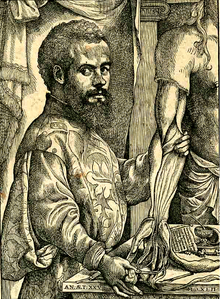
Portrait of Vesalius from his De humani corporis fabrica. Attributed to Jan van Calcar (circa 1499–1546/1550) - Page xii of De humani corporis fabrica (1534 edition), showing portrait of Andreas Vesalius. Original scan of page cropped to show portrait alone, contrasted slightly to 70 in Microsoft Photo Editor. The original book from which the scan arises is a copy of the 1543 edition stored in the collection of the U.S. National Library of Medicine, a division of the National Institutes of Health (NIH) - Public Domain

Portrait of Vesalius from his De humani corporis fabrica.
Attributed to Jan van Calcar (circa 1499–1546/1550) – Page xii of De humani corporis fabrica (1534 edition), showing portrait of Andreas Vesalius. 

Meanwhile, Andreas Vesalius was an anatomist, physician, and author of one of the most influential books on human anatomy, De humani corporis fabrica (On the Fabric of the Human Body). Vesalius is often referred to as the founder of modern human anatomy. He was born in Brussels, which though now part of Belgium, was then part of the Habsburg Netherlands. He was professor at the University of Padua and later became Imperial physician at the court of Emperor Charles V. One must keep in mind that Vesalius faced much prejudice from the ecclesiastical enthusiasts for his work.

In the middle of the 16th Century (1532), an Act of Parliament in England provided for the “institution of Commissions of Sewers in all parts of the Kingdom.” (Fitzgerald, John Gerald, et. al., An Introduction to the Practice of Preventive Medicine, page 653.)

The 17th Century saw the publication of “Novum Organum.” The Novum Organum, full original title Novum Organum Scientiarum (‘new instrument of science’), is a philosophical work by Francis Bacon, written in Latin and published in 1620. The title is a reference to Aristotle’s work Organon, which was his treatise on logic and syllogism. In Novum Organum, Bacon details a new system of logic he believes to be superior to the old ways of syllogism. This is now known as the Baconian method.

The title page illustration of Instauratio magna Francis Bacon (author) - *EC.B1328.620ib, Houghton Library, Harvard University Houghton Library at Harvard University   Location Cambridge, Massachusetts - Public Domain

The title page illustration of Instauratio magna
Francis Bacon (author) – *EC.B1328.620ib, Houghton Library, Harvard University Houghton Library at Harvard University Location Cambridge, Massachusetts – Public Domain

Also, in the 17th Century we find the accomplishments of William Harvey. Harvey (1 April 1578 – 3 June 1657) was an English physician. He was the first known to describe completely and in detail the systemic circulation and properties of blood being pumped to the brain and body by the heart, though earlier writers, such as Jacques Dubois, had provided precursors of the theory.

Even so, it was the 18th Century’s domain to develop modern preventive medicine. Richard Mead’s advice, for example, during the plague of 1663-1665 became crystalized in the legal decrees of George I, especially in the practice of quarantines. 

Sir John Pringle, 1st Baronet, PRS (10 April 1707 – 18 January 1782) was a Scottish physician who has been called the “father of military medicine.” In 1742 he became physician to the Earl of Stair, then commanding the British army in Flanders. About the time of the battle of Dettingen in Bavaria in June 1743, when the British army was encamped at Aschaffenburg, Pringle, through the Earl of Stair, brought about an agreement with the Duc de Noailles, the French commander, that military hospitals on both sides be considered as neutral, immune sanctuaries for the sick and wounded, and should be mutually protected. His first book, Observations on the Nature and Cure of Hospital and Jayl Fevers, was published in 1750, and in the same year he contributed to the Philosophical Transactions of the Royal Society three papers on Experiments on Septic and Antiseptic Substances, which gained him the Copley Medal. Two years later he published his important work, Observations on the Diseases of the Army in Camp and Garrison, which entitles him to be regarded as the founder of modern military medicine. Pringle’s work “resulted in a diminution in the incidence of typhus fever and enterie disease.” (Fitzgerald, pg. 653)

James Lind introduced the idea of “dietetic measures” with his Treatise on Scurvy in 1753. James Lind (4 October 1716 – 13 July 1794) was a Scottish physician. He was a pioneer of naval hygiene in the Royal Navy. By conducting the first ever clinical trial,he developed the theory that citrus fruits cured scurvy. He argued for the health benefits of better ventilation aboard naval ships, the improved cleanliness of sailors’ bodies, clothing and bedding, and below-deck fumigation with sulphur and arsenic. He also proposed that fresh water could be obtained by distilling sea water. His work advanced the practice of preventive medicine and improved nutrition.

Richard Mead (11 August 1673 – 16 February 1754) was an English physician. His work, A Short Discourse concerning Pestilential Contagion, and the Method to be used to prevent it (1720), was of historic importance in the understanding of transmissible diseases. Mead considered quarantine  a preventive medicine – separating the healthy from the sick – essential to suppressing the contagions of the time. 

Captain James Cook gave a notation in his many journals to the teachings of Pringle, Mead, and others during Cook’s great voyage of discovery. He received the gold medal from the Royal Society of London for his paper on the preservation of his sailors from scurvy. (Sala, G. A., and E. H. Yates, editors, Temple Bar, Volume 94, page 373.) Cook’s voyage lasted for a little over 3 years, but during that time, despite being beset with numerous difficulties, only one man out of his 118 man crew died. This was unprecedented at the time, and Cook gave credit to the application of hygienic rules and dietetic measures advocated by James Lind to his crew’s success.

Edward Jenner (1749-1823), Discoverer of vaccination. James Northcote - National Portrait Gallery - Public Domain

Edward Jenner (1749-1823), Discoverer of vaccination.
James Northcote – National Portrait Gallery – Public Domain

Next we find the work of Edward Jenner, who was an English physician and scientist who was the pioneer of smallpox vaccine, the world’s first vaccine. He is often called “the father of immunology,” and his work is said to have “saved more lives than the work of any other human.”

This growth of preventive medicine brought a more “enlightened” and more humane time. Politics and religion and education formed a bond that brought England to the forefront of the world. 

Posted in British history, Great Britain, medicine | Tagged , , , | 2 Comments

Celebrating the Release of “Elizabeth Bennet’s Deception: A Pride and Prejudice Vagary” + Giveaway

Although I have written nearly a dozen Austen-inspired retellings, sequels, and mysteries, Elizabeth Bennet’s Deception is my first attempt at what is known as a “variation” in the JAFF (Jane Austen Fan Fiction) community. In a variation, the author changes one of the events in the original Austen story line and creates a new and intriguing twist. Leave a comment below for a chance to win an eBook copy of this release. 

EBD Cover Concept copyWhat if Fitzwilliam Darcy refused to approach Elizabeth Bennet when he spots her upon the grounds of Pemberley? What if Elizabeth permits Mr. Darcy to think her the one ruined by Mr. Wickham? What if love is not enough to bring these two souls together?

FITZWILLIAM DARCY’s pride makes the natural leap to ELIZABETH BENNET’s ruination when she appears, without notice, upon Pemberley’s threshold to plead for his assistance in locating Darcy’s long time enemy, George Wickham. Initially, Darcy refuses, but when Charles Bingley demands that Darcy act with honor, Darcy agrees. The idea of delivering Miss Elizabeth into the hands of Mr. Wickham rubs Darcy’s raw. Even so, Darcy does his best to bring Wickham to marry Elizabeth Bennet; but it is not long before Darcy realizes Elizabeth practices a deception, one he permits to continue so he might remain at Elizabeth’s side.

Their adventure takes more twists and turns than does the original Pride and Prejudice, but the reader will enjoy the devotion displayed by both Darcy and Elizabeth as they not only bring Wickham to toe the line in Lydia’s defense, but they work their way through new misconstructions. Darcy’s finally wooing of Elizabeth brings them both to a public declaration of their love.

Excerpt “Elizabeth Bennet’s Deception: A Pride and Prejudice Vagary”
Chapter One

Darcy froze in his steps.

“It could not be,” he whispered to his foolish heart. He returned to Pemberley a day early to make the final arrangements for the surprise he meant for his sister. He left Georgiana in the care of his friend, Charles Bingley, and Bingley’s sisters. Darcy experienced a twinge of guilt at his expecting Georgiana to contend with Caroline Bingley and Louisa Hurst, but Miss Bingley’s effusions sorely wore Darcy’s patience away, and so he made his excuses.

He cut across Pemberley’s parkland to come forward from the road, which led behind it to the stables. Upon his approach, Darcy noted the unmarked carriage before the estate. Recognizing the possibility of visitors in the common rooms, he remained in the shadows, meaning to enter the private quarters through the back entrance; yet, the appearance of a young woman upon the rise leading to the river brought Darcy to a stumbling halt. From a distance, the woman had the look of Elizabeth Bennet, but he did not approach. Darcy acted the fool previously and refused to be found wanting again.

Perhaps a month after his disastrous proposal to Miss Elizabeth at Hunsford Cottage, Darcy spotted a young lady entering Hatchard’s Books, and without thinking, he followed her.

“Miss Elizabeth,” Darcy said as he came up behind her, but when the woman spun around to greet him, the lady was not the woman whose being haunted Darcy’s thoughts for almost a year.

The girl’s forehead furrowed in confusion.

“Pardon me, Sir. Do we hold an acquaintance?”

Darcy bowed stiffly.

“It is I, miss, who begs your pardon. From behind, I thought you a long-standing acquaintance.” He stepped back to widen the distance between them. “I apologize for the inconvenience.”

The girl’s frown line deepened.

“Yet, you called me by my Christian name.” The tone of the girl’s voice spoke of her suspicions.

Darcy swallowed the blush of embarrassment rushing to his cheeks.

“If you are also an ‘Elizabeth,’ it is purely a coincidence,” he insisted.

“I am.”

Darcy rushed his apologies when he spied a matron marching to the young woman’s rescue.

“Then I am doubly apologetic. My actions placed you in an awkward position. Please forgive me.” He held enough experience with Society mamas to know when to make a speedy exit.

During his return to Darcy House, Darcy silently cursed his inanity for stumbling into what was a more humiliating situation. Later, in his study, he admitted to the empty room, if not to himself, that he missed looking upon Elizabeth Bennet’s animated countenance.
“If it were she,” Darcy warned his conscience, “Miss Elizabeth would have, in all probability, presented me the direct cut. The lady spoke quite elegantly upon her disdain, and you are imprudent to think your letter would change Miss Elizabeth’s mind. Accept the fact the woman is not for you.”

And so when Darcy noted another possessing Elizabeth’s likeness upon the streets in the warehouse district of Cheapside a fortnight later, he turned away with the knowledge that as a gentleman’s daughter, Miss Elizabeth would not be found in Cheapside. He strove to convince himself that he would soon replace Elizabeth Bennet’s charms with that of another.

Belatedly, realizing he studied the woman standing upon the rise longer than was proper, Darcy slipped through an open patio door to escape the vision of Elizabeth Bennet at Pemberley, which so often followed him about. It was deuced frustrating to look for the woman wherever he his steps took him.

“Leave it be,” Darcy chastised as he crossed the drawing room only to be brought up short a second time by the appearance of his housekeeper.

Mrs. Reynolds caught at her chest in obvious surprise.

“Mr. Darcy,” she gasped. “I did not realize you returned, Sir.”

Darcy caught her elbow to steady the stance of his long-time servant. Mrs. Reynolds came to Pemberley when he was but three. She, Mr. Nathan, his butler, and Mr. Sheffield, his valet, all knew the Darcy family’s employ for over twenty years. “I noted visitors, and as I was not dressed properly, I thought to avoid the necessary greetings,” he explained.

“I have just this minute turned them over to the gardener,” Mrs. Reynolds assured.

Darcy swallowed the question rushing to his lips.

“Very well. Then I am free to seek the privacy of my quarters.”

“Yes, Sir.” Mrs. Reynolds glanced toward the entrance hall. “Should I have a footman bring up bath water, Sir?”

Darcy nodded his agreement. Again, he fought the urge to ask of the estate’s visitors, but Darcy chose not to punish his pride with false hopes.

“Has Miss Darcy’s gift arrived?”

“Yes, Sir. As you instructed I had the instrument placed in Miss Darcy’s sitting room. It fits perfectly. Miss Georgiana will know such joy.”

He smiled with the woman’s kindness.

“My sister deserves a bit of happiness. After my ablutions, I mean to view the arrangement personally.”

“Very good, Sir.” Mrs. Reynolds started away to do his bidding. Yet, despite his best efforts, Darcy called out to her. “Yes, Master William. Is there something more?”

Darcy’s eyes searched the staircase where he often imagined Elizabeth Bennet standing. Such yearning swelled his chest that he experienced difficulty breathing. It is best not to know, he cautioned his wayward thoughts.

“Would you tell the footman I will require his assistance in dressing. Mr. Sheffield and my coach will arrive later this evening.”

“Certainly, Sir.”

“And you and I should speak before Mr. Bingley’s family arrives. Miss Bingley did not enjoy the vista from her guest room when last the Bingleys were here.”

A scowl of disapproval crossed his housekeeper’s features. Darcy knew many of his servants prayed he would not take up with Caroline Bingley. He expected if he were to act so foolish, he would receive a large number of notices of leaving from his staff.
“Perhaps before supper, Sir,” Mrs. Reynolds said stiffly.

Darcy nodded his approval, and the lady strode away; yet, he whispered to her retreating form.

“Have no fear. Only one woman knows my approval as the Mistress of Pemberley.” Darcy chuckled in irony. “And it remains unfortunate that even Pemberley’s grandeur could not entice the lady to overlook its master’s shortcomings.”

* * *

Mr. Darcy’s housekeeper consigned Elizabeth and her aunt and uncle over to the gardener, who met them at the hall door. As they followed the man toward the river, Elizabeth turned to look upon the gentleman’s home. For very selfish reasons, she opposed her aunt’s suggestion of the tour of Mr. Darcy’s estate, but Elizabeth was glad she came. In her future daydreams, she would picture him on the grand staircase.

If Elizabeth, when Mr. Darcy gave her the letter he wrote in clarification of his actions, did not expect it to contain a renewal of his offers, she formed no expectation at all of its contents. But such as they were, it might well be supposed how eagerly she went through them and what a contrariety of emotions they excited. No one observing her progress could give voice to her feelings. With amazement did she first understand that Mr. Darcy believed any apology to be in his power; and she steadfastly denied that he could possess an explanation, which a just sense of shame would not conceal.

With a strong prejudice against everything he might say, she examined his account of what occurred at Netherfield. She read with an eagerness, which hardly left her power of comprehension, as well as from an impatience of knowing what the next sentence might bring, so much so she could not attend to the sense of the written lines before her eyes. Mr. Darcy’s belief of Jane’s insensibility Elizabeth instantly resolved to be false, and his account of his real objections to the match brought such anger that she could not declare his actions just. The gentleman expressed no regret for acting upon his beliefs, at least none, which satisfied her. Elizabeth declared his style lacking in penitence, instead of naming it haughty and prideful and insolence.

But Mr. Darcy’s account of his relationship with Mr. Wickham bore so alarming an affinity to Mr. Wickham’s own narration of the events that astonishment, apprehension, and even horror, oppressed her. Elizabeth wished to discredit it, but every line proved that the affair, which she believed beyond the pale, could name the gentleman entirely blameless throughout the whole.

In hindsight, Elizabeth grew absolutely ashamed of her accusations. Of neither Darcy nor Wickham could she think without feeling she was blind, partial, prejudiced, and absurd.
“I acted the harpy,” Elizabeth whispered as she implanted the image of Pemberley upon her mind.

When her relatives insisted upon touring the estate, Elizabeth convinced herself that viewing Mr. Darcy’s property would prove just punishment for the pain she caused the gentleman.

“Of all this, I might be mistress,” she reminded herself with each new discovery of how easily she and Mr. Darcy could suit. They held similar tastes in architecture and décor. “So different from his aunt’s ornate presentation at Rosings.”

And so, although Pemberley’s gallery sported many fine portraits of the Darcy family, Elizabeth searched for the one face whose features she wished to look upon again. At last, it arrested her, and Elizabeth beheld a striking resemblance to Mr. Darcy, with such a smile upon his lips as she remembered to have sometimes seen when he looked upon her. The viewing brought Elizabeth instant regret for she recognized the honor of Mr. Darcy, which led her to consider his regard for her with a deeper sentiment of gratitude than she ever admitted, even to herself.

Elizabeth wished she could tell Mr. Darcy that she found Pemberley “delightful” and “charming,” but she quickly deduced the gentleman would assume her opinions mischievously construed: Mr. Darcy would think her praise of Pemberley a device to elicit a renewal of his proposal.

“Better this way,” Elizabeth whispered as she turned to follow her aunt and uncle further into the woods. “I have memories of Pemberley, and no one else is the wiser of my presence under Mr. Darcy’s roof.”

* * *

Unable to quash his curiosity any longer, after supper, Darcy sent for Mrs. Reynolds.
“Yes, Sir?” The lady curtsied from her position inside the open door to his study.
Darcy motioned her forward.

“Would you see there is a vase of yellow roses placed upon the new instrument in Miss Darcy’s quarters.”

Mrs. Reynolds’ countenance relaxed.

“I asked Mr. Brownley for fresh cuttings previously, Sir.”

Darcy nodded his approval.

“I should not think to instruct you on providing for Georgiana’s pleasure. You have been an exemplary member of Pemberley’s staff for longer than I can remember.”

The woman blushed at Darcy’s kindness, but she kept a business-like tone.

“I also aired out the green bedchamber for Miss Bingley’s use. I pray that will serve the lady’s purpose.”

Darcy understood Mrs. Reynolds’ poorly disguised question.

“You may inform the staff I hold no intention of seeing Miss Bingley in the family quarters. The green chamber is close enough.”

Mrs. Reynolds closed her eyes in what appeared to be a silent prayer of thanksgiving.
“Will that be all, Sir?”

Darcy’s heart raced, but he managed to pronounce the necessary words.

“Did we have more than one set of visitors today? Thanks to your efficiency, I so rarely encounter the estate guests, but I would not have you beset upon. Your first duty is to the running of Pemberley.”

“No, Sir. Mr. and Mrs. Gardiner were the only ones we accepted in well over a week. It is no bother: I am proud of Pemberley.”

“Mrs. Gardiner,” Darcy’s mind caught the name and rolled it through his body like a tidal wave striking a ship. If the lady he observed was Elizabeth, had she married? Had she thought to compare what she earned to what she lost?

Darcy’s mind retreated from the possibilities, but he could not quite quash his fears.

“A young couple then? Perhaps on a holiday?”

Mrs. Reynolds shook her head in denial.

“Mr. and Mrs. Gardiner would be the age of your late parents. I overheard Mrs. Gardiner tell her niece a tale of the village oak. It sounded as if the lady spent part of her childhood on the London side of Lambton.”

“Her niece?” Darcy’s mind latched onto the one word in his housekeeper’s tale that rang with hope.

“Yes, Sir. A fine young lady. Very kind to her aunt, offering her arm to Mrs. Gardiner’s support. I believe the lady held an acquaintance with you. She and her aunt had a private conversation when they spotted the miniature of Mr. Wickham on your father’s mantelpiece.” Mrs. Reynolds’ shoulders stiffened. “I am sorry to report, Sir, I could not give Mrs. Gardiner a civil account when she asked her niece how the young lady liked it. In truth, I quickly turned the conversation to your miniature.”

“I appreciate your loyalty,” Darcy said with a wry smile.

“My respect for the girl increased when she admitted she knew you ‘a little’ and that she found you ‘very handsome,’” Mrs. Reynolds continued.

Darcy’s eyebrow rose with curiosity. He hoped perhaps Mrs. Reynolds described Elizabeth Bennet, but he could not imagine Miss Elizabeth’s declaring him handsome: The woman abhorred him.

“And how did this conversation come about?”

Mrs. Reynolds blushed, but she did not avoid his unspoken accusation, a sign of her long-standing position in his household.

“Do not look to place blame, Master William. I respect the late master’s kind heart and his benevolence toward his godson, but I see no reason to display George Wickham’s image in this house. Even the late Mr. Darcy could peer down from Heaven and see Mr. Wickham turned out very wild.”

“We will discuss the future of Mr. Wickham’s likeness upon another occasion. Speak to me of your conversation with the young lady.”

It was Mrs. Reynolds’ turn to raise an eyebrow in interest; however, she swallowed her questions.

“Mrs. Gardiner remarked of your fine countenance when she looked upon the miniature, and then the lady asked her niece whether it was an accurate likeness. I then inquired if the young lady held an acquaintance with you. When she admitted as such, I asked if she found you a handsome man.”

“Then, it was Mrs. Gardiner and you who placed words in the lady’s mouth,” he reasoned. Darcy felt the female likely agreed only to be rid of the conversation.

Mrs. Reynolds blustered.

“The girl’s aunt and I stated the obvious,” she declared with a tone commonly found among upper servants. “But neither Mrs. Gardiner nor I instructed the young lady to search out your portrait in the gallery nor did we lead her to it again and again.”
Darcy’s heart hitched higher.

“I count no one named Gardiner among my acquaintances. Did you overhear the young lady’s name?”

“Her aunt called her ‘Lizzy’ several times so I would assume it is Miss Elizabeth or Lady Elizabeth.”

“Miss Elizabeth Bennet,” Darcy corrected. Remorse at not having met her today filled his chest. A glance to his housekeeper said Mrs. Reynolds wished an explanation. “The young lady’s parents are neighbors of Mr. Bingley’s estate in Hertfordshire. If it is truly Miss Elizabeth, we met upon several occasions. I believe I stood up with her at the Netherfield’s ball.”

“Then perhaps you might renew the acquaintance,” Mrs. Reynolds suggested. “Mrs. Gardiner was to dine with friends before the family moved on to Matlock. I am certain Mr. Bingley would wish to behold Miss Elizabeth again.”

An invisible hand squeezed Darcy’s heart. Should he risk an encounter with Elizabeth Bennet? Had his letter softened the lady’s disdain for him?

“Miss Bingley took a dislike for the Bennets,” Darcy offered in explanation. “Mr. Bingley developed a regard for Miss Bennet. His leaving Netherfield was poorly done.”

“I am sad to hear it, Sir, but your confidence explains the halfhearted air, which follows Mr. Bingley about.”

Darcy nodded his acceptance: His housekeeper gave voice to what Darcy’s pride denied. Darcy sorely wounded his friend by acting in partnership with Miss Bingley in separating Bingley from Miss Bennet. With a second nod, he excused his servant. For several long minutes, Darcy stared off into the emptiness, which marked his life.

“I cannot seek out Miss Elizabeth,” he told the rise of expectation climbing up his chest. “Even if the lady might offer her forgiveness, Miss Elizabeth holds no interest in renewing our acquaintance. Furthermore, I do not deserve happiness when I robbed my friend of an opportunity to know it.”

* * *

“You are very quiet this evening, Lizzy.” Her aunt’s friends invited them to dine in the evening, but once they returned to their let rooms, Elizabeth preferred to spend time alone with her thoughts of Mr. Darcy.

“Just a bit fatigued.” Elizabeth made herself smile at her dearest aunt.

“Then you should retire early,” her Uncle Edward declared.

Her aunt ignored her husband’s lack of intuitiveness.

“Are you certain what the Pemberley housekeeper said of Mr. Wickham did not upset you? I would venture the woman’s loyalty to the Master of Pemberley colored her opinions.”
Elizabeth expected her aunt to ask of Mr. Darcy, not of Mr. Wickham.

“Not in the least,” Elizabeth assured. “While in Kent, I learned more of what occurred between Mr. Darcy and Mr. Wickham, enough so to acquit the former of any ill doing.”

Aunt Gardiner’s interest piqued.

“Would you care to elaborate?”

“I promised my source secrecy.” Elizabeth would like to confide in her aunt and uncle for she wished someone would give her permission to beg Mr. Darcy’s forgiveness, but she dug the pit of regret in which she wallowed. “As I explained in my letter before I departed for Kent, Mr. Wickham bestowed his affections upon Miss King, and I held no loyalty for the man when I arrived on Charlotte’s threshold; therefore, I was free to accept other versions of the events.” Hers was an exaggeration of what occurred, but it held some truth. “Although I still believe handsome young men must have something to live on, I pity whoever accepts Mr. Wickham’s hand.” If only I did not previously express my opinions to the contrary, Elizabeth thought.

“That is quite a transformation,” her uncle observed.

“I am only aggrieved that I behaved with foolish disregard for Mr. Darcy. I treated the gentleman poorly.”

Her aunt’s question came quickly.

“Is this revelation the source of your reluctance in viewing Mr. Darcy’s home?”

Elizabeth swallowed the bile rushing to her throat.

“I rejoiced today when Mr. Darcy’s housekeeper informed us that we missed his return to Derbyshire by a day. I would not wish to encounter the gentleman. Our last exchange of words was far from pleasant.”

“If I knew…” her uncle began.

Elizabeth shook off his regrets.

“I asked the inn’s staff of Mr. Darcy’s being at Pemberley before we came to the place.”
“We should be on to Matlock the day after tomorrow,” her aunt declared. “Even with Mr. Darcy’s presence at Pemberley we are not likely to encounter him. My friends do not travel in the same circles as Mr. Darcy. We shall be gone soon, and the gentleman will know nothing of our coming into his part of the shire.”

Purchase Links (Note! The eBook version of the book is on sale for a limited time. Grab your copy now.): 

Amazon

Kobo 

Kindle 

Nook 

CreateSpace 

Posted in Jane Austen, Living in the Regency, Regency era, Vagary | Tagged , , , , | 25 Comments

Early Political History of England: The West Saxons

Under King Offa, the Mercians defeated the Northumbrians, but the Mercian rule lasted only as long Offa remained in control. The Mercians were replaced by a line of West Saxon kings, including Ine (688-725); Egbert (802 -839), and Alfred the Great (871-901), who subdued the Mercians. During Egbert’s rule the West Saxons attained supremacy for both Northumbria and Wales accepted Egbert as their lord, and East Anglia sought his protection. 

“Egbert (Ecgberht in Anglo Saxon) king of Wessex (802-39), and the first Saxon king recognized as sovereign of all England . He was the son of a Kentish noble but claimed descent from Cerdic (reigned 519-34), founder of Wessex, the kingdom of the West Saxons in southern England. During the late 8th century, when King Offa of Mercia (reigned 757-96) ruled most of England, Egbert lived in exile at the court of Charlemagne. Egbert regained his kingdom in 802. He conquered the neighboring kingdoms of Kent, Cornwall, and Mercia, and by 830 he was also acknowledged as sovereign of East Anglia, Sussex, Surrey, and Northumbria and was given the title of Bretwalda (Anglo-Saxon, “ruler of the British”). During following years Egbert led expeditions against the Welsh and the Vikings. The year before his death he defeated a combined force of Danes and Cornish at Hingston Down in Cornwall. He was succeeded by his son Aethelwulf, the father of Alfred.” (Royal Family History)

Meanwhile, the Danes penetrated the country, and Egbert’s successors felt the full force of the Danes’ strength. Aethlred, Egbert’s grandson lost his life in 871 to the Danish force. However, Alfred the Great defeated the Danes at Ethandun in 878. Alfred set off a separate piece of land, called a Danelagh, for the Danes. 

alfred“In 870 Alfred and his brother Aethelred fought many battles against the Danes. Alfred gained a victory over the Danes at Ashdown in 871, and succeeded Ethelred as king in April 871 after a series of battles in which the Danes had been defeated. Not all his campaigns were so successful; on a number of occasions he had to resort to buying off the Danes for a brief respite. Five years of uneasy peace followed while the Danes were occupied in other parts of England. In 876 the Danes attacked again, and in 878 Alfred was forced to retire to the stronghold of Athelney which was at that time an island in the Somerset Levels. The legend of him burning the cakes probably comes from this period. Saxons & Vikings Book available here

His come back and great victory at Edington in 878 secured the survival of Wessex, and the Treaty of Wedmore with the Danish king Guthrum in 886 established a boundary between the Danelaw, east of Watling Street, and the Saxons to the west. The Anglo-Saxon Chronicle says that following his capture of London in 886 ‘all the English people submitted to him, except those who were in captivity to the Danes’. In some respects, therefore, Alfred could be considered the first king of England. A new landing in Kent encouraged a revolt of the East Anglian Danes, which was suppressed 884–86, and after the final foreign invasion was defeated 892–96, Alfred strengthened the navy to prevent fresh incursions.

During periods of peace Alfred reformed and improved his military organization. He divided his levies into two parts with one half at home and the other on active service, giving him a relief system he could call on to continue a campaign. He also began to build burhs (fortified strongpoints) throughout the kingdom to form the basis of an organized defensive system. Alfred is popularly credited as being the founder of the Royal Navy; he did build a fleet of improved ships manned by Frisians and on several occasions successfully challenged the Danes at sea.” (Royal Family History)

In addition to his fine military organization and law code, Alfred also encouraged literature. He is considered responsible for “The Anglo-Saxon Chronicle” and the translation of Bede’s “Ecclesiastical History.” 

Alfred’s successors continued the conquest of Britain. Edward recovered East Anglia, Essex, and much of Mercia. His son Aethlstan overcame the Scots, Welsh, and Danes. Under Edred, the Danes were subdued to the level of peaceful subjects of the kingdom. 

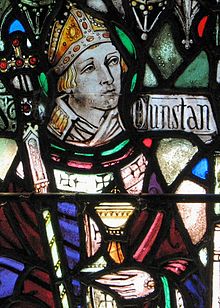
220px-Saint_DunstanAn unlikely reformer was the monk known as St. Dunstan.  “Dunstan (909 – 19 May 988) was an Abbot of Glastonbury Abbey, a Bishop of Worcester, a Bishop of London, and an Archbishop of Canterbury, later canonised as a saint. His work restored monastic life in England and reformed the English Church. His 11th-century biographer, Osbern, himself an artist and scribe, states that Dunstan was skilled in ‘making a picture and forming letters,’ as were other clergy of his age who reached senior rank.

Dunstan served as an important minister of state to several English kings [Edred and Edgar]. He was the most popular saint in England for nearly two centuries, having gained fame for the many stories of his greatness, not least among which were those concerning his famed cunning in defeating the Devil.” (Dunstan)

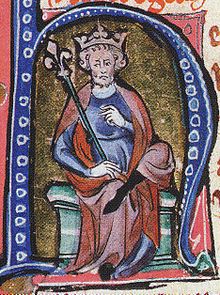
220px-Ethelred_the_UnreadyUnder King Edgar, local self-government grew. When Aethelred the Redeless came to the throne, the local aldermen declared their own independence. Royal power took a nose dive, so to speak. The Danes again revolted. Aethelred received no assistance form his nobles against the Danes, so in 1002 on St. Brice’s Day, Aethelred ordered a massacre of Danish settlers. Soon, Aethelred was deposed. 

At Swein’s death, Cnut became the Danish chief. He was opposed by Edmund Ironside and London, with whom he signed a treaty. With Edmund’s murder, Cnut became sole ruler.  He reigned from 1016 – 1035. 

220px-Knut_der_Große_croppedAs a Prince of Denmark, Cnut won the throne of England in 1016 in the wake of centuries of Viking activity in northwestern Europe. His accession to the Danish throne in 1018 brought the crowns of England and Denmark together. Cnut maintained his power by uniting Danes and Englishmen under cultural bonds of wealth and custom, rather than by sheer brutality. After a decade of conflict with opponents in Scandinavia, Cnut claimed the crown of Norway in Trondheim in 1028. The Swedish city Sigtuna was held by Cnut. He had coins struck there that called him king, but there is no narrative record of his occupation. The kingship of England lent the Danes an important link to the maritime zone between the islands of Great Britain and Ireland, where Cnut, like his father before him, had a strong interest and wielded much influence among the Gall-Ghaedhil. Cnut’s possession of England’s dioceses and the continental Diocese of Denmark – with a claim laid upon it by the Holy Roman Empire’s Archdiocese of Hamburg-Bremen—was a source of great leverage within the Church, gaining notable concessions from Pope Benedict VIII and his successor John XIX, such as one on the price of the pallium of his bishops. Cnut also gained concessions on the tolls his people had to pay on the way to Rome from other magnates of medieval Christendom, at the coronation of the Holy Roman Emperor. After his 1026 victory against Norway and Sweden, and on his way to Rome for this coronation, Cnut, in a letter written for the benefit of his subjects, stated himself “King of all England and Denmark and the Norwegians and of some of the Swedes”. (Cnut the Great)

The English line returned after Cnut’s death. Cnut’s two sons died without heirs, and Edward the Confessor, son of Aethelred, became king. Edward was a Norman, and he brought many Normans to England with him, and they wielded a great influence in affairs of state. After Cnut’s death, the deaths of his heirs within a decade, and the Norman conquest of England in 1066, his legacy was largely lost to history. Historian Norman Cantor has made the statement that he was “the most effective king in Anglo-Saxon history”, despite not being Anglo-Saxon.

Edward the Confessor was King of England from 1042. He lived in Normandy with his mother Emma of Normandy’s relatives until shortly before his accession to the English Throne. During his reign power was held by Earl Godwine and his son Harold, while the king devoted himself to religion, including the rebuilding of Westminster Abbey (consecrated in 1065), where he is buried.

Godwine, the Earl of Wessex, opposed the Normans, and was, therefore, exiled in 1051. The Normans were unpopular. Therefore, Godwine returned to England in 1052. Godwine’s son Harold becomes principal adviser to the King Edward in 1053.  

Harold succeeded his father as Earl of Wessex with his Godwine’s death in 1053. At that time, Wessex covered the southern third of England. Earl Siward died in 1055 and Earl Elfgar in 1062, providing Godwine’s children with the opportunity to assume control of Britain. Tostig assumed the earldom of Northumbria. Harold succeeded Edward the Confessor as King. That is until he was defeated in the Norman Conquest. 

In 1064, Harold visits William of Normandy and swears an oath to support William’s claim to the throne. 

 At the end of 1065, King Edward the Confessor fell into a coma without clarifying his preference for the succession. He died on 5 January 1066, according to the Vita Ædwardi Regis, but not before briefly regaining consciousness and commending his widow and the kingdom to Harold’s “protection”. The intent of this charge remains ambiguous, as is the Bayeux Tapestry, which simply depicts Edward pointing at a man thought to represent Harold. When the Witenagemot convened the next day they selected Harold to succeed, and his coronation followed on 6 January, most likely held in Westminster Abbey; though no evidence from the time survives to confirm this. Although later Norman sources point to the suddenness of this coronation, the reason may have been that all the nobles of the land were present at Westminster for the feast of Epiphany, and not because of any usurpation of the throne on Harold’s part.

In early January 1066, hearing of Harold’s coronation, Duke William II of Normandy began plans to invade England, building 700 warships and transports at Dives-sur-Mer on the Normandy coast. Initially, William could not get support for the invasion but, claiming that Harold had sworn on sacred relics to support his claim to the throne after having been shipwrecked at Ponthieu, William received the Church’s blessing and nobles flocked to his cause. In anticipation of the invasion, Harold assembled his troops on the Isle of Wight, but the invasion fleet remained in port for almost seven months, perhaps due to unfavourable winds. On 8 September, with provisions running out, Harold disbanded his army and returned to London.

On 12 September William’s fleet sailed. Several ships sank in storms, and the fleet was forced to take shelter at Saint-Valery-sur-Somme and wait for the wind to change. On 27 September the Norman fleet finally set sail for England, arriving, it is believed, the following day at Pevensey on the coast of East Sussex. Harold’s army marched 241 miles (386 kilometres) to intercept William, who had landed perhaps 7000 men in Sussex, southern England. Harold established his army in hastily built earthworks near Hastings. The two armies clashed at the Battle of Hastings, at Senlac Hill (near the present town of Battle) close by Hastings on 14 October, where after nine hours of hard fighting and probably less than 30 minutes from victory, Harold was killed and his forces routed.

When Edward died in January 1066, his childlessness led to a struggle for power. The succession went first to Harold Godwinson and then to the conquest by William of Normandy nine months later at the Battle of Hastings in October 1066. 

Posted in British history, Great Britain | Tagged , , , , , | Comments Off on Early Political History of England: The West Saxons

Sir Walter Scott, the Historical Romance, and the Creation of a National Identity – Part I

Sir Walter Scott, 1st Baronet http://www.britannica. com/EBchecked/topic /529629/Sir-Walter-Scott-1st-Baronet

Sir Walter Scott, 1st Baronet http://www.britannica.
com/EBchecked/topic
/529629/Sir-Walter-Scott-1st-Baronet

Walter Scott was the first great writer to recognize the potential of historical romance as a “dramatic narration of national history, a modern commercial equivalent of the old national epic. Scott’s Waverley novels started out as the romance of Scotland, but of a Scotland that was now part of the United Kingdom, so that the hero was generally a young adventurer from south of the border. But Scott soon broke with this pattern, and with Ivanhoe (1819), the tenth in the series, her turned the adventure tale into a ‘foundation epic of England.'” [Parrinder, Patrick, Nation and Novel, Oxford University Press, 2006, pg. 151]

In Ivanhoe, Scott addresses what he purports to be the beginnings of the “English identity” with the portrayal of the barriers between the Norman lords and their Saxon serfs. Scott creates “history” with his scenes demonstrating the divide between these two groups: politically, culturally, and linguistically. These depictions influenced later historiography. For a discussion of whether this “creation of history” was a good or a bad thing, read The Isles: A History, by Norman Davies (Macmilliam Press, 2000, pp. 335-337).

ivanhoeScott’s story brings to life the hardships under which the Saxons lived. Ivanhoe is set four generations after the Norman conquest of England. Having been captured on his return to England after the Crusades, King Richard is an Austrian prison. His brother, Prince John, has claimed the throne. Prince John encourages the Norman nobles to claim supremacy over the Saxons, capriciously robbing the Saxons of their lands and turning Saxon landowners into serfs. The Saxon nobility, especially Cedric of Rotherwood, decry the Norman’s highhandedness.  Cedric is so loyal to the Saxon cause that he has disinherited his son Ivanhoe for following King Richard to war.

The epigraph for Chapter 7 comes from John Dryden’s poem “Palamon and Arcite.” This poem is based on Geoffrey Chaucer’s “Knight’s Tale,” one of the Canterbury Tales. In these particular lines, we get a description of knights coming together for a tournament.

Knights, with a long retinue of their squires,
In gaudy liveries march and quaint attires;
One laced the helm, another held the lance,
A third the shining buckler did advance.
The courser paw’d the ground with restless feet,
And snorting foam’d and champ’d the golden bit.
The smiths and armourers on palfreys ride,
Files in their hands, and hammers at their side;
And nails for loosen’d spears, and thongs for shields provide.
The yeomen guard the streets in seemly bands;
And clowns come crowding on, with cudgels in their hands.
Palamon and Arcite

Chapter 7 gives the reader a detailed description of the conditions in which the nation suffered. Scott’s uses the suffering of the Saxons as a means to define the ‘state of the nation.’

The condition of the English nation was at this time sufficiently miserable. King Richard was absent a prisoner, and in the power of the perfidious and cruel Duke of Austria. Even the very place of his captivity was uncertain, and his fate but very imperfectly known to the generality of his subjects, who were, in the meantime, a prey to every species of subaltern oppression.

Prince John, in league with Philip of France, Coeur-de-Lion’s mortal enemy, was using every species of influence with the Duke of Austria, to prolong the captivity of his brother Richard, to whom he stood indebted for so many favours. In the meantime, he was strengthening his own faction in the kingdom, of which he proposed to dispute the succession, in case of the King’s death, with the legitimate heir, Arthur Duke of Brittany, son of Geoffrey Plantagenet, the elder brother of John. This usurpation, it is well known, he afterwards effected. His own character being light, profligate, and perfidious, John easily attached to his person and faction, not only all who had reason to dread the resentment of Richard for criminal proceedings during his absence, but also the numerous class of “lawless resolutes,” whom the crusades had turned back on their country, accomplished in the vices of the East, impoverished in substance, and hardened in character, and who placed their hopes of harvest in civil commotion. To these causes of public distress and apprehension, must be added, the multitude of outlaws, who, driven to despair by the oppression of the feudal nobility, and the severe exercise of the forest laws, banded together in large gangs, and, keeping possession of the forests and the wastes, set at defiance the justice and magistracy of the country. The nobles themselves, each fortified within his own castle, and playing the petty sovereign over his own dominions, were the leaders of bands scarce less lawless and oppressive than those of the avowed depredators. 

To maintain these retainers, and to support the extravagance and magnificence which their pride induced them to affect, the nobility borrowed sums of money from the Jews at the most usurious interest, which gnawed into their estates like consuming cankers, scarce to be cured unless when circumstances gave them an opportunity of getting free, by exercising upon their creditors some act of unprincipled violence.

Under the various burdens imposed by this unhappy state of affairs, the people of England suffered deeply for the present, and had yet more dreadful cause to fear for the future. To augment their misery, a contagious disorder of a dangerous nature spread through the land; and, rendered more virulent by the uncleanness, the indifferent food, and the wretched lodging of the lower classes, swept off many whose fate the survivors were tempted to envy, as exempting them from the evils which were to come.

Parrinder says, “In Ivanhoe the King whose banner of Le Noir Faineant, literally, the ‘do-nothing’ black knight – [represents] a medieval anticipation of the nineteenth century doctrine of laissez-faire (155).” Scott’s story creates a crisis of instability and anarchy as the setting. Much of the derision between the Normans and the Saxons occupies the opening chapters of the novel. The “contagious disorder” in the quote above is the suffering of ordinary people. 

Scott follows this description of desolation with a “romantic” scene of a tournament held to entertain Prince John. One of the champions of the displaced Saxons turns out to be Ivanhoe, who fights under the name of the ‘Disinherited Knight.’ Ivanhoe defeats his Norman foes. “The ethic of chivalry is manifestly inadequate to deal with the social injustices Scott has outlined, but, after, all, he is writing an adventure romance and not a historical tract for his times.” (Parrinder, 155)

This “epic” romance is what Scott called the “Big Bow-Wow strain.” In Part II, we will look at the “romance” found in Scott’s Ivanhoe.


Posted in Anglo-Saxons, British history, Great Britain | Tagged , , | 5 Comments

Inspired by Jane Tea Collection

1423188077Recently, a fellow Charlottean (a person living in Charlotte, NC) approached me with a product she distributed. This woman, Sara Thomas, recognized my love of all things Jane Austen. Ms. Thomas offered me a free canister of one of her specialty teas for an HONEST review. So, permit me to introduce you to the “Inspired By Jane” Tea Collection.

7606887_orig2227010_orig2838890_orig


9830943_orig5100777_orig

Inspired By Jane LLC, in cooperation with The Tea Can Company, is proud to announce their new Jane Austen Inspired Tea Collection. These beautiful tea tins are inspired by the literary works of Jane Austen. Each blend is named for a manor home of one of the beloved characters, and the flavors were specially chosen to reflect the spirit of that home. Each can features period artwork against a vintage background, and a quote from the associated book. The current flavors are:

Pemberley, a lavender and lemon green tea. Contains caffeine. 

Longbourn, a chamomile blend with lemon myrtle, spearmint and lavender. Caffeine-free 

Donwell Abbey, a black tea flavored with cinnamon and marsala wine. Contains caffeine. 

Hartfield, an antioxidant rich green tea infused with peppermint leaves and peppermint flavor. 

Barton Cottage, a delicate blend of Ceylon black tea, with rose petals and flavoring. Contains caffeine. 

Each can contains 10 premium sachets which can each brew 2-3 cups of tea. Available exclusively on amazon.com and www.inspiredbyjane.com

MY REVIEW: For those of you who know me well, you will easily guess that I tried the “Pemberley” brew. In reality, I chose the Pemberley tea for it has been several years since I enjoyed a good lavender tea, plus it was combined with a green tea (one of my favorites). Many times “packaged” teas combine lavender with honey, but that makes the tea too sweet for me. This tea had a light, floral flavor (sweet, even without the sugar). The lavender is the prominent flavor – not overpowered by the lemon grass. As lavender is a member of the mint family, one can taste an undertone of mint, but also an earthy, apple-like sense of flavor is quickly noted. The lavender and lemongrass combination makes a beautiful tea, complementing each others’ flavors. The tea is full and smooth at the same time. The lemongrass keeps the floral flavor from being too dominant. Both lavender and lemongrass are known for their calming effects on the digestive tract, and I found this to be true. Lemongrass is a milder flavor, which does not dominate the lavender, which I find both honey and perhaps even a chamomile combination would do. Lemon grass has a delicate lemon taste and a very aromatic floral fragrance: Smooth and fragrant with a clean finish and a slightly, spicy taste. 

I loved the flavor of this tea and had two full “mugs” early in the day on Saturday last. I chose the earlier part of thee day for in choosing the “Pemberley” brew, I erred. I did not read the “caffeine” part of the label, and as I do not do well with caffeine, I paid the price for this oversight. Instead of the lavender and lemon grass creating a calming effect, I knew a faster heart rate. That being said, I have purchased the caffeine free blend. 

Note! There are other Austen related items available upon the website. If you are interested, pay it a visit; yet, know this is review is not meant as an endorsement. I receive no reimbursement for this review other than a canister of the tea. 


Posted in Jane Austen, real life tales, tea | Tagged , , | 19 Comments

What is a Perpetual Curacy?

According to The Law Dictionary, a perpetual curacy is 
“the office of a curate in a parish where there is no spiritual rector or vicar, but where a clerk (curate) is appointed to officiate there by the impropriator. 2 Burn. Ecc. Law, 55. The church or benefice tilled by a curate under these circumstances is also so called.”

From Family Search: Clergy of Church of England (in England), we can find a detailed definition of positions within the Church. 

“The incumbent of a parish is the person in charge of its spiritual well being, the “cure of souls”. He held the benefice with its income, mostly derived from its land, and might be a rector, receiving a tithe or ten per cent of the crops and grain, hay and timber (the great tithes) and of new born animals, wool, garden and other produce of the parish (the small tithes) or a vicar, receiving only the small tithes. The estimated value of each benefice in 1535 was set out in the Valor Ecclesiasticus, printed in six volumes by the Record Commissioners in 1810-34 [FHL only has Diocese of Llandaff on Film 1696528.1].

The incumbent may be known colloquially as a parson and live in the parsonage. Before the 17th century, curate was often another word for parson. Although a clergyman is technically ordained as a priest, the use of the general word priest to denote a minister of the Church of England (or Anglican Church) declined after the Reformation, being more often used in the Roman Catholic and Eastern churches. Anglican clergy were described as clerks in holy orders or clerks (a writing clerk was a “writer”). Until the 18th century a clerk who had been to university was, in Latin, called Magister. A non-graduate clerk was Dominus, a word often translated as Sir, but this does not mean that he was a knight.

The person who originally founded, built or endowed the church had the right as its patron to make presentation to the bishop of a suitable person to be its incumbent. This right (called the advowson) descended to the patron’s heirs and might be bought and sold like any other property. A college might thus buy the advowsons of lucrative benefices in order to provide positions for its future Fellows. The descent of the ownership of the advowson is recorded in the older county histories and in the Victoria County Histories.

The person presented, who might well be a relative of the patron, had usually already been ordained by his local bishop as a deacon or priest in order to celebrate mass and hear confession. He was supposed to be over 21 and of legitimate birth. It is said that the usual age at ordination was 23 years and six months.

Following approval by the bishop, the priest is then admitted to the benefice. Institution follows, putting him in charge of its spiritual cure, and then induction, which gives him rights to the land and income. The two acts are usually combined in a ceremony at the parish church (though institution may take place elsewhere) when the induction is symbolised by the archdeacon putting the bell rope into the hands of the newly instituted priest and by the latter tolling the bell.

Chaplains and curates were licensed by the bishop and, not having benefices, were not instituted or inducted. Curates, who may be assistant, temporary or stipendiary, assist the rector or vicar and are employed and paid by him. A perpetual curate, however, was nominated to a benefice by the lay owner or impropriator of its great or rectorial tithes. This lay patron kept the income from the benefice and paid (or granted land to) the curate. The latter needed only a licence from the bishop and was “perpetual” as he could only be removed by the withdrawal of that licence. A chapel of ease could be established in the outlying parts of a parish provided the bishop, patron and incumbent agreed. This might be convenient for the patron but the curate of such a place was paid from the income of the “mother church” and disputes frequently arose about the division of fees, tithes and the costs of repairs to the benefice house and the two churches.”

According to Wikipedia, the practice of a “perpetual curate” greatly affected the Church’s practice in the 19th Century.  

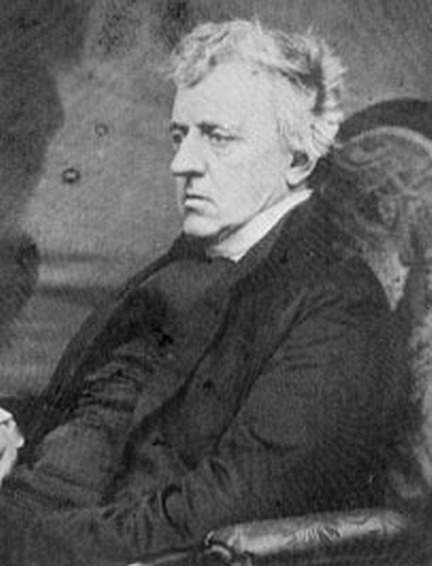
The Revd Charles Dodgson, perpetual curate of All Saints' Church, Daresbury in Cheshire; and father of C.L.Dodgson, otherwise known as Lewis Carroll. All Saints had been created as a perpetual curacy in 1536 out of a chapel of ease of nearby Norton Priory - Public Domain - Wikipedia

The Revd Charles Dodgson, perpetual curate of All Saints’ Church, Daresbury in Cheshire; and father of C.L.Dodgson, otherwise known as Lewis Carroll. All Saints had been created as a perpetual curacy in 1536 out of a chapel of ease of nearby Norton Priory – Public Domain – Wikipedia

“Perpetual Curate was a class of resident parish priest or incumbent curate within the United Church of England and Ireland. The name is found in common use mainly during the first half of the nineteenth century. The legal status of perpetual curate originated as an administrative anomaly in the 16th Century. Unlike ancient rectories and vicarages, perpetual curacies were supported by a cash stipend, usually maintained by an endowment fund, and had no ancient right to income from tithe or glebe.

In the nineteenth century, when large numbers of new churches and parochial units were needed in England and Wales politically and administratively it proved much more acceptable to elevate former chapelries to parish status, or create ecclesiastical districts with new churches within ancient parishes, than to divide existing vicarages and rectories. Under the legislation introduced to facilitate this, the parish priests of new parishes and districts, were legally perpetual curates.

There were two particularly notable effects of this early 19th century practice: compared to rectors and vicars of ancient parishes perpetual curates tended to be of uncertain social standing; and also be much less likely to be adequately paid.

Perpetual curates disappeared from view in 1868, after which they could legally call themselves vicars, but perpetual curacies remained in law until the distinct status of perpetual curate was abolished by the Pastoral Measure 1968.”

During the Victorian Period, Margaret Oliphant wrote The Perpetual Curate, a book which takes place in Oliphant’s fictional Carlingford. From the Victorian Web, we learn a bit about The Chronicles of Carlingford series. “Carlingford is the setting for Margaret Oliphant’s most famous series of novels, The Chronicles of Carlingford, published between 1863 and 1876. Carlingford is, according to Oliphant, “essentially a quiet place” with “no trade, no manufactures, no anything in particular” (The Perpetual Curate, 2). Instead, the “centre of life . . . round which everything circles is, in Carlingford, found in the clergy”. Accordingly, Oliphant often refers to the geography of the town in ecclesiastical terms. The socially advantaged inhabitants of Grange Lane nearly always belong to the Church of England; its parish living is occupied first by the evangelically-minded Mr Bury, secondly by Morley Proctor (The Rector), thirdly by Mr Morgan (The Perpetual Curate), and finally by Frank Wentworth (The Perpetual Curate). Carlingford’s poor live in Wharfside, where the parish church has established a missionary presence with services in the schoolhouse; its High Church adherents congregate a half-mile out of town at the chapel of ease of St Roque’s. Established to bear some of the weight of an overlarge parish, St. Roque’s is occupied by Frank Wentworth in The Perpetual Curate, and later by Reverend May in Phoebe, Junior.”


Posted in British history, Great Britain, Living in the Regency, religion | Tagged , , , | Comments Off on What is a Perpetual Curacy?

Early Political History of England: The Roman Occupation

The Romans brought Christianity and other Oriental religions to the England. They also insisted upon the building of roads and the establishment of city sites, which was the first glimmers of “civilization.”

However, we cannot think that the native people of Britain “welcomed” the suppression of their pagan religions, as well as the financial obligations required by the Romans. Upset, Queen Boadicea led a revolt against the Romans.

Boudica (d. AD 60 or 61) was queen of the British Iceni tribe, a Celtic tribe who led an uprising against the occupying forces of the Roman Empire.

Boudica’s husband Prasutagus was ruler of the Iceni tribe. He ruled as a nominally independent ally of Rome and left his kingdom jointly to his daughters and the Roman emperor in his will. However, when he died, his will was ignored and the kingdom was annexed as if conquered. Boudica was flogged, her daughters were raped, and Roman financiers called in their loans.

In AD 60 or 61, while the Roman governor Gaius Suetonius Paulinus was leading a campaign on the island of Anglesey off the northwest coast of Wales, Boudica led the Iceni as well as the Trinovantes and others in revolt. They destroyed Camulodunum (modern Colchester). Camulodunum was earlier the capital of the Trinovantes, but at that time was a colonia—a settlement for discharged Roman soldiers, as well as the site of a temple to the former Emperor Claudius. Upon hearing the news of the revolt, Suetonius hurried to Londinium (modern London), the twenty-year-old commercial settlement that was the rebels’ next target.

The Romans, having concluded that they did not have the numbers to defend the settlement, evacuated and abandoned Londinium. Boudica led 100,000 Iceni, Trinovantes and others to fight Legio IX Hispana and burned and destroyed Londinium, and Verulamium (modern-day St Albans). An estimated 70,000–80,000 Romans and British were killed in the three cities by those led by Boudica. Suetonius, meanwhile, regrouped his forces in the West Midlands, and despite being heavily outnumbered, defeated the Britons in the Battle of Watling Street.

Boadicea Haranguing the Britons - Public Domain - en.wikipedia.     org/wiki/Boudica#/ media/File:Queen_ Boudica_by_John_Opie. jpg

Boadicea Haranguing the Britons – Public Domain – en.wikipedia. org/wiki/Boudica#/
media/File:Queen_
Boudica_by_John_Opie.
jpg

The crisis caused the Emperor Nero to consider withdrawing all Roman forces from Britain, but Suetonius’s eventual victory over Boudica confirmed Roman control of the province. Boudica then either killed herself so she would not be captured, or fell ill and died. The extant sources, Tacitus and Cassius Dio, differ.

Interest in the history of these events was revived during the English Renaissance and led to a resurgence of Boudica’s fame during the Victorian era, and Queen Victoria was portrayed as her namesake. Boudica has since remained an important cultural symbol in the United Kingdom. However, the absence of native British literature during the early part of the first millennium means that knowledge of Boudica’s rebellion comes solely from the writings of the Romans.(Queen Boadicea)

Photo of the statue of Gnaeus Julius Agricola erected in 1894 at the Roman Baths

Photo of the statue of Gnaeus Julius Agricola erected in 1894 at the Roman Baths

It was not until the rule of Agricola (78-84) that Britain became reconciled with its European masters. Gnaeus Julius Agricola is said to have been more “just” than many other governors of Britain. Arriving in midsummer of 77, Agricola found the Ordovices of north Wales had virtually destroyed the Roman cavalry stationed in their territory. He immediately moved against them and defeated them. He then moved north to the island of Mona (Anglesey), which Suetonius Paulinus had failed to subjugate in 60 because of the outbreak of the Boudican rebellion, and forced its inhabitants to sue for peace. He established a good reputation as an administrator, as well as a commander, by reforming the widely corrupt corn levy. He introduced Romanising measures, encouraging communities to build towns on the Roman model and educating the sons of the native nobility in the Roman manner.

He also expanded Roman rule north into Caledonia (modern Scotland). In the summer of 79, he pushed his armies to the estuary of the river Taus, usually interpreted as the Firth of Tay, virtually unchallenged, and established some forts. Though their location is left unspecified, the close dating of the fort at Elginhaugh in Midlothian makes it a possible candidate.(Gnaeus Julius AgricolaAgricola fostered education, more equitable taxation, a justice system, and an established series of forts for defense. 

Agricola was the exception and not the rule of Roman governors. After his time on the island, the next 100-200 years was marked with unrest and upheaval. The Franks and Saxon took up piratical activity, while the Scots menaced the border shires. The Germanic tribes had had enough of the Romans. In 407 A.D. Roman troops withdrew from Britain to Gaul. The never returned. The Britons were free to rule themselves, but Rome’s mark remained: a uniform legal system, local self-government, theaters, roads, cities, and Christianity. 

After the Roman withdrawal, Britain was subjected to a series of invasions by Teutonic tribes. These tribes organized into large kingdoms, and these kingdoms struggled for supremacy during the 7th to the 9th centuries. 

Christianity came to Britain with the conversion of Aethelbert, King of Kent, in 597, but with his death, pagan ways returned. However, when Northumbria became more powerful, Christianity spread with the accession to the throne in Northumbria of Edwin (who succeeded Aethelfrith). Christian kings continued in Northumbria as Oswald succeeded Edwin. The Roman Church established the Synod of Whiby in 664, as well as its supremacy. 

European civilizations came to Britain’s door. An organized church was established, and Theodore, Archbishop of Canterbury, founded parochial schools. Orders of monks spread throughout the land, with the Benedictine order the most famous of those established. Many early English writers were monks. 

The death of King Oswy in 670 signaled an end of Northumbria’s supremacy. In the middle of the 8th Century, under the warrior King Offa, who ruled from 757 to 796, Mercia became prominent. 

Posted in British history, Great Britain | Tagged , , , , | Comments Off on Early Political History of England: The Roman Occupation

One Calamity Solves Another: The Great Plague of 1665 and the Great Fire in London in 1666

http://www. openhistorysociety.org/ members-articles/the-great-plague-of-london-1665/

http://www.
openhistorysociety.org/
members-articles/the-great-plague-of-london-1665/

The Great Plague of 1665 stands out as an important event in medical history. The Great Plague was not the first time England knew the disease.

In 1580, the Lord Mayor of London complained publicly of the number of burials at St. Paul’s. Evidently, there were so many bodies that when the sextons dug additional graves, he opened previous ones. The Lord Mayor “suggested” other parishes not send their bodies to St. Paul’s.

Another outbreak of the disease came in 1606. During this time, watchmen were stationed outside infected houses.

Other flareups of the disease came in 1625 and between 1629-1631. The government issued orders that the streets were to be kept clean and the ditches used for human waste cleansed. Infected houses were marked with a red cross or the words “Lord have mercy.” Guards were posted outside infected houses to prevent the comings and goings of those inside. Public meetings and sporting events (bear-baitings, prize fights, etc.) were prohibited.

Again in 1636, London knew another bout of the plague. This time, those who disobeyed the ordinances to contain the disease were sent to Newgate.

The Continent was drowning in plague victims in 1663. Amsterdam and Hamburg were known to be heavily infested. Therefore, London took unprecedented measures by putting in place a quarantine; yet, the effort was fruitless. The Great Plague arrived in England in the spring 1665. By the early autumn months, 60-70% of those infected lost their lives. Figures of the time say over 100,000 people succumbed to the disease in less than 6 months. During the winter of 1665 and the early spring of 1666, the number of casualties lessened, but by summer of 1666, the plague had reclaimed its reign over London.

http://www.luminarium. org/encyclopedia/ greatfire.htm

http://www.luminarium.
org/encyclopedia/
greatfire.htm

However, even the Great Plague was no opponent for an even greater event: The 1666 Great Fire in London. In The History of England by Thomas Babington Macaulay, 1st Baron Macaulay, called the fire “such as had not been known before in Europe since the conflagration of Rome under Nero, laid in ruins the whole city, from the Tower to the Temple, and from the river to the purlieus of Smithfield.”

The fire served as the “disinfectant” required to wipe out the plague. The older parts of London were laid bare. Sir John Simon, who was the first Chief Medical Officer for Her Majesty’s Government from 1855–1876, said of the buildings and their inhabitants, “Unsunned, unventilated dwellings, they, from when they were built, had been saturating themselves with streams of uncleanliness, and their walls and furniture must have stored an infinity of ancestral frowziness and infection. These nests of pestilence had gone to nought; and even out of the soil, congested to its depths with filth, and filth had been burnt away as in a furnace.”

Although the Great Fire of London was an unparalleled calamity, one thing proved true: The Levantine Plague no longer an issue in London.

Information for this post comes from Encyclopedia Britannia and Temple Bar, Volume 94.

Posted in British history, Great Britain | Tagged , , | 6 Comments

Calomel: A Poison Once the Standard for Medical Treatment

Many of you who follow this blog are parents and grandparents. Are we not glad that this medicine is no longer a part of our children’s teething issues? Read on…

From Evidence Based Science we learn that Calomel was once considered standard medicine.
It may be hard to believe now, but this was considered good science at one time, and was used for teething with babies. It was called Calomel, but it is Mercury.

From LOYOLA UNIVERSITY CHICAGO
Medical uses for calomel were common well into the nineteenth century. It acts as a purgative and kills bacteria (and also does irreversible damage to their human hosts). Some treatments are of historical interest. The three physicians atttending Gen. Washington’s final hours administered calomel to the dying President. Lewis and Clark carried it on their expedition and used it to treat their men’s STD’s. Louisa May Alcott (author of Little Women) suffered from its effects. Even in the present decade several cases of mercury poisoning have been attributed to facial cremes containing calomel. Such cremes are banned in the United States because mercury is readily absorbed through the skin.
http://www.luc.edu/faculty/spavko1/minerals/calomel/calomel-main.htm

The Encyclopedia Britannica provides the following information regarding calomel

Alternate titles: horn mercury; mercurous chloride; mercury(I) chloride

Calomel (Hg2Cl2), also called mercurous chloride or mercury(I) chloride, a very heavy, soft, white, odourless, and tasteless halide mineral formed by the alteration of other mercury minerals, such as cinnabar or amalgams. Calomel is found together with native mercury, cinnabar, calcite, limonite, and clay at Moschellandsberg, Germany; Zimapán, Mexico; and Brewster County, Texas, U.S. 

Once the most popular of cathartics, calomel has been used in medicine since the 16th century. The recognition of its potential toxicity (because of disassociation into mercury and mercuric chloride), together with the development of superior and safer cathartics, led to a decline in its use in internal medicine. It has found application in certain insecticides and fungicides, however. The compound is also used in the construction of calomel electrodes for potentiometric titration (a chemical technique designed to measure the potential between two electrical conductors in a medium such as an electrolyte solution).

From Vancouver’s The Herb Museum website we find an “advert” for a wintergreen flavored calomel from Parke, Davis & Co out of Detroit, Michigan. The information describes many uses for calomel. 

LatestGuppy 052 copyMercury Chloride
Merck- Mercurous-C.P.
Calomel; Mild Mercury Chloride; Mercury Subchloride, or Monochloride, or Protochloride.
Actions: Cathartic; Alter. ; Diuretic; Antiseptic; Anthelmintic.
Uses: Detecting cocaine, pilocrpine, SCN, & free alkali; I; also in electrolysis as the calomel electrode.
Uses (Internal): constipation, incubation period of infectious disease, cholera, dysentery, cardiac dropsy, pleurisy, malign. fever, malaria, syphilis, gout, worms, cholelithiasis, mitral insufficiency, eclampsia gravidarum
Uses (External): smallpox pitting, pruritus, diphtheria, syphilitic ulcers, myiasis, membrane croup (by fumigation), condylomata, warts.
Effect of dose not in proportion to size. Small, well-triturated doses better than large coarse ones. Larger doses in proportion to age of children than w.o. medicine.
Caution: Keep in the dark.
-pp. 324-325, Merck’s Index: Fourth Edition (1930)

Posted in American History, British history, Great Britain, medicine, Regency era, Uncategorized, Victorian era | Tagged , | 7 Comments