Do You Have the Time to Learn More of Horology?

From Wikipedia, we are given this definition of “horology.” 

Vintage Time Pieces http://www.homejelly. com/5-tips-discover-vintage-collectables- flea-market/

Vintage Time Pieces http://www.homejelly.
com/5-tips-discover-vintage-collectables-
flea-market/

“Horology (via Latin horologium from Greek ὡρολόγιον, from ὥρα hṓra “hour; time” and -o- interfix and suffix -logy; lit. “the study of time”) is the art or science of measuring time. Clocks, watches, clockwork, sundials, hourglasses, clepsydras, timers, time recorders, marine chronometers, and atomic clocks are all examples of instruments used to measure time. In current usage, horology refers mainly to the study of mechanical time-keeping devices, while chronometry more broadly includes electronic devices that have largely supplanted mechanical clocks for the best accuracy and precision in time-keeping.

People interested in horology are called horologists. That term is used both by people who deal professionally with timekeeping apparatus (watchmakers, clockmakers), as well as aficionados and scholars of horology. Horology and horologists have numerous organizations, both professional associations and more scholarly societies.”

Did you know there are entire websites dedicated to Horology? “During the first public surge of interest in the internet in the mid-1990’s, Fortunat Mueller-Maerki, a longtime member of the NAWCC (National Association of Watch and Clock Collectors), created Horology – The Index at http://www.horology.org as part of the WWW-Virtual Library; probably the most comprehensive, hierarchical, not-for-profit collection of virtual information resource links in existence at that time. That index page and its subsidiary pages attempted to provide a comprehensive index of active links and cross-links to as much horological information on the WWW as could then be found….In 2005, Ted Orban developed The Horology Source to provide to the global horological community an expanded and updated resource of horology links. Over the years, The Horology Source grew to encompass more than 5,700 active links.The NAWCC Internet Advisory Committee in 2009 spearheaded th e process to implement Horology – The Index in the NAWCC space. Ted Orban agreed to design the site and infrastructure, transfer the content from The Horology Source, and maintain the site going forward. Now, the new Horology – The Index at NAWCC combines the best of these two great horological resources.”

There are several institutions/associations that devote their efforts to Horology, including the British Horological Institute, which produces a Horological Journal. “The British Horological Institute is a professional body created by the members, for the members, to further their interests. We aspire to be the natural home for all involved in horology, whether professionally or recreationally, and we will achieve this by:

Facilitating education and providing specialist training;
Setting recognised standards of excellence in workmanship and professional conduct;
Supporting our members in the furtherance of their horological aspirations.

Membership of the BHI is open to anyone from any part of the world. Professional membership grades are ‘Member’ and ‘Fellow’ – these are recognised professional qualifications. ‘Associate’ level is open to non-qualified people who have an interest in timekeeping.”

Birmingham City University has an BA(Hons) course in Horology. “This course is the only one of its kind, designed to train and create employable students in horology, tailored to meet the growing global demand for watchmakers and clockmakers, qualified to the industry standard.”

Posted in horology | Tagged | Comments Off on Do You Have the Time to Learn More of Horology?

Early History of the English Language

I thought I might put all those years of education to use by adding a series of posts on English Language and Literature. I am going back to the beginning and working my way forward. I hope you enjoy the posts and learn something new. After all, any day we learn something new is a good day.

The Teutonic branch of the Indo-European languages marks the early English language. The common ancestor of all of the languages in this branch is called Proto-Germanic—also known as Common Germanic—which was spoken in approximately the middle-1st millennium BC in Iron Age Northern Europe. Proto-Germanic, along with all of its descendants, is characterized by a number of unique linguistic features, most famously the consonant change known as Grimm’s law. Early varieties of Germanic enter history with the Germanic tribes moving south from Northern Europe in the 2nd century BC, to settle in the area of today’s northern Germany and southern Denmark.(Germanic Languages) We know little of the early Indo-Europeans, but we assume they arrived in Britain from the Tigris-Euphrates Valley.

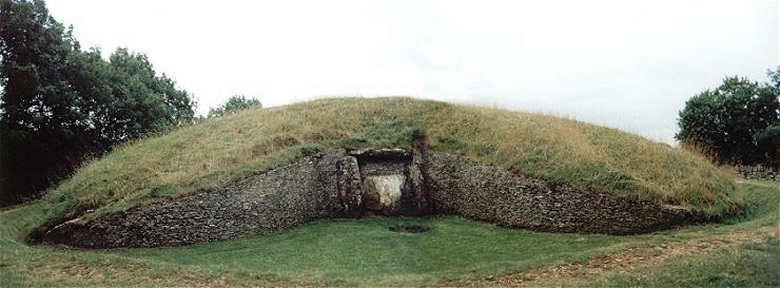
http://www.stone-circles.org.uk/stone/ belasknap.htm  A superb and stunning example of a 'Severn-Cotswold' chambered long barrow, the partially restored Belas Knap is reached after a long 800 metre climb.

http://www.stone-circles.org.uk/stone/
belasknap.htm A superb and stunning example of a ‘Severn-Cotswold’ chambered long barrow, the partially restored Belas Knap is reached after a long 800 metre climb.

The Neolithic people known as the long-barrow men followed the first invaders of Britain, who were similar to the “Eskimo” race. The “long barrow” men received their name from prehistoric monuments, which are rectangular or trapezoidal tumuli or earth mounds that sport several bodies within the tombs. Long barrows are also typical for several Celtic, Slavic, and Baltic cultures of the 1st millennium A.D. We customarily refers to the long barrow men as the Picts. (“History of English Literature: Part 1 – Early Saxon Through Milton,” Hymarx Outline Series, Boston, MA)

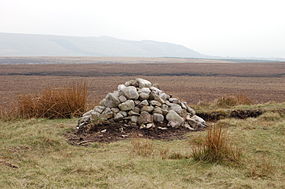
The long barrow men were followed by the round barrow men. Again, the name comes from the burial crypts used by the society, which were likely an Aryan people who we believe introduced the Celtic tongue.At its simplest, a round barrow is a hemispherical mound of earth and/or stone raised over a burial placed in the middle. Beyond this there are numerous variations which may employ surrounding ditches, stone kerbs or flat berms between ditch and mound. The central burial may be placed a stone chamber or cist or in a cut grave. Both intact inhumations and cremations placed in vessels can be found. Many round barrows attract surrounding satellite burials or later ones inserted into the mound itself. In some cases these occur hundreds or even thousands of years after the original barrow was built and were placed by entirely different cultures. (Round Barrows)

Round Loaf on Anglezarke Moor, Lancashire, England - Public Domain -                       en.wikipedia.org/wiki/ Round_Loaf

Round Loaf on Anglezarke Moor, Lancashire, England – Public Domain – en.wikipedia.org/wiki/
Round_Loaf

The round barrows in the UK can be dated to the Early Bronze Age, although we do have examples which are Neolithic. Even Roman, Viking, and Saxon societies used round barrows as part of their customs. 

An article I found most interesting is based on this abstract from Nature: International Weekly Journal of Science: The Modern Londoner and Long Barrow Man

AT a meeting of the Royal Anthropological Institute held on March 8, Prof. F. G. Parsons read a paper on “The Modern Londoner and Long Barrow Man,” in which he discussed a claim made by Dr. Macdonell and Prof. Karl Pearson that the head shape of Londoners of the seventeenth and eighteenth centuries was more like that of the Long Barrow men than of any other race. Prof. Parsons, however, showed, by a detailed comparison of contours obtained from thirty male London skulls of the seventeenth and eighteenth centuries dug up in the Clare Market district, and corresponding with the averages obtained by Dr. Macdonell from his London skulls found at Whitechapel and Moorfields, with those of twenty Long Barrow skulls from Yorkshire, Wiltshire, ani Gloucestershire, that in the head measurements, in the depth of the orbital openings, in the length of the face, and in other anatomical details the London skulls differed markedly from those of the Long Barrow men. On the other hand, in every respect these London skulls corresponded more closely with those of Anglo-Saxons than with those of Long Barrow men. Occasionally a Londoner might reproduce the Long Barrow type, as in the case of the notorious thief Jonathan Wild, but these cases were so rare as not to affect the average contour.”

[What do you think of the abstract’s proposal? Add you comments below.]

The Romans arrived on British shores about 54 B.C. and held control of the island until 410 A.D. Surprisingly, the Roman conquest had little influence on the Celtic language. Internal strife claimed the land with the departure of the Romans. The Picts and Scots in Scotland and Ireland fought the Britons. 

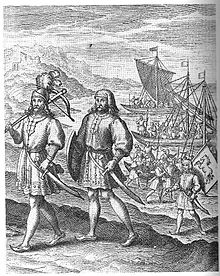
In 499, Vortigern, King of Britain, invited the Jutes to help him in repelling the Picts and the Scots. Hengist and Horsa came to the island. Hengist (or Hengest) and Horsa (or Hors) are figures of Anglo-Saxon history, which records the two as the Germanic brothers who led the Angle, Saxon, Frisian, and Jutish armies that conquered the first territories of Britain in the 5th century. Tradition lists Hengist  as the founder of the Kingdom of Kent.

Hengest and Horsa, from A Restitution of Decayed Intelligence by Richard Verstegan (1605)  Richard Verstegan - A Restitution of Decayed Intelligence by Richard Verstegan (1605) "The Arrival of the First Ancestors of Englishmen out of Germany into Britain", from A Restitution of Decayed Intelligence by Richard Verstegan (1605) - Public Domain                         en.wikipedia.og/wiki/ Hengist_and_Horsa

Hengest and Horsa, from A Restitution of Decayed Intelligence by Richard Verstegan (1605)
Richard Verstegan – A Restitution of Decayed Intelligence by Richard Verstegan (1605)
“The Arrival of the First Ancestors of Englishmen out of Germany into Britain”, from A Restitution of Decayed Intelligence by Richard Verstegan (1605) – Public Domain en.wikipedia.og/wiki/
Hengist_and_Horsa

Hengist and Horsa arrived in Britain as mercenaries serving Vortigern, King of the Britons. This event is traditionally recognised as the beginning of the Anglo-Saxon invasion of Britain. Sources disagree about whether Hengist was the father or grandfather of Oisc of Kent and Octa of Kent, one of whom succeeded Hengist as king. In the Historia Brittonum, Hengist had an unnamed daughter (Historia Regum Britanniae first gave her name as Rowena), who seduced Vortigern, eventually leading to the Treachery of the Long Knives when Hengist’s men massacred the Britons at a peace accord. While the early sources indicate that Horsa died fighting the Britons, no details are provided about Hengist’s death until Geoffrey’s Historia, which states that Hengist was beheaded by Eldol, the British duke of Gloucester, and buried in an unlocated mound. (Hengist and Horsa)

These Teuton invaders split into three sections: the Angles, the Jutes, and the Saxons. The Angles settled in Northumbria (northern England and southeast Scotland) and central Mercia (the English Midlands). The Jutes were known to settle in Kent and the Isle of Wight. The Saxons were found in the Essex countries of the south. From these areas, four dialects developed: Northumbrian, Mercian, Kentish, and West Saxon. (“History of English Literature”)

None of these dialects were “literary” in character – no literary writing is claimed. However, as the tribes associated with other European civilizations, the languages took on more “standard” characteristics.

Northumbria (650-850) was the first to achieve political and literacy supremacy. It gave the name “English” to the language. Even after the Mercians defeated the Northumbrians in war, the Mercians adopted the Northumbrian language. The West Saxons were next to claim power, but they, too, set their own standard, adopting most of the Northumbrian language. Therefore, the English language has strong Anglo-Saxon roots. (“History of English Language”)


Posted in British history, Great Britain, history, literature | Tagged , , , , , , , , , , | 8 Comments

Granville County, NC ~ Roots in England and the War for Independence

Map of Granville County, North Carolina With Municipal and Township Labels ~ Public Domain

Map of Granville County, North Carolina With Municipal and Township Labels ~ Public Domain

Granville County is a county located in the U.S. state of North Carolina. As of the 2010 census, the population was 59,916. Its county seat is Oxford.

Granville County comprises the Oxford, NC Micropolitan Statistical Area, which is also included in the Raleigh-Durham-Chapel Hill, NC Combined Statistical Area.

The county includes access to Kerr Lake and Falls Lake and is included in the Roanoke, Tar and Neuse River water basins.

History
The county was formed in 1746 from Edgecombe County. It was named for John Carteret, 2nd Earl Granville, who as heir to one of the eight original Lords Proprietors of the Province of Carolina, claimed one eighth of the land granted in the charter of 1665. The claim was established as consisting of approximately the northern half of North Carolina and this territory came to be known as the Granville District, also known as Oxford.

In 1752, parts of Granville County, Bladen County, and Johnston County were combined to form Orange County. In 1764, the eastern part of Granville County became Bute County. Finally, in 1881, parts of Granville County, Franklin County, and Warren County were combined to form Vance County.

John Penn (1741-1788) was an affluent politician of early America, as he was one of the three signers from North Carolina to sign the Declaration of Independence. After earning his admittance to the bar, Penn moved to Granville County in 1774. The county had become the hub of Carolina’s independence campaign. A remarkable orator, Penn earned a place at the Third Provincial Congress of 1775, and he replaced Richard Caswell, joining William Hooper and Joseph Hewes in Philadelphia for the convening of the Continental Congress in 1776. Later, John Penn, with Cornelius Harnett and John Williams, signed the Articles of Confederation for North Carolina. Penn retired to Granville County, and he died at a relatively young age of 48 years old in 1788. His remains are interred at the Guilford Courthouse National Military Park in Greensboro, NC.

Like most early counties on the eastern side of the early North Carolina colony, Granville was site of the Tuscarora uprising. Once the natives were defeated after the Tuscarora War, Virginia farmers and their families settled Granville County and they focused on producing tobacco. Slave labor proved vital to the fledging economy of the region, and by the start of the Civil War, Granville plantation owners worked over 10,000 slaves on their farms.

During the Civil War, more than 2,000 men from Granville County served the Confederacy. One company was known as the “Granville Grays.” Most in this regiment fought in most major battles during the war. Surprisingly, many survived until the end of the war.

Although the Civil War brought an end to the plantation and slave labor economy that had made Granville County prosperous, the agricultural sector continued to thrive in the county due to the presence of free African Americans in Oxford and the discovery of bright leaf tobacco. Many African Americans in Granville County were free before the start of the Civil War, and they made lasting contributions to the region, particularly through their skilled labor. Several black masons constructed homes for the county’s wealthy landowners. Additionally, the bright leaf tobacco crop proved a successful agricultural product for Granville County. The sandy soil and a new tobacco crop could be “flue-dried” proved a great incentive to farmers and tobacco manufacturers. According to historian William S. Powell, Granville has remained a top tobacco-producing county in North Carolina for several decades. By the late 1800s and early 1900s, Oxford had become a thriving town with new industries, schools, literary institutions, and orphanages forming due to jobs created by the bright tobacco crop.

In the late 1800s and early 1900s, northern Granville County, together with Halifax County, Virginia were important mining areas. Copper, tungsten, silver and gold were mined in the region. The Richmond to Danville Railroad was a critical lifeline to the northern part of the county and provided an important link for miners and farmers to get their goods to larger markets in Richmond and Washington, DC.

In the 1950s and 1960s, various manufacturing businesses had built up across Granville County, and the region gradually moved away from the agricultural sector. Today, the manufacturing industry produces cosmetics, tires, and clothing products in Granville County.

During the late 1800s and early 1900s, Granville County played a pivotal role as tobacco supplier for the southeast United States. With many farms and contracts tied to major tobacco companies, like American Tobacco Company, Lorillard, Brown & Williamson, and Liggett Group, the local farmers became prosperous. With the Great Depression, came a plague new to the people of Granville County. The Granville Wilt Disease, as it became known, destroyed tobacco crops all across northern North Carolina. Botanists & Horticulturists found a cure for the famine at the Tobacco Research Center located in Oxford.

Camp Butner, opened in 1942 as a training camp for World War II soldiers, once encompassed over 40,000 acres in Granville, Person, and Durham counties. During the war, more than 30,000 soldiers were trained at Camp Butner, including the 35th and 89th Divisions. The hilly topography at Camp Butner proved helpful in teaching soldiers how to respond to gas bombings and how to use camouflage and cross rivers. Additionally, both German and Italian prisoners served as cooks and janitors at Camp Butner. Today, most of the land that was Camp Butner now belongs to the North Carolina government, and the no longer operational, Umstead Hospital was located at the Camp Butner site.

Built in 1838 ~  CC BY-SA 3.0 File:GRANVILLE COUNTY COURTHOUSE.jpg

Built in 1838 ~ CC BY-SA 3.0
File:GRANVILLE COUNTY COURTHOUSE.jpg

Granville County Courthouse
The Granville County Courthouse, of Greek Revival architect, was completed in 1840 and added to the National Register of Historic Places in 1979.


Source for much of this post comes from Wikipedia  and the Granville County Website.

Posted in America, American History | Tagged , , | Comments Off on Granville County, NC ~ Roots in England and the War for Independence

John Carteret, 2nd Earl Granville, 18th Century Diplomat

Tomorrow, we will have a look at a portion of North Carolina, which knew the hand of Great Britain in forming its boundaries. Today, we look at one of those who claimed part of the North Carolina as his own.

The Earl Granville William Hoare (between circa 1707 and circa 1792) - National Portrait Gallery: NPG 1778 ~ Public Domain

The Earl Granville
William Hoare (between circa 1707 and circa 1792) – National Portrait Gallery: NPG 1778 ~ Public Domain

John Carteret, 2nd Earl Granville, 7th Seigneur of Sark, KG, PC (22 April 1690 – 02 January 1763), commonly known by his earlier title as Lord Carteret, was a British statesman and Lord President of the Council from 1751 to 1763; effectively leader of the country when Spencer Compton was Prime Minister.

Origins
The family of Carteret was settled in the Channel Islands, and was of Norman descent. John was the son of George Carteret, 1st Baron Carteret (1667–1695), by his marriage with Lady Grace Granville (3 September 1654 – 18 October 1744), daughter of John Granville, 1st Earl of Bath (29 August 1628 – August 1701). On his mother’s side of the family he was a descendant of the Elizabethan admiral Sir Richard Grenville, famous for his death in the Revenge at the Battle of Flores.
John was Seigneur of Sark from 1715 to 1720 when he sold the fief. He held (in absentia) the office of Bailiff of Jersey from 1715.

Early Life
John Carteret was educated at Westminster School, and at Christ Church, Oxford. Jonathan Swift says that “with a singularity scarce to be justified he carried away more Greek, Latin and philosophy than properly became a person of his rank”. Throughout life Carteret not only showed a keen love of the classics, but a taste for and knowledge of modern languages and literature. He was almost the only English nobleman of his time who knew German, which allowed him to talk with George I, who spoke no English. Walter Harte, the author of the Life of Gustavus Adolphus, acknowledged the aid which Carteret provided him.

On 17 October 1710 Carteret married Lady Frances Worsley at Longleat House. She was the granddaughter of the first Viscount Weymouth. One of their daughters, Georgiana Caroline Carteret Spencer, became the grandmother of Georgiana, Duchess of Devonshire, as well as an ancestor of Diana, Princess of Wales.

Upon reaching his majority, Lord Carteret took his seat in the House of Lords on 25 May 1711. Though his family, on both sides, were devoted to the House of Stuart, Carteret was a steady adherent of the Hanoverian dynasty. He was a friend of the Whig leaders Stanhope and Sunderland and supported the passing of the Septennial Act.

Diplomat
Carteret’s interests were however in foreign, and not in domestic policy. His serious work in public life began with his appointment, early in 1719, as Ambassador to Sweden. During this and the following year he was employed in saving Sweden from the attacks of Peter the Great, and in arranging the pacification of the north. His efforts were finally successful.

During this period of diplomatic work he acquired an exceptional knowledge of the affairs of Europe, and in particular of Germany, and displayed great tact and temper in dealing with the Swedish senate, with Queen Ulrica, with King Frederick IV of Denmark and King Frederick William I of Prussia. But he was not qualified to hold his own in the intrigues of Court and Parliament in London. Named Secretary of State for the Southern Department on his return home, he soon became helplessly in conflict with the intrigues of Townshend and Sir Robert Walpole.

Rivalry with Walpole
To Walpole, who looked upon every able colleague or subordinate as an enemy to be removed, Carteret was exceptionally odious. His capacity to speak German with the King would alone have made Sir Robert detest him. When, therefore, the violent agitation in Ireland against Wood’s halfpence made it necessary to replace the Duke of Grafton as Lord Lieutenant, Carteret was sent to Dublin. He landed in Dublin on 23 October 1724, and remained there till 1730. In the first months of his tenure of office he dealt with the furious opposition to Wood’s halfpence, and to counteract the effect of Swift’s Drapier’s Letters. The Lord Lieutenant had a strong personal liking for Swift, who was also a friend of Lady Carteret’s family. It is highly doubtful whether Carteret could have reconciled his duty to the crown with his private friendships, if government persisted in endeavouring to force the detested coinage on the Irish people. Wood’s patent was however withdrawn, and Ireland settled down. Carteret was a profuse and popular Lord Lieutenant who pleased both the English interest and the native Irish. He was at all times addicted to lavish hospitality, and according to the testimony of contemporaries was too fond of burgundy.

Americas
Carteret inherited a one-eighth share in the Province of Carolina through his great-grandfather Sir George Carteret. In 1727 and 1728, John learned that the other inheritors of the original shares were planning to sell them back to the crown. Carteret declined to join them. After the others surrendered their claims in 1729, Carteret in 1730 agreed to give up any participation in government in order to keep ownership of his share. This share was later defined as a 60-mile wide strip of land in North Carolina adjoining the Virginia boundary, and became known as the Granville District. The lands of the Granville District remained in the Carteret family until the death of Carteret’s son Robert in 1776. Following the American Revolution, Robert’s heirs were compensated in part for the loss of the lands.

Carteret County is a county located in the U.S. state of North Carolina.  Its county seat is Beaufort. The county was created in 1722 as Carteret Precinct and gained county status in 1739. It was named for Sir George Carteret, one of the 17th century English Lords Proprietor, or for his descendant and heir John Carteret, 2nd Earl Granville.

Queen Caroline
When Carteret returned to London in 1730, Walpole was firmly established as master of the House of Commons, and as the trusted Minister of King George II. Walpole also had the full confidence of Queen Caroline, whom he prejudiced against Carteret. Until the fall of Walpole in 1742, Carteret could take no share in public affairs except as a leader of opposition of the Lords. His brilliant parts were somewhat obscured by his rather erratic conduct, and a certain contempt, partly aristocratic and partly intellectual, for commonplace men and ways. He endeavoured to please Queen Caroline, who loved literature, and he has the credit, on good grounds, of having paid the expenses of the first handsome edition of Don Quixote to please her. He also involved himself in the establishment of the Foundling Hospital, a charity championed by the Queen, for which he became a founding Governor . But he reluctantly, and most unwisely, allowed himself to be entangled in the scandalous family quarrel between Frederick, Prince of Wales and his parents. Queen Caroline was provoked into classing Carteret and Bolingbroke, as “the two most worthless men of parts in the country”.

Secretary of State
Carteret took the popular side in the outcry against Walpole for not making war on Spain. When the War of the Austrian Succession approached, his sympathies were entirely with Maria Theresa—mainly on the ground that the fall of the house of Austria would dangerously increase the power of France, even if she gained no accession of territory. These views made him welcome to George II, who gladly accepted him as Secretary of State in 1742. In 1743 he accompanied the King to Germany, and was present at the Battle of Dettingen on 27 June 1743. He held the secretary-ship till November 1744.

Carteret succeeded in promoting an agreement between Maria Theresa and Frederick II of Prussia. He understood the relations of the European states, and the interests of Great Britain among them. But the defects which rendered him unable to baffle the intrigues of Walpole made him equally unable to contend with the Pelhams. His support of the King’s policy was denounced as subservience to Hanover. Pitt called him “an execrable, a sole minister who renounced the British nation”. A few years later Pitt adopted an identical policy and professed that whatever he knew he learnt from Carteret.

Earl Granville
On 18 October 1744 Carteret became Earl Granville on the death of his mother. His first wife died on 20 June 1743 at Hanover, and in April 1744 he married Lady Sophia Fermor, daughter of Lord Pomfret and Henrietta Louisa Fermor—a fashionable beauty and “reigning toast” of London society, who was younger than his daughters. “The nuptials of our great Quixote and the fair Sophia” and Granville’s ostentatious performance of the part of lover were ridiculed by Horace Walpole.

The Countess Granville died on 7 October 1745, leaving one daughter Sophia, who married William Petty, 2nd Earl of Shelburne, later 1st Marquess of Lansdowne. Granville’s second marriage may have done something to increase his reputation for eccentricity. In February 1746 he allowed himself to be entrapped by the intrigues of the Pelhams into accepting the secretaryship, but resigned in forty-eight hours. In June 1751 he became President of the Council, and was still liked and trusted by the King, but his share in government did not go beyond giving advice, and endeavouring to forward ministerial arrangements. In 1756 he was asked by Newcastle to become Prime Minister as the alternative to Pitt, but Granville, who perfectly understood why the offer was made, declined and supported Pitt. When in October 1761 Pitt, who held information of the signing of the “Family Compact” wished to declare war on Spain, and declared his intention to resign unless his advice was accepted, Granville replied that “the opinion of the majority (of the Cabinet) must decide”. He spoke in complimentary terms of Pitt, but resisted his claim to be considered as a “sole minister” or Prime Minister.

Whether he used the words attributed to him in the Annual Register for 1761 is more than doubtful, but the minutes of Council show that they express his meaning.

Marriages & Progeny
He married twice:

Firstly to Frances Worsley (d.1743), daughter of Sir Robert Worsley, 4th Baronet, by whom he had at least 6 children, 2 sons and 4 daughters:

George Carteret (b.14 Feb 1716, bap 11 Mar 1716 St Martin In The Fields, Westminster)
Robert Carteret, 3rd Earl Granville (b.21 Sep 1721, bap 17 Oct 1721 St Martin In The Fields, Westminster).
Louisa Carteret (circa 1712 – 1736) married Thomas Thynne, 2nd Viscount Weymouth and had issue
Grace Carteret (b.08 Jul 1713, bap 22 Jul 1713 St James, Westminster), married Lionel Tollemache, 4th Earl of Dysart and had issue
Georgiana Caroline Carteret (b.12 Mar 1715, bap 05 Apr 1715 St Martin In The Fields, Westminster; died 1780); she married firstly John Spencer, MP, and was the mother of John Spencer, 1st Earl Spencer; she married secondly William Clavering-Cowper, 2nd Earl Cowper
Frances Carteret (b.06 Apr 1718, bap 1 May 1718 St Martin In The Fields, Westminster)

Secondly in 1744 he married Sophia Fermor (d.1745), daughter of Thomas Fermor, 1st Earl of Pomfret. She died the following year during the birth of their only daughter:
Sophia Carteret, who married William Petty, 1st Marquess of Lansdowne and had issue.

Death & Burial
Granville remained in office as President of the Privy Council until his death. His last act was to listen while on his death bed to the reading of the preliminaries of the Treaty of Paris (1763). He was so weak that the Under-Secretary, Robert Wood, author of an essay on The Original Genius of Homer, would have postponed the business, but Granville said that it “could not prolong his life to neglect his duty”, and quoted the speech of Sarpedon from Iliad xii. 322-328, repeating the last word (iouee) “with a calm and determined resignation”. He died in his house in Arlington Street, London, on 02 January 1763. His remains were interred at Westminster Abbey.

The title of Earl Granville descended to his son Robert, who died without issue in 1776, when the Earldom of this creation became extinct.

Popular Culture
John Carteret is depicted in the 2011 film Pirates of the Caribbean: On Stranger Tides by Anton Lesser.

Information for this post comes from Encyclopedia Britannica, Wikipedia, and the North Carolina History Project.

Posted in British history, real life tales | Tagged , | Comments Off on John Carteret, 2nd Earl Granville, 18th Century Diplomat

Consistory Courts and the Church of England

From A Virtual Stroll Around the Walls of Chester - Consistory Court http://www.chesterwalls. info/cathedral2.html

From A Virtual Stroll Around the Walls of Chester – Consistory Court http://www.chesterwalls.
info/cathedral2.html

The consistory court is a type of ecclesiastical court, especially within the Church of England. They were established by a charter of King William I of England, and still exist today, although since about the middle of the 19th century consistory courts have lost much of their subject-matter jurisdiction. Each diocese in the Church of England has a consistory court (called in the Diocese of Canterbury the Commissary Court).

Jurisdiction
Before 1858 consistory courts exercised jurisdiction (concurrently with the courts of their respective provinces) over matrimonial and probate matters. This jurisdiction was moved to the secular courts by the Court of Probate Act 1857 and the Matrimonial Causes Act 1857. Consistory courts also had corrective jurisdiction over the crimes of clerks, but this was abrogated by the Church Discipline Act 1840. Other former areas of jurisdiction included defamation and certain contracts cases.

The Ecclesiastical Courts Act 1855 and the Ecclesiastical Courts Jurisdiction Act 1860 removed the remaining judicial functions of the courts. (The National Archives)

Today, the principal business of consistory courts is now the dispensing of faculties dealing with churchyards and church property, although they retain the power to hear the trial of clergy (below the rank of bishop) accused of immoral acts or misconduct (under the Clergy Discipline Act 1892).

Procedures
The Consistory court usually sits “on paper” without formal hearings. When hearings are required they can be held in any convenient building; either an existing court building or a school or community hall hired for the purpose. Historically consistory courts had a say in the cathedral and many cathedrals still contain court rooms, although these are now used for other purposes. Consistory courts dealing with faculty applications may sit in the church affected.

Chancellors
Each Consistory court is presided over by the Chancellor of the Diocese (or in Canterbury the Commissary-General). The chancellor is appointed by letters patent. All jurisdiction, both contentious and voluntary, is committed to the Chancellor under two separate offices, those of official principal and vicar-general: the distinction between the two offices is that the official principal usually exercises contentious jurisdiction and the vicar-general voluntary jurisdiction. (Technically the bishop himself may sit, but this no longer happens and is regarded as an obsolete anomaly.)

The chancellor must be over 30 years of age, a barrister of seven years’ standing or who has held high judicial office, and a communicant of the Church of England. He takes the judicial oath, the oath of allegiance and makes a declaration of assent. The chancellor may be removed by the bishop if the Upper House of the Convocation of the province so resolves.

Chancellors are addressed on the bench as “Worshipful Sir” or “Sir”. Most wear the robes of a QC even if not of that degree, though at least one sits in his academical robes. The court itself is styled “this venerable court”. Most have a mace, carried by the apparitor, who is usually a member of the staff of the diocesan registry and who is the official who serves the processes of the court and causes defendants to appear by summons.

There may also be a deputy chancellor, who may hear certain matters. He must be a barrister of seven years’ standing or have held high judicial office.

Registrars
The registrar of the diocese is also the registrar of the consistory court. He was usually also the legal secretary to the bishop, and now must be a legal adviser, and is registrar to the archdeacons. He must be a solicitor learned in ecclesiastical law, and be a communicant of the Church of England. He is appointed by the bishop after consultation with the Bishop’s Council and the Standing Committee of Diocesan Synod. Each consistory court has a seal, which is in the care of the registrar. There may be a deputy registrar, who acts only in the absence of the registrar. There may be a separate clerk of the court, if there might be a conflict of interest for the registrar to act in this capacity. He must be a solicitor.

Discipline of Clergy
The consistory court can only become involved in the case of a priest or deacon who is accused of an offence (not involving matters of doctrine, ritual or ceremonial) after the bishop has given the complainant and the accused an opportunity of seeing him. The bishop may decide not to proceed, but if he does favour a trial, the matter is referred to an examiner with legal qualifications (who must be a communicant). If he decides that there is a case to answer, then the trial begins in the consistory court.

The rules under which the clergy can be disciplined are governed by the Ecclesiastical Jurisdiction Measure adopted by the Archbishops’ Communion in 1963. Courts have only been convened three times for this purpose since then. (Under Authority – Report on Church Discipline. Church House Publishing. 1996. p. 3. ISBN 0-7151-3796-4.) The last discipline case to be heard by a Consistory Court was that of Brandon Jackson, the Dean of Lincoln, who was acquitted of sexual misconduct in 1995.(“Leading Article: The Last Chronicle of Lincoln”. The Independent. 20 July 1995.)

Trials and Appeals
The chancellor is expected to appoint a deputy chancellor if he himself is inexperienced in criminal law. In a trial the court comprises four assessors, two lay and two clerical, who are the sole finders of fact, and their verdict must be unanimous. The judge is required to sum up in open court to the assessors. If the chancellor certifies that the case involves a question of doctrine, ritual or ceremonial, appeal lies to the Court for Ecclesiastical Causes Reserved. In the case of faculties, appeal lies to the provincial court (either the Arches Court for Canterbury or the Chancery Court for York), and then to the Judicial Committee of the Privy Council.

Facilities
Most cathedrals had purpose-built courtrooms. Many have since been converted for other uses, for example the former consistory court at St Paul’s Cathedral is now the Chapel of the Order of St. Michael and St. George. One of the oldest surviving complete ecclesiastical courtrooms in Great Britain is the consistory court at Chester Cathedral (pictured above). (Alfred Ingham (2003). Cheshire: Its Traditions and History. Kessinger Publishing. p. 44. ISBN 0-7661-5506-4.)  Probably the oldest known example (1617) is in the Chapel of St Nicholas, King’s Lynn, Norfolk.

Today, a consistory court can theoretically be convened and meet in any appropriate church building.

Information for this post comes from The Law Dictionary,  Cardiff Law School, and Wikipedia,

Posted in Church of England, Great Britain, religion | Comments Off on Consistory Courts and the Church of England

Are You Familiar with These Words and Phrases?

We have a variety of words that mean “stupid or foolish person”
Ninnyhammer – First Known Use: 1592
Berk – The usage is dated to the 1930s. A shortened version of Berkeley Hunt, the hunt based at Berkeley Castle in Gloucestershire. In Cockney rhyming slang, hunt is used as a rhyme for cunt, giving the word its original slang meaning. (Wiktionary)
Charlie – First Known Use: circa 1946
Nit – meaning a minor shortcoming
Origin: Middle English nite, from Old English hnitu; akin to Old High German hniz nit, Greek konid-, konis – First Known Use: before 12th century
Git – British for a foolish or worthless person; Origin variant of get, term of abuse; First Known Use: 1929

From phrases.org, we find these entries…
Daft as a Brush
Meaning: Very foolish.
Origin
On the face of it, brushes wouldn’t seem to be any more daft than anything else. As the source of the expression isn’t obvious, various suggestions have been put forward as to what form of brush is being referred to; for instance:
– The phrase originated as ‘as soft as a brush’ and the brush is the tail of a fox. This is plausible in that ‘soft’ is a northern English term for stupid, and foxes tails are in fact quite soft to the touch.
– The brushes in the expression are the boys that were employed in the 18th/19th centuries to climb inside chimneys to sweep them. The theory here, which is somewhat less plausible, is that the boys were made into idiots by being repeatedly dropped on their heads when being lowered down the chimneys.
Nevertheless, as we shall see, the ‘brush’ in this simile is neither of these; it is, as the dictionary would have it “A utensil consisting of a piece of wood or other suitable material, set with small tufts or bunches of bristles, hair, or the like, for sweeping or scrubbing dust and dirt from a surface”, that is – a brush.
In looking for early examples of ‘daft as a brush’ in print we find that it first starts appearing in the 1950s. An example is in William Morgan Williams’s The Sociology of an English Village: Gosforth, 1956:
The wives of two members of a kin-group locally thought to be eccentric and extremely unsociable were pointed out by several people as ‘gay queer’ and ‘daft as a brush’.
[Gosforth is in Cumbria, UK]

1956 seems late for this phrase. A scan of some north country references seems in order.  ‘Daft as a brush’ it is in fact predated by an earlier variant ‘daft as a besom’. The earliest citation found is a listing in William Dickinson’s A glossary of the words and phrases of Cumberland, 1859:
Daft, without sense. “Ey, as daft as a besom.”
A ‘besom’ is of course a brush made from twigs and a corroboration that the phrase originated with the ‘besom’ rather than the ‘brush’ version comes in another glossary, from just a few years earlier and collected in the same area – John and William Brockett’s A glossary of North country words, with their etymology, 1846:
Fond, silly, foolish. An old Northern word. ‘Fond-as-a-buzzom’, remarkably silly.
The use of ‘fond’ to mean foolish predated our current usage, which is ‘to be fond of something or someone’. That present day meaning migrated from the earlier word, which in time came to mean ‘display a foolish affection for’. In Richard Rolle’s Psalter, 1339, the author refers to ‘fonnyd maydyns’ (foolish girls). The word appears in more contemporary language in John Lyly’s Euphues: the Anatomy of Wyt, 1578:
He that is young thinketh the old man fond.
So remember, if you are visiting the English northern counties and some old codger says that you are ‘as fond as a buzzom’, it isn’t exactly a compliment.

Get Down to Brass Tacks 
Meaning: Engage with the basic facts or realities.
Origin: The figurative expression ‘getting down to brass tacks’ isn’t particularly old as phrases go. Its first appearance in print came from the US in January 1863, was in the Texas newspaper The Tri-Weekly Telegraph:
“When you come down to ‘brass tacks’ – if we may be allowed the expression – everybody is governed by selfishness.”
All of the other known early citations either originate in, or refer to, Texas. It is reasonable to assume that the phrase was coined there, in or about the 1860s.

Brass tacks are, of course, real as well as figurative items and two of the most commonly repeated supposed derivations refer to actual tacks. Firstly, there’s the use of brass-headed nails as fabric fixings in the furniture trade, chosen on account of their decorative appearance and imperviousness to rust. Such brass tacks were commonly used in Tudor furniture and long predate the use of the phrase, which would tend to argue against that usage as the origin – why wait hundreds of years and then coin the phrase from that source? The supporters of that idea say that, in order to re-upholster a chair, the upholsterer would need first to remove all the tacks and fabric coverings, thus getting down to the basic frame of the chair. While that is true, it hardly seems to match the meaning of the expression, as the tacks would be the first thing to be removed rather than the last.

The second explanation that relies on actual tacks comes from the haberdashery trade. Here the notion is that, in order to be more accurate than the rough-and-ready measuring of a yard of material by holding it out along an arm’s length, cloth was measured between brass tacks which were set into a shop’s counter. Such simple measuring devices were in use in the late 19th century, as is shown by this piece from Ernest Ingersoll’s story The Metropolis of the Rocky Mountains, 1880:
“I hurried over to Seabright’s. There was a little square counter, heaped with calicoes and other gear, except a small space clear for measuring, with the yards tacked off with brass tacks.”
Various other explanations relate to the tacks in boots, those that were put on chairs as a prank, the rivets on boats, etc., etc. None of these come equipped with any real evidence and are best left alone.
Of the supposed explanations that do not have literal allusions, we can rule out links with any form of ‘brass tax’. There have been taxes on brass at various times, but no one can find any connection with this phrase. ‘Getting down to brass tax’ appears to be just a misspelling. The expression is also often said to be an example of Cockney rhyming slang, meaning ‘facts’. In the strange world of Cockney argot, ‘tacks’ does indeed rhyme with ‘facts’ (facks), but that’s as far as it goes. Rhyming slang coinages from the 19th century are limited to the UK and Australia. The apparent US origin of the phrase discounts the rhyming slang origin.

We Are Not Amused 
Meaning: A quotation, attributed to Queen Victoria.

Origin: This supposed quotation was attributed to Queen Victoria by courtier Caroline Holland in Notebooks of a Spinster Lady, 1919. Holland attests that Victoria made the remark at Windsor Castle: ‘There is a tale of the unfortunate equerry who ventured during dinner at Windsor to tell a story with a spice of scandal or impropriety in it. “We are not amused,” said the Queen when he had finished.’Holland doesn’t claim to have been present at the dinner and is good enough to describe the account as a “tale’, that is, her account has the same standing as “a man in the pub told me”.

Despite the fact that in almost all of the photographs and paintings of her, Victoria provides a particularly po-faced demeanour, she had the reputation of being in private a very fun loving and amusing companion, especially in her youth and before the crown began to weigh heavily on her. In public, it was another matter, as Victoria preferred to maintain what she saw as the dignity of her position by remaining sternly impassive. She did, of course, become considerably less fun-loving after the death of her husband and her persona in later life is well-documented as being dour and strait-laced.
As to whether she ever uttered the expression ‘we are not amused,’ there is little convincing evidence that she did so with the intention of conveying the serious intent that we now ascribe to the phrase, although in the 1976 biography Victoria Was Amused, Alan Hardy makes the claim (again without offering explicit evidence) that Victoria did sometimes utter the expression ironically.
The evidence to support the idea that Queen Victoria originated this expression ‘we are not amused’ lies somewhere between thin and nonexistent.

Rack Your Brains 
Meaning: To rack one’s brains is to strain mentally to recall or to understand something.
Origin: The rack was a mediaeval torture device. The crude racks often tore the victim’s limbs from their bodies. It is not surprising that ‘rack’ was adopted as a verb meaning to cause pain and anguish. Shakespeare was one of many authors who used this; for example, from Twelfth Night, 1602: “How haue the houres rack’d, and tortur’d me, Since I haue lost thee?”

The term was called on whenever something or someone was under particular stress and all manner of things were said to be ‘racked’; for example, in the Prymmer or boke of priuate prayer nedeful to be vsed of al faythfull Christians, 1553 there’s a reference to the racking, that is, increasing, of land rent:
“They may not racke and stretche oute the rentes of their houses”
The first recorded use of this being specifically applied to brains is in William Beveridge’s Sermons, circa 1680:
“They rack their brains… they hazard their lives for it.”
The same idea was used by the composer William Byrd in 1583 when he wrote:
“Racke not thy wit to winne by wicked waies.”

Ne’er do well 
Meaning: A worthless, good for nothing person.
Origin: The term ‘ne’er do well’ is of course a contraction of ‘never do well’. Ne’er has been used in that shortened form since the 13th century, notably in the North of England and in Scotland. ‘Ne’er do well’ itself originated in Scotland and an early citation of it in print is found in the Scottish poet and playwright Allan Ramsay’s A collection of Scots proverbs, 1737:
Some ha’e a hantla fauts [have many faults] , ye are only a ne’er-do-well.

A Legend in One’s Own Lifetime
Meaning: Literal meaning, that is, a living person of considerable fame.
Origin: The original use of this phrase was ‘a legend in her lifetime’, written of Florence Nightingale by Giles Lytton Strachey, in his well-known book Eminent Victorians, 1918:

http://en.wikipedia.org/ wiki/Florence_ Nightingale

http://en.wikipedia.org/
wiki/Florence_
Nightingale

The name of Florence Nightingale lives in the memory of the world by virtue of the lurid and heroic adventure of the Crimea. Had she died–as she nearly did–upon her return to England, her reputation would hardly have been different; her legend would have come down to us almost as we know it today–that gentle vision of female virtue which first took shape before the adoring eyes of the sick soldiers at Scutari.
She was a legend in her lifetime, and she knew it.

The ‘own’ is now almost always added to make ‘a legend in his/her own lifetime’.
The associated term ‘living legend’ derives from ‘a legend in one’s own lifetime’. This term sprang up in the USA in 1939 and immediately grabbed the imagination of writers here. In that year alone all of these people were described in print as living legends:
Jack Dempsey (boxer)
Cordell Hull (U.S. senator and Nobel Peace Prize Laureate (1945))
Diego Rivera (artist)
Fielding H. Yost (football coach)
The ‘lost’ Apaches of northern Mexico.
D. B. MacRae (journalist)
Strachey’s phrase has spawned imitations. ‘A legend in his own lunchtime’ is often used humorously about chefs or notorious drinkers (“Lunchtime O’Booze” was used by Private Eye magazine as a generic term for a habitually drunken journalist). Less affectionately, there’s also ‘a legend in his own imagination’, referring to those whose good opinions of themselves are not shared by others.

Posted in British history, Uncategorized, word play | Tagged , , | 8 Comments

Do You Remember The “Washington Marathon” to Forestall Desegregation and Voting Rights?

I live close to Rock Hill, South Carolina (Rock Hill is across the state border with Charlotte, NC), which recently commemorated the Friendship 9. The Friendship Nine was a group of African American men who went to jail after staging a sit-in at a segregated McCrory’s lunch counter in Rock Hill, South Carolina in 1961. The group gained nationwide attention because they followed an untried strategy called “Jail, No Bail,” which lessened the huge financial burden civil rights groups were facing as the sit-in movement spread across the South. They became known as the Friendship Nine because eight of the nine men were students at Rock Hill’s Friendship Junior College.

The Herald Dispatch photo archive

The Herald Dispatch photo archive

Anyway, with all the national news coverage of the exoneration of the charges against them and the reenactment of their sit in, I began to reflect upon that turbulent time. I was in junior high school and high school throughout those years, but one of the most dramatic events was the closing of the all-black Douglass High School in my hometown of Huntington, West Virginia. “2011 marked 50 years that the all-black Douglass High School closed. In 1961, Douglass closed its doors as a school and the students integrated with Huntington High. It was a transition that was bittersweet, former Douglass students said — one that meant new opportunities, but the passing of a time when their world was close-knit and familiar.” (The Herald Dispatch)

One of the events which I recall most vividly was the filibuster of 1960. Southern Democrats in the Senate, headed by Richard Bl Russell of Georgia, began to filibuster on 29 February 1960 to forestall a vote on – or to force compromises in – legislation dealing with school desegregation and voting rights. At the heart of the battle is the Southerners’ unwillingness to recognize a Supreme Court desegregation decision as law. In preparation for round-the-clock sessions, cots were moved into Senate offices and committee rooms. On March 8, the filibuster finally ended when Democratic leader Lyndon B. Johnson responded to a bipartisan petition signed by 31 senators calling for a vote. Eventually, after many compromises, the Senate passed a watered-down version of the bill in April. (“February and March 1960,” Memories: The Magazine of Then and Now, February/March 1990.)

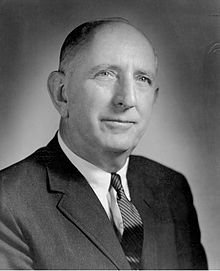
Former United States Senator and President of the U.S. Senate Richard Russell, Jr. United States Library of Congress ~ Public Domain

Former United States Senator and President of the U.S. Senate Richard Russell, Jr.
United States Library of Congress ~ Public Domain

Richard Brevard Russell, Jr. (November 2, 1897 – January 21, 1971) was an American politician from Georgia. A member of the Democratic Party, he briefly served as speaker of the Georgia house, and as Governor of Georgia (1931–33) before serving in the United States Senate for almost 40 years, from 1933 until his death in 1971. As a Senator, he was a candidate for President of the United States in the 1948 Democratic National Convention, and the 1952 Democratic National Convention.

While a prime mentor of Johnson, Russell and the then-president Johnson also disagreed over civil rights. Russell, a segregationist, had repeatedly blocked and defeated civil rights legislation via use of the filibuster and had co-authored the Southern Manifesto in opposition to civil rights. He had not supported the States Rights’ Democratic Party of Strom Thurmond in 1948, but he opposed civil rights laws as unconstitutional and unwise. (Unlike Theodore Bilbo, “Cotton Ed” Smith and James Eastland, who had reputations as ruthless, tough-talking, heavy-handed race baiters, he never justified hatred or acts of violence to defend segregation. But he strongly defended white supremacy and apparently did not question it or ever apologize for his segregationist views, votes and speeches.) Russell was key, for decades, in blocking meaningful civil rights legislation intended to protect African-Americans from lynching, disenfranchisement, and disparate treatment under the law. After Johnson signed the Civil Rights Act of 1964, Russell (along with more than a dozen other southern Senators, including Herman Talmadge and Russell Long) boycotted the 1964 Democratic National Convention in Atlantic City. (Wikipedia)

Russell was a founder and leader of the conservative coalition that dominated Congress from 1937 to 1963, and at his death was the most senior member of the Senate. He was for decades a leader of Southern opposition to the civil rights movement.

Posted in American History | Tagged , , , , | 2 Comments

Have You Heard of the Oxford Electric Bell?

The Oxford Electric Bell in December 2009 The Oxford Electric Bell or Clarendon Dry Pile is an experimental electric bell that was set up in 1840 and has rung almost continuously after that. It is located in the foyer of the Clarendon Laboratory at the University of Oxford. CC BY-SA 3.0

The Oxford Electric Bell in December 2009
The Oxford Electric Bell or Clarendon Dry Pile is an experimental electric bell that was set up in 1840 and has rung almost continuously after that. It is located in the foyer of the Clarendon Laboratory at the University of Oxford. CC BY-SA 3.0

The Oxford Electric Bell or Clarendon Dry Pile is an experimental electric bell that was set up in 1840 and which has run almost continuously ever since, apart from occasional short interruptions caused by high humidity. It was “one of the first pieces” purchased for a collection of apparatus by clergyman and physicist Robert Walker. It is located in a corridor adjacent to the foyer of the Clarendon Laboratory at the University of Oxford, England, and is still ringing, though inaudibly, because it is behind two layers of glass.

“The Clarendon Dry Pile was purchased by Robert Walker (Professor of physics 1839 – 1865) and bears the label in his handwriting “Set up in 1840,” though a later note indicates that it may have been constructed some 15 years earlier. It consists of two voltaic “dry-piles,” covered with an insulating layer of sulphur, connected in series and, at their lower ends, to two bells. Between the bells is suspended a metal sphere about 4mm in diameter which is attracted alternately by the bells and transfers charge from one to the other. The frequency of its oscillation is about 2Hz; so far the bells have been rung of the order of 10 billion times.

The internal construction of the piles themselves remains a matter for conjecture, but records of similar popular curiosities of the period, e.g. Zamboni piles, indicate that they are probably of alternate layers of metal foil and paper coated with manganese dioxide.

Some published reports of the Pile unfortunately refer to it as an example of perpetual motion but the Guinness Book of Records has it under the ‘world’s most durable battery’ delivering ‘ceaseless tintinnabulation.’ It is seen but not heard as the ringing is muffled, in the ground floor display cabinet near the main entrance of the Clarendon Laboratory.”(University of Oxford, Department of Physics)

Design
The experiment consists of two brass bells, each positioned beneath a dry pile, the pair of piles connected in series. A metal sphere approximately 4 mm in diameter is suspended between the piles, and rings the bells by means of electrostatic force. As the clapper touches one bell, it is charged by one pile, and then electrostatically repelled, being attracted to the other bell. On hitting the other bell, the process repeats. The use of electrostatic forces means that while high voltage is required to create motion, only a tiny amount of charge is carried from one bell to the other, which is why the piles have been able to last since the apparatus was set up. Its oscillation frequency is 2 hertz.

The exact composition of the dry piles is unknown, but it is known that they have been coated with molten sulphur to prevent effects from atmospheric moisture and it is thought that they may be Zamboni piles.

At one point this sort of device played an important role in distinguishing between two different theories of electrical action: the theory of contact tension (an obsolete scientific theory based on then-prevailing electrostatic principles) and the theory of chemical action.

The Oxford Electric Bell does not demonstrate perpetual motion. The bell will eventually stop when the dry piles are depleted of charge if the clapper does not wear out first. (Wikipedia)

Posted in architecture, Bells, British history, Great Britain, real life tales, Uncategorized, Victorian era | Tagged , , | 7 Comments

Are You Familiar with “Franklin Bells”?

Franklin bells (also known as Gordon’s Bells or Lightning bells) are an early demonstration of electric charge designed to work with a Leyden jar. Franklin bells are only a qualitative indicator of electric charge and were used for simple demonstrations rather than research. This was the first device that converted electrical energy into mechanical energy in the form of continuous mechanical motion, in this case, the moving of a bell clapper back and forth between two oppositely charged bells.

George Adams - George Adams' Lectures on Natural and Experimental Philosophy, published in the 18th century (first American printing 1806) A diagram of franklin bells, as printed in George Adams' Lectures on Natural and Experimental Philosophy. Public Domain. http://en.wikipedia.org/ wiki/Franklin_bells# mediaviewer/File: Franklinbells.jpg

George Adams – George Adams’ Lectures on Natural and Experimental Philosophy, published in the 18th century (first American printing 1806)
A diagram of franklin bells, as printed in George Adams’ Lectures on Natural and Experimental Philosophy. Public Domain. http://en.wikipedia.org/
wiki/Franklin_bells#
mediaviewer/File:
Franklinbells.jpg

History – During one of his experiments with electricity, Benjamin Franklin reportedly invented the “bells” in the 18th Century. However, it should be known that circa 1742 Andrew Gordon, Professor of Natural Philosophy at the University at Erfurt, Germany, created an instrument known as “electric chimes.” This discovery was noted in many scientific books of the age. “Franklin made use of Gordon’s idea by connecting one bell to his pointed lightning rod, attached to a chimney, and a second bell to the ground. One of his papers contains the following description:

In September 1752, I erected an Iron Rod to draw the Lightning down into my House, in order to make some Experiments on it, with two Bells to give Notice when the Rod should be electrified.

I found the Bells rang sometimes when there was no Lightning or Thunder, but only a dark Cloud over the Rod; that sometimes after a Flash of Lightning they would suddenly stop; and at other times, when they had not rang before, they would, after a Flash, suddenly begin to ring; that the Electricity was sometimes very faint, so that when a small Spark was obtained, another could not be got for sometime after; at other times the Sparks would follow extremely quick, and once I had a continual Stream from Bell to Bell, the size of a Crow-Quill. Even during the same Gust there were considerable variations. (Benjamin Franklin’s Lightning Bells)

Excerpted from: The Papers of Benjamin Franklin. Edited by Leonard W. Labaree. New Haven: Yale University Press, 1962. Vol. 5, p. 69, letter from Benjamin Franklin to Peter Collinson dated September 1753.

What quantity of lightning a high, pointed rod, well communicating with the earth, may be expected to discharge from the clouds silently in a short time, is yet unknown; but I reason from a particular fact to think it may at some times be very great. In Philadelphia I had such a rod fixed to the top of my chimney, and extending about nine feet above it. From the foot of this rod, a wire (the thickness of a goose-quill) came through a covered glass tube in the roof, and down through the well of the staircase; the lower end connected with the iron spear of a pump. On the staircase opposite too my chamber door, the wire was divided; the ends separated about six inches, a little bell on each end; and between the bells a little brass ball, suspended by a silk thread, to play between and strike the bells when clouds passed with electricity in them. After having frequently drawn sparks and charged bottles from the bell of the upper wire, I was one night awaked by loud cracks on the staircase. Starting up and opening the door, I perceived that the brass ball, instead of vibrating as usual between the bells, was repelled and kept at a distance from both; while the fire passed, sometimes in very large, quick cracks from bell to bell, and sometimes in a continued, dense, white stream, seemingly as large as my finger, whereby the whole staircase was inlightened (sic) as with sunshine, so that one might see to pick up a pin. And from the apparent quantity thus discharged, I cannot but conceive that a number of such conductors must considerably lessen that of any approaching cloud, before it comes so near as to deliver its contents in a general stroke; an effect not to be expected from bars unpointed, if the above experiment with the blunt end of the wire is deemed pertinent to the case. (Benjamin Franklin’s Lightning Bells)

Design and Operation
The bells consist of a metal stand with a crossbar, from which hang three bells. The outer two bells hang from conductive metal chains, while the central bell hangs from a nonconductive thread. In the spaces between these bells hang two metal clappers, small pendulums, on nonconductive threads. A short metal chain hangs from the central bell.

The central bell’s chain is put in contact with the inner surface of a Leyden jar, while the outside surface of the jar is put in contact with the metal stand. Thus, the central bell takes its charge from the inner surface of the jar, while the outer surface charges the two bells on the conductive chains. This causes the bells to have a difference in electrical potential equal to that between the inner and outer surfaces of the jar. The hanging metal clappers will be attracted to one bell, will touch it, pick up its charge, and be repelled; they will then swing across to the other bell, and do the same there. Each time the clappers touch a bell, charge is transferred between the inner and outer surfaces of the Leyden jar. When the jar is completely discharged, the bells will stop ringing.

Information for this post came from Glimpses and Wikipedia.

Posted in American History, Bells, British history | Tagged , , , , | Comments Off on Are You Familiar with “Franklin Bells”?

Win a Manuscript Evaluation from Barbara Kyle – No Entry Fee!!!

71F91QgrLNL._UX250_Barbara Kyle is a master writer who teaches classes on writing, as well as being an accomplished author. More important for those working on their own manuscripts, Barbara is offering a contest to win a manuscript evaluation from her. 

What Is a Manuscript Evaluation?

A manuscript evaluation is an in-depth, developmental editing report. It provides a “big picture” analysis of one’s story, examining its premise, structure, character development, voice, dialogue, setting, prose style, pacing, POV (point of view), and marketability. It also offer suggestions on how any weaknesses might be improved.

Grand Prize: a $1,200 manuscript evaluation!

(The information below is from Barbara Kyle’s website and included with her permission. Please visit the site for testimonials of those who Barbara has assisted and information on the need for manuscript evaluations before submitting one’s work to a publisher.)

Want expert feedback about your manuscript? Then this contest is for you.

The contest open to anyone with a work of fiction or narrative non-fiction. All genres are welcome. There is no fee to enter. Entry deadline is 30 April 2015.

And here is the great thing. If you win, you have up to a year to send Barbara your manuscript. If it’s ready now, that’s fine; send it as soon as you hear you’ve won. But if you need more time to complete it, that’s fine too. Winners will have up to a year to send their manuscript.

Through Barbara’s mentoring experience, she has launched many writers to published success, including bestselling mystery author Robert Rotenberg, historical novelists Ann Birch, Tom Taylor, and Barbara Wade Rose, award-winner Steven T. Wax, and debut novelist Marissa Campbell.

Now it is your turn! Enter now for a chance to win an in-depth analysis of your work.

prizes-300x285Prizes and more prizes

Grand Prize: Barbara’s evaluation of a full manuscript – a $1,200 value
Second Prize: Barbara’s evaluation of a manuscript’s first 50 pages
Third Prize: Barbara’s evaluation of a manuscript’s first 25 pages

The manuscript evaluation will be conducted in a discussion with Barbara by Skype or by phone. The Grand Prize winner will receive a full 2-hour discussion with Barbara. The Second Prize winner and Third Prize winner will each receive a half-hour discussion with Barbara.

The evaluation will consist of Barbara’s in-depth analysis of the manuscript in which she will pinpoint the story’s strengths and weaknesses with regard to premise, structure, character development, voice, dialogue, setting, prose style, pacing, POV (point of view) and marketability. She will also offer suggestions on how any weaknesses might be improved.

“Kyle is a master at her craft.” – RT Book Reviews

contest-logo-300x232Contest Rules:

**The deadline to enter the contest is 12:00 midnight EST on 30 April 2015.
**There is no fee to enter the contest.
**To enter, email a sample of your writing to Barbara at manuscriptcontest@gmail.com. **Send it either in the body of the email or as an attachment in Word or PDF.

**Maximum length of the writing sample: 1,500 words. It can be from your work-in-progress or a previous work.
**The 3 winners will be notified on 10 May 2015 and their names will be posted on Barbara’s website.
**The 3 winners can then send Barbara their manuscripts right away, or take up to 12 months to do so. So, if you win, there’s lots of time to finish your manuscript if you need it.
**For the Grand Prize winner, the maximum length of the full manuscript is 120,000 words. The manuscript must be double-spaced in 12-point font.
**For the Second Prize winner, the maximum length is 50 manuscript pages double-spaced in 12-point font.
**For the Third Prize winner, the maximum length is 25 manuscript pages double-spaced in 12-point font.

Ready to enter? Great! Here’s how.

Enter-to-win2How To Enter the Contest

1. Send a sample of your writing to Barbara at manuscriptcontest@gmail.com.

2. Maximum length of the sample: 1,500 words. Format: double-spaced, 12-point font.

3. The sample can be from your work-in-progress or a previous work.

4. Send the sample either in the body of your email or as an attachment in Word or PDF.

5. Include in your email your contact info:

your full name
your address
your preferred email address
your phone number (optional)
where did you hear about the contest?
Enter now! Email your sample and contact info to Barbara at manuscriptcontest@gmail.com.

Deadline to enter the contest is midnight EST on 30 April 2015.

Posted in manuscript evaluation | Tagged , , | Comments Off on Win a Manuscript Evaluation from Barbara Kyle – No Entry Fee!!!