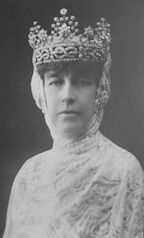
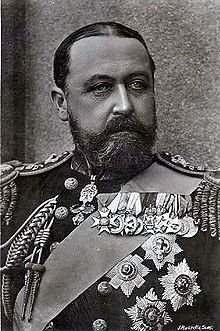
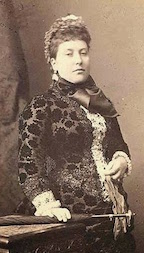
Princess Helena Augustus Victoria of the United Kingdom

HelenaSaxeCobourgGothaQueen Victoria gave birth to her third daughter, and fifth child, Princess Helena Augusta Victoria on 25, May 1846, one day after the queen’s twenty-seventh birthday. Named in honor of Princess Hélène of Orléans, Helena’s godmother. (Princess Hélène of Orléans was a member of the deposed Orléans family of France and, by marriage to a  branch of the Italian royal family, the Duchess of Aosta. Although her hand in marriage was sought for the heirs to the thrones of both the United Kingdom and the Russian Empire, religious differences prevented either alliance.) 

Helena’s name was affectionately shortened by her father, Prince Albert, to the German diminutive Lenchen (Helena in German is Helenchen). Prince Albert, together with his friend and counsellor Baron Stockmar, also chose her tutors. Like the other children not weighted down by the prospect of being the Princess Royal or the heir to the throne, Princess Helena’s childhood was quiet and carefree. Obstetrically, Helena’s birth was what was known as “protracted.” Protracted labor is abnormally slow cervical dilation or fetal descent during active labor. Protracted labor may result from fetopelvic disproportion (the fetus cannot fit through the maternal pelvis), which can occur because the maternal pelvis is abnormally small or because the fetus is abnormally large or abnormally positioned. Another cause of protracted labor is uterine contractions that are too weak or infrequent (hypotonic uterine dysfunction) or, occasionally, too strong or close together (hypertonic uterine dysfunction). We do not know the cause of the protracted labor in Helena’s cause, but both mother and child recovered in a relatively short period. Ironically, of the female children of Queen Victoria, Helena would be the most robust of them all. She would also be termed the least remarkable of the bunch. 

Victoria and Albert had declared great things for Princess Victoria. They planned a glorious marriage for their first child. Alice, the second girl, was also set for a brilliant match. Alice’s prospects would further their father’s dream of a democratic European world. With such prospects, no aspirations for Helena’s match was set by her parents. Unlike her siblings, Helena distinguished herself at her christening by crying through the entire ceremony. 

Shortly after her birth, the royal nursery was reorganized. Vicky and Bertie were be moved into a “classroom” for the “Development of Their Character.” That left Alice, Affie, and Helena in the official nursery. Victoria, the Princess Royal, and Albert Edward, the Prince of Wales, were given a supervised education, which included poetry, history, geography, mathematics, diction, languages, etc. There were also lessons in art, music, dancing, and scriptures. Vicky excelled in these studies. Albert, not so much. 

But in December 1861, tragedy struck. Her beloved father died. The whole family, and particularly Queen Victoria, was devastated. The Queen would wear mourning clothes for the rest of her life.

Helena fell in love with Carl Rutland, her father’s German librarian. Queen Victoria “was not amused.” She dismissed Rutland and had the man sent back to homeland. Then she made it her mission to discover a suitable husband for Helena. 

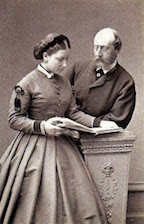
Christian_and_helenaOn 5 July 1866, Helena married the impoverished German Prince Christian of Schleswig-Holstein, who was 15 years her senior. Because Prince Christian did not have any principality or crown to inherit, the couple settled in England, which suited Queen Victoria very well. This way, Helena could continue working as her mother’s secretary, a position she had assumed the previous year, after the marriage of her older sister Alice.

2dd9118b0495cf1a8bd0cbd4ca12ad94

Windsor Great Park – Long Walk. (view from Snow Hill to Windsor Castle). Deer passing by on a quiet day (via Sharon Lathan)

Helena and Christian had six children: Christian Victor (1867), Albert (1869), Helena Victoria (1870), Marie Louise (1872), and two sons who died in early infancy.  Queen Victoria had made Christian the honorary Ranger of Windsor Great Park, which is where the family residence of Cumberland Lodge was located. With no lands, titles or real job, Christian spent most of his time hunting or feeding his beloved pigeons.

“Princess Helena was an unprepossessing and sturdy, but emotionally fragile, woman. Her mother described her as ‘most useful and active and clever and amiable’ but also mentioned that she ‘does not improve in looks and has great difficulty with her figure and her want of calm, quiet, graceful manners.’ She was also addicted to laudanum and opium, and suffered from poor health. Her mother, though, didn’t believe she was ill and accused her of being a hypochondriac. Princess Helena had real health problems though. In the 1870s she suffered from severe rheumatism, congestion in her lungs, and had problems with her joints too.

“Despite her poor health, Princess Helena carried out many royal engagements. This is all the more remarkable because at the time, royals were not really expected to appear in public often. The Princess also became patron of several charities and institutions. She was the founding president of the Royal School of Needlework, as well as the president of the Royal British Nurses’ Association, in which role she helped support nurse registration against the advice of Florence Nightingale. Princess Helena was also one of the founding members of the Red Cross, as well as a supporter of women’s rights. In addition, she hosted free dinners for children and unemployed people, which gained her great popularity. Contemporary author C. W. Cooper, said that ‘the poor of Windsor worshipped her.’ Another interest of the princess was translations. She translated several Germans works into English, some of which were published. In 1916, Princess Helena and her husband Christian celebrated their 50th wedding anniversary. The next year, Christian died. Helena followed her husband in the grave several years later. She died at Schomberg House on 9 June 1923.” (History and Other Thoughts)

Other Sources: 

A Victorian 

NineteenTeen 

Royal Splendor 

Unofficial Royalty 

Posted in British history, family, Great Britain, history, marriage, royalty, Victorian era | Tagged , , , | 2 Comments

“X” Does Not Always Mark the Spot

Recently, I spent a delightful morning counting words in Pride and Prejudice. Why? You may ask: Regina, do you not have enough to do with your retirement years than to sit around counting how many times Jane Austen used the word “sex” in this novel? (That would be seven times, by the way.) The truth is I am a bit OCD about some things. (Okay, I’m a lot OCD at times, but not as afflicted as my friend Brooke who turns all the paperclips in the holder on her desk in the same direction. Yet, that is another story.)

Counting and numbers actually are distracting. It exercises the other side of my brain, and on this particular day, I had hit a wall with my new novel. I had three possible scenarios for an ending, and I could not make up my mind, which one would play out the best. Needless to say, choosing the ending affected the events I would include early on in the storyline. My writing was at a stand still. After seven years of cranking out novels, I have learned that I cannot force the story line. I must simply wait it out. Eventually, I will have that “aha” moment where what was so “obvious” reveals itself. (Usually in the form of a 4 A.M. wake-up call.) Therefore, I turned my attention to the post I had yet to write for my own blog.

One of the things I discovered some time ago, especially when I worked on my “Do You Speak Jane Austen?” series was that there are no words that begin with “x” in Austen’s novels. I took that as a personal challenge and added “x” words to my Christmas at Pemberley when the house guests were playing a parlor game called “I have a basket.”

“There is no word for ‘X'” Bingley protested. 

Edward corrected, “There is a xebec.”

Southland explained to a perplexed-looking Bingley, “A small, three-masted Mediterranean vessel.”

From where he sat, Darcy added “Xylem, Bingley. It’s a woody plant.”

Xiphi. A sword,” Elizabeth added. “It is one of my favorite Greek roots.

Xyster,” Mr. Bennet placed another word into play. 

“One could always use Xanthippe,” Georgiana said softly. 

Bingley laughed lightly. “Point well taken, everyone. I should not play word games with those who devour books.” 

 I wanted to find a word or two in Austen’s writings that began with the letter “X.” I was soon to discover that “X” as the beginning letter was quite elusive. I scanned Pride and PrejudiceSense and Sensibility, and Mansfield Park. No “X” words were to be found. However, that doesn’t mean that our Jane never used the letter. On the contrary, 158 different words containing the letter “X” are used within Pride and Prejudice alone.9babf977a786cb67c723e8bb89b13a46

The most commonly used word containing “x” was “next,” and I shall take great pleasure in telling my editor, who seems to frown on the word, that Jane Austen used “next”71 times in Pride and Prejudice. Other “X” words that our Jane used repeatedly were “expected” (43); “expect” (35); “exactly” (30); “exceedingly” (27); “expressed” (25); “anxious” (25); “express” (to mean both “to state” and “the mail”) (24); “expression” (22); “fixed” (22); “except” (22); and “excellent” (20).

Jane was also quite fond of “expectation” (19); “anxiety” (18); “extraordinary” (17); “excuse” (used both as a noun and a verb) (16); “extremely” (14); “excessively” (11); “expressions” (11); “vexation” (10); and “excited” (10).

pp_ball

“vexation”

Of course, there are the variations of each of these words:“vexing” (1); “vex” (1); “vexed” (8); “vexatious” (2): “vexations” (1); “exceeding” (1); “exceeded” (2); “exceed” (2); “expectations” (7); “expecting” (8); “expects” (1); “expecting” (1); “excepting” (4); “fixing” (2); “fix” (3); “inexpressibly” (1); “expressing” (3); “inexpressible” (1); “expressly” (1); “expressed” (1); “expressively” (1); “anxiously” (1); “excessive” (4); “excess” (2); “excellency” (1) “unexpected” (8); “unexpectedly” (3); “excuses” (2); and “extreme” (4).

However, some of my favorite finds had nothing to do with Austen’s repeating of these common words. Instead, I enjoyed finding “Oxford” (1), “annexed” (1), “exigence” (1), “bandbox” (1), “beaux” (1), “proxy” (1), “expostulation” (1), “exercise” (6), “exertion” (9), and “foxhounds” (1).

six1

signing the number “6”

Another thing I noted (minus the deep scientific study I should have executed) is that Austen seems to use the number “six” quite often in her writing. In Pride and Prejudice, she used “six” ten times, “sixth” once, and “sixteen” seven times. I laughingly told myself it was because our dear Jane had to handwrite her stories (which you might recall is an act in my writing process) and “six” is much shorter to write than say “seven” or “eight.” That reasoning died away when I thought of the words “one,” “two,” and “ten.” Perhaps, “six” was Austen’s lucky number. After all, in Mandarin, “six” is good for business and can mean happiness. Did our Jane anticipate her literary success by using the number “six” often? Yes, it is used multiple times in Sense and Sensibility also. Or, mayhap, I am simply looking for a good story behind all this counting. MTE1ODA0OTcxNTQ2ODcxMzA5

My mathematical brain is now assuaged. (Did I ever tell you that I began college as a math major? Eventually, I switched to language arts, and the rest is history.) Hopefully, some of you are also both right and left brained and can understand my need to be whole brained in my daily life. If not, you will continue to see me as quite eccentric. [By the way, if one is looking for more delicious Jane Austen words, check out the Jane Austen Thesaurus (http://writelikeausten.com/).]

Posted in book excerpts, British history, Georgian England, Georgian Era, Jane Austen, Living in the Regency, writing | Tagged , , , , | 9 Comments

Sir Thomas Wyatt (c. 1503 – 1542), 16th C English Ambassador and Lyrical Poet

Sir_Thomas_Wyatt_(1)_by_Hans_Holbein_the_YoungerBorn to Henry and Anne Wyatt at Allington Castle, near Maidstone, Kent, in 1503, Thomas Wyatt made his first appearance at the royal court in 1516 as Sewer Extraordinary to Henry VIII.  In 1516 he also entered St. John’s College, University of Cambridge. Around 1520, he took his M. A., and at the age of seventeen, he married Lord Cobham’s daughter Elizabeth Brooke. She bore him a son,  Thomas Wyatt, the Younger, in 1521.  He was at favorite at court and carried out several foreign missions for King Henry VIII. Sir Thomas Wyatt was an ambassador to France and Italy. He accompanied Sir Thomas Cheney on a diplomatic mission to France in 1526 and Sir John Russell to Venice and the papal court in Rome in 1527. He was made High Marshal of Calais (1528-1530) and Commissioner of the Peace of Essex in 1532. Wyatt’s travels abroad exposed him to different forms of poetry, which he adapted for the English language — most notably, the sonnet.

Around 1525, Wyatt separated from his wife, charging her with adultery; it is also the year from which his interest in Ann Boleyn probably dates. (Rebholz, R. A., Sir Thomas Wyatt: The Complete Poems. New York, Penguin, 1994). Also in 1532, Wyatt accompanied King Henry and Anne Boleyn, who was by then the King’s mistress, on their visit to Calais. Anne Boleyn married the King in January 1533, and Wyatt served in her coronation in June.

15923.books.origjpgWyatt was presented a knighthood n 1535, but soon fell out of favor and in 1536 he was imprisoned in the Tower of London for quarreling with the Duke of Suffolk.  It was also rumored that Wyatt was one of Anne Boleyn’s lovers, and he spent a month in the Tower until Boleyn’s execution for adultery. As part of his imprisonment, from the Bell Tower, Wyatt witnessed the execution of Anne Boleyn on 19 May 1536. During that time, he  V. Innocentia Veritas Viat Fides Circumdederunt me inimici mei

V. Innocentia Veritas Viat Fides Circumdederunt me inimici mei

by Sir Thomas Wyatt, the Elder

Who list his wealth and ease retain,
Himself let him unknown contain.
Press not too fast in at that gate
Where the return stands by disdain,
For sure, circa Regna tonat.2

The high mountains are blasted oft
When the low valley is mild and soft.
Fortune with Health stands at debate.
The fall is grievous from aloft.
And sure, circa Regna tonat.

These bloody days have broken my heart.
My lust, my youth did them depart,
And blind desire of estate.
Who hastes to climb seeks to revert.
Of truth, circa Regna tonat.

The bell tower showed me such sight
That in my head sticks day and night.
There did I learn out of a grate,
For all favour, glory, or might,
That yet circa Regna tonat.

By proof, I say, there did I learn:
Wit helpeth not defence too yerne,
Of innocency to plead or prate.
Bear low, therefore, give God the stern,
For sure, circa Regna tonat.

(The Latin title adapts Psalm 16.9: “My enemies surround my soul.” Also note that Wyatt’s name (“Vial” in the title is surrounded by “Innocence,” “Truth,” and “Faith.”) (Luminarium)

He was released later that year. Many consider his poem “Whoso List to Hunt” to be about Boleyn. His romance with Anne Boleyn, if it did exist, ended in the early 1530s when the young Marchioness came to the attention of Henry VIII. Wyatt’s brilliant sonnet, “Whoso list to hunt,” is widely believed to refer to this severance.

Whoso List to Hunt

Whoso list to hunt, I know where is an hind,
      But, as for me: helas, I may no more.
      The vain travail hath wearied me so sore,
      I am of them, that farthest cometh behind.
   Yet may I by no means my wearied mind
      Draw from the deer; but as she fleeth afore
      Fainting I follow. I leave off therefore,
      Since in a net I seek to hold the wind.
   Who list her hunt, I put him out of doubt,
      As well as I, may spend his time in vain.
      And, graven with Diamonds, in letters plain,
   There is written, her fair neck round about:
      Noli me tangere, for Caesar’s I am,
      And wild for to hold—though I seem tame.

Wyatt was returned to favor and made ambassador to the court of the Holy Roman Emperor,  Charles V, in Spain. He returned to England in June 1539, and later that year was again ambassador to Charles until May 1540. Wyatt’s praise of country life, and the cynical comments about foreign courts, in his verse epistle Mine Own John Poins derive from his own experience.

In 1541 Wyatt was charged with treason on a revival of charges originally leveled against him in 1538 by Edmund Bonner, Bishop of London. Bonner claimed that while ambassador, Wyatt had been rude about the King’s person, and had dealings with Cardinal Pole, a papal legate and Henry’s kinsman, with whom Henry was much angered over Pole’s siding with papal authority in the matter of Henry’s divorce proceedings from Katharine of Aragón. Wyatt was again confined to the Tower, where he wrote an impassioned ‘Defence’. He received a royal pardon, perhaps at the request of then queen, Catharine Howard, and was fully restored to favor in 1542. Wyatt was given various royal offices after his pardon, most notably he was made Commander of the Fleet. He fell ill after welcoming Charles V’s envoy at Falmouth and died at  Sherborne  on 11 October 1542.

penguin-wyattOn his journey to Italy in 1527, Wyatt became enthralled with the works of Italian love poets, most prominently Petrarch and Serafino dell’ Aquila. His translation of Petrarch produced the first group of sonnets in English. His Seven Penitential Psalms are a close imitation of the work of Aretino. 

“The Lover Compareth His State to a Ship in Perilous Storm” is one of Wyatt’s best known and most typical of sonnets. In it, the unhappy lover is like a ship tossed by waves. In the extended metaphor his sighs are like the winds, the disdain of his sweetheart like the dark clouds, and his tears are the rainstorm. Meanwhile in “A Renouncing of Love,” another sonnet, the poet prefers liberty to love and orders love to leave him and other troubled young lovers. 

In “Forget Not Yet the Tried Intent,” the reader finds one of the finest lyrics (of the time) in English. Simplicity, grace, and sincerity mark Wyatt’s style. The lover asks his mistress to remember his anguish, his patience, and his steadfast faith. The change of the refrain “Forget not yet” to “Forget not this” at the end of the lyric is unexpected and appropriate. It adds emphasis and clinches the idea of the poem. It is a subtle stroke of art. 

“Of the Mean and Sure Estate” is an epistolary (letter) poem. The story told here is that of the country mouse who visits her modish sister in town. The country mouse pays dearly for the luxury of the town for which she has left the peaceful country. She is caught by a cat. “And so you see, dear Poins,” says Wyatt to the friend to whom he writes, “Each kind of life hath with him his disease. Content yourself with your fortune, for in the end your only happiness will be found in your mind.”

Wyatt wrote a wide variety of verse, sonnets, epigrams, satires, moralizings, elegies, and pastorals. Some of his poems are on court life, though most deal with love. His verse is vigorous and sometimes rough, displaying the struggle with the new medium – New English. Wyatt wrote no memorable poems, but he blazed the track for future English poetry, and it was through the sonnet that lyricism again entered English verse. 

Sources:

The Anne Boleyn Files

Heale, Elizabeth. Wyatt, Surrey, and Early Tudor Poetry.  London ; New York: Addison Wesley Longman, 1998.

The Hyper Texts 

Luminarium 

Poetry Foundation

Thomas Wyatt’s Poetry about Anne Boleyn on English History 


Posted in Great Britain, history, marriage, poetry, real life tales, romantic verse, Tudor | Tagged , , , , , , | 2 Comments

Do You Know The Origin of These Words and Phrases?

Three Sheets to the WindUrban Dictionary defines this phrase to mean “to be explicitly drunk; inebriated.” The origin is likely found in practicality: Sheets actually refer to the ropes that are used to secure a ship’s sail. If the 3 ropes used were loose in the wind, the sail would flop around, causing the ship to wobble around, much like a drunk.

From phrases.org, we find something similar. “To understand the phrase “three sheets to the wind,” we need to enter the arcane world of nautical terminology. Sailors’ language is, unsurprisingly, all at sea and many supposed derivations have to go by the board. Do not be taken aback to hear that sheets aren’t sails, as landlubbers might expect, but ropes (or occasionally, chains). These are fixed to the lower corners of sails, to hold them in place. If three sheets are loose and blowing about in the wind then the sails will flap and the boat will lurch about like a drunken sailor.

“The phrase is these days more often given as ‘three sheets to the wind’, rather than the original ‘three sheets in the wind’. The earliest printed citation that I can find is in Pierce Egan’s Real Life in London, 1821: ‘Old Wax and Bristles is about three sheets in the wind.’
The-Fisher-s-Daughter-Part-2-Mason-Catherine-9781167247231“Sailors at that time had a sliding scale of drunkenness; three sheets was the falling over stage; tipsy was just ‘one sheet in the wind’, or ‘a sheet in the wind’s eye’. An example appears in the novel The Fisher’s Daughter, by Catherine Ward, 1824: ‘Wolf replenished his glass at the request of Mr. Blust, who, instead of being one sheet in the wind, was likely to get to three before he took his departure.’ The earliest manifestation of the phrase in print is the ‘two sheets’ version. That is found in The Journal of Rev. Francis Asbury, 1815, which recounts Asbury’s travels through Kentucky. His entry for September 26th 1813 includes this: ‘The tavern keepers were kind and polite, as Southern folks should be and as Southern folks ought not to be; they were sometimes two sheets in the wind. O, that liquid fire!’ That leads us to think that the phrase may be of American origin. However, Asbury was English, born in West Bromwich and travelled to America when he was in his mid twenties. Whether he took the phrase with him from the English Black County or heard it (or indeed coined it) in the U.S., we cannot be certain.

imgres“Robert Louis Stevenson was as instrumental in inventing the imagery of ‘yo ho ho and a bottle of rum’ piracy as his countryman and contemporary Sir Walter Scott was in inventing the tartan and shortbread ‘Bonnie Scotland’. Stevenson used the ‘tipsy’ version of the phrase in Treasure Island, 1883 – the book that gave us ‘X marks the spot’, ‘shiver me timbers’ and the archetypal one-legged, parrot-carrying pirate, Long John Silver. He gave Silver the line: ‘Maybe you think we were all a sheet in the wind’s eye. But I’ll tell you I was sober.'”

________________________________________

Duece Take It! – We who write Regency romances are always looking for a way for out gentleman hero to curse without appearing coarse in manners. Therefore, “duce take it!” appears often in these books. From The Century Dictionary and Cyclopedia, we find this meaning: n. The devil: used, with or without the definite article, chiefly in exclamatory or interjectional phrases, expressing surprise, impatience, or emphasis: as, deuce take you! go to the deuce! the deuce you did!

From The American Heritage ® Dictionary of the English Language, 4th Edition

  • n. The devil: “Love is a bodily infirmity . . . which breaks out the deuce knows how or why” ( Thackeray).
  • n. An outstanding example, especially of something difficult or bad: had a deuce of a time getting out of town; a deuce of a family row.
  • n. A severe reprimand or expression of anger: got the deuce for being late.
  • n. Used as an intensive: What the deuce were they thinking of?

_____________________________

rotting-fish-head-river-rocks-26740A fish rots from the head down Phrases.org gives us this definition: When an organization or state fails, it is the leadership that is the root cause. The origin of this phrase likely lies in some ancient proverb. Many countries lay claim to it – China, Russia, Poland, England, Greece and so on, but usually with no evidence to substantiate those claims. One source says it was written in a Greek text by Erasmus, who died in 1546, but this cannot be substantiated.

“All of the early examples of the phrase in print in English prefer the variant ‘a fish stinks from the head down’ to ‘a fish rots from the head down’, which is more popular nowadays. Those early examples all ignore the nations mentioned above and credit the term to the Turks. Sir James Porter’s Observations on the religion, law, government, and manners of the Turks, 1768, includes this: “The Turks have a homely proverb applied on such occasions: they say ‘the fish stinks first at the head,’ meaning, that if the servant is disorderly, it is because the master is so.’ The early date of this citation and the fact that Porter was in a position to be authoritative on Turkish custom, being British ambassador to the Sublime Porte of the Ottoman Empire for 15 years in the second half of the 18th century, gives Turkey a strong claim to be the birthplace of this proverb.” Needless to say, the proverb isn’t a lesson in piscine biology. The phrase appears to have been used in Turkey in a metaphorical manner rather than using the literal sense for, in reality, it is the guts of fish that rot and stink before the head.

______________________________________

Brimborion (Pronounced /brɪmˈbɔərɪən/)

World Wide Words tells us that this “Weird Word” is “not a word that rises unbidden to the lips of English speakers today, nor — if the record is to be trusted — at any time. It means a thing without value or use. It was borrowed from French, where it may still be found in dictionaries, though firmly marked as literary. According to the lexicographer Emile Littré, who compiled a famous dictionary of French in the middle decades of the nineteenth century, it’s a bastardised form of the Latin breviarium, the source of breviary for the service book used by Roman Catholic priests.

“The link had been explained by another lexicographer two centuries earlier. Randall Cotgrave wrote in his French-English dictionary of 1611 that the word came to mean ‘foolish charms or superstitious prayers, used by old and simple women against the toothache, and any such threadbare and musty rags of blind devotion,’ hence something valueless. A rare appearance is in a letter of 1786 by the writer Fanny Burney, in which she refers to ‘Talking to your royal mistress, or handing jewels … and brimborions, baubles, knick-knacks, gewgaws.’

“It is much less weird in German, in which the closely connected Brimborium, also borrowed from French but given a Latinate ending, is an informal term for an unnecessary fuss. The sentence ‘du machst viel zu viel Brimborium um eine Kleinigkeit’ might be translated as ‘you’re making a lot of fuss about nothing.'”

____________________________________________

Furlong (mile) – “Before the days when Edward I ruled England (1272 – 1307), an acre of land was understood to be such amount of tillable land as a yoke of oxen could plow in a day. The size was indefinite, just as was the  Latin ager, field, from which acre is derived. It was several times the size of our present acre, usually ten times the size, because in some regions at least the extent was measured as the amount which a team of eight oxen could plow in a day. This latter ideal field was a square which measured an eighth of a Roman mile, or a stadium, in each direction. The furrows were therefore each a stadium in length and, with the primitive plow then used, there were probably 320 furrows across the field. The length of a furrow thus became a convenient measure of distance – a furlang, as it was called in Old English from furh, furrow, and lang, long. But for the sake of standardization, the size of the acre was reduced under the statutes of King Edward. Thereafter it denoted an area which measured forty rods in length by four rods in breadth, although neither the rod nor the yard upon which it was based were of standard size. Then when the Roman mile of a thousand paces (mille passus), or about 1,618 yards, was replaced by the standard English mile of 1.790 yards, and the length of the yard became a standard measure, furlong became merely a term for a unit of distance an eighth of a mile or 220 yards in length, no longer equal to the Roman stadium.” (Charles Earle Funk, Thereby Hangs the Tale, ©1950, Harper and Row, page 127)

____________________________________________

SitooterieWorld Wide Words tells us, “This word is a Scots colloquial term, though not a common one in print. It means a place to sit out in, a summerhouse or gazebo, from sit plus oot (a Scots pronunciation of out) plus the noun ending –erie of French origin that’s familiar from words like menagerie and rotisserie.

In the flickering light from a distant candle my partner and I sat in a “sitooterie” to partake of tea, pie and cakesMotherwell Times, 10 Mar. 1933.

“English newspaper readers suddenly started to see this word during the summer of 2000 because it was applied to an art exhibition in the historic landscaped gardens of Belsay House in Northumberland, near Newcastle upon Tyne. A dozen designers and architects were each given a budget and invited to interpret the idea of a sitooterie as a meditation on the perception of landscape. This resulted in intriguing structures, some practical, some more like follies. The exhibition had the minor consequential effect of turning sitooterie for a brief period into part of the English — as opposed to the Scots — tongue. It has since vanished again.

“Several Scottish subscribers have remarked that the word used to have a rather different meaning — a secluded corner where you could take your partner during a dance. It would seem that the word has either shifted sense, or the exhibition organisers have extended its meaning.”

__________________________________________

That’s all she wrote – Needless to say a female author would find this phrase’s origin fascinating. World Wide Words tells us, “Let’s be clear to start with what the expression means. It always has an implication of finality about it, though it can be variously translated as ‘that’s all there is,’ ‘it’s finished,’ ‘it’s over,’ ‘there’s no more,’ ‘that’s enough’:

When it starts to get really dark — when the sky goes from blue to purple — I’m flipping back. That’s it; that’s all she wrote. I’m not walking through these woods after darkThe Talisman, by Stephen King, 1984.

Skipper Tom meowing and hopping around like he had the itch. Then dumped a load of cat crap all over a lobster trap. Jack threw it overboard to rinse it, and that’s all she wrote buddy, he was jerked into the waterThe Shipping News, by E Annie Proulx, 1993.

On the one hand it is obvious enough what the phrase means, but why should anybody drag in a reference to an anonymous woman writer?

“If one searches the reference books for the answer, he will probably come across the story that it’s from a bitter joke of the Second World War. An American serviceman opens a letter from his wife or girlfriend and starts to read it to his mates: ‘Dear John.’ He stops. ‘Well, go on,’ his listeners urge him, ‘read us the rest of it.’ ‘I can’t,’ he replies, ‘that’s all she wrote.’ Dumping letters were common enough to have been given the Dear John letter epithet at the time, though it starts to appear in the record only in 1945. It’s a nice story, but it’s a pity about the absence of any contemporary evidence for it, such as somebody on record as telling the joke or referring to it.

“Another suggestion is that that’s all she wrote comes from the words of a popular song, perhaps one that linked Dear John to it. A song by Aubry Gass and Tex Ritter, written in 1950, the same year Hank Williams recorded it, has the line: ‘And that’s all she wrote, Dear John.’ That arrived on the scene too late to be the origin. In 1946, George Crawford penned That’s All She Wrote, ’Cause the Pencil Broke, though similarly the dating confirms the title came from the existing saying. But there’s an earlier one.

ernesttubbsongfolio

The cover of a sheet music collection by Ernest Tubb The Ernest Tubb collection of 1942 that contains the song

“A World Wide Words reader, Michael Templeton, found a song by Ernest Tubb, dubbed the Texas Troubadour, who was a pioneer of country music on radio from the late 1930s. His song was entitled That’s All She Wrote and appeared in a sheet music collection that was published by the American Music Inc of Hollywood in 1942.

“American researcher Garson O’Toole, writing on the American Dialect Society mailing list, has unearthed three examples of that’s all she wrote from 1942. All derive from civilian contexts, so the prevailing view that the idiom is from World War Two servicemen being dumped by Dear John letters is no longer sustainable. Four even earlier appearances, all from Texas, were posted on the American Dialect Society list in October 2015 by Bonnie Taylor-Blake. The oldest is this excellent example:

No power except that of the legislature can change the rolls. The assessor-collectors do not have the power, the commissioners’ courts do not have the power. That’s all she wrote and it’s final, the attorney general says in language much more eloquent and technical. – Ralph L Buell, in his In Our Valley column in The Brownsville Herald (Texas), 16 Jun. 1935. 

“Ralph Buell clearly used the phrase in the expectation that his readers would recognise and understand it. The Texas Troubadour’s song is very unlikely to have reached such widespread popularity as early as 1935 and so has to be rejected as the origin. It’s more likely that it was an existing folksy saying among Texans that Ernest Tubb happened to make use of.”

________________________________________

Pall Mall – This name marks both a popular brand of cigarettes, as well as street in London. Both names came to the language from an old outdoor game. The name (and the game) entered the language from the French (ball, palle + mallet, maille). Palle maille was a popular 16th Century game that arrived in England during the reign of Charles I (1625 – 1649). “The boxwood ball used in the game was about the size of the modern croquet ball, and the mallet, also of wood, was similar to the croquet mallet, except that the head was curved and the two faces sloped toward the shaft. The game was played on an alley of considerable length, from the starting point at one end to an iron ring suspended at some height at the other end. The player was winner who took the fewest strokes to drive his ball through the ring. The most noted alley in London in which the game was played was the near St. James’s, now bearing the name of the game. The French name was long retained, but because of its pronunciation, the spelling was altered by some to pell-mell. Others, however, recalled that the Latin sources of the French words were respectively palla and malleus, and therefore insisted upon the spelling pall-mall, which; nevertheless, is still pronounced in England either as if spelled ‘pell-mell’ or like the first syllables of ‘pallet’ and ‘mallet’ respectively.” (Charles Earle Funk, Thereby Hangs the Tale, ©1950, Harper and Row, page 213)

________________________________________

Wet one’s whistle – Some claim this one comes from a tale that goes something like this: ‘Many years ago in England, pub frequenters had a whistle baked into the rim or handle of their ceramic cups. When they needed a refill, they used the whistle to get some service. ‘Wet your whistle’ is the phrase inspired by this practice’. 

Although fun to read, there is but a “morsel of truth with a large serving of invention. They lie at one extreme of the spectrum of folk or popular etymology, and they’re a very good illustration of the way that mistaken ideas about words and phrases can disseminate.

One “can be sure that no pub cup or mug ever had a whistle fitted to it for this purpose. If one wanted another drink, he went up to the bar and asked for it; if the place was posh enough to have table service, he most certainly wouldn’t blow a whistle to get attention! You sometimes see such mugs today, but they’re the pottery equivalent of your a joke on a long-established saying.

imgres-1“In the expression, whistle is just a joking reference to one’s mouth or throat and to the fact that one can’t easily whistle when one’s mouth is dry. It’s a very ancient expression: its first recorded appearance is in Chaucer’s Canterbury Tales at the end of the fourteenth century, and it must surely be even older.

“You can sometimes find it as whet one’s whistle, through confusion with whet one’s appetite and similar words in whet, literally meaning to sharpen. It would seem that those who first wrote it that way, more than 300 years ago, were as unsure of the real source of the expression as many of us are today (the first known example is from a book of 1674 by Thomas Flatman with the title Belly God).”

_______________________________________

Guinea – A special gold coin came into place in 1663. The Royal Mint of England created the gold coinage of twenty-shilling pieces “in the name and for the use of the Company of Royal Adventurers of England,” who traded with Africa. When they came into general use, these coins, designed for the specific purpose of trading, were called guineas, because the “Company of Royal Adventurers of England” were actually along the coast of Guinea. “At this period in English history the standard of value was not gold, but silver, and the silver coinage was in bad state owing to the activities of ‘clippers,’ who mutilated coins by paring the edges. The value of the gold guinea therefore increased to more than twenty-shillings’ worth of silver coin, or more than its face value. Accordingly, in 1717, its value was fixed at 21 shillings. After the establishment of the gold standard in 1816 no more guineas were coined.” (Charles Earl Funk, Thereby Hangs the Tale, ©1950, Harper and Row, page 139)

Posted in Age of Chaucer, Canterbury tales, etymology, history, Jane Austen, real life tales, tall tales, word origins, word play, writing | Tagged , , , , , | 4 Comments

Carolina Book Festival 2016

Carolina Book Fest Banner

Book Signing

Carolina Book Fest is a book signing taking place in the Queen City
of Charlotte, North Carolina, on October 15, 2016. The book signing will
be held at the Marriott City Center (100 West Trade Street) in downtown Charlotte from 10 AM to 3 PM.
This is the perfect opportunity to meet over 100 bestselling authors from all
genres!  You can find more information on the Marriott by going here.

Monster Mash (After Party)

Join us at 7:30 PM back at the Marriott for our Monster Mash! We will be throwing an epic after party to end our night! Dress in your best costume and get ready to mingle with authors and readers!  A cash bar will be provided at the party.

Admission Prices

Book Signing: $15

Book Signing & After Party: $25

If you are interested in purchasing tickets to attend Carolina Book Fest 2016, they can be purchased here:  http://bit.ly/carolinabookfest2016tickets

Attending AuthorsCBF Attending Authors May 2016 Update

To keep up to date with all things Carolina Book Fest, follow us!

Website        Facebook      Twitter

Posted in book release, books, eBooks, Uncategorized, writing | Tagged , , , | Comments Off on Carolina Book Festival 2016

John Skelton (1460 – 1529), Tudor Poet

51IbLD28kdL._SY344_BO1,204,203,200_The Poetry Foundation tells us something of John Skelton. “No one can deny the power, endurance, and memorable lines of the work of John Skelton; he is indisputably the first major Tudor poet, writing during the reigns of Edward IV, Richard III, and (for most of his career) Henry VII and Henry VIII. His poems are by turn lyric, passionate, vitriolic, learned, allusive, bewildering, scriptural, satiric, grotesque, and even obscene; his one extant play, Magnificence (circa 1530), makes dramatic allegory sternly didactic and pointedly political. Yet while Skelton’s importance is clear enough, just how he is to be read and evaluated has always been contested. His poems might be royalist in tone, or they might be highly critical of government; he could write for the court and his patrons, the Howard family, yet still need political sanctuary; he could write a moving lament for a young novitiate’s loss of a pet sparrow at the same time that he was castigating his own parish curate, the archbishop of York, and the lord chancellor. While his poems seem to have circulated widely, few of them were published in his lifetime. Nor have readers in later times fared much better in penetrating his meaning and appreciating his style. After the Reformation, George Puttenham found this very Catholic poet a ‘rude railing rhymer,’ and Ben Jonson used him as a character, but in a character, but in an antimasque; by the time of Alexander Pope he was “beastly Skelton,” offensive for his attack on a village alewife in The Tunning of Elinor Rumming (circa 1521), a poem which nevertheless remained in print throughout the eighteenth and nineteenth centuries, often as the single representation of his art.

“In recent scholarship, there remains much disagreement. John M. Berdan, without much quarrel, called Skelton in 1920 “the greatest English poet to have been born in the fifteenth century”; he is seen as an erudite and clever poet of considerable breadth by F. W. Brownlow; an early-Tudor humanist steeped in classical learning by William Nelson; a poet primarily concerned with the literary aspect of his poems, as in his play with the medieval strategies of satire, by A. R. Heiserman; a chiefly rhetorical poet who invokes a reader response through his personal engagements and disengagements with his subjects for Stanley Eugene Fish; and essentially a priest who used poetic and dramatic works to instruct the laity by basing them in scriptural lessons and liturgical services of the Roman Catholic church for Arthur F. Kinney. Perhaps the best way to recover and understand Skelton’s work is to consider all of these perspectives.”

Skelton began his career as a sober scholar and ended it as a ribald priest. He brought to his vernacular poems an originality of style. He was known for his flow of voluble verse, unrestrained satire and jocularity, and a profusion of grotesque imagery mixed with Latin and East Anglican phrases. It is as a satirist that Skelton displays great merit. His best satires are (1) “The Boke of Colin Clout,” which is a general attack on the ignorance and sensuality of the clergy; (2) “Why Come Ye Not to Courte,” a fierce invective against Cardinal Wolsey from whom the poet had not received expected preferment; and (3) “The Bouge of “Courte,” a type of allegorical satire on the right to nations at King Henry VIII’s table. 

“‘The Bouge of Court’ is typical of the medieval tradition in several ways. [“Bouge” means “Rewards” or “Provisions.”] It uses rhyme royal to tell a dream allegory, relies heavily on personification and the use of court terms, and has the usual astronomical opening and closing apology. The prologue begins with allusions to the sun, the moon, and Mars. The narrator wishes he could write, but being warned by Ignorance not to try, he lies down and dreams of going aboard a ship, The Bouge of Court, which is owned by Sans Peer and captained by Fortune. The narrator, who reveals that he is called Drede, is first accosted and frightened by Danger, the chief gentlewoman of Sans Peer. Before Drede can flee, he is soothed by Desire, who persuades him to stay aboard.

“After this introduction comes the main body of the poem, which consists of conversation between Drede and seven of the passengers, Skelton’s representations of the seven deadly sins. Drede first describes the approaching figure in unforgettable detail; then, as the figure speaks, an even sharper focus of his personality is achieved. The seven passengers are named Favel or Flattery, Suspect, Harvy Hafter, Disdain, Riot, Dissimulation, and Deceit. Harvy Hafter is Skelton’s most colorful creation in the poem, and he is still around.” (The Poetry of John Skelton)

ef116918d92d4187eca3a7b5b9ac87b0In the “Picture of Riot from the Boure of Courte,” for example, Riot is described as rushing upon deck, unkempt and ragged, throwing dice, and swearing. His hair has grown through his hat, his eyes are bleared, and his face shiny. His clothes were torn and tattered, patched in places, broken through in others as at the elbows and knees. He went along singing, his dagger by his side and his pockets empty. 

“Philip Sparrow” is a mock-elegy for the loss of a girl’s pet sparrow. This girl’s name is Mistress Jane Scope. The mock-elegy is written in typical Skeltonian verse, which is a rattling, breathless sort of doggerel. The verse is usually trimeter, but it is too irregular to be classified. There are frequent lines in Latin so it seems almost macaronic verse. “Following a medieval point of view, Skelton wrote this poem in the short-lined couplets, tercets, and quatrains now known as Skeltonic verse. This poem is Skelton’s most playful and most popular work; in it, readers see the poet in a mood in which he casts dignity and restraint aside and indulges himself in a bit of fantasy. He describes the activities of the bird, its death, and its funeral. It is a long and rather loose poem that can be broken into three distinct parts. Skelton gives the reader his appraisal of Geoffrey Chaucer, John Gower, and John Lydgate, and uses the opportunity to display his wide reading in Greek and Latin. He parodies the funeral mass by having the whole host of birds chant over the dead body of Philip Sparrow.” (The Poetry of Skelton)

“Tunning of Eleanor Rumming” is a satire of the drunken hags of the time. “Tunning” means “Brewing.” The poem begins with a powerful and disgusting portrait of Eleanor; 

Her loathly lere (face)/ Is nothing clear/ But ugly of cheer/ Droopy and drowsy/ Scurvy and lousy.

In “Colin Clout,” Skelton speaks out against the clergy and the indifference of the people to their corruption. Colin admits both sides, the clergy and the laity, are in the wrong. The clergy have neglected their flocks. Bishops are lazy and covetous. Colin is bitter against the practice of selling indulgences. The clergy fatten on the poor people’s sufferings. 

Criticism of John Skelton: As a court poem and cleric and satirist, most view Skelton as half medieval and half modern. He is a herald of the Renaissance, which was soon destined to arrive in England. Like the later Elizabethans, he used classical models for some of his verse, but like the poets of the Renaissance, his poetry is formless. His diction is curious for it does not follow standards of English. He mixes Latin phrases with his native dialect.

“One fundamental difficulty in understanding Skelton is that very little is known of his life, and the absence of facts has been filled in over the centuries with legend and myth as well as, on occasion, questionable evidence—there were about one hundred John Skeltons born in the fourteenth and fifteenth centuries—or conflicting evidence—he seems to have written The Garland of Laurel both near the middle and the end of his life, and the result is a layered poem with some obscure passages. There are few extant documents that can be associated with him with certainty, so that the biography of the poet whom William Wordsworth once described as “a demon in point of genius” rests on such demonizing Protestant works as the anonymous Merry Tales of Skelton (1567), which make him into a legendary subject for jest and even scurrility, and on the genius Skelton inscribes for himself in his work. Both sources can be unreliable if not treacherous unless the reader is careful, so that any reconstruction of his life is more or less conjectural. (Poetry Foundation)


Posted in British history, Chaucer, history, poetry, Tudor | Tagged , , , , | Comments Off on John Skelton (1460 – 1529), Tudor Poet

Welcome Suspense Writer, Tierney James, and the Latest Release in the Enigma Series

Pati Tierney 4 Low ResToday, I welcome fellow Black Opal Books Author, Tierney James, and news of her latest release. Tierney and I have included a short Q and A to introduce her and her Enigma mystery series. 

I know you love to travel. Tells us a few places you have been. 

Besides serving as a Solar System Ambassador for NASA’s Jet Propulsion Lab and attending Space Camp for Educators, I have traveled across the world. From the Great Wall of China to floating the Okavango Delta of Botswana, Africa, I enjoy tying my unique experiences into my writing projects such as the action thriller novel, An Unlikely Hero, the first in the Enigma Series, along with Winds of Deception, the second in that series. I lived on a Native American reservation and in a mining town for many years, and those experiences fuel the type of characters I love to create. 

9610243_9781623472238_cover (1)Wind cover new (1)

You started out writing a series of books involving Enigma, a secretly funded Homeland Security agency that work off the books. How did you get interested in writing these stories?

It was a case of mistaken identity. When I lived in Northern California people kept thinking I was someone named Melanie. Even the DMV questioned me when I tried to get a driver’s license. So I started wondering who she was; could she be in danger, a spy, a dangerous criminal or maybe someone who lived a double life? My imagination went into overdrive.

How is your main character, Tessa Scott like you?

Let’s see. I bake really good chocolate chip cookies, have blonde curly hair and possess a taste for adventure. I lived in Grass Valley where the story takes place and that house, well, I lived there too.

Rooftop Angels is #3 in the Enigma Series. How is it different from the first two?

Tessa is a lot more confident and is working for Enigma full time through the State Department. She also commits the ultimate crime and works with a notorious drug dealer. There are also children in this novel that need protecting.

Why did you choose Afghanistan for the setting for this book?

My dad gave me a National Geographic that featured the Kyrgyz tribesmen of the Wahkan Valley in Northern Afghanistan. They are a hardy and beautiful people. I fell in love with them. I wanted to bring them into my life and into Enigma.

What can we expect in the future from Enigma?

Expect them to become involved with the Kurds who are fighting ISIS, as well as an unexpected marriage proposal and pregnancy, and a trip to China.

Traditional or Indie Published? Explain please.

I’m a hybrid author so I do both. I love the control of indie and I make more money. Traditional publishing opens a few more doors for me, and I love that whole process of working with top notch people.

Tell readers something that touches your heart.

Mission K9 Rescue, located in Texas works with military dogs to rescue, rehabilitate, and reunite with soldiers. They are amazing!

RooftopAngelsTierneyJames200x300  Rooftop Angels from Tierney James 

When Tessa Scott wakes with blood on her hands in a rat infested shack in Afghanistan, she discovers six orphan girls and the Undersecretary of State counting on her for protection. Confused at how she got there or why a smoldering Black Hawk helicopter has crashed outside the village, forces her into yet another adventure of cat and mouse with the Taliban who intend to kidnap them. With the help of a Kyrgyz tribesman and his men, they elude the danger only to discover their protection comes at a price which involves marriage to the leader. An unexpected chance at new love outweighs the secret Tessa must now carry forever. Meanwhile Captain Hunter, an Enigma agent, desperately searches for her before she disappears on the rooftop of the world. A race against time and ruthless drug lords, who work with the U.S. government, create obstacles which change Tessa’s life in a way she never expected.

Purchase Links: 

Kindle         Amazon      Barnes & Noble

You can learn more of Tierney on… 

Facebook             Twitter   @TierneyJames          Pinterest 

Amazon Author Page         Lipstick and Danger Website 

You might also be interested in…

writing and family 043 (1)


Posted in Black Opal Books, blog hop, book release, books, eBooks, Guest Blog, Guest Post, mystery, suspense, writing | Tagged , , , , , , , , , , | Comments Off on Welcome Suspense Writer, Tierney James, and the Latest Release in the Enigma Series

Queen Victoria’s Growing Family and the Need for a Better Environment for the Royal Children

Alice_e_victoria_em_osborn

Alice (right) and her sister Victoria in the 1850s wikipedia

Princess Alice Maud Mary, the third child and second daughter of Queen Victoria and Prince Albert, arrived at Buckingham Palace 25 April 1843. Reportedly, the queen knew the severity of her labor, but the delivery itself was quite short, only about four hours. Although neither Victoria or Albert appeared concerned that the birth was of another daughter there were those who expressed “disappointment” that the succession was not shored up by the birth of a second son. Despite his removal from office of Prime Minister and of his health issues of crippling stroke, Lord Melbourne received the news of Princess Alice’s birth with great joy, and as “Alice” was one of his favorite female names, Melbourne celebrated the sovereign’s choice of names. 

After Alice’s birth, Victoria declared the need for different quarters for their growing family and for the queen’s social requirements. As George IV had incurred a debt of £1 million to remodel Buckingham Palace, convincing the British taxpayer of a need for a nicer nursery for the royal children was impossible. We must recall that at this time that Buckingham was surrounded by the unclean of Pimlico. The air was often filled with soot and foul smells, especially as Industrial Revolution brought more furnaces and stovepipes and smoldering garbage. 

wc_spring_2015_v4The royal family customarily escaped to Windsor to avoid the constant stench of London. “Windsor Castle is a royal residence at Windsor in the English county of Berkshire. It is notable for its long association with the British royal family and for its architecture. The original castle was built in the 11th century after the Norman invasion of England by William the Conqueror. Since the time of Henry I, it has been used by all monarchs, and is the longest-occupied palace in Europe.” (Windsor Castle)

Yet despite Windsor’s twenty mile remove from Buckingham Palace and the stench of London, it had its deficits. The most prominent of those was the inability to drain properly the sanitary needs of the neighborhood. “The primitive sanitary arrangements often caused a nearly over-powering stink, particularly when rainstorms overtaxed the drains. Randomly sited cesspits and foul odors in the summer from the sludgy Thames served only to increase Victoria’s impatience to get away from everything that was old. What she and Albert coveted for themselves and their growing family was cleanliness, space, and …privacy.” (Jerrold M. Packard, Victoria’s Daughters, page 28)

Osborne_House,_Isle_of_Wight,_England-LCCN2002708248The need for a better environment for their family sent the royal pair upon a search. When a property became available on the Isle of Wight, Albert entered into serious negotiations with the seller. Soon they took possession of Osborne House. “Osborne House is a former royal residence in East Cowes, Isle of Wight, United Kingdom. The house was built between 1845 and 1851 for Queen Victoria and Prince Albert as a summer home and rural retreat. Prince Albert designed the house himself in the style of an Italian Renaissance palazzo. The builder was Thomas Cubitt, the London architect and builder whose company built the main façade of Buckingham Palace for the royal couple in 1847. An earlier smaller house on the site was demolished to make way for a new and far larger house, though the original entrance portico survives as the main gateway to the walled garden.” (Osborne House)

The house included a full-sized “Swiss Cottage” for the playtime of the royal princes and princesses. But the “cottage” was also a learning tool. The girls learned something of tending to the house and to serve tea to their parents, while the boys learned to take care of the gardens and upkeep of the house. It was at Osborne that the royal children got to be just that: children (or as childlike as any royal may be). 

200px-Christian_Friedrich,_Baron_Stockmar

wikipedia ~ Baron Stockmar

The children practiced the educational regimen designed by fellow Coburger, Baron Christian Friedrich Freiherr von Stockmar. “He was educated as a physician, and became the personal physician of Prince Leopold of Saxe-Coburg-Gotha in 1816 at the time of Leopold’s marriage to Princess Charlotte of the United Kingdom, the only child of King George IV. Charlotte died giving birth to a stillborn son about a year later (had she lived, Leopold would have been Prince Consort of the United Kingdom), and Stockmar stayed in Leopold’s service as his private secretary, comptroller of the household, and political advisor. In 1837, he was sent by Leopold to serve as advisor to Queen Victoria: one of his first tasks was to brief her on whether Leopold’s nephew, Prince Albert, was a suitable mate. After the marriage of Victoria and Albert, Stockmar became their unofficial counsellor, including in the education of Victoria’s son and heir, the future King Edward VII, and intervened in several crises.” (Christian Friedrich Freiherr von Stockmar)

Stockmar earmarked an educational program for the royal children that included the “Child’s natural instincts.” Ironically, Prince Albert Edward (Bertie), the Prince of Wales, was not academically inclined, and the future king would resist all his tutor’s attempts to bring him in line with the program. The Princess Royal, on the other hand, was the perfect student. Jerrold Packard (page 30) says, “The potential dangers of their daughter’s brilliance were, of course, unseen by her proud and delighted parents. To her father, Vicky soon seemed a paragon of perfection. Vicky’s brother suffered in his mother’s evaluation the misfortune of coming up short in intellectual comparison. Many bitter weeds would go into the brew that poisoned more than a half century of relations between Victoria and this son. But one of the vilest was the early and invidious contrasting of Bertie and Vicky, the latter inevitably prevailing in their mother’s eye. 

220px-Alfred-sachsen-coburg-gotha“Throughout her childhood, Vicky’s egotism represented one of her least admirable traits, a sense of superiority that would for years have her lording her natural authority over her sisters and brothers, as well as the servants, and even, sometimes, her mother’s ministers. …[I]n August 1844…Prince Alfred [joined the royal nursery]. His family diminutized [his given name] to “Affie,” a name that stuck for fifty-six years of his life – was from birth preordained for a non-English adulthood. In a joint decision with Albert’s childless brother Ernest (who succeeded to Coburg’s throne the year Affie was born), Victoria and Albert designated this son as the uncle’s heir. Bertie would have been the normal successor (after Albert himself), but as the Prince of Wales, [Bertie’s] future sovereignty of the kingdom, was, of course, already set. The family firmly believed Coburg required a full-time monarch. And so Affie would from his earliest childhood be taught to love, as his mother would put it, ‘the dear small country to which he belongs in every respect, as does his papa.’ [Affie] grew up far the handsomest of Victoria’s sons, little suspecting that time would bring a strange, ultimately ruinous mixture of adventure and tragedy, and a life more distant from his mother than that of any of his siblings.” 


Posted in British history, family, George IV, Great Britain, Industrial Revolution, Victorian era | Tagged , , , , , , | 4 Comments

19th Century Childbirth Before and After Princess Charlotte’s Death

(This post originally appeared on Geri Walton’s Unique Histories of the 18th and 19th Century blog.) 

130906_TWO_ByrthFygures.jpg.CROP.article250-medium

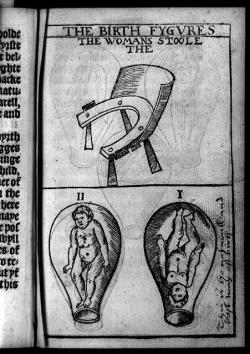
Clockwise from top: Woman’s stool (birthing chair); fetus in uterus, head down, marked “This is the naturall [sic] and best way of birth”; fetus in uterus, feet down. Courtesy of Thomas Raynalde/ Tradition of Science/Leonard C. Bruno/Library of Congress http://www.slate.com/articles/health_and_science/science_of_longevity/2013/09/death_in_childbirth_doctors_increased_maternal_mortality_in_the_20th_century.html

I am writing a new Regency era novel in which a forceps birth is required. To write the scene and the ramifications of the procedure, more research was required into such a difficult delivery. Having written about a less complicated delivery in a previous book, I held some knowledge of the history of forceps dating back to William Chamberlen and his two sons, both named Peter, Francois Mauriceau, and Van Roonhuysen, but the first story was set before the tragic death of Princess Charlotte in 1817 and the controversy which followed.

In Princess Charlotte’s case, she was some two weeks past her due date when she went into labor. The labor lasted some 50 hours, and she was pronounced dead 5 hours after the stillborn was delivered. The princess’s physician, Sir Richard Croft, removed the placenta after a difficult uterine examination. Three hours later, Princess Charlotte hemorrhaged and passed. This left Prince George (the future George IV), without an heir. Sir Richard committed suicide because of the criticism of his treatment of the princess. The use of forceps were more acceptable after this incident.

130906_TWO_BirthAssistance.jpg.CROP.article568-large

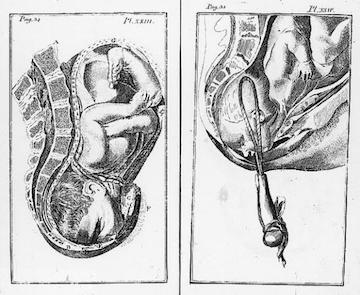
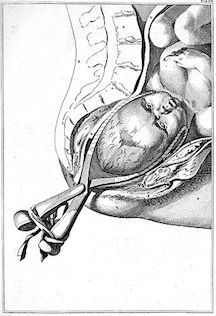
Two images of childbirth. Plate 23 (left) shows a child in the womb with the umbilical cord. Plate 24 shows forceps being used to deliver the child. Courtesy of William Smellie and John Norman/Library of Congress Rare Book and Special Collections Division http://www.slate.com/articles/health_and_science/science_of_longevity/2013/09/death_in_childbirth_doctors_increased_maternal_mortality_in_the_20th_century.html

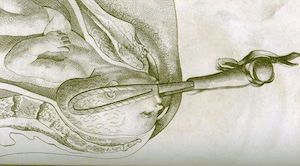
The history of forceps include William Smellie’s advancements. He is often considered the proponent of forceps delivery. In the mid 1700s, he designed his own forceps. His “English lock” permitted the blades of the forceps to be inserted into the woman’s vagina separately. He originally covered the blades with leather, and they were lubricated with hog lard. Smellie published the ‘Treatise on the Theory and Practice of Midwifery’ in 1752. (Studd J. “Pioneers in obstetrics and gyanaecology 1: William Smellie.” Diplomate 1994; 1: 153–4.)

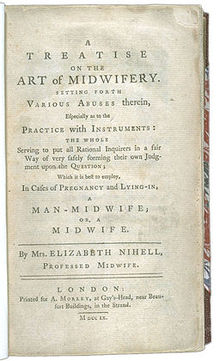
Treatise_on_the_Art_of_Midwifery

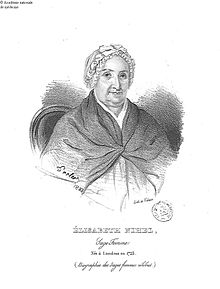
Elizabeth Nihell, a leading midwife of the period, opposed Smellie’s methods. Nihell trained at Paris’s Hôtel Dieu, a hospital which taught midwifery. In the two years of her residence she witnessed 2000+ births. When she moved to London, Nihell advertised as a midwife in the London Evening Post. In 1760, Nihell published ‘A Treatise of the Art of Midwifery,’ a public statement against Smellie’s development of forceps delivery and opposing the idea of male midwifery, in general. Nihell claimed that few deliveries required the use of forceps.

Smellie_forceps

Obstetrical Forceps, by Smellie (1792) – Public Domain https://en.wikipedia.org/wiki/Forceps_in_childbirth#/media/File:Forceps.Smellie.jpg

But forceps were not the only changes from the late 1700s to early 1800s saw. For example, in the 1700s most births were under the care of a midwife. Even Queen Charlotte employed the services of a midwife for the delivery of her fifteen children. The theory of humors, bloodletting, and purging were still common practices of “medicine.” There were some advances: A well-lit, airy birthing chamber replaced the heated lying-in chamber of the early part of the 18th Century. This was to ward off puerperal fever. Specialized birthing beds were seen in wealthier homes. Modesty was achieved by placing the woman on her side with her knees curled up during the delivery. The doctor would be behind her during this process. Even with these improvements, women were still expected to withdraw from society and from any duties for at least a month before her delivery.

1024px-Forceps.Smellie

Drawing of childbirth with use of forceps by William Smellie – Public Domain McLeod – Historical Medical Books at the Claude Moore Health Sciences Library, University of Virginia William Smellie (1697-1763): A Sett of Anatomical Tables with Explanations and an Abridgement of the Practice of Midwifery, 1754. https://en.wikipedia.org/wiki/Forceps_in_childbirth#/media/File:Smellie_forceps.jpg

The early 19th Century saw a more “scientific” birth approach in medicine. In addition to instruments to aid in difficult births, there were changes in birthing chairs. Ironically, most experts of the period speak to the fact that men waited to around age 30 to marry so they might be financially sound, but girls made their debut in Society as young as 16. Often it is heard that men married young girls because it was thought that the younger females could more easily withstand the rigors of childbirth. But even 200 years later, childbirth is the sixth most common cause of death for women aged 20-35. No matter the advances in medicine, women still die of postpartum sepsis (known as puerperal fever in earlier times), hemorrhage, eclampsia, etc.

Yet, before forceps, doctors ripped babies in breech or stuck in the birth canal from the woman’s vagina. Do you recall these lines from Shakespeare’s Macbeth (Act 5, Scene 8)?

MACBETH

     Thou losest labor.

As easy mayst thou the intrenchant air

With thy keen sword impress as make me bleed.

Let fall thy blade on vulnerable crests;

I bear a charmèd life, which must not yield

To one of woman born.

MACDUFF

     Despair thy charm,

And let the angel whom thou still hast served

Tell thee, Macduff was from his mother’s womb

Untimely ripped.

Sometimes those attending to the delivery cracked the baby’s skull, killing the newborn in order to spare the mother. Other times, the woman’s pubic bone was broken, which often killed the mother but saved the baby. Doctors had a collection of resources, including tools to hook a hard-to-deliver baby and drag it from the womb. Ironically, most of these gadgets resembled medieval torture tools.

Excellent Sources on the Subject Include:

Bull, Thomas. Hints to Mothers, For the Management of Health During the Period of Pregnancy, and in the Lying-in Room: with an Exposure of Popular Errors in Connexion with those Subjects and Hints Upon Nursing, Wiley & Putnam, New York, 1877.

Dewhurst, Jack. Royal Confinements, Weidenfeld and Nicolson, 1980.

Leavitt, Judith Walzer. Brought to Bed: Childbearing in America 1750-1950, Oxford University Press, New York.

imagesLewis, Judith Schneid. In the Family Way: Childbearing in the British Aristocracy, 1760-1860, Rutgers University Press, New Brunswick, New Jersey, 1986.
Loudon, Irvine. Death in Childbirth: An International Study of Maternal Care and Maternal Mortality 1800-1950, Clarendon Press, Oxford, 1992. (available on Google Books)

Ulrich, Laurel Thatcher. A Midwife’s Tale: The Life of Martha Ballard, Based on her Diary, 1785-1812, Knopf, New York, 1990.

Meet Regina Jeffers: Regina Jeffers, an award-winning author of historical cozy mysteries, Austenesque sequels and retellings, as well as Regency era romances, has worn many hats over her lifetime: daughter, student, military brat, wife, mother, grandmother, teacher, tax preparer, journalist, choreographer, Broadway dancer, theatre director, history buff, grant writer, media literacy consultant, and author. Living outside of Charlotte, NC, Jeffers writes novels that take the ordinary and adds a bit of mayhem, while mastering tension in her own life with a bit of gardening and the exuberance of her “grand joys.”

Every Woman Dreams Blog    and     Austen Authors Blog    

Regina Jeffers Website (excerpts, news and events, reviews, etc.)    

You may also find Regina at

Amazon Author Page      Twitter @reginajeffers         Facebook   


Posted in British history, Georgian England, Georgian Era, Great Britain, history, Living in the Regency, Living in the UK, medicine, Victorian era | Tagged , , , , , , , | 2 Comments

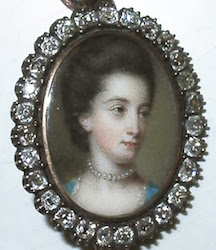
Eliza de Feuillide, Jane Austen’s Saucy Cousin and Sister in Marriage

eliza 3What do we know of Jane Austen’s cousin, Eliza de Feuillide, other than the fact she became Henry Austen’s wife?
john smart minaiature jane austen soc

Philadelphia Austen Hancock

Austen’s sister in marriage was born in Calcutta, India, on 22 December 1761 to her British parents, Philadelphia Austen (sister of Jane Austen’s father, George) and Tyson Saul Hancock, a physician with the East India Company. Eliza Hancock was, therefore, first cousin to the Austen siblings. Philadelphia had traveled to India in January 1752 with the specific purpose of finding a husband. She had no dowry, and so she met and married Hancock within six months of her arrival in the country. The couple had no children through the first 8 years of their marriage. It was only after the couple changed residences and took the acquaintance of Warren Hastings, the future Governor General of India, that Mrs. Hancock found herself with child. Many scholars believe that Hastings was Eliza’s father, but at any rate, he did serve as Eliza’s godfather. He presented her with £10,000 as a trust fund.

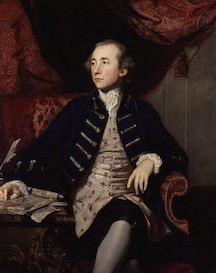
NPG 4445,Warren Hastings,by Sir Joshua Reynolds

Warren Hastings by Sir Joshua Reynolds, painting, 1767-1768

Mother and daughter traveled to England in 1768, while Hancock remained in India to finance their future. Unfortunately, Hancock died in 1775. Philadelphia took Eliza to live in Paris in 1777 for it was cheaper to live there than in England. In Paris, Eliza experienced a social coupe of sorts. She was known to have attended parties at the court of Marie Antoinette and Louis XVI. Eliza enjoyed the lifestyle offered to her in Paris. She was known to be a great horsewoman, and she opening expressed a passion for hot air ballooning in her letters to her cousins. At age 20, Eliza met and married a French Army captain if the Dragoons, Jean-François de Feuillide, who eventually became a French count.

Eliza was traveling to England by ship when she gave birth to Hastings de Feuillide, who was known to have seizures and learning difficulties. This was her second pregnancy, the first ending with a miscarriage. Eliza’s cousin Phylly Walter wrote in a letter, “[Hastings] has had another fit; we all fear very much his faculties are hurt; many people say he has the appearance of a weak head.” (Deirdre Le Faye, Jane Austen’s Letters, 85) He was slow to learn to walk and to speak. Some wonder of Eliza’s maternal instincts for she once referred to the child as “my wonderful Brat.” More than likely, Eliza experienced the frustration and the feeling of hopelessness when confronted with her son’s seizures.

Eliza, the baby, and Philadelphia arrived at Stevenson to mark Christmastide 1786. An eleven-year-old Jane found much to admire in this sophisticated husband. Henry Austen flirted with his cousin, who was ten years his senior. When Eliza’s husband was guillotined in 1794, Eliza, Hastings, and Philadelphia fled the reign of terror.

She did not play the role of “grieving widow.” Instead, Eliza defied social expectations. She acted as her own woman, despite suffering social disdain. Eliza’s cousin Phylly Walter said of Eliza, “Poor Eliza must be left at last friendless & alone. The gay and dissipated life she has so long had so plentiful a share of has not ensured her friends among the worthy; on the contrary many who otherwise have regarded her have blamed her for her conduct and will now resign her acquaintance. I have always felt concerned and pitied her thoughtlessness.” (Deirdre Le Faye, Jane Austen’s ‘Outlandish Cousin,’ London, British Library, 2002)

Henry Austen

Henry Austen

Eliza regained some of her reputation when she married Henry Austen in 1797.

Jane appeared in awe of Eliza’s worldliness, and they shared a biting insight into the foibles of others. Eliza was known to be a bit outlandish, but she was also noted for her optimism, her caring nature, and her intelligence. Hastings died in 1801, assumably from epilepsy. Eliza passed after a long illness on 25 April 1813.

Many think that the amorous and amoral Lady Susan Vernon is based on something of Eliza Austen. If nothing else, the rambunctious Eliza “introduced” the vicar’s daughter to the “puzzling matter of sexual attraction.” (Claire Tomalin, Jane Austen: A Life. New York, Vintage, 1999)

Sources: 

Cousin Eliza, the incurable flirt who inspired Jane Austen from The Telegraph

Eliza Hancock de Feuillide Austen from Madame Gilfurt

Eliza (nee Hancock, then de Feuillide) Austen: kindly, strong, deep feeling and thoughtful from Reveries Under the Sign of Austen

Philadelphia Hancock-Austen, Eliza Hancock, Eliza de Feuillide


Posted in British history, family, fashion, Georgian England, Georgian Era, Jane Austen, Living in the Regency, marriage, marriage customs, Regency era, Regency personalities | Tagged , , , , , , , | 7 Comments