Victoria, Princess Royal, Becomes a Mother

the_marriage_of_victoria_princess_royal_25_january_1858

Wikipedia ~ the marriage of Victoria and Fredrick

Previously, we spoke of the marriage of Victoria, Princess Royal, to Prince Frederick of Prussia, later Frederick III, German Emperor and King of Prussia. View that article HERE. The princess was only 17 when she married “Fritz,” and she was most certain Queen Victoria’s daughter. Her mother’s influence spelled doom from the beginning for the young princess. From Unofficial Royalty, we learn, ‘It was, and still is, customary for the wedding to be in the bride’s home territory, but Vicky was marrying a future monarch and the wedding was therefore expected to be in Berlin.  However, Queen Victoria had other ideas: “The assumption of it being too much for a Prince Royal of Prussia to come over to marry the Princess Royal of Great Britain in England is too absurd, to say the least…Whatever may be the usual practice of Prussian Princes, it is not every day that one marries the eldest daughter of the Queen of England.  The question must therefore be considered as settled and closed…’  Queen Victoria got her way and the wedding was scheduled for Monday, January 25, 1858, in the Chapel Royal of St. James’ Palace in London, England, where the bride’s parents had been married.”

The problems between Frederick and Vicky rested in her inability to assimilate to her new home. She still thought of herself as “English” and superior to her husband’s family and people. Vicky filled long letters to her mother where she described the ignorance of those in the Prussian court. Though her estimations were likely “astute” in many ways, her impetuous judgments caused Princess Victoria to lose the support of those she required, while she foolish made intimates of those who did not hold her best interest to heart. The princess wished to please her mother, and so she listened to Queen Victoria’s rebukes to operate in a Prussian court as if she were still in an English one. In justice to Vicky, the princess had spent a lifetime attempting to please a difficult and exacting mother. At such a young age she could not be expected to break the ties that bound her to the British Queen. 

Vicky became pregnant shortly after her marriage. This did not please her mother who thought the pair should have waited before becoming with child. Queen Victoria expressed her “disappointment” to Fritz, saying “you men are far too selfish!” 

For her 18th birthday, Vicky and Fritz moved into the newly refurbished Crown Prince’s Palace, where they escaped the “drab weariness” of the Royal Palace. The pair also, with the permission of Fritz’s father, Wilhelm I, took possession of the 200-rooms and three storied mansion known as Neues Palais. It was to become their true “home” throughout their marriage. Princess Victoria spent many years making Neues Palais a showplace. 

With the approach of the princess’s baby, Queen Victoria further opened wounds, in her daughter’s name, that were never healed. The Queen demanded that her daughter be attended by those who had attended the Queen during her later pregnancies. She sent her personal physician, Doctor James Clark, and a midwife, Mrs. Innocent, to tend the princess. Clark brought with him a bottle of chloroform, an accepted anesthetic in British childbirths, but not in Prussian ones. 

On 26 January 1859, the princess went into hard labor. Doctor Wegner, the German physician attending her, sent for a colleague, Doctor Edward Martin. By this time, Princess Victoria had been in labor eleven hours. Martin’s examination of her showed the baby in a breech position. If the child could not be turned, forceps would be used to pull it out. Some within the court privately sent an announcement of the demise of the princess and the child to the German press. 

Over Wegner’s objections, Martin requested that Clark administer the chloroform to the princess. Martin then manipulated the baby into a proper position. In Victoria’s Daughters by Jerrold M. Packard (St. Martin’s, 1998, page 74), we learn, “At 2:45 on the afternoon of the 27th – nearly fifteen hours into labor – the baby started to emerge. First its rear end appeared, and then the legs, which had been folded up against its stomach and chest. Following another dose of chloroform, the doctor surgically stretched Vicky’s uterus, after which the baby finished descending through with its left arm folded up behind its head. During the enormously difficult birth, the considerable force used to pull this arm free severely damaged the limb – whether from the application of forceps is unclear. The newborn baby did not immediately seem to be breathing. What is very likely, and would go far in explaining the future personality of the infant, was that long moments – perhaps some minutes – were passed until its first breath was taken, with some brain damage plausibly the result of the delay. The attendants rubbed the baby, possibly causing yet further unintentional damage to the already injured arm; the doctors evidently believed that a perfect baby had been born despite the horrifying circumstances of the delivery, and the severity of the injury to the limb was no even realized until three days later.”

victoria_and_frederick

29 January 1858 ~ Princess Victoria and Prince Frederick ~ Wikipedia

The child Wilhelm or “Willy” would spend a lifetime suffering first one medical experiment and gadget meant to FIX his deformed hand and shorter arm. Obviously, Princess Victoria was appalled to know she brought a less than perfect child into the world. Despite Willy’s disabilities, she was determined to mold her son into the future King of Prussia, a course that would destroy their relationship.

Posted in acting, British history, Great Britain, Living in the UK, marriage, medieval, royalty, Victorian era | Tagged , , , , , , , | 7 Comments

Gretna Green: Secret Engagements, Elopements and the World’s Most Famous Anvil, a Guest Post from Eliza Shearer

(This post originally appeared on the Austen Authors’ blog on December 1, 2017. Enjoy!)


After many years in my “to visit” list, I finally had the chance to make it to Gretna Green recently, as part of a family trip to England. The actual place we stayed at was Gretna, which is right alongside but couldn’t be more different. Whereas Gretna Green conjures images of forbidden romance, runaway brides and clandestine weddings, Gretna’s main claim to fame is mostly utilitarian: it was built during the Great War to provide homes for the 30,000 employees of what was the biggest munitions factory in the world at the time.

But back to Gretna Green. A pretty village, it is just over 10 miles from Carlisle, the last English town along the road, and it sits right on the border. An ideal location, therefore, for anybody desperate to reach the safety of Scotland. And why Scotland?

Relative Laws

Those of you familiar with the British Isles will know that Scots law is different from English law. A law in England does not a law in Scotland make, and this is precisely what happened with the Hardwicke Act of 1753. The new law made it compulsory for young people under 21 to obtain parental consent prior to their marriage, and for marriage ceremonies to be preceded by a publication of the banns, performed in a public ceremony in the parish of those getting married and presided by a Church official with the necessary license.

However, the Hardwicke Act applied to England and Wales only. Scotland maintained the old customs, which allowed boys over the age of 14 and girls over the age of 12 to marry without parental consent, provided they were not close relatives or in a relationship with a third party. All that brides and grooms had to do was make a public declaration. No surprise, then, that from 1753 onwards, a steady stream of Romeos and Juliets began the dash for Scotland to marry without parental approval.

A Very Convenient Location

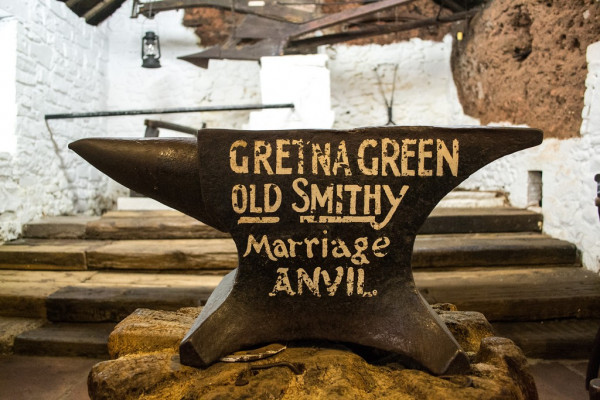
To begin with, those eloping weren’t aiming for a particular place, other than somewhere north of the border, but in the 1770s a new toll road made Gretna Green the most accessible Scottish village for those travelling from the south. It quickly became thedestination for those aiming for a secret wedding, because as well as fast access, ceremonies in the village had the added charm of being presided by the local blacksmith over an anvil.

Some say that the blacksmith’s shop was right next to the coaching inn, and he was so regularly asked to marry young couples that he ended up making a career out of it. However, I prefer an alternative explanation, which says that English couples, in spite of their eagerness to be married without the legal constraints of their country, were keen for their ceremony to be presided by someone in a position of authority in order to give it a more legitimate feel.

The Gretna Green blacksmith was happy to oblige, and added some theatricals to the ceremony by way of hammering on the anvil to symbolise the joining of new couples “in the heat of the moment but binding for eternity”. Genius!

Elopements to Scotland in Austen’s Novels

Whatever the actual reason behind the blacksmith’s story, the combination of the convenience of the toll road and the romance of the legendary anvil proved irresistible, and many couples of star-crossed lovers made Gretna Green their destination. By Jane Austen’s time, elopements to Scotland, mainly with Gretna Green as destination, were so established that they are mentioned in several of her works.

In Love and Freindship, Laura and Sophia convince young Janetta, who is to marry a man her father has chosen for her, that she is in love with Captain M’Kenzie. They manage to do the same with the gentleman, and they end up running away to “Gretna-Green”.

In Mansfield Park, Julia Bertram and Mr Yates elope to Scotland to marry. In Pride and Prejudice, Lydia and Wickham are thought to have run away to Scotland when word gets out of their escape, and the bride herself declares Gretna Green to be their destination in the infamous letter she leaves to her friend, Mrs Foster:

”MY DEAR HARRIET,

“You will laugh when you know where I am gone, and I cannot help laughing myself at your surprise tomorrow morning, as soon as I am missed. I am going to Gretna Green, and if you cannot guess with who, I shall think you a simpleton, for there is but one man in the world I love, and he is an angel. I should never be happy without hi, so think it no harm to be off. You need not send word at Longbourn of my going, if you do not like it, for it will make the surprise the greater, when i write to them and sign my name “Lydia Wickham.” What a good joke it will be!”

Pride and Prejudice, Chapter 47

And who does not remember the tragic love story between a young Colonel Brandon and Eliza, his father’s guard, in Sense and Sensibility? Before Eliza is forced to marry Brandon’s brother, the doomed couple plan to elope and get married in Gretna Green, but they are betrayed by “the treachery, or the folly” of Eliza’s maid.

In any case, the Gretna Green legend remains, so much so that the town has quite successfully marketed itself as a romantic wedding destination. And, I should add, rightly so, for who can resist the lure and romance of Scotland and of a marriage over the world’s most famous anvil, whether parental permission has been granted or not?

What do you think of Gretna Green’s reputation in history? Where should it feature in a list of Janeite locations in the UK?

Posted in British history, buildings and structures, Church of England, customs and tradiitons, Georgian England, Georgian Era, Great Britain, Gretna Green, Guest Post, history, Jane Austen, legends, Living in the Regency, marriage, marriage customs, marriage licenses, Pride and Prejudice | Tagged , , , , , , , , , , | Comments Off on Gretna Green: Secret Engagements, Elopements and the World’s Most Famous Anvil, a Guest Post from Eliza Shearer

Pre-Elizabethan Drama: Morality Plays

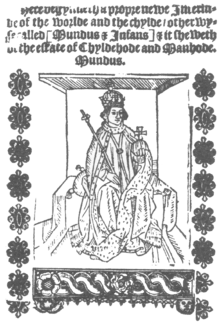
220px-mundas-et-infans-frontispiece-1522

The 1522 cover of “Mundus et Infans,” a morality play ~ Wikipedia

Previously, I did a piece on Liturgical Drama. Today I would like to look at Moralities. As compared to the Miracle or Liturgical dramas, the morality play was one where the playwright had to come up with an original story line, which many consider to be a major step forward in the history of drama. No longer did the playwright use the scripture for his plots. He did, however, employ a well-known allegory, popular for several centuries in England and upon the European continent, but which had rarely been celebrated as the central issue of a tale, as it was in the moralities. 

A morality play was defined as “an allegorical drama popular in Europe especially during the 15th and 16th centuries, in which the characters personify moral qualities (such as charity or vice) or abstractions (as death or youth) and in which moral lessons are taught.” (Britannica) The issue was the struggle between good and evil in claiming the soul of man. Vice and Virtue became the central characters. In these plays, mankind always desired to chase after the vice, but he is well aware that if he does he will face eternal damnation. Evidently, the medieval mind thought much upon the dichotomy presented in the plays. 

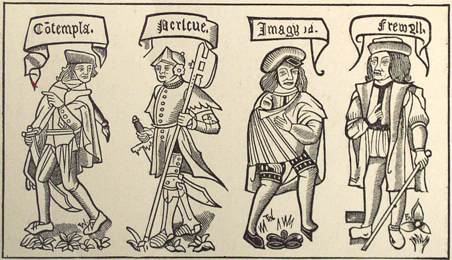
mummers2.jpgThe characters in the plays were personified abstractions. In moralities we find Friendship, Riches, Good, Evil, Knowledge, Mankind, etc. The action of the morality play centers on a hero whose inherent weaknesses are assaulted by such personified diabolic forces as the Seven Deadly Sins, but who may choose redemption and enlist the aid of such figures as the Four Daughters of God (Mercy, Justice, Temperance, and Truth). Customarily, the play began with Man being summoned to the Grave. The action that followed involved the conflict for the possession of Man’s spirit.

The purpose of the Moralities was didactic. In Everyman, for example, the protagonist is made acquainted with the entire Catholic scheme of salvation. In the play, Man dons the jewel of Penance and later, the robe of contrition. He also consumes the seven “blessed sacraments.” Through the action, the play teaches its audience that all men must adhere to the tenets of the church. The play ends with the Doctor or Expositor reemphasizing the moral of the story. He shows the audience how Pride, Beauty, Wealth, and other worldly aspirations abandon “Everyman” at death. Only Good Deeds will accompany him to the underworld. These early plays were solemn personifications of church sermons. 

MoralityFigures.JPGAmong the oldest of morality plays surviving in English is The Castle of Perseverance (c. 1425), about the battle for the soul of Humanum Genus. A plan for the staging of one performance has survived that depicts an outdoor theatre-in-the-round with the castle of the title at the centre. Everyman was published in 1500. They both were from the York Paternoster Plays, which date back to 1378. These plays were similar to the early moralities. They took their names from the belief that each clause of the Lord Prayer could counter one of the seven deadly sins. 

The character of Vice became the first element of comedy in 16th Century Moralities. Vice’s purpose was to irritate and arouse the ire of the Devil. Vice prodded the Devil with sticks. He taunted him. He baited him into arguments. The character of the Devil was a crossover from the Miracle plays. He “excited” the audience for they anticipated his antics. Both characters met the demand of the latter audiences for action rather than sore sermons. 

“Morality plays were an intermediate step in the transition from liturgical to professional secular drama, and combine elements of each. They were performed by quasi-professional groups of actors who relied on public support; thus the plays were usually short, their serious themes tempered by elements of farce. In the Dutch play Het esbatement den appelboom (“The Miraculous Apple Tree”), for example, a pious couple, Staunch Goodfellow and Steadfast Faith, are rewarded when God creates for them an everbearing apple tree with the property that whoever touches it without permission becomes stuck fast. This leads to predictable and humorous consequences.” (Britannica)

Resources: 

History of Morality Plays 

Luminarium 

New Advent: Catholic Encyclopedia 

Wikipedia 

Posted in acting, Age of Chaucer, Anglo-Normans, Anglo-Saxons, British history, drama, medieval, playwrights, Vagary | Tagged , , , , , | Comments Off on Pre-Elizabethan Drama: Morality Plays

Testing the Money: The Trial of Pyx

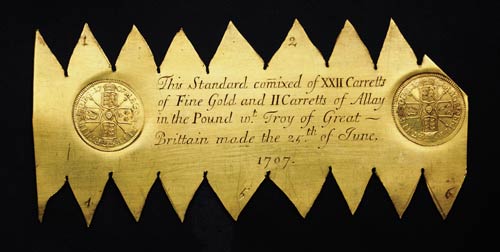
The Trial of Pyx is a near-800 year old ceremony to test Britain’s coinage. The Trial of the Pyx dates as far back as 1249. The Queen’s Remembrancer oversees the ceremony. Until the 19th century this duty was undertaken at the Court of Exchequer, but is now held at Goldsmiths’ Hall in the City of London. The ceremony puts the Royal Mint on trial. Over a four-month period, nearly 100,000 are scrutinized. During the process, the coins are tested for imperfections or impurities in the metals used, therefore, confirming their value. 

Historic UK tells us, “The Trial of Pyx is a rather interesting one. Every day the Royal Mint collect samples of the coins they produce: this amounts to around 88,000 coins a year. These coins are then placed in boxes (or pyxes) and every February they are brought to Goldsmiths Hall. The Queen’s Remembrancer swears in a jury of 26 goldsmiths whose job it is to count, measure, weigh and assay the coins. In April or May he or she returns to hear the jurers’ verdict.”

Coins from the commemorative £1,000 coin (worth £49,995) made from a kilo of solid gold to the 20p piece, all denominations of coins are tested. According to Coin Books, 2017 saw the Trial this year was the new £1 coin, which has 12 sides and will be released to the public later this year. It is considered to be the most secure coin ever developed.

32668549976_6f9061d0a9

This one kilo gold coin celebrates the Queen’s 90th birthday. via Coin Books http://www.coinbooks.org/v20/esylum_v20n06a21.html

The Royal Mint provides these insights: “As one of the nation’s longest-established judicial ceremonies, the Trial of the Pyx has a rich and fascinating history. It brings together some of the United Kingdom’s oldest organisations and offices with the purpose of ensuring the quality and accuracy of the nation’s coinage. 

“The ceremony involves the Chancellor of the Exchequer (or nominated representative), financial leaders, representatives of The Royal Mint and freemen of the Worshipful Company of Goldsmiths, commonly known as The Goldsmiths’ Company.”

“The word ‘pyx’ comes from the Latin word ‘pyxis’ or small box. In this case, it refers to the chests used to transport the coins. Throughout the year, in a procedure that has barely changed since the reign of Henry III, coins are randomly selected from every batch of each denomination struck, sealed in bags of 50 and locked away in the Pyx boxes for testing at the Trial.”


Business Insider describes the 2016 ceremony. “The opening of this year’s trial was on February 2nd was full of pomp and circumstance. It’s carried out by the Queen’s Remembrancer, a judge, who swears in the 16-strong jury who have the job of counting the coins sent for testing by the Royal Mint. While it’s mostly ceremonial, the Trial of the Pyx has an important message – merchants, not the state or the monarchy, must have power over the country’s currency. To allow the state to have power over the currency, risks eroding its credibility. Permission for the City of London to test the coins produced by the Royal Mint was granted by the Crown in the 13th century. Before that, the reigning monarch had a monopoly on producing and testing Britain’s coinage and would periodically alter the standards for the coins to finance wars. 

“‘There was the inherent danger of inflation and currency corruption,’ the Queen’s Remembrancer, Barbara Fontaine, said in her speech to open proceedings. The Trial was ‘a key stage of development of the international trust in our coinage.'”

these-are-the-pyx-reinforced-boxes-of-currency-ready-to-be-assayed-or-tested-the-word-pyx-comes-from-the-greek-for-wooden-box-in-them-are-hundreds-of-envelopes-containing-thousands-of-co

These are the Pyx, reinforced boxes of currency ready to be assayed or tested. The word Pyx comes from the Greek for wooden box. In them are hundreds of envelopes containing thousands of coins. via Business Insider

Coin Books also gives us these other sources: 

To read the complete article, see:
Take a tour around the Trial of the Pyx — the 800-year-old ceremony to test the UK’s coins(www.businessinsider.com/inside-the-trial-of-the-pyx-2017-1/#the-ceremony-takes-place-in-the-opulent-goldsmiths-hall-in-the-city-of-london-members-of-the-public-and-invited-dignitaries-are-sat-on-one-side-of-the-room-the-queens-remembrancer-a-judge-sits-at-the-head-of-the-table-to-give-her-address-and-start-the-trial-she-isnt-actually-present-when-counting-process-happens-1)

For more information, see:
The History of the Trial of the Pyx (www.royalmint.com/discover/uk-coins/history-of-the-trial-of-the-pyx)

The History of the Trial of Pyx (The Goldsmiths’ Company) 

The Business Insider site has some magnificent images of the process, the room, etc. Check them out HERE

Check out all the Royal Mint has to share on the topic. 

Posted in British history, commerce, customs and tradiitons, Living in the UK | Tagged , , , , , , | 3 Comments

How Did Smith Brothers Cough Drops Get Its Name?

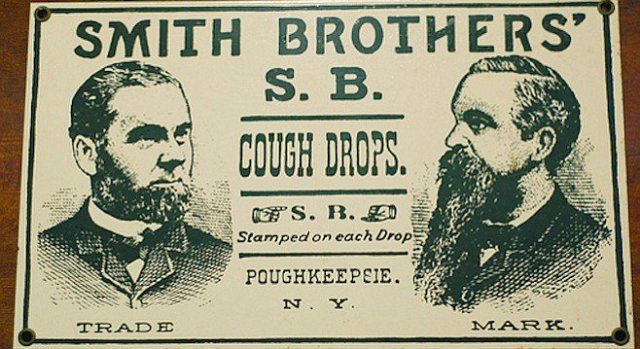
7594535_1056019660.jpgWilliam (Trade) and Andrew (Mark) were the sons of James Smith, who moved his family from St. Armand, Quebec, to Poughkeepsie, New York in 1847. A carpenter by trade, Smith meant to open a restaurant, Smith’s Dining Saloon, in his new home. He was also known for his candy making. 

Shortly after Smith’s moving to New York, a journeyman shared the formula for an effective cough candy with the elder Smith. Being an astute businessman, Smith saw an opportunity to expand his calling. He mixed up a batch of the cough drops upon his kitchen stove. He sold them from his dining saloon, and the word soon spread of the effects of the medication among those in the Poughkeepsie area. A newspaper of the time displays an advertisement for the cough drops, saying “all afflicted with hoarseness, coughs, or colds should test its virtues.” 

sb_box_2Soon William and Andrew sold the drops upon the streets of Poughkeepsie. “The Smith Brothers” were often sought out for the “cough candy.” The operation moved from the Smith’s kitchen to the restaurant and later to a loft building. When the elder Smith died in 1866, his sons carried on the business under the name Smith Brothers

When imitators started flooding the market with similar names, the Smith Brothers decided to trademark their product with their own images. The drops were originally sold from large glass bowls place on store counters. Customers put the drops in envelopes to be taken home. The word “Trade” was under William’s picture, and the word “Mark” under Andrew’s. Therefore, the two men were often referred to as “Trade” and “Mark,” rather than by their real names. 

In 1872, Smith Brothers developed one of the first factory-filled packages on the market. They trademarked images of the two men was transferred to the individual packages. Surprisingly, production increased from 5 pounds to 5 tons per day. 

Trade and Mark hold the world record for the number of times their likenesses have been reproduced. 

Posted in American History, business, medicine, science | Tagged , , , , , | 2 Comments

Oh, What Tangled Webs We Weave: The Complicated Banbury Peerage Case

In writing historicals set in England in the early 1800s, it is necessary for me to possess more than a working knowledge of primogeniture, which is both the custom and the law of inheritance in practice at that time. In primogeniture, it is the right of the first born legitimate son to inherit the real property of his father, in preference to daughters, younger sons, elder illegitimate sons, and other relations in the male line. The son of the deceased eldest brother inherits before a living younger brother by right of substitution for the deceased heir. Estates were entailed, not upon the eldest son, but upon the eldest sons first born son. By constantly extending the entail to the grandson,they became perpetual in nature.

But what if there are no sons? Then the family tree is searched for the nearest male blood relative, all the way back to the original holder of the estate. But things become even more convoluted when the heir goes missing before he has an apparent heir. Let us say the heir goes missing at sea. Believe it or not, the House of Lords would not automatically name the next in line as the new title owner. There is always the chance that the current lord survived the catastrophe he encountered. What would happen if he returned, say in 5 or 10 years? The ruling is that the title and the real estate would revert to the original owner, but not necessarily the personal property. The ruling is that the title and the real estate would revert back to original landowner, but not necessarily the personal property. It must not be forgotten that, by English law, ordinary leaseholds, whether they consist of lands or houses, count as personalty and are distributed as such on intestacy. Money in trust for investment in land is distributed as realty under the same rule of inheritance. What a legal mess! This little twerk of the law of inheritance is enough to set brother against brother in my latest romantic suspense, Angel Comes to the Devils Keep.

But was there a precedence for this type of ruling from the House of Lords? In fact, as a fundamental law, primogeniture is a practice of the landed aristocracy, rather than the general populace. Among the upper crustof society, generally, hereditary estates are entailed and not at the free disposal of individual landowners. There are few wealthy or noble families that have not employed the practice of primogeniture somewhere in their histories.

51CKzXQ2BsL._SX382_BO1,204,203,200_.jpg Occasionally, those histories become so complicated that it takes centuries for the peerage to be defined. For example, during the reign of Edward III, one of the companions of the Black Prince was Sir Robert Knollys, who earned the Blue Ribbon of the Garter for his valor. The Knollss family continued to receive the favor of successive reigns. One such person was Sir Francis Knollys, who married Catherine Gray, grand-niece of Queen Anne Boleyn. They produced two sons: Henry and William. According to Kidd and Williamson, editors of George Edward Cockaynes The Complete Baronetage, Henry did not survive his father, and so William claimed the baronetcy in 1596. In 1603, King James presented William an additional title beyond the baronetcy, making William Baron Knollys of Grays, in Oxfordshire. In 1619, King James further favored William with an another barony, by naming him Baron Wallingford; later, in 1626, King Charles presented him as the Earl of Banbury.

Williams first wife Dorothy did not provide William an heir. Upon Dorothys death, he married Lady Elizabeth Howard. William was nearing sixty years at the time of the marriage, and Lady Elizabeth was but twenty. Yet, keep in mind, William did not pass until the age of eighty-five.

After Banburys death, in April 1633, an inquisition occurred, stating that Elizabeth was Banburys wife at the time of his death and that the earl died without a male heir. However, records show that Elizabeth delivered two sons before her husbands death: Edward on 10 April 1627 (Banbury was 80 and Elizabeth 41 at the time) and Nicholas on 3 January 1631 (Banbury was 84 and Elizabeth 45). Generally speaking, common practice said if Banbury accepted the children as his and/or acknowledged them in some manner such as baptism or speaking of them as such to trustworthy witnesses, the boys would be considered his. Yet, the official investigation in 1633 skewed that ruling for it was written evidence to the contrary. Complicating the situation of whether the children were legitimate, after only five weeks of mourning Banbury, Elizabeth married Lord Vaux of Harrowden, a family friend. It was said the boys favored Vaux in countenance. Lady Elizabeth adopted Roman Catholicism, the religion of Lord Vaux. She, therefore, came under the scrutiny of the Long parliament, which was previously skeptical of her relationship with Vaux. Eventually, on 19 August 1643, the speaker issued a pass enabling her to remove to France, and on 13 June 1644 the House of Commons resolved that should she return she should be seized and kept under restraint. She died on 17 April 1658, and was buried at Dorking, Surrey, near the residence of her second husband. Vaux passed on 8 April 1661, and is said to have died without issue. (Lee, Sidney, ed. Dictionary of National Biography: Vol XXXI Kennett – Lambart: [London, Smith, Elder & Co., 1892. 287-288], accessed January 22, 2017. https://www.google.com/webhp?sourceid=chrome-instant&ion=1&espv=2&ie=UTF-8#q=Cal.+State+Papers%2C+Dom.+1654-5%2C+p.+55), page 287)

William Knollys, 1st Earl of Banbury

William Knollys, 1st Earl of Banbury via Wikipedia

 In 1640, William, Earl of Salisbury, guardian of the eldest boy Edward, filed in Chancery upon Edwards behalf for a claim to the earldom. Witnesses and evidence were presented to substantiate the filing, but on 1809 (nearly 170 years later) the House of Lords rejected the claim. How did that come about?

A hearing in 1641 dealt with the question of Edwards legitimacy; it found that Edward, Earl of Banbury, was the deceased earls son and heir because of the legal doctrine, Pater est quem nuptiæ demonstrant, which assumes in all cases of children born in wedlock that the husband is the children’s father. And although there was some debate as to whether Banbury recognized the child as his during the earls marriage to Elizabeth, a legal decision in favor of the claim to legitimacy was made. Edward, the elder of the countess’s two sons, was styled Earl of Banburyin a chancery suit to which in February 1640-1 he was party as an infant, for the purpose of establishing his right to a plot of land at Henley, styled the Bowling Place, and to other property left by his father. Under orders of the court of wards an inquiry into the late earl’s property was held at Abingdon on 1 April 1641, and the court found that ‘Edward, now Earl of Banbury, is, and at the time of the earl’s decease was, his son and next heir.’” (Lee, 287)

Unfortunately, another complication occurred after Edwards being named earl for he was killed in a quarrel upon the road to Calais in 1645. Edwards brother, Nicholas, naturally made a claim to the title, but he was a minor at the time and could not inherit. Nicholas then travelled to France with his mother in 1644, but in October 1646, he returned to England, for Lord Vaux settled all his lands at Harrowden on Lady Elizabeth, with the remainder to Knollys himself, who was styled Earl of Banbury in the deed. When Nicholas reached his majority, he moved to prove his right to the peerage and, thus, petitioned the Crown for his writ of summons to assume his seat in the House of Lords. The Committee of Privileges heard the petition, which granted the writ for Nicholas, Earl of Banbury.

Nicholas married Isabella, daughter of Mountjoy Blount, earl of Newport, and the pair soon fell into pecuniary difficulties. In February 1654, Nicholas, earl of Banbury, the Countess of Banbury, Lady Elizabeth Vaux and Lord Vaux petitioned Cromwell to remove the sequestration on Lord Vauxs estate so they might compound or sell some of the land to pay their debts of some 10,000l. The earl had been confined at the time at the Upper Bench prison because of the debt. Isabella died soon afterwards, and Nicholas married Anne, daughter of William, Lord Sherard of Leitrim. In June 1660 he attended the Convention parliament in the House of Lords, but it was not until 13 July 1660 that the first attempt was made to dispute his right to his seat there. It was then moved that there being a person that now sits in this house as a peer of the realm, viz. the Earl of Banbury, it is ordered that this business shall be heard at the bar by counselon the 23rd. Knollys attended the house daily in the week preceding that appointed for the hearing, and was present on the day itself. But no proceedings were taken, and on 24 July he was nominated, under the style of Earl of Banbury, to sit on the committee on the Excise Bill. On 21 Nov. it was ordered that the earl hath leave to be absent for some time.On 29 Dec. the Convention parliament was dissolved. No writ of summons was sent to Knollys for the new parliament, meeting 8 May 1661. He therefore petitioned the king for the issue of the writ and for all the old earl’s rights of precedency. His petition, when forwarded to the House of Lords, was referred to a committee of privileges. This committee examined the servants who were at Harrowden at the time of his birth. The attorney-general argued on behalf of the king that the old earl had died childless, but the committee reported on 1 July 1661 that Nicholas, Earl of Banbury, is a legitimate person.’” (Lee, 288)

His son Charles assumed the title upon Nicholass death. Likewise, Charles petitioned for his writ of summons, and the committee of privileges reported the history of the case, and the House of Lords agreed to hear counsel for and against the claim, but a delay occurred, one lasting some thirty years. During the delay, Charles had the misfortune of killing his brother-in-law, Captain Philip Lawson, in a duel. In November 1692, he was indicted and ultimately requested a trial by his peers before the House of Lords. This brought about another hearing upon whether Charles held a legitimate claim to the earldom. His petition to the House of Lords was dismissed with a ruling denying his right to be styled Banbury. He was removed to Newgate Prison.

According to The Banbury Peerage Caseon the Bennet Dictionary: The Bennet Dictionary: Celebrated Claimants from Perkin Warbeck to Arthur Orton [(1874). accessed December 13, 2016. http://bennetdictionary.com/banbury-peerage-case/], the trial and the various pleas took more than a year, during which Charles was presented bail to move about in society. At length, the Lords intervened, and Parliament took up his case again, but the session was discontinued indefinitely, and no decision was forthcoming. The trial also quashed the indictment against him for the duel for the prisoner was styled in the charges as Charles Knollys, esq.instead of the Earl of Banbury.

Nothing more was heard upon the legitimacy of Charless claims until four years later when in 1698, Charles Banbury again petitioned the King for the writ of summons. The House of Lords accepted the case again, but it went from continuance to continuance, passing through the end of the reign of William III and into that of Anne. There was hope for a resolution in late 1713, but the sudden death of Queen Anne in August 1714 once more delayed the proceedings.

Charles next petitioned George I, but no definite decision was given. Charles, Earl of Banbury, died in 1740. During his lifetime, to no avail, he presented five petitions to the Crown. However, not being officially recognized as the Earl of Banbury did not prevent him and his family from enjoying their position in Society.

Charles was followed by another two Charleses and a William, who died in 1776. Williams brother Thomas held the title until his death in 1793, when his son William Knollys, then called Viscount Wallingford, sent a formal petition in 1806 to the Crown for the Banbury earldom, the question of which was again returned to the House of Lords. By 1806, there had been an Earl of Banburyfor 180 years. Yet, Williams father, Thomas, had held a commission in the Third Regiment of Foot as a Lieutenant-General.As such, Thomas was styled by his military rank and not Banbury, causing Williams claim to be denied. Needless to say, primogeniture is not a clearly defined practice.

Angel .jpgAngel Comes to the Devils Keep [Romantic Suspense]

Huntington McLaughlin, the Marquess of Malvern, wakes in a farmhouse, after a head injury, being tended by an ethereal “angel,” who claims to be his wife. However, reality is often deceptive, and Angelica Lovelace is far from innocent in Hunt’s difficulties. Yet, there is something about the woman that calls to him as no other ever has. When she attends his mother’s annual summer house party, their lives are intertwined in a series of mistaken identities, assaults, kidnappings, overlapping relations, and murders, which will either bring them together forever or tear them irretrievably apart. As Hunt attempts to right his world from problems caused by the head injury that has robbed him of parts of his memory, his best friend, the Earl of Remmington, makes it clear that he intends to claim Angelica as his wife. Hunt must decide whether to permit her to align herself with the earldom or claim the only woman who stirs his heart–and if he does the latter, can he still serve the dukedom with a hoydenish American heiress at his side?

Posted in British history, Church of England, historical fiction, history, Inheritance, Jane Austen, marriage, primogenture, titles of aristocracy | Tagged , , , , , | 2 Comments

Jane Austen Adaptations: Film, TV, Web, and Stage

Realizing that many of my readers are unfamiliar with how the media has seen fit to adapt Jane Austen’s many novels, below you will find a list of the majority of them. We who write Austen adaptations know that our readers see the movie/TV adaptation and become hooked on the story lines.

Austen on Stage: The Complete Works of Jane Austen Adapted for the Stage (2019) – by Jon Jory [Note: Jory previously created 3-act plays of Pride and Prejudice, as well as Sense and Sensibility.]

A Modern Persuasion (2019) 

Sandition (2019) – PBS

Christmas at Pemberley Manor (2018) – a Hallmark channel modern Pride and Prejudice

Marrying Mr. Darcy (2018) – a Hallmark channel sequel to Unleashing Mr. Darcy

Pride, Prejudice and Mistletoe (2018) – a Hallmark channel modern story loosely based on Pride and Prejudice

Pride and Prejudice (2017) – a Kate Hamil adaptation for the stage

The Cate Morland Chronicles (2016) – an adaptive web series 

Pride and Prejudice and Zombies (2016) – a movie based on the novel of the same name 

Pride and Prejudice (2016) – described as a “fresh and sexy” adaptation 

Love and Freindship (2016) – a film version of Lady Susan

Unleashing Mr. Darcy (2016) – a Hallmark channel modern version of Pride and Prejudice

Austenatious (2015) – TV series

Jane by the Sea (2015) – film, turns Austen’s real life into a romantic comedy

Northbound (2015) – modern TV series based on Northanger Abbey


From Mansfield with Love (2014) – a YouTube vlog adaptation of Mansfield Park by Foot in the Door Theatre

The Jane Games (2014) – TV Series 

Kumkum Bhagya (2014) – an Indian television serial  based on Sense and Sensibility

Sandition (2014) – film adaptation 

Sense and Sensibility (2014) – a Kate Hamil adaptation for the stage

Emma Approved (2013-2014) – an Emmy-winning YouTube adaptation in which Emma Woodhouse is a matchmaker


Death Comes to Pemberley (2013) – a 3-part murder mystery television drama

Welcome to Sandition (2013) – a web series spin off of The Lizzie Bennet Diaries

The Lizzie Bennet Diaries – (2012 – 2013) – an Emmy winning YouTube adaption

Mansfield Park (2012) – stage adaptation by Tim Luscombe, produced by the Theatre Royal, Bury St Edmunds 

Jane Austen Hand Held (2011) – film based on Pride and Prejudice, as told through the lens of a documentary film crew 

Mansfield Park (2011) – a chamber opera

Pride and Prejudice: A Modern Day Tale of First Impressions (2011) – film


Prada to Nada (2011) – Film – modern day Sense and Sensibility with a Spanish “flavor”
Aisha (2010) – an Indie film version of Emma

Emma (2009) a BBC TV mini-series

Darcy and Elizabeth (2008) – a one-act play by Jon Jory


Sense and Sensibilidad (2008) – Film
Lost in Austen (2008) – TV mini-series that takes the main character into the novel’s pages
Sense and Sensibility (2008) – TV mini-series
Jane Austen Trilogy (2008) – a documentary with bibliographic intentions
Miss Austen Regrets (2008) – a made-for-TV show based on Austen’s letters
The Jane Austen Book Club (2007) – film based on the popular best-selling book
Mansfield Park (2007) – TV movie
Northanger Abbey (2007) – TV movie
Persuasion (2007) – TV movie
Becoming Jane (2007) – popular film based on Austen’s letters


I Love You Because (2006) – a modern play based on Pride and Prejudice

JANE, the musical (2006) – a West-End style musical theatre production based on the life of Jane Austen
Pride and Prejudice (2005) – Film
Bride and Prejudice (2004) – Indie film
Pride and Prejudice (2003) -modern adaptation film
The Real Jane Austen (2002) TV movie based on Jane Austen’s letters
Kandukondain, Kandukondain (2000) Film based on Sense and Sensibility
Mansfield Park (1998) – Film
“Wishbone”- “Pup Fiction” (1998) -an episode of the popular TV show based on Northanger Abbey
“Wishbone”- “Furst Impressions” (1997) – an episode of the popular TV show
Emma (1996) – TV movie
Emma (1996) – Film


Sense and Sensibility (1995) – Film
Persuasion (1995) – TV movie
Pride and Prejudice (1995) – TV mini-series

Pride and Prejudice (1995) – a musical by Bernard J. Taylor

Ruby in Paradise (1993) – an homage
Sensibility and Sense (1990) – TV movie

Metropolitan (1990) (originally titled “Manhattan”) – directed by Whit Stillman, was a loose adaptation of Mansfield Park set in modern time –  the film tracks “the Austen phenomenon beyond Austen, into what (is called) the ‘post-heritage’ film, a kind of historical costume drama that uses the past in a deliberate or explicit way to explore current issues in cultural politics


Northanger Abbey (1987) -TV movie
Mansfield Park (1983) – TV mini-series
Sense and Sensibility (1981) – TV movie
Jane Austen in Manhattan (1980) – Film
Pride and Prejudice (1980) – TV mini-series
Emma (1972) – TV mini-series novel
“Novela” – “Persuasión (1972) -TV series episode
Sense and Sensibility (1971) – TV movie
Persuasion (1971) -TV mini-series
“Novela” – “La abadía de Northanger (1968) -TV series episode
Pride and Prejudice (1967) – TV series
“Novela” – “Emma (1967) – TV series episode
“Novela” – “Orgullo y prejuicio (1966) -TV series episode
Vier dochters Bennet, De (1961) – TV mini-series based on Pride and Prejudice
Emma (1960) – TV movie
Camera Three (1960) – TV series based on Emma
Persuasion (1960) – TV mini-series


First Impressions (1959) – Broadway musical version of Pride and Prejudice
Pride and Prejudice (1958) – TV series
Pride and Prejudice (1958) – TV film
“General Motors Presents: Pride and Prejudice” (1958) – TV series episode
Orgoglio e pregiudizio” (1957) – TV mini-series
“Matinee Theater: Pride and Prejudice” (1956) _ TV series episode
“Kraft Television Theatre: Emma” (1954) – TV series episode
Pride and Prejudice (1952) – TV mini-series
“The Philco Television Playhouse: Sense and Sensibility” (1950) – TV series episode
“The Philco Television Playhouse: Pride and Prejudice” (1949) – TV series episode
Emma (1948) -TV film
Pride and Prejudice (1940) – Film
Pride and Prejudice (1938) -TV

Pride and Prejudice (1935) – Helen Jerome’s Broadway play (basis for the 1940 film)

“The Bennets: A Play Without a Plot, Adapted from Jane Austen’s Novel ‘ Pride and Prejudice,” (1901)

Jane Austen’s novels have never been out of print. It would seem that we might say the same thing of cinematic adaptations.

Posted in Austen actors, Austen Authors, contemporary romance, film adaptations, holidays, JASNA, Mansfield Park, Persuasion, playwrights, Pride and Prejudice, romance, Vagary | Tagged , , , , , , , | 7 Comments

The Tradition of “Christmas Carols”

Parts of this post were originally featured on Austen Authors, brought to us from Rebecca Jamison. I have added to what she shared and offer more of the history of the Christmas Carols than she did in her original post, but have kept some of her YOUTUBE examples. 

 “Christmas Carols” were originally called so because they were a piece of vocal music in what is known as “carol form.” The word “carol” comes to us from the Old French word carole, which means a circular dance accompanied by singers. These were popular dance songs from as early as the 1150s. They became processional songs in the 14th Century and were sung at festivals. Other such “carols” were written specifically to accompany the mystery plays, for example the Coventry Carol, written some time before 1534. [W. J. Phillips, Carols; Their Origin, Music, and Connection with Mystery-Plays (Routledge, 1921, Read Books, 2008), p. 24.]

 800px-WLANL_-_legalizefreedom_-_De_kindermoord_te_Bethlehem.jpg The “Coventry Carol” dates from the 16th Century. It was originally performed in Coventry, England as part of the mystery play entitled, The Pageant of the Shearmen and Tailors. The play depicts what is known as the Massacre of the Innocents, in which Herod orders all male infants under the age of two in Bethlehem to be killed, as told in Chapter Two of the Gospel of Matthew. The song takes the form of a lullaby sung by the mothers of the targeted children. The author is unknown; the oldest known text was written down by Robert Croo in 1534, and the oldest known setting of the melody dates from 1591. [Studwell, W. E. (1995). The Christmas Carol Reader. Haworth Press. pp. 15 ]

Before the Protestant Reformation, carols were performed in Latin by the clergy of the Catholic church. With the Reformation, the carols were brought “back to the people.” Music was translated into the native language of those who spoke it. The Protestant church also made a concerted effort to break the hold the Catholic Church had on what we would term “sacred music.” Composers such as William Bryd composed motet-like  [a mainly vocal musical composition, of highly varied form and style, from the late medieval era to the present] works for Christmas that they termed carols; and folk-carols continued to be sung in rural areas. Nonetheless, some famous carols were written in this period, and they were more strongly revived from the nineteenth century and began to be written and adapted by eminent composers.

“Musically speaking, carol has a very specific definition: a song, characteristically of religious joy, associated with a given season, especially Christmas; in which uniform stanzas, or verses (V), alternate with a refrain, or burden (B), in the pattern B, V1, B, V2 . . . B. A great deal of traditional and popular Christmas music does not actually meet the strict definition of “carol”, and the term Christmas carol has come, in modern times, to colloquially refer to any song, in any of a variety of styles, which references Christmas, the Christmas season, or events in proximity to that season.

Laws restricted festivities at Christmastime, and Christmas carols were not as common in the Regency Era as they are now. However, country people continued to sing carols in their homes and sometimes in churches. In 1822, shortly after Jane Austen’s death, Davies Gilbert, a native of Cornwall, published a collection of carols from his childhood, entitled, Some Ancient Christmas Carols…Formerly Sung in the West of England, which was not too far from where the Austens lived. (You can find the entire volume here.)

The first in the volume is entitled “The Lord at First Did Adam Make.” Wikipedia tells us, “The Lord at first did Adam make, alternatively The Lord at first had Adam made relates the events of Genesis, Chapter 3, relating the evils that have befallen humanity since the first fall and humanity’s subsequent redemption; during Advent, a traditional theme is of the birth of Jesus being the coming of the “Second Adam.”  

“In Davies Gilbert’s preface to his 1822 publication, he writes “The following Carols or Christmas Songs were chanted to the Tunes accompanying them, in Churches on Christmas Day, and in private houses on Christmas Eve, throughout the West of England, up to the latter part of the late century… The Editor is desirous of preserving them in their actual forms, however distorted by false grammar or by obscurities, as specimens of times now passed away, and of religious feelings superseded by others of a different cast…on account of the delight they afforded him in his childhood; when the festivities of Christmas Eve were anticipated by many days of preparation and prolonged through several weeks by repetitions and remembrances.

“Christmas Day, like every other great festival, has prefixed to it in the calendar a Vigil or Fast; and in Catholic countries Mass is still celebrated at midnight after Christmas eve, when austerities cease, and rejoicings of all kinds succeed. Shadows of these customs were, till very lately, preserved in the Protestant West of England. The day of Christmas Eve was passed in an ordinary manner; but at seven or eight o’clock in the evening, cakes were drawn hot from the oven; cyder or beer exhilarated the spirits in every house; and the singing of Carols took the place of Psalms in all the Churches, especially at afternoon service, the whole congregation joining; and at the end it was usual for the Parish Clerk to declare, in a loud voice, his wishes for a merry Christmas and a happy new year to all the Parishioners.

“It was popularised by its inclusion in John Stainer and Henry Ramsden Bramley’s Christmas Carols, New an dOld of 1877, albeit in a Victorianised non-modal form, with a grammatically corrected text. In addition to Gilbert Davies’ collected version, another tune also exists and there are numerous textual variations, including additional verses.” 

Check out these versions on You Tube 

The old English carol “The Lord At First Did Adam Make” as arranged for pipe organ and performed by composer Lewis A. Kocher.

The Choir of St Mary’s Episcopal Cathedral, Edinburgh, under the direction of Timothy Byram-Wigfield, perform a bouncy setting of the traditional text ‘The Lord at First Did Adam Make,’ arranged for SATB choir by St Mary’s organist Peter Backhouse.


The choir of St Patrick’s Donaghmore & St Michael’s Castlecaulfield, accompanied by Helen Hall, sing the traditional English carol “The Lord at first did Adam make” live at the annual service of Nine Lessons and Carols in St Patrick’s on Sunday 11th December 2011


Here is another of these carols adapted for modern choirs. It is called “A Virgin Most Pure”:


In all, the carols he shared were as follows (click on each title to link to the words to each carol):

  1. The Lord At First Did Adam Make
  2. When God At First Created Man
  3.  A Virgin Most Pure
  4. When Righteous Joseph Wedded Was
  5. Hark, Hark! What News The Angels Bring
  6. Whilst Shepherds Watched Their Flocks By Night
  7. God’s Dear Son Without Beginning
  8. Let All That Are To Mirth Inclined


In 1823, Gilbert published a second volume, which included the words to “The First Noel” as well as eleven other carols.


B6TGzjrIUAEuN-c

Posted in British history, Christmas, music, tradtions | Tagged , , , , | 4 Comments

Exquisite Excerpt from “Christmas at Pemberley”

JeffersC@PemberleyPreview of Christmas at Pemberley

My “Christmas at Pemberley” has won several awards as an inspirational romance. It is an Austen-inspired piece. The sequel is a cozy mystery, entitled The Disappearance of Georgiana Darcy. The third book in the series is entitled The Prosecution of the Darcy Cousin. It is also a cozy mystery. Both of those mysteries have been garnered as award-winners. 

I set this Christmas tale two years into the Darcys’ marriage. Elizabeth has been plagued by several miscarriages, and she is haunted with the idea that the “shades of Pemberley had been thus polluted” by her inability to present Darcy an heir. She is struggling with whether she is worthy of her husband’s devotion. Encouraged by her physician to bring some joy into his wife’s life, Darcy has invited the Bennets and the Bingleys to spend Christmastide at Pemberley. To that effect, to allow time for his guests’ arrival, Darcy has taken Elizabeth with him on a business journey. Upon their return to Pemberley, the Darcys are, unfortunately, unable to outmaneuver a blizzard-type storm, and Darcy and Elizabeth are stranded at a small inn, along with a young couple, whose last name ironically is “Joseph” and whose first child is likely to be born during the night.

Meanwhile, Georgiana attempts desperately to manage the chaos surrounding her brother’s six invited guests (Mr. and Mrs. Bennet, Kitty, Mary, Jane, and Bingley) and the eleven unscheduled arrivals, including Mary Bennet’s betrothed Mr. Grange (who Mrs. Bennet invited without asking the Darcys), Lady Catherine (who has not been at Pemberley since that infamous argument with Elizabeth and whose sudden presence will only confirm Elizabeth’s feeling of inadequacy), Anne De Bourgh (who can no longer be her mother’s pawn), Mrs. Jenkinson (who staunchly guards against Anne’s heart being broken), Mr. and Mrs. Collins (who Lady Catherine invited without anyone’s knowledge), Caroline Bingley (who decided to spend the holidays with the Bingleys rather than the Hursts), Mr. Winkler (the local minister who, during the storm, escorts the Collinses to Pemberley, but who is really there to woo Kitty Bennet), Colonel Fitzwilliam (who has returned from the American front), his aide-de-camp, Lieutenant Southland (whose cousin once held the living at Rosings Park and who is “fascinated” with the De Bourgh family), and an American, Beaufort Manneville (who the colonel has been ordered to escort to London, but of whom he is suspicious).

This first excerpt brings the last of the “uninvited guests” to Pemberley. Expecting Darcy and Elizabeth, Georgiana is both disappointed and elated that her cousin, Colonel Edward Fitzwilliam, has returned from his duty on the American front.

Georgiana and Kitty raced along the passage and down the main staircase. “We’ll tell Elizabeth that your parents allowed you to return to Pemberley because you were lonely now that Miss Bennet is engaged.”

“Elizabeth will never believe I miss Mary’s company,” Kitty objected.

Georgiana tutted her disagreement. “We simply need for our sister to believe us long enough for her to reach the drawing room to greet your family.”

They waited impatiently for the Darcys’ arrival, each girl fidgeting with her dress. Then Mr. Nathan opened the door, and instead of Mr. and Mrs. Darcy, three winter-cloaked gentlemen strode through the opening. Both girls stood in awe of the men—all fine specimens of maleness. “Oh, my,” Kitty swallowed her words. She clawed at Georgiana’s arm.

But Georgiana stood frozen in disbelief. The man in front held her mesmerized. A year—more than a year had passed since she had last seen him, but he remained as before. Solid. Raven haired. Smoky blue eyes. Eyes that appeared to look through her. See me. Georgiana willed herself not to say the words. Not quite as tall as Fitzwilliam, the man’s broad shoulders filled Georgiana’s gaze. “Edward!” she called and launched herself into his waiting arms. In his embrace, Georgiana inhaled him deeply. He smelled of cold and leather and sweat and the spicy cologne he always had worn. “Thank God, you’ve returned to us.”

Her cousin picked her up, clutching Georgiana to his chest, and swung her around in a circle. “My, goodness!” he laughed easily. “What happened to my little Georgie?”

“You’ve been away for a year, Edward,” she protested.“So, I have.” He laughed again as he set her on her feet. “Where’s that rascally brother of yours?” He glanced toward the main stairs.

“Fitzwilliam and Mrs. Darcy are on their way from Northumberland,” she explained.

Edward frowned. “Well, Fitz will be delayed. We barely made it from Liverpool on horseback. Darcy won’t chance it in a carriage.” The colonel gestured to the men waiting behind him. “Do you have rooms available, Cousin? I don’t wish to attempt riding to Matlock.”

Of course.” Georgiana nodded to Mr. Nathan, and the man ducked into a servant’s passageway to do her bidding.

Edward spotted Kitty waiting patiently. “And is this who I believe it to be?” he asked teasingly.

“You remember Mrs. Darcy’s sister Catherine from the wedding, do you not, Edward?”

The colonel bowed to Kitty. “Absolutely. I am pleased to find you at Pemberley, Miss Catherine.”

Kitty curtsied to the group. “I’m certain Mr. Darcy and Elizabeth shall be thrilled for your return, Colonel.” Edward placed Georgiana’s hand on his arm. “Allow we to introduce my traveling companions, my dear. Miss Darcy. Miss Catherine. May I present Lieutenant Roman Southland? The lieutenant is my assistant.”

The officer bowed formally. “Miss Darcy, the colonel has spoken often of his cousin, but his words did not do you justice.” He kissed Georgiana’s outstretched hand. “Thank you for accepting our intrusion upon your hospitality.”

“Pemberley would never turn away the colonel’s associates,” Georgiana responded.

“Edward is family.” She wanted to ask what her cousin had said of her and how often the colonel spoke of her, but instead, Georgiana smiled welcomingly at the man.

“And this gentleman,” the colonel indicated the man not wearing a uniform. “This is Mr. Beauford Manneville. Mr. Manneville is from South Carolina in the Americas, but he’s come to our ‘enemy’ shores to do business with our government and to renew his acquaintance with his distant cousin Lord Shelton.” 

“Welcome to England, Mr. Manneville.” Georgiana curtsied and again extended her hand.

I am sorry your first experience on British shores brings you icy roads.”The colonel laughed softly.

“You do not understand, Georgie. In South Carolina, snow rarely falls. Cold weather doesn’t tarry either. Is that not correct, Manneville?”

The man openly shivered. “I’ve never been so cold, Colonel, and you may leave your levity out of it, sir.” 

Colonel Fitzwilliam bowed stiffly. “As you wish, Manneville.” 

He turned to Georgiana with a touch of lightheartedness. “And from what did we pull you ladies?”

Georgiana suddenly remembered the others waiting in the drawing room for her return. “Oh, Edward,” she gushed. “I am doubly happy to see you, especially in Fitzwilliam’s absence. We’ve a houseful of guests, including Lady Catherine and Anne.”

“Darcy invited our aunt for Christmas?” he asked incredulously.

“No. Her ladyship invited herself, as well as Mr. and Mrs. Collins. Lady Catherine visited the earl, but his lordship and the countess have traveled east to welcome the arrival of Lord Lindale’s first child.”

Edward beamed with the news. “Did you hear, Southland? I’m to be an uncle. My brother Rowland’s wife is in her confinement.”

The lieutenant removed his gloves and laid them nearby. “Then it is fortuitous we did not seek Matlock. It appears your family is scattered between here and Lincolnshire, sir.”

“They are. That they are.” He smiled genuinely at Georgiana. “Come, gentlemen. I’ll introduce you to Lady Catherine De Bourgh, my family’s paragon of virtue,” he said teasingly.

Georgiana fell into step beside him as they climbed the stairs. “In addition to her ladyship and Anne, the Bingleys and the Bennets are in residence,” she said softly.

“My, you do have a houseful. I thought you exaggerated, Cousin. How many await me in the drawing room?” he directed Georgiana toward the open door. Kitty and the lieutenant followed, and Mr. Manneville brought up the rear.

“Counting you three, we number nineteen,” she responded. “Fitzwilliam invited the Bennets and Mr. and Mrs. Bingley as a surprise for Mrs. Darcy, but others have sought shelter at Pemberley.” Georgiana leaned against him. “Handling so many distinct personalities has been challenging.”

His finger stroked her arm. “You’ve performed well, Georgie. I’m proud of you.”

They had reached the open door. Taking a deep breath, Georgiana glided into the room. “Look who’s joined us,” she announced. 

~~~~~~~~~~~~~~~~~~~~~~~~~~~~~~~~~~~~~~

An hour later, Georgiana and Kitty climbed the main stairs together. “When had you planned to tell me of Mr. Winkler?” Georgiana teased.

“As I did not know myself until this evening, how could I tell anyone?” Kitty’s eyebrow kicked up. 

Georgiana giggled. “What do you think of the possibilities?”

Kitty clicked her tongue against the roof of her mouth. “Delicious. At least, in some ways. Mr. Winkler is a fine-looking man. But then again, so are Mr. Manneville, Lieutenant Southland, and your cousin.”

Georgiana jerked to a stop, her mind rebelling at her friend’s words. “Kitty, you’re welcome to choose among our guests. Look to Mr. Winkler, to Mr. Manneville, or to the lieutenant. Look to any of them except the colonel.” 

Kitty wrapped her hand around Georgiana’s elbow and smiled sweetly. “Exactly as I supposed. So, that’s how the land lies?”

“That’s exactly how it is.”

**************************************

This second excerpt appears a bit later in the book. Colonel Fitzwilliam is attempting to discover Lady Catherine’s true reasons for coming to Pemberley.

Edward tapped softly on Lady Catherine’s door and a maid admitted him immediately. Her ladyship lounged on a chaise. She held toast in one hand and a teacup in the other. He bowed and then motioned the maid’s departure. “Thank you for agreeing to see me, your ladyship.”

“Why would I not, Edward? You’re a most beloved nephew. You’ve brought honor to the Fitzwilliam name.” She gestured him to a chair.

Edward took the seat, but he remained alert. Years of dealing with his aunt had taught him to never underestimate the woman. Dressed in a dark purple velvet gown, his aunt was a paragon of determination, and many shrank from her renowned inflexibility. She was dark of eye and hair, much darker than her brother, Edward’s father, and the complete opposite of the fair-haired Lady Anne, Darcy’s mother. She could convey her arrogance with a lift of her square chin or a glare along her straight, high-bridged nose. “My choice of military service came as the lesser of two evils, but I’m content with my time. I believe God has placed me in this role to save men from death’s grip. I’m thankful for that position.”

“As you well should be.” Lady Catherine pushed her way to a seated position. “Of what did you wish to speak, Colonel?”

Edward frowned deeply. “I’d like to know your true reason for coming to Pemberley uninvited.”

“You came to Pemberley uninvited,” she accused.

His eyes forcefully demanded that his aunt not fence verbally. “True. However, I’ve never expressed indignation regarding Darcy’s marriage. Neither did I send him language so very abusive, especially of Mrs. Darcy, when he announced his engagement. You’ve not spoken to Darcy or his wife for over two years, and then suddenly you appear on my cousin’s doorstep. I ask myself why, but I cannot decipher your way, Aunt.”

“Possibly, I had no other recourse,” she said slyly.

Edward forced himself to hold her gaze. Years had taught him Lady Catherine used her dominating stare to quell her dissenters. “I might believe you sought Pemberley’s safety if you hadn’t sent word to Mr. Collins before you left Matlock.”

“Georgiana told you that, did she?” Lady Catherine accused.

Edward struggled for an obliging response. “I’m Georgiana’s guardian. It would be natural for her to seek my advice. And I would warn your ladyship not to think that I’ll fall for your diversionary tactics. Georgiana isn’t the issue. Now, let’s revisit your motive for returning to Pemberley.”

Lady Catherine’s mouth tightened in a furious line. “In reality, I have no response.” She waited for his retort, but Edward’s silence demanded a longer explanation. “Matlock left for Lincolnshire. I’d already promised Collins a means to Kent.” She ticked off her reasons on her fingers. “The road conditions deteriorated before I could make other arrangements. I saw my niece in your family home some days prior, and I realized I missed my sister’s offspring.”

Edward’s eyebrow rose in disbelief. “Do you mean to say, Aunt, that you wished for a reconciliation with Darcy?”

“Marriage is forever. I cannot change what’s been done. Although I vehemently disagree with Darcy’s choice, I’ve come to realize my objections are also keeping me from Georgiana. In order for my niece to have a successful Season, Georgiana requires the weight of her connections. Darcy’s position provides Georgiana impetus, but Matlock and Lindale’s names lend credence to her consequence.” His aunt’s words didn’t sit well with Edward, but he couldn’t identify what it was about the image of his cousin’s Society Come Out that bothered him most. It was certainly not Georgiana’s appearance; his cousin’s beauty would awe even the most hardened heart. Possibly, that was it: He could not imagine Georgiana in another man’s embrace. “The De Bourgh connection shall strengthen my niece’s suit.”

“So, for Georgiana’s sake, you’ll swallow your distress regarding Darcy’s marriage?” he said incredulously. 

“Darcy has thrice sent correspondence offering an appeasement. Admittedly, I’ve ignored his olive branch, but Christmastide seemed a time for forgiveness.”

Edward certainly did not believe her reasons, but he knew from experience that his aunt believed what she said. Therefore, Lady Catherine’s frankness penetrated his reserve. “You are an intelligent woman, your ladyship, so I’ll forego the customary warning. You’re aware of Darcy’s nature. My cousin will never tolerate your condemnation of his wife or his guests.” Surprised, he watched as Lady Catherine swallowed her temptation to criticize.

“I am appalled by the people with whom Darcy surrounds himself, but I can tolerate his acquaintances without considering them my intimates.”

“I pray you can, Aunt.” Her sincerity rang of possibilities. “It’s comforting to think you’ve considered Georgiana’s future, but you should also make room for Mrs. Darcy’s role in your life. You must maintain no delusions of Elizabeth ever being replaced in Darcy’s estimation. The man loves his wife, very much in the manner the late Mr. Darcy loved Lady Anne. You must accept it, or Darcy will limit your access to Georgiana.” He hoped his aunt didn’t practice some sort of chicanery. 

Their conversation at an end, Edward prepared to leave her; however, Lady Catherine reached out to stay him.

“Tell me what has transpired with Mrs. Darcy.”

“I don’t understand, Aunt.”

Lady Catherine sighed deeply in exasperation. “As you said, Colonel, I’m far from lacking my wits. I have overheard bits and pieces of information. Why has Mrs. Darcy not given her husband an heir?”

Edward’s suspicions returned. “If you mean to insinuate that Mrs. Darcy hasn’t presented my cousin with his first child because of her low connections, I’ll warn you of the danger of doing so. Darcy will bring his ire to your doorstep, ma’am.”

“That wouldn’t stop me, Edward,” she declared. “I have faced a man’s dudgeon before. Give me the facts, and I shall decide my actions.”

Edward growled. “I will not be a part of your venomous ways, your ladyship. A moment ago, you spoke of harmony. You cannot have it both ways, Aunt.”

“You make the assumption I mean Mrs. Darcy harm. I never said I would openly criticize the chit. I simply said Darcy’s ire wouldn’t deter me. Would you prefer I ask Mrs. Darcy’s witless mother?”

Edward felt his cheeks flush. “Mrs. Darcy hasn’t carried to term previously,” he said through gritted teeth. “But the lady’s with child. Darcy hopes the pleasure of seeing her family for Christmastide will provide Mrs. Darcy comfort. Darcy has surrounded his wife with those who love her.”

“Except for uninvited guests,” she observed.

“That’s more than half of those in attendance,” Edward responded. “Darcy is not likely to be happy with the alteration in his plans.”

“I suppose that means me.”

Dismay tightened Edward’s jaw. “Your presence will truly be a Christmastide surprise, your ladyship.”

CaP5x7.jpeg

Kindle  https://www.amazon.com/Christmas-Pemberley-Prejudice-Holiday-Through-ebook/dp/B07L9G7YTV/ref=sr_1_7?ie=UTF8&qid=1544626483&sr=8-7&keywords=christmas+at+Pemberley

Nook  https://www.barnesandnoble.com/w/christmas-at-pemberley-regina-jeffers/1101005215?ean=2940161697221

Kobo  https://www.kobo.com/us/en/ebook/christmas-at-pemberley-2

Posted in book excerpts, British history, excerpt, holidays, Jane Austen, Ulysses Press | Tagged , , , , , | Comments Off on Exquisite Excerpt from “Christmas at Pemberley”

Roderick Maclean’s Attempt to Kill Queen Victoria

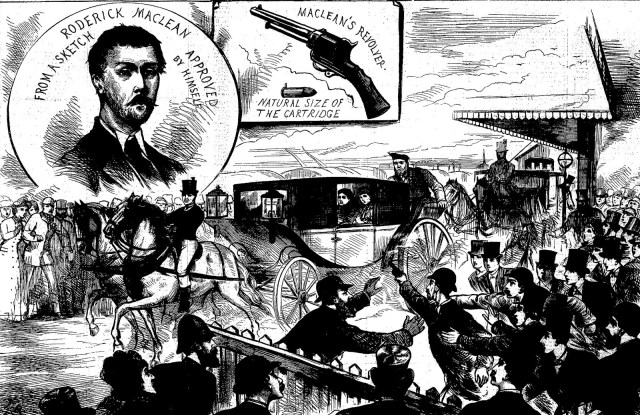
The last of the attempts on Queen Victoria’s life came on March 2, 1882. Unlike the previous attempts, this one was dangerous because by that date, weapons were well beyond the single shot volley stage. Roderick Maclean’s gun held six bullets, and he did fire at Victoria’s passing coach. If Maclean had had time for a second shot before he was beset upon by two Eton school boys, he might have actually hit the queen. 

Ch7b Macleans attack combined.jpg

The incident occurred at 4 o’clock in the afternoon. The Queen had departed Buckingham Palace, her carriage passing through Hyde Park on its way to Paddington station to board her special train bound for Windsor. The train arrived at Windsor, but as she left the station to enter her carriage, Maclean, who stood in the station yard, fired upon her. The Social Historian website says several police caught him up and took Maclean to the Windsor police station. Raymond Lamont Brown, in How Fat Was Henry VIII and 101 Questions on Royal History [The History Press, ©2008, 149-150), tells us two Eton school boys accosted Maclean with an umbrella until Superintendent George Hayes of the Windsor Police could take control of the situation. Mr. Brown goes on to tell us that Queen Victoria visited Eton several days later to thank the boys personally before 900 Eton boys in the Quadrangle of the school. 

“At the same time,” the queen wrote later, “there was the sound of what I thought was an explosion from the engine, but in another moment, I saw people rushing about and a man being violently hustled, rushing down the street.” (History.com)

“The following telegram was sent from the Queen at Windsor Castle to the Prince of Wales at Marlborough House:

“In case an exaggerated report should reach you, I telegraph to say that, as I drove from the station here a man shot at the carriage, but fortunately hit no one. He was instantly arrested. I am nothing the worse.Belfast News-Letter – Friday 03 March 1882 

“The prisoner’s name was Roderick Maclean. About 30-years-old, he was 5 feet 7 inches tall and was shabbily dressed. He told the police that he was a clerk out of employment and had been born in Oxford street in London and had only been in Windsor a few days, but it was later determined that he was a native of Ireland.

51PrljximcL

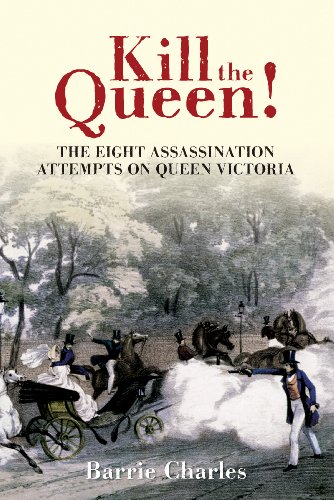
Kill the Queen!: The Eight Assassination Attempts on Queen Victoria by Barrie Charles

“The revolver was of German manufacture, with six chambers. Two chambers were loaded with empty cartridges, and two with loaded cartridges. One chamber had been discharged. No trace of a bullet has as yet been found. – from Belfast News-Letter – Friday 03 March 1882

“Maclean was tried on 19 April 1882 at Reading for high treason. Mr. Montague Williams presented overwhelming evidence that the prisoner was a lunatic and Maclean was acquitted on the ground of insanity. He was ordered to be detained during her Majesty’s pleasure.” The Social Historian  [Note: At Her Majesty’s pleasure (sometimes abbreviated to Queen’s pleasure or, when appropriate, at His Majesty’s pleasure or King’s pleasure) is a legal term of art referring to the indeterminate or undetermined length of service of certain appointed officials or the indeterminate sentences of some prisoners. It is based on the concept that all legitimate authority for government comes from the Crown.]

51baZLeQyrL._SX329_BO1,204,203,200_

Shooting Victoria: Madness, Mayhem, and the Rebirth of the British Monarchy by Paul Thomas Murphy

The jury’s deliberation lasted but five minutes. Maclean lived out the remainder of his days at Broadmoor Asylum. He died 9 June 1921. This last attempt on her life prompted the Queen to ask for a change in English law. All of those who attempted to kill Victoria showed signs of mental illness. Maclean, Robert Pate, and Edward Oxford were considered mentally deranged. The others were more of the “lone wolf” nature we see in modern times at mass shootings. Queen Victoria pushed for those accused to be named “guilty, but insane,” rather than “not guilty, but insane,” as had Maclean been found. This led to the Trial of Lunatics Act of 1883. This Act of Parliament permitted the jury to return aa verdict that the defendant was guilty, but insane at the time of the crime. The accused would be kept in custody as a “criminal lunatic.” It was to act as a deterrent to other lunatics, but one must wonder if someone was mentally ill whether a “deterrent” would make much difference. The phrasing was changed to “guilty of the act or omission charged, but insane so as not to be responsible, according to law, for his actions.” This act was eventually replaced by the Criminal Procedure (Insanity) Act of 1964. 

Other Sources: 

Barrie Charles 

Culture Trip 

Historum 

Smithsonian Magazine 

Wikipedia 

Posted in Act of Parliament, British history, England, history, kings and queens, research, royalty, Victorian era | Tagged , , , , , , | Comments Off on Roderick Maclean’s Attempt to Kill Queen Victoria