Baptism and Christenings in the Regency Period + a Giveaway of “Lady Chandler’s Sister”

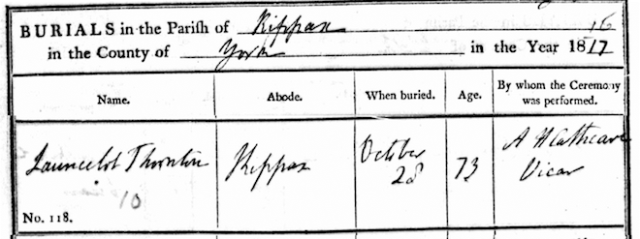
Today, we think of the recording of a birth as automatic. At most hospitals, the staff record such details, and they are passed on to the proper authorities. The birth announcement appears in the local newspaper usually within a week of the actual birth. This was not so for the Regency. Birth announcements were not recorded during the Regency Era. Births were not always recorded in the parish registers. Generally, only the Baptism/Christening was recorded. Some clergymen listed the child’s age or birth date  when recording the  baptism, but most did not. Usually the child had to be breathing to be baptised and  given a name for the parish records, but that was not an “absolute” in the practice of recording births. [Note! Today the terms (baptism and christening) are interchangeable by many. A Christening is a naming, but the church believes baptism is to save the soul of the infant  and to enroll him in the church of believers. The secular name is incidental and just for records.]

According to Nancy Mayer Regency Researcher, “Most of the evidence upon which today’s perceptions of the era are founded is faulty.  St Martin-in-the-Fields was probably the most fastidious of the parishes in those days, with the sextons recording in minute detail, everything about those they buried – and that included stillborns, abortives, infants (those who’d lived to draw breath), etc., etc.  Name, date of birth, date of death, address, sex, etc., etc.  No detail was missed.  But even in this parish there were anomalies based on the structure of burial fees – abortives were the cheapest burials. Chrisom’s came next.  Stillborns were the third cheapest, and from there, the fees increased the longer the individual lived.  So many infants who had lived through the first crucial week only to succumb to the infections that so beset newborns, were buried as stillborns because the family could not or did not want to pay the higher fees. But even with the stillborns and the Chrisoms, the father’s name was recorded by the sextons.  It was not until well after the Regency that the mother’s name was included.” Although it rarely happened, in reality, the parents did not need to present for the baptism. 

No ecclesiastical law forbid the baptism of a stillborn child. It was the expense of doing so that prevented many from recognizing their child’s existence.

I understand the confusion and grief following the lost of a child for I lost two children before I had my son. It bothered me deeply not to have access to the ones I lost early on. I could not shake the idea that it would never have a name or a place in our family’s recorded history. However, many in the early 19th Century were developing what we now associate with the British public as a whole: the stiff upper lip. Grief was not shown in public. 

51nvWRZSzpL._UY250_

Other parishes were not as meticulous as St Martin-in-the-Fields. Generally, the person requesting the recording of the birth was at the “mercy” of the clergyman overseeing the parish. The clergyman’s opinions or those of the aristocrat providing his living could differ greatly from parish to parish. Some clergy would look poorly upon an abortive situation. An aristocrat might privately have a stillborn child baptised, but a public announcement of such would not occur. The recording of a child’s birth, or the lack thereof, is a major plot plot point in Book 2 of my Twins’ Trilogy, The Earl Claims His Comfort. Any “public” records, such as Debrett’s The New Peerage, would simply include the line stillborn daughter or stillborn son.

41VA23GR86LWe find an example of such in Chapter 1 of Jane Austen’s Persuasion, Sir Walter Elliot picks up the Baronetage to read of his family history, “”ELLIOT OF KELLYNCH-HALL.
“Walter Elliot, born March 1, 1760, married, July 15, 1784, Elizabeth, daughter of James Stevenson, Esq. of South Park, in the county of Gloucester; by which lady (who died 1800) he has issue Elizabeth, born June 1, 1785; Anne, born August 9, 1787; a still-born son, Nov. 5, 1789; Mary, born Nov. 20, 1791.”

Many times the private family records, such as the family Bible, contained the name of the stillborn child. Parish records and private records did not always hold the same details. Often, especially in the male line, one might find two male offsprings with the same name in a private record, but the names of the children were listed as several years apart – the first one died at birth or shortly thereafter. 

As with everything else, there were those members of the clergy who accepted payment to record stillborns. Parents might, for example, argue that the Bible does not speak to forbidding the naming of stillborns. Babies could be baptised at home by any member of the household as long as water was used and the child was baptized in the name of the Father, Son, and Holy Ghost. This was a valid baptism  in most cases. 

431184283c0ccbfe915e11bf06d3477a Anciently, a chrisom, or “chrisom-cloth,” was the face-cloth, or piece of linen laid over a child’s head when he or she was baptised or christened. Originally, the purpose of the chrisom-cloth was to keep the chrism, a consecrated oil, from accidentally rubbing off. With time, the word’s meaning changed, to that of a white mantle thrown over the whole infant at the time of baptism. The term has come to refer to a child who died within a month after its baptism—so called for the chrisom cloth that was used as a shroud for it. Additionally, in London’s Bills of Mortality, the term chrisom was used to refer to infants who died within a month after being born. (Chrisom)

ATOHCrop2 In A Touch of Honor, Book 8 of the Realm Series, I used a different plot point associated with the recording of births and deaths. In that book, Lady Satiné Swenton dies in a terrible accident and the child she carried is also lost. The surgeon tending the body asks Lord Swenton if he wishes to have the stillborn buried with his mother. The mother and stillborn infant could be buried together as it was with Princess Charlotte’s child.  In that case the child was not named. However, in this time, the father could insist on having the child listed in the  death register and could have a name etched in the grave marker to recognize publicly the birth. The woman’s husband could have his wife and child buried in a private cemetery and act as he thought best for his family. 
parishbur

The Church of England provides this tutorial for the ceremony: 

What Happens at a christening?

At a christening a child is baptized with water. This is the heart of a christening. There are several moments in the service which have a special meaning too. Follow each step to see what happens.

“…I baptize you in the name of the Father, and of the Son, and of the Holy Spirit. Amen.”

Welcome

The vicar will welcome everyone and especially the child who will be christened and their family. There will be a Bible reading, and the vicar will also talk about what a christening means.

The promises

You and the godparents will make some important promises for your child in the service. You can see the full order of service here.  Everyone promises to continue supporting the child from this moment.

The vicar says: “…People of God will you welcome this child and uphold them in their new life in Christ?”

Everyone present says: “…With the help of God, we will.”

The sign

Often, this is the point in the service when parents and godparents will be invited to come out to stand at the front with the child. In many churches, a special oil may be used to make the sign of a cross on your child’s forehead. It’s a significant moment, which marks your child as belonging to God.

The vicar will say: “…Christ claims you as his own. Receive the sign of the cross.”

The water

Water which is blessed in the church’s font will be poured over your child’s head by the vicar. This is your child’s baptism. It’s a sign of a new beginning and becoming a part of God’s family.

The vicar says: “…I baptize you in the name of the Father, and of the Son, and of the Holy Spirit. Amen.”

Prayers and welcome

The vicar, or perhaps even someone else from the church, will pray for the child and for all those who will support them in their path of faith. Everyone present welcomes the child into the family of the church with words given in the service.

A candle

A candle will be given to the child at the end of the service.

The vicar says: “…Shine as a light in the world to the glory of God.”

Godparents play a special role in the ceremony and in the child’s life. The godparents were the ones to take the child to church, make the vows in his/her name, and say the name of the child for all the world to know. The godmother customarily holds the child during the ceremony. The child can be dipped into the baptismal font–first one side and then the other, but often water was poured on his head. Occasionally water was just sprinkled on or a damp cloth is used.  A cross is made with oil on the baby’s head to anoint the child. The rite in the Book of Common prayer of the day was used.

A female child was to have two female and one male godparent or sponsor, while a male child was to have two male and one female godparent or sponsor. Although they could serve the role, godparents were NOT automatically the child’s legal guardian of the child(ren) with the passing of a parent(s). A will would designate the legal guardian in such a scenario. 

During the Regency and beyond, royalty were often asked to be godparents to the children of peers, such as dukes or men who had positions at Court or were at Court often or were ranking members of Parliament. Quite often the royal godparents employed proxy stand-ins. When the child is 12 years of age, he/she would be confirmed; he/she would renew the promises made at his/her baptism for himself/herself.

You might wish to check out: 

10 Ways Christening Has Changed
LCS eBook Cover-01

Sir Alexander Chandler knows his place in the world. As the head of one of the divisions of the Home Office, he has his hand on the nation’s pulse. However, a carriage accident  on a deserted Scottish road six months earlier has Sir Alexander questioning his every choice. He has no memory of what happened before he woke up in an Edinburgh hospital, and the unknown frightens him more than any enemy he ever met on a field of battle. One thing is for certain: He knows he did not marry Miss Alana Pottinger’s sister in an “over the anvil” type of ceremony in Scotland.

Miss Alana Pottinger has come to London, with Sir Alexander’s son in tow, to claim the life the baronet promised the boy when he married Sorcha, some eighteen months prior. She understands his responsibilities to King and Crown, but this particular fiery, Scottish miss refuses to permit Sir Alexander to deny his duty to his son. Nothing will keep her from securing the child’s future as heir to the baronetcy and restoring Sir Alexander’s memory of the love he shared with Sorcha: Nothing, that is, except the beginning of the Rockite Rebellion in Ireland and the kidnapping of said child for nefarious reasons.

An impressive ending to the beautifully crafted Twins’ Trilogy – Starr’s ***** Romance Reviews

Love. Power. Intrigue. Betrayal. All play their parts in this fitting conclusion to a captivating, romantic suspense trio. – Bella Graves, Author & Reviewer

Kindle: https://www.amazon.com/dp/B07PVT5GQ9/ref=sr_1_2?keywords=lady+chandler%27s+sister&qid=1553390378&s=gateway&sr=8-2

Amazon: https://www.amazon.com/dp/1091376581/ref=sr_1_2?keywords=lady+chandler%27s+sister&qid=1553430979&s=gateway&sr=8-2

Kobo https://www.kobo.com/us/en/ebook/lady-chandler-s-sister

Nook https://www.barnesandnoble.com/w/books/1131002644?ean=2940161421314

NOTE: BEGINNING MONDAY, MARCH 25, BLACK OPAL BOOKS PUT ANGEL COMES TO THE DEVIL’S KEEP AND THE EARL CLAIMS HIS COMFORT ON SALE ALSO. 

Now for the Giveaway!!! I have two eBook copies of Lady Chandler’s Sister available to those who comment below. 
Posted in Uncategorized | 4 Comments

Clandestine Weddings and the Release of “Lady Chandler’s Sister” + a Giveaway

Clandestine/Irregular Weddings in Scotland

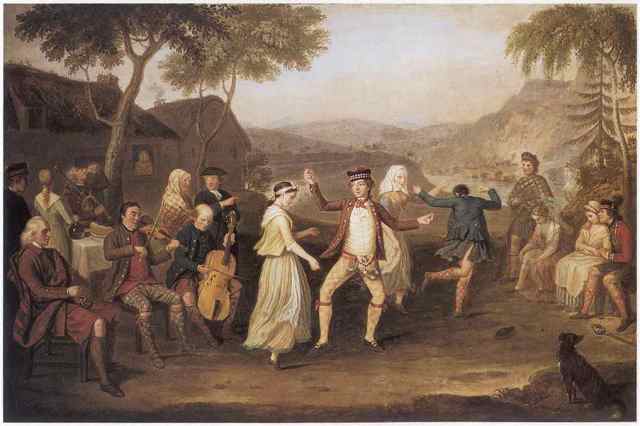
DavidAllan-highlandwedding1780.jpg A clandestine wedding plays a key role in solving the mystery that occurs in my latest Regency romantic suspense, Lady Chandler’s Sister: Book 3 the Twins’ Trilogy. But exactly what constituted a clandestine or irregular marriage during the Regency Period?

A clandestine/irregular marriage is what we today might call a “de facto” (describing practices that exist in reality, even if not legally authorized) wedding or even a “common law wedding.”  Irregular marriages were considered legal in Scotland up until the mid 1900s. The laws in Scotland varied greatly from other European countries. Marriages in the European Catholic countries were only legal if they were conducted by a priest of the Roman Catholic Church. In England, marriages were only legal if conducted by an Anglican clergyman. The Hardwicke Act of 1753 saw to that. A couple wishing to marry in England agreed to both a religious sacrament and a legal contract. English couples had to have the consent of one or both parents if they were under the age of 21, and the wedding ceremony had to take place in a parish church and conducted by a man ordained by the Church of England.

But in Scotland, we have a totally different structure. A regular marriage did not require a church as the setting for the wedding or parental consent. It did require the proclamation of the banns in the parish church and an authorized clergyman from the Scottish Church.

Four forms of irregular marriages were considered valid marriages in Scotland until 1 July 1940. An irregular marriage could be considered valid (1) if there was mutual agreement between the man and the woman, a declaration of per verba de presenti—declaring before two witness to take someone as one’s wife or husband, (2) if there was a public promise of per verba de futuro subsequente copula followed by consummation, (3) if the marriage was contracted by correspondence, or (4) if there was cohabitation and repute.

The first two conditions were abolished by the Marriage (Scotland) Act of 1939. All four forms included the agreement of the couple to be married and some form of witnesses or evidence offered as proof of the agreement. Any citizen could witness a public promise. Thus, the reason many English couples rushed to Scotland to be married by a “blacksmith.” The marriage did not actually have to be performed by a blacksmith, just by a citizen of a Scottish border town or village. A marriage of cohabitation and repute was still acceptable until the 2008 Family Law (Scotland) Act. “Repute” was the part upon which divorces were granted or not. This was a common law marriage, and Scotland was the last of the European countries to abolish it. For this law to apply, the minimum time the couple had lived together continuously had to exceed 20 days. Until this act, the only regular marriage available in Scotland was a religious marriage. Irregular marriages were not socially acceptable, and many people who decided to contract them did so where they were relatively unknown.

annesley-elopement.jpgAccording to Eleanor Gordon in “Irregular Marriages: Myth and Reality,” “The distinctive marriage arrangements of Scotland and England had very real consequences, most notoriously, the vogue for runaway marriages to Scotland, particularly Greta Green and other border towns, by young English couples seeking to avoid the need for parental consent for their marriage and to take advantage of the more flexible and informal marriage laws. Although Lord Brougham’s Act of 1856 attempted to stem the flow of young couples across the border by extending the residential qualification so that one of the parties had to be resident for 21 days, Gretna marriages continued to excite the disapproval of the authorities on both sides of the border into the twentieth century. Indeed it was the resurgence of these border marriages that prompted calls for reform of the marriage laws in the 1920 and 1930s. Although Dr. James Stark, Superintendent of Statistics under Scotland’s first Registrar General, William Pitt Dundas, described Scotland’s marriage laws as simple in comparison with “the complicated marriage laws of England,” they were in fact characterized more by ambiguity and uncertainty than clarity.For example, there were innumerable legal wrangles about whether particular situations demonstrated sufficient proof of exchange of consent as well as general misunderstanding of the nature of consent required, that is whether it needed to be expressed, written or tacit. Indeed when Scotland’s marriage laws were reviewed in both 1868 and 1935, it was the legal ambiguities surrounding irregular marriage that was one of the key reasons proffered for abolishing it.” [W. D. H. Seller, “Marriage by Cohabitation with Habit and Repute: Review and Requiem?” in D. L. Carey and D. W. Meyers (eds.), Comparative and Historical Essays in Scots Law (Edinburgh, 1992): 117–36.]

If contested, marriage by cohabitation was never legal in England. The fact was that most of the marriages by cohabitation or that of wife selling were invalid made little difference to the majority of the populace. Such distinctions only mattered when a child was declared legitimate or not and when a parish had to decide whether or not to give assistance to a woman in need. A couple who were married by cohabitation were, generally, not considered “respectable.” To be valid a marriage had to be started with a wedding in front of a clergyman. That is why so many went to the Fleet to get married by clergymen debtors. Women who lived with their betroths or declared themselves married without more than consummation, in England, found themselves unable to claim any property, any money or any benefits for themselves or the children because they were not considered legally married.

The world wars of the 1900s put a greater demand upon having a regular marriages. Inheritance and widows’ pensions required proof of a marriage beyond two witnesses marking a public commitment between a man and a woman. Registry offices served the need to legitimatize a marriage.

Nicol Warren on the Family Ancestry Detective Website suggests, “The National records of Scotland holds some irregular marriage information, on their website they have a pamphlet that gives the contact details of local society’s that may have more specific records. At the time of the marriage records may have been kept by priests and the couples, however it’s the kirk sessions where couples come before their local parish church that are the most kept records of an irregular marriage. With the birth of the first child meant paperwork would become an important part of legitimising the birth and registration generally happened hastily around that time. Kirk sessions like the South Leif kirk sessions recorded 1500 marriages. With the digitalisation of records all the time, it is always good to search through paid subscription sites to see whether the information is there.”

http://www.nrscotland.gov.uk/research/guides/birth-death-and-marriage-records/irregular-border-marriage-registers

In this example from 1773 (National Records of Scotland reference OPR 818/2) a couple made a public acknowledgement of their irregular marriage and paid a fine of a guinea to the poor. The entry is followed by a note of the kirk session’s concern at the frequency of irregular marriages in the parish and their decision to increase the fine!

irregular-marriage-from-1773-reference-opr-818-2-small.jpg

Resources:

Gordon, Eleanor. “Irregular Marriage: Myth and Reality.” Journal of Social History, Volume 47, Issue 2, 1 December 2013, pp. 507-525https://academic.oup.com/jsh/article/47/2/507/1325355/Irregular-Marriage-Myth-and-Reality

Leneman, Leah, and Rosalind Mitchison. “Clandestine Marriage in the Scottish Cities 1669-1780.” Journal of Social History. Oxford University Press. Vol 26, No. 4 (Summer 1993), pp. 845-861https://www.jstor.org/stable/3788783?seq=1#page_scan_tab_contents

Nicol Warren. “Irregular Marriages in Scotland.” The Family Ancestry Detective. 31 March 2015. http://familyancestrydetective.com/irregular-marriages-in-scotland/

“Old Parish Registers – Marriages and Proclamation of Banns.” National Records of Scotland. © Crown copyright, 2014. https://www.nrscotland.gov.uk/research/guides/birth-death-and-marriage-records/old-parish-registers/marriages-and-proclamation-of-banns

Images

The Elopement, or Lovers Stratagem Defeated. Courtesy of the British Museum. from All Things Georgian https://georgianera.wordpress.com/2015/10/01/an-irregular-marriage-arthur-annesley-powell-did-he-go-willingly/

Irregular Marriage from The Family Ancestry Detective http://familyancestrydetective.com/irregular-marriages-in-scotland/

Old Parish Registers https://www.nrscotland.gov.uk/research/guides/birth-death-and-marriage-records/old-parish-registers/marriages-and-proclamation-of-banns

LCS eBook Cover-01

Sir Alexander Chandler knows his place in the world. As the head of one of the divisions of the Home Office, he has his hand on the nation’s pulse. However, a carriage accident  on a deserted Scottish road six months earlier has Sir Alexander questioning his every choice. He has no memory of what happened before he woke up in an Edinburgh hospital, and the unknown frightens him more than any enemy he ever met on a field of battle. One thing is for certain: He knows he did not marry Miss Alana Pottinger’s sister in an “over the anvil” type of ceremony in Scotland.

Miss Alana Pottinger has come to London, with Sir Alexander’s son in tow, to claim the life the baronet promised the boy when he married Sorcha, some eighteen months prior. She understands his responsibilities to King and Crown, but this particular fiery, Scottish miss refuses to permit Sir Alexander to deny his duty to his son. Nothing will keep her from securing the child’s future as heir to the baronetcy and restoring Sir Alexander’s memory of the love he shared with Sorcha: Nothing, that is, except the beginning of the Rockite Rebellion in Ireland and the kidnapping of said child for nefarious reasons.

An impressive ending to the beautifully crafted Twins’ Trilogy – Starr’s ***** Romance Reviews

Love. Power. Intrigue. Betrayal. All play their parts in this fitting conclusion to a captivating, romantic suspense trio. – Bella Graves, Author & Reviewer

Kindle: https://www.amazon.com/dp/B07PVT5GQ9/ref=sr_1_2?keywords=lady+chandler%27s+sister&qid=1553390378&s=gateway&sr=8-2

Amazon: https://www.amazon.com/dp/1091376581/ref=sr_1_2?keywords=lady+chandler%27s+sister&qid=1553430979&s=gateway&sr=8-2

Kobo https://www.kobo.com/us/en/ebook/lady-chandler-s-sister

Nook https://www.barnesandnoble.com/w/books/1131002644?ean=2940161421314

NOTE: BEGINNING MONDAY, MARCH 25, BLACK OPAL BOOKS PUT ANGEL COMES TO THE DEVIL’S KEEP AND THE EARL CLAIMS HIS COMFORT ON SALE ALSO. 

NOW FOR THE GIVEAWAY!!! I have two eBook copies of Lady Chandler’s Sister available for those who comment below. Winners will be announced on April 7. 

Posted in Black Opal Books, book release, British history, eBooks, George IV, Georgian England, Georgian Era, giveaway, historical fiction, Ireland, marriage, marriage customs, publishing, real life tales, Regency romance, research, romance, Scotland, suspense, Uncategorized | Tagged , , , , , , , , , , , , , | 2 Comments

Scottish Smugglers and the Release of “Lady Chandler’s Sister, Book 3 of the Twins’ Trilogy” + a Giveaway

tempuspaperback Most of the smuggling trade was found in England’s southern shires, but that did not mean such was the only area of Great Britain with a sturdy smuggler contingent. The movement of goods from coast to coast was only a matter of 154 miles at its widest point (Buchan Ness to Applecross. The furthest one can be from the sea is 40-50 miles, and at its narrowest Scotland is only 25 miles wides (from the estuaries of the rivers Clyde and Forth. It is only 275 miles from its northern borders (Cape Wrath) to Mull of Galloway in the south. (RampantScotland.com) Obviously, these distances played into the success of Scottish smuggling. 

Scottish whisky was the product of choice for smugglers, but it was not the only one, for the excise officers tracking down smugglers in Scotland also had their hands full with illegal imports coming in along Scotland’s 6200 miles of coastland. Illegal distilling whisky was simply one of their responsibilities. 

Smugglers’ Britain tells us, “Most of the stilling went on in the glens, where there was a plentiful supply of the clean fresh water, needed for the soaking of the grain prior to malting. After several days soaking in a burn, the grain was spread out on a warm floor, and allowed to sprout. Roasting and grinding of the sprouted grain made the malt, which was mixed with hot water to create the wort. After fermentation, the wort was boiled in a copper container, and vapour condensed in a spiraling tube, called the worm, to make the spirit.

“All this was legal (though taxable) until 1814, when small stills of less than 500 gallons were prohibited. The response from the highlanders was, needless to say, not very sympathetic, and much of the public fury was vented against the officially approved distillers, who were hugely outnumbered by illicit manufacturers. In 1778 there were 8 legal stills in Edinburgh — and an estimated 400 working without payment of duty.”

dirks_cave

At Wigtown Bay, you can visit the cave used by the real-life Dirk Hatteraick. ~ http://www.smuggling.co.uk/gazetteer_scot.html

 “Not all the illegal hooch was consumed locally: much of it was moved south of the border, often in very odd containers. ‘Belly canteens’ for the transport of spirits held two gallons and were made of sheet iron. They gave the female wearer a convincing if somewhat rigid appearance of advanced pregnancy.  Another container was made to look like a passenger riding pillion behind the horse-borne smuggler — a leather head made the illusion complete.” 

anti_smuggling_poster The union of England and Scotland, which occurred in 1707, played a role in the growth of Scotland’s smuggling trade. Before the union, duties on goods north and south of the border varied greatly. The Scots had, generally, smuggled highly-taxed goods into England. With the union, taxes on many goods rose sevenfold in Scotland. 
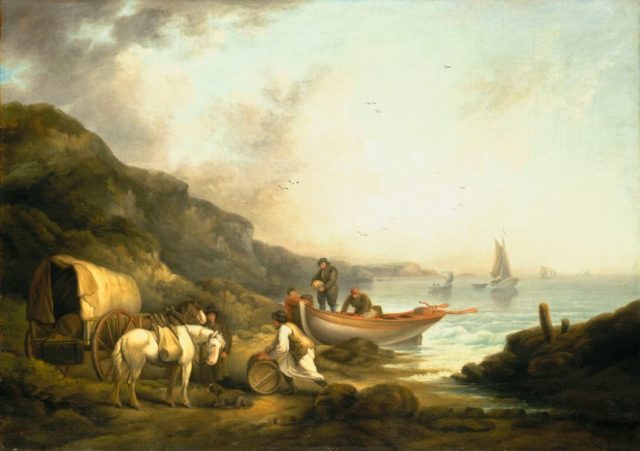
Coast to coast smuggling of expensive foreign goods did not occur on the same scale in Scotland as it did in England. Instead, Scottish smugglers transported staples required for household use. Salt, used to preserve meat and fish, etc., came in from Ireland along the western coast of Scotland. 

Scotland became sort of a warehouse for goods from the Continent, especially tea and tobacco.  “The clan system, the powerful Scots church and Jacobean sympathies further united the population behind the smugglers, and made it unlikely that a free-trader would be found guilty in a jury trial. Even when the customs men managed to secure a conviction, the fines were paltry.” (Smugglers’ Britain)

LCS eBook Cover-01

Available Now: 

Lady Chandler’s Sister, Book 3 of the Twins’ Trilogy

Sir Alexander Chandler knows his place in the world. As the head of one of the divisions of the Home Office, he has his hand on the nation’s pulse. However, a carriage accident  on a deserted Scottish road six months earlier has Sir Alexander questioning his every choice. He has no memory of what happened before he woke up in an Edinburgh hospital, and the unknown frightens him more than any enemy he ever met on a field of battle. One thing is for certain: He knows he did not marry Miss Alana Pottinger’s sister in an “over the anvil” type of ceremony in Scotland.

Miss Alana Pottinger has come to London, with Sir Alexander’s son in tow, to claim the life the baronet promised the boy when he married Sorcha, some eighteen months prior. She understands his responsibilities to King and Crown, but this particular fiery, Scottish miss refuses to permit Sir Alexander to deny his duty to his son. Nothing will keep her from securing the child’s future as heir to the baronetcy and restoring Sir Alexander’s memory of the love he shared with Sorcha: Nothing, that is, except the beginning of the Rockite Rebellion in Ireland and the kidnapping of said child for nefarious reasons.

An impressive ending to the beautifully crafted Twins’ Trilogy – Starr’s ***** Romance Reviews

Love. Power. Intrigue. Betrayal. All play their parts in this fitting conclusion to a captivating, romantic suspense trio. – Bella Graves, Author & Reviewer

Kindle: https://www.amazon.com/dp/B07PVT5GQ9/ref=sr_1_2?keywords=lady+chandler%27s+sister&qid=1553390378&s=gateway&sr=8-2

Amazon: https://www.amazon.com/dp/1091376581/ref=sr_1_2?keywords=lady+chandler%27s+sister&qid=1553430979&s=gateway&sr=8-2

Kobo https://www.kobo.com/us/en/ebook/lady-chandler-s-sister

Nook https://www.barnesandnoble.com/w/books/1131002644?ean=2940161421314

NOTE: BEGINNING MONDAY, MARCH 25, BLACK OPAL BOOKS PUT ANGEL COMES TO THE DEVIL’S KEEP AND THE EARL CLAIMS HIS COMFORT ON SALE ALSO. 


Posted in book excerpts, book release, British history, Georgian England, Georgian Era, Great Britain, historical fiction, Living in the Regency, political stance, real life tales, Regency era, Regency romance, romance, suspense, trilogy, writing | Tagged , , , , , , , , , | 2 Comments

Smuggling as a Plot Point in My Latest Release, “Lady Chandler’s Sister, Book 3 of the Twins’s Trilogy” + a Giveaway

anti_smuggling_poster.png One of the “cottage” industries of the late 1700s and early 1800s in England and Scotland was smuggling. This was not just a single individual stealing a keg or two and then selling it to his neighbors; these were operations where large volumes of contraband were moved about the southern counties of England and from coast to coast in Scotland. It is said that many of the villagers in Kent used gin to clean their windows, for it was so plentiful in the area. It is believed that 80% of the tea drunk in England at the time had not had a duty paid upon it. 

The typical smuggler at the time worked hard to transport their bounties inland. If one thinks of the White Cliffs of Dover, he might have a better idea of the obstacles smugglers encountered. Once the ship was captured, the goods had to be carried, literally, by men up steep cliffs to a waiting caravan of carts and ponies to take the goods inland. Sometimes, the barrels and tubs were strapped to a man’s back if there were no animals to be had. Whole communities depended upon the smuggled goods, and, upon occasion, they would take up arms to reclaim the items seized by the revenue men. 

Smugglers-1030x727.jpg

Smuggling was the result on tax laws placed upon the populace to pay for the wars in Europe and the American continent. Smugglers’ Britain tells us, “18th century taxation fell into two categories, each administered and collected by a separate government department. Customs duties had a historical precedent in that the English Crown had for centuries claimed a proportion of all cargoes entering the country — or a financial levy in lieu of the fine wine or bolts of fabric. In 1688, though, the customs duties were streamlined and restructured into a form that would — in theory at least — generate more revenue for the exchequer.

“The other type of duty had its origins in the Civil War: a tax on land took the place of two older taxes — wardship and the parliamentary subsidy — and a new tax, excise, was levied specially to pay for the war. Excise was a tax on domestic consumption, and during the years of the civil war it covered many different items, but its scope was reduced ten years later to cover just chocolate, coffee, tea, beer, cider and spirits. However, after 1688 it was progressively widened to include other essentials such as salt, leather, and soap.

smugglers_cartoon_1788_riot.jpg

“The separation of these two taxes mattered not a jot to the common man, who knew only that he had to pay more for what he bought. And as the 18th century progressed, the slice taken by the exchequer increased sometimes steadily and progressively, sometimes by leaps and bounds, as the conflicts with France ebbed and flowed. By the middle of the century, the tax on tea was nearly 70% of its initial cost, and the double burden of customs and excise duties was widely resented by a rural population often close to starvation.

“Collection of the customs duties was haphazard and bureaucratic and was largely based on a system, established in the 13th century, of custom houses at ports around the coast. In the ensuing centuries a creaking and corrupt hierarchy had grown up around the custom houses. The collectors and comptrollers of customs and their multitude of functionaries were primarily concerned with taxation on the export of the wool that made England wealthy. However, when the dawn of the 18th century heralded heavy taxation on imports, the system was ill-fitted to combat the spirited efforts of large numbers of Englishmen determined to defraud the King.”

Introducing… 

Lady Chandler’s Sister: Book 3 of the Twins’ Trilogy

LCS eBook Cover-01

Book Blurb: 

Sir Alexander Chandler knows his place in the world. As the head of one of the divisions of the Home Office, he has his hand on the nation’s pulse. However, a carriage accident  on a deserted Scottish road six months earlier has Sir Alexander questioning his every choice. He has no memory of what happened before he woke up in an Edinburgh hospital, and the unknown frightens him more than any enemy he ever met on a field of battle. One thing is for certain: He knows he did not marry Miss Alana Pottinger’s sister in an “over the anvil” type of ceremony in Scotland.

Miss Alana Pottinger has come to London, with Sir Alexander’s son in tow, to claim the life the baronet promised the boy when he married Sorcha, some eighteen months prior. She understands his responsibilities to King and Crown, but this particular fiery, Scottish miss refuses to permit Sir Alexander to deny his duty to his son. Nothing will keep her from securing the child’s future as heir to the baronetcy and restoring Sir Alexander’s memory of the love he shared with Sorcha: Nothing, that is, except the beginning of the Rockite Rebellion in Ireland and the kidnapping of said child for nefarious reasons.

An impressive ending to the beautifully crafted Twins’ Trilogy – Starr’s ***** Romance Reviews

Love. Power. Intrigue. Betrayal. All play their parts in this fitting conclusion to a captivating, romantic suspense trio. – Bella Graves, Author & Reviewer

Kindle: https://www.amazon.com/dp/B07PVT5GQ9/ref=sr_1_2?keywords=lady+chandler%27s+sister&qid=1553390378&s=gateway&sr=8-2

Amazon: https://www.amazon.com/dp/1091376581/ref=sr_1_2?keywords=lady+chandler%27s+sister&qid=1553430979&s=gateway&sr=8-2

Kobo https://www.kobo.com/us/en/ebook/lady-chandler-s-sister

Nook https://www.barnesandnoble.com/w/books/1131002644?ean=2940161421314

NOTE: BEGINNING MONDAY, MARCH 25, BLACK OPAL BOOKS PUT ANGEL COMES TO THE DEVIL’S KEEP AND THE EARL CLAIMS HIS COMFORT ON SALE ALSO. 


Excerpt: Alexander had spent a half hour with the Ladies Swenton, Remmington, and Berwick, learning what he could of what their husbands had shared with them, which was surprisingly more than he expected. It appeared Remmington, as well as Berwick and Swenton, confided much of their governmental business to their wives, treating the women as their partners in life, rather than the customary role of dependents. He wondered, not for the first time since learning the truth of his short courtship of Sorcha Pottinger, how he had wooed the woman and how he had treated her. Evidently, he had not made her aware of his search for Remmington’s “twin,” which was the real reason for his being in Scotland last August. Had he been ashamed of his impetuous actions? Was that the reason he had never escorted his wife to London to meet the rest of his family? The reason he had denied her existence, even to himself?

He now wondered how they had come together. Where had they met? What brought them together? How had their relationship progressed so quickly? Had he been sober or deep in his cups when he proposed their joining?

Before he departed Swenton’s estate, Lady Remmington had handed him a note from her husband. In it, Remmington had described their suspicions of smuggling upon Lord Angus’s part, and his friend cautioned Alexander to consider Lord Kavanaugh’s part in all that had occurred regarding Alexander’s accident. At the time of Frederick Troutman’s revenge against Remmington and the Davids’s family as a whole, Remmington had assumed the role of guardian of Kavanaugh’s daughter, Deirdre, when the Irish lord had disowned the child after Lady Kavanaugh, the former Miss Delia Phillips, had delivered a son. Kavanaugh had beaten his wife so often she died after delivering an heir for Kavanaguh. Remmington had taken offense, because his lordship had once thought to make the former Miss Phillips his wife. It was all a very convoluted affair, but Remmington had used his vast influence as both an English earl and a long-time agent for the Home Office to ruin Kavanaugh financially. His friend meant to remind Alexander that there was more than one player in this drama and how the McGinthurs had employed a man they suspected to be Kavanaugh’s illegitimate son in Sorcha’s abduction, and this likely pointed to a closer connection between Lord Lachlan and Kavanaugh than they originally thought. Alexander’s friends suspected Kavanaugh had become the Irish supplier of the contraband the McGinthurs moved about from port to coastal port in Scotland.

As he fell asleep that evening, still some five hours from the Scottish border, Alexander wondered if he could reach Sorcha in time to prevent her from giving herself to Lord Lachlan. He did not yet know how he would explain her and Greer to his superiors and to London society, but he could work out the details when she and the boy were safely in his arms again. If worst came, he would resign his position with the government. “After all, it does not matter how we were joined, but rather that we are joined. Marriage is forever. Moreover, I have neglected my country estate and my personal life for too long.”

NOW FOR THE GIVEAWAY: I HAVE TWO eBOOK COPIES OF “LADY CHANDLER’S SISTER” FOR THOSE WHO COMMENT BELOW. THE GIVEAWAY WILL END AT MIDNIGHT EDST ON  APRIL 1. 

Posted in Black Opal Books, book excerpts, book release, British history, eBooks, England, excerpt, food and drink, Georgian England, Georgian Era, giveaway, Great Britain, historical fiction, Living in the Regency, political stance, real life tales, Regency era, Regency romance, research, Scotland, tea | Tagged , , , , , | 2 Comments

Irish Agrarian Societies: the Rockite Movement and the Release of “Lady Chandler’s Sister: Book 3 of the Twins’ Trilogy”

The third book in my Twins’ Trilogy, Lady Chandler’s Sister, leads us along a dark path in British history. The book culminates in early January 1822, which was when the Rockite movement had set its sights on having its demands taken seriously. 1821 – 1824  was a time of sustained agrarian violence. They were named after their mythical leader, “Captain Rock.” SJ Connolly in “Mass Politics and Sectarian Conflict, 1823-30” [in WE Vaughan (ed.) A New History of Ireland, V: Ireland Under the Union, 1: 1801-70, Oxford, 1989, page 81] says the Rockite movement was “primarily a pragmatic, even conservative, movement, concerned with limited and specific economic-based goals, including the regulation of rents, wages and tithes, the protection of poor tenants threatened with eviction and wider access to land for tillage.” 

However in an essay from Rebecca Preston, the author proposes “that the Rockites were significantly influenced by contemporary politics and played a central role in pre-Famine Irish political life.” She goes on to argue, “that the Rockite movement had a strong political dimension as they were perceived as a political threat by the British Government and were partially motivated by political grievances. It is acknowledged that the Rockites were not solely motivated by political agitation — the movement encompassed a multifaceted agenda. The myriad motivations, however, including economic, ideological, political and religious, were interconnected and contributed to the politicisation of the Rockites.” 

In the three years in which they operated in the six southwestern counties of Ireland, up to 1000 “accused” were beaten, 93 murdered, with 16 of those coming in an arson incident at Mullinghone in County Tipperary.

51C+HH-ecRL._SX331_BO1,204,203,200_.jpg  In Captain Rock: The Irish Agrarian Rebellion of 1821 – 1824, James S. Donnelly, Jr., provides the reader with incident after incident of the aggression displayed and the government’s reaction. The book includes incident after incident of arson, murder, rape, mutilation, and names some 400 atrocities. The book’s description on Amazon reads:
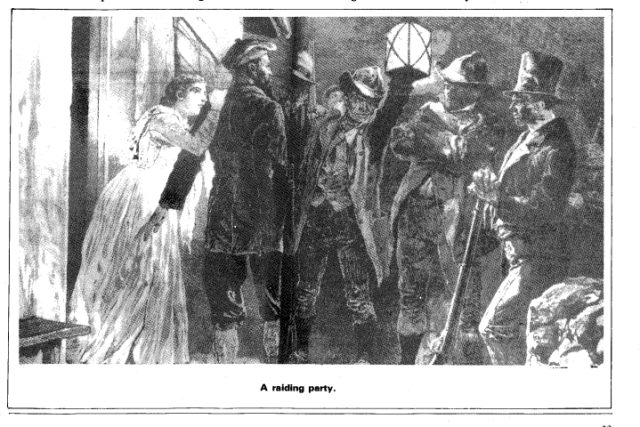
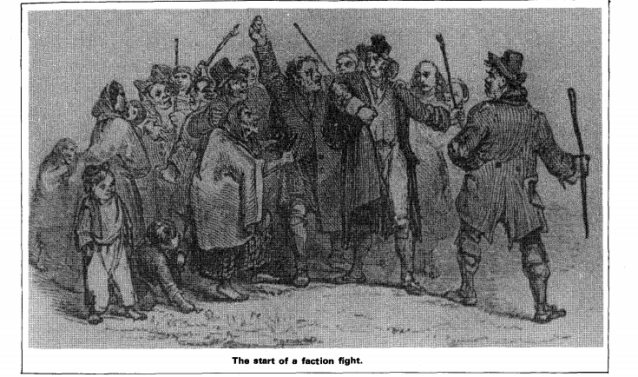
“Named for its mythical leader “Captain Rock,” avenger of agrarian wrongs, the Rockite movement of 1821–24 in Ireland was notorious for its extraordinary violence. In Captain Rock, James S. Donnelly, Jr., offers both a fine-grained analysis of the conflict and a broad exploration of Irish rural society after the French revolutionary and Napoleonic wars.

“Originating in west Limerick, the Rockite movement spread quickly under the impact of a prolonged economic depression. Before long the insurgency embraced many of the better-off farmers. The intensity of the Rockites’ grievances, the frequency of their resort to sensational violence, and their appeal on such key issues as rents and tithes presented a nightmarish challenge to Dublin Castle—prompting in turn a major reorganization of the police, a purging of the local magistracy, the introduction of large military reinforcements, and a determined campaign of judicial repression. A great upsurge in sectarianism and millenarianism, Donnelly shows, added fuel to the conflagration. Inspired by prophecies of doom for the Anglo-Irish Protestants who ruled the country, the overwhelmingly Catholic Rockites strove to hasten the demise of the landed elite they viewed as oppressors.

“Drawing on a wealth of sources—including reports from policemen, military officers, magistrates, and landowners as well as from newspapers, pamphlets, parliamentary inquiries, depositions, rebel proclamations, and threatening missives sent by Rockites to their enemies—Captain Rock offers a detailed anatomy of a dangerous, widespread insurgency whose distinctive political contours will force historians to expand their notions of how agrarian militancy influenced Irish nationalism in the years before the Great Famine of 1845–51.”

An article in the Irish Examiner, a review of Donnelly’s  book tells us, “In February 1822, a special commission in Cork charged 200 with Rockite or similar Whiteboy activity. Mercifully, only 15 were hanged. In the same month, the Insurrection Act introduced a sunset-to-sunrise curfew and summary justice for lawbreakers, of whom up to 330 per year were being transported in convict ships to Australia.

“Incidences of murder, arson, rape and mutilation are recorded by Donnelly in some detail, often gruesome. As a result, the comprehensive index, which names locations of more than 400 atrocities, gives modern residents anywhere in the southern counties a glimpse of their localities’ Rockite history and how much blood was spilt.

“Perhaps the most telling symptom of the near breakdown of rural Irish society in the 1820s was the 50,000 applications to a scheme of assisted emigration to Canada.

“Donnelly has theories aplenty for the historians and sociologists – for which the ordinary punter is advised to have their dictionary at hand. But what sets his book apart for non-academic readers are the reports from officials and information gleaned from newspapers, depositions and other sources. The author uses them to drill down to local level and bring us into a countryside riven by atrocities which are the symptoms of a non-functioning powder-keg society which was always just a spark away from igniting.

“Well before the trouble, trends were beginning in Irish agriculture which eventually set the scene for the rural protest movements of the late 18th and early 19th century. As livestock farmers expanded and took up more acres, a landless class of poor peasants and labourers also expanded.

“While better-off landowners were thriving from the mid-18th century to the end of the Napoleonic wars in 1813, inflation was slowly crippling the poor. While the landed elite were building their Georgian townhouses and Palladian mansions, the landless and land poor were falling behind.

“According to Donnelly, by 1841 there were 50,000 rich farmers averaging about 80 acres; 100,000 comfortable farmers averaging 50 acres; 250,000 family farmers averaging 20 acres; and 1.3 million poor peasants who laboured for the landowners and rented potato plots from them. The system offered the poor peasants just enough food, employment and land to ensure that their birth rates outstripped the rural Catholic middle class and that the rural social structure became more and more imbalanced with each year. At the top of the scale, absentee landlords worried little about the trouble brewing in Ireland, as long as sufficient rent came through to fund their high life in London.”

Other Sources: 

An Irish Apocalypse? 

Captain Rock: the Irish Agrarian Rebellion of 1821-1824 

Captain Rock and the Irish Agrarian Rebellion of 1821-1824

Ireland’s Forgotten ‘Rockite’ Rebellion 

Irish Immigration to Britain 

Political Dimension of Irish Rockite Movement

Whiteboys and Ribbonmen 

Arriving March 25, 2019

Lady Chandler’s Sister: Book Three in the Twins’ Trilogy

LCS eBook Cover-01


Sir Alexander Chandler knows his place in the world. As the head of one of the divisions of the Home Office, he has his hand on the nation’s pulse. However, a carriage accident  on a deserted Scottish road six months earlier has Sir Alexander questioning his every choice. He has no memory of what happened before he woke up in an Edinburgh hospital, and the unknown frightens him more than any enemy he ever met on a field of battle. One thing is for certain: He knows he did not marry Miss Alana Pottinger’s sister in an “over the anvil” type of ceremony in Scotland.

Miss Alana Pottinger has come to London, with Sir Alexander’s son in tow, to claim the life the baronet promised the boy when he married Sorcha, some eighteen months prior. She understands his responsibilities to King and Crown, but this particular fiery, Scottish miss refuses to permit Sir Alexander to deny his duty to his son. Nothing will keep her from securing the child’s future as heir to the baronetcy and restoring Sir Alexander’s memory of the love he shared with Sorcha: Nothing, that is, except the beginning of the Rockite Rebellion in Ireland and the kidnapping of said child for nefarious reasons.

An impressive ending to the beautifully crafted Twins’ Trilogy – Starr’s ***** Romance Reviews

Love. Power. Intrigue. Betrayal. All play their parts in this fitting conclusion to a captivating, romantic suspense trio. – Babe Galloway, Author & Reviewer

Kindle: https://www.amazon.com/dp/B07PVT5GQ9/ref=sr_1_2?keywords=lady+chandler%27s+sister&qid=1553390378&s=gateway&sr=8-2

Amazon: https://www.amazon.com/dp/1091376581/ref=sr_1_2?keywords=lady+chandler%27s+sister&qid=1553430979&s=gateway&sr=8-2

Kobo https://www.kobo.com/us/en/ebook/lady-chandler-s-sister

Nook https://www.barnesandnoble.com/w/books/1131002644?ean=2940161421314


Posted in book release, British history, eBooks, George IV, Georgian England, Great Britain, historical fiction, Ireland, Living in the Regency, publishing, real life tales, Regency era, suspense, trilogy | Tagged , , , , , , , , | Comments Off on Irish Agrarian Societies: the Rockite Movement and the Release of “Lady Chandler’s Sister: Book 3 of the Twins’ Trilogy”

Irish Agrarian Societies: The Ribbonmen, Part of the Plot of “Lady Chandler’s Sister: Book 3 of the Twins’ Trilogy”

Whiteboyism, the subject of Monday’s post, essentially ceased to operate toward the end of the eighteenth century, although it never truly disappeared, for it resurrected its head in the Munster region (Counties Clare, Cork, Kerry, Limerick, Tipperary, and Waterford) in the early nineteenth century. Unlike the whiteboys who proceeded them and the Rockites that followed, the Ribbonmen were more working class—farm laborers. Neither was it based in Catholic consciousness nor nationalism, but rather it acted as a force with which to be reckoned in defense of the rural poor. 

Grain prices dropped nearly 45% between 1814 and 1815. Therefore, farmers could no longer pay their rents to landowners, for the price of rents had been set when grain earned a higher wage. Laborers were ultimately thrown off their lands. Complaints also occurred to threats of evictions. 

One must remember during the early part of the 1800s, there were three major famines in Ireland: 1814 to 1816, 1821-1823, and 1831-1834. 1816 is often referred to as the Year Without Summer, and devastation hit Europe, England, the United Stares, etc.

Some experts point to an event on an estate in County Limerick as the impetus for the formation of the Ribbonmen. Supposedly, the new agent attempted to evict a large number of tenants who had fallen behind in the payment of their rents, but the truth is it was a combination of things: closing of common grazing grounds, the decline in grain prices, and another poor potato crop. Prior complaints had carried for the tithe wars as their banner. Meanwhile, Ribbonism, whose supporters were usually called Ribbonmen, was a 19th-century popular movement of poor Catholics in Ireland. The movement was also known as Ribandism. The Ribbonmen was active against landlords and their agents, and opposed “Orangeism, the ideology of the Protestant Orange Order. 

“The society was formed in response to the miserable conditions in which the vast majority of tenant farmers and rural workers lived in the early 19th century in Ireland. Its objective was to prevent landlords from changing or evicting their tenants. Ribbonmen also attacked tithe and process servers,  and later evolved the policy of Tenants’ Rights. The existence of “ribandmen” was recorded as early as 1817. The name is derived from a green ribbon worn as a badge in a button-hole by the members.

“Depending on the district, the society was variously known as the Fraternal Society, the Patriotic Association or the Sons of the Shamrock. The Ribbonmen’s organisation was similar to that of the Whiteboys or the Defenders of earlier periods. They were organised in lodges, and during the 1820s were in contact with certain organizations of Radicals in England.

“The ideology of the Ribbonmen supported the Catholic Association and the political separation of Ireland from Great Britain, and the rights of the tenant as against those of the landlord. The Ribbonmen were involved in violent (and sometimes deadly) riots with the Orange Order in the north of Ireland, and elsewhere used violence to resist paying tithes to the Protestant Church of Ireland. As the agitation for Catholic Emancipation grew, the tension between Ribbonism and Orangeism increased.

“On 26 July 1813 the Battle of Garvagh in County Londonderry  took place. Up to two hundred Catholic Ribbonmen attempted to destroy a tavern in Garvagh where the Orange Lodge met. They were armed with sticks and bludgeons, but Protestants were waiting inside armed with muskets and repelled them. One of the Ribbonmen was killed and the rest couldn’t gain access to the tavern and dispersed. The clash was commemorated in the song “The Battle of Garvagh.” [Ribbonism] [Murray, A.C. (1986). “Agrarian Violence and Nationalism in Nineteenth-Century Ireland: the Myth of Ribbonism”. Irish Economic and Social History13: 56–73.]

Pat Feeley tells us in his article Whiteboys and Ribbonmen, that Ribbonism leaned toward agrarian issues, not sectarian or political ones. When the price of cattle and other livestock rose in the pre-Famine years, landlords, many of them absentee ones, reduced the number of tenant farms and laborers – requiring less and less tillage. Most of the outbreaks of violence was between laborers and farmers. Feeley tells us, “Ribbonism spread through the rich farmlands of the Golden Vale, through the midland counties and into Roscommon and East Galway. It was not found in the western coastal districts where the farms were poor and the class divisions not so pronounced…. Violence was employed on a calculated, specific basis, in contrast to the gratuitous bloodletting of the faction fights and the sectarian riots. Victims were carefully selected for some infringement of the Ribbon code. Attacks were always clearly linked to a specific code — a particular eviction, a rise in rents, a protest against labourers being hired from another county. There was rarely much difficulty in ascribing a motive; the perpetrators took pains to publicise the reasons for the violence as a warning and a lesson to others. Violence was preventive or deterrent.” 

Other Sources: 

An Irish Apocalypse? 

Captain Rock: the Irish Agrarian Rebellion of 1821-1824 

Captain Rock and the Irish Agrarian Rebellion of 1821-1824

Ireland’s Forgotten ‘Rockite’ Rebellion 

Irish Immigration to Britain 

Political Dimension of Irish Rockite Movement

Whiteboys and Ribbonmen 


Arriving March 25, 2019 

Lady Chandler’s Sister: Book 3 of the Twins’ Trilogy 

LCS eBook Cover-01

Sir Alexander Chandler knows his place in the world. As the head of one of the divisions of the Home Office, he has his hand on the nation’s pulse. However, a carriage accident  on a deserted Scottish road six months earlier has Sir Alexander questioning his every choice. He has no memory of what happened before he woke up in an Edinburgh hospital, and the unknown frightens him more than any enemy he ever met on a field of battle. One thing is for certain: He knows he did not marry Miss Alana Pottinger’s sister in an “over the anvil” type of ceremony in Scotland.

Miss Alana Pottinger has come to London, with Sir Alexander’s son in tow, to claim the life the baronet promised the boy when he married Sorcha, some eighteen months prior. She understands his responsibilities to King and Crown, but this particular fiery, Scottish miss refuses to permit Sir Alexander to deny his duty to his son. Nothing will keep her from securing the child’s future as heir to the baronetcy and restoring Sir Alexander’s memory of the love he shared with Sorcha: Nothing, that is, except the beginning of the Rockite Rebellion in Ireland and the kidnapping of said child for nefarious reasons.

An impressive ending to the beautifully crafted Twins’ Trilogy – Starr’s ***** Romance Reviews

Love. Power. Intrigue. Betrayal. All play their parts in this fitting conclusion to a captivating, romantic suspense trio. – Bella Graves, Author & Reviewer

Kindle: https://www.amazon.com/dp/B07PVT5GQ9/ref=sr_1_2?keywords=lady+chandler%27s+sister&qid=1553390378&s=gateway&sr=8-2

Amazon: https://www.amazon.com/dp/1091376581/ref=sr_1_2?keywords=lady+chandler%27s+sister&qid=1553430979&s=gateway&sr=8-2

Kobo https://www.kobo.com/us/en/ebook/lady-chandler-s-sister

Nook https://www.barnesandnoble.com/w/books/1131002644?ean=2940161421314

Posted in book release, British history, Church of England, estates, Georgian England, Georgian Era, history, Ireland, Living in the Regency, political stance, real life tales, research | Tagged , , , , , , , , , , | Comments Off on Irish Agrarian Societies: The Ribbonmen, Part of the Plot of “Lady Chandler’s Sister: Book 3 of the Twins’ Trilogy”

Irish Agrarian Societies: Whiteboys and Levellers, Part of the Plot of “Lady Chandler’s Sister: Book 3 of the Twins’ Trilogy”

The Whiteboys and Levellers were mid 18th C and early 19th C secret agrarian societies located in Ireland, more specifically in the southwestern part of Ireland. The Whiteboys got their start in 1762 in County Waterford, when 18 men met act against those blocking common grazing. There were numerous groups in Limerick and Cork. They were opposed by the Catholic Church for the use of secret oaths of loyalty and sworn warnings against betrayal. The groups retaliated against the priests speaking out against them with their own brand of threats. They also spoke out against Catholic practices, such as an increase of fees collected at mass and charges for baptisms and marriages. 

Most people and many historians believe these groups were loosely organized and took up local issues only, mainly a defense of the peasants, tenant farmers, etc. Such groups had formed during the famines of 1741 and the one in 1756. In 1756, an act was passed to prevent the formation of such groups, especially those speaking out against tithes.

Over the series of articles I have planned in conjunction with the release of Lady Chandler’s Sister: Book Three of the Twins’ Trilogy, I hope to show these men were more politically engaged than many thought. They were also the sentinels, crying out their warnings of the coming potato famine and devastation. Unfortunately, few listened beyond their personal issues.

Although not a new phenomenon in rural Ireland, one of the first acts of resistance came in 1761 in Clogheen, a village in County Tipperary. Originally, the men in the group leveled the ditches that had been erected by landlords and graziers to keep others out of what was known as “common” grazing areas. Originally referred to a Levellers, the name changed when the groups took up other causes: rents, tithes, etc. Because the men wore white shirts, they became known as Whiteboys or Buachailli Bana. Nicholas Sheeby is a former Catholic parish priest serving the area. He was killed in 1766 because he was a vocal opponent of the practice of Anglican Church tithes. Elements of the Protestant Ascendancy [The Protestant Ascendancy, known simply as the Ascendancy, was the political, economic, and social domination of  Ireland between the 17th century and the early 20th century by a minority of landowners, Protestant clergy, and members of the professions, all members of the Church of Ireland or the Church of England.] decided to make an example out of Sheeby. He was put on trial for murder and treason, but it was not a fair gathering. With no witnesses or proof offered, Sheeby was hung. [Full Text of “The Literary Life and Correspondence of the Countess of Blessington”]

1024px-Shanrahan

Shanrahan Graveyard, where Nicholas Sheehy is buried ~ https://en.wikipedia.org/wiki/Clogheen,_County_Tipperary#/media/File:Shanrahan.jpg


In his article “Whiteboys and Ribbonmen,” Pat Feeley writes, “There was a swing towards grazing and beef cattle farming between 1735 and 1760. There were a number of reasons for this: the exemption of pasture land from tithes, the lifting of the ban on exports of live cattle to Britain, the outbreak of the Seven Years’ War, with a consequent demand for provisions, and, finally, wealthy Catholics wishing to evade the Penal Laws had found that grazing was the safest form of farm investment. This development led to a drop in tillage, with landlords and farmers switching over to the rearing of cattle. As a result there was high unemployment among the labourers, and the smaller tenant farmers were forced off the land to make way for open pastures. Most labourers, if they were not to starve, had to rent potato ground, and they now found that the competition of pasture farming forced up the rents. 

“There was an act of parliament which laid down that five out of every hundred acres should be devoted to tillage, There was, however, no machinery for enforcing it. There was not in Ireland at the time any statutory provision for the maintenance of poor and displaced people, who accordingly, when the bad times came, starved or were thrown back on the charity of their relatives and neighbours.” 

Irish Media Man tells us, “Tithe payment was an obligation on those working the land to pay ten per cent of the value of certain types of agricultural produce for the upkeep of the clergy and maintenance of the assets of the Church.

“Among the features which differentiated the Whiteboy movement from earlier combinations was the almost universal use of oaths to bind its adherents together. Every member was compelled to take an oath and those who refused to swear, were threatened with being buried alive. Of the 14,000 insurgents estimated to be in arms in County Tipperary in 1763 practically all were sworn to be true to the cause. Though scholars have so far discovered no clear examples of secret societies that were oath bound before the Whiteboys, the notion that earlier associations of peasants or urban tradesmen had never implied such a simple device seems on its face highly improbable. But even if oath bound popular organizations did exist on at least a local scale before the early 1760s, the Whiteboys should still be considered innovators because they invested oaths with great practical and symbolic importance in fusing local activists into the wider network of a regional movement.

“Some oaths expressed specific aims of the insurgents, while others dealt with matters of organization and discipline, as did one oath found in the possession of a number of Whiteboys apprehended in April 1762. This source and other contemporary documents indicate many Whiteboys enrolled under the banner of the mystical leader Sieve Oultagh, whom they designated their queen. Precisely how this usage originated is unknown, but it almost certainly derived its currency from the popular tradition in song and poetry of personifying Ireland as a woman and its people as her children.

“The Whiteboys had other symbols and customs that were explicit and functional. The Levellers of Waterford and other counties erected gallows, made coffins, and dug graves in the public roads, all obviously intended as portents of the fate awaiting those who refuse to obey their mandates. To a number of prominent Whiteboy practices some contemporaries also attributed a revolutionary meaning which in all probability they did not possess. Many of the Whiteboys sported white cockades which carried an implication of Jacobitism. Some saw in this agrarian movement a popish plot to overthrow, with French help, the Protestant constitution in church and state. The Whiteboys attire was patterned after the dress of the French Camisards who had rebelled in the year 1702. No doubt, some Whiteboys, expecting a foreign invasion, boasted they would change or put down governments. But the cry commonly heard from many Whiteboys was long King George III and Queen Sive, more accurately, if still somewhat ambivalent, reflected their political sentiments.”

Other Sources: 

An Irish Apocalypse? 

Captain Rock: the Irish Agrarian Rebellion of 1821-1824 

Captain Rock and the Irish Agrarian Rebellion of 1821-1824

Ireland’s Forgotten ‘Rockite’ Rebellion 

Irish Immigration to Britain 

Political Dimension of Irish Rockite Movement

Whiteboys and Ribbonmen 

Arriving March 25, 2019 

Lady Chandler’s Sister: Book Three of the Twins’ Trilogy 

LCS eBook Cover-01

Sir Alexander Chandler knows his place in the world. As the head of one of the divisions of the Home Office, he has his hand on the nation’s pulse. However, a carriage accident  on a deserted Scottish road six months earlier has Sir Alexander questioning his every choice. He has no memory of what happened before he woke up in an Edinburgh hospital, and the unknown frightens him more than any enemy he ever met on a field of battle. One thing is for certain: He knows he did not marry Miss Alana Pottinger’s sister in an “over the anvil” type of ceremony in Scotland.

Miss Alana Pottinger has come to London, with Sir Alexander’s son in tow, to claim the life the baronet promised the boy when he married Sorcha, some eighteen months prior. She understands his responsibilities to King and Crown, but this particular fiery, Scottish miss refuses to permit Sir Alexander to deny his duty to his son. Nothing will keep her from securing the child’s future as heir to the baronetcy and restoring Sir Alexander’s memory of the love he shared with Sorcha: Nothing, that is, except the beginning of the Rockite Rebellion in Ireland and the kidnapping of said child for nefarious reasons.

An impressive ending to the beautifully crafted Twins’ Trilogy – Starr’s ***** Romance Reviews

Love. Power. Intrigue. Betrayal. All play their parts in this fitting conclusion to a captivating, romantic suspense trio. – Bella Graves, Author & Reviewer

Kindle: https://www.amazon.com/dp/B07PVT5GQ9/ref=sr_1_2?keywords=lady+chandler%27s+sister&qid=1553390378&s=gateway&sr=8-2

Amazon: https://www.amazon.com/dp/1091376581/ref=sr_1_2?keywords=lady+chandler%27s+sister&qid=1553430979&s=gateway&sr=8-2

Kobo https://www.kobo.com/us/en/ebook/lady-chandler-s-sister

Nook https://www.barnesandnoble.com/w/books/1131002644?ean=2940161421314

Posted in book release, British history, Church of England, Georgian Era, Great Britain, Ireland, Living in the Regency, real life tales, Regency era, religion, research, writing | Tagged , , , , , , , , , , | Comments Off on Irish Agrarian Societies: Whiteboys and Levellers, Part of the Plot of “Lady Chandler’s Sister: Book 3 of the Twins’ Trilogy”

Plot Point: Agrarian Societies in Ireland, and the Release of “Lady Chandler’s Sister: Book 3 of the Twins’ Trilogy”

41Bbqs4DilL._SX316_BO1,204,203,200_.jpg 41CDX9dYMJL._SX330_BO1,204,203,200_.jpgWho was Captain Rock? First, let’s begin with a quick overview, simply to set some parameters. “Captain Rock was a mythical Irish folk hero, and the name used for the agrarian rebel group he represented in the south-west of Ireland from 1821 – 1824. Arising following the harvest failures in 1816 and 1821, the drought in 1818 and the fever epidemic of 1816-19. Rockites, similar to the earlier Whiteboys, targeted the English and Anglo-Irish Feudal landowners. Captain Rock (or Rockites) were responsible for up to a thousand incidents of beatings, murder, arson and mutilation in the short time they were active. The rebel acts waning in 1824 with the return of “a bearable level of subsistence”. Captain Rock was the symbol for retaliation by “an underclass which had nothing left to lose”. Over this period and in subsequent years, well into the nineteenth century, threatening letters signed by “Captain Rock” (as well as other symbolic nicknames, such as “Captain Steel” or “Major Ribbon”) issued warnings of violent reprisals against landlords and their agents who tried to arbitrarily put up rents, collectors of tithes for the Protestant Church of Ireland, magistrates who tried to evict tenants, and informers who fingered out Rockites to the authorities.” 

Agrarian societies had been active in Ireland as far back as the 1600s, but I became especially interested in those of the early 1800s, specifically those during 1820 – 1822, the time frame for my next novel, Lady Chandler’s Sister: Book 3 of the Twins’ Trilogy. One of the “bad guys” in book 2 of the Twins’ trilogy was an Irish baron, and the fate of Lord Kavanaugh was never decided. Therefore, in the final book of the trilogy, all loose ends must be addressed. That decision brought me to a closer study of the a character named “Captain Rock” and the Rockite movement. 

Before I continue, I have a small confession to make regarding my style of writing. I am a “pantser,” meaning I do not outline or plan my book in detail before writing the book by the “seat of my pants.” Captain Rock is the perfect example of what I mean. In the early drafts of the book, I have my hero, Sir Alexander Chandler, remark about his countenance being similar to an Irish ancestor, Captain Dongal Rockwell Chandler, a pirate and a smuggler, and affectionately called “Captain Rock.” At the time, I was unaware a the history of the Irish Captain Rock and the Rockite movement, but just as I required a twist to my story, I stumble across multiple essays and books on the good (or is that bad) captain, and, miraculously, he was active in the same time frame as the book takes place. I would like to say this was an unusual occurrence, but as it has happened with nearly every book I have written (all 39 of them), I just sit back and wait for the muses to have their say. I manage to pull lots of weeds from my flower garden in the meantime. 

Along with the Rockites there were movements like the “Whiteboys,” and the “Ribbonmen.” Irish Central tells us, “The Whiteboys were a secret Irish agrarian organization in 18th-century Ireland which took vigilante action to defend tenants’ land rights to subsistence farming. The group earned the moniker ‘Whiteboys’ due to their custom of wearing white smocks during their nightly raids. Some Irish immigrants who settled in the rural United States carried their rebellious spirit with them across the Atlantic, as a result of which ‘Whiteboy’ became a generic term for ‘rebel’ outside the cities. Back in Ireland, the Whiteboys usually referred to at the time as Levellers by the authorities, and by themselves as “Queen Sive Oultagh’s children”, “fairies”, “followers of Johanna Meskill” or “Sheila Meskill”, all symbolic figures supposed to lead the movement.

“The Whiteboys sought to address rack-rents, tithe collection, excessive priests’ dues, evictions, and other oppressive acts by landowners. Landlords and tithe collectors were their primary targets. The ‘boys ran a slick operation, priding themselves on extensive forward-planning and regular assemblies. Absolute loyalty was mandatory, and the Whiteboys were the first organization to invest the custom of swearing oaths with tremendous practical and symbolic importance. Whiteboy activism saw its first peak in County Limerick in 1761, quickly spreading to Tipperary, Cork, and Waterford. Initially activities focused only on specific grievances, and action was limited to leveling ditches that closed off common grazing land, and digging up ley lands and orchards.”


Ribbonmen or The Ribbon Society was principally an agrarian secret society, generally made up of rural Irish Catholics. The group came about in response to the miserable conditions placed upon tenant farmers and rural workers in the early 1820s. They meant to keep landlords from evicting tenants or raising rents. Ribbonmen also attacked tithe and process servers, and later evolved  the policy of Tenants’ Rights. The earliest notation of their existence was in 1817. Their name came from the green ribbon worn through the button-hole on a jacket or vest of its members. They were also known as the Sons of the Shamrock, the Patriotic Association, or the Fraternal Society. They supported the Catholic Association and the political separation of Ireland from Great Britain, along with their staunch support of tenants’ rights. Violent, and sometimes deadly clashes, occurred when the Ribbonmen came up against the Protestant  Orange Order in the North of Ireland. They specifically resisted paying tithes to the Protestant Church of Ireland. 

Ribbon-meeting-copy

Above: A sketch of Ribbonmen drinking whiskey at a meeting in a barn on the marquis of Bath’s estate in County Monaghan in 1851, from William Steuart Trench’s Realities of Irish life (London, 1868) ~ https://www.historyireland.com/uncategorized/ribbonism/


There is more to tell on the Rockite movement, Captain Rock, Whiteboys, etc. I hope you will return here in the next couple of weeks for more on this fascinating history.  

Other Sources: 

An Irish Apocalypse? 

Captain Rock: the Irish Agrarian Rebellion of 1821-1824 

Captain Rock and the Irish Agrarian Rebellion of 1821-1824

Ireland’s Forgotten ‘Rockite’ Rebellion 

Irish Immigration to Britain 

Political Dimension of Irish Rockite Movement

Whiteboys and Ribbonmen 

Arriving March 25, 2019

Lady Chandler’s Sister: Book Three of the Twins’ Trilogy

LCS eBook Cover-01

Sir Alexander Chandler knows his place in the world. As the head of one of the divisions of the Home Office, he has his hand on the nation’s pulse. However, a carriage accident  on a deserted Scottish road six months earlier has Sir Alexander questioning his every choice. He has no memory of what happened before he woke up in an Edinburgh hospital, and the unknown frightens him more than any enemy he ever met on a field of battle. One thing is for certain: He knows he did not marry Miss Alana Pottinger’s sister in an “over the anvil” type of ceremony in Scotland.

Miss Alana Pottinger has come to London, with Sir Alexander’s son in tow, to claim the life the baronet promised the boy when he married Sorcha, some eighteen months prior. She understands his responsibilities to King and Crown, but this particular fiery, Scottish miss refuses to permit Sir Alexander to deny his duty to his son. Nothing will keep her from securing the child’s future as heir to the baronetcy and restoring Sir Alexander’s memory of the love he shared with Sorcha: Nothing, that is, except the beginning of the Rockite Rebellion in Ireland and the kidnapping of said child for nefarious reasons.

An impressive ending to the beautifully crafted Twins’ Trilogy – Starr’s ***** Romance Reviews

Love. Power. Intrigue. Betrayal. All play their parts in this fitting conclusion to a captivating, romantic suspense trio. – Bella Graves, Author & Reviewer

Kindle: https://www.amazon.com/dp/B07PVT5GQ9/ref=sr_1_2?keywords=lady+chandler%27s+sister&qid=1553390378&s=gateway&sr=8-2

Amazon: https://www.amazon.com/dp/1091376581/ref=sr_1_2?keywords=lady+chandler%27s+sister&qid=1553430979&s=gateway&sr=8-2

Kobo https://www.kobo.com/us/en/ebook/lady-chandler-s-sister

Nook https://www.barnesandnoble.com/w/books/1131002644?ean=2940161421314

Posted in book release, British history, eBooks, Georgian Era, Great Britain, historical fiction, Ireland, Living in the UK, political stance, Regency era, research | Tagged , , , , , , , , , , , | Comments Off on Plot Point: Agrarian Societies in Ireland, and the Release of “Lady Chandler’s Sister: Book 3 of the Twins’ Trilogy”

In Want of a Wife: A Pride an Prejudice Vagary and “Romance Amnesia”

What we call “amnesia” serves as a major plot device in my latest Jane Austen variation, “In Want of a Wife.” When I began writing the book, I wanted a situation where Darcy and Elizabeth had to learn to trust each other again, without all the hoopla surrounding Lydia’s elopement, Bingley’s abandonment of Jane Bennet, Lady Catherine’s disapproval, etc. I wanted a “clean slate,” so I wiped away Elizabeth’s memory of her family and her relationship with Darcy, including the first five days of their marriage. Oops!!! 

Cover-VintageBookofAmnesia In a day and age where concussion protocol is practiced on sports fields and courts throughout America, the idea of amnesia as a plot point may appear a bit lame, but we all likely know someone who had been knocked out or fainted for a brief second or two, or perhaps minutes, who then wakes and takes a bit of time to recall where they are and what is going on. That is what happens to Elizabeth, but instead of minutes, she waits weeks to get her bearings again. In the meantime, she and Darcy are thrown together as husband and wife. One must remember that in the Regency era, marriage was FOREVER. Death do us part, and all that jazz. Divorces were very public and very expensive and, literally, took an act of Parliament. By making Elizabeth also not remember her family, she can no longer depend on others to right her mistakes. Only on Darcy and on herself.
 

In fiction, we refer to the use of amnesia to advance the story as a motif. Some refer to it as “global amnesia.” Jonathan Lethem in the introduction to his anthology, The Vintage Book of Amnesia: An Anthology of Writing on the Subject of Memory Loss, says, “Amnesia is a common motif in fiction, despite being extraordinarily rare in reality.


“Real, diagnosable amnesia – people getting knocked on the head and forgetting their names – is mostly just a rumor in the world. It’s a rare condition, and usually a brief one. In books and movies, though, versions of amnesia lurk everywhere, from episodes of  Mission Impossible to metafictional and absurdist masterpieces, with dozens of stops in between. Amnesiacs might not much exist, but amnesiac characters stumble everywhere through comic books, movies, and our dreams. We’ve all met them and been them.


“Lethem traces the roots of literary amnesia to Frank Kafka and Samuel Beckett, among others, fueled in large part by the seeping into popular culture of the work of Sigmund Freud, which also strongly influenced genre films such as film noir. Amnesia is so often used as a plot device in films, that a widely recognized stereotypical dialogue has even developed around it, with the victim melodramatically asking ‘Where am I? Who am I? What am I?’, or sometimes inquiring of his own name, ‘Bill? Who’s Bill?’” [Lethem, Jonathan (ed.) The Vintage Book of Amnesia New York: Vintage, 2000.] 
In movies and television, particularly sitcoms and soap operas, one often sees a second  blow to the head, similar to the first one which caused the amnesia, will then cure it. In reality, however, repeat concussions may cause cumulative deficits including cognitive problems, and in extremely rare cases may even cause deadly swelling of the brain associated with second-impact syndrome.  


******************************************************************
In Want of a Wife: A Pride and Prejudice Vagary 
“It is a truth universally acknowledged, that a single man in possession of a good fortune, must be in want of a wife.” – Jane Austen 

Elizabeth Bennet Darcy wakes in an unfamiliar room, attended by a stranger, who claims she is his wife and saying she has suffered an injury to her head. He accuses her of pretending her memory loss, but to Elizabeth, the fear is real. 

“Surely you know me,” he argued. His words sounded as if he held his emotions tightly in check. “I am William. Your husband.”
She thought to protest, but the darkness had caught her hand and was leading her away from him. With one final attempt to correct his declaration, her mind formed the words, but her lips would not cooperate. Her dissent died before she could tell him: I do not have a husband!


Fitzwilliam Darcy despises his new wife, for he fears she has faked her love for him, better to see her family well-settled, and if love is not powerful enough to change a life, what is? 

“This is unacceptable. I realize I was never your first choice as a husband, but it is too late to change your mind. The vows have been spoken. The registry signed. You cannot deny your pledge with this ploy. I will not have it. No matter how often you call out George Wickham’s name, he will never be your husband. I will never release you.”
MDP eBook Cover


Available On…


Excerpt: 
 
“I plan to enjoy a walk,” Elizabeth told Mr. Nathan. She had been most disappointed when Miss Darcy did not arrive yesterday as planned, and her restlessness had gotten the better of her. Surely Georgiana would make an appearance soon. Elizabeth did not like being alone at Pemberley. Doing so brought on a return of her fears of never recovering her memory.
The butler frowned. “It is not my place to prevent your doing so, but Mr. Darcy charged me and the rest of the staff with your safety, ma’am. Might I add a caution?” Reluctantly, she nodded her acceptance of his warning. “Pemberley is well-tended by the gardeners and groundskeepers, but there is much open land that holds dangerous trails and drop-offs unless one is familiar with the contour of the area.”
Elizabeth wished to remind Mr. Nathan she was the estate’s mistress and she could do as she pleased, but she knew the man was only following Mr. Darcy’s instructions. “I do not mean to go far. Miss Darcy will hopefully arrive soon, and I wish to be here to greet her, but I require a stretch of my legs, or I might go mad.” She added a smile to assure the man she spoke figuratively.
Mr. Nathan nodded his understanding. “Then perhaps you might choose to walk the entrance road. It is wide—properly graveled—nearly a mile to the gatehouse—possesses wonderful views of the parkland and the stream—”
“And I cannot become lost,” Elizabeth finished.
“There is that also,” Mr. Nathan said in practiced tones.
Elizabeth again smiled at the man. “Then fetch my pelisse and my muff, Mr. Nathan.”
“Yes, ma’am.”
Within five minutes, she was crossing the circular drive toward the bend in the road that hid the full grandeur of Pemberley from those who dared to arrive on the property without knowledge of Pemberley House, as well as to those who called upon the estate on a regular basis.
As she walked briskly along, Elizabeth concentrated on each remarkable spot, often turning in place and pausing to admire the great variety of ground. Each step revealed more of the splendor into which she had married. “And of this place, I am to serve as mistress,” she whispered in awe.
Finally, she reached a point where the woods began in earnest. It was a considerable eminence, and Elizabeth turned back to rest her eyes on Pemberley House, which was situated on the opposite side of the valley. Its greatness and its beauty had her swallowing a bit of trepidation rushing to her chest. The manor was a large, handsome stone building, imposing in the simplicity of its architectural lines, standing well on high ground, and backed by a ridge of woody hills, which she now recognized as part of the nature trail at the edge of the lawns. She thought there could be no other place for which nature had done more good.
With a sigh of satisfaction, she set her sights on the wooded area ahead. The walk was easy because she was walking downhill. She recalled when she arrived at Pemberley, Mr. Darcy’s coach entered the park at a low point and slowly climbed to the manor house. “The return will require me to assume a slower pace,” she said with a smile. The crisp air on her cheeks felt good, as did the freedom of the exercise. In spite of her infirmity, the Lord had blessed her. She paused to count God’s favors. She closed her eyes and lifted her chin to speak to Heaven. “Thank you, God, for sparing my life and for bringing William into my world. I possess a loving and faithful husband who promises to protect both me and our family.”
“Does he?”
Elizabeth’s eyes sprang open. She turned frantically in circles, searching the thick woods for any signs of another person.
“Who is there? Show yourself,” she demanded, but there was no movement—no other sound—not even the chirp of birds or the chatter of a squirrel—nothing but the soft snap of a twig and a quick hitch of her breathing.
Suddenly frightened by the unknown, she hiked her skirt and made her feet move in the direction she had come. Constantly looking over her shoulder, she stumbled along the road she had enjoyed until this moment. “Be sensible,” she silently chastised herself, but she did not slow down. The incline she had anticipated earlier caused her to labor, her chest heaving from the exertion. 

Finally, she cleared the heavy woods, but she still did not feel safe. She silently cursed her response, but such did not slow her steps. She was in a strange place, a place she had visited previously, but of which she held no memory. Reaching the spot where she had previously viewed Pemberley in the distance, Elizabeth paused; bent over at the waist and hands braced on her knees, she struggled to capture her breath.
Then she heard it: a loud rumbling coming from the direction she had just fled.  
Posted in Austen Authors, book excerpts, book release, eBooks, Georgian England, Georgian Era, historical fiction, Jane Austen, Living in the Regency, Pride and Prejudice, Regency era, Regency romance, research, Vagary, writing | Tagged , , , , , , , , , , | 3 Comments

Irish Castles in Ruins: Research for My Next Release, “Lady Chandler’s Sister”

In book 3 of my Twins’ Trilogy, entitled Lady Chandler’s Sister, the ruins of an Irish castle play out in the book’s conclusion. Therefore, I spent time looking for the right image before I wrote those final scenes. As with all these little details required to write an historical piece, some plans work. Others do not. This was a do not. Instead of an actual castle we could still see images of with a Google search, I settled on one that no longer existed, for, in that manner, I could imagine it as I wished. 

Castles_of_Connacht_-_Barnaderg,_Galway_-_geograph.org.uk_-_1953295

Permission details Creative Commons Attribution Share-alike license 2.0 ~ Castles of Connacht: Barnaderg, Galway, near to Barnaderg and Castlemoyle, Ireland. A five storey O’Kelly tower house dating from the late C16. ~ https://en.wikipedia.org/wiki/Barnaderg#/media/File:Castles_of_Connacht_-_Barnaderg,_Galway_-_geograph.org.uk_-_1953295.jpg

In my mind’s eye, before I began writing the scene, Barnaderg Castle (Irish: Bearna Dhearg, meaning “red gap”) in County Galway (near Tuam) was the perfect image. Five stories high, the castle could supply distance to see one’s enemies approach, but also the element of danger because of its condition. Built by Malachy O’Kelly, Barnaderg Castle was a 16th Century stronghold of the O’Kelly clan. The castle is claimed to have been one of the last castles built in Ireland. Most experts believe it once had a draw bridge, for the area surrounding the castle is saturated throughout much of the year. (Historic Sites of Ireland)

Carrigogunnell

Carrigogunnell Castle is situated 3 km north of Clarina Village, Limerick, Ireland. It was built circa 1450 and was destroyed by gunpowder in 1691. Creative Commons Attribution Share-alike license 2.0 ~ https://en.wikipedia.org/wiki/Carrigogunnell#/media/File:Carrigogunnell.jpg


Digital_Eye–2015–Carrigogunnell_Castle,_Co._Limerick

CC BY-SA 4.0 File:Digital Eye–2015–Carrigogunnell Castle, Co. Limerick.jpg Created: 30 September 2015 ~ https://en.wikipedia.org/wiki/Carrigogunnell#/media/File:Digital_Eye%E2%80%932015%E2%80%93Carrigogunnell_Castle,_Co._Limerick.jpg

Another possible choice was Carrigogunnell, again because of its location and the condition. A medieval Irish fortification, it is attributed to the to the Irish Gaelic tribe of the Dalcassians, “generally accepted by contemporary scholarship as being a branch of the Déisi Muman, that became a powerful group in Ireland during the 10th century. Their genealogies claimed descent from Cormac Cas, who is said to have lived in the 3rd century AD. Their known ancestors are the subject of The Expulsion of the Déisi tale and one branch of their blood-line went on to rule the petty kingdom of Dyfed in Wales during the 4th century; probably in alliance with Roman emperor, Magnus Maximus.” (Dalcassians)

Carrigogunnell Castle is located near the village of Clarina in County Limerick, on the banks of the River Shannon. The structure dates to at least the early 13th century, and was slighted [Slighting is the deliberate destruction, partial or complete, of a fortification without opposition, to render it unusable as a fortress.] in September 1691 after being captured during the second siege of Limerick. Unfortunately, Clarina was not in the part of Limerick I required for my tale. Close, but not close enough. Moreover, by the time I had spent hours research land routes to both Barnaderg and Carrigogunnell, I decided the time required would not fit the story.

castle connell

Engraved for Ferrar’s History of Limerick 1780, North View of Castle Connell ~ http://www.limerickcity.ie/Library/LocalStudies/BooksJournals/FerrarsHistoryofLimerick/ Castleconnells name in Irish is Caislean Ui gConnaing, which means Gunnings castle. This was because the Dal Cais Gunning family built the riverside castle over a thousand years ago, the name was then anglicised to Castleconnell by which the village and parish are still known as today. For more information log onto: http://www.castleconnell.ie (or) http://visitballyhoura.com/index.php/2012/04/16/castleconnell/

Finally, I decided on a castle that no longer stood, one closer to the city of Limerick. The roads in this part of Ireland at the time were horrendous; therefore, I chose a route from Dublin to Limerick, one supposed more passable that those in other parts of southwest Ireland at the time. Castleconnell is situated on the River Shannon some 11 km (6.8 miles) from Limerick City, near the counties Clare and Tipperary. The actual Castle of Connell was built on a rock outcrop, overlooking the bend of the river. It was the seat of the chief of Hy-Cuilean, a territory south-east of Abbeyfeale, in the barony of Upper Connello near the borders of Cork and Kerry. The castle then came into the possession of the O’Briens of Thomond.  The castle was blown up by General Godert de Ginkel during the War of the Two Kings (also called the Williamite War in Ireland or the Jacobite War in Ireland). Ginkel was fighting in support of the Army of William of Orange. A large portion of the castle wall lies some 50 feet from the castle, thrown across the road by siege cannons. 

There you have it. I settled for my imagination, rather than an actual place. 

h2896.jpg

Arriving March 25, 2019 

Lady Chandler’s Sister: Book 3 of the Twins’ Trilogy

LCS eBook Cover-01


Posted in book release, buildings and structures, castles, eBooks, Great Britain, historical fiction, history, Ireland, Living in the Regency, publishing, real life tales, Regency era, Regency romance, romance, Scotland, trilogy | Tagged , , , , , , , , , , , , , , , , | 4 Comments