Militia Officers During the Regency

What were the differences between the various units of militia officers during the Regency? For example, how could George Wickham in Jane Austen’s Pride and Prejudice serve in Hertfordshire when his home shire was Derbyshire? And how was Colonel Fitzwilliam’s service in the Regulars, from the same book, yet be another facet of the military in the Regency?

At the time of the war with Napoleon, Great Britain did not employ a standing militia. They were only recruited when the Regulars were required to engage the enemy. The militia assumed the “policing” of the country in the absence of the Regulars. They served on home land. They were dispensed to squash riots and seditious actions. They protected British soil while the Regulars engaged the enemy outside of the home land. The militia was often dispatched to shires away from their homes to avoid their sympathizing with those they were charged to dispatch. In Pride and Prejudice, the militia which Mr. Wickham joins in Hertfordshire, is supposedly peppered with Derbyshire volunteers. 

Militia officers served as long as they liked and like Wickham in Pride and Prejudice, could be from anywhere while those picked or volunteering for militia duty in the rank and file served five years, *usually* from their home county. There were substantial signing bonuses during the wars as the Militia, Regulars and Volunteers competed for the same pool of men, so anyone from outside the county would and did join the militia for the bonus and pay.

“In the novel the anonymous regiment of – shires caused a considerable stir on its arrival in the quiet country town of Meryton – and among the Bennet family of five unmarried daughters. “. . . They were well supplied both with news and happiness by the recent arrival of a militia regiment in the neighborhood; it was to remain the whole winter, and Meryton was the head quarters.” (Pride and Prejudice 28). The regiment and its officers figure prominently in the fortunes of the Bennet family for the remainder of the novel. Jane Austen’s own experience of the militia was probably not too different from that of  the Bennet sisters. From about the age of sixteen she began to attend the monthly assembly at the town of Basingstoke, about seven miles distant from her home village of Steventon. Here, during the winter of 1794-95, the assemblies would have been graced by officers of the South Devon Militia: three of their eight companies were quartered in Basingstoke. Their colonel was John Tolle, Member of Parliament for Devonshire since 1780, whose support for William Pitt, the Prime Minister, had made him the butt of the opposition Whigs in the mock-epic Rolliad. The officers of the South Devonshires would have enlivened local society just as the -shires did at Meryton. As they all came from the neighborhood of Exeter, it is likely that Jane Austen heard a great deal about that area from them, and it is probably not coincidence that when she wrote the beginnings of her first mature novel in the summer of 1795 about two girls called Elinor and Marianne, she set their new home, Barton, in South Devon “within four miles northward of Exeter” (Sense and Sensibility 25).” (Breihan and Caplan: Jane Austen and the Militia)

Few members of the militia were trained in military tactics, such as shooting, horsemanship, or use of a sword. They were required to have their own guns to be a member of the militia. Those picked or volunteering for militia duty in the rank and file served five years, while some served for seven years. Officer commissions were not available (as opposed to those in the Regulars). Those who held rank in the militia received that rank based on how much land the family held. Captain Denny in Pride and Prejudice would need either to be the heir of land worth at least £400 per year or actually own land worth at least £200 per year. Although we are given nothing of Denny’s background in Austen’s novel, we are told that George Wickham becomes a lieutenant in the Meryton militia. This is a bit confusing to many who know something of military history, for a lieutenant in the militia would be required to hold land worth £50 per year. If Wickham had nothing of his own upon which to depend, how did he receive his lieutenancy? Most experts speak of a lowering of the standards for the few who would qualify as a junior officer otherwise, meaning Wickham held a gentleman’s education, making him “qualify as a junior officer.” The wages presented to the officers was only to cover their expenses, not replace their income from their land. 

All Protestant males were required to be available for the militia. There was a quota for each area. A local nobleman (customarily referred to as the Lord Lieutenant) was charged “by the King” (or rather by the King’s spokesman) to gather a force of able-bodied men between the ages of 18 – 45 to serve as part of the country’s militia. A local landowner was appointed as the “colonel” in charge of the men of the unit. These men were “guaranteed” not to know service outside of the homeland, meaning they would not know the battlefield frequented by professional soldiers. They also experienced a steady social life provided by the local gentry. Only clergymen were exempt from this duty.

Parishes were fined if they did not raise the required numbers of militiamen, so they were happy to have anyone fill the rosters, paying a bonus that was far less than the fine. And, of course, sooner or later the parishes and regular army learned not to  pay the bonuses before the men were marched away. More than a few made a living out of getting the bonuses and then skipping out, only to ‘enlist’ again someplace else for bonuses there. A man who did not wish to serve could pay another to serve in his stead. They were offered between £25 and  £60, which was equivalent to a year’s wage for many in the Regency. 

Pride and Prejudice takes place in Regency England during the French Revolution, which began in 1789. To combat the threat of Napoleon’s conquest of Europe, militia forces were moved across the countryside to lie in wait of an attack at camps where they were involved in training sessions. Landowning aristocrats generally led the militia of their locality, although the soldiers of each regiment came from various places. Though the militia was made up of volunteers, a commission was needed to enroll. With the Militia Act of 1757, which created a more professional force with proper uniforms and better weapons, the militia became seen as a more respectable occupation, especially for younger sons who would not inherit land.” (The Militia in “Pride and Prejudice”)

In any case, When Napoleon returned, the Militia were called up and regular army volunteers were asked for from the militia, both officers and men. A number went to Belgium, but the militias were held in readiness on the coasts during and after Waterloo. After Waterloo, there was an effort to stop the surge in smugglers and ex-pats trying to escape a now monarchial France, landing along the English coasts, so it is reasonable that the Essex militia would have been in that county on duty.

Because of the militia riots of 1813, militias were more often kept in the county of origin in small groups across the countryside. Doing so also helped in watching the coasts. Most regular army units were not disbanded or reduced until the autumn of 1816, so the militia wouldn’t have been sent to their homes until about the same time depending on the mood of the county folks and the coastal activity.

Remember, when speaking of the Napoleonic Wars, one is speaking of a twenty-year period of war, 1792-1815. There were several kinds of militia during this time, besides yeomanry, fensible, and volunteer organizations. The threat of invasion and the desperate need for manpower in the regular army also affected how and where militia were used.

There were very few barracks at all at the start of the Napoleonic wars, better than 85% of the ones existing for militia and regular troops in 1815 being built during the wars. And then there are the various militia revolts which colored the way the militia was deployed in later years. 

The militia was not seen as the ‘standing army’. In fact, it was seen as a local force which negated the need for a standing army, e.g., the Regulars] …as it was argued in Parliament. It was also seen and used as a police force when more than a couple of locals were needed to enforce the law. Seeing militia ‘guarding’ important groups or individuals was not that unusual. It was only when one adds in the 1813 militia uprisings and such events as Peterloo (1819) that the militia was given a bad name. Usually, a police force made up of militia would be locals whom everyone knew.  Opinions varied, of course, but generally the militia was not viewed in the same way as a standing [regular] army, who had put Cromwell on the ’throne’ and before and during the Napoleonic wars were housed in citizens’ homes … generally strangers and a lower [armed] class than the owners of those homes.  One of the major reasons for the extensive creation of the barrack system during and after the war.

You may also find this previous piece on militia officers of use.  


Posted in British history, British Navy, George Wickham, Georgian England, Georgian Era, history, Jane Austen, Living in the Regency, military, Napoleonic Wars, Pride and Prejudice, Regency era | Tagged , , , , , , , , , | Comments Off on Militia Officers During the Regency

The Craft of Reading, a Guest Post from Leenie Brown

This post originally appeared on Austen Authors on May 7, 2019. I loved it so much, I thought I would share it with you here. 

As an author and passionate lover of writing and storytelling, I often spend time studying my craft. Most often this comes in the form of reading articles and listening to podcasts/video lessons.

About a month ago, I listened to an excellent podcast on the skill of showing and not telling and during the lesson, it struck me how the information contained in this lesson pertained not just to writers but also to readers. It is not the first time I had such thoughts. I have taught both reading and writing, and these two areas of study overlap in many points.

Therefore, today, I am going to talk about the skill of showing and not telling and how it appears in writing and what it can do for a reader.

Warning: This is not a short post because… 

I will be using examples from my own writing as illustrations since they will give you a better idea of how I attempt to use the skill of showing and not telling in my work. These examples will come from stories which are currently posting on my blog so that you can read the examples in context if you so wish.

However, both of these stories are ending — one, His Dearest Friend, just concluded today and the other, Loving Lydia, will conclude on May 30, so do not wait too long to read them because I will have to take them down for publication very soon.

You can take the teacher out of the classroom, but you can’t take the classroom out of the teacher. 🙂

Please note: I am not using these illustrations because I think I have it “all figured out.” There is always…ALWAYS…room for a writer to hone his or her skill. I am just hoping that by sharing these examples it will give us all something to consider as we improve our skills.

Before we dive into my examples, it would probably be good to explain what I mean by showing and not telling.

According to Wikipedia,

Show, don’t tell is a technique used in various kinds of texts to allow the reader to experience the story through action, words, thoughts, senses, and feelings rather than through the author’s exposition, summarization, and description.

If an author can master the use of this skill, it will improve the reading experience for the reader. Characters will become alive. Scenes will play out as if you are there. The character’s emotions and well-being will become a part of the reader and will compel her to keep reading because she desires the resolution as much as the character does.

Because of these things, show, don’t tell is, in this author’s opinion, a fundamental skill, and it demonstrates not only a love and respect for the craft of writing but also for the reader because you are striving to give that reader the best possible reading experience.

As a reader, you can enhance your own enjoyment of a story if you can extrapolate or infer the nuances that such a technique gives to a story.

So are you ready to do some guided extrapolating and inferring? I hope so since we are going to begin the examples and explanation portion of this post.

We will start with two excerpts from His Darling Friend that should give us insights into who the characters are about whom we are reading. This is especially important in a story such as this one since this story is an original sweet Regency romance with deliberate nods to Jane Austen’s Emma but does not build off of any plot or character found in Jane Austen’s work. The characters in this story start out as strangers to us, and we have to get to know them. (Unless you read His Beautiful Bea, then you would have already met Roger.)

Roger Shelton slumped down on the cream-coloured settee in the far corner of the Abernathy’s drawing room next to a pretty young lady whom he knew would not bat her lashes at him or smile coyly as all the other eager young women at this house party seemed wont to do. Not that he blamed them, of course. He would make a fine catch if he were ready to be caught.

This, the opening paragraph of His Darling Friend, should reveal something to you about the hero of the story through his actions and thoughts.

  • He slumps. He does not sit. This should clue us in to the fact that Roger Shelton eases his way through life. He’s a devil-may-care sort of fellow.
  • He is obviously handsome, rich, or both if the ladies at this house party are attempting to flirt with him.
  • He does not have a self-esteem issue. He sees himself as a “fine catch,” and he’s not the sort to deny it.
This book was made available to read on May 14, 2019.

This next example is also from the first chapter of His Darling Friend.

He had known she would not believe him. Her father was too kind to tease in such a fashion, and he was in no rush to see his darling daughter given away to anyone.

“Your father did give me that package for you. That is the truth. As is the fact that my mother suggested I take a good turn through the ladies of the room looking for more than pleasant curves and a willing smile.”

“You are dreadful!”

Roger placed a hand on his heart. “I promise you she said that very thing. Mother is not known for her delicacy when chiding me.” In that way, Victoria was a lot like his mother. “There was also something in the diatribe about grandchildren before she turned her toes up.” He shot a devilish grin at his friend.

“Do not say it,” Victoria hissed.

It amused him how her expression was appropriately appalled at the mere thought of what he was about to say. She did know him well. Of course, her expression would not prevent him from continuing.

“Mother was not pleased when I suggested that producing children did not require a marriage license.”

“You did not!” Victoria shook her head. “Of course, you did. I can nearly hear you saying it.”

“I am wounded.”

“By the truth?”

“No, by the thought that you think I would –” A severe glare stopped his words.

“Are you or are you not, Roger Shelton, the charmer of ladies, the stealer of kisses, the seeker of pleasure?”

Even before we get to Victoria’s statement describing Roger in this section, we should have already ascertained that these two know each other very well, that they are opposites when it comes to propriety, and Roger is a rake. We don’t really need Victoria to state what should be obvious to us from the conversation the two friends are having. However, could there be a reason why that sentence is necessary? Could it be there to reveal something about Victoria? Those words, coupled with the glare she is giving him, should let us know that, in this relationship, Victoria is the more likely of the two to do any scolding.

By the end of the first chapter, the reader of His Darling Friend should have a good understanding of the friendship that exists between Roger and Victoria and should also have a hunch that there is more than just a friendship brewing between the two life-long friends.

Now that we have looked at two brief examples of character and relationships being revealed through the action, dialogue, and thoughts in a story, let’s move on to deciphering how a character might be feeling during a scene.

I want you to pay attention to Lydia in this excerpt from Loving Lydia. Can you see, through her actions, the mix of emotions she is feeling?

Lydia rose, dried her eyes and nose once more, straightened her shoulders, and lifted her chin.

Elizabeth wound her arm around Lydia’s, and they took their time returning to the house. Just as they were about to enter through the servant’s entrance, Lydia stopped.

“I am scared,” she whispered when Elizabeth turned toward her. “What if I am not as good as you or Jane?”

“What do you mean? Neither Jane nor I are better than you.”

“Oh, you are!” Lydia cried. “You think about things that are not fashion.”

“That does not make us better.”

Lydia looked at the ground. “What if I discover I am not the kind of lady who can love someone who is not handsome?”

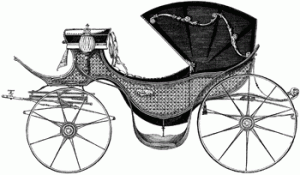
By Rudolph Ackermann (England, London, 1764-1834) [Public domain], via Wikimedia Commons

She straightens her shoulders and lifts her chin. This should give the feeling of someone determined to take on whatever lies ahead. And her determination carries her as far as the door to the house where she stops and whispers. That whisper should make us pay special attention to what she is fearful of revealing. There is no one there to hear her except Elizabeth. She does not need to hide her words from anyone except herself and her sister. That’s significant. Then, as she comes to the heart of what is causing her unease, she looks at the ground as if she is embarrassed to admit what she is feeling. Again, that little motion is significant to deciphering Lydia’s feelings. I am sure you can tell from this excerpt that the Lydia in this story is not the standard one dimensional Lydia we might expect from canon. This Lydia has layers.

Next, let’s take a look at some nuances of a changing Caroline in this story.

“…There is a door at the far end, do you see it? It is nearly obscured by design.”

“Oh, yes! It is very cleverly done,” Lydia answered.

“That is how your servants will most often enter and exit. Well, the junior staff and below. Servants such as Mrs. Nicholls and Mr. Harvey will enter just as we do. There are lines that must not be crossed. Order cannot be retained as it should be if any maid or groom is allowed to come flouncing in however he or she wishes.” She smiled at Jane. “That is my opinion, of course. A mistress of an estate must determine with the agreement of her husband as to how those lines are formed and how firmly they are held. Sir Matthew, I believe, is more forgiving of things than I am, and, therefore, I shall have to learn his ways.” She turned from the room and took Lydia’s arm. “One must always consider the opinion of one’s husband to be the greater opinion.”

“But what if he is wrong?” Lydia asked.

“He is not. Ever.”

“I think it is not impossible for a husband to be wrong,” Sir Matthew said from where he stood on the grand staircase. “However, I try not to be wrong too often.” He bowed his good days to the ladies. “Not every rule which is parroted from matron to daughter must remain as it is. It is my opinion, that a good marriage is a friendship of the greatest kind. The joining of two people to act as one – not to become as the other but to enhance and support the other.” He smiled and shrugged. “My father was a parson. I fear I have picked up some of his ability to wax eloquent on some subjects which interest me. But, I should allow you to return to your tour. I was just on my way to the library.”

“To read?” Lydia asked.

“Yes,” Sir Matthew replied, his lips twitching ever so slightly.

“Will you be there long?”

He nodded. “Most likely, unless something draws me away from my book.”

“I only ask,” Lydia said very seriously, “so that I will know to be quiet when I enter. My father does not like to be disturbed when he is reading, you see.”

Sir Matthew gave a small bow of his head. “I thank you in advance for your consideration.” He looked at Caroline. “You are doing an admiral job, my dear.”

Caroline beamed as she watched him make his way to the library. “I have been blessed.” She sighed but then looked at Jane. “Even if I did not think it a blessing at first, it is.”

A reader should be able to tell from this excerpt that Caroline is changing. She is not the same Caroline she was when this series of stories departed from Pride and Prejudice’s plot line. However, she has not suddenly become something altogether different either. You should be able to see her feeling of self-importance as she instructs Lydia on things a lady running an estate such as Netherfield should know. We also see her training coming through in her opinion about a husband’s opinion always being correct. Thankfully, Sir Matthew, her betrothed, corrects her on this point. And then at the close, after Sir Matthew has called her my dear and congratulated her on doing a good job, we see her admiration for him. She is a lady in love. And then, we get a quick shot of the sharp Caroline as she gets a little jab in at Jane, who was complicit in the scheme that forced Caroline to accept Sir Matthew’s proposal.

Rudolph Ackermann. August 1812. Los Angeles County Museum of Art [Public domain] via Wikimedia Commons

51zPn+QGsHL._SY346_.jpg Finally, I want to share a look at one of Elizabeth’s other sisters, who will be a main character in the next book of the Marrying Elizabeth series. If you remember Mary from Delighting Mrs. Bennet, you will know from her few lines in that story that she speaks directly and does not bother to contain her snark if she is speaking to someone she does not particularly care for.

This is the first meeting between Mary and Darcy’s cousin (Colonel Fitzwilliam’s older brother); however, Miss Mary has obviously heard a thing or two about the gentleman. See if you can get tell what her opinion of him is from her actions and words.

“Where our mother’s delights will no longer be able to be heard,” Mary muttered from where she sat in the corner of the room.

Elizabeth gave Mary a stern look. It was one thing to add sardonic comments to a conversation when it was just their close family and friends who were present. It was another thing altogether when one was entertaining a person of importance whose opinion could affect the future happiness of a lady’s sisters. As was normal, a stern glare did little to affect Mary, who merely stared blankly in return as if to say, “but it is true.”  And it was true. Elizabeth knew that her mother would not greet Lord Westonbury quietly, for the more excited their mother became, the louder her voice grew.

“Lord Westonbury, this is my sister Mary,” Jane said, “and next to Lydia is Kitty. Mary, Kitty, this is Mr. Darcy’s cousin, the Viscount Westonbury.”

Mary placed her sewing aside and rose – reluctantly, it seemed to Elizabeth – to curtsey and greet Lord Westonbury properly.

“And tell me, Miss Mary,” Westonbury said, making his way across the room to sit near her, “should I fear this introduction to your mother?”

Mary raised an eyebrow at him. “You are likely safe as long as you do not tell her that you know Sally.” She leaned around him to see Lydia. “That was the lady’s name at the brothel, was it not?”

“Mary!” Elizabeth scolded. “A proper lady does not speak of such things.”

“And an honourable gentleman does not do such things, and yet here we are.” She gave Westonbury an appraising look but said no more.

“I am not offended,” Westonbury said.

Mary opened her mouth to speak but closed it again when Elizabeth glared at her. “Then, allow me to be offended on your behalf. I assure you that my sisters do know how to comport themselves properly.”

Again, Mary’s brow rose as if to ask, “Do we?”

If you read that and thought that Mary has no desire to meet Lord Westonbury, has no regard for his title, and is more than a trifling bit angry with the gentleman, you would absolutely correct.

Now, did you note where Lord Westonbury chose to sit? Yep, right next to the angry hornet. And if you are thinking he tends to be the sort to seek out trouble and poke the hornet’s nest, you’d also be correct about that. It should be interesting to find out how their relationship develops.

Before we conclude, let me give one example to answer the question

How does this showing differ from telling?

Instead of showing the meeting of Lord Westonbury and Mary as I did above, I could have said something like…

It was obvious to Elizabeth, from Mary’s expression, that Mary did not care to meet Lord Westonbury while it was equally as evident that Lord Westonbury found Mary to be of interest. How Elizabeth was ever going to endure this call was beyond her. 

I have stayed in Elizabeth’s point of view here and have told you what she saw and even gave you how she felt about it. And in some circumstances, if this meeting was just a small point that did not need more attention than a quick glossing over, this sort of telling might be useful.

(There are times that telling is better than showing. For instance, not every bow and curtsy or formal introduction needs to be shown.)

However, this meeting between these two characters is no small point in the story, and I would hope that you would agree that seeing Mary’s expressions, hearing her words, and witnessing Lord Westonbury’s reaction makes for much more interesting reading.

That is where we are going to leave this lesson for today as it has already been a long one. Hopefully, it has been of some benefit to you in seeing how I attempt to use the advice to show and not tell in my writing.

If you wish to read His Darling Friend or Loving Lydia, you can at the time of this posting find them on my blog at these links:

His Darling Friend

Loving Lydia

Posted in Austen Authors, book excerpts, books, Guest Post, reading, reading habits, Vagary, word play, writing | Tagged , , , , , , , | 7 Comments

Arthur Wellesley, the Duke of Wellington, “the Last Great Englishman”

Lord_Arthur_Wellesley_the_Duke_of_Wellington.jpg Sunday, June 18, will be the 202nd Anniversary of the Battle of Waterloo, marking the final defeat of the French military leader and emperor Napoleon Bonaparte. On the English side stood Arthur Wellesley, the Duke of Wellington, an Anglo-Irish soldier and statesmen, who was one of the leading military figures of 19th Century Britain, and a man Alfred Lloyd Tennyson dubbed “the last great Englishman.” 

1024px-Dangan_Castle,_Co_Meath,_Ireland,_1840

Wellesley spent much of his early childhood at his family’s ancestral home, Dangan Castle, engraving 1842. via Wikipedia ~ Public Domain


images

remnants of Dangan Castle, Meath, Ireland, the duke’s childhood home

Wellesley was the third surviving son (b. 1769) of an Irish aristocratic family. His father was the first earl of Mornington. In truth, as a child Arthur was uninspiring. A mediocre student. Lazy. Socially awkward. Uninvolved. Only excelling in his playing the violin. At age 12, Arthur entered Eton, where is remained withdrawn and occasionally aggressive. It was the same year that marked his father’s death. Eventually, he was removed from school (1784). Arthur traveled to Brussels with his mother in 1785.

With few options, it was decided that a military career would be a good fit for him. His eldest brother’s connections brought Arthur a number of commissions. The first was as a junior officer in the 73rd Foot. Later, he was the aide-de-camp to the Lord Lieutenant of Ireland. As the French Revolution set England on alert, by February 1793, England and France were at war. In April of the same year, Arthur became the commander of the 33rd Foot. His brother’s connections could take him no further. For once, Wellesley was on his own. If he were to advance, it would be because he truly deserved it.

p02tgcys.jpg In 1794, the 33rd Foot was part of the English forces that knew defeat in the Netherlands. Although Wellesley knew praise for his part in the Flanders Campaign, the defeat was a mighty lesson for the young officer: He must learn how to lead his men and the “art” of war. Avoiding being shipped to the West Indies because of foul weather, Arthur found himself instead sent to India.

Wellington, then Colonel Arthur Wesley (the last name was later changed to Wellesley) of the 33rd regiment, arrived in Calcutta at the age of 28 in February 1797, after a journey of more than three months. He spent eight years in India, where his brother was Governor-General. These years were spent in honing the skills for which he later claimed greatness. He learned something of being a tactician in battle. It was in India that the future victor of Waterloo and future prime minister of Great Britain first dealt with questions of war and peace and civil government.

download.jpg On 26 March 1799, the Muslim ruler Tipu Sultan, the Tiger of Mysore attacked Wellington’s army. The enemy forces had been trained by the French and were well armed, but Wellington’s men held their fire until their enemy was but 60 yards removed. Then,  British infantry decimated the columns of their attackers, while cavalry forces scattered the remnants of the attacking force. Later, in April and May of 1799, Wellington participated in the siege of Seringapatam in Mysore and led an attack on the entrenchments of the fortress there. After Seringapatam was taken, Wellington was made civil governor and remained there until 1802.

p02tgk0k

Wellington defeats Indian leader Dhoondiah Waughat the Battle of Conaghull in India. Getty Images

During his time in Seringapatam, Wellington was ordered to suppress a rebellion in north Mysore led by Dhoondiah Waugh. For the first time, Wellington exercised independent command in battle. During this operation, Rory Muir explains, Wellington “displayed all the characteristics of his subsequent campaigns, . . .” which included attention to logistics and “unremitting aggression.” He fought a battle at Conaghul and won a complete victory. Muir writes that Wellington exhibited a remarkable flexibility on the field of battle. A British officer commented on Wellington’s “alacrity and determination” during battle.

Battle_of_Assaye.jpeg-1

Battle of Assaye ~ J.C. Stadler After W. Heath – National Army Museum, London ~ Public Domain ~ via Wikipedia

On 23 September 1803, Wellington, now a Major General, won his first major victory at the Battle of Assaye. His forces were outnumbered 20:1 by troops of the Maratha Confederacy. A cavalry patrol warned Wellington of the advancing enemy. Despite being outnumbered, Wellington attacked before the enemy forces could set up camp, catching them by surprise. With only 7000 men under his command, he earned a decisive victory at Assaye, but with a heavy cost of men. Wellington later remarked that Battle of Assaye was “the bloodiest for the numbers that I ever saw.” One officer noted that Wellington “was in the thick of the action the whole time . . . I never saw a man so cool and collected as he was.” Another officer commented that Wellington “behaved with perfect indifference in the hottest fire.”

2831CF7800000578-3063831-image-a-69_1430467772842.jpg He returned to London and became MP for Rye. In April 1806, he married Kitty Pakenham, a girl he had long loved and to whom he once proposed (but had been found wanting by her father), but meeting her again 1805, he was less enthralled with her, but, perhaps out of duty (for once a gentleman made a promise of marriage, he was honor bound to follow through), he married her, nevertheless. They had two sons, but their marriage was never an easy one. 

In 1807, he was appointed Chief Secretary of London, but he did not forsake his army career for a political one. He was often called upon as a military advisor by then Prime Minister, William Cavendish-Bentinck, 3rd Duke of Portland. When the Spanish revolted against Napoleon’s occupation, it was to Wellington that British ministers turned to deliver an advantageous outcome for the Crown.

According to BBC iWonder, “Wellington had been in overall command of British forces in the Iberian Peninsula since 1809. In January 1812 he led troops from Portugal into Spain. Early victories saw Wellington reach Salamanca in June but by July he was locked in stalemate with an evenly matched French force. On 22 July, his opportunity finally came. Over lunch an aide delivered the message Wellington had been waiting for: the French had over-extended. A quick glance through his telescope was enough. ‘Marmont,’ the French general, he said excitedly, ‘is lost.’ In under an hour, his forces won a decisive victory and all Europe acknowledged Wellington’s military genius.

“Wellington’s victory in Spain and even more devastating French losses in Russia forced Napoleon to abdicate. The duke’s old rival was bested. Victory won him a new title – the Duke of Wellington. Invited to become Britain’s ambassador to France, Wellington moved to Paris, even forging relationships with several of Napoleon’s former mistresses as the deposed emperor endured exile on Elba. He was now a big name on the world stage. After a hero’s welcome on his first return to Britain since 1808, Wellington was dispatched to represent the country at the Congress of Vienna which had been convened to re-draw the map of Europe.”

waterloo.jpg In February 1815, Napoleon escaped from Elba and returned to France, where he mobilized his army once again. At the Duchess of Richmond’s ball in Brussels, Wellesley learned that Napoleon was less than 20 miles removed from the city. Early the next morning, he departed for the front. On 18 June 1815, the bloody Battle of Waterloo took place. The French army was defeated by two of the armies of the Seventh Coalition: an Allied army under Wellington’s command, along side a Prussian arm under the command of Gehard Leberecht von Blucher, Prince of Wahlstatt. At the height of his military career, Wellesley returned to England as the country’s hero. 

Unfortunately, the political battleground was not so easy for him to maneuver. He joined Lord Liverpool’s cabinet at time when the masses were beginning to demand political reform. The refusal of Wellington and the political classes to countenance social and political reform put them out of step with the public.

54bafd47e3c94_harriette_wilson.jpg In his personal life, with his marriage far from a happy one, Wellington sought relationships with several courtesans/mistresses. One of those with with the infamous Harriette Wilson, who wrote a detailed kiss-and-tell book describing their encounters. The publisher, pornographer and scandal-monger Joseph Stockdale, even (unsuccessfully) attempted to blackmail the duke prior to its release. Cartoonists and satirists delighted in Wellington’s reputation. wilson-bloomsbury-11-7-13.jpg

“Affairs at Westminster were no less fraught. Demand for reform refused to quieten. In 1828, George IV asked Wellington to become prime minister. The government was beset with problems. Divisions ran deep between warring factions of the parties. His new role was something of a poisoned chalice. Cannier political operators may have refused the position but the duke, dutiful to the last, accepted. He quickly discovered that leading the country had little in common with leading an army. The autocratic style which had served him so well in the military did not go down so well in Westminster.

“If Wellington thought MPs could be ordered into unity he quickly discovered he was mistaken. One of the most divisive issues of the day centred on Catholic emancipation. Catholics had been barred from holding public office since the 17th Century but by 1829 these restrictions threatened civil strife. Some Tories, who had championed Wellington’s appointment, were aghast at his support for the Roman Catholic Relief Act. One, the Earl of Winchilsea, was particularly vitriolic in his criticism and on 23 March the duke and the earl fought a duel on Battersea Fields. Both survived.

“Wellington had been willing to countenance Catholic Emancipation for the greater good, but parliamentary reform he could not stomach. As a soldier, Wellington had been famed for anticipating what lay “on the other side of the hill” but he lacked the same degree of political imagination. Whig party leader Earl Grey led the calls for reform but Wellington would not budge. Out of step with the times, Wellington’s popularity plummeted. He lost control of the House of Commons, his government unable to tread a path between the attacks from Ultra Tories and reformists. By November he had little option but to resign.

“Despite the collapse of his government, Wellington had continued to lead the charge against Grey’s proposals for parliamentary reform. As his popularity continued to fall, the iron shutters he had installed on his house to protect his windows from the ire of the mob reinforced the image of the ‘Iron Duke’ refusing to move with the times. But in 1832, with the country in deadlock, Wellington backed down for the sake of the country. After persuading his supporters to stay away from Parliament, the Reform Bill finally passed. Even so, he was mobbed by an angry crowd on Waterloo Day. Wellington had remained active in government, as foreign secretary and, latterly, a minister without portfolio. Approaching his ninth decade, Wellington finally retired from public life in 1846. Even then he retained his post as commander-in-chief of the armed forces, unable to step away completely from the public service to which he had devoted his life – servant of crown and country to the last.

“On 14 September (1852) Wellington succumbed to a stroke at his favourite home, Walmer Castle, in Kent. In death the duke’s divisive political legacy was forgotten. Wellington was the hero of Waterloo once more. On 18 November, Britain said goodbye to a hero of a bygone age. The nation united in a display of grief more extravagant than anything seen before. More than 1.5 million lined the streets to pay their respects as Wellington’s coffin was borne to St Paul’s, where a further 10,000 dignitaries packed into the cathedral. Wellington may have been gone, but his reputation lived on.”

Statue_Of_The_Duke_Of_Wellington-Hyde_Park_Corner.jpg

Resources: 

Biography Online

BBC iWonder 

The Diplomat 

“The Duke of Wellington: 11 Things You Didn’t Know,” The Telegraph

Encyclopedia Britannica

The Victorian Web 

Posted in British history, buildings and structures, George IV, Georgian England, Georgian Era, history, Living in the Regency, Napoleonic Wars, political stance, real life tales, Regency era, Regency personalities, religion, titles of aristocracy, war, world history | Tagged , , , , , , , , , , , | 6 Comments

The Duchess of Richmond’s Ball and Waterloo, a Guest Post from Jann Rowland

On June 15, 1815, perhaps the most famous (or infamous) ball in history was held. The Duchess of Richmond’s ball is generally regarded as the event in which Arthur Wellesley, Duke of Wellington, was informed of the advance of French forces into the kingdom of the Netherlands. This is somewhat accurate.

In March of 1815, Napoleon Bonaparte escaped Elba and landed in France, quickly assuming control of the Empire of France from Louis XVIII, setting off the Hundred Days campaign. The nations of Europe, quickly mobilized against him, with the British and the Prussians fielding armies in the Netherlands, while the Russians, Austrians, and several Germanic Princedoms marched to support them. Thus, outnumbered and facing enemies on potentially three sides, Napoleon knew his only chance was to defeat the coalition armies separately before they could assemble against him.

The allies had set the date of their invasion of France for July 1, but it was considered possible (perhaps even likely, given the reputation of the French Emperor) the French would attack first. The Duchess of Richmond, whose husband was the commander of British forces defending Brussels, had planned some weeks earlier to host a ball. When rumors of French advances began to run through the city, she asked Wellington if the ball should be canceled his response was: “Duchess, you may give your ball with the greatest safety, without fear of interruption.” Thus, the ball was held as scheduled, the most likely location being a coach house attached to the house the Lennox family was leasing in Brussels.

When the first circles of Brussels society gathered that night, the main topic of discussion was, of course, the rumored impending invasion. Even with so desperate a subject on the tongues of those who attended, however, by all accounts the ball proceeded smoothly. Wellington and his commanders arrived at about 11 PM that evening, and it was said that “with the exception of three generals, every officer high in [Wellington’s] army was there to be seen.”

before-waterloo-henry-nelson-oneil

fineartamerica.com Before Waterloo Painting by Henry Nelson O’Neil

But Wellington had allowed the ball to go on that evening in an attempt to confirm that all was well and proceeding as planned. In reality, he had received word earlier that day that the French army had crossed the Belgian frontier and was engaging the British allies, the Prussian army, to the east. Wellington put the entire British army on alert. But he was still unaware of the speed of the French advance and the location of the attack and did not order his army to mass just yet.

Just before dinner, a dispatch arrived for William, Prince of Orange, commander of the Dutch-Belgian army. The prince handed Wellington the missive, who put it in his pocket and continued on as if nothing had happened. When he read the note twenty minutes later, he ordered William back to his command post and went into supper. To his surprise, William returned only a short time later with word that the French had pushed much further than expected.

By now rumors were flying through the ballroom. Wellington orders both William and the Duke or Brunswick back to their command posts, though he, himself stayed for another twenty minutes. Then he announced his intention to retire. Before he left the room, however, he whispered in Duke of Richmond’s ear, asking if he had a good map. The two men left the room, going to Richmond’s study, where Wellington surveyed the potential battlefields. The French had pushed far enough into the Belgian countryside that they now threatened Quatre Bras, and Wellington, knowing he would not be able to mobilize his army in time to stop them there, exclaimed: “Napoleon has humbugged me, by God; he has gained twenty-four hours’ march on me.” As he surveyed the map, he fixed his gaze on Waterloo and allowed his finger to fall in the name as the place where the British would stop the French.

By now the ball was all but over. Officers were pulled from the ballroom and given orders to return to their units, and many did so without even changing back into their uniforms, fighting in their suits and dancing shoes. Those who bade them farewell weeping with fear for those who were going into danger, knowing not all of them would return. The city soon became a bustle of movement as the regiments departed for the front and the battle against the invading French.

The next day, both the Battle of Quatre Bras and the Battle of Liege were fought. Quatre Bras was a victory for the British as they denied Napoleon the crossroads and his strategic objective of driving a wedge between the two allied armies. Liege was a victory for Napoleon, but he was not able to destroy the Prussians. The British, by Wellington’s design, fell back to Waterloo and linked up with the Prussian army. Two days later, the final battle of the Napoleonic wars was fought at Waterloo, and the French were defeated, ending Napoleon’s power forever.

Posted in British history, Georgian England, Great Britain, Guest Post, Ireland, Living in the Regency, Napoleonic Wars, Regency era, research, war | Tagged , , , , | 1 Comment

Nigel Lewis’s “The Cover Plan Conspiracy,” a Deception Created by the Allied Forces in WWII

On June 5 of this week, I posted an article on Exercise Tiger, which was a tragic rehearsal for D-Day. That article brought me to the notice of Nigel Lewis, who has written extensively on the subject. Therefore, I asked him to guest post with us. 

unnamed.pngThe Cover Plan Conspiracy takes a new look at a subject that I first wrote about in a book published thirty years ago. Its American title was Exercise Tiger, after the US landing-operation of that name held in the English Channel in late April, 1944.

Tiger is remembered for an incident in the early morning of April 28th, when the last of its eight convoys – Convoy T-4 – was set upon by German E-boats. Two of its landing-ships were sunk, and 639 Americans lost their lives. The incident is routinely mentioned in the histories of D-Day and the Normandy invasion, and readers might imagine that there is nothing new to be said about it. 

But there is. The T-4 incident is usually seen as a temporary setback in the Allied preparations for the invasion. Set in the final few weeks before D-Day,  The Cover Plan Conspiracy goes behind the scenes of the preparations and makes major discoveries about Tiger and T-4. I do not peddle some conspiracy theory. The book is based on hard evidence and years of research in the British National Archives. [Please note: The active part of Exercise Tiger, after the ships set sail, was divided into three phases, 1) the seaborne phase, 2) the landings, 3) the movement inland of the troops who had been landed. The piece below concerns only the seaborne phase (1). The landings were on Slapton Sands. The attack on T-4 was during the seaborne phase, and it occurred almost forty miles from Slapton Sands, off the county of Dorset.]

To the men on T-4 and the other convoys, Tiger was just another training exercise. Their commanding officers knew that it was also a dress rehearsal for the Utah Beach landing in Normandy. But there was something else that even their commanders didn’t know. One of my discoveries is that Tiger was tightly locked into the schedule of the invasion’s top-secret deception plan, Operation Fortitude, also known as the Cover Plan. In fact, the exercise was at the cutting-edge of the Plan, its so-called tactical threat delivered on April 24th, the day that Tiger began.

There was, then, a deceptive side to Tiger, which has been hidden by subtle distortions of its history. In 1944, for example, the Allied Naval Commander, Admiral Bertram Ramsay, claimed that the E-boats were on a routine reconnaissance sortie when they chanced to run into Convoy T-4. The Supreme Commander, General Eisenhower, made the same claim in 1946. The claim is false and was known to be so. The E-boats did not simply happen upon their targets. Almost two days before the attack, the enemy had learned that there were about to be large-scale Allied amphibious operations in the west of the English Channel.

On the morning of April 26th, just hours before the first convoy put to sea, German photo-reconnaissance aircraft overflew Torbay, a natural harbour in the western Channel where ten of Tiger’s landing-ships lay at anchor. It would have been clear from the photos that the ships were combat-loaded, ready for action. The Germans did not know it was an exercise. To them, it looked like the long-expected invasion. Hitler himself anticipated that the invasion would be on April 26th.

Certain British officers in charge of the shore defences knew that the recce (Reconnaissance) had tipped off the enemy. But by disguising it in the intelligence bulletins as a harmless flight over the sea “off Dartmouth”, they concealed this vital piece of information. An even more disturbing discovery is that the Allied air forces paved the way for the reconnaissance. During exercises, it was considered “essential” that air-patrols should watch over the loaded ships while they were still in harbour. A few days later the even bigger D-Day rehearsal, Exercise Fabius, was patrolled by the RAF. The patrols for Tiger, however, were cancelled, leaving a wide-open window of opportunity for enemy aircraft to fly through.

Early that morning, the E-boats had arrived in Cherbourg, having moved there from Boulogne. Royal Navy intelligence knew that the move meant that E-boat operations in the west of the Channel were imminent. It also knew that the E-boats only put to sea after their targets had been identified by German air reconnaissance. A German message decrypted by the British code-cracking operation, Ultra, revealed that an E-boat sortie “northwestward” from Cherbourg was planned for the night of the 26th/ 27th, but postponed. Also decrypted by Ultra was a report on the air reconnaissance over Torbay. A copy of it was sent to the Commander-in-Chief, Plymouth, Admiral Sir Ralph Leatham.

By lunchtime on the 27th, it was clear that E-boats were about to prowl the western Channel, and that great danger awaited Convoy T-4 – the only convoy still in harbour. Leatham had the power to stop it from sailing, but did nothing. Other evidence of underhand action and inaction by him is in Chapters 20 and 21 of my book. He could and should have allocated more warships to Tiger, and because he didn’t its convoys – all apart from the first one – were very weakly defended. 

What explains this devious behaviour by one ally towards another? The Cover Plan does. Fortitude was nothing if not devious. Its aim was to divert attention from the real area of the invasion, Normandy, by convincing the enemy that the Allies would land 150 miles away at the narrow, eastern end of the Channel, in the area known as the Pas de Calais. Historians have not appreciated how difficult it was to fit the far western end of the Channel – where the Americans were – into this plan. As I explain in Part 1 of my book, the fact that there were more invasion ports to the west than to the east, and the refusal of the Americans to take the Cover Plan seriously, only added to the difficulty.

The success of Fortitude was considered indispensable to the invasion, and the failure of the invasion was unthinkable. For all its make believe, Fortitude was a major operation of war, in which it was legitimate to take risks. It aimed to save Allied lives, but above all it aimed to expedite the invasion, even at the cost of incurring loss of life.

This all has a bearing on Tiger, in several ways. The key point is that because the Americans were too far away from the Pas de Calais to include them in the master-narrative of the Cover Plan, another story had to be found for them. We cannot be sure what the story was. But a “pretended diversion” to the west was probably part of it, and a provocative “mock-invasion” certainly was.

There is also the distressing possibility that Tiger was a sacrifice operation carried out to create an impression of Allied unpreparedness and weakness in the west. Tiger was not the first exercise to double as a deception, and unwitting Allied servicemen – and British civilians – were sometimes killed in deception operations. The sacrifice was usually on a comparatively small scale, but in late April the tactical threat allowed for great risks to be taken to safeguard the secret that Normandy was the Allied landing-area. The large presence of US forces in the west jeopardised the secret, and the high death-toll of Tiger may be an indication of how much it mattered to establish a fake “cover story” for the Americans.

The western alliance was supposed to be bilateral in its thinking, planning, and decision-making. But where the Cover Plan is concerned, the bilateralism broke down. Fortitude was almost entirely a British operation, and it was certainly the British who took the lead in hatching and implementing the scheme within Fortitude – a secret scheme that deserves to be called a conspiracy – that collaterally contributed to the deaths of 639 Americans in the E-boat attack. An unresolved question is the extent to which Supreme Allied Headquarters and some of its US generals, including Eisenhower, were aware of the scheme.

The English Channel in early 1944 was a highly dangerous place, and Tiger’s seaborne phase was made even more perilous by the lowering of the air and sea defences and the dissembling of the enemy air recce over Torbay. These were all intentional measures, and in my book I suggest that whether or not Tiger was used as the vehicle for a sacrifice operation, it “certainly became one”. I also say that the 639 who died were “sacrificial victims of the Cover Plan”.

I stop short of saying that a sacrifice on that scale was specifically intended. Before coming to that conclusion, I would want further evidence. Meanwhile, there is the evidence that we already have, of premeditation on the Allied side of the Channel. The deceptionists – as the deceivers called themselves – must have realised that their actions increased the odds that one of Tiger’s convoys would be attacked, ships sunk, and lives lost. They may, however, have gambled on the chance that there would be no attack, or, if there were one, that its death-toll would be low – an acceptable price to pay for the security of the invasion.

If so, the gamble did not come off.

Copyright © 2017, Nigel Lewis

Excerpts from The Cover Plan

        From Chapter 1 – Hesketh’s History

In Arlington Cemetery, Virginia, is a plaque to the memory of the men who died that night. Commending their sacrifice, it states that they died in “the Allied cause”. So they did, but the same may be said of any Allied soldier who died in World War II. In their case, the specific cause was deeply hidden. Caught without knowing it in a story designed to delude the enemy, they were sacrificial victims of the Cover Plan, whose ruthless demands were intrinsic to the catastrophe of T-4. The one operation – the training exercise – was mangled in the machinery of the other one: the deception structured around it.

British historian John Keegan’s description of the T-4 incident, “sad but subordinate”, no longer applies. It would be more accurate to say that it was made to seem subordinate. The emotive story of the doomed convoy turns out not to be random, after all. It can no longer be regarded as an optional add-on to the pre-D-Day history of the Normandy landings – it is right at the heart of that history. Nor can it be construed simply as a “sad” story, sad though it is. General Bradley, the commander of First US Army, rightly called it “one of the major tragedies of the European War”.

What happened to T-4 was monstrously unfair, but there is also a certain wartime inevitability to it, and it is a tragic inevitability. It seems incredible that hundreds of men could die merely for a story. But there were powerful forces at work in the background to Tiger, and the British too were prey to those forces, as we will see …

The deceptionists worked under a disadvantage. They were not responding to events so much as setting the scene for events yet to come, trying to mould an outcome that still lay in the future. Knowing that it was a successful outcome, we are less likely to be amenable to the idea that it might have been less successful if there had been no deception around Tiger, or that T-4 may have forestalled a greater tragedy. Those arguments now look frail and hypothetical. But the deceptionists lived with hypothesis on a daily basis. In trying to second-guess the enemy, they could only act on the basis of conjecture. The ramifications of this point will become clear as the story progresses.

The Cover Plan posed ethical dilemmas that most of us would find intolerable. But the deceptionists could not let the dilemmas detain them for long. They had to choose. They acted out of military necessity, as they saw it, and it is often hard to see how, in the circumstances, they might have acted differently.

But decisions that may have seemed inevitable to them at the time do not necessarily seem so to us in the present-day. There was, as we will see, an objective basis for the Tiger deception, but was it objectively necessary to go ahead with it? There can be no definitive answer to that question. It lies in the realm of “might-have-been” history. Objective necessity does not eliminate the human factor, however. That too had a part to play, as it usually does. Character-defects in some of the commanders make one suspect that the Tiger deception may have got out of hand and run away with itself. I am thinking of the stubborn pride and arrogance that the Greeks knew as hubris, and the misplaced “gung-ho” enthusiasm that is the fatal flaw of many a military disaster. Wartime deception is a dangerous game – the deceptionists may have played it too assiduously.

I will present the evidence known to me, and set the T-4 disaster in the context of the extreme and exacting circumstances in which the decision to weave a deception around Tiger seemed inevitable and right. Before the reader rushes to judgement, I ask that those circumstances be taken into account. It is not my intention either to blame the British en bloc, or to absolve them from blame. But it would be an over-simplification to take the story out of context and see it in black-and-white terms, with the British as the villains of the piece. Their judgements may be in doubt, but not their motives. They were not driven by narrow British self-interest. It was their duty to ensure the security of the invasion, and they took the decisions they did because they saw Allied advantage in taking them. They did not die in the Allied cause, but they did act in that cause. If this is immoral, it is the immorality of war itself.

The concept of the Tiger deception seems to have been British, and the operation was British-led, but readers should be aware from the outset that Americans too took part. The full extent of US participation is unclear, but there were certainly Americans active in carrying out the operation, and others who covered it up. It was eventually an Allied operation, as the Cover Plan was supposed to be. The story unfolds within a warring family – what Eisenhower called “the family relationship of SHAEF”. Americans and British were of course on the same side, not like the house of Atreus in Greek tragedy, warring with one another. It is well known, however, that they were not always as united in thought and deed as they liked to present themselves as being. T-4 – a secret grief of the western alliance – takes that knowledge to a new level.

From Chapter 6 – Sacrifice

Because of Allied protocol, the British could not directly intervene in the crisis in the west. But protocol could not be allowed to get in the way of the overriding operational need for a fully effective Cover Plan. Given US unwillingness to co-operate in the Plan, only the British could save the day by creating the “necessary false picture” in this area. They therefore had to intervene, but could only do so indirectly. Soon enough, Harold Kehm’s prediction of 1943 would come true, as the British took over the American share of the Cover Plan.

To repeat my earlier caveat, all the people in this story – British and American alike – were under the compulsion of the impersonal forces unleashed by war. It would be a mistake to interpret the story in wholly personal terms, to imagine, for example, that the British set out to settle a grudge and punish the Americans for their negligence and non-co-operation in the Cover Plan. That is not how it was. It was the misfortune of the Americans that they had the geographical bad luck of occupying the area that it was most problematic for the deceptionists to accommodate within the Cover Plan. At the same time, it was an Allied responsibility – which became a British responsibility – to ensure that the Overlord cover was watertight and comprehensive. Despite the high-level US reluctance to get involved in the Cover Plan, and despite the extreme difficulty posed by the West Country and the US forces concentrated there, leaving them out of the Plan was not an option.

 515IEe-zmDL.jpg  51SlketIPAL.jpg 41i44u+hSTL.jpg 41isUv1LzYL.jpg

About the Books…

Set in England in the momentous final few weeks before the Normandy invasion of June 6th, 1944, this is the astonishing true story of the deadliest, best kept secret of the Anglo-American alliance of World War II.

The Cover Plan Conspiracy is a complete reappraisal of one of the most publicised but also most misunderstood episodes of the whole D-Day period. In the early morning of April 28, 1944, enemy torpedo-boats attacked an American troopship convoy in the west of the English Channel. Convoy T-4 was the final follow-up convoy of Exercise Tiger, a huge US dress rehearsal for the Normandy landings. The story ever since has been that the 639 Americans killed in the attack were the accidental victims of an unforeseen disaster in training.

The real story, told here for the first time, is devastatingly different. Nigel Lewis draws on extensive research and a wealth of fresh evidence to show that Exercise Tiger was secretly enmeshed in the Allied deception plan for Normandy, the invasion’s so-called “Cover Plan”. Without their knowledge, the men taking part in Tiger were entangled in Allied deception strategy, acting out a narrative designed to mislead the enemy before D-Day. The hundreds killed in the convoy disaster were secret sacrificial victims of the D-Day Cover Plan.

Shedding unprecedented light on Allied disarray and the secret war waged by the Allies before Normandy, this book breaks new ground. The Cover Plan was intended to fool the enemy for a few months. The cover-up of Tiger and T-4 has deceived the historians and peoples of two nations for more than seventy years.

The Cover Plan Conspiracy falls naturally into four parts – The Plan, ‘A Larger Plan’, The Operation, and The Cover-Up. All four parts are available here.

Please note, there are no maps in the book.

Part 1: The Plan sets the scene for the whole book and describes Anglo-American disagreements and other problems that led to the larger plan …

Part 2: ‘A Larger Plan’ shows the net closing around Tiger, and explains the circumstances in which the exercise got caught in the Cover Plan …

Part 3:  The Operation exposes the covert steps taken to weaken Tiger’s defences and tip off the enemy, culminating in the attack on its final convoy …

Part 4: The Cover-Up reveals what was done in 1944 and afterwards to conceal the Tiger deception and the real causes of the convoy disaster …

51ZWjGYSWRL._SX336_BO1,204,203,200_.jpg   519ycaTho7L._SY373_BO1,204,203,200_.jpg You might also check out…

Exercise Tiger: The Dramatic True Story of a Hidden Tragedy of World War II Hardcover – July, 1990 

(This book is only available from 3rd Party book sellers (starting at $3.95)

In the autumn of 1943, the United States armed forces, with the cooperation of the British government, evacuated seven villages and took over 30 acres of Devon to set up a high security camp where thousands of young American recruits could be trained for the forthcoming invasion of Europe. Known as Exercise Tiger, the operation included manoeuvres and rehearsals on landing craft in the English Channel. On the night of April 28th 1944, the landing craft had an inadequate escort of warships and seven German E-boats in the area moved in. At first, the Americans thought they were part of the exercise, but then they saw that their friends were being wounded and killed on several of the vessels, the order was given to abandon ship. Many of the soldiers who jumped, drowned soon after hitting the water.

unnamed-1.jpg Meet Nigel Lewis…

Nigel Lewis was born in Central America in 1948 and is a graduate of Cambridge University. He was a journalist for twenty-five years, for the BBC and other outlets. The Cover Plan Conspiracy is his second excursion into the investigative history of World War II. His first book, Paperchase (1981), exposed a state secret of the Soviet bloc, the secret purloining, by Poland, of thousands of priceless musical and other manuscripts evacuated during the war from the Prussian State Library in Berlin. He is also the librettist of The First Commandment, the English version of an early Mozart opera.

In the late 1980’s he wrote a blow-by-blow documentary account of the E-boat attack on Exercise Tiger in 1944, published in the UK as Channel Firing and in the USA as Exercise Tiger. He is currently working on another book about the US presence in wartime Britain – Bugbear: the Americans and the Beaches of the West Country, 1943-1944. He lives in London, and spends part of the year in Italy. 

Posted in American History, book excerpts, British history, excerpt, Guest Post, history, legacy, military, real life tales, research, war, world history, writing | Tagged , , , , , , , , , , | 2 Comments

Jonathan Martin, Arsonist ~ Full of Fury and Fire

Many of my Regency stories is set in Yorkshire, one of my favorite places in the UK. Today, I bring you a tale that occurred on 1 February 1829, in the town of York and, specifically, involved the Cathedral and Metropolitical Church of Saint Peter, now known as York Minster.

An artist’s impression of Martin in captivity ~ https://www.onthisday.com/articles/the-fire-and-fury-of-jonathan-martin

One Jonathan Martin was outraged with what “went on” in the Gothic cathedral. Martin had sent the church’s clergy several warning letters regarding their sins: “repent of bottles of wine, and roast beef and plum pudding.”

Martin was born at Highside House, near Hexham in Northumberland, one of 12 children. His brother John Martin was an English Romantic painter, engraver and illustrator. Another brother, William Martin, was an English eccentric and self-described philosopher. Jonathan was said to have been farmed out to his aunt, Ann Thompson, a staunch Protestant to spoke often of her visions of hell to the boy. Jonathan was “tongue tied” and spoke with an impediment.

Later, he stood witness to his sister’s murder by a neighbor and was sent to his uncle’s farm to recover from the shock. Eventually, Jonathan was apprenticed to a tanner but was caught in London and press ganged in 1804. He served for six years upon the HMS Hercule and even saw action at the Battle of Copenhagen.

Jonathan finally returned to England when the HMS Hercule was broken up in 1810. He settled to Durham, where he married and where his son Richard was born in 1814. Shortly, thereafter, he became a Wesleyan preacher and denounced the Church of England. He was well-known for disruptive Protestant church services, calling the members of the clergy of the Church of England as “vipers from hell.”

In 1817, he was arrested, tried, and sent to a private asylum in West Auckland for his threats to shoot Edward Legge, the Bishop of Oxford. Later, he was transferred to the public asylum in Gateshead, from which he escaped in June 1820, but was quickly recaptured.

In 1821, upon learning his wife had died, Martin escaped a second time from the asylum. He was not recaptured, and, so, he returned to work as a tanner and a preacher. Because he believed that all prayer should come from the heart, rather than be recited from formal liturgy, Martin thought it his mission to expose the “corrupt state” of the established church, and he acted according to those tenants for nearly a decade following his return to society. He published his autobiography in 1826, with additional editions in 1828, 1829, and 1830. This was his chief source of income.

In 1828, he remarried; this time to Maria Hudson. The couple moved to York, where he experienced another mental breakdown in 1829.

On Sunday, 1 February, Martin attended the evensong (the Anglican equivalent to Vespers in the Roman Catholic Church) at York Minster. During the service, he became distracted by what he termed to be a “buzzing sound” coming from the organ. Instead of returning home after the service, Martin hid in the building, finally making his way to the bell tower. Ironically, any who noted his light did not question its presence in the tower. Later that night, Martin set fire to the woodwork in the choir area, using hymn books, cushions, and curtain as the fuel, and then escaped by climbing down a bell rope from the tower.

Evensong rehearsal in the quire of York Minster, showing carved choir stalls. https://en.wikipedia.org/wiki/Choir#/media/File:Evensong_in_York_Minster.jpg

Smoke was not noted until the early hours of 2 February. It was raging by 8 of the clock. It took until the afternoon of 3 February before the fire was under control. “A section of the roof of the central aisle approximately 131 foot (40 m) long was destroyed, stretching from the lantern tower towards the east window, together with much of the internal woodwork from the organ screen to the altar screen, including the organ, medieval choir stalls, the bishop’s throne, and the pulpit. The cause – arson – soon became apparent, and the culprit was identified from threatening placards Martin had left on the Minster railings in previous days, including his initials and address. (Jonathan Martin, arsonist)

Martin was captured near Hexham on 6 February. He neither denied his guilt nor resist arrest. He simply declared his actions as “God’s will.”

He was tried at York Castle in March 1829, before Baron Hullock and a jury. At his trial Martin said: “It vexed me to hear them singing their prayers and amens. I knew it did not come from the heart; it was deceiving the people.” Martin was defended by Henry Brougham, who had gained notoriety for defending Queen Caroline in 1821 and who became a liberal leader in the House of Lords, as well as Lord Chanceloor of Great Britain (24 November 1830 to 9 July 1834). Unfortunately, like the placards left at the scene, Martin had sent a series of letters to the clergy at the York cathedral. He had signed each with “JM” and include his address. One of them included the threat: “Your great Minsters and churches will come rattling down upon your guilty heads.”

At his trial Martin told the judge: ‘After I had written five letters to the clergy, the last of which I believe was a very severe one, I was very anxious to speak to them by word of mouth; but none of them would come near me. So I prayed to the Lord, and asked him what was to be done. And I dreamed that I saw a cloud come over the cathedral – and it tolled towards me at my lodgings; it awoke me out of my sleep, and I asked the Lord what it meant; and he told me it was to warn these clergymen of England, who were going to plays, and cards, and such like: and the Lord told me he had chosen me to warn them.’

“Feelings were running high against Martin, so much so that a detachment of soldiers remained in court during the trial because the judge feared that he might be lynched. He is said to have smiled a great deal during the hearing, fuelling howls of anger from the public gallery.” (The Fire and Fury of Jonathan Martin)

Despite the jury ruling that he was guilty on a capital charge, which should have resulted in a death sentence, the judge declared him not guilty on the grounds of insanity. He was detained in Bethlem Royal Hospital, where he remained until he died nine years later. During this period of detention, he made a number of drawings, including self-portraits and an apocalyptic picture of the destruction of London. His son, Richard, from his first marriage, was brought up by Jonathan’s brother John. Richard committed suicide in September 1838, three months after his father’s death.

Other Sources: 

Balston, T, The life of Jonathan Martin … with some account of William and Richard Martin (1945).

H. C. G. Matthew, ‘Martin, Jonathan (1782–1838)’, Oxford Dictionary of National Biography, Oxford University Press, September 2004; online edn, October 2006.

“Jonathan Martin, A Madman Who Set Fire to York Minster.” The Newgate Calendar.

Rede, Leman Thomas. “Arson and Sacrifice: The Life and Trial of Jonathan Martin.” York Castle in the Nineteenth Century, Being an Account of All the Principal Offences Committed in Yorkshire, from The Year 1800 to the Present Period; with The Lives of Capital Offenders; Accompanied with Interesting Anecdotes, Etc.

Posted in British history, buildings and structures, Church of England, Georgian England, Georgian Era, Great Britain, history, real life tales, religion, research | Tagged , , , , , , , , | Comments Off on Jonathan Martin, Arsonist ~ Full of Fury and Fire

The Brides, the Grooms, and the Weddings in Jane Austen Novels, a Guest Post from Eliza Shearer

This post originally appeared on the Austen Authors Blog on April 30, 2019. 

The wedding season is well and truly upon us. I have three weddings this year, two of them in the next few weeks, which has got me thinking about how vow exchanging ceremonies feature in Jane Austen’s novels…

The Tradition

“It was a very proper wedding. The bride was elegantly dressed; the two bridesmaids were duly inferior; her father gave her away; her mother stood with salts in her hand, expecting to be agitated; her aunt tried to cry; and the service was impressively read by Dr. Grant.”

Mansfield Park, Chapter XXI

Weddings in Jane Austen’s time were not that different from the sort of celebrations we are used to today. Some of the elements and features that we immediately recognise (even expect) in a contemporary wedding were already present. The blushing bride, the emotional future mother-in-law and the bridesmaids and their unspoken duty not to upstage the bride have been around for over two-hundred years. Who knew?


The Wedding-Clothes

Of course, some details were slightly different. For example, the bride’s family was expected to provide “wedding-clothes” for their daughter, which comprised of her wedding dress, new gowns and the linen required to equip her new home. In Northanger Abbey, Mrs Allen says that Miss Drummond (later Mrs Tiney) was so wealthy that  “when she married, her father gave her (…) five hundred to buy wedding-clothes.” That is the same as the yearly income of Mrs Dashwood and her daughters in Sense and Sensibility, so it must have been quite the trousseau.

The quantity and quality of a bride’s wedding-clothes were a social marker, and hence Mrs Bennet’s obsession with the matter in Pride and Prejudice, in spite of the circumstances of Lydia and Wickham’s marriage. She instructs her brother to “tell Lydia she shall have as much money she chooses to buy them (wedding clothes)” and even “not to give any directions about her clothes till she has seen me, for she does not know which are the best warehouses.” Too bad that her husband isn’t having any of it.

The Wedding Ceremony

Maria Bertram and Mr Rushworth’s wedding in Mansfield Park is particularly lavish, as it marks the marriage of a Baronet’s daughter and a very wealthy man. Most of the ceremonies during the Regency were a more modest affair, even when those getting married had a generous income. Having said that, the trend for simplicity was not to everyone’s liking. Here’s the delightful passage at the end of Emma, from the point-of-view of self-important Mrs Elton. It describes Mr Knightley’s and Emma’s wedding, and the subtext tells us what Austen thought of extravagant ceremonies:

“The wedding was very much like other weddings, where the parties have no finery or parade; and Mrs. Elton, from the particulars detailed by her husband, thought it all extremely shabby, and very inferior to her own.-‘Very little white satin, very few lace veils; a most pitiful business!-Selina would stare when she heard of it’.”

Emma, Chapter 55

The Wedding Cake

Although weddings were not necessarily followed by a celebratory meal, the wedding cake was the centrepiece of any Regency wedding. The recipe made for a rich and dense confection, packed with dried fruit and a fair bit of alcohol, not unlike the Christmas pudding already popular at the time. The wedding cake was cut and distributed to friends, family and neighbours, and would keep for ages, if not consumed immediately after the ceremony.

In Emma, while at Mr and Mrs Weston’s wedding, Mr Woodhouse consults with Mr Perry about the digestibility of the wedding cake. “Mr Woodhouse’s delicate stomach could bear nothing rich, and he could never believe other people to be different from himself”, so he is pleased when the apothecary admits that “wedding-cake might certainly disagree with many—perhaps with most people, unless taken moderately.” Mr Woodhouse tries to convince guests not to consume the sweet, but in spite of his best efforts, all the wedding cake is eaten up, and even the little Perrys are rumoured to have eaten some!

The New Carriage

Last but definitely not least, wealthy newlyweds would sometimes purchase a new carriage for the wedding, marking in yet another way their new status as a married couple. In Persuasion, upon marrying Captain Wentworth, Anne Elliot becomes “the mistress of a very pretty landaulette.” The lack of a brand new carriage is precisely the only faux pas in the Rushworths’ wedding. This is the sentence that follows the paragraph of Mansfield Park quoted above:

“Nothing could be objected to when it came under the discussion of the neighbourhood, except that the carriage which conveyed the bride and bridegroom and Julia from the church-door to Sotherton was the same chaise which Mr Rushworth had used for a twelvemonth before. In everything else, the etiquette of the day might stand the strictest investigation.”

Mansfield Park, chapter XXI

Given Jane Austen’s eye for detail, and the combined wealth of the bride and groom, this is no small detail. I see it as the author’s subtle way to convey that the Rushworths’ marriage was doomed from the start.


The Perfect Wedding Guest

If you have any weddings coming up this year, enjoy the celebrations, but remember what is expected of a good wedding guest. As Miss Woodhouse puts it when discussing the Westons’ nuptials in the opening chapter of Emma: “we all behaved charmingly. Every body was punctual, every body in their best looks; not a tear, and hardly a long face to be seen.” I intend to make Emma’s words my guide in the next few weeks. 


Which is your favourite Austen wedding and why?

Posted in Austen Authors, Church of England, Georgian England, Georgian Era, Guest Post, marriage, marriage customs, Pride and Prejudice, Regency era, Uncategorized | Tagged , , , , , , | 2 Comments

The Common Practice of Primogeniture in Regency England

410f-CzGozL._SX316_BO1,204,203,200_.jpgOf late, I have been studying the laws and statutes that comprised the practice of primogeniture in Regency England. In truth, I can only work on the project for a few hours each day for some of the material is written in such legal jargon that it has me back checking the meaning of certain words and of individuals, known widely in the UK, but of which I am unaware here in the States. Therefore, I am attempting to clear my thoughts by placing them on paper. 

First, I discovered that there are few statistics available to chronicle the incidence of primogeniture as part of settlements and wills. During the period in which I am researching there were no register of settlements of land ownership, existing in the greater part of England. Scotland had such a register, but looking at them creates a conflicting estimates of settled and unsettled property. I have looked at several sources for wills, but they do not show the extent of the land bestowed. Nor can I determine with any accuracy whether they are displaying a will that aggravates or mitigates the settlements upon the eldest son. In the Regency, as far as I can tell there was no distinction in the records as to land passing by will and land passing by settlement. Even so, we can catch a glimmer of the influence of primogeniture on the social life of England. 

First, we must recall that personal property is exempt from the law of primogeniture. Nor must it be forgotten that by English law, ordinary lease holds whether they consist of lands or houses, count as personalty and are distributed as such on intestacy; whereas, money in trust for investment in land counts as realty and falls under the same rule of inheritance. Vast lease holdings were constantly included in settlements of personalty, all without any references to primogeniture. In most instances, the funds were invested equally for the benefit of all the sons and daughters, though a power was usually reserved to the parents of modifying this distribution by “appointment,” at their own discretion. Testators of small landed estates purchased with their own funds also could direct the land to be divided equally among their children. 

For members of the yeoman class or of the gentry, the ordinary practice was of primogeniture, with the inheritance going to the eldest son, but that, in accordance with the Scottish rule of legitimyounger children could be compensated, so far as possible, for their disinherison. If the land was burdened by mortgages, it could be sold and the profit divided equally among the survivors. 

Gavelkind stood in contrast to the custom of primogeniture. Gavelkind is practiced in Kent, Wales, and parts of Ireland. In gavelkind the younger children are placed on equal footing with the eldest son, either by the subdivision or by heavy charges on the tenant-right. 

Primogeniture was popular among the landed aristocracy and those who wished to be counted among their ranks. Among English squires, Scottish lairds, and the Irish gentry, primogeniture was accepted as a fundamental law to which the practice of entails, which was introduced in 1685, added substantial power. Currently in England, where so much land is in the hands of corporations or trustees for public objects, and where almost all deeds relating to land are in private custody, we cannot venture to speak with much confidence on this point. 

Large estates were generally entailed either by will or settlement. Smaller hereditary estates were also often entailed. Some land that changed hands each year did so by the governance of the law of intestacy. What we do know is that an intestate may be carried into effect by arrangement within the family, or an amicable suit in equity, without the public becoming aware of the fact, especially if those wishes should coincide with the course of descent at common law. 

Mr. Joshua Williams, a barrister at Lincoln Inn (1845) in his Principles of the Law of Real Property says, “In families where the estates are kept up from one generation to another, settlements are made every few years for this purpose; thus, in the event of a marriage, a life-estate merely is given to the husband; the wife has an allowance for pin-money during the marriage, and a rent-charge or annuity by way of jointure for her life, in case she should survive her husband. Subject to this jointure, and to the payment of such sums as may be agreed on for the portions of the daughters and the younger sons of the marriage, the eldest son who may be born of the marriage is made by the settlement tenant-in-tail. In case of his decease without issue, it is provided that the second son, and then the third, should in like manner be tenant-in-tail; and so on to the others; and in default of sons, the estate is usually given to the daughters; not successively, however, but as ‘tenants in common in tail,’ with ‘cross remainders’ in tail. By this means the estate is tied up till some tenant-in-tail attains the age of twenty-one years; when he is able, with the consent of his father, who is tenant for life, to bar the entail with all the remainders. Dominion is thus again acquired over the property, which dominion is usually exercised in a re-settlement on the next generation; and thus the property is preserved in the family. Primogeniture, therefore, as it obtains among the landed gentry of England is as custom only, and not a right; though there can be no doubt that the custom has originated in the right which was enjoyed by the eldest son, as heir to his father, in those days when estates-tail could not be barred.” 

Posted in Act of Parliament, Anglo-Saxons, British history, business, commerce, Georgian England, history, Living in the Regency, marriage customs, primogenture, Scotland, titles of aristocracy, Wales | Tagged , , , , , | 3 Comments

Special Licences in Regency Era

In 1753, the Hardwick Marriage Act passed, and Georgian couples in England and Wales could choose among three ways to marry: with the reading of the banns, by a common (sometimes referred to as an “ordinary”) licence, and by special licence.

Marriage requirements in England according to Hardwicke’s Marriage Act of 1753–

  1. a couple needed a license and the reading of the banns to marry
  2. parental consent if either was under the age of 21
  3. the ceremony must take place within a public chapel or church by authorized clergy
  4. the marriage must be performed between 8am and noon before witnesses
  5. the marriage had to be recorded in the marriage register with the signatures of both parties, the witnesses, and the minister.

Banns had been in use since the 1200s. An actual reading of the banns took place at the parish church over three consecutive Sundays (a minimum of 15 days, if one started counting on the first Sunday). They were called in the parish or parishes in which the bride and groom resided. The purpose of banns is to enable anyone to raise any canonical or civillegal impediment to the marriage, so as to prevent marriages that are invalid. Impediments vary between legal jurisdictions, but would normally include a pre-existing marriage that has been neither dissolved nor annulled, a vow of celibacy, lack of consent, or the couple’s being related within the prohibited degrees of kinship. Banns were more than likely used by the majority of the residents of a village or town. There was little or no expense involved. The couple then had ninety days to finalize the ceremony. If not done for whatever reason, the Banns would need to be called another time.

The wording of banns according to the rites of the Church of England is as follows:

  • I publish the banns of marriage between NN of (parish) and NN of (parish). This is the first / second / third time of asking. If any of you know cause or just impediment why these two persons should not be joined together in Holy Matrimony, ye are to declare it. (Book of Common Prayer 1662) 

new-or-east-kilpatrick-reference-opr-500-10.jpg

1906bannsEllen&smith.jpg

According to Louis Allen at Jane Austen’s London, “A common licence could be issued by archbishops, bishops, some archdeacons and ministers in parishes which were ‘peculiars’ (eg St Paul’s cathedral). The 1753 Act required a marriage by licence to take place in a parish where one of the spouses had been resident for at least four weeks (i.e., George Wickham in Jane Austen’s Pride and Prejudice), but this was often ignored.

“To obtain a licence someone, usually the bridegroom, had to apply at the registry for the appropriate jurisdiction and submit an allegation which was a statement, under oath, that there were no impediments to the marriage. Usually the document included the names, ages, occupations and marital status (single or widowed) of the parties and, if one of them was a minor, it had to name the parent or guardian giving their consent. Sometimes a money bond was provided to back up the allegation.

“Allegations, bonds and the licences themselves survive quite rarely. The licence was given to the couple to hand to the clergyman who would perform the marriage and, presumably, they often did not give them back.”

By the Regency the aristocrats were more likely to marry by ordinary license to avoid the publishing of the banns for 3 Sundays  in a row. In that manner, it was easier to have a quiet family wedding in the local church. Quite a few middling sort married by common license as well to avoid vulgar comment from friends and enemies. The Hardwicke Marriage Act said all marriages by minors by license without permission were NULL and VOID from the beginning. People usually went to court (Church court)  to have this made official to avoid other legal complications.

marriage1847rob.jpg

A Special Licensc was obtained from the Archbishop of Canterbury in Doctors Commons in London. The big differences between the “special” license and the “common” license were the cost – over 20 guineas plus a £4 to £5 Stamp Duty for the paper — and that the couple could be married at any time of the day and anywhere they wanted. All the other requirements were the same. As one can imagine, only someone very wealthy with a very good reason to pay the money, and go to the trouble of traveling to London and gaining an audience with the Archbishop of Canterbury, would hassle with it. Not an easy task even if rich.

The Archbishop did not need to know the couple—or the man’s title in the peerage—although the Archbishop usually knew of the family if the man was at all connected. The Archbishop was not personally involved with the granting of special or standard licences, which were dispensed at the office in Doctors’ Commons. He did have the right to limit the granting of special licences to whomever he wished. However the grants were customarily limited to the nobility, aristocracy, Judges, high ranking clerics, barristers, etc.—those who would be thought to extend their word as their bond that the information on the form was true as to age and permission. The ones who asked for special licences did not need to name their parishes as they would have for a standard license. In the Regency one had to appear in person or have the father or legal representative do so. It has to be someone who could swear to the truth of the facts. In this case, the  most important part is that the female have valid permission for the marriage.  If the invalidity of the marriage ever came to light, the couple would need to be remarry, if they so wished.  Unfortunately, all children born during the voidable marriage would be considered illegitimate.

c74b6b4fd89117e926da80afcf26cc5b--regency-era-parental-consent.jpgEdmund_Blair_Leighton_-_Wedding_march.jpgIf the man (groom) is of an aristocratic family, a barrister, a clergyman, or otherwise of the status where he is likely to subscribe to the code that his word was his bond, he could obtain a special licence. If he wanted, the man could obtain a standard licence from the local bishop and pay the fee for a bond. It would be necessary for him to give the name of the church in which he and his prospective bride planned to marry, which was usually his parish church. The Ton customarily had two parish churches: Most had a country church and lived within the parish of St George Hanover Square in Town.

Though, obviously, more peers and their families married by special licence than did the gentry or the lower classes, in reality, there really were no more than about 300 issued in a hundred years. In other words, do not be misled by the number of dukes or the number of special licences one finds in Regency romance novels. Both were smaller in number than one could be led to believe.

All weddings, no matter where they took place, had to be recorded in the  register of the parish church in  which the  wedding takes place.  Even if a couple married by special licende at home, the marriage register was supposed to be signed by them. 

Unlike the issuance of ordinary licences, there were no allegation bonds for special licences. The archbishop limited the  disbursement of the special license to those who Gave their word—or from whom he expected to be truthful.  The standard licence required a £100 bond. The fee paid was not great, and  they never paid more unless the truth of the assertions came into question.Edmund_Blair_Leighton_-_signing_the_register.jpg

For further questions, have a look at these sites:  

Miranda Neville’s Blog: 

http://mirandaneville.blogspot.com/2016/01/what-did-special-license-look-like.html

Nancy Regency Researcher 

http://www.regencyresearcher.com/pages/marriage.html

There’s actually quite a lot of detailed info on this page, including who can issue licenses if people are from different areas of England.

https://familysearch.org/learn/wiki/en/Marriage_Allegations,_Bonds_and_Licences_in_England_and_Wales

Posted in British history, Church of England, George IV, Georgian England, Georgian Era, Jane Austen, Levirate marriage, Living in the Regency, marriage, marriage customs, marriage licenses, Regency era, Wales | Tagged , , , , , , , , , , | 6 Comments

The Foils of Jane Austen, Part 1, a Guest Post from C. D. Gerard

The post originally appeared on the Austen Authors’ blog on January 26, 2019. Enjoy! 


51UgVdrufYL._SX331_BO1,204,203,200_.jpgThe question of why we love Jane Austen so much has been pondered by many a scholar and reader over the past 200 years.  But if you ask ten people this question, you will surely get ten different answers.

Some would say the plots are what they like best.  Others read and admire Austen for her wit and humor. And what about her amazing insight into romantic relationships?

I would say what makes Austen so great is her characters.  After you’ve read an Austen novel, you remember these vibrant people in the story that jump right off the page.  We remember Elizabeth Bennett’s staunch individuality, or Marianne Dashwood’s vulnerable and romantic disposition.  We think of Fanny Price’s morality, and of course, who could dismiss the all-time favorite Fitzwilliam Darcy, the broodingly handsome hero who saves the day, not only for Elizabeth, but for the entire Bennett family.

But what about the minor characters? Most people don’t even give them a second thought.  Why? Minor characters are the foundation that holds up the major players in a  story.  The are foils; put there to do a variety of things.  They make a major character look prettier, or even plainer; think of Isabella Thorpe next to Catherine Moreland in “Northanger Abbey,” or more heroic, which was George Wickham’s function in regard to Darcy.

I have always been intrigued by these characters, and who they could have been i.f they’d had a stronger voice, and went beyond mere support of the main characters.   So I decided to start developing them by giving them a story of their own.

The first one I wrote about was Mrs. Dashwood from “Sense and Sensibility” in my novel “Mrs. Dashwood Returns.”  This was because I always thought Mrs. Dashwood got what you might call “a bum rap.”

Why?  Just look at the plot.  The story begins with the tragedy of her losing her husband and her home.  She is betrayed by her stepson through his greedy and evil wife, leaving her and her daughters with very little means. Let’s face it; Fanny Dashwood makes the evil stepmother in “Cinderella” look like Mother Theresa.

Mary is forced to move from Sussex to Devonshire, and live on the kindness of a relative.  Her daughters are jilted by the men they desire.  It seems to never end as Mrs. Dashwood goes from heartbreak to heartbreak.

In the end, it is implied Mrs. Dashwood is happy with her daughter’s good fortune, but what about her life? We assume John and Fanny Dashwood go back to Norland Park and their immense wealth.  They suffer no consequence for the pain they caused.  The same goes for Mr. Willoughby.  Sure, he marries a woman he doesn’t love; but what is that to all the wealth he gains in the process? I just felt things weren’t right with the universe, if these villains were allowed to triumph. In other words, Mrs. Dashwood needed a win.

And that is where “Mrs. Dashwood Returns” begins.  Living quietly in her Devonshire cottage ten years after the weddings of her daughters, she is content, until circumstances led her back to Norland Park. There, in confronting John and Fanny, she gets the opportunity to be recognized as someone of worth.  She is able to  look back on her life and put things in prospective.  She still holds bitterness over her and her daughters travails, but finds that though kindness and forgiveness, which are part of her nature, she makes peace with those that harmed her and her family.  She also finds the love and support of a mysterious man that unexpectedly comes into her life when she thought all possibility of that kind of love was gone.

Most of all, I wished to make her into someone who was fearless; and never afraid to stand up for herself and her family.  She is a great matriarch without great wealth or titles.

I plan to examine more minor characters.  Next time, I will bring to light Thomas Bertram, oldest son of Mr. and Mrs. Bertram, and the hero of my novella, “Becoming Sir Thomas.”

Posted in Austen Authors, books, excerpt, Georgian England, Georgian Era, Guest Post, historical fiction, Industry News/Publishing, Jane Austen, Living in the Regency, Mansfield Park, real life tales, Regency era, Regency romance, Vagary, writing | Tagged , , , , , , | Comments Off on The Foils of Jane Austen, Part 1, a Guest Post from C. D. Gerard