Kimpton and the Dacre Family + Celebrating the Upcoming Release of “Elizabeth Bennet’s Gallant Suitor” + a Giveaway

Arriving October 5 is my latest Pride and Prejudice vagary. PreOrders of Elizabeth Bennet’s Gallant Suitor continue. If you have not done so previously, claim it while you may, before the price goes up. 

Okay, here are the parameters of the tale… 

Darcy came to Hertfordshire a year earlier to assist Bingley in letting Netherfield, but he did not stay long and never met the Bennets. 

Bingley permitted his sisters to lead him away from Jane and Netherfield, and he does not immediately return, just as before, his return is due to several legitimate reasons, which I will not disclose at this time. 

Although Bingley still carries on with his father’s business, one of his true passions is horse breeding and thoroughbreds. He has expanded his stables at Netherfield. 

Jane Bennet is NOT Mr. Bennet’s biological daughter, although she has been christened as a “Bennet,” and, during the Regency, the record of the church was the official one. 

Mrs. Bennet was previously married to Stewart Belwood, the youngest son of Sir Wesley Belwood, a baronet from Hertfordshire. Stewart died in a carriage accident before Jane was born. 

Stepton Abbey is one of the properties belonging to the baronetcy, but was owned free and clear by Stewart Belwood. Thus, as Stewart’s only child, Jane is to inherit it. 

Sir Wesley is brother to Lady Matlock, and, in order to keep the abbey in the family, he wants his nephew, Colonel Fitzwilliam, to marry Jane. (There are more nefarious things going on, but you will learn of those when you read the story.)

Elizabeth means to protect Jane from being “forced” into a marriage not of her sister’s choosing. 

Darcy places himself in a position to do the same for the colonel. 

They all end up together at the abbey. And then . . . 

Book Blurb

When Elizabeth Bennet’s eldest sister is named as the granddaughter of Sir Wesley  Belwood, the Bennet family’s peaceful world is turned on its ear. Over Mr. Bennet’s objections, when Sir Wesley orders Jane to Stepton Abbey, Mrs. Bennet escorts her daughter to meet Jane’s true grandfather, a man who once turned the former Frances Gardiner Belwood out without even a widow’s pension. Elizabeth also travels with the pair, in hopes of protecting both from a man none of them truly know. 

Fitzwilliam Darcy travels to Stepton Abbey with his cousin, Colonel Fitzwilliam, whose Uncle Wesley has summoned the colonel to the abbey to meet the baronet’s granddaughter, a woman few in the family knew existed. Sir Wesley is the Countess of Matlock’s brother, and the man wishes for a marriage between the colonel and Jane Bennet (née Belwood) in order to keep the abbey in the family, while Darcy means to be in a position to protect his cousin from being forced into a marriage of convenience.  

When Elizabeth Bennet and Mr. Darcy meet sparks of self-righteousness fly between them, but soon they join forces to protect their loved ones from Sir Wesley’s manipulations. Moralizing soon turns to respect and then to trust and then to love. This is a friends to lovers tale turned upon its head with unexpected consequences for all. 
Historical Background: 

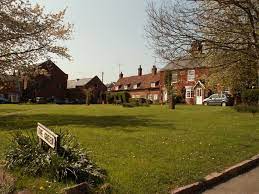
Most of my latest Austen vagary takes place in Hertfordshire; therefore, it was necessary for me to work in some of the places in the area and relate them back to the original Pride and Prejudice. One way I did so was to introduce my readers to a place called “Kimpton,” a village in Hertfordshire (with only a little over 2000 residents today), some seven miles north of St Albans. It is mentioned in the Domesday Book, which you will learn something of in the excerpt below. The manor house associated with the village’s founding was later held by the Hoo-Keate family and then, by marriage to the “Dacre” family. 

I dearly love it when little links fall into place and become part of the story line.

Do you not think the real-life “Kimpton” sounds something of the imaginary “Kympton,” where Wickham was to be clergyman? And what of the “Dacre” family? Could they be distant relations to Fitzwilliam Darcy? Spellings varied greatly at the time. LOL! 

In truth, the title Baron Dacre was created three times in the Peerage of England, every time by writ. (You may read about the various times the barony was created and forfeited HERE.) Ralph (or Ranulph) Dacre, 1st Baron Dacre, was summoned to the House of Lords as Lord Dacre in 1321. Ten years later, he was appointed High Sheriff of Cumberland and Governor of Carlisle. [Remember: By some accounts, Carlisle is none other than Camelot, the mythical seat of King Arthur’s court, based on the idea Sir Gawain, one of the Knights of the Round Table, stayed at the Castle of Carlisle on a hunting expedition in the haunted Inglewood Forest, as related in a poem of the period. These events parallels another 14th century poem, “Sir Gawain and the Green Knight.” [Sorry! Former English teacher geeking out again!]

If one looks at the list of Governors of Carlisle, he will see a number of the Dacres were named so, including William de Dacre (appointed by Henry III), Ralph Dacre, 1st Baron Dacre (appointed by Edward III), Thomas Dacre, 2nd Baron Dacre (appointed by Henry VII), William Lord Dacre of Gillesland (appointed by first Henry VIII and also by Edward VI, Mary I, and Elizabeth I). Yet, a closer look shows us one Ralph Fitzwilliam, Baron of Greystoke, who was appointed by Edward II. “Fitzwilliam”??? Now, where have we heard that surname before?

Enough of my teasing. In this excerpt, Darcy has let horses from Bingley so Darcy, Elizabeth, Jane, and the colonel can all go riding out together. Bingley tags along in hopes of an opportunity to apologize to Jane Bennet AGAIN for not returning to Hertfordshire when the lady thought he should. At this point, the colonel is “ignorant” of the former connection between Jane and Bingley. 

Earlier in the book, Elizabeth realized Darcy was the same man of whom Wickham had spoken. They have a mighty argument (as would be expected of ODC), but the colonel has set Elizabeth straight on Wickham’s true character. In this scene from the end of Chapter Five and the beginning of Chapter Six, she explains something of her confusion to Darcy. ENJOY!  

Elizabeth greatly enjoyed the banter between the gentlemen, but she would wish, just once, to be thought equal to Jane’s attractiveness. Her sister’s blue riding habit made Jane’s eyes appear bluer and her complexion fairer. Meanwhile, Elizabeth’s sometimes green and sometimes brown eyes knew no complementary color, at least, not one which did not make her feel “drab” and “insignificant.” She had never been one to be jealous of Jane; yet . . . 

“As to your cousin’s observations, I shall answer for myself, Mr. Darcy,” Elizabeth responded. “Better to be called ‘sensible’ than ‘insensible.’” 

Mr. Darcy appeared to ignore her defense. Instead, he said, “If you are prepared, allow me to provide you a hand up, Miss Elizabeth.” 

Elizabeth reluctantly nodded her agreement. First, she fished in her pocket to provide the bay a sliver of sugar. “Permit me to spoil you, my beauty. No one can look upon you and not see your exquisiteness.” 

Mr. Darcy stepped behind her. “No man worth his salt could think you anything but exceptionally handsome,” he said softly and for her ears only. 

She turned slowly to look up at him. “Sometimes I wish . . .” 

She was not permitted the opportunity to confess her deepest wish, for the colonel called, “Do you require my assistance, Darcy?” 

The gentleman shook off his cousin’s teasing. “Miss Elizabeth is simply pampering the bay.” He caught her elbow and directed her toward the animal’s side. Rather than asking her to place her foot in his interlocked fingers, he lifted her with ease—his hands about her waist—to the saddle, to set her in the seat and brace her until she could wrap her knee about the “horn,” before adjusting the strap holding the stirrup iron. 

Afterwards, the gentleman strode to the dappled grey stallion awaiting him and mounted easily. Elizabeth admired his seat. The man obviously knew his way about a horse. She could give no credence to his naming her as “handsome,” but his praise had been what she had required at the moment. It was nice to think he understood her just a bit. 

Naturally, she would not latch her hopes on the man, but she was not completely immune to his charms. “He will only be in Hertfordshire for another sennight,” she murmured. “Then he will return to London. Do not become too attached to him.” Yet, she feared her warnings had been spoken too late.

* * *

Darcy had never viewed a woman so in tune with the horse she rode. Certainly, he was acquainted with any number of women who rode in London’s parks and even a few who rode with men at a fox hunt. His own sister was a fair hand with the ribbons, and his mother was said to be a superb rider, but watching Miss Elizabeth and the bay was as if he watched how God imagined a horse and a human could communicate. 

He knew without being told Miss Elizabeth Bennet thoroughly enjoyed the freedom the ride provided. He, too, felt the pressures of the last few days leaving his stiff muscles as the miles sped by. He glanced over his shoulder to view his cousin, Bingley, and Miss Belwood further and further behind. 

The wind upon his face felt as if it cleared his thinking, and he was one with nature. Hertfordshire certainly could not compete with his blessed Derbyshire, but the shire possessed its own unique beauties, one of which rode the little bay some twenty feet ahead of him. He should not have taken note of the lady’s perfectly formed le cul d’une femme—her derriere, but he had, and his hands still tingled from the pleasure of holding her about her waist. 

* * *

Elizabeth smiled as she rode ahead of her little party. It was not because they had, by silent consent, permitted her to lead, but, rather, it was simply being seated upon a spirited horse, as well as still indulging in the compliment Mr. Darcy had provided her. Although it would have been an impossible task, she was relatively certain the gentleman had read her thoughts, and, even if his declaration was false, she would cherish his compliment and his kindness forever. 

They had permitted the horses to gallop for a good period of time. Breathing in the clean Hertfordshire air, she guided the bay around the cluster of Holm oaks surrounded by a field of sedum, still in bloom. 

At length, she pulled up on the reins and looked down upon the village of Kimpton. Within seconds, Mr. Darcy drew up beside her. “This was always one of Papa’s favorite places,” she explained as they waited in companionable silence for the others to join them. The gentleman appeared to be of a like nature, not wishing to speak unless absolutely necessary; yet, Elizabeth knew from his quietness he, too, appreciated the view. 

Within minutes, the others joined them, and Elizabeth swallowed the twinge of regret at losing the feeling of “closeness” she had experienced with Mr. Darcy. 

“One of our father’s special places,” Jane said. 

“As we waited, I told Mr. Darcy something similar,” Elizabeth admitted. “The village below is Kimpton, and it is mentioned in the Domesday Book. It says, ‘In the Half-Hundred of Hitchin 24 Ralph holds Kimpton from the Bishop. It answers for 4 hides. Land for 10 ploughs. In Lordship 2; a third possible. 2 Frenchmen and 12 villagers with 2 smallholders have 7 ploughs. 3 cottagers; 5 slaves. Meadow for 6 oxen; woodland, 800 pigs; 1 mill at 8s. The total value is and was £12; before 1066 £15. Aelfeva, mother of Earl Morcaz held this manor.’” 

“You know the passage word for word?” Mr. Darcy asked in awe. 

“Not as accurately as I would hope,” Elizabeth admitted with a blush. 

“Do not believe her, Mr. Darcy,” Jane teased. “Elizabeth possesses a remarkable memory.” 

Feeling self-conscious, Elizabeth shrugged her response. “Not so remarkable,” she declared. “Unless for a bit of history.” 

Jane added, “Some of the houses from what is called ‘High Road’ date back to the 1500s.”

The colonel asked, “Does the village possess an inn or an ale house?”

“Yes, I will show you,” Jane said. “Follow me.” 

Her sister led Mr. Bingley and Colonel Fitzwilliam down the gentle hill. By silent consent, Elizabeth and Mr. Darcy followed. She glanced to the man beside her. “Might I share a revelation of sorts with you, sir?”

The gentleman sounded curious. “More history, Miss Elizabeth?” he asked as he nudged his horse forward so they might follow the others at a sedate pace.

“My observation involves Mr. Wickham,” she cautioned. 

She did not look at him. Even so, she knew a frown marked his brow, and he sat very tall and straight in the saddle, as if he expected her to strike him. “If you must, madam,” he said through stiff tones. 

“I would not wish to injure you, sir,” she admitted. 

They remained in silence for several seconds before he offered assurances. “I will trust you, Miss Elizabeth.” However, his facial expressions, when she looked upon him, told her he would prefer not to hear her tale. 

Yet, Elizabeth was certain Mr. Darcy would find her story “amusing,” or perhaps the word might be “enlightening.” Therefore, she claimed the trust he had presented her and carefully spoke what she thought was important for him to know. “When Mr. Wickham spoke of the living he thought had been denied him, he spoke of ‘Kympton.’ With his northern accent, at first, I kept thinking the lieutenant was saying ‘Kimpton.’ They sound so similar and possess a close spelling. I kept wondering where a church for his services existed in Kimpton, for I was relatively assured those in Kimpton go into Harpender and attend the church at St Nicholas.” 

Thankfully, Mr. Darcy smiled at her. “Did not Mr. Wickham tell you I held the living for Kympton?”

“Naturally, he did,” Elizabeth shared. “But, you see, the Earl of Morcar’s manor—the earldom I mentioned from the Domesday listing—was later held by the Hoo-Keate family and then, by marriage, to the Dacre family. When Mr. Wickham was saying ‘Darcy,’ through his somewhat strong Derbyshire accent, my mind was conjuring up all the tales of the Dacres I could recall from my father’s stories of the family.”

“I have warned Mr. Wickham on multiple occasions,” he shared, “those in London speak with a different intonation than do those in the shires.” He looked off to where his cousin’s party rode ahead of them. “Were the Dacres notorious?” he asked with a gentle smile, and Elizabeth knew she had not offended him. 

“Just in the fact they were styled as barons in three different generations, and, perhaps,” she teased, “for a sundry of other offenses.” 

“How so?” he inquired.

“In 1321, Ralph Dacre was summoned to the House of Lords as Lord Dacre. Later, he became High Sheriff of Cumberland and Governor of Carlisle.” 

“A member of my mother’s family, the Fitzwilliams, also served as Governor of Carlisle, and, ironically, he, too, was a ‘Ralph.’ Ralph Fitzwilliam, Baron of Greystoke. He served under Edward II.” 

“Ralph Dacre served under Edward III,” she clarified before continuing. “Lord Dacre married Margaret de Multon, Baroness Multon of Gilsland, but he did so without Edward III’s permission, for, you see, Margaret was the King’s ward. Ralph stole her away in the night.” 

“Was he not hanged for his offense? Many have hanged for a lesser crime,” he observed. 

“Pardoned, for the lady was of age.” 

“Fortunate for him,” Mr. Darcy remarked. “Being drawn and quartered would have placed a period on his barony.” 

Elizabeth was quick to say, “Oh, there were those in the Dacre family who were murdered and one, in particular, who was accused of murder. As to the second creation of the title, another Ralph, son of Thomas Dacre, the sixth baron, became Lord Dacre of Gilsland, but the title did not continue through that Ralph’s line. Thomas Dacre’s fifth son, Humphrey, became Lord Dacre in the third creation.” 

“I suppose for family history, it was advantageous for Thomas Dacre to father multiple sons,” he summarized. 

“Yet, can you see why I thought so lowly of you with Mr. Wickham’s tale of your perfidy? In my uninformed opinion, you were just another ‘Dacre’ whose sordid past brought about sometimes ill-gotten gains.” 

“I have forgiven you, Miss Elizabeth,” he said as he dismounted to assist her to the ground before a small inn. “There is no need for further explanation.” 

“For your kindness, I am truly blessed, but I wished you to know how much of our previous misunderstanding came about. I do not wish us to be at loggerheads.” She did not totally comprehend why she had confessed her tale, for the gentleman would soon be gone from her life forever, but, while he was here, she wished for his good opinion. 

“We will not argue, at least, not over someone as insignificant as Mr. Wickham,” he assured as he turned their steps toward the inn. 

“Yet, you may argue over something ‘significant,’” she asked. 

“I am counting on it, Miss Elizabeth,” he said with a grin. “I find you quite delightful when you mean for us to ‘discuss’ a topic upon which you are certain we will disagree.” 

TIME FOR A GIVEAWAY!!! I have 2 eBooks of Elizabeth Bennet’s Gallant Suitor available for those who comment below. Winners will be contacted via email October 6, the day after the book goes live.
Posted in Austen Authors, book excerpts, book release, British history, eBooks, Georgian England, Georgian Era, giveaway, historical fiction, history, Pride and Prejudice, Regency era, Regency romance, Vagary | Tagged , , , , , , , , , , , , , , , , | 14 Comments

St Albans in Hertfordshire, Setting for my Latest JAFF Novel, “Elizabeth Bennet’s Gallant Suitor” + a Giveaway

Today is a continuation of my celebration for my newest Austen-inspired book, Elizabeth Bennet’s Gallant Suitor: A Pride and Prejudice Vagary. The book is on preorder now and will release on October 5. Grab your copy before the price change kicks in. 

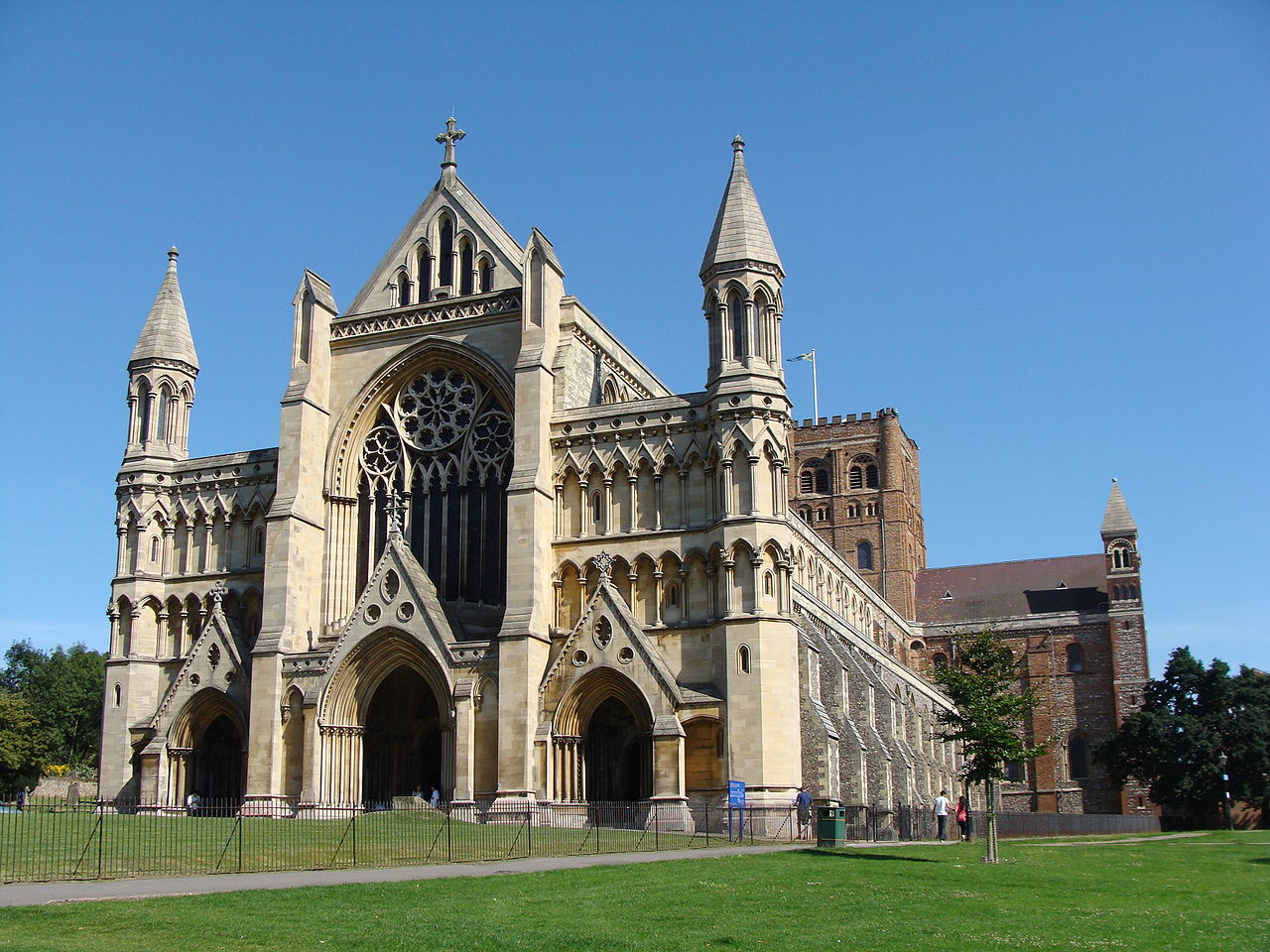
Cathedral and Abbey Church of St Albans, St Albans, Hertfordshire, UK ~ Wikipedia

Much of the action of Elizabeth Bennet’s Gallant Suitor takes place in or near St Albans in Hertfordshire. St Albans is a cathedral city, some 20 miles northwest of London. It was the first major town on the old Roman road of Watling Street for travelers heading north and became the Roman city of Verulamium. Nowadays, it is within the London commuter belt. 

St Albans takes it name from the first British saint, Alban. The most elaborate version of Alban’s story appears in Bede’s Ecclesiastical History of the English People. In the tale set in the 3rd or 4th century, Alban provided shelter for a Christian priest fleeing his persecutors and sheltered the man in his own home. In speaking extensively to the man, Alban is converted to Christianity. When the authorities searched his house, he dressed himself as the Christian and accepted the persecutors’ punishment in the man’s place. He was beheaded, and it is said a well sprang up where his head came to a stop. 

Before the 20th century, St Albans was a rural market town, a Christian pilgrimage site, and the first coaching stop of the route to and from London, which accounts for its numerous old inns. 

St Albans High Street in 1807, showing the shutter telegraph on top of the city’s Clock Tower ~ Public Domain ~  https://en.wikipedia.org/wiki/File:Stalbanshighstreet1807_cropped640.jpg Original print is annotated “Engraved from a Drawing by G. Shepherd”, “for the Beauties of England and Wales.”

“The mixed character of St Albans and its proximity to London have made it a popular filming location. The Abbey and Fishpool Street areas were used for the pilot episode of the 1960s ecclesiastical TV comedy All Gas and Gaiters. The area of Romeland, directly north of the Abbey Gateway and the walls of the Abbey and school grounds, can be seen masquerading as part of an Oxford college in some episodes of Inspector Morse (and several local pubs also appear). Fishpool Street, running from Romeland to St Michael’s village, stood in for Hastings in some episodes of Foyle’s WarLife Begins was filmed largely in and around St Albans. The Lady Chapel in the Abbey itself was used as a location for at least one scene in Sean Connery’s 1995 film First Knight, whilst the nave of the Abbey was used during a coronation scene as a substitute for Westminster Abbey in Johnny English starring Rowan Atkinson. The 19th-century gatehouse of the former prison near the mainline station appeared in the title sequence of the TV series Porridge, starring Ronnie Barker. The 2001 film Birthday Girl starring Ben Chaplin and Nicole Kidman was also partly filmed in St Albans.

“More recently, several scenes from the film Incendiary, starring Michelle Williams, Ewan McGregor and Matthew Macfadyen, were filmed in St Albans, focusing in particular on the Abbey and the Abbey Gateway. It has also been used in the setting for the fictional town Waltringham, in the TV show Humans. As well as this, in late 2021 celebrities such as Timothee Chalamet and others were spotted in Verulanium Park filming the new Charlie and the Chocolate Factory, though the release date has only been speculated at, rather than being released officially by the filmmakers.”

Book Blurb 

When Elizabeth Bennet’s eldest sister is named as the granddaughter of Sir Wesley  Belwood, the Bennet family’s peaceful world is turned on its ear. Over Mr. Bennet’s objections, when Sir Wesley orders Jane to Stepton Abbey, Mrs. Bennet escorts her daughter to meet Jane’s true grandfather, a man who once turned the former Frances Gardiner Belwood out without even a widow’s pension. Elizabeth accompanies the pair, in hopes of protecting both from a man none of them truly know. 

Fitzwilliam Darcy travels to Stepton Abbey with his cousin, Colonel Fitzwilliam, whose Uncle Wesley has summoned the colonel to the abbey to meet the baronet’s granddaughter. Sir Wesley is the Countess of Matlock’s brother, and the man wishes for a marriage between the colonel and Jane Bennet (née Belwood) in order to keep the abbey in the family, while Darcy means to be in a position to protect his cousin from being forced into a marriage of convenience.  

When Elizabeth Bennet and Mr. Darcy meet sparks of self-righteousness fly between them, but soon they join forces to protect their loved ones from Sir Wesley’s manipulations. Moralizing soon turns to respect and then to trust and then to love. This is a friends to lovers tale turned upon its head with unexpected consequences for all. 

Excerpt from Chapter Twelve . .

When Lindale learned of the upcoming horse race, the viscount had insisted they all go into St Albans and enjoy the amusements already pouring into the market town. Fearing Sir Wesley’s return and the baronet finding an empty house, Mrs. Bennet “regrettably” remained at the abbey, charging each of her girls, especially the two youngest, to remember they were in the company of “two very distinguished gentlemen and a future earl.” They were each to be on her best behavior, but Darcy overheard the woman warn the two eldest not to permit Miss Lydia and Miss Katherine out of their sights. 

The men had ridden in Lindale’s town coach, while Darcy permitted the ladies the use of his larger traveling carriage, even though he would have preferred to have sat beside Miss Elizabeth and enjoyed the scent of lavender wafting off her skin and the conversation he had become accustomed to share with the lady. He would, unquestionably, regret losing her company when this adventure knew completion. 

At last, they reached St Albans without incident. If the rest of the day had gone as smoothly, Darcy would have been on his knees with words of thanksgiving. Such was not to be. 

Lindale had claimed Miss Belwood on his arm, with Miss Lydia demanding to join them. Darcy thought Lindale should have seen Fitzwilliam and Miss Belwood together, but his eldest cousin would, naturally, wish to be seen with the so-called “beauty” of their group. Darcy could tell Rowland Fitzwilliam was not best pleased by Miss Lydia’s forwardness, but he tucked the girl in on his other side and led the way down the busy street. The colonel followed with Miss Mary and Miss Kitty, leaving Darcy and Miss Elizabeth to walk together. 

In truth, he did not mind having the lady all to himself; even so, he prepared himself for more of her astute observations. 

“I suppose Jane told you of her aversion to a reconciliation with Mr. Bingley,” she said as they followed the others. 

“She did,” he said, “As Bingley’s friend, I had hoped she would agree to forgive him, but she assures me, she cannot. I explained why he delayed his return, and your sister grudgingly admitted she understands his predicament. However, she cannot forgive his lack of effort in informing her of his intended return: He did not consider the situation in which he left her to face the shame and mocking of others.”

Miss Elizabeth admitted, “Dozens of our neighbors commented on Jane losing yet another suitor, but I thought once we encountered Mr. Bingley at Longbourn again, all would be forgiven. Even I did not realize the depths of her despair. It makes me very sad to realize I failed her and nearly as bad as did Mr. Bingley.” 

“I doubt Miss Belwood sees you as anything less than a loving sister who wants only the best for her,” Darcy assured.

“Will Colonel Fitzwilliam agree to a marriage to Jane?” Miss Elizabeth asked. “Your cousin appears less than enthusiastic about marrying her. How could he object to Jane? She is both lovely and kind.” 

Darcy did not respond immediately. At length, he said, “No doubt Fitzwilliam would agree regarding Miss Belwood’s many fine attributes, but, in order to marry her, my cousin would be giving up a career in the military, one he has crafted over the last eight years, with a look forward to what he will do as an occupation after the war. Fitzwilliam hopes to join Whitehall and earn his living in government service. Did you realize he may soon be made a brigadier?” 

Miss Elizabeth said, “I had no idea. I never considered how much he might lose if he married Jane. I simply thought of the advantages of their joining.” 

“Fitzwilliam will eventually inherit a small estate in Oxfordshire when another relation passes; therefore, though it would be an asset, Stepton Abbey does not have the draw it might have for another man. My cousin has known his destiny all his life, and he has purposely crafted connections over those years since university with individuals who would aid him in a life of his own choosing. Just as Miss Belwood has been forced into a life not designed for her, so will be my cousin if he agrees to marry your sister. It truly worries me for the success of such a joining, for each will have given up his or her dreams for a ‘whim’ of a man of Sir Wesley’s nature. Pardon me, but if I am required to agree Miss Belwood should have a say in this matter, I must insist we apply the same standards to the colonel.” 

Miss Elizabeth was quick to say, “I agree. I just assumed, as a second son, he would embrace the opportunity to claim an estate and a comely wife.” 

“You do not think Miss Mary is comely?” Darcy asked cautiously. 

Miss Elizabeth looked to where the colonel walked with two of her sisters. “You have previously suggested a connection between the colonel and Mary, but I never considered it seriously, even though Mary asked Kitty to assist in making her appearance more appealing, something Mary has never done previously. As the colonel is proving to be Mary’s ‘first flirtation,’ I just assumed he would leave, and she would know a broken heart. My father and I briefly discussed how such might be devastating for her, at first. But . . .” She did not finish, simply watched the ease with which the colonel and Miss Mary conversed, viewing it with “new” eyes. 

“A man, especially a man who has often looked Death in the eye and walked away, wants something different in a woman than does a man who has never worked a day in his life,” Darcy confided. “Previously, you said, Miss Mary tends to be more religious than, say, even yourself. Can you not imagine a man who questions God’s hand in the destruction to which Fitzwilliam has stood witness requires a mate who can quietly speak to God’s love and the Lord’s benevolence in keeping the colonel alive when others have died—a woman—perhaps not an enchantress on the outside, but one who possesses a deeply beautiful and caring soul? Equally as important, I know Fitzwilliam will claim he possesses a less than  handsome countenance, for I have heard him say so often, though I can think of no finer gentleman. Yet, I have never viewed him singling out the beauty at a ball. He often chooses those looked over the first time, for he says they are essentially more interesting than the diamonds of the first run. Despite holding an allegiance to Lord Lindale, I must say Fitzwilliam is the truest companion of my life. Obviously, one cannot judge a book or a person upon first glance.”

Before Miss Elizabeth could respond, Lindale stopped up ahead, and, when Darcy noted who was to greet them, he instinctively nudged Miss Elizabeth closer to his side. 

“Darcy,” Lord Samuels said, “I should have known you would be around.” 

“Would not wish to disappoint you, Samuels,” Darcy said blandly. He and Samuels had competed for top honors, as well as competitive rowing while at university, and Samuels did not enjoy being second in either. 

Lindale was saying, “Samuels, Coppersmith. Permit me to introduce my cousins. This is Miss Belwood, Miss Elizabeth Bennet, Miss Mary Bennet, Miss Katherine Bennet and Miss Lydia Bennet.” He nodded to each lady in turn as they bobbed a curtsey. “Ladies, may I present Lord Samuels and Mr. Coppersmith.”

Coppersmith asked, “Is there no Miss Bennet. You have Miss Elizabeth, Miss Mary, Miss Katherine, and Miss Lydia?”

Miss Lydia responded before any of them could form a proper explanation. “Jane is also Miss Bennet.” 

“Jane?” Samuels asked. 

Lindale must not have approved of the lecherous look in Samuel’s eyes. “It is a long story.” Darcy’s cousin offered the baron no further explanation. “You must pardon us. We promised the ladies new ribbons for their bonnets and a proper meal before we return to the abbey.” 

“The abbey?” Samuels inquired.

“One of my uncle’s homes. We are visiting with him for a few days,” Lindale said with a touch of impatience. 

“Will we see you ‘all’ at the race?” Samuels persisted with a knowing tone. 

Thankfully, Miss Belwood caught her youngest sister’s arm before Miss Lydia could again provide information no one wished her to share. “Come along, before the gentlemen change their minds about the ribbons, Lydia.” She tugged the girl away from where they all still stood. Immediately, the other three ladies dipped a parting curtsey and followed, with Miss Elizabeth keeping the Misses Mary and Kitty close to her side.

“Explain yourself,” Samuels demanded. 

“Nothing to explain. Miss Belwood is the daughter of my mother’s nephew, Stewart Belwood, who passed before she was born,” Lindale spoke in bored tones, indicating his impatience with Samuels. “Her mother remarried and produced additional children for her husband, a country squire from Hertfordshire. Now you know my family’s history and should be excessively glad I do not pester you to chronicle your own family lines. I assume even you are reasonably capable of repeating mine accurately, if anyone else is foolish enough to ask something of the Matlock family.” Lindale pulled himself up in a manner reminiscent of his father when someone taxed Matlock’s patience one time too many. He gestured for both the colonel and Darcy to precede him. 

Samuels, evidently, did not know when to cut his losses. “Will you return to St Albans for the race?”

Darcy and Fitzwilliam turned to view Lindale’s response. 

“I do not recall a need to ask for your approval of my plans,” Lindale said in displeasure. 

“We should go,” Coppersmith tugged slightly on Samuels’s arm. 

“All I meant,” Samuels persisted, “was to tell Lindale not to bet on the filly from the Netherfield estate.” 

Darcy’s interest had returned. “And why is that, Samuels?” he asked. 

The baron appeared to be satisfied to know Darcy was game for some gossip. “Last evening, I overheard two shabby-looking men talking about making certain the Netherfield horse would not be able to run.” 

“Is such all they said? Nothing on what they planned to do?” Darcy pressed. 

“No more,” Coppersmith assured. “They left the inn shortly afterwards.” 

“Are you planning to bet against the odds, Darcy?” Samuels taunted. 

Darcy’s mind was already planning on how to protect Bingley’s investment. “You of all people should know I never lose,” he said cryptically. “Come along, Lindale, we should not keep the ladies waiting.” 

Giveaway: I have 2 eBook copies of the Elizabeth Bennet’s Gallant Suitor available to those who comment below. The eBooks will be presented to winners on October 6, after the book’s release.

Preorder the eBook HERE.

Posted in Austen actors, Austen Authors, book excerpts, book release, eBooks, Georgian England, Georgian Era, giveaway, historical fiction, Jane Austen, Pride and Prejudice, publishing, Regency era, Regency romance, research, writing | Tagged , , , , , , , , , , , , , , , , , | 13 Comments

Marriage A-la-Mode and the Upcoming Release of “Elizabeth Bennet’s Gallant Suitor” + a Giveaway

My latest Austen-inspired tale, Elizabeth Bennet’s Gallant Suitor, goes on preorder today. It is a friends to lovers to tale, but with more than one twist to mess with your minds. LOL! Part of it was inspired by William Hogart’s The Marriage Settlement.

The Marriage Settlement is the first in the series of six satirical paintings known as Marriage A-la-Mode painted by William Hogarth. (Wikipedia)

The plot of the painting is the unmitigated greed of the two fathers, the Alderman and the Earl. The Alderman is wealthy to excess, and the Earl is heavily in debt but still retains his ancient title. The Alderman is desirous of becoming the grandfather to a noble son, and the Earl wants to ensure his line is carried on, and is willing to put up with the common Alderman for the sake of his money.

Meanwhile, the soon to be married two are completely ignoring each other, and the bride is being courted by the lawyer. Myriad details show the true natures of the characters present, especially the Earl and his son.

In my tale the couple ignoring each other are Colonel Fitzwilliam and Jane Bennet, but, if you know anything of my writing, you know I love to twist a tale, sometimes turning it on its head and giving it a good shake.

Book Blurb:

When Elizabeth Bennet’s eldest sister is named as the granddaughter of Sir Wesley  Belwood, the Bennet family’s peaceful world is turned on its ear. Over Mr. Bennet’s objections, when Sir Wesley orders Jane to Stepton Abbey, Mrs. Bennet escorts her daughter to meet Jane’s true grandfather, a man who once turned the former Frances Gardiner Belwood out without even a widow’s pension. Elizabeth accompanies the pair, in hopes of protecting both from a man none of them truly know. 

Fitzwilliam Darcy travels to Stepton Abbey with his cousin, Colonel Fitzwilliam, whose Uncle Wesley has summoned the colonel to the abbey to meet the baronet’s granddaughter. Sir Wesley is the Countess of Matlock’s brother, and the man wishes for a marriage between the colonel and Jane Bennet (née Belwood) in order to keep the abbey in the family, while Darcy means to be in a position to protect his cousin from being forced into a marriage of convenience.  

When Elizabeth Bennet and Mr. Darcy meet sparks of self-righteousness fly between them, but soon they join forces to protect their loved ones from Sir Wesley’s manipulations. Moralizing soon turns to respect and then to trust and then to love. This is a friends to lovers tale turned upon its head with unexpected consequences for all. 

Excerpt from Chapter Three 

Elizabeth had waited, somewhat impatiently, for the gentlemen to retire for the evening. Supper had been a very stifled affair, even more so with Sir Wesley’s edicts and Mrs. Bennet’s continued silence, although her mother must have bitten off the end of her tongue many times over, for the baronet continued to insult all except his nephew and his granddaughter. If nothing else became of this chaos, Mrs. Bennet would, incontestably, own a renewal of her appreciation of Mr. Bennet’s generally kind nature. 

Mr. Darcy had kept his comments directed to his cousin and the baronet, and Elizabeth had felt the sting of his “silence” most poignantly; therefore, she had tacitly pledged to issue an apology as soon as possible, which, for her, meant counting the minutes until she heard Mr. Darcy and the colonel talking softly as they made their way to their quarters. 

As they drew near, she stepped into the soft light of the hallway. “Mr. Darcy, would you do me the honor of permitting me a moment of your time?” 

The gentleman glanced to his cousin, who said, “We may require the lady’s assistance, Darcy.” With those words, the colonel left his cousin and her alone in a semi-dark corridor. 

Elizabeth waited until the colonel entered his quarters before she said, “I wish to confess I have acted despicably in my dealings with you. I find myself quite off kilter in my thoughts of late. My dearest sister is being ripped from the bosom of her family, and I am being expected to stand alone and permit it to happen.

“Moreover, your announcement of Mr. Wickham’s true nature was another blow to my previous view of the world. I have always prided myself on my discernment until now.” She avoided looking directly into his steely grey eyes. She played with her lower lip a moment before asking, “Is there a means of earning a bit of your forgiveness?”

He leaned closer and spoke in hushed tones. “You are not the first woman to be taken in by Mr. Wickham’s half-truths and lies, and my cousin reminded me you had no point of reference to discern the truth. I, too, acted in a prideful manner. However, Fitzwilliam says our conversation was fortunate because, now, you will be less prone to accept any other lies Mr. Wickham offers you. In such a manner, our acquaintance has likely saved you from an imprudent choice.” 

“Are there other lies of which I should be made aware?” she asked in concern. 

The gentleman’s face screwed up in obvious self-chastisement. “You and I speak to each other in a different manner than do many new acquaintances. Why do you suppose such is true?”

She pulled a grimace at him. “I imagine it is because we care deeply for our loved ones and do not wish to view them injured by Sir Wesley’s manipulations. Consequently, we set aside some of the strictures society would have us practice.” 

“On that point, I can agree.” 

She opened the subject again. “You did not respond to my question regarding Lieutenant Wickham’s other schemes. What else should I know of the man?”

For an elongated pause, Mr. Darcy remained tight-lipped before saying, “Mr. Wickham wishes to live a life of luxury, never comprehending even a small estate demands constant care and labor. He, generally, how should I phrase this, searches out the wealthiest woman upon whom to share his ‘charms.’”

“Miss King,” Elizabeth whispered. 

“Pardon?” Mr. Darcy asked. 

“Miss King. The lady recently received an inheritance of ten thousand pounds. Mr. Wickham calls often on the girl,” Elizabeth explained. 

“I have viewed his efforts along those veins many times,” Mr. Darcy commented, “and I personally know three women who foolishly considered eloping with him.” 

“Three?” Elizabeth asked in amazement. 

Mr. Darcy replied, “I will explain all at a more opportune time, for now, it is late, and I am keeping you from your bed. Are we each forgiven for our earlier testiness?”

“I am willing if you are, sir,” she said with a small smile. 

“I am willing, Miss Elizabeth.” He caught her hand and brought it to his lips, placing a gentle kiss on her knuckles. The sensation sent her heart pounding a quick tattoo. “Good night,” he whispered. 

Releasing her hand, he turned and walked away, pausing briefly to nod to her before entering his quarters. Even so, Elizabeth did not move beyond bringing the spot on her hand where he had kissed it to caress her own cheek. “Oh, my . . .” she whispered. 

* * *

Darcy found her in the gallery the next morning. Like it or not, he had had several very “specific” dreams of Miss Elizabeth Bennet last evening, and the memory of how he shared himself with her still clung to him, even though he knew nothing was possible between them. He assumed it had something to do with how quickly their relationship had progressed and the sincerity with which they spoke to each other. “I thought we might go down to breakfast together. It would be good to prove to the others we have resolved our differences.” 

“Certainly,” she murmured in distraction. “Permit me a moment to return these engravings to their rightful place.” 

Darcy glanced to the collection. “Hogarth?” he questioned. 

“Yes, reportedly, Sir Wesley purchased the set when they were offered to subscribers back in the middle of the last century. According to my mother, Sir Wesley presented them to his son a year or so before Stewart Belwood married my mother. When the baronet drove her from the abbey, my mother wished to take them with her as something to give to Stewart’s child when it was older, but Sir Wesley adamantly refused her, going so far as placing the blame of his son’s death squarely on my mother’s shoulders. A guinea was all these items had cost him; yet, he would not permit my mother even one memory of her marriage.” 

“A bit of irony, do you not think?” Darcy asked as he looked closer upon the grouping. “Especially as the first one in the series is called ‘The Marriage Settlement.’”

Miss Elizabeth smiled up at him. “Yes, it depicts Hogarth’s opinion of the disastrous consequences of marrying for money rather than love.” 

Darcy agreed. “Just look. There are the two self-seeking fathers—one a spendthrift nobleman requiring a fortune to keep his estate alive and the other a wealthy London tradesman who desires to see his daughter move in aristocratic circles.” 

“Irony indeed,” the lady remarked. “See how the unhappy couple sit with their backs to each other and are obviously bored by the negotiations when it is their future being discussed.” 

“Perhaps Sir Wesley thought the image hit a little too close to home,” Darcy summarized, “although he likely presented the engraving to Stewart long before the man made your mother’s acquaintance.” 

“Mama says otherwise. She claims they were in a package presented to Stewart from his father some weeks before the wedding. Sent from the family estate along with other items belonging to her late husband and left behind when Stewart departed the family estate. I think it was a last minute reminder of what Stewart should expect in his marriage. As to my mother, she claims to have held Stewart Belwood in affection and he likewise with her, but I cannot help but to think it more than a coincidence how Stewart was disowned by Sir Wesley and my mother was the daughter of a wealthy London merchant. Perhaps ‘the father’ shared the engravings with his son as a warning rather than a gift from the heart.”

“I thought Sir Wesley disowned Stewart before the wedding,” Darcy observed. 

“He did, but only days before, not months, as one would assume. When he received word of Stewart’s intentions, the baronet made his objections known.” She shrugged her indecision. “Hogarth created art which imitated life.”

“Do you believe the engraving was an effort to prevent Stewart from pursuing a woman for whom the baronet held disdain?”

“You must have observed how much contempt Sir Wesley holds for my mother. He blames her for his son’s death. I assume, although the baronet already owned the engraving set, he chose to share it with Stewart when his arguments against the marriage did not prevail.” 

Darcy found he enjoyed the quickness of the lady’s mind as she discussed her points, as well as the myriad of emotions crossing Miss Elizabeth’s features. He thought he might seriously miss her when this adventure was over; yet, it was too soon to say. He asked with a smile and an offer of his arm, “We could speculate forever on the workings of Sir Wesley’s mind. For now, breakfast, Miss Elizabeth?”

“Gladly, Mr. Darcy,” she responded with the most compelling smile he had ever seen. He knew in that instant she would change his life in ways he had not anticipated.

GIVEAWAY: I have 2 eBook copies of Elizabeth Bennet’s Gallant Suitor available to those who comment on this post. The winners will be notified by email on October 6, 2022.

PREORDER the ebook HERE.

Posted in book excerpts, book release, British history, eBooks, excerpt, Georgian England, Georgian Era, giveaway, history, Jane Austen, marriage, Pride and Prejudice, publishing, Regency era, research, Vagary, writing | Tagged , , , , , , , , , , , , , , , , , , | 13 Comments

Annuities in the Regency as Basis for “Mr. Darcy’s Bargain”

Much of the action of my Mr. Darcy’s Bargain, is based around a scam perpetrated by Mr. Wickham upon the citizens of Meryton, as well as Mr. Darcy’s attempts to thwart him. Wickham convinces many in Hertfordshire to invest in an annuity scheme. But how exactly did annuities work during the Regency?

First, if you are like me, your eyes blur over when people in other fields start tossing around the “jargon” associated with their occupations. I do not pretend to be an expert in such matters as annuities, but I will attempt to keep my description of public funds at the time as simple as possible.

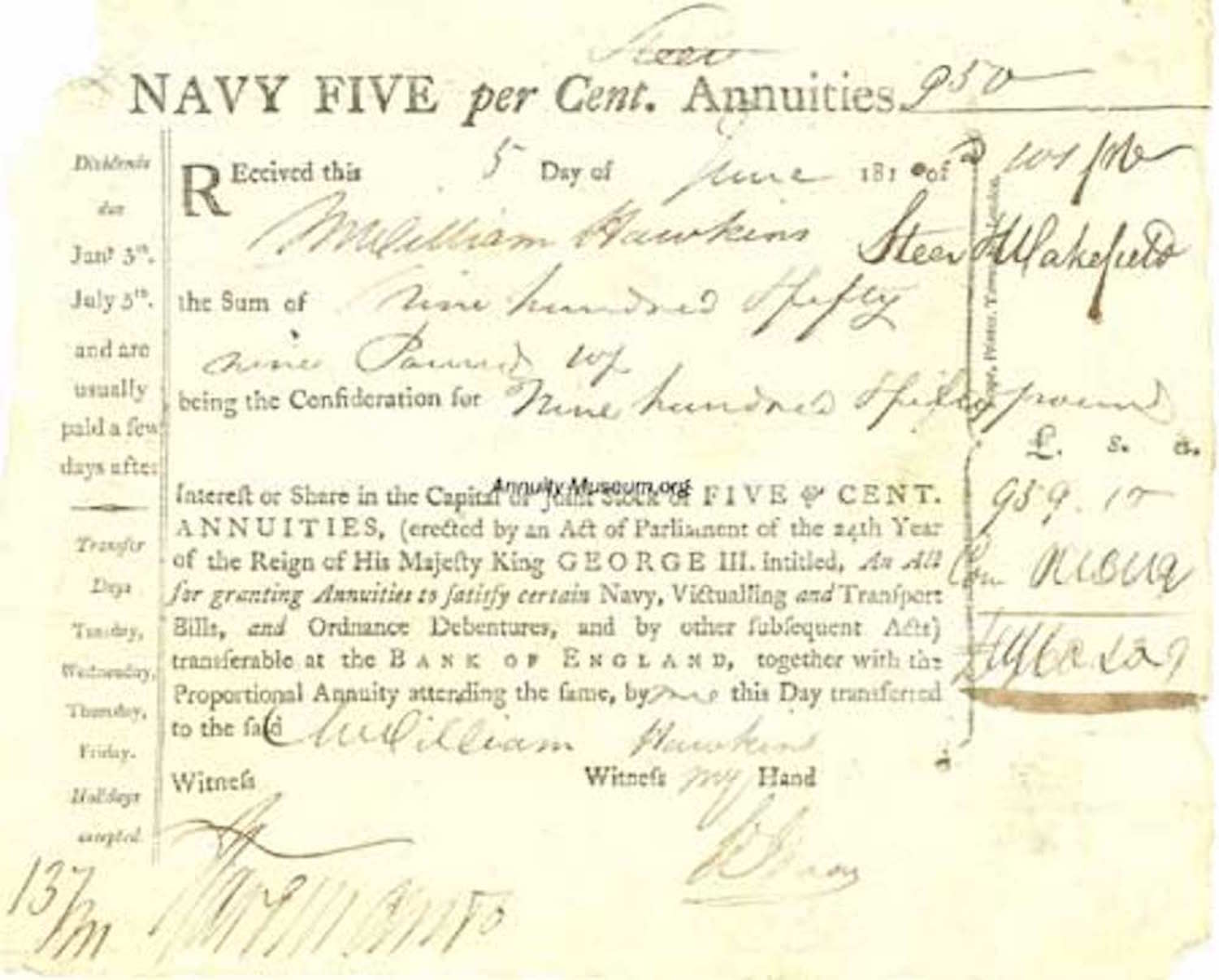
First, there were Navy five percent annuities that were produced from about fifty millions of stock, partly formed out of navy bills and converted in 1784, into a stock bearing interest at five percent, whence the name.

Four percent consolidated annuities were popular at the time. They were produced from a like stock as was the Navy five percent funds. They offered a profit of 4% as the title indicated. They originally carried a higher percentage rate.

Three percent consolidate annuities were produced by above four hundred millions of stock, in part formed by the consolidation of several stocks, bearing interest at 3%. When the word “console” is indefinitely used, it is always understood to mean these annuities. Three percent Irish annuities were produced by about two millions of stock formed by loans for use of Ireland, before the union with England.

The type of annuity Wickham presents to the Meryton citizens was one of bank stock, specifically the Bank of England. Bank stock was a capital of nearly 12 million with which the company of the bank has accommodated the government with various loans, and with which they carry on the banking business, purchase bullion, etc. The dividends on bank stock were at one time ten percent, so that the profits of the company were near twelve hundred thousand pounds per annum. This situation was the perfect scam. Who would not like to earn 10% interest.

10049-f-full-mid.jpg

Book Blurb:

When Elizabeth Bennet appears on his doorstep some ten months after her refusal of his hand in marriage, Darcy uses the opportunity to “bargain” for her acceptance of a renewal of his proposal in exchange for his assistance in bringing Mr. Wickham to justice. In Darcy’s absence from Hertfordshire, Wickham has practiced a scheme to defraud the citizens of Meryton of their hard-earned funds. All have invested in a Ten Percent Annuity scheme, including Mr. Bennet, and her family and friends are in dire circumstances. Elizabeth will risk everything to bring her father to health again and to save her friends from destitution, but is she willing to risk her heart? She places her trust in Darcy’s thwarting Wickham’s manipulations, but she is not aware Darcy wishes more than her acquiescence. He desires her love. And what will happen if Darcy does not succeed in bringing Mr. Wickham to justice? Will such end their “bargain,” or will true love prevail?

mdb-front-cover-1Purchase Links:

Amazon      Kindle     Kobo     CreateSpace

Excerpt: (Mr. Gardiner has called Wickham’s bluff and demanded a stock certificate as proof of the investment. Wickham brings one to Mr. Bennet, who is recovering from a spell with his heart.)

Already apprehensive over Mr. Bingley’s news, when Mr. Wickham again appeared upon their threshold, Elizabeth was sore to keep her composure. “If it would not upset Mr. Bennet, I would prefer to present him the certificates you requested,” the lieutenant announced after they exchanged greetings. 

It had been three days since his last visit. Elizabeth could not help but wonder if Lieutenant Wickham had actual certificates available. She shot a quick glance to her uncle. “Lizzy will call upon Mr. Bennet to see if my brother is awake. Doctor Doughty still provides my him with several powders. While Elizabeth tends her father, come join me in the small drawing room.”

Elizabeth reluctantly followed her uncle’s instructions. Tapping lightly upon Mr. Bennet’s door, she was gladden to observe his sitting before the window and reading a book. Such was one of her favorite memories of her father—always with a book in his hand. “Ah, Lizzy,” he called when she peeked in. “Come to keep your old papa company?”

“Anytime, sir,” she said with a true smile. “If I had known you were awake, I would have happily made an appearance.”

Her father’s cheeks claimed a bit of color. “Then join me. Surprisingly, I am in need of gossip from the lower levels of my house. With Mrs. Bennet still claiming the periodic role of invalid, unless, of course, she deems it her role to oversee Jane’s return to Mr. Bingley’s side, I possess no one to keep me abreast of the comings and goings under my roof. I feel somewhat bereft of the tattling, but do not speak a word of this to Mrs. Bennet, otherwise my lady will fill my remaining days with her chattering.”

“I fear I shall not deliver the latest news of Mr. Hill’s carbuncle with the same enthusiasm as does Mrs. Bennet, but I am certain I can present you with the abbreviated version,” she said with bemusement.

“Come sit with me,” her father instructed.

Elizabeth bit her bottom lips in indecision. “Actually, sir, Lieutenant Wickham has called and has asked to speak to you. When the gentleman last called upon Longbourn, uncle inquired of stock certificates. Mr. Wickham says he would prefer to present yours to you personally.”

Her father’s expression hardened in disapproval. “Gardiner has kept me informed of the latest developments. I wish you were not so deeply involved in this madness.”

“I am no longer a little girl upon your knee,” she argued.

“And more is the pity,” her father countered. “I would prefer the adoring eyes of my dearest Lizzy rather than the assessing gaze of Miss Elizabeth Bennet.”

“Are you well enough to speak to Lieutenant Wickham? If you are too tired, I will ask Uncle Gardiner to continue to act in your stead,” she asked in concern.

Her father sighed deeply. “I have avoided this chaos my foolishness has created long enough. See Mr. Wickham up.”

Elizabeth was not happy with this choice, but she nodded her acceptance. “I shall return in a few moments, sir.”

Her father reached for her hand as she turned to go. “Elizabeth, leave the door to my dressing room open so Mr. Gardiner may hear my conversation with Lieutenant Wickham. I wish I possessed Gardiner’s aplomb in business. I will require his advice after Mr. Wickham’s departure. I would also prefer you remain in the room. Mayhap your presence will remind me of all I will lose if Gardiner and Darcy cannot catch Mr. Wickham in the act of fraud.”

“I shall tell the gentleman I mean to record some of what he says to assist your memory.”

On her way downstairs she called upon her aunt’s room to explain, “Lieutenant Wickham is below. He wishes to speak to Mr. Bennet. Father requests Uncle Edward secret himself away in Mr. Bennet’s dressing room to listen to the conversation. Could you relay the message while I see Mr. Wickham to father’s quarters?”

Aunt Gardiner agreed to use the servants’ stairs so as not to draw Mr. Wickham’s interest. Within a few minutes, Elizabeth directed the lieutenant into the small sitting room attached to her father’s bedchamber. In her absence, Mr. Bennet had moved his chair to face the open dressing room door with an empty chair backing the door behind which Mr. Gardiner would hide. He had placed a blanket across his lap and mussed his hair. He appeared less robust than previously.

“You will forgive me, Wickham,” her father said jovially, “for not rising. I fear struggling to my feet is still quite tedious.”

“I understand, sir,” Wickham repeated in practiced respect. “I shan’t keep you long.” He glanced to Elizabeth. “I am assuming your daughter has explained the purpose of my call.”

“She did,” her father acknowledged. “I asked Elizabeth to remain. I pray you hold no objections. My grip on a pen is not what it once was. Nor is my memory as sharp.” Her father demonstrated the tremble of his hand. The realization of his infirmity shook Elizabeth to her core. Tears rushed to her eyes. Had she missed that infirmity somehow?

“No objection, sir.” Mr. Wickham’s “show” of agreement opened her eyes further to how well the man could perform to his audience. The idea the lieutenant saw her as insignificant crossed her mind. Whereas Wickham looked upon her as a conquest, Mr. Darcy valued her intelligence. He would seek her opinions, as her father often did. The acknowledgment only proved how her earlier judgments of the man were faulty.

Once seated, Mr. Wickham reached into a leather satchel to remove a rolled document. “I have brought you the official certificate of annuities.”

“Annuities?” her father asked. “I thought we discussed investing in canals in both Surrey and Lancashire or shipping fleets to the West Indies.”

Wickham’s obsession with lint upon his uniform had returned. “We did, sir,” he confessed with an easy smile, “but after conferring with Kiernaugh, it was decided the funds would do better in an annuity. I would have discussed the change with you, but with your illness, I did not have the heart to disturb you further. Moreover, I spoke to Sir William and several others within the neighborhood, and each assured me you would hold no objections. I pray I did not err in securing your investment, sir.”

Elizabeth studied her father’s customarily animated features. The fact she could read none of his thoughts in his expression worried her.

“I should learn more of these annuities before I comment,” Mr. Bennet said evenly. He folded his hands upon his lap, a sign indicating his displeasure. Obviously, Mr. Wickham did not understand her father’s unconscious gesture.

Wickham cleared his throat in importance. “I do not pretend expertise in the matter, but I have learned much of government annuities of late. Over the years under King George’s rule, for example, we have seen stocks created by loans to Germany and Ireland before the union. Some of the annuities are called consols, or consolidated, from the stock having been informed by the consolidation of several debts of government.”

Elizabeth scratched out notes with a pencil of which she hoped her uncle could make sense.

Wickham continued, “Consolidated annuities are formed by the consolidation of several stocks bearing the same interest. In the past there have been three, four, and five percent stocks.”

Mr. Bennet observed, “I doubt there are many ten percent consolidated annuities.”

Lieutenant Wickham returned to the invisible lint, and Elizabeth bit her bottom lip to hide her smile. She wished she had recognized his habit earlier on.

“Not as many as we would like, but there are a few.” His voice sounded stiff with what was likely false pride for he did not expect her father to question his actions. “What we have chosen as investments are a form of bank stocks with which the bank has accommodated the government with various loans and with which to conduct banking business, such as purchasing bullions. The dividends on the bank stock are now ten percent, which could easily prove twelve hundred pounds per annum for the steady investor.”

Her father asked, “And this is the Bank of England of which you speak?”

“Most assuredly,” Wickham declared. “I think I should point out the India stock, which forms the trading capital of the East India Company, produces an annual dividend of more than ten percent.”

Mr. Bennet had yet to express his favor or disapproval. “I suppose I should see this certificate.” Lieutenant Wickham passed the rolled paper to her father. “Come here, Lizzy,” he instructed. “I will require your steady hand and your clear eyes.”

Elizabeth knelt beside her father, unrolled the paper, and held it where he could study it.

“Read it for me, Lizzy,” Mr. Bennet said with what sounded of exhaustion. She shot him a look of concern, but she did as he asked.

Swallowing back her tears, she read aloud, “The United Kingdom of Great Britain and Ireland Ten Per Cent Annuities. Received this 26th day of January of 1813, of Thomas Bennet the sum of one thousand pounds being the consideration for one thousand pounds. Interest or share in the capital of joint stock of the Ten Per Cent Annuities, (erected by an Act of Parliament of the 53rd year of the reign of His Majesty King George III Entitled, and all for granting annuities to satisfy certain Navy, Victualling and transportation bills, and ordnance debentures, and by other subsequent acts) transferable at the Bank of England, together with the proportional annuity attending the same, by Jasper Kiernaugh this day transferred to the said Thomas Bennet. There are also the names of the witnesses, as well as when dividends are paid, etcetera.”

Her father winked at her, and Elizabeth breathed easier. She had not known until that moment he pretended to be an invalid. To Wickham he said, “Everything appears in order. Most assuredly, I should have my solicitor look at this.”

“I assure you Mr. Philips approves of the investment,” Wickham said in confidence.

Her father motioned her to roll the certificate again and place it on the table. “I am pleased to hear Philips has examined the document.” He coughed heavily and then rested his head against the cushion of the chair back. “If you will pardon me, Lieutenant,” he said breathlessly. “I find my energies are thin. Lizzy, ring for Mrs. Hill to show Mr. Wickham out. I will require your assistance, child.”

“Certainly, sir,” Wickham said as he rose. “If you have additional questions, do not hesitate to send word. I remain your servant, sir.”

Mr. Bennet nodded genially, but as Wickham made his way to the door, her father said nonchalantly, “I am surprised Kiernaugh chose a loan to the English government. I thought the man an American. Are we not at war with the country?” He had not raised his head from the cushioned back.

Mr. Wickham stumbled to a halt as his expression betrayed how his mind raced to form a response. “I must have misspoke,” he said in what sounded of earnestness. “Kiernaugh has been in America for the better part of ten years, but his loyalties remain with England, as do all who serve His Majesty.”

Purchase Links: 

Amazon:   https://www.amazon.com/dp/1540317218/ref=sr_1_1?ie=UTF8&qid=1479045960&sr=8-1&keywords=mr.+Darcy%27s+Bargain

Kindle:  https://www.amazon.com/dp/B01N3VELUT/ref=sr_1_2?ie=UTF8&qid=1479045960&sr=8-2&keywords=mr.+Darcy%27s+Bargain

Or Read for free on Kindle Unlimited

Posted in Act of Parliament, Austen Authors, book excerpts, book release, British currency, British history, British Navy, commerce, eBooks, George Wickham, historical fiction, Living in the Regency, Living in the UK, Pride and Prejudice, publishing, Regency era, Regency romance, religion, Vagary | Tagged , , , , , , , | 6 Comments

Recording of Births in the Church of England During the Regency

Previously, I spoke of Churching of Women for how woman were treated after childbirth in the Church of England in many Western religions. “Churching” involved a celebration welcoming women back into the church/religion after they had given birth, even if the child was stillborn or passed shortly after birth or with no christening.

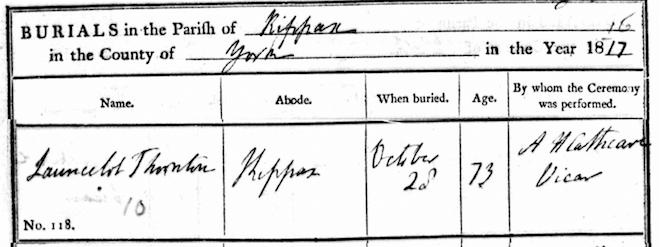
Today, we think of the recording of a birth as automatic. At most hospitals, the staff record such details ,and they are passed on to the proper authorities. The birth announcement appears in the local newspaper usually within a week of the actual birth. This was not so for the Regency. Birth announcements were not recorded during the Regency Era. Births were not always recorded in the parish registers. Generally, only the Baptism/Christening was recorded. Some clergymen listed the child’s age or birth date  when recording the  baptism, but most did not. Usually the child had to be breathing to be baptised and  given a name for the parish records, but that was not an “absolute” in the practice of recording births. [Note! Today the terms (baptism and christening) are interchangeable by many. A Christening is a naming, but the church believes baptism is to save the soul of the infant  and to enroll him in the church of believers. The secular name is incidental and just for records.]

According to Nancy Mayer Regency Researcher, “Most of the evidence upon which today’s perceptions of the era are founded is faulty. St Martin-in-the-Fields was probably the most fastidious of the parishes in those days, with the sextons recording in minute detail, everything about those they buried – and that included stillborns, abortives, infants (those who’d lived to draw breath), etc., etc.  Name, date of birth, date of death, address, sex, etc., etc.  No detail was missed.  But even in this parish there were anomalies based on the structure of burial fees – abortives were the cheapest burials. Chrisoms came next.  Stillborns were the third cheapest, and from there, the fees increased the longer the individual lived.  So many infants who had lived through the first crucial week only to succumb to the infections that so beset newborns, were buried as stillborns because the family could not or did not want to pay the higher fees. But even with the stillborns and the Chrisoms, the father’s name was recorded by the sextons.  It was not until well after the Regency that the mother’s name was included.” Although it rarely happened, in reality, the parents did not need to present for the baptism. 

No ecclesiastical law forbid the baptism of a stillborn child. It was the expense of doing so that prevented many from recognizing their child’s existence.

I understand the confusion and grief following the lost of a child for I lost two children before I had my son. It bothered me deeply not to have access to the one I lost early on. I could not shake the idea it would never have a name or a place in our family’s recorded history. However, many in the early 19th Century were developing what we now associate with the British public as a whole: the stiff upper lip. Grief was not shown in public. 

Other parishes were not as meticulous as St Martin-in-the-Fields. Generally, the person requesting the recording of the birth was at the “mercy” of the clergyman overseeing the parish. The clergyman’s opinions or those of the aristocrat providing his living could differ greatly from parish to parish. Some clergy would look poorly upon an abortive situation. An aristocrat might privately have a stillborn child baptised, but a public announcement of such would not occur. The recording of a child’s birth, or the lack thereof, is a major plot point in Book 2 of my Twins’ Trilogy, The Earl Claims His Comfort. Any “public” records, such as Debrett’s The New Peerage, would simply include the line stillborn daughter or stillborn son.
41VA23GR86L We find an example of such in Chapter 1 of Jane Austen’s Persuasion, Sir Walter Elliot picks up the Baronetage to read of his family history, “”ELLIOT OF KELLYNCH-HALL.
“Walter Elliot, born March 1, 1760, married, July 15, 1784, Elizabeth, daughter of James Stevenson, Esq. of South Park, in the county of Gloucester; by which lady (who died 1800) he has issue Elizabeth, born June 1, 1785; Anne, born August 9, 1787; a still-born son, Nov. 5, 1789; Mary, born Nov. 20, 1791.”

Many times the private family records, such as the family Bible, contained the name of the stillborn child. Parish records and private records did not always hold the same details. Often, especially in the male line, one might find two male offsprings with the same name in a private record, but the names of the children were listed as several years apart – the first one died at birth or shortly thereafter. 

As with everything else, there were those members of the clergy who accepted payment to record stillborns. Parents might, for example, argue the Bible does not speak to forbidding the naming of stillborns. Babies could be baptised at home by any member of the household as long as water was used and the child was baptized in the name of the Father, Son, and Holy Ghost. This was a valid baptism  in most cases. 

431184283c0ccbfe915e11bf06d3477a Anciently, a chrisom, or “chrisom-cloth,” was the face-cloth, or piece of linen laid over a child’s head when he or she was baptised or christened. Originally, the purpose of the chrisom-cloth was to keep the chrism, a consecrated oil, from accidentally rubbing off. With time, the word’s meaning changed, to that of a white mantle thrown over the whole infant at the time of baptism. The term has come to refer to a child who died within a month after its baptism—so called for the chrisom cloth used as a shroud for it. Additionally, in London’s Bills of Mortality, the term chrisom was used to refer to infants who died within a month after being born. (Chrisom)
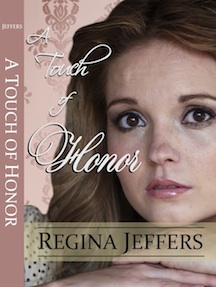
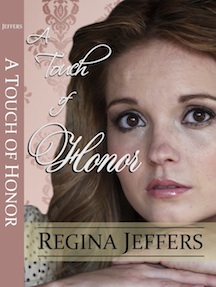
ATOHCrop2 In A Touch of Honor, Book 8 of the Realm Series, I used a different plot point associated with the recording of births and deaths. In the book, Lady Satiné Swenton dies in a terrible accident and the child she carried is also lost. The surgeon tending the body asks Lord Swenton if he wishes to have the stillborn buried with his mother. The mother and stillborn infant could be buried together as it was with Princess Charlotte’s child. In that case the child was not named. However, the father could insist on having the child listed in the death register and could have a name etched in the grave marker to recognize publicly the birth. The woman’s husband also held the option of having his wife and child buried in a private cemetery and act as he thought best for his family. 
parishbur

The Church of England provides this tutorial for the ceremony: 

What Happens at a christening?

At a christening a child is baptized with water. This is the heart of a christening. There are several moments in the service which have a special meaning too. Follow each step to see what happens.

“…I baptize you in the name of the Father, and of the Son, and of the Holy Spirit. Amen.”

Welcome

The vicar will welcome everyone and especially the child who will be christened and their family. There will be a Bible reading, and the vicar will also talk about what a christening means.

The promises

You and the godparents will make some important promises for your child in the service. You can see the full order of service here.  Everyone promises to continue supporting the child from this moment.

The vicar says: “…People of God will you welcome this child and uphold them in their new life in Christ?”

Everyone present says: “…With the help of God, we will.”

The sign

Often, this is the point in the service when parents and godparents will be invited to come out to stand at the front with the child. In many churches, a special oil may be used to make the sign of a cross on your child’s forehead. It’s a significant moment, which marks your child as belonging to God.

The vicar will say: “…Christ claims you as his own. Receive the sign of the cross.”

The water

Water which is blessed in the church’s font will be poured over your child’s head by the vicar. This is your child’s baptism. It’s a sign of a new beginning and becoming a part of God’s family.

The vicar says: “…I baptize you in the name of the Father, and of the Son, and of the Holy Spirit. Amen.”

Prayers and welcome

The vicar, or perhaps even someone else from the church, will pray for the child and for all those who will support them in their path of faith. Everyone present welcomes the child into the family of the church with words given in the service.

A candle

A candle will be given to the child at the end of the service.

The vicar says: “…Shine as a light in the world to the glory of God.”

Godparents play a special role in the ceremony and in the child’s life. The godparents were the ones to take the child to church, make the vows in his/her name, and say the name of the child for all the world to know. The godmother customarily holds the child during the ceremony. The child can be dipped into the baptismal font–first one side and then the other, but often water was poured on his head. Occasionally water was just sprinkled on or a damp cloth is used.  A cross is made with oil on the baby’s head to anoint the child. The rite in the Book of Common prayer of the day was used.

A female child was to have two female and one male godparent or sponsor, while a male child was to have two male and one female godparent or sponsor. Although they could serve the role, godparents were NOT automatically the child’s legal guardian of the child(ren) with the passing of a parent(s). A will would designate the legal guardian in such a scenario. 

During the Regency and beyond, royalty were often asked to be godparents to the children of peers, such as dukes or men who had positions at Court or were at Court often or were ranking members of Parliament. Quite often the royal godparents employed proxy stand-ins. When the child is 12 years of age, he/she would be confirmed; he/she would renew the promises made at his/her baptism for himself/herself.

You might wish to check out: 

10 Ways Christening Has Changed

Posted in British history, Church of England, Georgian England, Living in the Regency, Regency era | Tagged , , , , , | 5 Comments

Billiards in the Regency Era

Here I am again, answering a question from another reader on what I know of the game of billiards in the Regency era. Specifically, the person wanted to know whether the billiard balls were solid colored, striped, numbered? From the research I have done, thus far, (I would welcome any who know more than I to chime in.) I know the balls were made from ivory (female tusk was preferable for some reason,) and they plugged the hole where the nerve ran through the tusk with ebony.

The article from Wikipedia speaks to many of the rules, and, in truth, it has been many years since I have played billiards. I used to be quite good. A former beau was a superb player so he taught me a few tricks. LOL! If you never have played the game, the rules and terminology can be a bit confusing, especially for the traditional game of billiards. English billiards

“Dating to approximately 1800, English billiards, called simply billiards in many former British colonies and in Great Britain where it originated, was originally called the winning and losing carambole game, folding in the names of three predecessor games, the winning game, the losing game and the carambole game (an early form of straight rail), that combined to form it. The game features both cannons (caroms) and the pocketing of balls as objects of play. English billiards requires two cue balls and a red object ball. The object of the game is to score either a fixed number of points, or score the most points within a set time frame, determined at the start of the game.

“Points are awarded for:

Two-ball cannons: striking both the object ball and the other (opponent’s) cue ball on the same shot (2 points).

Winning hazards: potting the red ball (3 points); potting the other cue ball (2 points).

Losing hazards (or “in-offs”): potting one’s cue ball by cannoning off another ball (3 points if the red ball was hit first; 2 points if the other cue ball was hit first, or if the red and other cue ball were “split“, i.e., hit simultaneously).

One might find this piece especially helpful. A Practice Treatise on the Game of Billiards: https://books.google.com/books?id=RB1dAAAAcAAJ&pg=PA9&dq=billiards&hl=en&sa=X&ved=0ahUKEwiQrsP4wJDMAhVDeCYKHSvlA6MQ6AEIKzAA#v=onepage&q=billiards&f=false

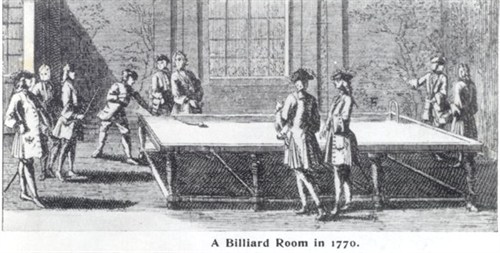
The game of billiards in England was not standardized in Regency England. There were a number of variations on how the game was played. In addition, billiard tables, cues and balls were all custom-made. Also, it might be useful to know English billiard tables had pockets, while billiard tables on the Continent did not.

Billiards in Regency England did not use as many balls as are used in the game today. In most cases, there was a single red “object” ball and two white “cue” balls (one for each player), with one of the white cue balls marked with a black dot, to distinguish it from the plain white ball. As the game evolved, to propel the players made use of the opposite side of the stick to get better results which came to known as “cue.” As the tip of the cue were, generally, very smooth, it was difficult to control where the ball went once it was struck. Someone around 1807 (do not know who) thought to place a small piece of leather on the tip of the cue, giving the player more control of the ball.

The use of several multi-colored balls was not introduced until 1819, with a table game known as “pool.”  So, if the story is set before 1819, the characters only have to deal with three balls on their billiard table, two white and one red. One might find this article on Regency Redingote helpful: You can find it here: https://regencyredingote.wordpress.com/2013/11/15/billiards-in-the-regency/

Other Sources:

Billiards During the Regency and Victorian Era

Entertainment in the Georgian Era

The History of Billiards

An Odd History of Billiards and Pool

Posted in British history, Georgian England, Georgian Era, Living in the Regency, real life tales, Regency era, research | Tagged , , , , , , | Comments Off on Billiards in the Regency Era

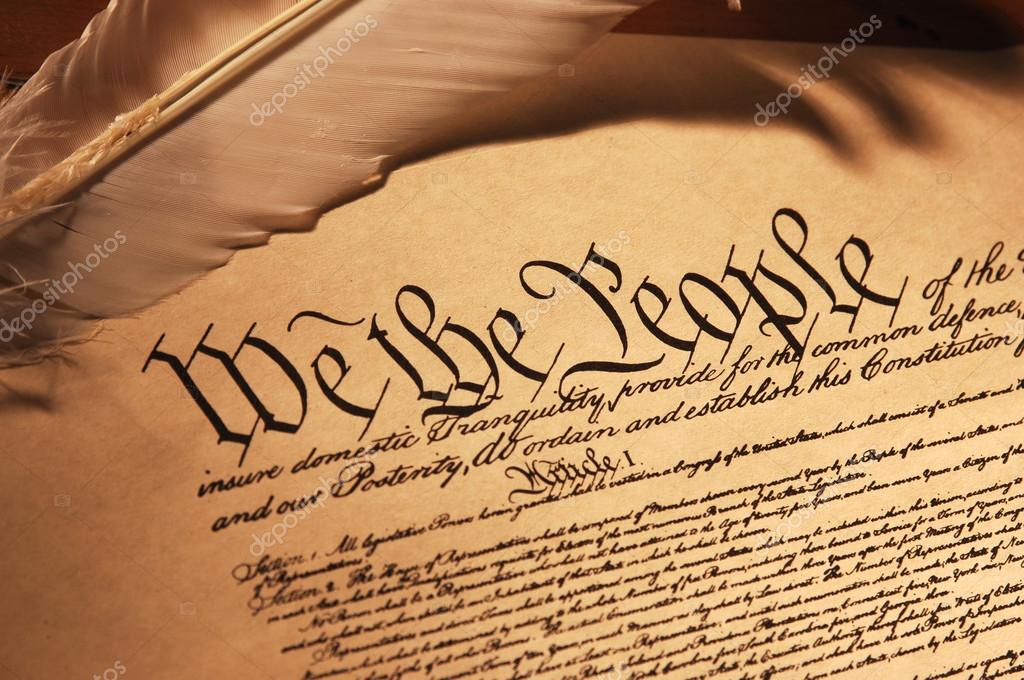
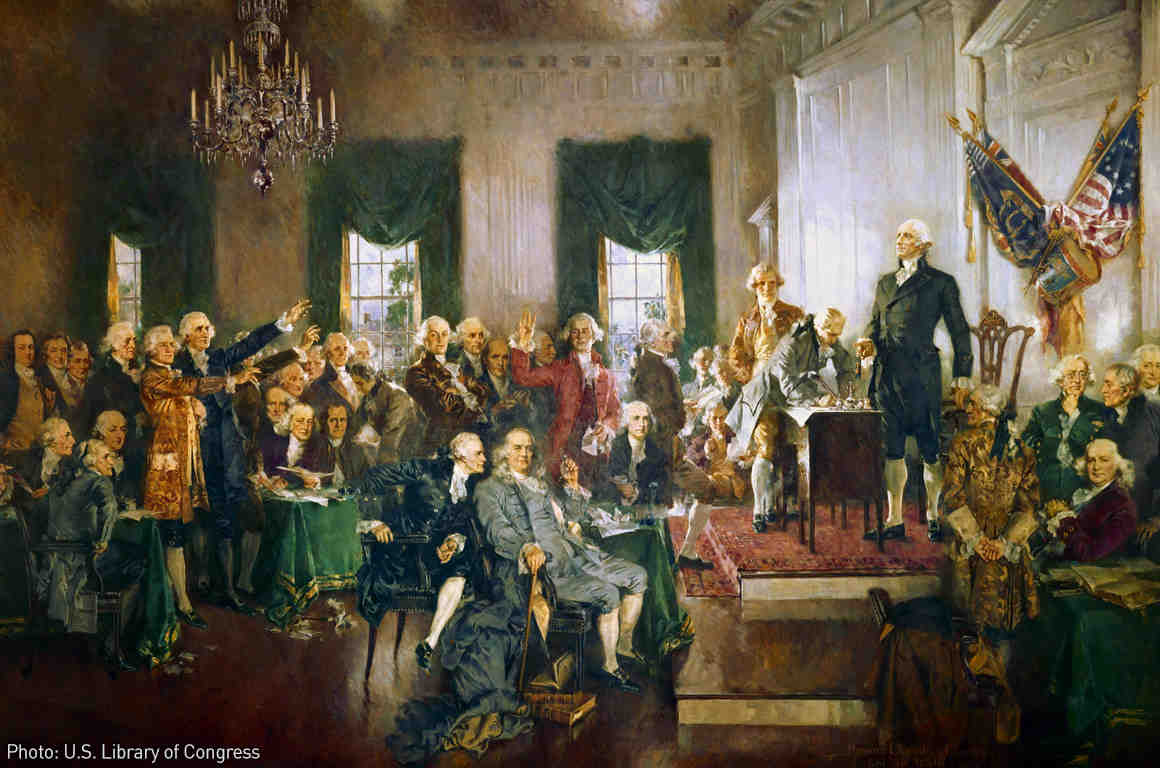
September 17, 1787, the U. S. Constitution Was Signed ~ 235 Years Ago

On September 17, 1787, 39 delegates to the Constitutional Convention in Philadelphia signed the Constitution of the United States. The next step was to have nine of the 13 U. S. states ratify it, but that process was not so easy.

Prior to this document being written, the U. S. had accepted the Articles of Confederation. “The Articles of Confederation and Perpetual Union was the first written constitution of the United States. Written in 1777 and stemming from wartime urgency, its progress was slowed by fears of central authority and extensive land claims by states. It was not ratified until March 1, 1781. 

“Under these articles, the states remained sovereign and independent, with Congress serving as the last resort on appeal of disputes. Significantly, The Articles of Confederation named the new nation “The United States of America.” Congress was given the authority to make treaties and alliances, maintain armed forces and coin money. However, the central government lacked the ability to levy taxes and regulate commerce, issues that led to the Constitutional Convention in 1787 for the creation of new federal laws under The United States Constitution.” (History.com)

As the Articles of Confederation did not prove to be a strong enough document to keep the fledging country together, in 1786, five states’ delegates met in Annapolis, Maryland. After long and often heated discussions, the other states were ask to send delegates to a new convention in Philadelphia, one meant to create a more important and more powerful centralized government.

At the first meeting in May 1786, all states were represented, except Rhode Island, which chose not to participate in the initial process. The group quickly determined the Articles of Confederation were not strong enough to meet their needs; therefore, they began to draft a new document. George Washington served as the elected president of the convention.

The delegates designed a government with a system of checks and balances. One of the main sticking points was how many representatives would be chosen to serve in Congress for each state. Naturally, the states with the most population preferred to have the number of delegates chosen based on population. the lesser populated states wished for the same number of delegates from each state (equal representation).

“On May 29, 1787, Edmund Randolph of the Virginia delegation proposed the creation of a bicameral legislature. Under his proposal, membership in both houses would be allocated to each state proportional to its population. Candidates for the lower house would be nominated and elected by the people of each state, while candidates for the upper house would be nominated by the state legislatures of each state and then elected by the members of the lower house. This proposal was known as the Virginia Plan.

“Less populous states like Delaware were afraid such an arrangement would result in their voices and interests being drowned out by the larger states. Many delegates also felt that the Convention did not have the authority to completely scrap the Articles of Confederation, as the Virginia Plan would have done. In response, on June 15, 1787, William Paterson of the New Jersey delegation proposed a legislature consisting of a single house. Each state was to have equal representation in this body, regardless of population. The New Jersey Plan, as it was called, would have left the Articles of Confederation in place but would have amended them to somewhat increase Congress’s powers.[Yale Avalon Project]

“At the time of the convention, the South was growing more quickly than the North, and southern states had the most extensive Western claims. South Carolina, North Carolina, and Georgia were small in the 1780s, but they expected growth and thus favored proportional representation. New York was one of the largest states at the time, but two of its three representatives (Alexander Hamilton being the exception) supported an equal representation per state, as part of their desire to see maximum autonomy for the states. New York’s two other representatives departed the convention before the representation issue was voted upon, leaving Alexander Hamilton, and New York State, without a vote in the issue.”

“James Madison and Hamilton were two of the leaders of the proportional representation group. Madison argued that a conspiracy of large states against the small states was unrealistic as the large states were so different from each other. Hamilton argued that the states were artificial entities made up of individuals and accused small state representatives of wanting power, not liberty. For their part, the small state representatives argued that the states were, in fact, of a legally equal status and that proportional representation would be unfair to their states. Gunning Bedford Jr. of Delaware notoriously threatened on behalf of the small states, “the small ones w[ould] find some foreign ally of more honor and good faith, who will take them by the hand and do them justice”. Elbridge Gerry ridiculed the small states’ claim of sovereignty, saying “that we never were independent States, were not such now, & never could be even on the principles of the Confederation. The States & the advocates for them were intoxicated with the idea of their sovereignty.” [Yale Avalon Project]

On June 19, 1787, the delegates rejected the New Jersey Plan and voted to proceed with a discussion of the Virginia Plan. The small states became increasingly discontented, and some threatened to withdraw. On July 2, 1787, the Convention was deadlocked over giving each state an equal vote in the upper house, with five states in the affirmative, five in the negative, and one divided.

What was to become known as the Connecticut Compromise saved the day, so to speak. The Connecticut Compromise (also known as the Great Compromise of 1787 or Sherman Compromise) was an agreement reached during the Constitutional Convention of 1787 that in part defined the legislative structure and representation each state would have under the United States Constitution. It retained the bicameral legislature as proposed by Roger Sherman, along with proportional representation of the states in the lower house or House of Representatives, and it required the upper house or Senate to be weighted equally among the states; each state would have two representatives in the Senate. [Connecticut Compromise]

With all those details complete, on September 17, 1787, the Constitution of the United States was signed. It still was not yet a binding document, for Article VII required nine of the 13 states must first ratify it to make it legal.

In early December of 1787, Connecticut, Pennsylvania, New Jersey, Delaware, and Georgia ratified the document. Five states of the nine required were in place.

Massachusetts barely ratified it because, as written, the constitution did not protection the rights we Americans felt important at the time: those of freedom of speech, religion, and press. A compromise was reached in which amendments would be added to cover what had been previously omitted. Therefore, in February 1788, Massachusetts became the sixth state to ratify the Constitution.

Maryland and South Carolina followed suit. In June 1788, New Hampshire became the ninth state to ratify the document. Enough had agreed to proceed. The government under the U. S. Constitution officially began on March 4, 1789.

Other states also ratified the document.

June 1789 – Virginia was the 10th state added.

July 1789 – New York was the 11th state added.

September 25, 1789 – the first Congress of the United States adopted 12 amendments to the Constitution. The first Ten are what we in the U. S. called The Bill of Rights. Ten amendments were ratified in 1791.

November 1789 – North Carolina was the 12th state added.

Rhode Island was the only state remaining who did not agree to the ratification. Rhode Island was concerned with federal control of currency and remained unsatisfied with the compromise on the issue of slavery. After the U. S. government threatened to sever commercial enterprise with the state, Rhode Island agreed to the ratification by barely two “yes” votes more than the “nays.” This occurred in May 1790. All thirteen states were joined together.

The U. S. Constitution is the oldest written constitution in operation in the world.

The Bill of Rights

Posted in America, American History, history, political stance, presidents, real life tales, research | Tagged , , , , , | 4 Comments

Balls in London During the Georgian Era

We often read in Regency romances of the hero and heroine meeting at a ball, but how often was that activity actually a reality?

One thing we must keep in mind how large the actual house was depended upon the era in which the house was built. Was the house built when there was lots of land available, such as Grosvenor House?

Grosvenor House was one of the largest townhouses in London, home of the Grosvenor family (better known as the Dukes of Westminster) for more than a century. Their original London residence was on Millbank, but after the family had developed their Mayfair estates, they moved to Park Lane to build a house worthy of their wealth, status and influence in the 19th century. The house gave its name to Upper Grosvenor Street and Grosvenor Square.

The site was originally occupied by a small house named ‘Gloucester House’ (after Prince William Henry, Duke of Gloucester and Edinburgh, who owned it), with the front entrance on Upper Grosvenor Street. This house was purchased by Robert Grosvenor, 1st Marquess of Westminster, in 1805 for £20,000. He spent £17,000 on extending the house to make it more fashionable. In 1821, a large picture gallery 50 feet (15 m) long was added to the west of the house.

Grosvenor House, c. 1828. ~ https://en.wikipedia.org/wiki/Grosvenor_House#/media/File:Grosvenor_house_circa_1828_THS.jpg

Chesterfield House was another such structure. Chesterfield House was a grand London townhouse built between 1747 and 1752 by Philip Stanhope, 4th Earl of Chesterfield (1694–1773), statesman and man of letters. The exterior was in the Palladian style, the interior Baroque. The house was built on land belonging to Richard Howe, 1st Earl Howe by Isaac Ware. In his “Letters to his Son”, Chesterfield wrote from “Hotel Chesterfield” on 31 March 1749: “I have yet finished nothing but my boudoir and my library; the former is the gayest and most cheerful room in England; the latter the best. My garden is now turfed, planted and sown, and will in two months more make a scene of verdure and flowers not common in London.”

Chesterfield House in 1760, published in Walford’s Old & New London (1878) ~ https://en.wikipedia.org/wiki/Chesterfield_House,_Westminster#/media/File:ChesterfieldHouse1760.jpg

So the employment of a ballroom would depend on how old the family is, how rich, and if they built in an era in which there was lots of land available to spread out, or are they in one of the newer parts of town with one of the row townhouses.

Other possible sources:

https://en.wikipedia.org/wiki/List_of_demolished_buildings_and_structures_in_London

http://www.gaelenfoley.com/h-04-reghomes.html

In the Regency, Mayfair contained about 30 mansions set in grounds that had been enveloped as London grew westward. Those probably had ballrooms. The larger town houses set around the oldest squares might have had ballrooms but were certainly large enough to fold back walls to create a ballroom out of two or three regular rooms. But the majority of large balls held during the Season were held in rented space such as Almacks, and few houses other than the mansions already mentioned had garden space suitable for outdoor excursions since most town houses used that space for storing ashes and other sorts of trash, for personal mews space, for raising chickens, and for the servants’ privy. The average town house in Mayfair outside of those on squares was 24′ wide.

Other places with private ballrooms were the villas along the Thames out toward Richmond — close enough to town to hold evening entertainments. A villa was along the lines of a country manor house but without agricultural land to support it. They were detached homes set in grounds and could be quite large. And there were other country manors just west of Mayfair which remained rural, but were close enough to use for entertaining. Holland House was one of these and still exists, now fully enclosed by London just west of Kensington Gardens.

By the way, did you know many of the best hostesses had chalk drawings created on their ballroom floors. This was a very practical measure, as one might understand. The floors used for the ballrooms were highly polished and the shoes of the dancers were leather. The combination could be quite comical or very dangerous. To read more on chalking floors, especially if you wish to add it to your next Regency novel, check out Donna Hatch’s piece on the subject or visit the one by Kathryn Kane on the Regency Redingote.

You might also find these sites helpful when researching the goings on at a ball:

Assembly and Ballroom Culture

How to Behave at a Ball

** “Having a Ball” ~  Watching this is as if one is within one of Jane Austen’s novels.  


https://www.amazon.co.uk/dp/B00CIWS5UK
Posted in British history, buildings and structures, dancing, fashion, Georgian England, Georgian Era, history, Jane Austen, Living in the Regency, real life tales, Regency era | Tagged , , , , , , , , , , , | Comments Off on Balls in London During the Georgian Era

When Is a “Baron” Not a Baron?

 A “baron” is defined as the lowest rank of nobility in the British peerage system. It is a title of honor and customarily a hereditary one. That being said, the sticking point of this post is the fact the term “Baron” is not used as a form of address in Britain, barons are usually referred to as “Lord.” In direct address, they can also be referred to as my lord or your lordship. Husband(s) of a Baroness in her own right are not conferred any elevated style in their right. Children of Barons and Baronesses in their own right, whether hereditary or for life, have the style The Honourable [Forename] [Surname]. After the death of the father or mother, the child may continue to use the style The Honourable. I know this is surprising for many of you. It was for me when I realized how often I had misused this in my novels. 

“In the England, the medieval Latin word bariobaronis was used originally to denote a  tenant-in-chief of the early Norman kings who held his lands by the feudal tenure of “barony” (in Latin per baroniam), and who was entitled to attend the Great Council, which by the 13th century had developed into the Parliament of England. Feudal baronies (or “baronies by tenure”) are now obsolete in England and without any legal force but any such historical titles are held in gross, that is to say are deemed to be enveloped within a more modern extant peerage title also held by the holder, sometimes along with vestigial manorial rights and tenures by grand serjeanty.” (Baron)

According to all of the reference books on titles I researched, the word Baron is used only in peerage books, patents of peerages, and in Parliament where certain seats are designated for barons. A man might be a baron, but he is never addressed or referred to as such. The aristocracy believed that if a person was one of them, then he or she would practice this styling. Using Baron incorrectly proved the person was no one of the elite aristocratic group.

When a woman is named a Baroness that means that she holds her title in her own right. A Baroness in her own right can be addressed either as Baroness or lady title.

 A bit of confusion arises for many of us because the judges of the court of the Exchequer are called Barons. This is even more confusing because the men are Sirs.

ATOHCrop2 Most barons use their family name as their title so the two are the same. But in some cases they are different.  In my A Touch of Honor, John Swenton is Lord Swenton. He is a baron. However, it is possible that I could have styled him as John Swenton, Lord Monroe. Obviously, in an 8-book series, one more name would have been confusing to my readers, but it was an option. More confusion could arise because sometimes there are two barons with the same title name, so if there were two Lord Swentons, one would be Lord Swenton of Swenton Hall, while the other would be Lord Swenton of Nash Manor. In other words, they become known as Lord XXXX of (some place name at or near their seat) to differentiate them, though the ‘of’ is merely a way to keep them straight than an actual part of their title.
 95b7fdcd3e03649edf7f87e1a7c57bb2582dd630 Though one can say “Lord Byron is a baron,” one would never call him Baron Byron.  He would always be “Lord Byron.” One did not say “Baron and Baroness Byron” arrived, entertained, etc. The fact that Byron was a baron was noted in the book of peerage, in his seat in the House of Lords, and when one had to rank men by precedence. Otherwise he is always Lord Byron. His wife is Lady Byron. He would have been styled as The Right Honourable The Lord Byron.
“In the twentieth-century Britain introduced the concept of non-hereditary life peers. All appointees to this distinction have (thus far) been at the rank of baron. In accordance with the tradition applied to hereditary peers they too are formally addressed in parliament by their peers as ‘The Noble Lord.’

“In addition, baronies are often used by their holders as subsidiary titles, for example as courtesy titles for the son and heir of an Earl or higher-ranked peer. The Scottish baronial title tends to be used when a landed family is not in possession of any United Kingdom peerage title of higher rank, subsequently granted, or has been created a knight of the realm.

“Several members of the royal family with the style of Royal Highness are also titled Barons. For example, Charles, Prince of Wales also is The Baron of Renfew. His eldest son Prince William, Duke of Cambridge is also The Baron Carrickfergus. Similarly, Prince Andrew, Duke of York is The Baron Killyleagh. (Baron)

 If a woman is introduced or known as Baroness XXXX, for instance, that meant she held the title in her own right. That is why it is correct to call female life peers “baroness,” but not to do call the  wife of a baron “baroness.”

“Scottish barons style their surnames similarly to Clan Chiefs, with the name of their barony following their name, as in John Smith of Edinburgh orJohn Smith, Baron of Edinburgh. Most formally, and in writing, they are styled as The Much Honoured Baron of Edinburgh. Their wives are styled Lady Edinburgh, or The Baroness of Edinburgh. The phrase Lady of Edinburgh is wrong if the lady in question does not hold a Scottish barony in her own right. Orally, Scottish barons may be addressed with the name of their barony, as in Edinburgh or else as Baron without anything else following, which if present would suggest a peerage barony. Informally, when referring to a Scots feudal baron in the third person, the name Baron of [X] is used or simply [X].

“The United Kingdom policy of using titles on passports requires that the applicant provides evidence that the Lord XXXX has been recognised with a feudal barony, or the title is included in Burke’s Peerage. If accepted (and if the applicant wishes to include the title), the correct form is for the applicant to include the territorial designation as part of their surname ([surname] of [territorial designation]; e.g. Smith of Inverglen). The Observation would then show the holder’s full name, followed by their feudal title e.g. The holder is Brian Smith, Baron of Inverglen.” (Baron)

Foreign  barons can be called Baron. Customarily when one was introduced to a man called Baron YYYY it meant he was of foreign extraction.

The only other baron called  baron was a judge of the Exchequer who was called a baron of the Exchequer — meaning a judge of that court.

British Titles and Orders of Precedence.  from http://www.chinet.com/-laura/html/titles12.html

A baron is the lowest rank to the British peerage. A baron is “Right Honorable” and is styled “My Lord”.  All children of a baron are: “Honorable.”

HOWEVER, 
Announced formally or in formal correspondence:  The Right Honorable Lord Featherstone.
Salutation on formal correspondence:    My Lord
Announced informally or addressed on social correspondence: The Lord Featherstone
Salutation on social correspondence: “Dear Lord Featherstone.” or more familiarity: “Dear Featherstone.”
Addressed speech as: “Lord Featherstone: (the first time in conversation, followed by “my lord” (or more familiarity, “Featherstone”
Signature: Featherstone
Baron’s wife:  The Right Honorable, Lady Featherstone.
Saltuation and formal correspondence:  “Madam”.
Announced informally or addressed on social correspondence as  The Lady Featherstone
Salutation on social correspondence; “Dear Lady Featherstone.
Addressed in speech as”Lady Featherstone” the first time in conversation, followed by ‘my lady.”
Referred to in speech as (The) Lady Featherstone (or more familiarly “Sophia Featherstone”.  
Signature: Sophia Featherstone

Posted in British history, Georgian England, Georgian Era, history, Living in the Regency, Living in the UK, Regency era, titles of aristocracy, Uncategorized | Tagged , , , , | 13 Comments

The First Autobiography Ever Written in the English Language

Likely, many of you reading this piece will have never heard of Margery Kempe, but her autobiography was the first recorded in the English language.

First, we must realize Mrs. Kempe was born in 1373 in Lynn (later Bishop’s Lynn and now referred to as King’s Lynn) in East Anglia (now Norfolk). She lived 72 years in a time when the English court still spoke French. In fact, Lynn became the first English town to abandon Latin and French and to adopt English as its main language. Yet, that is the matter for a different post. This one deals with Margery Kempe.

Margery Kempe (née Burnham) was the daughter of the local mayor, John Burnham. She married John Kempe when she was 20 years of age (1393) and presented him with 14 children, which I think is remarkable in itself in the late Medieval period. She reportedly had frequent visions of Jesus. She claimed a heavenly vision told her to go on a pilgrimage to the Holy Land, and she sought her husband’s permission to make this journey. She agreed to settle all his debts if he would permit her to go. Personally, I suspect she wanted to be free of being pregnant for awhile, but I cannot prove my theory, so I will stick with what we know.

We know Margery was a middle-class woman. She was illiterate, but such does not mean she did not have the mind for exploring the unusual. She held several jobs over the years, including being both a horse-mill-owner and a brewer. The thing about Margery’s life which makes it so “extraordinary” is its “ordinariness.” The British Library tells us, “The experiences of people like this rarely survive from the Middle Ages, and it is the unashamed earthiness of Margery’s Book that has captivated readers since the discovery of the only surviving manuscript of her work in 1934. Had it not been for this chance discovery in 1934, we would have little sense of this woman and her astonishing life. Previously, the only known text of Kempe’s Book was seven pages of extracts of the work printed by Wynkyn de Worde in 1501.”

The Book of Margery Kempe begins during her first pregnancy and provides the reader glimpses of her life until she was in her mid 60s. It is not, however, in chronological order of the events. She had thought she would die with the delivery of her first child, and so, she gave confession to a priest who rightly chastised her for her many sins. The admonishment so moved her that she experienced some sort of “episode,” in which Jesus appeared to her. “In her account, her recovery is signalled when she asks her husband for the keys to the ‘buttery’, or pantry so that she might eat and drink as she had done before. There is something so charming about a woman who sits down to a hearty dinner after a mystical experience, and it is exactly these kinds of details that make Margery’s account so fascinating.” [British Library]

Eventually, Margery began to deny herself the few pleasures of life she had once enjoyed as a sort of penance for her past and present sins. She went on her first pilgrimage in 1413. Reportedly, she suffered from frequent bouts of loud wailing and weeping, which, naturally, did not make Margery a favorite with the other pilgrims, nor to the people of Lynn when she returned home. That first pilgrimage saw Margery visiting the anchoress and mystic, Julian of Norwich. Later, in 1413, she traveled to Jerusalem. She did not return to her family until 1415. In 1417, she traveled to Santiago de Compostela.

Considered to be a heretic by many, Margery went on trials at York, Hull, Hessle, and Beverley. Eventually, she returned to Lynn in 1418.

She began seeking out someone to assist her with her book as early as 1432, supposedly to a local priest. We do not know her exact date of death, but it was after 1438.

According to Brittanica, “Her descriptions of her travels and her religious ecstasies, which often included “boystous” crying spells, are narrated in an unaffected prose style that uses such contemporary expressions as “thou wost no more what thou blaberest than Balamis asse.” Apparently illiterate, she dictated her Book of Margery Kempe to two clerks from about 1432 to about 1436. It was first published (modernized) in 1936 and in Middle English in 1940.”

“Margery faces several challenges in attempting to record her experiences. She was illiterate and so she had to dictate the work to an ‘amanuensis’ – a scribe who listened to her words and wrote them down. In fact, three different amanuenses were involved in the project. The first was ‘an englishman’ who lived in Germany. This was probably her son. Unfortunately he died before the work was completed. After this, the work was taken up by a priest who said it was ‘so ill-written that he could make little sense of it’ and they seemed to have begun again. During the course of this, however, the priest was discouraged by malicious gossip that he had heard about Kempe and so he delayed the project for four years. He directed Kempe to a third man, who had at one time been a correspondent of the ‘englishman’ (the first amanuensis). This scribe could not understand the text. Subsequently, the priest began to suffer pangs of guilt and prayed to god to be able to understand the work, whereupon he was miraculously able to complete the Book. This convoluted story shows Margery’s admirable determination to find her voice and get her experiences recorded in the face of so many obstacles.

“he only surviving manuscript was written by a scribe named ‘Salthouse’ in the 15th century. The manuscript may have been made by members of the Carthusian order, and it seems to have been read with interest: there are four sets of annotations in the book.”

Other Sources:

Margery Kempe

Margery Kempe (1373-1438)

Margery Kempe and Her Close Encounter with a Falling Beam

Posted in Age of Chaucer, British history, medieval, real life tales, religion, research | Tagged , , , , | Comments Off on The First Autobiography Ever Written in the English Language