The Pitfalls of Breaking an Engagement During the Regency Era

How easy was it to break an engagement during the Regency Era? Who stood to win and who to lose in such an arrangement?

Only if a man uncovered a flaw in the morals of the lady to whom he proposed could he even consider calling off a marriage proposal. Once he spoke the words and the lady had accepted, there was no “take backs.” If the man left the woman standing at the altar as a no-show (another plot point I have used previously in Elizabeth Bennet Excellent Adventure), it was thought he had discovered something of her low character, generally, that she had known another intimately.

About the only means to “rethink” the situation was if the lady’s father and/or guardian could not come to an agreement regarding the marriage settlements with the man.

If it was a situation where the man simply could not go through with the ceremony because he loved another, the only thing to soften the blow to his original betrothed’s reputation was quickly to marry the woman he originally desire. And by “quickly” I mean, marry the woman he desired before the one he was engaged to learned she had been jilted at the altar. Unfortunately, the jilted bride did have the right to a breach of promise suit.

When the church courts no longer enforced betrothals as a “contract,” it became a matter of a man’s honor. The man could walk away from the arrangement with less damage to his reputation than could a woman.

“Breach of promise of marriage suits originated in the ecclesiastical courts; the Hardwicke Marriage Act, however, invalidated betrothals and forced jilted lovers to use the common law courts for redress. Lower-middle and upper-working class couples had a definite set of courtship rituals, based on their desire for respectability and their simultaneous lack of economic security. Though most couples wanted to find the companionate ideal, they also needed to have good homemakers (for men) and solid providers (for women). They indulged in middle-class sentimentality in their letters and poetry, yet their courting was less formal and unsupervised. This mixture of needs was also reflected in their motives for separating, a combination of ideological, structural and personal difficulties. There was a sustained argument over breach of promise in the later Victorian period, which showed the tensions between individualism and companionate marriage in its culture. The legal community was divided over the desirability of the suit; most judges supported it and most lawyers did not. It also divided the populace, since the lower classes were favorable, but the upper classes abhorred it. Women, too, were unable to agree, breach of promise protected them, but it also placed them in a special category that was inherently unequal. Ironically, the plaintiffs, by appealing to the patriarchal courts, proved to be strong feminists, since they refused to be passive in the face of victimization. This showed great determination, since most of the commentators on the action were hostile; breach of promise cases in fiction, in fact, were overwhelmingly negative, legitimizing the upper-class disdain for the suit and ignoring its usefulness for poorer women.” [Rice University Digital Scholarship Archives; Promises broken: Breach of promise of marriage in England and Wales, 1753-1970, Ginger Suzanne Frost, 1991]

The couple would often try to come up with some excuse that showed that the woman simply changed her mind, and she and the man agreed to part amicably. However, the “tale” told was often set aside for the rumors and gossip were much more tantalizing to repeat. More gossip and scandal stuck to female’s name than it did for the man, who was often expected to keep a mistress or have had several women’s names attached as possibilities to his; there was less blame attributed to the man unless the girl’s family entered into a counter attack to shift the blame to him or to make it appear the daughter broke the engagement. The appeal to honor was very strong. Both the Duke of Wellington and Lord Byron married women they didn’t want because they had once made the mistake of showing interest in or of discussing marriage with the women.

That is the bare bones of it–the woman generally paid the price unless the couple could successfully claim she felt they would not suit–however, how society reacted depended on the woman’s dowry and her family position. [This held true for the gentleman, as well.] If a great heiress was jilted, people would be careful not to blame her too much because they would want a chance for a son or nephew to marry her. A rich peer or a rich young man was always a good catch, and a father or guardian of the next young lady to catch his eye would make certain he made it to the altar.

A woman could cry off, but she had to be wary of being labeled a “jilt.”  (1670s term for a “loose, unchaste woman; harlot;” also “woman who gives hope then dashes it;” probably a contraction of jillet, gillet, from Middle English gille “lass, wench,”)

A man who promised marriage and cried off could be sued for breach of promise, particularly if the promise was in writing. To win such a suit, one had to prove the promise and damages. Or he might just be labeled as bad ton. There were a few cases of men winning breach of promise suits. A good reference for those cases is Broken Engagements: The Action for Breach of Promise of Marriage and the Feminine Ideal, 1800–1940, by Saskia Lettmaier; Ginger Frost; Victorian Studies, Vol. 54, No. 1 (Autumn 2011), pp. 151-153, Indiana University Press. Not everyone would sue for breach of promise for it involved there being damages (to the daughter, leaving her unable to marry), so upper class might be inclined to sweep the whole thing aside as soon as possible so the social stain might be forgotten. Either way, it was poor form. A gentleman was not to propose unless he meant to go through with it; likewise a woman should not accept unless she was certain. 

I used the idea of a breach of promise and a jilted bride and bridegroom in my tale MR. DARCYS BRIDEs.


I much prefer the sharpest criticism of a single intelligent man to the thoughtless approval of the masses.

ELIZABETH BENNET is determined that she will put a stop to her mother’s plans to marry off the eldest Bennet daughter to Mr. Collins, the Longbourn heir, but a man that Mr. Bennet considers an annoying dimwit. Hence, Elizabeth disguises herself as Jane and repeats her vows to the supercilious rector as if she is her sister, thereby voiding the nuptials and saving Jane from a life of drudgery. Yet, even the “best laid plans” can often go awry.

FITZWILLIAM DARCY is desperate to find a woman who will assist him in leading his sister back to Society after Georgiana’s failed elopement with Darcy’s old enemy George Wickham. He is so desperate that he agrees to Lady Catherine De Bourgh’s suggestion that Darcy marry her ladyship’s “sickly” daughter Anne. Unfortunately, as he waits for his bride to join him at the altar, he realizes he has made a terrible error in judgement, but there is no means to right the wrong without ruining his cousin’s reputation. Yet, even as he weighs his options, the touch of “Anne’s” hand upon his sends an unusual “zing” of awareness shooting up Darcy’s arm. It is only when he realizes the “zing” has arrived at the hand of a stranger, who has disrupted his nuptials, that he breathes both a sigh of relief and a groan of frustration, for the question remains: Is Darcy’s marriage to the woman legal?

What if Fitzwilliam Darcy and Elizabeth Bennet met under different circumstances than those we know from Jane Austen’s classic tale: Circumstances that did not include the voices of vanity and pride and prejudice and doubt that we find in the original story? Their road to happily ever after may not, even then, be an easy one, but with the expectations of others removed from their relationship, can they learn to trust each other long enough to carve out a path to true happiness?

In this excerpt from the end of Chapter 22 and the beginning of Chapter 23, you might see how a threat of a Breach of Promise suit plays out in MR. DARCY’S BRIDEs.

“Mr. Darcy?” He turned to find Elizabeth beside him. “Although Mrs. Bennet suggested one of the clock for your arrival at Longbourn, by the time Mr. Bingley greets the community, it will be near that time. I must assist my mother so I have asked Miss Darcy to walk back to the estate with me. Mr. Bennet’s coach could not hold eight. Jane, Mary and I walked to services this morning to leave room for the others. Your sister suggested that you may wish to join us. In that manner, Miss Bennet and my sister Mary can join Mr. Bingley and Mrs. Annesley in your coach, leaving only four for Mr. Bennet’s carriage. I am a very good walker, and Miss Darcy claims to be one also. I know you to be hardy enough for the mile to Longbourn.”

He bowed to them. “It would be my pleasure.”

Darcy took a moment to whisper the arrangements in Bingley’s ear before following Elizabeth to where her father stood watching them. When Elizabeth explained her need to speak to him and Georgiana alone, Mr. Bennet declared, “I do not like this sudden interruption in our day, Lizzy.”

“Papa,” she soothed. Darcy watched as Elizabeth reasoned with her father. “We knew we could not keep the rest of the world in ignorance of my daring. It cannot be long until Mr. Collins realizes Mr. Darcy’s identity. He will report Mr. Darcy’s presence in the neighborhood to Lady Catherine. It is imperative that Mr. Darcy and I discuss how best to proceed before Mr. Collins is made known of the facts. Your cousin dines with the Lucases this afternoon. Surely Sir William will have something to say of Mr. Bingley’s and Mr. Darcy’s sudden appearance at Netherfield.”

Mr. Bennet glared at Darcy. “I do not welcome having someone force my hand.”

“At least,” Darcy said in uncompromising tones, “you can be assured a lion will do all within his power to protect his pride.”

“A lion, Mr. Darcy?” Elizabeth asked as they turned their steps toward the road leading to Longbourn.

He chuckled as he assumed his place at her side. He thought to place her hand on his arm, but Elizabeth kept her hands clasped behind her as she strolled along, and so he accepted his role as her escort. “It is a better moniker that the lap dog your father determined Bingley to be.”

Elizabeth smiled widely, and he enjoyed viewing the happy thoughts upon her face. “It is good to know Mr. Bennet’s health has returned. There were many weeks when he made no witty comments.” She squinted up at Darcy. “A lap dog is major step up from what my father calls Mr. Collins, when he thinks no one is listening. Mr. Bennet has been especially caustic in his interactions with his cousin since your aunt’s rector proposed marriage to me.”

Darcy stumbled to a halt. “He did what?”

“Proposed,” Elizabeth said with a teasing lift of her brow. “You understand, do you not, Mr. Darcy. Proposals lead to nuptials which lead to “I, William, take thee, Elizabeth.” Her smile spread across her features when she noted his lack of humor. “Mr. Collins Christian name is ‘William.’”

Georgiana giggled, and both he and Elizabeth turned to stare at his sister as if they had forgotten she accompanied them. “Lady Catherine would have Miss Elizabeth arrested if Mr. Collins delivered Lizzy to Hunsford. It would not surprise me if that was not her purpose in permitting him to come to Hertfordshire.”

Darcy warned, “You should not speak so disparagingly of our aunt.”

“Should I lie?” his sister questioned.

Elizabeth caught Georgiana’s hand. “I am honored that you meant to defend me with your speech, but I believe your brother does not wish you only to look at a person’s negative qualities. Is that not correct, Mr. Darcy?”

“Elizabeth speaks sense,” he said, but he made no further comment, for his mind could not release the idea of another man taking Elizabeth to his bed. The idea was intolerable to him!

“Moreover,” Elizabeth said on a rush when Darcy remained silent, “I refused Mr. Collins, and he is now engaged to my friend, Charlotte Lucas. If her ladyship meant to employ Mr. Collins deviously, he would not have turned his attentions so readily from me to Miss Lucas. He has written to Lady Catherine to ask for her ladyship’s approval, but to the best of my knowledge, your aunt is not in Kent.”

Georgiana looked to him. “Do you think her ladyship learned something of Anne’s presence in Scotland?”

Darcy’s expression tightened. “I pray not, but it would take little effort for our aunt to discover that Anne and Lady Lindale traveled to the Fitzwilliam property in Scotland. A few coins to a servant would bring her the necessary information. Lady Catherine thought to bring a criminal conversation suit against you,” he told Elizabeth. “But such would be Anne’s dominion, not our aunt’s, for my cousin is well past her majority. Mayhap her ladyship means to force Anne to pursue a breach of promise suit against me. Both would require Anne’s cooperation.”

“Crim…criminal conversation?” Elizabeth stammered. “That would mean she would charge that an affair occurred between us. A public accounting of our relationship would be spread in every newspaper in the land.”

Darcy did not think a judge would accept such a case, for the evidence was too sparse, but he would not guarantee that his aunt was not vindictive enough to pursue a public chastisement for his stubbornness. “I will not permit her ladyship to torment you. If she persists, I will bring a breach of promise suit against Anne. She was the one who left me at the altar. I will claim a large portion of Anne’s inheritance if that be the case.”

Tears pooled in Elizabeth’s eyes. “But your cousin is not at fault in this matter. I am. You may say you would have left the church before Miss De Bourgh appeared, but I know your nature, Mr. Darcy. You would have waited to learn of your cousin’s fate. If you bring a breach of promise suit against Miss De Bourgh, she will be termed a jilt. Her reputation will be more problematic than mine. Surely there must be another means from this debacle.”

“There is,” he said. “Marry me again. If we marry quickly, Anne will not be marked by negative gossip—just a bit of sympathy.”

Posted in book excerpts, British history, customs and tradiitons, Georgian England, Georgian Era, historical fiction, history, Jane Austen, laws of the land, Living in the Regency, marriage, Pride and Prejudice, publishing, reading, reading habits, Regency romance, writing | Tagged , , , , , , , , , , , | 2 Comments

Amending the Shades of Pemberley ~ Featured Today on @eBookDaily

CHECK IT OUT!!!!

<a href=”http://<a id=”ebookdaily” href=”https://ebookdaily.com”><img id=”ebookdaily-img” alt=”I’ve been featured on eBookDaily” src=”https://ebookdaily.com/img/eBookDaily250.jpg”>http://<a id=”ebookdaily” href=”https://ebookdaily.com”><img id=”ebookdaily-img” alt=”I’ve been featured on eBookDaily” src=”https://ebookdaily.com/img/eBookDaily250.jpg”></a&gt;

Posted in Always Austen, book release | Tagged , , , , , , | 2 Comments

Practicing Medicine in Jane Austen’s Regency England

In Regency England, the medical field consisted of apothecaries, surgeons, and physicians. Only physicians could call themselves “Doctor.”

https://www.britannica.com/topic/Australian-ballot

The physicians were essentially the internists. They were men of the “gentleman” class – from the gentry or, perhaps, even the younger sons of an aristocrat. They did not “soil” their hands by tending a wounds or doing some sort of surgery. They would have had a university education, as did all “gentlemen” of the gentry or the aristocracy, but did not take any courses in the few medical schools available. At Oxford or Cambridge, they would study Greek and Latin. Chances were he received his license without ever having had any clinical experience at all. At the most, they would have observed medical procedures in a lecture hall. They had never dissected a cadaver or performed an autopsy or practiced on patients in any form. As a “gentleman” they might watch over the procedure performed by a surgeon, but they did not participate beyond, mayhap, a bit of curiosity. A physician might dine with the family while he was in attendance in the home, while a surgeon or apothecary would eat with the servants. Also, a doctor would not be paid his fee directly, for such would mean he “worked” for a living.

After medical school, a physician could take further training and become a “consulting physician,” brought in by other doctors to diagnose and recommend treatment in complicated cases.

A surgeon would train at as an apprentice with another surgeon. “Surgeon” in those days did not mean the same as we think of it today. In truth, they rarely performed surgery beyond setting broken bones, etc. No open heart procedures or cancer treatments. No eye surgeries. They were more of the nature of what we would call a “general practitioner” in our time. They treated common ailments – coughs, colds, blisters, influenza, etc. In order to become a surgeon, the man was expected to serve as an intern to an older, more established surgeon. What we would now call “on the job training.” Even the poet, John Keats, began such an internship at the age of 16. He was assigned to one Mr. Thomas Hammond. Before begin the internship, Keats was educated beyond grammar school. He was not a “gentleman,” as I discussed earlier. His grandfather owned a livery. He performed menial jobs such as cleaning the examining room and tending to the surgeon’s horses. Ironically, he left the internship after two years and set himself up as a surgeon. Unfortunately for Keats, the law overseeing surgical procedures changed the following year. Then it was set at a FIVE-year apprenticeship and a six-months training course to maintain a license as a surgeon.

Keats was not completely discouraged. He applied to medical school and was located in London, where he (for the sake of all of us who love poetry) took the acquaintance of Leigh Hunt, the person who first published Keats’s poems. Alicia Rasley tells us, “From Keats’s experience, we can learn a lot about Regency-era medical education. For example, (Dr. Arpan K.)Banerjee writes that Keats paid 25 pounds 4 shillings (a considerable sum equivalent to about six months wages for many workers) for a 12-month course of study at Guy’s Hospital in Southwark (just south of the Thames, very close to the site of Shakespeare’s Globe Theater). Guy’s was, and is now, one of the more prestigious of medical schools.

“Keats took anatomy, physiology, and surgery, and to earn more money became a “dresser” at the hospital. This job appears to have little to do with dressing the doctors, but much to do with applying dressings to wounds. Dressers were doctors’ assistants, performing minor surgical tasks and taking notes. After a year of schooling, Keats qualified to take the apothecary exam and passed. Apothecaries were pharmacists, mixing medications to sell to the public. Keats could have continued with his education to become a physician, or stopped then and set up shop as an apothecary. But—the writers among us might recognize this sequence of events—he got his first acceptance letter (for a sonnet), and quit medicine forever.

“Banerjee concludes, ‘John Keats is surely the only Licentiate of the Society of Apothecaries to be a member of the select pantheon of great poets of the English language. Few others in this pantheon lived a shorter life than he, yet Keats managed to qualify as a doctor in this time in addition to producing a prolific poetic output.””

One must keep the terms straight when writing about medical care in the Regency. There were surgeons, apothecaries, and physician. All three could be referred to as “doctor.” This sometimes throws me off when writing such a scene. In my novella, “The Earl’s English Rose,” the heroine’s Indian man servant is shot in a highway robbery. At first, I called the man who treated him, “doctor.” Though he was most assuredly a surgeon, I hesitated in calling him such, but finally realized “doctor” might confuse some of the readers, because they were associating “doctor” and “physician” as one and the same. One distinction which helps in writing such scenes is a physician would be called “Doctor,” while a surgeon or apothecary was addressed as “Mister.”

“Guy’s (which united with St. Thomas during Keats’s years) was probably the most prestigious of medical schools in the kingdom. However, Edinburgh was also known for giving an exceptional medical education, and many of the most prominent 19th Century physicians (including Conan Doyle) trained there.” (Doctors in the Regency)

Apothecaries were supposed only to be the “pharmacists,” but often acted as general practitioners in lieu of other medical help. They would be one step above a tradesperson on the social ladder. Like surgeons, they customarily learned their trade during their tenure as apprentices. They were the alternative for those who could not afford a physician’s fees. Generally, they were only paid for the drugs and lotions and mixtures they sold, not for any advice they dispensed along the way.

These men were educated in the use and composition of herbs, potions, and medicines, and were usually found more in rural areas.

An apothecary shop offered a customer herbs, panaceas, poultices, etc. Herbs grew in an adjacent garden and were stored in apothecary jars and drawers and pouches made of linen or even cotton.

As a group they “seceded from the Worshipful Company of Grocers, and were incorporated as a separate city livery company in 1617, [and] were supposed to stay in their shops and dispense the prescriptions written by the physicians.” (A Primer on Regency Era Doctors)

Mrs. Bennet, Kitty Bennet, Lydia Bennet, and Mary Bennet visit an ill Jane Bennet at Netherfield.

In Jane Austen’s Pride and Prejudice, we learn Mr. Jones, would have traveled to Netherfield Hall and dispensed his advice without recompense. But he recommended his draughts, which enabled him to earn some money, and instructed Elizabeth on how to use them:

The apothecary came and having examined his patient said as might be supposed that she had caught a violent cold and that they must endeavor to get the better of it advised her to return to bed and promised her some draughts. The advice was followed readily for the feverish symptoms increased and her head ached acutely.

Other Sources:

My own piece on Medical Professions in the Georgian Era

Plus, these excellent articles . . .

Posted in British history, Georgian England, Georgian Era, herbs, history, Jane Austen, Living in the Regency, medicine, Pride and Prejudice, real life tales, Regency era, research | Tagged , , , , , , , , , , , , , | 6 Comments

How Did a By-Election Work During the Georgian Era?

First, I suppose I should explain a “by-election” for those of us in the U.S. The UK Parliament page does a wonderful job of summarizing the key tenets of the situation.

  1. A by-election occurs when a seat in the House of Commons becomes vacant between what we call “general elections.”
  2. A by-election can become necessary if a Member of Parliament (MP) dies, resigns, takes a seat in the House of Lords, is convicted of a serious crime, or declares bankruptcy. [Please recall, especially up through Queen Victoria’s reign, we would find the title holder for a peerage in the House of Lords, while the man’s eldest son and heir sat in the House of Commons.]
  3. If the MP simply changes his political party, a new election is not always called.
  4. With an open seat in the Commons, customarily, a Member of Parliament from a neighboring constituency covers both seats until a new member is elected.
  5. The Chief Whip of the political party the former MP claimed starts the process of a by-election to fill the seat. [In the U.S., this would be either the Speaker of the House or the President Pro Tempore of the Senate.]
  6. “Whips are MPs or members of the House of Lords appointed by each party to inform and organise their own members in Parliament. One of their responsibilities is to make sure that their members vote in divisions, and vote in line with party policy. It is the party whips, along with the Leader and Shadow Leaders of each House, that negotiate behind the scenes to arrange the day to day business in Parliament – a process often referred to as ‘the usual channels’.
  7. “The Chief Whip of a party is a senior position and they are usually involved in top-level party discussions.” [UK Parliament]
  8. The Chief Whip begins the process by “moving the Writ,” a motion requesting “that the Speaker do issue his Warrant to the Clerk of the Crown to make out a new Writ for the electing of a Member to serve in this present Parliament for the constituency of …. in the room of…”
  9. The Speaker puts the question to MPs to decide whether to agree to the motion.
  10. If MPs agree it becomes an Order for the Speaker. The Speaker then issues a Warrant to the Clerk of the Crown who then sends the writ to the Returning Officer. The timetable is between three and four weeks of the writ being issued, but such is not a rule of thumb.
  11. Generally, it takes three months for the process to know fruition. It can, however, take longer. Procedure wise, if the situation occurs toward the end of a governmental session, a seat may be left vacant until a new Parliament is convened.
  12. If more than one vacancy occurs, the elections tend to coordinated to fall on the same date.
A newspaper sketch of the general elections of 1880, with the caption “30,000 a year and 30 shillings a week are equal this time”

Here are some of the other things I know of such an election . . .

Serious practical difficulties also arise in the calculation of the size of a `voterate’ from polling figures alone, because of the nature of elections in double-Member constituencies. Even in a straightforward contest between two pairs of candidates, not all freeholders would vote a ‘straight’ party ticket. Some cross-voting, or ‘split’-voting, would be inevitable, even in constituencies polarized by party interests. 

Pollbook analysis for the counties of Buckinghamshire and Westmorland, for example, in the years after 1701, shows an already low percentage of ‘split’ votes declining at every election, but never disappearing completely. Other voters would ‘plump’ for their favoured candidate by casting a single vote. Calculations based on the votes cast for each candidate thus offer no more than a rough guide to the total number of freeholders polled. 

The method adopted in the constituency articles has been to add up all the votes cast and divide by the number of seats being contested, which produces a minimum figure. This obviously works best when four candidates have contested two seats. Three-cornered contests, and those rare occasions in which there were more than four candidates, make the arithmetic more problematic and the results even more approximate. 

Each borough elected two representatives to the House of Commons, and, in a general election, each elector had TWO votes in filling a borough’s Member of Parliament seat. Remember most boroughs had two seats in the Commons. Those votes could be split or both placed for the same candidate.

Yep, two votes, (Oh, what we Americans could do with such manipulations!!! LOL) with which voters could vote straight (both votes to one party), split (one each for candidates of two different parties), or vote “plump” (cast only one vote for one candidate; the other vote goes unused.). I am thinking the by-election would give voters only one vote, but I cannot find that in my notes. I am hoping I did not make that up.

These are double member constituencies. Or like in London where 4 voters had to fill 4 seats. I think there were candidates for each seat, and voters could vote for someone for each vacancy. I don’t know if this method changed before 1832. A by-election concerned one seat so would involve one vote (I hope.)

By-elections, when fought between two candidates over one seat, produce a precise aggregate of votes cast, but are by definition exceptional, their circumstances (with not every major interest in a county necessarily involved) proved to be conducive to a low turnout.

Other Resources:

By-elections, Institute of Government (very thorough overview of the process)

“Constituencies and Elections,” The History of Parliament

UK Parliamentary By-Elections

UK Parliamentary By-Elections in Great Britain

Posted in Act of Parliament, British history, Georgian England, Georgian Era, history, laws of the land, Living in the UK, political stance, real life tales, Regency era, research | Tagged , , , , , , , , , , , , | Comments Off on How Did a By-Election Work During the Georgian Era?

‘Kinder- un Hausmärchen’ + the Release of “Amending the Shades of Pemberley” + a Giveaway

When I was still teaching one of the courses assigned to me was World Literature. It was a tenth grade course and contained many of the world classics we treasure today. [Eleventh grade was American literature and twelfth grade was British literature, both of which I also taught, as well as journalism and an Advanced Placement Language course.] I really did not mind switching subjects for it forced me to be versatile. However, I will admit, when it came to teaching World Lit to the lower level classes (many with learning challenges – I have two advanced degrees as a Reading Specialist and another in the field of special education), we all struggled through some of the material, so I came up with this idea to develop a couple of units geared to the students learning needs, rather than to “dumb down” the curriculum. Instead, I brought in books on different cultures so my students could understand what influenced the writers of those countries. Books designed for the middle grade learner or above. Next, I created a simple in appearance (but complicated) unit on stories in common from around the world. One section of that program dealt with fairy tales. I purchased some twenty different versions of the “Cinderella” story. Children’s books, really.

Together the students and I created a chart of what was common knowledge in all the Cinderella versions of the tale they had read or viewed in movies: glass slipper, wicked stepmother, stroke of midnight, etc. For example, Korea.net tells us, “The story of Kongjwi and Patjwi is a beloved and popular Korean folktale made around the late Joseon period. The folktale is known to exist in 17 variant forms, and the novel version was first published in 1928. Often compared to the Western fairy tell of Cinderella for sharing common motifs, Kongjwi and Patjwi also features a wicked stepmother, a misplaced shoe, and helper-characters with magical powers. The universal theme of “good prevailing over evil” is also found in both. These commonalities appear in almost all variations of the more than 1,000 Cinderella-type stories known to exist worldwide.” My students learned about cultures and literature at the same time. No challenges they could not overcome because I broke it down into easy to achieve goals. Just simple love of learning.

https://www.korea.net/NewsFocus/Culture/view?articleId=120649

In my new Jane Austen Fan Fiction book, I do not use a Cinderella story, though many of us would compare Elizabeth Bennet to Cinderella and Mr. Darcy to the prince. Rather, I thought about both Elizabeth’s and Darcy’s love of reading and how they could often read each other’s minds, creating a connection which could not be broken. Last Friday, I spoke of Love’s Labour’s Lost from Shakespeare. In the book, they also share an oral reading of Taming of the Shrew. Yet, it is a brief mention of the tale of Hansel and Gretel, which might likely catch some off guard. Do not worry. I did my homework. I cannot have some reviewer telling me I made a mistake on when the book was published.

The first volume of the collected fairy tales from Jacob and Wilhelm Grimm was published in 1812 under the title Kinder- un Hausmärchen. By 1822, the Grimm brothers had three such volumes under their belts and containing some 170 tales. Their work had a great influence on other European countries. Even so, the Grimm “fairy” tales were not cleaned up, so to speak, until much later.

from Maude Frome @frome_maude ~ Hansel & Gretel originated in the Baltic Regions during the Great Famine of 1314 to 1322, a time of such hunger that children were often abandoned (like H & G) & even eaten – a fate Hansel narrowly avoids when Gretel pushes the witch into her own oven.

Jacob and Wilhelm Grimm published the first volume of their collected fairy tales in 1812 under the title Kinder- und Hausmärchen. By 1822, the brothers had published three volumes containing 170 tales total with subsequent editions bringing that number to over 200. Their work both in collecting and composing these tales had a great influence on other collectors in Europe who subsequently compiled and published stories from their own countries throughout the 19th century. 

The Illinois University Library tells us, “The early volumes of Grimm tales were criticized because they were not suitable for children and later editions were sanitized to make the stories more palatable. Wicked mothers became wicked stepmothers, likely due to the perceived sanctity of motherhood, and sexual references such as pregnancy were removed, as in “Rapunzel.” Despite these changes, Grimm fairy tales are much more violent than in modern adaptations, particularly when it comes to punishing villains.”

Upon first arriving at Pemberley, Elizabeth and Mary comment on leaving a trail of bread crumbs to find their way back to their quarters.

Entering the suite indicated, Elizabeth paused in awe. The broad corridor leading to this particular wing of the house had been lined with artwork from Sir Joshua Reynolds and Thomas Gainsborough and George Romney and others she did not recognize, but would study when the opportunity proved itself. 

Mrs. Reynolds opened the door to a large sitting room. “This is your suite, Mrs. Darcy, with the sitting room to be shared with the master. I will have your trunk brought up. Mr. Darcy indicated you would require a lady’s maid; therefore, I have taken the liberty to hire a girl from the village on a trial basis. You are under no obligation to retain her services if she does not please you.” 

While the woman bustled about the room, Elizabeth naturally gravitated to the large window, sporting a window seat and several pillows, which she knew would become one of her favorite places to look out upon the well-groomed lawns of the estate. “I am certain the girl will serve me well. I am not one to sit before a mirror for very long.” She turned from the window to run her fingers across the backs of two straight-back upholstered chairs seated before a fireplace, which had been set for her pleasure. The material used on the chairs complemented the green, such as that found in a forest, of the drapes. A compact desk occupied one corner alongside two floor-to-ceiling book shelves. A low table and a settee were available for sharing tea, and upon the floor stood a cream and green rug, likely from China. “Mama would be speechless,” she murmured. 

“Pardon?” Mrs. Reynolds asked. 

“Just ruminating on my mother’s delight in such a room.” Realizing Mary and the child still waited for the housekeeper, Elizabeth said, “I should add a few more pins to my hair while you show my sister and Miss Alice to their quarters.” 

“Certainly, Mrs. Darcy,” Mrs. Reynolds said as she pulled herself up royally to finish the task. “Mr. Darcy’s quarters are through the dressing room, ma’am.” She nodded to Mary and the child to follow her. 

Elizabeth stood looking at the door the housekeeper had indicated. Would this be the night Mr. Darcy finally claimed his husbandly duties? The idea both frightened and enticed her. “Pull yourself together, Elizabeth,” she chastised. “What is to be will be. You made a bargain to save yourself and Mary. You weighed your options, and this one proved the best. The house is magnificent and your husband is wealthy. For what more could you wish? What if Mr. Darcy does not hold you in affection? You would be no different from half the female population of England in that manner. You only asked for a place where you and Mary would be safe. God granted your wish: Do not ask for more.” 

She was nearly finished with her hair when Alice, carrying her doll tucked under one arm, bounded through the still open door. “Bis Lizbeth, I’ve a bowteaful room too. You’ll come to see it?”

“It is nearly time for your father to fetch us for our meal, but I promise to view both your and Mary’s rooms when we see the rest of the house.” 

“Did I hear my name?” Mary asked as she came through the door. 

“Alice wishes us to view her new quarters,” Elizabeth explained. “I suggested we wait until after our meal and Mr. Darcy’s tour of the house.” 

“I am rather hungry, are you not also, Alice?” Mary said perceptively before the child could lodge a protest.

“Will there be cakes?” Alice asked. “Biss Cassandra likes cakes.”

Mr. Darcy appeared in the open doorway. “If my daughter wishes cakes, she will have them,” he announced as he lifted the child to his arms. 

“Yet, not before Miss Alice eats a proper meal,” Elizabeth corrected. “Cake will not have you growing up, but rather out.” She gestured with her hands, and the child giggled. “Lead on, Mr. Darcy,” she instructed. Wrapping her arm through Mary’s, Elizabeth added, “All your ladies are at your disposal.” To Mary, she teasingly said, “We should steal a few of the bread rolls and leave a trail of bread crumbs to find our way back to our rooms.” 

Her husband said over his shoulder, “Despite the tale in Kinder- und Hausmärchen, your doing so will only earn one of the maids a good tongue-lashing from Mrs. Reynolds.” He grinned at Elizabeth.

Elizabeth remarked, “You really should smile more often, sir. It pleases me to see you thusly.” 

“Other than Alice, I have not had a reason to smile in many years.” His brows lifted in an apparent challenge. 

Elizabeth gently tugged Mary closer. “Then, we three ladies must provide you more reasons to know happiness.” 

The gentleman did not respond, but he looked upon her in a serious manner until Alice tapped his cheek to reclaim his attention, but Elizabeth thought, if only for a brief moment, he approved of her response.

Amending the Shades of Pemberley: A Pride and Prejudice Vagary 

“You have willfully misunderstood me, Miss Bennet. You have no worry of my releasing you, for I do not wish you to perform as a governess to my daughter, but rather as my wife and the mistress of my hereditary estate.”  

Elizabeth Bennet had thought the stranger quite handsome; yet, she had ignored those first tendrils of interest, for she was in no position for the gentleman to pursue her. She and her sister Mary were all who remained of their family. Moreover, Longbourn and its furnishings were to be sold. They were destitute, and, if fortunate, headed for service in some stranger’s household. 

Fitzwilliam Darcy’s proposal of marriage would save both Mary and her, for her sister had agreed to assist with the gentleman’s young daughter. But what of the man’s tale of having corresponded with her father and of Mr. Bennet having purported a marriage between this stranger and her? Elizabeth knew nothing of the arrangement nor of the man’s existence. Though their marriage would solve all her troubles, what if the man’s tale was not completely truthful? Would Mr. Darcy become her enemy or a man she could learn to love? 

GIVEAWAY: Amending the Shades of Pemberley releases next Wednesday, April 26. To be a part of the giveaway of 2 eBook copies of this tale, add a comment below. Winners will be notified by email.

Purchase Links:

Kindle https://www.amazon.com/Amending-Shades-Pemberley-Prejudice-Vagary-ebook/dp/B0C1HLTW2M/ref=tmm_kin_swatch_0?_encoding=UTF8&qid=&sr=

You will also be able to Read the book on Kindle Unlimited beginning April 26. 

Amazon Print Copy https://www.amazon.com/dp/B0C1J2GT3F/ref=tmm_pap_swatch_0?_encoding=UTF8&qid=&sr=

BookBub https://www.bookbub.com/books/amending-the-shades-of-pemberley-a-pride-and-prejudice-vagary-by-regina-jeffers

Releases April 26, 2023

Posted in book excerpts, book release, books, British history, customs and tradiitons, eBooks, excerpt, Georgian England, Georgian Era, giveaway, historical fiction, history, Jane Austen, literature, Pride and Prejudice, publishing, reading, reading habits, real life tales, Regency era, Regency romance, research, tall tales, Vagary, writing | Tagged , , , , , , , , , , , , , , , , , , , , | 4 Comments

Cecil Sharp’s Influence on “Amending the Shades of Pemberley” + a Giveaway

In my latest Jane Austen Fan Fiction, Amending the Shades of Pemberley, I bent the rules a bit, and had Elizabeth singing the song “Hush, Little Baby” (or also known as the “Mockingbird” song) to Mr. Darcy’s daughter. I explained it all away by having her grandfather Gardiner learning the song from some Scots and Irish immigrants in the southern states of the U.S.

As with many folk songs, the author and date of origin of “Hush, Little Baby” remain an unknown. The English folklorist Cecil Sharp collected and notated a version of this song found in Endicott, Franklin County, Virginia in 1918, but such simply means the song had been around much longer, passed down from generation to generation, with little changes in it depending on whether one’s ancestors were from Scotland, Ireland, England, Wales, or Northwest Europe. Sharp, himself, found a different version with complete lyrics in Micaville, North Carolina. A version recorded by James Madison Carpenter on a wax cylinder in the early 1930s in Durham, North Carolina, can be heard online at the Vaughan Williams Memorial Library website. Naturally, that date is well past the time of my story, but Cecil Sharp discovered such songs over and over again. If you have never heard of Sharp, you will be surprised by all he accomplished.

Cecil Sharp was an English born collector of folk songs, folk dances, and instrumental music. He was the man behind the folk-song revival in England during the Edwardian period. Sharp collected over 4000 songs from untutored rural singers in both Southwest England and the Southern Appalachian region of the U.S., where many have settled. “He published an extensive series of song books based on his fieldwork, often with piano arrangements, and wrote an influential theoretical work, English Folk Song: Some Conclusions. He also noted down surviving examples of English Morris dancing, and played an important role in the revival both of the Morris and English country dance.

I am going to take a side note here and speak of both a film and a book. The film is entitled Songcatcher, and although Songcatcher is a work of fiction, it is loosely based on the work of Olive Dame Campbell, founder of the John C. Campbell Folk School in Brasstown, North Carolina, and that of the English folk song collector Cecil Sharp, portrayed at the end of the film as professor Cyrus Whittle. A Lionsgate Film, Songcatcher about a woman whose drive to pursue the things she believes in leads her on an unexpected path to self-discovery. It is 1907, and musicologist Doctor Lily Penleric (Janet McTeer) has just been denied a promotion in the male-dominated world of her university. Frustrated and determined to get academic recognition, she heads to Appalachia with a recording device and writing materials. It also features Aidan Quinn and Emmy Rossum, along with Pat Carroll (the original voice of Ursula in “The Little Mermaid’). [Note: There is a situation in the story regarding homosexuality for which I offer a warning, but the tale itself is so beautifully told on how songs were preserved in the mountains of Appalachia, it is worth fast-forwarding through that part if you hold objections.]

The other is a book by Sharyn McCrumb entitled “The Songcatcher.” The Songcatcher traces one American family from the Revolutionary War to the present by following an English ballad as it is handed down through the generations. It is part of Ms. McCrumb’s ballad series, which I adored.

Amending the Shades of Pemberley: A Pride and Prejudice Vagary 

“You have willfully misunderstood me, Miss Bennet. You have no worry of my releasing you, for I do not wish you to perform as a governess to my daughter, but rather as my wife and the mistress of my hereditary estate.”  

Elizabeth Bennet had thought the stranger quite handsome; yet, she had ignored those first tendrils of interest, for she was in no position for the gentleman to pursue her. She and her sister Mary were all who remained of their family. Moreover, Longbourn and its furnishings were to be sold. They were destitute, and, if fortunate, headed for service in some stranger’s household. 

Fitzwilliam Darcy’s proposal of marriage would save both Mary and her, for her sister had agreed to assist with the gentleman’s young daughter. But what of the man’s tale of having corresponded with her father and of Mr. Bennet having purported a marriage between this stranger and her? Elizabeth knew nothing of the arrangement nor of the man’s existence. Though their marriage would solve all her troubles, what if the man’s tale was not completely truthful? Would Mr. Darcy become her enemy or a man she could learn to love? 

++++++++++++++++++++++++++++++++++++++++++++++++++++++++++++++++++++

GIVEAWAY: I have another two eBook copies of Amending the Shades of Pemberley available for those who comment below. The book released on Wednesday, April 26.

Purchase Links:

Kindle https://www.amazon.com/Amending-Shades-Pemberley-Prejudice-Vagary-ebook/dp/B0C1HLTW2M/ref=tmm_kin_swatch_0?_encoding=UTF8&qid=&sr=

Also Available to Read on Kindle Unlimited 

Amazon https://www.amazon.com/dp/B0C1J2GT3F/ref=tmm_pap_swatch_0?_encoding=UTF8&qid=&sr=

BookBub https://www.bookbub.com/books/amending-the-shades-of-pemberley-a-pride-and-prejudice-vagary-by-regina-jeffers

+++++++++++++++++++++++++++++++++++++++++++++++++++++++++++++++++++

Now, back to my JAFF tale. In this scene, Darcy overhears Elizabeth singing the song “Hush, Little Baby” to Alice. At this point in the book, their relationship is quite strained.

“Hush little baby, don’t say a word, papa’s going to bring you a mockingbird,” Elizabeth softly sang the familiar lyrics as Alice nodded off to sleep. This was the third time she had sung the song this evening. The lullaby had quickly become Alice’s favorite. Elizabeth suspected it was because the lyrics spoke of what her father might bring her. 

“Papa,” the child whispered and reached out a hand. It was only then did Elizabeth realize Mr. Darcy stood in the open doorway. 

“Good evening, sweetheart.” He stepped inside and knelt beside the child’s bed. A gentle hand brushed the hair from Alice’s cheek. “It is good of Elizabeth to sing the lullaby so many times.” 

“One more,” the child said rolling her eyes upward to meet Elizabeth’s. “Peas.” 

“Last time,” Elizabeth warned, not because she disliked being with the child, but because she wished to avoid her husband. She began again, “Hush, little baby, don’t say a word. Papa’s going to bring you a mockingbird. If that mockingbird doesn’t sing, papa’s going to bring you a diamond ring. If that diamond ring turns to brass, papa’s going to bring you a looking glass. If that looking glass is broke, your papa will bring you a billy goat.” 

Thankfully, the child’s thumb found her mouth, and Elizabeth was not required to finish the song. 

The nursery maid slipped into the room where she would sleep nearby. “I’ll douse the candle, sir,” the girl whispered. 

Mr. Darcy nodded his agreement. He rose, but tarried a moment to look upon his child with an expression of longing Elizabeth could not identify, before he extended his hand to her. She did not want to touch him, for Elizabeth knew herself too susceptible to him; yet, she accepted the heat of his palm as it encircled her closed fist. Gently, he interlaced their fingers and led her from the room. As they walked away, hand-in-hand, she could not completely swallow the whimper rushing to her lips. 

Her husband paused, turning her to face him. “What bothers you so profoundly, love?” he asked as he reached to caress her cheek.

Elizabeth wished desperately for him to touch her in affection; however, she knew such would never occur. She managed to say, “The lullaby reminds me of my mother. She sang it to each of her children. I have both her and my father on my mind since the Holy Days. Like Alice, I always wondered when my papa would bring me each of the fairings.” 

“I have never heard the song before. Where did you learn it?” he asked, tucking her hand about his arm and directing their steps towards their quarters.

“From my Grandfather Gardiner. He was a tradesman, building what is now my Uncle Edward’s import and export business. At that time, Grandfather Gardiner often traveled to exotic and not so exotic places. Once, he made his way to the American continent, for he had heard of a place a bit north of what now is the port of Charleston. There were artisans there who created hand-crafted furniture, which my grandfather thought would be popular with many in London, for it was sturdy and made of an odd wood with lines, that when polish was added to it, made for a bit of what he liked to call a ‘masterpiece in wood and grit.’

“While he dealt with the fathers in a rudimentary village, GG heard a woman singing the song to her child. She had a Scottish accent.” 

“You called your grandfather ‘GG’?” he asked with a large smile.

“No, Jane called him such, for she had difficulty saying ‘Gardiner,’” she corrected. “For a bit he was ‘Grandfather G.’ By the time Mary came along, he was ‘GG.’” She paused, “Should I continue to speak of the lullaby or should we discuss what you called your grandparents when you were young, and do not forget, Alice calls me ‘Lizbet.’”

“My maternal grandparents were your lordship and your ladyship,” he said with that boyish grin which made him appear ten years younger. “However, I wish to know more of the song, Mrs. Darcy.” 

“The settlement was full of Irish and Scottish residents. Evidently, they both had a version of the song, which they gladly taught to him. By the time he returned to England, he had mixed up some of what they told him, but he enjoyed singing the song for first one grandchild and then another. As Mrs. Frances Bennet was the youngest of GG’s children, she heard it more often than her older brother and sister, and she shared it with us often.” 

“I like the idea Alice has a unique lullaby,” he admitted. “Thank you for providing my daughter a future. Such was one of my promises to her as a babe in the cradle, but I have always feared I had tempted the Fates one too many times.” 

Elizabeth wished to ask what other promises he had made to Alice and why the Fates would wish to destroy something so sacred for a child, but she swallowed her curiosity once more. 

“Sleep well, my dear,” he said as he bent to kiss her tenderly. 

“You as well, sir.” Elizabeth wished to tarry. To kiss him again and maybe one more time. Yet, she knew she could not share her bed with a man who took his pleasure elsewhere. Therefore, she turned quickly and entered her room, refusing to look back at the man who she had once thought would appreciate her efforts to please him. 

Posted in Appalachia, ballads, book excerpts, book release, British history, customs and tradiitons, eBooks, excerpt, Georgian England, Georgian Era, giveaway, historical fiction, Ireland, Jane Austen, Pride and Prejudice, publishing, real life tales, Regency era, Regency romance, research, tradtions, Vagary, writing | Tagged , , , , , , , , , , , , , , , , , , , , , , , | 5 Comments

Could Longbourn Be Lost to Mortgage Debt? + the Release of “Amending the Shades of Pemberley” + a Giveaway

In many Regency novels, either the hero inherits an estate/title that is deep in debt, not of his making, or the heroine’s father has died and left his family destitute, due to his gaming debts or his poor investments. Both situations play well into the hands of a skilled author of Regencies, and, although they are somewhat cliché, that does not mean a reader will not enjoy the twists and turns all over again. However, of late, I have noted on several of the Facebook groups that people are confused about a particular plot point that mentions a debt-ridden inheritance. Therefore, I am taking on the topic today. 

Property could be tied up by entails, previous wills, marriage settlements, deeds, and other conditions accompanying a deed—we usually speak of all of these as being “entailed” property, but each could have a different line of descent. For quite a long time real property could not be devised by a person’s last will and testament, but had to be done by deeds or other means of transfer.

Only registered debts like mortgages and those on which the stamps and fees had been paid were legally enforceable. The law of the time said an heir was only liable for debts to the sum of the assets he inherited. Most mortgages could be continued, just by paying the interest. As I said above, much of this depends on whether the land was settled or not—deeded to another, entailed, passed by settlements—as to what happened to it. If the man inherited by entail, then he was stuck with the property and the debt. If by will and deed, he could refuse to accept the inheritance and let it be as though the man had died intestate. Then the solicitors would be involved and  go looking for the heir while the executor dealt with the creditors.

In my latest Jane Austen Fan Fiction tale, before his death, Mr. Bennet has invested in a mine, which supposedly has gone bust. He meant to present his daughters decent dowries so they might marry, but because the mine did not prove what he had hoped, Longbourn has been mortgaged. All would be well in Bennet’s mind, because after his death, the debt would be Mr. Collins’s responsibility. Yet, Fate has a way of wagging her finger at those who mean to tempt her. Mr. Bennet meets an untimely death due to a heart spasm, and Mr. Collins is brought down by the pox which took many lives in the neighborhood, including Mrs. Bennet, Lydia, and Kitty. Now, the debt falls on Elizabeth’s most honourable shoulders, and she agrees to auction off the household items to offset the mortgage debt.

Enjoy this scene from Chapter One of Amending the Shades of Pemberley, and then comment below to be a part of the GIVEAWAY. Today, we have another 2 eBook copies of the tale available for the chosen winners. Remember, Amending the Shades of Pemberley is currently on preorder on Amazon. It will release on Wednesday, April 26, 2023.

You may purchase the book at these links:

Kindle https://www.amazon.com/Amending-Shades-Pemberley-Prejudice-Vagary-ebook/dp/B0C1HLTW2M/ref=tmm_kin_swatch_0?_encoding=UTF8&qid=&sr=

Also Available to Read on Kindle Unlimited 

Amazon https://www.amazon.com/dp/B0C1J2GT3F/ref=tmm_pap_swatch_0?_encoding=UTF8&qid=&sr=

BookBub https://www.bookbub.com/books/amending-the-shades-of-pemberley-a-pride-and-prejudice-vagary-by-regina-jeffers

Amending the Shades of Pemberley: A Pride and Prejudice Vagary 

“You have willfully misunderstood me, Miss Bennet. You have no worry of my releasing you, for I do not wish you to perform as a governess to my daughter, but rather as my wife and the mistress of my hereditary estate.”  

Elizabeth Bennet had thought the stranger quite handsome; yet, she had ignored those first tendrils of interest, for she was in no position for the gentleman to pursue her. She and her sister Mary were all who remained of their family. Moreover, Longbourn and its furnishings were to be sold. They were destitute, and, if fortunate, headed for service in some stranger’s household. 

Fitzwilliam Darcy’s proposal of marriage would save both Mary and her, for her sister had agreed to assist with the gentleman’s young daughter. But what of the man’s tale of having corresponded with her father and of Mr. Bennet having purported a marriage between this stranger and her? Elizabeth knew nothing of the arrangement nor of the man’s existence. Though their marriage would solve all her troubles, what if the man’s tale was not completely truthful? Would Mr. Darcy become her enemy or a man she could learn to love? 

Excerpt from Chapter One

Chapter One

Early Autumn 1814

“How might I be of service, Sister Elizabeth?”

Elizabeth looked up to view the solemn face of Mr. Bingley. Today was the first time he had made an appearance at Longbourn since Jane’s untimely passing. Sadness still marked the man’s features, and Elizabeth reached out to take his hands in hers. “Thank you for coming. I know all this is difficult for you.” 

“No more so than it is for you and Miss Mary,” he said kindly. “Have all the arrangements been made? What of you and your sister?”

“Mary will stay with Aunt and Uncle Gardiner. The Phillipses have offered me a home, but I could not remain in Meryton and view Longbourn in the hands of another,” she admitted. “Aunt Gardiner’s second eldest brother is a vicar in the north. Her eldest brother passed at the same time as her father. Mr. Ericks has agreed to take me in until I can claim a position as a governess or a teacher at a girls’ school.” 

“There is no need for either you or Miss Mary to enter service. You are my sweet Jane’s sisters. You will always have a home with me,” he declared. 

Elizabeth wrapped her arm through his. “You are wonderfully generous and caring, and Mary and I are honored by your kindness; yet, we cannot accept. First and foremost, you do not require a constant reminder of your loss. You must eventually begin again, for you owe it to your family name to do so. I know you cannot yet think of taking another to wife, but you must some day act accordingly, and such would be quite awkward if your late wife’s sisters resided with you. No woman wishes to share her house with ‘reminders’ of another, especially a woman of Jane’s angelic beauty and kindness.” 

Elizabeth knew Mr. Bingley’s sisters would not approve of his attentions to Jane’s family. Although Jane’s being a gentleman’s daughter had raised Mr. Bingley’s status in society, Miss Bingley and Mrs. Hurst had never approved of their brother’s marriage to the woman he loved and was dearly loved in return. The sisters wanted their own tickets into society, riding their brother’s coattails into the haut ton

“There must be something of significance I may do for you,” he insisted. 

Elizabeth led him to a small sitting room. She purposely avoided her mother’s favorite drawing room. She and Mr. Bingley each had too many memories associated with the room. It was the room in which Bingley had proposed and in which her dear father had taken his last breath. “Would you like tea?” she asked. “Or something stronger?”

Mr. Bingley shook off the offer. “All I require is for you to speak to me honestly,” he instructed. 

Elizabeth heaved a weary sigh. “The news from Mr. Birkhead was worse than I initially thought,” she began without looking directly into Mr. Bingley’s eyes. “The area lost so many to the pox. Some saw whole families wiped out. Despite the passing of Lydia and Kitty and Mama, Papa was certain we could go on. I should not say this, but you will understand: Neither Mr. Bennet’s thoughts nor mine were meant to be malicious. Yet, with Mr. Collins’s passing and Charlotte delivering forth a daughter, Mr. Bennet believed he had been presented a reprieve. He could, assuredly, after a period of mourning, marry another and, perhaps, produce a son to keep the entailment alive.”

“Who is to inherit now?” Mr. Bingley asked. 

“If I understand it properly,” she began, “the entail will end, but a thorough search will be conducted to learn if another can make a claim. There are no male heirs coming from Mr. Bennet’s line, but perhaps that of another cousin.” 

“Could not you and Miss Mary inherit through some sort of common recovery? Or, perhaps, though not what you wish, even Mr. Collins’s daughter? Was not Collins’s claim through a female line some four generations removed?” Mr. Bingley asked. 

“I am not as well versed in Mr. Collins’s lineage as I should be, but Mr. Birkhead says otherwise. Moreover, I have spoken to Charlotte, and she will make no claim on the estate. In fact, it is my understanding, the gentleman who will replace Mr. Collins at Hunsford has requested to court Charlotte once Mrs. Collins’s mourning period has ended. It seems Lady Catherine de Bourgh believes Charlotte would be a good influence on her ladyship’s new rector.” 

“Then why cannot you and Miss Mary remain in Meryton?” Mr. Bingley asked. 

Elizabeth swallowed hard. “There is not enough money.” 

“I could . . .” Mr. Bingley began. 

However, she signaled for him to swallow his words. “It seems Mr. Bennet planned some sort of sweet revenge on Mr. Collins. As you may have concluded, my dear father greatly despised Mr. Collins’ father. When Mr. Bennet thought he held no chance of seeing his own line succeed, my father mortgaged Longbourn in order to invest in a mine. If the mine succeeded, Papa meant to provide all his daughters with enticing dowries and simply enjoy his final years in some luxury. According to his correspondence with Mr. Birkhead, if the investment failed, it would be Collins’s debt of honor. Unfortunately, when Mr. Collins passed, along with Mrs. Bennet and my younger sisters, Mr. Bennet’s prospects changed, but the gold mine vein was too weak to sustain the debt. My father’s revenge on Mr. Collins turned its ugly head on its server. The realization of his gambling away his heritage was enough to drive Mr. Bennet into a fit of anger and a spasm with his heart, one strong enough to kill him.” 

“How much?” Mr. Bingley asked. 

“Nearly ten thousand. Everything must be sold or else Mary and I will each inherit a debt we can never repay, no matter how many years we labor in service. Uncle Gardiner has offered to assist us, but neither of us can permit his family to suffer because of our father’s messy revenge on another claiming his beloved Longbourn.” 

Mr. Bingley appeared not to agree with her assessment, but he said, “In your note, you asked for my assistance: If I am not to see you well settled elsewhere, then I must return to my initial question: How might I be of service?”

“Mary and I discussed it. We hoped you might organize some sort of auction of the household goods. Surely my father’s books must be of interest to collectors. He has many first printings, and there is the china and artwork. I realize Longbourn is not a stylish house in Town, but, according to Mr. Birkhead, we should not simply walk away from all inside. The gentleman says we could greatly reduce the debt if we sold the household in ‘parts,’ rather than a whole. I thought with your import and export business . . .” 

“Your uncle’s business could serve you equally as well. Mayo’s is larger than mine in that manner,” Mr. Bingley argued. 

“Uncle Gardiner already holds several such obligations for others,” she explained. “Moreover, I thought it would be difficult for him to be required to see his youngest sister’s belongings sold to another, especially if someone offered less than the true worth.” 

Mr. Bingley smiled comfortably. “I have viewed more than one ‘heated disagreement’ at an auction, but never between those overseeing the sale and those bidding.” He sighed in regret. “Naturally, I will arrange it all. Leave it in my hands. It will be part of my debt to Jane. I will bring my staff from Netherfield to assist Mr. and Mrs. Hill in preparing the rooms. Once we have a list of the furniture and goods, I will have adverts printed and posted along the roads between here and London and throughout the neighboring shires. You should know,” he said in hesitation, “I have decided not to renew my lease at Netherfield. It is simply too hard.” He broke off with a sigh of grief. 

“I am greatly remorseful for not being in a position to offer you the necessary comfort you required with Jane’s passing,” she said in true sympathy. 

“You had your own hardships,” he returned. “All of Meryton had their own hardships.” 

“We all thought you and Jane would be together forever,” she assured. 

“So did I,” he said as tears misted his eyes. “If I had known having a child would steal away the woman I so dearly loved . . .”

“Each of us thought when you sealed off Netherfield from the rest of the community all would be well. It was quite a task to keep Mama from visiting Jane, but once she, too, took sick, Mrs. Bennet praised her own sensibility in protecting your child.” 

Mr. Bingley said with renewed sadness, “In the end, all our protections proved worthless. The pox did not take my Jane, but, rather, the gift with which God had blessed us did the job. I lost both Jane and my first child in one fell swoop. I cannot think upon how empty Netherfield appears without her within.” 

“You should have come to us,” Elizabeth declared, although, instinctively, she knew he could not, for Longbourn was in total chaos. 

“You had too much sorrow of your own,” he countered, “and I required time to permit my dear wife her leave-taking. I am not quite there yet, but, with God’s grace, I have reached some peace. It will do me well to serve Jane’s family.” He reached across to her and caught Elizabeth’s hand. “You must make me a promise, if your plans become too much for you as a genteel lady, you will send me word. I will come for you immediately. Inform Miss Mary of my offer. Anytime. No matter the circumstances. I will be your gallant.” 

IF YOU WISH A LONGER AND MORE DETAILED DISCUSSION OF A DEBT-RIDDEN INHERITANCE, CHECK OUT MY PIECE HERE.

Posted in aristocracy, book excerpts, book release, British history, eBooks, estates, finance, Georgian England, Georgian Era, giveaway, historical fiction, history, Inheritance, Jane Austen, laws of the land, Living in the Regency, Pride and Prejudice, primogenture, publishing, reading habits, real life tales, Regency era, Regency romance, research, Vagary, writing | Tagged , , , , , , , , , , , , , , , , , | 8 Comments

Shakespeare’s “Love’s Labour’s Lost” + the Release of “Amending the Shades of Pemberley” + a Giveaway

My latest Jane Austen Fan Fiction, Amending the Shades of Pemberley, is currently up for preorder and will officially release on Saturday, May 13, 2023. Grab your copy before the price goes up. In it, Elizabeth and Darcy both use a quote from Shakespeare’s play, Love’s Labour’s Lost. It is not unusual for me to consider Darcy and Elizabeth quoting Shakespeare, for we know both to be great readers. Moreover, performing plays or pieces of plays was a common activity at house parties. We see one such scene in Austen’s Mansfield Park. However, for me, the play is customarily something along the lines of Taming of the Shrew or Much Ado About Nothing. [BTW, “Labour’s” is a contraction of “Labour is” for those of you who thought there were too many apostrophes.]

However, for this story, I chose Love’s Labour’s Lost. The reason for my choice deals something with the theme(s) of Shakespeare’s tale. First, we have the wise reluctance of women in believing in love at first sight, which likely makes sense for most of you who are reading this post. The second is the immaturity of men. Although Elizabeth Bennet is quite capable of managing a large estate, arranging the education and future of Mr. Darcy’s daughter, and saving herself and the child, in Regency England, she is still the “property” of her husband, and Mr. Darcy’s choice – good or bad and always without her input – controls the trajectory of her life. “The central conflicts in the play are (1) the struggle of Ferdinand, Berowne, Longaville, and Dumaine to remain faithful (or to appear to remain faithful) to their vow to give up women for three years while they pursue an austere life of learning; (2) the resistance of the women to commit to a relationship with the men after the men renounce their vow.” (Study Guide) I play with this concept, for Elizabeth worries over Darcy’s faithfulness to her and their marriage. (NO panic from those of you who hate angst. I did not say the unfaithfulness was founded, just suspected.)

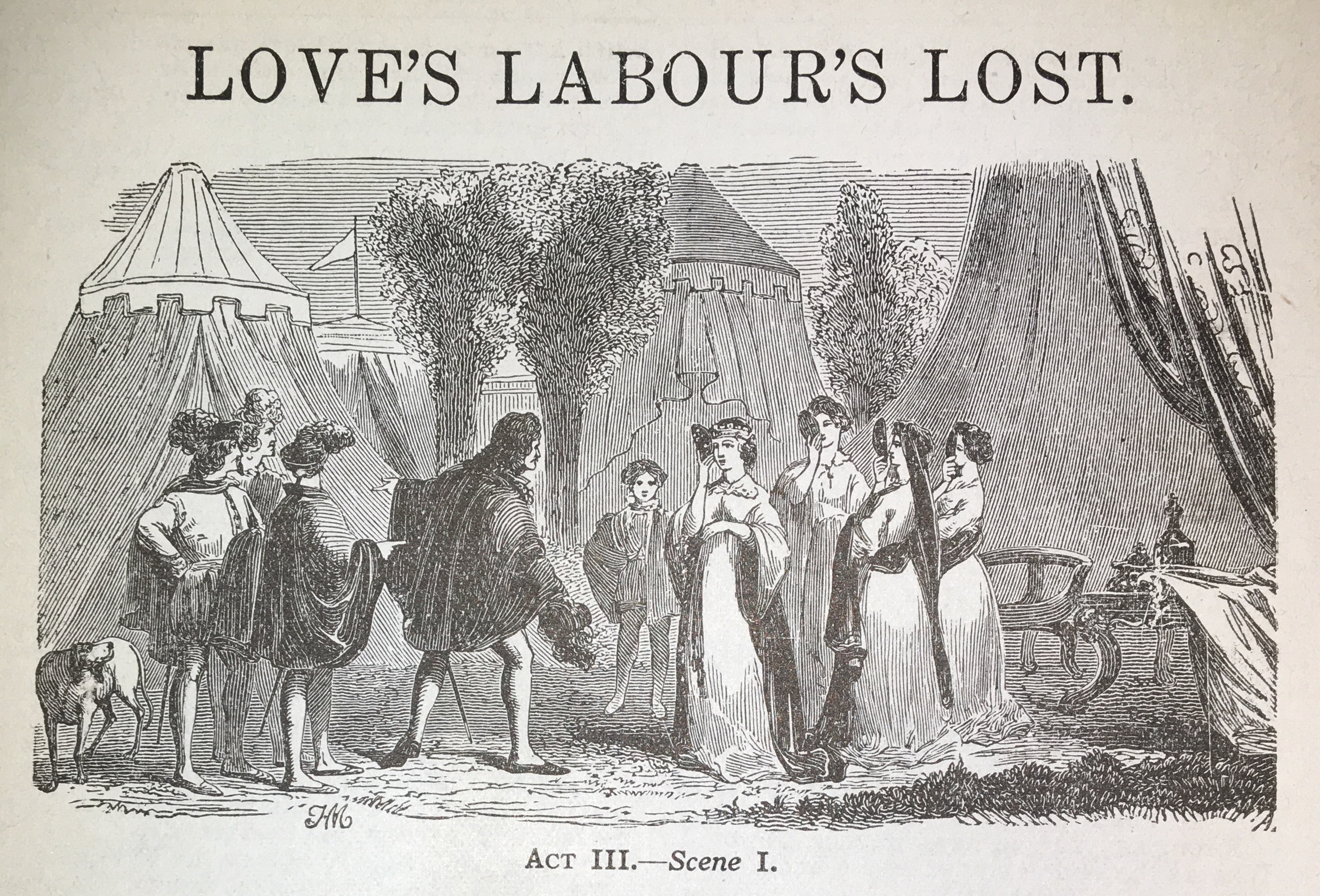
https://commons.wikimedia.org/wiki/File:Love%27s_Labour%27s_Lost_Lithograph.jpg

The action of Shakespeare’s play takes place in Navarre (Spanish, Navarra), originally a region in northern Spain and southern France (département of Basses-Pyrénées). Most of you likely know something of the area, even if you think otherwise, for its capital, Pamplona is famous for the Festival of St. Fermin (July 6-14), in which a chief attraction is encierro—the running of bulls each morning through the streets of the city.

The Kindle Study Guide tells us, “Evidence indicates that Love’s Labour’s Lost was probably first performed in December 1597 at the court of Queen Elizabeth I, although G.B. Harrison notes that the New Cambridge Shakespeare says: “In our opinion its first performance had Christmas 1593 for date and for place some great private house, possibly the Earl of Southampton’s” (Shakespeare: The Complete Works. New York: Harcourt, 1952. page 395).  If the play was performed before the queen in 1597, an intriguing question for scholars might center on how the queen responded to the performance. When she viewed it, she would have been sixty-four and, of course, still a spinster. She had had many opportunities to marry—for love or for political advantage—but seized upon none of them. She died in 1603, still unmarried. All of love’s labours showered on her—and all of love’s labours she showered on others—were lost.”

Love’s Labour’s Lost is a romance comedy. Shakespeare depended heavily on wit rather than on character development, which I suppose is a good thing in this story, for at the end, the Princess of France asks that her love interest King Ferdinand wait a year in a hermitage before they can marry. Some sort of test of his love?

Amending the Shades of Pemberley: A Pride and Prejudice Vagary 

“You have willfully misunderstood me, Miss Bennet. You have no worry of my releasing you, for I do not wish you to perform as a governess to my daughter, but rather as my wife and the mistress of my hereditary estate.”  

Elizabeth Bennet had thought the stranger quite handsome; yet, she had ignored those first tendrils of interest, for she was in no position for the gentleman to pursue her. She and her sister Mary were all who remained of their family. Moreover, Longbourn and its furnishings were to be sold. They were destitute, and, if fortunate, headed for service in some stranger’s household. 

Fitzwilliam Darcy’s proposal of marriage would save both Mary and her, for her sister had agreed to assist with the gentleman’s young daughter. But what of the man’s tale of having corresponded with her father and of Mr. Bennet having purported a marriage between this stranger and her? Elizabeth knew nothing of the arrangement nor of the man’s existence. Though their marriage would solve all her troubles, what if the man’s tale was not completely truthful? Would Mr. Darcy become her enemy or a man she could learn to love? 

GIVEAWAY: Leave a comment below to be entered in the giveaway. I have 2 eBooks of Amending the Shades of Pemberley available each day of the promotion to those who follow the blog and this release.

This book releases on Wednesday, April 26, as an eBook. Print copies are already available.

Purchase Links:

Kindle https://www.amazon.com/Amending-Shades-Pemberley-Prejudice-Vagary-ebook/dp/B0C1HLTW2M/ref=tmm_kin_swatch_0?_encoding=UTF8&qid=&sr=

Also Available to Read on Kindle Unlimited 

Amazon https://www.amazon.com/dp/B0C1J2GT3F/ref=tmm_pap_swatch_0?_encoding=UTF8&qid=&sr=

BookBub https://www.bookbub.com/books/amending-the-shades-of-pemberley-a-pride-and-prejudice-vagary-by-regina-jeffers

Enjoy this excerpt from Chapter 7:

“What if I fall?” Alice questioned. 

“You will have a wet shoe, but I do not think you will fall,” Elizabeth assured. “You are magnificently brave, for you traveled from India to England. Surely a girl as brave as you can take one step without holding my hand. Miss Cassandra and your papa and Mary will all be so very proud of you. One step at a time, sweetheart.” 

Alice studied the stones, but she stood a bit taller. “One step, Lizbet.” 

“I shall be right behind you. You are the leader this time.” 

Without more coaxing required, Alice long stepped for the last stone, and Elizabeth reached a hand to prevent her fall, but there was no reason. The child wobbled, but quickly stood firmly on the stone. “Now up the bank, love, and to the ash tree. You were quite wonderful, you know.” And it was done. A lesson in bravery. 

Following Alice up the bank, she could hear her own father saying, “Well done, Elizabeth. You are a brave girl,” just as he had done all those years ago when he taught her to walk along a stone wall without falling. “One step at a time, child.” 

Experiencing her own bit of pride for teaching the child necessary skills, Elizabeth led Alice forward to stand beneath the tree. She pulled down one of the branches. “Let us continue our study. See the leaves always align opposite each other. Some of the smaller branches have three leaves on each side. See. Let us count them.” The child counted the pairs as Elizabeth pointed to each. Next, she reached for a longer branch. “The bigger branches have six leaves on each side. One. Two . . .” Alice finished counting to six. 

“Look, Miss Lizbet. That one has three. One. Two. Three. And there is ‘nother with six.” 

“Excellent. You may tell your Papa of these wonders this evening. Let us see what else we might tell him. First, the tree leaves follow the sun, even this winter sun.” 

The child’s face screwed up in confusion. 

“Permit me to show you.” She led the child back to the brick path and a few feet away. “Look up.” Alice did as she instructed. “See how the top of the tree appears as if it is leaning to the side.” 

“Like this.” Alice bent at the waist to lean to the side. 

Elizabeth smiled largely. “Many flowers and trees, and even people who travel, like on the silk roads in India, follow the sun. Have you not seen people pause to look up at the sun to enjoy the feel of it on their faces?” 

“Not in India,” the child said innocently. 

Elizabeth chuckled. “No, I do not imagine the sun is so kind there, at least not to Englishmen.” 

“Papa worked hard in the sun,” the child disclosed. “Would fall asleep before me.” 

Elizabeth did not comment, but she filed Alice’s observation away with the other tidbits she had learned of her husband—another piece of the puzzle. Someday, she hoped the image would be complete. 

“We will take a few leaves today. In the spring, we will find flowers on the branches. The twig, which is what we call a little branch—a ‘child’ branch, which has yet to grow to its full size, will have purple clusters close to the tip. Then the new leaves will appear. The flowers are sometimes purple and sometimes yellow. The new leaves will be a softer colored green, almost yellow in color.” 

She walked the child back towards the tree. “The bark, as you can see, is pale brown.” She pointed to the bark, peeling back a small piece to add to their collection. “Some parts appear grey.” She took Alice’s hand to direct it to the bark to explore. “In winter, which is quickly approaching our new home, twigs appear almost black, but we can see new buds forming. Feel the little bumps under your fingers when you touch it.” 

“Bumps,” the child declared with a grin. 

“Like that of each thing that in season grows. Yet, for today, we will only take a few leaves, but we will come back again and again. Each time we will claim something new. In the spring, we will add some flowers to our study and mayhap a bud or two. In late summer or early autumn, the flower clusters will change into seed pods. My sisters and I referred to them as ‘wings.’ The seed pods will fall to the ground. See, there are a few here. and few more over there.” 

The child scrambled to gather several clusters of the pods to carry them back to Elizabeth. 

She bent to share their find with Alice. “The birds pick them up and carry them to another place. They drop the seeds and often those seeds will take root and a new tree is born.” 

“God’s plan?” the child asked. 

“I would think so,” Elizabeth admitted. “Just as I think it was God’s plan that my father met your father years ago. Their friendship brought your papa to my door when I needed him most.” 

“And I need you and Miss Mary,” the girl spoke honestly. 

Elizabeth felt her eyes tearing up, so she simply said, “Exactly,” as she turned to point to the ground beneath them. “Notice, this plant here is called a ‘dog violet’ and this one,” she said as she pointed towards the other side of the tree, “is called ‘wild garlic.’ The ‘wild’ just means it grows outside of the planned garden Cook uses for our meals. It is not ‘wild,’ as if it cannot be tame. Mr. Farrin and the others in the stables have tamed the horses we ride, so they are no longer wild.” 

Alice’s expression spoke of the question forming in her thoughts before she spoke it. “Is the dog biolet not ‘wild’ then, and why you call it a ‘dog’?” 

Elizabeth’s laughter bubbled forth. “God was smart in permitting the tree and the plants to share the same place, but He might have made an error in permitting people to name the plants.” She turned the child in the direction of where they left their box. Elizabeth leaned over to say, almost as if it were a secret, “As I understand it, ‘dog’ refers to the fact this violet has no scent. Most violets are sweet smelling, but the dog violet has no scent. There are also pig violets and horse violets and even snake violets, but I have never seen any of those, but I assume they also possess no scent.” She nudged the child forward. “It is time for us to return to the house. Do you have your leaves and your ‘wings’ to share with your father after supper?”

“Yes, Lizbet.” 

Elizabeth took the larger items and placed them in a cloth sack, while Alice added the smaller ones to the wooden box. Once they were prepared to return to the house, she led Alice towards the manor. She said, “Did you know the wood from an ash tree is so strong, we make our carriages out of them? In Norway, which is another country, just as India is one and England is yet another, the Norwegians believe the ash tree is the Tree of Life, meaning it is where God made the first man.” 

“But forgot to tell the man what to call everything,” the child pronounced with pride. 

“Your father will enjoy your version of the tale of God making the first ash tree. I imagine it will delight him excessively.” 

* * *

Darcy had listened carefully to his child’s recitation regarding what she had learned on this particular day, but his mind was on the wonder of the moment. Not only did Alice share the facts of the ash tree, but his child proved, without a doubt, his decision to make Elizabeth Bennet his wife was a turn for the better in his life. His daughter was no longer frightened by her own shadow. She no longer clung to him in desperate pleas not to leave her. 

Alice was enjoying claiming Elizabeth as her “mother,” although the word still remained from the child’s lips. In his opinion, such was true because in English households in India, the children were raised by an Indian ayah, not the mistress of the house. In England, Alice should be raised by a governess. If his daughter claimed Elizabeth as “mother,” then Elizabeth might slip away from someone taking care of her to someone who supervised the caregiver. His arrangement with Elizabeth placed her as both “governess” and “mother,” a much better situation for his child. 

“The ash tree is related to olive trees,” he commented. 

“Do I like olive?” his child asked. 

“I seriously doubt it, but perhaps some day you will,” he responded with a grin. “Olives are not sweet like Cook’s cakes.” 

Alice smiled up at him. “Cook’s cakes make me happy.” 

“Like that of each thing in season grows,” he remarked. 

“Miss Lizbet say the same today,” his daughter shared. 

He looked up to Elizabeth to notice her smile. “Elizabeth and I often share similar thoughts.” He prayed she would be willing to share his bed this evening. “The line comes from a famous English writer who you, too, will read some day. Today, Elizabeth was speaking of how the ash tree changes with each ‘season.’ You likely heard her say the words ‘summer, autumn, winter, and spring.’ Those are the seasons for growing and playing in the sun. As for me, I was considering the writer’s purpose of the story.”

“Do you believe it will take a year?” his wife asked. “For it, for us, to be as it was for Navarre and the princess in Love’s Labour’s Lost? As they were at the end?”

“I pray not,” he admitted. “Would you not say we are more than halfway there already?”

Posted in book excerpts, book release, British history, eBooks, Georgian England, Georgian Era, giveaway, Jane Austen, love quotes, playwrights, Pride and Prejudice, publishing, reading habits, Regency era, research, romance, Vagary, writing | Tagged , , , , , , , , , , , , , , , , , | 10 Comments

The Origin of “Humpty Dumpty” + the Release of “Amending the Shades of Pemberley” + a Giveaway

There is a sweet scene in my latest Jane Austen Fan Fiction tale between Elizabeth Bennet and Mr. Darcy’s daughter, and it involves the nursery rhyme of “Humpty Dumpty.” Therefore, I thought a piece on the meaning of the nursery rhyme might be of interest to others.

https://www.classicfm.com/discover-music/humpty-dumpty-sat-on-a-wall-lyrics-history/ ~ Classic fm Radio

The most common version is Humpty Dumpty is a representation of King Richard III of England, who was defeated at the Battle of Bosworth Field in 1485. The “egg” shape refers to King Richard supposedly being a “humpback,” as is portrayed in Shakespeare’s play. “Shakespeare called Richard III a ‘hunchback’, which means that he was hunching forward while walking. Richard III’s skeleton actually shows a sideways displacement of the spine, a heavy scoliosis, which made the king walk obliquely. So there is a certain match between the two: something unusual about the body.” (British Council) The “wall” falling is the loss of his reign as king. The king’s horses and men are the army who failed to defeat their enemy.

https://www.britishcouncil.org/voices-magazine/how-close-was-shakespeares-portrayal-richard#:~:text=Shakespeare%20called%20Richard%20III%20a,something%20unusual%20about%20the%20body.

Others relate the story of a cannon used during the English Civil War, which was supposedly nicknamed “Humpty Dumpty” for the difficulty of moving it about on the battle field. Anyway, according to the legend, a gunner named Thompson managed to drag Humpty Dumpty to the top of the tower of St Mary at the Walls church. The “at the walls” name may cause some confusion until one understands the church stands immediately beside the old Roman town wall of Colchester.

According to Britain Express, “Colchester was held for the king during the Civil War. Parliament besieged the town in 1648, an attack that lasted 12 weeks. During the siege, a one-eyed gunner named Thompson hauled his ‘saker’ (a small cannon) to the top of the tower of St Mary’s church. The vantage point allowed him to direct damaging fire onto the besieging troops under the command of Lord Fairfax. The Parliamentary gunners concentrated their fire on St Mary’s tower and eventually hit the unfortunate Thompson and sent the gunner and his weapon falling to the ground. A later twist on the tale of Thompson the one-eyed gunner is the idea the story was the origin of the nursery rhyme about Humpty Dumpty. There does not seem to be any truth to the tale that Thompson was the ‘egg’ who ‘had a great fall’, but it makes a nice story.”

Meanwhile, CLASSIC fM Radio tells us, “A professor David Daube once had a fourth theory to add. In 1956, he posited that ‘Humpty Dumpty’ might have been reference to an armoured siege engine that was deployed unsuccessfully in the 1643 Siege of Gloucester during the English Civil War. This one was soon dismissed as a bit of a spoof by academics – but not before English composer Richard Rodney Bennett took the plot and ran with it for his children’s opera, All the King’s Men.

As a point of reference, I must also mention Francis Grose‘s definition, for he was, in truth, my 6th Great-Uncle. CLASSIC fM says, “Interestingly, Francis Grose’s Classical Dictionary of the Vulgar Tongue from 1785 – we’re totally imagining this as the Urban Dictionary of its time – defines ‘Humpty Dumpty’ as ‘a short clumsy person of either sex; also ale boiled with brandy,’ so the rhyme could have derived from either meaning.”

Humpty Dumpty – oldest known lyrics (1797)

Humpty Dumpty sat on a wall,
Humpty Dumpty had a great fall.
Four-score Men and Four-score more,
Could not make Humpty Dumpty where he was before.

Amending the Shades of Pemberley: A Pride and Prejudice Vagary 

“You have willfully misunderstood me, Miss Bennet. You have no worry of my releasing you, for I do not wish you to perform as a governess to my daughter, but rather as my wife and the mistress of my hereditary estate.”  

Elizabeth Bennet had thought the stranger quite handsome; yet, she had ignored those first tendrils of interest, for she was in no position for the gentleman to pursue her. She and her sister Mary were all who remained of their family. Moreover, Longbourn and its furnishings were to be sold. They were destitute, and, if fortunate, headed for service in some stranger’s household. 

Fitzwilliam Darcy’s proposal of marriage would save both Mary and her, for her sister had agreed to assist with the gentleman’s young daughter. But what of the man’s tale of having corresponded with her father and of Mr. Bennet having purported a marriage between this stranger and her? Elizabeth knew nothing of the arrangement nor of the man’s existence. Though their marriage would solve all her troubles, what if the man’s tale was not completely truthful? Would Mr. Darcy become her enemy or a man she could learn to love? 

Just as I did on each of the last five posts, I have 2 eBook copies of Amending the Shades of Pemberley available to those who comment below. The book is available for purchase at these links:

Kindle https://www.amazon.com/Amending-Shades-Pemberley-Prejudice-Vagary-ebook/dp/B0C1HLTW2M/ref=tmm_kin_swatch_0?_encoding=UTF8&qid=&sr=

Also Available to Read on Kindle Unlimited 

Amazon https://www.amazon.com/dp/B0C1J2GT3F/ref=tmm_pap_swatch_0?_encoding=UTF8&qid=&sr=

BookBub https://www.bookbub.com/books/amending-the-shades-of-pemberley-a-pride-and-prejudice-vagary-by-regina-jeffers

Excerpt from Chapter 3. Enjoy!!

“I told her of you,” he said. 

“Of me?” she gasped. “What have you to say of me?”

“Only that I have extended my hand to you, and I believe the two of you might go on well together,” he explained. An awkward pause hung between them before he said, “If I am not being too presumptuous, might I bring my daughter inside? She is most desirous to know the lady whose house I visited earlier this week.” 

“Please tell me you did not promise the child I was to be her stepmother,” Elizabeth begged. “I have not presented you my response, sir.” 

“I simply described you as the daughter of a friend,” he assured. “I would not use my child as a pawn to have my way. If you agree to marry me, I pray you do so because you believe a future together is in our grasp.” 

“If all is as you described it, I would be pleased to greet the child,” she said with the slightest hesitation. 

“Pardon me a moment.” With a quick bow, he disappeared while Elizabeth claimed the interruption to pat her hair in place. Yet, before she was thoroughly prepared, the gentleman reappeared. He looked quite awkward as he bent to hold the child’s hand. He was tall, and the child appeared to be so very small, though, in reality, she had the build of Jane, when Jane was a child. 

“Who do we have here, Mr. Darcy?” Elizabeth asked with a smile. The child looked down, and Elizabeth instinctively knelt before her—not bending over, but going down on one knee to be at the child’s eye level. “How very beautiful you are.” The girl gazed shyly at her as she and her father came to stand before Elizabeth. Mr. Darcy knelt also. 

“Miss Elizabeth,” he said formally while watching his daughter, “may I present Miss Alice Darcy?”

The child frowned. “Biss Alice Faith Anne Darcy, Papa,” the child said precociously. 

“I stand corrected, my love,” he responded dutifully. “Miss Alice Faith Anne Darcy.” 

Elizabeth noted the faint violet shadows under the child’s eyes, belying her liveliness. “Your father told me what a wonderful daughter you are.” 

The child looked up to Mr. Darcy. “He says I’m his fav-or-right girl.” 

Elizabeth, too, looked to the gentleman. “I can understand his preference, and may I also have the acquaintance of your doll?” The child clutched a fine china doll with a head of blonde hair and blue glass for eyes. 

“This is Biss Cass Andra Darcy,” the child proudly pronounced. 

Elizabeth took the doll’s porcelain hand and shook it. “I am honored by the acquaintance, Miss Cassandra.” 

Before the child could respond, a few notes of music could be heard from the adjoining room. 

“What that?” the girl asked. 

Elizabeth assured, “Such is my sister Mary practicing her music. Would you like to greet her also?”

The child looked to her father. “I likes music, Papa.” 

Mr. Darcy’s features softened. “I know you do, love.” He nodded his permission for Elizabeth to escort his child into the other room, stood, and reached down a hand for Elizabeth to assist her to stand. Like it or not, Elizabeth enjoyed the warmth of his hand as it encircled hers. It was the first time she had felt safe in many months.

The child released her father’s hand and claimed Elizabeth’s free one, which, like it or not, had Elizabeth yearning for her own children. By the time she had led Alice into the small parlor, Elizabeth realized although he had risen, Mr. Darcy had not followed her. “Good day, Mary,” she said as the child slowed her pace. “We have a visitor.” 

Mary stopped her efforts to address the child. “My, I do not think I have ever had such a delightful audience. Do you like music?” 

The child nodded her agreement, but did not step closer. Elizabeth knelt again. “Should we ask Mary to play for us again?”

“Peas,” the child said softly. 

Mary nodded her agreement and set her fingers to playing a children’s chant. When she finished with a flourish, the child begged, “Again.” 

“I mean to please,” Mary responded and set about playing the tune once more. 

“Again,” the child ordered with a smile, which immediately melted Elizabeth’s heart. 

“Only if you ask Elizabeth to sing,” Mary countered. 

“Peas, Biss Lizbet,” the girl pleaded. 

Elizabeth asked, “Do you not know the rhyme?”

The child shook her head in the negative. 

“Then might I teach you?”

“Yes, peas.” 

“Very well. Listen first, and then we shall sing it together.” She looked to her sister. “The first phrase, if you would, Mary.” Elizabeth waited for Mary to finish playing before she sang, “Humpty Dumpty sat on a wall.” 

“Again,” the child ordered. 

“Humpty. Dumpty. Sat. On. A. Wall,” Elizabeth said slowly. “Will you try it with me?” The child nodded unsurely. Elizabeth began again, saying each word slowly. A third and a fourth time had the child mumbling some words while managing others. “Let us add line two. I shall permit you time to repeat each line until you are assured of yourself.” 

The child smiled weakly, but she did not look away. Elizabeth sang the first line, and the child repeated the words she knew. 

“Humpty Dumpty had a great fall.” Elizabeth enunciated each word slowly just as she had done with the opening line. 

Alice’s eyes widened. “I fells down once, but Papa not mad I torn my dress.” 

“I am pleased to hear it. My father never was angry when I tore my good dress,” Elizabeth shared. 

“Mama was,” Mary remarked before she realized what she said. 

“I no have a mama,” the child explained innocently. 

“Then we three are all alike,” Elizabeth assured. “Mary and I no longer have a mother either.” 

“Are you bonely?” the girl asked. 

“Sometimes,” Elizabeth admitted. “You are fortunate to have your Papa.” After an awkward moment, she sang the whole rhyme. “Humpty Dumpty sat on a wall. Humpty Dumpty had a great fall. All the King’s horses and all the King’s men could not put Humpty together again.” 

“Why Umpty break?” the child asked in concern. 

“Most people consider him to be an egg,” Elizabeth said as she looked to Mary who shrugged her response. “An egg would surely break if it fell from a wall.” 

The child giggled. “Spat.” 

Elizabeth bit her lip to keep from correcting the girl. “Shall we sing the lines again?”

Alice nodded her agreement and began the song herself. “Umpty, dumpty sat on a . . . wall. Umpty, dumpty, have a gre. . . at fall.” Unexpectedly, the child plopped down on the floor, but when she realized she still held her doll, she jumped up to carry the doll to her father. It was only then Elizabeth realized Mr. Darcy was standing in the open doorway. “Did you see me spat, Papa?”

Mr. Darcy’s smile widened. “I did, sweetheart.” 

“Biss Lizbet say she fell when she a little girl like me,” the child announced. 

Elizabeth noted how tears misted Mr. Darcy’s eyes. Therefore, she said, “Perhaps we might convince Mary to teach you the notes on the pianoforte while I speak to your father for a moment.” She shot a pleading glance to Mary, but Elizabeth need not worry, for Mary had already stood to move the bench closer. 

With Mary’s assistance, the girl climbed readily onto the bench.

“I will be near, Alice,” Mr. Darcy told the child.

“Leave Biss Cassie,” the child instructed without looking to her father. 

Elizabeth whispered her gratitude to Mary, but her sister was already leaning over the child to take the girl’s finger to play the first note. 

Posted in book excerpts, book release, British history, customs and tradiitons, eBooks, Georgian England, Georgian Era, giveaway, historical fiction, Jane Austen, Living in the Regency, marriage, music, Pride and Prejudice, publishing, reading, Regency era, Regency romance, research, Vagary, writing | Tagged , , , , , , , , , , , , , , , | 13 Comments

Have You Ever Heard of a “Bachelor Tax”?

Tomorrow is tax day in the U.S. At one time in my life, I was a tax preparer for H&R Block and before that I worked for a private/personal tax preparer. I despise tax preparation nowadays, for an a self-employed author, I must keep every little scrap of paper which might hold a deduction. However, I have never encountered a Tax on Bachelors. Have you?

In the late 1600s (1695, to be more exact), the English parliament passed The Marriage Duty Act or Registration Tax, which imposed a tax on births, marriages, burials, childless widowers, and bachelors over the age of 25. The tax’s purpose was to rase revenue for the war with France. It was also to ensure proper records were kept by an Anglican church officials. The tax was found ineffective and abolished by 1706. 

Alan Taylor sparked my interest in this topic with this bit on the British History Georgian Lives Facebook page back on May 14, 2018: “Bachelor taxes have been common in many countries over the years. In late 17th/early 18th Century England women of marriageable age outnumbered men but many gentlemen of the upper and middle classes refused to commit to an expensive business when instead they could spend their time carousing in clubs, sit all day with their friends in coffee houses or even take a mistress or two. Women hit back at this selfish attitude and ‘three score thousand hands with never a cracked maidenhead amongst them” signed a petition deploring the laziness of their opposite sex complaining that: ‘they showed an aversion to the squalling of children..though the sot can sit a whole day at Wills(a coffee house) amidst the…quarrels of no wits’. The government was also keen to support marriage as the resulting children would make up for the appalling mortality rate of babies and youngsters (although a cynic might also add that politicians did not want females to assert their independence!!). Consequently they introduced a tax of 1 shilling a year on bachelors and widowers over 25, but apparently it did not work as it was repealed in 1706.”

The Act was initially implemented for a five-year period, but was extended (by 8 & 9 Wm. III, c. 20) to August 1, 1706. British History Online tells us: “Among Gregory King’s papers there is a printed broadsheet entitled A probable calculation of the annual income to be raised by a tax on marriages, burials, and legacies, with a note in King’s handwriting on the back — ‘Fryth’s Project of the Duty on Marriages, Births and Burials’. And after the Act had been passed, the Treasury received a petition from Richard Firth, claiming that he had (some six years earlier) suggested such taxes to the Duke of Shrewsbury, who had mentioned it to the King, and ‘in this sessions it was accepted by the House of Commons; praying their bounty for his charge and pains’. The Treasury comment was: ‘To be considered if there be any places to be disposed on this fond.’ No other supporting evidence has so far been found. The references in the Journals of the House of Commons are entirely formal and give no indication of the proposers or of the arguments they had in mind. Various amendments to the Bill were made during its passage through the House. One was to exempt from the tax on bachelors fellows and students of Oxford and Cambridge, ‘where, by the Statutes of their Colleges, they are to be displace, if they shall marry’. Another was concerned particularly with recording the deaths (and descent) of persons of quality. [Journals of the House of Commons, vol. 11, pp. 294-5.] But the Bill appears to have had an easy passage; introduced in the Committee on Ways and Means in February 1694/5, it was sent to the Lords on 8 April and their assent was notified on 12 April. Nevertheless, an aura of mystery still surrounds the Act. Three points arise, in particular.

“First, the apparatus required for implementing the Act was quite formidable, involving nothing less than a complete enumeration of the population and a comprehensive system of vital registration. Because some of the taxes fell upon individuals with specified characteristics (childless widowers and bachelors above the age of 25 years) it was necessary to know the names of all such individuals. In addition, the taxes were graduated in accordance with the social status of the individual — and graduated in a complex way. For example, the tax on the burial of a ‘common’ person was 4 shillings. For a Duke the tax was £50 4s for himself, the same for a Duchess, £30 4s for the eldest son or his wife, and £25 4s for a younger son or his wife or for an unmarried daughter. And similar variations applied to the duties on births and marriages and to the annual taxes on bachelors and widowers (Table 1a and b). The Act came into force on 1 May 1695 and on or before that date the Assessors were supposed to furnish the Commissioners with complete lists of the population in their areas, specifying their names and surnames, estates, degrees, titles and qualifications and indicating the taxes and duties to which they were liable, or would be liable if a specified event occurred (that is, a marriage, birth or death). Moreover, these lists were to be brought up to date each year, being corrected in respect of the ‘death change of quality or degree or removal of any person or persons or otherwise’ (Sections XI and XVI). Lodgers and servants were to be included in the enumeration, for they were to be taxed at their place of residence (Section XXIV). A further complication was that in London the basis of the enumeration was the parish, in contrast to the more usual ward basis. This may well have involved substantial problems, especially in the recruitment of a large and separate body of Assessors and Collectors.

“The parish basis was linked to the requirements for vital registration, for in order to prevent evasion it was necessary to improve the reliability and scope of the parochial system. A double check was provided. First, the scope of the parish register was widened to cover everyone married, buried, christened or born in a parish (Section XX), and stillbirths were to be notified (Section XXI). And persons in Holy Orders (and their substitutes) were instructed to keep accurate records of marriages and burials and of all persons ‘christened or born’, under penalty of a fine of £100 (Section XX). Secondly, a special responsibility was placed upon parents in respect of children born to them; it was their duty to notify the Collectors, within five days of the occurrence of the birth of a child, whether live or stillborn — and a stillbirth had to be attested by two or more persons (Section XXI). A similar duty was placed upon Quakers, Roman Catholics and Jews (and any other comparable individuals) to report their marriages to the Collectors within five days (Section LVII). And special arrangements were prescribed for ‘the better preserving the Genealogies Descents and Alliances of the Nobility and Gentry’. Upon the death of any of them (anyone liable to a burial duty of 20 shillings or more), the person responsible for paying the duty had to provide the Collectors with a certificate showing the ‘name surname quality office employment (if any) of such deceased person with the age time of death place of burial marriages and issue and the ages of such issue together with the names sirnames titles and qualities of the parents of such deceased persons. . .’. These certificates were to be sent to the Receiver-General or his deputies for transmission to the College of Arms, which institution was instructed to ‘number schedule and digest the same in alphabetical order in Books to bee provided for that purpose’ and to file the originals for public use (Section L).”

But this was not the only attempts in history to tax bachelors. The first bachelor tax was introduced in 9 AD by emperor Augustus to encourage marriage. It was called the ‘Lex Papia Poppaea’, and apart from taxing bachelors also taxed married people with no children, and those who were celibate. An exception was granted to Vestal Virgins (Ulp. Frag. xvii.1). In 1821, the US state of Missouri applied a $1 tax on all unmarried men. In 1921, the US state of Montana applied a $3 tax on all bachelors. In response to California’s low birth rate, in 1934 they proposed a $25 bachelor tax. The tax was never enacted. Benito Mussolini enacted a bachelor tax in Italy in 1927. The taxes twin objectives were to raise 50 million lira of revenue per year, and increase the Italian population. Mussolini was concerned that there were only 40 million Italians compared to 90 million Germans and 200 million Slavs. By 1936, Italian bachelors paid nearly double the normal income tax rate. To avoid the bachelor tax, the solution was simple, just get married. Italy’s bachelor tax was repealed in 1943. [Tax Fitness]

Even in the U. S. today, singles are taxed higher than say a single person able to file as “Head of Household.” The Head of Household filing status has some important tax advantages over theSingle filing status. If you qualify as Head of Household, you will have a lower tax rate and a higher standard deduction than a Single filer. Also, Heads of Household must have a higher income than Single filers before they owe income tax. While filing as head household gives you a higher standard deduction and usually a lower tax rate, than if you choose to file as single, one needsto qualify first. … To qualify, you must be able to claim a qualifying child or qualifying relative on your tax return.

On Google Books one can find Jane Frecknall-Hughes’s The Theory, Principles and Management of Taxation: An Introduction.  It says, 
Screen Shot 2018-10-16 at 12.14.28 PM.png
Screen Shot 2018-10-16 at 12.13.48 PM.png
512tnr5nuBL.jpg Want to mix a little romance with your history? You might try The Bachelor Tax by Carolyn Davidson. I have not read it, but I am adding it to my Want to Read List on Goodreads. 
Posted in British history, business, history, Living in the UK, marriage, real life tales, war, world history | Tagged , , , , , , , | Comments Off on Have You Ever Heard of a “Bachelor Tax”?