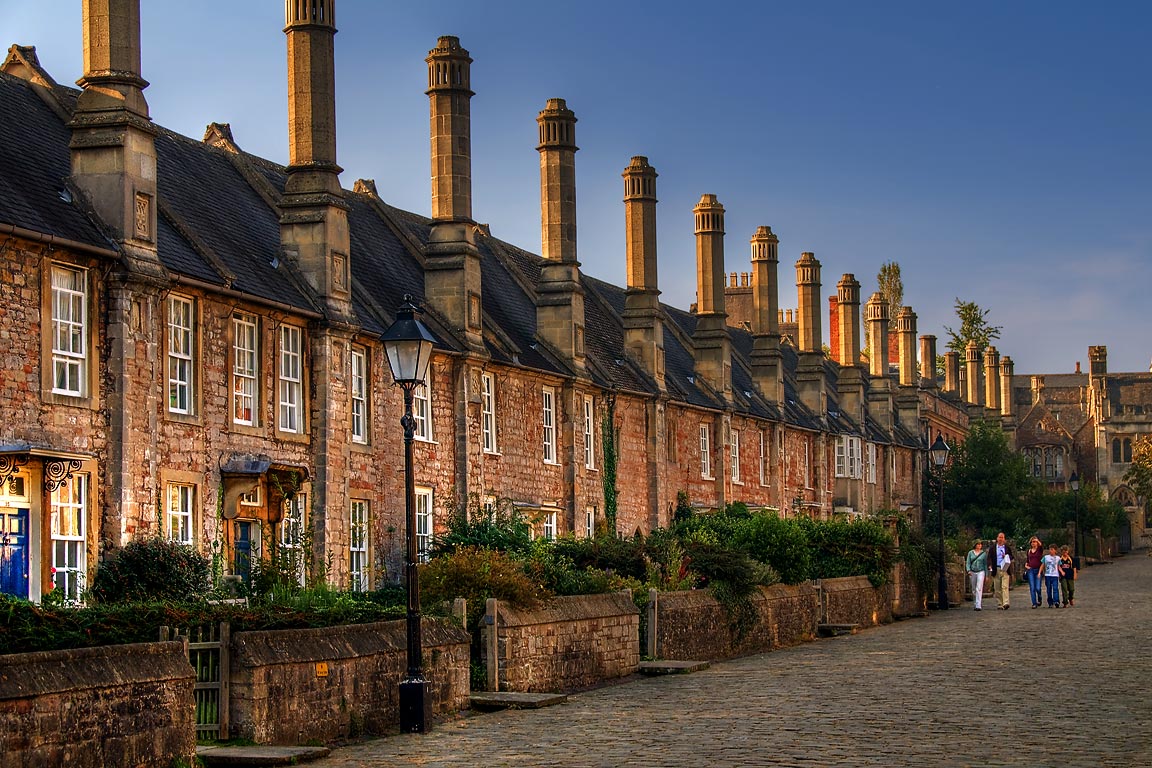
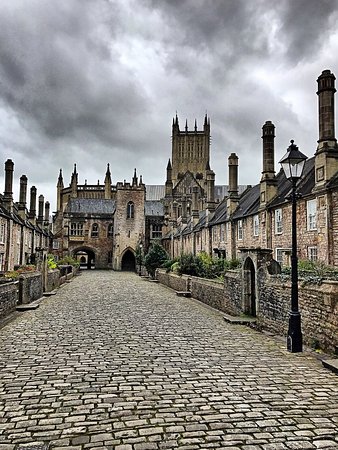
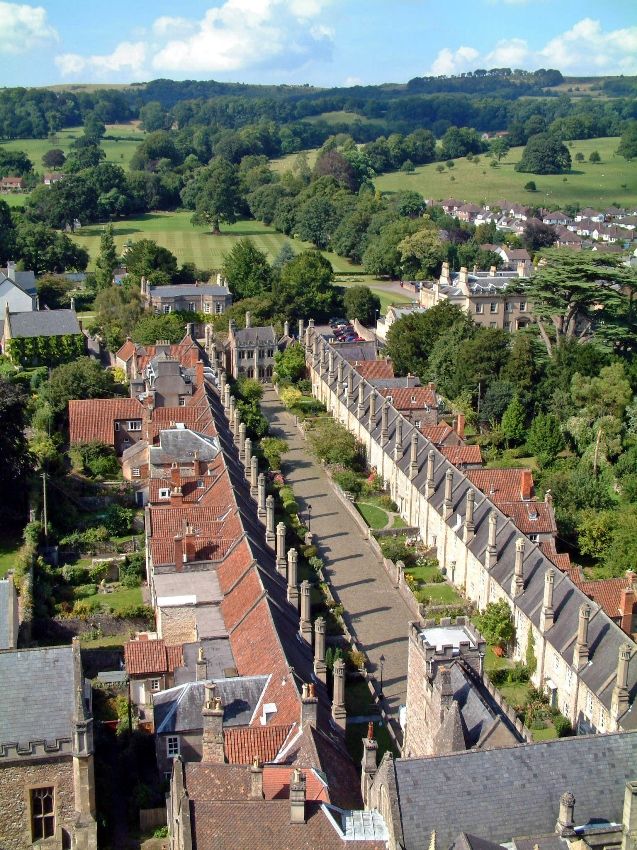
Letchworth, the World’s First Garden City

As those of you who follow me regularly know, I am a Pride and Prejudice fan, then you must realize I am exceedingly interested in any little bit of information that comes my way regarding Hertfordshire, the home shire of the novel’s heroine, Elizabeth Bennet. 

Letchworth was a “city” envisioned by Ebenezer Howard, who had the notion to relieve the crowded conditions of London’s slum. He was supported in his efforts by prominent Quakers and by what was known as the Arts and Crafts Movement. The idea was to provide clean industries, low-rent housing, services to the poor, a healthy country “air” environment. Howard advocated the construction of a new kind of town, summed up in his three magnets diagram as combining the advantages of cities and the countryside while eliminating their disadvantages. Industry would be kept separate from residential areas—such zoning was a new idea at the time—and trees and open spaces would prevail everywhere.

The original Letchworth was a small, ancient parish. St Mary the Virgin, the parish church, was built around the latter part of the 12th Century or early 13th Century. The village was located along the road now called Letchworth Lane, stretching from St Mary’s and the adjoining medieval manor house (now Letchworth Hall Hotel) up to the crossroads of Letchworth Lane, Hitchin Road, Baldock Road and Spring Road, where there was a post office. Letchworth was a relatively small parish, having a population in 1801 of 67, rising to 96 by 1901.

Ebenezer_Howard.jpg Along comes Sir Ebenezer Howard, OBE, who in 1898 had written a book entitled To-Morrow: A Peaceful Path to Real Reform, which was the groundwork for Howard’s first Garden City, a utopian city in which people lived harmoniously together with nature. Other Garden Cities followed: Welwyn Garden City, also in Hertfordshire, (1920), and those in other countries, Forest Hills Gardens (in the borough of Queens, New York), designed by F. L. Olmsted, Jr. (1909), Radburn, New Jersey, (1923), and the Suburban Resettlement Programs towns of the 1930s, including Greenbelt, Maryland; Greenhills, Ohio; Greenbrook, New Jersey; Greendale, Wisconsin; and Canberra, Australia (1913). [Stern, Robert (1981). The Anglo American Suburb. London: Architectural Design Profile. pp. 84, 85.]

“According to the book the term ‘garden city’ derived from the image of a city being situated within a belt of open countryside (which would contribute significantly to food production for the population), and not, as is commonly cited, to a principle that every house in the city should have a garden.

“The concept outlined in the book is not simply one of urban planning, but also included a system of community management. For example, the Garden City project would be financed through a system that Howard called ‘Rate-Rent,’ which combined financing for community services (rates) with a return for those who had invested in the development of the city (rent). The book also advocated a rudimentary form of competitive tendering, whereby the municipality would purchase services, such as water, fuel, waste disposal, etc., from (often local) commercial providers. These systems were never fully implemented, in Letchworth, Welwyn or their numerous imitators.” [Letchworth]

letchworth_2-756x815-1

Ebenezer Howard’s “Three Magnets” diagram, 1898 Copyright status This was published in the book Tomorrow: A Peaceful Path to Real Reform in 1898, and so is now out of copyright. The text The text reads: THE THREE MAGNETS THE PEOPLE Where will they go? Town Closing out of nature. Social opportunity. Isolation of crowds. Places of amusement. Distance from work. High money wages. High rents & prices. Chances of employment. Excessive hours. Army of unemployed. Fogs and droughts. Costly drainage. Foul air. Murky sky. Well-lit streets. Slums & gin palaces. Palatial edifices. Country Lack of society. Beauty of nature. Hands out of work. Land lying idle. Trespassers beware. Wood, meadow, forest. Long hours, low wages. Fresh air. Low rents. Lack of drainage. Abundance of water. Lack of amusement. Bright sunshine. No public spirit. Need for reform. Crowded dwellings. Deserted villages. Town-Country Beauty of nature. Social opportunity. Fields and parks of easy access. Low rents, high wages. Low rates, plenty to do. Low prices, no sweating. Field for enterprise, flow of capital. Pure air and water, good drainage. Bright homes & gardens, no smoke, no slums. Freedom. Co-operation. http://www.spatialagency.net/database/garden.cities

A competition was held to find a town design which could translate Howard’s ideas into reality.  Richard Barry Parker and Raymond Unwin were appointed architects, and 6 square miles (16 km²) of land outside Hitchin were purchased for building. The town was divided into three zones, with industrial areas kept well away from the residential sections. In keeping with the ideals only one tree was felled during the entire initial construction phase of the town, and an area devoted to agriculture surrounding the town was included in the plan – the first “Green Belt.” Additional contests were held to secure builders for inexpensive housing, which attracted some 60,000 visitors. This had a significant impact on what we now refer to as “pre-fabricated” building techniques. It also alter the ideas regarding gardens in the yards, both floral and vegetable. The exhibitions were sponsored by the Daily Mail, and their popularity was significant in the development of that newspaper’s launching of the Ideal Home Exhibition (which has more recently become the Ideal Home Show) – the first of which took place the year after the second Cheap Cottages Exhibition.

Railways often brought sight-seers to the town, who found the social experiment both interesting and amusing. Letchworth’s founding citizens, attracted by the promise of a better life, were often caricatured by outsiders as idealistic and otherworldly. John Betjeman in his poems Group Life: Letchworth and Huxley Hall painted Letchworth people as earnest health freaks. The idea of banning pubs was often criticized, for example. 

Spirella_Building_-_geograph.org.uk_-_988178

Spirella Building A view of this magnificent former corset factory, now a base for small businesses. To me this restoration shows how a great old building can be retained in all its glory, sympathetically modernised inside with high quality design, and thus serve a useful purpose in the twenty-first century.https://en.wikipedia.org/wiki/Letchworth#/media/File:Spirella_Building_-_geograph.org.uk_-_988178.jpg

The Spirella Company, the maker of ladies’ corsets, built a large factor close to the town’s middle in 1912. Despite its central location, the Spirella Building complements the town’s other buildings. It resembles a large country house, complete with towers and a ballroom. During WWII, the factory was also produced parachutes and decoding machines. Because corsets fell out of fashion, the factory closed in the 1980s, and was eventually refurbished and converted into offices.

Shelvoke and Drewry, a manufacturer of dustcarts and fire engines was part of Letchworth from 1922 to 1990. Hands, another of the industries found in Letchworth, manufactured axles, brakes, and Hands Trailers. Other such industries included Kryn & Lahy Steel Foundry, the Irvine’s Airchutes Parachute Factory, and British book publisher, J. M. Dent and Son. 

British Tabulating Machine Company (later International Computers Limited) was one of the largest employers in the area, with over 30 factory sites along Icknield Way and the surrounding area. 

Other Resources:

Letchworth, England (Britannica)

Letchworth Garden City: Heritage Foundation

Re-Imagining the Garden City 

Spatial Agency: Letchworth Garden City 


Posted in British history, buildings and structures, contemporary, Living in the UK, research | Tagged , , , , , , | Comments Off on Letchworth, the World’s First Garden City

Colonel Matthew Locke, an Advocate for Universal Manhood Suffrage

On Friday, May 19, I presented you with the celebration of the Mecklenburg Declaration of Independence. On Monday, May 22, I included an article on Captain James Jack, who was not as famous as Paul Revere, but just as heroic. Today, I have another Revolutionary War hero: Colonel Matthew Locke. 

300px-Locke-1591.jpg Colonel Matthew Locke was a Revolutionary War leader, as well as a member of Congress, who just happened to have been born in Northern Ireland. Like many in the present day North Carolina, Locke’s ancestors first settled in Lancaster County, Pennsylvania. A few years after his father died, his mother married a man by the name of John Brandon and moved to Anson County, North Carolina. Anson is the next county over from I live outside of Charlotte, and I can tell you there is LOTS of history to found in this area. Later, around 1752, the Brandons moved to Grants Creek, which was part of Mecklenburg County at that time, but is now part of Rowan County, North Carolina. 

Meanwhile, Matthew Locke purchased some 200 acres near his mother and step-father’s residence, where he began a trading business. Matthew and his brother Francis set up a trade line, including skins from the backcountry of Charles Town, South Carolina, and goods produced by the North Carolina Moravian settlements. He and his brother became quite wealthy in this venture. 

Locke’s first foray into public life came during the Regulator uprising. The Regulator Movement was a rebellion started by the backcountry (inland regions) residents of North Carolina (basically the western counties – those backing against the mountain range separating them from present day Tennessee – remember, at one time, North Carolina territory went as far west as the current day Nashville, Tennessee). These dissidents believed the royal government mistreated them by falsifying records and imposing excessive fees. The less productive land of the western mountain ranges were taxed at the same rate as the rich coastal plain. These inland residents wished to “regulate” their own affairs. Although the Regulator Movement began with protests, eventually violence was involved. 

Locke became involved when the officers of Rowan County appointed Locke as one of four men to meet with the Regulators’ contingent to attempt to come to some sort of agreement. Through sometimes heated negotiations, Locke’s committee agreed to repay any unlawful fees to those bringing suit. Liking the taste of public office, Locke became a member of the colonial Assembly in 1771, where he served until 1775. 

During the Revolutionary War period, Locke joined the Patriot cause. He was named to Rowan County’s first Committee of Safety. The purpose of the Committees of Safety were to enforce the Continental Association banning all trade with Great Britain. These committees had the endorsement of the Second Provincial Congress of North Carolina and the North Carolina Assembly. They existed in late 1774 and early 1775. These committees oversaw military preparations, the control of the price of select items, especially those needed for war efforts, and the sell of seized imported goods. They also were involved in the return of slaves, punishment for those who went against the Continental Association’s dictates, and even regulated public morals. The Wilmington-New Hanover Committee of Safety managed to run then Governor Josiah Martin out of office, causing him to first seek refuge at Fort Johnston on the Cape Fear River and then on the British warship Cruizer. The Committees of Safety were replaced by the Third Provincial Congress of North Carolina in August 1775. 

Matthew Locke was a delegate to the Third Provincial Congress. He was active in the financing of the case for liberty. He also saw to the militia stationed throughout North Carolina. Locke made the arrangements for governing the colony in Governor Josiah Martin’s abrupt absence until Governor Richard Caswell took over the office. 

Later, Locke was a member of the Fourth Provincial Congress (April 1776). This time the group met at Halifax. Out of their sometimes heated discussions came the Halifax Resolves, which was the first official action by one of British colonies calling for a break with Great Britain and the independence of all the colonies. 83 delegates to the Provincial Congress ratified the Resolves. They were then sent to the North Carolina delegation for the Second Continental Congress in Philadelphia. The Halifax Resolves served as the first call for action against Britain. Virginia followed with their own recommendations to the Continental Congress. These led to Thomas Jefferson’s penning The Declaration of Independence.

Locke then became involved with a group probing the activities of those not supporting a break from Great Britain. Reportedly, Locke led the arrest of John Dunn, the founder of Salisbury, and Benjamin Booth, both of whom were suspected of treason, because early on they had signed a document pledging loyalty to the King. 

queens-university-of-charlotte_8790753498_o.jpgCarolina’s first state constitution was drafted. He was in charge of the militia pay of six frontier counties. He procured supplies for the Continental Army. He served in the North Carolina House of Commons on and off from 1777 to 1793. He was known to support universal manhood suffrage, an idea to remove owning property as a right to vote and holding office, in other words, removing the stipulation of ownership of 50 acres of property or the payment of taxes as a prerequisite to vote. He also supported the endowment of Queen’s Museum (later Queen’s College and now Queen’s University) in Charlotte, which is considered the first institution of higher learning in North Carolina. [Just as a side note, my daughter-in-law earned her masters degree at Queens, and my son was an assistant track and cross country coach at the college. It is still a vibrant piece of Charlotte’s history.] In the vote to ratify the U. S. Constitution, Locke took a stand for the new country’s many farmers, who could not afford an expensive, nor oppressive, government. 

In 1793, Locke replace the unpopular Josh Steele, a Federalist, as the congressman for the Salisbury district. He was considered “the honest farmer” and took a leading role in the concept of Jeffersonian democracy in North Carolina. He remained in the NC House of Representatives until 1800, to another Federalist, Archibald Henderson. He died in 1801. 

8078741_120423862421

Gen Matthew Locke BIRTH 1730 Ireland DEATH 7 Sep 1801 (aged 70–71) Mill Bridge, Rowan County, North Carolina, USA BURIAL Thyatira Presbyterian Church Cemetery Mill Bridge, Rowan County, North Carolina, USA ~ https://www.findagrave.com/memorial/8078741/matthew-locke

Following Locke’s death, an obituary in the Raleigh Register edited by Joseph Gales, a staunch Jeffersonian, bemoaned the passing and called him a “friend and fixed Republican” who had “served his state admirably in Congress.” He was buried in Thyatira Presbyterian Church cemetery in Rowan County.

Posted in American History, British currency, Declaration of Independence, England, Georgian Era, Great Britain, history, political stance, real life tales, research, Uncategorized | Tagged , , , , , , , , , | Comments Off on Colonel Matthew Locke, an Advocate for Universal Manhood Suffrage

Captain James Jack, Hero of the Mecklenburg Declaration of Independence

Captain-Jack-Statue-CharlotteOn Friday, May 19, I presented you a piece on the first Declaration of Independence, a year before Thomas Jefferson’s document. Today, permit me to introduce you to the hero of the Mecklenburg Declaration of Independence, Captain James Jack. 

Born in 1731, Jack was was the oldest of nine children of Patrick and Lillis McAdoo Jack. Rumors say his grandfather was Reverend William Jack of Laggan Presbyterian in Northern Ireland. Reverend Jack was removed from his post by King Charles II for issues of nonconformity to the dictates of the Church of England. The Jacks lived southwest of Chambersburg, Pennsylvania, (close to where I once lived) but they left the area during The French and Indian War, moving to North Carolina. 

Around 1760, the Jacks located in Thyatira, one of the first Presbyterian communities to be established west of the Yadkin River. The current Thyatira Presbyterian Church is located ten miles west of Salisbury, North Carolina, and is thought to have been founded around 1753. It was known over the years as Lower Meeting House and as Cathey’s Meeting House. The community surrounding it were of Scotch-Irish and German descent. [As a side note, several of my ancestors were part of this community.] Thyatira took more of an “old school” approach to the church services, ignoring the exuberance of the Great Awakening. One of the church’s most well-known ministers was Samuel McCorkle, who took over the reins in August 1777. McCorkle was a great proponent of religion and of education. He established what is thought to be the first normal school in America, Zion-Parnassus Academy.  In 1798, when the then-fledgling University of North Carolina held its first commencement, six of the seven graduates were from Zion-Parnassus.

89317463_135423440704.png In 1766, James Jack married Margaret Houston, and the couple soon moved to Charlotte, where the elder Mr. Jack had purchased lots on the south side of West Trade Street. The family built a house on one of the lots and operated a tavern out of it. James Jack earn a fortune from real estate speculation. He was later appointed as a tax collector, as well as an overseer of the poor in Mecklenburg County. [Note: The county of Mecklenburg and the city of Charlotte were named after King George III’s queen, Charlotte of Mecklenburg.]

Tensions grew across the colonies over the pronouncements by the British Parliament and King George III, and North Carolinians struggled with their loyalty to the King and their desire to govern themselves. According to MeckNC.gov, “​On May 19, 1775, a rider raced into Charlottetowne with news of the massacre of colonists by the British at the Battle of Concord and Lexington. Angered at this news and already burdened by the oppressive, unjust laws of King George III, tradition says a band of local patriots met through the night and into May 20th to draft the Mecklenburg Declaration of Independence (or MecDec). On May 31, they met again to draft a set of Resolves that outlined how they would self govern. These treasonous documents declared the actions of the Crown were intolerable and Charlottetowne and Mecklenburg County were no longer under British rule.

“…Captain James Jack volunteered to take these powerful documents on the arduous journey to the Continental Congress. Knowing full well that if caught he would be immediately hung; he risked his livelihood, property, family and very life to transport these important documents. Slipping past British regulars and spying Tories, Jack arrived in Philadelphia, demanding Mecklenburg County’s declaration of freedom be read into record. Just as Paul Revere’s famous ride alerted patriots to the British landing in Boston, James Jack’s ride helped kindle the embers of revolution in the Continental Congress.”

The MecDec and the Resolves declared British authority over those in Mecklenburg County, North Carolina, to be null and void. James Jack and his father were strong supporters of the call for independence. Reportedly, many of the Committee of Safety meetings were conducted at the Jacks’ tavern. NCpedia tells us, ” Jack recalled that ‘for some time previous to, and at the time of those resolutions [of May 1775] were agreed to, I . . . was priviledged to a number of meetings of some of the . . . leading characters of that county on the subject before the final adoption of the resolutions.'” 

jack-2

Painting of Captain Jack riding north to Philadelphia to deliver the Mecklenburg Declaration of Independence. The courthouse can be seen behind Jack in the distance. Courtesy of Chas Fagan. https://allthingsliberty.com/2013/02/second-coming-of-a-revolutionary-war-patriot/

James Jack set out on his famous ride in June 1775, stopping briefly in Salisbury, North Carolina, to have the document read publicly into the records of the district court session. After a journey of nearly 600 miles through the Appalachian mountains and flatland, he reached Philadelphia, where Jack presented the North Carolina delegates to the Continental Congress with the Mecklenburg County document. Although the delegates agreed with the document’s sentiment, the Continental Congress at the time still hoped for a reconciliation with England. They chose not to inform the other delegations to the Congress of the Mecklenburg action.

Charlotte-Liberty-Walk.jpgCaptain James Jack returned to his home in Charlottetowne on July 7 of the same year. He rode an average of 30 miles each day—hard riding for the time and the geographic challenges—completing his journey of some 1100 miles in 38 days.

James Jack was a popular captain in the Mecklenburg militia during the Revolutionary War. As a warning, Lord Cornwallis had Jack’s s father removed from the man’s sick bed and kept in a damp cell for questioning. The elder Mr. Jacks died shortly afterwards (September 1780). The Jack home was burned to the ground. The tavern was rebuilt, but the financial loss, in addition to Jack’s personal money spent for wartime expenditures (some £7,646), which was never reimbursed, left him in ruin. Ironically, Jack’s claim was was paid to a friend, who died before delivering the money to Jack. 

89317463_133618159621.jpg With the war’s end, Jack moved his family to the western part of North Carolina, which at the time stretched all the way to present-day Nashville. He signed the petition to the North Carolina Assembly to make North Carolina a separate state. Later, he moved to what is now Wilkes County, Georgia, where he was not so successful as a farmer. Finally, he and his wife Margaret moved again to neighboring Elbert County, to live with their son William and live out their days. James Jack died in December 1822. His obituary lists his age at death as being 84, but in December 1819, he wrote of being 88 years of age. Therefore, he was like 91 years old at his death. 

The History of Charlotte (You Tube)

Mec Dec Day (You Tube)

Trail of History (You Tube)

https://www.mecknc.gov/ParkandRec/TrailOfHistory/Documents/Captain%20Jack%20Obituary.pdf

The following is the obituary for Captain James Jack from the Raleigh Registe of January 17, 1823. “Died.- In Elbert County, Georgia, on the 18th instant (ultimo), Captain James Jack, in the 84th year of his age. He was born in the State of Pennsylvania, from whence he removed to North Carolina and settled in the town of Charlotte, where he remained till the end of the Revolutionary War, in which he took a decided and active part from the commencement to the close, after which he removed to Georgia with his family, whom he supported by the sweat of his brow. He spent the prime of his life and his little all in the glorious struggle for independence, and enjoyed it with a heart warmed with gratitude to the God of battles. In the spring of ’75 he was the bearer of the Mecklenburg Declaration of Independence to Congress. His claims on the State of North Carolina for Revolutionary services and expenditures were audited by Colonel Mathew Locke, and amounted to 7,646 pounds in currency. Those papers being of little value at that time, he left them in the hands of a friend, who dying some years after, the claim to him was lost. It fell, possibly, into the hands of some speculator, who may by now faring sumptuously on the fruits of his toil. But wealth had no charm for him; he looked for a ‘house not made with hands, eternal in the heavens, whose builder and maker is God.’ He has left a widow, two sons (his eldest, Colonel Patrick Jack, of the U. S. Army in her late contest with Britain, having died about two years past), a daughter besides a numerous offspring of grandchildren and great grandchildren. Some few of his old comrades who bore the burden and the heat of the day are still living. Should this notice catch the eye of any one of them, it may draw forth a sigh or elicit a tear to the memory of their friend, more to be valued than a marble monument.”

Posted in America, American History, British history, Church of England, Declaration of Independence | Tagged , , , , , , , | Comments Off on Captain James Jack, Hero of the Mecklenburg Declaration of Independence

The Mecklenburg Declaration of Independence, a Year Before Thomas Jefferson’s Document

Some of you realize, I live in North Carolina, a state draped in rich history. One of those events is the the Mecklenburg Declaration of Independence. A year before Thomas Jefferson’s “Declaration,” there was Meck-Dec, as we in the area fondly call it. 

Johann_Georg_Ziesenis_-_Queen_Charlotte_when_Princess,_Royal_Collection.jpgAfter the French and Indian War, King George and the British Parliament sometimes ignored the American colonies and sometimes saw them as a source of income for the numerous wars in which they engaged. The Stamp Act and the taxes on tea, however, provoke the colonists into breaking with Great Britain. When the British Army occupied Boston and close the port, word of the aggression quickly spread, even to the backwoods of Mecklenburg County in North Carolina. Not liking what they heard, those within the county authorized Colonel Thomas Polk, the commander of the county militia, to call a meeting where the “aggression” might be discussed. Two representatives were named by each of the nine militia companies within the county. Whatever decision theses men would make would be binding on the county’s citizens. These men met at the county courthouse, which was located in Charlotte, a town named for King George III’s queen, Charlotte of Mecklenburg-Strelitz.

This meeting took place on Friday, 19 May 1775. Imagine how these men felt when an express rider, on the very day of the meeting, brought word of the Battle of Lexington and the Battle of Concord. The news that British soldiers had killed and wounded British citizens (which was what the Americans considered themselves at the time) brought a new urgency to the discussion taking place in Charlotte. 

Out of these discussion came the five resolutions that make up the Mecklenburg Declaration of Independence. It was sent to the North Carolina representative at the Continental Congress, and it declared that Mecklenburg County had separated from the Great Britain. 

mecklenburg_declaration.jpgThe five resolutions explained how Great Britain had “wantonly trampled on our rights and liberties and inhumanly shed the innocent blood of American patriots at Lexington.” It went on the say, we “dissolve the political bands which have connected us to the Mother country” and declare ourselves “a free and independent people.”  The laws were to remain the same but “The Crown of Great Britain never can be considered as holding rights, privileges, immunities, or authority therein.”  To read the complete text of the Mecklenburg Declaration of Independence, click here.

SAR-MeckDec-2016-5-1024x683.jpg

“This document was read from the courthouse steps the next day at noon to the acclamation of a large assembly of Mecklenburg citizens.  Everyone knew of the meeting on Friday the 19th and that whatever resulted, the news would be read out from the courthouse steps on Saturday.  The news of Lexington and Concord greatly increased the people’s interest.  Since the decisions made here would be binding on all of the citizens of the county, people came from far and wide to hear the news.

presentationThumbnail.jpg“Even as they were debating and approving what came to be known as The Mecklenburg Declaration, the delegates had realized that it lacked coherence and organization and they appointed a committee to revise it.  By May 31st the committee had completed their work which was not a revision but rather a completely new document, and which came to be called the Mecklenburg Resolves.  This new document was less emotional, more logical, and much better organized than the original:

  • The introduction states the reason for declaring independence:  Parliament had declared the Colonies to be in a state of rebellion, thereby annulling the King’s authority and forcing the colonies to provide for their own governance.
  • The first three resolves remove all royal officers, suspend all royal laws and place all legislative and judicial powers in the Congress of each Province.
  • Resolves 4-15 lay out laws governing the Militia and the courts of justice and is concerned mostly with debts, rents and taxes.
  • Numbers 16 and 17 deal with the punishment of those who remain loyal to the King and Parliament.
  • Number 18 says that these resolves are in force until the NC Provincial Congress says otherwise, or until Great Britain changes its attitude toward the Colonies.
  • Number 19 says that everyone should arm themselves and be ready for action.
  • And finally resolve number 20 directs Col. Thomas Polk and Dr. Joseph Kennedy to buy 300 pounds of gunpowder, 600 pounds of lead and 1,000 flints on behalf of the county.

 17461.33608.jpg“In short, finding themselves declared outlaws by the King, they set up their own government and prepared to defend themselves.  And note that they did this not just for Mecklenburg County, but for the whole thirteen colonies.  To read the complete text of the Mecklenburg Resolves, click here.

Captain-Jack-Statue-Charlotte.jpg“On about June 1, 1775 Militia Captain James Jack set off for Philadelphia with both documents to lay them before the Second Continental Congress then meeting in that city.  When he returned he said that the representatives from North Carolina had read and approved the documents.  However, at that time the Congress was debating and approving a petition to the King asking for reconciliation so the Mecklenburg Declaration of Independence was forgotten and not head from outside of Mecklenburg County for many years.” (James Williams, June 10, 2008, The Mecklenburg Historical Association)

LIberty-Walk-Map-scanned-391x1024.jpg

Also See: 

Blythe, Legette; Brockman, Charles Raven (1961). “Mecklenburg Resolves, Preamble and Resolution 2”. Hornet’s Nest: The Story of Charlotte and Mecklenburg County. Charlotte, NC: Public Library of Charlotte and Mecklenburg County. p. 429.

Charlotte’s Liberty Walk

Graham, George Washington (1905). The Mecklenburg Declaration Of Independence, May 20, 1775, And Lives Of Its Signers. The Neale Publishing Company

Hoyt, William Henry (1907). The Mecklenburg Declaration of Independence: A Study of Evidence Showing that the Alleged Early Declaration of Independence by Mecklenburg County, North Carolina, on May 20th, 1775, is Spurious. G.P. Putnam’s Sons.

The Mecklenburg Declaration – The Celebrations

The Mecklenburg Declaration – The Controversy

Posted in American History, British history, British Navy, Declaration of Independence, Georgian England, history, political stance, research, war | Tagged , , , , , , , | 2 Comments

The Duke Is Dead, Long Live the Duke . . . Now What?

I received another question, this time from a fellow writer: Generally, how long would it take for probate (courts) to settle a man’s estate and how long before the late peer’s son could be styled by his new title? Here’s my question: Does the new duke (he is of legal age, though not by much) come into his full inheritance immediately, or must he wait until his father’s will goes through probate or some such thing? (There are debts to be settled.)

moneycrashers.com

Okay, let’s settle the easy part first. The peer’s eldest legitimate son is immediately considered the new peer. Most often, people would not call him by his new title until after his father’s funeral, but he would assume his father’s position as soon as the man’s death was pronounced. The new peer could deal with tenants and offer the will to be probated. It might be best if he did not use the supposed fortune associated with the peerage to build himself a model of Prince George’s Royal Pavilion, but for all intents and purposes, he is the new peer.

Now, comes the more complicated part: THE MONEY and THE DEBTS.

I think is obvious to say how a person with any property (real, personal, or both) during the Georgian era (and even today) should have a will. I recently purchased a new house (had it built), and I made certain it would not be tied up in probate court for years while my son paid taxes on an empty house if something should happen to me. Like today, the person creating the will had to be of “sound mind.”

During the Georgian era, a will could be declared void it the person was insane or drunk at the time of its creation or be voided if it was proven to have been written for a convicted felon, a prisoner, or an outlaw/thief. So it was also for those who committed suicide or had been excommunicated from the church or if the person was a slave. A married woman required the consent of her husband to have a will drawn up. Worst so, the husband had the right to withdraw his permission up until the will was probated. Because the legal age to marry during the time was 14 for boys and 12 for girls, such was the same ages for wills.

A testator oversaw the payment of debts (real or moral) and carried out any other duties prescribed in the will. Even so, will could be challenged. One of those thought to have been included in the will, but found himself omitted could contest the will on the grounds that the person for whom it had been created had been coerced by another, had been under undue influence by another or had been defrauded somehow. For those of us who are authors, we might have the testator sign the will while drunk or under some form of drugs. You get the picture, right?

Naturally, a will had to be witnessed properly. If we go back to the peer who died, if he did not update his will with the birth of each child, it could be considered invalid.

Whoever was listed as the executor of the will was charged with informing the new peer of any restrictions or special actions, as quickly as possible. The executor would oversee the care of the debts and paying out legacies, etc. Actually, the new peer/son could be the executor, for the executor was usually a family member or close friend. If the son proved to be the executor, it would prove beneficial to him to see all was done properly, more so than in haste. [Note: The Family History Guide has example of actual probate and court records.]

Probate of the peer’s will would likely take place in the church probate court in London. The Prerogative Court of Canterbury (PCC), which actually sat in London, was the senior church court, and dealt with the wills of relatively wealthy people living in the south of England and Wales, as well as with the estates of people who died at sea or abroad leaving personal property in England or Wales. (Even today, cases in the Property, Trusts and Probate List are managed by the Chancery Masters and heard by the Chancery Division judges.) This would be especially true if the man was a duke or an earl. This was customarily a matter of offering the will for review/probate and being granted the right to proceed with the will’s stipulations. [Note: There are online will indexes available at the National Archives.]

Notices were sent to the newspapers asking for any outstanding debts or bills. Inventory was usually taken and money located and accounted for.

Creditors were required to wait for the will to be probated and assets discovered before learning what would be granted them in payment. Just as a peer would pay his debt of honor (meaning gaming debts) before he would pay his tailor, so might be the disposition of funds. Based on the family’s fortune, not all debts were honored at probate.

The new peer would be assured he had the right to the cash on hand; yet, nothing was guaranteed. (Meaning no Royal Pavilion replica and perhaps not enough to pay the servants’ wages) The new peer’s father had the right to give away any cash on hand.

On top of all this, there fees associated with a title. 

I am adding an additional question at this point to answer both in the same post. So would each man as he receives his title – previous peer dying, of course – have to pay a new fee? Or is it just for new peerages?  I understand there was a go-fund-me type event for Wellington to pay the fees. Or am I wrong?

Yes there is a fee each noble paid on creation of a new title or succeeding to a title after the death of the previous peer.           

When the peer makes his first appearance at the House of Lords, he participates in an old age ceremony for which a fee also must be paid.

These fees were paid to the Receiver of Fees – who was a clerk in the House of Peers. In 1812. this was a Mr. Charles Sutherland.

Prince of Wales: upon creation – £703 6 8 – Upon his first introduction to the House he paid £30. (730 pounds, 6 shillings, and 8 pence)

A Duke paid £350 3 4 upon creation and £27 on first introduction

A Marquis paid £272 10 8, then £19 6 8 upon introduction.

An Earl paid £203 3 4 upon creation, and £14 on first introduction.

A Viscount paid £159 7 4 upon creation, then £12 upon introduction.

A baron paid £150 upon creation and £ 9 upon introduction.

If a peer advanced in title, (i.e., If a baron was made a viscount or an earl) he was required to pay the appropriate fee.

Every bishop was required to pay upon his first Consecration and upon future Promotion £14. The Archbishop paid £27 upon introduction.

This information is from the Royal Kalendar and annual Register for 1812. (provided by Nancy Mayer, Regency Researcher)

Also from Nancy, we learn, “Parliament voted to assist Wellington in paying his fees. He received about a 100000 each time he was elevated in the peerage. It is said it took all day for him to be invested in all the titles at once and pay all the fees. Nelson and Collingwood had friends pay their fees. Collingwood never even reached England to be formally invested in his title.”

All this being said, those fees did not need to be paid immediately after the previous peer died.

Each peer also was required to purchase parliamentary robes. Usually theirs were hand me downs from Papa or Uncle, but every so often, one needed to buy new ones before he sent in his petition for a writ of summons to parliament.

Posted in Act of Parliament, aristocracy, British history, estates, family, Georgian England, Georgian Era, history, Inheritance, laws of the land, legacy, Living in the Regency, Living in the UK, real life tales, Regency era, titles of aristocracy | Tagged , , , , , , , , , , , | 2 Comments

Two Attempts to Assassinate King George III in a Single Day, 15 May 1800

Theatre Royal, Drury Lane

On 15 May 1800, George III went to Hyde Park to review the 1st Foot Guards. During the review, a shot was fired which narrowly missed the King. Mr Ongley, a clerk in the Navy Office, who was standing only a few paces away, was struck, and it was said that “had the wound been two inches higher it must have been mortal”.

Undeterred, later that same day, at the Theatre Royal, Drury Lane, James Hadfield tried to shoot King George III while the national anthem was being played, and the king was standing to attention in the royal box, along with other members of the Royal Family.

It’s reported that after missing his target, Hadfield then said to the king:

‘God bless your royal highness; I like you very well; you are a good fellow.’

From Regency History and Wikimedia, we learn, “Michael Kelly, the musical director of the theatre at the time recorded: ‘When the arrival of the King was announced, the band, as usual, played ‘God save the King’. I was standing at the stage-door, opposite the royal box, to see His Majesty. The moment he entered the box, a man in the pit, next the orchestra, on the right hand, stood up on the bench, and discharged a pistol at our august Monarch, as he came to the front of the box. Never shall I forget His Majesty’s coolness – the whole audience was in an uproar. The King, on hearing the report of the pistol, retired a pace or two, stopped, and stood firmly for an instant; then came forward to the very front of the box, put his opera-glass to his eye, and looked round the house, without the smallest appearance of alarm or discomposure.”

“The orchestral performers seized the perpetrator – an ex-soldier named James Hadfield who was later judged insane – and dragged him into the music room under the stage. The audience demanded that Hadfield should be brought on the stage, but Kelly succeeded in calming them with the assurance that he was in safe custody and that, if he were brought forward, he might have the chance to escape. Despite the Lord Chamberlain urging him to retire, George III determined to remain and see the performance.”

We know very little of Hadfield’s early years, but we do know that he was captured by the French at the Battle of Tourcoing in 1794, supposedly after being struck on the head eight times with a sabre. Over the years that followed, these wounds were spoken of for their prominence, especially in the accounts of his trial. We also know that he followed the millennialist movement [Millennialism, also called millenarianism or chiliasm, the belief, expressed in the book of Revelation to John, the last book of the New Testament, that Christ will establish a 1,000-year reign of the saints on earth (the millennium) before the Last Judgment. More broadly defined, it is a cross-cultural concept grounded in the expectation of a time of supernatural peace and abundance on earth.] As such, Hadfield thought the Second Coming of Jesus Christ would be advanced by his own death, specifically at the hands of the British government. He, therefore, resolved to conspire with Bannister Truelock to kill King George III and bring on his own punishment. T

The Past Tense Blog tells us, “In other witness accounts, after James Hatfield received more wounds from prisons and escaped, he said he had found a lake where he could bathe his wounds, claimed he was in heaven and that he was the biblical Adam and made himself a ‘covering of boughs of trees’ to put round his waist. He was taken to prison again after that where he smashed a water jug and proceeded to cut his feet with it to ‘purge away his sins’ whilst claiming he was the ‘Supreme Being’.

“After some time, he got well again and escaped to Calais, where he then took a boat to Dover, arriving in London in September 1795. He rejoined his army regiment, arriving in Croydon Barracks on 5 April 1796 and was discharged soon after due to insanity and was collected by his brother. He eventually found work as a silversmith. But he became very depressed, and began to believe that God had big plans for him. God told Hadfield that when he died the world would die too. According to the usually trumpeted account, ‘after several ‘fits of insanity’ including one where he threatened to dash his child’s brains out (just days before), he made the assassination attempt on Mad King George.‘”

King George was in attendance at the Theatre Royal, Drury Lane, on the evening of 15 May 1800. During the playing of the national anthem, King George stood in place in his royal box. Hadfield took the opportunity to fire a pistol at the King. Thankfully, the shot was unsuccessful.

Thomas Erskine, the leading barrister of the time, defended Hadfield during the trial. Hadfield pleaded insanity, but such was a hard road to prove, for in the Georgian era, to be “insane” the defendant must be “lost to all sense … incapable of forming a judgement upon the consequences of the act which he is about to do”. Hadfield’s planning of the shooting appeared to contradict such a claim. Moreover, according to the 1795 Treason Act, plotting treason was equal in severity as was committing treason

According to European Royal History, “Erskine chose to challenge the insanity test, instead contending that delusion ‘unaccompanied by frenzy or raving madness [was] the true character of insanity’. Two surgeons and a physician testified that the delusions were the consequence of his earlier head injuries. The judge, Lloyd Kenyon, 1st Baron Kenyon, at this point, halted the trial declaring that the verdict ‘was clearly an acquittal’ but ‘the prisoner, for his own sake, and for the sake of society at large, must not be discharged.'”

In 1800, Parliament passed the Criminal Lunatics Act to make it easier to define “insane” in such cases. That was quickly followed by the Treason Act of 1800, which made it easier to prosecute those who attacked the King.

Hadfield was confined to the Bethlehem Royal Hospital, although he did one briefly escape, but was recaptured at Dover as he attempted to flee to France. He was held at Newgate Prison for a time, but then transferred back to Bethlehem Hospital, known commonly as “Bedlam.” Hadfield died from tuberculosis in 1841.

The Past Tense Blog also tells us, “Truelock was also held in Bedlam; he was still there in 1816, ‘perfectly quiet and always occupied at his trade…‘ he ‘had an insight into his own condition an acknowledged that his religious views were preventing his discharge, although he considered them perfectly orthodox‘. Another observer thought him ‘cool, steady, and deliberate in all his actions…‘ Mad Truelock and Hadfield may have been, but then madness is a reasoned response in the face of class oppression, war and exploitation.”

This medal commemorates the two failed assassination attempts on the life of King George III in a single day. When a gun went off in Hyde Park and wounded a man a few steps away, George III calmly offered his assistance. Later that day, the unflappable monarch took in a comedy at the Theatre Royal. As the national anthem played, a disturbed war veteran named James Hadfield fired his pistol at the royal box, convinced he could hasten the Second Coming of Christ by being killed in an act of regicide. When he missed, he offered friendly words to the unfazed sovereign – and the play went on. Hadfield was acquitted of treason due to insanity and should have been freed. But the prospect of an assassin on the loose was so worrying that new legislation was drafted, allowing insane offenders to be detained indefinitely ”at His Majesty’s pleasure.” ~ https://commons.wikimedia.org/wiki/File:King_George_III_Assassination_Attempt_Medal,1800(35535720232).jpg
https://www.britannica.com/biography/George-III

Sources of Interest:

The BNA Blog (Contains links to other tales in the British Newspaper Archives of Hadfield’s escape from prison and recapture)

European Royal History

James Hadfield

Millennialism

Past Tense Blog

Regency History

Posted in Act of Parliament, British history, Georgian England, Georgian Era, history, political stance, Realm series, royalty | Tagged , , , , , , , , , | Comments Off on Two Attempts to Assassinate King George III in a Single Day, 15 May 1800

Rotten Row: How This Fashionable Place Earned Such an Unusual Name?

During the Regency Era one of the places to see and be seen was a broad stretch of track running along the south side of Hyde Park in London. It was known as Rotten Row, not a very enticing name for a place where the beau monde would congregate. Some say the name Rotten Row is believed to be a corruption of La Route du Roi, or King’s Road, which was its original name. Another likely possibility as to the name comes from the materials of the road made of a mix of gravel and crushed tree bark to create a firm, yet pliable surface. Some definitions of “rotten” are”friable,” “soft” or “yielding” which describes the surface ideal for horses’ feet and legs. Think of the tracks which runners use, firm yet slightly springy–perfect for running without causing undue strain on athletes’ bones, muscles, and tendons. 

The Book of London Place Names by Caroline Taggart says the name is actually more likely due to the soil used as footing (not to a corruption of royal). “As for the name of the ‘row’ or avenue, the commonly held view that it derived from the French route du roi, ‘road of the king’, seems unlike to be true. After all, William III [on the throne at the time] was Dutch and spent much of his reign at war with France: French was not the fashionable language at the time. More probable is that ‘rotten’ was simply a colloquial description of the row’s sandy, gravelly soil — the OED [Oxford English Dictionary] gives this definition, current at the period: ‘of ground, soil, etc.: lacking structure or cohesion; excessively soft. loose, or boggy’.”

Kathryn Kane at the Regency Redingote says the name Rotten Row dates to about 1780.. However, it became public in 1730, so it might have been called that before 1780. [The Regency Redingote site is excellent for a more detailed history of how the road names changed and how the Rotten Row came into existence.]

The site Friends of Rotten Row (who support Southport, near Liverpool, not the London route) tell us, “The name ‘Rotten Row’ is traceable to the mid-nineteenth century. It certainly derives its unusual name from the Rotten Row in Hyde Park, London, which is a broad straight road or walkway along the southern edge of the park, originally used for horse-riding and laid out at the end of the seventeenth century. There are several alternative theories about the name ‘Rotten Row’ (of which there are over fifteen examples in England): 

a)     a place where there was once a row of tumbledown cottages infested with rats (raton), and of medieval derivation

b)    a corruption of rotteran (to muster), and therefore a place where the militia paraded

c)     Ratten Row meaning ‘roundabout way’

d)    Route du roi (thus, the king’s or royal road)

e)     rotten because of the soft material with which the road was covered”

The track, which is 1,384 metres in length leads from Hyde Park Corner to Serpentine Road. During the late Georgian Period, Rotten Row was a fashionable place for the ton, England’s upper class, to be seen horseback riding. Even today, Londoners can ride their horses along the stretch. 

Rotten Row came into existence at the end of the 17th Century, under the reign of William III. It was designed to provide a faster and safer means to travel between St James Palace and Kensington Palace. It was wide enough for three carriages to pass each other easily, and it was the first highway to be artificially lit in Britain. Some 300 oil lamps were used to ward off highwaymen and to make the pathway more appealing. 

In the 18th and the 19th Century, it was not uncommon to find the aristocracy/gentry enjoying a picnic along the pathway. Wikipedia tells us that the adjacent South Carriage Drive was used by society people in carriages to be seen. This was especially helpful to those who did not ride. 

Rotten_Row_by_James_Valentine_1894

Rotten Row and South Carriage Drive (1894) by James Valentine ~ Public Domain ~ https://en.wikipedia.org/wiki/Rotten_Row#/media/File:Rotten_Row_by_James_Valentine_1894.jpg

Thomas_Blinks_-_Rotten_Row

A view of Rotten Row, painted by Thomas Blinks, circa 1900 https://en.wikipedia.org/wiki/Rotten_Row#/media/File:Thomas_Blinks_-_Rotten_Row.jpg

The information site goes on to say, “A Royal plaque commemorating 300 years of Rotten Row was erected in 1990.

“ROTTEN ROW – The King’s Old Road, Completed 1690

This ride originally formed part of King William III’s carriage drive from Whitehall to Kensington Palace. Its Construction was supervised by the Serveyor of their Majesties’ Roads, Captain Michael Studholme and it was the first lamp-lit road in the Kingdom. Designated as a public bridleway in the 1730’s, Rotten Row is one of the most famous urban riding grounds in the world.”

Posted in British history, Georgian England, Georgian Era, Living in the Regency, real life tales, research, travel, vocabulary, word origins | Tagged , , , , , , , , , , | Comments Off on Rotten Row: How This Fashionable Place Earned Such an Unusual Name?

Gibbeting, A Grotesque and Very Slow Means of Death

Gallows_at_Caxton_Gibbet

The reconstructed gallows-style gibbet at Caxton Gibbet, in Cambridgeshire, England https://en.wikipedia.org/wiki/Gibbeting#/media/File:Gallows_at_Caxton_Gibbet.jpg

A gibbet is an instrument used as part of a public execution. Gibbeting refers to the gallows-type structure used in the execution. A dead or dying body would be hung on public display to deter other potential criminals from committing similar crimes. A gibbet could also be used as the means of execution, essentially leaving the condemned person in a small cage, with no means of escape, to die from exposure to the elements or from thirst and starvation. 

Hanging_of_William_Kidd

The Pirates Own Book, by Charles Ellms, Hanging of William Kidd ~ Public Domain ~ https://en.wikipedia.org/wiki/Gibbeting#/media/File:Hanging_of_William_Kidd.jpg

The Murder Act of 1752 permitted a judge’s prerogative to sentence the guilty to a gibbet in the case of murder, but it was also used for traitors, pirates, highwaymen, and sheep stealers. The Act required bodies of convicted murderers to be either publicly dissected or gibbeted. The gibbet was placed at crossroads of highways and waterways as a warning to others who meant to break the law. Also called hanging in chains, gibbeting was formally abolished in England in 1834. Surprisingly, the need of medical schools for bodies upon which to perform anatomy lessons curbed the use of gibbets. A rotting body held no worth in those cases. Women criminals were not gibbetted because the medical schools were interested in the workings of the female body, and so those women who were condemned were not sentenced to gibbeting. The medical schools were permitted 50 bodies per year through these measures. As they required 200+, they became “creative” cultivators of “fresh” bodies. Grave robbers and restorationists made a living in bodies. At the time, a person could drive through a village with a dead and naked body in the wagon, without breaking a law. If, however, they left the body clothed, they could be arrested for stealing the dead man’s clothes. It was all quite convoluted. 

Prior to that, it was a rare, notorious, horrifying punishment, which gathered quite the crowd to witness the spectacle of a gibbet being erected. According to Rebel Circus, a blacksmith designed and constructed the gibbet to fit the size of the person. The gibbet cages were designed so the rotting body stayed together, holding the shape of the person. “The person’s chin and nose were usually strapped in place, and their arms and legs were left to dangle in the air. If a person had dared to attempt to help a person in a gibbet, their efforts would be futile. The gibbets were held up on poles that were, at a minimum, 30′ high. The gibbets were covered in sharp studs to keep people from attempting to touch them. 

A+man+rides+past+a+gibbet.+Lithograph+by+W.jpg “Gibbets were not removed once the condemned finally became reduced to a skeleton. They were left up for years at a time. They became landmarks, and a few even had streets named after them. There were many different designs and variations of the gibbet. Some kept the condemned in place by impaling the back of his head on a spike, but that was later stopped because it allowed for the condemned to die too quickly.”

There are 16 gibbets remaining in England, the majority of which can be viewed in museums. The practice peaked in the 1740s. 134 men were placed in a gibbet between 1752 and 1832. According to Atlas Obscura, beyond the obvious stench of the rotting bodies, “…unfortunately for its neighbors, the gibbet was not a fleeting visitor. They remained in place for decades sometimes, as the corpses inside were eaten by bugs and birds and turned into skeletons. Steps were taken to prevent people from removing them; the posts were often 30 feet or higher. One was studded with 12,000 nails to keep it from being torn down. They became landscape features; gibbeted criminals lent their names to roads (like Parr) and became boundary markers.

234234-47.jpg“Because gibbeting was so rare, blacksmiths had little to go on when called upon to make a gibbet. Some were heavy, some were very loose, some were adjustable. One had a notch where a nose would go. In some cases, the gibbet held only the torso, allowing the arms and legs to dangle outside its confines. After a gibbet was removed (or fell down from wear) the gibbet and its components were sometimes turned into souvenirs, such as a post that was carved up into tobacco bowls.”

image.jpg

Artist Thomas Rowlandson’s Crowd by a Gibbet, c. late 18th century. (Photo: Yale Center for British Art/Public Domain)

Harnessing the Power of the Criminal Corpse provides us information on building the gibbet, the cost of the project, the locations chosen for the gibbet, the gibbets that have lasted the longest (as landmarks), ant the end of the practice for those of you seeking more facts. 

Screen Shot 2018-05-09 at 12.08.53 PM.png

Spooky Isles gives us the story of the last person to be gibbetted. This punishment took place in Baslow, near historic Chatsworth House in Derbyshire. Learn what happened when the Duke of Devonshire was awakened by the condemned person’s scream by checking out the story on this link or the one below. 

Resources: 

Atlas Obscura

Criminal Corpses

Rebel Circus 

Spooky Isles

Posted in British history, buildings and structures, England, Georgian England, Georgian Era, history, spooky tales | Tagged , , , , , | 3 Comments

The Pitfalls of Breaking an Engagement During the Regency Era

How easy was it to break an engagement during the Regency Era? Who stood to win and who to lose in such an arrangement?

Only if a man uncovered a flaw in the morals of the lady to whom he proposed could he even consider calling off a marriage proposal. Once he spoke the words and the lady had accepted, there was no “take backs.” If the man left the woman standing at the altar as a no-show (another plot point I have used previously in Elizabeth Bennet Excellent Adventure), it was thought he had discovered something of her low character, generally, that she had known another intimately.

About the only means to “rethink” the situation was if the lady’s father and/or guardian could not come to an agreement regarding the marriage settlements with the man.

If it was a situation where the man simply could not go through with the ceremony because he loved another, the only thing to soften the blow to his original betrothed’s reputation was quickly to marry the woman he originally desire. And by “quickly” I mean, marry the woman he desired before the one he was engaged to learned she had been jilted at the altar. Unfortunately, the jilted bride did have the right to a breach of promise suit.

When the church courts no longer enforced betrothals as a “contract,” it became a matter of a man’s honor. The man could walk away from the arrangement with less damage to his reputation than could a woman.

“Breach of promise of marriage suits originated in the ecclesiastical courts; the Hardwicke Marriage Act, however, invalidated betrothals and forced jilted lovers to use the common law courts for redress. Lower-middle and upper-working class couples had a definite set of courtship rituals, based on their desire for respectability and their simultaneous lack of economic security. Though most couples wanted to find the companionate ideal, they also needed to have good homemakers (for men) and solid providers (for women). They indulged in middle-class sentimentality in their letters and poetry, yet their courting was less formal and unsupervised. This mixture of needs was also reflected in their motives for separating, a combination of ideological, structural and personal difficulties. There was a sustained argument over breach of promise in the later Victorian period, which showed the tensions between individualism and companionate marriage in its culture. The legal community was divided over the desirability of the suit; most judges supported it and most lawyers did not. It also divided the populace, since the lower classes were favorable, but the upper classes abhorred it. Women, too, were unable to agree, breach of promise protected them, but it also placed them in a special category that was inherently unequal. Ironically, the plaintiffs, by appealing to the patriarchal courts, proved to be strong feminists, since they refused to be passive in the face of victimization. This showed great determination, since most of the commentators on the action were hostile; breach of promise cases in fiction, in fact, were overwhelmingly negative, legitimizing the upper-class disdain for the suit and ignoring its usefulness for poorer women.” [Rice University Digital Scholarship Archives; Promises broken: Breach of promise of marriage in England and Wales, 1753-1970, Ginger Suzanne Frost, 1991]

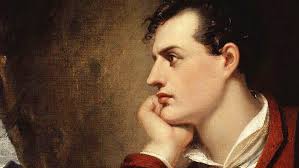
The couple would often try to come up with some excuse that showed that the woman simply changed her mind, and she and the man agreed to part amicably. However, the “tale” told was often set aside for the rumors and gossip were much more tantalizing to repeat. More gossip and scandal stuck to female’s name than it did for the man, who was often expected to keep a mistress or have had several women’s names attached as possibilities to his; there was less blame attributed to the man unless the girl’s family entered into a counter attack to shift the blame to him or to make it appear the daughter broke the engagement. The appeal to honor was very strong. Both the Duke of Wellington and Lord Byron married women they didn’t want because they had once made the mistake of showing interest in or of discussing marriage with the women.

That is the bare bones of it–the woman generally paid the price unless the couple could successfully claim she felt they would not suit–however, how society reacted depended on the woman’s dowry and her family position. [This held true for the gentleman, as well.] If a great heiress was jilted, people would be careful not to blame her too much because they would want a chance for a son or nephew to marry her. A rich peer or a rich young man was always a good catch, and a father or guardian of the next young lady to catch his eye would make certain he made it to the altar.

A woman could cry off, but she had to be wary of being labeled a “jilt.”  (1670s term for a “loose, unchaste woman; harlot;” also “woman who gives hope then dashes it;” probably a contraction of jillet, gillet, from Middle English gille “lass, wench,”)

A man who promised marriage and cried off could be sued for breach of promise, particularly if the promise was in writing. To win such a suit, one had to prove the promise and damages. Or he might just be labeled as bad ton. There were a few cases of men winning breach of promise suits. A good reference for those cases is Broken Engagements: The Action for Breach of Promise of Marriage and the Feminine Ideal, 1800–1940, by Saskia Lettmaier; Ginger Frost; Victorian Studies, Vol. 54, No. 1 (Autumn 2011), pp. 151-153, Indiana University Press. Not everyone would sue for breach of promise for it involved there being damages (to the daughter, leaving her unable to marry), so upper class might be inclined to sweep the whole thing aside as soon as possible so the social stain might be forgotten. Either way, it was poor form. A gentleman was not to propose unless he meant to go through with it; likewise a woman should not accept unless she was certain. 

I used the idea of a breach of promise and a jilted bride and bridegroom in my tale MR. DARCYS BRIDEs.


I much prefer the sharpest criticism of a single intelligent man to the thoughtless approval of the masses.

ELIZABETH BENNET is determined that she will put a stop to her mother’s plans to marry off the eldest Bennet daughter to Mr. Collins, the Longbourn heir, but a man that Mr. Bennet considers an annoying dimwit. Hence, Elizabeth disguises herself as Jane and repeats her vows to the supercilious rector as if she is her sister, thereby voiding the nuptials and saving Jane from a life of drudgery. Yet, even the “best laid plans” can often go awry.

FITZWILLIAM DARCY is desperate to find a woman who will assist him in leading his sister back to Society after Georgiana’s failed elopement with Darcy’s old enemy George Wickham. He is so desperate that he agrees to Lady Catherine De Bourgh’s suggestion that Darcy marry her ladyship’s “sickly” daughter Anne. Unfortunately, as he waits for his bride to join him at the altar, he realizes he has made a terrible error in judgement, but there is no means to right the wrong without ruining his cousin’s reputation. Yet, even as he weighs his options, the touch of “Anne’s” hand upon his sends an unusual “zing” of awareness shooting up Darcy’s arm. It is only when he realizes the “zing” has arrived at the hand of a stranger, who has disrupted his nuptials, that he breathes both a sigh of relief and a groan of frustration, for the question remains: Is Darcy’s marriage to the woman legal?

What if Fitzwilliam Darcy and Elizabeth Bennet met under different circumstances than those we know from Jane Austen’s classic tale: Circumstances that did not include the voices of vanity and pride and prejudice and doubt that we find in the original story? Their road to happily ever after may not, even then, be an easy one, but with the expectations of others removed from their relationship, can they learn to trust each other long enough to carve out a path to true happiness?

In this excerpt from the end of Chapter 22 and the beginning of Chapter 23, you might see how a threat of a Breach of Promise suit plays out in MR. DARCY’S BRIDEs.

“Mr. Darcy?” He turned to find Elizabeth beside him. “Although Mrs. Bennet suggested one of the clock for your arrival at Longbourn, by the time Mr. Bingley greets the community, it will be near that time. I must assist my mother so I have asked Miss Darcy to walk back to the estate with me. Mr. Bennet’s coach could not hold eight. Jane, Mary and I walked to services this morning to leave room for the others. Your sister suggested that you may wish to join us. In that manner, Miss Bennet and my sister Mary can join Mr. Bingley and Mrs. Annesley in your coach, leaving only four for Mr. Bennet’s carriage. I am a very good walker, and Miss Darcy claims to be one also. I know you to be hardy enough for the mile to Longbourn.”

He bowed to them. “It would be my pleasure.”

Darcy took a moment to whisper the arrangements in Bingley’s ear before following Elizabeth to where her father stood watching them. When Elizabeth explained her need to speak to him and Georgiana alone, Mr. Bennet declared, “I do not like this sudden interruption in our day, Lizzy.”

“Papa,” she soothed. Darcy watched as Elizabeth reasoned with her father. “We knew we could not keep the rest of the world in ignorance of my daring. It cannot be long until Mr. Collins realizes Mr. Darcy’s identity. He will report Mr. Darcy’s presence in the neighborhood to Lady Catherine. It is imperative that Mr. Darcy and I discuss how best to proceed before Mr. Collins is made known of the facts. Your cousin dines with the Lucases this afternoon. Surely Sir William will have something to say of Mr. Bingley’s and Mr. Darcy’s sudden appearance at Netherfield.”

Mr. Bennet glared at Darcy. “I do not welcome having someone force my hand.”

“At least,” Darcy said in uncompromising tones, “you can be assured a lion will do all within his power to protect his pride.”

“A lion, Mr. Darcy?” Elizabeth asked as they turned their steps toward the road leading to Longbourn.

He chuckled as he assumed his place at her side. He thought to place her hand on his arm, but Elizabeth kept her hands clasped behind her as she strolled along, and so he accepted his role as her escort. “It is a better moniker that the lap dog your father determined Bingley to be.”

Elizabeth smiled widely, and he enjoyed viewing the happy thoughts upon her face. “It is good to know Mr. Bennet’s health has returned. There were many weeks when he made no witty comments.” She squinted up at Darcy. “A lap dog is major step up from what my father calls Mr. Collins, when he thinks no one is listening. Mr. Bennet has been especially caustic in his interactions with his cousin since your aunt’s rector proposed marriage to me.”

Darcy stumbled to a halt. “He did what?”

“Proposed,” Elizabeth said with a teasing lift of her brow. “You understand, do you not, Mr. Darcy. Proposals lead to nuptials which lead to “I, William, take thee, Elizabeth.” Her smile spread across her features when she noted his lack of humor. “Mr. Collins Christian name is ‘William.’”

Georgiana giggled, and both he and Elizabeth turned to stare at his sister as if they had forgotten she accompanied them. “Lady Catherine would have Miss Elizabeth arrested if Mr. Collins delivered Lizzy to Hunsford. It would not surprise me if that was not her purpose in permitting him to come to Hertfordshire.”

Darcy warned, “You should not speak so disparagingly of our aunt.”

“Should I lie?” his sister questioned.

Elizabeth caught Georgiana’s hand. “I am honored that you meant to defend me with your speech, but I believe your brother does not wish you only to look at a person’s negative qualities. Is that not correct, Mr. Darcy?”

“Elizabeth speaks sense,” he said, but he made no further comment, for his mind could not release the idea of another man taking Elizabeth to his bed. The idea was intolerable to him!

“Moreover,” Elizabeth said on a rush when Darcy remained silent, “I refused Mr. Collins, and he is now engaged to my friend, Charlotte Lucas. If her ladyship meant to employ Mr. Collins deviously, he would not have turned his attentions so readily from me to Miss Lucas. He has written to Lady Catherine to ask for her ladyship’s approval, but to the best of my knowledge, your aunt is not in Kent.”

Georgiana looked to him. “Do you think her ladyship learned something of Anne’s presence in Scotland?”

Darcy’s expression tightened. “I pray not, but it would take little effort for our aunt to discover that Anne and Lady Lindale traveled to the Fitzwilliam property in Scotland. A few coins to a servant would bring her the necessary information. Lady Catherine thought to bring a criminal conversation suit against you,” he told Elizabeth. “But such would be Anne’s dominion, not our aunt’s, for my cousin is well past her majority. Mayhap her ladyship means to force Anne to pursue a breach of promise suit against me. Both would require Anne’s cooperation.”

“Crim…criminal conversation?” Elizabeth stammered. “That would mean she would charge that an affair occurred between us. A public accounting of our relationship would be spread in every newspaper in the land.”

Darcy did not think a judge would accept such a case, for the evidence was too sparse, but he would not guarantee that his aunt was not vindictive enough to pursue a public chastisement for his stubbornness. “I will not permit her ladyship to torment you. If she persists, I will bring a breach of promise suit against Anne. She was the one who left me at the altar. I will claim a large portion of Anne’s inheritance if that be the case.”

Tears pooled in Elizabeth’s eyes. “But your cousin is not at fault in this matter. I am. You may say you would have left the church before Miss De Bourgh appeared, but I know your nature, Mr. Darcy. You would have waited to learn of your cousin’s fate. If you bring a breach of promise suit against Miss De Bourgh, she will be termed a jilt. Her reputation will be more problematic than mine. Surely there must be another means from this debacle.”

“There is,” he said. “Marry me again. If we marry quickly, Anne will not be marked by negative gossip—just a bit of sympathy.”

Posted in book excerpts, British history, customs and tradiitons, Georgian England, Georgian Era, historical fiction, history, Jane Austen, laws of the land, Living in the Regency, marriage, Pride and Prejudice, publishing, reading, reading habits, Regency romance, writing | Tagged , , , , , , , , , , , | 2 Comments

Amending the Shades of Pemberley ~ Featured Today on @eBookDaily

CHECK IT OUT!!!!

<a href=”http://<a id=”ebookdaily” href=”https://ebookdaily.com”><img id=”ebookdaily-img” alt=”I’ve been featured on eBookDaily” src=”https://ebookdaily.com/img/eBookDaily250.jpg”>http://<a id=”ebookdaily” href=”https://ebookdaily.com”><img id=”ebookdaily-img” alt=”I’ve been featured on eBookDaily” src=”https://ebookdaily.com/img/eBookDaily250.jpg”></a&gt;

Posted in Always Austen, book release | Tagged , , , , , , | 2 Comments