Writers Require Precision in Language Choices

https://portlandenglish.edu/learn-english-blog/precision-in-language/

From the MasterClass Articles we learn that “Diction is the careful selection of words to communicate a message or establish a particular voice or writing style. For example, flowy, figurative language creates colorful prose, while a more formal vocabulary with concise and direct language can help drive home a point.

“Different styles of diction impact how different ideas are expressed. There are eight common types of diction:

  1. Formal diction. Formal diction is the use of sophisticated language, without slang or colloquialisms. Formal diction sticks to grammatical rules and uses complicated syntax—the structure of sentences. This elevated type of language is often found in professional texts, business documents, and legal papers.
  2. Informal diction. Informal diction is more conversational and often used in narrative literature. This casual vernacular is representative of how people communicate in real life, which gives an author freedom to depict more realistic characters. Most short stories and novels use informal diction.
  3. Pedantic diction. This is when a writer is highly detailed or academic in their writing. Words are chosen specifically to convey only one meaning. It is sometimes used in literature when characters speak in a highly educated manner, as in F. Scott Fitzgerald’s The Great Gatsby.
  4. Colloquial diction. Colloquial words or expressions are informal in nature and generally represent a certain region or time. “Ain’t” and “y’all” are examples of colloquial expressions, born in rural areas of the United States. Colloquialisms add color and realism to writing.
  5. Slang diction. These are words that originated within a specific culture or subgroup but gained traction. Slang can be a new word, a shortened or modified word, or words that take on a new meaning. Examples of common contemporary slang words are “aggro” instead of “aggravated”; “hip,” which means trendy; and “throw shade,” which is to lob an insult at someone.
  6. Abstract diction. This is when a writer uses words to express something intangible, like an idea or an emotion. Abstract phrases often lack physical detail and specificity because they are things the reader cannot experience through their five senses.
  7. Concrete diction. Concrete diction is the use of words for their literal meanings and often refer to things that appeal to the senses. The meaning is not open to interpretation because the writer is specific and detailed in their phrasing. For example, the sentence: “I ate an apple.”
  8. Poetic diction. Poetic diction is driven by lyrical words that relate to a specific theme reflected in a poem, and create a euphonious, or harmonious, sound. Poetic diction usually involves the use of descriptive language, sometimes set to a beat or rhyme.”

Choosing the precise word or phrase remains a challenge for all authors, whether they write professionally or for their own pleasure. The majority of those who make a living from writing have knowledge of words they never use in their creations. I write novels based in the Regency Period (1811-1820). Contemporary words/phrases such as Google, HD, iPad, and mouse are never used, but one easily finds acquiesce, obeisance, imprudence, and forbearance. From this quick example, one can easily observe the number of words which a person uses in his writing falls short of the number of which he is familiar. Add to that fact, how quickly the English language changes, and an author/poet will find it difficult to keep up with the flexibility of the language. Yet, some basics persist. It is the writer’s responsibility to use the best word(s) for a particular situation. Instead of choosing a word, it is important to choose the word that expresses the exact meaning he intends. (For the examples below, I give credit to my college journalism professor. These examples remain in my spiral notebook even after all these years.)

 Institute for Humane Education • 31 weeks ago "Defining Moments" (article) (via Teaching Tolerance) (Spring 2012) Explores the evolving definitions and meanings of many words used in children’s dictionaries and the challenges of dealing with complex issues related to words such as "feminism," "gender," "race," and "ethnicity" — as well as even “simple” definitions, like "tan." (From The Power of Language on Pinterest)

Institute for Humane Education • 31 weeks ago
“Defining Moments” (article) (via Teaching Tolerance) (Spring 2012) Explores the evolving definitions and meanings of many words used in children’s dictionaries and the challenges of dealing with complex issues related to words such as “feminism,” “gender,” “race,” and “ethnicity” — as well as even “simple” definitions, like “tan.” (From The Power of Language on Pinterest)

Affect, Effect
Affect is a verb meaning to influence.
Effect is a noun meaning result.

Influence, Impact (two words often associated with affect/effect)
Influence refers to the ability to cause desired effects.
Impact means to strike or to collide; to wedge in.

Acute, Chronic
Acute indicates intenseness; that something has become immediately critical.
Chronic means recurring or continuing over a considerable time.

Adapt, Adopt, Adept
Adapt means to adjust to a changing situation.
Adopt means to accept something as one’s own.

Adept means having skills.

Adverse, Averse
Adverse means unfavorable.
Averse means having a distaste for something.

Aggravate, Annoy, Irritate
Aggravate means to make worse or more troublesome. It is used to refer to things.
Annoy means to make angry, usually through repetition. Use it to refer to people.
Irritate means to provoke to impatience or anger.

Agree To, Agree With
Agree to is used to refer to things.
Agree with is used to refer to people.

Character, Reputation
Character is the sum of a person’s behavior and his moral standards.
Reputation is other people’s perception of the person.

Each Other, One Another
Each other is used when two people, places or things are involved.
One another is used for three or more.

Cynic, Skeptic
Cynic refers to a person who doubts or denies the goodness of human nature and does so in a sarcastic manner.
Skeptic refers to a person who has a doubting, questioning attitude. He wants evidence to prove his ideas.

Allusion, Delusion, Illusion
Allusion is an indirect mention.
Delusion is to believe in something even when evidence shows otherwise.
Illusion is a false or misleading idea or image.

Expect, Anticipate
Expect is used when no preparation is made.
Anticipate is used when preparation has been made for something that will occur.

Smell, Odor, Aroma
Smell is a neutral word depending on the surrounding words.
Odor refers to something unpleasant.
Aroma refers to something pleasant.

Eager, Anxious
Eager shows impatient desire.
Anxious indicates worry or concern.

Appraise, Apprise
Appraise means to determine the value.
Apprise means to notify or inform.

Cement, Concrete
Cement is the powder used as an adhesive ingredient in concrete. (Note! Cement is not a verb.)

Doctor
Doctor is a title, not a profession. It should be used generically. Use physician, minister, professor, etc., for more specific descriptions. [Heck, I am a “doctor,” but you do not wish me in the operating room.]

Pretense, Pretext
Pretense refers to a false appearance or action used purposely for deception.
Pretext is a false or fabricated reason, developed to hide the truth.

Because, Since
Most writers make no distinction in use between these two words. However, there are certain differences that should be addressed.
Because is used to indicate a cause or a reason.
Since refers to time, meaning between then and now.

To be fair, English is full of such traps. After all, I can deposit my paycheck in a bank, I can sit on the river bank to fish, or I can bank a basketball off the backboard. English is a language where one’s nose runs and his feet smell. It possesses a deceptively complex structure, but it is well worth knowing English’s subtleties.

JeffersC@Pem2

Christmas at Pemberley: A Pride and Prejudice Christmas Sequel

To bring a renewed sense joy to his wife’s countenance, Fitzwilliam Darcy has secretly invited the Bennets and the Bingleys to spend the Christmastide festive days at Pemberley. But as he and Elizabeth journey to their estate to join the gathered families, a blizzard blankets the English countryside. The Darcys find themselves stranded at a small out-of-the-way inn with another couple preparing for the immediate delivery of their first child, while Pemberley is inundated with friends and relations seeking shelter from the storm.

Without her brother’s strong presence, Georgiana Darcy desperately attempts to manage the chaos surrounding the arrival of six invited guests and eleven unscheduled visitors. But bitter feuds, old jealousies, and intimate secrets quickly rise to the surface. Has Lady Catherine returned to Pemberley for forgiveness or revenge? Will the manipulative Caroline Bingley find a soul mate? Shall Kitty Bennet and Georgiana Darcy know happiness?

Written in Regency style and including Austen’s romantic entanglements and sardonic humor, Christmas at Pemberley places Jane Austen’s most beloved characters in an exciting yuletide story that speaks to the love, the family spirit, and the generosity that remain as the heart of Christmas.

Regina-270x300


Before writing romance, Regina Jeffers wore many hats, including that of a tax preparer, journalist, choreographer, Broadway dancer, theatre director, history buff, teacher, grant writer, and media literacy consultant for school districts and public television. Now, “supposedly” retired, she writes full-time, skillfully enveloping her readers in the hearts and minds of her characters. 

Find Regina at:

Every Woman Dreams (Blog)  https://reginajeffers.wordpress.com

Always Austen (Group Blog) https://alwaysausten.com/

Facebook  https://www.facebook.com/Regina-Jeffers-Author-Page-141407102548455/?fref=ts

Twitter  https://twitter.com/reginajeffers

Amazon Author Page https://www.amazon.com/Regina-Jeffers/e/B008G0UI0I/ref=sr_ntt_srch_lnk_1?qid=1479079637&sr=8-1

Pinterest  https://www.pinterest.com/jeffers0306/

BookBub  https://www.bookbub.com/profile/regina-jeffers

Instagram  https://www.instagram.com/darcy4ever/

You Tube Interview  https://www.youtube.com/watch?v=vzgjdUigkkU
Website  https://rjefferscom.wordpress.com/

Posted in holidays, Jane Austen, language choices, Pride and Prejudice, word choices, word play, writing | Tagged , , , , | Comments Off on Writers Require Precision in Language Choices

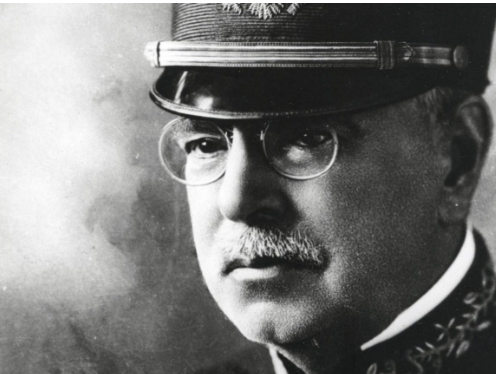
Veterans Day and the Great John Philip Sousa

Today, we have a celebration of Veterans’ Day, a day originally called Armistice Day.

The Department of Veterans Affairs Website tells us, “In November 1919, President Wilson proclaimed November 11 as the first commemoration of Armistice Day with the following words: “To us in America, the reflections of Armistice Day will be filled with solemn pride in the heroism of those who died in the country’s service and with gratitude for the victory, both because of the thing from which it has freed us and because of the opportunity it has given America to show her sympathy with peace and justice in the councils of the nations…”

“World War I – known at the time as ‘The Great War’ – officially ended when the Treaty of Versailles was signed on June 28, 1919, in the Palace of Versailles outside the town of Versailles, France. However, fighting ceased seven months earlier when an armistice, or temporary cessation of hostilities, between the Allied nations and Germany went into effect on the eleventh hour of the eleventh day of the eleventh month. For that reason, November 11, 1918, is generally regarded as the end of ‘the war to end all wars.’”

Though I am as patriotic as one might expect of someone from my generation, this post is not on Veterans Day, but rather about the man known as The March King. If you have ever been a part of a marching band or the military, you will recognize John Philip Sousa’s influence on the tradition.

John Philip Sousa was born 6 November 1854 in Washington, DC, near the Marine Barracks at that time, for his father Antonio was a musician in the Marine Band. After grammar school, he enrolled in a private conservatory of music. There, he studied piano and orchestral instruments, but the violin was his favorite. His father later insisted that John enlist as an apprentice musician with the Marine Band. He was 13 at the time, and he stayed with the band until he was 20.

In addition to his musical training in the Marine Band, he studied music theory and composition with George Felix Benkert, a noted Washington orchestra leader and teacher.

After being discharged from the Marine Corps, he toured with several traveling orchestras. During that time he also worked as a composer, arranger, and proofreader for publishing houses. He wrote the incidental music and the march for the musical “Our Flirtation” and toured with the company. While on tour in St. Louis, he received a telegram offering him the leadership of the Marine Band in Washington. He accepted and reported for duty on Oct. 1, 1880, becoming the band’s 17th Leader.

His time with the Marine Band was unlike any other leaders before him. “He replaced much of the music in the library with symphonic transcriptions and changed the instrumentation to meet his needs. Rehearsals became exceptionally strict, and he shaped his musicians into the country’s premier military band. Marine Band concerts began to attract discriminating audiences, and the band’s reputation began to spread widely.

“Sousa first received acclaim in military band circles with the writing of his march “The Gladiator” in 1886. From that time on he received ever-increasing attention and respect as a composer. In 1888, he wrote “Semper Fidelis.” Dedicated to “the officers and men of the Marine Corps,” it is traditionally known as the “official” march of the Marine Corps.

“In 1889, Sousa wrote the “Washington Post” march to promote an essay contest sponsored by the newspaper; the march was soon adapted and identified with the new dance called the two-step. The ‘Washington Post” became the most popular tune in America and Europe, and critical response was overwhelming. A British band journalist remarked that since Johann Strauss, Jr., was called the “Waltz King” that American bandmaster Sousa should be called the ‘March King.’ With this, Sousa’s regal title was coined and has remained ever since.” [Marines]

Some of my favorite Sousa marches:

The Stars and Stripes Forever

The Thunderer

The Washington Post March

Semper Fidelis

Posted in American History, military, music | Tagged , , , , , | Comments Off on Veterans Day and the Great John Philip Sousa

The Do’s and Don’t’s of Writing of a Peer’s Time in the Houses of Parliament

When writing British Regencies and other historicals set in the 1700s and 1800s, one must know something of inheritance laws, as well as how Parliament operated during those times. Below, you will find a mishmash of facts I have learned, especially as an American who is writing about British history. Hopefully, it will help someone else not make the same mistakes as I did.

According to this site (https://en.wikipedia.org/wiki/House_of_Lords), in 2014 the House of Lords passed a Reform Act which allowed peers to retire or resign from the chamber. Prior to this act, only hereditary peers could disclaim their peerages, which implies they could in the Regency era. I do not know the process but I am confident someone else does and will point the way just as I am pointing out the tidbits I have picked up over the years..

Question: In 1818, could a peer ever resign his seat in the House of Lords? What would that entail if so?  If not, could he refuse to attend Parliament when summoned for the annual session? I’m sure illness, etc., prevented some peers from attending.

Answer: No, he could not resign. However, he need not accept it when he first succeeds to the title, just as Maurice Berkeley did when he was named Earl of Berkeley. The earldom remained dormant during his life.

Born the illegitimate son of Frederick Berkeley, 5th Earl of Berkeley, and his wife Mary Berkeley (née Cole), Berkeley entered the Royal Navy in June 1802. Entering politics, Berkeley became Whig Member of Parliament for Gloucester in the 1831 general election. He resigned his seat in April 1833 following his appointment as Fourth Naval Lord in the Grey ministry that month and remained in office until December 1834. He successfully became Member of Parliament for Gloucester again at the 1835 general election but, although he secured his old job as Fourth Naval Lord back again in the Second Melbourne ministry in July 1837, he was defeated at the 1837 general election. He remained in office as Fourth Sea Lord but became concerned over reductions in manning and resigned in March 1839.

Lord Byron left the country and just never returned so never answered his writ of summons and never took the oath again so he could not name a proxy.

Catholics, minors, females and the deranged could not attend, but others were supposed to go for a time or two to take the oath at the beginning of a new parliament (after an election).

Once they came in and took the oath, they could name a proxy and give him permission to vote for him. Usually the man then retired to the country. That was done due to illness of the man or to circumstances at home or various such legitimate excuses. It was considered an obligation of peerage to go to parliament at least to take the oath so that a party member could be given the proxy. Quite a few stayed away unless an important vote was pending. At that time “whippers in” would go out to corral all they could to attend and vote.

Even when a peerage was disclaimed, the heir was still the heir. The heir could not inherit until the holder died. The usual reason for disclaiming a peerage was to stay in the House of Commons. A bill was passed to allow the heir who sat in the House of Commons to continue to do so when he succeeded to the peerage. If this occurred, usually the man was PM or had some other important position in the House.

The proxy to vote could not be given to the son (heir), because he is not entitled to sit in the House of Lords until he succeeds to the title and is summoned to Parliament. The proxy can only be given to someone who is already sitting in the House of Lords.

During the Regency, many viscounts served in the House of Commons, especially ones with Irish titles.

In Scotland, there was not such a big hoopla of a child being legitimate or not based on the date of marriage. A Scot was considered legitimate by the subsequent marriage of his parents in Scotland, but under English law, he was not heir to any English property or titles and honors. Only a child born after his parents married could inherit English property and titles.

All the Irish and Scottish peers were not given seats in the House of Lords. Only a representative number of each were elected by other peers to attend the House of Lords. The Irish peers were elected for life while the Scottish peers were elected for the parliament (from one general election to the next).

The Irish peers who were not  elected as representative peers could sit in the House of Commons. Scottish peers could not. These were peers without English titles. Of course, because there are often no absolutes in these matters, by the Regency Period, those with English titles were entitled to a seat in the House of Lords. 

Those Irish peers who did sit in the House of Commons lost privileges of Peerage, but did have privilege of Parliament. It is hard to know, offhand, whether a viscount was a peer or an heir.

Here are some book recommendations for learning more on this process:

The Unreformed House of Commons by Edward and Anne Porritt. Two separate volumes. Available on Amazon and Google Books.

It’s an incredibly detailed resource that’s available online. I am going to link you to the chapter on the physical houses of Parliament since some of you were looking for a floor plan (there isn’t one, but there’s quite a lot about the buildings):

And here’s the Table of Contents which is pretty detailed and mostly hyperlinked on Google Books.

I suspect that Part 4, The House and Its Usages, will be most useful for you. 🙂 Obviously it is not a floor plan of which I have had several requests, but if you have not seen it, here is a great picture of the main chamber of the House of Commons: https://commons.wikimedia.org/wiki/File:The_House_of_Commons_-_Microcosm_of_London_%281808-1811%29,_21_-_BL.jpg

And here is a partial timeline on construction and renovations on the Houses of Parliament before they burned down in 1834:

http://www.parliament.uk/about/living-heritage/building/palace/estatehistory/reformation-1834/

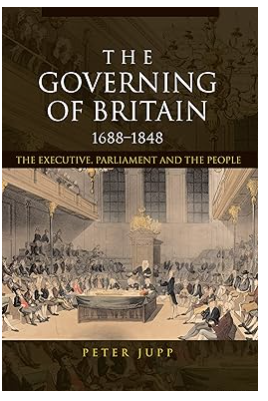
If your hero is a Tory and member of the government’s party, I recommend The Governing of Britain, 1688-1848: The Executive, Parliament and the People, by Peter Jupp. Detailed explanation of the workings of Parliament, cabinet, the monarchy, etc. It is a huge book but it is separated by time period so you should not be required to read the whole thing to find the relevant information.

Focusing on the institutions and players of central and local government during an era of great transformation, Peter Jupp examines the cohesive nature of the British state, and how Britain was governed between 1688 and 1848.
Divided into two parts, bisected by the accession of George III in 1760, this study:
examines the changes to the framework and function of executive government
presents an analysis of its achievements, the composition and functions of Parliament, explores Parliament’s role in government
looks at the interaction between the executive, Parliament and the public.
Providing new insights into the formulation of notions and traditions of legislation, the public sphere and popular politics, The Governing of Britain is an essential guide to a formative era in political life.

If your character is a Whig and member of the Opposition, I would choose The Whigs in Opposition: 1815-1830, by Austin Mitchell. It contains very detailed explorations of the inner workings of the Whig party, with discussions of specific bills and votes in Parliament.

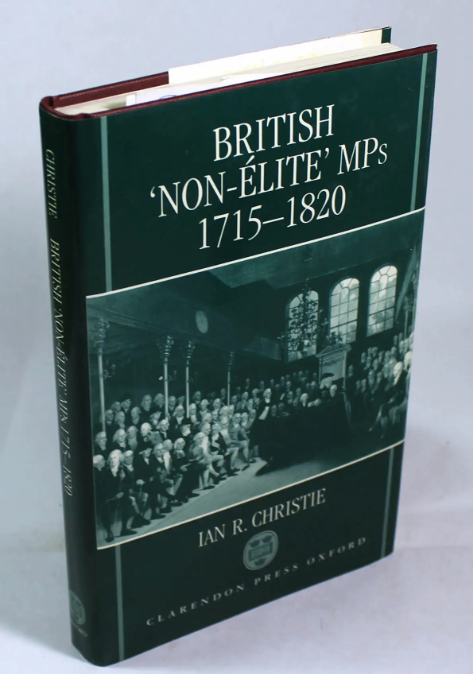
If he is not part of the aristocracy, check out British ‘Non-Elite’ MPs: 1715-1820, by Ian R. Christie. I have not actually read this book; yet, but it looks awesome!

In the eighteenth century the considerable degree of social mobility in British society, especially between the upper and middling ranks, was arguably one of the important factors contributing to political and social stability. The extent of that mobility among the members of the nation’s legislature was particularly important in this regard. In the first detailed analysis of its kind, Ian R. Christie examines how far the House of Commons reflected and was itself affected by such social mobility. Enquiry is directed at the growth in number of `non-élite’ members of parliament; men without land. This is a fascinating study which every historian of 18th-century Britain will want to read.

Here are some other books I might also recommend to the serious writer.

The Great Reform Act of 1832, by Eric J. Evans. Very short and concise, with an excellent section on the Unreformed system.

Regency England: the Age of Lord Liverpool, by John Plowright. Another short one, a great overview of the political currents of the time and major issues, politicians and legislation.

The English Town 1680-1840: Government, Society, and Culture, by Rosemary Sweet. Invaluable for writing provincial England, with a good section on local politics.

Hansard’s Parliamentary Debates 1803-2005

Government and Community in the English Provinces, 1700-1870, by David Eastwood.

The Scandalous Affair That Nearly Ended a Monarchy: The Trial of Queen Caroline, by Jane Robin.

Posted in Act of Parliament, aristocracy, British history, buildings and structures, England, Georgian England, Georgian Era, history, Living in the Regency, Living in the UK, peerage, Regency era, research | Tagged , , , , , , , , , , , , , | Comments Off on The Do’s and Don’t’s of Writing of a Peer’s Time in the Houses of Parliament

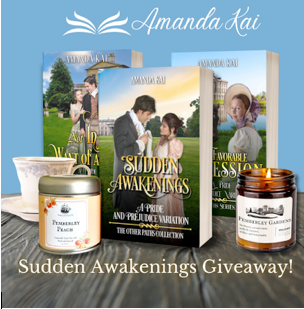
Sudden Awakenings, a New JAFF from Amanda Kai + an Excerpt + a Giveaway

Thank you, Regina, for taking time out of your hectic schedule to host me today on Every Woman Dreams. So exciting to hear about your upcoming Regency Romances for Dragonblade mystery series associated with the Lyon’s Den Realm and your new Jane Austen variation, Leave Her Wild, coming out in February! I hope one day to be as prolific as you are.

Today, I’m celebrating the release of my newest Pride and Prejudice variation “Sudden Awakenings”, which is third standalone P&P variation in The Other Paths Collection. Each book operates in its own “universe” and featuring a different path to Happily Ever After for Darcy and Elizabeth, so you can enjoy them in any order.

In this twist, Elizabeth’s sleepwalking condition puts her in a bind when she accidentally wanders into Mr. Darcy’s room while they are guests at Netherfield Park, forcing them to get married to save Elizabeth’s reputation. Enemies to lovers is one of my very favorite tropes, especially when combined with forced marriage or arranged marriage situations, so it was a lot of fun to write this story, and I hope you will all enjoy it.

Blurb:

What could be worse than awakening in the bed of the man you hate?

Elizabeth Bennet, haunted by a family history of sleepwalking, has spent her life navigating the challenges and eccentricities of her condition. 

A sudden encounter during a sleepwalking episode forces her and Mr. Darcy into a marriage of convenience. As they navigate their newfound relationship, their initial prejudices give way to unexpected feelings. 

However, Darcy’s formidable aunt, Lady Catherine, opposes the match and schemes to break them apart. Can Elizabeth and Darcy overcome the obstacles placed before them and awaken to the realization of the love between them? 

This clean, heartwarming romance will leave you captivated and yearning for more. A unique Pride and Prejudice variation culminating in a happily ever after for Our Dear Couple.

Excerpt from Chapter 2 of Sudden Awakenings

Mr. Bingley returned to Netherfield Park the following week, accompanied by Miss Bingley, along with his elder sister and her husband, the Hursts. During his absence, the servants set up the house for him. The rooms were cleaned and readied, the larder stocked, and Bingley’s own possessions unpacked. He had little in the way of furniture or decorations, having lived the life of a bachelor for some time now, so it was fortunate the owners had left the house furnished and in good condition. 

The quality was not up to Miss Bingley’s standards, however. “When you purchase a house, Charles, I hope you shall let me decorate it. This house is positively ancient, and these furnishings are at least ten years out of date. I suppose it is to be expected in this rustic neighborhood.”

“I find no fault with the furnishings, Caroline,” he retorted, plopping himself onto the sofa and stretching himself out comfortably. He was the sort of man who could be comfortable in any environment, whereas Caroline loved to criticize at every turn. In her eyes, their abode, no matter whether in London or the countryside, always appeared to be too poor, too shabby, too outdated. The exception was when they were guests at the home of someone far wealthier than them. There, no room could go without praise or exclamation from her; she must comment on its size and proportion, the colors of the decor, the comfort and style of the furnishings, and the excellent taste of the art. 

“I positively dread giving a dinner here,” Miss Bingley continued. “Did you see how small the dining table is? We can hardly fit six couples. Such a large dining room could easily accommodate a table twice that size. What a pity the owners did not think to purchase a larger one before they vacated the house.”

“Perhaps they could not afford to,” Mr. Bingley suggested. 

Mrs. Hurst quipped, “As you have no acquaintances in the neighborhood yet, I do not think you must worry about having too little room at your table to accommodate them. Your worry lies in filling the seats you already possess.”

Miss Bingley glared at her sister over this remark, prompting a chuckle from their brother.

***

Mr. Bennet’s call on Mr. Bingley was paid, despite all his assurances (and Mrs. Bennet’s fears) that it would not, and the connection formed. Mr. Bingley, having heard of Mr. Bennet’s beautiful daughters from Sir William Lucas, and finding Mr. Bennet to be an agreeable man, was keen to return the visit at the earliest convenient time. 

Miss Bingley and Mrs. Hurst accompanied him to visit the Bennet family. Though themselves not anxious to develop acquaintances in that region, they wished to form an opinion of the people with whom they would be forced to mingle during their stay. Mr. Hurst, who cared for nothing that did not relate to his victuals, his sleep, or his recreation, saw no advantage to paying calls and chose to remain behind for an afternoon nap. 

Mr. Bingley thought all of the Bennet sisters to be beautiful, but he was especially taken with the eldest. Miss Bennet’s fair features and sweet disposition would have been enough to make him declare her an angel, but when coupled with her pert lips and her perfectly-proportioned figure, accentuated by the empire waist of her crisp, white, morning gown, he found himself quite entranced. 

Mrs. Bennet noticed his immediate attraction towards her daughter and insisted that Jane exchange seats with her to be nearer to their guests. From then on, she took pains to promote Jane’s finer qualities at every opportunity. 

Mrs. Bennet’s forward inquiries about Mr. Bingley’s business, his prospects, and his intention to remain in the neighborhood were not lost on his sisters. It became equally apparent to them that the family’s connections were nothing; no ties to the nobility, not even a baronet. Mrs. Bennet had a brother in trade and a sister whose husband was a country solicitor. Such a decidedly low situation was compounded by the estate being entailed on a cousin, the husband of one daughter. While she might expect a good life as the mistress of Longbourn, the others could have precious little in the way of a dowry. The fact of the matter was, the remaining sisters must depend on making good matches, and it was plain by Mrs. Bennet’s vulgar attention to Mr. Bingley’s fortune that she saw him as an advantageous prospect. 

Mr. Bingley, however, was all too ready to be taken advantage of. Having beheld his ideal woman, he was eager to further his acquaintance with her.

“Will you be at the assembly this month, Miss Bennet?” he asked, his eyes dilating at the prospect of seeing her in an evening gown.

Jane nodded, an alluring smile forming on her lips. “Indeed, I shall. My sisters and I always attend, for we dearly love to dance.”

“Excellent! Then I shall look forward to the pleasure of dancing with you–with all of you, that is,” he added, nodding at her sisters in turn. 

“Does your brother-in-law dance too, Mr. Bingley?” Miss Elizabeth asked him eagerly. “For gentlemen are scarce in these parts, and we are often short on partners.”

Mr. Bingley shook his head. “Mr. Hurst does not dance, I am afraid. Now that he is married, he spends all his time in the card room at such gatherings. But do not despair; I have it on good authority that my dear friend, Mr. Fitzwilliam Darcy, will be coming down in time for the assembly. He has accepted my invitation to stay at Netherfield this season, and was only delayed in coming by some pressing business.”

“How delightful!” Mrs. Bennet exclaimed. “Where does your friend hail from?”

“Mr. Darcy’s home is in Derbyshire, ma’am. At Pemberley.”

Mrs. Bennet leaned closer in eager attention. “I confess, I have not heard of it. Is it a very large place?”

“To be sure!” Mr. Bingley nodded. “One of the finest estates in all of Derbyshire. And Mr. Darcy is an excellent fellow. I have known him long. I am certain he will make a welcome addition to all our parties.”

“Oh, no doubt about it!” Mrs. Bennet said. “We shall be pleased to meet him.” 

The notion of having yet another eligible man added to their gatherings was a most delightful one, and before the guests had departed, Mrs. Bennet was already envisioning two of her daughters happily settled; one at Netherfield, and one at this Pemberley place. With her limited knowledge of geography, she knew not how far Derbyshire might be from Hertfordshire, but the distance could be of no consequence if the man were as rich as he seemed. She formed a mental note to begin making inquiries about him. 

That Jane should be one of the two brides was a given; but which of her other daughters might also be chosen would depend on the gentlemen’s preferences, she supposed. 

Continue reading Sudden Awakenings on Amazon and Kindle Unlimited

About the Author:

Amanda Kai’s love of period dramas and classic literature inspires her historical and contemporary romances. She is the author of several stories inspired by Jane Austen, including Not In Want of a Wife, Elizabeth’s Secret Admirer, and Swipe Right for Mr. Darcy. Prior to becoming an author, Amanda enjoyed a career as a professional harpist, and danced ballet for twenty years. When she’s not diving into the realm of her imagination, Amanda lives out her own happily ever after in Texas with her husband and three children.

Game: 

Each day during my blog tour, you’ll find a different game or puzzle to play. Today’s game is a memory-match, featuring covers from my books.  Enjoy! 

Giveaway:

To celebrate the release of Sudden Awakenings, Amanda is giving away some fabulous prizes. Thank you, Regina, for taking time out of your hectic schedule to host me today on Every Woman Dreams. So exciting to hear about your upcoming Regency Romances for Dragonblade mystery series associated with the Lyon’s Den Realm and your new Jane Austen variation, Leave Her Wild, coming out in February! I hope one day to be as prolific as you are.

Today, I’m celebrating the release of my newest Pride and Prejudice variation “Sudden Awakenings”, which is third standalone P&P variation in The Other Paths Collection. Each book operates in its own “universe” and featuring a different path to Happily Ever After for Darcy and Elizabeth, so you can enjoy them in any order.

In this twist, Elizabeth’s sleepwalking condition puts her in a bind when she accidentally wanders into Mr. Darcy’s room while they are guests at Netherfield Park, forcing them to get married to save Elizabeth’s reputation. Enemies to lovers is one of my very favorite tropes, especially when combined with forced marriage or arranged marriage situations, so it was a lot of fun to write this story, and I hope you will all enjoy it.

Blurb:

What could be worse than awakening in the bed of the man you hate?

Elizabeth Bennet, haunted by a family history of sleepwalking, has spent her life navigating the challenges and eccentricities of her condition. 

A sudden encounter during a sleepwalking episode forces her and Mr. Darcy into a marriage of convenience. As they navigate their newfound relationship, their initial prejudices give way to unexpected feelings. 

However, Darcy’s formidable aunt, Lady Catherine, opposes the match and schemes to break them apart. Can Elizabeth and Darcy overcome the obstacles placed before them and awaken to the realization of the love between them? 

This clean, heartwarming romance will leave you captivated and yearning for more. A unique Pride and Prejudice variation culminating in a happily ever after for Our Dear Couple.

Excerpt from Chapter 2 of Sudden Awakenings

Mr. Bingley returned to Netherfield Park the following week, accompanied by Miss Bingley, along with his elder sister and her husband, the Hursts. During his absence, the servants set up the house for him. The rooms were cleaned and readied, the larder stocked, and Bingley’s own possessions unpacked. He had little in the way of furniture or decorations, having lived the life of a bachelor for some time now, so it was fortunate the owners had left the house furnished and in good condition. 

The quality was not up to Miss Bingley’s standards, however. “When you purchase a house, Charles, I hope you shall let me decorate it. This house is positively ancient, and these furnishings are at least ten years out of date. I suppose it is to be expected in this rustic neighborhood.”

“I find no fault with the furnishings, Caroline,” he retorted, plopping himself onto the sofa and stretching himself out comfortably. He was the sort of man who could be comfortable in any environment, whereas Caroline loved to criticize at every turn. In her eyes, their abode, no matter whether in London or the countryside, always appeared to be too poor, too shabby, too outdated. The exception was when they were guests at the home of someone far wealthier than them. There, no room could go without praise or exclamation from her; she must comment on its size and proportion, the colors of the decor, the comfort and style of the furnishings, and the excellent taste of the art. 

“I positively dread giving a dinner here,” Miss Bingley continued. “Did you see how small the dining table is? We can hardly fit six couples. Such a large dining room could easily accommodate a table twice that size. What a pity the owners did not think to purchase a larger one before they vacated the house.”

“Perhaps they could not afford to,” Mr. Bingley suggested. 

Mrs. Hurst quipped, “As you have no acquaintances in the neighborhood yet, I do not think you must worry about having too little room at your table to accommodate them. Your worry lies in filling the seats you already possess.”

Miss Bingley glared at her sister over this remark, prompting a chuckle from their brother.

***

Mr. Bennet’s call on Mr. Bingley was paid, despite all his assurances (and Mrs. Bennet’s fears) that it would not, and the connection formed. Mr. Bingley, having heard of Mr. Bennet’s beautiful daughters from Sir William Lucas, and finding Mr. Bennet to be an agreeable man, was keen to return the visit at the earliest convenient time. 

Miss Bingley and Mrs. Hurst accompanied him to visit the Bennet family. Though themselves not anxious to develop acquaintances in that region, they wished to form an opinion of the people with whom they would be forced to mingle during their stay. Mr. Hurst, who cared for nothing that did not relate to his victuals, his sleep, or his recreation, saw no advantage to paying calls and chose to remain behind for an afternoon nap. 

Mr. Bingley thought all of the Bennet sisters to be beautiful, but he was especially taken with the eldest. Miss Bennet’s fair features and sweet disposition would have been enough to make him declare her an angel, but when coupled with her pert lips and her perfectly-proportioned figure, accentuated by the empire waist of her crisp, white, morning gown, he found himself quite entranced. 

Mrs. Bennet noticed his immediate attraction towards her daughter and insisted that Jane exchange seats with her to be nearer to their guests. From then on, she took pains to promote Jane’s finer qualities at every opportunity. 

Mrs. Bennet’s forward inquiries about Mr. Bingley’s business, his prospects, and his intention to remain in the neighborhood were not lost on his sisters. It became equally apparent to them that the family’s connections were nothing; no ties to the nobility, not even a baronet. Mrs. Bennet had a brother in trade and a sister whose husband was a country solicitor. Such a decidedly low situation was compounded by the estate being entailed on a cousin, the husband of one daughter. While she might expect a good life as the mistress of Longbourn, the others could have precious little in the way of a dowry. The fact of the matter was, the remaining sisters must depend on making good matches, and it was plain by Mrs. Bennet’s vulgar attention to Mr. Bingley’s fortune that she saw him as an advantageous prospect. 

Mr. Bingley, however, was all too ready to be taken advantage of. Having beheld his ideal woman, he was eager to further his acquaintance with her.

“Will you be at the assembly this month, Miss Bennet?” he asked, his eyes dilating at the prospect of seeing her in an evening gown.

Jane nodded, an alluring smile forming on her lips. “Indeed, I shall. My sisters and I always attend, for we dearly love to dance.”

“Excellent! Then I shall look forward to the pleasure of dancing with you–with all of you, that is,” he added, nodding at her sisters in turn. 

“Does your brother-in-law dance too, Mr. Bingley?” Miss Elizabeth asked him eagerly. “For gentlemen are scarce in these parts, and we are often short on partners.”

Mr. Bingley shook his head. “Mr. Hurst does not dance, I am afraid. Now that he is married, he spends all his time in the card room at such gatherings. But do not despair; I have it on good authority that my dear friend, Mr. Fitzwilliam Darcy, will be coming down in time for the assembly. He has accepted my invitation to stay at Netherfield this season, and was only delayed in coming by some pressing business.”

“How delightful!” Mrs. Bennet exclaimed. “Where does your friend hail from?”

“Mr. Darcy’s home is in Derbyshire, ma’am. At Pemberley.”

Mrs. Bennet leaned closer in eager attention. “I confess, I have not heard of it. Is it a very large place?”

“To be sure!” Mr. Bingley nodded. “One of the finest estates in all of Derbyshire. And Mr. Darcy is an excellent fellow. I have known him long. I am certain he will make a welcome addition to all our parties.”

“Oh, no doubt about it!” Mrs. Bennet said. “We shall be pleased to meet him.” 

The notion of having yet another eligible man added to their gatherings was a most delightful one, and before the guests had departed, Mrs. Bennet was already envisioning two of her daughters happily settled; one at Netherfield, and one at this Pemberley place. With her limited knowledge of geography, she knew not how far Derbyshire might be from Hertfordshire, but the distance could be of no consequence if the man were as rich as he seemed. She formed a mental note to begin making inquiries about him. 

That Jane should be one of the two brides was a given; but which of her other daughters might also be chosen would depend on the gentlemen’s preferences, she supposed. 

Continue reading Sudden Awakenings on Amazon and Kindle Unlimited

About the Author:

Amanda Kai’s love of period dramas and classic literature inspires her historical and contemporary romances. She is the author of several stories inspired by Jane Austen, including Not In Want of a Wife, Elizabeth’s Secret Admirer, and Swipe Right for Mr. Darcy. Prior to becoming an author, Amanda enjoyed a career as a professional harpist, and danced ballet for twenty years. When she’s not diving into the realm of her imagination, Amanda lives out her own happily ever after in Texas with her husband and three children.

Game: 

Each day during my blog tour, you’ll find a different game or puzzle to play. Today’s game is a memory-match, featuring covers from my books.  Enjoy! 

Giveaway:

To celebrate the release of Sudden Awakenings, Amanda is giving away some fabulous prizes. Click here to enter. Giveaway ends Dec. 1, 2024.

Posted in book excerpts, book release, books, eBooks, excerpt, Georgian Era, Guest Blog, Guest Post, Jane Austen, Pride and Prejudice, publishing, reading, Regency era, Regency romance, Vagary, writing | Tagged , , , , , , , , , , , | Comments Off on Sudden Awakenings, a New JAFF from Amanda Kai + an Excerpt + a Giveaway

The Amazing Wisdom of Thomas Jefferson: The Man. The Myth.

As this coming Tuesday is election day, I thought I might share something of the man who largely wrote our country’s “Declaration of Independence.” I found this most agreeable as Jefferson’s holds a place on my family tree. Moreover, this is about as political as I ever hope to be on social media. 

Thomas Jefferson: The Man. The Myth. 

This is amazing. There are two parts. I dare you to read the quotes from the 2nd part and not think he is talking about modern day politics.

Thomas Jefferson was a very remarkable man who started learning very
early in life and never stopped.
> At 5, began studying under his cousin’s tutor.
> At 9, studied Latin, Greek and French.
> At 14, studied classical literature and additional languages.
> At 16, entered the College of William and Mary.
> At 19, studied Law for 5 years starting under George Wythe.
> At 23, started his own law practice.
> At 25, was elected to the Virginia House of Burgesses.
> At 31, wrote the widely circulated “Summary View of the Rights of
British America” and retired from his law practice.
> At 32, was a Delegate to the Second Continental Congress.
> At 33, wrote the Declaration of Independence.
> At 33, took three years to revise Virginia’s legal code and wrote a
Public Education bill and a statute for Religious Freedom.
> At 36, was elected the second Governor of Virginia, succeeding Patrick
> Henry.
> At 40, served in Congress for two years.
> At 41, was the American minister to France and negotiated commercial
treaties with European nations along with Ben Franklin and John Adams.
> At 46, served as the first Secretary of State under George Washington.
> At 53, served as Vice President and was elected president of the
American Philosophical Society.
> At 55, drafted the Kentucky Resolutions and became the active head of
Republican Party.
> At 57, was elected the third president of the United States.
> At 60, obtained the Louisiana Purchase, doubling the nation’s size.
> At 61, was elected to a second term as President.
> At 65, retired to Monticello.
> At 80, helped President Monroe shape the Monroe Doctrine.
> At 81, almost single-handedly created the University of Virginia and
served as its first president.
> At 83, died on the 50th anniversary of the Signing of the Declaration
of Independence, along with John Adams

Thomas Jefferson knew because he himself studied the previous failed attempts at government. He understood actual history, the nature of God, his laws and the nature of man. That happens to be way more than what most understand today. Jefferson really knew his stuff. A voice from the past to lead us in the future:
John F. Kennedy held a dinner in the White House for a group of the brightest minds in the nation at that time. He made this statement:
“This is perhaps the assembly of the most intelligence ever to gather at one time in the White House with the exception of when Thomas Jefferson dined alone.”

Here are some of Jefferson’s quotes. Do any strike a bell for you?

When we get piled upon one another in large cities, as in Europe, we shall become as corrupt as Europe.” — Thomas Jefferson

“The democracy will cease to exist when you take away from those who are willing to work and give to those who would not..” — Thomas Jefferson

“It is incumbent on every generation to pay its own debts as it goes. A principle which if acted on would save one-half the wars of the world.” — Thomas Jefferson

“I predict future happiness for Americans if they can prevent the government from wasting the labors of the people under the pretense of taking care of them.” — Thomas Jefferson

“My reading of history convinces me that most bad government results from too much government.” — Thomas Jefferson

“No free man shall ever be debarred the use of arms.” — Thomas Jefferson

“The strongest reason for the people to retain the right to keep and bear arms is, as a last resort, to protect themselves against tyranny in government.” — Thomas Jefferson

“The tree of liberty must be refreshed from time to time with the blood of patriots and tyrants.” — Thomas Jefferson

“To compel a man to subsidize with his taxes the propagation of ideas which he disbelieves and abhors is sinful and tyrannical.” — Thomas Jefferson

Thomas Jefferson said in 1802:
“I believe that banking institutions are more dangerous to our liberties than standing armies.
If the American people ever allow private banks to control the issue of their currency, first by inflation, then by deflation, the banks  and corporations that will grow up around the banks will deprive the people of all property – until their children wake-up homeless on the
continent their fathers conquered.”

Below, find an easier version of the document to read. When I taught Advanced Placement Language courses, I used The Declaration of Independence as the perfect example of an argumentative essay.

For those who have not studied this form (meaning many of today’s politicians) the 4 parts of an argumentative essay are the claim, counterclaim, reasoning, and evidence. The claim is the author’s argument that they are attempting to prove in the essay. The counterclaim is the opposite argument which the author addresses in order provide a rebuttal. The reasoning is the logic used to prove a claim. The evidence is the facts, data, and quoted experts used to provide support for the reasoning.

IN CONGRESS, July 4, 1776

The unanimous Declaration of the thirteen united States of America,

When in the Course of human events, it becomes necessary for one people to dissolve the political bands which have connected them with another, and to assume among the powers of the earth, the separate and equal station to which the Laws of Nature and of Nature’s God entitle them, a decent respect to the opinions of mankind requires that they should declare the causes which impel them to the separation.

We hold these truths to be self-evident, that all men are created equal, that they are endowed by their Creator with certain unalienable Rights, that among these are Life, Liberty and the pursuit of Happiness. — That to secure these rights, Governments are instituted among Men, deriving their just powers from the consent of the governed, — That whenever any Form of Government becomes destructive of these ends, it is the Right of the People to alter or to abolish it, and to institute new Government, laying its foundation on such principles and organizing its powers in such form, as to them shall seem most likely to effect their Safety and Happiness. Prudence, indeed, will dictate that Governments long established should not be changed for light and transient causes; and accordingly all experience hath shewn, that mankind are more disposed to suffer, while evils are sufferable, than to right themselves by abolishing the forms to which they are accustomed. But when a long train of abuses and usurpations, pursuing invariably the same Object evinces a design to reduce them under absolute Despotism, it is their right, it is their duty, to throw off such Government, and to provide new Guards for their future security. — Such has been the patient sufferance of these Colonies; and such is now the necessity which constrains them to alter their former Systems of Government. The history of the present King of Great Britain is a history of repeated injuries and usurpations, all having in direct object the establishment of an absolute Tyranny over these States. To prove this, let Facts be submitted to a candid world.

He has refused his Assent to Laws, the most wholesome and necessary for the public good.

He has forbidden his Governors to pass Laws of immediate and pressing importance, unless suspended in their operation till his Assent should be obtained; and when so suspended, he has utterly neglected to attend to them.

He has refused to pass other Laws for the accommodation of large districts of people, unless those people would relinquish the right of Representation in the Legislature, a right inestimable to them and formidable to tyrants only.

He has called together legislative bodies at places unusual, uncomfortable, and distant from the depository of their public Records, for the sole purpose of fatiguing them into compliance with his measures.

He has dissolved Representative Houses repeatedly, for opposing with manly firmness his invasions on the rights of the people.

He has refused for a long time, after such dissolutions, to cause others to be elected; whereby the Legislative powers, incapable of Annihilation, have returned to the People at large for their exercise; the State remaining in the mean time exposed to all the dangers of invasion from without, and convulsions within.

He has endeavoured to prevent the population of these States; for that purpose obstructing the Laws for Naturalization of Foreigners; refusing to pass others to encourage their migrations hither, and raising the conditions of new Appropriations of Lands.

He has obstructed the Administration of Justice, by refusing his Assent to Laws for establishing Judiciary powers.

He has made Judges dependent on his Will alone, for the tenure of their offices, and the amount and payment of their salaries.

He has erected a multitude of New Offices, and sent hither swarms of Officers to harrass our people, and eat out their substance.

He has kept among us, in times of peace, Standing Armies without the Consent of our legislatures.

He has affected to render the Military independent of and superior to the Civil power.

He has combined with others to subject us to a jurisdiction foreign to our constitution, and unacknowledged by our laws; giving his Assent to their Acts of pretended Legislation:

For Quartering large bodies of armed troops among us:

For protecting them, by a mock Trial, from punishment for any Murders which they should commit on the Inhabitants of these States:

For cutting off our Trade with all parts of the world:

For imposing Taxes on us without our Consent:

For depriving us in many cases, of the benefits of Trial by Jury:

For transporting us beyond Seas to be tried for pretended offences:

For abolishing the free System of English Laws in a neighbouring Province, establishing therein an Arbitrary government, and enlarging its Boundaries so as to render it at once an example and fit instrument for introducing the same absolute rule into these Colonies:

For taking away our Charters, abolishing our most valuable Laws, and altering fundamentally the Forms of our Governments:

For suspending our own Legislatures, and declaring themselves invested with power to legislate for us in all cases whatsoever.

He has abdicated Government here, by declaring us out of his Protection and waging War against us.

He has plundered our seas, ravaged our Coasts, burnt our towns, and destroyed the lives of our people.

He is at this time transporting large Armies of foreign Mercenaries to compleat the works of death, desolation and tyranny, already begun with circumstances of Cruelty & perfidy scarcely paralleled in the most barbarous ages, and totally unworthy the Head of a civilized nation.

He has constrained our fellow Citizens taken Captive on the high Seas to bear Arms against their Country, to become the executioners of their friends and Brethren, or to fall themselves by their Hands.

He has excited domestic insurrections amongst us, and has endeavoured to bring on the inhabitants of our frontiers, the merciless Indian Savages, whose known rule of warfare, is an undistinguished destruction of all ages, sexes and conditions.

In every stage of these Oppressions We have Petitioned for Redress in the most humble terms: Our repeated Petitions have been answered only by repeated injury. A Prince whose character is thus marked by every act which may define a Tyrant, is unfit to be the ruler of a free people.
Nor have We been wanting in attentions to our British brethren. We have warned them from time to time of attempts by their legislature to extend an unwarrantable jurisdiction over us. We have reminded them of the circumstances of our emigration and settlement here. We have appealed to their native justice and magnanimity, and we have conjured them by the ties of our common kindred to disavow these usurpations, which, would inevitably interrupt our connections and correspondence. They too have been deaf to the voice of justice and of consanguinity. We must, therefore, acquiesce in the necessity, which denounces our Separation, and hold them, as we hold the rest of mankind, Enemies in War, in Peace Friends.

We, therefore, the Representatives of the united States of America, in General Congress, Assembled, appealing to the Supreme Judge of the world for the rectitude of our intentions, do, in the Name, and by Authority of the good People of these Colonies, solemnly publish and declare, That these United Colonies are, and of Right ought to be Free and Independent States; that they are Absolved from all Allegiance to the British Crown, and that all political connection between them and the State of Great Britain, is and ought to be totally dissolved; and that as Free and Independent States, they have full Power to levy War, conclude Peace, contract Alliances, establish Commerce, and to do all other Acts and Things which Independent States may of right do. And for the support of this Declaration, with a firm reliance on the protection of divine Providence, we mutually pledge to each other our Lives, our Fortunes and our sacred Honor.

[Georgia:]

Button Gwinnett
Lyman Hall
George Walton

[North Carolina:]

William Hooper
Joseph Hewes
John Penn

[South Carolina:]

Edward Rutledge
Thomas Heyward, Jr.
Thomas Lynch, Jr.
Arthur Middleton

[Maryland:]

Samuel Chase
William Paca
Thomas Stone
Charles Carroll of Carrollton

[Virginia:]

George Wythe
Richard Henry Lee
Thomas Jefferson
Benjamin Harrison
Thomas Nelson, Jr.
Francis Lightfoot Lee
Carter Braxton

[Pennsylvania:]

Robert Morris
Benjamin Rush
Benjamin Franklin
John Morton
George Clymer
James Smith
George Taylor
James Wilson
George Ross

[Delaware:]

Caesar Rodney
George Read
Thomas McKean

[New York:]

William Floyd
Philip Livingston
Francis Lewis
Lewis Morris

[New Jersey:]

Richard Stockton
John Witherspoon
Francis Hopkinson
John Hart
Abraham Clark

[New Hampshire:]

Josiah Bartlett
William Whipple
Matthew Thornton

[Massachusetts:]

John Hancock
Samuel Adams
John Adams
Robert Treat Paine
Elbridge Gerry

[Rhode Island:]

Stephen Hopkins
William Ellery

[Connecticut:]

Roger Sherman
Samuel Huntington
William Williams
Oliver Wolcott

Source: http://www.archives.gov/exhibits/charters/declaration_transcript.html

Posted in America, American History, British history, Declaration of Independence, England, Georgian England, Georgian Era, Regency era, research, world history | Tagged , , , , , | Comments Off on The Amazing Wisdom of Thomas Jefferson: The Man. The Myth.

All Hallow’s Eve During the Regency

For this piece, I pulled together bits of information on All Hallow’s Eve from a variety of sources, all of which are cited within the post. I hope you enjoy learning of some of Halloween’s traditions. 

All Hallow’s Eve (Halloween or Hallowe’en) comes to us via the Celtic festival of Samhain (pronounced sów-en, and meaning “end of summer”), which was a Druid “bonfire” festival. November 1 is half way between the autumn and the winter solstices, and it was believe to be the start of a new year during these times. Harvests were in and winter approached. The belief was that spirits could slip through the crack between the end of one year and the beginning of the next. As October 31 was the eve of the “new year,” with spirits about – good or bad – the day began to take on a superstitious overtone. Priests and villagers often staged ceremonies where they “led” the spirits back to their resting place, a walk often ending in the community grave yard. Far from being a burning Hell, the Celtic “underworld” was a place of light and feasting, much more akin to the Christian ideal of Heaven.

A bonfire was traditionally set by the local priests, who offered up blessings. Villagers would permit the fire in their hearth to burn out, and, then, they would relit the hearth fire with a flame from the community one, symbolizing their unity. People would also light “neeps,” lanterns made from beets, turnips, mangelwurzel, and rutabagas, to welcome home good spirits and drive away bad ones. (Remember: Pumpkins were not brought to England until the 1600s.) Pranks and mischief were also common on All Hallow’s Eve. 

The Jane Austen Centre tells us, “When the Romans conquered Britain in AD 43 they drove the Celts to Scotland and Ireland, building Hadrian’s Wall across Britannia in order to protect their settlements from raiders, officially dividing the two countries. Though they brought with them their own polytheistic religion, they were not above incorporating the holidays already in place in the land, adding a celebration to their goddess of fruit trees, Pomona, to the revelries, forever linking apples and feasting to Halloween.

“The result of the Roman invasion and subsequent adoption of the Julian Calendar, which moved New Year’s Day to January 1st, was that for some, the entire period between October 31st (the Old New Year) and January 1st became a time when Ghosts were free to wander the earth and meddle in the affairs of mortals. It was with this in mind that, in 1843, Charles Dickens wrote A Christmas Carol as a ghost story. A vivid picture of this kind of nocturnal wandering can be found in Ebenezer Scrooge’s first meeting Marley’s Ghost. ‘The air was filled with phantoms, wandering hither and thither in restless haste, and moaning as they went. Every one of them wore chains like Marley’s Ghost; some few (they might be guilty governments) were linked together; none were free. Many had been personally known to Scrooge in their lives. He had been quite familiar with one old ghost, in a white waistcoat, with a monstrous iron safe attached to its ankle, who cried piteously at being unable to assist a wretched woman with an infant, whom it saw below, upon a door-step. The misery with them all was, clearly, that they sought to interfere, for good, in human matters, and had lost the power for ever.’

“Such was the power of tradition begun by the Druids. With the spread of Christianity in the 7th-10th centuries came the desire by the church to wipe out pagan rituals and holidays and replace them with festivals of Christian significance. Accordingly, Pope Gregory III (731–741) moved All Saints Day (originally celebrated on the first Sunday after Pentecost, signaling the official end of Easter) from May to November 1, followed by All Souls Day on November 2. All Saints Day, which involves a vigil kept the night before (October 31) was set aside to commemorate all saints too numerous to be given their own feast day. With the far reaching influence of the Catholic church, the day was soon celebrated across Europe and later the Americas.”

Regency Reader explains: “In England we celebrate all hallows eve or nutcrack night as this vigil is called by eating apples and cracking nuts; we disclaim and reject all worship of saints but as they never did us any harm if the apples are good and the nuts sound and we feel inclined to eat them we indulge our taste and kindly suffer the departed worthies to take whatever credit they may think redounds to them from the due performances of these ceremonies.” –The London Magazine, 1826

In an annotated version of Burn’s Halloween, Hamilton Paul (1819) describes Halloween as “thought to be a night when witches, devils, and other mischiefmaking beings, are all abroad on their baneful, midnight errands; particularly those a’e’rial people-, the Fairies, are said on that night to hold a grand anniversary”

So, what parts of this ancient tradition were still popular during the Regency era? In truth, not many, as Guy Fawkes’s Day proved more popular. However, fortune-telling would be a sensible choice for a Regency author, particularly, if the story is set in Ireland or Scotland. Having the cards reveal a potential spouse would be an acceptable plot point. Regency Redingote tells us, “One of the most popular of these fortune-telling games was played in both Ireland and Scotland well into the twentieth century. In Ireland, the game was played with cabbages, and in Scotland with kale. Though there were many variations on these games, most required that the person seeking to know their fortune enter the field where the vegetable of choice grew, either backwards or blind-folded and select one of the plants without seeing it. Once the kale or cabbage was pulled from the soil, it was examined for telling details about the harvester’s future mate. A straight or crooked stalk indicated the future spouse’s character, while the taste of it, whether sweet or sour, would indicated that future spouse’s nature.

“Another popular fortune-telling ritual, especially in Scotland, was the burning of nuts. Again, there were several variations. A pair of lovers might each throw a nut into the fire, in which case, the future of their relationship was to be indicated by whether the two nuts burned together into ash side by side, or if one jumped away from the other. Or, a woman or a man with multiple potential mates might name a nut for each of them, throwing all the nuts into the fire at once. The nut which burned the brightest and the longest was considered to be a sign of the truest mate. The most commonly used nuts for these fortune-telling games were chestnuts, hazelnuts and walnuts. It was due to this fortune-telling ritual that Halloween was also known as ‘Nutcrack Night’ in some parts of Scotland and the far north of England.” [Also check out this site for information on other traditions, such as “bobbing for apples.”]

The Historical Hussies: Regency Halloween explains about “carving pumpkins.” “Carving jack o’ lanterns was another custom. Believing the “head” of a vegetable its most potent part, the Celts carved vegetables into heads with faces to scare away supernatural beings. By Regency times, these lighted vegetables were called jack o’ lanterns from the seventeenth century Irish legend of Shifty, or Stingy, Jack. Shifty Jack, so evil neither Heaven or Hell would take him, was doomed forever to wander the earth while carrying a lantern.”

Back to The Jane Austen Centre and Austen, in particular, we learn: “The Celts who populated Scotland and Ireland, however, were loathe to relinquish their old ways in favor of Christian feast days or lack there of. Instead, they incorporated these new rites into the old celebration. It is clear from Scottish poet Robert Burns’ 1786 work, Halloween, that by Georgian times, the holiday was still alive and well, with much of its superstitious symbolism intact. The poem describes the tricks (such as eating an apple in front of a mirror in hopes of seeing your beloved) and treats (Flummery and Barmbrack) of the season to which most Scots or Irishmen would have been familiar.

‘The extended Regency was an era fascinated by the mysterious and horrible. Frightening gothic romances, such as The Mysteries of Udolpho, were being written and were read by all. Some of the more familiar icons of modern Halloween such as Frankenstein (1816) and The Headless Horseman (brought to life in The Legend of Sleepy Hollow, 1820) were created during this era.
“Jane Austen, an avid reader with a taste for novels was no doubt familiar many of these gothic masterpieces as well as with the work of Robert Burns. She would have been aware of these celebrations and divination rites; however, as the daughter of an Anglican clergyman, it is doubtful that she would have partaken in such goings on. Surely, growing up in a houseful of boys, she would have celebrated with a bonfire on Guy Fawkes night, but we nowhere find that she dabbled in any of the occultic practices of the more ancient holidays still celebrated by the local villages. She mentions neither of these holidays or her feelings towards them. The trappings of Halloween which we now so regularly employ would have been foreign to her, even if their roots lay deep in the English history, of which she was so fond.”

Sources: 

Halloween in the Regency

Original Irish Jack-o-Lanterns were truly terrifying and made of turnips 

Regency Reader: All Hallows Eve and Nutcrack Night 

Regency Reader: Regency Culture and Society: All Hallow’s Eve, Part II

Posted in British history, history, holidays, Ireland, Jane Austen, legends, legends and myths, medieval, Northanger Abbey, real life tales, religion, Scotland, Wales | Tagged , , , , , , , , , , | Comments Off on All Hallow’s Eve During the Regency

Condemned by the Church of England and the Catholic Church, Yet … Famous Suicides in the Regency Era

Suicide was condemned by the Church of England, as well as the Catholic church during the Regency. In the late Georgian Era, one who was named as having committed suicide was to be buried naked, at the crossroads with a stake through his/her heart and his goods and money forfeited to the King for a year. Suicide was more a crime against God. It was more a religious thing about not being buried in consecrated ground. Supposedly, from some accounts, before the Reformation, after the suicide, the man’s goods went to the Church, and it was only after the Reformation that they went to the King.

Felo de se, Lating for “felon of him- or herself,” was applied against the personal estates (assets) of adults who committed suicide. Early on, English Common Law considered suicide a crime. Although dead, a person found guilty of the crime would have penalties, including forfeiture of property to the monarch and a shameful burial. Beginning in the 1600s, precedent and coroners’ custom gradually labeled “suicide” more of a temporary insanity than a crime against nature.  In the 17th and 18th centuries in England, as suicides came to be seen more and more as an act of temporary insanity, many coroner’s juries began declaring more suicide victims as non compos mentis (temporarily insane) instead. As such the perpetrator’s property was not forfeit (given to the Crown). MacDonald and Murphy write that “By the 1710s and 1720s, over 90 per cent of all suicides were judged insane, and after a period of more rigorous enforcement of the law, non compos mentis became in the last three decades of the century the only suicide verdict that Norwich Coroners returned. …Non compos mentis had become the usual verdict in cases of suicide by the last third of the century.” [Sleepless Souls: Suicide in Early Modern England by Michael MacDonald and Terence R. Murphy (1990). Chapter 4.]

Eventually, that period of “payment” was reduced to a year. After the year, the man’s property reverted to his heirs, but his family remained tainted by the act. Like the public hangings, the treatment of suicides was supposed to strike terror in the people, as well as show how the act would leave the family poor for a year to act as a deterrent. In England and Wales, the offense of felo de se was abolished by section 1 of the Suicide Act 1961

The burying at the crossroads with a stake through the heart was a bit of superstition left over from previous ages where it was thought the ghost of suicides would haunt people and  places unless pegged in place. Evil spirits could be made to stay in one place and not haunt people if a stake pinned them to the ground. A crossroads would misdirect the spirit, and it could no longer find its way home.

This punishment could be avoided if the verdict was “while balance of the mind was disturbed,” or the equivalent statement related to mental stability. Generally, the more prominent the man, the more likely it was that the verdict would be “balance of the mind was disturbed.”

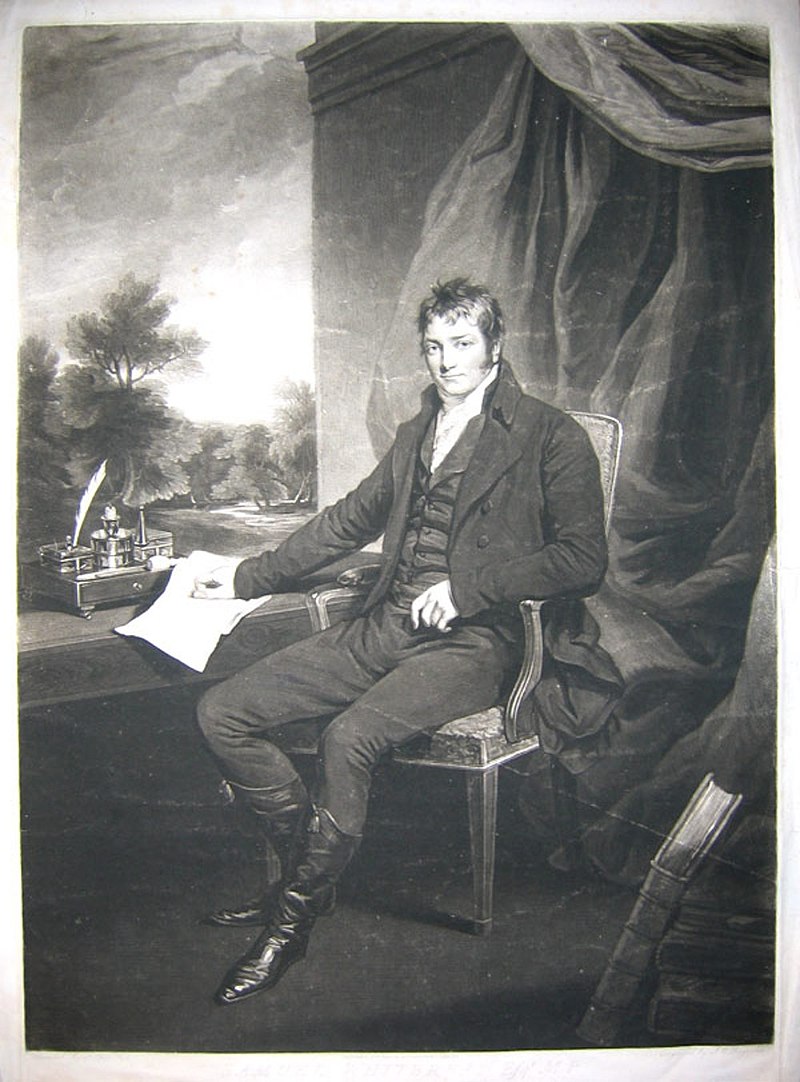
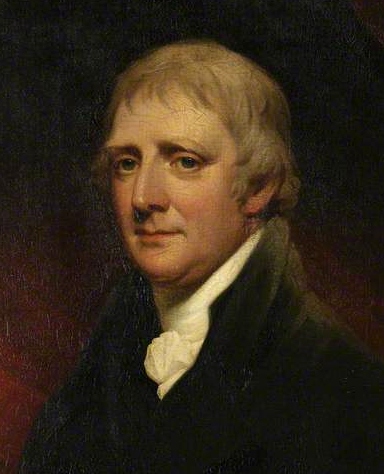
Samuel Whitbread II by John Opie ~ Public Domain

In 1815, a Member of Parliament (MP), Samuel Whitbread, shocked society by committing suicide. The Coroner said that the heavy responsibility of being an MP at that time was too much for him. Whitbread was an MP for Bedford, a post he held for 23 years. He was a reformer—a champion of religious and civil rights and for the abolition of slavery. He was a proponent of a national education system, and, in 1795, sponsored an unsuccessful bill for the introduction of a minimum wage for workers. He was a close colleague of Charles James Fox, and became the leader of the Whigs upon Fox’s death. In 1805, he led the campaign to remove Henry Dundas, 1st Viscount Melville, from office. 

What most do not know of Whitbread was his admiration for Napoleon and French leader’s reforms in France and Europe. Whitbread strongly advocated for Britain’s withdrawal from the Continent during the war years. Napoleon’s abdication in 1814 was a devastating blow to Whitbread’s beliefs. He began to suffer from depression, and on the morning of 6 July 185, he committed suicide by cutting his throat with a razor. 

(c) National Trust, Croft Castle; Supplied by The Public Catalogue Foundation

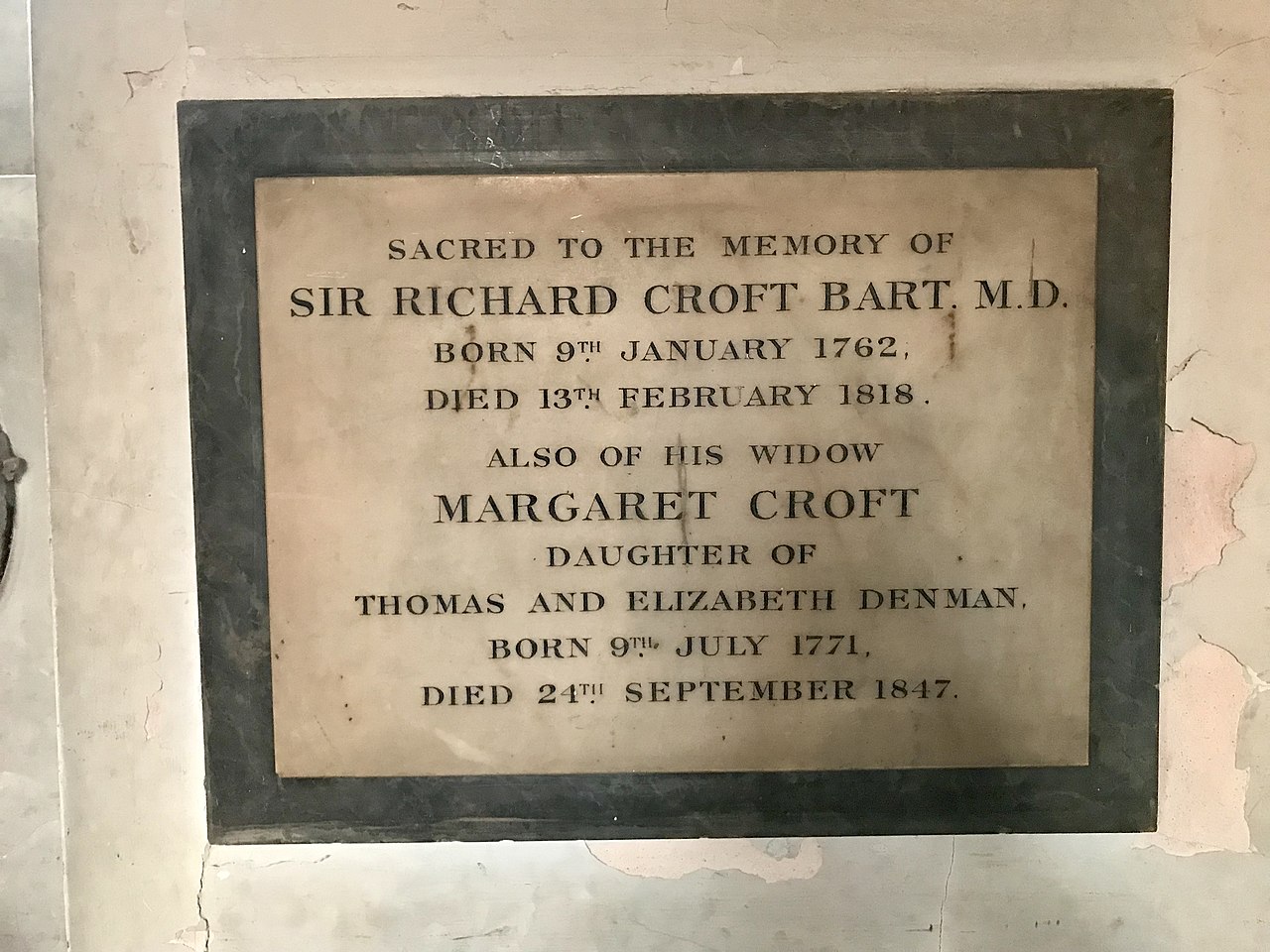
In 1818, Sir Richard Croft, 6th Baronet, the English physician to the British Royal family, who had attended Princess Charlotte and became famous due to his role in “the triple obstetrical tragedy,” killed himself when another patient died. 

When Princess Charlotte conceived in February 1817, Croft was chosen to attend her. Following medical dogma, Croft restricted her diet and bled her during the pregnancy. Her membranes broke on 3 November 1817. The first stage of labor lasted 26 hours. At the beginning of the second stage of labour, Croft sent for Dr. John Sims, who arrived 7 hours later. The second stage of labour lasted 24 hours. He had correctly diagnosed a transverse lie of the baby during labor; however, forceps were not used as they had fallen into disfavor in the British medical community. Eventually Princess Charlotte delivered  a stillborn 9-pound male. Five hours later she died. An autopsy ruled that Croft “had done his best.” However, the death of the Princess continued to weigh heavily on Croft, and on 13 February 1818, at age 56, he killed himself with a gun. Near his body a copy of Shakespeare’s Love’s Labour’s Lost was found open with the passage (Act V, Scene II): “Fair Sir, God save you! Where is the Princess?”

The website Prinny’s Taylor lays out more than one version of Sir Richard Croft’s death, including several conflicting reports in the Times and the inquest findings. If interested, you may read that report HERE.

Both Croft and his wife are buried at St. James’s Church, Piccadilly. A memorial to them is found within the church.

CC BY-SA 4.0
File:A memorial to Sir Richard Croft, 6th Baronet, in St James’s Church, Piccadilly.jpg
Created: 31 January 2019


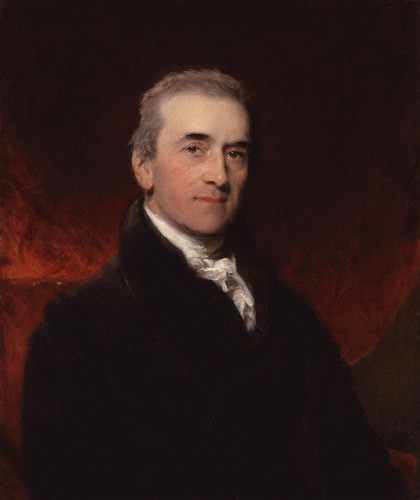
November 1818, Sir Samuel Romilly, a British lawyer, politician and legal reformer, died by cutting his throat. It was said that he was despondent over the death of his wife. From a background in the commercial world, he became well-connected, and rose to public office and a prominent position in Parliament. After an early interest in radical politics, he built a career in chancery cases, and then turned to amelioration of the British criminal law.

Sir Samuel Romilly by Sir Thomas Lawrence, painting, circa 1806-1810 ~ Public Domain


Romilly worked to reform the criminal law. He spent a dozen years of his life on the passage through Parliament of legislative reforms. In 1808, Romilly managed to repeal the Elizabethan statute which made it a capital offense to steal from the person. Successful prosecutions of pickpockets then rose. In 1809, three bills for repealing draconian statutes were thrown out by the House of Lords. Romilly saw further bills rejected; but in March 1812 he had repealed a statute of Elizabeth I making it a capital offense for a soldier or a mariner to beg without a pass from a magistrate or his commanding officer. Romilly failed to pass a law which would have abolished corruption of blood for all crimes, but in the following year he tried again and succeeded (except for treason and murder).  Also in 1814, he succeeded in abolishing hanging, as well as drawing and quartering. 

On 29 October 1818 Lady Romilly died in the Isle of Wight. A few days later, on 2 November 1818, Romilly cut his throat, and died in a few minutes, in his house on Russell Square in London. His nephew Peter Mark Roget attended him in his final moments.  His last words were written: My dear, I wish … presumably regarding his late wife.

Lord Byron was not at all kind to Romilly’s memory because of the part Romilly played in Byron’s separation from his wife. Though Byron’s solicitor had engaged Romily to act for Byron, Romilly and Lushington had  acted for Lady Byron. The case never went to court and Byron never forgave Romilly. When Romilly died, Byron did not mourn him. He said something to the effect that it was ironic that after separating Byron from his wife, Romilly cut his own throat when he lost his own wife. 

As was the custom of the time, he was given a proper burial. Romilly was buried on 11 November 1818 at the parish church of St Michael and All Angels, Knill, Herefordshire, along with his wife Ann.

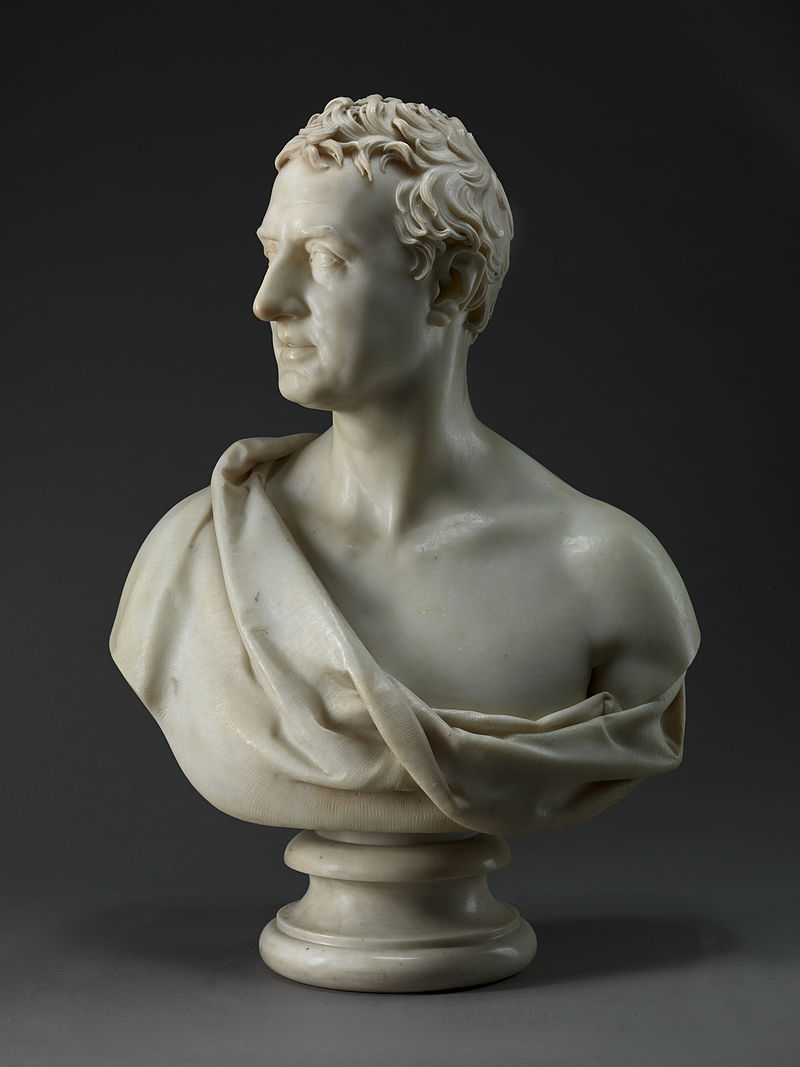
Marble bust of Castlereagh by Joseph Nollekens, 1821. Yale Center for British Art ~ Public Domain

Robert Stewart, 2nd Marquess of Londonderry, usually known as Lord Castlereagh, derived from the courtesy title Viscount Castlereagh was an Anglo-Irish statesman and another high-ranking person Lord Byron “skinned” in his poetry.

Posterity will ne’er survey

A nobler grave than this:

Here lie the bones of Castlereagh:

Stop, traveller, and piss.

Beginning in 1812, Castlereagh served as the British Foreign Secretary. He played a key role in managing the coalition that eventually defeated Napoleon. He was the principal British diplomat at the Congress of Vienna. He was also leader of the British House of Commons for the Liverpool government.

Despite his contributions to Napoleon’s defeat, Castlereagh was extremely unpopular in the country he served. His critics disliked how he constructed peace, allowing reactionary governments on the Continent to suppress dissent. He was also called out for his association with the Home Secretary, Lord Sidmouth’s repressive measures at home. Castlereagh chose to support the infamous Six Acts, which suppressed any meetings advocating political reform in order to remain in cabinet and diplomatic work.

The suicides who died due to “unbalance of the mind” were often buried in a separate section of the church yard or family plots on their own grounds. They were not buried in “holy” ground. 

For these reasons, Castlereagh appears with other members of Lord Liverpool’s Cabinet in Percy Bysshe Shelley’s poem The Masque of Anarchy, which was inspired by and heavily critical of the Peterloo Massacre:

I met Murder on the way –
He had a mask like Castlereagh –
Very smooth he looked, yet grim;
Seven bloodhounds followed him
All were fat; and well they might
Be in admirable plight,
For one by one, and two by two,
He tossed them human hearts to chew
Which from his wide cloak he drew.

In 1822, he began to suffer from a form of a nervous breakdown. He was severely overworked with both his responsibilities in leading the government in the House and the never-ending diplomacy required to manage conflicts among the other major powers. At the time, he said “My mind, is, as it were, gone.” Towards the end of his life, there are increasing reports, both contemporaneous and in later memoirs, of exceptionally powerful rages and sudden bouts of uncharacteristic forgetfulness. He surprised his friends by admitting his belief in ghosts and other supernatural beings, in particular the “radiant boy”, a figure which emerges from fire and is supposed to foretell death, which he claimed he had seen as a young man in Ireland.

He is said to have told the King during a meeting on August 9 that he was being watched by a servant who was tailing him everywhere. It is also reported that he told the King, “I am accused of the same crime as the Bishop of Clogher,” referring to Percy Jocelyn, the Bishop of Clogher who had been accused of homosexuality the previous month. Many later thought, after the suicide, that Castlereagh was being blackmailed.

The King surmised that Castlereagh believed he was being blackmailed for the same reason. It remains unclear whether there was some sort of extortion attempt, and if so, whether such attempt represented a real threat of exposure, or whether the purported blackmail was a symptom of paranoia. His friends and family were alarmed and hid his razor. Unfortunately, on 12 August, Castlereagh managed in the three to four minutes he was left alone to find a small knife with which he cut his own throat.

“A retrospective speculative diagnosis has linked various instances of (at the time) little explained illness to syphilis, possibly contracted at Cambridge. Stewart’s undergraduate studies were interrupted by a mysterious illness first apparent during the closing months of 1787, and which kept him away from Cambridge through the summer of 1788. Later, there were unexplained illnesses in 1801 and 1807, the first described by a contemporary as ‘brain fever”‘which would be consistent with syphilitic meningitis.” (Robert Stewart, Viscount Castlereagh

The Suicide of Lord Castlereagh by George Cruikshank, 1822 ~ Public Domain

The temporary insanity decree allowed Lady Londonderry to bury her husband in Westminster Abbey. The pallbearers included Lord Liverpool, the Prime Minister, Lord Sidmouth, the former Prime Minister, and two future Prime Ministers, the Duke of Wellington and Frederick Robinson, 1st Viscount Goderich. Many viewed the verdict and Castlereagh’s public funeral as a damning indictment of the elitism and privilege of the unreformed electoral system. His funeral on 20 August was greeted with jeering and insults along the processional route, although not to the level of unanimity projected in the radical press. A funeral monument was not erected until 1850.

Soon there after, a carpenter or such who committed suicide and was to be buried naked at the cross roads with a stake in his heart.

“Crossroads burials ended with the increasing understanding of mental illness and depression, particularly after the suicide of Lord Castlereagh in 1822. Many Londoners were also shocked in 1823 at the crossroads burial of Abel Griffiths – a disturbed young man who had killed his father – at the junction of Eaton Street, Grosvenor Place and the King’s Road. Crossroads burials were abolished by an act of parliament the same year. Few objected, although one argument against abolition was that the disgrace of crossroads burial was a ‘deterrent’ to suicide.” [History Extra]

Even so, for the common man, the suicides who died due to “unbalance of the mind” were often buried in a separate section of the church yard or family plots on their own grounds. They were not buried in “holy” ground. 

Posted in Act of Parliament, British history, Church of England, Georgian England, Georgian Era, Great Britain, history, political stance, Regency era, religion | Tagged , , , , , , , , , , , , , | 4 Comments

Just for Halloween: the Witchcraft Acts in Great Britain

The UK Parliament website tells us, “In 1542 Parliament passed the Witchcraft Act which defined witchcraft as a crime punishable by death. It was repealed five years later, but restored by a new Act in 1562.  

“A further law was passed in 1604 during the reign of James I who took a keen interest in demonology and even published a book on it. The 1562 and 1604 Acts transferred the trial of ‘witches’ from the Church to the ordinary courts.”  

These laws affected England, Ireland, Wales, and Scotland. As mentioned above, the first of these laws came in 1542 during the reign of King Henry VIII. The law made witchcraft a felony with a punishment of death for the accused. 

Those convicted would be required to forfeit all goods and chattels to the government. The act forbid all citizens to “use devise practise or exercise, or cause to be devysed practised or exercised, any Invovacons or cojuracons of Sprites witchecraftes enchauntementes or sorceries to thentent to fynde money or treasure or to waste consume or destroy any persone in his bodie membres, or to pvoke [provoke] any persone to unlawfull love, or for any other unlawfull intente or purpose … or for dispite of Cryste, or for lucre of money, dygge up or pull downe any Crosse or Crosses or by such Invovacons or cojuracons of Sprites witchecraftes enchauntementes or sorceries or any of them take upon them to tell or declare where goodes stollen or lost shall become.”

Moreover, the act also removed the “benefit of clergy” right for the individual convicted of witchcraft. This legal maneuvering spared anyone from hanging who could read a passage from the Bible. Henry VIII’s son, Edward VI, repealed this statute in 1547.

Britannica tells us: “Benefit of clergy, formerly a useful device for avoiding the death penalty in English and American criminal law. In England, in the late 12th century, the church succeeded in compelling Henry II and the royal courts to grant every clericus, or “clerk” (i.e., a member of the clergy below a priest), accused of a capital offense immunity from trial or punishment in the secular courts. On producing letters of ordination, the accused clerk was turned over to the local bishop for trial in the bishop’s court, which never inflicted the death penalty and frequently moved for acquittal. Later, anyone having the remotest relationship to the church could also claim benefit of clergy. In the 14th century, the royal judges turned this clerical immunity into a discretionary device for mitigating the harsh criminal law by holding that a layman, convicted of a capital offense, might be deemed a clerk and obtain clerical immunity if he could show that he could read, usually the 51st Psalm. Later, a layman was allowed to claim benefit of clergy only once.

“From the 16th century on, however, a long series of statutes made certain crimes punishable by death “without benefit of clergy.” The importance of this device was further diminished by the 18th-century practice of transporting persons convicted of capital crimes to the colonies, whether they were entitled to benefit of clergy or not, and it was finally abolished in the early 19th century.”

An Act Against Conjurations, Enchantments and Witchcraft was passed in 1562, during the reign of Elizabeth I. It showed a bit of mercy by demanding the death penalty only when the accused caused harm to another. Lesser offenses resulted in imprisonment. The Act said that anyone who should “use, practise, or exercise any Witchcraft, Enchantment, Charm, or Sorcery, whereby any person shall happen to be killed or destroyed, was guilty of a felony without benefit of clergy, and was to be put to death.”

The Scottish Witchcraft Act of 1563 spoke to the practice of witchcraft and consulting with witches. Both were considered capital offenses. The Act was on the Scottish law books until 1735.

Francisco Goya: El conjuro or Las brujas (“The Conjuring” or “The Witches”)
El conjuro or Las brujas (“The Conjuring” or “The Witches”), oil on canvas by Francisco Goya, 1797–98; in the Museo Lázaro Galdiano, Madrid.(less)
SCALA/Art Resource, New York ~ via Britannica

With James’ accession to the English throne, the Elizabethan Act was broadened to bring the penalty of death without benefit of clergy to any one who practiced the black arts or who consorted with familiars. The act’s official name was An Act against Conjuration, Witchcraft and dealing with evil and wicked spirits. The self-styled Witch-Finder General, Matthew Hopkins, used the act freely to accuse his victims.

The practice of witchcraft became a felony with the installation of Elizabeth’s and James’s acts. As a felony, the accused was removed from the ecclesiastical courts’ jurisdiction and placed under the judgment of the common court. Burning at the stake was eliminated, except in cases of witchcraft that were also petty treason. As a criminal court proceeding, most convicted were hanged. If a witch was found guilty of a minor offense (punishable by one year in prison) and then committed a second one, he/she was sentenced to death.

The Witchcraft Act of 1735 saw a change in the manner in which “witches” were treated. The change came in the attitude of the educated electorate, who assumed that witchcraft was nothing more than superstition and an impossibility to actually perform. Instead, the punishment was for the pretense of witchcraft. Those who claimed magical powers were punished as vagrants and were subject to fines and imprisonment. The Act applied to the whole of Great Britain, repealing both the 1563 Scottish Act and the 1604 English Act.

Northern Ireland still has the Witchcraft Act on the books as a crime, though it has never been applied to a case brought before judges.

To the best of my knowledge, the Act is still in force in Israel, having been introduced into the legal system of the British Mandate over Palestine; Israel gained its independence before the law was repealed in Britain in 1951. Article 417 of the Israeli penal code of 1977, incorporating much legislation inherited from British and Ottoman reigns, sets two years’ imprisonment as the punishment for witchcraft, fortune telling, or magic. The law in Israel applies only to practitioners of witchcraft who charge a fee.

UK Parliament tells us, “Formal accusations against witches – who were usually poor, elderly women – reached a peak in the late 16th century, particularly in south-east England. 

“513 ‘witches’ were put on trial there between 1560 and 1700, though only 112 were executed. The last known execution took place in Devon in 1685.  

“The last trials were held in Leicester in 1717. Overall, some 500 people in England are believed to have been executed for witchcraft.”

Other Resources You Might Find interesting:

Witchcraft: Eight Myths and Misconceptions

Witchcraft: Facts or Fiction?

Five Witchcraft Myths Debunked by an Expert

Posted in Act of Parliament, British history, Church of England, gothic and paranormal, legends and myths, Regency era | Tagged , , , , | Comments Off on Just for Halloween: the Witchcraft Acts in Great Britain

A Closer Look at “Vampire Darcy’s Desire”

51aOC31U1IL._SX319_BO1,204,203,200_.jpg In late 2009, at the height of the Twilight mania, Ulysses Press approached me regarding my writing a vampiric version of Pride and Prejudice. [Each book in the Twilight series was inspired by and loosely based on a different literary classic: Twilight on Jane Austen’s Pride and Prejudice, New Moon on Shakespeare’s Romeo and Juliet, Eclipse on Emily Brontë’s Wuthering Heights (which is ironic because most critics consider Heathcliff’s digging up Catherine’s grave a form of vampirism), and Breaking Dawn on a second Shakespeare play, A Midsummer Night’s Dream [with a bit of A Merchant of Venice).] I will tell you upfront I lodged my initial objection to the idea of mixing my Jane Austen with the paranormal. Eventually, though, I succumbed to my friends’ advice. If you know anything of me, you know I jumped into the research of vampires with both feet.

The problem with writing about vampires in the Regency is the idea of vampirism was still much in legend rather than in literature. One must recall Dracula was not released until 1897, some 80+ years after the tale found in Pride and Prejudice.

Therefore in my version, I depended heavily on the legends of vampires, Celtic gods, and the baobhan sith (Scottish female vampires). I mixed those with a traditional Scottish ballad, the tale of Lord Thomas and Fair Ellender. The story dates back at least to the time of Charles II and the ballad probably dates back further. It is still popular in England, Ireland and Scotland. There are similar stories in Norse and other European ballads. It is also found in the Appalachian Mountain region.

Unfortunately, the original book I wrote for Ulysses Press is now out of print. When a book goes out of print with a traditional publisher, there is a procedure in getting one’s rights to the book returned. The contract customarily reads something to the effect of… “If after the expiration of two years from the date of the first publication the WORK the PUBLISHER may terminate this Agreement and give the AUTHOR the option to purchase, at fair market value, all volumes on hand and all materials used in the printing of the WORK.” (and) “If the WORK remains out of print for longer than 180 days and PUBLISHER does not agree to reprint WORK with 180 days of receipt of written notice/request from AUTHOR to reprint the WORK, this Agreement shall terminate.”

So, while I waited for rights to be returned to me, what was I to do? My contracts with Ulysses also hold a non-competition clause. It essentially says I cannot sell the rights to my books to other traditional publishing houses, but “AUTHOR may continue to self-publish such works, but under no circumstances may AUTHOR publish a competing work with a traditional publisher that sells into the brick-and-mortar retail book trade.”

Problem Resolved. I could self publish the book without being in violation of my contract. Since those days of fighting for my rights back, Ulysses Press has finally returned the rights to all 12 of my titles with them. So I have rereleased Vampire Darcy’s Desire with a flashy new cover from Chris Kudi and SKC Design. The story is essentially the same as the one from before. However, if you have never read it, what better month than October and Halloween to take on a paranormal version that includes our favorite couple?

Book Blurb: Vampire Darcy’s Desire presents Jane Austen’s Pride and Prejudice as a heart-pounding vampire romance filled with passion and danger.

Tormented by a 200-year-old curse and his fate as a half human/half vampire dhampir, Fitzwilliam Darcy vows to live a solitary life rather than inflict the horrors of his life upon an innocent wife and his first born son. However, when he encounters the captivating Elizabeth Bennet, his will is sorely tested.

As a man, Darcy yearns for Elizabeth, but as a vampire, he is also driven to possess her. Uncontrollably drawn to each other, they are forced to confront a different kind of “pride” and his enemy’s “prejudice,” while wrestling with the seductive power of forbidden love. Evil forces, led by George Wickham, the purveyor of the curse, attack from all sides, and Darcy learns his only hope to survive is to align himself with Elizabeth, who is uncannily astute is how to defeat Wickham, a demon determined to destroy each generation of Darcys.

Vampire Darcy’s Desire retells Austen’s greatest love story in a hauntingly compelling tale. Can love be the only thing that can change him?

vdd-ebook-coverCheck out these Reviews:     JustJane1813     and    The Royal Reviews  

Excerpt:

Elizabeth thumbed through the book she found on the floor as the clerk totaled her purchases and prepared them for shipping to Derbyshire. She noted references to the crucifix, the rosary, and holy water, as well as beliefs regarding mirrors. She remembered Wickham’s blurry reflection in the window in Meryton, and suddenly things made sense. Darcy told her of using the vial of holy water when Wickham approached Georgiana at Ramsgate. On another page, she discovered that Germans believed the head should be buried between the feet to release the soul. It seems as though Darcy was right on that point, she thought.

Flipping the page again, her eyes fell on a sketch of a woman holding a crucifix and a vampire retreating. She thought how foolish the drawing appeared until she read the caption: “Say the vampire’s name backwards as you bring forth the crucifix.” Well, she thought, I wonder if that would do the trick? Elizabeth closed the book and slid it toward the clerk.

“This is quite an agglomerate,” the old man said with amusement.

“My father reads everything having to do with Scottish beliefs, folklore, and customs,” she declared. “I thought to share these with him after I learn more about the beginnings of the well-dressing ceremonies. I understand them to be based on ancient pagan customs. Mr. Darcy and I only recently married, and I have yet to see his estate. I do not want the villagers to judge my ignorance on such traditions as being a poor reflection on my husband. Moreover, I have a cousin who leaves for Jamaica soon. I thought he would find the books on spirits and such amusing.”

“Your thoughtfulness is admirable, Mrs. Darcy,” the man observed as he stacked the items. The shopkeeper picked up the last two books. “And these are to be delivered to Darcy House?”

“Yes, that is exactly what I require.”

* * *

Stepping from the bookstore, Elizabeth found neither her husband nor the carriage. “Where can they be?” she mused aloud. “Surely Georgiana and Belton are at the coach by now.” Impatient, as usual, she paced along the walkway. It was not like Darcy to be late. Never had she known him to be tardy for anything. Agitated, she searched both sides of the street for her husband, Georgiana, or even one of the servants in the Darcy livery. Reaching the alley, a flash of color along a row of boxes caught her eye, and, intuitively, Elizabeth turned toward the bright object. It is Georgiana’s slipper! How did it get there? And where is she? Impulsively, she rushed forward to retrieve it.

The overhang of the buildings blocked the little winter sun the day offered, and the alley itself, although not totally black, was heavily draped in shadows. “Georgiana?” she called, and then listened before stepping further into the opening. Nothing moved, and Elizabeth turned to leave, but then a muffled whimper froze her in place.

“Georgiana!” she yelled louder, before charging into the dusky obscurity.

As if a theatrical light were thrown on the scene, Elizabeth stared in horror at the tableau playing out before her. Georgiana, wide-eyed, stood in the narrow, gloom-filled street. Wickham held one hand over her mouth and the other wrapped around her waist, and her hands were tied behind her back. Georgiana struggled to free herself, but Wickham’s mouth remained poised above the indentation of her neck.

“Step away, Wickham!” Elizabeth’s voice rebounded off the brick walls.

“Mrs. Darcy.” He raised his head but did not release his captive. “You may be next, but you must wait your turn, my dear. Your lovely sister is ahead of you.”

Elizabeth squared her shoulders. If she could delay the wretched creature who was hovering over Georgiana, mayhap Darcy would arrive in time to assist her. She spoke slowly and loudly: “I said to release her!

“If you insist, Elizabeth,” Wickham said with a laugh, but he did not slacken his hold on Georgiana. “You may go first.”

“I am not Elizabeth to you,” she insisted. She lifted the chain from about her neck, exposing the jeweled cross. “You will release Mr. Darcy’s sister.”

He challenged, “Do you think that pitiful crucifix has any effect on me?”

“Actually, I believe it does,” she asserted. “If not, you would have claimed me at the Netherfield Manor House.” She extended the cross before her for protection. “I think, Mr. Wickham, the reason Georgiana is still alive is because she wears a similar crucifix.”

This thing?” Wickham used his hand to flick at the chain, but Elizabeth noted he did not touch the cross.

Realizing Georgiana required hope if they stood a chance of surviving this encounter, Elizabeth addressed Darcy’s sister directly: “Georgiana, you must believe in your brother. The crucifix protects you as long as you wear it.” She watched with satisfaction as the terror on the girl’s face diminished. “Your brother does all to protect you. Continue to believe in him.”

Wickham jerked Georgiana closer, but Elizabeth noted a bit of confusion cross his expression.

“Why do you care if I take her?” Wickham countered. “Why not claim the freedom you will earn with her death?”

“Because we all swore to end the curse that our ancestors began,” Elizabeth said coolly.

Our ancestors?” Wickham repeated sneeringly.

Elizabeth smiled. “Do you really not know that Arawn Benning, the Lord Thomas of the tale, was my ancestor, just as Ellender D’Arcy was William’s? How ignorant you are! It is Fate that brings my dear husband and me together. You cannot defeat us, Wickham,” she insisted.

“Yet I can still exact my revenge.”

Elizabeth attempted to think of something to frighten Wickham away. She still clutched the crucifix before her. Then she thought of the diagram from the book. “Wickham George!” she called out as she took a step forward.

Wickham did not turn a hair. “My followers call me My lord. You may do so when you join me.”

“Pigs will sprout wings first.” Elizabeth’s mind raced. If Darcy were coming, he would be here. Reverse the letters. Visualize Wickham’s  name and reverse the letters. It was a silly thought, but she was desperate. “Mahkicw Egroeg!” she tried.

“Gibberish, Mrs. Darcy?” Wickham inquired mockingly. “You are grasping at straws, my dear.” He lowered his voice and spoke in an intimate tone, “Taking you will double my pleasure. Revenge on both the D’Arcys and the Bennings in one fell swoop.”

Purchase Links:

Kindle  https://www.amazon.com/Vampire-Darcys-Desire-Prejudice-Paranormal-ebook/dp/B01LXG0NJB/ref=sr_1_2?ie=UTF8&qid=1475700131&sr=8-2&keywords=vampire+darcy%27s+desire

Kobo https://store.kobobooks.com/en-us/ebook/vampire-darcy-s-desire-1

Amazon   https://www.amazon.com/Vampire-Darcys-Desire-Prejudice-Paranormal/dp/1539344657/ref=sr_1_2?ie=UTF8&qid=1475839165&sr=8-2&keywords=vampire+darcy%27s+desire

Nook  http://www.barnesandnoble.com/w/vampire-darcys-desire-regina-jeffers/1124778221?ean=2940157104719

BTW, this book was featured at the Smithsonian along with Pride and Prejudice and Zombies and Sense and Sensibility and Sea Monsters. Here’s the promo from the Smithsonian Program. 

Posted in gothic and paranormal, Jane Austen, paranormal, Pride and Prejudice, reading habits, romance, Scotland, vampires | Tagged , , , , , , , | 20 Comments

John Francis Attempted to Kill Queen Victoria Twice

On May 29, 1842, Prince Albert and Queen Victoria were returning to their home at Buckingham Palace from Sunday morning services at the royal chapel at St. James’s Palace when what Albert later described as “a little, swarthy, ill-looking radical” attempted to shoot the Queen. John Francis, a 20-year-old cabinetmaker, reportedly stood astride along the Mall and pointed a small flintlock pistol in the royal couple’s direction. Unfortunately for Francis, but, fortunately, for Her Majesty, the weapon failed to fire. Francis turned quickly away and disappeared into the crowd and across Green Park. 

29

John Francis’s attempt: “The Cowardly and Disgraceful Attempt on the Life of Her Majesty.” The Illustrated London News, 4 June 1842. http://www.victorianweb.org/history/victoria/murphy.html

One would think after the attempt by Edward Oxford in June 1840 and the growing unrest and the number of dissidents that the Queen would be afforded more security, but no extra precautions had been instigated. Albert, in a letter to his father, wrote: “[I] saw a man step out from the crowd and present a pistol fully at me. He was some two paces from us….” John Francis was close enough to the Queen for Prince Albert to report that he heard the trigger click. 

Prime Minister Robert Peel agreed to a plan to identify the Queen’s attacker. Victoria and Albert rode out again the following day, Monday, May 30. Only Colonel Charles Arbuthnot and Lieutenant Colonel William Wylde escorted them to and from Hampstead as outrider equerries. John Francis foolishly attempted a second attack upon the Royals’ return. 


51baZLeQyrL._SX329_BO1,204,203,200_

Shooting Victoria: Madness, Mayhem, and the Rebirth of the British Monarchy by Paul Thomas Murphy

History.com tells us, “While Prince Albert informed the royal security forces that a gunman was on the loose in London, Queen Victoria insisted she would not confine herself to Buckingham Palace until he was caught. Believing that the best way to flush out the would-be assassin was for the royal couple to leave the palace again the following day, Victoria and Albert were nervous as they circled London for an evening drive in an open barouche. “You may imagine that our minds were not very easy,” Albert wrote to his father. “We looked behind every tree, and I cast my eyes round in search of the rascal’s face.” While plain-clothed officers with a description of the suspect scoured the crowd, a shot suddenly rang out just five paces from the carriage. Police tackled the suspect who missed his mark. Once again, it was Francis….”

Francis was imprisoned at Newgate. He was tried and found guilty of high treason and sentenced to be hanged, drawn and quartered. Queen Victoria commuted his sentence to Transportation for Life to Norfolk Island. Francis was eventually released on “ticket-of-leave” in 1867. 


51PrljximcL

Kill the Queen!: The Eight Assassination Attempts on Queen Victoria by Barrie Charles

Posted in British history, history, political stance, real life tales | Tagged , , , , , , | Comments Off on John Francis Attempted to Kill Queen Victoria Twice