The “Hunchback’s” Attempt to Kill Queen Victoria

51PrljximcL

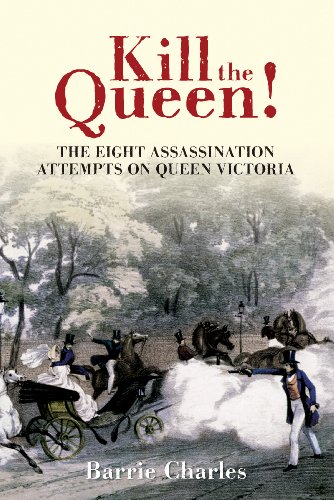
Kill the Queen!: The Eight Assassination Attempts on Queen Victoria by Barrie Charles

Two weeks after John Francis’s second attack on Queen Victoria, the 16-year-old John William Bean made an attempt to assassinate the Queen. “In 19th century Britain, treason had its own special rules of evidence and procedure, which made it difficult to prosecute traitors successfully, such as the requirement that the prosecution produce two witnesses to the same overt act, or that three judges preside at the trial. The Treason Act 1800 relaxed these rules in relation to attempts on the King’s life, bringing the rules in such cases in line with the less restrictive rules which then existed in ordinary murder cases. Section 1 of the 1842 Act went further, removing the special rules in all cases of treason involving any attempt to wound or maim the Queen.” (Treason Act 1842) Section 2 of this act is still in place. It created a new offense (less serious than treason) of assaulting the Queen, or of having a firearm or offensive weapon in her presence with intent to injure or alarm her or to cause a breach of the peace. 

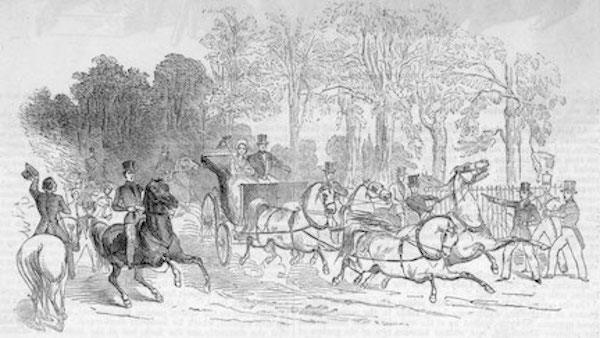
John William Bean’s attack came on Sunday, July 3, 1842.  Queen Victoria was in a carriage with King Leopold I of Belgium. They were traveling along the Mall from the Chapel Royal. Bean had waited for the procession to leave Buckingham Palace. When the Queen’s carriage neared, Bean pushed his way to front of the crowd lining the Mall before pulling his gun from beneath his coat. Someone in the crowd knocked the weapon from Bean’s hand, grabbing Bean’s wrist. The gun failed to fire because it contained a mixture of paper, tobacco, and gunpowder. Even so, Bean managed to escape into the crowd. 

51baZLeQyrL._SX329_BO1,204,203,200_

Shooting Victoria: Madness, Mayhem, and the Rebirth of the British Monarchy by Paul Thomas Murphy

Unfortunately for him, he was readily identified because he suffered from a spinal deformity and was said to be barely four feet tall. “Unhappy with his existence, the depressed Bean wanted a change—any kind of change—and hoped that threatening the queen would be a chance for a new life, even one in prison. When he pulled the trigger, however, the gun failed to fire. A bystander grabbed Bean’s wrist, but he managed to escape into the crowd. That night, London police rounded up the city’s hunchbacks before discovering Bean at his family home. Bean said the queen’s life was never endangered as his pistol was loaded with more tobacco than gunpowder and pointed to the ground.” (History.com)

Neither Edward Oxford, John Francis, nor John William Bean had been political assassins. Rather, they were what we would likely now term as “publicity seekers.” The Treason Act of 1842, support by Robert Peel, provided for “the further protection and security of Her Majesty’s person.’ It was no longer considered high treason to attack the monarch. Instead, the crime was considered as a “high misdemeanor.” The punishment was up to 7 years’ transportation or imprisonment. Addition time could be added or the person sentenced to hard labor or even a birching.

John William Bean  was sentenced to 18 months of hard labor.

The Social Historian fills in other information on the event: “… a humpbacked boy dressed in a long brown coat pushed his way to the front of the standing crowd and pulled out a pistol. Standing near him, sixteen-year-old Charles Edward Dassett seized his wrist. Seeing two policemen walking on the opposite side of the mall, Dassett took the boy over, showed them the pistol and told them that he had been trying to shoot the Queen. They laughed and told Dassett that there was no charge to be made and he was forced to let the boy go.

“Not long after, Dassett was apprehended in Green Park for having a pistol in his hand. He was taken to the station house where he told his story about the humpbacked boy who had tried to shoot the Queen. Witnesses were called and the story was collaborated upon which point the two police constables, Hearn and Calxton were called in and reprimanded for not taking the accusation seriously. They were suspended from further duty for the present time.

“From Dassett’s description, it was determined that the accused boy was William Bean, the son of a jeweler in Clerkenwell. The police proceeded to the Bean house and took the lad into custody.

“Bean declared that he had not intended to hurt the Queen but that he had committed the act only to be taken up. He said he had put nothing in the pistol but powder and paper and had been in the park for three days waiting for his opportunity. He said that he was tired of his life and wanted to be transported and added that he had pointed the pistol at the ground and not at the Queen.

“On Thursday, 25 August 1842, John William Bean was indicted for a misdemeanour in assaulting the Queen. After witnesses were called and testimony was heard as to the boy’s good character, the jury did not even leave the box, but quickly returned a verdict of guilty. Lord Abinger told the court that he would be passing sentence upon the prisoner.

“Lord Abinger said, he should be doing a violence to his own feelings, and to the feelings all who heard him, if he did not pass upon him the heaviest sentence the common law of the land allows, and that sentence was, that you, John William Bean, imprisoned in her Majesty’s gaol of Newgate for the term of 18 calendar months. The prisoner was then removed from the bar, and the vast crowd which had been in court during the day, shortly afterwards left. The trial occupied six hours.The Suffolk Chronicle; or Weekly General Advertiser & County Express. – Saturday 27 August 1842″

Paul Thomas Murphy, author of Shooting Victoria, tells us, “Of the seven, John William Bean—the only one who was born, lived, and died in London—might have seemed the easiest to trace to his death. But John William Bean, too, faded into obscurity, clearly preferring that the world forget him and his 3 July 1842 assault upon the Queen. English censuses every ten years from 1841 on give us glimpses of him—giving up his employment as a gold-chaser and taking up as a newsvendor, marrying twice, raising his son Samuel in the family business. Bean last appeared in the 1881 census. I could find no death record after that. And so I spent hours—days—scouring British newspapers for any reference to Bean’s death. Finally, thankfully, I found it: not as I expected in a local or metropolitan daily newspaper, but rather in a national weekly journal. Lloyd’s Weekly Newspaper, 30 July 1882, presents a vivid portrait of Bean’s sad mental state in 1882—and obviously for some time before. Clearly, the depression that the nervous 17-year-old felt as he pointed a pistol at his Queen lived on in him for forty more years, until John William Bean, always tired of life, finally swallowed enough opium to end it all.” (Shooting Victoria)

tumblr_inline_mk0pqdwgyX1qz4rgp.jpg

Posted in British history, history, kings and queens, real life tales, research, Victorian era | Tagged , , , , , , | Comments Off on The “Hunchback’s” Attempt to Kill Queen Victoria

Did Edward Oxford Really Shoot Prince Albert?

Edward_Oxford's_assassination_attempt_on_Queen_Victoria,_G.H.Miles,_watercolor,_1840

Edward Oxford shooting at Queen Victoria, June 10, 1840; the Queen and Prince Consort driving in a phaeton with four horses towards Constitution Hill; Oxford standing in front of the Green Park railings pointing a pistol in an attempt to assassinate the Queen, while a policeman runs towards him, one of the Queen’s attendants on horse at left. By G. H> Miles, 1840, British Museum. Watercolour, strengthened with gum This image is either reversed horizontally or inaccurate, as the carriage had the railings of the park on its right at the time of the attempt. ~ public domain ~ G. H.Miles (Life time: 1840) – Original publication: June-Dec, 1840 Immediate source: British Museum ~ https://en.wikipedia.org/wiki/Edward_Oxford#/media/File:Edward_Oxford%27s_assassination_attempt_on_Queen_Victoria,_G.H.Miles,_watercolor,_1840.jpg

On Monday of this week, I added a post to the blog regarding Edward Oxford, the man who was the first to make an attempt on Queen Victoria’s life. However, afterwards, I was wondering if Oxford was the one who shot Prince Albert. After all, I have watched the movie Young Victoria many times, and I have witnessed Albert’s love for his wife and hers for him. Right? Even the TV show Victoria has included a like scene (without Albert being shot). Surely, the screenwriter and the director and the producer did not play havoc with history. (Smirk!!!)

In both the film and the television version of Queen Victoria’s life, when Oxford’s assassination attempt happens, Albert throws himself across his wife to protect her. In the film, he is hit by a bullet, sending Victoria into fits of worry. 

First, I wish to repeat a quote from Monday’s post..In a letter from Prince Albert to his brother, Prince Ernest of Saxe-Coburg, Albert explains what happened: 

12 June 1840: I saw a most disagreeable looking man leaning against the rail of Green Park only six paces from us, holding something toward us. Before I could see what it was, a shot cracked out. It was so dreadfully loud that we were both quite stunned. Victoria, who had been looking to the left, towards a rider, did not know the cause of the noise. My first thought was that, in her present state, the fright might harm her. I put both arms around her and asked her how she felt, but she only laughed. Then I turned round to look at the man (the horses were frightened and the carriage stopped). The man stood there in a theatrical position, a pistol in each hand. It seemed ridiculous. Suddenly he stooped, put a pistol on his arm, aimed at us and fired, the bullet must have gone over our heads judging by the hole made where it hit the garden wall. [Raymond Lamont-Brown, How Fat Was Henry VIII, The History Press, ©2008, page 147]

Notice, there is no words of his being wounded or his doing more that putting his arms about Victoria. According the website History House, this was the way things transpired:

The Times newspaper reported that Oxford,

“… presented a pistol and fired it directly, either at Her Majesty or Prince Albert, there being no person between him and the carriage. The Prince who, it would seem, had heard the whistling of the ball, turned his head in the direction from which the report came, and Her Majesty at the same instant rose up in the carriage, but Prince Albert as suddenly pulled her down by his side. The man then drew from behind his back a second pistol, which he discharged after the carriage, which proceeding at the ordinary pace, had … passed him a little.” 
The Times 11 June 1840, page 4.

“The day after the attempted assassination, The Times reported that Oxford was giving a different account saying that the Prince was even trying to get out of the carriage.

“Oh, I know to the contrary; for when I fired the first pistol, Albert was about to jump from the carriage and put his foot out, but when he saw me present the second pistol, he immediately drew back.” 
The Times, 12 June 1840, page 6.

“However, a witness at the later trial testified that Prince Albert had indeed pushed the Queen down,

“…the flash of the pistol came almost immediately over the Queen’s head – the Queen was crouching – she rather crouched, and the Prince stood – I think, to the best of my knowledge, the Queen first rose, and by what I observed, the Prince rather pressed her down; and it was immediately before the second pistol was fired that her Majesty crouched – it was the second flash which appeared to come over the Queen’s head.” [The Proceedings of Old Bailey: Edward Oxford]

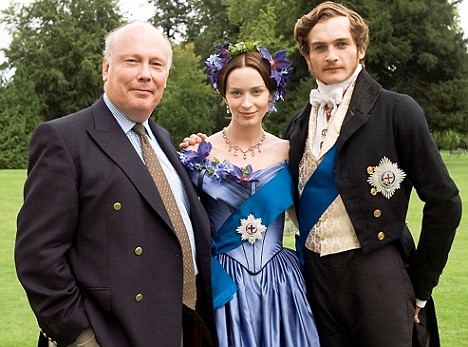
“There is no evidence that Prince Albert received any injury. The scriptwriter for the film, Julian Fellowes, has admitted that the injury has been added to the film’s story for dramatic effect.” 

From The Daily Mail, this is Julian Fellowes take on the scene: 

“Fellowes immediately recognised he had been given a tremendous responsibility in having to recreate the story of a young Queen coming to the throne at 18, against considerable family plotting, as well as having to capture the manners, snobbery and strict class confines of Victorian England.

“‘I’ve tried to be truthful,’ he says. ‘I’ve only changed two elements of fact for the screen.’

“The first was an assassination attempt made on the young Queen as Victoria and her husband Prince Albert were riding in an open carriage up Constitution Hill. Spotting the gunman raise his pistol in the crowd, Albert immediately pushed his young wife down into the well of the carriage to protect her. By doing so the bullet injured Albert. But did it?

“Fellowes agrees there are differing accounts of what really happened. ‘One is that the bullet was fired, but missed him, and the other is that the gun jammed. But the event itself certainly happened.

“‘I felt that this was fantastically brave of Prince Albert and that if the gun had jammed, we would lose how brave his action was. I believe Victoria was so impressed that he was prepared literally to take the bullet, that it changed something in her.

“‘She realised how much Albert truly loved her. You see this change in her immediately after the assassination attempt, with her moving his desk into her own study at the Palace so they could be side-by-side throughout each day.

“‘I know I will be criticised, but in the end a movie has to deliver the right emotions. And I felt it would not be possible to represent that as the act of bravery and selflessness that it was, without showing the gun going off.'”

Posted in British history, film adaptations, Great Britain, historical fiction, history, kings and queens, marriage, Victorian era, weaponry | Tagged , , , , , , | 6 Comments

Edward Oxford, the First to Attempt to Assassinate Queen Victoria

There was a total of eight attempts to assassinate Great Britain’s Queen Victoria. The first came at the hands of Edward Oxford, a man who was considered to be a half-wit. On 10 June 1840, Prince Albert and Queen Victoria had called upon her mother, the Duchess of Kent. They were in a low carriage making their way along London’s Constitution Hill when the attack occurred. 

Edward_Oxford's_assassination_attempt_on_Queen_Victoria,_G.H.Miles,_watercolor,_1840

Edward Oxford shooting at Queen Victoria, June 10, 1840; the Queen and Prince Consort driving in a phaeton with four horses towards Constitution Hill; Oxford standing in front of the Green Park railings pointing a pistol in an attempt to assassinate the Queen, while a policeman runs towards him, one of the Queen’s attendants on horse at left. By G. H> Miles, 1840, British Museum. Watercolour, strengthened with gum This image is either reversed horizontally or inaccurate, as the carriage had the railings of the park on its right at the time of the attempt. ~ public domain ~ G. H.Miles (Life time: 1840) – Original publication: June-Dec, 1840 Immediate source: British Museum ~ https://en.wikipedia.org/wiki/Edward_Oxford#/media/File:Edward_Oxford%27s_ assassination_attempt_on_Queen_Victoria,_ G.H.Miles,_watercolor,_1840.jpg

Born in 1822, Edward Oxford was the third of seven children. His father, George Oxford, made his living as a gold chaser, [While repoussé is used to work on the reverse of the metal to form a raised design on the front, chasing is used to refine the design on the front of the work by sinking the metal.] After attending school, Edward worked in a bar owned by his aunt and was later employed as a pot boy in other public houses. At the time of the attack he was barely eighteen years old, unemployed and living with his mother and sister in lodgings in Camberwell, having recently quit his job at the Hog-in-the-Pound in Oxford Street. Since his mother had returned to Birmingham on a regular trip to see family over a month before, Oxford was, in effect, living alone at the time of the event. [Edward Oxford]

It turned out that Oxford’s attempt was not a spur-of-the-moment lark. He had purchased two guns and a gunpowder flask the week prior to the attempt. He had even practiced shooting the weapons in a variety of shooting galleries. He purchased 50 copper percussion caps from a former classmate named Gray and asked where he might purchase gunpowder and bullets. Gray sold Oxford the gunpowder and recommended another establishment for the bullets. [The Newgate Calendar: Edward Oxford]

As the Queen, who was four months pregnant at the time, and Prince Albert had developed a habit of riding about in a phaeton in the late afternoon and early evening, and without proper protection from dissidents, and the like, it was not difficult to know something of their route on this particular evening. Oxford simply waited for their return from the Duchess’s residence. He fired both pistols, thankfully missing both times. He was immediately seized on by onlookers and taken into custody. Oxford openly declared: “It was I, it was me that did it.” [Edward Oxford]

In a letter from Prince Albert to his brother, Prince Ernest of Saxe-Coburg, Albert explains what happened: 

12 June 1840: I saw a most disagreeable looking man leaning against the rail of Green Park only six paces from us, holding something toward us. Before I could see what it was, a shot cracked out. It was so dreadfully loud that we were both quite stunned. Victoria, who had been looking to the left, towards a rider, did not know the cause of the noise. My first thought was that, in her present state, the fright might harm her. I put both arms around her and asked her how she felt, but she only laughed. Then I turned round to look at the man (the horses were frightened and the carriage stopped). The man stood there in a theatrical position, a pistol in each hand. It seemed ridiculous. Suddenly he stooped, put a pistol on his arm, aimed at us and fired, the bullet must have gone over our heads judging by the hole made where it hit the garden wall. [Raymond Lamont-Brown, How Fat Was Henry VIII, The History Press, ©2008, page 147]

When the authorities searched his room, after Oxford’s arrest, not only did they find more ammunition and other weapons, but they discovered the rules and regulations for a made-up martial society in which Oxford created officers and correspondence. The members were to be armed with a brace of pistols, a sword, and a dagger. [ The Proceedings of Old Bailey: Edward Oxford]

Because no spent bullets were found at the scene, the Crown could not prove that Oxford could actually harm another. Later, Oxford claimed there were no bullets in the pistols, only gunpowder. “Oxford appeared to be oblivious for most of the proceedings. The prosecution presented much eyewitness evidence, while the defence case consisted of various family members and friends who testified that Oxford had always seemed of unsound mind, and that both his grandfather and father were alcoholics who had exhibited signs of mental illness. This carried a great deal of weight, as it was thought during this time that both drink and hereditary influence were strong causal factors for insanity. Oxford’s mother testified her late husband had been violent and intimidating, and that her son was not only prone to fits of hysterical laughter and emitting strange noises, he had been obsessed with firearms since he was a child. Various eminent pathologists and physicians testified that due to “brain disease” or other factors, such as the shape of his head, Oxford was either a mental imbecile or simply incapable of controlling himself.” [Edward Oxford]

Oxford was imprisoned at Newgate and tried on a charge of high treason at the Central Criminal Court before Lord Chief Justice Thomas Denman. Sidney Taylor defended Oxford, and the man was found guilty, but was declared insane. Oxford was ordered to Bethlehem Hospital (Bedlam) for the insane at Moorfields. He spent 35 years in the facility. At age 52, he was released to travel to Australia. 

Edward_Oxford_c_1856

Henry Hering, photographer (1814-1893) – Bethlem hospital museum ~ public domain ~ https://en.wikipedia.org/wiki/Edward_Oxford#/media/File:Edward_Oxford_c_1856.jpg

“Central Criminal Court, to wit.– The jurors for our lady the Queen, upon their oath present, that Edward Oxford, late of Westminster, in the county of Middlesex, labourer, being a subject of our lady the Queen, heretofore, to wit on the 10th of June, in the year of our Lord 1840, within the jurisdiction of the said court, as a false traitor to our lady the Queen, maliciously and traitorously, with force and arms, &c., did compass, imagine, and intend to bring and put our said lady the Queen to death. And to fulfil, perfect, and bring to effect his most evil and wicked treason, and treasonable compassing and imagination aforesaid, he the said Edward Oxford, as such false traitor as aforesaid, to wit, on the said 10th day of June, in the year of our Lord, 1840, aforesaid, and within the jurisdiction of the said court, with force and arms, maliciously and traitorously did shoot off and discharge a certain pistol, the same then and there being loaded with gunpowder and a certain bullet, and which pistol he the said Edward Oxford then and there had and held in one of his hands at the person of our said lady the Queen, with intent thereby and therewith maliciously and traitorously to shoot, assassinate, kill, and put to death our said lady the Queen. And further, to fulfil, perfect, and bring to effect his most evil and wicked treason and treasonable compassing and imagination aforesaid, he the said Edward Oxford, as such false traitor as aforesaid, afterwards, to wit, on the said 10th day of June, in the year of our lord 1840, aforesaid, and within the jurisdiction of the said court, with force and arms maliciously and traitorously did shoot off and discharge a certain other pistol, the same then and there being loaded with gunpowder and a certain bullet, and which pistol he the said Edward Oxford then and there had and held in one of his hands, at the person of our said lady the Queen, with intent thereby and therewith maliciously and traitorously to shoot, assassinate, kill, and put to death our said lady the Queen, and thereby then and there traitorously made a direct attempt against the life of our said lady the Queen, against the duty of the allegiance of him the said Edward Oxford, against the form of the statute in that case made and provided, and against the peace of our said lady the Queen, her crown, and dignity.” [The Newgate Calendar: Edward Oxford]

Wikipedia tells us, “Oxford lived out the rest of his life in Melbourne, Australia.  Oxford landed in Melbourne with a new alias, John Freeman. Setting out to reform himself and become a respectable citizen, Freeman became a house painter and joined the West Melbourne Mutual Improvement Society. In 1881 he married a widow with two children, and became a church warden a St Paul’s Cathedral. Under the pseudonym “Liber” he wrote articles for The Argus about the city’s slums, markets and racetracks, and these became the basis for an 1888 book, Lights and Shadows of Melbourne Life. Freeman died in 1900.

“His patient record at Broadmoor includes a letter sent in 1883 by George Haydon, a Steward at Bethlem, to Dr. David Nicolson. It includes an article from The Age, a Melbourne newspaper, which reports that on 4 May 1880, a “John” Oxford, identified as the man who shot at the Queen many years ago, and who had subsequently been a patient in an asylum before he was discharged to Australia, had recently been convicted of stealing a shirt and spent a week in jail. Upon his release, the prison governor requested the police to keep an eye on him, “in consequence of the old man’s eccentric conduct”. The police subsequently arrested Oxford for vagrancy, and he was reportedly remanded for further medical examination. There were no further updates to the record. It is not certain that this person was Edward Oxford.

“The connection between Oxford and “John Freeman” was established by F. B. Smith’s 1987 article “Lights and Shadows in the Life of John Freeman”. Freeman wrote several letters to Haydon, beginning in 1888 and apparently ceasing on Haydon’s death in 1889. Freeman’s wife and stepchildren appear to have been totally ignorant that he might be anyone other than John Freeman. Additionally, a photograph of John Freeman taken for the 1888 Centennial Exhibition in Melbourne matches a portrait of Oxford held in the archives of the Bethlem aslyum. Freeman’s correspondence to Haydon was donated to the National Library in the 1950s by the family. Stevens points out that the former Steward contributed nothing more to Oxford’s Broadmoor record about his progress beyond the troubling report published in the newspaper, and never confirmed that Oxford was the author of Freeman’s book. This may have been because Haydon was departing Bethlem at the time he began receiving the letters.”


Posted in British history, history, political stance, research, Victorian era, weaponry | Tagged , , , , , , , , | 1 Comment

Life Below Stairs: English Servants Emigrating to Australia, Part II

Previously, we looked at how some servants chose to emigrate to Australia rather than to remain in England. You may find that discussion HERE: 

Life Below Stairs: English Servants Emigrating to Australia, Part I

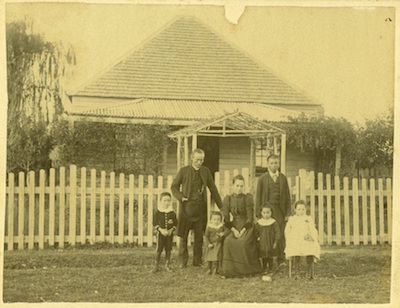
Family-group-SLV-H2005.34103.jpg  An article entitled “Mistress and Maid” from The Victorian Magazine (Vol. XXVI, 1876, London, page 509) tells us “Australia offers to the young woman of the working class, high wages, a splendid climate, and greater liberty than she could enjoy at home, either in service or in a workshop, and these high wages can be earned without further qualification than strong health, strong arms, a willing mind and a good character.” The girls who emigrated found a much freer society than they had left behind in England. In Australia, they found a “fairer” situation, one removed from the petty aspirations and gross exploitations they met in set structure of household servants in England. They also found higher wages and better working conditions, as well as the possibility of an advantageous marriage. 
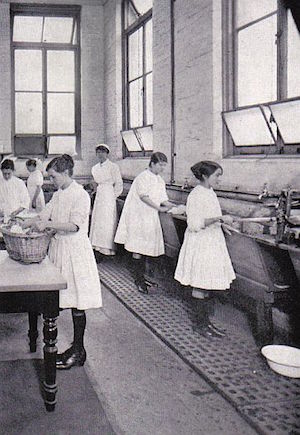
Although they were expected to clean their own rooms and wash their own clothes, servants in Australia in the 1870s made between £20 and £26 per year. Women cooks earned as high as £40. Governesses, especially in the rural areas of Australia, were considered a prize servant. They could earn between £80 and £100. 

girls-of-australia-learning-the-domestic-arts-1924

Jane Resture’s Oceania Page Girls of Australia learning the domestic arts. http://www.janesoceania.com/australia_history/index3.htm

One of the biggest differences was the ability of the servants to find a suitable marriage. The women received multiple marriage proposals, not always from gentlemen (for those high and in demand household servants), but at least from hard-working men who were looking for a woman to help build their land. These women could look forward to a handsome and comfortable house. The only “danger” was accepting a bushman who had yet to earn the fortune they claimed to possess. Multiple offers of marriage were not uncommon. Emigration could change a maid into a mistress. 

Posted in British history, servant life, Victorian era | Tagged , , , | 1 Comment

Life Below Stairs: English Servants Emigrating to Australia, Part I

Liverpoo.gif In the mid to late 1840s, many girls in service decided to make the arduous journey from England to Australian ports. One must remember that the journey took three to four months to complete, depending upon the weather and the winds. Clipper ships were still being used for such journeys for they were more economical than steam-driven ships. The clippers would export their “live lumber” and bring back a much needed import to English shores. Many died during the journey. Illness and harsh treatment was commonplace. It was not unusual to have 50 to 100 to die during the journey. Many of those deaths were babies of women who hoped for a better way for them and theirs. 

Some of the agents hired to gather candidates for the servant class presented the girls free passage. They also were not opposed to giving free passage to prostitutes. The girls were not promised protection on the journey, and many found themselves debauched by the men aboard ship. 

janilye-4794-full.gif In 1846, South Australia appointed matrons to oversee the girls in hopes of securing more appropriate candidates. This became a common practice. As many as fifty to sixty employers met with each of the “acceptable” girls. It cost about £20 per girl (train fare to Portsmouth, bedding, and fare) to bring a woman from England to Australia. Queensland and South Australia groups often absorbed the cost of the girls’ voyages to bring reliable help to their homes. These schemes were abandoned when governmental economic issues interfered with the practice. Even so, thousands of servant girls arrived in Australia thanks to these programs. 
“In the decade from 1878 to 1888, over 21,000 female servants went out to Queensland alone, a total surpassed only by the number of farm workers who emigrated to the same colony. Nevertheless, the demand remained so high, that is could never be wholly satisfied. Some girls elected to stop off even before they reached Australia, as there was always an eager queue of would-be employers waiting at Colombo, Batavia, and Thursday Island and, after the Suez Canal had been opened in 1869, at Malta, Port Said, and Aden, too. One young woman servant, who disembarked at Thursday Island, off the northern tip of Queensland, eventually amassed a fortune of £15,000 by becoming the owner of five pearl-fishing boats and of the island’s best hotel. For those who completed the voyage, adequate provision had been made for them to obtain suitable situations. In the early days, some girls had drifted into prostitution through the great temptations which prevailed in the pioneer towns with their great excess of single men. In 1841, Mrs. Caroline Chisholm, the wife of an Indian Army officer, established a home and registry office in Sydney and, later, at her own expense, took her first party of girls, who had been frightened by ‘foolish stories about blacks and robbers in the bush,’ up river on a steamer to a district called Hunters River, where all sixty girls soon found situations at double the wages they could have obtained in Sydney. She went on to establish four more homes and sent many servants out to famers in the bush. By the 1850s, New South Wales had also set up its own official depot, where servant girls could live in charge of a matron until they were hired. (Both publican and lodging house keepers were prohibited from hiring single girls for obvious reasons.)” (Frank E. Huggett, Life Below Stairs, Book Club Associates London. pages 139 -141) 

Posted in British history, business, commerce, servant life, Victorian era | Tagged , , , , , | 2 Comments

The Battle of the Bees: A Revolutionary War Skirmish Won by American Patriots and a Swarm of Bees

battle_of_the_bees

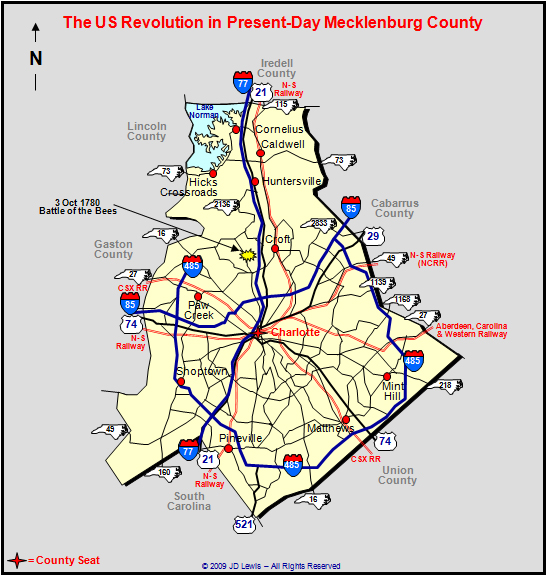
I live close to the town of Matthews, in the lower right-hand corner. The Battle of the Bees took place just a little north of Charlotte, about 7 miles, out Beattie’s Ford Road.

I live outside of Charlotte, North Carolina, and the Battle of Bees plays an important role in the region’s history. Also known as the Battle of McIntyre’s Farm, the Battle of Bees was a Revolutionary War incident, which occurred on October 3, 1780. When the British commander, Lord Charles Cornwallis, left Charlotte on 12 Oct. 1780, after a 16-day occupation, he was heard to say that the defiant and rebellious town was a ‘damned hornet’s nest.”‘Although the British were figuratively stung by unrelenting hostility and violent ambushes, one foraging party was stung, both, literally and figuratively, by Patriots and by bees in the skirmish at McIntyre’s Farm.

Cornwallis had ordered Major John Doyle to lead a foraging expedition into the countryside surrounding the town of Charlotte (Note: Both the town and the county were named for Charlotte of Mecklenburg-Strelitz, King George III’s royal consort.) Supplies were low, but the British did not take the mission lightly. Their 40 wagons were accompanied by 450 foot soldiers, as well as a cavalry detachment. Doyle’s contingent were trailed by 13 American patriots, under the command of Captain James Thompson. Thompson’s men kept out of sight as the British halted seven miles from town at McIntyre’s farm. There, some of the British remained behind to plunder the farm while Doyle and the rest of the party began to march on.

At the farm, some of the soldiers accidentally knocked over a beehive and were forced to scatter to evade the bees’ combined anger. Taking advantage of the situation, the Patriots attacked, killing a British captain, nine soldiers, and two horses. Because the Patriots fired from cover with great accuracy and constantly shifted their positions, it seemed to the startled Redcoats that they were under attack from a much larger force.

mcintyre_cabin

McIntye’s Cabin. Image from the Charlotte-Mecklenburg Historic Landmarks Commission. Available from http://www.cmhpf.org/Properties%20Foundation%20Reports/McIntyreFarm.html (accessed Sept. 3, 2018)

Thinking themselves under heavy attack and outnumbered, Doyle foolishly ordered his men to retreat. The Americans managed to kill some of the horses pulling the supply wagons, which created a road block, of sorts. A few of the British soldiers cut away the uninjured horses and made their escape. The American soldiers from the neighborhood took a turn at firing on the escaping Redcoats, creating more havoc. The Battle of McIntyre’s Farm was only one of several sharp clashes fought between Cornwallis and local Patriots around Charlotte. [The Battle of McIntyre’s Farm, NC Pedia]

Carolana.comCarolana.com provides a summary of this incident: 

After a week in Charlotte, Lt. General Charles, Lord Cornwallis needed to send out foraging parties to replenish his supplies. A large foraging party of 450 Provincials under the command of Capt. John Doyle moved out of Beattie’s Ford Road with sixty wagons. A local boy notified the McIntyre family that the Loyalists were coming.Then, the boy rode on and informed Capt. James Thompson of the local militia. Capt. Thompson quickly rounded up Capt. James Knox and thirteen farmers to harass Capt. Doyle’s troops, and then hid the riflemen in two locations at the McIntyre farm.

Capt. Thompson watched as Capt. Doyle’s men plundered McIntyre’s barns and raided their livestock pens. The Provincials tied their horses to the farm wagons while they went about their work. When the baggage wagons arrived they loaded bags of corn and oats onto them.

During the pillaging, the Loyalists accidentally knocked over some beehives and found themselves under attack by the swarming bees. One Loyalist officer stood in the doorway and laughed as the men swatted at the bees and ran from the danger.

As they were occupied, Capt. Thompson and his men approached the raiders. He yelled out that he would take out a captain he had spotted and that every man should quickly select their target. Capt. Thompson and a militiaman named Francis Bradley fired at the same time. Thompson’s shot found its mark and the man thought to be a captain fell dead. The enemy mounted their horses and formed a line, but Capt. Thompson and his men were able to reload and fire a second time.

Dogs were set loose on the Patriots and they pursued one group of Capt. Thompson’s men:

“The dogs came on the trail of these retreating men, and the leading one sprung upon the heels of a man who had just discharged his rifle. A pistol shot laid him dead, and the other dogs, coming up to him, paused, gave a howl, and returned.”

Capt. Doyle believed that his men were being attacked by a much larger force and ordered a speeedy retreat back to Charlotte. More of the local farmers showed up and began firing at the British from concealment, in a skirmish that resembled the start of the war at Concord, Massachusetts.

Later, Rev. William Henry Foote wrote:

“The leading horses of the wagons were some of them shot down before they ascended the hill by the branch, and the road was blocked up; and the retreat became a scene of confusion in spite of the discipline of the British soldiers, who drew up in battle array and offered to fight the invisible enemy that only changed their ground and renewed their fire.”

Capt. Doyle’s men rode so hard that “many of their horses fell dead in the streets.”

Eight Loyalists were killed, along with two horses. Twelve others were wounded.

Known Patriot Participants Known British/Loyalist Participants
Capt. James Thompson – Commanding Officer

Mecklenburg County Regiment of Militia detachment of two (2) known captains:
– Capt. James Thompson
– Capt. James Knox, with 13 local farmers:

Frank Bradley
Joh Dickson
Thomas Dickson
George Graham
James Henry
George Houston
Hugh Houston
John Long
Thomas McClure
John Robinson
Robert Robinson
Edward Shipley
George Shipley

Reinforced later by unknown number of more farmers

Capt. John Doyle – Commanding Officer

450 Provincials (likely the Volunteers of Ireland)

60 Cavalry (unit unknown)

40 Wagons

Posted in Act of Parliament, American History, British history, Georgian England, Georgian Era, history, research | Tagged , , , , , , , | 2 Comments

Life Below Stairs – The ‘Pugs’ Procession of Precedence

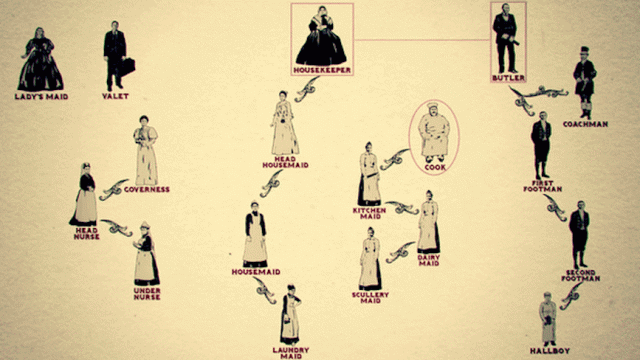
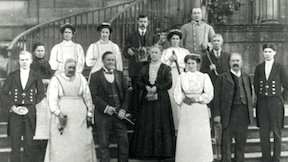
maxresdefault A sense of status above stairs was to be expected among the aristocracy, but it was no less observed below stairs. For example, the lower servants often spoke poorly of the “Pug’s” Procession, which happened after the first course of supper below stairs. All the servants would eat the first course together, generally in enforced silence. However, when that first course ended, the upper servants would exit to either the house steward’s quarters or those of the housekeeper where their pudding would be served to them. Even when leaving the table, they rose and filed from the room in order of precedence within the household. During the Victorian era, butlers and upper servants associated with like servants from other fine houses in their “clubs.” Footmen had similar clubs where they met and socialized. At a social gathering, such as a country fête, the servants took on the status of their employer. A maid tending to a mere “Miss” would be lower on the line of precedence than the maid tending a member of the aristocracy. 
A smart servant, however, especially a footman or butler, could manage his day where he could find time for all sorts of leisure hours. A maid may be expected to carry a bucket of coals up and down the steps of the house, while a footman was entrusted with a silver salver containing a single letter. There was no accounting for chivalry. 

eb356c7c0710d4a18f15ee668eef300d1c851c223e5e3a6f1a79f5f786acd50e

As it was true that many had poor accommodations within the household, at least they were not out upon the streets. The servants had a roof over their heads.There were four meals provided each day – breakfast, dinner, tea, and supper. A resourceful servant might also salvage a bit of what was left over from the meals served to the master and his guests. Servants were given home-brewed beer at each meal. (This tradition began in the 1700s when imported tea was too expensive for the master to squander upon his servants.) The male servants received a pint and the females at half pint at each meal. In some households, instead of the beer a “beer allowance” was paid each day. It amounted to about 8d per day. Upper servants sometimes received wine with their meals. 

Servants generally received their wages upon a quarterly basis. According to the archives of the West Sussex Record Office regarding the estate books of the family seat of the Duke of Richmond’s Goodwood House (near Chichester, West Sussex), in 1888, the house steward received £100 per year, the groom of the chamber, £70; the valet, £60; and the butler £45. The footmen were paid between £26 and £34. The two housekeepers each received £60; the cook £60, the ladies’ maids, £26 to £28; the stillroom maid, £22; kitchen maids, £14 to £24; housemaids and laundry maids, £12 to £26; and the scullery maid £12. 

According to Banking in Bath in the Reign of George III, “As the customer base expanded, the subject of deposits by “the poorer sort” of person arose. This resulted in the appearance of a new kind of banking organisation in Bath when, in January 1815, the Provident Institution or Bank for Savings opened its doors in Trim Street. The Institution was supervised by a Committee and Trustees and invested deposits in Government 5% stocks which were held in the names of the individual depositors. Dividends were payable six-monthly. The Institution grew out of the success of a Servants Fund established in 1808. That fund was limited in size to £2000 and was consistently over-subscribed. The Bath Provident Institution had no limit to the size of its deposits and was one of the first such establishments in the country. A similar organisation, the Bristol Savings Bank, was founded in the same year having grown out of the success of the Prudent Man’s Friend Society.” Lady Isabella Douglas reportedly organized the first servants bank in Bath in 1808. “About a quarter to a half of all depositors in the early savings banks were servants: in York, 322 out of the first 670; in Lincoln 49 out of the first hundred; and in Bolton, 44 out of the first two hundred.(Horne, H. Oliver, A History of Savings Banks, Oxford University Press, 1947). A thrifty servant could save enough funds to begin his or her own business rather than to remain in service. 

servants-poster_large_graphic

Posted in British history, estates, Georgian England, Georgian Era, Living in the Regency, Living in the UK, Regency era, servant life, Victorian era | Tagged , , , , , , | 3 Comments

Life Below Stairs ~ Housing the Servants

It was not uncommon for an English aristocrat or a wealthy man of the gentry to own several properties: country estates and a London house in a fashionable area of London. In doing so, the owner employed a variety of servants to meet the needs of his household, as well as any guests he might entertain. Many took their valuables from their London homes when they returned to their country estates. Gold and silver plate. Chairs and other large furniture placed against the wall and draped with dust covers. Carpets rolled up. Drapes in hessian sacking. Sheets or brown paper over the art work/portraits. A majority of servants in tow. Those left behind to live on board wages in lieu of food. 

In the homes, there was a hierarchy of rooms available for the servants. The employer was often forced to supply “better” rooms to meet this hierarchy and an excessive consciousness of rank. The house would, for example, have a butler’s pantry with a specifically constructed repository for the valuable plate and a separate scullery if the plate was frequently in use. The butler would have a separate bedroom. 

The housekeeper would have a parlour of sufficient space to store all her homemade biscuits and preserves, as well as some of the china and glassware stored a china closet. Upper servants might eat in this parlour. Likely, a stillroom would be attached. In Victorian times, this room would have a lead sink, table, confectioner’s oven, etc., to make the cakes and biscuits. A room to store groceries may have been close by. This would need to be cool so food would not spoil. 

erddig

countryhousereader.wordpress. com BBC Programme: Servants – The True Story of Life Below Stairs

A lady’s maid would also require her own separate sitting room. There would be a place for sewing and ironing clothes. Some houses would have a separate room for brushing the dirt from the clothes, a knife room, a shoe room, a lamp room, etc. 

servantssml

community.dur.ac.uk Photographs of servants doing the laundry

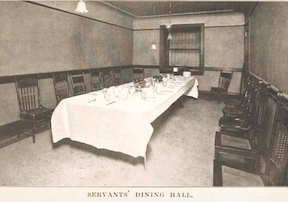
In the servants’ hall, one would find an area for the servants to eat. The men’s quarters were separate from the women’s. These might be separate rooms or partitioned dormitories. The maids often slept two to a room in the attic. The butler, house steward, the cook, the lady’s maid(s), and the valet would have their own rooms. If guests were in the house, separate rooms would be required for equivalent servants traveling with his master. 

a_CompVic_ServantsHallTitle

The Servants Hall http://www.thecompletevictorian. com

servants_hall02

Household management and Servants of the Victorian Era http://www.avictorian.com

At the beginning of Queen Victoria’s reign, it was estimated that a gentleman would require £2500 to £3000 to support his staff. According to Frank E. Huggett’s Life Below Stairs (page 20), “…the estimated household expenses of the fourth Earl of Ashburnham were £2742 a year, say thirteen to eighteen times the salary of a country curate or one and twenty times the wages of a farm labourer. Of the total, £769 went on wages and house labour, £200 on servants’ beer and another £138 on liveries and hats, about 40 per cent in all. Despite the agricultural depression which breathed coldly on the fortunes of many landed proprietors in the 1870s and even more icy blast of estate duties some twenty years later, many of them continued to retain their fortunes – and their large staff of servants – to the end of the reign. The Duke of Westminster, who was one of the richest men in England, and the sixth Duke of Portland, each employed about three hundred servants, about the same number as the Queen herself, who had a separate staff of Indian cooks just to prepare a curry lunch each day whether anyone wanted to eat it or not. Some of the incredible waste in the royal kitchens is recalled by Gabriel Tschumi, who became an apprentice at Buckingham Palace in 1898. Dozens of pheasants, salmon, sturgeon, trout, foie gras, soufflés made with four or five dozen eggs all found their way from time to time into the rubbish bins in the cause of gastronomic perfection. A year before he started working there, twenty-four extra cooks had been brought from France to prepare the fourteen-course banquet in celebration of the queen’s diamond jubilee; the main course rosettes de saumon au rubis (cold salmon in claret jelly) had to be made three times before it received the approval of the Royal chef.” 

Posted in British history, buildings and structures, Georgian, Georgian England, Georgian Era, Great Britain, Living in the Regency, Living in the UK, real life tales, Regency era, Victorian era, William IV | Tagged , , , , | 2 Comments

Life Below Stairs: Rising with the Sun in Victorian England, Part II

Recently, we had a look at breakfast chores for servants in a Victorian household. See it HERE. Today, we carry on with other duties. 

About a half hour after the household staff consumed their meager meal, the family was summoned to morning prayers. The children and servants would join the head of the household. There a short Bible reading and perhaps an acknowledgement of a woman’s equality in the God’s sight. The latter years of the Victorian reign did away with this custom. 

images.jpgThe parlourmaid had previously set the table: linen cloth, polished cutlery, a mitre-shaped napkin, cups, saucers. Upon the table when the family sat to breakfast was jars of jam, whole honeycombs, bread, toast, rolls, butter, cream, sugar, etc. Victorians loved their food and consumed it readily. On the sideboard, one might find bacon, eggs, cutlets, chicken, fish, omelettes, kidneys, ham, tongue, game pies, potted meat, etc. According to Henry James’s travel book, English Hours, describes how the late century Victorians abandoned having servants waiting upon them at breakfast and served themselves. 

While the family fueled themselves for the day, the maids made the beds, cleaned the wash basins, emptied chamberpots, and tidied the bed chambers. The room was aired.One must recall that the Victorian era bed customarily held three mattresses. The straw-filled bottom mattress was turned once per week. The middle mattress was turned daily. It was filled with wool or horsehair. The feather-filled top mattress was not only turned daily,  but it was also beaten to eliminate lumps and then fluffed for comfort. 

When that was completed, carpets were swept, furniture and fixtures dusted, and mirrors polished. Carpets were regularly rolled up and beaten to remove dust. Soft wood (deal) floors were cleaned with a combination of soap, water, and potassium carbonate before being recovered with the carpet. Oak floors were polished with beeswax. 

Work was interrupted at eleven o’clock for a short tea break. This constant cleaning was to be finished by midday. The servants ate their “dinner” at one o’clock. The family had their midday meal between noon and one. This servant meal was more substantial than the morning one: meat, vegetables, rice or suet pudding (or an apple tart). The nursery staff could similar meal as those in the kitchen, but often they were presented with something less expensive, such as shepherd’s pie or plain broth. 

In aristocratic circles, the midday meal was served by liveried footmen. This meal was about being “seen” and being “relevant.” Expensive items were served to guests. The middle classes followed aristocratic ways, but with a more practical expenditures for the meal items. The table was set properly. The household donned a gown acceptable for company. Items such as jellies, creams, and pastries were placed upon the table so guests might serve themselves. Unlike the supper hour when gentlemen escorted the ladies to the table, at “lunch,” the women entered first, walking together two-by-two, and followed by the gentlemen. The guests would remove coats, gloves, etc., in the dining room, not before then. 

The parlourmaid served the luncheon. Salmon, beef, chicken, and lamb, followed by a pudding or a tart, and fresh fruit was be the usual faire. The Victorians did not tarry over their meals. Queen Victoria was said to finish a seven-course meal in 30 minutes. Returning to the drawing room after the meal, the guests donned their outwear and were gone from the house within another 20 minutes. By 2:30 in the afternoon, social calls began. 

961612_orig.jpeg

Posted in British history, Great Britain, servant life, Seven Years' War, Uncategorized, Victorian era | Tagged , , , , | 2 Comments

Life Below Stairs: Rising with the Sun in Victorian England ~ Part I

Servants needed to be up and about their business long before the Master and the Mistress. For example, lower servants were up at 5 A.M. and at work minutes later. Most did not waste time in their rooms for they were cold and draughty. Customarily, a half hour deferment was presented to the servants during the winter months, allowing them not to rise until 5:30. They would work some two hours before they sat to their own breakfast. 

The kitchenmaid was usually the first downstairs. Her first job was to clean or to blacklead the range and whiten the hearth and build a fire before a kettle could be set to boil. Ranges of the time were either “bright” or “black.” To keep the bright range “bright,” one had to polish it was liberal application of rotten-stone and sweet oil until it shine like a mirror. This mixture was applied by rubbing it on with a leather strip. A bright range had a alternate set of fire-bars for summer use. These cast iron bars were rubbed with mutton fat and wrapped in brown paper during the winter months. 

closed-range

victoriandecorating.blogspot.com The closed range was introduced and was widely available by the 1840’s. A metal hot-plate covered the fire box and had rings for pans and kettles to rest upon.

A black range was one made of cast-iron. The maid placed a cloth before the stove before she raked out the cinders and then swept the dust off the bars, the hobs and the hearth. She would take a piece of black lead (which came in solid block) and mix it with water in a small pan. Then she would apply it with a round-headed brush to all insides of the range. When the black lead dried, it was rubbed until it shined with a special polishing brush, with a little splay of bristles at the top for getting to tight ornamental work. The flues were swept clean once a week. This maid between two and eight shillings per week for her trouble.

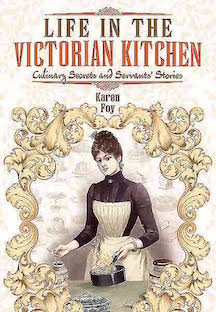
images.jpg Karen Foy in Life in the Victorian Kitchen (©2014)tells us, “Cooking on a kitchen range was hard work, but those with a range were much more fortunate than the poorer classes, who still cooked over an open grate, but easier options had to be found. By the mid 1800s, kitchen ranges changed dramatically and the graft involved in both using and cleaning them was reduced, greatly improving the everyday life of the cook and the kitchen staff…. Like many other new and innovative creations, a glimpse of what the future might hold for Victorian cooks was witnessed at the Great Exhibition of 1851, where early versions of gas-powered were showcased.”

Servant precedence required that the upper servants rose around 6. The cook was required to prepare four different meals, each of separate dishes – those for the family, those for the servants, and those for the children. Parlourmaids (the Victorian substitute for a butler) set the table for the meal and often cleaned the room. The place setting contained knives, forks, and folded serviette. Rolls, bread, and toast were on platters. There were jars of jam, whole honeycombs, and butter dishes. A jug of cream and a sugar basin was in the middle of the table. Additional cups and saucers were kept at hand. Breakfast included bacon, eggs, kidneys, cutlets, fish, omelettes, and broiled chicken. Some households also served cold meats, such as tongue and ham. Game pies and potted meats might also be served. If no lady’s maid was employed in the household, tending the mistress was an additional duty. 

The children’s nurse provided the child/children two to seven mandatory meals/feedings Not all middle class mothers breast fed their babies. Wet nurses filled that duty. Nannies raised the children, who were often “out of sight – out of mind.” The mistress of the house customarily saw their children only during a thirty minutes or so meeting in mid afternoon, around tea time. The nurse’s duties included bathing the babies each morning, administering prescribed medicine and feeding the children. Usually, the child was given a mixture of milk and barley water. Older children also received a bath and nurses assisted in dressing them. Until the age of 7 or 8 boys were laced into stays. Girls wore them throughout their lives. Children customarily ate at 8 A.M. The meal was quite sparse: porridge or break and milk. Perhaps they would receive an egg on Sunday. Their parents had extensive choices for breakfast, and they ate at 9. 

For the remainder of the family, maids brought hot water for washing and tea with bread and butter for consumption to tide them over until breakfast. Lady’s maids laced up their mistresses. Then they assisted the women of the household with multiple petticoats, steel-hooped crinolines or horsehair bustles, long drawers or tight pantaloons, and dresses which contained 20 to 40 yards of material. Some parlourmaids even acted as valet for the master of the house. 

At 8, the servants (except the children’s nurse) sat to breakfast. The meal was often left overs from the previous evening’s meal. It was not extensive. At about 8:45, the family was summoned to the morning room/dining room. Often beforehand, the family and the servants prayed together or read the Bible together before they went about their days. 

Posted in British history, history, Living in the UK, servant life, Victorian era | Tagged , , , | 1 Comment