From Where Does That Phrase Come? A Bit of Slang

images-1 Slang, consists of a lexicon of non-standard words and phrases in a given language. Use of these words and phrases is typically associated with the subversion of a standard variety (such as Standard English) and is likely to be interpreted by listeners as implying particular attitudes on the part of the speaker. In some contexts a speaker’s selection of slang words or phrases may convey prestige, indicating group membership or distinguishing group members from those who are not a part of the group.

A bad egg
This bit of “slang” did not develop until the mid 1800s. Today, the phrase refers to someone or something that disappoints or does not meet expectations. Shakespeare had used the word “egg” to refer to a young person, as in Macbeth when the murderers seeking Macduff meet up with his young son and kill the boy. “What you egg! Young fry of treachery!” The earliest use of the word to connote “disappointment” comes from the Milwaukee Daily American (September 1856). “Mayor Woods is moving heaven and earth to procure his renomination. One of his dodges is, to get up letters in the newspaper, pretending to emanate from ‘distinguished citizens,’ including merchants, mechanics and working men, soliciting him in the most pathetic terms to present himself to the dear people. There are also on the list a number of notorious blacklegs whom Woods keeps in pay. He is a bad egg.”

To fly the coop
This is another bit of slang, which likely dates back to the nineteenth century. It has come to mean to run off, to escape, or to depart abruptly. “Coop” is criminal cant for prison or jail. The phrase has come to mean an unceremonious departure. “Coop” finds its roots in Middle English coupe for “basket” or Norwegian kaup for “wooden can.”

Iron Curtain
Winston Churchill, Prime Minister of Great Britain, coined this phrase following WWII. On 5 March 1946, he expressed his misgivings regarding European politics at Fulton, Missouri, where he was receiving an honorary degree from Westminster College. He said, “From Stettin in the Baltic to Trieste in the Adriatic, an iron curtain has descended across the continent.” The Iron Curtain symbolizes the ideological conflict and physical boundary diving Europe into two separate areas from the end of World War II in 1945 until the end of the Cold War in 1991.

Cadge
Etymology: Possibly a corruption of cage, from Old French; as a noun cadge it finds meaning in falconry to refer to a circular frame on which cadgers carry hawks for sale. As a verb, it can be used (US, UK, slang) to mean to obtain something by wit or guile; to convince someone to do something they might not normally do or in (UK, Scotland, dialect) meaning too carry, as a burden; To hawk or peddle, as fish, poultry, etc., or To intrude or live on another meanly; to beg.

To Lie in One’s Teeth
This phrase means to lie grossly or maliciously: If she told you exactly the opposite of what she told me, she must be lying in her teeth. Also, lie through one’s teeth. The origin comes to us before 900; (noun) Middle English; Old English lyge; cognate with German Lüge, Old Norse lygi; akin to Gothic liugn; (v.) Middle English lien, Old English lēogan (intransitive); cognate with German lügen, Old Norse ljūga, Gothic liugan. The phrase is thought to have made its way into the language in the early 1300s, as in The Romances of Sir Guy of Warwick: and Remburn His Son. “Thou liest amidward and therefore have thou maugreth (shown ill will).”

On tenterhooks
This phrase means to be in a state of anxious suspense. A “tenter” is a frame or endless track with hooks or clips along two sides that is used for drying and stretching cloth. It comes to us from Middle English teyntur, probably from Medieval Latin tentura, from tenta tent frame or tent. Its first known use was in the 14th century. Because of the tenter’s similarity to the rack in its construction, the term “tenterhooks” became to be known for its suspended tension.

Rope of sand
This phrase means something of no cohesion or stability: a feeble union or tie. It is used ironically to describe a treaty or a contract, meaning a paper with no binding power over the two parties involved. Sir Francis Bacon used the phrase as such, “to knit a rope of sand.” Samuel Butler (in 1712) wrote “I leave to my said children a great chest full of broken promises and cracked oaths; likewise a vast cargo of ropes made of sand.” The Urban Dictionary calls it a running joke used in academic writing. The phrase, purposefully meaningless and ambivalent, is used after a colon to “spice up” a title.
The Collapse of the Ottoman Empire: A Rope of Sand
Organ Transplant Rejection: A Rope of Sand
My Summer Vacation: A Rope of Sand

Unknown Too big for one’s breeches
This one likely dates back to the mid 1100s. It means to assert oneself beyond his authority or ability. It comes from our pride in trying to impress another. The first print version of the phrase comes to us from H. G. Wells in 1905, but it was in wide use in the spoken language long before that time. Other versions of the phrase include “too big for one’s boots,” “he of the swelled buttocks,” and “swellhead.”

To go berserk
This phrase means to behave in a frenzied and violent manner. This term has something in common with ‘run amok’. The two phrases, as well as sounding rather similar, mean virtually the same thing. Their sources though could hardly be further apart. ‘Run amok’ derives from the Far East, whereas ‘go berserk’ is of Viking (Norse) origin. In that tradition a ‘Berserker’ was a warrior of great strength and courage, who fought with wild ferocity. The word is believed to be derived from ‘bear sark’, that is, bear coat. That berserker fighting tradition, in which the warriors took on the spirit (or even in their belief, the shape) of bears whilst foaming at the mouth and gnawing the edges of their shields, is the source of the Vikings’ fierce reputation. It dates back to the first millennium but had died out by the 1100s and thereafter the word berserker didn’t feature widely in the English language until the 19th century. There is a rival, but less widely accepted, version of the derivation. In this the Vikings were supposed to show their bravery by going into battle with their sark jackets open, that is, ‘bare-sark’.
Who better to bring the word to our notice than that inveterate reviver of historical stories, Sir Walter Scott? In his 1822 book ‘Pirate’, he wrote:
“The berserkars were so called from fighting without armour.”
It was quite some time before the word began to be used in the figurative sense, that is, for it to be applied to people who ‘went berserk’ without an allusion to Viking warriors. Rudyard Kipling’s book Diversity of Creatures, 1908 has:
“You went Berserk. I’ve read all about it in Hypatia … you’ll probably be liable to fits of it all your life.”
The first reference to the actual use of the term ‘go berserk’ is in the obscure US newspaper the La Crosse Tribune and Leader-Press, 1919:
“With hungry Russians crowding in from the east, a hungry Germany may shortly toss its new conventions after the old and go berserk in the teeth of the cannon.” (The Phrase Finderimages-1)

Posted in language choices, Pop Culture, word play, writing | Tagged , , , | 2 Comments

UK “Real” Estate: All Hallows-by-the-Tower

250px-AllHallowsByTheTowerChurchAll Hallows-by-the-Tower, also previously dedicated to St. Mary the Virgin and sometimes known as All Hallows Barking, is an ancient Anglican church on Byward Street in the City of London, overlooking the Tower of London. The church and Tower Hill play a role in the climax of my current Work in Progress (WIP), a cozy mystery.

Founded in 675, it is one of the oldest churches in London and contains, inside, a 7th-century Saxon arch with recycled Roman tiles, the oldest surviving piece of church fabric in the city. (St. Pancras Parish Church in King’s Cross has been a place of Christian worship since the sixth century.)

History
All Hallows-by-the-Tower was first established in 675 by the Saxon Abbey at Barking and was for many years named after the abbey, as All Hallows Barking. The church was built on the site of a former Roman building, traces of which have been discovered in the crypt. It was expanded and rebuilt several times between the 11th and 15th centuries. Its proximity to the Tower of London meant that it acquired royal connections, with Edward IV making one of its chapels a royal chantry and the beheaded victims of Tower executions being sent for temporary burial at All Hallows.

The church was badly damaged by an explosion in 1650 caused when some barrels of gunpowder being stored in the churchyard exploded; its west tower and some 50 nearby houses were destroyed, and there were many fatalities. The tower was rebuilt in 1658, the only example of work carried out on a church during the Commonwealth era of 1649-1660. It only narrowly survived the Great Fire of London in 1666 and owes its survival to Admiral William Penn, father of William Penn of Pennsylvania fame, who had his men from a nearby naval yard demolish the surrounding buildings to create firebreaks. During the Great Fire, Samuel Pepys climbed the church’s spire to watch the progress of the blaze and what he described as “the saddest sight of desolation.”

Restored in the late 19th century, All Hallows was gutted by German bombers during the Blitz in World War II and required extensive reconstruction, only being rededicated in 1957.

Many portions of the old church survived the War and have been sympathetically restored. Its outer walls are 15th-century, with a 7th-century Saxon arch doorway surviving from the original church, which is the oldest piece of church material in London. Many brasses remain in the interior (where one of London’s brass rubbing centres is now located). Three outstanding wooden statues of saints dating from the 15th and 16th centuries can also be found in the church, as can an exquisite Baptismal font cover which was carved in 1682 by Grinling Gibbons for ₤12, and which is regarded as one of the finest pieces of carving in London. In 1999, the AOC Archaeology Group excavated the cemetery and made many significant discoveries.

The church has a museum called the Undercroft Museum, containing portions of a Roman pavement which together with many artefacts was discovered many feet below the church in 1926. The exhibits focus on the history of the church and the City of London, and include Saxon and religious artefacts. Also on display are the church’s registers dating back to the 16th century, and notable entries include the baptism of William Penn, the marriage of John Quincy Adams, and the burial of Archbishop William Laud. Laud remained buried in a vault in the chapel for over 20 years; it was moved during the Restoration to St. John’s College, Oxford.

The altar in the crypt is of plain stone from the castle of Richard I at Athlit in The Holy Land.

All Hallows-by-the-Tower has been the Guild church of Toc H since 1922. The church was designated a Grade I listed building on 4 January 1950.

Notable People Associated with the Church
**John Quincy Adams, sixth president of the United States: married 1797
**Judge Jeffreys, notorious “hanging judge”: married 1667
**William Laud, Archbishop of Canterbury: beheaded at the Tower, buried 1645
**Thomas More, beheaded at the Tower for refusing to sign Henry VIII’s Act of Supremacy: buried 1535
**John Fisher, beheaded at the Tower: buried
**Lancelot Andrewes: baptised 1555
**William Penn, founder of Pennsylvania: baptised 1644
**Albert Schweitzer, made organ recordings at All Hallows
**Philip Clayton, also known as ‘Tubby’, former vicar and founder of Toc H
**Cecil Thomas, a sculptor who provided several funerary figures between the Wars

Vicars
1269 John de S Magnus
1292 William de Gattewicke
1312 Gilbert de Wygeton
1317 Walter Grapynell
1333 Maurice de Jenninge
1351 John Foucher
1352 Nicholas Janing
1365 Thomas de Broke
1376 Thomas de Dalby
1379 Laurence de Kagrer
1387 William Colles
1387 Robert Caton
1390 Nicholas Bremesgrove
– Jo Clerke
1419 John Harlyston
1427 W. Northwold
1431 John Iford
1434 Thomas Virley
1454 John Machen
1454 John Wyne
14- John Walker
1468 Thomas Laas
1475 Robert Segrym
1478 Richard Baldry
1483 William Talbot
1492 Edmund Chaderton
1493 Rad Derlove
1504 William Gedding
1512 William Pattenson
1525 Robert Carter
1530 John Naylor
1542 William Dawes
1565 William Tyewhit
1584 Richard Wood
1591 Thomas Ravis
1598 Robert Tyghe
1616 Edward Abbott
1654 Edward Layfield
1680 George Hickes
1686 John Gaskarth
1732 William Geeke
1767 George Stinton
1783 Samuel Johnes Knight
1852 John Thomas
1884 Arthur James Mason
1895 A.W. Robinson
1917 C.E. Lambert
1922 Philip Byard Clayton
1963 Colin Cuttell
1977 Peter Delaney
2005 Bertrand Olivier

The Organ
170px-All_Hallows-by-the-Tower_Organ,_London,_UK_-_Diliff The earliest records of an organ in All Hallows is one by Anthony Duddyngton dating from 1521. This was presumably lost during the English Civil War.

An organ was installed in 1675 by Thomas and Renatus Harris. In 1720 a new case was built by Gerard Smith. The organ was restored and improved by George Pike England in 1813, Bunting in 1872 and 1878, and Gray and Davison in 1902. There was further work by Harrison and Harrison in 1909 and 1928. After destruction in 1940, a new organ by Harrison and Harrison was installed in 1957.

Organists
Albertus Bryne II (or Bryan) 1675-1713
Charles Young 1713-1758
Charles John Frederick Lampe 1758-1767
Samuel Bowyer 1767-1770
Charles Knyvett and William Smethergell 1770-1783
William Smethergell 1783-1823
Mary Morrice 1823-1840
Lisetta Rist 1840-1880
Arthur Poyser
Gordon Phillips 1956-1991
Jonathan Melling

Posted in British history, buildings and structures, Great Britain, Living in the UK, real life tales, religion | Tagged , , , , , | Comments Off on UK “Real” Estate: All Hallows-by-the-Tower

“The London Monster” and Piquerism

1 May 1790, artist's depiction of the London Monster attacking a woman. The likeness was created from various reports from alleged victims and before the arrest of Rhynwick Williams.

1 May 1790, artist’s depiction of the London Monster attacking a woman. The likeness was created from various reports from alleged victims and before the arrest of Rhynwick Williams.

The London Monster was the name given to an alleged attacker of women in London between 1788 and 1790. The attacker had a signature behavior of piquerism, the pricking or stabbing of victims with a knife, pin or needle.

First reports of the Monster appeared in 1788. According to the victims (most of them from wealthier families), a large man had followed them, shouted obscenities and stabbed them in the buttocks. Some reports claimed an attacker had knives fastened to his knees. Other accounts reported that he would invite prospective victims to smell a fake nosegay and then stab them in the face with the spike hiding within the flowers.

In all cases the alleged assailant would escape before help arrived. Some women were found with their clothes, cut and others had substantial wounds. In two years the number of reported victims amounted to more than 50.

The press soon named the maniac The Monster. However, descriptions of the attacker varied greatly. When people realized the Monster attacked mainly beautiful women, some women began to claim that they had been attacked to gain attention and sympathy. Some of them even faked wounds. Some men, in turn, were afraid to approach a lady in the dark lest they scare her. Some of the reports of the would-be-attacks were likely to be fabrications or results of a lady being afraid of an innocent man who had somehow attracted suspicion. Some men even founded a No Monster Club and began to wear club pins on their lapels to show that they were not the Monster.

Londoners were outraged when the Bow Street Runners, the London police force, failed to capture the man. Philanthropist John Julius Angerstein promised a reward of £100 for capture of the perpetrator. Armed vigilantes began to patrol in the city. Fashionable ladies began to wear copper pans over their petticoats. There were false accusations and attacks against suspicious people. Local pickpockets and other criminals used the panic to their advantage; they picked someone’s valuables, pointed at him, shouted “Monster!”, and escaped during the resulting mayhem.

In 1790 an unemployed 23-year-old man, Rhynwick Williams, was arrested on suspicion of being the Monster. After two trials, he was sentenced to six years in prison, but historians question whether the conviction was sound.

Arrest of Rhynwick Williams
On 13 June 1790, Anne Porter claimed she had spotted her attacker in St. James’s Park. Her admirer, John Coleman, began a slow pursuit of the man, who realised he was being followed. When Rhynwick Williams, an unemployed 23-year-old, reached his house, Coleman confronted him, accusing him of insulting a lady, and challenged him to a duel. He eventually took Williams to meet Porter, who fainted when she saw him.

Williams protested his innocence but, given the climate of panic, it was futile. He admitted that he had once approached Porter but had an alibi for another of the attacks. Magistrates charged Williams with defacing clothing — a crime that in the Bloody Code carried harsher penalty than assault or attempted murder. During the trial, spectators cheered the witnesses for the prosecution and insulted those for the defence. One of the claimed victims confessed that she had not been attacked at all.

Realizing the absurdity of the situation, Williams was granted a retrial. In the new trial Williams’ defence lawyer was Irish poet Theophilus Swift, whose tactic was to accuse Porter of a scheme to collect the reward, Porter having married Coleman, who had received the reward money. Despite the fact a number of alleged victims gave contradictory stories and coworkers testified he had an alibi for the most famous attack, Williams was convicted on three counts and sentenced to two years each, for a total of six years in prison.

Historians have speculated whether Williams was the culprit and have even questioned whether the London Monster existed at all beyond the hysteria. Reports of Monster-like attacks continued to be reported for many years, although they lessened somewhat while Williams was imprisoned.

Posted in British history, Georgian Era, gothic and paranormal, Great Britain, legends and myths, Living in the UK, mystery, real life tales | Tagged , | 2 Comments

The Great Frost of 1709 – An Extraordinary Winter Event

The Great Frost cover The Great Frost (as it was known in England) or Le Grand Hiver (as it was known in France) was an extraordinarily cold winter in Europe in late 1708 and early 1709, and was found to be the coldest European winter during the past 500 years. The severe cold occurred during the time of low sun spot activity known as the Maunder Minimum.

Notability
William Derham recorded in Upminster, near London, a low of −12 °C (10 °F) on the night of 5 January 1709, the lowest he had ever measured since he started taking readings in 1697. His contemporaries in the weather observation field in Europe likewise recorded lows down to −15 °C (5 °F). Derham wrote in Philosophical Transactions: “I believe the Frost was greater (if not more universal also) than any other within the Memory of Man.”

France was particularly hard hit by the winter, with the subsequent famine estimated to have caused 600,000 deaths by the end of 1710. Because the famine occurred during wartime, there were contemporary nationalist claims there were no deaths from starvation in the kingdom of France in 1709.

This winter event has drawn the attention of modern day climatologists in the European Union’s Millennium Project because they are presently unable to correlate the known causes of cold weather in Europe today with weather patterns documented in 1709. According to Dennis Wheeler, a climatologist at the University of Sunderland: “Something unusual seems to have been happening.”

The severity of the winter is thought to be an important factor in the emigration of the German Palatines from Central Europe.

Anecdotal Events
Françoise-Marie de Bourbon, the Duchess of Orleans, is said to have written a letter to her great aunt in Germany describing how she was still shivering from cold and could barely hold her pen despite having a roaring fire next to her, the door shut, and her entire person wrapped in furs. She wrote, “Never in my life have I seen a winter such as this one.”

European Union Millennium Project
One of the key aims of the European Union Millennium Project is climate reconstruction. This objective has gained significance in recent years because scientists are exploring the precise causes for climate variations instead of merely accepting they are within an acceptable historical range. Modern climate models do not appear to be entirely effective for explaining the climate of 1709. great-frost-1709

Posted in British history, Great Britain, Living in the UK, weather | Tagged | Comments Off on The Great Frost of 1709 – An Extraordinary Winter Event

From Where Does That Phrase Come?

images-1 UnknownRecently, I was checking the source of several key phrases within my current WIP (Work in Progress), a cozy mystery, checking to discover whether the word/phrase would have been used in Regency England. Below, are some of those I researched. As one can easily observe, several I kept within the story, others made a quick exit.

A Wild Good Chase…
Noun: wild-goose chase (plural wild-goose chases) (idiomatic); (figuratively) A futile search, a fruitless errand; a useless and often lengthy pursuit; A task whose execution is inordinately complex relative to the value of the outcome.
Etymology:Early recorded use refers to a type of 16th century horse race where everyone had to try to follow the erratic course of the lead horse, like wild geese have to follow their leader in formation. Mentioned in the William Shakespeare play Romeo and Juliet, Act 2, scene 4 by the character Mercutio: “Nay, if our wits run the wild-goose chase, I am done; for thou hast more of the wild goose in one of thy wits than, I am sure, I have in my whole five.” Mentioned in Robert Burton, Anatomy of Melancholy (1621). Common use in the current may be the origin for the sport sense.

Red Herring…
Noun: red herring (plural red herrings):A smoke-cured and salt-brined herring strong enough to turn the flesh red; a type of kipper.
“Up in the morning, and had some red herrings to our breakfast, while my boot-heel was a-mending, by the same token the boy left the hole as big as it was before.” (Samuel Pepys diary entry of 28 February 1660);
(figuratively) A clue or information that is or is intended to be misleading, that diverts attention from a question.
Etymology:Until 2008, the accepted etymology of the idiom was that red herring were used to train dogs to track scents. This has proved to be a false In truth, it originated from a news story by English journalist William Cobbett, c. 1805, in which he claimed that as a boy he used a red herring (a cured and salted herring) to mislead hounds following a trail; the story served as an extended metaphor for the London press, which had earned Cobbett’s ire by publishing false news accounts regarding Napoleon.

The Cake is a Lie…
(Internet slang) The end you are pursuing is unattainable or misguided; the reward you have been promised is false.
Etymology: From the 2007 video game Portal, in which a self-aware computer, GLaDOS, lures the player into participating in dangerous experiments with the promise of cake. As the game progresses, the player discovers graffiti left by previous test subjects, including the warning “the cake is a lie.”

Tilt at Windmills…
Verb (intransitive) To attack imaginary enemies; (intransitive, idiomatic) to persistently engage in a futile activity.
Etymology: From a passage in the novel Don Quixote where the eponymous character tilts at (i.e. joust at) windmills he has mistaken for giants.

A Merry Dance…
Noun:merry dance (plural merry dances); (idiomatic) A useless waste of time resulting from a deception.

Keep It Between the Ditches…
Verb: (idiomatic) To stay out of trouble or follow a righteous (God-fearing) path.
Etymology:
This is a phrase that originated as a popular saying in the State of Alabama, particulary the northern part, to generally emphasize the desire to live a good and clean life. The rock band Drive By Truckers used the phrase in their song “The Rightgeous Path.” Some members of the band are from the northern part of Alabama.

Kill the Fatted Calf…
Verb: (idiomatic) To begin a festive celebration and rejoicing for someone’s long-awaited return.
Etymology:The phrase derives from the parable of the prodigal son in the New Testament.

Knuckle Dragger…
Noun: (plural knuckle draggers); (idiomatic, often derogatory) A large, strong, and rather dimwitted person: Synonyms: Neanderthal
Etymology: An allusion to the practice of less-evolved larger primates of walking upright with their knuckles close to the ground.

Dimber Damber…
Noun: dimber damber upright man (plural dimber damber upright men);
(idiomatic, obsolete, slang) The chief of a gang of male thieves or gypsies: Synonym: arch rogue

Dick Munch…
Noun: (plural dick munches); (vulgar, pejorative, idiomatic) idiot, foolish person.

Cake Walk…
Noun:(plural cake walks):(idiomatic) Something extremely easy.
Etymology: A type of dance originating in the United States in the 19th century. From the mid 1900s, a game at a fair or party in which people walk around a numbered circle along to music. When the music is stopped, the caller draws a number from a jar and whoever is standing on or closest to that number wins a cake.

Arsy Versy…
Adverb: arsy versy (not comparable); (idiomatic, UK, vulgar) Tumbling upside down; head over heels; backwards.
Etymology: Alteration of arsa versa, a blend of an alteration of arse + vice versa, modeled on vicey versey

Head Over Heels… (Although I customarily write ‘Heels Over Head’ for to be upside down, one’s heels are up and the head down.)
Adverb (comparative form, more head over heels, superlative form, most head over heels) Tumbling upside down; At top speed; frantically; Hopelessly smitten.
Etymology: Emerged in the 14th century as “heels over head,” which is more literally accurate, as “head over heels” is the more standard state of being. “Heels over head” evolved into “head over heels” in common use departing its literal meaning, probably for reasons of phrasal elegance.

Greengrocer’s Apostrophe…
Noun: (plural greengrocer’s apostrophes); The incorrect use of an apostrophe to form the plural of a word through ignorance of the use of the apostrophe.
Etymology: The term is believed to have been coined in the middle of the 20th century by a teacher of languages working in Liverpool, at a time when such mistakes were common in the handwritten signs and advertisements of greengrocers (e. g., Apple’s 1/- a pound, Orange’s 1/6d a pound). Some have argued that its use in mass communication by employees of well-known companies has led to the less literate assuming it to be correct and adopting the habit themselves.

Speak of the Devil…
(idiomatic, humorous) An expression sometimes used when a person mentioned in the current conversation happens to arrive on the scene.
Etymology: Variation of “Speak of the devil and he shall appear,” which can be traced back to “Talk of the Devil, and he’s presently at your elbow” attested in 1666.

Sour Grapes…
Noun:sour grapes (uncountable) (plural only); (idiomatic) Things that somebody pretends to despise because he/she cannot possess them.
(idiomatic) A putting down or expression of disdain about something that one desires but cannot have.
Etymology: From the Aesop’s fable The Fox and the Grapes, in which a fox, unable to reach grapes he is seeking, decides that they must have been sour.

Square Away…
Verb: square away, squared away; (idiomatic) To finish, complete, tidy or put in order; (nautical) To square the ships’ yards to make her run before the wind, with the wind blowing straight from the stern.

Rag Bagger…
Noun: rag bagger (plural rag baggers);(idiomatic, disrespectful) A sailor who tends to sail on messy cruising vessels; (idiomatic, disrespectful) A sailboat, usually a cruising sailboat tending to carry and store lots of supplies along the deck, or any sailboat that looks neglected or messy.
Etymology: From rag referring to the sails, and bagger referring to the storage of many items.

And these are for my internet friend, Carol Cork, who asked of them in last month’s phraseology post. I was listening, Carol.

To Call a Spade, a Spade
This means to avoid euphemisms, calling a thing what it really is. The phrase goes back to the time of Plutarch in the 1st Century A.D. It is found in Plutarch’s writing about the life of Philip of Macedon. What many do not know is the Greek work for “spade” is very similar to the one for “boat” or “bowl.” Lucian, a Greek writer of the 2nd Century, supposedly used the phrase also.

The Bee’s Knees
This phrase has come to mean something of good quality, but in the 18th Century the phrase was used to mean something very small. Likely, it came to us from the fact that bees carry pollen back to the hive in sacs on their legs, but there is no proof to that fact. According to Phrase Finder, ‘Bee’s knees’ began to be used in early 20th century America. Initially, it was just a nonsense expression that denoted something that didn’t have any meaningful existence – the
kind of thing that a naive apprentice would be sent to the stores to ask for, like a ‘sky-hook’ or ‘striped paint’. That meaning is apparent in a spoof report in the New Zealand newspaper The West Coast Times in August 1906, which listed the cargo carried by the SS Zealandia as ‘a quantity of post holes, 3 bags of treacle and 7 cases of bees’ knees’. The teasing wasn’t restricted to the southern hemisphere. The US author Zane Grey’s 1909 story, The Shortstop, has a city slicker teasing a yokel by questioning him about make-believe farm products:
“How’s yer ham trees? Wal, dog-gone me! Why, over in Indianer our ham trees is sproutin’ powerful. An’ how about the bee’s knees? Got any bee’s knees this Spring?”
The nonsense expression ‘the bee’s knees’ was taken up by the socialites of Roaring 20s America and added to the list of ‘excellent’ phrases. A printed reference in that context appears in the Ohio newspaper The Newark Advocate, April 1922, in a piece on newly coined phrases entitles ‘What Does It Mean?’:
“That’s what you wonder when you hear a flapper chatter in typical flapper language. ‘Apple Knocker,’ for instance. And ‘Bees Knees.’ That’s flapper talk. This lingo will be explained in the woman’s page under the head of Flapper Dictionary.” [an ‘apple knocker’ is a rustic]

Cat Got Your Tongue
Cat-got-your-tongue The phrase means someone remains inexplicably silent even though someone has implored him for information. From Phrase Finder, once again, we discover “‘Cat got your tongue?’ is the shortened form of the query ‘Has the cat got your tongue?’ and it is the short form that is more often used. It is somewhat archaic now but was in common use until the 1960/70s. It was directed at anyone who was quiet when they were expected to speak, and often to children who were being suspiciously unobtrusive.
There’s no derivation that involves any actual cat or celebrated incident of feline theft. It certainly doesn’t relate to sailors becoming taciturn when punished with the cat o’ nine tails as some have suggested – that’s pure invention. Like the blackbird that ‘pecked off his nose’, the phrase is just an example of the lighthearted imagery that is, or was, directed at children.
The expression sounds as though it might be old but isn’t especially so. It isn’t found in print until 1881, in the US illustrated paper Ballou’s Monthly Magazine, Volume 53:
Has the cat got your tongue, as the children say?
The demarcation of the phrase as being ‘children’s’ suggests that it may be earlier than the 1880s. Children’s language wasn’t written down until it became used by adults, which may be some years after it was common parlance in the playground.”

Marry in Haste, Repent at Leisure
The meaning of this phrase is quite literal. This proverbial saying was first expressed in print by William Congreve in his comedy of manners The Old Batchelour, 1693:
Thus grief still treads upon the heels of pleasure:
Married in haste, we may repent at leisure.

To Take Down a Peg or Two
This phrase means to lower one’s opinion of himself. Phrase Finder says, “Various quantities and qualities have been measured by the use of pegs. It has been suggested that the pegs in question here were those used to regulate the amount of drink taken from a barrel, or those that controlled the hoisting of the colours (flags) of ships. Either of these might be correct although, like the ‘yards’ of ‘the whole nine yards’, ‘pegs’ could relate to many things.
It is interesting though that all the early citations of the phrase have a religious context; for example:
Pappe with An Hatchet, 1589 – ‘Now haue at you all my gaffers of the rayling religion, tis I that must take you a peg lower.’
Joseph Mead’s Letters, 1625 – ‘A-talking of the brave times that would be shortly… when… the Bishop of Chester, that bore himself so high, should be hoisted a peg higher to his little ease.’
Samuel Butler’s Hudibras, 1664 – ‘We still have worsted all your holy Tricks,… And took your Grandees down a peg.'”

Posted in editing, language choices, word play, writing | Tagged , , | 4 Comments

Living in Regency Era London ~ Lighting the House

Living in Regency London – Lighting the House

Today, I have have dealt with three power outages in my area, and with each, I have privately cursed how dark is my home without the power of electricity. I have had to go without lights, TV, the internet, phone service, etc., and this modern-day “deprivation” has set me to thinking about the days of the Regency era when the almighty CANDLE ruled the home.

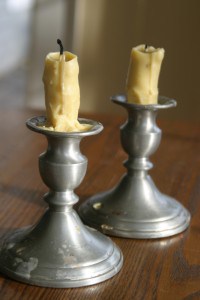
candlesUntil the Victorian Era, candles, lanterns, and rush-lights served as the principal means of lighting the Georgian styled home, and like every other aspect of Regency life, the use of the these sources of light adhered to their own “hierarchy” of use.

At the top of the Candle Hierarchy was the beeswax candle. These candles were more expensive than the others and could be left unattended for longer periods than could tallow or rush lights. However, they did melt faster than tallow candles. Wax candles were used by the very rich to prove their superiority to others. Wax candles were used in chandeliers because they burned themselves out rather than having to be snuffed out by the servants. img_3004-e1272244558721-200x300

Tallow candles, usually made from mutton fat, were the main source of light in middle class homes and the lower gentry. They left behind a most annoying odor and did not burn evenly. Generally, the flame had to be snuffed out to prevent the charred wick falling into the tallow. If this happened, a “gutter” formed and melted wax would flow over everything. The tallow candle offered poor lighting and did not last for long.

rushlight2Rush-lights were used by the poor. Rush-lights were made by dipping the stripped pith of common rushes into hot animal fat, often bacon fat. Rushes are commonly 2 feet long. They were held in place by a stand with a clip, and they usually burned out in an hour or so. The poor sometimes chose to burn tallow candles, but they were not economical. Eleven rushes would cost a family a farthing.

It was commonplace to have only two candlesticks in each room. In some homes, wall sconces with mirrors behind them increased the lights. These sconces were typically mounted on the chimney-breast.

Unlike the homes on the Continent, most homes in Georgian London were slow to accept oil burning lamps. Ami Argand of Geneva demonstrated his improved lamp in 1783 to the French Academy of Sciences. Unfortunately for Argand, the French Academy did not take well to the experiment. So, Argand brought his invention to London. Argand lamps using Colza oil were used in some wealthier London homes, but they were very expensive and were “plagued” by the cumbersome need to mount the oil reservoir above the level of the burner. This mounted reservoir blocked off the light from one side of the lamp. After 1798, a pump was available to force the oil upwards.

Candles were more economical and remained the main source of light until the mid-19th Century.

Posted in British history, buildings and structures, customs and tradiitons, Great Britain, Living in the Regency, Living in the UK, Regency era | Tagged , , , | 10 Comments

The “French” Influence on the Regency Period

With George III’s first bit of madness in 1788 to the death of George IV in 1830, the world experienced the French Revolution, the Napoleonic Wars, the Congress of Vienna, and the Age of Reform.

England found itself inundated with French refugees during the French Revolution. Thousands of French aristocrats arrived on English shores in the wake of the Terror. Estimates are set at 40,000 + French aristocrats coming through ports such as Brighton. Many arrived with nothing more than the clothes on their backs.

French émigrés left behind many of their valuables, but they brought tales of the Terror to English shores. There were, for example, stories of Victims’ Balls. These were parties given by the survivors of the Terror, those whose relatives had been executed. To be admitted one had to present a certificate to prove that one of the person’s relatives had been guillotined. When a male entered the party, he would bow his head as if presenting it to the guillotine. Women would wear a red ribbon about their necks as a symbol of the spilled blood.

The stories of horror turned many good Englishmen against the idea of Reform. Any steps toward thinking of changing the status of the working poor through governmental reform took on the language of treason. Add to the reality of the French Revolution the one taking place in America, and the idea of change in the electoral system took a GIGANTIC step backward.

In 1793, England declared war on France. It would be 1815 before peace would be declared. The war was very unpopular with the English public. The English educated class had held a long love affair with everything French. They spoke French with ease and adored French fashion and art. The great majority of the public, however, were very much anti-French. Part of this dislike of the French came from the lower classes’ dislike of the English upper classes’ fascination with the French.

history-of-fashion_picture31Francophiles spoke French, indulged in French food and wine, and filled their houses with French furniture. Even George IV, the Prince Regent, decorated his houses in the French style. English Society had no intention of letting a little thing such as a war to interfere with their French obsession. Smugglers thrived, especially smugglers of French brandy and art, as well as luxury food stuffs.

A temporary peace arrived on English shores with the Treaty of Amiens in 1802. English high society kept the Channel busy as they streamed into Paris to scarf up all things French. Whig leader, Charles James Fox, was one of the first to arrive on French shore, along with the Duchess of Devonshire as part of his entourage. George IV’s future mistress, Lady Conyngham, was deemed the most beautiful woman in Paris at the time. It was quite fashionable to be presented to Napoleon. Fraternizing with the enemy was very much in vogue.

Madame Recamier was the most famous hostess of the English influx, but the peace held for barely fourteen months. The peace may not have lasted, but the English fascination with the French remained entrenched throughout the Regency. It was quite ironic to hear the English conducting business in the language of their enemy.

The Regency is noted for its elegance and achievements in the fine arts and architecture. This era encompassed a time of great social, political, and even economic change. War was waged with Napoleon and on other fronts, affecting commerce both at home and internationally as well as politics. Despite the bloodshed and warfare the Regency was also a period of great refinement and cultural achievement, shaping and altering the societal structure of Britain as a whole.

Posted in British history, customs and tradiitons, fashion, George IV, Great Britain, Living in the Regency, Living in the UK, Napoleonic Wars, political stance, Regency era, Regency personalities | Tagged , , , , | 1 Comment

Determining Order of Succession

An order of succession is the sequence of those entitled to hold a high office such as head of state or an honour such as a title of nobility in the order in which they stand in line to it when it becomes vacated. This sequence may be regulated through descent or by statute.

An established order of succession is the normal way of passing on hereditary positions, and also provides immediate continuity after an unexpected vacancy in cases where office-holders are chosen by election: the office does not have to remain vacant until a successor is elected. In some cases the successor takes up the full role of the previous office-holder, as in the case of the presidency of many countries; in other non-hereditary cases there is not a full succession, but a caretaker chosen by succession criteria assumes some or all of the responsibilities, but not the formal office, of the position. For example, when the position of Catholic Pope becomes vacant, the College of Cardinals collectively carries out the essential functions of the papacy until a successor is elected.

Monarchies and Nobility
In hereditary monarchies the order of succession determines who becomes the new monarch when the incumbent sovereign dies or otherwise vacates the throne. Such orders of succession usually specify a selection process, by law or tradition, which is applied to indicate which relative of the previous monarch, or other person, has the strongest claim to assume the throne when the vacancy occurs.

Often, the line of succession is restricted to persons of the blood royal, that is, to those legally recognized as born into or descended from the reigning dynasty or a previous sovereign. The persons in line to succeed to the throne are called “dynasts.” Constitutions, statutes, house laws, and norms may regulate the sequence and eligibility of potential successors to the throne.

Prince_Charles_2012 In the past, the order of succession was sometimes superseded or reinforced by the coronation of a selected heir as co-monarch during the life of the reigning monarch. Examples include Henry the Young King and the heirs of elective monarchies, such as the use of the title King of the Romans for the Habsburg emperors. In the partially elective system of tanistry, the heir or tanist was elected from the qualified males of the royal family. Different monarchies use different algorithms or formulas to determine the line of succession.

Hereditary monarchies have used a variety of methods and algorithms to calculate the order of succession among possible candidates related by blood or marriage. An advantage of employing such formulae is that dynasts may, from early youth, receive grooming, education, protection, resources and retainers suitable for the future dignity and responsibilities associated with the crown of a particular nation or people. Such systems may also enhance political stability by establishing clear, public expectations about the sequence of rulers, potentially reducing competition and channeling cadets into other roles or endeavors.

Some hereditary monarchies have had unique selection processes, particularly upon the accession of a new dynasty. Imperial France established male primogeniture within the descent of Napoleon I, but failing male issue the constitution allowed the emperors to choose who among their brothers or nephews would follow them upon the throne. The Kingdom of Italy was designated a secundogeniture for the second surviving son of Napoleon I Bonaparte but, failing such, provided for the emperor’s stepson, Eugène de Beauharnais, to succeed, even though the latter had no blood relationship to the House of Bonaparte. XIR183069 Serbia’s monarchy was hereditary by primogeniture for male descendants in the male line of Prince Alexander I, but upon extinction of that line, the reigning king could choose any among his male relatives of the House of Karađorđević. In Romania, on the other hand, upon extinction of the male line descended from Carol I of Romania, the constitution stipulated that the male-line of his brother, Leopold, Prince of Hohenzollern, would inherit the throne and, failing other male line issue of that family, a prince of a “Western European” dynasty was to be chosen by the Romanian king and parliament. By contrast, older European monarchies tended to rely upon succession criteria that only called to the throne descendants of past monarchs according to fixed rules rooted in one or another pattern of laws or traditions.

Primogeniture
In primogeniture (or more precisely male primogeniture), the monarch’s eldest son and his descendants take precedence over his siblings and their descendants. Elder sons take precedence over younger sons, but all sons take precedence over all daughters. Children represent their deceased ancestors, and the senior line of descent always takes precedence over the junior line, within each gender. The right of succession belongs to the eldest son of the reigning sovereign (see heir apparent), and then to the eldest son of the eldest son. This is the system in the Commonwealth realms, Spain, and Monaco.

Fiefs or titles granted “in tail general” or to “heirs general” follow this system for sons, but daughters are considered equal co-heirs, at least in modern British practice. This can result in the condition known as abeyance. In the medieval period, actual practice varied with local custom. While women could inherit manors, power was usually exercised by their husbands (jure uxoris) or their sons (jure matris).

Absolute Primogeniture
Absolute primogeniture is a law in which the eldest child of the sovereign succeeds to the throne, regardless of gender, and where females (and their descendants) enjoy the same right of succession as males. This is currently the system in Sweden (since 1980), the Netherlands (since 1983), Norway (since 1990), Belgium (since 1991), Denmark (since 2009) and Luxembourg (since 2011). In October 2011 it was agreed that absolute primogeniture will be introduced in the Commonwealth realms at a future date.

Agnatic Succession
Main article: Patrilineality § Agnatic succession
Agnatic (or semi-Salic) succession, prevalent in much of Europe since ancient times, is the restriction of succession to those descended from or related to a past or current monarch exclusively through the male line of descent: descendants through females were ineligible to inherit unless no males of the patrilineage remained alive.

In this form of succession, the succession is reserved firstly to all the male dynastic descendants of all the eligible branches by order of primogeniture, then upon total extinction of these male descendants to a female member of the dynasty. The only current monarchy that operated under semi-Salic law until recently is Luxembourg, which changed to absolute primogeniture in 2011. Former monarchies that operated under semi-Salic law included Austria (later Austria-Hungary), Bavaria, Hanover, Württemberg, Russia, Saxony, Tuscany, and the Kingdom of the Two Sicilies.

If a female descendant should take the throne, she will not necessarily be the senior heiress by primogeniture, but usually the nearest relative to the last male monarch of the dynasty by proximity of blood. Examples include Christian I of Denmark’s succession to Schleswig-Holstein, Maria Theresa of Austria (although her right ultimately was confirmed in consequence of her victory in the War of the Austrian Succession launched over her accession), Marie-Adelaide and Charlotte of Luxembourg, Anne of Brittany, and Maria Vladimirovna, Grand Duchess of Russia, as well as Christian IX of Denmark’s succession in the right of his wife, Louise of Hesse.

Salic Law
The Salic law, a form of agnatic succession, restricted the pool of potential heirs to males of the patrilineage, altogether excluding females of the dynasty and their descendants from the succession. The Salic law applied to the former royal or imperial houses of Albania, France, Italy, Romania, Yugoslavia, and Prussia/German Empire. It currently applies to the house of Liechtenstein.

Unknown In 1830 in Spain the question whether or not the Salic law applied – and therefore, should Ferdinand VII be followed by his daughter Isabella or by his brother Charles – led to a series of civil wars and the formation of a pretender rival dynasty which exists up to the present.

Generally, hereditary monarchies that operate under the Salic law also use primogeniture among male descendants in the male line to determine the rightful successor, although in earlier history agnatic seniority was more usual than primogeniture. Fiefs and titles granted “in tail male” or to “heirs male” follow this primogenitural form of succession. (Those granted to “heirs male of the body” are limited to the male-line descendants of the grantee; those to “heirs male general” may be inherited, after the extinction of the grantee’s male-line descendants, by the male-line descendants of his father, paternal grandfather, etc.)

Rota System
The rota system, from the Old Church Slavic word for “ladder” or “staircase,” was a system of collateral succession practiced (though imperfectly) in Kievan Rus’ and later Appanage and early Muscovite Russia.

In this system the throne passed not linearly from father to son, but laterally from brother to brother (usually to the fourth brother) and then to the eldest son of the eldest brother who had held the throne. The system was begun by Yaroslav the Wise, who assigned each of his sons a principality based on seniority. When the Grand Prince died, the next most senior prince moved to Kiev and all others moved to the principality next up the ladder.

Appointment, Election, Tanistry, and Rotation
Order of succession can be arranged by appointment: either the incumbent monarch or some electoral body appoints an heir or a list of heirs before vacancy occurs. A monarchy may be generally elective, although in a way that the next holder will be elected only after it becomes vacant.

In history, quite often, but not always, appointments and elections favored, or were limited to, members of a certain dynasty or extended family. There may have been genealogical rules to determine who all are entitled to succeed, and who will be favored. This has led sometimes to an order of succession that balances branches of a dynasty by rotation.

It currently applies, with variations, to the Holy See, Malaysia, Cambodia, Kuwait, the UAE, Andorra, Swaziland, and Samoa.

Seniority
Main article: Agnatic seniority
In seniority successions, a monarch’s or fiefholder’s next sibling (almost always brother), succeeds; not his children. And, if the royal house is more extensive, (male) cousins and so forth succeed, in order of seniority, which may depend upon actual age or upon the seniority between their fathers.

Partible Inheritance
In some societies, a monarchy or a fief was inherited in a way that all entitled heirs had a right to a share of it. The most prominent examples of this practice are the multiple divisions of the Frankish Empire under the Merovingian and Carolingian dynasties or similarly Gavelkind in the British Isles.

Proximity of Blood
Proximity of blood is a system wherein the person closest in degree of kinship to the sovereign succeeds, preferring males over females and elder over younger siblings. This is sometimes used as a gloss for “pragmatic” successions in Europe; it had somewhat more standing during the Middle Ages everywhere in Europe. In Outremer it was often used to choose regents, and it figured in some of the succession disputes over the Kingdom of Jerusalem. It was also recognized in that kingdom for the succession of fiefs, under special circumstances: if a fief was lost to the Saracens and subsequently re-conquered, it was to be assigned to the heir in proximity of blood of the last fief-holder.

Ultimogeniture
Ultimogeniture is an order of succession where the subject is succeeded by the youngest son (or youngest child). This serves the circumstances where the youngest is “keeping the hearth”, taking care of the parents and continuing at home, whereas elder children have had time to succeed “out in the world” and provide for themselves.

Lateral Succession
Lateral or fraternal system of succession mandates principles of seniority among members of a dynasty or dynastic clan, with a purpose of election a best qualified candidate for the leadership. The leaders are elected as being the most mature elders of the clan, already in possession of military power and competence. Fraternal succession is preferred to ensure that mature leaders are in charge, removing a need for regents. The lateral system of succession may or may not exclude male descendants in the female line from succession. In practice, when no male heir is mature enough, a female heir is usually determined “pragmatically,” by proximity to the last monarch, like Boariks of the Caucasian Huns or Tamiris of Massagetes in Middle Asia. The lateral monarch is generally elected after the leadership throne becomes vacant. In the early years of the Mongol empire, the death of the ruling monarchs, Genghis Khan and Ögedei Khan, immediately stopped the Mongol western campaigns because of the upcoming elections.

In East Asia, the Lateral succession system is first recorded in the pre-historical period starting with the late Shang Dynasty’s Wai Bing succeeding his brother Da Ding, and then in connection with a conquest by the Zhou of the Yin Shang, when Wu Ding was succeeded by his brother Zu Geng in 1189 BC and then by another brother Zu Jia in 1178 BC.

A drawback of the lateral succession is that, while ensuring a most competent leadership for the moment, the system inherently created derelict prince lines not eligible for succession. Any scion of an eligible heir that did not live long enough to ascend to the throne was cast aside as not eligible, creating a pool of discontented pretenders called Tegin in Turkic and Izgoi in Rus dynastic lines. The unsettled pool of derelict princes was eventually bringing havoc to the succession order, and dismemberment to the state.

Matrilinear Succession
In matrilinear succession (also known as Marumakathayam), practiced in Kerala by the Nair nobility and royal families, a man’s wealth and title is inherited by his sister’s children, and his own children receive their inheritance from their own maternal uncles. The Maharajah of Travancore is therefore succeeded by his sister’s son, and his own son receives a courtesy title but has no place in the line of succession. Since Indian Independence and the passing of several acts such as the Hindu Succession Act (1956), this form of inheritance is no longer recognised by law. Regardless, the pretender to the Travancore throne is still determined by matrilinear succession.

Succession Crises
When a monarch dies without a clear successor, a succession crisis often results. For example, when King Charles IV of France died, the Hundred Years War erupted between Charles’ cousin, Philip VI of France, and Charles’ nephew, Edward III of England, to determine who would succeed Charles as the King of France. Where the line of succession is clear, it has sometimes happened that a pretender with a weak or spurious claim but military or political power usurps the throne.

Religion
In Tibetan Buddhism it is believed that the holders of some high offices such as the Dalai Lama are reincarnations of the incumbent: the order of succession is simply that an incumbent is followed by a reincarnation of himself. When an incumbent dies, his successor is sought in the general population by certain criteria considered to indicate that the reincarnated Dalai Lama has been found, a process which typically takes two to four years to find the infant boy.

In the Catholic Church there are prescribed procedures to be followed in the case of vacancy of the papacy or a bishopric.

Republics
In republics, the requirement to ensure continuity of operations at all times has resulted in most offices having some formalized order of succession. In a country with fixed-term elections, the head of state (president) is sometimes succeeded following death or resignation by the vice president or prime minister, in turn followed by various office holders of the legislative assembly or other government ministers. For example, if the President of the United States is unable to serve, the Vice President takes over if able to serve. If not, the order of succession is Speaker of the House, President pro tempore of the Senate, Secretary of State, and other cabinet officials as listed in the article United States presidential line of succession. In many republics, however, a new election takes place some time after the presidency becomes unexpectedly vacant. In Finland, the president’s temporary successor is the prime minister and then the ministers in the order of days spent in office, instead of in order of ministry. There is no vice president, and a new president has to be elected if the president dies or resigns.

In states or provinces within a country, frequently a lieutenant governor or deputy governor is elected to fill a vacancy in the office of the governor.

Posted in Inheritance, political stance | Tagged , | Comments Off on Determining Order of Succession

The Great Storm of 1703 ~ A Blow to the British Navy!

20090619211132_duck-cloud The Great Storm of 1703 was one of the most severe storms or natural disasters ever recorded in the southern part of Great Britain. The storm came in from the southwest on 26 November 1703 (Julian calendar) or 7 December 1703 in the current calendar.

Observers at the time recorded barometric readings as low as 973 millibars (measured by William Derham in south Essex), but it has been suggested the storm may have deepened to 950 millibars over the Midlands.

Damage
In London, approximately 2,000 massive chimney stacks were blown down. The lead roofing was blown off Westminster Abbey and Queen Anne had to shelter in a cellar at St James’s Palace to avoid collapsing chimneys and part of the roof. On the Thames, around 700 ships were heaped together in the Pool of London, the section downstream from London Bridge. HMS Vanguard was wrecked at Chatham. Admiral Sir Cloudesley Shovell’s HMS Association was blown from Harwich to Gothenburg in Sweden before way could be made back to England. Pinnacles were blown from the top of King’s College Chapel, in Cambridge.

There was extensive and prolonged flooding in the West Country, particularly around Bristol. Hundreds of people drowned in flooding on the Somerset Levels, along with thousands of sheep and cattle, and one ship was found 15 miles inland. At Wells, Bishop Richard Kidder was killed when two chimneystacks in the palace fell on him and his wife, asleep in bed. This same storm blew in part of the great west window in Wells Cathedral. Major damage occurred to the south-west tower of Llandaff Cathedral at Cardiff. 2984b114-b46f-4eca-b7cf-b3b8fe5b3bb5

At sea, many ships (some of which were returning from helping Archduke Charles, the claimed King of Spain, fight the French in the War of the Spanish Succession) were wrecked, including on the Goodwin Sands, HMS Stirling Castle, HMS Northumberland, HMS Mary, and HMS Restoration, with about 1,500 seamen killed particularly on the Goodwins. Between 8,000 and 15,000 lives were lost overall. The first Eddystone Lighthouse off Plymouth was destroyed on 27 November 1703 (Old Style), killing six occupants, including its builder Henry Winstanley (John Rudyard was later contracted to build the second lighthouse on the site). 5 A ship torn from its moorings in the Helford River in Cornwall was blown for 200 miles before grounding eight hours later on the Isle of Wight. The number of oak trees lost in the New Forest alone was 4,000.

The storm of 1703 caught a convoy of 130 merchant ships and their Man of War escorts, the Dolphin, the Cumberland, the Coventry, the Looe, the Hastings and the Hector sheltering at Milford Haven. By 3 P.M. the next afternoon losses included 30 vessels.

Reaction
The storm, unprecedented in ferocity and duration, was generally reckoned by witnesses to represent the anger of God – in recognition of the “crying sins of this nation.” The government declared 19 January 1704 a day of fasting, saying it “loudly calls for the deepest and most solemn humiliation of our people.” It remained a frequent topic of moralizing in sermons well into the nineteenth century.

Literary
The Great Storm also coincided with the increase in English journalism, and was the first weather event to be a news story on a national scale. Special issue broadsheets were produced detailing damage to property and stories of people who had been killed.

Daniel Defoe produced his full-length book, The Storm, published in July 1704, in response to the calamity, calling it “the tempest that destroyed woods and forests all over England.” He wrote: “No pen could describe it, nor tongue express it, nor thought conceive it unless by one in the extremity of it.” Coastal towns such as Portsmouth “looked as if the enemy had sackt them and were most miserably torn to pieces.” Winds of up to 80 MPH destroyed more than 400 windmills. Defoe reported in some the sails turned so fast that the friction caused the wooden wheels to overheat and catch fire. He thought the destruction of the sovereign fleet was a punishment for their poor performance against the Catholic armies of France and Spain during the first year of the War of the Spanish Succession.

Thirteen Ships Lost in the Royal Navy
In the English Channel, fierce winds and high seas swamped some vessels outright and drove others onto the Goodwin Sands, an extensive sand bank situated along the southeast coast of England and the traditional anchorage for ships waiting either for passage up the Thames estuary to London or for favourable winds to take them out into the Channel and the Atlantic Ocean. The Royal Navy was badly affected, losing thirteen ships, including the entire Channel Squadron, and upwards of fifteen hundred seamen drowned.

**The third rate Restoration was wrecked on the Goodwin Sands; of the ship’s company of 387 not one was saved.
**The third rate Northumberland was lost on the Goodwin Sands; all 220 men, including 24 marines were killed.
**The third rate (battleship) Stirling Castle was wrecked on the Goodwin Sands. Seventy men, including four marine officers, were saved, but 206 men were drowned.
**The fourth rate Mary was wrecked on the Goodwin Sands. The captain and the purser were ashore, but Rear Admiral Beaumont and 268 other men were drowned. Only one man, Thomas Atkins, was saved. His escape was remarkable – having first seen the rear admiral get onto a piece of her quarter-deck when the ship was breaking up, and then get washed off again, Atkins was tossed by a wave into the Stirling Castle, which sank soon after. From the Stirling Castle he was swept into a boat by a wave, and was rescued.
**The fifth rate Mortar-bomb was wrecked on the Goodwin Sands and her entire company of 65 were lost.
**The sixth rate advice boat Eagle was lost on the coast of Sussex, but her ship’s company of 45 were all saved.
**The third rate Resolution was lost at Pevensey on the coast of Sussex; all her ship’s company of 221 were saved.
**The fifth rate Litchfield Prize was wrecked on the coast of Sussex; all 108 on board were saved.
**The fourth rate Newcastle was lost at Spithead. The carpenter and 39 men were saved, and the other 193 were drowned.
**The fifth rate fire-ship Vesuvius was lost at Spithead; all 48 of her ship’s company were saved.
**The fourth rate Reserve was lost by foundering off Yarmouth. The captain, the surgeon, the clerk, and 44 men were saved; the other 175 members of the crew were drowned.
**The second rate Vanguard was sunk in Chatham harbour. She was not manned and had no armament fitted; the following year she was raised for rebuilding.
**The fourth rate York was lost at Harwich; all but four of her men were saved.

Lamb (1991) claimed 10,000 seamen were lost in one night, a far higher figure, about 1/3 of all the seamen in the British Navy. Shrewsbury narrowly escaped a similar fate. Over 40 merchant ships were lost.

Posted in British history, buildings and structures, Great Britain, Living in the UK, weather | Tagged , | Comments Off on The Great Storm of 1703 ~ A Blow to the British Navy!

Do You Remember: “Little Boy” and “Fat Man”?

300px-Tibbets-wave On 6 August 1945 at 8:15 A.M., the Enola Gay released a uranium-charged bomb, nicknamed “Little Boy” over Hiroshima, an act which killed over 100,000 people. Three days later, another plane dropped a plutonium-charged atomic bomb, dubbed “Fat Man” upon Nagasaki. Another 40,000 lost their lives. On 15 August, Japan surrendered, bringing about an end to World War II.

The Enola Gay is a Boeing B-29 Superfortress bomber, named for Enola Gay Tibbets, the mother of the pilot, Colonel Paul Tibbets, who selected the aircraft while it was still on the assembly line. On 6 August 1945, during the final stages of World War II, it became the first aircraft to drop an atomic bomb. The bomb, code-named “Little Boy,” was targeted at the city of Hiroshima, Japan, and caused unprecedented destruction. Enola Gay participated in the second atomic attack as the weather reconnaissance aircraft for the primary target of Kokura. Clouds and drifting smoke resulted in Nagasaki being bombed instead.

After the war, the Enola Gay returned to the United States, where it was operated from Roswell Army Air Field, New Mexico. It was flown to Kwajalein for the Operation Crossroads nuclear tests in the Pacific, but was not chosen to make the test drop at Bikini Atoll. Later that year it was transferred to the Smithsonian Institution, and spent many years parked at air bases exposed to the weather and souvenir hunters, before being disassembled and transported to the Smithsonian’s storage facility at Suitland, Maryland, in 1961.

In the 1980s, veterans groups began agitating for the Smithsonian to put the aircraft on display. The cockpit and nose section of the aircraft were exhibited at the National Air and Space Museum (NASM) in downtown Washington, D.C., for the bombing’s 50th anniversary in 1995, amid a storm of controversy. Since 2003, the entire restored B-29 has been on display at NASM’s Steven F. Udvar-Hazy Center.

Enola Gay was personally selected by Colonel Paul W. Tibbets, Jr., the commander of the 509th Composite Group, on 9 May 1945, while still on the assembly line. The aircraft was accepted by the United States Army Air Forces (USAAF) on 18 May 1945 and assigned to the 393d Bombardment Squadron, Heavy, 509th Composite Group. Crew B-9, commanded by Captain Robert A. Lewis, took delivery of the bomber and flew it from Omaha to the 509th’s base at Wendover Army Air Field, Utah, on 14 June 1945.

Thirteen days later, the aircraft left Wendover for Guam, where it received a bomb-bay modification, and flew to North Field, Tinian, on 6 July. It was initially given the Victor (squadron-assigned identification) number 12, but on 1 August, was given the circle R tail markings of the 6th Bombardment Group as a security measure and had its Victor number changed to 82 to avoid misidentification with actual 6th Bombardment Group aircraft. During July, the bomber made eight practice or training flights, and flew two missions, on 24 and 26 July, to drop pumpkin bombs on industrial targets at Kobe and Nagoya. Enola Gay was used on 31 July on a rehearsal flight for the actual mission.

The partially assembled Little Boy gun-type nuclear weapon L-11 was contained inside a 41-inch (100 cm) x 47-inch (120 cm) x 138-inch (350 cm) wooden crate weighing 10,000 pounds (4,500 kg) that was secured to the deck of the USS Indianapolis. Unlike the six Uranium-235 target discs, which were later flown to Tinian on three separate aircraft arriving 28 and 29 July, the assembled projectile with the nine Uranium-235 rings installed was shipped in a single lead-lined steel container weighing 300 pounds (140 kg) that was securely locked to brackets welded to the deck of Captain Charles B. McVay III’s quarters. Both the L-11 and projectile were dropped off at Tinian on 26 July 1945.

200_Van-Kirk In an interview in 1995, Captain Theodore Van Kirk, the Enola Gay’s navigator, spoke of the moments following the release of the 10,000 pounds Little Boy. The plane lurched upward and picked up speed. “Almost everyone was mentally calculating to themselves how long it had been from the release. Some were thinking it might be a dud.” A brilliant light, “like a photographer’s flash,” finally came, followed closely by two intense shock waves. “The first one was like sheet metal cracking. We saw a large white cloud almost up to our altitude. Some people saw various colors in it near the base.” (Singer, Karen. Remember, June/July 1995, pp 14)

550_crew_6 Enola Gay‘s crew on 6 August 1945, consisted of 12 men. The crew was:
Colonel Paul W. Tibbets, Jr. – pilot and aircraft commander
Captain Robert A. Lewis – co-pilot; Enola Gay’s regularly assigned aircraft commander*
Major Thomas Ferebee – bombardier
Captain Theodore “Dutch” Van Kirk – navigator
Captain William S. Parsons, USN – weaponeer and mission commander.
First Lieutenant Jacob Beser – radar countermeasures (also the only man to fly on both of the nuclear bombing aircraft)
Second Lieutenant Morris R. Jeppson – assistant weaponeer
Technical Sergeant George R. “Bob” Caron – tail gunner*
Technical Sergeant Wyatt E. Duzenbury – flight engineer*
Sergeant Joe S. Stiborik – radar operator*
Sergeant Robert H. Shumard – assistant flight engineer*
Private First Class Richard H. Nelson – VHF radio operator*
Source: Campbell, Richard H. (2005). The Silverplate Bombers. Jefferson, North Carolina: McFarland & Company, Inc. ISBN 0-7864-2139-8. p. 30. Asterisks denote regular crewmen of the Enola Gay.

Nagasaki mission
For the Nagasaki mission, Enola Gay was flown by Crew B-10, normally assigned to Up An’ Atom:

Captain George W. Marquardt – aircraft commander
Second Lieutenant James M. Anderson – co-pilot
Second Lieutenant Russell Gackenbach – navigator
Captain James W. Strudwick – bombardier
Technical Sergeant James R. Corliss – flight engineer
Sergeant Warren L. Coble – radio operator
Sergeant Joseph M. DiJulio – radar operator
Sergeant Melvin H. Bierman – tail gunner
Sergeant Anthony D. Capua, Jr. – assistant engineer/scanner
Source: Campbell, 2005, p. 134.

Posted in Do You Remember? | Tagged , , , , | Comments Off on Do You Remember: “Little Boy” and “Fat Man”?