The Bloody Assizes and the Demon Judge, George Jeffreys

The Bloody Assizes and the Demon Judge, George Jeffreys

Historical Context

King Charles II

King Charles II

With the death of Oliver Cromwell in 1658, the newly-elected Parliament “restored” Charles II to the throne of England. Charles II’s reign (1660-1685) was marked by political unrest. The ruling class split into two parties: the Whigs and the Tories. The Whigs supported Charles’s brother, James, the Catholic heir to the throne. They believed in constitutional monarchism and opposed absolute rule. The Whigs played a central role in 1688’s Glorious Revolution and were the standing enemies of the Stuart kings and pretenders, who were Roman Catholic. They took full control of England’s government in 1715 and remained in control until King George II came to the throne in 1760. The Whigs were reliant on parliamentary power and distrustful of the Catholic Church.

James II

James II

The Tories, on the other hand, remained sympathetic to royal power and the reestablishment of the Anglican Church. They were hostile to Protestant “dissenters,” such as the Baptists, the Quakers, and the Presbyterians.

Each side tried to outmaneuver the other in its power struggle. Unfortunately, the Whigs tried one too many manipulations when they encouraged Titus Oates to lodge conspiracy and treason charges against James and other governmental officials of Catholic sympathies. “God, King, and Country”

Charles II disbelieved Oates’s conspiracy theories, but he dared not to confront Oates openly. In 1681, he was able to dissolve a Whig parliament and rule directly, with the support of the Tories. Charles II’s reign saw the outbreak of the Second Anglo-Dutch War in 1665, as well as the Great Plague in the same year and the Great Fire of London in 1666.

Charles II died in 1685 after being received into the Roman Catholic Church on his deathbed, and his brother James II came to the throne. Although he was a known Catholic, James II did not impose his beliefs upon his people, but most Whigs did not believe him. Therefore, a Whig faction supported a revolt by Charles II’s illegitimate son, the Duke of Monmouth. The revolt was quickly dispensed, and James sent Judge George Jeffreys to deal out his “revenge.” The result was what is known as The Bloody Assizes.

Full of confidence, James II dismissed Parliament (1685) and appointed Catholic officials, even going so far as to ally himself with the much-despised Louis XIV of France. In 1686, James took measures to restore Catholicism in England and to set up a standing army of 13,000 troops. A like army was supported in Ireland, which created large pockets of distrust among the English. The execution of the Duke of Monmouth united James’s Whig opposition behind the only remaining Protestant claimant to the throne, William of Orange, husband to Mary, James’s daughter. In 1688, Whigs and disenchanted Tories invited William to England to restore English liberties and to drive James from the throne. In 1688, James abdicated and fled to exile in France.

The Bloody Assizes were a series of trials, which began on August 25, 1685, in the aftermath of the Battle of Sedgemoor, which ended the Monmouth Rebellion. There were five judges: Sir William Montague (Lord Chief Baron of the Exchequer); Sir Robert Wright; Sir Francis Wythens (Justice of the King’s Bench); Sir Creswell Levinz (Justice of the Common Pleas), and Sir Henry Polexfen. The group was under the direction of Dorset’s Demon Judge, Lord Chief Justice George Jeffreys.

James Scott, the first Duke of Monmouth

James Scott, the first Duke of Monmouth

In June 1685, James Scott, the first Duke of Monmouth, the illegitimate son of King Charles II, landed at Lyme Regis in Dorset, bringing with him a bloody swatch of rebellion. In the days that followed, horror filled the hearts and minds of those living in the area. Monmouth brought some eighty trained soldiers with him. When King Charles II died, his Catholic brother, James, the Duke of York, who became King James II, succeeded him. However, Monmouth, a Protestant, made a bloody bid for the throne.

Landing in Lyme Regis, Monmouth marched across the West Country towards Taunton, into Somerset, Devon, and back to Dorset, gathering support for his bid. The revolt soon became known as The Pitchfork Rebellion. When word reached James II of his “nephew’s” efforts to claim the throne, James II sent an army, commanded by Lord Faversham, to crush the revolt.

On July 6, the two armies clashed at the Battle of Sedgemoor, where Monmouth’s army, along with the Duke, fled. The following morning, disguised as a farm laborer and hiding in a ditch at a spot now known as Monmouth’s Ash, the Duke was captured near Horton Heath, about 8 miles south of the hamlet of Woodyates. Escorted immediately to London, Monmouth was tried for treason and, eventually, beheaded on Tower Hill on July 15, 1685.

George Jeffreys

George Jeffreys

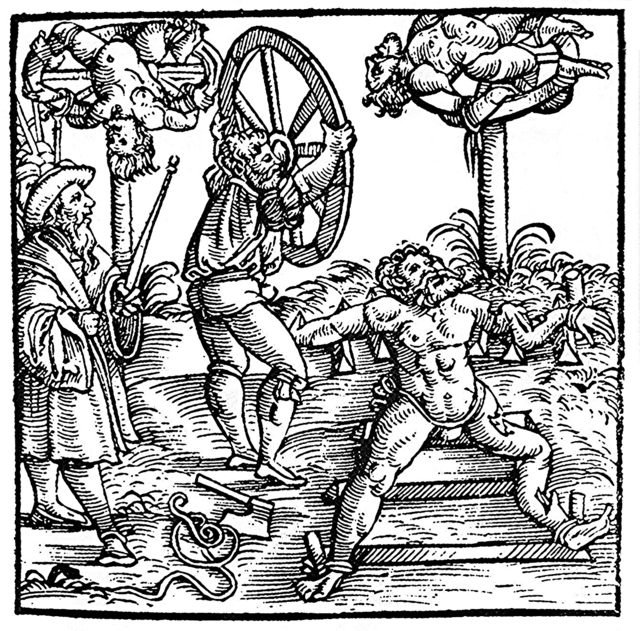
As part of his revenge on those who stood with Monmouth, King James II sent his most ruthless judge, George Jeffreys, the First Baron Jeffreys of Wem, to deal with the rebels. Jeffreys held a reputation for swift justice and merciless sentences; he, eventually, rose to the position of Lord Chancellor, and occasionally served as Lord High Steward. Some 1400 prisoners were brought before Jeffreys at the courts of Winchester, Taunton, and Dorchester. The court hearings were given the title of The Bloody Assizes, for some 300 men were put to death during the proceedings. Those found guilty by Jeffreys were hanged or drawn and quartered. Rotting bodies hung from makeshift gallows peppered the main highways and towns in the area. These gruesome sights were a clear warning to those who might force the king’s hand. Another 800 men were sentenced for transportation.

From his Prescript to the Sheriff of Dorset, Jeffreys leaves these orders: “These are, therefore, to will and require of you, immediately on sight hereof, to erect a gallows in the most public place to hand the said traytors on, and that you provide halters to hang them with, a sufficient number of faggots to burn the bowels, and a furnace or cauldron to boil their heads and quarters, and salt to boil them with, half a bushel to each traytor, and tar to tar them with, and a sufficient number of spears and poles to fix and place their heads and quarters; and that you warn the owners of four oxen to be ready with dray and wain, and the said four oxen, at the time hereafter mentioned for execution, and you yourselves together with a guard of forty able men at the least, to be present by eight o’clock of the morning to be aiding and assisting me or my deputy to see the said rebels executed. You are also to provide an axe and a cleaver for the quartering of the said rebels.”

Judge Jeffreys opened the Bloody Assizes at Dorchester on 5 September 1685 at the Antelope Hotel in the “Oak Room.” During his stay in Dorchester, Jeffreys stayed at a house in High West Street, a building, which is still known as his lodgings, and made his way to the courtroom by a secret passage in order to avoid the angry crowds. In one of his more infamous manipulations, Jeffreys convinced a young girl to spend the night in his bed in exchange for her brother’s freedom. When the girl woke the next morning, she peered out the window to see her brother hanging from the neck by a Bridport Dagger. (The town of Bridport was known for the production of netting and rope for the fishing industry and for use by the British navy. Bridport was also known for the production of the hangman’s rope. It was customary to say that those who were hanged were “stabbed by a Bridport Dagger.”) By the time, Jeffreys moved on to Lyme Regis, he had sentenced 74 men to death, sent another 175 to transportation, had 9 whipped, and pardoned 55.

On 11 September 1685, the Bloody Assizes opened at Lyme Regis. On the 12th of September, twelve men were executed on the beach west of the Cobb, and their body parts were displayed on spikes along the railings around the church. Two of the men’s heads were impaled on the iron gates of Chatham House. Jeffreys had dined at the great house on Broad Street the evening before the executions. Since that time, Jeffreys’ ghost is said to carry a bloody bone through the house.

This ghost tale is circumspect at best. After all, in reality, Jeffreys died some four years after the Bloody Assizes ended. During the Glorious Revolution, Jeffreys stayed in London when James II fled However, when William III’s troops marched into the city, Jeffreys disguised himself as a sailor and made his escape. He was captured at a public house in Wapping (now named The Town of Ramsgate). Fearing the public outcry for his “crimes,” Jeffreys begged for protection. On 18 April 1689, he died of kidney failure while in custody in the Tower of London.

Posted in British history, Great Britain, Living in the UK, political stance, real life tales, religion, royalty | Tagged , , , , | 2 Comments

Adder Stones? Hag Stones? Witch Stones? Magical Powers or False Hopes?

Adder Stones, Hag Stones, Witch Stones…Do You Know These?

35536284529987812_flgujylm_bAdder stones are usually glass stones with a naturally occurring stone in them. Archaeologists have found them in both Britain and Egypt. In Britain, they stones are also called hag stones, witch stones, serpent’s eggs, or snake’s eggs. In Wales, they are called glain neidr, while in Cornwall, adderstanes is the word of choice. The southern provinces of Scotland terms them as Gloine nan Druidh (“Druids’ glass).

Believed to have magical powers, the stones have been used to cure eye diseases, preventing nightmares, curing whooping cough, as well as snakebites. Superstition says they can aid the holder by giving a person the ability to see through a fairy’s or a witch’a disguise.220px-feuerstein_mit_loch-huehnergott

152066924888350309_ndmskacm_bThere are many legends that define the origin of the stones. Among the most popular include: (1) the stones are the hardened saliva of large numbers of serpents massing together; (2) the stones are from the head of a serpent or are made by the sting of an adder; and (3) the stones can be any rock with a hole bored through the middle by water.

imagesDruids highly esteemed Adder stones. There is a passage in Pliny’s Natural History, book xix, minutely describing the nature and the properties of a particular amulet. The following is a translation of it:images-11

“There is a sort of egg in great repute among the Gauls, of which the Greek writers have made no mention. A vast number of serpents are twisted together in summer, and coiled up in an artificial knot by their saliva and slime; and this is called “the serpent’s egg”. The druids say that it is tossed in the air with hissings and must be caught in a cloak before it touches the earth. The person who thus intercepts it, flies on horseback; for the serpents will pursue him until prevented by intervening water. This egg, though bound in gold will swim against the stream. And the magi are cunning to conceal their frauds, they give out that this egg must be obtained at a certain age of the moon. I have seen that egg as large and as round as a common sized apple, in a chequered cartilaginous cover, and worn by the Druids. It is wonderfully extolled for gaining lawsuits, and access to kings. It is a badge which is worn with such ostentation, that I knew a Roman knight, a Vocontian, who was slain by the stupid Emperor Claudius, merely because he wore it in his breast when a lawsuit was pending.”OLYMPUS DIGITAL CAMERA

Posted in British history, customs and tradiitons, gothic and paranormal, legends and myths, Living in the UK | Tagged , , , , , | 4 Comments

Legend of the Beast of Bodmin

 A walk on Bodmin Moor, Cornwall (7), 30 Sept. 2010 - Flickr - PhillipC CC BY 2.0 Phillip Capper from Wellington, New Zealand - A walk on Bodmin Moor, Cornwall (7), 30 Sept. 2010


A walk on Bodmin Moor, Cornwall (7), 30 Sept. 2010 – Flickr – PhillipC CC BY 2.0
Phillip Capper from Wellington, New Zealand – A walk on Bodmin Moor, Cornwall (7), 30 Sept. 2010

The Beast of Bodmin, also known as the Beast of Bodmin Moor (Cornish: Best Goon Brenn) is a phantom wild cat purported to live in Cornwall, in the United Kingdom. Bodmin Moor became a centre of these sightings with occasional reports of mutilated slain livestock: the alleged panther-like cats of the same region came to be popularly known as the Beast of Bodmin Moor.

In general, scientists reject such claims because of the improbably large numbers necessary to maintain a breeding population and because climate and food supply issues would make such purported creatures’ survival in reported habitats unlikely.

Investigation
A long held hypothesis suggests the possibility that alien big cats at large in the United Kingdom could have been imported as part of private collections or zoos, later escaped or set free. An escaped big cat would not be reported to the authorities due to the illegality of owning and importing the animals.

The Ministry of Agriculture, Fisheries and Food conducted an official investigation in 1995. The study found that there was ‘no verifiable evidence’ of exotic felines loose in Britain, and the mauled farm animals could have been attacked by common indigenous species. The report stated that ‘the investigation could not prove that a “big cat” is not present.’

Skull
Less than a week after the government report, a boy was walking by the River Fowey when he discovered a large cat skull. Measuring about 4 inches (10 cm) long by 7 inches (18 cm) wide, the skull was lacking its lower jaw but possessed two sharp, prominent canines that suggested it might have been a leopard. The story hit the national press at about the same time of the official denial of alien big cat evidence on Bodmin Moor.

The skull was sent to the Natural History Museum in London for verification. They determined that it was a genuine skull from a young male leopard, but also found the cat had not died in Britain and the skull had been imported as part of a leopard-skin rug. The back of the skull was cleanly cut off in a way that is commonly used to mount the head on a rug. There was an egg case inside the skull that had been laid by a tropical cockroach that could not possibly be found in Britain. There were also cut marks on the skull indicating the flesh had been scraped off with a knife, and the skull had begun to decompose only after a recent submersion in water.

Posted in British history, gothic and paranormal, Great Britain, legends and myths, mystery | Tagged , , , | Comments Off on Legend of the Beast of Bodmin

Legend of the Black Dog in the British Isles

Sidney Paget's illustration of The Hound of the Baskervilles. The story was inspired by a legend of ghostly black dogs in Dartmoor.

Sidney Paget’s illustration of The Hound of the Baskervilles. The story was inspired by a legend of ghostly black dogs in Dartmoor.

A black dog is the name given to a being found primarily in the folklores of the British Isles. The black dog is essentially a nocturnal apparition, often said to be associated with the Devil or a Hellhound. Its appearance was regarded as a portent of death. It is generally supposed to be larger than a normal dog, and often has large, glowing eyes. It is often associated with electrical storms (such as Black Shuck’s appearance at Bungay, Suffolk), and also with crossroads, places of execution and ancient pathways.

The origins of the black dog are difficult to discern. It is impossible to ascertain whether the creature originated in the Celtic or Germanic elements in British culture. Throughout European mythology, dogs have been associated with death. Examples of this are the Cŵn Annwn, Garmr and Cerberus,all of whom were in some way guardians of the underworld. This association seems to be due to the scavenging habits of dogs. It is possible that the black dog is a survival of these beliefs. Black dogs are almost universally regarded as malevolent, and a few (such as the Barghest) are said to be directly harmful. Some, however, like the Gurt Dog in Somerset and the Black Dog of the Hanging Hills in Connecticut, are said to behave benevolently.

Black Dogs by Locale
Some of the better-known black dogs are the Barghest of Yorkshire and Black Shuck of East Anglia. Various other forms are recorded in folklore in Britain and elsewhere. Other names are Hairy Jack, Skriker, Padfoot, Churchyard Beast, Shug Monkey, Cu Sith, Galleytrot, Capelthwaite, Mauthe Doog, Hateful Thing, Swooning Shadow, Bogey Beast (Lancashire), Gytrash, Gurt Dog, Oude Rode Ogen, Tibicena (Canary Islands), and Dip (Catalonia). Although a Grim is not a barghest, a Church or Fairy Grim can also take the form of a big black dog.

England
Black Dogs have been reported from almost all the counties of England, the exceptions being Middlesex and Rutland.

On Dartmoor, the notorious squire Cabell was said to have been a huntsman who sold his soul to the Devil. When he died in 1677, black hounds are said to have appeared around his burial chamber. The ghostly huntsman is said to ride with black dogs; this tale inspired Arthur Conan Doyle to write his well-known story The Hound of the Baskervilles.(See an alternate explanation in Monday’s post on “Hergest Court.”)

The Devon Wishthounds (‘Wisht’ is a dialect word for “Ghostly/Haunted”) are a related traditional folklore phenomenon apparently related either to the Germanic dogs of the Wild Hunt or the Brythonic Cwn Annwn.
In Lancashire, the black hound is called Barguist, Gytrash, Padfoot, The Grim, Shag, Trash, Striker or Skriker.

In Tring, Hertfordshire, a fierce-looking black hound with red eyes is said to haunt the middle of the road in the area where the gibbet once stood. Locally it is known as Lean Dog, and is the spirit of a chimney sweep executed for murder. When approached, the lean dog sinks into the ground.

The Gurt Dog (“Great Dog”) of Somerset is an example of a benevolent dog. It was said that mothers would allow their children to play unsupervised on the Quantock Hills because they believed the Gurt Dog would protect them. It would also accompany lone travellers in the area, acting as a protector and guide.

Stories are told of a black dog in Twyford, near Winchester.
In Wakefield, Leeds, Pudsey, and some areas of Bradford the local version of the legend is known as “Padfoot.”

There are many tales of ghostly black dogs in Lincolnshire collected by Ethel Rudkin for her 1938 publication Folklore. Such a creature, known locally as “Hairy Jack,” is said to haunt the fields and village lanes around Hemswell, and there have been reported sightings throughout the county, from Brigg to Spalding. Rudkin, who claimed to have seen Hairy Jack herself, formed the impression that black dogs in Lincolnshire were mainly of a gentle nature and looked upon as a spiritual protector.

A black dog has been said to haunt the Newgate Prison for over 400 years, appearing before executions. According to legend, in 1596, a scholar was sent to the prison for witchcraft, but was killed and eaten by starving prisoners before he was given a trial. The dog was said to appear soon after, and although the terrified men killed their guards and escaped, the beast is said to have haunted them wherever they fled.

Galley Hill in Luton, Bedfordshire, is said to have been haunted by a black dog ever since a storm set the gibbet alight sometime in the 18th century.

Betchworth Castle in Surrey is said to be haunted by a black dog that prowls the ruins at night.

In Norfolk, Suffolk and the northern parts of Essex a black dog, known as Black Shuck or Shug is regarded as malevolent, with stories ranging from terrifying victims to being a portent of illness or death to themselves or a person close to the victim. There are tales that in 1577 it attacked the church in the village of Bungay, killing two people before running to the church in the nearby village of Blythburgh, leaving claw marks which remain today. There are also less common tales of a similar dog said to accompany people on their way home in the role of protector rather than a portent of ill omen. But in mid Essex Black Shuck is most commonly regarded as a bringer of death.

Black Dog Hill and Black Dog Halt railway station in Wiltshire are named after a dog, which is said to be found in the area.

A Barguest is said to roam the snickelways and side roads of York, preying on passers by; this dog has also been seen near Cliffords Tower. To see the monstrous dog is said to be a warning of impending doom.

A black dog is said to haunt Ivelet Bridge near Ivelet in Swaledale, Yorkshire. The dog is allegedly headless, and leaps over the side of the bridge and into the water, although it can be heard barking at night. It is considered a death omen, and reports claim that anybody who has seen it died within a year. The last sighting was around a hundred years ago.

Devon’s Yeth Hound
The yeth hound, also called the yell hound, is a black dog found in Devon folklore. According to Brewer’s Dictionary of Phrase and Fable, the yeth hound is a headless dog, said to be the spirit of an unbaptised child, which rambles through the woods at night making wailing noises.The yeth hound is also mentioned in The Denham Tracts. It may have been one inspiration for the ghost dog in The Hound of the Baskervilles by Sir Arthur Conan Doyle, described as “an enormous coal-black hound, but not such a hound as mortal eyes have ever seen” – with fire in his eyes and breath (Hausman 1997:47).

Scotland
The Cù Sìth (Scottish Gaelic pronunciation: kuː ʃiː) is an enormous, otherworldly hound, said to haunt the Scottish Highlands. Roughly the size of a cow or large calf, the Cù Sìth was feared as a harbinger of death and would appear to bear away the soul of a person to the afterlife (similar to the manner of the Grim Reaper). Supernatural dogs in the legends are usually completely black, or white with red ears. The Cù Sìth’s coloration is therefore highly unusual because of its light green color, although it may be derived from the green color often worn by Celtic fairies.

Channel Islands and Isle of Man
In the Isle of Man is the legend of the Moddey Dhoo, ‘black dog’ in Manx, also styled phonetically Mauthe Doog or Mawtha Doo. It is said to haunt the environs of Peel Castle. People believe that anyone who sees the dog will die soon after the encounter with the dog. It is mentioned by Sir Walter Scott in The Lay of the Last Minstrel:
“For he was speechless, ghastly, wan
Like him of whom the Story ran
Who spoke the spectre hound in Man.”

In the Channel Island of Guernsey, there are two named dogs. One, Tchico (Tchi-coh two Norman words for dog, whence cur), is headless, and is supposed to be the phantom of a past Bailiff of Guernsey, Gaultier de la Salle, who was hanged for falsely accusing one of his vassals. The other dog is known as Bodu or tchen Bodu (tchen being dog in Dgèrnésiais). His appearance, usually in the Clos du Valle, foretells death of the viewer or someone close to him. There are also numerous other unnamed apparitions, usually associated with placenames derived from bête (beast).

"Hel" (1889) by Johannes Gehrts.

“Hel” (1889) by Johannes Gehrts.

In Jersey folklore, the Black Dog of Death is also called the Tchico, but a related belief in the Tchian d’Bouôlé (Black Dog of Bouley) tells of a phantom dog whose appearance presages storms. The real reason for the superstition of the Black Dog of Bouley Bay is thought to be due to smugglers. If the superstition was fed and became ‘real’ to the locals, then the bay at night would be deserted and the smuggling could continue in security. The pier at Bouley Bay made this an exceptionally easy task. A local pub retains the name “The Black Dog.”

On mainland Normandy, the dog is referred to as the Rongeur d’Os (bone-gnawer)
.
Wales
In Wales, its counterpart was the gwyllgi, the “Dog of Darkness”, a frightful apparition of a mastiff with baleful breath and blazing red eyes. Also related are the spectral Cŵn Annwn, connected with the otherworld realm of Annwn referred to in the Four Branches of the Mabinogi and elsewhere; however, they are described as being dazzling white rather than black in the medieval text.

Another ghostly black dog is said to haunt St Donat’s Castle, with some witnesses claiming it to have been accompanied by a hag.

Cornwall
A black dog is said to have appeared to wrestlers at Whiteborough, a tumulus near Launceston.

A black dog was once said to haunt the main road between Bodmin and Launceston near Linkinhorne.

Ireland
A black dog is known to haunt an area that was frequented by a local Hellfire Club, and is connected to a spiritual Black Cat. Sightings have persisted for years, and it has been known to attack an inn in the area of the old Hellfire Club’s location.

Posted in British history, gothic and paranormal, Great Britain, legends and myths, Living in the UK, mystery | Tagged , , , , | 2 Comments

Happy Birthday to Our Precious Girl!

party-clip-art-balloons-different-coloursThis little girl is one today, and we are celebrating! Anna10-6-14party-clip-art-balloons-different-coloursJames&AnnaonTrain

Posted in Uncategorized | Tagged , | 7 Comments

Do You Remember America’s First True TV Hero: Hopalong Cassidy?

220px-Poster_-_Eagle's_Brood,_The_01On 24 June 1949, “Hopalong Cassidy” premiered upon television. It would be another three months before “The Lone Ranger” followed suit. Soon, more people were watching “Hopalong” than TV stalwarts Athur Godfrey, Ed Sullivan, and Groucho Marx. Hopalong Cassidy was a fictional cowboy hero created in 1904 by the author Clarence E. Mulford, who wrote a series of popular short stories and many novels based on the character. Mulford, a NY marriage license clerk did not travel to the West until after the publication of his 18th book.

In his early writings, Mulford portrayed the character as rude, dangerous, and rough-talking. From 1935, the character—as played by movie actor William Boyd in films adapted from Mulford’s books—was transformed into a clean-cut hero. Sixty-six popular films appeared, only a few of which relied on Mulford’s stories. Mulford later revised and republished his works to be more consistent with the character’s screen persona.

William Boyd as Hopalong Cassidy

William Boyd as Hopalong Cassidy

William Boyd portrayed Cassidy, a man known for his resolve, his honesty, and his sense of justice. Prior to playing Cassidy, Boyd had been a silent screen romantic lead. According to The Way It Was, “Boyd’s Hoppy was as wise as he was no-nonsense. Foreman of the Bar 20 Ranch, the sharp-thinking, hard-riding sleuth tirelessly pursued a host of unsavory hombres, from cattle rustlers to murderers to lusters after gold.”

Boyd was born in Hendrysburg in Belmont County, located 26 miles east of Cambridge, Ohio. He was reared in Tulsa, Oklahoma, the son of day laborer Charles William Boyd and his wife, the former Lida Wilkens. Following his father’s death, he moved to California and worked as an orange picker, surveyor, tool dresser and auto salesman.

image of William Boyd from Cowboys and Kids http://cowboysandkids.blogspot.com/

image of William Boyd from Cowboys and Kids http://cowboysandkids.blogspot.com/

In Hollywood, he found extra work in Why Change Your Wife? and other films. During World War I, he enlisted in the army but was exempt because of a “weak heart.” More prominent film roles followed, and he became famous as a leading man in silent film romances, earning an annual salary of $100,000. He was the lead actor in Cecil B. DeMille’s The Volga Boatman (1926) and DeMille’s extravaganza, The King of Kings, helping Christ carry the cross as Simon of Cyrene and also in DeMille’s Skyscraper. He then appeared in D.W. Griffith’s, Lady of the Pavements (1929).The_Volga_Boatman-997657252-large

Radio Pictures ended Boyd’s contract in 1931 when his picture was mistakenly run in a newspaper story about the arrest of another actor, William “Stage” Boyd, on gambling and liquor charges. Having been reckless with his money, Boyd was broke and without a job, and for a few years he was credited in several films as “Bill Boyd” to prevent being mistaken for his actor namesake.

As portrayed on the screen, white-haired Bill “Hopalong” Cassidy was usually clad strikingly in black (including his hat, an exception to the western film stereotype that only villains wore black hats). He was reserved and well spoken, with a sense of fair play. He was often called upon to intercede when dishonest characters took advantage of honest citizens. “Hoppy” and his white horse, Topper, usually traveled through the west with two companions—one young and trouble-prone with a weakness for damsels in distress, the other comically awkward and outspoken.

The juvenile lead was successively played by James Ellison, Russell Hayden, George Reeves, and Rand Brooks. George Hayes (later to become known as “Gabby” Hayes) originally played Cassidy’s grizzled sidekick, Windy Halliday. After Hayes left the series because of a salary dispute with producer Harry Sherman, he was replaced by the comedian Britt Wood as Speedy McGinnis and finally by the veteran movie comedian Andy Clyde as California Carlson. Clyde, the most durable of the sidekicks, remained with the series until it ended. A few actors of future prominence appeared in Cassidy films, notably Robert Mitchum, who appeared in seven films at the beginning of his career.

The 66 Hopalong Cassidy pictures were filmed by independent producers who released the films through the studios. Most “Hoppies,” as the films were known, were distributed by Paramount Pictures to favorable returns. They were noted for fast action and outdoor photography (usually by Russell Harlan). Harry Sherman wanted to make more ambitious movies and tried to cancel the Cassidy series, but popular demand forced Sherman back into production, this time for United Artists. Sherman gave up the series in 1944, but William Boyd wanted to keep it going. To do this, he gambled his future on Hopalong Cassidy, mortgaging most of what he owned to buy the character rights from Mulford and the backlog of movies from Sherman.

In the first film, Hopalong Cassidy (then spelled “Hop-along”) got his name after being shot in the leg. Hopalong’s “drink of choice” was the nonalcoholic sarsaparilla.

Boyd resumed production in 1946, on lower budgets, and continued through 1948, when “B” westerns were being phased out. Boyd thought Hopalong Cassidy might have a future in television, spent $350,000 to obtain the rights to his old films and approached the fledgling NBC network. The initial broadcasts were so successful that NBC could not wait for a television series to be produced and edited the feature films to broadcast length. On June 24, 1949, Hopalong Cassidy became the first network Western television series.

The success of the television series made Boyd a star. The Mutual Broadcasting System began broadcasting a radio version, with Andy Clyde (later George MacMichael on Walter Brennan’s ABC sitcom The Real McCoys) as the sidekick, in January 1950; at the end of September, the show moved to CBS Radio, where it ran until 1952.

The series and character were so popular that Hopalong Cassidy was featured on the cover of national magazines such as Look, Life, and Time. Boyd earned millions as Hopalong ($800,000 in 1950 alone), mostly from merchandise licensing and endorsement deals. In 1950, Hopalong Cassidy was featured on the first lunchbox to bear an image, causing sales for Aladdin Industries to jump from 50,000 to 600,000 in one year. In stores, more than 100 companies in 1950 manufactured $70 million of Hopalong Cassidy products, including children’s dinnerware, pillows, roller skates, soap, wristwatches, and jackknives.

There was a new demand for Hopalong Cassidy features in movie theaters, and Boyd licensed reissue distributor Film Classics to make new film prints and advertising accessories. Another 1950 enterprise saw the home-movie company Castle Films manufacturing condensed versions of the Paramount films for 16mm and -mm projectors; they were sold through 1966. Also, in January 1950, Dan Spiegel began to draw a syndicated comic strip with scripts by Royal King Cole; the strip lasted until 1955.

Boyd began work on a separate series of half-hour westerns made for television; Edgar Buchanan was his new sidekick, Red Connors (a character from the original stories and a few of the early films). The theme music for the television show was written by Nacio Herb Brown (music) and L. Wolfe Gilbert (lyrics). The show ranked number 7 in the 1949 Nielsen ratings. The success of the show and tie-ins inspired juvenile television westerns such as The Range Rider, Tales of the Texas Rangers, Annie Oakley, The Gene Autry Show, and The Roy Rogers Show.

After Boyd’s death, his company devoted to Hopalong Cassidy, U.S. Television Office, retained control of Cassidy films but, by the mid-1960s, had withdrawn them from television and sales in home movie markets. This remained the situation until the mid-1990s, after many Cassidy fans had died, when the company made available to The Western Channel a package series of restored and cleaned negative-based prints of the films to cable TV. These remained available on that channel until 2000, when they were again withdrawn. Minimal effort was made at that time, nor has it been made since, to offer the films for home video, excepting two packages of compressed, multi-title Hopalong Cassidy anthology DVDs, the first requiring purchase of the entire TV series to obtain copies of about a dozen films and then, in 2014, a reissue of the remaining stock of these same DVD pressings combined with the remaining titles in a first-time pressing.

In Other Media:
Novels

Louis L’Amour wrote four Hopalong Cassidy novels, which are still in print. In 2005, author Susie Coffman published Follow Your Stars, new stories starring the character. In three of these stories, Coffman wrote the wife of actor William Boyd into the stories.

Comic Books/Comics Strips
Fawcett Comics published a Hopalong Cassidy comic book one-shot in 1943, followed by an ongoing series from 1946–1953, when the company ceased publishing. DC Comics took over the title in 1954 with issue #86, publishing it until issue #135, in 1959.

Mirror Enterprises Syndicate distributed a Hopalong Cassidy comic strip starting in 1949; it was bought out by King Features in 1951, running until 1955. The strip was drawn by Dan Spiegle.

Record Readers
Beginning in 1950, Capitol Records released a series of Hopalong Cassidy “record readers” featuring William Boyd and music by Billy May, produced by Alan W. Livingston.

Music
The song “It’s Beginning To Look A Lot Like Christmas” includes a reference to Hopalong boots as a holiday gift desired by children.

Museums
There have been museum displays of Hopalong Cassidy. The major display is at the Autry National Center at Griffith Park in Los Angeles, California. Fifteen miles east of Wichita, Kansas, at the Prairie Rose Chuckwagon Supper was the Hopalong Cassidy Museum. The museum and its contents were auctioned on August 24, 2007, owing to the failure of its parent company, Wild West World.

Posted in Do You Remember?, film, real life tales | Tagged , , , | 2 Comments

See No Evil, Hear No Evil, Speak No Evil: The Three Monkeys

As part of my coming release of “The Prosecution of Mr. Darcy’s Cousin,” I completed research on the Three Mystic Apes, as there are references to the extended maxim within my story’s plot line. I thought you might enjoy a bit of history on this phenomenon.


Three wise monkeys 20 October 2007 Tumi-1983~Licensing The copyright holder of this work released this work into the public domain.

Three wise monkeys
20 October 2007
Tumi-1983~Licensing
The copyright holder of this work released this work into the public domain.

The three wise monkeys (Japanese: 三猿, san’en or sanzaru, or 三匹の猿, sanbiki no saru, literally “three monkeys”), sometimes called the three mystic apes, are a pictorial maxim. Together they embody the proverbial principle to “see no evil, hear no evil, speak no evil.” The three monkeys are Mizaru, covering his eyes, who sees no evil; Kikazaru, covering his ears, who hears no evil; and Iwazaru, covering his mouth, who speaks no evil.

There are various meanings ascribed to the monkeys and the proverb including associations with being of good mind, speech, and action. In the Western world the phrase is often used to refer to those who deal with impropriety by turning a blind eye.

In English, the monkeys’ names are often given as Mizaru, Mikazaru, and Mazaru, as the last two names were corrupted from the Japanese originals.

The source that popularized this pictorial maxim is a 17th-century carving over a door of the famous Tōshō-gū shrine in Nikkō, Japan. The carvings at Toshogu Shrine were carved by Hidari Jingoro, and believed to have incorporated Confucius’s Code of Conduct, using the monkey as a way to depict man’s life cycle. There are a total of 8 panels, and the iconic three wise monkeys picture comes from panel 2. The philosophy, however, probably originally came to Japan with a Tendai-Buddhist legend, from China in the 8th century (Nara Period). It has been suggested that the figures represent the three dogmas of the so-called middle school of the sect.

In Chinese, a similar phrase exists in the Analects of Confucius from 2nd to 4th century B.C.: “Look not at what is contrary to propriety; listen not to what is contrary to propriety; speak not what is contrary to propriety; make no movement which is contrary to propriety” (非禮勿視, 非禮勿聽, 非禮勿言, 非禮勿動). It may be that this phrase was shortened and simplified after it was brought into Japan.

It is through the Kōshin rite of folk religion that the most significant examples are presented. The Kōshin belief or practice is a Japanese folk religion with Chinese Taoism origins and ancient Shinto influence. It was founded by Tendai Buddhist monks in the late 10th century. A considerable number of stone monuments can be found all over the eastern part of Japan around Tokyo. During the later part of the Muromachi period, it was customary to display stone pillars depicting the three monkeys during the observance of Kōshin.

Though the teaching had nothing to do with monkeys, the concept of the three monkeys originated from a simple play on words. The saying in Japanese is mizaru, kikazaru, iwazaru (見ざる, 聞かざる, 言わざる?) “don’t see, don’t hear, don’t speak.” However, -zaru, an archaic negative verb conjugation, is pronounced the same as zaru, the vocalized form of saru (猿?), “monkey,” so the saying can also be interpreted as the names of three monkeys.

It is also possible that the three monkeys came from a more central root than a play on words. The shrine at Nikko is a Shinto shrine, and the monkey is an extremely important being in the Shinto religion. The monkey is believed to be the messenger of the Hie Shinto shrines, which also have connections with Tendai Buddhism. There are even important festivals that are celebrated during the year of the Monkey (occurring every twelve years) and a special festival is celebrated every sixteenth year of the Kōshin.

“The Three Mystic Apes” (Sambiki Saru) were described as “the attendants of Saruta Hito no Mikoto or Kōshin, the God of the Roads.” The Kōshin festival was held on the 60th day of the calendar. It has been suggested that during the Kōshin festival, according to old beliefs, one’s bad deeds might be reported to heaven “unless avoidance actions were taken….” It has been theorized that the three Mystic Apes, Not Seeing, Hearing, or Speaking, may have been the “things that one has done wrong in the last 59 days.”

According to other accounts, the monkeys caused the Sanshi and Ten-Tei not to see, say or hear the bad deeds of a person. The Sanshi (三尸?) are three worms living in everyone’s body. The Sanshi keep track of the good deeds and particularly the bad deeds of the person they inhabit. Every 60 days, on the night called Kōshin-Machi (庚申待?), if the person sleeps, the Sanshi will leave the body and go to Ten-Tei (天帝?), the Heavenly God, to report about the deeds of that person. Ten-Tei will then decide to punish bad people, making them ill, shortening their time alive, and in extreme cases putting an end to their lives. Those believers of Kōshin who have reason to fear will try to stay awake during Kōshin nights. This is the only way to prevent the Sanshi from leaving their body and reporting to Ten-Tei.

An ancient representation of the ‘no see, no hear, no say, no do’ can be found in four golden figurines in the Zelnik Istvan Southeast Asian Gold Museum. These golden statues date from the 6th to 8th century. The figures look like tribal human people with not very precise body carvings and strong phallic symbols. This set indicates that the philosophy comes from very ancient roots.

Meaning of the Proverb
Just as there is disagreement about the origin of the phrase, there are differing explanations of the meaning of “see no evil, hear no evil, speak no evil.”

**In Buddhist tradition, the tenets of the proverb are about not dwelling on evil thoughts.
**In the Western world both the proverb and the image are often used to refer to a lack of moral responsibility on the part of people who refuse to acknowledge impropriety, looking the other way or feigning ignorance.
**It may also signify a code of silence in gangs, or organised crime.

Variations
Sometimes there is a fourth monkey depicted with the three others; the last one, Shizaru, symbolizes the principle of “do no evil.” He may be shown crossing his arms or covering his genitals.

In another variation, a fourth monkey is depicted with a sulking posture and the caption “have no fun.”

Cultural Influences
The three wise monkeys and the associated proverb are known throughout Asia and in the Western world. They have been a motif in pictures, such as the ukiyo-e (Japanese woodblock printings) by Keisai Eisen and are frequently represented in modern culture.

Mahatma Gandhi’s one notable exception to his lifestyle of non-possession was a small statue of the three monkeys. Today, a larger representation of the three monkeys is prominently displayed at the Sabarmati Ashram in Ahmedabad, Gujarat, where Gandhi lived from 1915 to 1930 and from where he departed on his famous salt march. Gandhi’s statue also inspired a 2008 artwork by Subodh Gupta, Gandhi’s Three Monkeys.

In Planet of the Apes (1968 film), near the end of the tribunal to determine Taylor’s origins, the three orangutan judges strike a Three Wise Monkeys pose, emphasizing their refusal to acknowledge the evidence at odds with their dogma.

The maxim inspired an award-winning 2008 Turkish film by director Nuri Bilge Ceylan called Three Monkeys (Üç Maymun).

Posted in customs and tradiitons, legends and myths, mystery | Tagged , | Comments Off on See No Evil, Hear No Evil, Speak No Evil: The Three Monkeys

UK “Real” Estate: Wimborne Minster’s Grandeur

Wimborne Minster’s Grandeur


800px-wimborne_minsterKnown locally as the Minster, Wimborne Minster is the parish church of Wimborne, Dorset, England. The Minster has existed for over 1300 years and is recognised for its unusual chained library (one of only four surviving chained libraries in the world). The Minster, a former monastery and Benedictine nunnery, is the resting place of King Ethelred of Wessex.

Dedicated to Sain Cuthburga, who founded a Benedictine abbey of nuns at the present day minster in circa A.D. 705. A monastery for men was built around this time, adjacent to the abbey. In 871, Alfred the Great buried his brother King Ethelred in the Minster.

The women’s monastery was destroyed by the Danes in 1013 during one of their incursions into Wessex and never rebuilt, though the main abbey building survived. In 1043, Edward the Confessor founded a college of secular (non-monastic) canons, consisting of a dean, four prebends, four vicars, four deacons, and five singers at the minster. The minster was remodelled and rebuilt by the Normans between 1120 and 1180, to support that institution.

The West Tower

The West Tower

In 1318, Edward II issued a document that made the minster a Royal Peculiar, which exempted it from all diocesan jurisdiction. The choir used to wear scarlet robes, a legacy of this ‘Peculiar’. Similar robes of this type are worn in Westminster Abbey and St. George’s Chapel at Windsor Castle. In 1496, Lady Margaret Beaufort, granddaughter of John of Gaunt and mother of Henry VII, founded a small chapel in the minster. With the reign of Henry VIII, the remaining parts of the monastery were adopted into part of the minster to avoid being destroyed. However much of the wealth of the minster was confiscated by King Henry VIII.

Sixty six years later in 1562 a grant was obtained from Queen Elizabeth I by which part of the property formerly belonging to the college, together with all ecclesiastical rights and prerogatives was returned to Wimborne and vested in twelve governors. The charter was surrendered to James I and a new charter was obtained from Charles I at a cost of £1000 with the addition of an organist and singing men. During the English Civil War, when Charles I was beheaded his coat of arms was painted out from the wall of the minster, but on the restoration of Charles II the arms were speedily replaced and have now been restored.

the pulpit

the pulpit

In 1846 the Royal Peculiar was abolished, and now all that remains of the old order is the control by 12 governors of some of the minster affairs. The church was renovated towards the end of the 19th century and its last addition, a vestry was added at the same time. Today the church is a place of visit and worship for the local community and visitors.

The old Treasury which housed the wealth of the minster has an important chained library. The library was founded in 1686 and is the second largest chained library in the country and also one of the first public libraries. Some of the collections of the library include a manuscript written on lambskin in 1343, a book bound for the Court of Henry VIII, an incunabulum printed in 1495 on the works of Saint Anselm, and a Paraphrase of Erasmus printed in 1522 with a title page designed by Holbein.

Wimborne Minster is the home of an astronomical clock, one of a group of famous 14th to 16th century astronomical clocks to be found in the west of England. It is currently maintained by notable Wimborne resident Bruce Jensen.

Posted in British history, buildings and structures, religion | Tagged , , | Comments Off on UK “Real” Estate: Wimborne Minster’s Grandeur

The Concept of a “Marriage of Convenience” as a Plot Line in Jane Austen’s Novels

What hope was there for the dowerless daughters of the middle class during Jane Austen’s lifetime? Such is a topic Austen explored repeatedly in her novels. Elizabeth and Jane Bennet sought men of a like mind. The Dashwood sisters found their choices limited by their financial situation. Fanny Harville and Captain Benwick could not marry until he earned his future. General Tilney drove Catherine Morland from his home because of the lady’s lack of funds. Charlotte Lucas accepted Mr. Collins as her last opportunity for a respectable match. The intricacies and tedium of high society, particularly of partner selection, and the conflicts of marriage for love and marriage for property are repeated themes.

a3b80-80m Marriage provided women with financial security. Henry Tilney of Northanger Abbey explains, “… in both [marriage and a country dance], man has the advantage of choice, woman only the power of refusal: that in both, it is an engagement between man and woman, formed for the advantage of each.” Women of Austen’s gentry class had no legal identity. No matter how clever the woman might be, finding a husband was the only option. A woman could not buy property or write a will without her husband’s approval. If a woman was fortunate, she would bring to her marriage a settlement – money secured for her when she came of age – usually an inheritance from her mother. The oldest son or male heir received the family estate, and the unmarried or widowed females lived on his kindness.

emma-and-knightley-dancing The ladies of Sense and Sensibility have this reality thrust upon them when Uncle Dashwood changes his will and leaves Norland to his grandnephew. In Uncle Dashwood’s thinking, this change will keep Norland in the Dashwood family. However, the four Dashwood ladies suddenly find themselves living in a modest cottage with an income of £500 annually. As such, they have no occasion for visits to London unless someone else assumes the expenses. Their social circle shrinks, and the opportunities to meet eligible suitors becomes nearly non-existent. With dowries of £1000 each, the Dashwood sisters are not likely to attract a man who will improve their lots.

Jane Austen, herself, lived quite modestly. The Austens lived frugally among the country gentry. The Austen sisters were well educated by the standards of the day, but without chances for dowries, Jane and Cassandra possessed limited prospects. Jane met a Mr. Blackall the year Cassandra lost her Mr. Fowle. In a letter, Blackall expressed to Mrs. Lefroy a desire to know Jane better; yet, he confided, “But at present I cannot indulge any expectation of it.” To which, Jane Austen responded, “This is rational enough. There is less love and more sense in it than sometimes appeared before, and I am very well satisfied.” Imperfect opportunities were Jane Austen’s reality. In 1802, Jane Austen accepted an offer of marriage from Harris Bigg-Wither. With this marriage, Jane would have become the mistress of Manydown.

200px-CassandraAusten-JaneAusten(c.1810)_hires Yet, despite her affection for the family, Austen could not deceive Bigg-Wither. The following morning, she refused the man’s proposal. Whether she thought to some day find another or whether Austen accepted the fact that her refusal doomed her to a life as a spinster, we shall never know. In the “limited” world in which Jane Austen lived, she could not have known her eventual influence on the literary canon.

Austen held personal knowledge of young women seeking husbands in one of the British colonies. Reverend Austen’s sister, Philadelphia, traveled to India in 1752, where she married an English surgeon Tysoe Hancock, a man twenty years her senior. When the Hancocks returned to England a decade later, Reverend Austen traveled to London to greet his sister. However, Philadelphia and Tysoe were not to live “happily ever after.” Unable to support his family in proper English style, Tysoe returned to India to make his living. He never saw his wife and child again. Despite its tragic ending, this “marriage” secured Philadelphia’s future and the lady’s place in Society. Only marriage could offer a woman respectability.

In Jane Austen for Dummies (page 134), Joan Klingel Ray breaks down the financial prospects of the Dashwood sisters. Converting the £500 to a modern equivalent, Ray comes out with a figure of $46,875. For the gentry, supporting four women, two maids, a man servant, paying rent, buying clothes, food, coal, etc., that sum would have meant a poor existence. I find in reading Sense and Sensibility that I am often disappointed with the eventual choices of the Dashwood sisters. Edward Ferras and Colonel Brandon have less of the “glitz and the glamour” that my innate Cinderella syndrome requires in a love match. However, if any affection did exist between the couples, then Marianne and Elinor, under the circumstances and the times, made brilliant matches.

Posted in British history, customs and tradiitons, George IV, Georgian Era, Great Britain, Jane Austen, Living in the Regency, Living in the UK, Pride and Prejudice, Regency era | Tagged , , , , , , | Comments Off on The Concept of a “Marriage of Convenience” as a Plot Line in Jane Austen’s Novels

A Medieval Misconception: All Women Were Chattel, A Guest Post by Kim Rendfeld, who is Celebrating the Release of “The Ashes of Heaven’s Pillar”

Medieval Misconception: All Women Were Chattel

By Kim Rendfeld

Early medieval women were far from passive damsels waiting for a knight to rescue them.

Of course, this time period is hardly an ideal time for women: childbirth so risky expectant mothers were urged to confess their sins before they went into labor, fathers choosing whom a girl would marry, age 13 considered marriageable, wife beating defined as a right.

But to say that girls were nothing but pawns valued only for their ability to produce sons grossly oversimplifies medieval women’s reality, and it gives a false impression that women in this era were merely victims who contributed little to their society. Truth is, they tried to shape their situations.

In the mid-eighth century, Saint Boniface depended on both nuns and monks to assist him in his mission to strengthen the church in Europe and spread Christianity. The women left the security of their abbey in Britain and took an uncomfortable, hazardous journey to areas east of the Rhine. Those who were appointed abbesses were not only pious. They were in a position of influence; therefore, they needed to act independently.

On the secular side, aristocratic women did more than produce an heir, although husbands did try to set aside wives unable to bear children. The queen’s role was “to release the king from all domestic and palace cares, leaving him free to turn his mind to the state of his realm,” according to the ninth-century treatise The Government of the Palace. In an age when the personal and political were intertwined, the queen was the guardian of the treasury, and she controlled access to her husband. When houseguests were foreign dignitaries, royal hospitality was key to international relations.

453px-Bertrada_Broadfoot_of_Laon_Berthe_au_Grand_Pied_VersaillesBertrada, Charlemagne’s mother, had been her husband’s full partner as they seized the kingdom of Francia in a bloodless coup. After he died, she became a diplomat whose most important mission was peace within her own country. Her sons, Charles and Carloman, each inherited half the kingdom, and Bertrada kept the rivalry between the brothers, ages 20 and 17, from escalating to civil war.

Bertrada is just one example. After Carloman died of an illness, and Charles seized his dead brother’s lands, the widow Gerberga was not about to let her toddling sons lose their kingdom without a fight. Likely a teenager, Gerberga crossed the Alps with two little boys in tow and sought the aid of Desiderius, the Lombard king furious over Charles’s divorce from his daughter. Later, Charles’s third wife, Hildegard, might have been the one to convince him to make her sons his heirs, perhaps excluding the son by his first marriage.

perf6.000x9.000.indd These historic women are why the heroines of my novels try to solve their own problems, even when it’s painful. Alda in The Cross and the Dragon has a household to run and servants to keep in line. She bargains with the merchants and gives to charity. Leova in The Ashes of Heaven’s Pillar is a peasant, but at the beginning of the novel, she is a free woman with responsibilities, including children to raise and a house and farm to maintain with her husband. When she is betrayed and sold into slavery, she resents being seen as property and yearns to be a respectable woman again.

The existence of slavery meant that some women were chattel, but so were their male counterparts. But as one can see in this excerpt from The Ashes of Heaven’s Pillar, even slaves could use their wits to get their way.

Excerpt:
Looking down, Leova stepped forward, her limbs stiff. Her thoughts were consumed with worry that Deorlaf would rush forward to defend her, just as Derwine would. She glanced over her shoulder.

Sunwynn stood rigid. Deorlaf’s body was tense like a cat ready to pounce into a fight. His hand strayed to his belt where his eating knife used to be. Deorlaf, don’t!

“Peace, Deorlaf,” Ragenard called over Leova’s shoulder. “I mean your mother no harm.”

She felt Ragenard’s hands on her sides and started. The touch against her ribs was gentle. Turning toward Ragenard, she met his gaze. She saw no malice in his amber eyes. A smile flickered on his lips. Then, he straightened and dropped his hands.

“You have cared for her well, my lord,” said Ragenard, his chiseled features impassive. “She is comely and has the temper I seek. So many other serving women are crushed and almost useless or lazy and willful. But this colt is worth more than the best maidservant.” He patted the sleek animal’s shoulder. “He is in his prime, obedient to the rein, yet has enough spirit to charge into the hunt.”

Leova seized the opportunity. “You’re right, Ragenard,” she said, hoping to keep the tremor from her voice. “A horse is worth more than me. Take the children as well.”

“Be still, woman,” Pinabel snarled. “Or I’ll rip out your tongue.”

Sources:
Medieval Women Monastics: Wisdom’s Wellsprings, edited by Miriam Schmitt, Linda Kulzer

Charlemagne: Translated Sources, P.D. King

Carolingian Chronicles: Royal Frankish Annals and Nithard’s Histories, translated by Bernhard Walters Scholz with Barbara Rogers

“Pavia and Rome: The Lombard Monarchy and the Papacy in the Eighth Century,” Jan T. Hallenbeck, published in 1982 by Transactions of the American Philosophical Society

“Women at the Court of Charlemagne: A Case of Monstrous Regiment?” Janet L. Nelson, The Frankish World 750-900

“Family Structures and Gendered Power in Early Medieval Kingdoms: The Case for Charlemagne’s Mother,” Janet L. Nelson. Women Rulers in Europe: Agency, Practice and Representation of Political Powers (XII-XVIII)

Daily Life in the World of Charlemagne, Pierre Riche

Kim Rendfeld author photoMeet the Author:
Kim Rendfeld has a lifelong fascination with fairy tales and legends, which set her on her quest to write The Cross and the Dragon. 

She grew up in New Jersey and attended Indiana University, where she earned a bachelor’s degree in journalism and English, with a minor in French. If it weren’t for feminism, she would be one of those junior high English teachers scaring the bejesus out of her students and correcting grammar to the point of obnoxiousness. Instead, her career has been in journalism, public relations, and now fiction.

Kim was a journalist for almost twenty years at Indiana newspapers, including the Journal and Courier in Lafayette, The Muncie Star, and The News and Sun in Dunkirk, and she won several awards from the Hoosier State Press Association. Her career changed in 2007, when she joined the marketing and communications team at Ball State University in Muncie, Indiana. She gets paid to agonize over commas and hyphens, along with suggesting ways to improve writing, and thoroughly enjoys it. She is proud to have been part of projects that have received national recognition. 

Kim lives in Indiana with her husband, Randy, and their spoiled cats. They have a daughter and three granddaughters.

To read the first chapters of either novel [The Cross and the Dragon (2012, Fireship Press) or The Ashes of Heaven’s Pillar (2014 Fireship Press)]  or learn more about Kim, visit kimrendfeld.com.
You’re also welcome to visit her blog Outtakes of a Historical Novelist, at kimrendfeld.wordpress.com, like her on Facebook at facebook.com/authorkimrendfeld, or follow her on Twitter at @kimrendfeld, or contact her at kim@ kimrendfeld.com.

Advance Praise for The Ashes of Heaven’s Pillar
“Carolingian Europe comes alive in Kim Rendfeld’s sweeping story of family and hope, set against the Saxon Wars. Her transportive and triumphant novel immerses us in an eighth century world that feels both mystical and starkly real.”  – Jessica Brockmole, author of Letters from Skye

“A captivating historical filled with rich detail, compelling characters, and a well-paced plot that keeps the pages turning to its very satisfying end. A true delight for fans of historical fiction. I couldn’t put it down.” — Susan Spann, author of the Shinobi Mysteries

“The Ashes of Heaven’s Pillar is refreshingly set in a less familiar medieval period – soon after Charlemagne has conquered a portion of today’s Germany and its people. The characters are refreshing also, common folk instead of the lords and ladies who are the usual inhabitants of historical novels, and how they adjust to their new condition is fascinating. Altogether, this book was absorbing from start to finish.” – Roberta Gellis, author of The Roselynde Chronicles


Ashes Tour GraphicVisit The Ashes of Heaven’s Pillar Fireship Press Virtual Book Tour at
 http://www.fireshippress.com/virtual_book_tours/the-ashes-of-heavens-pillar-by-kim-rendfeld-on-tour-august-28-september-30.html

Posted in book excerpts, book release, customs and tradiitons, excerpt, legends and myths, medieval, military, real life tales, Uncategorized, writing | Tagged , , , , , , , , , , | 11 Comments