A Character Study of Kitty Bennet, a Guest Post from Lelia Eye

(For those who think many Jane Austen fan fiction writers do not study the author’s work, I give you this post from Lelia Eye on combing Austen’s words in order to delineate characterization. It first appeared on the Austen Authors’ blog on 19 November 2020. Enjoy!)

I would first like to apologize for the length of this post. I hemmed and hawed over how to handle a character study of Kitty Bennet before finally deciding to aim for comprehensive and include every mention of her in Pride and Prejudice in this blog post. This comes with a sort of caveat, though. There are some instances in which she is lumped in with a group of others, and I am not including those sorts of indirect references unless it seems necessary for character explanation. In addition, it’s always possible that I missed an instance where her name was not specifically given. But I can confidently say that I have collected most of the references to Kitty.

The name “Kitty” appears seventy-one times in Pride and Prejudice. Of course, you also have to look for “Catherine.” When you exclude the name “Lady Catherine,” you will find that the name “Catherine” occurs ten times in Pride and Prejudice. Interestingly, seven of those times is in conjunction with Lydia’s name (“Catherine and Lydia”), one instance occurs with Elizabeth’s name (“Elizabeth and Catherine”), and two instances occur in which the name is not used with a sister’s name. Of note, there are also seven occurrences of “Kitty and Lydia” to be found, which only further solidifies Kitty’s connection to Lydia. Oddly, there is no occurrence of “Miss Kitty” or “Miss Catherine” to be found, which makes it a bit difficult when one tries to determine what non-family members call her. I am inclined to think that new acquaintances call her “Miss Catherine,” but I would be interested in hearing your thoughts! I haven’t especially found a rhyme or reason for those ten mentions of “Catherine” – unless it’s just to emphasize that “Kitty” is a nickname.

I have long held an interest in Kitty due to the possibilities inherent in her character. My general impression of her has always been that she is a muted Lydia – but one for whom there is ultimately some hope. It has always seemed strange to me that she is older than Lydia, yet Lydia is the leader. Perhaps it can be attributed to Mrs. Bennet’s treatment of Lydia. Since Lydia is the baby of the family, that may be why Mrs. Bennet favors her. Kitty’s options for a sister to “buddy up” with include her two intelligent older sisters (who are already best buds), the moralizing Mary, or the headstrong but fun-seeking Lydia. I suppose she cannot be entirely blamed for wanting to have fun!

Her parents certainly do not think especially well of her:

  • “They have none of them much to recommend them,” replied [Mr. Bennet]; “they are all silly and ignorant like other girls; but Lizzy has something more of quickness than her sisters.” 
  • Mrs. Bennet deigned not to make any reply, but, unable to contain herself, began scolding one of her daughters.
    “Don’t keep coughing so, Kitty, for Heaven’s sake! Have a little compassion on my nerves. You tear them to pieces.”
    “Kitty has no discretion in her coughs,” said her father; “she times them ill.”
    “I do not cough for my own amusement,” replied Kitty fretfully. “When is your next ball to be, Lizzy?” 
  • “Now, Kitty, you may cough as much as you choose,” said Mr. Bennet; and, as he spoke, he left the room, fatigued with the raptures of his wife. 
  • [Mrs. Bennet speaking about Jane and disparaging her other daughters:] “I am sure,” she added, “if it was not for such good friends I do not know what would become of her, for she is very ill indeed, and suffers a vast deal, though with the greatest patience in the world, which is always the way with her, for she has, without exception, the sweetest temper I have ever met with. I often tell my other girls they are nothing to her. . . . “
  • But their father, though very laconic in his expressions of pleasure, was really glad to see [Jane and Elizabeth]; he had felt their importance in the family circle. The evening conversation, when they were all assembled, had lost much of its animation, and almost all its sense by the absence of Jane and Elizabeth.
  • [Mr. Bennet to Elizabeth:] “Do not make yourself uneasy, my love. Wherever you and Jane are known you must be respected and valued; and you will not appear to less advantage for having a couple of—or I may say, three—very silly sisters . . . .”
  • “We will be down as soon as we can,” said Jane; “but I dare say Kitty is forwarder than either of us, for she went up stairs half an hour ago.”
    “Oh! hang Kitty! what has she to do with it? Come be quick, be quick! Where is your sash, my dear?”
  • Happy for all her maternal feelings was the day on which Mrs. Bennet got rid of her two most deserving daughters. [Note: Kitty isn’t one of them.]

Unsurprisingly, Mr. Bingley’s sisters do not think well of Kitty either:

  • Miss Bennet’s pleasing manners grew on the goodwill of Mrs. Hurst and Miss Bingley; and though the mother was found to be intolerable, and the younger sisters not worth speaking to, a wish of being better acquainted with them was expressed towards the two eldest.
  • “I hope,” said [Mrs. Bingley to Mr. Darcy], as they were walking together in the shrubbery the next day, “you will give your mother-in-law a few hints, when this desirable event takes place, as to the advantage of holding her tongue; and if you can compass it, do cure the younger girls of running after officers. . . .”

Darcy naturally has his own protests about Kitty:

  • “ . . . The situation of your mother’s family, though objectionable, was nothing in comparison to that total want of propriety so frequently, so almost uniformly betrayed by herself, by your three younger sisters, and occasionally even by your father.”
  • The compliment to herself and her sister was not unfelt. It soothed, but it could not console her for the contempt which had thus been self-attracted by the rest of her family; and as she considered that Jane’s disappointment had in fact been the work of her nearest relations, and reflected how materially the credit of both must be hurt by such impropriety of conduct, she felt depressed beyond anything she had ever known before.

Even Elizabeth does not seem especially thrilled about hanging out with her younger sisters in the absence of Jane:

  • Absence had increased her desire of seeing Charlotte again, and weakened her disgust of Mr. Collins. There was novelty in the scheme, and as, with such a mother and such uncompanionable sisters, home could not be faultless, a little change was not unwelcome for its own sake.

However, it may be said that Elizabeth does seem to feel a bit for Kitty and Lydia:

  • “ . . . Kitty and Lydia take [Mr. Wickham’s] defection much more to heart than I do. They are young in the ways of the world, and not yet open to the mortifying conviction that handsome young men must have something to live on as well as the plain.”

As for Kitty’s preferences in a general sense, she seems to be more concerned with dancing than with the characters of her dance partners (and especially concerned with the notion of having a ball): 

  • Mary had heard herself mentioned to Miss Bingley as the most accomplished girl in the neighbourhood; and Catherine and Lydia had been fortunate enough never to be without partners, which was all that they had yet learnt to care for at a ball. 
  • [In this passage, Lydia is to step forward to speak, but it is after consultation with Kitty:] . . . Mrs. Bennet was satisfied, and soon afterwards ordered her carriage. Upon this signal, the youngest of her daughters put herself forward. The two girls had been whispering to each other during the whole visit, and the result of it was, that the youngest should tax Mr. Bingley with having promised on his first coming into the country to give a ball at Netherfield. 
  • The happiness anticipated by Catherine and Lydia depended less on any single event, or any particular person, for though they each, like Elizabeth, meant to dance half the evening with Mr. Wickham, he was by no means the only partner who could satisfy them, and a ball was, at any rate, a ball.
  • If there had not been a Netherfield ball to prepare for and talk of, the younger Miss Bennets would have been in a very pitiable state at this time, for from the day of the invitation, to the day of the ball, there was such a succession of rain as prevented their walking to Meryton once. No aunt, no officers, no news could be sought after—the very shoe-roses for Netherfield were got by proxy. Even Elizabeth might have found some trial of her patience in weather which totally suspended the improvement of her acquaintance with Mr. Wickham; and nothing less than a dance on Tuesday, could have made such a Friday, Saturday, Sunday, and Monday endurable to Kitty and Lydia.
  • Wickham, Lydia, were all forgotten. Jane was beyond competition her favourite child. At that moment, she cared for no other. Her younger sisters soon began to make interest with her for objects of happiness which she might in future be able to dispense.
    Mary petitioned for the use of the library at Netherfield; and Kitty begged very hard for a few balls there every winter.

Kitty is also highly concerned with obtaining gossip, particularly as pertains to the milia regiment (but not limited to it):

  • Catherine and Lydia had information for them of a different sort. Much had been done and much had been said in the regiment since the preceding Wednesday; several of the officers had dined lately with their uncle, a private had been flogged, and it had actually been hinted that Colonel Forster was going to be married. 
  • Charlotte hardly had time to answer, before they were joined by Kitty, who came to tell the same news; and no sooner had they entered the breakfast-room, where Mrs. Bennet was alone, than she likewise began on the subject, calling on Miss Lucas for her compassion, and entreating her to persuade her friend Lizzy to comply with the wishes of all her family. 
  • Kitty and Lydia were far from envying Miss Lucas, for Mr. Collins was only a clergyman; and it affected them in no other way than as a piece of news to spread at Meryton. 
  • The village of Longbourn was only one mile from Meryton; a most convenient distance for the young ladies, who were usually tempted thither three or four times a week, to pay their duty to their aunt and to a milliner’s shop just over the way. The two youngest of the family, Catherine and Lydia, were particularly frequent in these attentions; their minds were more vacant than their sisters’, and when nothing better offered, a walk to Meryton was necessary to amuse their morning hours and furnish conversation for the evening; and however bare of news the country in general might be, they always contrived to learn some from their aunt. At present, indeed, they were well supplied both with news and happiness by the recent arrival of a militia regiment in the neighbourhood; it was to remain the whole winter, and Meryton was the headquarters.
    Their visits to Mrs. Phillips were now productive of the most interesting intelligence. Every day added something to their knowledge of the officers’ names and connections. Their lodgings were not long a secret, and at length they began to know the officers themselves. Mr. Phillips visited them all, and this opened to his nieces a store of felicity unknown before. They could talk of nothing but officers; and Mr. Bingley’s large fortune, the mention of which gave animation to their mother, was worthless in their eyes when opposed to the regimentals of an ensign.
    After listening one morning to their effusions on this subject, Mr. Bennet coolly observed:
    “From all that I can collect by your manner of talking, you must be two of the silliest girls in the country. I have suspected it some time, but I am now convinced.”
    Catherine was disconcerted, and made no answer; but Lydia, with perfect indifference, continued to express her admiration of Captain Carter, and her hope of seeing him in the course of the day, as he was going the next morning to London.

What I find interesting with regard to Mr. Bennet’s comment above concerning Kitty and Lydia’s silliness is Mrs. Bennet’s subsequent defense of her children, as is seen below (note: I think her reference to their age is not truly unreasonable, nor is her astonishment that Mr. Bennet would disparage his own children):

  • “I am astonished, my dear,” said Mrs. Bennet, “that you should be so ready to think your own children silly. If I wished to think slightingly of anybody’s children, it should not be of my own, however.”
    “If my children are silly, I must hope to be always sensible of it.”
    “Yes—but as it happens, they are all of them very clever.”
    “This is the only point, I flatter myself, on which we do not agree. I had hoped that our sentiments coincided in every particular, but I must so far differ from you as to think our two youngest daughters uncommonly foolish.”
    “My dear Mr. Bennet, you must not expect such girls to have the sense of their father and mother. When they get to our age, I dare say they will not think about officers any more than we do. . . .”

Here is further evidence of Kitty’s redcoat obsession (with a strong emphasis on Mr. Wickham when he appears as a new acquaintance, which trumps even the other redcoats):

  • In Meryton they parted; the two youngest repaired to the lodgings of one of the officers’ wives, and Elizabeth continued her walk alone . . . . 
  • To Catherine and Lydia, neither the letter nor its writer were in any degree interesting. It was next to impossible that their cousin should come in a scarlet coat, and it was now some weeks since they had received pleasure from the society of a man in any other colour.
  • All were struck with the stranger’s air, all wondered who he could be; and Kitty and Lydia, determined if possible to find out, led the way across the street, under pretense of wanting something in an opposite shop, and fortunately had just gained the pavement when the two gentlemen, turning back, had reached the same spot. Mr. Denny addressed them directly, and entreated permission to introduce his friend, Mr. Wickham, who had returned with him the day before from town, and he was happy to say had accepted a commission in their corps. This was exactly as it should be; for the young man wanted only regimentals to make him completely charming.
  • She had been watching him the last hour, she said, as he walked up and down the street, and had Mr. Wickham appeared, Kitty and Lydia would certainly have continued the occupation, but unluckily no one passed windows now except a few of the officers, who, in comparison with the stranger, were become “stupid, disagreeable fellows.” 
  • After breakfast, the girls walked to Meryton to inquire if Mr. Wickham were returned, and to lament over his absence from the Netherfield ball. He joined them on their entering the town, and attended them to their aunt’s where his regret and vexation, and the concern of everybody, was well talked over. 
  • In the afternoon Lydia was urgent with the rest of the girls to walk to Meryton, and to see how everybody went on; but Elizabeth steadily opposed the scheme. It should not be said that the Miss Bennets could not be at home half a day before they were in pursuit of the officers.
  • [When the redcoats leave:] The elder Miss Bennets alone were still able to eat, drink, and sleep, and pursue the usual course of their employments. Very frequently were they reproached for this insensibility by Kitty and Lydia, whose own misery was extreme, and who could not comprehend such hard-heartedness in any of the family.
    “Good Heaven! what is to become of us? What are we to do?” would they often exclaim in the bitterness of woe. “How can you be smiling so, Lizzy?”
    Their affectionate mother shared all their grief; she remembered what she had herself endured on a similar occasion, five-and-twenty years ago.
    “I am sure,” said she, “I cried for two days together when Colonel Miller’s regiment went away. I thought I should have broken my heart.”
    “I am sure I shall break mine,” said Lydia.
    “If one could but go to Brighton!” observed Mrs. Bennet.
    “Oh, yes!—if one could but go to Brighton! But papa is so disagreeable.”
    “A little sea-bathing would set me up forever.”
    “And my aunt Phillips is sure it would do me a great deal of good,” added Kitty.
    Such were the kind of lamentations resounding perpetually through Longbourn House.
  • When Elizabeth had rejoiced over Wickham’s departure she found little other cause for satisfaction in the loss of the regiment. Their parties abroad were less varied than before, and at home she had a mother and sister whose constant repinings at the dullness of everything around them threw a real gloom over their domestic circle; and, though Kitty might in time regain her natural degree of sense, since the disturbers of her brain were removed, her other sister, from whose disposition greater evil might be apprehended, was likely to be hardened in all her folly and assurance by a situation of such double danger as a watering-place and a camp. 
  • Her tour to the Lakes was now the object of her happiest thoughts; it was her best consolation for all the uncomfortable hours which the discontentedness of her mother and Kitty made inevitable; and could she have included Jane in the scheme, every part of it would have been perfect.

I think part of what hurts Kitty’s development into an adult is the lack of expectations for just about anything, whether it is helping out with matters related to food (which Charlotte has to do) or trying to become involved in some “accomplishments” to preoccupy herself:

  • “Did Charlotte dine with you?”
    “No, she would go home. I fancy she was wanted about the mince-pies. For my part, Mr. Bingley, I always keep servants that can do their own work; my daughters are brought up very differently. . . .” 
  • The dinner too in its turn was highly admired; and he begged to know to which of his fair cousins the excellency of its cooking was owing. But he was set right there by Mrs. Bennet, who assured him with some asperity that they were very well able to keep a good cook, and that her daughters had nothing to do in the kitchen.
  • “Oh! then—some time or other we shall be happy to hear you. Our instrument is a capital one, probably superior to——You shall try it some day. Do your sisters play and sing?”
    “One of them does.”
  • “Why did not you all learn? You ought all to have learned. The Miss Webbs all play, and their father has not so good an income as yours. Do you draw?”
    “No, not at all.”
    “What, none of you?”
    “Not one.”
  • “Compared with some families, I believe we were; but such of us as wished to learn never wanted the means. We were always encouraged to read, and had all the masters that were necessary. Those who chose to be idle, certainly might.”

Only Mr. Collins seems to really have anything good to say about Kitty, and even then, it is indirect:

  • He had not been long seated before he complimented Mrs. Bennet on having so fine a family of daughters; said he had heard much of their beauty, but that in this instance fame had fallen short of the truth; and added, that he did not doubt her seeing them all in due time disposed of in marriage.

Kitty certainly has no good feelings toward Mr. Collins (which is of course justified):

  • Mr. Collins readily assented, and a book was produced; but, on beholding it (for everything announced it to be from a circulating library), he started back, and begging pardon, protested that he never read novels. Kitty stared at him, and Lydia exclaimed.
  • In pompous nothings on his side, and civil assents on that of his cousins, their time passed till they entered Meryton. The attention of the younger ones was then no longer to be gained by him. Their eyes were immediately wandering up in the street in quest of the officers, and nothing less than a very smart bonnet indeed, or a really new muslin in a shop window, could recall them.

Though Elizabeth is our heroine, it may have been better if Kitty and Lydia had been restricted from being “out” in spite of what Elizabeth thinks:

  • “All! What, all five out at once? Very odd! And you only the second. The younger ones out before the elder ones are married! Your younger sisters must be very young?”
    “Yes, my youngest is not sixteen. Perhaps she is full young to be much in company. But really, ma’am, I think it would be very hard upon younger sisters, that they should not have their share of society and amusement, because the elder may not have the means or inclination to marry early. The last-born has as good a right to the pleasures of youth at the first. And to be kept back on such a motive! I think it would not be very likely to promote sisterly affection or delicacy of mind.”

One thing that is to be said about Kitty is that she does not push things as far into the realm of “improper” as Lydia does:

  • Elizabeth passed quietly out of the room, Jane and Kitty followed, but Lydia stood her ground, determined to hear all she could; and Charlotte, detained first by the civility of Mr. Collins, whose inquiries after herself and all her family were very minute, and then by a little curiosity, satisfied herself with walking to the window and pretending not to hear. 
  • Elizabeth was sitting with her mother and sisters, reflecting on what she had heard, and doubting whether she was authorised to mention it, when Sir William Lucas himself appeared, sent by his daughter, to announce her engagement to the family. With many compliments to them, and much self-gratulation on the prospect of a connection between the houses, he unfolded the matter—to an audience not merely wondering, but incredulous; for Mrs. Bennet, with more perseverance than politeness, protested he must be entirely mistaken; and Lydia, always unguarded and often uncivil, boisterously exclaimed:
    “Good Lord! Sir William, how can you tell such a story? Do not you know that Mr. Collins wants to marry Lizzy?”
    Nothing less than the complaisance of a courtier could have borne without anger such treatment; but Sir William’s good breeding carried him through it all; and though he begged leave to be positive as to the truth of his information, he listened to all their impertinence with the most forbearing courtesy.
    Elizabeth, feeling it incumbent on her to relieve him from so unpleasant a situation, now put herself forward to confirm his account, by mentioning her prior knowledge of it from Charlotte herself; and endeavoured to put a stop to the exclamations of her mother and sisters by the earnestness of her congratulations to Sir William, in which she was readily joined by Jane, and by making a variety of remarks on the happiness that might be expected from the match, the excellent character of Mr. Collins, and the convenient distance of Hunsford from London.

These are some of the best descriptions of Kitty (and Lydia), if a bit scathing:

  • Her father, contented with laughing at them, would never exert himself to restrain the wild giddiness of his youngest daughters; and her mother, with manners so far from right herself, was entirely insensible of the evil. Elizabeth had frequently united with Jane in an endeavour to check the imprudence of Catherine and Lydia; but while they were supported by their mother’s indulgence, what chance could there be of improvement? Catherine, weak-spirited, irritable, and completely under Lydia’s guidance, had been always affronted by their advice; and Lydia, self-willed and careless, would scarcely give them a hearing. They were ignorant, idle, and vain. While there was an officer in Meryton, they would flirt with him; and while Meryton was within a walk of Longbourn, they would be going there forever. 
  • [Elizabeth talking first about Lydia:] “ . . . Her character will be fixed, and she will, at sixteen, be the most determined flirt that ever made herself or her family ridiculous; a flirt, too, in the worst and meanest degree of flirtation; without any attraction beyond youth and a tolerable person; and, from the ignorance and emptiness of her mind, wholly unable to ward off any portion of that universal contempt which her rage for admiration will excite. In this danger Kitty also is comprehended. She will follow wherever Lydia leads. Vain, ignorant, idle, and absolutely uncontrolled! Oh! my dear father, can you suppose it possible that they will not be censured and despised wherever they are known, and that their sisters will not be often involved in the disgrace?

I think this is one of the silliest showings of Lydia and Kitty–acting as though they are going to be giving their sisters a huge treat, only to have to borrow money because they just spent it all shopping (and then later causing the carriage to be crammed because they purchased too much):

  • [A]s they drew near the appointed inn where Mr. Bennet’s carriage was to meet them, they quickly perceived, in token of the coachman’s punctuality, both Kitty and Lydia looking out of a dining-room upstairs. These two girls had been above an hour in the place, happily employed in visiting an opposite milliner, watching the sentinel on guard, and dressing a salad and cucumber.
    After welcoming their sisters, they triumphantly displayed a table set out with such cold meat as an inn larder usually affords, exclaiming, “Is not this nice? Is not this an agreeable surprise?”
    “And we mean to treat you all,” added Lydia, “but you must lend us the money, for we have just spent ours at the shop out there.”
  • As soon as all had ate, and the elder ones paid, the carriage was ordered; and after some contrivance, the whole party, with all their boxes, work-bags, and parcels, and the unwelcome addition of Kitty’s and Lydia’s purchases, were seated in it.

Of course, there are other silly things done by Lydia and Kitty, as described in the below instances by Lydia:

  • “ . . . Dear me! we had such a good piece of fun the other day at Colonel Forster’s. Kitty and me were to spend the day there, and Mrs. Forster promised to have a little dance in the evening; (by the bye, Mrs. Forster and me are such friends!) and so she asked the two Harringtons to come, but Harriet was ill, and so Pen was forced to come by herself; and then, what do you think we did? We dressed up Chamberlayne in woman’s clothes on purpose to pass for a lady, only think what fun! Not a soul knew of it, but Colonel and Mrs. Forster, and Kitty and me, except my aunt, for we were forced to borrow one of her gowns; and you cannot imagine how well he looked! When Denny, and Wickham, and Pratt, and two or three more of the men came in, they did not know him in the least. Lord! how I laughed! and so did Mrs. Forster. I thought I should have died. And that made the men suspect something, and then they soon found out what was the matter.”
    With such kinds of histories of their parties and good jokes, did Lydia, assisted by Kitty’s hints and additions, endeavour to amuse her companions all the way to Longbourn.
  • “Oh! Mary,” said she, “I wish you had gone with us, for we had such fun! As we went along, Kitty and I drew up the blinds, and pretended there was nobody in the coach; and I should have gone so all the way, if Kitty had not been sick; and when we got to the George, I do think we behaved very handsomely, for we treated the other three with the nicest cold luncheon in the world, and if you would have gone, we would have treated you too. And then when we came away it was such fun! I thought we never should have got into the coach. I was ready to die of laughter. And then we were so merry all the way home! we talked and laughed so loud, that anybody might have heard us ten miles off!”

Whenever Lydia has something that Kitty does not, it makes Kitty become rather childish:

  • The rapture of Lydia on this occasion, her adoration of Mrs. Forster, the delight of Mrs. Bennet, and the mortification of Kitty, are scarcely to be described. Wholly inattentive to her sister’s feelings, Lydia flew about the house in restless ecstasy, calling for everyone’s congratulations, and laughing and talking with more violence than ever; whilst the luckless Kitty continued in the parlour repined at her fate in terms as unreasonable as her accent was peevish.
    “I cannot see why Mrs. Forster should not ask me as well as Lydia,” said she, “Though I am not her particular friend. I have just as much right to be asked as she has, and more too, for I am two years older.”
    In vain did Elizabeth attempt to make her reasonable, and Jane to make her resigned.
  • Kitty was the only one who shed tears [when Lydia left for Brighton]; but she did weep from vexation and envy. Mrs. Bennet was diffuse in her good wishes for the felicity of her daughter, and impressive in her injunctions that she should not miss the opportunity of enjoying herself as much as possible—advice which there was every reason to believe would be well attended to; and in the clamorous happiness of Lydia herself in bidding farewell, the more gentle adieus of her sisters were uttered without being heard.
But Kitty does enjoy being part of Lydia’s “secrets,” even to her detriment:

  • “Since writing the above, dearest Lizzy, something has occurred of a most unexpected and serious nature; but I am afraid of alarming you—be assured that we are all well. What I have to say relates to poor Lydia. An express came at twelve last night, just as we were all gone to bed, from Colonel Forster, to inform us that she was gone off to Scotland with one of his officers; to own the truth, with Wickham! Imagine our surprise. To Kitty, however, it does not seem so wholly unexpected. I am very, very sorry. So imprudent a match on both sides! . . .”
  • “ . . . And as to my father, I never in my life saw him so affected. Poor Kitty has anger for having concealed their attachment; but as it was a matter of confidence, one cannot wonder. . . .”
  • ” . . . Kitty then owned, with a very natural triumph on knowing more than the rest of us, that in Lydia’s last letter she had prepared her for such a step. She had known, it seems, of their being in love with each other, many weeks.”
    “But not before they went to Brighton?”
    “No, I believe not.”
  • “Do you suppose them to be in London?”
    “Yes; where else can they be so well concealed?”
    “And Lydia used to want to go to London,” added Kitty.
    “She is happy then,” said her father drily; “and her residence there will probably be of some duration.”

Without Lydia around, Kitty seems less confident and a bit fearful, but she also seems to start to come out from under Lydia’s shadow a bit:

  • They lagged behind, while Elizabeth, Kitty, and Darcy were to entertain each other. Very little was said by either; Kitty was too much afraid of him to talk; Elizabeth was secretly forming a desperate resolution; and perhaps he might be doing the same.
    They walked towards the Lucases, because Kitty wished to call upon Maria; and as Elizabeth saw no occasion for making it a general concern, when Kitty left them she went boldly on with him alone.
  • “I advise Mr. Darcy, and Lizzy, and Kitty,” said Mrs. Bennet, “to walk to Oakham Mount this morning. It is a nice long walk, and Mr. Darcy has never seen the view.”
    “It may do very well for the others,” replied Mr. Bingley; “but I am sure it will be too much for Kitty. Won’t it, Kitty?” Kitty owned that she had rather stay at home. Darcy professed a great curiosity to see the view from the Mount, and Elizabeth silently consented.
  • When Lydia went away she promised to write very often and very minutely to her mother and Kitty; but her letters were always long expected, and always very short. Those to her mother contained little else than that they were just returned from the library, where such and such officers had attended them, and where she had seen such beautiful ornaments as made her quite wild; that she had a new gown, or a new parasol, which she would have described more fully, but was obliged to leave off in a violent hurry, as Mrs. Forster called her, and they were going off to the camp; and from her correspondence with her sister, there was still less to be learnt—for her letters to Kitty, though rather longer, were much too full of lines under the words to be made public.After the first fortnight or three weeks of her absence, health, good humour, and cheerfulness began to reappear at Longbourn. Everything wore a happier aspect. The families who had been in town for the winter came back again, and summer finery and summer engagements arose. Mrs. Bennet was restored to her usual querulous serenity; and, by the middle of June, Kitty was so much recovered as to be able to enter Meryton without tears; an event of such happy promise as to make Elizabeth hope that by the following Christmas she might be so tolerably reasonable as not to mention an officer above once a day, unless, by some cruel and malicious arrangement at the War Office, another regiment should be quartered in Meryton.
  • In the dining-room they were soon joined by Mary and Kitty, who had been too busily engaged in their separate apartments to make their appearance before. One came from her books, and the other from her toilette. The faces of both, however, were tolerably calm; and no change was visible in either, except that the loss of her favourite sister, or the anger which she had herself incurred in this business, had given more of fretfulness than usual to the accents of Kitty.
  • “Mary and Kitty have been very kind, and would have shared in every fatigue, I am sure; but I did not think it right for either of them. Kitty is slight and delicate; and Mary studies so much, that her hours of repose should not be broken in on. . . .”
  • “This is a parade,” he cried, “which does one good; it gives such an elegance to misfortune! Another day I will do the same; I will sit in my library, in my nightcap and powdering gown, and give as much trouble as I can; or, perhaps, I may defer it till Kitty runs away.”
    “I am not going to run away, papa,” said Kitty fretfully. “If I should ever go to Brighton, I would behave better than Lydia.”
    You go to Brighton. I would not trust you so near it as Eastbourne for fifty pounds! No, Kitty, I have at last learnt to be cautious, and you will feel the effects of it. No officer is ever to enter into my house again, nor even to pass through the village. Balls will be absolutely prohibited, unless you stand up with one of your sisters. And you are never to stir out of doors till you can prove that you have spent ten minutes of every day in a rational manner.”
    Kitty, who took all these threats in a serious light, began to cry.
    “Well, well,” said he, “do not make yourself unhappy. If you are a good girl for the next ten years, I will take you to a review at the end of them.”
  • [When Lydia and Wickham come as a married couple.] The family were assembled in the breakfast room to receive them. Smiles decked the face of Mrs. Bennet as the carriage drove up to the door; her husband looked impenetrably grave; her daughters, alarmed, anxious, uneasy.

Indeed, a Kitty without Lydia seems sort of innocent but more aware than she was previously:

  • “There is a gentleman with him, mamma,” said Kitty; “who can it be?”
    “Some acquaintance or other, my dear, I suppose; I am sure I do not know.”
    “La!” replied Kitty, “it looks just like that man that used to be with him before. Mr. what’s-his-name. That tall, proud man.”
  • Two obstacles of the five being thus removed, Mrs. Bennet sat looking and winking at Elizabeth and Catherine for a considerable time, without making any impression on them. Elizabeth would not observe her; and when at last Kitty did, she very innocently said, “What is the matter mamma? What do you keep winking at me for? What am I to do?”
    “Nothing child, nothing. I did not wink at you.” She then sat still five minutes longer; but unable to waste such a precious occasion, she suddenly got up, and saying to Kitty, “Come here, my love, I want to speak to you,” took her out of the room. Jane instantly gave a look at Elizabeth which spoke her distress at such premeditation, and her entreaty that she would not give in to it. In a few minutes, Mrs. Bennet half-opened the door and called out:
    “Lizzy, my dear, I want to speak with you.”
    Elizabeth was forced to go.
    “We may as well leave them by themselves you know;” said her mother, as soon as she was in the hall. “Kitty and I are going upstairs to sit in my dressing-room.”
    Elizabeth made no attempt to reason with her mother, but remained quietly in the hall, till she and Kitty were out of sight, then returned into the drawing-room.
  • It was an evening of no common delight to them all; the satisfaction of Miss Bennet’s mind gave a glow of such sweet animation to her face, as made her look handsomer than ever. Kitty simpered and smiled, and hoped her turn was coming soon.

Through the work of her family, Kitty is able to grow into a much better person:

  • Kitty, to her very material advantage, spent the chief of her time with her two elder sisters. In society so superior to what she had generally known, her improvement was great. She was not of so ungovernable a temper as Lydia; and, removed from the influence of Lydia’s example, she became, by proper attention and management, less irritable, less ignorant, and less insipid. From the further disadvantage of Lydia’s society she was of course carefully kept, and though Mrs. Wickham frequently invited her to come and stay with her, with the promise of balls and young men, her father would never consent to her going.

Here is a collection of the bits and pieces pertaining to Kitty that I do not think have much significance to them in comparison to the other bits – but I did want to include everything so we could make sure to view her character in a complete sense:

  • “We will go as far as Meryton with you,” said Catherine and Lydia. Elizabeth accepted their company, and the three young ladies set off together.
  • Before Elizabeth had time for anything but a blush of surprise, Mrs. Bennet answered instantly, “Oh dear!—yes—certainly. I am sure Lizzy will be very happy—I am sure she can have no objection. Come, Kitty, I want you upstairs.” And, gathering her work together, she was hastening away, when Elizabeth called out:
    “Dear madam, do not go. I beg you will not go. Mr. Collins must excuse me. He can have nothing to say to me that anybody need not hear. I am going away myself.”
    “No, no, nonsense, Lizzy. I desire you to stay where you are.” And upon Elizabeth’s seeming really, with vexed and embarrassed looks, about to escape, she added: “Lizzy, I insist upon your staying and hearing Mr. Collins.”
    Elizabeth would not oppose such an injunction—and a moment’s consideration making her also sensible that it would be wisest to get it over as soon and as quietly as possible, she sat down again and tried to conceal, by incessant employment the feelings which were divided between distress and diversion. Mrs. Bennet and Kitty walked off, and as soon as they were gone, Mr. Collins began.
  • Elizabeth took the letter from his writing-table, and they went upstairs together. Mary and Kitty were both with Mrs. Bennet: one communication would, therefore, do for all.
  • She then hastened away to her mother, who had purposely broken up the card party, and was sitting up stairs with Kitty.
  • [When Lady Catherine appears at Longbourn:] They were of course all intending to be surprised; but their astonishment was beyond their expectation; and on the part of Mrs. Bennet and Kitty, though she was perfectly unknown to them, even inferior to what Elizabeth felt.
  • “And that I suppose is one of your sisters.”
    “Yes, madam,” said Mrs. Bennet, delighted to speak to Lady Catherine. “She is my youngest girl but one. My youngest of all is lately married, and my eldest is somewhere about the grounds, walking with a young man who, I believe, will soon become a part of the family.”
  • In a few minutes he approached the table where she was sitting with Kitty; and, while pretending to admire her work said in a whisper, “Go to your father, he wants you in the library.”
  • He then recollected her embarrassment a few days before, on his reading Mr. Collins’s letter; and after laughing at her some time, allowed her at last to go—saying, as she quitted the room, “If any young men come for Mary or Kitty, send them in, for I am quite at leisure.”
  • “My mother is tolerably well, I trust; though her spirits are greatly shaken. She is upstairs and will have great satisfaction in seeing you all. She does not yet leave her dressing-room. Mary and Kitty, thank Heaven, are quite well.”
  • [Mrs. Bennet, excited:] “ . . . Lizzy, my dear, run down to your father, and ask him how much he will give her. Stay, stay, I will go myself. Ring the bell, Kitty, for Hill. I will put on my things in a moment. My dear, dear Lydia! How merry we shall be together when we meet!”
  • [Mrs. Bennet, excited:] “ . . . Kitty, run down and order the carriage. An airing would do me a great deal of good, I am sure. Girls, can I do anything for you in Meryton? Oh! Here comes Hill! My dear Hill, have you heard the good news? Miss Lydia is going to be married; and you shall all have a bowl of punch to make merry at her wedding.”

And there you have the various pieces of text pertaining to Kitty! I think these pieces seem to indicate that Kitty is an unsure and sensitive girl who just wants someone to hold on to. Though she appears to be an extrovert because of her association with Lydia, Lydia actually does a lot of the talking. It seems to me more as if Kitty is an introvert trying to copy an extrovert. She is not especially appreciated by her family, and though Lydia has fun with her, Lydia does not seem to particularly care about tending to Kitty’s feelings.

I think this makes Kitty a rather sympathetic character. She seems to be a typical teenager in some ways–self-doubting and uncertain about the world around her.

What are your general thoughts about Kitty? Do you like seeing her play a bigger role in Pride and Prejudice variations?

As a sort of side note, I would like to announce the recent publication of my Pride and Prejudice variation, A Sister’s Sacrifice. While Elizabeth and Darcy are the main characters, I do give Kitty a bigger role than Mary and Lydia.

I view Kitty as someone who has a lot of potential because she’s a wild card. To use Lydia in a story, you will have to go through quite a bit of work to make her anything other than what she is. But with Kitty, she can follow in Lydia’s footsteps or Elizabeth’s footsteps. Whose footsteps do you think I chose in A Sister’s Sacrifice? (Insert Cheshire grin here.)

I would love to hear your thoughts about Kitty!
Posted in Austen Authors, Guest Post, Jane Austen, Pride and Prejudice | Tagged , , , , , | 3 Comments

Peerage Law in Georgian England

TITLES (IN DISPUTE):

One could not renounce an English title. 

In the mid 20th century,  a law was passed allowing a man to disclaim a title he had not yet taken up. However, the title became “dormant,” and no one could have it until the man who disclaimed it died. It had to be disclaimed within a year of succession. 

At one time, Scottish peers could turn in their titles to be reissued to them with a new heir, not a new holder. However, that was not possible with English titles. I know of no case where a man could step down from a title and present it to someone else.

The King, the Home Secretary and the House of Lords’ Committee on Privilege, plus, the College of Arms would be involved in all questions of peerage titles. Ordinary courts could deal with property and other questions, but they had no jurisdiction over peerage questions.

Before the law was passed allowing one to disclaim an inherited title (and the heir had to wait until the man was dead to take it up), the most a man could do was refuse to use the title or to take his seat in the Lords under the title.

 The title would be dormant. Some have been dormant for a hundred years or more and others for a mere twenty.  This is not the same thing as a title in abeyance.

Such an event would not have been contested in court. It might have been contested in the Committee for Privileges, which decided upon such claims. I’m not sure about specific Regency cases, but there are a TON of cases in the Peerage Law Handbook that one can get for free on Google Books: 

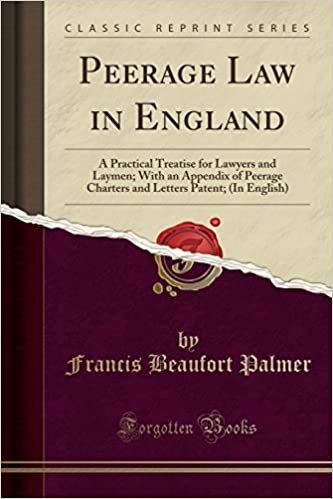
Peerage Law in England: A Practical Treatise for Lawyers and Laymen; With an Appendix of Peerage Charters and Letters Patent; (In English)

https://books.google.com/books?id=1GIWAAAAYAAJ&pg=PR3&hl=en#v=onepage&q&f=false

The History Hoydens group has a couple of blog posts that cover the basics and have links to specific cases:

http://historyhoydens.blogspot.com/2012/04/inheriting-english-peerage.html

http://historyhoydens.blogspot.com/2012/04/challenging-claim-to-peerage.html

A title with no apparent “taker” would go dormant, if there was a chance that the heir had had a legitimate son.  However, the property attached to the title could pass to another, because property could be given back to the rightful owner, but a peerage could not (This is a minor plot line in my Regency romantic suspense entitled, The Earl Claims His Comfort.)

Property and Peerage operated with different rules.

When a peer died, his heir or a claimant to the title put in a petition, a request for a writ of summons to Parliament. That was the time when one had to bring forth objections and other claims. That was what happened when the oldest son of the Earl of Berkley put in his claim. An objection was voiced about his legitimacy. After a thorough investigation, the fifth son was declared the earl and the older four became illegitimate.

When the Frederick Berkeley, 5th Earl of Berkley died, his oldest son applied for a Writ of Summons to the House of Lords. Berkeley and Mary Cole (who also passed under the name of Tudor), the daughter of a local publican and butcher, had seven sons and five daughters, but the disputed date of their marriage prevented their elder sons from succeeding as Earl of Berkeley and Baron Berkeley. The pair asserted their marriage had taken place on 30 March 1785, but the earliest ceremony of which there is incontrovertible proof was a wedding in Lambeth Church, Surrey, on 16 May 1796, at which date Mary was pregnant with their seventh child. Berkeley settled Berkeley Castle upon their eldest son, William FitzHardinge Berkeley, but William’s attempt to assume his father’s honours were disallowed by the House of Lords, who considered him illegitimate.

Therefore, the Committee on Privilege turned down the eldest’s request, saying he and the other brothers born before 1795 were illegitimate, and the earldom had fallen to the 16-year-old born in 1796. Berkeley’s titles devolved as a matter of law upon his fifth but first legitimate son, Thomas Morton Fitzhardinge Berkeley (1796–1882), but were never used by him and he did not take his seat in the House of Lords. Per his father’s will, he would have lost his small inheritance had he disputed his eldest brother’s claim to the titles. The boy was too young, for he had not reached his majority, to do anything about the matter, and his oldest brother and mother ran things. When he came of age, he still never put forth a claim to the earldom. However, he was, by right and law, the earl, so anything requiring the signature of the earl had to be signed by him. He signed responsibility over to his oldest brother, but the title itself went dormant until he died. 

In another case, two cousins fought over a peerage in front of the Committee One was finally chosen. Later the loser came forward with proof, he said, that the chosen one was actually illegitimate. “Sorry,” he was told. You had your chance and lost. Once a choice was made it was not undone. Sorry, once it is decided which one has the title, the other one is out of luck.

Many times in Regency-based novels we have the situation where for one reason or another, the hero refused the title he has inherited and “abdicates” his new peerage. The question is whether this is a viable plot line. 

The answer is a bit more complicated than we might expect. Let us say we have an earl who wishes to abdicate his title. He would have the option of refusing the title, the properties, and the money, but he would still technically be the earl until he dies and another secedes him. To have the full title and the honors accompanying it, the man would need to be confirmed before Parliament. [In my release, “Courting Lord Whitmire,”  there is a lengthy scene where Lord Andrew Whitmire appears before Parliament to claim the viscountcy after his father’s death.] Parliament demands that the person making the claim to the title present evidence of his right to it. If the man wishes to be styled as an earl, he must claim the title. He does not need to send in the Writ of Summons to the House of Lords, and he can refuse to use the title, but someone must care for the property, and no one else can have the title while he is alive.

If he wished to claim the privileges of the peerage, which included: Peers had some special privileges. The main one was the right to sit in the House of Lords, unless they were Roman Catholic, a minor, a female or a lunatic. They could not be arrested for debts. They had to advance the peerage as an affirmative defense. They did not have to sit on juries.  (This made sense as the House of Lords was in effect the supreme court and the last court of appeal). If arrested for a crime, they were allowed to be tried by the House of Peers. Their wives also claimed these privileges, except for sitting in the House of Lords. It was against the law to libel or slander a peer or to strike him. It was not until 1963 that anyone could walk away from a title.

A man could be stripped of his title by the Crown if he committed treason, but not only would be tried and executed for his action, but his family would also be held “guilty.” The University of Michigan‘s website refers to Blackstone’s summary of the laws: 

“Since High Treason was, and arguably remains, the most serious capital crime, testimony of two witnesses to the same overt act was required to convict, and the punishment in the Eighteenth century was severe. Blackstone states that ‘the punishment of high treason in general is very solemn and terrible’:

  1. That the offender be drawn to the gallows, and not carried or walk: though usually (by connivance length ripened by humanity into law) a sledge or hurdle is allowed, to preserve the offender from the extreme torment of being dragged on the ground or pavement 
  2. That he be hanged by the neck and then cut down alive
  3. That his entrails be taken out and burned, while he is yet alive
  4. That his head be cut off 
  5. That his body be divided in four parts 
  6. That his head and quarters be at the King’s disposal. [Blackstone, Wm., Knight. Chase, George, ed. Chase’s Blackstone Commentaries on the Laws of England in Four Books. New York: Baker, Voorhis & Co., 1936. p889.]

“The punishment did not end with the personal suffering of the offender: the punishment extended to his or her family. The law states that a person who is found guilty of treason must also undergo “forfeiture” and “corruption of blood.” In forfeiture, the person is force to give all their lands and property to the Crown. Corruption of blood prevents the person’s immediate family and hereditary heirs from owning property or conducting business—in effect ruining the offender’s family forever.”

On the other hand, if the peer committed suicide, nothing happened to the title. The son inherited as usual. It would be a rare man of that time who did not want a title just because his father had disgraced it. He was not required to claim it, but he could not sit in the House of Lords if he did not. He could change his name either by sign manual, deed poll, or just by doing it. However, those are extreme measures, and he would be compounding the failure of his father by not attending to the estate, the workers, the servants and all the others who depend on the family in one way or another. [I use all this legal rigamarole in my book, The Heartless Earl, which is available on Amazon and KU. The earl is accused of a crime that puts not only his life, but the earldom, in jeopardy.]

Posted in Act of Parliament, British history, customs and tradiitons, Georgian England, Georgian Era, Great Britain, history, Inheritance, peerage, primogenture, Regency era, research | Tagged , , , , , , | Comments Off on Peerage Law in Georgian England

Enlisting in the British Army During the Regency Era

Being an officer in the British Army was considered a “suitable” occupation for sons of peers and wealthy families of the gentry. Generally, the head of the family (father, uncle, brother, etc. would purchase commissions for his relation. We often hear of second sons in Regency romances being the one to join the Army. Such is Colonel Fitzwilliam’s position in Jane Austen’s Pride and Prejudice.

After 1795, the minimum age requirement to join the Army was 16. Before that time, it was common for family to buy their son commissions at young ages. Thomas John Cochrane of Navy fame found at fifteen that his father had purchased a petty officer’s commission for him when he was twelve. He was always destined to go to sea, and was entered into the navy at the age of seven. Cochrane began his naval career in 1796 when enlisted at the age of seven and was promoted to lieutenant at the age of 16. His rise quickly in the ranks was considered by many to be blatant patronage because of his father’s influence. Cochrane first commanded HMS Forte.

Later, his uncle purchased an ensign’s commission in the Army for him when he was thirteen. He earned pay from both positions, gaining seniority while never actually serving. This was 1790 though. Such practices were eventually eliminated in both the Navy and, afterwards, in 1795, the Army. One must also recall that during the Regency, an Army officer was considered to be higher in Society’s rank than a naval officer. 

A man had to be between 16 and 21 years of age to purchase a commission. He had to demonstrate the ability to read and write with a degree of proficiency and have the connections to pay for the position he desired. Again, think of how long Colonel Fitzwilliam must have been serving England. When Elizabeth Bennet meets Darcy, he is 28 years of age, and the colonel was several years Darcy’s senior, which means he had likely been in the Army for, at least, ten years—perhaps longer. A candidate for an officer’s commission also had to present a recommendation from an existing officer, of, at a minimum, the rank of major, warranting the man’s education, character, and physical stability to assume leadership positions in the British Army.

One could only purchase a commission with a cavalry or infantry regiment. Other commissions were presented by organizations such as the Royal Engineers or the Royal Artillery, meaning one had to attend the Royal Military Academy at Woolwich to be presented a commission beyond infantry or cavalry. Promotions from the Royal Military Academy were based on experience and length of service.

The purchasing of commissions was a custom from the early days of war in England when men of rank formed armies to fight along or against the King. By the early 19th Century, people had come to believe paying for a commission guaranteed a certain “quality” of officers. No one considered the fact that those not of the peerage or the gentry had the ability to be an equally capable officer.

If a man died in battle, the purchase price of the commission was not refundable. If a man died in an heroic manner, his widow MIGHT be gifted a sum equal to the value of his commission, but this was not a guaranteed practice.

Commissions were expensive – at approximately £450 – and usually only the wealthy could afford them, with landed families purchasing commissions for their sons. It can be assumed that serving with the Army did command a certain respect, and those men that became the holder of an office “could lay claim to the title of [being a] gentleman.” Therefore, self-interest, respect and status were enticing prospects for many who were to join the army. Despite what the Regency romances say, in reality, only a small proportion of officers were from the nobility; in 1809, only 140 officers were peers or peers’ sons. A large proportion of officers came from the Militia, and a small number were gentlemen volunteers, who trained and fought as private soldiers but messed (ate) with the officers and remained as such until vacancies (without purchase) for commissions became available.

The Duke of York oversaw a reform of the sale of commissions, making it necessary for officers to serve two full years before either promotion or purchase to captain and six years before becoming a major, improving the quality of the officers through the experience gained.

If a man enlisted before 1809, his service to his country was considered “a life sentence.” He could be pensioned off when his battalion disbanded or he was wounded or placed in the invalid corp and remain in the army.  But those were the only alternatives and the enlisted man did not make the choice. After 1809, this was changed. The government finally realized that a life enlistment could discourage volunteers.  So enlistment could be for seven or twenty years. With the twenty year enlistment one received a pension when one “retired.”  

“Crying out” is what an officer who did not pay for his commission would do. If he bought his commission, he would “sell out.'”  In either case, giving up his commission means the man is no longer in the army; he becomes a civilian again. And yes, he would have to be an officer to do that.  If he has spent 14 years in the military as an officer, the odds are that he would be a captain or better by then, even at 26. 

There were very few opportunities for an enlisted man to “better” himself, other than to gain a higher rank. Only a few men from the ranks became an officer. From listings in the Gazette, it appears about 5% of officers came from the ranks. They could be identified in the Gazette because they were termed as being “a gentleman of private means,” but officer records also identified their past occupations, such as laborer or dock worker.

 There was little chance of an enlisted man to better himself by choosing the military as his occupation. Achieving an officer’s rank, such as ensign or lieutenant was usually done with exemplary service, sergeant’s rank AND some act of heroism that was noticed by those who could do something about it. Conduct medals were reserved for officers. The other way an “ordinary man” might better himself was through war booty/prize money.  Soldiers would be given a portion of the value of war materials or valuables, just as sailors could gain prize money.  The soldiers that ”captured” Louis XVIII’s war chest and carriage after Vittoria did well for themselves.  

Anyway, becoming an officer was a better way of ‘bettering himself’ if he was a gentleman at all. He could volunteer [at his own expense] and go with a regiment overseas in the hopes of filling a vacancy there, which was easier for the commander than waiting months for a possible replacement from home. 

The cheapest entry grade was that of ENSIGN in a marching Regiment of Foot. That would cost a man £400. If he wanted a like position in the Foot Guards, he would need to shell out £900. A CORNET was the Cavalry equivalent of an ensign. It would cost £1,102 to purchase a Cornetcy in the Dragoon Guards and £1600 in the Horse Guards. Men could only purchase ranks up to the position of COLONEL. However, to purchase a promotion, one had to wait for the position to become available due to death, severe injury or pensioned out. A man had to have served for three years, for example, to become a CAPTAIN.

A man could go on half-pay, but he was still officially in the Army and could be called up again, not that such would necessarily be required. Pensions were for officers who did not buy their commissions [meaning about two-thirds of the officers throughout the wars] and that is when they left the army, not half-pay. An officer who bought his commission, only got the price of his rank when he ‘cried out’, which could run from £400 for a Lieutenant to a thousand or more for a full colonel, depending on whether he was cavalry or infantry, guard or regulars.  

An officer in the Army received an “honorarium,” rather than pay. This was done because a “gentleman” was NEVER employed. “The daily pay of a British soldier differed with respect to his position within the army. A sergeant could expect to be paid between 1s 6d (7.5 pence) and 2s 6d (12.5 pence) depending on whether he served with a foot regiment or the dragoons respectively. A trumpeter could be paid up to 2s 8d (14 pence), while a drummer may have been paid 3s (15 pence) if he served with the cavalry. A normal private soldier may have been paid 8d if serving with a Regiment of Foot, but received almost 2s 6d if enlisted with the cavalry. In comparison, a labourer in the mid-18th century would have earned a daily wage of 2s (10 pence).

“A soldier would have to pay for food and forage beyond the supplied rations  – and for any other extras such as beer – out of his wage. A loaf of bread usually cost around 5d (2 pence), while a dragoon soldier, earning 1s 6d daily, would have paid 6d for a ration of forage consisting of 18 lb (8 kg) of hay and one peck (16 dry pints) of oats. From 1800 onwards, soldiers received a daily beer money allowance in addition to their regular wages. The practice was started on the orders of The Duke of York.

“Considering the prices of camp necessaries during this period, many items cost a few shillings: a haversack could be purchased for 3s 6d (17.5 pence) while leather powder bags could be found for 7s (35 pence). Dragoons may have purchased a nose bag for the sum of 2s (10 pence) and a drum case would be worth 10s (50 pence). The larger items such as tents would obviously cost more; it cost approximately £4 10s for a complete round tent and £2 12s for a bell tent for arms. Normally, the tents would be provided by the Board of Ordnance, but other necessities may have been purchased by the colonel of the regiment who would later be reimbursed.” (British Soldiers in the eighteenth century)

______________________________

Resources:

Bois, Mark (November 2008). “Leadership and experience: British Officers at Waterloo”. Napoleon Series.

British Soldiers in the Eighteenth Century

Gentlemen’s Occupations: Army and Navy

Posted in British history, customs and tradiitons, Georgian England, Georgian Era, Great Britain, history, Living in the Regency, military, real life tales, Regency era, research | Tagged , , , , , , , , , | 2 Comments

A Widow’s Stipend, Jointures, Dower, Settlements, and Dowry. Which is Which in the Regency?

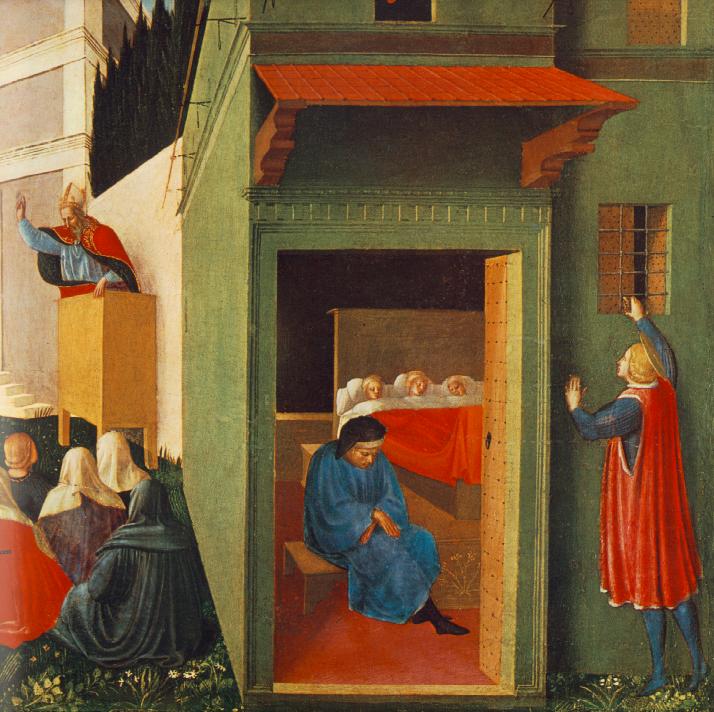
Fra Angelico’s painting: The Story of St Nicholas – Giving Dowry to Three Poor Girls. The 15th-century painting relates to the story of a poor man with three daughters. In those days a young woman’s father
had to offer prospective
husbands a dowry. Without a dowry, a woman was unlikely to marry. Mysteriously, on three occasions,
so goes the story,
a bag of gold appeared in their home, for the dowries, courtesy of St Nicholas. ~ https://en.wikipedia.org/wiki/Dowry#/media/File:Angelico,_san_nicola_done_tre_palle_d’oro_a_tre_fanciulle_
poverer_farle_maritare,_vaticano.jpg


English Common Law provided a widow a life interest in one-third of the freehold lands her husband owned at the time of their marriage. She could not be denied these rights unless she was found guilty of treason, felony, or adultery. The law of dower gave a wife one-third of any property a man held on his death. That excluded entailed property, for the most part. However, the husband could defeat dower by leaving his wife as little as £50. The Court of Chancery did rectify such lapses if the widow had the resources or the  friends to help her bring suit and there was any property or money to be had. The court looked to the amount of the dowry and the position the widow had held as wife. Obviously, the court would see that a countess was provided for better than the widow of a vicar. Unfortunately in this cases, the countess had had a father or guardian who made sure iron-clad settlements were drawn up, whereas the vicar’s wife might not have been so lucky.

Even if the father did not bother to arrange the marriage settlements before the actual marriage (i.e., an elopement), and the husband did not leave his widow anything in his will, she was, as previously explained, supposedly entitled to one-third of his own estate. This is called her dower. She was to ask the sheriff to see that this was arranged properly. However, quite often the husband had no property he owned outright, as it was all entailed. Then, she would have to petition the Court of Chancery for a sum upon which to live.

It was difficult for a husband to set up a trust for his wife during his lifetime, other than in a will, if doing so was not accomplished before the marriage. Because a husband and wife, under law, were considered one, he could not legally give himself his own money. There were cases where a husband did give the wife money and wrote it out that this money was to be hers to do with as she would. However, in such one case where the woman took that money and purchased houses, she lost the property without recompense when her husband died, and the heir sued to have the houses declared part of the estate. Other situations that were deemed illegal included where the husband gave his wife money in a trust and then raided the trust, presented her property and then sold it for his profit, etc.

The Oxford Reference defines the Statue of Uses as, “The use was a legal device whereby property could be held by one person for the benefit of another, e.g. when a landowner was absent on crusade. But, by extension, it might be employed to evade or avoid obligations, defraud creditors, or escape legislation against mortmain. Henry VIII pressed strongly that uses should be restricted, arguing that his revenue was affected, but the Parliament of 1532 was unwilling to legislate and was told sharply ‘not to contend with me’. In 1535 Parliament accepted 27 Hen. VIII c. 10, which complained of ‘subtle inventions and practices’ and restored obligations to the beneficiary.” The “jointure” came into practice with the Statue of Uses. It was a settlement on a bride by her future husband of a freehold piece of property to be used to secure her widowhood. The bride was required to surrender her dower (not her “dowry,” although the terms can be confusing). 

Later in the 19th Century, wives lost their right to inherit, meaning in the 1830s, if the woman had no jointure rights recorded in her husband’s will, the widow could be left without anything upon which to survive. She could also lose the right to the property if she remarried. It would automatically revert back to his heir. 

Jointures were usually payable be the heir of the estate as an annual payment, which was equal to one-tenth of the dowry she brought to the marriage. This number was established because it was assumed that the wife would outlive her husband by ten years, for that was often the difference in their ages when they married. She would receive this payment for the remaining days of her lifetime. Thereafter, the principle would be allotted to her children. Providing the widow one-tenth of what she brought into the marriage meant she received back her dowry. The percentages were per year. The amounts were generally paid quarterly. The formula generally followed this plan: pin money was 2% of the dowry, while jointure was 10%.

As stated above, the jointure is usually set forth in the marriage settlements, which is a prenuptial or ante nuptial agreement. These funds are supposed to come to the widow without let or hindrance. However, it is often set up to be the income from some piece of land. If there is no income from said land, she is out of luck.

Yet, if the husband had not set up a jointure (her annual annuity), but, rather, left her a small sum in his will, that was all she would receive. Or if the heir was not her son, and the estate was encumbered by a mortgage, she might have a problem receiving either the jointure or the dower.

She was supposed to receive a sum large enough to allow her to live decently according to her rank, but not all knew equality under the law. There were even cases where the man left most of his cash to a grandson of a child by his first wife. In a few such cases, the courts felt the widow should have the return of most of her dowry, if nothing else.

A dowry was provided as compensation to the husband for taking on the care of the woman for the remainder of his and her days. Interest from the dowries equalled what the woman would have a spending money or pin money. It played a part in how much income she had readily available once she became a widow (See the formula mentioned above.), and determined the distributions made to the children of the marriage once she, too, died. The problem was that often a dowry could only be used as a “dowry,” and the widow would only  have the interest upon which to live.

Exceptions were often made if the marriage lasted less than a year and the woman was not pregnant nor had she borne a child in that time. The law of Scotland, for example, set it out as a definite thing that in such cases the dowry was returned. One of the reasons elopements were frowned upon was that the wife usually had no protection  except the goodwill of the husband and his heir upon which to make a claim, if she did not bear a son.

To determine the settlement agreed upon before the exchange of marriage vows, one took the total amount of funds set aside for the dowries of the daughters and divide by the number of daughter in the family. To guarantee fairness, one would think the amount would be divided equally, but there was no written guidelines or laws that made this method official. The father could add to the sum during his lifetime, but, again, he was not compelled to do so by law.

Other issues that complicated the situation were numerous. For example, if she was  under 21, she would still require a guardian, though she could remarry without permission. The guardianship often reverted back to the widow’s father or brother .

Widows of aristocrats and the upper gentry were seldom left destitute, but they could be left with very little income. Usually the widow was also given the use of the Dower House or another house owned by the husband.

If the marriage settlements or the will left her money, the executor of the will was supposed to see that she received it. Unless she was still a minor, no one was supposed to keep it from her.

If her father was a peer, it was unlikely that the heir’s family would attempt to keep her money from her. However, if he were a clergyman, or, if her father was dead, they might try to withhold the money.The solicitor and executor would have to be complicit in such behaviour.

If she is young, but without children, though she is of age, it is likely that her father or brother, if father is dead, would attempt to take over her finances.

If the woman had no money set aside for her widowhood in a settlement or a will, the courts gave her her dower of one third of the man’s property– but it is possible for her not to know this, or if she knows it, she doesn’t know how to approach the court, and she needs a place to live so, youngish, childless widows were expected to go back home. What the law says and what people do are often at odds.

Jane Austen often speaks of dowries, dower, jointures, and settlements in her tales. For example, in Sense and Sensibility, Mrs. Dashwood is not the mother of the heir, for Mr. John Dashwood is the only son of Mr. Henry Dashwood and his first wife. The estate has passed to John Dashwood’s hands, and he holds no obligation to provide for his step-mother or his half sisters. They are made to live, instead, on the income supplied by the jointure. The amount is £500, which means Mrs. Dashwood likely brought £5000 to the marriage in the form of her dowry. The Dashwood ladies’ lifestyle is greatly reduced. The £500 will allow for a servant or two, but no carriage and, likely, a tougher cut of meat. 

Mrs. Bennet’s dowry of £5000 in Pride and Prejudice would provide each of her five daughters only £1000, if it is divided equally. Mr. Darcy is taking a large loss of funds when he chooses to marry Elizabeth Bennet because Elizabeth’s dowry certainly does not offset the £30,000 dowry that will be an outlay when Georgiana Darcy marries. 

Posted in British history, customs and tradiitons, estates, Georgian England, Georgian Era, Great Britain, history, Inheritance, Jane Austen, Living in the Regency, marriage, marriage customs, Pride and Prejudice, real life tales, Regency era, Regency romance, Sense & Sensibility, Uncategorized | Tagged , , , , , , , , , , , , , | 6 Comments

Vicars and Rectors and Livings, a Guest Post from Elaine Owen

(As there was much interest on my recent post on the Clergy during the Regency era, I thought this perspective from Elaine Owen might also assist in clarifying the differences. It first appeared on the Austen Authors’ blog on 3 December 2020. Enjoy!)

Last month I discussed the aristocracy of England, a system that was so pervasive in Jane Austen’s time that she had no need to explain it to her readers. Today I’d like to talk about another system that she could assume her readers understood: the clergy of the Church of England.

The Church of England, of course, was the official church in Austen’s day. Though there were Catholics, Evangelicals, Quakers, and other groups in the country, the majority of people belonged to the state church, which we now call the Anglican church.

The most basic unit in the Anglican church was the parish, which usually consisted of a church and the community that built up around it. The clergyman in charge of a parish church was usually a vicar, and along with the responsibilities of a vicar he received a salary or stipend.  But sometimes the parish church was filled by a rector, who was.supported by the tithes from the parish. Confusingly, sometimes a church was overseen by both a rector and a vicar, but in that case the usual work of the parish would still be carried out by the vicar. It’s safe to say that being a vicar was the most common career in the Anglican church.

Vicars were not necessarily financially well off, as Jane Austen’s life shows. If the parish was large and the parishioners were generous, then they might make a decent living. But there were many poor parishes, and some parishes offered such a small salary that they had a difficult time attracting any clergyman at all. Jane Austen’s father was a vicar in a parish with a respectable income, but he also had a large family to support. He therefore found it necessary to tutor students and farm some of his own land in order to make ends meet.

Below the level of rector or vicar was a curate. A curate was the pastor of a church that was not associated with a parish. These churches were smaller than parish churches and usually could not afford to pay their pastor a living wage. So the poor man who got stuck in a curacy would have to find some other source of income and work at that even as he called on parishioners, prepared sermons, and did all the work that his more prosperous brothers in parish churches carried out.

It was possible for a curate to be promoted to a parish church and become a vicar, and for a vicar to be promoted to a rector. Above these levels a man could also be promoted to archdeacon, deacon, bishop, or even archbishop. But the vast majority of the ordained clergy occupied one of these three lowest ranks.

A living was therefore a valuable commodity. A man with an appointment to a parish church could count on the income from that parish for as long as they kept their position, which was presumed to be for life. It was possible to buy and sell livings based on the projected income to be made from that parish, just as we invest in annuities or bonds today. This flies in the face of how we think about pastors, but in Austen’s time, a clergyman did not necessarily  need a spiritual calling from God. For many people it was simply a job, something that would provide security and an income once a man was lucky enough to get into it.

How did a man become a rector, vicar or curate? In most cases the right to appoint the pastor of a church belonged to the family who owned the nearby estate. If they had more than one son then they might very well give the living to one of the younger sons. Other times they might sell it to another family who was trying to provide for their own son’s future. And in some cases, such as that of George Wickham or Mr. Collins, the living was given outright by the family who owned it.  It is no wonder that Collins was so careful to keep on Lady Catherine’s good side, since his own income depended on her good will. (And Elizabeth thought that Lady Catherine might have other livings to give away, too. Perhaps Sir William didn’t visit Rosings just to check on Charlotte!)

There were far more ordained clergymen than there were livings of any sort, even just a curacy. Some unlucky clergy had to wait ten years or more for a living to open up for them!

With all of this as a background, we can understand the story Wickham and the Darcy family living much better. Wickham was the son of an estate steward, a nobody in the regency world. He grew up on the estate and was intimate with the Darcy family, but as an adult he had no way to make a living. He could only go into the military or perhaps learn a trade, which would have been a step down the social ladder. So the old Mr. Darcy left him a “valuable family living.” This would have supported him for life, or at least given him a huge head start. Instead Wickham sold the living to someone else for three thousand pounds, squandered all of that money, and afterwards had the audacity to come back to Darcy and ask for the living again. No wonder Darcy sends him packing.

I hope this helps you understand a little about how the system of livings and patronages worked. For more details or further reading you can follow these links:

Clergy in the Regency

Vicar vs Rector – What’s the Difference?

Jane Austen and the Clergy – How the System Worked

Posted in Austen Authors, British history, Church of England, Georgian England, Georgian Era, Guest Post, real life tales, Regency era | Tagged , , , , , , | Comments Off on Vicars and Rectors and Livings, a Guest Post from Elaine Owen

“Murder of a Bastard Child,” an Historical Crime Against Children

In the 18th Century in England, what was the fate of a child born to a young woman pregnant out of wedlock? Alan Taylor in the British History Georgian Lives Facebook Group tells us, “The most common capital offence for women in the 18th Century was ‘murdering a bastard’- 98 women were hanged for this between 1735 and 1834! The vast majority of these women were in extreme poverty, had been abandoned by their partners and had no where to find shelter and food. Society at that time was very harsh in its judgement to these women condemning them for their immorality and even sending the mother and baby away and therefore denying them poor relief. The story of Elizabeth Harrard is one heartbreaking example. On December 21st 1739 she and nine other condemned men were transported From Newgate prison to Tyburn and there hanged. Her crime was that she had murdered her new born baby and thrown the body into a river. If you read her story in the accompanying article (see link below under NOTE), you will perhaps realise what drove her to this act and how little pity was shown to her in her condition.” 

Romulus-and-Remus

The most famous account of attempted infanticide, in which babies were left exposed to the elements, is the story of Romulus and Remus (Wikimedia Commons)

The Greeks considered infanticide barbaric, but instead of outright killing their babies, they practiced exposure. Exposure would be just leaving the child.it was not considered murder because a passerby or a God could take pity on the child and save it. 
In Rome, exposure was common, in a letter from a man to his wife during 1 BC he says:  “I am still in Alexandria. … I beg and plead with you to take care of our little child, and as soon as we receive wages, I will send them to you. In the meantime, if (good fortune to you!) you give birth, if it is a boy, let it live; if it is a girl, expose it.” Another option would be to take the child to the family patriarch and they would decide whether the child should be killed or left to exposure. Usually babies with birth defects were killed. By 374 AD infanticide was illegal in Rome, but offenders were rarely ever prosecuted. Pagan German tribes also practiced a similar exposure to unwanted children. Many were left in the forest without food….this was especially common for children born out of wedlock.

Meanwhile, Christianity abhorred infanticide. In Apostles it was written, “You shall not kill that which is born”. In 318 AD Constantine I felt that infanticide was a crime. In 374 AD Valentinian stated that people must rear all children. The Council of Constantinople issued that infanticide was murder and in 589 AD the Third Council of Toledo worked on ending the Spanish custom of killing their children .

Child sacrifice was common among the Gauls, Celts, and Irish during the Middle Ages. “They would kill their piteous wretched offspring with much wailing and peril, to pour their blood around Crom Cruaich”, a deity of pre-Christian IrelandBut soon abandoning children on the doorsteps of churches and abbeys became more common than exposure. This gave birth to the world’s first orphanages. (History of Infanticide)

For many women delivering an unwanted baby, infanticide was the answer. Humanian speaks to the modern version of this heinous act. “Infanticide is the act of deliberately causing the death of a very young child (under 1 year old). In the past, and in many societies, it was a widespread practice, permitted by different cultures around the world. Nowadays, it is considered to be an unethical crime; however, it is still performed. In some cultures, children are not considered to be human beings until certain ceremonies have been performed (name-giving ceremonies or haircuts for example). Infanticide occurs rarely once those ceremonies have taken place but killing a child before them is not seen as a homicide. Infanticide is usually difficult to report, because in most cases these deaths are covered as stillbirths or children are just not registered at the civil registry after the birth. Indirect or passive infanticide begins with inadequate nutrition, neglect or careless parenting, especially when the baby gets sick. In many societies, especially in the past, infanticide was routinely used as a way to control and regulate the population. As such, it particularly affected female children, since having fewer women meant having a lower rate of reproduction (fewer children).

“Female infanticide is the most common form of infanticide, both nowadays and in the past. This practice is mainly due to the fact that, in some cultures, males are considered to be socially more valuable than women. Moreover, female infanticide is sometimes related to the control of the population. For example, the UN World Report on Violence Against Children conducted among 1,000 women in India revealed that infanticide was the cause of 41% of deaths among newborn girls.

“In China, infanticide is also practiced, mainly due to the one-child policy (even though it existed before), which states that each couple can have only one child. Many parents prefer to have an abortion before the birth, if they know that the child is a girl. However, among people who do not have this possibility, infanticide at birth can be performed. Female infanticide and abortions have caused a great imbalance between the sexes in some regions. In 2007, a UN report estimated that approximately 100 million girls worldwide had disappeared, 80 million of them in China and India. In the future, this could lead to an increase in girls trafficking or to forcing women to marry more than one man.”

A common capital crime in the 1700s in England was that of the murder of a bastard child. These were generally not still births or deaths from disease or some other natural cause. These were purposeful deaths: ones to rid a woman of the child she had never wanted in the first place. We must remember that contraception was not readily available or dependable to the majority of the population. Women accused of the crime had gotten rid of their infant children in a variety of manners: beaten to death, drowned, buried alive, poisoned, cutting their throats, etc. Women of the time, especially those living in poverty, had few resources available to them, and so many took drastic measures to survive. 

 Capital Punishment UK tells us, “Some seventy nine women were hanged for this crime between 1735 and 1799 and a further nineteen between 1800 and 1834.  The last being twenty four year old Mary Smith who went to the gallows at Stafford on the 19th of March 1834. It is not always possible from surviving records to know whether a child murder fell into this category or not.  Large numbers of women and girls continued to be sentenced to death between 1840 and 1922 for killing their infant children but were all reprieved. It wasn’t until the Infanticide Act of 1922 that the killing of a newborn baby by its mother was no longer classed as a capital crime and factors such as the disturbed mental state of a new mother were permitted to provide a partial defence to a murder charge.  The Infanticide Act of 1938 removed the death penalty altogether for women who killed their babies in their first year of life, stating ‘at the time of the act or omission the balance of her mind was disturbed by reason of her not having fully recovered from the effect of giving birth to the child or by reason of the effect of lactation consequent upon the birth of the child.’ In some cases it was possible to show that a baby had not been born alive and the mother could then be charged with concealment of the birth but this did not carry the death penalty.”

 NOTE: The Capital Punishment UK site also discusses four cases of the murder of bastard children, those of Elizabeth Harrard, Sarah Jones, Ann Statham and Hannah Halley, if you are interested in how the law treated such cases.  I chose not to detail the cruelty here. 

The Encyclopedia of Death and Dying tells us, “Most societies agree that the drive to protect and nurture one’s infant is a basic human trait. Yet infanticide—the killing of an infant at the hands of a parent—has been an accepted practice for disposing of unwanted or deformed children since prehistoric times. Despite human repugnance for the act, most societies, both ancient and contemporary, have practiced infanticide. Based upon both historical and contemporary data, as many as 10 to 15 percent of all babies were killed by their parents. The anthropologist Laila Williamson notes that infanticide has been practiced by nearly all civilizations. Williamson concludes that infanticide must represent a common human trait, perhaps genetically encoded to promote self-survival.

“Neonaticide is generally defined as ‘the homicide of an infant aged one week or less.’ The psychiatrist Phillip Resnick further limits neonaticide to the killing of an infant on the day of its birth. Infanticide in general usage is defined as ‘the homicide of a person older than one week but less than one year of age.’ Filicide is defined as ‘the homicide of a child (less than eighteen years of age) by his or her parent or stepparent.'”

Read more: http://www.deathreference.com/Ho-Ka/Infanticide.html#ixzz59MQ3SoxS

The Discovery of a Mass Baby Grave Under a Roman Bathhouse 

Posted in British history, family, history, medicine, medieval, world history | Tagged , , , , , , , , , , | Comments Off on “Murder of a Bastard Child,” an Historical Crime Against Children

And the Winners Are…

The winners of an eBook copy of “The Mistress of Rosings Park” from my recent giveaways are . . .

Glynis

Glenda M

bn100

Sharon

Ginna

kayelem

Emails have been sent to each in order to claim the eBook. Check your inboxes.

Posted in giveaway | Tagged | Comments Off on And the Winners Are…

“The Mistress of Rosings Park” Has Arrived!

Today, my latest book baby takes its first breath. I am hoping my faithful readers will enjoy this latest tale of Jane Austen Fan Fiction.

Before I share an excerpt, permit me to give you some of the background. First, the tale is told completely from Elizabeth Bennet’s point of view, just as was Jane Austen’s Pride and Prejudice. The reader does not know what Mr. Darcy is thinking, only something of his actions.

The action begins with Elizabeth’s visit to Hunsford Cottage. Mr. Bingley has not yet arrived in Hertsfordshire. There has been no Netherfield Ball or love at first sight between Bingley and Jane (not yet, anyway). Elizabeth has come to Kent to save her friendship with Charlotte (Lucas) Collins. However, upon her first visit to Rosings Park, she encounters a situation which will throw her into the path of Mr. Fitzwilliam Darcy, Lady Catherine’s nephew, a man her ladyship has come to despise, for Mr. Darcy means to remove Lady Catherine as the mistress of Rosings Park. For you see, my dear readers, Mr. Darcy did as the family expected. He married Miss Anne de Bourgh, who succumbed to her many “illnesses” shortly after their marriage. As Miss de Bourgh was to inherit Rosings Park, in fact, should have been the mistress of the estate for nearly seven years, Mr. Darcy, as the lady’s husband, is now the owner of the estate. He has provided Lady Catherine a year to remove to the dower house, but her ladyship refuses to budge.

When Charlotte Lucas is ordered to bed by the physician in order to save the child she carries, Elizabeth Bennet is “recruited” to assist with Lady Catherine’s transition to the dower house. Despite disapproving of Lady Catherine’s “hysterics,” Elizabeth holds some sympathy for the grand dame. After all, her own mother and any unmarried sisters will be displaced by Mr. Collins when Mr. Bennet dies. Elizabeth believes that a woman who has given the better part of her life as mistress of an estate should not be so easily displaced.

Enjoy this excerpt from Elizabeth and Mr. Darcy’s first meeting.

Some three hours later, Elizabeth asked one of the housemaids to sit with her ladyship while Elizabeth partook of a light meal in the morning room. “Please thank the cook for providing me a meal in here rather than taking a tray in Lady Catherine’s sitting room,” she told Mr. Sidney as he remained close to serve her. “I required a few moments to clear my mind.” In reality, she required those few moments to breathe. Charlotte had been correct about the stuffy air in Lady Catherine’s bedchamber. 

“How goes it with her ladyship?” the man asked. 

“Likely just as Mrs. Fischer has reported,” Elizabeth said diplomatically. “Doctor Wilson believes Lady Catherine shall be laid up for a week or a bit more, but there was no break of her leg, which is a blessing for someone of a particular age, or so I am told.” 

“Nicely put, Miss Bennet,” the man said with a slight turning up of the corner of his lips. 

Elizabeth ventured, “Do you think Lady Catherine would object if I chose a book from the library to entertain myself while I sit with her?”

Mr. Sidney seriously considered her request before stating his permission. 

With a nod of gratitude, after finishing her meal, Elizabeth made her way to the library. She was just beginning her search when a loud rap of the front knocker striking the door filled the empty hallways. 

Quietly, she tiptoed to the still open door to have a look at the visitor. Elizabeth knew it might be a return of the Collinses, but her instincts said it would be the unwelcome appearance of Mr. Darcy, and she was curious about the man. 

A second round of rapping occurred before Mr. Sidney appeared from a side hallway and rushed toward the sound. 

At length, voices could be heard below. Elizabeth could not make out every word, but the occasional phrase reached her ears. 

“The whole house is at sixes and sevens.” 

“My aunt is still at home?”

“Assist with the packing.” 

“Where is her ladyship?”

“An accident, sir.”

A murmured curse. 

“Perhaps you might speak to Miss Bennet,” Mr. Sidney was saying. 

Elizabeth did not wait to hear the gentleman’s response. Instead, she hurriedly grabbed a book from the shelf and rushed to be seated, pretending to read as she caught a steadying breath and stiffened her spine in preparation for her encounter with the oft-spoken-of Mr. Darcy. She settled her eyes on the page halfway through the first chapter, but did not carry her pretense of occupation as far as actually to read the book before her, but instead kept a sharper ear out for Mr. Darcy’s approach. 

Even as she listened intently for the gentleman to make an appearance, Elizabeth considered how calm Mr. Darcy’s voice had sounded when he had heard of his aunt’s presence at Rosings Park, as if he had expected nothing less from her ladyship. He did not raise his voice until he learned of the accident. In reality, Elizabeth had expected him to be furious, allowing her to name his obvious control as an intolerable sort of arrogance. Her opinion, as was her way, had formed quickly, before she set eyes upon the man.

She had no time to present a name to any further impressions before Mr. Sidney announced, “Mr. Darcy, miss.” 

Elizabeth’s idea of the gentleman’s arrogance was rather reinforced by the man’s appearance and the manner in which he carried himself. His presence filled the door, rather to say, it filled the empty room, despite its size. 

Square jaw, displaying the shadow of a beard from his day’s travel rather than perfectly clean as if he were appearing in a lady’s drawing room. His skin had been darkened by the sun; apparently, he spent a great deal of time in the fields. Tall. He was a man who announced his place in the world simply by walking into a room. Although a bit wrinkled, his dark coat, as well as his tailored breeches and highly polished boots declared him a man of means. His presence was so strong, Elizabeth felt a jolt of recognition—an elemental sizzle running through her as she rose to greet the gentleman. 

“Miss Bennet,” he said as he bowed properly. “I am to understand you have assumed the care of my aunt.” 

“Not exactly, sir,” she said with a hint of a smile. She had no reason to smile at the man, for she was certain she did not like him, despite his handsome face; yet, it felt natural to smile upon him. 

“Then perhaps you might explain exactly what is your role at Rosings Park,” he said rather coolly. 

“If you believe, sir, that your aunt’s accident is some sort of hum to delay Lady Catherine’s removal from her home, you are sadly mistaken, Mr. Darcy. I have viewed her injuries myself. They are quite real.” 

“If you stood witness,” Mr. Darcy continued in the same reserved tones as previously, “the account must be accurate.” He gestured to the seats. Elizabeth was not certain whether his remark was an insult or an observation, but she moved to the chair nevertheless. He continued, “Mayhap we might sit and you can explain your role at Rosings Park. Are you her ladyship’s companion? If so, you appear quite young for such an exalted position.” 

Elizabeth fought hard not to frown, but knew she did not succeed. “Today is only my second visit to Rosings Park,” she said evenly. 

“Yet, you believe it is your right to instruct her ladyship’s staff and sit in Lady Catherine’s library reading her books,” he accused. 

Her expression must have displayed the nature of her objections to his insinuations, for the gentleman’s eyebrow rose in speculation. 

“For your information, my cousin Mr. Collins holds the living associated with the baronetcy. I am a guest at Hunsford Cottage. I took your aunt’s acquaintance yesterday afternoon when I accompanied Mr. and Mrs. Collins to Rosings only to discover your aunt in a state of dudgeon as you have apparently ordered her from her home.” 

Mr. Darcy’s eyebrows tugged together in obvious disapproval. “My dealings with Lady Catherine are none of your concern. You are nothing to my aunt; therefore, nothing to me.”

Elizabeth responded in her best imitation of Lord Matlock’s quelling tones. “As Lady Catherine has yet to relinquish control of this house to you, sir, I shall continue to act in her ladyship’s stead until she is in a position to do so for herself. Lady Catherine was set to remove to Bourgh House today, actually to be gone before your arrival. As her accident prevents her from doing so, you can have no doubt of the obvious necessity for a change in your plans. Permit me to suggest that you choose the local inn for your residency in Kent until the plans for Lady Catherine to accept Bourgh House can be renewed.” 

She was satisfied with the calm in her voice and the command she portrayed in her words, but, infuriatingly, her visitor’s composure did not falter even one iota. 

His reply proved equally unsatisfactory. “As I do not recognize your place of authority in this household,” he began in harsh civility, “I will make the decisions for this estate and this manor house, Miss Bennet. Until I have established a reliable steward who can execute the management of the estate’s affairs properly, I will be in residence at Rosings Park. You may return to Hunsford Cottage and your cousin. It will be my domain to oversee Lady Catherine’s care.” 

Before she could organize her thoughts, the gentleman stepped to the door to present Mr. Sidney with orders. Elizabeth should have realized the butler had remained in the hall and had heard her exchange with Mr. Darcy and would, likely, carry the tale to those below stairs; however, she had not considered the obvious. Angry, as much with herself as she was the gentleman, Elizabeth groused beneath her breath, “Of all the arrogance!”

“I heard that,” Mr. Darcy said blandly from his place in the hall. 

Within seconds, the gentleman returned—too quickly for Elizabeth to regain her composure completely. “I ordered tea,” he announced. The man turned his full attention upon her, and Elizabeth fought hard not to fidget. “Might we sit again, Miss Bennet?” he asked in calm tones—tones Elizabeth actually admired, but never would she mention that fact aloud. “I can hardly sit in the presence of a lady, and, personally, I despise drinking tea while standing. The cup and saucer always feel much smaller when one stands about attempting to look comfortable than it does when one is seated. We will both be more agreeable if we are seated during our conversation.” 

“And I am less likely to slap your face when we are both seated,” she challenged. 

A small smile graced his lips. “Another noted advantage,” he remarked in maddening carelessness. 

Flushed in anger, Elizabeth sat heavily in the chair she had occupied when he entered the room. The gentleman followed suit, sitting with a flourish only a man accustomed to the finest of society could manage, with the exception that this particular man of society leisurely stretched his legs out before him. “Perhaps you might speak of what occurred in this house yesterday. I understand from Mr. Sidney that my Uncle Matlock called upon Lady Catherine. Were you witness to their discussion?”

“I was,” Elizabeth said with a lift of her chin. 

“And?” he prodded.

“And,” she spoke in a decidedly unfriendly manner, but she spoke the truth. “Lord Matlock chastised his sister for ignoring your request.” Before he could respond, Elizabeth added, “In my opinion, forcing Lady Catherine from her home names you as cruel.” 

Mr. Darcy corrected, “As Lady Catherine is the Dowager Lady de Bourgh, her ladyship’s home, once my late wife reached her majority and married, should have been Bourgh Hall, the dowager’s residence.” 

Elizabeth knew his reasons true; yet, the idea of a woman being forced from her home hit too close to her own vulnerability to allow the gentleman any level of rightness in her mind. “Could you not share Rosings Park with her ladyship?” she suggested. 

“I mean to set the estate on the path the late Sir Lewis de Bourgh had designed, in consideration of my late wife’s dying wishes.” 

“Is there not another to inherit?” Elizabeth asked, constantly aware Mr. Collins would displace her family someday. “Is there not a means to share this grand estate with your family?”

“My wife Anne inherited the property. The baronetcy was not devised to pass through the male line. Mrs. Darcy’s property reverted to me upon her death,” he explained.

“And what shall you choose to do with it? Will you leave it to another or live in it?” she demanded. 

Still and all, before the gentleman could answer, Mr. Sidney reappeared with John Lucas close behind him. “Mr. Lucas, Miss Bennet.” 

Either John did not see the gentleman coming to his feet or he was too consumed with his news to take note of Mr. Darcy. “Oh, Lizzy, I am sorry to bring bad news.” 

“Is Charlotte unwell?” Elizabeth asked, thinking of her friend’s news. 

“How did you know?” John questioned. His face was flushed, as if he had run to Rosings rather than walked. “Charlotte collapsed when we reached Hunsford Cottage. Mr. Collins sent for Doctor Wilson. Wilson has confined my sister to her bed.” 

Elizabeth wished to ask of the child, but could not do so before Mr. Darcy. Moreover, discussing Charlotte’s condition with Charlotte’s brother felt too personal. She would learn the truth at the cottage. “I shall fetch my things, and we may return to Hunsford immediately.” 

John finally glanced to Mr. Darcy. “I did not mean to interrupt, sir.” 

Elizabeth felt the necessity of the introduction. “Mr. Darcy, may I present Mr. Lucas, Mrs. Collins’s brother. Mr. Lucas is a member of the Dover militia and visits with his sister for the next few weeks.”

Mr. Darcy nodded in John’s direction, but the gentleman’s eyes remained on her. His eyebrows rose in question. “Lizzy?”

“I am Miss Elizabeth Bennet.” 

Mr. Darcy presented her a half-smile. “Elizabeth. The name suits you.” 

Elizabeth was uncertain what he meant and whether his words were a compliment or an insult; yet, she dared not ask. Instead, she said, “You have your wish, Mr. Darcy. Your aunt’s care is now in your hands.” 

John frowned dramatically. “You do not understand, Lizzy. I mean, Elizabeth.” 

“Miss Bennet,” Mr. Darcy corrected in firm tones. 

John’s frown deepened. “Miss Bennet is in Hertfordshire. She is Miss Jane Bennet,” he said with a bit of defiance. 

Mr. Darcy did not blink an eye when he said, “Yet, you are not in Hertfordshire at the moment. From what I can assume, your connections to Miss Bennet is your sister Mrs. Collins and both of you being from the same neighborhood in Hertfordshire. Correct me if I have erred. Do you hold a relationship with Miss Bennet beyond your sister and your families dwelling in close proximity?”

“I do not see where my and Miss Elizabeth’s relationship is any care of yours,” John said testily. 

“Miss Bennet is currently a guest in my house, and I would see her properly addressed,” Mr. Darcy said evenly. 

“You forget yourself, sir. I am not a guest at Rosings Park,” Elizabeth asserted.

“I have reconsidered your position in this household,” Mr. Darcy countered. “Lady Catherine will heal quicker if she has someone she trusts to see to her welfare. With the recent falling out between my aunt and me, I doubt her ladyship would do as I ask. More likely, she would question my motives or even the type of care she was receiving.” 

Elizabeth wished to ask of the supposed “falling out” between Mr. Darcy and Lady Catherine, but the gentleman truly owed her no explanation. Instead, she argued, “I cannot possibly remain in a household with an unmarried gentleman—a man who is an acquaintance of less than an hour.” 

“But, Lizzy,” John began and stopped himself before Mr. Darcy could once again correct him. “Miss Elizabeth, Mr. Collins plans to send for my mother to assist Charlotte, which means there shan’t be enough room at the cottage for all three of us as guests. He begged me to ask that you be prepared to return to Hertfordshire in the morning.” 

Elizabeth knew instant disappointment. She had agreed to this visit specially to spend time with Charlotte and to mend fully the rift between them. Next to her sister Jane, Charlotte had been Elizabeth’s most loyal companion. “Naturally, I must return to Longbourn,” she said in lackluster tones. Placing a smile upon her lips, she recited the necessary assurances, “Again, permit me to fetch my things, and we may return to the cottage.” 

However, before she could act, Mrs. Fischer appeared at the door. “Miss Bennet, thank goodness you remain at Rosings Park. Her ladyship has awakened and is demanding to see either you or Mrs. Collins immediately.” 

“Mrs. Collins is indisposed,” Elizabeth explained after shooting a glance to Mr. Darcy, whose resolve had not disappeared from his countenance. 

“Then you must come, miss,” Mrs. Fischer declared. “Her ladyship is determined to remove from her bed. You must convince her it is too dangerous for her to disobey Doctor Wilson’s orders. 

Elizabeth again looked to Mr. Darcy. He nodded his agreement. “Go. We will decide the rest after you speak to Lady Catherine.” 

She pointed her finger at Mr. Darcy and John. “You two are not to argue in my absence.” 

Mr. Darcy smiled at her. “What topic would you suggest, Miss Bennet, for Mr. Lucas and me to discuss.” 

Elizabeth gestured with a sloping arc of her arm. “How am I to know?” she began as she headed toward the door, but she paused to turn back to the two men, each sporting a scowl upon his features. “Agriculture,” she announced. “Mr. Lucas commented earlier today on the condition of some of the fields and the pathways in the park. Perhaps, he may be of service to you, Mr. Darcy. At home in Hertfordshire, Mr. Lucas has assumed much of the care of his father’s modest estate.” 

Purchase Links:

Kindle https://www.amazon.com/dp/B08R2435N4?ref_=pe_3052080_276849420

Kindle Unlimited https://www.amazon.com/kindle-dbs/hz/subscribe/ku?passThroughAsin=B08R2435N4&_encoding=UTF8&shoppingPortalEnabled=true

Amazon https://www.amazon.com/Mistress-Rosings-Park-Prejudice-Vagary/dp/B08R2CLJ16/ref=sr_1_1?keywords=the+mistress+of+rosings+park&qid=1608841210&sr=8-1

BookBub https://www.bookbub.com/books/the-mistress-of-rosings-park-a-pride-and-prejudice-vagary-by-regina-jeffers

Posted in Austen Authors, book excerpts, book release, books, estates, excerpt, Georgian England, Georgian Era, heroines, historical fiction, Jane Austen, Living in the Regency, Pride and Prejudice, reading habits, Regency era, romance, Vagary, writing | Tagged , , , , , , , , , , | 5 Comments

Linen Drapers During the Regency Era + a Teaser from “The Mistress of Rosings Park” You MUST Read + a Giveaway

Cloth manufacturing was one of the first industries in Great Britain. Wool and cotton fabrics were available with some ease. Cotton printed muslin was often found upon the backs of people of the age. By the end of the Regency era, Great Britain had imported 90 million pounds of cotton. Messrs. Harding Howell & Co in Pall Mall was one of the leaders of choice linen-drapers. In 1811, Jane Austen described a shopping excursion she made to a London establishment that sold handkerchiefs, gauzes, nets, veils, trims, and cloth as . . .

We set off immediately after breakfast and must have reached Grafton House by 1/2 past 11 -, but when we entered the Shop, the whole counter was thronged & we waited a full half an hour before we c’d be attended to. When we were served however, I was very well satisfied with my purchases.

It was not unusual for customers to haggle over the prices, but, by the Regency, the shoppers saw more “set” prices on items. Unfortunately, for the shopkeepers, they were “obliged” to extend credit to the aristocracy, which saw the privilege as a necessary part of their positions in Society. Being paid was purely on the backs of the shopkeepers, who often went bankrupt with little recourse, for peers could not be sent to debtors’ prison for non-payment.

Harding Howell & Co – This print displays the large inventory of the shop. Please note the assistants were all males, who served the female customers. ~ From Ackermann’s Repository of arts, literature, commerce, manufactures, fashions and politics (1809) ‘Harding, Howell, & Co.s grand Fashionable Magazine, No. 89, Pall Mall’ (Plate 12: Vol. 1, No. 3, March 1809)

By the beginning of the 19th Century, it is estimated that 200 different shops could be found in London. These shops kept long hours, generally, 12-hour days. The shopkeepers and their assistants often lived on the premises. Warehouses were located in Covent Garden. Mercers and linen drapers could be found in Cheapside. Shops lined the streets with shopkeepers living above. We know that ladies of Society shopped on Oxford Street an Bond Street in Mayfair. Men frequented the shops and gentlemen’s clubs in St. James. Newer styled shops sprung up along the Strand.

Cheapside 1813, East India House on the left ~ Cheapside’, published 1813 in Ackermann’s Repository of Arts Vol 9, Plate: 44.

Those of us who love Pride and Prejudice can easily recall Caroline Bingley’s disdain when speaking of Elizabeth Bennet’s unsuitable pedigree to Mr. Darcy.

“Yes; and they have another [uncle], who lives somewhere near Cheapside.”

“That is capital,” added her sister, and they both laughed heartily.

“If they had uncles enough to fill all Cheapside,” cried Bingley, “it would not make them one jot less agreeable.”

“But it must very materially lessen their chance of marrying men of any consideration in the world,” replied Darcy. (Pride and Prejudice, chapter 8)

From Jane Austen’s World, we learn, “Shop keepers advertised through circulars, trade cards, newspaper notices, or board-men, who were employed to roam the streets. In the 1760’s, the large shop signs that had once hung over shops and identified the shop’s merchandise to a populace that largely could not read were deemed hazardous. They were removed by law, but a few managed to survive, as this account in the Book of Days describes:

In Holywell-street, Strand, is the last remaining shop sign in situ, being a boldly-sculptured half-moon, gilt, and exhibiting the old conventional face in the centre. Some twenty years ago it was a mercer’s shop, and the bills made out for customers were ‘adorned with a picture’ of this sign. It is now a bookseller’s, and the lower part of the windows have been altered into the older form of open shop. A court beside it leads into the great thoroughfare; and the corner-post is decorated with a boldly-carved lion’s head and paws, acting as a corbel to support a still older house beside it. This street altogether is a good, and now an almost unique specimen of those which once were the usual style of London business localities, crowded, tortuous, and ill-ventilated, having shops closely and inconveniently packed, but which custom had made familiar and inoffensive to all; while the old traders, who delighted in ‘old styles,’ looked on improvements with absolute horror, as ‘a new-fashioned way’ to bankruptcy.

___________________________________

The Mistress of Rosings Park: A Pride and Prejudice Vagary [arriving Friday, January 8, 2021]

I much prefer the sharp criticism of a single intelligent man to the thoughtless approval of the masses. – Johannes Kepler 

When she arrives at Hunsford Cottage for a visit with her long-time friend Charlotte Collins, Elizabeth Bennet does not expect the melodrama awaiting her at Rosings Park. 

Mrs. Anne Darcy, nee de Bourgh, has passed, and Rosings Park is, by law, the property of the woman’s husband, Mr. Fitzwilliam Darcy; yet, Lady Catherine de Bourgh is not ready to abandon the mansion over which she has served as mistress for thirty years. Elizabeth holds sympathy for her ladyship’s situation. After all, Elizabeth’s mother will eventually be banished from Longbourn when Mr. Bennet passes without male issue. She inherently understands Lady Catherine’s “hysterics,” while not necessarily condoning them, for her ladyship will have the luxury of the right to the estate’s dower house, and, moreover, it is obvious Rosings Park requires the hand of a more knowledgeable overseer. Therefore, Elizabeth takes on the task of easing Lady Catherine’s transition to dowager baronetess, but doing so places Elizabeth often in the company of the “odious” Mr. Darcy, a man Lady Catherine claims poisoned her daughter Anne in order to claim Rosings Park as his own.

Purchase Links:

Kindle https://www.amazon.com/dp/B08R2435N4?ref_=pe_3052080_276849420

Kindle Unlimited https://www.amazon.com/kindle-dbs/hz/subscribe/ku?passThroughAsin=B08R2435N4&_encoding=UTF8&shoppingPortalEnabled=true

Amazon https://www.amazon.com/Mistress-Rosings-Park-Prejudice-Vagary/dp/B08R2CLJ16/ref=sr_1_1?keywords=the+mistress+of+rosings+park&qid=1608841210&sr=8-1

BookBub https://www.bookbub.com/books/the-mistress-of-rosings-park-a-pride-and-prejudice-vagary-by-regina-jeffers

Excerpt from Chapter Nine: As part of her duties to aid Lady Catherine de Bourgh’s transition to the dower house at Rosings Park, Elizabeth must oversee the refurbishing of the rooms. The scene below should tease you into wanting to read more. ENJOY!

“Miss,” one of the workers interrupted Elizabeth’s thoughts. “We’s mean to walk up to the manor house for arn midday meal.” 

Elizabeth glanced up to the clock and noted it was nearly half past time for the men to leave. “I apologize. I lost track of the hour. Please hurry along. I did not mean to keep you.” 

“Wud ye care to walk up with us?” he offered. 

“I thank you, but I had my sisters send me a basket when they returned earlier. I shall be kindly kept busy in your absence.”

The man nodded his understanding. “We shan’t be overlong.” 

“Enjoy your meal and your rest,” she said in parting. 

Within minutes, the house was silent, and Elizabeth allowed herself a few moments to breathe. She felt as if she had held her breath since . . .  “Since taking Mr. Darcy’s acquaintance,” she admitted softly to the empty room she had claimed as hers while overseeing the house’s refurbishing. Despite saying otherwise, she had silently fumed over his refusal to attend the assembly and, naturally, stand up with her. Her anger and her shame had kept her awake for most of the night. “Well, no more,” she declared as she stood. “The man has no hold over me.” 

Catching up her sketchbook, she headed for the stairs. She had continued to outline and sketch what must be completed before Lady Catherine could take possession of Bourgh House. She wished to be free of this responsibility as quickly as the business could know an end. She desperately missed her home at Longbourn and the good sense of her father. 

Reaching the family wing, Elizabeth took a peek into the sitting room she had worked on previously. Thankfully, the room had been properly aired out. She had sent for the draper: He was to arrive at three of the clock. She had provided Lady Catherine several suggestions on the colors to be employed in the room. Elizabeth had ordered the walls to be painted a soft cream color. Today, she would order the royal purple cloth Lady Catherine had insisted should remain in both the bedchamber and the sitting room. “Hideous,” she remarked under her breath. “At least, her ladyship has agreed to the lilac, leaf green, and gold accents I suggested,” she said in satisfaction, as she surveyed the room another time. 

She had previously made the necessary notations for the guest rooms upon this storey. “The master’s suite is all that remains. Obviously, those rooms can be the last to know refreshening. Lady Catherine can make the final decisions on those particular rooms. I shall, for now, simply order a thorough cleaning and fresh paint.” 

Decision made, Elizabeth crossed to the door she had entered but three days prior. “No Mr. Darcy to encounter this time,” she warned the hitch in her breath as her hand touched the latch and the image of a very virile man crowded her mind. 

Feeling quite foolish, she made herself turn the mechanism and enter the room. However, a few steps in, she paused instinctively to inhale the slight scent of the cologne Mr. Darcy wore. The pleasant aroma lingered, and, like it or not, Elizabeth found herself closing her eyes to savor the moment. “You are a foolish woman, Elizabeth Bennet,” she murmured in self-chastisement.

Although her reason disagreed, she allowed the idea of dancing with a handsome gentleman, who may or may not be Mr. Darcy, to fill her mind. She turned in a small circle, her feet performing a dance she had, in reality, never danced, at least, not with a gentleman—only with her sisters and her Uncle Gardiner. The Meryton Assembly Hall musicians had never once played a “waltz,” such as those on the Continent were familiar, only a “country waltz,” which bore little resemblance to the dance many of Society had added to their evening entertainment, despite the dance being called “scandalous” by more than a few of Society’s matrons. 

Practicing the steps in her head before executing the move, she stepped awkwardly into the first part of the form. Slowly. Meticulously. Elizabeth picked up the tempo, turning more and more quickly until with one final turn she found herself in the embrace of a real-life gentleman. 

Her eyes sprung open to reveal a living, breathing version of the man she had been imagining: Mr. Darcy. “Sir,” she said in testy tones. “Release me at once!”

As if she had never spoken, his large hand briefly caressed her cheek, before lifting a loose curl to rest behind her ear. She waited for him to say something. To curse her as she had demanded. To fling her from him or to force her toward the waiting bed. Instead, he urged her into the dance pattern. 

“You are omitting the half-step immediately preceding the turn,” he whispered into her hair. “Allow me to demonstrate. Walk. Walk.” He directed her backward. The skirt of her day gown rubbed against the cloth of his work trousers. 

Elizabeth knew she should protest. Should slap his all-knowing features. Should rush from the room to the safety of her sisters’ bosoms. Should purchase a ticket on the next coach departing for Hertfordshire. She did none of these. Despite knowing she risked her reputation, she permitted the gentleman to guide her in a tight circle.

He tugged her to a soft stop. “Here,” he instructed. “Step back, but at a slight angle in anticipation of the turn: Do not transfer all your weight to that foot.” 

“My Uncle Gardiner never demonstrated such a step,” she protested, despite noting the step Mr. Darcy suggested would make it easier for her to move into the turn.

The gentleman still held her closer than any man had ever dared to hold her previously. He said, “I am not familiar with your Mr. Gardiner. Has he performed the waltz at a ball hosted by a Society grand dame?”

Elizabeth frowned. “No. My uncle does not associate with such high flyers socially.” 

Mr. Darcy’s expression remained implacable. “I have.” 

He was once more ruining the experience of being close to him. He seemed to possess a knack for turning her world upside down. Sometimes she wondered if his disdain was purposeful. Surely, he could not be ignorant of his offensive mannerisms. Had no one dared to speak truthfully to his manners? “Then, lead on, Macduff,” she huffed in irritation. 

“I sense your displeasure with me again, Miss Elizabeth,” he said with a scowl. 

“Why must you be such a prat, Mr. Darcy?” she accused. “I was enjoying the moment. Were you not?”

She thought she noted an odd emotion crossing his features, but it was so quick, she could not name it. As he had been previously, Mr. Darcy was better at disguising his thoughts than was she. 

“More than I should,” he said softly. His words were accompanied by his actual retreat. He dropped his hand from her waist and took a pronounced step backward. “I must apologize for my actions, Miss Elizabeth. It was never my intention to place you in a compromising situation. If it is your wish, I would offer you my hand.” 

Other Resources:

Lancashire Cotton Times

Regency Shopping ~ Fashion and Fabrics

GIVEAWAY: I HAVE 2 eBOOK COPIES OF THE MISTRESS OF ROSINGS PARK AVAILABLE TO THOSE WHO COMMENT BELOW. THE GIVEAWAY ENDS AT MIDNIGHT, TOMORROW, THURSDAY, JANUARY 7, 2021. THE PRIZES WILL BE DELIVERED ON FRIDAY, JANUARY 8, 2021, WHEN THE BOOK GOES LIVE. WINNERS WILL BE NOTIFIED BY EMAIL.

Posted in book excerpts, book release, commerce, dancing, eBooks, Georgian England, Georgian Era, Great Britain, historical fiction, Jane Austen, Living in the Regency, Pride and Prejudice, reading habits, Regency era, Regency romance, romance, writing | Tagged , , , , , , , , , , , , , | 5 Comments

Female Inheritance and the Release of “The Mistress of Rosings Park” + a Giveaway

Under English law, women were subordinate to their husbands. It was expected that the woman was under the “protection and influence of her husband, her baron, or lord.” The law stated the old adage of “two shall become one.” She was her husband’s “feme covert.” Any property she owned—real or personal—came under his control. A married woman could not draft a will or dispose of any property without her husband’s consent.

Women rarely inherited property. She could inherit “personal” belongings such as, furniture, jewelry, clothing, moveable goods, etc. But that does not mean that a woman could NOT inherit real property (which means she could inherit land, or what we now call “real estate”). The practice of primogeniture under English law presented the oldest son with the real property upon the death of the father. [Note: Matrilineal primogeniture, or female-preference uterine primogeniture, is a form of succession practiced in some societies in which the eldest female child inherits the throne, to the total exclusion of males. The order of succession to the position of the Rain Queen is an example in an African culture of matrilineal primogeniture: not only is dynastic descent reckoned through the female line, but only females are eligible to inherit.] Daughters could only inherit in the absence of a male heir. The law of intestate primogeniture remained on the statue books in Britain until the 1925 property legislation simplified and updated England’s archaic law of real property.

Aware of their daughters’ unfortunate situation, fathers often provided them with dowries or worked into a prenuptial agreement pin money, the estate which the wife was to possess for her sole and separate use not subject to the control of her husband, to provide her with an income separate from his.

In contrast to wives, women who never married or who were widowed maintained control over their property and inheritance, owned land and controlled property disposal, since by law any unmarried adult female was considered to be a feme sole. Some of the peeresses, in their own right had property, as well as the title which the husband couldn’t touch. Still, inheritance through the female of a peerage by patent was  extremely rare and usually only  put into the patent while the 1st peer was alive. Usually, the patents didn’t allow for female inheritance. It was rare for a woman to be able to inherit a peerage created by patent. The Duke of Marlborough had his patent changed when it was obvious he would not have a son, but that was a rare occurrence. Most females succeeded to a lesser peerage created by writ. Once married, the only way that women could reclaim property was through widowhood.

The dissolution of a marriage, whether initiated by the husband or wife, usually left the divorced females impoverished, as the law offered them no rights to marital property. The 1836 Caroline Norton court case highlighted the injustice of English property laws, and generated enough support that eventually resulted in the Married Women’s Property Act.

Lately, England has considered what is cleverly known as the “Downton Abbey” law. The Bill is so called after the anomaly of female succession at the heart of ITV’s Downton Abbey, in which the character of Lady Mary, the eldest daughter of the drama’s fictional earl, was unable to inherit the family seat because it had to pass to a male heir. The bill adds the rank of “baronets” to those titles in which females can inherit.

Like many in the JAFF community, I often write how Anne De Bourgh can inherit Rosings Park. I do so again in my latest novel, The Mistress of Rosings Park. But how is that possible? As mentioned above, Anne can inherit if she does not marry. By English law, she could inherit when she reaches her majority at age 21. I customarily add something in Sir Lewis’s will that has her wait until she is 25. I did not do so this time, but it is possible. Please consider the “chance” that Sir Lewis anticipated Lady Catherine’s “unwillingness” to be removed from the reins of Rosings Park, and provided Anne a bit of time to find a strong husband who would depose her ladyship. Yet, in reality, it is also possible for Anne to inherit because her father’s title is one of baronet. The rank of “baronet” was created by James I, who founded the hereditary Order of Baronets in England in 1611 to be conferred on 200 gentlemen with large, profitable estates on the condition they funded the salaries of 30 soldiers for the war with Ireland. In these early baronetcies, it was written into the letters patent from the monarch when the titles were created that women could inherit if there was no male heir. The last baronetess, Dame Anne Maxwell Macdonald, whose ancestors became baronets in 1628, died in 2011 at age 104. Therefore, Anne De Bourgh could be the next baronetess of Rosings Park and our “dear” Lady Catherine would then become the dowager baronetess and need to remove to the dower house. Imagine how that would go over, and you have the idea behind The Mistress of Rosings Park. Throw in a husband for Anne in the form of Mr. Fitzwilliam Darcy, and you have the gist of the tale, but not all the twists and turns I adore adding.

The Mistress of Rosing Park: A Pride and Prejudice Vagary

I much prefer the sharp criticism of a single intelligent man to the thoughtless approval of the masses. – Johannes Kepler 

When she arrives at Hunsford Cottage for a visit with her long-time friend Charlotte Collins, Elizabeth Bennet does not expect the melodrama awaiting her at Rosings Park. 

Mrs. Anne Darcy, nee de Bourgh, has passed, and Rosings Park is, by law, the property of the woman’s husband, Mr. Fitzwilliam Darcy; yet, Lady Catherine de Bourgh is not ready to abandon the mansion over which she has served as mistress for thirty years. Elizabeth holds sympathy for her ladyship’s situation. After all, Mrs. Bennet will eventually be banished from Longbourn when Mr. Bennet passes without male issue. Elizabeth inherently understands Lady Catherine’s “hysterics,” while not necessarily condoning them, for her ladyship will have the luxury of the right to the estate’s dower house, and, moreover, it is obvious Rosings Park requires the hand of a more knowledgeable overseer. Therefore, she takes on the task of easing Lady Catherine’s transition to dowager baronetess, but doing so places Elizabeth often in the company of the “odious” Mr. Darcy, a man Lady Catherine claims poisoned her daughter Anne in order to claim Rosings Park as his own.

Enjoy this excerpt:

And what, in that case, would become of Charlotte’s future? Elizabeth would not enjoy viewing Charlotte living in poverty. As Charlotte’s friend, she could not help but to wonder the extent of the living Lady Catherine had presented to Mr. Collins. Elizabeth knew some vicars lived on as little as thirty pounds per year. She suspected Mr. Collins received more, but how much more? It would take somewhere around one hundred pounds per year for the illusion of a modest lifestyle, which was what Elizabeth had observed at Hunsford Cottage. However, it was well understood that the right of presentation could be bought and sold. Was her father’s cousin receiving any of the tithes?  She would write to her father and ask him what he knew of Mr. Collins’s position. 

Like her mother, Elizabeth had made assumptions regarding Lady Catherine’s presentation of the living; none of the Bennets, perhaps with the exception of her father, had thought to question Mr. Collins’s constant praise of Lady Catherine’s generosity—just periodically roll their eyes at his foolishness mannerisms.

Now, since viewing her ladyship’s lack of care of parts of the estate, Elizabeth thought perhaps having Lady Catherine as Mr. Collins’s patroness might not be such a blessing, after all. She could not image her father’s cousin had come away from his days at Oxford with glowing reports that would draw the notice of any among the aristocracy. Then how came Mr. Collins to her ladyship’s notice? Perhaps he was acting in the place of another, more in the role of curate, and had not told anyone of the fragility of his position. Elizabeth made a silent promise to remain at Rosings to determine if she might be of service to her friend and mend the gap that had brought a breach in said friendship nearly a year prior and to learn the truth of Mr. Collins’s role in Hunsford’s future. 

Her thoughts were thusly engaged on what she might do to assist Charlotte, beyond taking over some of her friend’s duties at Hunsford Cottage, when the “play” before her shifted with the entrance of new character. 

“The Earl of Matlock, my lady,” the butler announced unexpectedly. 

Along with the Collinses, Elizabeth scrambled to her feet to curtsey. She had never been presented to an earl, and the idea pleased her, for she thought both her father and her sister Jane would find Elizabeth’s recollection of the encounter amusing. As the earl crossed the room, totally ignoring anyone but Lady Catherine, both Mr. Collins and Charlotte slowly and silently drifted toward the corner of the room which Elizabeth occupied. The earl’s ample figure filled the room with its stoutness and with the gentleman’s obvious importance. In Elizabeth’s opinion, there was a strong likeness between his lordship and Lady Catherine. They both had the same aristocratic features, but in Elizabeth’s opinion, the cut of their noses and jawlines was more attractive on the gentleman than they were on her ladyship. 

“What the deuce are you doing, Catherine?” he demanded of his sister without even an acknowledgement of Elizabeth’s or the Collinses’ presence in the room. 

The invisible servant, Elizabeth thought. She had often heard her father say those words in a derisive manner when observing others’ treatment of the working class. Now, she fully understood his contempt. The earl completely ignored her presence in the room, marking her place in his esteem, despite her being a gentleman’s daughter. 

“I expected to discover you removed to the dower house,” the earl continued. “Never thought you would take it upon yourself to set up such an uproar.” 

“I have not had enough time to make my move official,” Lady Catherine protested. 

“Nonsense,” the earl countered. “Anne, rest her soul, passed some fourteen months prior. Darcy has provided you more than enough time to vacate the manor house. Sir Lewis left everything to Anne. This house and estate have been your daughter’s, not yours, for some seven years. Rosings Park does not belong to you. It never has. From the day Anne met her majority, Rosings no longer was yours to oversee. You must come to terms with this situation. My God, you are a Fitzwilliam. We do not condone such hysterics. In her kindness, Anne erred in allowing you to remain in the role of the Mistress of Rosings Park, but, you must understand, legally, you cannot remain at the manor house. Darcy has the right to demand your withdrawal. If you do not comply, he can have the magistrate force you from your home. Save your dignity, Catherine, and do what is necessary. Such would be our father’s expectations for his eldest daughter.” 

“Darcy,” Lady Catherine hissed. “I am certain I have learned to detest that name! How can it be lawful for him to claim everything simply because he was Anne’s husband? I am Anne’s mother. Should I not have some rights to a home I have nourished and cherished since my wedding day? Darcy has only visited Rosings when it was necessary. He holds no allegiance to the estate.”

“It was your wish for Darcy to marry your daughter,” the earl reminded his sister in cold tones. “You cannot deny that it was so. When George Darcy was still alive, Darcy’s father denied the connection, but, with George’s death, you again began to badger the boy into marrying Anne. You knew Darcy would never make Rosings Park his home seat when his ancestral home is in Derbyshire, and the life blood of that estate runs through his veins. You wanted Rosings for yourself. And that is exactly who you must blame for this fiasco.” 

“He carried Anne off to Derbyshire, without even as much as a by your leave,” her ladyship argued. “Darcy was to protect her, not kill her. You know he poisoned Anne.” 

Elizabeth could not disguise her gasp of surprise. However, before anyone took notice of her presence in the room, Charlotte caught Elizabeth’s hand and tugged her further along the passageway. 

“You are to forget what you just heard,” Charlotte warned. “This is none of your concern. None of mine or Mr. Collins’s concern beyond our duty to Lady Catherine as her tenants. We owe my husband’s living to her ladyship.” 

Although Elizabeth would not soon forget the remark nor her questions regarding Mr. Collins’s pandering to Lady Catherine, she understood the unspoken words: Mr. Collins’s living depended upon what occurred between Lady Catherine and the unknown gentleman by the name of Darcy. “Certainly, Charlotte,” she whispered. “You are correct. I shall do nothing to jeopardize your position in the neighborhood.” 

“Mr. Collins and I will be expected to assist her ladyship,” Charlotte reiterated. “It grieves me not to be in a position to entertain you properly.” 

Elizabeth dutifully said, “I shall be content to walk the park and to learn something of the Kentish countryside.” 

Charlotte nodded sharply. “It shan’t be a total solitary endeavor. My brother John has been presented leave from his duties with the Dover militia. He thought to return to Hertfordshire, but I convinced him to visit with me instead. I hope you will not mind that I have asked him to spend time with us at Hunsford Cottage.” 

Elizabeth prayed Charlotte did not mean to push for an alliance between Elizabeth and John. She knew her mother and Lady Lucas often connived to place Elizabeth in John Lucas’s way. She adored the young man, but only in a “brotherly” manner. She had not set her cap for him. 

“Devilish rum business,” Lord Matlock’s voice reached them again before Elizabeth could respond. “But Darcy has his rights. You chose to force his hand, and, now, you must live with your manipulation. Our nephew married Anne. It is not his fault your daughter died in a little over half a year of pronouncing her vows. Even though they held nothing more than familial affection for each other, who is to say they might have made the best of it for the remainder of their days—mayhap they would have had a half-dozen children. That might have satisfied you to have grandchildren about you. Might have softened your nature. However, I do not think such a marriage would have made either Darcy or Anne happy. Like it or not, Catherine, they did not suit. Darcy adored his parents, and, whether you wish to recognize it or keep fooling yourself, George Darcy and our younger sister Anne were happy together. They loved each other deeply. Your belief that he should have chosen you instead of Anne—that you should have been mistress of such a breathtaking beautiful estate as Pemberley—is what drove you to force Darcy and your daughter together. You made your bed, now, you must lie in it.” 

“Why did you not say all this beforehand—before my Anne’s marriage?” Lady Catherine demanded. 

“I did say it, as did Lady Matlock, and my sons. You simply chose not to listen because you wished to be mistress of Rosings Park and use your courtesy title of ‘Lady Catherine’ from your reign as the daughter of an earl, rather than become the Dowager Lady de Bourgh,” the earl clarified. “Demme it, Catherine, with Anne’s passing, you did not even need to take on that dreaded stigma of ‘dowager.’ You could have simply been ‘Lady de Bourgh,’ a baronetess in your own right.” A long silence followed before Lord Matlock asked with a hint of sympathy, an emotion missing earlier from his voice. “Darcy is not the vindictive type. The boy says he has plans for Rosings Park that will provide you additional funds as part of your widow’s pension for the remainder of your days. Permit Darcy to tend the estate. It is admirable how you have handled Sir Lewis’s holdings for so long, but the political environment has placed even the wisest of land owners in this great kingdom at a disadvantage. If you heard half of what I do in the House of Lords, you would gladly step back from this charge. Permit Darcy to shoulder the responsibility. Accept the use of the dower house and enjoy your days without all these duties hanging over your head. Better yet, choose Bourgh Hall and join Society in London. There was a time you enjoyed the Season and all it brings. Allow the boy to do the work and claim what is your due. You served your husband well. No one can say otherwise.” 

“Do I possess a choice?” her ladyship grumbled in what sounded of sarcasm. 

“None whatsoever,” Lord Matlock pronounced in a cold tone. His lordship clapped his hands together as if the business was finished. “Should I summon your butler and your maid to assist in your removal to Bourgh House?” 

“As yet, I have not one foot in the grave. I am capable of removing to the dower house without your supervision. My staff is quite efficient. Moreover, Mr. and Mrs. Collins will make certain my orders are completed in a timely manner.” 

“Mr. Collins?” the earl asked. 

Charlotte shoved her husband toward the still open door just as Lady Catherine declared, “Mr. Collins.” As if she suddenly recalled their presence in the room, the mistress of Rosings Park called out, “Mr. Collins? Where are you?”

“Here, my lady.” Collins bowed deeply as he stepped into the framed doorway. 

“Tell his lordship you mean to assist me in this ugly business,” Lady Catherine ordered. 

Elizabeth watched in amusement as Mr. Collins swallowed hard. He bowed again, nearly falling over in his obeisance. “Mrs. Collins and my cousin Miss Bennet will consider it not only our Christian duty, but, also, our pleasure to be of assistance to Lady Catherine in whatever manner necessary.” Mr. Collins motioned Charlotte and Elizabeth to join him in the doorway. 

Elizabeth was just in time to note how the earl rolled his eyes when Mr. Collins bowed a third time in less than a minute. Dutifully, Elizabeth followed Charlotte in a curtsey. 

Having recovered some of her renowned bravado, Lady Catherine said, “I have only been notified this very day that the necessary cleaning and painting at Bourgh House has been completed. As Darcy initially indicated I might remove at my leisure, I did not press the workers in their task.” 

Elizabeth thought her ladyship’s reasoning foolish to assume, but she made no comment where her opinion would not be welcomed. 

Lord Matlock shook his head in a disapproving manner, however, confirming Elizabeth’s opinion without it being voiced. 

Lady Catherine quickly added in excuse, “I have not heard from Darcy for nearly a month.” 

Lord Matlock overrode her objection by saying, “I dare say Darcy means to be in Kent by tomorrow, and I doubt you are not aware of his arrival. The boy has not one spontaneous bone in his body. We both know Darcy is not the type to appear without notice. You were informed, but chose to ignore the message. You have wasted your time, your ladyship. You have acted in denial of the inevitable.” 

“Yet, there is no means for me to leave Rosings for, at least, another week.” 

“You cannot demand that Darcy stay at the local inn. It would be little-minded to demand he do so. You will make everyone in the family, including you, uncomfortable. Making them choose sides will not be a wise choice if you cherish your dignity.” He returned his gloves to his hands. “Yet, I doubt you much care for the opinion of others. You never did. Therefore, as I am not required in this matter, I will return to London.” 

“Will you not, at least, stay for tea?” her ladyship countered. 

“My countess has a supper planned this evening. If I press my horses, I could be there in time for the first course.”

Lady Catherine drew herself up in obvious indignation. “Then you held no intention to be of service to me.” 

“I would have stayed if you were not so headstrong, but I do not care to argue with you. You cannot be swayed. As to the supper, Lindale promised to assist his mother, but you know the nature of my eldest son.” With that, the earl brushed past Elizabeth and the Collinses without even a nod of his head in recognition. A quick glance to Lady Catherine noted a crestfallen expression for the briefest of moments, which was quickly replaced by aristocratic arrogance.

A pregnant moment passed before Charlotte found her voice and moved forward to curtsey again to Lady Catherine. “With your permission, your ladyship, I shall ring for tea, and we will assess how best to proceed in solving your dilemma.” 

“Yes . . . yes,” her ladyship stammered. “You are very kind, Mrs. Collins. It appears even my own brother means to see me removed from the house that has been my home for nearly thirty years.” 

Purchase Links:

Kindle. https://www.amazon.com/dp/B08R2435N4?ref_=pe_3052080_276849420

Kindle Unlimited. https://www.amazon.com/kindle-dbs/hz/subscribe/ku?passThroughAsin=B08R2435N4&_encoding=UTF8&shoppingPortalEnabled=true

Amazon https://www.amazon.com/Mistress-Rosings-Park-Prejudice-Vagary/dp/B08R2CLJ16/ref=sr_1_1?keywords=the+mistress+of+rosings+park&qid=1608841210&sr=8-1

BookBub. https://www.bookbub.com/books/the-mistress-of-rosings-park-a-pride-and-prejudice-vagary-by-regina-jeffers

GIVEAWAY: I HAVE TWO eBOOK COPIES OF THE MISTRESS OF ROSINGS PARK AVAILABLE TO THOSE WHO COMMENT BELOW. THE GIVEAWAY ENDS AT MIDNIGHT EST ON THURSDAY, JANUARY 7, 2021. WINNERS WILL BE CONTACTED BY EMAIL AFTER THE BOOK RELEASES.

Posted in Austen Authors, book excerpts, book release, British history, eBooks, estates, excerpt, family, Georgian England, Georgian Era, giveaway, history, Inheritance, Jane Austen, Living in the Regency, marriage, marriage customs, Pride and Prejudice, publishing, reading habits, Regency era, Regency romance, research, writing | Tagged , , , , , , , , , , , , , | 14 Comments