Although it has largely fallen out of favor with Western religion, the concept of “churching” in the Church of England can be traced well into the 20th Century. (Margaret Houlbrooke. Rite out of Time: a Study of the Ancient Rite of Churching and its Survival in the Twentieth Century (viii + 152pp. + 15 plates, Donington: Shaun Tyas, 2011, ISBN 978-1-907730-10-8). Data from the book “is based on new primary research utilizing ecclesiastical archives and personal testimony of both women and clergy. It mainly deals with churching as practised by the Church of England.
“Much of the evidence-base is qualitative, but some quantitative data are also included, albeit they are not always presented and analysed to optimal effect. Particularly interesting is the study of parochial records for three counties between the 1880s and 1940s, which reveals that the number of churchings was equivalent to two-thirds of baptisms (64% in Berkshire, 63% in Staffordshire, 64% in London). The relevant statistics may be found on pp. 27, 33, 35, 47, 49 and 51 and in plates 9 and 10.” [“Churching of Woman] But what exactly is “churching of women”?
The Christian concept of Churching of Women finds it roots in the Jewish practice spoken of in Leviticus 12:2-8. It is a practice in which women were purified after giving birth. It is a blessing of sorts. The practice includes a “thanksgiving” for the woman’s survival of childbirth. It is performed in the case of a live birth, a stillborn, or even for an unbaptized child that has died. The ceremony draws on the symbolism associated with the presentation of Jesus at the Temple, which is found in the New Testament in Luke 2:22-40. Even though many Christians consider Mary to have given birth to Christ without being despoiled, she is said to have gone to the Temple in Jerusalem to fulfill the requirement of the Law of Moses.
The custom specifies the ceremonial rite is to be used to restore ritual purity. The practice lies in the concept that childbirth makes a woman ritually unclean, meaning the presence of blood and body fluids.. This was part of ceremonial, rather than moral law. [Pope, Charles. “Lost Liturgies File: The Churching of Women”, Archdiocese of Washington]
The women are “reintroduced” to the religion/church/social responsibilities. This practice can be found across a number of cultures. All things having to do with birth and death are understood as somehow sacred. [Knödel, Natalie. “The Thanksgiving of Women after Childbirth, commonly called The Churching of Women”, University of Durham. 1995]In agricultural societies, it is assumed that the practice comes from not permitting a new mother to return to the field too soon. [Marshall, Paul V., Prayer Book Parallels. The public services of the Church arranged for comparative study, New York: The Church Hymnal Corporation, 1989]. In history, we find that women have typically been confined to their beds (or at a minimum, to their homes) for a period following giving birth. Forty days seems to be the customary number of days required for a woman’s “lying in.”Custom differs, but the usual date of churching was the fortieth day after confinement (or giving birth), in accordance with the Biblical date and Jewish practice. The Purification of Mary and the presentation of Jesus at the Temple are commemorated forty days after Christmas. During this time, a female relative took over the responsibilities of running the new mother’s household. If a relative was not available, a “monthly nurse” (a term used in the 18th and 19th centuries) could be hired. The custom of “churching” marked the end of the new mother’s “lying in” and welcomed her back to the community.
“The rite became the subject of a good deal of misunderstanding as many commentators and preachers, in describing its scriptural antecedents, did not explain the concept clearly, as early as the 6th century protested any notion that defilement was incurred by childbirth and recommended that women should never be separated from the church in case it was seen as such. As a blessing given to mothers after recovery from childbirth, “it is not a precept, but a pious and praiseworthy custom, dating from the early Christian ages”. David Cressy points out that the ceremony acknowledged the woman’s labours and the perils of childbirth. At the conclusion of a month after childbirth, women looked forward to churching as a social occasion, and a time to celebrate with friends. For men it marked the end of a month during which they had to take care of the domestic affairs, commonly referred to as the ‘gander month.'” [“Churching of Women“]
“The service included in the English Book of Common Prayer dates only from the Middle Ages. While the churching was normally performed by a priest in the parish church there were exceptions of women being churched at home. Prior to the English Reformation, according to the rubric the woman was to occupy the ‘convenient place’ near the parthex. In the first prayer book of Edward VI of England, she was to be ‘nigh unto the quire door.’ In the second of his books, she was to be ‘nigh unto the place where the Table (or altar) standeth.’ Bishop Matthew Wren orders for the diocese of Norwich in 1636 were that women to be churched would come and kneel at a side near the communion table outside the rail, being veiled according to custom, and not covered with a hat. In some parishes there was a special pew known as the ‘churching seat.’
“Churchings were formerly registered in some parishes. In Herefordshire it was not considered proper for the husband to appear in church at the service, or to sit with his wife in the same pew. The words in the rubric requiring the woman to come ‘decently appareled,’ refer to the times when it was thought unbecoming for a woman to come to the service with the elaborate head-dress then the fashion. A veil was usually worn.
“In pre-Reformation days, it was the custom in English Catholic churches for women to carry lighted tapers when being churched, an allusion to the Feast of the Purification of the Virgin (February 2), celebrated as Candlemas, the day chosen by the Catholic Church for the blessing of the candles for the whole year. At her churching, a woman was expected to make some votive offering to the church, such as the chrisom or alb placed on the child at its christening.” [“Churching of Women”]
Presentation in the Temple, a representation of the presentation of Jesus at the Temple upon which the churching of women is based. (Hans Memling, c. 1470, Museo del Prado. Madrid). ~ Public Domain ~ via Wikipedia
We all likely know something of “Rock-a-bye Baby“ as a nursery rhyme and lullaby. The melody is a variant of the song comes from an English satirical ballad called ‘Lillibullero,‘ a march that became popular in England at the time of the Glorious Revolution of 1688. It has aRoud Folk Song Indexnumber of 2768.
“One theory suggests the rhyme narrates a mother gently rocking her baby to sleep, as if the baby were riding the treetops during a breeze; then, when the mother lowers the baby to her crib, the song says ‘down will come baby.’ Another identifies the rhyme as the first English poem written on American soil, suggesting it dates from the 17th century and that it may have been written by an English colonist who observed the way Native American women rocked their babies in birch-bark cradles, which were suspended from the branches of trees, allowing the wind to rock the baby to sleep. The words appeared in print in England c. 1765.
“In Derbyshire, England, local legend has it that the song relates to a local character in the late 18th century, Betty Kenny (Kate Kenyon), who lived with her husband, Luke, and their eight children in a huge yew tree in Shining Cliff Woods in Derwent Valley, where a hollowed-out bough served as a cradle. Yet another theory has it that the lyrics, like the tune “Lilliburlero” it is sung to, refer to events immediately preceding the Glorious Revolution. The baby is supposed to be the son of James VII and II, who was widely believed to be someone else’s child smuggled into the birthing room in order to provide a Roman Catholic heir for James. The “wind” may be that Protestant ‘wind’ or force ‘blowing’ or coming from the Netherlands bringing James’ nephew and son-in-law William of Orange, who would eventually depose King James II in the revolution (the same ‘Protestant Wind’ that had saved England from the Spanish Armada a century earlier). The “cradle” is the royal House of Stuart. The earliest recorded version of the words in print appeared with a footnote, ‘This may serve as a warning to the Proud and Ambitious, who climb so high that they generally fall at last’, which may be read as supporting a satirical meaning. It would help to substantiate the suggestion of a specific political application for the words, however, if they and the ‘Lilliburlero’ tune could be shown to have been always associated.
Richard Norman Shaw (1831-1912) designed this cradle for the son of the architect Alfred Waterhouse. The cradle is in the Gothic style and decorated with painted panels. The cradle itself is also in the Museum’s collections. Although its structure is close to the design, the painting of the panels is different. The floral patterns in the drawing are replaced by signs of the Zodiac on the finished piece. In 1861 Shaw was designing in the reformed Gothic style, which is associated with William Burges (1827-1881) and William Morris (1834-1896). Painted panels formed the chief decorative element in this style. Very similar painted panels later became popular in works of the Aesthetic and Arts and Crafts movements. But they lacked the Gothic framing seen here. ~ http://collections.vam.ac.uk/item/O74294/design-for-a-cradle-design-shaw-richard-norman/
“Yet another theory is that the song is based around a 17th-century ritual that took place after a newborn baby had died. The mother would hang the child from a basket on a branch in a tree and waited to see if it would come back to life. The line ‘when the bough breaks the baby will fall’ would suggest that the baby was dead weight, so heavy enough to break the branch. Another possibility is that the words began as a ‘dandling’ rhyme – one used while a baby is being swung about and sometimes tossed and caught. An early dandling rhyme is quoted in The Oxford Nursery Rhyme Book which has some similarity:
Catch him, crow! Carry him, kite!
Take him away till the apples are ripe;
When they are ripe and ready to fall,
Here comes baby, apples and all, woop woop.”
Cradles have been around for centuries. The ancient Britons wove cradles in the tree-tops for both children and old men. It was the custom of weaving an infant’s cradle in the branches of a tree, out of harm’s way, to be rocked by wind power, possibly another source of the lullaby. The traditional wood for a cradle is birch the tree of inception, which the ancients believed drove away evil spirits.
Also, manuscripts of the ninth and tenth centuries show cradles hollowed out from halved tree trunks, with holes along the edges for straps or cords to keep the baby from falling out. Greek peasants were still using these in the late 19th century.
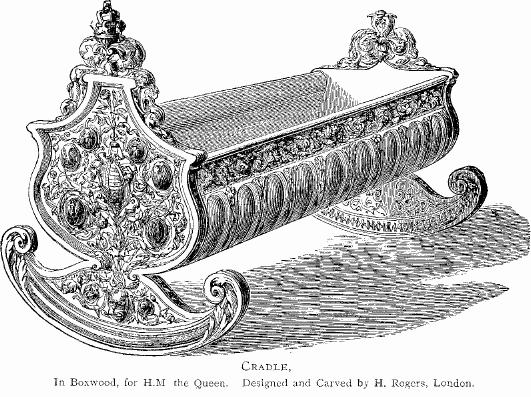
Some medieval cradles were made like miniatures of an adult’s bed, but on two curved rockers. In a wealthy/noble family, the cradle would be costly indeed. Take the instance when the men of Ghent despoiled the house of the Earl of Flanders in the 14th century – they destroyed all his furniture except the cradle. Not out of consideration for the baby, though – but because the cradle was solid silver.
There was also the cradle that swung from two fixed supports, a different principle from the rocker, the pivot being above the centre of gravity instead of below – and this one dates from the fifteenth century. It goes on rocking for some time with only an occasional push, and it seem to offer a more gentle ride, with less tendency to eject the child.
Graham Blackburn at FineWoodworking in “A Short History of Cradles” tells us, “The first piece of furniture many people used to encounter in this world was a small swinging or rocking bed known as a cradle. Now largely superseded by cribs or cots (which were both originally also swinging or rocking), the cradle has a long history and was also typically one of the first pieces of furniture to be acquired in new households, preceded only by beds, chests, and tables.
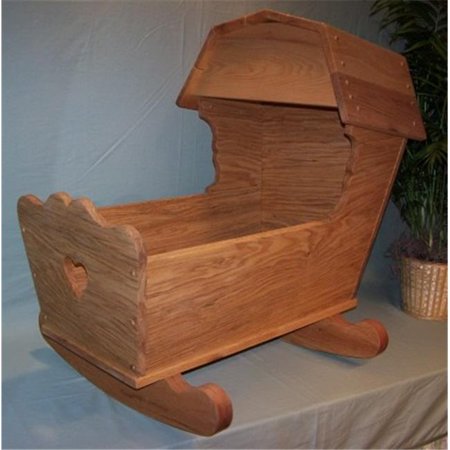
“The earliest and most common type of cradle is the rocker, derived undoubtedly from a half log, hollowed out to provide a secure resting place for the infant. From this to a simple box mounted on transverse curved sections was a short step, but a far cry from the miniature ‘great beds of state,’ richly carved and furnished with elaborate and costly hangings that were used to cradle the children of royalty. A particular American favorite is the type common with the early Colonists, characterized by sloping sides and a hooded end, most often made from simple nailed pine boards, although examples exist that represent in miniature all the major period styles, from Gothic to Art Nouveau.
Found on WalMart’s website ~ THE PUZZLE-MAN TOYS W-2510alt. Functional/Play Wooden Furniture – Live Baby Cradle Pennsylvania Dutch Overhead Canopy Style – Red Oak – 13 in. x 30 in.
“Almost as venerable is the type of cradle that consists of an open container suspended by hooks, chains, or rope from a standing frame. The earliest known example of this type is a Gothic cradle made at the end of the 15th century and reputed to have been used by Henry V (who, however, was born a hundred years earlier!). The box is simply pegged together and suspended between two standards or uprights braced on a flat frame. At the other extreme, in terms of construction, is a design illustrated by the famous 18th-century cabinetmaker Sheraton, in his Cabinet Dictionary, which includes a spring mechanism designed to keep the cradle rocking for an hour and a half — a function now accomplished by electric motors in this age of preoccupied childcare providers.”
The first time the future George IV received company, he was twelve days old and securely ensconced in a gold cradle surmounted with a gold coronet. He lay under a canopy of state, enveloped in crimson velvet and gold lace, in a nest of white satin. On either side stood ‘a fair mute, employed as occasion required, to rock the infant to sleep.’ The public were admitted in batches of forty. The daily bill for cake was GBP40, and for wine, ‘more than could have been conceived’.
Cradle commissioned by Queen Victoria for Princess Louise
Those who didn’t have money would fashion a cradle out of anything they could find – even an old barrel/key placed between two carefully spaced bricks or lumps of wood would provide a secure, ‘rockable’ cradle for a poor woman. Or, as people have done over the years, a drawer, her own bed, etc. I would think after the first year, unless the child was really sickly, but still lucky enough to be alive, the child would be getting a bit big for the standard drawer in furniture available to poorer folk in the Regency period.
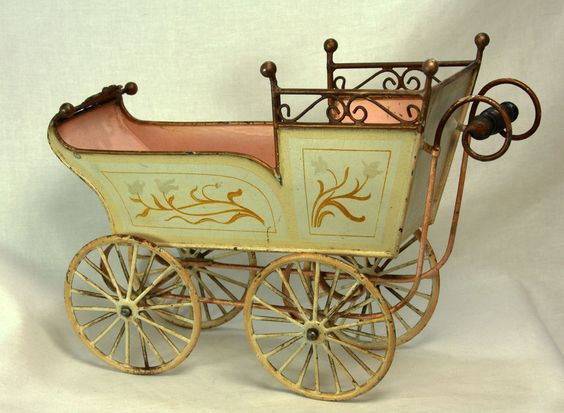
Antique Rare Large Marklin Doll Carriage c1910 ~ found on eBay
Some families converted a doll bed, but a family that had a doll bed for their child was a prosperous family. That goes well beyond subsistence living.
The church courts in Britain controlled the behavior of their clergymen. Yet, what all was involved? What were the “powers” of the bishop of each diocese?
The bishop had to ordain all clergymen. His approval was required for anyone who was presented a living. The bishop was the judge dealing with all aspects of marriage. They probated wills. The bishop or his representative were required to visit the churches within his diocese and hear any complaints of defamation, scold, blasphemy, and sacrilege, as well as other offenses for which a legal remedy was not openly apparent. This procedure was referred to as the “bawdy court.” The bishop’s power was limited to a. public scolding in church or excommunication. Most of the bishop’s power was over the church procedures and progress and the clergymen who ran the churches.
Governed by canon law, not the law of the land, the church courts had to right to try clerics for any number of violations. Each diocese had two types of church courts. The first was the “consistory” court which dealt with issues from the whole diocese and was presided over by the bishop.
Ecclesiastical courts not only placed clerics on trial. The courts also took on the duty of handling cases between “injured parties” if they were of a MORAL nature. Ecclesiastical courts addressed situations of accusation of a being a drunkard, swearing, attacking a cleric, gambling, especially during church services/mass, expressed heretical views, slander, leant money at interest, beating one’s wife, perjury, conducting business/trade on a Sunday, eating meat on a fasting day, not paying one’s tithes to the church, dissolution of a marriage based on claims of consanguinity or non-consummation, or a personal case against a cleric.
Ecclesiastical courts heard many cases related to fornication, adultery, homosexuality, prostitution, bigamy, bastardy, and incest. Anything dealing with “sex” were considered canon law.
These courts also oversaw some facets of a person’s will, especially if there were issues affecting the church or bringing it into dispute.
The other was the “archdeaconry court.” Its power covered only the archdeaconry and was presided over by the archdeacon.
If that last sentence went “over your head,” permit me an attempt to clarify. An archdeaconry is a legal division of a diocese for administrative purposes within which the archdeacon exercises an ordinary jurisdiction. The essential nature of the role has been described as ‘being a good steward so that others are freed to be the worshipping, witnessing and ministering. The legal responsibilities of the archdeacon can be found in this short PDF.
An archdeacon is a senior clergy position, below the bishop. Archdeacons serve the church in part of a diocese by taking particular responsibility for all buildings, the welfare of clergy and their families and the implementation of diocesan policy for the sake of the Gospel. An archdeaconry is their territorial division; these vary in number according to the size of the diocese and in a few, mainly English, cases an assistant (Suffragan) Bishop will also stand in as Archdeacon. [“The chapter”. Gloucester cathedral.]
They are usually styled “The Venerable” rather than their usual clerical style of “The Reverend.” In the Church of England the role can only be held by a priest who has been ordained for at least six years. (This rule was introduced in 1840. The rule stating they be in priest’s orders was enacted in 1662.) [Cross, FL, ed. (1957), The Oxford Dictionary of the Christian Church, London: Oxford University Press, p. 79.] In the Church of England, the legal act by which a priest becomes an archdeacon is called a collation. If that archdeaconry is annexed to a canonry of the cathedral, they will also be installed (placed in a stall) at that cathedral, in practice working largely in the chapter offices.
In some other Anglican churches, these men can be deacons instead of priests; such archdeacons often work with the bishop to help with deacons’ assignments to congregations and assist the bishop at ordinations and other diocesan liturgies. The Anglican ordinal presupposes (it is policy by default) that every Archdeacon helps to examine candidates for ordination and presents the most suitable candidate(s) to the ordaining bishop. [Archdeacons]
“For many, being tried in a church court was preferable to being tried in any of the other courts, especially for murder, since the church courts could not order capital punishment. The number of men in the church was vast. As well as monks and parish priests there were also chaplains and chantry priests scattered about the country. It’s been estimated that two percent or more of the male population was a cleric.
“A man could “prove” he was a cleric by reading a text from the Bible, which was not such an easy test as you might think. The literacy rate was low, but it was higher than two percent.
“Whilst the church courts did not have the death penalty, they did have some imaginative punishments. They issued fines or ordered the guilty party to be whipped. Most of the punishments were carried out in public. Sometimes it was to make an offering in church in front of the whole of the parish, or to stand in a white sheet by the door of the church, being passed by other parishioners as they went in and out of the church to mass. The ultimate punishment, of course, was excommunication.
“The highest church court was the Convocation where the worst crimes committed by clerics were tried. For a cleric, the worst punishment was usually being defrocked.” [A Writer’s Perspective]
I fear last Monday’s post stirred up more confusion than clarity. Such is the problem for many American writers of Regency era stories. Without a peerage system of our own in the U.S., we become easily confused. Most assuredly, I screwed up on more than one occasion. In one of my early books I had a duke addressed as “my lord” instead of “your grace.” Boy, did I hear from that one! I apologize again for all those who I offended. Ignorance is certainly not bliss!
So today, we have part two of some questions on courtesy titles and titles, in general.
Question #1: I believe I read somewhere that Prinny [George, Prince of Wales, (often referred to as Prinny) was the eldest son of George III and was named Prince Regent when his father became too mentally unstable to rule. His “regency,” 1811-1820, gives name to the period. He reigned as George IV from 1820 to 1830] could bestow courtesy titles, is that correct? If so, could a Duke approach Prinny and “purchase” a courtesy title for a man based on his brave deeds?
How would this work? And how long would this process take? And I see the Prince regent held frequent levees during the Regency where he conferred honors on men, welcomed ambassadors, celebrated his birthday, etc. Would these levees be a time for conferring such honors?
Response: The Prince Regent acted in place of the sovereign, and it is true the sovereign could award real titles, but, I fear, not courtesy titles.
Any one could recommend a man to be knighted, made a baronet, made a baron.
As to titles, a man could be made a knight, a baronet, baron, viscount, or earl, depending on the rank he already held and the service he had preformed. It was very rare for anyone to be made a peer of higher rank than earl on the first go around. Even the Duke of Wellington was only conferred as Viscount Wellington in the beginning.
To the best of my knowledge, James I openly sold baronetcies. Most other peerage titles were advancements in the peerage for those already peers or new creations like the one for Wellington. Most new creations in the peerage were made barons. The most issued honor was a common knighthood. Next comes a baronetcy. Both the knighthood and the baronetcy were addressed as “Sir,” but only the baronetcy was hereditary.
Follow-Up Question: So, I could have a Duke approach King George IV (as my story is set in 1820) and request a man be made a baron. What would likely sway the King? Some deed of bravery, such as saving a marquess’s daughter, a duke’s sister-in-law, and rescuing over 100 children? What would prove his loyalty to the king and also show him as worthy?
Also, how long before the title could be bestowed and how would it be announced?
Response: If the Duke could assure the King, the man would be a good Tory, the Prime Minister would not put up a fuss.
In the “olden” days, the king would take a sword and tap the man on the shoulder and then fasten a belt around his waist with which to hold the sword, such is why men had been called “belted earls.” By 1820, the man had to be asked what title he preferred. Wellington’s brother is said to have chosen Wellington for his brother’s peerage when the man was first made a viscount.
Then the College of Arms checks to see if anyone else has that title. Had been attainted? Was it in abeyance?
Then a patent is drawn up bestowing the peerage on the man. If the patent has an error it cannot be corrected.
There is a ceremony at which time the king bestows the title on the man and gives him the patent.
The man must pay the College of arms a fee.
Then he must apply to the House of Lords for admittance as a peer. (A writ of summons). He sends in a statement he has a patent and provides the information about it which has already been published in the London Gazette.
He asks two peers of his own rank– one the most senior he can find and the other the youngest before him (meaning the date their peerages were bestowed, not the person’s actual age) to accompany him. He receives a writ of summons and when the House is in session he dresses in his parliamentary robe with his two sponsors also in their robes (They must be of the same rank as he and cannot be the duke).
He approaches the woolsack and presents his credentials. His patent is read aloud. Then he and the two sponsors step out to remove their robes and return quietly to take seats in ordinary clothes.
As an after note, I used the introduction procedure as a plot point in my story “Courting Lord Whitmire.” In a pivotal chapter, Lord Andrew Whitmire is called to House of Lords to claim his title and, afterwards, encounters the Duke of Wellington. Irony, thy name is plot devices!
Courting Lord Whitmire: A May-December Regency Romance By Regina Jeffers
(Released March 22, 2020)
At the bend of the path, an unexpected meeting.
She is all May. He is December.
But loves knows not time.
Colonel Lord Andrew Whitmire has returned to England after spending fifteen years in service to his country. In truth, he would prefer to be anywhere but home. Before he departed England, his late wife, from an arranged marriage, had cuckolded him in a scandal that had set Society’s tongues wagging. His daughter, Matilda, who was reared by his father, enjoys calling him “Father” in the most annoying ways. Unfortunately, his future is the viscountcy, and Andrew knows his duty to both the title and his child. He imagines himself the last of his line until he encounters Miss Verity Coopersmith, the niece of his dearest friend, the man who had saved Andrew’s life at Waterloo. Miss Coopersmith sets Whitmire’s world spinning out of control. She is truly everything he did not know he required in his life. However, she is twenty-two years his junior, young enough to be his daughter, but all he can think is she is absolute perfection.
Keeping with Wednesday’s post on Circulating Libraries, I thought I might mention a library some, especially in the U.S. have not considered. The Cotton Library was founded by Sir Robert Bruce Cotton, 1st Baronet (1571-1631) of Conington Hall in Huntingdonshire, England. Cotton was an MP (Member of Parliament) but his importance, at least, the the subject of this post, he was an antiquarian who founded the Cotton Library.
Educated at Westminster School, where he was a pupil of Willian Camden, a renown antiquarian of his time, Cotton began collecting rare manuscripts as well as collecting information on the history of Huntingdonshire as early as age 17. Later, he studied first at the The College of the Blessed Virgin Mary, Saint John the Evangelist and the glorious Virgin Saint Radegund, near Cambridge and later entered the Middle Temple to study law. The library which he began to amass eventually surpassed those in royal manuscript collections.
After the Dissolution of the Monasteries, a set of administrative and legal processes between 1536 and 1541 by which Henry VIII disbanded monasteries, priories, convents, and friaries in England, Wales, and Ireland, many ancient manuscripts which had belonged to the monastic libraries came to be disseminated among a number of owners, many of whom had no idea of their cultural actual value to the nation. Cotton located, purchased, and preserved many of these documents, including items by Francis Bacon, [1st Viscount St Alban, an English philosopher and statesman who served as Attorney General and Lord Chancellor of England, but for today’s topic of libraries, Bacon led the advancement of both natural philosophy and the scientific method], Sir Walter Raleigh [authored The Historie of the World, In Five Books and a type of poetry that resisted the Italian Renaissance influence], and James Ussher [most famous for his identification of the genuine letters of the church father, Ignatius of Antioch, and for his chronology that sought to establish the time and date of the creation as around 6 P.M. on 22 October 4004 BC].
Cotton employed scholar and poet Richard James as his librarian. The library is of special importanace for having preserved the only copy of several works, such as with Beowulf and Sir Gawain and the Green Knight.
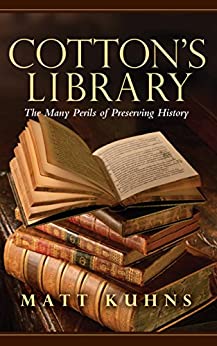
While doing some research into the history of the great Cotton Library for another project I have taken on, I came across a most excellent book on the topic, Cotton’s Library: The Many Perils of Preserving History, by Matt Kuhns. It is a great read, which I highly recommend to anyone interested in the history of old library collections. Below is the book blurb from Amazon, if anyone is interested.
“Cotton’s Library” reveals what can happen to a museum-quality collection before it reaches the safety of a museum (and sometimes, even after).
Discover the story of an embryonic British national library assembled more than 400 years ago by Sir Robert Cotton. Boasting masterpieces of medieval illumination, the sole manuscript sources of Beowulf and “Sir Gawain and the Green Knight,” and two of four surviving 1215 copies of Magna Carta as well as many less-famed but still priceless historic records, Cotton’s library was and is an irreplaceable treasure of the English-speaking world. Cotton and his successors nonetheless struggled for centuries to preserve his library for, and sometimes from, formal government custodianship.
Overcoming war, repression, greedy heirs, intriguing rivals and disastrous fires, they ultimately succeeded, to our own great benefit. “Cotton’s Library” tells how they did it.
Cotton House, in which the library was first housed, was located right in the middle of Westminster in the seventeenth century. Thus, it became the first de facto library of Parliament, the free use of which Cotton granted to all MPs. This so annoyed King Charles I he eventually “confiscated” the library, by actually putting guards in Cotton’s house, to prevent anyone from using it. Which is a great part of the library’s story.
Lest you think I digress, in order to show how close Cotton House actually stood to the Houses of Parliament at that time, The author Matt Kuhns includes a plan of the area of Westminster which shows the location of Cotton House. Even better, on the plan he includes the location of the Houses of Lords and Commons, along with Westminster Hall in the seventeenth century, the same locations they had during the Regency era, for those of us who dabble in Regency based tales. He also includes the footprint of the new, current Houses of Parliament. (see the link at the bottom of the page)
Matt Kuhns also has posted high-resolution .PNG files of some of the illustrations he used in his book at his blog. And one of those illustrations is the plan of Cotton House in Westminster, which includes the location of the House of Lords and the House of Commons as they were during the Regency, with the footprint of the new building overlaid.
Another author friend sent me these questions regarding the circulating libraries. I will provide the short answers to the questions first and then provide a longer explanations.
Was there always a fee to check out a book? Was that paid per item or weekly or monthly?
There was not necessarily a fee to take a book, but library users did have to subscribe to the library and pay a membership or user fee. The exact amount of the fee varied from library to library. Institutions typically offered a choice of annual, semi-annual, or quarterly memberships. Some had monthly options, or loaned books to individuals on a one-time basis for a fee. Once your subscription fee was paid, you were allowed to take out a certain number of books, and that number depended on your subscription level.
Was there a librarian who recorded titles and the patrons who wanted to borrow them?
No borrowing records have survived to my knowledge. Occasionally libraries listed subscribers in the back of their catalogues, along with the rules of subscription. There are many surviving library catalogues that provide lists of the books held by the library.
Was it called checking out a book? Borrowing? Something else?
They did not use “check out.” I have seen the term “use,” as in “the use of two books at a time.” I have also seen “take out.”
Also, from what I have found, it was a fashionable place to see and be seen, as well as check out books and read the latest magazines and newspapers.
They were certainly fashionable places for the middle classes and were used as places for meetings and discussions. Some libraries had newsrooms attached to them. There are engravings and images from the time which show what libraries looked like, including architecture, and patrons (even dogs) in the space.
The circulating libraries were not “free” libraries as we think of them today. In public libraries across the U.S. and the UK, people enter, use the books, even check out the books for their use at home with no cost to them. Many people use the libraries for their internet access.
However, during the Regency and a bit beyond, the patrons of the libraries paid a fee to use the materials within. Printed books from the time of the Gutenberg Bible onward were a rich man’s pleasure. Those of modest means, though they may be able to read and write, could not afford to purchase books.
From The Atlantic, we learn, “Before she was a writer, Jane Austen was a reader. A reader, moreover, within a family of readers, who would gather in her father’s rectory to read aloud from the work of authors such as Samuel Johnson, Frances Burney, and William Cowper—as well as, eventually, Jane’s own works-in-progress.
“Not surprisingly, then, in Austen’s novels, the act of reading is a key indication of how a character should initially be judged, and of major turning points in her development. For Austen, the way a character reads is emblematic of other forms of interpretation: One’s skills in comprehending written language are linked to one’s ability to understand life, other people, and oneself.”
Note! If you have not read this article from The Atlantic on “What Jane Austen’s ‘Pride and Prejudice’ Teaches Readers,” I highly recommend it. It provides wonderful insights into Austen’s innate love of literature and how she crafts her characters around it.
Initially, booksellers became a gathering place for the wealthy or those with particular interests to meet to discuss literature and ideas. The shops themselves offered comfy chairs to sit and peruse a book. A warm fireplace. Tea or other libations. It was assumed the rich could be trusted to treat the books with a degree of respect.
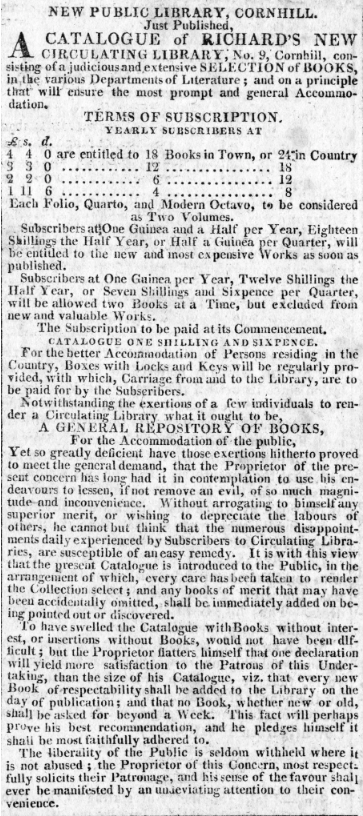
“By the mid-eighteenth century, the social aspects of these literary bookstores were nearly as important as the books they housed. In 1742, the Reverend Samuel Fancourt, a dissenting minister, opened what many believe to be the first circulating library in London. In fact, Fancourt may very well have coined the term, for the first instance of “circulating library” in print cited in the Oxford English Dictionary is from one of Fancourt’s advertisements in June of 1742. This library was organized on a subscription plan, by which those who wished to use the books became a member of the library. Each member paid one guinea per year, plus a shilling each quarter day. Fancourt had to relinquish ownership of his library in 1745, but the books were kept and other members reorganized the library as a non-commercial entity run by a committee of the subscribers. They maintained the same dues and fees, out of which they were able to rent rooms for the library in Crane Court, Fleet Street and pay the salary of the librarian, the Rev. Fancourt. The contents of this library were primarily theological, philosophical and technical, thus only appealing to a limited readership. But others in London saw the promise of this circulating library model and soon there were circulating libraries opening up all around London. Within a decade, they began to spread to other cities and towns across Britain. There were soon thriving circulating libraries in Bath, Bristol, Liverpool, Newcastle, Norwich, Birmingham, Hull and Edinburgh. Eventually, nearly every village and hamlet across Britain could boast a circulating library, be it ever so small.
“Few of these later circulating libraries stocked religious or philosophical books. But some did originally set up to cater to subscribers with specific areas of interest, though these libraries tended to be formed by existing clubs. For example, there were circulating libraries for members of clubs devoted to science which enabled all its members to have access to all the latest scientific publications in the club’s library, so long as they paid their club dues and were members in good standing. There were similar “club” libraries for those interested in the arts, the classics, the law or history. There were men’s clubs whose members had broader interests, and some of these clubs also had circulating libraries where their members would find books on a wider range of subjects, such as biography, travel, politics, and even agriculture, in addition to a smattering of the more popular books on history, natural philosophy and art. These more general club libraries usually also subscribed to most of the popular newspapers and magazines, making them available in their library or a separate reading room. Here, members could relax and catch up on current events, in the company of other members, with no fear of intrusion from non-members, even their families. Technically, both White’s and Brooks’s were circulating libraries of sorts, as they both subscribed to all the London and some provincial newspapers, which were made available to their members. Those circulating libraries which were established within a club were not open to the public, only to the members of the club which owned the library. In most cases, the membership was all male. Only the members could use the library or borrow books or other materials from it, but all of their family or friends who were not members of the club were excluded.” [Regency Redingote]
Eventually, the booksellers, especially those in London, realized there must be a means to “sell” books to all, not just to the wealthy, for this was a whole new market for their wares. Thus, they created the circulating libraries or lending libraries. Unlike the gentlemen’s clubs mentioned above, these libraries did not discriminate when it came to who could “borrow” the books. If one could afford to pay the fee, one could read from a variety of topics.
Those of us who love to read novels to escape to “other worlds,” would likely have been patrons of the circulating libraries. Many, initially, thought the novels had ruined the minds of young people, especially women. Moreover, novels were quite costly to print, and, as many would not invest so much for a book one might only read once, a change had to come. It was circulating libraries that “encouraged” the printers of the day to print books in three parts to keep patrons coming back for more.
Regency Redingote also tells us, “Books of poetry, books on classical studies, the law, science, history, agricultural improvements, even travel, were considered worthy of purchase by many, but few, even among the wealthy, would have considered purchasing a novel. . . . [b]y 1810, the average price of a three-decker novel was seven shillings per volume, which comes to about $90.00 modern-day US dollars. By the Regency, for about a guinea a year, equal to about twenty-one shillings, or the price of one three-decker novel, a circulating library subscriber could borrow as many novels as they liked, with the payment of a small fee, usually a few pence, for each volume they borrowed. By the beginning of the nineteenth century, many circulating libraries also offered group or family rates, thus providing affordable access to books by whole families.”
This post originally appeared on the Austen Authors’ blog on December 16, 2021. (Note: December 16, 1775, is Austen’s birthday.) Enjoy!
In pondering what to focus on for my December blog post, I naturally gravitated toward Christmas. Once known as “Christ’s Mass,” Christmas has certainly evolved into something that no one would have anticipated hundreds of years ago! As a sort of side note, as you may or may not know, it is perfectly fine to abbreviate Christmas as “Xmas” or “X-mas” in a symbolic sense. The “X” comes from the first letter of the Greek word used for “Christ,” and many moons ago, it was used as a way to represent Jesus’s title.
I decided it would be interesting to show references to Christmas in Jane Austen’s six major novels. The references below will not include all that happens during the Christmas period, but rather,a1 some of the text surrounding the word “Christmas” in her novels. To my surprise, every one of her six major novels referenced Christmas! (And there was not one occurrence of the word “yule,” in case you wondered!)
Emma (11 references to Christmas)
Her sister, though comparatively but little removed by matrimony, being settled in London, only sixteen miles off, was much beyond her daily reach; and many a long October and November evening must be struggled through at Hartfield, before Christmas brought the next visit from Isabella and her husband, and their little children, to fill the house, and give her pleasant society again.
“Very well; I will not plague you any more. Emma shall be an angel, and I will keep my spleen to myself till Christmas brings John and Isabella. John loves Emma with a reasonable and therefore not a blind affection, and Isabella always thinks as he does; except when he is not quite frightened enough about the children. I am sure of having their opinions with me.”
“Yes, my dear, if there is time.–But–(in a very depressed tone)–she is coming for only one week. There will not be time for any thing.””It is unfortunate that they cannot stay longer–but it seems a case of necessity. Mr. John Knightley must be in town again on the 28th, and we ought to be thankful, papa, that we are to have the whole of the time they can give to the country, that two or three days are not to be taken out for the Abbey. Mr. Knightley promises to give up his claim this Christmas–though you know it is longer since they were with him, than with us.””It would be very hard, indeed, my dear, if poor Isabella were to be anywhere but at Hartfield.”
In general their evenings were less engaged with friends than their mornings; but one complete dinner engagement, and out of the house too, there was no avoiding, though at Christmas. Mr. Weston would take no denial; they must all dine at Randalls one day;–even Mr. Woodhouse was persuaded to think it a possible thing in preference to a division of the party.
“Christmas weather,” observed Mr. Elton. “Quite seasonable; and extremely fortunate we may think ourselves that it did not begin yesterday, and prevent this day’s party, which it might very possibly have done, for Mr. Woodhouse would hardly have ventured had there been much snow on the ground; but now it is of no consequence. This is quite the season indeed for friendly meetings. At Christmas every body invites their friends about them, and people think little of even the worst weather. I was snowed up at a friend’s house once for a week. Nothing could be pleasanter. I went for only one night, and could not get away till that very day se’nnight.”
The weather was most favourable for her; though Christmas Day, she could not go to church. Mr. Woodhouse would have been miserable had his daughter attempted it, and she was therefore safe from either exciting or receiving unpleasant and most unsuitable ideas. The ground covered with snow, and the atmosphere in that unsettled state between frost and thaw, which is of all others the most unfriendly for exercise, every morning beginning in rain or snow, and every evening setting in to freeze, she was for many days a most honourable prisoner. No intercourse with Harriet possible but by note; no church for her on Sunday any more than on Christmas Day; and no need to find excuses for Mr. Elton’s absenting himself.
“How d’ye do?–how d’ye do?–We have been sitting with your father–glad to see him so well. Frank comes to-morrow–I had a letter this morning–we see him to-morrow by dinner-time to a certainty–he is at Oxford to-day, and he comes for a whole fortnight; I knew it would be so. If he had come at Christmas he could not have staid three days; I was always glad he did not come at Christmas; now we are going to have just the right weather for him, fine, dry, settled weather. We shall enjoy him completely; every thing has turned out exactly as we could wish.”
“Oh! for myself, I protest I must be excused,” said Mrs. Elton; “I really cannot attempt–I am not at all fond of the sort of thing. I had an acrostic once sent to me upon my own name, which I was not at all pleased with. I knew who it came from. An abominable puppy!–You know who I mean (nodding to her husband). These kind of things are very well at Christmas, when one is sitting round the fire; but quite out of place, in my opinion, when one is exploring about the country in summer. Miss Woodhouse must excuse me. I am not one of those who have witty things at every body’s service. I do not pretend to be a wit. I have a great deal of vivacity in my own way, but I really must be allowed to judge when to speak and when to hold my tongue. Pass us, if you please, Mr. Churchill. Pass Mr. E., Knightley, Jane, and myself. We have nothing clever to say–not one of us.
Mansfield Park (8 references to Christmas)
Once, and once only, in the course of many years, had she the happiness of being with William. Of the rest she saw nothing: nobody seemed to think of her ever going amongst them again, even for a visit, nobody at home seemed to want her; but William determining, soon after her removal, to be a sailor, was invited to spend a week with his sister in Northamptonshire before he went to sea. Their eager affection in meeting, their exquisite delight in being together, their hours of happy mirth, and moments of serious conference, may be imagined; as well as the sanguine views and spirits of the boy even to the last, and the misery of the girl when he left her. Luckily the visit happened in the Christmas holidays, when she could directly look for comfort to her cousin Edmund; and he told her such charming things of what William was to do, and be hereafter, in consequence of his profession, as made her gradually admit that the separation might have some use.
“Ordained!” said Miss Crawford; “what, are you to be a clergyman?””Yes; I shall take orders soon after my father’s return–probably at Christmas.”
“And I am convinced to the contrary. Nobody is fonder of the exercise of talent in young people, or promotes it more, than my father, and for anything of the acting, spouting, reciting kind, I think he has always a decided taste. I am sure he encouraged it in us as boys. How many a time have we mourned over the dead body of Julius Caesar, and to be’d and not tobe’d, in this very room, for his amusement? And I am sure, my name was Norval, every evening of my life through one Christmas holidays.”
” . . . I am glad to hear Bertram will be so well off. He will have a very pretty income to make ducks and drakes with, and earned without much trouble. I apprehend he will not have less than seven hundred a year. Seven hundred a year is a fine thing for a younger brother; and as of course he will still live at home, it will be all for his menus plaisirs; and a sermon at Christmas and Easter, I suppose, will be the sum total of sacrifice.”
“Ah, my dear Sir Thomas!” interrupted Mrs. Norris, “I knew what was coming. I knew what you were going to say. If dear Julia were at home, or dearest Mrs. Rushworth at Sotherton, to afford a reason, an occasion for such a thing, you would be tempted to give the young people a dance at Mansfield. I know you would. If they were at home to grace the ball, a ball you would have this very Christmas. Thank your uncle, William, thank your uncle!”
Edmund was at this time particularly full of cares: his mind being deeply occupied in the consideration of two important events now at hand, which were to fix his fate in life–ordination and matrimony–events of such a serious character as to make the ball, which would be very quickly followed by one of them, appear of less moment in his eyes than in those of any other person in the house. On the 23rd he was going to a friend near Peterborough, in the same situation as himself, and they were to receive ordination in the course of the Christmas week. Half his destiny would then be determined, but the other half might not be so very smoothly wooed.
” . . . I should like to have seen him once more, I confess. But you must give my compliments to him. Yes; I think it must be compliments. Is not there a something wanted, Miss Price, in our language–a something between compliments and–and love–to suit the sort of friendly acquaintance we have had together? So many months’ acquaintance! But compliments may be sufficient here. Was his letter a long one? Does he give you much account of what he is doing? Is it Christmas gaieties that he is staying for?”
” . . . Poor young man! If he is to die, there will be two poor young men less in the world; and with a fearless face and bold voice would I say to any one, that wealth and consequence could fall into no hands more deserving of them. It was a foolish precipitation last Christmas, but the evil of a few days may be blotted out in part. Varnish and gilding hide many stains. It will be but the loss of the Esquire after his name. . . . “
Northanger Abbey (3 references to Christmas)
“The very picture of him indeed!” cried the mother—and “I should have known her anywhere for his sister!” was repeated by them all, two or three times over. For a moment Catherine was surprised; but Mrs. Thorpe and her daughters had scarcely begun the history of their acquaintance with Mr. James Morland, before she remembered that her eldest brother had lately formed an intimacy with a young man of his own college, of the name of Thorpe; and that he had spent the last week of the Christmas vacation with his family, near London.
She went home very happy. The morning had answered all her hopes, and the evening of the following day was now the object of expectation, the future good. What gown and what head-dress she should wear on the occasion became her chief concern. She cannot be justified in it. Dress is at all times a frivolous distinction, and excessive solicitude about it often destroys its own aim. Catherine knew all this very well; her great aunt had read her a lecture on the subject only the Christmas before; and yet she lay awake ten minutes on Wednesday night debating between her spotted and her tamboured muslin, and nothing but the shortness of the time prevented her buying a new one for the evening. This would have been an error in judgment, great though not uncommon, from which one of the other sex rather than her own, a brother rather than a great aunt, might have warned her, for man only can be aware of the insensibility of man towards a new gown. It would be mortifying to the feelings of many ladies, could they be made to understand how little the heart of man is affected by what is costly or new in their attire; how little it is biased by the texture of their muslin, and how unsusceptible of peculiar tenderness towards the spotted, the sprigged, the mull, or the jackonet. Woman is fine for her own satisfaction alone. No man will admire her the more, no woman will like her the better for it. Neatness and fashion are enough for the former, and a something of shabbiness or impropriety will be most endearing to the latter. But not one of these grave reflections troubled the tranquillity of Catherine.
“You are so like your dear brother,” continued Isabella, “that I quite doted on you the first moment I saw you. But so it always is with me; the first moment settles everything. The very first day that Morland came to us last Christmas—the very first moment I beheld him—my heart was irrecoverably gone. I remember I wore my yellow gown, with my hair done up in braids; and when I came into the drawing-room, and John introduced him, I thought I never saw anybody so handsome before.”
Persuasion (6 references to Christmas)
Lady Russell, convinced that Anne would not be allowed to be of any use, or any importance, in the choice of the house which they were going to secure, was very unwilling to have her hurried away so soon, and wanted to make it possible for her to stay behind till she might convey her to Bath herself after Christmas; but having engagements of her own which must take her from Kellynch for several weeks, she was unable to give the full invitation she wished, and Anne though dreading the possible heats of September in all the white glare of Bath, and grieving to forego all the influence so sweet and so sad of the autumnal months in the country, did not think that, everything considered, she wished to remain. It would be most right, and most wise, and, therefore must involve least suffering to go with the others.
Though Charles and Mary had remained at Lyme much longer after Mr and Mrs Musgrove’s going than Anne conceived they could have been at all wanted, they were yet the first of the family to be at home again; and as soon as possible after their return to Uppercross they drove over to the Lodge. They had left Louisa beginning to sit up; but her head, though clear, was exceedingly weak, and her nerves susceptible to the highest extreme of tenderness; and though she might be pronounced to be altogether doing very well, it was still impossible to say when she might be able to bear the removal home; and her father and mother, who must return in time to receive their younger children for the Christmas holidays, had hardly a hope of being allowed to bring her with them.
Immediately surrounding Mrs Musgrove were the little Harvilles, whom she was sedulously guarding from the tyranny of the two children from the Cottage, expressly arrived to amuse them. On one side was a table occupied by some chattering girls, cutting up silk and gold paper; and on the other were tressels and trays, bending under the weight of brawn and cold pies, where riotous boys were holding high revel; the whole completed by a roaring Christmas fire, which seemed determined to be heard, in spite of all the noise of the others. Charles and Mary also came in, of course, during their visit, and Mr Musgrove made a point of paying his respects to Lady Russell, and sat down close to her for ten minutes, talking with a very raised voice, but from the clamour of the children on his knees, generally in vain. It was a fine family-piece.Anne, judging from her own temperament, would have deemed such a domestic hurricane a bad restorative of the nerves, which Louisa’s illness must have so greatly shaken. But Mrs Musgrove, who got Anne near her on purpose to thank her most cordially, again and again, for all her attentions to them, concluded a short recapitulation of what she had suffered herself by observing, with a happy glance round the room, that after all she had gone through, nothing was so likely to do her good as a little quiet cheerfulness at home. Louisa was now recovering apace. Her mother could even think of her being able to join their party at home, before her brothers and sisters went to school again. The Harvilles had promised to come with her and stay at Uppercross, whenever she returned. Captain Wentworth was gone, for the present, to see his brother in Shropshire.“I hope I shall remember, in future,” said Lady Russell, as soon as they were reseated in the carriage, “not to call at Uppercross in the Christmas holidays.”
“My dear Anne,–I make no apology for my silence, because I know how little people think of letters in such a place as Bath. You must be a great deal too happy to care for Uppercross, which, as you well know, affords little to write about. We have had a very dull Christmas; Mr and Mrs Musgrove have not had one dinner party all the holidays. I do not reckon the Hayters as anybody. The holidays, however, are over at last: I believe no children ever had such long ones. I am sure I had not. The house was cleared yesterday, except of the little Harvilles; but you will be surprised to hear they have never gone home. . . .”
“This was the light in which it appeared to those who knew the family, long before you returned to it; and Colonel Wallis had his eye upon your father enough to be sensible of it, though he did not then visit in Camden Place; but his regard for Mr Elliot gave him an interest in watching all that was going on there, and when Mr Elliot came to Bath for a day or two, as he happened to do a little before Christmas, Colonel Wallis made him acquainted with the appearance of things, and the reports beginning to prevail. . . .”
Pride and Prejudice (6 references to Christmas
“When my brother left us yesterday, he imagined that the business which took him to London might be concluded in three or four days; but as we are certain it cannot be so, and at the same time convinced that when Charles gets to town he will be in no hurry to leave it again, we have determined on following him thither, that he may not be obliged to spend his vacant hours in a comfortless hotel. Many of my acquaintances are already there for the winter; I wish that I could hear that you, my dearest friend, had any intention of making one of the crowd—but of that I despair. I sincerely hope your Christmas in Hertfordshire may abound in the gaieties which that season generally brings, and that your beaux will be so numerous as to prevent your feeling the loss of the three of whom we shall deprive you.”
On the following Monday, Mrs. Bennet had the pleasure of receiving her brother and his wife, who came as usual to spend the Christmas at Longbourn.
“Pray, my dear aunt, what is the difference in matrimonial affairs, between the mercenary and the prudent motive? Where does discretion end, and avarice begin? Last Christmas you were afraid of his marrying me, because it would be imprudent; and now, because he is trying to get a girl with only ten thousand pounds, you want to find out that he is mercenary.”
After the first fortnight or three weeks of her absence, health, good humour, and cheerfulness began to reappear at Longbourn. Everything wore a happier aspect. The families who had been in town for the winter came back again, and summer finery and summer engagements arose. Mrs. Bennet was restored to her usual querulous serenity; and, by the middle of June, Kitty was so much recovered as to be able to enter Meryton without tears; an event of such happy promise as to make Elizabeth hope that by the following Christmas she might be so tolerably reasonable as not to mention an officer above once a day, unless, by some cruel and malicious arrangement at the War Office, another regiment should be quartered in Meryton.
“Is your sister at Pemberley still?”“Yes, she will remain there till Christmas.” “And quite alone? Have all her friends left her?”“Mrs. Annesley is with her. The others have been gone on to Scarborough, these three weeks.”
“I would have thanked you before, my dear aunt, as I ought to have done, for your long, kind, satisfactory, detail of particulars; but to say the truth, I was too cross to write. You supposed more than really existed. But now suppose as much as you choose; give a loose rein to your fancy, indulge your imagination in every possible flight which the subject will afford, and unless you believe me actually married, you cannot greatly err. You must write again very soon, and praise him a great deal more than you did in your last. I thank you, again and again, for not going to the Lakes. How could I be so silly as to wish it! Your idea of the ponies is delightful. We will go round the Park every day. I am the happiest creature in the world. Perhaps other people have said so before, but not one with such justice. I am happier even than Jane; she only smiles, I laugh. Mr. Darcy sends you all the love in the world that he can spare from me. You are all to come to Pemberley at Christmas. Yours, etc.”
Sense and Sensibility (2 references to Christmas)
“He is as good a sort of fellow, I believe, as ever lived,” repeated Sir John. “I remember last Christmas at a little hop at the park, he danced from eight o’clock till four, without once sitting down.”“Did he indeed?” cried Marianne with sparkling eyes, “and with elegance, with spirit?”“Yes; and he was up again at eight to ride to covert.”
“Oh, my dear Miss Dashwood,” said Mrs. Palmer soon afterwards, “I have got such a favour to ask of you and your sister. Will you come and spend some time at Cleveland this Christmas? Now, pray do,—and come while the Westons are with us. You cannot think how happy I shall be! It will be quite delightful!—My love,” applying to her husband, “don’t you long to have the Miss Dashwoods come to Cleveland?”
It’s interesting to try to get a sort of general view of Austen’s use of Christmas in her novels. Much like in modern times, Christmas appears to have been a time about getting together and having fun. Of course, not everyone appreciates that fun as much as others! What are your thoughts on how Austen handles Christmas? I especially like what she does in Emma, though I find myself quite amused by the picture of children that is painted in Persuasion.
On a side note, I recently published a children’s book called The Moonicorn. It was illustrated by Jann Rowland’s very talented son, Andrew, and I would love for you to go check it out! I cannot praise Andrew’s beautiful illustrations enough!
All of the stories listed below will be on sale, starting today through January 5, 2023. Fill up your eReaders!!!! All books will be $0.99. These books are historical romantic suspense and Regencies, as well as two contemporary tales. Moreover, most are available to read on Kindle Unlimited. MERRY CHRISTMAS!!!!! [For Jane Austen Fan Fiction titles, see Friday’s post, December 23, 2022.]
Lady Joy and the Earl: A Regency Christmas Romance
Award-Winning Finalist in the Fiction: Novella category of the 2019 International Book Awards
They have loved each other since childhood, but life has not been kind to either of them. James Highcliffe’s arranged marriage had been everything but loving, and Lady Joy’s late husband believed a woman’s spirit was meant to be broken. Therefore, convincing Lady Jocelyn Lathrop to abandon her freedom and consider marriage to him after twenty plus years apart may be more than the Earl of Hough can manage. Only the spirit of Christmas can bring these two together when secrets mean to keep them apart.
Second Place in Short Historical Category ~ 2019 International Digital Awards
She is the woman whose letters to another man kept Simon alive during the war. He is the English officer her late husband claimed to be incomparable. In her, his heart whispers of finally being “home.” In him, she discovers a man who truly stirs her soul. Unfortunately for both, the lady fears no longer being invisible to the world and assuming a place at his side. Can Major Lord Simon Lanford claim Mrs. Faith Lamont as his wife or will his rise to the earldom and his family’s expectations keep them apart? “This was both a heart-breaking and heart-warming second chance love story, made all the more satisfying by the Christmas setting.” – Calico Hearts Review
Courting Lord Whitmire: A Regency May-December Romance
At the bend of the path, an unexpected meeting.
She is all May. He is December.
But loves knows not time.
Colonel Lord Andrew Whitmire has returned to England after spending fifteen years in service to his country. In truth, he would prefer to be anywhere but home. Before he departed England, his late wife, from an arranged marriage, had cuckolded him in a scandal that had set Society’s tongues wagging. His daughter, Matilda, who was reared by his father, enjoys calling him “Father” in the most annoying ways. Unfortunately, his future is the viscountcy, and Andrew knows his duty to both the title and his child. He imagines himself the last of his line until he encounters Miss Verity Coopersmith, the niece of his dearest friend, the man who had saved Andrew’s life at Waterloo. Miss Coopersmith sets Whitmire’s world spinning out of control. She is truly everything he did not know he required in his life. However, she is twenty-two years his junior, young enough to be his daughter, but all he can think is she is absolute perfection.
JACKSON SHAW, the Marquess of Rivens, never considered the “gypsy blessing” presented to his family during the time of Henry VIII truly a blessing. He viewed it more as a curse. According to the “blessing,” in his thirtieth year, at the Christmas ball hosted by his family, he was to choose a wife among the women attending. The catch was he possessed no choice in the matter. His wife was to be the one who proved herself to be his perfect match, according to the gypsy’s provisions: a woman who would bring prosperity to his land by her love of nature and her generous heart. In his opinion, none of the women vying for his hand appeared to care for anything but themselves.
EVELYN HAWTHORNE comes to River’s End to serve as the companion to the Marchioness of Rivens, his lordship’s grandmother. However, Lady Rivens has more than companionship in mind when she employs the girl, whose late father was a renown horticulturalist. The marchioness means to gather Gerald Hawthorne’s rare specimens to prevent those with less scrupulous ideas from purchasing Hawthorne’s conservatory, and, thereby, stealing away what little choice her grandson has in naming a wife, for all the potential brides must present the Rivenses with a rare flower to demonstrate the lady’s love of nature. Little does the marchioness know Hawthorne’s daughter might not only know something of nature, but be the person to fulfill the gypsy’s blessing.
What happens when a lady falls in love, not with her betrothed, but rather with his cousin?
Miss Priscilla Keenan has been promised to the Marquess of Blackhurst since her birth. The problem is: She has never laid eyes upon the man. So, when Blackhurst sends his cousin to York to assist Priscilla in readying Blackhurst’s home estate for the marquess’s return from his service in India, it is only natural for Priscilla to ask Mr. Alden something of the marquess’s disposition. Yet, those conversations lead Cilla onto a different path, one where she presents her heart to the wrong gentleman. How can she and Alden find happiness together when the world means to keep them apart? Inspired by Henry Wadsworth Longfellow’s “The Courtship of Miles Standish,” this tale wants for nothing, especially not a happy ending, which it has, but that ending is not what the reader anticipates.
Hendrake Barrymore, Lord Radcliffe, is a typical male, a bit daff when it comes to the ways of women, especially the ways of one particular woman, Miss Adelaide Shaw, his childhood companion, a girl who plays a part in every pleasant memory Drake holds.
Yet, since he failed to deliver Addy’s first kiss on her fifteenth birthday, his former “friend” has struck him from her life just at a time when Radcliffe has come to the conclusion Adelaide is the one woman who best suits him.
This tale is more than a familiar story of friends to lovers for it presents the old maxim an unusual twist.
Grandison Franklyn, 8th Earl Harlow, has earned the moniker “Grandison, the Great” for a variety of reasons: his well-honed attitude of superiority; his appearance; and a string of mistresses, most notably Lady Jenest, who created a “great” row when he cut her loose.
Miss Colleen Everley is the daughter of England’s most notorious thief, a man called “Brook’s Crook.” Colleen has been taught many of her father’s skills, along with an eye for the value of each item in a room. Unfortunately, the lady does not possess Thomas Everley’s daring.
Harlow and Miss Everley must combine forces to return Queen Charlotte’s sapphire necklace before Her Majesty learns it is missing. Toss in a healthy sprinkling of quirky characters and missteps in the investigation, and the reader will find a delightful tale that goes beyond the “Cinderella” effect and opposites attract.
Sir Frederick Nolan has stayed true to his late wife through all their years of marriage, but now he is widower and has waited the proper mourning period, he sees no reason he should not finally know the happiness of having Lady Violet Graham at his side. He meant to marry Violet when he was fresh from his university years and she was but a young lady; however, the realization she was perfect for him had come too late, and Violet had already accepted the proposal of Lord Graham.
Lady Violet Graham had never strayed from the love she held for Sir Frederick, but she had proven herself a good wife to her late husband, serving dutifully as Lord Giles Graham’s chatelaine and presenting him three sons. Now, her widow’s pension and the use of the dower house will provide her the only freedom she has ever known as a woman. She cannot think to become another man’s “property,” even when that man is the only one she has every loved. Enough is enough of not having a voice in her own future.
They have loved each other since they were children, but how does Sir Frederick convince Lady Violet to marry him, when she is most determined never again to permit any man dominion over her person?
Second Chances: The Courtship Wars(Contemporary Romance, Psychology, Sexology, Reality TV, Downs Syndrome, Eccentric Hermits)
Rushing through the concourse to make her way to the conference stage, GILLIAN CORNELL comes face-to-face with the one man she finds most contemptible, but suddenly her world tilts. His gaze tells stories she wants desperately to hear. As he undresses her with his eyes, Gillian finds all she can do is stumble through her opening remarks. The all-too-attractive cad challenges both her sensibility and her reputation as a competent sexologist.
DR. LUCIAN DAMRON never allows any woman to capture his interest for long. He uses them to boost his career and for his pleasure. Yet, Lucian cannot resist Gillian’s stubborn independence, her startling intelligence, and her surprising sensuality. Sinfully handsome, Lucian hides a badly wounded heart and a life of personal rejection.
Thrown together as the medical staff on “Second Chances,” a new reality TV show designed to reunite previously married couples, Lucian and Gillian soon pique the interest of the American viewing public, who tune in each week, fascinated by the passionate electricity coursing between them. Thus begins an all-consuming courtship war, plagued by potential relationship-ending secrets and misunderstandings and played out scandalously on a national stage.
One Minute Past Christmas: Tale of an Appalachian Christmas Miracle [short story, Appalachia, holidays, Christmas, family relationships, legends]
One Minute Past Christmas is the story of a Greenbrier County, West Virginia, family in which a grandfather and his granddaughter share a special ability — they call it a “gift”– that enables them to briefly witness each year a miraculous gathering in the sky. What they see begins at precisely one minute past Christmas and fills them with as much relief as it does wonder. But they worry the “gift” — which they cannot reveal to anyone else — will die with them because it has been passed to no other relative for forty-four years.
On Monday, December 26, several of my JAFF titles will go on sale for my annual Twelfth Night Sale! The sale runs from December 26, 2022, to January 5, 2023. Fill up your eReaders!!!! All books will be $0.99. These books are Austen-inspired tales set in the Regency era, with one being on the American continent and another a modern tale. Moreover, many are available to read on Kindle Unlimited. MERRY CHRISTMAS!!!!! [Many of my Regency tales will be on sale on Monday. Check out that post then.]
Darcy and Elizabeth are about to learn how “necessity” never makes a fair bargain.
When ELIZABETH BENNET appears on his doorstep some ten months after her refusal of his hand in marriage, FITZWILLIAM DARCY uses the opportunity to “bargain” for her acceptance of a renewal of his proposal in exchange for his assistance in bringing Mr. George Wickham to justice. In Darcy’s absence from Hertfordshire, Wickham has executed a scam to defraud the citizens of Meryton, including her father, of their hard-earned funds. All have invested in Wickham’s Ten Percent Annuity scheme. Her family and friends are in dire circumstances, and more importantly, Mr. Bennet’s heart has taken an ill turn. Elizabeth will risk everything to bring her father to health again and to save her friends from destitution; yet, is she willing to risk her heart? She places her trust in Darcy’s ability to thwart Wickham’s manipulations, but she is not aware that Darcy wishes more than her acquiescence. He desires her love. Neither considers what will happen if he does not succeed in bringing Mr. Wickham before a magistrate. Will his failure bring an end to their “bargain”? Or will true love prevail?
What if an accident prevents Elizabeth Bennet from reading Mr. Darcy’s letter of apology? What if said letter goes missing and ends up in the hands of George Wickham? What if Mr. Wickham plans to use the evidence of both Georgiana Darcy’s ruination and Darcy’s disdain for the Bennets to his benefit? How will Darcy counter Wickham’s plans and claim happiness with the woman he loves?
When he notices his long-time enemy in the vicinity of Hunsford Cottage, FITZWILLIAM DARCY means to put an end to an assignation between ELIZABETH BENNET and Mr. Wickham, but Darcy is not prepared for the scene which greets him in Rosings Woods. Elizabeth lies injured and crumpled beneath the trees, and in order to save her, by Society’s standards, Darcy must compromise Elizabeth. Needless to say, Darcy does not mind being forced into claiming Elizabeth to wife, but what of the lady’s affections? Can Darcy tolerate Elizabeth’s regard being engaged elsewhere?
Elizabeth Bennet’s acceptance of his hand in marriage presents FITZWILLIAM DARCY a hope of the world being different. Elizabeth offers warmth and naturalness and a bit of defiance; but there is vulnerability also. With characteristic daring, she boldly withstood Caroline Bingley’s barbs, while displaying undying devotion to her sister Jane. More unpredictably, she verbally fenced with the paragon of crudeness, his aunt, Lady Catherine, and walked away relatively unscathed. One often finds his betrothed self-mockingly entertaining her sisters and friends, and despite Darcy’s best efforts, the woman makes him laugh. She brings lightness to his spirit after so many years of grief.
Unfortunately for ELIZABETH BENNET, what begins gloriously turns to concern for their future. She recognizes her burgeoning fears as unreasonable; yet, she cannot displace them. She refuses to speculate on what Mr. Darcy will say when he learns she is not the brilliant choice he proclaims her to be. Moreover, she does not think she can submit to the gentleman’s staid lifestyle. Not even for love can Elizabeth accept capitulation.
Will Elizabeth set her qualms aside to claim ‘home’ in the form of the man she truly affects or will her courage fail her? Enjoy a bit of mayhem that we commonly call “Happily Ever After,” along with three alternate turning points to this tale of love and loss and love again from Austen-inspired author, Regina Jeffers.
Elizabeth Bennet’s Excellent Adventure: A Pride and Prejudice Vagary
The Last Man in the World She Wishes to Marry is the One Man Who Owns Her Heart!
ELIZABETH BENNET adamantly refused Fitzwilliam Darcy’s proposal, but when Maria Lucas discovers the letter Darcy offers Elizabeth in explanation of his actions, Elizabeth must swallow her objections in order to save her reputation. She follows Darcy to London and pleads for the gentleman to renew his proposal. Yet, even as she does so, Elizabeth knows not what she fears most: being Mr. Darcy’s wife or the revenge he might consider for her earlier rebuke.
FITZWILLIAM DARCY would prefer that Elizabeth Bennet held him in affection, but he reasons that even if she does not, having Elizabeth at his side is far better than claiming another to wife. However, when a case of mistaken identity causes Darcy not to show at his wedding ceremony, he finds himself in a desperate search for his wayward bride-to-be.
Elizabeth, realizing Society will label her as “undesirable” after being abandoned at the altar, sets out on an adventure to mark her future days as the spinster aunt to her sisters’ children. However, Darcy means to locate her and to convince Elizabeth that his affections are true, and a second chance will prove him the “song that sets her heart strumming.”
The Greatest Present He Would Ever Receive is the Gift of Her Love…
What if Mr. Darcy purchased a gift for Elizabeth Bennet to acknowledge the festive days even though he knows he will never present it to her? What if the gift is posted to the lady by his servants and without his knowledge? What if the enclosed card was meant for another and is more suggestive than a gentleman should share with an unmarried lady? Join Darcy and Elizabeth, for a holiday romp, loaded with delightful twists and turns no one expects, but one in which our favorite couple take a very different path in thwarting George Wickham and Lydia Bennet’s elopement. Can a simple book of poetry be Darcy’s means to win Elizabeth’s love? When we care more for another than ourselves, the seeds of love have an opportunity to blossom.
Words of Praise for Mr. Darcy’s Present… Jeffers takes a familiar story and reinvigorates it with humor, warmth, and wisdom. – Roses and Lilacs Reviews
“Our doubts are traitors and make us lose the good we oft might win, by fearing to attempt.” – Act 1, Sc. 4, William Shakespeare’s Measure for Measure
FITZWILLIAM DARCY has done everything within his power to prove his devotion to ELIZABETH BENNET. He believes they are so close to knowing happiness; howbeit, when his aunt, Lady Catherine de Bourgh, accosts Elizabeth with predictions of Elizabeth never being able to fit in with his social connections, everything changes. Although the lady sent his aunt packing with words to the contrary, a bit of doubt has slipped under Elizabeth’s shield of confidence, and she again refuses his hand in marriage, this time to protect him from the gossiping beau monde.
Therefore, Darcy must take a leap of faith; he proposes to her before the congregation gathered for the marriage of Jane Bennet and his friend Charles Bingley—a public proposal from which Darcy cannot legally or morally withdraw, one only Elizabeth Bennet can refuse. He bets, this time, he can win not only her heart, but also her consent. With the assistance of his family and hers, a plan is put into motion to prove to all comers that Elizabeth Bennet is not only worthy of his attentions, but also the only one Darcy should consider marrying.
Mr. Darcy’s Inadvertent Bride: A Pride and Prejudice Vagary
Love or Honor or Both?
Miss Elizabeth Bennet cannot quite believe Lieutenant George Wickham’s profession of affection, but young ladies in her position do not receive marriage proposals every day, and she does find the man congenial and fancies she can set him on the right path. However, the upright, and, perhaps uptight, figure of another man steps between them and sets her world on its head.
When Fitzwilliam Darcy spots Miss Elizabeth Bennet slipping from the Meryton Assembly to follow a man who favors George Wickham into the darkness, he must act. Although he has not been properly introduced to the young woman, he knows Wickham can be up to no good. Later, when he comes across the lady in London and searching for Wickham, Darcy does the honorable thing and assists her. Yet, when they are discovered alone in her uncle’s house, the pair find themselves being quickstepped to the altar for all the wrong reasons. Can they find happiness when they are barely speaking acquaintances?
Pemberley’s Christmas Governess: A Holiday Pride and Prejudice Vagary
Two hearts. One kiss.
Following his wife’s death in childbirth, Fitzwilliam Darcy hopes to ease his way back into society by hosting a house party during Christmastide. He is thrilled when his cousin Colonel Fitzwilliam sends a message saying not only will he attend, but the colonel is bringing a young woman with him of whom he hopes both Darcy and the colonel’s mother, Lady Matlock, will approve. Unfortunately, upon first sight, Darcy falls for the woman: He suspects beneath Miss Elizabeth Bennet’s conservative veneer lies a soul which will match his in every way; yet, she is soon to be the colonel’s wife.
Elizabeth Bennet lost her position as a governess when Lady Newland accuses Elizabeth of leading her son on. It is Christmastide, and she has no place to go and little money to hold her over until after Twelfth Night; therefore, when Lieutenant Newland’s commanding officer offers her a place at his cousin’s household for the holy days, she accepts in hopes someone at the house party can provide her a lead on a new position. Having endured personal challenges which could easily have embittered a lesser woman, Elizabeth proves herself brave, intelligent, educated in the fine arts of society, and deeply honorable. Unfortunately, she is also vulnerable to the Master of Pemberley, who kindness renews her spirits and whose young daughter steals her heart. The problem is she must leave Pemberley after the holidays, and she does not know if a “memory” of Fitzwilliam Darcy will be enough to sustain her.
The Mistress of Rosings Park: A Pride and Prejudice Vagary
I much prefer the sharp criticism of a single intelligent man to the thoughtless approval of the masses. – Johannes Kepler
When she arrives at Hunsford Cottage for a visit with her long-time friend Charlotte Collins, Elizabeth Bennet does not expect the melodrama awaiting her at Rosings Park.
Mrs. Anne Darcy, nee de Bourgh, has passed, and Rosings Park is, by law, the property of the woman’s husband, Mr. Fitzwilliam Darcy; yet, Lady Catherine de Bourgh is not ready to abandon the mansion over which she has served as mistress for thirty years. Elizabeth holds sympathy for her ladyship’s situation. After all, Elizabeth’s mother will eventually be banished from Longbourn when Mr. Bennet passes without male issue. She inherently understands Lady Catherine’s “hysterics,” while not necessarily condoning them, for her ladyship will have the luxury of the right to the estate’s dower house, and, moreover, it is obvious Rosings Park requires the hand of a more knowledgeable overseer. Therefore, Elizabeth takes on the task of easing Lady Catherine’s transition to dowager baronetess, but doing so places Elizabeth often in the company of the “odious” Mr. Darcy, a man Lady Catherine claims poisoned her daughter Anne in order to claim Rosings Park as his own.
The Road to Understanding: A Pride and Prejudice Vagary
DARIUS FITZWILLIAM’s life is planned down to who he will marry and where he will live, but life has a way of saying, “You don’t get to choose.” When his marriage to his long-time betrothed Caroline Bradford falls through, Darius is forced to take a step back and to look upon a woman who enflames his blood with desire, but also engenders disbelief. Eliza Harris is everything that Darius never realized he wanted.
ELIZA HARRIS is accustomed to doing as she pleases. Yet, despite being infuriated by his authoritative manner, when she meets the staunchly disciplined Captain Fitzwilliam, she wishes for more. She instinctively knows he is “home,” but Eliza possesses no skills in achieving her aspirations.
Plagued with misunderstandings, manipulations, and peril upon the Great Valley Road between eastern Virginia and western Tennessee in the years following the Revolutionary War, Darius and Eliza claim a strong allegiance before love finds its way into their hearts.
This is a faith-based tale based on Jane Austen’s Pride and Prejudice.
Honor and Hope: A Contemporary Pride and Prejudice
Liz Bennet’s flirtatious nature acerbates Will Darcy’s controlling tendencies, sending him into despair when she fiercely demands her independence from him. How could she repeatedly turn him down? Darcy has it all: good looks, intelligence, a pro football career, and wealth. Attracted by a passionate desire, which neither time nor distance can quench, they are destined to love each other, while constantly misunderstanding the other until Fate deals them a blow from which their relationship may never recover. Set against the backdrop of professional sports and the North Carolina wine country, Honor and Hope offers a modern romance loosely based on Jane Austen’s Pride and Prejudice.
This post originally appeared on the Austen Authors’ blog on December 14, 2021. Enjoy!
Because Christmas is little less than a week from today, I decided to share the story behind the creation of Charles Dickens’ masterpiece, a work as popular now as when it was first published. It is to me an inspiring account, and a message of love during this most precious and sacred time of year.
A Christmas Carol, or to use its proper title of A Christmas Carol. In Prose. Being a Ghost Story of Christmas, is one of Mr. Dickens’ best known and most beloved literary creations. For many, myself included, the story illustrates the true meaning of many aspects of the season.
The account, first published in the form of a novella in 1843, concerns Mr. Ebenezer Scrooge, an elderly miser who is haunted on Christmas Eve by the ghosts of his former business partner Jacob Marley and those of Christmas Past, Present, and Yet to Come. The effect of these visits is to transform this penny-pinching, ill-tempered curmudgeon into a kinder and gentler man.
Dickens wrote the story at a time when the British were re-evaluating their traditions of Christmas, and adopting different ideas to help them commemorate the festive occasion. Many of these new customs were essential parts of his story and provide us, as readers, with incredibly clear mental images of Christmas observances during this time in England.
Celebrations of the Christmas season had grown in popularity throughout England, beginning in the Georgian era and extending into the Victorian. The practice of decorating an indoor Christmas tree, a German tradition first introduced by Queen Charlotte and adopted by Queen Victoria and Prince Albert, was copied in many homes throughout the country. The early part of the 19th century had also seen a revival of interest in singing Christmas carols, reversing their decline in popularity over the preceding few hundred years, when the observance of Christmas had actually been against the law. The publication of numerous books of carols, complete with music and lyrics, fed this growing appreciation.
Many of the author’s own experiences and history were included in the narration, as his childhood had been anything but blessed and happy. He was born into a middle class family, but his father was a spendthrift who was committed to Marshalsea, a debtor’s prison in Southwark, London. As a result Charles, who was only twelve at the time, was forced to pawn his book collection, leave school, and work in a rat-infested shoe-blacking factory. This change in his circumstances heavily influenced both his writing and his general outlook on life, giving him what was described as a “deep personal and social outrage”.
Dickens loved Christmas, and his first story on the subject, Christmas Festivities, was published in 1835; it was then republished as A Christmas Dinner in “Sketches by Boz”, a Dickens periodical from 1836. Many of his stories from this time contain ideas and themes that were included in A Christmas Carol and indeed, all Dickens’ stories up to this point influenced the final iteration of this wonderful tale.
By 1842 he was a well-established and popular author, having written and published six major works and a number of novellas, short stories, and other pieces. At the end of the year he introduced Martin Chuzzlewit as a monthly serial, but though the novel was his personal favorite, it was not as popular with the public, and Dickens faced potentially serious difficulties. Sales had fallen off and his wife, Catherine, was pregnant with their fifth child.
To add insult to injury, his publisher threatened to reduce his monthly income by £50 if the buying public continued to ignore the work. Desperate for a story that would solve his financial problems once and for all, he came up with the idea for one of Christmas redemption.
Mr. Slater says that A Christmas Carol was: “intended to open its readers’ hearts towards those struggling to survive on the lower rungs of the economic ladder and to encourage practical benevolence, but also to warn of the terrible danger to society created by the toleration of widespread ignorance and actual want among the poor”.
Interestingly, his hand-written manuscript of the story does not contain the sentence in the penultimate paragraph “…and to Tiny Tim, who did NOT die,”; it was added later, during the printing of the novella.
Reviews of the work were for the most part uniformly kind. The Illustrated London News described how the story’s “impressive eloquence … its unfeigned lightness of heart—its playful and sparkling humour … its gentle spirit of humanity” all put the reader “in good humour with ourselves, with each other, with the season and with the author”. Other reviews echoed the same sentiment, although there were some that were not as impressed with the story. The reception in the US was less enthusiastic, but by the end of the Civil War the book was widely circulated in North America.
Published on 19 December, the first edition sold out by Christmas Eve. By the end of 1844 thirteen editions had been released. In 1849 Mr. Dickens began public readings of the story, which were so successful that he continued doing them. He personally read the account one hundred and twenty-seven times, the last in 1870, the year of his death. In the end, while he initially set out to write a story that would give him financial security for the rest of his life, what he created was a tale that transformed him spiritually, and has touched the world with its themes of hope, love, and the spirit of Christmas, sentiments that for me take on a special importance at this wonderful time of year.
My mother and sisters are great fans of the Alistair Sims and George C. Scott film versions of the tale. I am not, as I find both of them depressing, to put it mildly. I have two versions I watch every year. One is Scrooged, starring Bill Murray, and the other is A Muppet Christmas Carol. These movies stay more or less true to the original tale while interjecting humor into the plot. When Carol Kane, as the ghost of Christmas Present, tells Bill Murray “It’s a toaster!” while using it to lay him out, I lose it. One of my favourite scenes in the Muppet’s version is Rizzo screaming: “Light the lamp, not the rat! Light the lamp, not the rat!” Again, it might be my infantile sense of humor, but those scenes crack me up every year.
Above all, though, I appreciate the message contained in every version of this story. Scrooge’s redemption and transformation is a lesson much needed in the world today, and it continues to touch my heart.
It is my hope that everyone, including those who do not celebrate the season, feels an extra measure of love from friends, acquaintances, and the people you meet as you go about your business. May the season be filled with the joy of giving and the companionship of family and loved ones. This year will be a special one for me and my wife, as we are expecting children and grandchildren to spend the holiday with us in our new home, as I mentioned last month. I even went out and purchased a seven foot pre-lit Christmas tree in defiance of Debbie’s wishes because our little three footer just didn’t do it for me, and we now have the room for a decent tree.
That’s not to say the former was relegated to the dustbin of history. Au contraire, I put it to use in my new office, and gave it a place of honor on my desk. I’m doing my darndest to feel the joy of the season and decorated it all by myself, as you can probably tell. With luck my wife will help with the big tree, because for me, the ability to decorate is lacking in a major way. I hope that the kitten we just adopted can be convinced to leave my little tree alone, but I have my doubts. The little twit keeps trying to climb it, and doesn’t seem to understand why it falls on him.
I haven’t yet decided whether to bring out my Charlie Brown tree; that one doesn’t say Christmas to me. I might, but doing so could get me in trouble with my sainted wife, and I don’t want to push my luck too far.
In closing, let me quote from Mr. Dickens’ work: “…and it was always said of him, that he knew how to keep Christmas well, if any man alive possessed the knowledge. May that be truly said of us, and all of us! And so, as Tiny Tim observed, God bless Us, Every One!”
I wish you a very Merry Christmas, and to those who purchase my latest, Duplicity and Deceit, thank you from the bottom of my heart. I’d love to hear what you thought of it.

 Although it has largely fallen out of favor with Western religion, the concept of “churching” in the Church of England can be traced well into the 20th Century. (Margaret Houlbrooke. Rite out of Time: a Study of the Ancient Rite of Churching and its Survival in the Twentieth Century (viii + 152pp. + 15 plates, Donington: Shaun Tyas, 2011, ISBN 978-1-907730-10-8). Data from the book “is based on new primary research utilizing ecclesiastical archives and personal testimony of both women and clergy. It mainly deals with churching as practised by the Church of England.
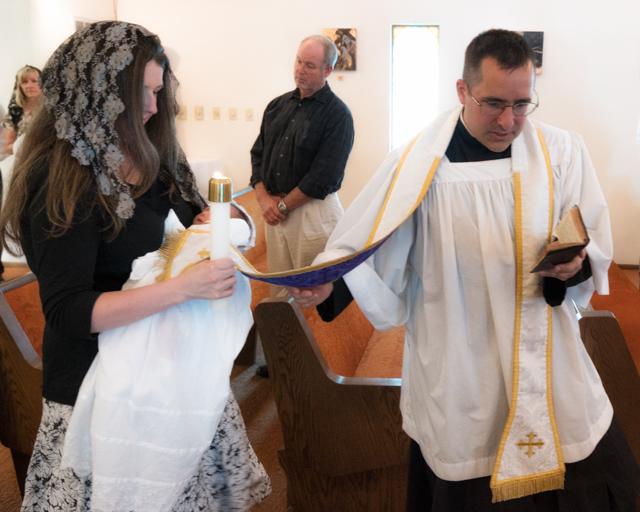

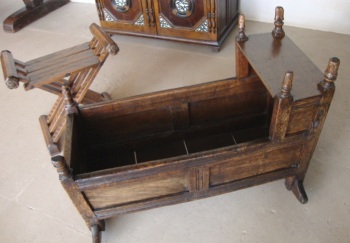
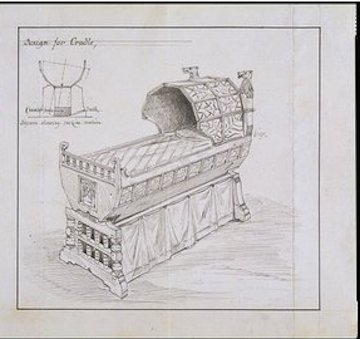
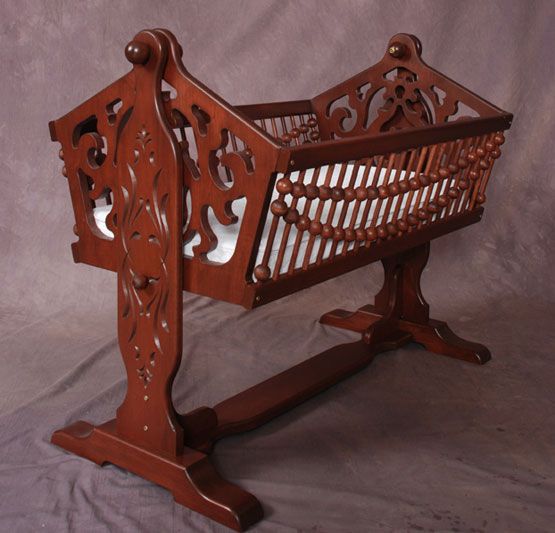 Cradles have been around for centuries. The ancient Britons wove cradles in the tree-tops for both children and old men. It was the custom of weaving an infant’s cradle in the branches of a tree, out of harm’s way, to be rocked by wind power, possibly another source of the lullaby. The traditional wood for a cradle is birch the tree of inception, which the ancients believed drove away evil spirits.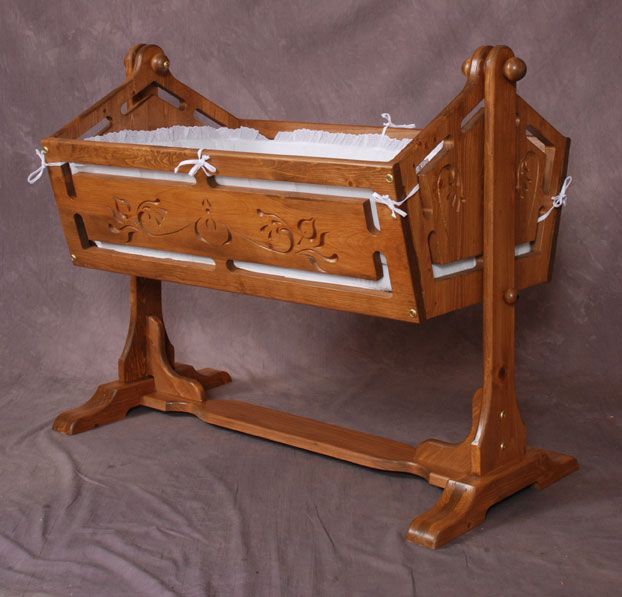
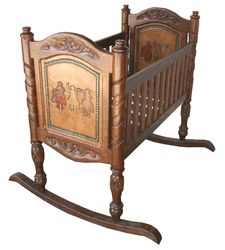 Graham Blackburn at FineWoodworking in “
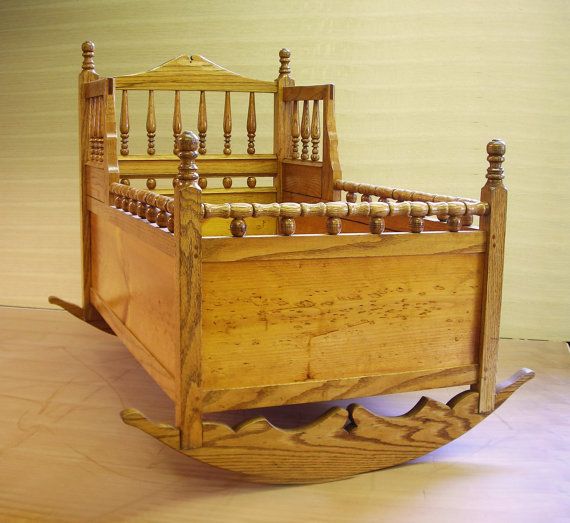 “The earliest and most common type of cradle is the rocker, derived undoubtedly from a half log, hollowed out to provide a secure resting place for the infant. From this to a simple box mounted on transverse curved sections was a short step, but a far cry from the miniature ‘great beds of state,’ richly carved and furnished with elaborate and costly hangings that were used to cradle the children of royalty.