Alcohol consumption was somewhat “necessary” during the Regency Era, as well as before and after that particular time period. Water obtained from public sources was unsanitary. The Georgian England site tells us, “The growth of cities and towns during the 1700s placed enormous pressures on the availability of cheap housing. With many people coming to towns to find work, slum areas grew quickly. Living conditions in many towns consequently became unimaginable. Many families were forced to live in single rooms in ramshackle tenements or in damp cellars, with no sanitation or fresh air. Drinking water was often contaminated by raw sewage and garbage was left rotting in the street. Problems with the disposal of the dead often added to the stench and decay. Many London graveyards became full to capacity, and coffins were sometimes left partially uncovered in ‘poor holes’ close to local houses and businesses.”
Cholera and typhoid epidemics were common, both diseases caused by contaminated water. Therefore, many did not drink from a public water source or from any “fresh” water source. Waste and fecal matter still found their way into public streams, rivers, and water supplies.
Jane Austen’s World tells us, “Those who drank ale, beer, wine, or a fermented drink, since the fermentation process killed almost all bacteria. Until the 16th century, the most common choice of drink was ale. By the end of the century, beer had replaced ale in popularity. Housewives and cooks gathered their own recipes for making beer, wine, cordials, possets, punch, spirit waters, and other distilled spirits, although these drinks could also be bought commercially. Fermented beverages were stored in containers similar to those in the photo above. Hops were added to beer to make the beverage last longer in storage. Interestingly, hops acted as antibacterial agents, making the beverage safe. In addition, real ale, or un-pasteurized beer, rich in nutrients, vitamin Bs, and minerals, was as nutritious as food.”
People were known to drink ale with each meal of the day. Keep in mind these products were not as potent as those we consume today. “Small beer, a term used to describe a weaker second beer, averaged an alcoholic content of only 0.8%. This concoction was obtained after the first brewing had used up almost all the alcohol from the grain. The product from the second brewing was 99.2% water and tasted nothing like our beer today. Small beer was consumed by people of all ages and strata in society, even children. Recipes for stronger drinks existed, but they were too expensive for ordinary people, taking twice as much grain to produce.”
Other drinks included cider and mead. Wine was the drink of the wealthy. It was imported from France and Germany and so it was expensive. Wine was also imported from the Eastern Mediterranean. It was called Malmsey wine, which is a corruption of Monemvasia, a town famous for its wine.
Another popular drink in England was sherry, which was known as sack and as brandy. In Scotland, whisky was a popular drink. In the 17th century, new drinks were introduced to England. Gin was invented in Holland early in the 17th century. It was introduced into England in the late 17th century. Gin soon became a very popular drink. Drinking cheap gin became endemic in the early 18th century, causing many social problems as shown by the picture Gin Lane by William Hogarth. However, gin-drinking was curtailed after 1751 when a duty was charged. In the early 18th-century porter became a common drink in London and Guinness was first brewed in Dublin in 1759. Another drink, champagne was invented in England in the late 17th century. Drinking rum became common in Britain in the 18th century. The British navy gave sailors a daily rum ration. (A History of Drinks)
Port became very popular in England after the Methuen Treaty of 1703, when merchants were permitted to import it at a low duty, while war with France deprived English wine drinkers of French wine. British importers could be credited for recognizing that a smooth, already fortified wine that would appeal to English palates would survive the trip to London. In 1678, a Liverpool wine merchant sent two new representatives to Viana do Castelo, north of Oporto, to learn the wine trade. While on a vacation in the Douro, the two gentlemen visited the Abbot of Lamego, who treated them to a “very agreeable, sweetish and extremely smooth” wine,” which had been fortified with a distilled spirit. The two Englishmen were so pleased with the product that they purchased the Abbot’s entire lot and shipped it home. The continued British involvement in the port trade can be seen in the names of many port shippers and brands: Broadbent, Cockburn, Croft, Dow, Gould Campbell, Graham, Osborne, Offley, Sandeman, Taylor, and Warre being amongst the best known. Shippers of Dutch and German origin are also prominent, such as Niepoort and Burmester. The British involvement grew so strong that they formed a trade association that became a gentlemen’s club. (Tom Stevenson, “The Sotheby’s Wine Encyclopedia,” The Fourth Edition, p. 334, DK Publishing, 2007)
Up until around 1802 all the wine from abroad had to be imported in casks to be bottled in England. Though the beverages were allowed to be imported in bottles after that, most importers continued buying wine in casks. The smugglers usually brought in wine in casks and kegs. Bottles are much more difficult to handle. They were heavy and noisy when they rubbed against each other and were easily broken. Wine could not be drunk immediately, as it had to settle so it was delivered to a bottler who acted as wholesaler.
I can see how this might play out depending on an individual or family’s wealth. The wealthiest could afford to buy entire casks for their private cellars, whereas the not-as-wealthy might buy smaller quantities in individual bottles from a wine merchant to stock their cellars, and the not-wealthy might only be drinking their own home-made wines and beers, probably in bottles they cleaned and reused. I am relatively certain the variations would depend on the particular beverage. I know most of the champagne people drank in the Regency was made in England by adding extra sugar into imported French wine and then bottling (or re-bottling) it for additional fermentation. They used the “sparkling wines,” not the “bubbly kind,” generally imported through Portugal. Champagne does not do as well in casks as did other beverages.
Also, the wire cage and cork affair sealing champagne bottles had not been invented. It was known as “The Devil’s Wine” because of the frequency of explosions caused by the fizz.
& Juliet is a 2019 coming-of-age jukebox musical. The story focuses on a “what if” scenario [Geez! Are not all Austenesque literature also “What If” scenarios?] where Juliet does not die at the end of Shakespeare’s Romeo and Juliet. In it, Juliet learns Romeo has had other relationships (both F & M), so she backs out of the dual suicide, meaning only Romeo dies.
Problem/Can’t Feel My Face (originally Ariana Grande/The Weeknd)
That’s The Way It Is (originally Celine Dion)
Everybody (originally Backstreet Boys)
As Long As You Love Me (originally Backstreet Boys)
It’s Gonna Be Me (originally NSYNC)
Shape Of My Heart (originally Backstreet Boys)
Stronger (originally Britney Spears)
F…..’ Perfect (originally P!nk)
Roar (originally Katy Perry)
I Want It That Way (Reprise) (originally Backstreet Boys)
Can’t Stop The Feeling! (originally Justin Timberlake)
One More Try (new song)
As I did a previous post on Pride and Prejudice with Broadway tunes, I thought I might take up the challenge and follow the & Juliet‘s example with “jukebox” tunes. [I will apologize up front to our younger readers. I am OLD and will be even OLDER in September. Though you are as likely to discover Taylor Swift on my iTunes as as easily as you will find Bachman Turner Overdrive, Taylor did not fit my purpose in this post. Sorry, Swifties!] I have included a YouTube link for each song if you are unfamiliar with it or simply wish to sing along.
Let’s start with the Meryton Assembly. We all recall how Darcy snubs Elizabeth and she overhears the “barely tolerable” comment and something of her response (from the 2005 film because I enjoyed the sassiness:
And that put paid to it. I wonder who first discovered the power of poetry in driving away love?
I thought that poetry was the food of love.
Of a fine stout love, it may. But if it is only a vague inclination I’m convinced one poor sonnet will kill it stone dead.
So what do you recommend to encourage affection?
Dancing. Even if one’s partner is barely tolerable.
First, let’s have Elizabeth tell Darcy something of how he must “get with her friends” if he wants not to be so snobbish. I would adore hearing Elizabeth break out into “Wannabe” by the Spice Girls.
Yeah, I’ll tell you what I want, what I really, really want
So tell me what you want, what you really, really want
I’ll tell you what I want, what I really, really want
So tell me what you want, what you really, really want
I wanna, I wanna, I wanna, I wanna
I really, really, really wanna zigazig ah
I wanna, I wanna, I wanna
I really, really, really wanna zigazig ah
If you want my future, forget my past
If you wanna get with me, better make it fast
Now don’t go wasting my precious time
Get your act together we could be just fine
If you wanna be my lover, you gotta get with my friends
Make it last forever, friendship never ends
If you wanna be my lover, you have got to give
Taking is too easy, but that’s the way it is
Yeah, I’ll tell you what I want, what I really, really want
So tell me what you want, what you really, really want
I wanna, I wanna, I wanna, I wanna
I really, really, really wanna zigazig ah
What do you think about that, now you know how I feel
Say, you can handle my love, are you for real
I won’t be hasty, I’ll give you a try
If you really bug me then I’ll say goodbye
If you wanna be my lover, you gotta get with my friends
Make it last forever, friendship never ends
If you wanna be my lover, you have got to give
Taking is too easy, but that’s the way it is
Yeah, I’ll tell you what I want, what I really, really want
So tell me what you want, what you really, really want
I wanna, I wanna, I wanna, I wanna . . .
To which Darcy sings “Walk Away” by the James Gang. You do recall how Keira Knightley leaves Matthew Macfadyen looking puzzled when she turns and walks away from him. When had any woman walked away from Darcy? I would NOT. [Note: The words in parentheses would replace the more modern words in yellow to fit the Regency era more appropriately.]
Although I realize I require a few more scenes before the Netherfield ball, this post will be long enough as it is. In preparation for the ball, I can view the Bennet sisters (along with Mrs. B, for she does want her daughters to marry well) singing “Gimme, Gimme, Gimme” by ABBA.
Half-past twelve (four)
And I’m watching the late show in my flat all alone (reliving the ball with just us two)
How I hate to spend the evening on my own
Autumn winds
Blowing outside the window as I look around the room
And it makes me so depressed to see the gloom
There’s not a soul out there
No one to hear my prayer
Gimme, gimme, gimme a man after midnight
Won’t somebody help me chase the shadows away?
Gimme, gimme, gimme a man after midnight
Take me through the darkness to the break of the day
Movie stars (Young ladies)
Find the end of the rainbow with a fortune to win
It’s so different from the world I’m living in
Tired of TV (the games)
I open the window and I gaze into the night
But there’s nothing there to see, no one in sight
There’s not a soul out there
No one to hear my prayer
Gimme, gimme, gimme a man after midnight
Won’t somebody help me chase the shadows away?
Gimme, gimme, gimme a man after midnight
Take me through the darkness to the break of the day
Gimme, gimme, gimme a man after midnight
Gimme, gimme, gimme a man after midnight
Upon arrival at Netherfield ball, Elizabeth is quite enamored with Mr. Wickham. Therefore, she seeks him out among Bingley’s many guests. I have appropriately presented her Dolly Parton’s “Romeo” for this segment.
A cross between a movie star (an aristocrat)
And a hero in a book
Romeo comes struttin’ in
And everybody looks
‘Cause he’s just got that special thang
That everybody needs
And everybody wants him
But not as bad as me
Hey, Romeo, where art thou
Get out here on the floor
I want to dance you darlin’
‘Til you forget wherefore
Let’s two step to a new step
We’ll keep it all in line
And we’ll call this the Romeo
‘Cause you’re so mighty fine
Romeo, Romeo, Romeo come dance with me
That sexy little body
Beats all I’ve ever seen
I ain’t never seen a cowboy (soldier)
Look that good in jeans (Who ever was bolder)
My temperature keeps risin’
Every time we meet
I may not be in love
But let me tell you
I’m in heat
Romeo, Romeo, I just know I’ll get you yet
Romeo, Romeo, I want to be your Juliet
So step it high, step it low
Step it out and in
Step to the side and let it slide
Then steppin’ up again
Step on toes, it all goes
Steppin’ as you please
But I’m one step away from love
So don’t step out on me
Romeo, Romeo, Romeo with the magic feet
So step it high, step it low
Step it out and in
Step to the side and let it slide
Then steppin’ up again
Step on toes, it all goes
Steppin’ as you please
But I’m one step away from love
So don’t step out on me
Romeo, Romeo
I just know I’ll get you yet
Romeo, Romeo
Won’t you be my Juliet
Romeo, Romeo
Romeo, Romeo
And we all know Darcy spies on Elizabeth at the ball before he asks her to dance with him. It is not so evident with the Colin Firth version, but in the Matthew Macfadyen version we see “Darcy” following Elizabeth about the many open areas. I thought “Creeping Up on You” by Darren Hayes would be a nice touch.
One, two, one, two, three
Yeah, yeah, oh, oh
Oh, yeah
Do do do do
Creepin’ up on you is the wrong thing to do
I found your address (directions), got your phone number (know the exact house), too
Visit all the stores shops where you buy all your clothes
Been to secret places you think nobody knows
If I have to live without you
Nobody could
I need to be around you
Watchin’ you
No one else can love you like I do
Feel it when I’m creepin’ up on you
I know that it wouldn’t be right
If I stayed all night
Just to peek in on you
Creepin’ up on you
Creepin’ up on you
I been hangin’ round all the places you haunt
Spyin’ on your friends to find out what you want
Drinkin’ from the glass that you left on the bar
Follow you around drivin’ home in your car (Together, wishing on the same star)
Do I have to breathe without you?
‘Cause nobody could
I need to be around you
Watchin’ you
No one else can love you like I do
Feel it when I’m creepin’ up on you
I know that it wouldn’t be right
If I stayed all night
Just to peek in on you
Creepin’ up on you
I’m creepin’ up on you
I know this must be wrong
It can’t go on
This kind of thing
Is taking all my sanity and making me a mockery
This must be wrong
It can’t go on
So won’t somebody free me from this misery
Bring my baby closer to me, yeah
Do do do do
Do do do do
Do, yeah, oh
‘Cause no one else can love you like I do
You feel it when I’m creepin’ up on you
I know that it wouldn’t be right
If I stayed all night
Just to peek in on you
Creepin’
No one else can love you like I do
Feel it when I’m creepin’ up on you
I know that it wouldn’t be right
If I stayed all night
Just to peek in on you
Creepin’ up on you
‘Cause no one else can love you
No, no, like I do
(I know you feel it) And when I’m peekin’ in on you
Watchin’ everything you do
‘Cause no one else can love you, no, like I do
No one else should love you, no, like I do
Baby, creepin’ up on you
Watchin’ everything you do, yeah
No one else can love you, no
No one else should touch you, no
No one else can love you, touch you
Love you, be with you
No, ’till I do, oh
***************************************
When the Bingley’s house party leaves Netherfield, we find Elizabeth telling Jane not to cry, for the gentleman will return. She will remind her sister that “Big Girls Don’t Cry,” a song by The Four Seasons.
Big girls don’t cry (they don’t cry)
Big girls don’t cry (who said they don’t cry)
My girl said good-bye (my oh my)
My girl didn’t cry (I wonder why)
(Silly boy) Told my girl we had to break up
(Silly boy) Thought that she would call my bluff
(Silly boy) But she said to my surprise
Big girls don’t cry
Big girls don’t cry (they don’t cry)
Big girls don’t cry (who said they don’t cry)
Baby I was cruel (I was cruel)
Baby I’m a fool (I’m such a fool)
(Silly girl) Shame on you your Mama said
(Silly girl) Shame on you, you cried in bed
(Silly girl) Shame on you, you told a lie
Big girls do cry
Big girls don’t cry (they don’t cry)
Big girls don’t cry (that’s just an alibi)
Big girls don’t cry [repeat and fade]
Meanwhile, we view Darcy’s solemn resignation with their departure. I think the song “She” by Elvis Costello fits perfectly. (Did you not love the song in the movie “Notting Hill”?)
She may be the face I can’t forget
A trace of pleasure or regret
May be my treasure or the price I have to pay
She may be the song that summer sings
May be the chill that autumn brings
May be a hundred different things
Within the measure of a day
She may be the beauty or the beast
May be the famine or the feast
May turn each day into a Heaven or a Hell
She may be the mirror of my dreams
A smile reflected in a stream
She may not be what she may seem
Inside her shell
She, who always seems so happy in a crowd
Whose eyes can be so private and so proud
No one’s allowed to see them when they cry
She may be the love that cannot hope to last
May come to me from shadows of the past
That I remember ’til the day I die
She may be the reason I survive
The why and wherefore I’m alive
The one I’ll care for through the rough and ready years
Me, I’ll take her laughter and her tears
And make them all my souvenirs
For where she goes I’ve got to be
The meaning of my life is
She, she
Oh, she
**********************************************
Our dear couple do not meet again until they encounter each other at Hunsford. First, Elizabeth “reprimands” Darcy for not dancing at the Meryton assembly. Notice, she omitted the fact she was the only female, other than Bingley’s sisters, he asked to dance at the ball, and he had asked her to do the same at Lucas Lodge. Darcy might be a slow learner, but he does learn his lessons. LOL!
“You mean to frighten me, Mr. Darcy, by coming in all this state to hear me? I will not be alarmed though your sister does play so well. There is a stubbornness about me that never can bear to be frightened at the will of others. My courage always rises at every attempt to intimidate me.”
“I shall not say you are mistaken,” he replied, “because you could not really believe me to entertain any design of alarming you; and I have had the pleasure of your acquaintance long enough to know that you find great enjoyment in occasionally professing opinions which in fact are not your own.”
Elizabeth laughed heartily at this picture of herself, and said to Colonel Fitzwilliam, “Your cousin will give you a very pretty notion of me, and teach you not to believe a word I say. I am particularly unlucky in meeting with a person so able to expose my real character, in a part of the world where I had hoped to pass myself off with some degree of credit. Indeed, Mr. Darcy, it is very ungenerous in you to mention all that you knew to my disadvantage in Hertfordshire—and, give me leave to say, very impolitic too—for it is provoking me to retaliate, and such things may come out as will shock your relations to hear.”
“I am not afraid of you,” said he, smilingly.
“Pray let me hear what you have to accuse him of,” cried Colonel Fitzwilliam. “I should like to know how he behaves among strangers.”
“You shall hear then—but prepare yourself for something very dreadful. The first time of my ever seeing him in Hertfordshire, you must know, was at a ball—and at this ball, what do you think he did? He danced only four dances, though gentlemen were scarce; and, to my certain knowledge, more than one young lady was sitting down in want of a partner. Mr. Darcy, you cannot deny the fact.”
“I had not at that time the honour of knowing any lady in the assembly beyond my own party.”
“True; and nobody can ever be introduced in a ball-room. Well, Colonel Fitzwilliam, what do I play next? My fingers wait your orders.”
“Perhaps,” said Darcy, “I should have judged better, had I sought an introduction; but I am ill-qualified to recommend myself to strangers.”
“Shall we ask your cousin the reason of this?” said Elizabeth, still addressing Colonel Fitzwilliam. “Shall we ask him why a man of sense and education, and who has lived in the world, is ill qualified to recommend himself to strangers?”
“I can answer your question,” said Fitzwilliam, “without applying to him. It is because he will not give himself the trouble.”
“I certainly have not the talent which some people possess,” said Darcy, “of conversing easily with those I have never seen before. I cannot catch their tone of conversation, or appear interested in their concerns, as I often see done.”
Instead of Darcy’s explanation about yada-yada, what if he broke into song instead. I am suggesting “Right Place, Wrong Time” from Dr. John. Just think of Colin Firth swiveling his hips in Mama Mia! and you will understand my thought process here.
I been in the right place
But it must have been the wrong time
I’d have said the right thing
But must have used the wrong line
I been on the right trip
But I must have used the wrong car (star)
Head is in a bad place and I wonder what it’s good for
I been in the right place
But it must have been the wrong time
My head is in a bad place
But I’m having such a good time
I’ve been running trying to get hung up in my mind
Really got to give myself a good talking to this time
Just need a little brain salad surgery
I got to que my insecurity
But I’ve been in the wrong place
But it must have been the right time
I been in the right place
But it must have been the wrong song
I been in the right vein
But it seems like a wrong arm
I been in the right world
But it seems like wrong, wrong, wrong, wrong, wrong
Slipping, dodging, sneaking, creeping, hiding out down the street
See my life shaking with every who I meet
Refried confusion is making itself clear
Wonder which way do I go to get on out of here
But I been in the right place
But it must have been the wrong time
I’d have said the right thing
But I must have used the wrong line
I took the right road
But I must have took a wrong turn
I took a right move
But I made it at the wrong time
I was in the right trip
But I made it in the wrong car (it was too far)
Head is in a good place, and I wonder what it’s bad for
At Rosings Park, Darcy musters up his nerve to propose to Elizabeth. We all know such did not go so well, but what if he offered her “Colour My World” from Chicago instead. [Personal note: This was my “wedding” song for one of my marriages. Love the song. The groom proved to be a Wickham, not a Darcy, in more ways than one.]
As time goes on
I realize
Just what you mean
To me
And now
Now that you’re near
Promise your love
That I’ve waited to share
And dreams
Of our moments together
Color my world with hope of loving you
Okay, so when Darcy proposed, Elizabeth was still blinded by her prejudice and did not fall in love as she should have. Therefore, Darcy returns to his room to rant and rave. This is the song before he decides he should write her a letter. You all know how it is. Sometimes you must “curse your destiny” before you “plead your case.” For the “cursing” part of this story, I chose “You Ain’t Seen Nothing Yet,” by Bachman-Turner Overdrive (BTO). I warned you there were more than a few songs by this group in my playlist. They still make me get up and dance when they come on.
I met a devil woman
She took my heart away
She said, I’ve had it comin’ to me
But I wanted it that way
I think that any love is good lovin’
So I took what I could get, mmh
Oooh, oooh she looked at me with big brown eyes
And said,
You ain’t seen nothin’ yet
B-b-b-baby, you just ain’t seen n-n-nothin’ yet
Here’s something that you never gonna forget
B-b-b-baby, you just ain’t seen n-n-nothin’ yet
“Nothin’ yet
You ain’t been around
That’s what they told me”
And now I’m feelin’ better
‘Cause I found out for sure
She took me to her doctor
And he told me of a cure
He said that any love is good love
So I took what I could get
Yes, I took what I could get
And then she looked at me with them big brown eyes
And said,
You ain’t seen nothin’ yet
B-b-b-baby, you just ain’t seen n-n-nothin’ yet
Here’s something, here’s something your never gonna forget
baby, you know, you know, you know you just ain’t seen nothin’ yet
“You need educatin’
You got to go to school”
Any love is good lovin’
So I took what I could get
Yes, I took what I could get
And then, and then, and then
She looked at me with them big brown eyes
And said,
You ain’t seen nothin’ yet
Baby, you just ain’t seen n-n-nothin’ yet
Here’s something, here’s something
Here’s something that your never gonna forget, baby
Baby, baby, baby you ain’t seen n-n-nothin’ yet
You ain’t been around
You ain’t seen nothin’ yet
That’s what she told me
She said, “I needed educatin’, go to school”
I know I ain’t seen nothin’ yet
I know I ain’t seen nothin’ yet
As this was just a pivotal point in the story, we must not forget that even after Elizabeth receives Mr. Darcy’s letter, it takes her a good number of readings before she begins to believe him. While she is still angry at him, I am offering her the song “It Ain’t Me Babe,” which was written and sung by Bob Dylan. I am sharing the Joan Baez version, for she is the one about whom Dylan wrote the song.
As Darcy regrets his actions and the loss of the woman he loves, we see him grieving for his mistakes. You must excuse this choice if you are not a country music fan. Yet, you see, in my home town, from the interstate, one can read a sign on the side of a building that says, “The Bar Billy Ray Cyrus …” In my humble opinion, Darcy has an “Acky, Breaky Heart.”
You can tell the world you never was my girl
You can burn my clothes up when I’m gone
Or you can tell your friends just what a fool I’ve been
And laugh and joke about me on the phone (in the hall)
You can tell my arms go back to the farm
You can tell my feet to hit the floor
Or you can tell my lips to tell my fingertips
They won’t be reaching out for you no more
But don’t tell my heart, my achy breaky heart
I just don’t think he’d understand
And if you tell my heart, my achy breaky heart
He might blow up and kill this man
Ooh
You can tell your ma I moved to Arkansas (myself to Hull)
Or you can tell your dog to bite my leg
Or tell your brother Cliff (sister Kit) who’s fist can tell my lips
He (She) never really liked me anyway
Or tell your Aunt Louise, tell anything you please
Myself already knows I’m not okay
Or you can tell my eyes to watch out for my mind
It might be walking out on me one-day
But don’t tell my heart, my achy breaky heart
I just don’t think he’d understand
And if you tell my heart, my achy breaky heart
He might blow up and kill this man
Ooh
But don’t tell my heart, my achy breaky heart
I just don’t think he’d understand
And if you tell my heart, my achy breaky heart
He might blow up and kill this man
Don’t tell my heart, my achy breaky heart
I just don’t think he’d understand
And if you tell my heart, my achy breaky heart
He might blow up and kill this man
Ooh
********************************************
So Elizabeth returns to Longbourn with a better understanding of Mr. Darcy, though with only Jane to confide the new knowledge of Mr. Wickham. Unfortunately, Jane offers no real solution to dealing with Lieutenant Wickham, and he elopes with Lydia. In London, when questioned by the always naïve Lydia, Wickham offers her this song: “Don’t Let Me Be Misunderstood” by The Animals.
Baby, do you understand me now
Sometimes I feel a little mad
Well, don’t you know that no-one alive
Can always be an angel
When things go wrong I seem to be bad
I’m just a soul who’s intentions are good
Oh Lord, please don’t let me be misunderstood
If I seem edgy, I want you to know
That I never meant to take it out on you
Life has it’s problems and I’ve got my share
And that’s one thing I never meant to do
‘Cause I love you
Baby, don’t you know I’m just human
And I’ve thoughts like any other man
And sometimes I find myself alone and regretting
Some foolish thing, some foolish thing I’ve done
But I’m just a soul who’s intentions are good
Oh Lord, please don’t let me be misunderstood
*************************************
The story progresses. Elizabeth goes on vaca with the Gardiners. As with any good “coincidence,” they end up at Pemberley. While there, Elizabeth hopes Darcy will propose a second time, but before such can occur, she receives the letter regarding Lydia’s elopement with Wickham. Elizabeth’s hopes are destroyed. On her return to Longbourn, she considers what might have been. “Insensitive” by Jann Arden expresses the pain of lost love.
How do you cool your lips after a summer’s kiss?
How do you rid the sweat after the body bliss?
How do you turn your eyes from the romantic glare?
How do you block the sound
Of a voice you’d know anywhere?
Oh, I really should have known
By the time you drove me home
By the vagueness in your eyes, your casual goodbyes
By the chill in your embrace
The expression on your face, told me
Maybe, you might have some advice to give
On how to be insensitive, insensitive, ooh, insensitive
How do you numb your skin after the warmest touch?
How do you slow your blood after the body rush?
How do you free your soul after you’ve found a friend?
How do you teach your heart
It’s a crime to fall in love again?
Oh, you probably won’t remember me
It’s probably ancient history
I’m one of the chosen few
Who went ahead and fell for you
I’m out of vogue, I’m out of touch
I fell too fast I feel too much
I thought that you might have some advice to give
On how to be insensitive
Oh, I really should have known
By the time you drove me home
By the vagueness in your eyes, your casual goodbyes
By the chill in your embrace
The expression on your face that told me
Maybe, you might have some advice to give
On how to be insensitive (how to be)
Insensitive (how to be)
Insensitive (how to be)
*****************************************
Back at Longbourn, the Bennets are miraculously saved from ruin by their “Uncle Gardiner.” Eventually, Darcy confesses his perfidy to Bingley. In convincing his friend to return to Jane Bennet, Darcy tells him, “You ain’t got nothing if you ain’t got love.” Cue Michael Bolton, please.
You can live your life on the edge of your seat
You can take your place down on easy street
Or just lose your mind
Over things only money can but
But it’s a fact of life no matter what you do
Every stake ya claim, every dream come true
Down deep inside these kinda things never satisfy
Oh love is the precious thing
Set ya free and give your heart the wings, to fly
Love is the living dream
Callin’ your name
Tellin’ you somethin’ ’cause you
Ain’t got nothin’ if you ain’t got love
Ain’t got nothin’ if you ain’t got love
You can conquer the world but it’s never enough
Because you ain’t got nothin’ if you ain’t got love
You can carry the flame across the finish line
You can sign your name in the sands of time
But fortune and fame, they’re just things that ya leave behind
Well you think you got the world in the palm of your hand
But there’s one thing missin’ in your promised land
It’s a thing called love, the one thing that your heart demands
Oh love is the rhythm of life
In your soul is where the secret lies
When love is lookin’ through your eyes
Every feelin’ inside
Is tellin’ you somethin’
Ain’t got nothin’ if you ain’t got love
Ain’t got nothin’ if you ain’t got love
You can conquer the world but it’s never enough
Because you ain’t got nothin’ if you ain’t got love
You can chase your dreams down the yellow brick road
Sail full steam down the river of gold
If you ever get it all ya never get enough
‘Cause you ain’t got nothin’ if you ain’t got love
Oh love is the precious thing
Set you free and give your heart the wings, to fly
Callin’ your name, ooh
Bingley chickens out and does not speak the necessary proposal and leaves as quickly as he arrived. Elizabeth says she is sorry Mr. Bingley did not ask Jane to marry him. Jane, however, has decided, he came for her, and she tells Elizabeth, “It’s Gonna Be Me.” I had to put a bit of Backstreet Boys in this story line.
It’s gonna be me
Ooh, yeah
You might been hurt, babe
That ain’t no lie
You’ve seen them all come and go, oh
I remember you told me
That it made you believe in
No man, no cry
Maybe that’s why
Every little thing I do
Never seems enough for you
You don’t want to lose it again
But I’m not like them
Baby, when you finally
Get to love somebody
Guess what
It’s gonna be me
You’ve got no choice, babe
But to move on, and you know
There ain’t no time to waste
You’re just too blind to see
But in the end, ya know it’s gonna be me
You can’t deny
So just tell me why
Every little thing I do
Never seems enough for you
You don’t want to lose it again
But I’m not like them
Baby, when you finally
Get to love somebody (somebody)
Guess what (guess what)
It’s gonna be me
It’s gonna be me
Ooh, yeah yeah
There comes a day
When I’ll be the one, you’ll see
It’s gonna gonna gonna gonna
It’s gonna be me
All that I do is not enough for you
I don’t want to lose it
But I’m not like that
When finally (finally)
You get to love
Guess what? (guess what?)
It’s gonna be me
Every little thing I do
Never seems enough for you (for you, babe)
You don’t want to lose it again (don’t want to lose it)
But I’m not like them
Baby, when you finally
Get to love somebody (love)
Guess what (guess what)
It’s gonna be me
Every little thing I do
Never seems enough for you
You don’t want to lose it again (don’t want to lose it)
But I’m not like them
Baby, when you finally (baby, when you finally)
Get to love somebody
Guess what (guess what)
It’s gonna be me
Bingley realizes he was a doofus and returns to propose. He woos Jane with “Sometimes When We Touch” by Dan Hill. [The is another wedding song. A better husband than the other one I mentioned.]
You ask me if I love you
And I choke on my reply
I’d rather hurt you, honestly
Than mislead you with a lie
And who am I to judge you
On what you say or do?
I’m only just beginning
To see the real you
And sometimes when we touch
The honesty’s too much
And I have to close my eyes and hide
I wanna hold you ’til I die
‘Til we both break down and cry
I wanna hold you
‘Til the fear in me subsides
Romance and all its strategy
Leaves me battling with my pride
But through the insecurity
Some tenderness survives
I’m just another writer
Still trapped within my truth
A hesitant prize fighter
Still trapped within my youth
Sometimes when we touch
The honesty’s too much
And I have to close my eyes and hide
I wanna hold you ’til I die
‘Til we both break down and cry
I wanna hold you
‘Til the fear in me subsides
At times I’d like to break you
And drive you to your knees
At times I’d like to break through
And hold you endlessly
At times I understand you
And I know how hard you’ve tried
I’ve watched while love commands you
And I’ve watched love pass you by
At times I think we’re drifters
Still searching for a friend
A brother or a sister
But then the passion flares again
And sometimes when we touch
The honesty’s too much
And I have to close my eyes and hide
I wanna hold you ’til I die
‘Til we both break down and cry
I wanna hold you
‘Til the fear in me subsides
Elizabeth is happy for Jane, but still miserable. Darcy says he will return to London. That evening she blows out the candle (in the 2005 movie, not so in the book) and lies awake, while Jane sleeps beside her. I am thinking “Sleeping Single in a Double Bed” by Barbara Mandrell might be appropriate. [Many of you have never heard of this song. I offer my apologies. Sort of …]
Sleeping single in a double bed
Thinking over things I wish I’d said
I should have held you but I let you go
Now I’m the one sleeping all alone, oh
Sleeping single in a double bed
Tossing, turning trying to forget
I could be lying with you instead
I’m sleeping single in a double bed
I’d pour me a drink, but I’d only be sorry
‘Cause drinking doubles alone don’t make it a party
Another sleepless night and it’s the same old story
When you’re the only one at two in the morning
I’m sleeping single in a double bed
Thinking over things I wish I’d said
I should have held you but I let you go
Now I’m the one sleeping all alone
Sleeping single in a double bed
Tossing, turning trying to forget
I could be lying with you instead
I’m sleeping single in a double bed
Yet, we all know Darcy cannot stay away from Elizabeth for long. He returns with hope in his heart after hearing Lady Catherine’s declaration that he cannot marry Elizabeth Bennet. “Will You Still Love Me?” by Chicago is the song.
Take me as I am, put your hand in mine now and forever
Darling here I stand, stand before you now deep inside I always knew
It was you, you and me, two hearts drawn together bound by destiny
It was you and you for me, every road leads to your door
Every step I take forever more
Just say you’ll love me for the rest of your life
I gotta lot of love and I don’t want to let go
Will you still love me for the rest of my life?
‘Cause I can’t go on, no I can’t go on
I can’t go on if I’m on my own
Take me as I am, put your heart in mine, stay with me forever
‘Cause I am just a man who never understood, I never had a thing to prove
There was you you and me then it all came clear so suddenly
How close to you that I wanna be
Just say you’ll love me for the rest of your life
I gotta lot of love and I don’t want to let go
Will you still love me for the rest of my life?
‘Cause I can’t go on, no I can’t go on
I can’t go on if I’m on my own
Do you believe a love could run so strong?
Do you believe a love could pass you by?
There was no special one for me
I was the lonely one, you see
But then my heart lost all control
Now you’re all that I know
Just say you’ll love me for the rest of your life
I gotta lot of love and I don’t want to let go
Will you still love me for the rest of my life?
‘Cause I can’t go on, no I can’t go on
‘Cause I can’t go on, no I can’t go on
I can’t go on without somebody I could call my own
‘Cause I can’t go on, no I can’t go on
I can’t go on
‘Cause I can’t go on, no, I can’t go on
Elizabeth is quickly enamored with Darcy. They have a connection other couples do not. She accepts his proposal and attempts to convince her family her feelings are legitimate.
Lizzy, are you out of your senses? I thought you hated the man.
No, Papa.
He’s rich, to be sure, and you will have more fine carriages than Jane. But will that make you happy?
Have you no objection other than your belief in my indifference
None at all. We all know him to be a proud, unpleasant sort of fellow… but that would be nothing if you really liked him.
I do like him.
Well . . .
I love him. He’s been a fool about so many things, about Jane, and others . . . but then, so have I. You see, he and I are so similar. (laughs at herself) We’ve been nonsensical! Papa, I . . .
[Her fatherhas tears in his eyes and starts laughing, softly] You really do love him, don’t you?
Very much.
“Say Goodnight, but Not Goodbye” by Beth Nielsen Chapman seemed an appropriate choice.
Say goodnight not good-bye
You will never leave my heart behind
Like the path of a star
I’ll be anywhere you are
In the spark that lies beneath the coals
In the secret place inside your soul
Keep my light in your eyes
Say goodnight not good-bye
Don’t you fear when you dream
Waking up is never what it seems
Like a jewel buried deep
Like a promise meant to keep
You are everything you want to be
So just let your heart reach out to me
I’ll be right by your side
Say goodnight not good-bye
You are everything you want to be
So just let your heart reach out to me
Keep my light in your eyes
Say goodnight not good-bye
They are married. This last song could have been part of the second proposal, but . . . It is an oldie, but goodie, so I am adding here: “If I Was a Carpenter” by Bobbie Darren.
If I were a carpenter
And you were a lady,
Would you marry me anyway?
Would you have my baby?
If a tinker were my trade
Would you still find me,
Carrin’ the pots I made,
Followin’ behind me.
Save my love through loneliness,
Save my love for sorrow,
I’m given you my onliness,
Come give me your tomorrow.
If I worked my hands in wood,
Would you still love me?
Answer me babe, “Yes I would,
I’ll put you above me.”
If I were a miller
At a mill wheel grinding,
Would you miss your color box,
And your soft shoe shining?
If I were a carpenter
And you were a lady,
Would you marry me anyway?
Would you have my baby?
Would you marry anyway?
Would you have my baby?
Such is my attempt at creativity. Please feel free to suggest other song titles. There is a lot more story to tell.
What is the “Windsor Uniform”? The Windsor uniform is a type of formal dress worn at Windsor Castle by male members of the British royal family (and some very senior courtiers). [“Windsor uniform”. Dress and insignia worn at His Majesty’s court (London: 1921).]
Introduced in 1777 by George III, the full dress version of the Windsor uniform did not survive after 1936. It was quite strict and consider too ornate for modern times. Just too much gold!
However, the “undress” version, introduced in 1798, is still worn today. It includes a dark blue jacket with red facings. For those of you who do not know the term “facings,” it is a common tailoring technique for European military uniforms where the visible inside lining of a standard military jacket, coat or tunic is of a different color to that of the garment itself. The jacket lining evolved to be of different colored material, then of specific hues. Accordingly, when the material was turned back on itself: the cuffs, lapels and tails of the jacket exposed the contrasting colours of the lining or facings, enabling ready visual distinction of different units, each with their own specific and prominent colors.
It is now worn only at Windsor Castle, and since the reign of King Edward VII, it has generally been worn only as evening dress (although King Charles III has worn a version of it as a riding coat).
The uniform currently takes the form of an evening tail coat of dark blue cloth, lapelled, with scarlet collar and cuffs. There are three buttons on each front, two at the back of the waist, two at the end of each tail, and also two on each cuff (plus one above). The gilt buttons bear a design of a Garter star within a garter, surmounted by the imperial crown.
It is worn with a white single-breasted waistcoat with three small gilt buttons of the same pattern, and with plain black evening-dress trousers. When the court is in mourning, a black waistcoat and black armband are worn. As well as the tail coat version, the late Prince Philip, Duke of Edinburgh, also wore (and King Charles III continues to wear) a dinner jacket version of the coat.
During the reign of George III, females at court were expected to dress in a manner which reflected their status. They wore silks and the formal court mantua or suit.
In the early 1700s, women wore the open-fronted mantua, with a train and a matching petticoat. To keep the shape, stays and hooped petticoat or panniers were worn underneath. They were decorated with opulent embroidery, often using silver or gold thread or gilt lace.
Both George III and his wife Queen Charlotte made moves to protect British silk making, going so far as to, in 1765, King George introduced an Act of Parliament that prevented the import of French silks, while Queen Charlotte encouraged members of her court to wear English silks instead.
George III was considered by many to be a bit eccentric, often dressing in practical clothes and wandering about London. [See the post from Wednesday on His Majesty, Farmer George]
Kelly Crawford tells us, “In 1777, the King introduced what became known as the ‘Windsor uniform’, which he originally intended to wear while at Windsor Castle. The blue suit was very similar to military uniforms and hunting outfits of the day, and it is possible he was inspired by a similar hunting outfit worn by his father, Frederick, Prince of Wales (1707‒1751). Dark blue was also an increasingly popular colour of choice for men’s coats in the second half of the century. There were two versions of the suit, a plain and a dress uniform, both dark blue with red facings (collars and cuffs) and the only difference being the dress uniform had gold embellishment and gilt, monogrammed buttons.”
——- the Windsor uniform, rich, handsome, and laced as it was, and worn with a sword, cocked hat, and buckles, ——-was a frock; because the cape and collars were red, while the coat was blue ; and because the cape was a double one. Of this Windsor uniform there were three classes in the last thirty years of George III.: the common blue frock with red cape and cuffs, worn in the morning ; the laced blue frock, with gold‑laced button‑holes on the breasts, pocket‑flaps, capes, and cuffs; with this coat, white breeches, and a cocked hat and sword, were worn. It was the dress of those who attended the king when not actually at court. The third was a blue full‑dress coat with standing collar, embroidered, with red silk breeches: this was a complete court dress, but worn only by cabinet ministers and the great officers of the crown. The Princes of the Blood, and the Lord Lieutenant of Ireland, have a kind of frock uniform; blue for the former, &c.j the latter the colour he may choose, lined with silk, and with a button bearing the initial and coronet of the Prince or Lord Lieutenant; but not otherwise differing from the usual frock coat. The uniform of George IV., when Prince of Wales, was blue lined with buff, and buff waistcoats and breeches. When he became Prince Regent, the buttons bore G. P. R., and also the members of his government wore it. There was also established a kind of full dress of blue, with black cape and cuffs, and gold frogs, and Brandenberg embroidery; but it did not take.
From Gentleman’s Fancy Dress published in 1882:
WINDSOR UNIFORM. The Windsor uniform, of blue coat and red collar, dates from the early part of the reign of George III. It has been asserted that the King adopted the blue and red in compliment to the Countess of Pembroke, who at that time was an object of the King’s admiration; blue and red being the colours of the Pembroke livery. This uniform is worn only by members of the Household, or by those to whom the privilege has been granted by the sovereign. The blue coat and red collar are its distinctive characteristics, but the shape of the coat and the other parts of the dress are adapted to the fashion of the day. The coat for ordinary occasions is cut like the usual evening coat, but the full‑dress one is made like a military uniform, buttoned up the centre, with a stand‑up collar and gold embroidery. A cocked hat, edged with white feathers ; blue trousers, with a broad stripe of gold lace, and a sword, complete the equipment. The present Ministerial and Diplomatic uniforms are the same as the Windsor uniform, with the exception of black velvet in lieu of red collars, and were first introduced during the Regency. Drawings of all State uniforms are deposited in the Lord Chamberlain’s office. An Evening Dress Coat, with red cloth or blue silk cuffs and lapels, is an easy and effective method of wearing a fancy costume, and is called Windsor Uniform.
If one were to search history books, he would learn that King George III was King of England during the American Revolutionary War. He might also discover that the same King George “went mad” in his later years. Hopefully, the person would also learn the following, which is provided (in more detail than I have included below) by Royal.uk:
**”George III became heir to the throne on the death of his father in 1751, succeeding his grandfather, George II, in 1760. He was the third Hanoverian monarch and the first one to be born in England and to use English as his first language.
**George III was devoted to his wife, Charlotte of Mecklenburg-Strelitz. They had 15 children, 13 of whom reached adulthood.
**”George III was the first king to study science as part of his education (he had his own astronomical observatory), and examples of his collection of scientific instruments can now be seen in the Science Museum.
**”The American War of Independence ran from 1775 to 1783 and resulted in Britain’s loss of many its colonies in North America. France was eager to retaliate against Great Britain following their defeat during the Seven Years’ War. Various conflicts against Napoleonic France started in 1793 and led to the Battle of Waterloo in 1815.
**”George III bought Buckingham House (now known as Buckingham Palace) in 1761 for his wife Queen Charlotte to use as a comfortable family home close to St James’s Palace, where many court functions were held. Buckingham House became known as the Queen’s House.
**”One of the most cultured of monarchs, George III started a new royal collection of books (65,000 of his books were later given to the British Museum, as the nucleus of a national library) and opened his library to scholars.
**”After serious bouts of illness in 1788-89 and again in 1801, George became permanently deranged in 1810. He was mentally unfit to rule in the last decade of his reign; his eldest son – the later George IV – acted as Prince Regent from 1811. Some medical historians have said that George III’s mental instability was caused by a hereditary physical disorder called porphyria.
**”During his reign, George III acquired the nickname ‘Farmer George’, in part due to his agricultural interests and in part as a playful pun. The survival of private papers offers one of the best opportunities to assess the true character and extent of George III’s agricultural interests including many notes made by him on agricultural books.”
It is said by many that George was a child who did not progress as fast mentally, as did others his age. He was a passionate young man, which made him difficult to teach or to command. Supposedly, he could not read properly until he was 11 years of age. When his father died, George, age 12 at the time, became the heir to the throne of England. Because he was aware of his “deficiencies,” George never thought himself worthy of the throne. Even so, he appeared determined to be successful, hiding his self doubt behind a facade of confidence. His method of screwing up his courage was to set himself an ideal of conduct. John Stuart, 3rd Earl of Bute became this ideal for George III. Bute became George’s inspiration, his teacher, and later his chief minister.
“Succeeding to his father’s earldom in 1723, Bute was known to remained aloof from politics until he met (1747) and won the favour of Frederick Louis, Prince of Wales, son of King George II. Upon Frederick’s death in 1751, Bute became the constant companion and confidant of the prince’s son George, heir to the throne, whose tutor he had been. After his accession George III made the earl secretary of state (March 1761). The king appointed Bute in order to break the power of the dominant Whig leaders and to achieve a peace with France. From the first, Bute, as a Scotsman, was widely disliked in England. He aroused further hostility by ousting from his administration William Pitt (later 1st Earl of Chatham), creator of England’s successful strategy in the Seven Years’ War. Bute replaced Thomas Pelham-Holles, 1st Duke of Newcastle, as first lord of the Treasury (in effect, prime minister) in May 1762, and in February 1763 he signed the Treaty of Paris, which made peace with France but was extremely unpopular in England. After imposing a hated cider tax and becoming involved in the controversial elevation of Henry Fox to the peerage, Bute resigned (April 1763). Nevertheless, he maintained his influence with George III until the new prime minister, George Grenville, made the king promise (May 1765) that he would neither employ Bute in office nor seek his counsel.”
One must not think of the nickname of “Farmer George” to be a disparaging one, for during George III’s long reign, England was very much an agricultural country, so referring to the King as “Farmer George” was a tribute of sorts. The Royal Collection Trust tells us: “During his reign, George III acquired the nickname ‘Farmer George’, in part due to his agricultural interests and in part as a playful pun – a nod toward nominative determinism given that his name, George, derived from the Greek geōrgos (γεωργός), meaning ‘farmer’ or ‘earth worker’. However, the extent to which this popular name arose from his reputation as an agriculturalist has been debated. The anecdotes and caricatures from the 1780s and 1790s tended to depict a friendly, homespun country gentleman, rather than a progressive, experimenting improver. The ‘farmer’ characterisation captured both his reportedly simple domestic life and his traditional paternalistic role as the nation’s father, as much as his zeal for the theory and practice of agriculture. Furthermore, it is difficult to reconstruct an accurate portrait of his engagements with farming from the accounts of contemporaries, whose compliments and stories are partly attributable to the honour owed to a patron and a king.”
In 1780, George III began to develop the parklands around Windsor Castle. The history of Windsor Castle on the internet tells us: “George I took little interest in Windsor Castle, preferring his other palaces at St James’s, Hampton Court, and Kensington. George II rarely used Windsor either, preferring Hampton Court. Many of the apartments in the Upper Ward were given out as “grace and favour” privileges for the use of prominent widows or other friends of the Crown. The Duke of Cumberland made the most use of the property in his role as the Ranger of Windsor Great Park. By the 1740s, Windsor Castle had become an early tourist attraction; wealthier visitors who could afford to pay the castle keeper could enter, see curiosities such as the castle’s narwhal horn, and by the 1750s buy the first guidebooks to Windsor, produced by George Bickham in 1753 and Joseph Pote in 1755. As the condition of the State Apartments continued to deteriorate, even the general public were able to regularly visit the property.
“George III reversed this trend when he came to the throne in 1760. George disliked Hampton Court and was attracted by the park at Windsor Castle. George wanted to move into the Ranger’s House by the castle, but his brother, Henry, was already living in it and refused to move out. Instead, George had to move into the Upper Lodge, later called the Queen’s Lodge, and started the long process of renovating the castle and the surrounding parks. Initially the atmosphere at the castle remained very informal, with local children playing games inside the Upper and Lower Wards, and the royal family frequently seen as they walked around the grounds. As time went by, however, access for visitors became more limited.”
Under George III’s orders, the parklands surrounding Windsor Castle were transformed from grounds for hunting to pristine parks and gardens. One major change was the conversion of the areas known as the Lower Park and the Upper Park into agricultural lands to be used by Frogmore farm. George III was known to have enjoyed overseeing the husbandry efforts at the farm. It is said, King George insisted that newer farming methods be practiced at Frogmore. A four-crop rotation was incorporated so as not to overuse the land.
Charles Townsend, 2nd Viscount Townsend, who served as Secretary of State under George I, used the four crop method on his estate in Norfolk. Townsend had learned of the method from farmers in Holland. It was also used in America and to a lesser extent in Scotland. Crops were rotated on a four-year basis. Townsend considered clover and turnips as two of the crops. The Open Door Website explains the The Four Field System, thusly: “Viscount Townshend successfully introduced a new method of crop rotation on his farms. He divided his fields up into four different types of produce with wheat in the first field, clover (or ryegrass) in the second, oats or barley in the third and, in the fourth, turnips or swedes. The turnips were used as fodder to feed livestock in winter. Clover and ryegrass were grazed by livestock. Using this system, he found that he could grow more crops and get a better yield from the land.
“If a crop was not rotated, then the nutrient level in the field would go down with time. The yield of the crop from the field decreased. Using the four field system, the land could not only be “rested”, but also could be improved by growing other crops. Clover and turnips grown in a field after wheat, barley or oats, naturally replaced nutrients into the soil. None of the fields had to be taken out of use whilst they recovered. Also, where animals grazed on the clover and turnip fields, eating the crop, their droppings helped to manure the soil. The four field system was successful because it improved the amount of food produced.”
Back at Frogmore, George III also set up a dairy. All together, more than 1,000 acres were used for farm purposes at Windsor. George may have been “slow” at reading when he was young, but he held a great deal of knowledge in the areas of animal husbandry and botany and agriculture. He imported sheep from Spain, a suggestion from Sir Joseph Banks, the President of the Royal Society. Those sheep became the ancestors of the Merino sheep found in New Zealand and Australia.
George III wrote letters for the Annals of Agriculture under the pen name of ‘Ralph Robinson,’ the name of one of the shepherds he employed on the farm. He kept meticulous notes on the latest improvements in farming practices and animal husbandry.
The Royal Collection Trust tells us: “The start of George III’s reign coincided with a new surge in agricultural publishing, such that by 1776 Lord Kames was moved to open his own treatise with a joke about the flood of texts: ‘Behold another volume on husbandry!’ It is, therefore, not entirely surprising that in the 1760s and 1770s a monarch concerned with the wealth of his kingdom and curious about the arts and sciences would collect and read books on agriculture. Indeed, George’s intellectual interest can be considered typical of many British gentlemen landowners at the time. Moreover, the surviving papers on agriculture form only a small proportion of the total number in the collection of George’s essays (around one to two per cent). We should therefore resist the temptation offered by his nickname to over-interpret the significance of such notes.
“The first point to make about George’s notes is that they are mostly taken from books published over a relatively short period, 1762–71. This may only be an effect of what survives, but it suggests that George was concerned with the latest ideas and debates, and it is not unreasonable to assume that his notes were made within a relatively short number of years following the publication of a new book or treatise. The exceptions are a short note on a book of 1775 and notes from volumes the periodicals Annals of Agriculture and Transactions of the Society of Arts, Manufacturers and Commerce from the 1780s. We can roughly divide the surviving notes made by George into three general themes: the political economy of agriculture, the merits of old versus new husbandry methods and the cultivation of specific crops.”
ERP_15a_BOOK_19 083
Unfortunately or fortunately, depending on how one views history, George III’s keen interest in agriculture made him a “subject” of several cartoonists of the day. He was lampooned by the famous James Gillray on more than one occasion. John Wolcott satirized the King, just as he did members of the Royal Society. In Wolcott’s piece, King George explains how to make an apple dumpling to a farmer’s wife.
In tempting row the naked dumplings lay,
When lo! the monarch is on his usual way,
Like lightening spoke “What’s this? what’s this? what? what?”
In my first post of August, a reader asked about a means for a female to go about the estate to paint scenery, etc. In my response, among my suggestions, I mentioned the use of dog carts as a possibility for the story. Naturally, I should have considered my response. I, most assuredly, did not mean I condoned the use of dogs for transporting people about. I was simply speaking of the history of the era and the use of dog carts being an appropriate means for a young lady who had a fear of horses. See the previous post HERE.
It was 1839 before dog carts were abolished in London, but such does not mean they were abolished everywhere in England and certainly not on the Continent.
The Metropolitan Police Act of 1839 ordered dog carts were not to be used within fifteen miles of Charing Cross:
“XXXIV. [Prohibition of Dog Carts.] And be it further enacted, That after the First Day of January next every Person who within the City of London and the Liberties thereof shall use any Dog for the Purpose of drawing or helping to draw any Cart, Carriage, Truck, or Barrow, shall be liable to a Penalty not more than Forty Shillings for the First Offence, and not more than Five Pounds for the Second or any following Offence.”
Now, some of you are likely praising this ordinance, but it was not completely based on the cruelty to the animals. Some dogs were expected to carry too heavy of a load. Obviously, it was cheaper to keep a dog in London that a horse or a pony. The problem was the weight of the load was not reduced.
In 1822, Parliament banned cruel treatment of horses and cattle.
1835 saw the Cruelty to Animals Act, banning animal-baiting and animal fighting styled bloodsports.
The banning of dog-carts had other motives beyond the cruelty to animals. The dog-carts often caused a traffic jam when horse-drawn carts/carriages were involved. The dogs nipped at the horses, etc. There was also the issue of rabies among the dogs. Over-worked dogs were thought to contract the disease easily. “According to the medical journal ‘The Lancet’ in 1841, there had been a decline in the number of cases of rabies in London since the act was passed: “Whether the police or the Dog-Cart Act have had anything to do with the decline of hydrophobia, we cannot say”. [Dogcarts and Lioncarts] – Note: You can find some of the “discussion” of this bill on this site.
One point of the discussion was if the license for a donkey was the same cost as one for dogs, then donkeys would quickly replace the dogs. The elimination of dog-carts would remove the employment of persons of small means to make a living. If size was the issue, they should also eliminate Shetland ponies from the street.
Other members of Parliament argued a dog was not meant to be a beast of draught.
Another argument stated by protecting the dogs in London they discriminated against the animals in the countryside. A man could move his business to one of the larger cities outside of London and not be restricted, where people in London would lose services as part of the ban.
Part of the argument included the dog’s feet and what they had to cross. The terrain was different. One member of Parliament argued that a dog’s feet are not designed to enable them to bear heavy weights.
“The dogcart nuisance was not only offensive to humanity, but was oftentimes productive of serious consequences. Only within the last few months the Lynn coach had been overturned by a dogcart, and much mischief was the result. He hoped, therefore, that the House would allow the bill to be proceeded with. An outright ban would also have been easier and cheaper to implement than rules and restrictions on the loading of dog-carts, the correct fitting of harness, the number of hours a dog could work before needing a rest and the provision of drinking facilities (in the same way that horse troughs were provided) etc. It was a case of using a legislative sledgehammer to crack a nut.”
Even with the London ban, the use of dogs to pull a variety of carts and products continued well into the 1900s in Europe.
There was a passage in one of Charles Dickens’s books—I think it was Barnaby Rudge, but I could not find it to quote it here, where the dog carts used to transport people were so heavy the paws of the dogs left bloody prints on the pavement. I read the story as a serial years ago when I was prepping to teach Advanced Placement Language courses.
I have a character in the book I am writing who prefers to keep her distance from horses, but she enjoys painting and walking quite long distances to sketch outdoors. Her husband notices and arranges for her to have a vehicle at her disposal, so she would have more flexibility. Unfortunately for me, I am not assured what would be the best choice. I was thinking a dogcart since it would have nice cargo space and she wouldn’t need anything more to rattle around the countryside, but wouldn’t she drive it herself? I’d rather she had someone else doing the driving for her, perhaps, a groom, since she’s not a horse woman. But then, if she had a servant for a driver, they would not sit side by side on the same bench, would they? A carriage is too much. She needs only a relatively small and open vehicle for driving in good weather. What would be a plausible choice?
Perhaps, a phaeton might work. Those of us familiar with Jane Austen’s know a bit about phaetons for they are mentioned twice in Pride and Prejudice. First, we have the one for Miss de Bourgh and then the one mentioned in her letter from Mrs. Gardiner to Elizabeth upon learning of Mr. Darcy’s proposal.
“Miss de Bourgh’s phaeton was of the low-slung variety, especially as it is being pulled by ponies. It would have a lower center of gravity and be very safe and secure, and the ponies easy for a woman to control and unlikely to run away with the vehicle. Mrs. Gardiner seems to think a phaeton and ponies just the thing for a woman to drive, especially on sightseeing expeditions:
Pray forgive me if I have been very presuming, or at least do not punish me so far as to exclude me from P. I shall never be quite happy till I have been all round the park. A low phaeton, with a nice little pair of ponies, would be the very thing.” [Margaret Sullivan]
However, though a phaeton might work, if one is afeared of horses, one still has an issue.
Phaetons did not have a place for a servant to ride behind, and the likelihood of the mistress of a great house wishing to sit on the bench with a groom would be slim. I can view Elizabeth Bennet doing so, but not Miss Anne de Bourgh or Miss Caroline Bingley.
And any carriage can overturn, even one though to have great stability. One hits a rough enough bump (side of a deep ditch will do nicely) and boom the carriage can go over.
As to the horses, the act of overturning usually breaks the harness. If the harness does not break with the accident itself, it is possible the horses will pull the vehicle around and around, attempting to break free.
Overturning a carriage does not guarantee fatal–or even serious–injuries. Such depends on luck. It is possible to jump free of an open carriage such as a gig or curricle, or even a phaeton. Then it all depends, too, on what you hit when you land. Rocks and rock walls will not be your friend.
Finally, the buckboard brake you speak of comes from mid to late 1800’s–it’s not around in the Regency. In the Regency, there is no brake that you can set from the seat. (That’s invented in 1835.)
As noted by this account from the Sporting Magazine (English, circa 1820s), for heavier stages and coaches, one of the coachmen had to get out to set a “drag” that would slow the carriage when going down a hill:
“Some few years past I was travelling to Brighton, I think by the ” Alert,” at the time driven by a coachman named Pattenden. On pulling up at the extreme point of Reigate Hill, and being anxious to get the drag on, he did not do it securely. On starting rather brisk, whether it came in contact with a stone, or from what cause I know not, but it flew from the wheel it was placed on to the opposite one, and fixed as properly and securely as if placed by hand, in which manner we proceeded down the hill, in my opinion, a providential and singular circumstance, which perhaps, prevented a serious accident.“
Remember: all vehicles of the time period were custom made. Some curricles had a step on the back. Some had a seat on the back. If no tiger was up back, a box of scrap metal was placed there to adjust the balance so the curricle harness did not weigh too heavily on the horses.
Okay, back to the question at hand.
The fussy part of me would suggest, if she wants to travel around, I would suggest she have a landau and a driver. If her husband/father can afford the vehicle, he can likely afford a driver. It is really hard to deal with a horse (or pony) and do other things. Despite what every Western you ever viewed with a horse and carriage, horses do not “park” very easily. Her assigned driver would sit up front for this, and she could use the vehicle for visiting as well.
You could also use a gig, or sometimes called a whisky, which are nice small sporting type carts. Gig carts are constructed with the driver’s seat sitting higher than the level of the shafts. Traditionally, a gig is more formal than a village cart or a meadowbrook cart, and more comfortable, usually being sprung.A light gig can be used for carriage racing. The Oxford English Dictionary gives the date of first known reference to a horse-drawn gig as 1791, and they were ubiquitous by the early 1800s. [Gig]
Reference for More Information: Felton, W. (1796). A Treatise on Carriages: Comprehending Coaches, Chariots, Phaetons, Curricles, Gigs, Whiskies… Together with Their Proper Harness. In which the Fair Prices of Every Article are Accurately Stated (Vol. 2). Debrett.
She would have to sit next to her driver/groom, but these carriages often had a space under the seat where she could put her gear. Even the most plodding horse can spook or shy or generally cause problems, and if she wants to stop, she really does need someone to look after the horse and carriage while she’s painting. She might prefer the fold up top of the landau for more protection–even the nicest days in England can turn fast on a person. Rain is always predictable.
A pony cart might work. It would be less intimidating, the lady could have a young groom take her about – maybe like a child of 10 to 12 years, to stay with the pony, fetch the animal water, assist in carrying her things, etc. She could even teach the young man how to draw as one of the plot points. [Gee! I think I have already written a similar scene.] Her doing so could provide a good opportunity for characterization or to draw out some backstory, etc.
Naturally, she would not need to be a horse person to drive a dog cart. Someone could instruct her on how to tether the animal when she reaches the place she wants to paint.
Such is basically all she would need to know. There would be grooms to hick the horse or pony or dog(s) to the vehicle and to unhitch him when she returns.
In England and Wales from the 12th Century forward enclosure (or inclosure) was a common practice. Before enclosure, much of the land was only used during the growing season. Once the harvest took place, the was at the disposal of the community. People grazed their livestock freely upon the land. They also found other uses for it. Enclosure occurred when someone, usually the manorial lord, put up a fence or a hedgerow to separate open land and the land the lord chose to claim. This prevented common grazing rights.
The article on enclosure on Wikipedia says, “Enclosure (sometimes inclosure) was the legal process in England of enclosing a number of small landholdings to create one larger farm. Once enclosed, use of the land became restricted to the owner, and it ceased to be common land for communal use. In England and Wales, the term is also used for the process that ended the ancient system of arable farming in open fields. Under enclosure, such land is fenced (enclosed) and deeded or entitled to one or more owners. The process of enclosure began to be a widespread feature of the English agricultural landscape during the 16th century. By the 19th century, unenclosed commons had become largely restricted to rough pasture in mountainous areas and to relatively small parts of the lowlands.
Enclosure could be accomplished by buying the ground rights and all common rights to accomplish exclusive rights of use, which increased the value of the land. The other method was by passing laws causing or forcing enclosure, such as Parliamentary enclosure involving an Inclosure Act. The latter process of enclosure was sometimes accompanied by force, resistance, and bloodshed, and remains among the most controversial areas of agricultural and economic history…. During the Georgian era, the process of enclosure created a landless working class that provided the labour required in the new industries developing in the north of England.”
The movement for enclosure spread quickly from the mid 1400s to the mid 1600s. This process increased the full-time pasturage each manorial lord claimed. Common rights had included not just the right of cattle or sheep grazing, but also the grazing of geese, foraging for pigs, gleaning, berrying, and fuel gathering. During the period of parliamentary enclosure, employment in agriculture did not fall, but failed to keep pace with the growing population.From 1750 to 1860, the idea of enclosing the open land turned from manorial concerns to that of “agricultural efficiency.” The problem was how the open fields kept the agricultural fields low. There was no incentive for a man to improve his land with fertilizer or proper drainage. Such “foolishness” would only result in those who used the open land after the harvest repeating the benefits of a more productive field without paying any of the expenses.
Alan Taylor tells us from an article on Facebook found in the British History: Georgian Lives Group, “Enclosure of common land was a process which produced much resentment by the rural poor who often depended on this land for grazing of cattle, horses etc and collection of firewood. Enclosure began in Elizabethan times as the old medieval manors were dismantled and replaced by fenced and walled fields owned by Freeholders or Copyholders who still paid homage to the Lord of the Manor. The effect of this major change in English landscape, accelerated in the 18th and early 19th Centuries by a series of Acts of Parliament, is usually only recorded by the literate new landowners who would benefit from the changes. Thus in a letter sent by a John Parker in 1812 he refers in a matter of fact way to an enclosure in a Manor in Essex: ‘ My son Comyns took a very active part as to the enclosures of the Common, it passed off extremely well, the Copyholders..appeared very well satisfied with their Allotments’. There is no sympathy here for the poor of the Manor who would have suffered greatly!
“Occasionally however rebellions took place against this loss of privilege. One such example was recorded in a letter of 1796 sent by a Thomas Swinnerton of Butterton Hall near Newcastle under Lyme. The letter was addressed to the agent of the Bishop of Lichfield who was Lord of the Manor in which Thomas had his estate. In the letter Thomas complained about a rebellion that had taken place when he decided to enclose common land adjoining the ‘green lane’ which ran through his property explaining why he had done so: ‘the great object of the enclosure..was to prevent the building of a Workhouse or the converting of..the land into Gardens for the Poor’. However the ‘poor’ had rebelled and convened a Manorial Court at a local pub during which : ‘the landlord..where the Court was held was a most principal party in exciting & encouraging the Mob to destroy the inclosure & …on return of the Mob gave them ale’.. Another agent provocateur was apparently ‘a man who hires out horses which may be found..in the night in the inclosures’. Again there was no sympathy at all for the poor some of whom were destitute needing accommodation and land to grow food. They had invoked an ancient custom by convening a Manorial Court at which their grievances could be aired but understandably this had ended in violence. I do not know whether the Bishop took any action as a result of this letter but the draft reply sent by his agent seemed more sympathetic to the ‘Mob’ than to Swinnerton!!”
I would venture to say the majority of us know of the issues this planet faces with the decay of the environment. We have likely all heard of the terms ecosystem (a community of living things and their environment), contamination (spoiling by contact), air pollution (contamination of the air, especially by smoke and gas from vehicles, factories, etc.), carcinogen (any cancer-causing agent), etc. However, test yourself on some of these . . .
eutrophication – This word did not come into use until the late 1940s and early 1950s. It means, “excessive richness of nutrients in a lake or other body of water, frequently due to runoff from the land, which causes a dense growth of plant life and death of animal life from lack of oxygen.” The National Ocean Service tells us, “Eutrophication is a big word that describes a big problem in the nation’s estuaries. Harmful algal blooms, dead zones, and fish kills are the results of a process called eutrophication — which occurs when the environment becomes enriched with nutrients, increasing the amount of plant and algae growth to estuaries and coastal waters.”
argochemicals – This word is also relatively knew, picking up usage in the late 1960s. It means, “a chemical used in agriculture, such as a pesticide or a fertilizer.”
debt-for-nature swap – This term is relatively self explanatory. It refers to the cancellation of the debts of developing countries if they promise/make a commitment to enforce environmental conservation.
biogas – This word, like those above, entered the language around 1970. It means “gaseous fuel, especially methane, produced by the fermentation of organic matter.”
Gaia hypothesis – This is a theory, put forward by James Lovelock in 1970, that living matter on the earth collectively defines and regulates the material conditions necessary for the continuance of life. The planet, or rather the biosphere, is thus likened to a vast self-regulating organism. It is named after a Greek Earth goddess. For more on this phenomenon, check out Springer Link or read ScienceDirect.
Population pyramid – A population pyramid (age structure diagram) or “age-sex pyramid” is a graphical illustration of the distribution of a population (typically that of a country or region of the world) by age groups and sex; it typically takes the shape of a pyramid when the population is growing. Males are usually shown on the left and females on the right, and they may be measured in absolute numbers or as a percentage of the total population. The pyramid can be used to visualize the age of a particular population. It is also used in ecology to determine the overall age distribution of a population; an indication of the reproductive capabilities and likelihood of the continuation of a species. Number of people per unit area of land is called
PCBs – PCBs are Polychlorinated biphenyls. Polychlorinated biphenyls (PCBs) are highly carcinogenic chemical compounds, formerly used in industrial and consumer products, whose production was banned in the United States by the Toxic Substances Control Act in 1979 and internationally by the Stockholm Convention on Persistent Organic Pollutants in 2001. They are organic chlorine compounds with the formula C12H10−xClx; they were once widely used in the manufacture of carbonless copy paper, as heat transfer fluids, and as dielectric and coolant fluids for electrical equipment.
Because of their longevity, PCBs are still widely in use, even though their manufacture has declined drastically since the 1960s, when a host of problems were identified. The International Agency for Research on Cancer (IARC) rendered PCBs as definite carcinogens in humans. According to the U.S. Environmental Protection Agency (EPA), PCBs cause cancer in animals and are probable human carcinogens. Many rivers and buildings, including schools, parks, and other sites, are contaminated with PCBs and there has been contamination of food supplies with the substances. Moreover, because of their use as a coolant in electric transformers, PCBs still persist in built environments.
Robertson LW, Hansen LG, eds. (2004). PCBs: Recent advances in environmental toxicology and health effects. Lexington, KY: University Press of Kentucky. p. 11. ISBN 978-0813122267.
Biomagnification of toxins in the food chain of a terrestrial environment. The dots represent the organic molecules present in each trophic level. The crosses represent the mercury present in each trophic level. While dots remain relatively constant in each individual, the concentration of crosses become greater in each preceding trophic level. Biomagnification: An increase of toxin concentration as the food chain moves up to higher levels. Organisms at the top have a higher tissue concentration of toxins and pollutants than lower levels. The concentration system is due to persistence of the toxins, food chain energetics, and low rate of internal degradation or excretion of the substance.Trophic level I represents the primary producers. Trophic level II represents the primary consumers. Trophic level III represents the secondary consumers. Trophic level IV represents the tertiary consumers. Per: http://www.thefreedictionary.com/biomagnificationhttp://users.rcn.com/jkimball.ma.ultranet/BiologyPages/D/DDTandTrophicLevels.htmlBiomagnification ~ CC BY-SA 3.0 ~ https://en.wikipedia.org/wiki/Polychlorinated_biphenyl#/media/File:Biomagnification.svg
monoculture – The Gallant website tells us, “Monoculture farming refers to cultivating a single crop on a large percentage or all of the farm, season after season. It places attention on crop specialization in modern agricultural terms.” Obviously, monoculture maximizes the use of farm machinery required, cutting costs in that manner; however, it increases the risk of crop diseases, infestation, and poor soil structure. “Given that it is not based on natural settings, monoculture imitates natural ecological components to safeguard crops and profits through the usage of artificial synthetic elements.”
irradiated food – This is a means to preserve food by exposing it to ionizing radiation. The U.S. Drug and Food Administration site tells us, “Food irradiation (the application of ionizing radiation to food) is a technology that improves the safety and extends the shelf life of foods by reducing or eliminating microorganisms and insects. Like pasteurizing milk and canning fruits and vegetables, irradiation can make food safer for the consumer. The Food and Drug Administration (FDA) is responsible for regulating the sources of radiation that are used to irradiate food. The FDA approves a source of radiation for use on foods only after it has determined that irradiating the food is safe.
“How Is Food Irradiated?
“There are three sources of radiation approved for use on foods.
Gamma rays are emitted from radioactive forms of the element cobalt (Cobalt 60) or of the element cesium (Cesium 137). Gamma radiation is used routinely to sterilize medical, dental, and household products and is also used for the radiation treatment of cancer.
X-rays are produced by reflecting a high-energy stream of electrons off a target substance (usually one of the heavy metals) into food. X-rays are also widely used in medicine and industry to produce images of internal structures.
Electron beam (or e-beam) is similar to X-rays and is a stream of high-energy electrons propelled from an electron accelerator into food.”
“Corridors are the habitual routes that animals use based on learned behavior, seasonal influence, and inherited traits. Corridors can often be identified by landscape features that indicate optimal paths of movement, including topography, elevation, vegetation type, or physical barriers like roads or rivers that may direct wildlife movement.
Corridors can include:
Routes wildlife use seasonally to reach water, food or other resources, utilized by a single animal or entire herds.
Paths between daytime and nighttime habitat; or between resting, feeding, and watering locations.
Examples of corridors:
The 125-mile migration that Wyoming pronghorn undertake each year, traveling between Grand Teton National Park and Pinedale, Wyoming in the spring and the fall.
The route formerly used by mountain lions in Southern California to travel between the Pacific Ocean and the Sierra Madre Mountains. This route is currently blocked by freeways and other development.”
How often have you read a Regency based story and the author uses some sort of concoction to incapacitate the hero or the heroine? Heck, I have written that plot line several times. Yet, what was the truth of this action?
Mostly used during the period were opium based and alcohol based mixtures and were used for pain. Some were plant based in could be found among the herbal realm, but, generally, nothing during the day worked efficiently and safely. Part of the problem was the dosage could not be adjusted for the person’s weight and medical history, as one might find today. A woman like my 95 pounds mother might be given the same dosage as a 200 pounds man.
In this short excerpt below from my Realm series (A Touch of Cashémere, book 3), a man has kidnapped Cashémere Aldridge, or, at least, he believes the woman is Cashémere, who her Scottish uncle has promised to the man. The only problem is Lachlan Charters does not realize Cashémere has an identical twin sister. He has grabbed the wrong girl. In this scene, he has taken her to his farm in Scotland. He has Satiné locked in a small cottage/hut on his land. In this scene, we learn Charters has used a sponge/rag soaked in a combination of opium, hemlock and mandragora. Knock one’s socks off!!!!
Charters silently opened the room’s door. He’d used a concealed exit to the wine cellar to come out behind several large boulders some one hundred yards east of his home. Such tunnels had come with the house when his father had purchased the land some fifty years past. As a child, Lachlan had spent endless hours playing castle and knights in the darkened passages. Some thought the house, which had been built upon the ruins of a Scottish keep, held ghosts and even a curse, but practical Lachlan had never believed any such tales. Yet, as he’d emerged from the hidden entrance, a shiver of foreboding had shot down his spine. “Maybe I should let the gel go free,” he told himself as he set a course towards the cottage, but Lachlan had realized it was too late for him to do so. He’d have to do what Averette had suggested.
He’d taken the last of the sponges with him. Before he’d gone to England, Lachlan had sent to his maternal grandmother, her clan’s healer, for something to deaden pain. The woman regularly dealt in drugs not readily found in the bags of country doctors. His grandmother had sent him a mixture of opium, hemlock, and mandragora. Lachlan had seen his grandmother use sponges soaked in the mixture to ease grown men into a peaceful sleep while she reset their broken bones or removed bullets. It was what he’d used on Cashémere to subdue the girl so he might remove her from her English home. Afterwards, he’d given her laudanum mixed in water to keep her unconscious through most of their journey to his home. On the road, he couldn’t trust her not to attempt an escape, but now she’d returned to Scotland, Lachlan had hoped their joining wouldn’t be so repugnant to the girl.
“It be good to see you up,” he said softly as he closed the door behind him and set the lock. The girl didn’t turn. She’d moved the lone chair in the room to sit before the window, and she appeared entranced by her narrow view of the world. Lachlan placed the small basket he’d carried on the table. “I brought ye some more food.” Still, she didn’t respond, and he’d wondered what bothered her. “I be sorry, Gel, for being so rough with ye, but I had no way of convincing ye to come back to me.” He chuckled lightly. “I not be treating you as such once ye be me wife. Ye know I care deeply for ye. I need me a wife to give me children and to tend the children, but I want a gel with whom I kin get along.”
As was mentioned in the last part of the excerpt, if someone wanted to drug a person, he would probably try a drop or two of laudanum, but, no one knew how much to use to make a person sleepy, even apothecaries could not name a definitive amount to use.
In my Tragic Characters in Classic Literature tale, I Shot the Sheriff, I used laudanum to keep the heroine subdued once she was kidnapped.
In all honesty, at times he felt as if he should have been the parent of the other two gentlemen who had joined Miss Busnik and her friends for supper; yet, he could not recall a time he more enjoyed himself at a ball, even during those days when he caroused with the best of them, he had never known such contentment. Naturally, he doubted he had ever been so green as were the two sons of two different earls who shared his table, when he had been their age, but, perhaps, his memory had been skewed by the fact Miss Busnik permitted him to hold her hand for a brief period, until he feared their indiscretion had become obvious to Miss Harrison. Skin to skin. No gloves. All done on a hush. Beneath the table drape, he had held her hand against his knee. Heat streaming through his body in anticipation.
The lady’s eyes had opened wider in surprise when his fingers first sought hers, but she had recovered quickly, even smiling at him in what he hoped was encouragement. The heat of her skin against his had done strange things to his own composure. Miss Busnik was so demme perfect, the idea made him ache with desire to claim her. If he would be so blessed to know a woman of Miss Busnik’s ilk as his own, he would spend the remainder of his days on this earth attempting to prove himself worthy of her.
He had sat beside her, conversing with those around them, as if they had done so for years. However, if she had known the direction of even a small portion of his thoughts, she would have slapped his face and stormed away.
Finally, the supper hour drew to a close, and he dutifully assisted her to her feet. He was not certain how much longer he would remain at the ball. They could not, according to the indubitable rules of propriety, dance together again, and it would be impossible for him to watch her on the dance floor, enjoying the interest of other men. However, when she swayed in place, as if attempting to gain her balance, he was not about to leave her side. He caught her elbow to steady her. “Are you unwell, my dear?” Now, that he looked closely at her, she appeared a bit pale.
“Just a bit light-headed. Too much to drink, I suspect,” she said with a weak smile.
“To the best of my knowledge, you have had but two glasses of champagne this evening, the one we shared earlier and the toast we made over supper. The rest of your libations have been the lemon punch,” he argued.
“Perhaps I drank the last toast too quickly. I am not known to be a drinker.” She looked up into his face, and William could note her eyes were watery. “I rarely consume champagne.”
“Then you should have said something,” he mildly chastised. “You must not drink simply to be sociable. That was a hard lesson I learned years ago.” He glanced around to a nearly empty room, couples returning to the dance floor. “I would not like to hand you off to another if you are feeling poorly. Have you promised this upcoming dance to another?”
She shook her head in the negative. “I had hoped we could walk the room again,” she admitted.
The idea pleased him, but his concern for her took precedence. “Instead of walking the room, mayhap we could step out on the terrace. We will stay near the open doors where people can view us, but the cool night air could cure your lightheadedness.”
“I would enjoy doing so.” She accepted his arm, leaning heavier against it than she had earlier in the evening. She appeared rather more sleepy than inebriated, in his opinion, but William had little experience telling the difference when it came to women. When he had previously shared a bed with a woman, sleeping was not part of the reason to be together. The idea suddenly struck him that he would not mind sleeping beside Miss Busnik, no matter whether they shared the bed for other reasons or not. He would cherish the idea of falling asleep with her in his arms.
Slowly, and purposefully, he set a course for the nearest door leading to the terrace. At length, they were outside, a cool breeze easing the heat of the ballroom. He led her to a nearby bench, propping her back against the balcony’s wall, before kneeling before her. She had not said a word the whole time they traversed the ballroom, a fact completely uncharacteristic of the lady.
“My dear Miss Busnik,” he said softly so as not to draw attention. A few other couples were making their return to the ballroom, and he did not want them to hear his concerns. “I fear you suffer from more than a glass of champagne.”
Her eyes opened briefly to look into his. “I believe you are correct, sir.”
He shrugged out of his tail coat and wrapped it around her shoulders when he noted that she shivered. “With your permission, I will leave you alone for a minute while I fetch your brother. Promise me you will not attempt to stand on your own.”
“Promise,” she whispered weakly, leaning her head back against the wall and closing her eyes again.
Obviously, for storytellers, a knockout punch was much more reliable.
One must remember neither ether nor chloroform were available during the Regency Era. WIKIPEDIA says Chloroform was first made by an American for a pesticide. It was first used in medicine 1847.
Ether seems to have come to notice about the same time in 1846. Ether was known for centuries; however, it’s anesthesia properties were not employed until the 1840s, and it is highly likely more than scientists would have had access to it.
Ether and chloroform might prove boon to Victorian authors, though. However, I still wonder, how does one carry a rag soaked with chloroform or ether around with one without having it affect the person toting it about? Can you not image the villain overcome by the vapors or having the vapors evaporate before the rag could be employed in some nefarious manner?
A person set on something nefarious pretty much just had laudanum or straight opium. Opium smoke would put someone in a daze, but was also risky to the person creating it. Some other natural herbs with sleep properties, but the drug would have to be ingested.
No Thank You, We Like Pain a seven-minute listen on NPR is very enlightening, but this excerpt proves to be quite helpful. I have provided the link below.
The trouble with Laughing gas and electricity is that they require an apparatus and certainly not part of the Regency era. Other substances require them to be ingested.
Many substances and articles were invented long before they became available to the general public.
As to routes, we must remember, a medication administration route is often classified by the location at which the drug is applied, such as oral or intravenous. Therefore, I am adding a couple of quick notes about routes:
Inhaled substances act quickly on the brain (think about it—nose straight up to sinus, close to brain—fast acting). This is why the modern Narcan is often administered by an inhaled device (really kills an opiate buzz fast). So breathing in a gas is the way to go for speed. It reacts within 15 seconds on up to about a minute, depending on what is administer and how much is given.
Next, you could go directly into the bloodstream, better known as an IV. This usually acts in about 5 minutes. Unfortunately in film stories, a quick jab with a needle and out the person goes. Such is pure movie fiction.
Next, is an injection into a muscle. This can take 15 to 20 minutes or longer to react to the body.
Lastly we have ingestion-—drinking or eating any substance to cause either poisoning or some kind of altered mental state, such as being unconscious takes time and may require a great quantity of the drug. Drinking a lot of hard spirits can tank you because the body cannot process it fast enough. Usually it would take about 20-30 minutes or more for anyone to go down, but such depends on the person and amount ingested.
Also, not everyone reacts the same. This is why hospitals have someone dedicated to putting anyone out—one may have to adjust as he goes. This is true for all substances–inhaled, into vein, into muscle, digested.
As to hitting anyone on the head. It is actually difficult and dangerous to “knock someone out.” This is called a concussion—anytime anyone is unconscious, he suffers brain damage to some degree. One has actually to rattle the brain around to knock a person out. A hit on the head is far more likely to produce pain, staggering, nausea, and bleeding.
Now, some folks have what is called “a glass jaw.” He/She are extremely sensitivity in the jaw and such can lead to enough pain to “knockout” someone. Usually this applies to boxing. If one hits the right place in the jaw, down goes his opponent. Just keep in mind, one REALLY has to know how to do this—the placement of the punch and how hard to hit. Not easy in any manner whatsoever.
So…the fiction of easily making someone unconscious without killing them is just that: FICTION. Gas is the best way to go. Lovely carbon monoxide, which one can get from a wood stove, will make everyone feel like they have the flu, and, eventually, they pass out as the carbon monoxide replaces the oxygen in the body. However, as the NPR article noted, most folks really do not know anything about air exchange or what happens in the body with using any kind of pain killers.
If nothing else works, I suppose you might consider mesmerism, meaning hypnotism. It has been used both to treat and leave folks unable to feel the pain. Or if the person doing the bad deed is a student of history, he might go back to some old fashioned ideas, meaning a sponge soaked in opium and hemlock—which sounds like it’ll be one of those kill or cure ideas. That is, unless you are an author and need a means to put the hero or heroine in dire straits, then it is ALWAYS . . . well, not a cure, but the characters will survive.
The first of the “two earls” featured in this collection was released in the summer of 2022 as part of the Regency Summer Garden Anthology (which is only available in print format).
Rose Vickers has been sent home by her parents from India where she has lived since she was a mere child. She arrives in England with her Indian ayah (a native maid or nursemaid employed by Europeans in India) and the woman’s son in tow. For some five years she had attempted to keep her estate from faltering, but Rose knows nothing of running the estate, and as both parents have perished in an uprising in India where her father served with the East India Company’s army, she has trusted first one scoundrel and then another. She will not fully inherit until she is one and twenty, so what does she do before then?
The Earl’s English Rose: A Regency Romance Novella
The new Earl of Everwalt was not one to appreciate being bamboozled by an obstinate, headstrong girl, though pretty she may be. If he did not require her to repair his reputation, he would leave her to the schemes she had concocted to save her father’s estate.
Just because he was now her guardian, the Earl of Everwalt had no right to decide who she might marry. Therefore, Miss Rose Vickers sets out for London to provide the new earl a piece of her mind, only to run into a highwayman. As if scripted, the new earl proves to be her savior, but it would be some time before the suspicious Rose and the extremely susceptible Everwalt learn the depth of their connection and the true meaning of love.
Excerpt:
“I see.” Rose Vickers managed to murmur as Mr. Arnold Palmer explained something of the passing of her step-mother’s eldest brother. Naturally, she had expected as such; yet, it made her sad to think upon the world losing another kind soul. When Lord Everwalt did not answer her multiple pleas for the assistance he had promised, she had repeatedly told herself his lordship had not abandoned her as those around her had often warned. “And you say the new Lord Everwalt means to continue the guardianship?”
Mr. Palmer wiped his palms down across the trousers he wore, evidence he was as uncomfortable with this conversation as was she. “Most assuredly, the present Lord Everwalt will see all you have chronicled set to right. First, I must issue a caveat, however. Surely you comprehend his lordship must first appear before the House of Lords in a formal ceremony to be recognized before that esteemed chamber as Everwalt.”
Rose swallowed her words of protest. “And how long will this formal recognition require of the earl?”
“It is my understanding the ceremony is scheduled to occur when Parliament returns to the Capital for its next session, along with the more prestigious families of the land,” Mr. Palmer explained. “Such is seven weeks removed.”
Alarm registered in Rose’s chest. “That is nearly two months. My father’s tenants must have seed to grow. Food on their tables. I have already sold many of the colonel’s favorite belongings to hold the estate together while I waited for the previous Lord Everwalt to act upon my behalf. I require the new earl’s intervention immediately. I can only do so much without my guardians’s permission. I am not yet of age.”
Mr. Palmer fidgeted in his chair. “I will relay your concerns to the new earl, but I must warn you his lordship has much of which to attend as he transitions to his rightful title. Have you no one to assist you with the estate business?”
“Lord Everwalt was the only guardian my parents saw to name on my behalf. As to the estate, I released my father’s steward when the tenants’ complaints proved to be true,” she explained. “Dhruv Bhatt has taken over many of the responsibilities Mr. Rinhart had ignored; yet, things have not gone as well as I had hoped. As to conducting business for the estate, as I am not of age and I am a woman, I cannot ask for credit for supplies. Such is the reason I have sold off some of my father’s possessions so I can offer the shopkeepers and others coins for the estate’s needs.”
“My, you are ingenious,” Mr. Palmer offered in praise. “And I promise to relay your concerns to Lord Everwalt upon my return to London.”
********
“You I might discover here,” Diya Bhatt said through a thick Indian accent and the typical reversals found in all her conversations. The woman had been the only “ayah” Rose could recall with her parents had arrived in India some fifteen years prior. Diya had been Rose’s closest confidante since she was a child. The woman had traveled to England with Rose when she returned some three years earlier, but, more importantly, “Ayah” had remained in England, even after Rose had received word of her parents’ passing.
“I fear I am quite predictable,” Rose said with a slight shrug of embarrassment. She pulled her knees in closer to her body to make room for the woman. She sat sideways on a long bench beneath her real mother’s favorite rose arbor, thus, the source of her name. And although the roses had lost their petals because of the winter months, some buds were still evident, and they gave her great comfort whenever the world felt too much for Rose to handle.
The late Lady Helen Vickers had been the only mother of which Rose held true memories, but Rose often imagined her real mother was in her room at night and watching over her, and she knew the look of her real mother, for her father had always commented on how much Rose had favored the late Mrs. Charlotte Vickers. However, those borrowed memories were the only ones she owned: Her mother had been ill for an elongated period before she passed, and Rose was not yet two years of age at the time.
She sighed heavily. “It is as we suspected. Lord Everwalt has passed. The new earl has promised to continue his support, but, as, he has yet to be named ‘Everwalt’ by the House of Lords, I cannot say when the financial allotments will resume.”
“The urgency to Mr. Palmer you did explain, did not you?” her ayah asked in well-practiced tones.
“Naturally, but, as Mr. Palmer is simply Lord Everwalt’s man of business, I fear he will not fully express the dire need of my request. After all, I am nothing more than another obligation the new Lord Everwalt has assumed.”
Ayah’s eyebrow rose in observation. “At least the reports of Lord Everwalt’s ‘activities’ now you know in the newsprints were not the the kindly ‘grandfather-like’ man Memsahib Vickers introduced through her letters to you.”
“We must thank our stars for that particular face, but such means the reports of Lord Everwalt and his mistress are in reference to my new guardian,” Rose countered.
Diya looked away as if seeing something Rose did not. “Your choice be few, my child.”
“I have settled on a plan,” Rose stated as she turned to place her feet on the ground, “but I would be willing to listen to your preferences.” Staring straight ahead, she asked, “Would you care to go first or should I?”
Diya said solemnly, “You believe yourself to speak to the new Lord Everwalt rather than you should wait in dependence on Mr. Palmer.”
Rose turned to the woman who had served her loyally for many years. “I do. Do you think my plan too forward on my part. From what little we know of the new Lord Everwalt, could such a man be trusted to act honorably?”
“Maintaining a mistress not be part of character of elder Lord Everwalt, I think,” Diya declared. “He was a man to be admired.”
“Amiable, truly defined the man,” Rose said softly as she recalled the few brief days she had spent with the previous earl, “yet, we do not know his nature when he was younger.” She sighed in
resignation. “Despite the presence of both a former mistress and the likely employment of a new one, we know nothing of the present lord—nothing of the true essence of his character. Therefore, I cannot but think I must personally plead my case before the earl.”
“How be so possible unless his lordship calls on you in Dover?” Diya asked, as confusion furrowed her brow.
“I plan to travel to London to request an audience with the earl,” Rose declared. “Surely, if the late Lord Everwalt educated the new lord, as Mr. Palmer assures me the former earl did, then the younger Lord Everwalt will be both reasonable and responsible.”
“If not he be?” Diya asked in obvious concern.
“Then I shall know how to proceed. I will return to Beetham Hall and either release a third of my father’s cottagers to conserve the land and the funds we have, or I will accept a marriage offer and pray the man I choose will not run through my inheritance before I turn one and twenty and claim a voice in estate matters.”
“With you I go,” Diya stated firmly.
“I hoped you would agree,” Rose admitted. “I do not believe I could face Lord Everwalt without you near.”
The second story in this collection was originally released the summer of 2021 as part of the Regency Mid-Summer Mischief anthology.
In the story, the heroine’s father is labeled “Brook’s Crook” for is from Brook, a hamlet in the civil parish of Bramshaw, in Hampshire, England. It lies just inside the New Forest. The hamlet contains a mix of 18th and 19th century cottages, just south of the village of Bramshaw. There are two inns in Brook on opposite sides of the road – The Green Dragon and The Bell Inn. Both buildings date from the 18th century, albeit with 19th and 20th century alterations. Brook is also home to the club-house of Bramshaw Golf Club, which claims to be the oldest golf club in Hampshire.
Just south of the village at Lower Canterton lies the Rufus Stone. This stone is said to mark the place where in 1100 the then King of England, William Rufus, was killed by an arrow whilst out hunting. The arrow was fired by a French nobleman, Walter Tyrell, but it has never been established if the death was an accident or murder.
Brook: the green A large-ish wedge-shaped green on the acute junction of the B3078 and a small side lane. The Bell Inn is in the distance. ~ CC BY-SA 2.0 File:Brook, the green – geograph.org.uk – 1444359.jpg ~ Created: 15 August 2009 ~ https://en.wikipedia.org/wiki/Brook,New_Forest#/media/File:Brook,_the_green–geograph.org.uk-_1444359.jpg
The Jewel Thief and the Earl
Grandison Franklyn, 8th Earl Harlow, has earned the moniker “Grandison, the Great” for a variety of reasons: his well-honed attitude of superiority; his appearance; and a string of mistresses, most notably Lady Jenest, who created a “great” row when he cut her loose.
Miss Colleen Everley is the daughter of England’s most notorious thief, a man called “Brook’s Crook.” Colleen has been taught many of her father’s skills, along with an eye for the value of each item in a room. Unfortunately, the lady does not possess Thomas Everley’s daring.
Lord Harlow and Miss Everley must combine forces to return Queen Charlotte’s sapphire necklace before Her Majesty learns it is missing. Toss in a healthy sprinkling of quirky characters and missteps in the investigation, and the reader will find a delightful tale that goes beyond the “Cinderella” effect and opposites attract.
Excerpt:
Grand had been in many low-born areas of London, but not this particular one. He gagged, despite holding a handkerchief over his nose. The stench made it hard to breathe; yet, Miss Everley moved along the streets as if she was strolling through the Queen’s gardens. Garbage and human waste crawled along the curb of the road as a light drizzle attempted to rinse away the muck. In Grandison’s opinion, it would take a hurricane to wash away the filth piled upon these particular streets.
“We shall begin here,” Miss Everley announced.
Grandison looked up to view a building leaning against the one beside it. He wondered if someone pushed hard enough on the exterior wall of the first building, if all along the street would fold in on themselves, one after another, like the ribs of a lady’s fan, until they were all flattened. “Who are we seeking within?” he asked, his nose wrinkling again. “Surely no one inside would possess knowledge of a sapphire necklace.”
“You may be surprised,” she responded.
As he held the door for her, loud, coarse language could be heard within. Grand glanced to Miss Everley, but the lady showed no sign she had even heard the string of curse words exchanged by two men, who stood across from each other at a table strewn with cards. He wondered how often, during her upbringing, she had been exposed to the underbelly of society. Oddly, he took offense, for, in Grand’s opinion, no lady of her quality should have previously tramped through these streets nor known her way around the community.
A bruiser of a man blocked their entrance until his eyes fell upon Miss Everley, and they softened. “Good evening, miss. Didnae know ye meant to call tonight. Mr. William didnae say nothin’ to me of it.”
Miss Everley laid her hand on the man’s beefy arm and batted her eyes at him. “Such is my fault, Mr. Hahn. I did not send Mr. William a note of my desire to speak to him on a matter of importance. Would it be an imposition to claim a few minutes of his time?”
From his place behind her, Grand watched as man after man inside the establishment placed his cards or his drink down before him and turned his attention to Miss Everley and him. Despite the rough clothing they both wore, they certainly did not fit in among these people. Moreover, they were sadly outnumbered, at least twenty to one. Even so, Grand edged closer to the lady, prepared to drag her from the place, if necessary.
Mr. Hahn glanced to Grand. “And yer friend, miss?”
“Will not harm anyone unless someone is foolish enough to attempt to pick his pocket or come too close to me,” she declared in bored tones.
Mr. Hahn barked a laugh. “Ye always be the brave one, beggin’ yer pardon, miss, fer me sayin’ so.”
Again, Miss Everley smiled on the man. “No offense taken. In fact, if you give me a moment, there is a cloth sack in my basket, especially for you. I made you something sweet.”
“Biscuits?” the man questioned through a toothy grin.
“You know I would not beg for your assistance,” she countered, “without a bit of a bribe.”
“Better than a monkey,” the man declared. “Come along. Mr. William be in his office.”
Miss Everley handed the man a cloth sack, tied off the string, and Grand wondered what else she had in the basket she carried.
As they crossed the room, he remained close behind her. All eyes in the place followed their movements, and he glanced over his shoulder several times to make certain no one approached. Meanwhile, Miss Everley walked past the rubble with her head held high and not a glance, one way or the other, at the danger within the room. In Grand’s opinion, she was both quite foolish and quite magnificent at the same time.
Mr. Hahn stopped before a dark door and gave it a cursory knock before opening it. “Miss Everley, sir, come to speak to you.” Mr. Hahn stepped aside to permit their entrance into the office before closing the door behind them as he returned to his post.
A man Grand recognized as the youngest son of Lord Harris- Green and another of Liverpool’s agents stood to greet them. Grand knew a scowl of disapproval marked his brow, but he held his tongue, at least for the moment. “Mr. William,” as the man was obviously known in this section of London, came around the desk to take the hand the lady extended to him and to bring it to his lips for an air kiss. “My dear, Miss Everley. What brings you to our door and at this hour? If I had known you were desirous to speak to me, I would have arranged a more suitable situation. You know I cannot guarantee your safety unless I am aware of your presence in this area of London.”
“Do not chide me, Lionel,” the lady said sweetly, causing Grand’s scowl to deepen. She did not speak to him in that particular tone, which was likely for the best, for it could be his undoing. “As you may readily observe, I did not travel alone. Moreover, Jones and Ardent wait outside, ‘anticipating,’ shall we say, my return.”
“Mr. William” raised an eyebrow to glance to Grand, but the man kept possession of Miss Everley’s hand. It was all Grandison could do not to pry the dastard’s fingers from the lady’s. A serious need to protect the woman had arrived, and he was not certain he was very happy about the feeling. “Mister . . .?” the man began.
“Franklyn,” Grand supplied. “I am certain you recognized me as easily as I recognized you.”
The man turned a well-placed smile on Miss Everley. “My, my, it appears I have innocently insulted Lord Harlow. I must recall my place and something of the truth of his lordship’s reputation.”
Miss Everley easily removed her hand from “Mr. William’s” grasp. “His lordship and I shall not keep you. I simply wished to know if you might check your customary sources regarding a missing sapphire necklace, one of great ‘sentimental’ value.”
GIVEAWAY – I have three eBook copies of Two Earls to Love available to those who comment below. The winner will be contacted by email and announced July 30, 2023. Good Luck!


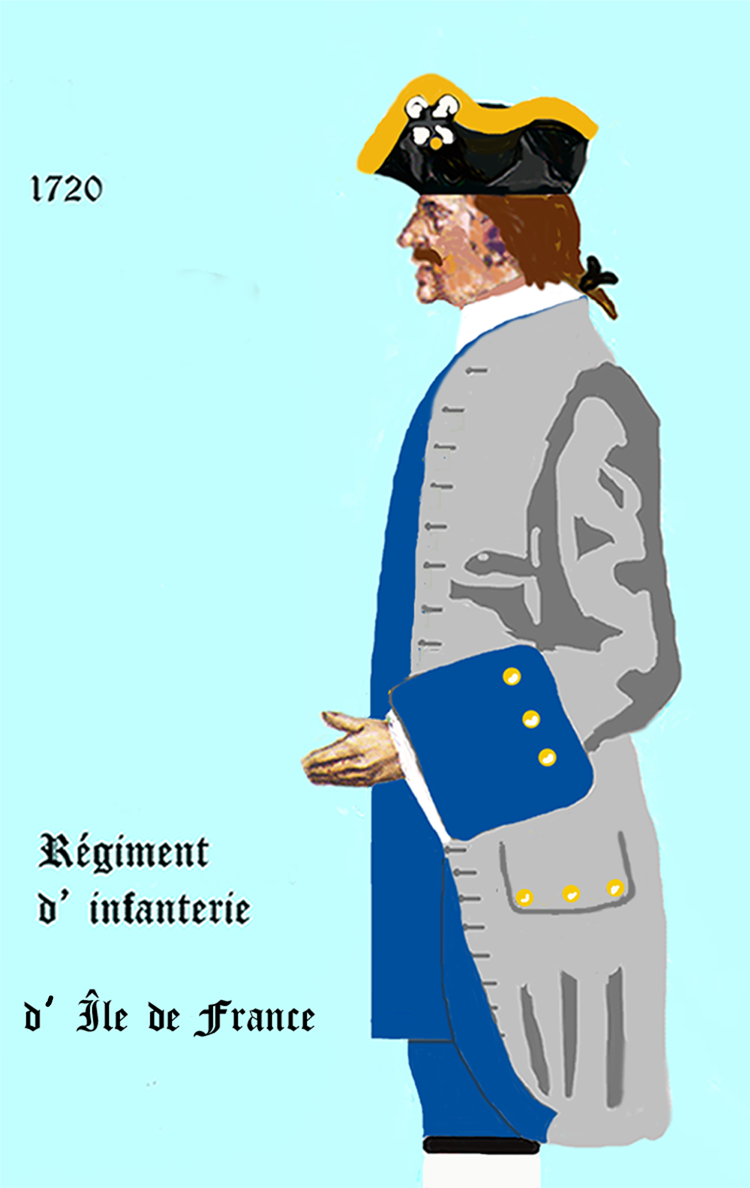
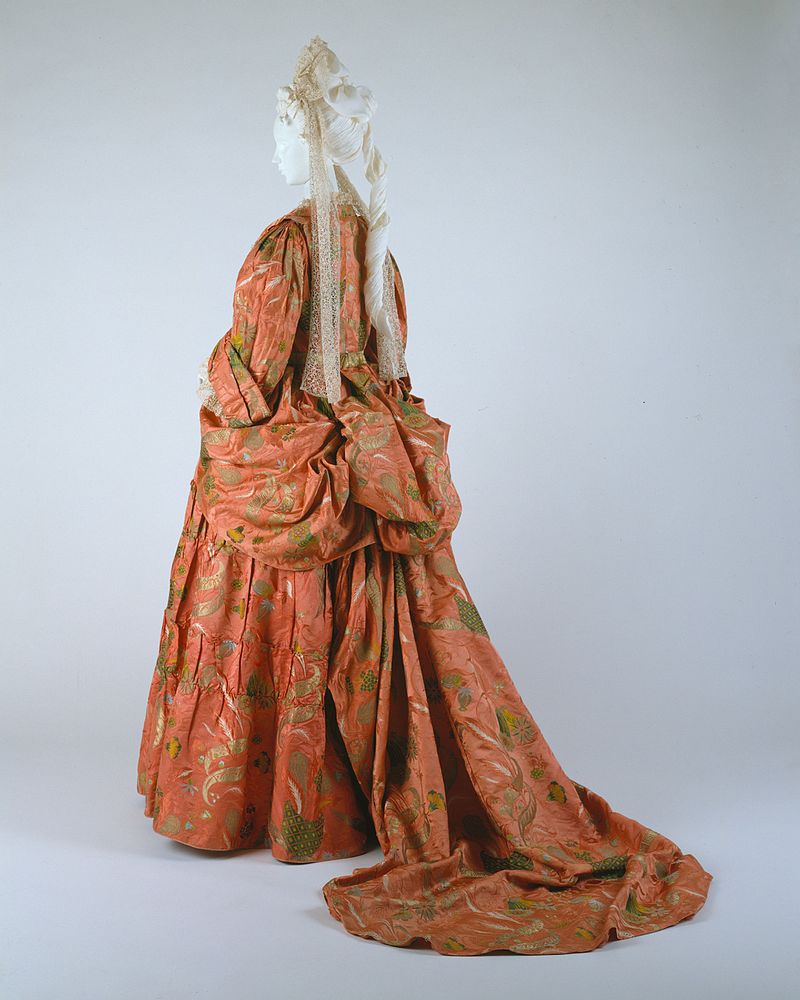
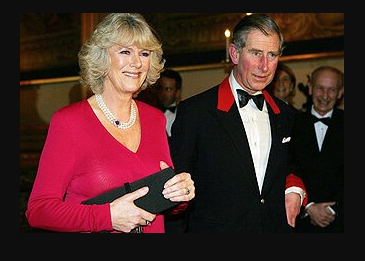
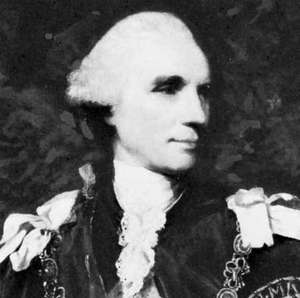 “Succeeding to his father’s earldom in 1723,
 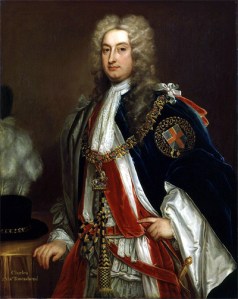 Charles Townsend, 2nd Viscount Townsend, who served as Secretary of State under George I, used the four crop method on his estate in Norfolk. Townsend had learned of the method from farmers in Holland. It was also used in America and to a lesser extent in Scotland. Crops were rotated on a four-year basis. Townsend considered clover and turnips as two of the crops. The Open Door Website explains the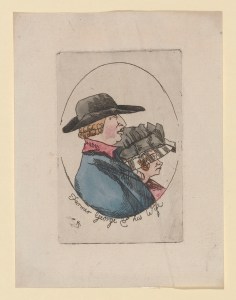
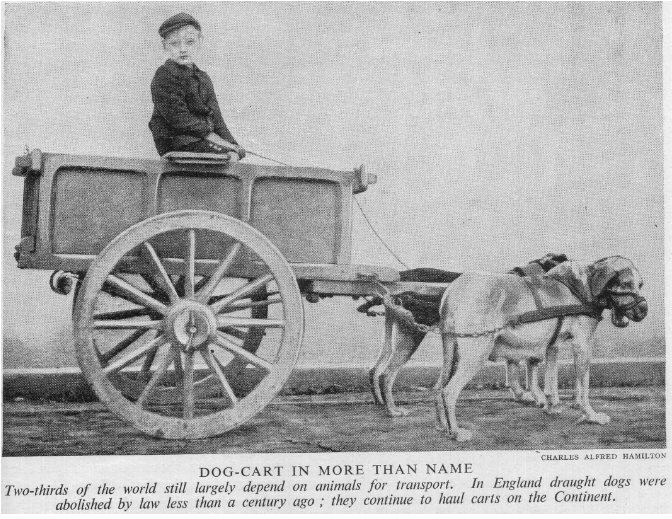

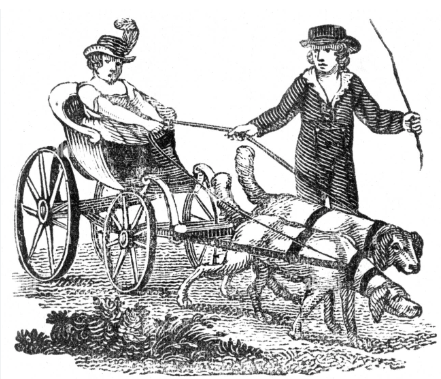
 In England and Wales from the 12th Century forward enclosure (or inclosure) was a common practice. Before enclosure, much of the land was only used during the growing season. Once the harvest took place, the was at the disposal of the community. People grazed their livestock freely upon the land. They also found other uses for it. Enclosure occurred when someone, usually the manorial lord, put up a fence or a hedgerow to separate open land and the land the lord chose to claim. This prevented common grazing rights.
 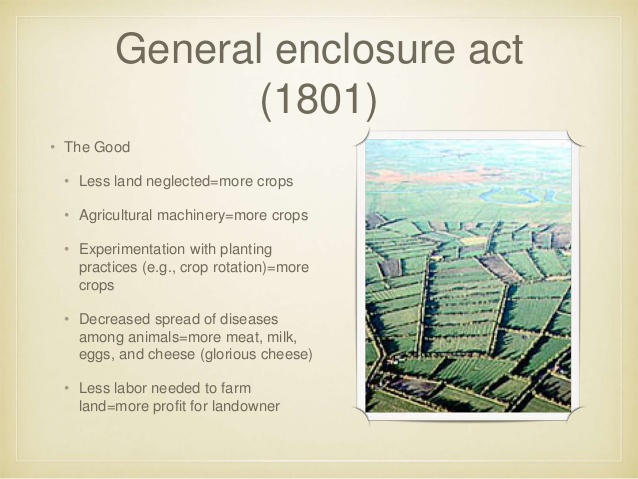 The article on enclosure on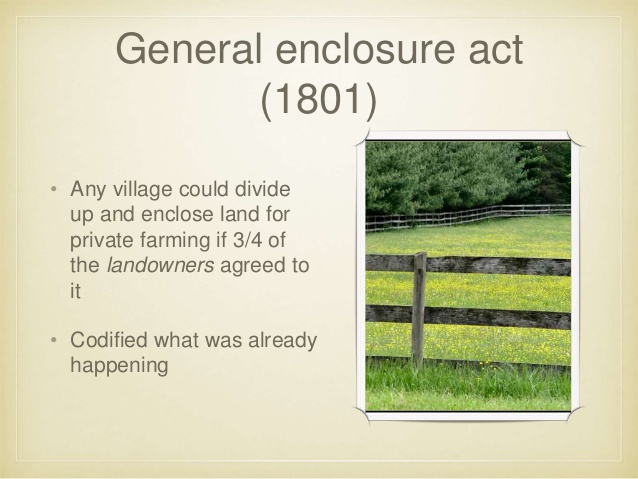
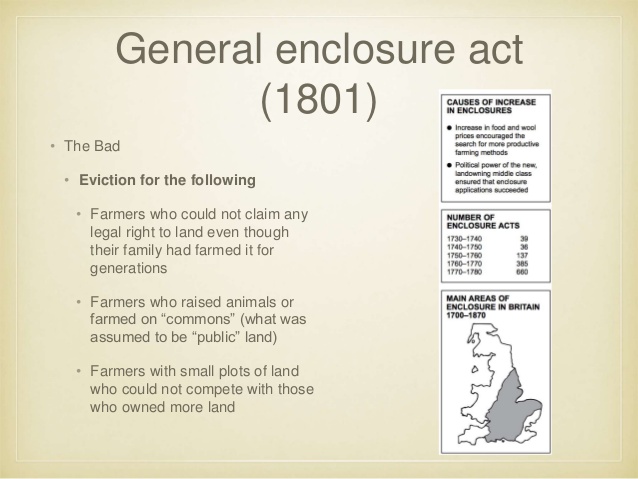
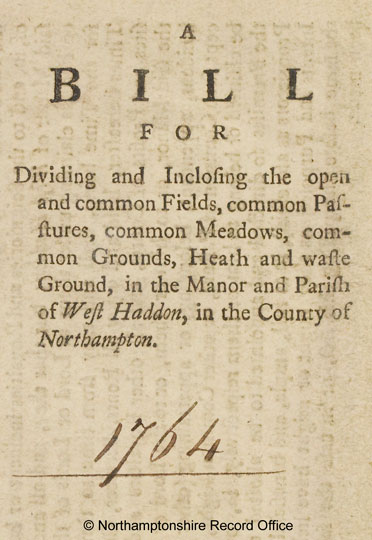 “Occasionally however rebellions took place against this loss of privilege. One such example was recorded in a letter of 1796 sent by a Thomas Swinnerton of Butterton Hall near Newcastle under Lyme. The letter was addressed to the agent of the Bishop of Lichfield who was Lord of the Manor in which Thomas had his estate. In the letter Thomas complained about a rebellion that had taken place when he decided to enclose common land adjoining the ‘green lane’ which ran through his property explaining why he had done so: ‘the great object of the enclosure..was to prevent the building of a Workhouse or the converting of..the land into Gardens for the Poor’. However the ‘poor’ had rebelled and convened a Manorial Court at a local pub during which : ‘the landlord..where the Court was held was a most principal party in exciting & encouraging the Mob to destroy the inclosure & …on return of the Mob gave them ale’.. Another agent provocateur was apparently ‘a man who hires out horses which may be found..in the night in the inclosures’. Again there was no sympathy at all for the poor some of whom were destitute needing accommodation and land to grow food. They had invoked an ancient custom by convening a Manorial Court at which their grievances could be aired but understandably this had ended in violence. I do not know whether the Bishop took any action as a result of this letter but the draft reply sent by his agent seemed more sympathetic to the ‘Mob’ than to Swinnerton!!”



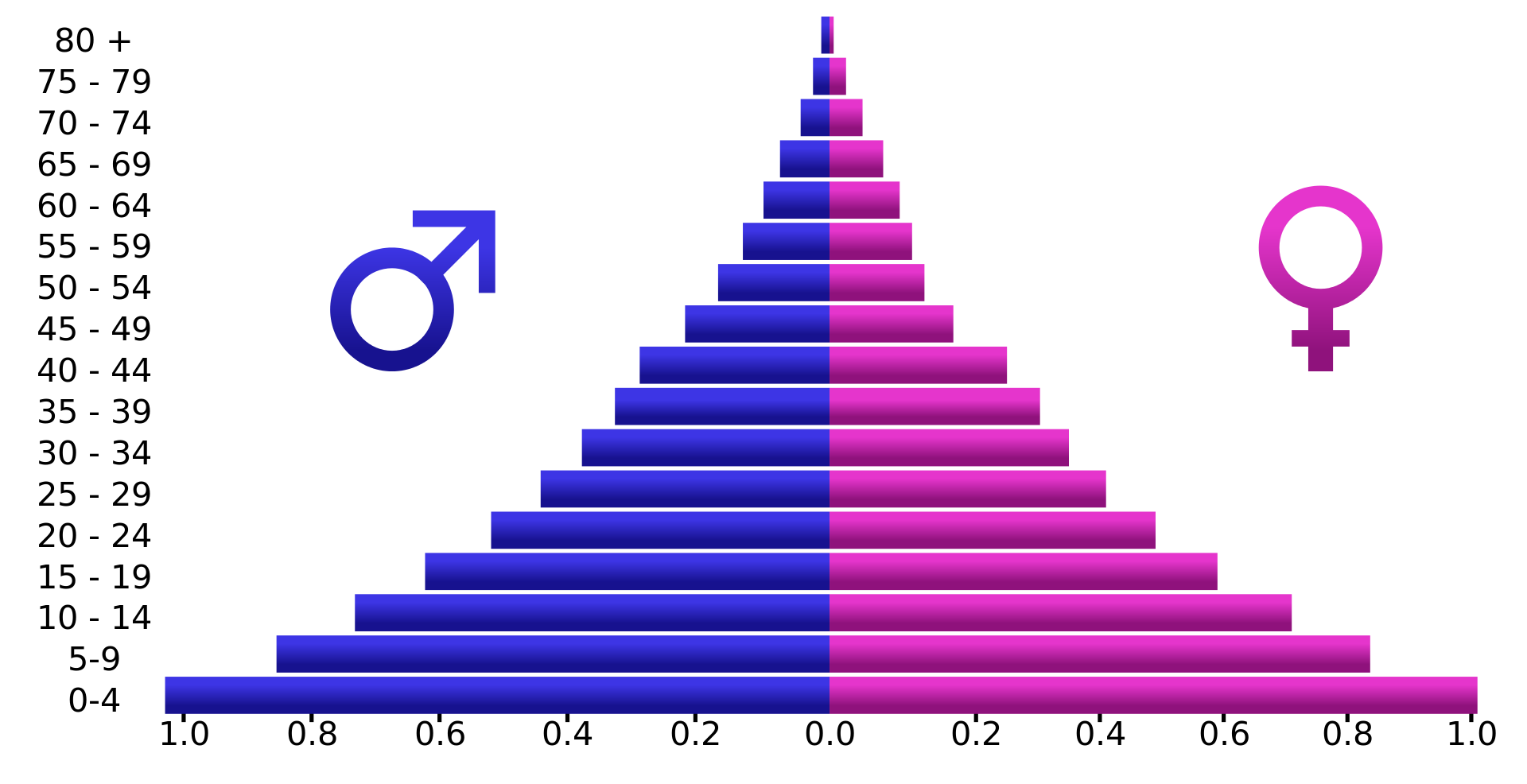





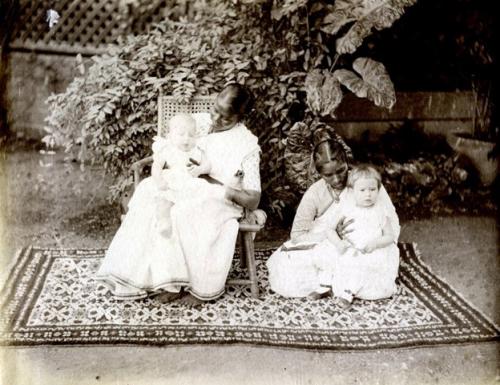
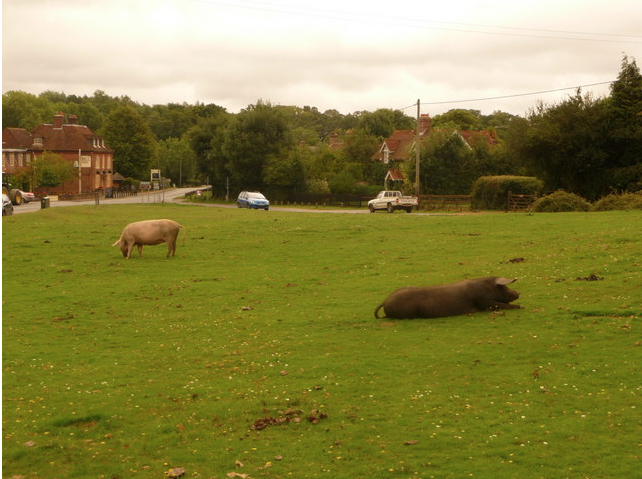


 Every Woman Dreams...


