The Real Life Character of Beau Brummell in My Newest Release, “Loving Lord Lindmore” + a Giveaway

The real life character of George “Beau” Bryan Brummell makes two very important appearances in my story “Loving Lord Lindmore,” which is part of A Regency Summer Scandal Anthology. His first permits my heroine, Lady Cora Midland, to become the “toast of the ton.” The second assists Lady Cora in teaching her childhood friend a lesson in not settling for second best. However, who was “the Beau” and how did a non-aristocrat manage to rule the haut ton?

George Bryan Brummell (1778 – 1840) was a famous English dandy, setting the standard of dress for many men in the ton at the beginning of the 19th Century. He was for many years friends with George, Prince of Wales, better known to those of us who read and write Regency era based romances as the Prince Regent (eldest son of King George III.

Ironically, Brummell was not born into the aristocracy. His grandfather was a shopkeeper in St. James parish (London), who let lodgings to many in the aristocracy who came to Town for the London Season or for Parliament. Brummell’s father was private secretary to Lord North and also high sheriff of Berkshire. Brummell reportedly always had an eye for his clothing and took great care in his dress. At Eton he was known at “Buck Brummell” and proved to be very popular with his classmates. At Oxford, he developed, not only his reputation as a fashion leader, but also his rapier quick wit. In 1794, the Prince of Wales, to whom had been presented at Eton, gave Brummell a commission in his own regiment. Four years later, Brummell had reached the rank of captain, leaving the service in 1798.

In 1799, Brummell inherited a fortune of £30,000 from his father. He quickly set up his bachelor establishment in the elite area of London known as Mayfair. Combining his connection to Prince George and his reputation for perfection in his clothing, Brummell was recognized as the arbiter of all things fashionable. For a time, he was the ruling “KING” of fashion, but he lost much of his influence as his debts began to mount and a very public falling out with the Prince took its toll. In 1816, he fled to Calais, where he remained for 14 years, all to avoid his creditors. However, even in Calais, he never seemed to be able to keep his head above water. From 1830-1832, he was made British consul at Caen. However, 1835 found him imprisoned for debt. Fortunately, his friends again brought him up to snuff in financials and provided him a small income. His personal appearance, no longer important to him, he was now known to be quite slovenly and dirty. He very much lived in fantasies of his past life. In 1837, he had two separate attacks of paralysis and never fully recover. One final time, friends found him shelter in the charitable asylum of Bon Sauveur in Caen, where he spent his final years.

In my tale, however, he still has considerable influence on the fashionable of the beau monde, for it takes place in 1814.

Loving Lord Lindmore

BOOK BLURB…

LADY CORA TAKES SOCIETY BY STORM . . .

Lady Cora Midland, a highly-spirited country beauty, offers no pretensions, which wins her many admirers, despite her lack of knowledge on how to manage the beau monde. However, Matthew Harrington believes she is taking advantage of his elderly grandmother, and he means to put a stop to the girl.

LORD MATTHEW LINDMORE IS IN DENIAL . . . 

Lindmore reluctantly assists his grandmother in bringing Lady Cora out in Society. Yet, what appeared to be a daunting task becomes a transformation the earl does not expect. He finds the woman as delightful as do others in the haut ton. Yet…

When Lady Cora is on the the verge of marrying another, Lindmore fears time will expire before he can speak his own proposal. 

Excerpt with Cora’s first encounter of Beau Brummell:

Cora had not looked up to the impeccably, though a bit flamboyantly dressed man, but rather when she felt the earl’s eyes upon her. She liked how Lindmore studied her, and, despite a number of young men with sharp and rather high shirt points standing about her, she looked to his lordship and smiled. Unfortunately, the earl did not smile back, but the other gentleman had. 

Although she would prefer the earl’s company, she kept the smile upon her lips as the other gentleman approached and her current admirers all took a gigantic step away from her to permit the newcomer his sway. All conversation around them stopped and many leaned forward to better hear the gist of their conversation.

When the man spoke, it was in a drawl, indicating a certain level of boredom with all around him. She was surprised to discover Lord Lindmore had trailed the man across the room. “If you would indulge me, Lindmore, I would ask for a proper introduction to your ward.” 

“Ward!” Cora began, but the earl shook off her protest with a warning frown. 

Instead, he said, “Lady Cora, I would give you the acquaintance of Mr. George Brummell, but his friends call him ‘Beau.’” 

“Yet, we are not yet ‘friends,” Cora declared, though she heard the waring in the earl’s tone and chose to ignore it.

 “This is Beau Brummell?” one of the young men still close enough to overhear her response protested. 

“I am aware of the gentleman’s name,” she corrected the fellow. “However, Lord Lindmore said Mr. Brummell’s friends refer to him as ‘Beau.’ I simply made the observation I am not yet Mr. Brummell’s friend, but I suppose one day I could be.” 

The room remained eerily quite until Mr. Brummell barked a laugh. “The lady is correct, sir.” He extended his arm to her. “If you are willing, my lady, let us walk about the room and stroll into our friendship.” 

As he stood so regally before her, in all her innocence, Cora recognized a monumental moment had arrived. “I find the prospects delightful, sir.” She slid her hand about the crook of his arm and followed his lead as they made their way about the room. It was as if all those within held their collective breath. Clusters of people bowed as they passed them, although the man at her side was not a titled gentleman. Ironically, he quite spectacularly ignored them and kept his attention of her. 

It was not as if Cora held no knowledge of Mr. Brummell, for the newsprints spoke of his friendship with Prince George. Moreover, she had heard Jordan speak of the man when she had teased her friend for, first, one outrageous fashion trend and then another, and, naturally, her half-brother, the current Lord Midland, often sported questionable fashion, claiming “the Beau” had approved of it. 

“You are friend to Lindmore?” she asked. 

“Most men and women of the ton know something of each other,” he said with a tilt of his head. Generally, we approve of what we learn. More often than not, we pray the other will fall from grace so we might be entertained and consider ourselves fortunate not to be the poor soul.” 

“How very sad,” she observed. 

“Is such not the way of all people?” Mr. Brummell questioned. “We wish others to fail so we might think ourselves the fortunate ones, though often we are tittering on the edge of failure ourselves. Yet, enough of my sermonizing. I did not ask to walk about the room with you to discuss such morbid thoughts. Tell me, instead, something of your people, Lady Cora.” 

“Gladly so,” she said with another smile. “I adore speaking of them. My mother, Miss Sophia Cooper, was half sister to Lord Lindmore’s mother, Miss Louisa Copper. They shared a father, Edward, 7th Viscount Cooper. Louisa married Frederick Harrington, who as you well know, both passed quite young, leaving their son as the heir to the Lindmore line.

“My mother was the second wife of Lord John Midland. With our father’s passing, my half-brother has assumed the earldom. My mother inherited Cameron Manor from her mother, the late Viscountess Cooper. The manor is mine, or I should say will be mine when I am considered old enough to manage on my own. Before she passed, Lady Midland asked the Dowager Countess of Lindmore to see to my Come Out.” Cora would not admit how her mother had not trusted the Midlands to do right by her. Some family secrets were be held close to the chest. 

“My own father was not a landed gentleman,” Brummell admitted. “Not that anyone in this room cares. Never permit them to know you possess a weakness,” he advised. “They will turn upon you in the manner of a swarm of bees.” 

Cora glanced to those watching them intently. “You make me wish to run screaming from the room, sir,” she admitted. 

Brummell chuckled. “Perhaps we both should do so and see how many follow suit. I have heard of the habits of Norway lemmings, which suddenly appear in large numbers, seemingly out of nowhere, as if they fell from the sky. They are thought to come upon the notion of following each other so closely that when one jumps from a cliff, they all follow without reason. Some day I may place this rumor into practice to see what might be the result.” 

Cora felt sympathy for a man who could not even turn around without everyone remarking on it. 

He sighed heavily. “Tell me something outrageous regarding your father.” 

Cora frowned. “I would not wish others to think poorly of him.” They had come to stand in one corner of the room. Thankfully, people had held back and not edged in around them to listen upon their conversation. “He was an exemplary father,” she assured. 

“What I know of the current Lord Midland does not speak of ‘exemplary’ parentage,” Brummell countered. 

“My mother always suggested such was due to the nature of my father’s first wife,” she admitted, though Cora was not assured she should be sharing family secrets with a complete stranger, though she sensed Mr. Brummell could be trusted, for he appeared to shun the gossipy nature of the beau monde as much as she. Moreover, she assumed he made it a point to know other’s weaknesses in order to protect his own. 

“You are likely correct. We men do not give women enough credit for shaping our futures,” Brummell observed. “What is some article or lesson which speaks to the previous Lord Midland’s nature?”

Cora smiled easily. “I suppose you mean something other than adoring me.”

He laughed and nodded his agreement.

“Upon my father’s passing, my brother Midland quickly claimed a fashionably-made pocket watch by Mr. John Ellicott, similar to the one Ellicott made for Robert Wapole, as well as a dozen or so ornamental snuff boxes.” 

“Oh, my, say it is not so! Lord Petersham would require a physician if he was made aware of Midland claiming snuff boxes of such merit. You see, my dear, Petersham is singular in his collection of ornamental boxes.”

Cora giggled. “If I take Lord Petersham’s acquaintance, perhaps I should suggest Midland could be persuaded to part with my father’s collection.” 

“Petersham will not relent. You would be unleashing a ‘rabid dog’ onto Midland’s scent. Not very ladylike, I fear. Perhaps I should be the one to inform his lordship. I would not wish to cause trouble between you and Midland. Moreover, I would not have you subjected to Petersham’s ‘appreciation.’” Brummell chuckled again. “In reality, Lord Petersham can be quite tiring, but his approval will secure your success this season,” he assured. “Yet, before we must separate, which we must because others will soon criticize us, rather than admire us, I must learn what you kept from your father’s worldly goods. What memory did you claim? Such will speak to your goodness or . . . . Well, I refuse to think you as base as your brother.” 

“You will only consider me quite eccentric,” she protested. 

“The most interesting people always are a bit eccentric,” he assured. 

Cora had quickly come to appreciate Mr. Brummell’s own form of “eccentricity.” “You shall consider me odd,” she began. “My father possessed a silver-hilted sword he would wear when we would come to London. He claimed parts of the Capital were quite lawless. He sported it on his left side; it was of the nature of a French dueling épeé. He also owned a quill knife with a sliding blade and a folding pen knife, the handles of both were made of ivory and encrusted with jewels. The blade of each slides into the haft when not in use. I have been quite obsessed with different knives since I was young.” She chuckled at her confession. “Lady Midland always said my father wished for another son. To prove otherwise, Lord Midland presented my mother with a silver stitching knife carved with a delicate pattern and engraved with a promise of his devotion. She used it often.”

“And where are these weapons now?” Brummell asked in what appeared true interest. 

“The épeé is still at my estate. Two of the blades are in my quarters at Lind Hall. One in my reticule,” she confessed. “I took it from my trunk and carried it with me in the coach. I felt safer, and, I admit, more loved. As if, my father was watching over me as I made my way in the world.” 

“The weapon with which you cut the strings of Lady Lindmore’s bonnet,” he surmised. “People have been wondering on that part of the tale of the countess’s rescue. There is no question you know something of how to use such a piece.” 

“I am quite efficient with a blade, sir,” she whispered. “On a fish or a bonnet’s ribbon or on a scoundrel.” 

Before more could be said, Lindmore interrupted them. “Brummell, you have claimed enough of Lady Cora’s attentions this evening. My grandmother extends her gratitude for your singling out my cousin. We are all greatly in your debt, sir. Are we not, my lady?” he asked Cora. 

“I will permit your interference this time,” Mr. Brummell drawled. “Yet only because this is Lady Cora’s first foray and because I adore Lady Lindmore. As to the others, I care not their opinions.” He presented Cora an elegant bow before bringing her gloved hand to his lips. “I will anticipate our next meeting, my dear,” he said loud enough for others to hear. “It has been many years since I have been so delightfully entertained. Adieu.” 

Adieu, sir,” Cora dutifully repeated. “I am most grateful for your consideration.” 

As Brummell turned towards the exit, Lindmore offered her his arm. “What a thrilling experience. I feel quite privileged,” she shared. 

“And here I thought you simply preferred Brummell to me,” he said with a teasing lift of his brows.

“You are quite impossible, sir,” she chastised, but Cora enjoyed the warmth of his arm beneath her gloved fingers and the scent of sandalwood waifing from his skin. She would prefer to remain on his arm the remainder of the evening, but his grandmother had other ideas. 

Loving Lord Lindmore is currently on PreOrder with a release date on February 21, 2024.

Kindle https://www.amazon.com/dp/B0CTFSRB7R?ref_=pe_93986420_775043100

Upon Release Available to Read on Kindle Unlimited

Amazon https://www.amazon.com/dp/B0CTLY847C?ref_=pe_93986420_774957520

To Enter the Giveaway, leave a comment below. Winners will be chosen the weekend of February 17, and prizes will be delivered on February 21, 2024, the book’s release date.

Posted in aristocracy, book excerpts, book release, British history, eBooks, excerpt, Georgian England, Georgian Era, giveaway, heroines, historical fiction, publishing, reading, reading habits, real life tales, Regency era, Regency personalities, Regency romance, research, writing | Tagged , , , , , , , , , , , , , , , , , | 1 Comment

Snuff Boxes and the “Avid” Georgian Era Collectors + the Release of “Loving Lord Lindmore” + a Giveaway

Christie’s Auction House’s Facebook page tells us, “In the Georgian era, snuff was the tobacco of choice for high society. It came in a great many varieties and spending on it was lavish.

The boxes in which snuff was carried were trinkets of great importance and collecting them became an obsession amongst Georgian gentlemen. Lord Byron spent £500 on snuff-boxes in a single shopping spree, while Viscount Petersham owned 365, one for every day of the year, and always chose ‘one that suited the weather’ http://ow.ly/ri30306bYVl

In 1777 The Universal Magazine of Knowledge and Pleasure carried a comic poem by Holbeach (but as the most recognizable writer known as Holbeach was not born until 1824 … well). Nevertheless, the rhyme listed the ingredients to make a ‘modern fop’. Among other things: ‘A lofty cane, a sword with silver hilt, a ring, two watches, and a snuff-box gilt.’ As additional information, here’s a bit about Henry Holbeach. “William Brighty Rands also known as Henry Holbeach and many other names, was a British writer. His nursery rhymes made him famous. William published several volumes of children’s literature using pseudonyms. His most known pseudonyms were Henry Holbeach, Matthew Browne, and T. Talker. He also worked in the House of Commons, (the Parliament reporting staff of Messrs Gurney).” [Victorian Era]

The tobacco of choice for those of the haut tone was snuff. Some believe the aristocracy smoked a great deal; however, snuff was the tobacco of choice. That being said, the Word Wenches site tells us: “Cigars, which is to say the rolled leaf kinda tucked up neatly for smoking, were ancient in the New World when Columbus dropped by. This way of smoking came over to Europe with tobacco itself. Cheroot is another term. This means a cylindrical cigar, one made without the tapered ends. It would have existed in the Regency period but would probably have come from India or points east.”

Snuff was flavored and spice was often added. Lord Petersham’s collection, at his death was worth more than £3000. Snuff boxes were ornate—made of precious metals, porcelain, or tortoiseshell. Many sported illustrations by well-known painters.

Lord Petersham receives a nice mention by Beau Brummell and a bit in one of the final scenes, nonetheless, in my latest tale, Loving Lord Lindmore.

BOOK BLURB…

LADY CORA TAKES SOCIETY BY STORM . . .

Lady Cora Midland, a highly-spirited country beauty, offers no pretensions, which win her many admirers, despite her lack of knowledge on how to manage the beau monde. However, Matthew Harrington believes she is taking advantage of his elderly grandmother, and he means to put a stop to the girl.

LORD MATTHEW LINDMORE IS IN DENIAL . . . 

Lindmore reluctantly assists his grandmother in bringing Lady Cora out in Society. Yet, what appeared to be a daunting task becomes a transformation the earl does not expect. He finds the woman as delightful as do others in the haut ton. Yet… When Lady Cora is on the the verge of marrying another, Lindmore fears time will expire before he can speak his own proposal. 

***

Enjoy this excerpt from Chapter Five of Loving Lord Lindmore, where Beau Brummell makes an appearance and Lord Petersham is mentioned. (Name droppers…)

Cora had not looked up to the impeccably, though a bit flamboyantly dressed man, but rather when she felt the earl’s eyes upon her. She liked how Lindmore studied her, and, despite a number of young men with sharp and rather high shirt points standing about her, she looked to his lordship and smiled. Unfortunately, the earl did not smile back, but the other gentleman had. 

Although she would prefer the earl’s company, she kept the smile upon her lips as the other gentleman approached and her current admirers all took a gigantic step away from her to permit the newcomer his sway. All conversation around them stopped and many leaned forward to better hear the gist of their conversation.

When the man spoke, it was in a drawl, indicating a certain level of boredom with all around him. She was surprised to discover Lord Lindmore had trailed the man across the room. “If you would indulge me, Lindmore, I would ask for a proper introduction to your ward.” 

“Ward!” Cora began, but the earl shook off her protest with a warning frown. 

Instead, he said, “Lady Cora, I would give you the acquaintance of Mr. George Brummell, but his friends call him ‘Beau.’” 

“Yet, we are not yet ‘friends,” Cora declared, though she heard the waring in the earl’s tone and chose to ignore it.

 “This is Beau Brummell?” one of the young men still close enough to overhear her response protested. 

“I am aware of the gentleman’s name,” she corrected the fellow. “However, Lord Lindmore said Mr. Brummell’s friends refer to him as ‘Beau.’ I simply made the observation I am not yet Mr. Brummell’s friend, but I suppose one day I could be.” 

The room remained eerily quite until Mr. Brummell barked a laugh. “The lady is correct, sir.” He extended his arm to her. “If you are willing, my lady, let us walk about the room and stroll into our friendship.” 

As he stood so regally before her, in all her innocence, Cora recognized a monumental moment had arrived. “I find the prospects delightful, sir.” She slid her hand about the crook of his arm and followed his lead as they made their way about the room. It was as if all those within held their collective breath. Clusters of people bowed as they passed them, although the man at her side was not a titled gentleman. Ironically, he quite spectacularly ignored them and kept his attention of her. 

It was not as if Cora held no knowledge of Mr. Brummell, for the newsprints spoke of his friendship with Prince George. Moreover, she had heard Jordan speak of the man when she had teased her friend for, first, one outrageous fashion trend and then another, and, naturally, her half-brother, the current Lord Midland, often sported questionable fashion, claiming “the Beau” had approved of it. 

“You are friend to Lindmore?” she asked. 

“Most men and women of the ton know something of each other,” he said with a tilt of his head. Generally, we approve of what we learn. More often than not, we pray the other will fall from grace so we might be entertained and consider ourselves fortunate not to be the poor soul.” 

“How very sad,” she observed. 

“Is such not the way of all people?” Mr. Brummell questioned. “We wish others to fail so we might think ourselves the fortunate ones, though often we are tittering on the edge of failure ourselves. Yet, enough of my sermonizing. I did not ask to walk about the room with you to discuss such morbid thoughts. Tell me, instead, something of your people, Lady Cora.” 

“Gladly so,” she said with another smile. “I adore speaking of them. My mother, Miss Sophia Cooper, was half sister to Lord Lindmore’s mother, Miss Louisa Copper. They shared a father, Edward, 7th Viscount Cooper. Louisa married Frederick Harrington, who as you well know, both passed quite young, leaving their son as the heir to the Lindmore line.

“My mother was the second wife of Lord John Midland. With our father’s passing, my half-brother has assumed the earldom. My mother inherited Cameron Manor from her mother, the late Viscountess Cooper. The manor is mine, or I should say will be mine when I am considered old enough to manage on my own. Before she passed, Lady Midland asked the Dowager Countess of Lindmore to see to my Come Out.” Cora would not admit how her mother had not trusted the Midlands to do right by her. Some family secrets were be held close to the chest. 

“My own father was not a landed gentleman,” Brummell admitted. “Not that anyone in this room cares. Never permit them to know you possess a weakness,” he advised. “They will turn upon you in the manner of a swarm of bees.” 

Cora glanced to those watching them intently. “You make me wish to run screaming from the room, sir,” she admitted. 

Brummell chuckled. “Perhaps we both should do so and see how many follow suit. I have heard of the habits of Norway lemmings, which suddenly appear in large numbers, seemingly out of nowhere, as if they fell from the sky. They are thought to come upon the notion of following each other so closely that when one jumps from a cliff, they all follow without reason. Some day I may place this rumor into practice to see what might be the result.” 

Cora felt sympathy for a man who could not even turn around without everyone remarking on it. 

He sighed heavily. “Tell me something outrageous regarding your father.” 

Cora frowned. “I would not wish others to think poorly of him.” They had come to stand in one corner of the room. Thankfully, people had held back and not edged in around them to listen upon their conversation. “He was an exemplary father,” she assured. 

“What I know of the current Lord Midland does not speak of ‘exemplary’ parentage,” Brummell countered. 

“My mother always suggested such was due to the nature of my father’s first wife,” she admitted, though Cora was not assured she should be sharing family secrets with a complete stranger, though she sensed Mr. Brummell could be trusted, for he appeared to shun the gossipy nature of the beau monde as much as she. Moreover, she assumed he made it a point to know other’s weaknesses in order to protect his own. 

“You are likely correct. We men do not give women enough credit for shaping our futures,” Brummell observed. “What is some article or lesson which speaks to the previous Lord Midland’s nature?”

Cora smiled easily. “I suppose you mean something other than adoring me.”

He laughed and nodded his agreement.

“Upon my father’s passing, my brother Midland quickly claimed a fashionably-made pocket watch by Mr. John Ellicott, similar to the one Ellicott made for Robert Wapole, as well as a dozen or so ornamental snuff boxes.” 

“Oh, my, say it is not so! Lord Petersham would require a physician if he was made aware of Midland claiming snuff boxes of such merit. You see, my dear, Petersham is singular in his collection of ornamental boxes.”

Cora giggled. “If I take Lord Petersham’s acquaintance, perhaps I should suggest Midland could be persuaded to part with my father’s collection.” 

“Petersham will not relent. You would be unleashing a ‘rabid dog’ onto Midland’s scent. Not very ladylike, I fear. Perhaps I should be the one to inform his lordship. I would not wish to cause trouble between you and Midland. Moreover, I would not have you subjected to Petersham’s ‘appreciation.’” Brummell chuckled again. “In reality, Lord Petersham can be quite tiring, but his approval will secure your success this season,” he assured. “Yet, before we must separate, which we must because others will soon criticize us, rather than admire us, I must learn what you kept from your father’s worldly goods. What memory did you claim? Such will speak to your goodness or . . . . Well, I refuse to think you as base as your brother.” 

“You will only consider me quite eccentric,” she protested. 

“The most interesting people always are a bit eccentric,” he assured. 

Cora had quickly come to appreciate Mr. Brummell’s own form of “eccentricity.” “You shall consider me odd,” she began. “My father possessed a silver-hilted sword he would wear when we would come to London. He claimed parts of the Capital were quite lawless. He sported it on his left side; it was of the nature of a French dueling épeé. He also owned a quill knife with a sliding blade and a folding pen knife, the handles of both were made of ivory and encrusted with jewels. The blade of each slides into the haft when not in use. I have been quite obsessed with different knives since I was young.” She chuckled at her confession. “Lady Midland always said my father wished for another son. To prove otherwise, Lord Midland presented my mother with a silver stitching knife carved with a delicate pattern and engraved with a promise of his devotion. She used it often.”

“And where are these weapons now?” Brummell asked in what appeared true interest. 

“The épeé is still at my estate. Two of the blades are in my quarters at Lind Hall. One in my reticule,” she confessed. “I took it from my trunk and carried it with me in the coach. I felt safer, and, I admit, more loved. As if, my father was watching over me as I made my way in the world.” 

“The weapon with which you cut the strings of Lady Lindmore’s bonnet,” he surmised. “People have been wondering on that part of the tale of the countess’s rescue. There is no question you know something of how to use such a piece.” 

“I am quite efficient with a blade, sir,” she whispered. “On a fish or a bonnet’s ribbon or on a scoundrel.” 

Before more could be said, Lindmore interrupted them. “Brummell, you have claimed enough of Lady Cora’s attentions this evening. My grandmother extends her gratitude for your singling out my cousin. We are all greatly in your debt, sir. Are we not, my lady?” he asked Cora. 

“I will permit your interference this time,” Mr. Brummell drawled. “Yet only because this is Lady Cora’s first foray and because I adore Lady Lindmore. As to the others, I care not their opinions.” He presented Cora an elegant bow before bringing her gloved hand to his lips. “I will anticipate our next meeting, my dear,” he said loud enough for others to hear. “It has been many years since I have been so delightfully entertained. Adieu.” 

Adieu, sir,” Cora dutifully repeated. “I am most grateful for your consideration.” 

As Brummell turned towards the exit, Lindmore offered her his arm. “What a thrilling experience. I feel quite privileged,” she shared. 

“And here I thought you simply preferred Brummell to me,” he said with a teasing lift of his brows.

“You are quite impossible, sir,” she chastised, but Cora enjoyed the warmth of his arm beneath her gloved fingers and the scent of sandalwood waifing from his skin. She would prefer to remain on his arm the remainder of the evening, but his grandmother had other ideas. 

Loving Lord Lindmore is currently on PreOrder with a release date on February 21, 2024 Purchase links are below.

Kindle https://www.amazon.com/dp/B0CTFSRB7R?ref_=pe_93986420_775043100

Upon Release Available to Read on Kindle Unlimited

Amazon https://www.amazon.com/dp/B0CTLY847C?ref_=pe_93986420_774957520

To Enter the Giveaway, leave a comment below. Winners will be chosen the weekend of February 17, and prizes will be delivered on February 21, 2024, the book’s release date.

Posted in anthology, aristocracy, book excerpts, book release, British history, Dreamstone Publishing, eBooks, excerpt, fashion, Georgian England, Georgian Era, giveaway, historical fiction, history, Living in the Regency, Living in the UK, reading, real life tales, Regency era, Regency personalities, Regency romance, research, romance, writing | Tagged , , , , , , , , , , , , , , , , , , , , | 1 Comment

The Film Adaptation of Jane Austen’s “Persuasion” (1995) ~ Part II


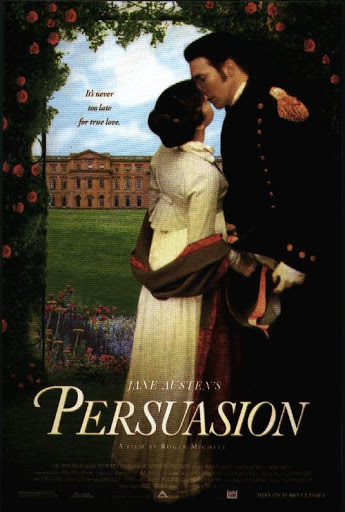
Persuasion is a 1995 period drama film directed by Roger Michell and baed on Jane Austen’s 1817 novel of the same name. In her theatrical film debut, the British actress Amanda Root stars as protagonist Anne Elliot, while Ciarán Hinds plays her romantic interest, Captain Frederick Wentworth. The film is set in 19th century England, nine years after Anne was persuaded by others to reject Wentworth’s proposal of marriage. Persuasion follows the two as they become reacquainted with each other, while supporting characters threaten to interfere.

“The film was adapted by the writer Nick Dear, who considered the story maturer than Austen’s other novels. He characterised it as one of realism and truthfulness, particularly in telling the story of two people separated and then reunited. As Austen’s narrative style conveys Anne’s thoughts internally, Dear and Root felt compelled to translate the character’s emotions using comparatively little dialogue. Persuasion was shot in chronological order, allowing the actress to portray Anne’s development from being downtrodden to happy and blossoming.” (Persuasion 1995 film)

To view part I of this analysis of “Persuasion” (1995), please look HERE.

Last time, we looked at the main characters of Anne Elliot and Captain Frederick Wentworth. This time, we will explore how the minor characters were portrayed in the film. 

Persuasion_374-1Let us begin with Admiral Croft (John Woodvine). Like Wentworth, Benwick, and Harville, this naval man is often seen in natural settings. We even view the admiral onboard ship at the beginning of the film. He is one of the most affable characters in the story line. One imagines the admiral to be honest and forthcoming. Croft displays a wry sense of humor when he jokes with Anne about how quickly Wentworth recovers from the “broken engagement” with Louisa Musgrove. His easy going nature is indispensable in handling the undisciplined Musgrove boys. Unlike other married couples displayed in Austen’s novels, in the Crofts we find a pair who complement each other and display affection. 

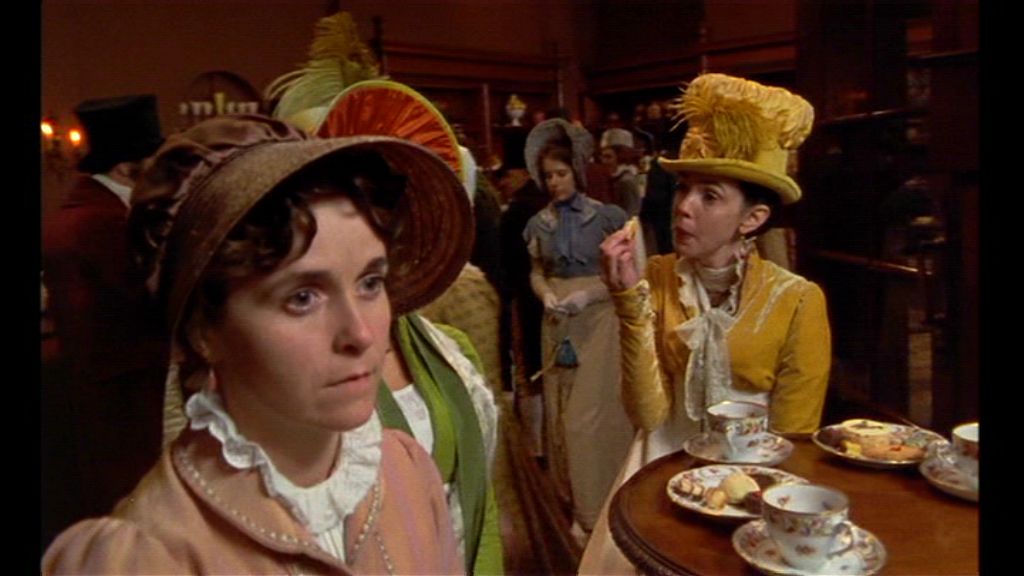
Persuasion-1995-persuasion-5174222-1024-576Sir Walter Elliot (Corin Redgrave), as portrayed in Austen’s book, is a more than a bit self-indulgent. In the 1995 film adaptation, the viewer meets a man immaculately dressed. His knee breeches and cutaway coat are made of the finest fabric. Even when seen at home, Sir Walter is the picture of the perfect “dandy.” He admires himself in mirrors and window reflections. Redgrave’s antics reveal Sir Walter as one of Austen’s finest comic characters. Sir Walter, like many of Austen’s patriarchs and matriarchs, cannot claim a bit of fatherly admiration. 

Elizabeth Elliot is portrayed by Phoebe Nicholls in this adaptation. This is one situation in which the screenwriter erred. Nicholls plays Elizabeth as less than ladylike. She sprawls upon the furniture. Stuffs her face with delicacies. Laughs too loud. Elizabeth cruelly insults Anne by saying “No one will want you in Bath, I am sure you had better stay here.” A woman of Elizabeth Elliot’s station (especially one with Sir Walter as her father) would not be so crass in her actions and her speech. Nick Dear’s chooses to portray Elizabeth in a manner that no one will hold sympathy for her when she is left without prospects at the end of the film. 

The Musgroves dote upon their children, especially the eldest son Charles. Even though they do not approve of Mary Musgroves “complaints of ill health,” they welcome their daughter in marriage to their home. They treat Louisa and Henrietta with great affection and do what they can to permit the girls to marry where their hearts are rather than to force a marriage of convenience upon them. This attitude is in sharp contrast to Sir Walter’s neglect of Anne (and of Mary to a certain extent). Sir Walter does not think Wentworth’s position in the Navy is worthy of the Elliot family.I strongly object to the Navy. It brings people of obscure birth into undue distinction and it cuts up a man’s youth and vigor most horribly!

images-3Charles and Mary Musgroves’ children are seen as mischievous and not very likable. They are demanding of Anne’s attentions, to the point of jumping upon her back. Mary Musgrove (Sophie Thompson) ignores her children. Snobbish as is her father, she thins of the Musgroves as “farmers.” She only married Charles Musgrove because he will inherit the Musgrove fortune, and Charles will be the second most important person in the neighborhood (behind her father, Sir Walter). For her bit of the attention, Mary is a hypochondriac. Her manners are demanding and self-indulgent. Our first glimpse of Mary is of her looking out of the window for Anne’s arrival. As soon as Mary spots Anne, she lies down and pretends to be ill. 

Mary Musgrove: Anne, why could you not have come sooner?
Anne Elliot: My dear Mary, I really have had so much to do.
Mary Musgrove: Do? What can you possibly have had to do?
Anne Elliot: A great many things I assure you.
Mary Musgrove: Well. Dear me.

The younger Musgroves reside in a “farmhouse” sporting messy rooms and sloppy care of the servants. This is to add to the portrayal of Mary Musgrove as the inferior daughter of the Elliot family. We can only predict that Mary will prove a poor mistress of the manor when she and Charles move into the great house upon the elder Musgrove’s passing. In the novel, the converted farmhouse was to have been thoroughly renovated into Uppercross cottage. 

Charles Musgrove (Simon Russell Beale) is shown as a great outdoorsman. He is customarily dressed for hunting. One must wonder if he spends so much time from his home because he holds no idea how to deal with his wife’s constant need for attention. He has the personality of his parents. Charles Musgrove is unpretentious. In this depiction we see quite clearly what Louisa Musgrove means when she tells Wentworth that the family would have preferred for Charles to marry Anne. 

In this adaptation Mrs. Musgrove (Judy Cornwell) and Mr. Musgrove (Roger Hammond) come across as happy and accommodating. Their home is NOT so properly arranged. Theirs is a country manor house, one appropriate for country squire. It appears “lived in.” The 1995 version of the novel does not address the musings of Mrs. Musgrove over her scapegrace son, Dick Musgrove. In the novel we learn of Anne’s observations that “Captain Wentworth should be allowed some credit for the self-command with which he attended to her [Mrs. Musgrove’s] large fat sighings over the destiny of a son whom alive nobody had cared for.” As two of Austen’s brothers spent time at sea, Jane Austen likely hear more than one tale of a wayward rascal who thought to earn his fortune at the hands of the French navy. 
Louisa and Henrietta Musgrove hold an infatuation with Wentworth. Louisa is the outspoken one, while Henrietta is less sure of herself. Although Wentworth encouraged Louisa’s flirtations to spite Anne’s earlier refusal of his hand, he refers to Louisa’s jump from the Cobb as “Damned foolish!

A sense of real life is created by showing these characters as dusty and even muddy as they walk through the countryside or ride a horse. They often appear disheveled. The Harvilles reside in cramped quarters in Lyme. There is barely room for them Uppercross party at the table. 

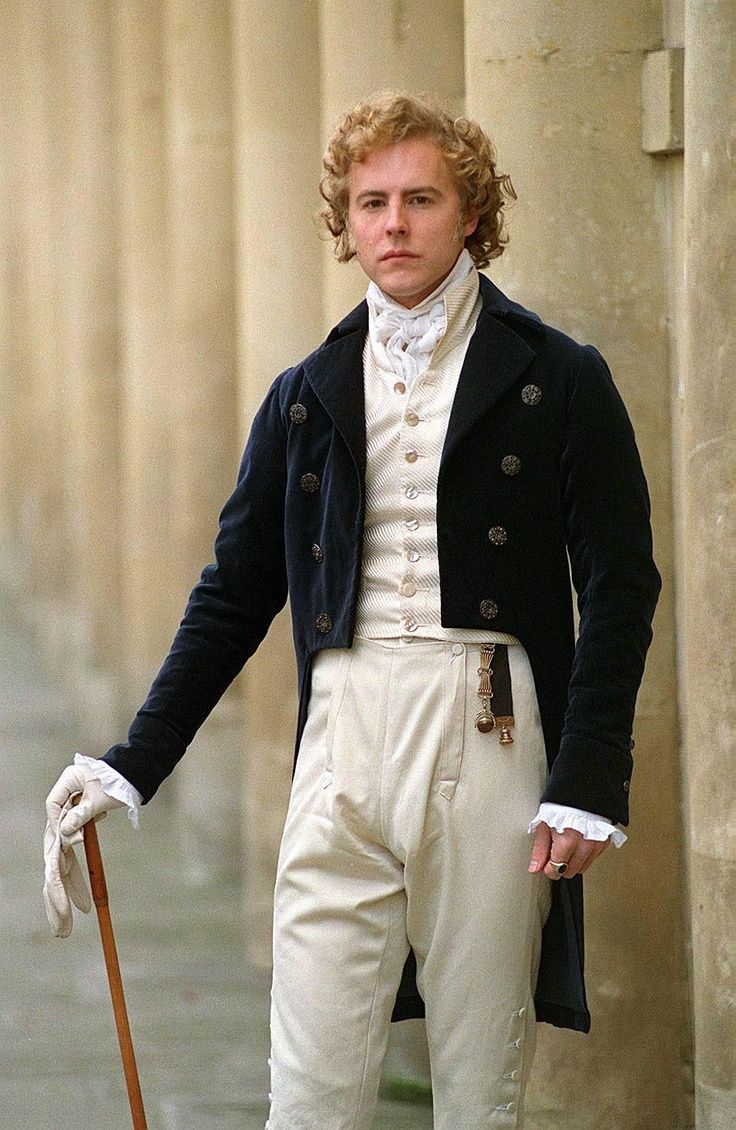
Samuel West portrays William Elliot in this adaptation. In contrast to Wentworth’s seaworthy countenance, Mr. Elliot is “pretty.” His manners are too polished, and the audience knows immediately he lacks scruples. The character of William Elliot is seen as a “villain” in this adaptation. Not only has Mr. Elliot led Mrs. Smith’s husband into bankruptcy, but Elliot too lives beyond his means. The man wishes to marry Anne in order to secure the baronetcy. He also has an affair with Elizabeth’s companion, Mrs. Clay. This portrayal provides the audience an instant dislike for Mr. Elliot. The question is: Will Anne Elliot recognize Mr. Elliot’s manipulations before it is too late? Anne tells Lady Russell: My instinct tells me, he is charming and clever but I have seen no burst of feeling, warmth of fury. or delight. When Wentworth announces his betrothal to Anne at the card party, we see Mr. Elliot and Mrs. Clay exchanging a knowing glance that marks their speedy withdrawal to London. 

Mr Elliot: Have you thought any more about my offer?
Anne: What offer was that?
Mr Elliot: My offer to flatter and adore you all the days of your life.
Anne: I haven’t had a moment, Mr Elliot, to turn my mind to it.

The card party at the end of the film sums up much of what we as viewers are yet to know. We learn that with Mr. Elliot’s attentions to Anne that Elizabeth thinks to lower her standards and accept Wentworth’s fortune. Elizabeth warns Anne not to monopolize Wentworth’s time. “When Captain Wentworth arrives you must not monopolise him. That’s a very bad habit of yours.” Lady Russell tells Anne to make a decision and hold fast. The indication is that Lady Russell thinks Anne should marry Mr. Elliot. Elliot asks Anne if she has thought more on his proposal. 

When Wentworth and Harville enter, Wentworth wastes no time in informing Sir Walter that Anne accepted Wentworth’s proposal. He asks permission to set the date. As Anne is of age, Wentworth no longer requires Sir Walter’s permission to marry. The idea of setting the date is a mere formality. Sir Walter’s surprise is apparent, as is Elizabeth’s frustration. 

Captain Wentworth: I come on business, Sir Walter.
Sir Walter Elliot: Business?
Captain Wentworth: Yes, my proposal of marriage to your daughter, Anne, has been accepted and I respectfully, sir, request permission to set a date.
Sir Walter Elliot: Anne? You want to marry Anne? Whatever for?


Posted in Austen actors, British history, customs and tradiitons, England, family, film, film adaptations, historical fiction, history, Jane Austen, Living in the Regency, marriage, Persuasion | Tagged , , , , , , , | 14 Comments

The Film Adaptation of Jane Austen’s “Persuasion” (1995) ~ Part I

Inspired by Jane Austen's Persuasion – Captain Wentworth's Glove ... janeaustensequelsblog.wordpress.com

Inspired by Jane Austen’s Persuasion – Captain Wentworth’s Glove …
janeaustensequelsblog.wordpress.com

Director: Roger Michell; Screenplay: Nick Dear

 Although I have seen the other version of Austen’s   “Persuasion,” this one is my favorite. It certainly is not the   pretty heritage film common to the genre. The scenes are   grittier and more life like. Nick Dear uses candles for lighting,   which provides the viewer a sense of being within the scene   with the actors. In this version, we are well aware that Anne   Elliot “has lost her bloom.” Amanda Root goes through a   change of appearance in the film, from dowdy to attractive. 

 Nick Dear’s notes on the screenplay indicate that the character   of Anne Elliot will be less well dressed than the rest of her   family, especially Elizabeth and Sir Walter, who preen   throughout the action. Through the first third of the film, the   viewer sees Anne as do the Musgroves, the Elliots and Captain  Wentworth: She became an “old maid.” Her plain clothing   choices, strict undo, meek behavior among her immediate   family, and the solemn expression upon her countenance name Anne as hopeless. Anne wears loosely fit clothing and over large capes, indicating she wishes to fade into the wallpaper. At Kellynch, Anne is little more than a housekeeper. We see this because it is Anne who is in charge of the keys and the organization of the house while her father and Elizabeth retrench in Bath. At Uppercross, Anne is relegated to pianist while the others enjoy the evening with dance, and it is Anne who tends Mary’s children. 

Anne’s life is very small. She looks out the window upon the others participating in life. She remains alone in her rooms at Uppercross while the rest of the family shares in Wentworth’s arrival. The scene is quite poignant. Anne stares at her reflection in the mirror. The camera is behind her, and the viewer sees her introspective expression in the mirror. Anne realizes she has nothing to tempt Wentworth’s return to her side. 

The journey to Lyme brings a change to Anne’s countenance and her confidence. She encounters William Elliot for the first time, and Captain Benwick’s attentions go a long way in bolstering Anne’s self worth. They also go a long way in igniting Wentworth’s jealousy. The captain disapproves of Benwick reciting poetry to Anne, and Wentworth takes note of William Elliot’s notice of Anne on the steps from the beach. We observe the suppressed emotions on Ciarán Hinds’ countenance in the role of Captain Wentworth.

By the time Anne travels to Bath, she is transformed. There is more sophistication, and her stature no longer is one of meekness. Her clothes are more closely fitted, and there is a bit of color to her cheeks. At the concert in Bath, Anne hopes to express her resolve to have Wentworth if he would simply accept her overtures. We see her break with propriety by chasing Wentworth from the concert hall when he means to leave in a jealous huff. Her desire to prevent his leaving indicates Anne’s desire to reunite with Wentworth. His brusque reply to Anne’s entreaty displays his lack of control when observing William Elliot court Anne. Michell’s use of a circulating camera adds to the chaos of Anne’s desperation and emphasizes Wentworth’s desire to plant Mr. Elliot a facer. Wentworth’s pride and uncertainty causes him to lash out at Anne. He knows he still loves her, and he cannot tolerate another rejection. Moreover, Wentworth wonders if Anne is still under the influence of her godmother, Lady Russell.

One of the differences in this film adaptation is there is no voice over narrator, as with the makings of Mansfield Park or Emma. The director, Roger Michell, used the camera to convey the strong emotions bombarding Wentworth and Anne. Please note how seamlessly this occurs. At the first meeting between Anne and Wentworth, she utters but two words, “Captain Wentworth.” She grips the back of the chair to steady her composure. Michell directs the camera to take a close up of Anne’s face to clock her discomfiture and then to pan to her white knuckled fingers on the chair. Without words or elaborate staging, the viewer recognizes Anne’s anguish at seeing her dreams vanish before her eyes. 

PERSUASION” (1995) Review | Ladylavinia1932's Blog ladylavinia1932.wordpress.com

PERSUASION” (1995) Review | Ladylavinia1932’s Blog
ladylavinia1932.wordpress.com

 When the Uppercross party walks to Winthrop, we   again see Anne’s extreme discomfort when Wentworth   warns Louisa Musgrove to stick to her decisions. The   one man Anne always adored expresses her most   unforgivable sin: permitting others to define her   happiness. When Wentworth is the only one to note   how Anne struggles on the long walk, it does Anne   well to know he does not wish her harm. There is a close up on Wentworth’s hand on her waist as he assists her in the gig with his sister and Admiral Croft. Yet, even with the kindness, Wentworth turns away from her gaze when Anne looks back to him. He is saying, “I will not see you suffer, but I mean to have none of you.” 

There is a slight break from the novel. In “Persuasion,” Wentworth tells his sister that “anyone between fifteen and thirty may have him for the asking,” but in the film Sophia Croft says these words to Anne. It is a reminder to Anne that Wentworth is likely to choose one of the Musgrove sisters. In the novel, Wentworth’s words indicate that he knows his duty as a gentleman, but deciding on another is not so easy. Anne Elliot is the woman by whom he judges all other. Despite his best efforts to overcome Anne’s supposed betrayal, Wentworth knows the Musgroves cannot hold a candle to Anne. 

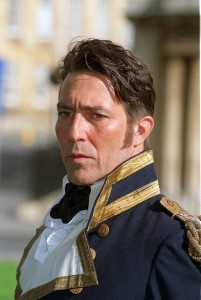
Ciarán Hinds as Captain Frederick Wentworth in "Persuasion" 1995

Ciarán Hinds as Captain Frederick Wentworth in “Persuasion” 1995

 Michell chose to present Hinds in   naval garb rather than Regency   civilian clothing worn by Bryan   Marshall in the 1971 film. Hinds is   also not the “pretty boy” we find   other adaptations of Austen’s works.   He has the rugged look of a man   who spent his time at sea. We view   Wentworth’s command as he leads   his little party through Lyme and   upon the Cobb. Yet, we also see   him as “a fish out of water” in his   interactions with Anne. He acts out   of pettiness when he treats Anne   coldly and when he accepts the   adulation of the Musgrove sisters to   prove Anne “missed out on a good   thing.” 

Posted in British history, film, film adaptations, Great Britain, Jane Austen, Living in the Regency, Persuasion, Regency era | Tagged , , , , , , , | 20 Comments

Georgian Era Lexicon – We Take Up Again ~ This Time With Words Beginning with “Co”

In the singular form the lexicon of a particular subject is all the terms associated with it. The lexicon of a person or group is all the words they commonly use. As a plural noun, a lexicon is an alphabetical list of the words in a language or the words associated with a particular subject. To distinguish lexicon from a dictionary, it is an alphabetical list of the words in a language or the words associated with a particular subject.

These examples are a mix of what one might hear upon the lips of the aristocracy, as well as examples of Cant used upon London’s streets and those terms used by farmers and like in the country.

coach – a vehicle used for public transportation, as well as private; could hold six or more passengers; two seats facing each other; closed vehicle; front and back axles connected to a “crank neck”

cob – a sturdily built horse, often ridden by an overweight person

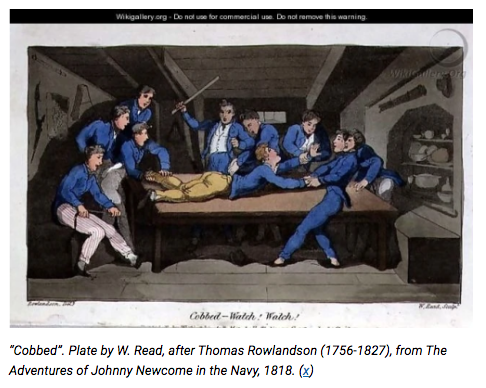
cobbing – “A punishment often used aboard ship to address petty offenses. It normally involved 12 or so whacks to the posterior with a cobbing stick (a heavy, flat piece of wood resembling a yardstick) or pipe staff, although handsawa or anything flat could also be used in a pinch. The first stroke on the back was traditionally accompanied with the cry of “Watch” at which time all crew in the vicinity removed their hats on pain of like punishment. The closing stroke, which was always delivered with as much force as possible, was called the “purse”. But that only referred to the way in which the adults or boys over 14 were punished. Boys under 14 and midshipmen were punished with a slap on the butt, but the procedure was the same.” [https://ltwilliammowett.tumblr.com/post/695849527296606208/cobbing]

At he first stroke the person doling out the punishment repeats the word “watch,” and all persons present take off their hats, on pain of a like punishment. The last stroke is always given as hard as possible and is called “the purse.” Ashore, among soldiers, where this punishment was also often adopted, “watch” and “purse” are not included in the number, but given over and above, or, in the vulgar phrase “free gratis for nothing.” This piece of discipline was also inflicted in Ireland, by the school boys, on persons entering the school without taking off their hats. There it was called “school butter.”

coble (or) cobble – The word ‘coble’ refers to the wooden boat traditionally used for inshore fishing on the NE English coast between Berwick-upon-Tweed in Northumberland and the Humber in Yorkshire. [Living Language]

https://coble-keelboatsociety.org/

cock and bull story – a roundabout story, without beginning or ending

cockles of your heart -“Something that warms the cockles of one’s heart induces a glow of pleasure, sympathy, affection, or some such similar emotion. We do know that the expression turns up first in the middle of the seventeenth century, and that the earliest form of the idiom was rejoice the cockles of one’s heart. Cockles are a type of bivalve mollusc, once a staple part of the diet for many British people (you may recall that Sweet Molly Malone once wheeled her wheelbarrow through Dublin’s fair city, crying “cockles and mussels, alive, alive oh!”). They are frequently heart-shaped (their formal zoological genus was at one time Cardium, of the heart), with ribbed shells. It may be that the shape and spiral ribbing of the ventricles of the heart reminded surgeons of the two valves of the cockle.” (World Wide Words)

cock robin – a soft, easy fellow

cock sure – certain: a metaphor borrowed from the cock of a firelock, as being more certain to fire than the match

cocker – one fond of the diversion of cock fighting

cod – a good sum of money

codders – persons employed by the gardeners to gather peas

codger – an old fellow

cokes – the fool in the play of Bartholomew Fair: perhaps a contraction of “coxcomb”

college – one of the residential units around which the universities of Oxford and Cambridge were organized, though “university” appears to be a more appropriate choice of words, for “college” was also associated with the prison system as in King’s College (King’s Bench) and Newgate College

collogue – to wheedle or coax; early 17th century (in the sense ‘flatter, pretend to agree with or believe’): probably an alteration of obsolete colleague ‘conspire’, by association with Latin colloqui ‘to converse’.

Come Out – the process by which a young woman (usually 17 or 18) was presented to Society and was considered available for marriage

commoner – an Oxford undergraduate not on scholarship

condescension – being polite and generous to those from a lower rank

conservatory – a room for growing plants

consumption – an advanced stage of tuberculosis

cool tankard – wine and water, with lemon, sugar, and burrage (borage – a herbaceous plant with bright blue flowers and hairy leaves, used medicinally and as a salad green) Note: There is some concern that borage seed oil might prolong bleeding time and increase the risk of bruising and bleeding. Liver disease: Borage products containing hepatotoxic pyrrolizidine alkaloids (PA) might make liver disease worse.

colt – a grand or petty juryman on his first assize

colt’s tooth – an old fellow who marries or keeps a young girl is said to have a “colt’s tooth” in his head

“Coming? So is Christmas!” – said of a person who has long been called and, at length, answers

Commons (or House of Commons) – These members represented subjects of the Crown who were not Lords Temporal or Spiritual, who themselves sat in the House of Lords. The House of Commons gained its name because it represented communities (communes).

Comus – (A Masque Presented at Ludlow Castle, 1634) is a masque in honour of chastity written by John Milton. It was first presented on Michaelmas 1634 before John Egerton, 1st Earl of Bridgewater at Ludlow Castle in celebration of the Earl’s new post as Lord President of Wales.

Comus’s Court – a social gathering formerly held at the Half-Moon Tavern in Cheapside, London

conny wabble – a drink made of eggs and brandy beaten up together

https://www.dailymail.co.uk/news/article-2224582/New-book-built-working-days-reveals-host-absurd-evocative-English-words.html

content – a thick liquor, in imitation of chocolate, made of milk and gingerbread

contra dance – a dance where the dancers of the different sexes stand opposite each other, instead of side by side, as in the minuet, rigadoon. louvre, etc, and now corruptly called a country dance

contredance; early 18th Century wood engraving after drawing by Fritz Bergen – Public Domain

coquet – a jilt or flirt

Corinthians – frequenters of brothels; also an impudent, brazen-faced fellow, perhaps taken from the “Corinthian brass”

cork brained – light-headed; foolish

Corn Laws – The Corn Laws were tariffs and other trade restrictions on imported food and corn enforced in the United Kingdom between 1815 and 1846. The word corn in British English denoted all cereal grains, including wheat, oats and barley. These laws were designed to keep corn prices high to favour domestic producers, and represented British mercantilism. The Corn Laws blocked the import of cheap corn, initially by simply forbidding importation below a set price, and later by imposing steep import duties, making it too expensive to import it from abroad, even when food supplies were short. The House of Commons passed the corn law bill on 10 March 1815, the House of Lords on 20 March and the bill received royal assent on 23 March 1815.

1815 Corn Law, An Act to amend the Laws now in force for regulating the Importation of Corn ~ Public Domain

costard monger – a dealer in fruit, especially in apples

cottagers – lived in cottages upon a landowner’s property; worked on the estate (also referred to as tenants)

cotillion – a French dance in which 4 couples form a square

countenance – another word for the “face” or a person’s appearance

country dance – very much like a square dance; a vigorous dance (see contra dance above)

county member – a member of Parliament; represented the county rather than a borough

courtesy books – publications that advised on the education and conduct of a courtier ( a man of the royal court) or a prince

Covent Garden – a large market near Charing Cross; sold fruit and vegetables; near the theatre district; many brothels were also situated within this area

Coventry – to send one to Coventry was a punishment inflicted by officers of the army on such of their “brethren” as are guilty of improper behavior, but not so much as to warrant a court martial. The person sent to Coventry is considered “absent,” and no one must speak to him or answer any of his questions, except those relative to his assigned duties, under penalty of sharing his fate. On a proper submission, the penitent is recalled and welcomed by the mess, as if he just returned from a journey to Coventry.

cow-handed – awkward

cow-hearted – fearful

coxcomb – anciently, a fool, deriving from how fools, in great families, wore a cap with bells, on the top in which was a piece of red cloth, in the shape of a cock’s comb; later it came to signify a fop or a vain self-conceited fellow

Other Sources: 

Candice Hern

Donna Hatch

18th Century Vocabulary 

Georgette-Heyer: Regency Cant and Expressions 

Jane Austen Organization

Kathleen Baldwin

Messy Nessy Chic

Regency Reader

Sara Ramsey

Sharon Lathan

Posted in Georgian Era, Living in the Regency, Regency era, research, vocabulary, word choices, word origins, word play | Tagged , , , , , , , , , | Comments Off on Georgian Era Lexicon – We Take Up Again ~ This Time With Words Beginning with “Co”

The Streets of London, What Do We Know of Them During the Regency Era?

In this post, I plan to share some of the fabulous links I have discovered in regards to the layout of London during the Regency Era. Is this information complete? Not in a million years. However, those of you like me who are always searching for the “history” to place in our historical romance or historical mystery, will likely find it beneficial. If you have additional sites you would not mind sharing, add them in the comments below.

Many places considered in Town now were actually in the country then. Kew gardens, Richmond, Hampstead Heath, and many more commonly mentioned places in Regency historicals — anything more than twenty miles away — would definitely be out of city limits. London was the square mile plus of the banks and the Lord Mayor’s residence. Hyde Park and Mayfair were in Westminster. One could even drive from Town to the city and be away from fashionable places. Holyhead Road would lead from Hyde Park to the outskirts of London.

The Survey of London is a research project to produce a comprehensive architectural survey of central London and its suburbs, or the area formerly administered by the London County Council. It was founded in 1894 by Charles Robert Ashbee, an Arts-and-Crafts designer, architect and social reformer[1] and was motivated by a desire to record and preserve London’s ancient monuments. The first volume was published in 1900, but the completion of the series remains far in the future.

The Survey consists of a series of volumes based mainly on the historical parish system. Each volume gives an account of the area, with sufficient general history to put the architecture in context, and then proceeds to describe the notable streets and individual buildings one by one. The accounts are exhaustive, reviewing all available primary sources in detail. The Survey devotes thousands of words to some buildings that receive the briefest of mentions in the Buildings of England series (itself a vast and detailed reference work by most standards). However, the earlier volumes largely ignored buildings built after 1800.

Due to the scale of the existing endeavour, there are no current plans to extend the project to take in the whole of Greater London. As of 2020, 53 volumes in the main series have been published. Separately, 18 monographs on individual buildings have been published. Most of the volumes have not been updated since publication, but those published online (up to Vol. 47) have received a limited amount of updating.

The Survey of London has extensive information about  the development of the streets and who lived there.

Title page of the first volume, covering Bromley-by-Bow, 1900 ~ Public Domain ~ https://en.wikipedia.org/wiki/Survey_of_London#/media/File:Surveyoflondon01lond_0007_(retouched).jpg

Survey of London: Whitechapel

London 1800-1913 (Lots of information can be found here on the Old Bailey Website – population, hinterlands, etc.

The Rookeries of London

South Kensington in Retrospect

These are just a few of the items available on the internet to start you on your search.

***************************************************************

Remember: Modern maps have A 5 where Regency maps would not. Traveling that particular road would take your characters out of town fairly quickly.

A5 road (Great Britain) – Wikipedia, the free encyclopedia

The section of the A5 between London and Shrewsbury is roughly contiguous with one of the principal Roman roads in Britain: that between Londinium and Deva, which diverges from the present-day A5 corridor at Wroxeter (Viroconium Cornoviorum) near Shrewsbury.

The Act of Union 1800, which unified Great Britain and Ireland, gave rise to a need to improve communication links between London and Dublin. A parliamentary committee led to an Act of Parliament of 1815 that authorised the purchase of existing turnpike road interests and, where necessary, the construction of new road, to complete the route between the two capitals. This made it the first major civilian state-funded road building project in Britain since Roman times.

Marble Arch, London – start of the A5

In 1812, the Regent’s Canal Company was formed to cut a new canal from the Grand Junction Canal’s Paddington Arm to Limehouse, where a dock was planned at the junction with the Thames. The architect John Nash played a part in its construction, using his idea of ‘barges moving through an urban landscape’.

Completed in 1820, it was built too close to the start of the railway age to be financially successful and at one stage the Regent’s only narrowly escaped being turned into a railway. But the canal went on to become a vital part in southern England’s transport system.

The aristocrats lived in the West End — Mayfair — Westminster. Most of them apparently moved away from the water.

Jane Austen in Vermont suggests the following books on London.

1. Regency London, by Stella Margetson. New York: Praeger, 1971 [London: Cassell, 1971].

Margetson wrote a few novels but also a number of books of English social history especially of the late 18th and the 19th-century. This book on Regency London is a short introductory text that covers the basics, with black and white contemporary illustrations throughout:

  1. Carlton House
  2. The Mercantile City
  3. Westminster and Government
  4. The Regent and the Architect
  5. High Society
  6. Entertainment
  7. The Artists and the Writers
  8. The Populace
  9. Some Visitors to London [Jane gets a few pages on her stays in London]
  10. An Expanding City

The A to Z of Regency LondonIntroduction by Paul Laxton; index compiled by Joseph Wisdom. Lympne Castle, Kent: Harry Margary, in association with Guildhall Library, London, 1985.

This historical atlas is based on Richard Horwood’s survey of London in 1792-9 and updated by William Faden in 1813 – it shows the streets, lanes, courts, yards, and alleys, but also every individual building with its street number – the 40 sheets of the original Horwood have been photographically reduced, and the index for this edition expands the original by threefold.

The Horwood map is available online in various formats [a terrific one is here: https://www.romanticlondon.org/explore-horwoods-plan/#16/51.5112/-0.0747], but this is a treasure to have close at hand. One can easily trace Austen’s meanderings described in her letters, and follow the many characters in Sense and Sensibility – where they live, visit, and shop – her one novel where London is central to the plot (though it is also where the dilemma of Harriet gets sorted!)

For those of you who love maps, there are others to choose from in this series: The A to Z of Elizabethan LondonRestoration LondonGeorgian LondonVictorian London, and Edwardian London (there is also one for Georgian Dublin)

A book about Mayfair describes the squares where the wealthy lived.

Bankers and merchants might live within London, but I do not think it was a salubrious place to live by the Regency. They went to Vauxhall by boat, and many lived closer to the water outside of Mayfair and London.

Jane Austen in Vermont provides an extensive list of resources, though the post was last updated in 2016.

************************************************

Cary’s map provides a detailed view of London in 1818 when Dr. John Snow, the prominent epidemiologist and anesthesiologist, was five years old.  At that time he was living in York, England, not yet starting his elementary schooling.  The other large maps at this site, London in 1846 During John Snow and  John Snow’s London in 1859,  provides a similar view of the city, but at the middle and end of Dr. Snow’s illustrious life.  With print date of January 1, 1818, Cary’s map has 27 panels arranged in 3 rows of 9 panels, each measuring approximately 6 1/2 by 10 5/8 inches. The complete map measures 32 1/8 by 59 1/2 inches.

*******************************************

Below is link for a map of London from 1817, blocked off and blown up per section. It has been marked off with color to show boundaries. Darton’s New Plan Of The Cities Of London & Westminster, & Borough Of Southwark, 1817

From Mapco.net

The Map

Full Title:An Entire New Plan Of The Cities Of London & Westminster, & Borough Of Southwark; The East & West India Docks, Regent’s Park, New Bridges, &c. &c. With The Whole Of The New Improvements Of The Present Time.
Publisher:London. Published July 1st 1817 by W. Darton, Junr. 58 Holborn Hill.
Engraver:Engraved by G. Alexander, Clarks Place, Islington. 1817.
Date:July 1st 1817
Size:91.8cm x 47.1cm (36″ x 18½”)
Scale:3¾” : 1 statute mile
Extent:Islington – West Ham Abbey Marsh – Walworth – Kensington Gardens
Description:Folding map of Regency London. Hand-coloured sections, laid down on linen. Title at top right. Explanation and Scale at top left. Recorded as Howgego No. 268 (2).This map of London has been extended east by an extra sheet 17cm (6¾”) wide, extending the map from Stepney as far east as Greenwich Marsh. This is a highly decorative map, although it has some offsetting (transfer of the image from one part of the map to the other due to folding).The map illustrates proposals for the “Intended Markets” on the eastern side of Regent’s Park (which became the Cumberland & Clarence Markets); the Intended Docks east of London Docks; the location of the soon-to-be-constructed Regent Street, running from Oxford Street to Piccadilly; and many other proposed improvements. It also has nice detail of Kensington Gardens.

Posted in British history, buildings and structures, Georgian England, Georgian Era, history, Living in the UK, real life tales, Regency era, research | Tagged , , , , , | Comments Off on The Streets of London, What Do We Know of Them During the Regency Era?

29 January 1820, the End of the Regency Period

This week in history marks the end of what was called the Regency Period, the era which we relish as being best reflected by Jane Austen’s stories. King George III died on 29 January 1820, and his son, Prince George Augustus Frederick, came to the throne as George IV, bringing about the end of the Regency. George IV ruled until his death in July 1830.

Yet, the period of 1811 to 1820 was not the first crisis to mark the call for a Regent.

It is believed by many that King George III suffered from a hereditary disease known as “porphyria.” Some of you might recall the 1994 film called “The Madness of King George.” The film is a biographical and historical comedy/drama and tells the story of George III’s deteriorating mental health, as well as his strained relationship with his eldest son, Prince George, and it centers on the Regency Crisis of 1788-1789. The film depicts King George III’s bouts of “madness” that triggered a power struggle between factions of Parliament under the Tory Prime Minister William Pitt the Younger and the reformed-minded leader of the opposition in the form of Charles James Fox.

The “thing” with George III’s mental capacities, they came and went. It was said he could recall appointments to office from years past, but could not remember who within his government was friend or foe. Many of us today might consider this as the early stages of dementia.

The Mayo Clinic lists these signs of dementia:People may experience:Cognitive: mental decline, confusion in the evening hours, disorientation, inability to speak or understand language, making things up, mental confusion, or inability to recognize common thingsBehavioral: irritability, personality changes, restlessness, lack of restraint, or wandering and getting lostMood: anxiety, loneliness, mood swings, or nervousnessPsychological: depression, hallucination, or paranoiaMuscular: inability to combine muscle movements or unsteady walkingAlso common: memory loss, falling, jumbled speech, or sleep disorder

That being said, in the summer of 1788, King George’s mental health had deteriorated. However, he managed to discharge some of his duties and to declare Parliament prorogued from 25 September to 20 November of that year. However, during Parliament’s recess, the King’s symptoms became worse, some believing he posed a threat to his own life. When Parliament reconvened in November, the King was not in a condition to deliver the ritual speech from the throne, outlining the government’s agenda and focus for the forthcoming session, during the State Opening of Parliament. According to long-established law, Parliament could not proceed without the delivery of the King’s Speech at a State Opening. [Innes, Arthur Donald (1914). A History of England and the British Empire, Vol. 3. The MacMillan Company. pp. 396–397.]

Though some questioned their right to do so, Parliament debated the necessity of forming a regency. Charles James Fox, who was a close associate with Prince George approached Parliament. In the Commons on 10 December, Fox declared it was Prince George’s right to install himself as the regent immediately. Fox declared the Prince was automatically entitled to exercise sovereignty during the King’s incapacity. Obviously, William Pitt the Younger opposed this idea. He argued, as there was an absence of a statute in the contrary, that is was the right of Parliament to choose the regent. It is said that Pitt, upon hearing Fox’s assertion, slapped his thigh in an uncharacteristic display of emotion and declared that he would “unwhig” Fox for the rest of his life. Fox’s argument did indeed seem to contradict his lifelong championing of Parliament’s rights over the Crown. Pitt pointed out that the Prince of Wales had no more right to the throne than any other Briton, though he might well have a better claim to it as the King’s firstborn son. It was Parliament’s constitutional right to decide who the monarch could be.

The Prince Regent in Profile by Sir Thomas Lawrence, c. 1814 ~ https://en.wikipedia.org/wiki/George_IV#/media/File:George_IV_by_Sir_Thomas_Lawrence.jpg

Prince George did not attempt to exercise any power without possessing the consent of Parliament to do so. With the consent of Parliament, Pitt outlined a formal plan for the regency in which it was suggested that the power of presented to Prince George be greatly limited. For example, the Prince would not be able to create and grant a peerage to anyone other than one of his siblings. George could also not sell any property belonging to the King. The Prince of Wales denounced Pitt’s “suggestions,” declaring it a “project for producing weakness, disorder, and insecurity in every branch of the administration of affairs.” [May, Thomas Erskine. (1896). The Constitutional History of England Since the Accession of George the Third, 1760-1860 (11th ed.) London: Longmans, Green and Co., chapter III, pp. 184-195.]  A compromise was required.

Without the speech from the throne, debate on a Regency Bill before Parliament could not proceed. Such a speech had to be delivered by the ruling monarch, but it could also be delivered by royal representatives known as “Lords Commissioners.” Unfortunately the Lords Commissioners [The Lords Commissioners are Privy Counsellors appointed by the King/Queen to exercise, on his or her behalf, certain functions relating to Parliament which would otherwise require the monarch’s attendance.] could not act without the Great Seal of the Realm affixed to it, meaning the incoherent King George III would be required to legally affix the authorization of the sovereign with the Great Seal. Pitt overrode the objects and instructed the Lord Chancellor to affix the Great Seal without the King’s consent. The actions were called “forgery,” “fraud, “a glaring falsehood,” and the like. The Duke of York declared the move as “unconstitutional and illegal.” However, many in government declared the situation the only means to preserve government, as they knew it. Therefore, on 3 February 1789, an “illegal” group of Lords Commissioners opened Parliament. The Regency Bill was introduced, but before it could pass, King George III made a recovered. Ironically, the King declared the instrument authorizing the Lords Commissioners to act was valid.

In late 1810, the King was once again overcome by his malady. Therefore, Parliament agreed to follow the precedent of 1788, and, without the King’s consent, the Lord Chancellor affixed the Great Seal of the Realm to letters patent naming Lords Commissioners. Although they lacked the Royal Sign Manual, the letters patent passed both Houses of Parliament. The Lords Commissioners appointed by the letters patent acted in the name of the King. They granted Royal Assent to a bill that was later called the Regency Act 1811. Originally, Parliament restricted some of the Prince Regent’s powers, but those constraints expired one year after the passage of the act. Prince George, the Prince of Wales, became Prince Regent on 5 February 1811.


Lithograph of George IV in profile by George Atkinson, 1821 – via Wikipedia

Prince George was often referred to as the “First Gentleman of England.” His style and manners were much remarked upon. He was bright, clever, and knowledgeable, speaking three languages other than his native English. His laziness and gluttony kept him from being recognized for his talents. He was, however, a leader in many ways, especially those we think of as part of the Regency era. For example, when political leaders placed a tax on wig powder, the Prince abandoned wearing a powdered wig, choosing to style his natural hair. He wore dark colored clothing because it assisted in minimizing his weight, but men in Society followed suit. He favored pantaloons and trousers over the knee to breeches, mainly because they were looser and not so binding. By the end of his reign, men had left their breeches behind. He wore elaborately-tied neck cloths to hide his double chin, and it is said that his 1822 visit to Scotland, when he was King, brought back into fashion the Scottish tartan dress, as it is know today.

Titles and styles:

  • 12 August 1762 – 19 August 1762: His Royal Highness The Duke of Cornwall
  • 19 August 1762 – 5 February 1811: His Royal Highness The Prince of Wales
  • 5 February 1811 – 29 January 1820: His Royal Highness The Prince Regent
  • 29 January 1820 – 26 June 1830: His Majesty The King

At birth, he was also entitled to the dignities Prince of Great Britain and Ireland, Electoral Prince of Brunswick-Lüneburg and Duke of Rothesay. Under the Act of Parliament that instituted the regency, the prince’s formal title as regent was “Regent of the United Kingdom of Great Britain and Ireland”.

Posted in Act of Parliament, British history, George IV, Georgian England, Georgian Era, history, Jane Austen, Living in the Regency, real life tales, Regency era, Regency personalities | Tagged , , , , , | 2 Comments

Georgian Era Lexicon – Continuing with “Ci” to “Cl”

In the singular form the lexicon of a particular subject is all the terms associated with it. The lexicon of a person or group is all the words they commonly use. As a plural noun, a lexicon is an alphabetical list of the words in a language or the words associated with a particular subject. To distinguish lexicon from a dictionary, it is an alphabetical list of the words in a language or the words associated with a particular subject.

These examples are a mix of what one might hear upon the lips of the aristocracy, as well as examples of Cant used upon London’s streets and those terms used by farmers and like in the country.

cinder garbler – a servant maid whose job is to shift through the ashes for cinders

circulating libraries – “Circulating libraries were private businesses that loaned books to subscribing members. They were popularised in the late 18th and early 19th centuries, when books were expensive luxury items and public libraries were not yet in existence. Instead, subscriptions to circulating libraries could be obtained at various price tiers, allowing patrons across social classes different levels of access to a wide range of books at a fraction of the price of purchase. Higher tiers of subscription were given access to newer books and allowed for more books to be borrowed at a time. They are particularly associated with the growth of a female readership in the period. Some circulating libraries were operated by book publishers themselves, such as William Lane’s Minerva Press. Others were set up as separate commercial enterprises in resort centers like Bath, Brighton or Margate, or in smaller provincial towns. Circulating libraries sometimes combined the rental of books with the sale of other tempting merchandise, such as stationery, cosmetics, fashion accessories, art supplies and patent medicines. Although the industrialization of book printing, resulting in lower prices, and the rise of public libraries spelled an end to these enterprises, their impact on the publishing industry and reading culture still resonates today.” [University of Windsor]

circumbendibus – a roundabout way or story

cit – a citizen of London

clack – a gossip, chiefly applied to women; a simile drawn from the clack of a water mill

clack-loft – a pulpit, so called by John Henley, English clergyman, commonly known as ‘Orator Henley’, a preacher known for showmanship and eccentricity.

Engraved caricature of the Reverend John HENLEY (1692- 1756) preaching in defence of Jacobinism. He is orating with a sword and shield in hand, with text below and then printed text pasted to mounting explaining who he was ~ Public Domain

clammed – starved

clan – a family’s tribe or brotherhood; a word much used in Scotland

clanker – a great lie

clap on the shoulder – an arrest for debt

clapper claw – to scold or abuse, or claw off with the tongue

clapperdogeon – a beggar born (Cant.)

claret – French red wine; also, figuratively for “blood,” as in “I tapped his claret” meaning made the blood run

cleaver – one that will cleave; used to describe a forward or a wanton woman

cleymes – artificial sores, made by beggars to excite charity

clicker – a salesman’s servant

to climb three trees with a ladder – going to the gallows

clinch – a pun or quibble, an improbable story told by another, deriving from the story of a man who claimed to have driven a tenpenny nail through the moon, and a bystander said he was on the other side and “clinched it”

clinkers – Clinker (also known as ‘Dutch’) bricks are so named due to the metallic sound they make when struck together. They are produced from clay that is fired at extremely high temperatures, sintering the surface to form its characteristically shiny coating, whether in deep red, black, purple, or yellow. They were often used only on the outer layer of the facade as a facing. A good quality clinker is weather-resistant for centuries, even without plaster. [Clinker Brick History]

to clip – to hug or embrace

clod hopper – a country farmer or ploughman

clod pate – a dull-brained person or someone who acts foolishly

clogs – shoes with wooden or metal rims on the bottom; used to walk in bad weather

close – Generically such an alleyway is termed a close /ˈkloʊs/, a Scots term for alleyway, although it may be individually named close, entry, court, or wynd. A close is private property, hence gated and closed to the public, whereas a wynd is an open thoroughfare, usually wide enough for a horse and cart.

“The tenements were three or four storey stone buildings entered by a ‘close’ which gave access to the common stair and the back court. Off the stair were the apartments, and beneath them the cellars, in which the working class lived. Very few of these tenements had internal sanitation or water supplies; a privy in the back court and a hand pump for water in the street would often supply hundreds of occupants.” [The Old Closes and Streets of Glasgow]

close-fisted – covetous or stingy

clyster pipe – if you any inclination as to the meaning of this phrase, you probably had a “weird” English teacher in high school (pointing the finger at myself) who explained this line from Shakespeare’s Othello, Act 2, Scene 1: “Yet again your fingers to your lips. Would they were clyster pipes for your sake!” A clyster pipe, for those of you not in the medical profession, is the anal-tube of an enema syringe or used to deliver medication. You have no idea how easily such a phrase can interest a high school boy in something he thought was B-O-R-I-N-G!

Other Sources: 

Candice Hern

Donna Hatch

18th Century Vocabulary 

Georgette-Heyer: Regency Cant and Expressions 

Jane Austen Organization

Kathleen Baldwin

Messy Nessy Chic

Regency Reader

Sara Ramsey

Sharon Lathan

Posted in euphemisms, Georgian England, Georgian Era, history, language choices, lexicon, research, word origins, word play, writing | Tagged , , , , , , , | Comments Off on Georgian Era Lexicon – Continuing with “Ci” to “Cl”

January 25, Burns Suppers Celebrated Worldwide: A Salute to the Scottish Poet, Robert Burns


A Burns supper is a celebration of the life and poetry of the poet Robert Burns (25 January 1759 – 21 July 1796), the author of many Scots poems. The suppers are normally held on or near the poet’s birthday, 25 January, occasionally known as Robert Burns Day (or Robbie Burns Day] or Rabbie Burns Day) but more commonly known as Burns Night (ScotsBurns Nicht). However, in principle, celebrations may be held at any other time of the year.

The first supper was held in memoriam at Burns Cottage by Burns’s friends, on 21 July 1801, the fifth anniversary of his death; it has been a regular occurrence ever since. The first still extant Burns Club was founded in Greenock in 1801 by merchants who were born in Ayrshire, some of whom had known Burns. They held the first Burns supper on what they thought was his birthday, 29 January 1802, but in 1803, they discovered the Ayr parish records that noted his date of birth was actually 25 January 1759. Since then, suppers have been held on or about 25 January.

No Burns supper would be complete without a “Haggis.” Before you read any further, you should know that “Haggis” is a traditional Scottish dish, considered by many the National Dish of Scotland, and the Scots make it from a pluck (a sheep’s stomach) and lights (the lungs, heart, and liver). That said, the following recipe is a summary of the one from Mistress Margaret Dods’ Cook and Housewife Manual, which was first published in 1826. In reality, Meg or Margaret Dods was the pseudonym of Christian Isobel Johnstone, a writer and editor who lived from 1781-1857. People originally considered the book a literary farce because Johnstone used the name of the fictional landlady of Cleikum Inn from Sir Walter Scott’s novel St. Ronan’s Well. Research, however, proved the book to be legitimate, and for many years it was considered a useful household manual.

Ingredients:
pluck and lights of a sheep
4-5 onions (chopped)
pepper, salt, cayenne pepper
2 cups finely ground oatmeal, toasted
beef gravy
450 g (or 1 lb.) beef suet
lemon juice

Procedure:
Soak the stomach in salted water overnight. Turn it inside out. Pour boiling water over it and scrape out any residue. Boil the pluck for at least 45 minutes. Then remove from the pot.
Wash the heart, liver and lungs (which should still be attached to each other). Pierce the heart and lungs to drain any blood remaining in the organs. Parboil the 3 organs, letting the windpipe hang from the pot. Change out the water for fresh.
Cut the liver in half. Remove the gristle. Then chop (a food processor) the heart, half liver and lungs into a very fine mixture. Blend in 2 cups of oatmeal and the onions.  Add in the beef suet. Grate the other half of the liver into the mixture. Season to taste and use the mixture to stuff the stomach bag. Pour in the beef gravy. Be sure to leave some room because the oatmeal will swell. Add the juice of one lemon. Secure the bag’s opening to hold in the mixture. Return the pluck to the pot in which you originally boiled it. Prick the bag when it begins to swell and boil for three hours.

The supper customarily follows a certain procedure:

Pipes or traditional Scottish music is played while the guest gather in an outer room.

A host welcomes the participants with an explanation of why they have gathered such.

Once the guests are seated, the Selkirk Grace, a Scottish “prayer” of thanksgiving is pronounced, customarily in the Scots language. Although the Selkirk Grace had been known since the 1600s as the “Galloway Grace” or the “Covenanters Grace,” it is often attributed to have been produced by the hand of Robert Burns. It received the name of “Selkirk Grace” because Burns recited it at a dinner given by the Earl of Selkirk.

 Some hae meat an canna eat,
And some wad eat that want it;
But we hae meat, and we can eat,
And sae the Lord be thankit.

A Scottish soup is customary served for the beginning course: Scotch broth, potato soup, cullen skink, or cock-a-leekie.

When the Haggis is brought in, the attendees stand. With tradition, a piper leads the way, followed the cook or server, to the host’s table. “A Man’s A Man for A’ That”, “Robbie Burns Medley” or “The Star O’ Robbie Burns” might be played. The host, or perhaps a guest, then recites the “Address to a Haggis.”

“Address to a Haggis” 
Fair fá your honest, sonsie face, Is there that owre his French ragout
Great chieftan o’ the pudding-race! Or olio that wad staw a sow,
Aboon them a’ yet tak your place, Or fricassee wad make her spew
Painch, tripe, or thairm: Wi’ perfect sconner,
Weel are ye wordy o’a grace Looks down wi’ sneering, scornfu’
As lang’s my arm. View on sic a dinner?
The groaning trencher there ye fill, Poor devil! see him owre his trash,
Your hurdies like a distant hill,  As feckles as wither’d rash,
Your pin was help to mend a mill His spindle shank, a guid whip-lash
In time  o’need His nieve a nit;
While thro’ your pores the dews  Thro’ bloody flood or field to dash,
distil, Like amber bead. O how unfit!
His knife see rustic Labour dight But mark the Rustic, haggis-fed
An’ cut you up wi’ ready sleight, The trembling earth resound his
Trenching your gushing entrails tread. Clap in his walie nieve a blade,
bright, Like ony ditch; He’ll make it whissle;
And then, O what a glorious sight, An’ legs an’ arms, an’ hands will
Warm-reekin’, rich! sned, Like taps o’ trissle.
Then, horn for horn, they stretch Ye Pow’rs, wha mak mankind your
an’ strive: Deil tak the hindmost! care, And dish them out their
on they drive, Till a’ their bill o’ fare, Auld Scotland wants
weel-swall’d kytes belyve nae skinking ware
Are bent like drums That jaups in luggies;
Then auld Guidman, maist like But, if ye wish her gratefu’ prayer
to rive, Bethankit! hums. Gie her a haggis!      (1786)

Haggis served wi tatties an neeps (with potatoes and swede) ~ https://en.wikipedia.org/wiki/Burns_supper#/media/File:A_haggis_serving.JPG

Burns Supper describes the remainder of the supper procedure as such: “At the line His knife see rustic Labour dicht, the speaker normally draws and sharpens a knife. At the line An’ cut you up wi’ ready slicht, he plunges it into the haggis and cuts it open from end to end. When done properly, the ‘ceremony”‘ is a highlight of the evening. At the end of the poem, a whisky toast will be proposed to the haggis, and the company will sit down to the meal. The haggis is traditionally served with mashed potatoes (tatties) and mashed swede (neeps).

“A dessert course, cheese courses, coffee, etc., may also be part of the meal. The courses normally use traditional Scottish recipes. For instance, dessert may be cranachan or tipsy laird (whisky trifle), followed by oatcakes and cheese, all washed down with the “water of life” (uisge beatha), Scotch whisky. When the meal reaches the coffee stage, various speeches and toasts are given. The main speaker gives a speech remembering some aspect of Burns’s life or poetry. It may be either light-hearted or serious and may include the recitation of a poem or a song by Burns. A toast to the Immortal Memory of Robert Burns then follows.”

An address to the Lassies follows. “This was originally a short speech given by a male guest in thanks to the women who had prepared the meal. However, it is now much more wide-ranging and generally covers the male speaker’s view on women. It is normally amusing and not offensive, particularly since it will be followed by a reply from the “lassies” concerned. The men drink a toast to the women’s health.”

Reply to the Laddies might also be added. “This is occasionally (and humorously) called the ‘Toast to the Laddies’. Like the previous toast, it is generally now quite wide-ranging. A female guest will give her views on men and reply to any specific points raised by the previous speaker. Like the previous speech, it should be amusing but not offensive. Quite often, the speakers giving this toast and the previous one will collaborate so that the two toasts complement each other.

“After the speeches there may be singing of songs by Burns (such as Ae Fond Kiss, Parcel o’ Rogues and A Man’s a Man) and more poetry (such as To a Mouse, To a Louse, Tam o’ Shanter, The Twa Dogs and Holy Willie’s Prayer). Finally, the host will call on one of the guests to give the vote of thanks. Then, everyone is asked to stand, join hands, and sing Auld Lang Syne to bring the evening to an end.”

Needless to say, sheep lung is a bit hard to find in modern day supermarkets.That is because many Scottish sheep have been infected with Lung Worm, which makes the lungs inedible. Sandy Clark of the Scottish Agricultural College said, “…the changing climate and availability of the parasite is becoming a problem.” So, Scottish butchers are securing their sheep lungs from Irish farms instead. For vegetarians, such as I, there are meatless versions. Haggis is also available in the canned variety.

This work is released under CC-BY-SA  http://creativecommons.org/licenses/by-sa/3.0/
Posted in British history, food and drink, legends and myths, poetry | Tagged , , , , , , , , , | 4 Comments

The 1701 Act of Settlement

The Act of Settlement prevented George IV from marrying Maria Fitzherbert, the woman he affected, but what did the Act entail?

williamiiiThe Act of Settlement was a Parliamentary Act meant to settle the issue of succession to both the English and Irish thrones upon the Electress Sophia of Hanover, who was a granddaughter of James VI of Scotland and I of England, and her non-Roman Catholic heirs. An “Electress” is the consort of a Prince-elector of the Holy Roman Empire. Sophia of Hanover became heiress presumptive to England’s and Ireland’s throne under the Act. Unfortunately, Sophia passed less than two months before she was to Queen. Her claim passed to her eldest son, George Louis, Elector of Hanover, who became George I on August 1714 (Old Style), indicating the end of the Stuarts’ reign and the beginning of the Hanovers’. Sophia passed on 8 June 1714, some two months prior to the death of Queen Anne on 1 August 1714. 

The issue occurred because King William III and Queen Mary II, as well as Mary’s sister Queen Anne produced no surviving heirs. Those of the Stuart house who did survive were practicing Roman Catholics. Although Sophia’s family line was a lesser one, it consisted of staunch Protestants. 

Under the Act of Settlement anyone in line for the throne who becomes a Roman Catholic or marries one is disqualified from inheriting the throne. Such was the need for Prince George to deny publicly his clandestine marriage to the twice-widowed Mrs. Fitzherbert. 

The Act also limits the role of foreigners in the British government, as well as limits the power of the monarchy. 

Wikipedia summarizes as such: 

aepProvisions
The Act of Settlement provided that the throne would pass to the Electress Sophia of Hanover – a granddaughter of James VI and I and a niece of King Charles I – and her descendants, but it excluded “all and every Person and Persons who… is are or shall be reconciled to or shall hold Communion with the See or Church of Rome or shall profess the Popish Religion or shall marry a Papist”. Thus, those who were Roman Catholics, and those who married Roman Catholics, were barred from ascending the throne. Eight additional provisions of the act would only come into effect upon the death of both William and Anne:

**The monarch “shall join in communion with the Church of England.” This was intended to ensure the exclusion of a Roman Catholic monarch. Along with James II’s perceived despotism, his religion was the main cause of the Glorious Revolution of 1688, and of the previous linked religious and succession problems which had been resolved by the joint monarchy of William and Mary.
**If a person not native to England comes to the throne, England will not wage war for “any dominions or territories which do not belong to the Crown of England, without the consent of Parliament.” This was far-sighted, because when a member of the House of Hanover ascended the British throne, he would retain the territories of the Electorate of Hanover in what is now Lower Saxony, then part of the Holy Roman Empire. This provision has been dormant since Queen Victoria ascended the throne, because she did not inherit Hanover under the Salic Laws of the German-speaking states.
**No monarch may leave “the dominions of England, Scotland, or Ireland,” without the consent of Parliament. This provision was repealed in 1716, at the request of George I who was also the Elector of Hanover and Duke of Brunswick-Lüneburg within the Holy Roman Empire; because of this, and also for personal reasons, he wished to visit Hanover from time to time.
**All government matters within the jurisdiction of the Privy Council were to be transacted there, and all council resolutions were to be signed by those who advised and consented to them. This was because Parliament wanted to know who was deciding policies, as sometimes councillors’ signatures normally attached to resolutions were absent. This provision was repealed early in Queen Anne’s reign, as many councillors ceased to offer advice and some stopped attending meetings altogether.
**No foreigner (“no Person born out of the Kingdoms of England Scotland or Ireland or the Dominions thereunto belonging”), even if naturalised (unless born of English parents) shall be allowed to be a Privy Councillor or a member of either House of Parliament, or hold “any Office or Place of Trust, either Civill or Military, or to have any Grant of Lands, Tenements or Hereditaments from the Crown, to himself or to any other or others in Trust for him.” Subsequent nationality laws made naturalised citizens the equal of those native born, and this provision no longer applies.
**No person who has an office under the monarch, or receives a pension from the Crown, was to be a Member of Parliament. This provision was inserted to avoid unwelcome royal influence over the House of Commons. It remains in force, but with several exceptions. (As a side effect, this provision means that members of the Commons seeking to resign from parliament can get round the age-old prohibition on resignation by obtaining a sinecure in the control of the Crown; while several offices have historically been used for this purpose, two are currently in use: appointments generally alternate between the stewardships of the Chiltern Hundreds and of the Manor of Northstead.)
**Judges’ commissions are valid quamdiu se bene gesserint (during good behaviour) and if they do not behave themselves, they can be removed only by both Houses of Parliament, or the one House of Parliament, depending on the legislature’s structure. This provision was the result of various monarchs influencing judges’ decisions, and its purpose was to assure judicial independence.
**That “no Pardon under the Great Seal of England be pleadable to an Impeachment by the Commons in Parliament”. This meant in effect that no pardon by the monarch or the ministers of the crown was to save someone from being impeached by the House of Commons.

From The Official Website of the British Monarchy, we learn “The Sovereign now had to swear to maintain the Church of England (and after 1707, the Church of Scotland).

“Two examples of members of the current Royal family being removed from the line of succession are that of The Earl of St. Andrews and HRH Prince Michael of Kent, who both lost the right of succession to the throne through marriage to Roman Catholics. Any children of these marriages remain in the succession provided that they are in communion with the Church of England.

“In 2008 it was announced that Peter Philips, son of The Princess Royal, would marry Autumn Kelly. She had been baptised as a Catholic but had been accepted into the Church of England before her marriage. Therefore, Peter Phillips retained his place in the line of succession.

“The Act of Settlement not only addressed the dynastic and religious aspects of succession, it also further restricted the powers and prerogatives of the Crown.

“Under the Act, parliamentary consent had to be given for the Sovereign to engage in war or leave the country, and judges were to hold office on good conduct and not at royal pleasure – thus establishing judicial independence.

To learn more, check out these sources: 

A copy of the Act may be read HERE. (Legislation.gov.uk)

History Today offers this explanation.

Michael Nash’s The Removal of Judges Under the Act of Settlement offers a different perspective. 

Posted in Act of Parliament, British history, Great Britain, Living in the Regency, Regency era | Tagged , , , , , , , , , | Comments Off on The 1701 Act of Settlement