In the singular form the lexicon of a particular subject is all the terms associated with it. The lexicon of a person or group is all the words they commonly use. As a plural noun, a lexicon is an alphabetical list of the words in a language or the words associated with a particular subject. To distinguish lexicon from a dictionary, it is an alphabetical list of the words in a language or the words associated with a particular subject.
These examples are a mix of what one might hear upon the lips of the aristocracy, as well as examples of Cant used upon London’s streets and those terms used by farmers and like in the country.
coach – a vehicle used for public transportation, as well as private; could hold six or more passengers; two seats facing each other; closed vehicle; front and back axles connected to a “crank neck”
cob – a sturdily built horse, often ridden by an overweight person
cobbing – “A punishment often used aboard ship to address petty offenses. It normally involved 12 or so whacks to the posterior with a cobbing stick (a heavy, flat piece of wood resembling a yardstick) or pipe staff, although handsawa or anything flat could also be used in a pinch. The first stroke on the back was traditionally accompanied with the cry of “Watch” at which time all crew in the vicinity removed their hats on pain of like punishment. The closing stroke, which was always delivered with as much force as possible, was called the “purse”. But that only referred to the way in which the adults or boys over 14 were punished. Boys under 14 and midshipmen were punished with a slap on the butt, but the procedure was the same.” [https://ltwilliammowett.tumblr.com/post/695849527296606208/cobbing]
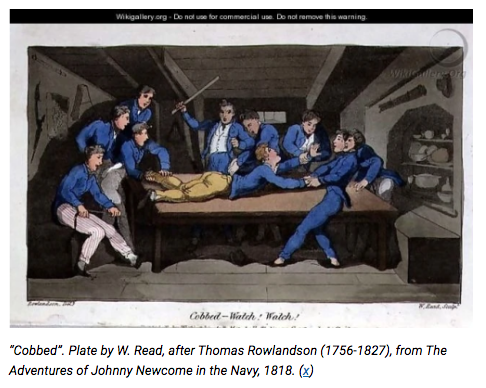
At he first stroke the person doling out the punishment repeats the word “watch,” and all persons present take off their hats, on pain of a like punishment. The last stroke is always given as hard as possible and is called “the purse.” Ashore, among soldiers, where this punishment was also often adopted, “watch” and “purse” are not included in the number, but given over and above, or, in the vulgar phrase “free gratis for nothing.” This piece of discipline was also inflicted in Ireland, by the school boys, on persons entering the school without taking off their hats. There it was called “school butter.”
coble (or) cobble – The word ‘coble’ refers to the wooden boat traditionally used for inshore fishing on the NE English coast between Berwick-upon-Tweed in Northumberland and the Humber in Yorkshire. [Living Language]

cock and bull story – a roundabout story, without beginning or ending
cockles of your heart -“Something that warms the cockles of one’s heart induces a glow of pleasure, sympathy, affection, or some such similar emotion. We do know that the expression turns up first in the middle of the seventeenth century, and that the earliest form of the idiom was rejoice the cockles of one’s heart. Cockles are a type of bivalve mollusc, once a staple part of the diet for many British people (you may recall that Sweet Molly Malone once wheeled her wheelbarrow through Dublin’s fair city, crying “cockles and mussels, alive, alive oh!”). They are frequently heart-shaped (their formal zoological genus was at one time Cardium, of the heart), with ribbed shells. It may be that the shape and spiral ribbing of the ventricles of the heart reminded surgeons of the two valves of the cockle.” (World Wide Words)
cock robin – a soft, easy fellow
cock sure – certain: a metaphor borrowed from the cock of a firelock, as being more certain to fire than the match
cocker – one fond of the diversion of cock fighting
cod – a good sum of money
codders – persons employed by the gardeners to gather peas
codger – an old fellow
cokes – the fool in the play of Bartholomew Fair: perhaps a contraction of “coxcomb”
college – one of the residential units around which the universities of Oxford and Cambridge were organized, though “university” appears to be a more appropriate choice of words, for “college” was also associated with the prison system as in King’s College (King’s Bench) and Newgate College
collogue – to wheedle or coax; early 17th century (in the sense ‘flatter, pretend to agree with or believe’): probably an alteration of obsolete colleague ‘conspire’, by association with Latin colloqui ‘to converse’.
Come Out – the process by which a young woman (usually 17 or 18) was presented to Society and was considered available for marriage
commoner – an Oxford undergraduate not on scholarship
condescension – being polite and generous to those from a lower rank
conservatory – a room for growing plants
consumption – an advanced stage of tuberculosis
cool tankard – wine and water, with lemon, sugar, and burrage (borage – a herbaceous plant with bright blue flowers and hairy leaves, used medicinally and as a salad green) Note: There is some concern that borage seed oil might prolong bleeding time and increase the risk of bruising and bleeding. Liver disease: Borage products containing hepatotoxic pyrrolizidine alkaloids (PA) might make liver disease worse.

colt – a grand or petty juryman on his first assize
colt’s tooth – an old fellow who marries or keeps a young girl is said to have a “colt’s tooth” in his head
“Coming? So is Christmas!” – said of a person who has long been called and, at length, answers
Commons (or House of Commons) – These members represented subjects of the Crown who were not Lords Temporal or Spiritual, who themselves sat in the House of Lords. The House of Commons gained its name because it represented communities (communes).
Comus – (A Masque Presented at Ludlow Castle, 1634) is a masque in honour of chastity written by John Milton. It was first presented on Michaelmas 1634 before John Egerton, 1st Earl of Bridgewater at Ludlow Castle in celebration of the Earl’s new post as Lord President of Wales.
Comus’s Court – a social gathering formerly held at the Half-Moon Tavern in Cheapside, London
conny wabble – a drink made of eggs and brandy beaten up together
content – a thick liquor, in imitation of chocolate, made of milk and gingerbread
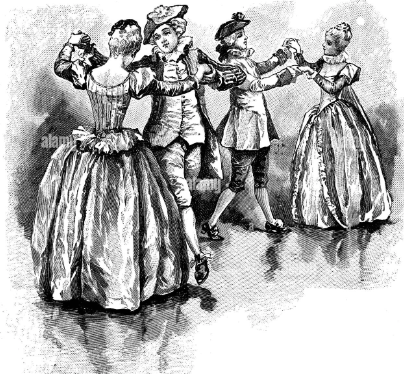
contra dance – a dance where the dancers of the different sexes stand opposite each other, instead of side by side, as in the minuet, rigadoon. louvre, etc, and now corruptly called a country dance
coquet – a jilt or flirt
Corinthians – frequenters of brothels; also an impudent, brazen-faced fellow, perhaps taken from the “Corinthian brass”
cork brained – light-headed; foolish
Corn Laws – The Corn Laws were tariffs and other trade restrictions on imported food and corn enforced in the United Kingdom between 1815 and 1846. The word corn in British English denoted all cereal grains, including wheat, oats and barley. These laws were designed to keep corn prices high to favour domestic producers, and represented British mercantilism. The Corn Laws blocked the import of cheap corn, initially by simply forbidding importation below a set price, and later by imposing steep import duties, making it too expensive to import it from abroad, even when food supplies were short. The House of Commons passed the corn law bill on 10 March 1815, the House of Lords on 20 March and the bill received royal assent on 23 March 1815.

costard monger – a dealer in fruit, especially in apples
cottagers – lived in cottages upon a landowner’s property; worked on the estate (also referred to as tenants)
cotillion – a French dance in which 4 couples form a square
countenance – another word for the “face” or a person’s appearance
country dance – very much like a square dance; a vigorous dance (see contra dance above)
county member – a member of Parliament; represented the county rather than a borough
courtesy books – publications that advised on the education and conduct of a courtier ( a man of the royal court) or a prince
Covent Garden – a large market near Charing Cross; sold fruit and vegetables; near the theatre district; many brothels were also situated within this area
Coventry – to send one to Coventry was a punishment inflicted by officers of the army on such of their “brethren” as are guilty of improper behavior, but not so much as to warrant a court martial. The person sent to Coventry is considered “absent,” and no one must speak to him or answer any of his questions, except those relative to his assigned duties, under penalty of sharing his fate. On a proper submission, the penitent is recalled and welcomed by the mess, as if he just returned from a journey to Coventry.
cow-handed – awkward
cow-hearted – fearful
coxcomb – anciently, a fool, deriving from how fools, in great families, wore a cap with bells, on the top in which was a piece of red cloth, in the shape of a cock’s comb; later it came to signify a fop or a vain self-conceited fellow
Other Sources:


