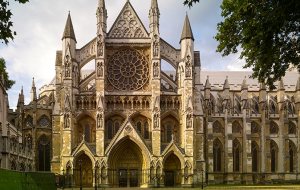
24 July 1817, Marks the Burial of Jane Austen at Winchester Cathedral

via http://www.telegraph.co.uk/women/womens-life/10199138/Jane-Austen-unveiled-as-face-of-new-10-note.html


July 18, 2024 marked the 207th anniversary of the death of Jane Austen. Tribute from Austen’s most loyal fans continue to flow through any number of activities, readings, evensongs, and events, leading us to July 24, the date of her funeral. In the UK, for the 200th anniversary of her death, public benches were dedicated to Austen, and the “Rain Jane” program had Austen’s words appear in public places throughout Hampshire whenever there was precipitation. Yet, this year, which is not so monumental in terms to be marked, it will those of the Austen brigade, those who still read her daily or study her with an intensity many in the public eye cannot fathom or write their own versions of her stories who will stop and take note of the passing of a lady from Hampshire, England.

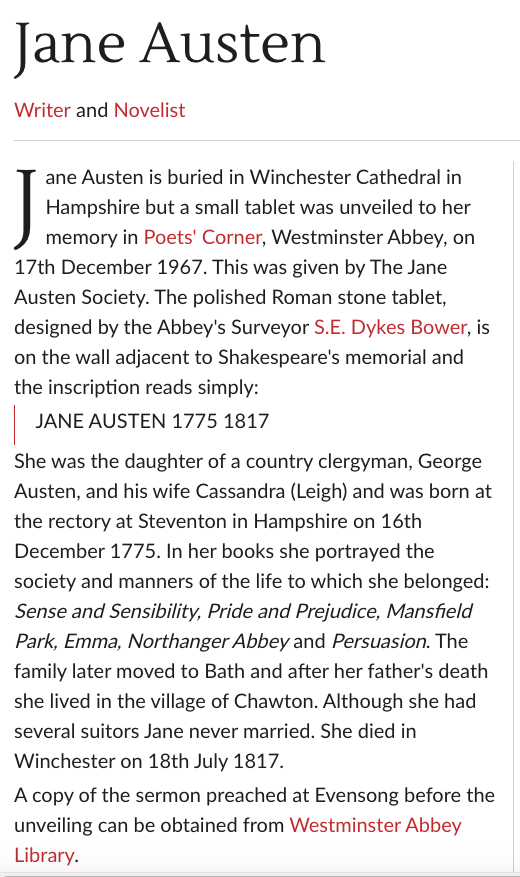
Even in this “off” year, Winchester Cathedral, where she is interred, will likely see a steady influx of visitors. For the 200th Anniversary of her burial, the UK unveiled a £10 note (image above), graced with her face. As she is also on the £2 coin, Austen is the first person, other than a monarch, to appear on more than one form of British currency at the same time. Cathedral bell, on that day, tolled 41 times to mark each of her years on this earth.

In mid April 1817 Jane Austen was so ill she took to her bed in Chawton. By the 27th April she had written her will. After a visit from her brother James and his wife Mary she agreed to go to Winchester to be close to her surgeon who would take care of her there. (Jane Austen’s World)

Austen came to Winchester due to its proximity to Chawton, where Jane was initially brought when her illness reached a point she could no longer deny. She stayed at #8 College Street, along with her family. She reportedly passed away in her sister Cassandra’s arm. Jane Austen was but 41 years of age. There are rumors that she might have died of arsenic poisoning, but something sinister, but it was common for physicians to administer arsenic during the late Georgian era.

“In early June of 1817 James Austen wrote to his son at Oxford, ‘I grieve to write what will grieve to read; but I must tell you that we can no longer flatter ourselves with the least hope of having your dear valuable Aunt Jane restored to us.’”

We who love Austen, likely know the answer, but in case some of you have not thought twice about the lady, permit to answer this question: Why, when this comparatively obscure spinster died in 1817, was she buried in a cathedral which houses the bones of Saxon kings and saints?

It seems highly unusual for an ordinary citizen to be buried in a place normally reserved for secular and religious leaders. According to Jo Bartholomew, curator and librarian at the cathedral, the mortuary chests hold such dignitaries as: Cynigils and Cenwalh, two Christian kings from the seventh century; Kings Egbert and Ethelwulf (grandfather and father of King Alfred); King Cnut (Canute) and his Queen Emma; two bishops, Alwyn and Stigand; and king William Rufus. Most had been originally buried in Old Minster, the predecessor to Winchester Cathedral, which was just to the north and partially beneath it.

Was it common for an ordinary citizen to be buried there in 1817, or was this an extraordinary honor? In those days, not so extraordinary after all. Indeed, Jane was the third and last person buried there that year. Cost, rather than rank, may have been the limiting factor for a cathedral interment. Jane’s funeral expenses came to £92, a significant amount for someone of her means. Clearly, she or her family was determined to make a statement—after all, none of her brothers, including Frank, who died the highest-ranking naval officer in England, received such a burial.

In Memory of
JANE AUSTEN
Youngest daughter of the late
Rev GEORGE AUSTEN,
formerly Rector of Steventon in this County
she departed this Life on the 18th of July 1817,
aged 41, after a long illness supported with
the patience and the hopes of a Christian.
The benevolence of her heart,
the sweetness of her temper, and
the extraordinary endowments of her mind
obtained the regard of all who knew her and
the warmest love of her intimate connections.
Their grief is in proportion to their affection
they know their loss to be irreparable.
but in their deepest affliction they are consoled
by a firm though humble hope that her charity,
devotion, faith and purity have rendered
her soul acceptable in the sight of her
REDEEMER.

Elizabeth Proudman, vice chairman of the Jane Austen Society and an expert on Jane Austen, said in a letter that the location was likely Austen’s choice: “I believe that she is buried there, because she wanted to be. It was up to the Dean in those days to decide who could and who could not be buried in the Cathedral. Usually it was enough to be respectable and ‘gentry.’ This, of course, she was as her late father and two of her brothers were in the church.”

Jane’s father, George, had been the rector at Steventon, fourteen miles away, until he retired in 1801. He was succeeded by James, his oldest son, who still held that position in 1817. Henry, who had taken up the cloth after his bank collapsed in the recession of 1816, also had a clerical position nearby. It probably did not hurt that Jane’s brother Edward was the wealthy inheritor of the Knight estate, with extensive holdings in Steventon and Chawton, which was sixteen miles away. From his recent ordination, Henry knew the Bishop, according to Claire Tomalin; and the Dean, Thomas Rennell, was a friend of the important Chute family who were relatives of the Austens.

Having lived at Chawton for nine years, where she wrote or significantly revised her oeuvre, Jane was taken to Winchester for unsuccessful medical treatment. “She had been ill in Winchester for about two months, and I think her burial must have been discussed,” Proudman says. “I like to think that her family would have talked about it with her, and that they followed her wishes. … It may be that she had no particular attachment to the village [of Chawton]. We know that she admired Winchester Cathedral, and she knew several of the clergy. When she died she had some money from her writing, and her funeral expenses were paid from her estate. It was a tiny funeral, only 3 brothers and a nephew attended, and it had to be over before the daily business of the Cathedral began at 10.00 am.”

plaque on #8 College Street, Winchester, where Austen spent her final days

In fact, most funerals were relatively small in those days, and women did not attend. Cassandra, with their friend Martha Lloyd (James’s sister-in-law), “watched the little mournful procession the length of the street & when it turned from my sight I had lost her forever.” In a letter to their niece Fanny in the days after Jane’s death, Cassandra added: “I have lost a treasure, such a Sister, such a friend as can never be surpassed,—She was the sun of my life, the gilder of every pleasure, the soother of every sorrow, I had not a thought concealed from her, & it is as if I have lost a part of myself. … Never was [a] human being more sincerely mourned … than was this dear creature.”

Jane Austen
known to many by her
writings, endeared to
her family by the
varied charms of her
Character and ennobled
by Christian Faith
and Piety, was born
at Steventon in the
county of Hands Dec.
xvi mdcclxxv, and buried
In this Cathedral
July xxiv mdcccxvii
“She openeth her
mouth with wisdom
and in her tongue is
the law of kindness”
Prov xxxi. v. xxvi

Edward, Francis, and Henry were the brothers who attended. Charles was too far away to come. James was ill (He died two years later.), but his son, James Edward, rode from Steventon to Winchester for the service. Thomas Watkins, the Precentor (a member of a church who facilitates worship), read the service. Jane was interred in a brick-lined vault on the north side of the nave.

Burial site of for Jane Austen’s mother and sister near Chawton

Tomalin believes it was Henry who “surely sought permission for their sister to be buried in the cathedral; splendid as it is, she might have preferred the open churchyard at Steventon or Chawton.” One suspects it was Henry who pushed for the cathedral, and Jane would have been happy to be at rest anywhere. Yet, modest as she was in many ways, she understood the worth of her writing. She may have made the decision with a view to posterity. In any event, Cassandra was pleased with the decision. “It is a satisfaction to me,” she said, that Jane’s remains were “to lie in a building she admired so much—her precious soul I presume to hope reposes in a far superior mansion.”

Henry arranged for a plaque to be installed in the cathedral to commemorate Jane’s benevolence, sweetness, and intellect—but curiously enough, not her writing. As the popularity of her novels grew over time, officials were baffled by the pilgrims coming to visit the crypt of a woman the church knew not as a brilliant novelist but only as the daughter of a rural clergyman.

Spencer Means tells us, “Her memorial stone makes no mention of her writing, but that fact was rectified by the addition of a brass plaque nearby in 1872 and a stained glass window in her honor in 1900. Although the stone is the original location of Austen’s tomb, it is said by Cathedral guides that the coffin was moved “a yard or two to the right” when central heating was installed in the 1930s.The question of why she is buried here among saints, kings, and bishops has been the subject of speculation, as you can see here: www.jasa.net.au/l&t/grave.htm. The Cathedral Web site’s answer to “Why here?” is that she “greatly admired” the building (!). It also acknowledges that only four persons attended the “modest funeral.”

Meanwhile, the Winchester Cathedral website provides us with this information:
Posted in British currency, British history, buildings and structures, Georgian England, Georgian Era, Great Britain, history, Jane Austen, literature, Living in the Regency, Living in the UK, publishing, reading, reading habits, real life tales, Regency era, Regency personalities, writing | Tagged , , , , , , , , , | Comments Off on 24 July 1817, Marks the Burial of Jane Austen at Winchester Cathedral

“King of the Road” or the Cost of Traveling in the Regency Era

In nearly every historical book set in the Regency, we find characters traveling by coach from one destination to the next. The question is: How expensive was it to do so? 

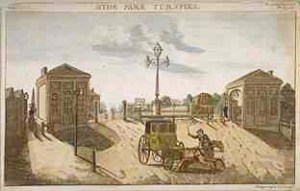
The Hyde Park Gate in London, erected by the Kensington Turnpike Trust. This was the first toll point encountered along the Bath Road, upon leaving London. ~ Public Domain ~ https://en.wikipedia.org/wiki/
Turnpike_trusts#/media/
File:Hyde_park_turnpike_toll_
gate.jpg

First, the major roads during the Regency were TOLL ROADS. Readers should keep in mind that the person hiring or owning the carriage paid the toll. Many aristocrats trusted a footman with the task of actually paying the toll keeper, but it was the responsibility of the person letting or owning the carriage to see that the fee was paid. Turnpikes had been established with toll gates and tolls set by local parishes, who were responsible for maintenance of their stretch of road. Rates were variable, as were the distances between toll gates–could be anything from 10 miles apart to 30 miles apart. [I live in North Carolina. Our tolls are often determined my the number of cars using those lanes.]

Jane Austen’s World provides us this description of A View of London: Tottenham Court Road, 1812. “Inquiring readers, I had read about the closeness of rural areas near London during Jane Austen’s day. This image of Tottenham Court Road from the 1812 edition of Ackermann’s Repository shows the countryside beyond the toll gate. One imagines that Jane Austen was accustomed to such vistas when she visited her brother Henry in London. One moment she would be traveling through the countryside, the next moment she would be entering a teeming metropolis (Click here to see map):

“In the first years of the eighteenth century, pastures and open meadows began by Bloomsbury Square and Queens Square; the buildings of Lincoln’s Inn, Leicester Square and Covent Garden were surrounded by fields, while acres of pasture and meadow still survived in the northern and eastern suburbs outside the walls. Wigmore Row and Henrietta Street led directly into fields, while Brick Lane stopped abruptly in meadows.“World’s End” beside Stepney Green was a thoroughly rural spot, while Hyde Park was essentially part of the open countryside pressing upon the western areas of the city. Camden Town was well-known for its “rural lanes, hedgeside roads and lovely fields”where Londoners sought “quietude and fresh air.” – Extract from “LONDON The Biography”, by Peter Ackroyd. Published by Vintage, 2001.

Or, perhaps, you might find an earlier piece of mine entitled, The Beginning of the Turnpike Roads in Georgian England, helpful.  

Next, we must consider how much time was involved in the journey. I often research the distance from point A to B in current miles, and then I make appropriate adjustments for time of year of the story, proximity to the London Road or other major roads, etc., before I add the travel to the story. More than once, I have had to make major adjustments to my “time” profile of the story before I could finish writing it. Time for the journey depends on several things: weather (time of year), how much money do the characters have available (more money means more ability to hire horses, and the character can hire a team instead of a pair), and quality of the horses and carriage.

The stage and mail coaches generally took 2 days or about 20 to 30 hours of travel, depending on the coach and specific route taken. There were a couple of route options on the Great North Road. For a post chaise, the cost was about 1s 6d a mile for a pair of horses, and double that for four. So it was not really an economical method of travel. Tickets on the stage or the mail coach were cheaper, but travel was slower. (It is claimed that the highwayman Dick Turpin rode from London to York in less than 15 hours on his mare Black Bess. No idea if such was actually true, but a horseman can get over bad ground far easier and faster than wheels.) A trick I learned from another writer was to use Google Maps and set up one’s search for “traveling by bicycle” to estimate traveling by carriage during the Regency era. 

Snow and mud slows everything down. An author does not even need to write in a broken axle, just bad weather. Even rain that takes out bridges or flooded rivers that must be forded will put a stop to travel.

In estimating the speed of the travel, one must consider a number of factors. As mentioned above, the journey would be much slower in mud because horses can pull a tendon or a shoe in mucky ground. One must figure the average speed of a walk = 4 mph, trot – 4-12 mph, and that was the safest gait at which to travel. It is symmetric, meaning the horse is less likely to slip. We see movie images of stage coaches with horses cantering and galloping, but the post chaises–the fastest conveyances in Regency England–only averaged 11 mph, and that was in summer, when the roads were best. A galloping horse can do 35 mph, but not for long, especially not when hauling a load. 

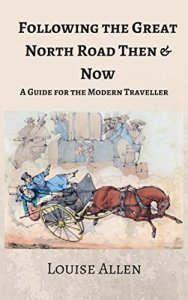
An excellent source to consult is Following the Great North Road Then and Now: A Guide for the Modern Traveller, by Louise Allen. “From the Romans to the present day the Great North Road has carried travellers between London and Edinburgh. Roman emperors, Samuel Pepys, Dick Turpin and Jane Austen are only a few of famous and infamous travellers who passed along this iconic route. Despite bypasses, dual carriageways and concrete, the old road remains to be explored, and this guide is for any curious traveller who wants to break the monotony of a long drive by discovering the picturesque towns and curious byways on this route through British history. With it you can travel in the wheel tracks of coach passengers in the early 19th century, before the railway and the motorcar changed travel for ever.” The book describes the old road as it would have been in the coaching days, shows where the modern road diverges from it, lists a number of the inns along the way, and some description of the scenery as it would have been and various landmarks along the way.
A private light weight vehicle could go about 7 to 8 miles an hour for short distances on decent roads. “16 mile an hour tits” meant carriage horses could do 16 miles an hour. This would be a good, fit, well fed team. The trick was it was impossible to sustain this pace for miles and miles and miles. If one was going for speed, he would change horses every 10 miles, which is about once an hour.

In Jane Austen’s Pride and Prejudice, Mr. Darcy tells Elizabeth Bennet that fifty miles of good road was “little more than half a day’s journey.”  And the roads were so good to Brighton that they were often used for setting speed records.

Much of the above information can be found at https://shannondonnelly.com/2009/06/14/horse-sense/

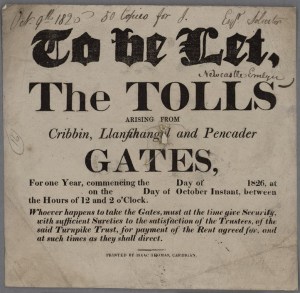
Poster advertising the letting of tolls, 1826.
Unknown – National Library of Wales ~ Public Domain ~ https://en.wikipedia.org/wiki/Turnpike_trusts#/media/
File:To_Be_Let_The_Tolls_Cribbin,_
Llanfihangel_and_
Pencader_Gates_1826.jpg

As to costs at an inn, those also varied, depending on the type of inn (is it a high class one or not) and services required. The American Joseph Ballard wrote in 1815: “Besides the fare in the coach you have to pay the coachman one shilling per stage of about thirty miles, and the same to the guard whose business it is to take care of the luggage, &c. &c. You must pay also, at the inns, the chambermaid sixpence a night, the “boots” (the person who cleans them) two pence a day, and the head waiter one shilling a day. The porter who takes your portmanteau up stairs moves his hat with ‘pray remember the porter, Sir.’  In fact, it is necessary in travelling through England to have your pocket well lined with pounds, shillings and sixpences, otherwise you never can satisfy the innumerable demands made upon a traveller by landlord, waiters, chambermaids, and coachmen, &c. &c.  My bill at Manchester for one supper, a dinner, a breakfast, and two nights lodging was five dollars. (About a pound).”

So…cost for inns were pretty expensive. A night on the road not so bad….several days due to whatever problems could quickly mount up.

Other Resources: 

https://wordwenches.typepad.com/word_wenches/2015/03/travelling-the-roads-of-regency-england-with-louise-allen.html

Thoughts on Travel in ‘Sense and Sensibility’

The Hyde Park Gate in London, erected by the Kensington Turnpike Trust. This was the first toll point encountered along the Bath Road, upon leaving London. ~ Public Domain ~ https://en.wikipedia.org/wiki/
Turnpike_trusts#/media/
File:Hyde_park_turnpike_toll_
gate.jpg

 janeaustenslondon.com/tag/regency-travel

Posted in British history, commerce, Georgian England, Georgian Era, history, Jane Austen, Living in the Regency, real life tales, Regency era, travel | Tagged , , , , , , | 2 Comments

Georgian Era Lexicon – We Are Up to “U” and “V”

In the singular form the lexicon of a particular subject is all the terms associated with it. The lexicon of a person or group is all the words they commonly use. As a plural noun, a lexicon is an alphabetical list of the words in a language or the words associated with a particular subject. To distinguish lexicon from a dictionary, it is an alphabetical list of the words in a language or the words associated with a particular subject.

These examples are a mix of what one might hear upon the lips of the aristocracy, as well as examples of Cant used upon London’s streets and those terms used by farmers and like in the country.

under the hatches – to be without funds

undress – a term for the more casual clothes one might wear at home 

union – short for a workhouse; usually built by a union of several individual parishes

up – used in referring to moving toward London; used in referring to coaches (and later to trains)

up – meant toward Oxford or Cambridge (to go up); in contrast, to be sent down was to be expelled from university

up in the boughs – to be overly elated or upset and the emotions associated with either

up the River Tick – bound for debtor’s prison; highly in debt; some believe debtor’s notes were called “tickets “– shortened to tick

Bath Assembly Rooms - Wikipedia, the free encyclopedia en.wikipedia.org Three chandeliers adorning the Tea Room
Bath Assembly Rooms – Wikipedia, the free encyclopedia
en.wikipedia.org
Three chandeliers adorning the Tea Room

Upper Rooms – Bath possessed two large assembly rooms. The older Lower Rooms were near Bath Abbey in the lower part of the city. The Lower Rooms were destroyed by fire in 1820. The Upper Rooms were located near The Circus and Bennett Street in the upper part of the city. Although damaged by bombing in World War II, the Upper Rooms have been refurbished.

upper orders – same as the “ton“; upper class; high society

upper servants – those with the most seniority in a household; included the butler, the housekeeper, valet, and the lady’s maid; the housekeeper was always addressed as “Mrs.”

upper ten thousand – the term was likely coined by Georgette Heyer in her Regency books; meant to refer to the ton; most say it came from the wealthy families of New York in the 1840s

usher – an assistant to a headmaster of a school

vacation – the period between terms at the universities or the terms for London’s high courts

vail – a form of gratuity given by a departing guest to the household servants who attended him

valet – the counterpart to a lady’s maid; the valet took care of a gentleman’s dress/clothing; referred to as a gentleman’s gentleman; the gentleman’s personal manservant. He dressed and undressed his master, shaved him, did his hair, kept his clothes neat and meticulously ironed, blacked his boots, sewed buttons as needed, and kept secret any flaws of his master’s figure that might need correction by means of a male corset, shoulder pads, or false calves. But most importantly of all, the valet had the solemn duty of starching and tying that showpiece of male attire—the cravat.

valise – a small piece of luggage; carried by hand

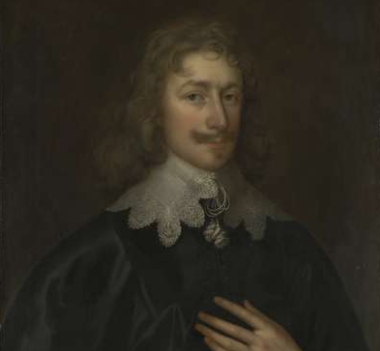
vandyke – named after the painter, Anthony Van Dyke; a style of collar or trimming with a dentate (ie sawtooth) border in lace or fabric


https://artcollection.culture.gov.uk/subject/gac-subject-terms/society/costume-fashion/accessories/van-dyke-collar/

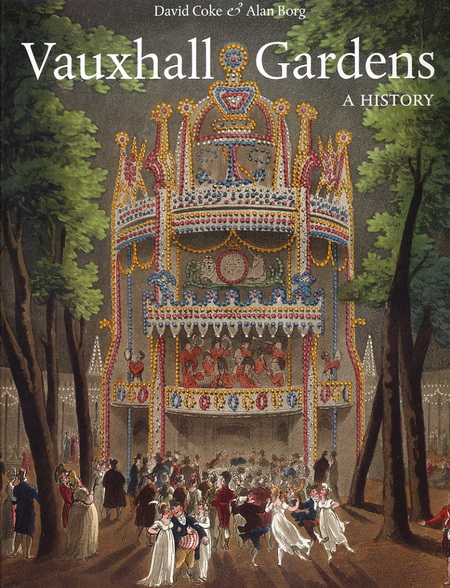
Vauxhall Gardens – an eleven-acre pleasure garden across the Thames from London; one of the leading venues for public entertainment in London from teh mid 17th Century to the mid 1800s

vellum – a parchment made from sheep or goat skin and used for fine quality writing paper

Venerable – a term of respect used when addressing an archdeacon of the Church of England

verger – the man who tended to the inside of a church

Vernon, Lady Susan – the main character in Austen’s Lady Susan novella; known as “the most accomplished coquette in England”

Very Reverend – form of respect/address for a dean in the Church of England

vestry – the room where the clergyman dressed for the service; also where the bride and groom signed the registry following the wedding ceremony; was often used to store sacred vessels or to conduct parish business

vexed – being highly annoyed

vicar – a parish priest appointed to the living by a landowner; he shared the tithes with the landowner; in contrast, a rector received all the tithes

vinaigrette

vinaigrette – a small silver box containing vinegar; it was used to revive women who swooned or fainted; A small sealing box with a second pierced lid inside to contain gauze soaked in vinegar, lavender water, or other scent, the smelling of which was to revive when faint or to relieve from unpleasant odors. Carried inside a reticule or hung from a chatelaine, vinaigrettes were made by fine silversmiths.

A Vindication of the Rights of Woman with Strictures on Political and Moral Subjects (1792) – written by the 18th-century British feminist Mary Wollstonecraft, is one of the earliest works of feminist philosophy. In it, Wollstonecraft responds to those educational and political theorists of the 18th century who did not believe women should have an education. She argues that women ought to have an education commensurate with their position in society, claiming that women are essential to the nation because they educate its children and because they could be “companions” to their husbands, rather than mere wives. Instead of viewing women as ornaments to society or property to be traded in marriage, Wollstonecraft maintains that they are human beings deserving of the same fundamental rights as men.

ving-et-un – a card game; basically, it was the equivalent of “21”; getting as close to 21 without going over

vis-à-vis — a carriage capable of carrying four people; two seats; passengers in the front face backwards/rearward and those in the rear face forward; from the French for “face-to-face.”

https://www.metmuseum.org/art/collection/search/379422 ~ Design for Vis-A-Vis Cabriolet Carriage ~ Established in 1810 by James Brewster (1788–1866) in New Haven, Connecticut, Brewster & Company, specialized in the manufacture of fine carriages. 

viscount – a peer ranking below an earl and above a baron; his wife is a viscountess; was spoken of or called the “Right Honourable” and addressed as Lord__________

visiting card – a card displaying one’s name; left when paying a call

visitation – when a bishop or archdeacon made a tour of a parish or a diocese

Volume the First – one of the three sections of what is known as Jane Austen’s “Juvenilla”; it contains Austen’s “Jack and Alice” and “Henry and Eliza”; Austen copied many of her pieces in three volumes; the volumes are NOT in chronological order

Volume the Second – the earliest of Austen’s three volumes, likely completed when she was 14-15 years of age; it is marked with “Ex dono mei Patris” (From my father); it is dated in 1790; two of the better selections in this volume is “Love and Friendship” and “The History of England,” which made fun of Oliver Goldsmith’s History of England

Volume the Third – another of Austen’s “Juvenilla”; inside is written in her father’s handwriting “Effusions of Fancy by a very Young Lady Consisting of Tales in a Style entirely new”; this volume contains “Caatharine; or The Bower” and “Evelyn”

volumes – books during the Regency were published in volumes; most often the books were three-deckers (three separate volumes); in Jane Austen’s case, all her books are three-deckers, except Persuasion and Northanger Abbey, which were two volumes each

vowels – an I.O.U.; debts

Other Sources: 

Candice Hern

Donna Hatch

18th Century Vocabulary 

Georgette-Heyer: Regency Cant and Expressions 

Jane Austen Organization

Kathleen Baldwin

Messy Nessy Chic

Regency Reader

Sara Ramsey

Sharon Lathan

Posted in British history, history, Jane Austen, language choices, Living in the Regency, reading, Regency era, research, terminology, vocabulary, word choices, word origins, word play | Tagged , , , , , , , , , , , , | Comments Off on Georgian Era Lexicon – We Are Up to “U” and “V”

What Do We Know of London and the Surrounding Areas in the Regency?

On a snowy afternoon, while walking on Hampstead Heath, author C.S. Lewis was inspired with the idea for a new novel; it became The Lion, the Witch and the Wardrobe. https://www.heathandhampstead.org.uk/heath/

Some people who read Regency-based novels do not realize London itself was not all the areas we writers mention in our novels. Many areas, such as Hampstead Heath (famous for its duels), Kew Gardens (founded in 1840 from the exotic garden at Kew Park in Middlesex), Richmond Park (where we often see our characters picnicking, located 8.2 miles west-southwest of Charing Cross), Mayfair and Hyde Park (both located in Westminster), were not part of London proper in the Regency era. In other words, the wealthy lived outside of London proper.

For example, Westminster is now a government district in Central London within the City of Westminster, part of the West End, on the north bank of the River Thames. However, historically the area lay within St Margaret’s parish, City & Liberty of Westminster, Middlesex. The name describes an area no more than 1 mile (1.6 km) from Westminster Abbey and the Palace of Westminster immediately to the west of the River Thames. The settlement grew up around the palace and abbey, as a service area for them. The need for a parish church, St Margaret’s Westminster for the servants of the palace and of the abbey, who could not worship there, indicates that it had a population as large as that of a small village. It became larger and in the Georgian period became connected through urban ribbon development [Ribbon development is building houses along the routes of communications radiating from a human settlement.] with the City along the Strand. [The Early History of Westminster]

The link below from the Survey of London holds extensive information about the development of the streets and who lived there. Note the excerpt provided. 

The Bartlett School of Architecture – Survey of London – University College of London (***Be certain to screen down and open the draft chapters of volumes 51 and 52. Lots of interesting information found there. – Such as Chapter 18 discusses Upper Regent Street, saying, “North of Oxford Circus, Regent Street runs for just three full blocks. Beyond this short section, sometimes known informally as Upper Regent Street, the ‘New Street’ laid out by John Nash for the Crown from 1813 twists westward as Langham Place, connecting with the earlier Portland Place, thence to Park Crescent and Regent’s Park, where Nash’s great planning vision for London resumes at a fresh pitch of grandeur and invention. These 250 yards at the top of the street were unique only in having the rotunda and steeple of All Souls, Langham Place, as their beguiling northern focus. In their earliest years they were less commercial than the central run of Regent Street between the circuses, but that was already changing by 1840.” Is it not lovely to have such resources at our disposal? 

In 1812, the Regent’s Canal Company was formed to cut a new canal from the Grand Junction Canal’s Paddington Arm to Limehouse (from west London to the River Thames in the east), where a dock was planned at the junction with the Thames. The architect John Nash played a part in its construction, using his idea of ‘barges moving through an urban landscape’. Nash’s masterplan provided for the canal to run around the northern edge of Regent’s Park; as with other projects, he left its execution to one of his assistants, in this case James Morgan. The first phase of the Regent’s Canal was completed in 1816 and finally completed in 1820. Unfortunately,  it was built too close to the start of the railway age to be financially successful and at one stage the Regent’s Canalonly narrowly escaped being turned into a railway. But the canal went on to become a vital part in southern England’s transport system.
The aristocrats lived in the West  End: Mayfair, Westminster, etc. Most of them had moved away from the water and the stink of the Thames.

If you are exceedingly interested in this topic, you might have a look at A-Z Regency England, which has maps but a book about Mayfair  describes the  squares where the wealthy lived. “The London Topographical Society A to Z series consists of seven books, which provide fully-indexed maps of London at roughly 100 year intervals. Each reproduces a key map of the period. The indexes allow users to identify the position of streets and buildings, in some cases right down to small courts and alleys. They appeal to anyone interested in the development of London and are invaluable for those researching family history. The A to Z Regency London with introduction by Paul Laxton and index by Joseph Wisdom. Horwood’s Plan of the Cities of London and Westminster (3rd Edition 1813) in book form on a scale of 14 inches per mile, with key and index. Extends Hyde Park-East India Docks; Pentonville-Walworth. A3 size approximate.” 

Bankers and merchants might have live within London, but I do not think it was  a salubrious place to live by the Regency. They went to Vauxhall by boat and many lived closer to the water outside of Mayfair and London.

CLICK HERE FOR LINK TO GEORGIAN/REGENCY MAP (via Google)

https://www.google.com/maps/d/viewer?mid=1f06GI-JEaXroXCEx3pbV1G4lgMM&ll=51.53616515415856%2C-0.09922600000004422&z=10

0r

Georgian London Street and Business Index 

or

GenMaps maps of London, Middlesex, Surrey, Essex) 

also

GenMaps’ Home page for other places in England, Wales, and Scotland 

or

Georgian London Street and Business Locations 

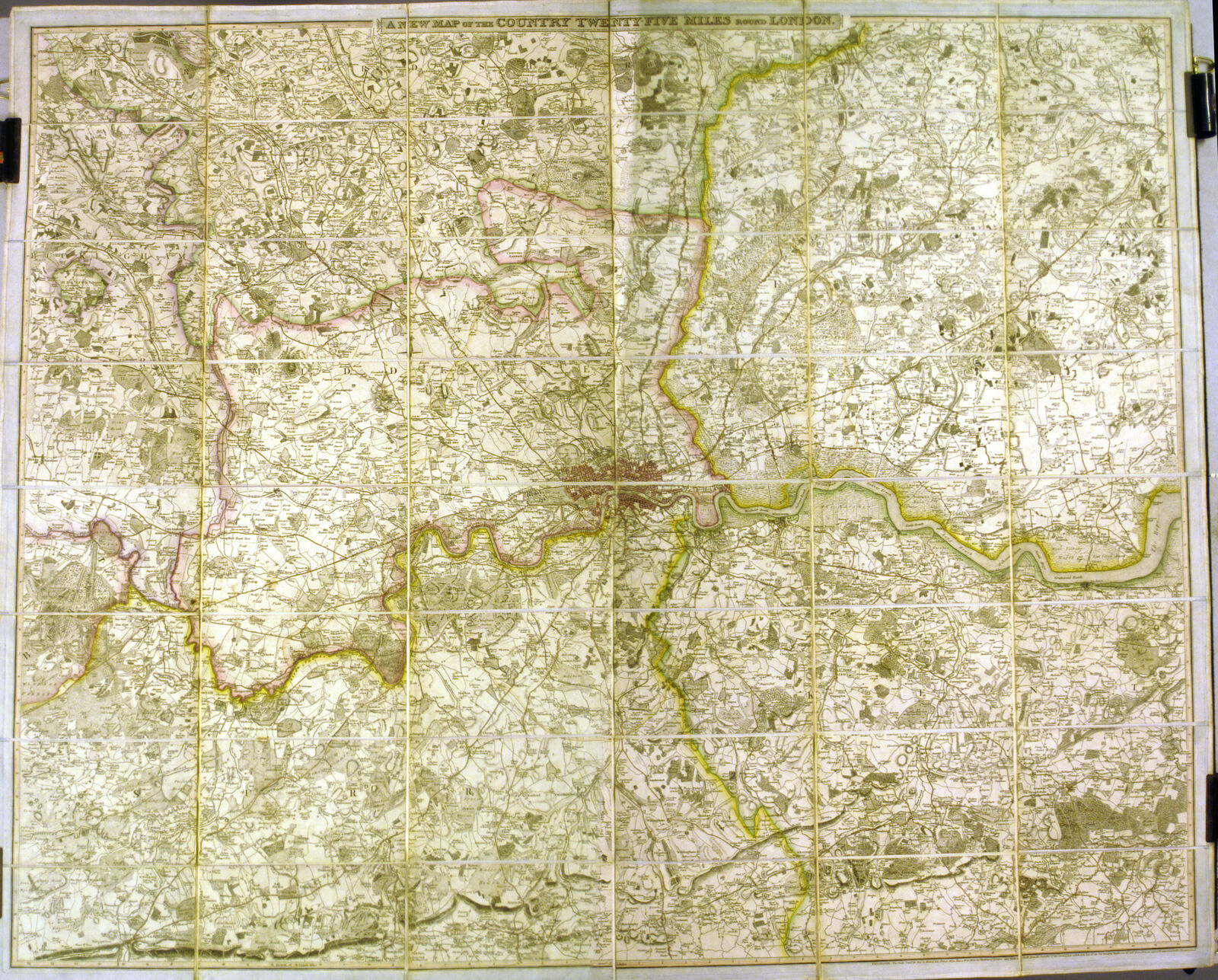
Below is a link to an actual 1818 map of London that is partitioned into blocks. If you click on any block, you will get a blow-up of that section. The upper left hand block has a directory of various places. [Note! The site is not as secure as I would personally prefer.]

http://www.ph.ucla.edu/epi/snow/1818map/1818map_linkc.htm

Below is a similar map from 1817, blocked off and blown up in the same manner. It has been marked off with color to show boundaries.

http://mapco.net/darton1817/darton.htm

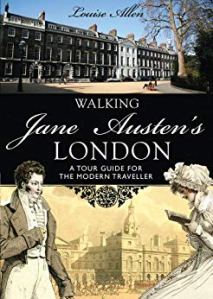
For those of you who are my Austen followers, try Louise Allen’s Walking Jane Austen’s London. This book presents nine walks through both the London Jane Austen knew and the London of her novels! Follow in Jane’s footsteps to her publisher’s doorstep and the Prince Regent’s vanished palace, see where she stayed when she was correcting proofs of Sense and Sensibility and accompany her on a shopping expedition – and afterwards to the theatre. In modern London the walker can still visit the church where Lydia Bennett married Wickham, stroll with Elinor Dashwood in Kensington Palace Gardens or imagine they follow Jane’s naval officer brothers as they stride down Whitehall to the Admiralty. From well-known landmarks to hidden corners, these walks reveal a lost London that can still come alive in vivid detail for the curious visitor, who will discover eighteenth-century chop houses, elegant squares, sinister prisons, bustling city streets and exclusive gentlemen’s clubs amongst innumerable other Austenesque delights.

Posted in British history, buildings and structures, business, commerce, England, estates, Georgian England, Georgian Era, history, Living in the Regency | Tagged , , , , , , , , , , , , | Comments Off on What Do We Know of London and the Surrounding Areas in the Regency?

Gretna Green: The “Las Vegas” Marriage Destination of the Regency Period

Scottish Elopements and the Marriage Act of 1753

“An Act for Better Preventing of Clandestine Marriage,” popularly known as Lord Hardwicke’s Marriage Act (1753), was the first statutory legislation in England and Wales to require a formal ceremony of marriage. Precipitated by a dispute about the validity of a Scottish marriage, the legislation took effect on 25 March 1754.

Before the Act, canon law of the Church of England governed the legal requirements for a valid marriage in England and Wales. These requirements involved the calling of the banns and a marriage license. The stipulation also required that the marriage should take place in the resident parish of one of the participants. However, these stipulations were not mandatory and did not render a marriage void for not following the directory requirements. An Anglican clergyman pronouncing the vows was the only indispensable requirement.

The Act tightened the existing ecclesiastical rules regarding marriage, except for Jews, Quakers, and, ironically, members of the British Royal Family. The exemption for the Royal Family was the basis of objection for Prince Charles’s 2005 civil ceremony with Camilla Parker-Bowles, civil marriage being the creation of statue law. It was also provided that the 1753 Act had no application to marriages celebrated overseas or in Scotland.

On the most southerly point of the English border on Scotland’s west side was the village of Gretna Green. It was on the main road from Carlisle to Glasgow. The road crossed the Sark River, which marked the border itself, a half mile from Gretna Green. On the English side of the border was the village of Longtown.  

Near the Solway Firth, the Regency era’s Greta Green is described in Gretna Green Memoirs as, “…[a] small village with a few clay houses, the parish kirk, the minister’s house, and a large inn. From it you have a fine view of the Solway, port Carlisle and the Cumberland hills, among which is the lofty Skiddaw; you also see Bowness, the place where the famous Roman wall ends.” Within Gretna, at the Headlesscross, is the junction of five coaching roads, and here lay the Blacksmith’s Shop.

The common phrase of the time was to be married “over the anvil,” meaning that the eloping couple took their vows at the first convenient stop, a blacksmith’s shop. “Blacksmith priests” conducted the ceremony, which was nothing more than a public acknowledgment of a couple’s desire to pledge themselves to one another.

In truth, many couples wed at the inn, or at other Scottish villages, and any man could set himself up as an ‘anvil priest.’ It was a lucrative trade. Anvil priests would receive the necessary fee, as well as an appropriate tip, which could be upwards of fifty guineas. According to Romances of Gretna Green, “…[t]he man who took up the trade of ‘priest’ had to reckon on the disapprobation of the local Church authorities.”

The Act effectively put a stop to clandestine marriages (valid marriages performed by an Anglican clergyman but not in accordance with the canons). It brought about the end of the notorious Fleet Marriages associated with London’s Fleet Prison. However, it increased the traffic along the North Road to Scottish “Border Villages” (Coldstream Bridge, Lamberton, Mordington, and Paxton Toll). In the 1770s a toll road passing through the hitherto obscure village of Graitney led to Gretna Green becoming synonymous with romantic elopements.

Despite many assertions to the contrary, the Act did not render invalid any marriage involving minors (those under 21) who married without parental consent. Since the Act specifically prohibited the courts from inquiring into the couple’s place of residence until after the marriage had been celebrated, many chose having the banns called in a different parish without their parents’ permission. The Act also did not do away with common-law marriages, or informal folk practices such as handfasting or broomstick marriages.

One of my favorite Regency authors, Louis Allen, has a fabulous post on Harlequin.com Community on “The Romance of Elopement,” in which she speaks of the expensive race to the Scottish border. She explains, “
London to Gretna, via Manchester, is 320 miles. That is £20 for the chaise and horses alone at a time when a housemaid would be glad to earn £16 a year, all found.”

Isaac Cruikshank – View of the Houses of Lords and Commons from Old Palace Yard – B1977.14.17696 – Yale Center for British Art ~ https://en.wikipedia.org/wiki/Parliament_of_Great_Britain#/media/File:Isaac_Cruikshank_-_View_of_the_Houses_of_Lords_and_Commons_from_Old_Palace_Yard_-_B1977.14.17696_-_Yale_Center_for_British_Art.jpg

Rules of Marriages:

  1. Reading of the Banns occurred on 3 consecutive Sundays or Holy Days during Divine Service, immediately before the Offertory. At least one of the marrying couple had to be a resident in the parish, in which they wished to be married; the banns of the other party were read in his/her parish of residence, and a certificate provided from the clergyman stating it was properly done. Banns were good for three months. The wedding ceremony was scheduled at the church between 8 A.M. and noon.
  2. Wording:
 “I publish the Banns of marriage between Groom’s Name of–his local parish–and Bride’s Name of–her local parish. If any of you know cause or just impediment why these two persons should not be joined together in Holy matrimony, ye are to declare it. This is the first [second, third] time of asking.”
  3.  Common/Ordinary Licence – This could be obtained from any bishop or archbishop; a common/ordinary license meant the Banns need not be read – and so there was not the delay of two weeks. A sworn statement was given that there was no impediment [parties were not related to one another in the prohibited degrees, proof of deceased spouse given, etc.]. The marriage was required to take place in church or chapel where one party has already lived for 4 weeks. It was also good for 3 months from date of issue. Cost of the license: 10 shillings.
  4. Special License – Obtained from Doctors Commons in London, from the Archbishop of Canterbury or his representative. The difference between this and the Ordinary license was that it granted the right of the couple to marry at any convenient time or place. All other requirements were the same. Names of both parties were given at the time of the application. Cost: In 1808 a Stamp Duty was imposed on the actual paper, vellum or parchment the license was printed upon, of £4. In 1815, the duty increased to £5.

So how does the details of a Scottish marriage fit into my latest novel, The Disappearance of Georgiana Darcy?

The Disappearance of Georgiana Darcy: A Pride and Prejudice Mystery  

A THRILLING NOVEL OF MALICIOUS VILLAINS, DRAMATIC REVELATIONS, AND HEROIC GESTURES THAT STAYS TRUE TO AUSTEN’S STYLE

SHACKLED IN THE DUNGEON of a macabre castle with no recollection of her past, a young woman finds herself falling in love with her captor—the estate’s master. Trusting him before she regains her memory and unravels the castle’s wicked truths would be a catastrophe.

Far away at Pemberley, the Darcys happily gather to celebrate the marriage of Kitty Bennet. But a dark cloud sweeps through the festivities: Georgiana has disappeared without a trace. Upon receiving word of his sister’s likely demise, Darcy and his wife, Elizabeth, set off across the English countryside, seeking answers in the unfamiliar and menacing Scottish moors.

How can Darcy keep his sister safe from the most sinister threat she has ever faced when he doesn’t even know if she’s alive? True to Austen’s style and rife with malicious villains, dramatic revelations and heroic gestures, this suspense-packed mystery places Darcy and Elizabeth in the most harrowing situation they have ever faced— finding Georgiana before it’s too late.

Read for FREE on Kindle Unlimited https://www.amazon.com/kindle-dbs/hz/subscribe/ku?passThroughAsin=B083HMQZRR&ref_=ku_lp_rw_pbdp&_encoding=UTF8&shoppingPortalEnabled=true

Kindle https://www.amazon.com/Disappearance-Georgiana-Darcy-Prejudice-Mystery-ebook/dp/B083HMQZRR/ref=sr_1_1?crid=1X6CU5PESKGJC&keywords=the+disappearance+of+georgiana+darcy&qid=1578930549&sprefix=The+disappearance+of+geor%2Caps%2C145&sr=8-1

Amazon https://www.amazon.com/Disappearance-Georgiana-Darcy-Prejudice-Mystery/dp/1655799037/ref=sr_1_2?crid=1X6CU5PESKGJC&keywords=the+disappearance+of+georgiana+darcy&qid=1578930573&sprefix=The+disappearance+of+geor%2Caps%2C145&sr=8-2

Audible https://www.amazon.com/Disappearance-Georgiana-Darcy-Prejudice-Mystery/dp/B00JJ6THLE/ref=sr_1_1?keywords=the+disappearance+of+georgiana+darcy&qid=1581880142&s=audible&sr=1-1

Audible (Virtual Narrator) https://www.amazon.com/dp/B0CXHNMWJN

Book Bub https://www.bookbub.com/books/the-disappearance-of-georgiana-darcy-a-pride-and-prejudice-cozy-mystery-by-regina-jeffers

Posted in Act of Parliament, British history, Church of England, customs and tradiitons, Georgian England, Georgian Era, Great Britain, Gretna Green, historical fiction, history, Jane Austen, laws of the land, Living in the Regency, marriage, marriage customs, marriage licenses, Pride and Prejudice, reading, real life tales, Regency romance, terminology, writing | Tagged , , , , , , , , , , , , , , , , , | 5 Comments

Georgian Era Lexicon – Crossing Our “T’s”

In the singular form the lexicon of a particular subject is all the terms associated with it. The lexicon of a person or group is all the words they commonly use. As a plural noun, a lexicon is an alphabetical list of the words in a language or the words associated with a particular subject. To distinguish lexicon from a dictionary, it is an alphabetical list of the words in a language or the words associated with a particular subject.

These examples are a mix of what one might hear upon the lips of the aristocracy, as well as examples of Cant used upon London’s streets and those terms used by farmers and like in the country.

tailcoat – everyday wear for a fashionable gentleman; worn over shirts and waistcoat; it was square cut around the waist for formal attire and sloped for more less formal situation, as well as for riding

take orders – becoming a clergyman in the Church of England

A 1903 caricature of Robert McCall KC (formerly QC) wearing his court robes at the Bar of England and Wales. For court, he wears a short wig, and bands instead of lace at the collar, but he retains the silk gown and court tailcoat worn on ceremonial occasions. Public Domain. Leslie Ward - Published in Vanity Fair, 19 November 1903.  http://en.wikipedia.org/ wiki/Queen's_Counsel #/media/File:QC_Court_ robes_crop.jpg
A 1903 caricature of Robert McCall KC (formerly QC) wearing his court robes at the Bar of England and Wales. For court, he wears a short wig, and bands instead of lace at the collar, but he retains the silk gown and court tailcoat worn on ceremonial occasions. Public Domain. Leslie Ward – Published in Vanity Fair, 19 November 1903. http://en.wikipedia.org/
wiki/Queen’s_Counsel
#/media/File:QC_Court_
robes_crop.jpg

take silks – a barrister would wear a silk gown once he became the King’s Counsel (or the Queen’s Counsel)

taking the waters – spa towns such as Bath or Tunbridge Wells were thought to be places of healing; to “take the waters” meant to drink the mineral waters available there or to bathe in them

tallow – fat from oxen or sheep, which was used to make soap and candles

tambour – a hoop filled with material; used for embroidery work

tandem – a team of two horses harnessed one behind the other, rather than side by side

tanner – slang for a sixpence

taproom – an inn’s room where ordinary laborers were served (as opposed to a private parlor for the genteel sect)

Tattersall’s – near Hyde Park Corner; established specifically for the sale by auction of horses, carriages, harnesses, etc., though one could purchase a hunting dog there, as well; held accommodation for 120 horses, a large number of carriages, and a spacious kennel for hounds; held a sporting lounge for gentlemen when horse auctions (around 100 horses were for sale each week) were not happening; home of the Jockey Club; subscribers paid one guinea per year and all sporting bets were settled there, regardless of where the sporting event took place

tea caddy – a box that held tea

teapoy – a 3-legged stand used for serving tea

Tea Room – located in the Bath assembly rooms; one could take tea in the room, but it was also used for concerts

tea service – in contrast to the suppers served at private balls, at assemblies or public balls, teas was served halfway through the evening; gentlemen sat with the ladies with whom they had danced prior to the tea service

Temple – the site for two of the four Inns of Court (the Inner Temple and the Middle Temple); was once occupied by the Knights Templar

Temple Bar – a gate that marked the formal entrance to the City of London; the sovereign had to request permission of the Lord Mayor to enter the city; north of the Temple at the eastern end of the Strand

tenants – prosperous farmers who rent land; not necessarily the poor

tenner – slang for a ten-pound note

Test Act – legislation that forbid Catholics from holding public office, including Parliament; was repealed in 1828

Thirty-nine Articles – the basis of the Church of England; a clergyman “read himself in” to a new parish congregation by reading the articles aloud to the congregation from the pulpit

New Grub Street (Victorian novel) raunerlibrary.blogspot. com/2011/11/triple-headed-monster.html
New Grub Street (Victorian novel) raunerlibrary.blogspot.
com/2011/11/triple-headed-monster.html

three-decker novel – a common occurrence in novels of the 18th and 19th Centuries; the novel is divided into three volumes within one book; the volumes were published as separates (only Austen’s Northanger Abbey and Persuasion are two volumes; all other Austen works were 3 volumes)

tick – was the Regency version of buy now and pay later; also referred to as “run upon a tick”

ticket-of-leave – an early release from jail (similar to parole)

ticket porter – a member of the official group licensed to carry goods, parcels, etc.; a ticket porter carried a badge which identified him as a member of this occupation; like a guild member

ticket to a public ball – anyone who could afford a ticket to a public ball or assembly was admitted; a season of tickets would cost between one pound and ten guineas (depending on the country or in London)

tidewaiter – a customs official for incoming boats/ships

tiffany – a transparent silk gauze 

tiger – usually a young boy who served as a groom; the term comes from the orange and black-striped waistcoat he worn; he was responsible for holding the horses reins when the master disembarked from his carriage; he would also exercise the horse while his master was making business or social calls; he road on a seat at the back of the carriage, so situated as not to throw off the balance of the carriage while in motion; a very fashionable thing to employ a tiger; not a popular term until about 1817

tights – thin, skintight pants worn by gentlemen in the early part of the century; were so tight that men resorted to carrying a purse for their money

Tilbury Magazine on Ancestry.com http://freepages.genealogy.rootsweb.ancestry.com/ ~cmtilbury/ttm/ttm_ tilbury_gig.html
Tilbury Magazine on Ancestry.com http://freepages.genealogy.rootsweb.ancestry.com/
~cmtilbury/ttm/ttm_
tilbury_gig.html

tilbury – the cloth covering part of a wagon; A tilbury is a light, open, two-wheeled carriage, with or without a top, developed in the early 19th century by the London firm of Tilbury, coachbuilders in Mount Street. A tilbury rig is little more than a single “tilbury seat”—the firm’s characteristic spindle-backed seat with a curved padded backrest— mounted over a raked luggage boot, and fitted with a dashboard and mounting peg, all on an elaborate suspension system of curved leaf springs above the single axle. The tilbury has large wheels for moving fast over rough roads. A tilbury is fast, light, sporty and dangerous.

Times – the most important newspaper of the day; one could find the entire text of parliamentary debates in the Times

tinderbox – used to start a fire before matches became common; one struck the flint from the box against a piece of metal in hopes that a spark would light the rags inside the box; candles, etc., were lit from the tinderbox

tippet – a fur scarf that hung about the neck and down either side of the chest; many times the tippet was a dead animal (think Fox furs, a boa, a stole, etc.) In the latter part of the 1700s, they were long and thin, more like a boa might be nowadays. However, by the Regency, they took on the look of a caplet. 

The print shows a detail from “Morning & Walking Dress,” Ackermann’s Repository of Arts, November 1810. It is described as a “French tippet of leopard silk shag.” – via https://candicehern.com/regency-world/glossary/

tithes – the amount paid in kind to the local parish clergyman; equal to 1/10 of the farmer’s or tradesman’s annual produce

toad eater – a flatterer; one giving false praise

ton – the word is always in Italics for it comes from the French word bon ton, which can be translated to mean “good form,” i.e., good breeding, good manners, well spoken, etc.; fashionable society; those of the peerage or the gentry class

too high in the instep – snobbish; someone who is very proud, or haughty

top – the place in a ballroom or assembly from which the orchestra played; the “top” couple in a line of dance was the one closest to the orchestra; to be at the top of the line was a place of honor, usually afforded to the highest ranking aristocrat in the room

top boots – high boots used for riding

topsy turvy – utter confusion; Derived from the obsolete 1528 English word terve to turn upside

toque – became popular towards the end of the Regency period; close-fitting hat with no brim; turban-like; could be worn both for daytime and evening wear

Ackermann’s Repository of Arts, June 1818: “Head-dress, a pea-green satin toque, ornamented with flowers.” ~ https://candicehern.com/regency-world/glossary/

Tory – the conservative party in English politics

Town – meaning London; therefore, it would be capitalized; people went “up to Town”

Town bronze or Town polish – fashionable manners expected of those in Town (London)

training college – a college that trained teachers for the national schools

Transatlantic Trade Triangle – goods were shipped from British ports to the west coast of Africa, where they were exchanged for slaves; the slaves were taken by The Middle Passage to the Americas; slaves were traded for agricultural goods (cotton and sugar) and returned to England

transportation – sending English criminals overseas as punishment; until 1776, the American colonies were the destination; afterwards, the criminal was sent to Australia

traveling post – a hired driver, chaise, and horses for a journey

pear-n-ginger-upsidedown-pudding20080430black-treacle

treacle – a sweet medicine (similar to molasses); Treacle is any uncrystallised syrup made during the refining of sugar. The most common forms of treacle are golden syrup, a pale variety, and a darker variety known as black treacle. Black treacle has a distinctively strong, slightly bitter flavour, and a richer colour than golden syrup, yet not as dark as molasses. Treacle is a common sweetener and condiment in British cookery, found in such dishes as treacle tart and treacle sponge pudding.

trousers – a looser-fitting pants than were breeches or pantaloons; worn to the ankles; customarily had a foot strap that fit around the arch of the foot to hold them in place

truck system – paying one’s employees in goods, food, etc., rather than money

tucker – a piece of lace to cover a woman’s chest in lady’s garments

tulip – a very fashionable man (think Beau Brummell)

turbans – a popular ladies’ fashion in the early part of the century; an imitation of a Middle Eastern headdress

turnkey – a jailer

turnpike – a toll road; the average toll was 2-3 pence per mile

twelfth cakes – cakes made for Twelfth Night; those who found the coin or bean inside became the “king” or “queen” of the celebration

Twelfth Night – January 5; the night before the 12th day after Christmas; when Christmastide officially ended; January 6 is the Epiphany

two-dance rule – a couple was expected not to dance more than twice; dancing more often with a partner was a symbol of serious matrimonial interest

two-penny post – London’s local mail delivery system, which was run as a separate entity from the national mail system; similar local mail delivery systems rose up within other large metropolitan areas

tucker – often worn for modesty purposes on both daytime apparel and low-cut gowns for evening wear; it was an edging of white lace, muslin, or lawn, that was usually frilled and added to disguise a low neckline; if it hung down over the front of the bodice, it was called a “falling tucker”

“Round dress of white net over white satin, with full short sleeves of the same materials. This dress is most superbly finished at the borders by rich embossment of satin and chenille. The bust is chastely displayed with a beautiful falling tucker of fine broad lace…” Ackermann’s Repository – Nov 1819

turnpike – The 1663 Turnpike Act set up tolls/fees to be paid to travel certain roads; a gate across the road prevented people from crossing until they paid the necessary fee; in 1706 the government created the Turnpike Trusts, which were private companies who collected the tolls and were also responsible for maintaining the roads

twelvemonth – the term covers a typical 12-calendar month

Other Resources:

Candice Hern

Donna Hatch

Fashion in the Age of the Georgians

Jane Austen Organization

Kathleen Baldwin

Messy Nessy Chic

Regency Researcher

Sara Ramsey

Sharon Lathan

Posted in British history, etymology, Georgian England, Georgian Era, Great Britain, history, language choices, Living in the Regency, Regency era, vocabulary, word choices, word origins, word play | Tagged , , , , , , , , , , , | 5 Comments

Proxy Marriages: Valid or Invalid?

Upon occasion I have come across a plot line in a Regency historical novel where the couple is married by proxy. Unfortunately, such a marriage was not valid. Today’s interpretation of a marriage by proxy tells us that it is a wedding in which one (or both) of the people seeking to be married are not physically present and are being represented instead by another person. If both partners are absent a double proxy wedding occurs. 

Nowadays, a proxy marriage might occur if one or both partners cannot attend for reasons such as military service, travel restrictions, imprisonment or when a couple lives in a jurisdiction in which they cannot legally marry. 

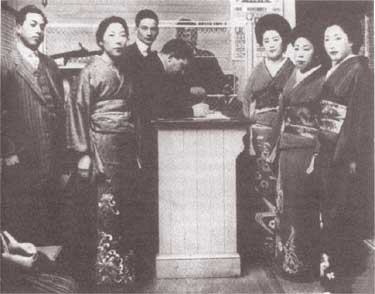
Here is the U. S., four states deem proxy marriages as legal; those states are Texas, Kansas, Colorado, and Montana. Only Montana permits double-proxy marriages. A Federal Court in the U.S in 1924 upheld a proxy marriage of a Portuguese woman and a man living in Pennsylvania, where common-law marriages were legal at the time. Afterwards, the woman immigrated to the U.S., the marriage making her legal, whereas, before the marriage she would have been inadmissible due to being illiterate. In the early 1900s, Japanese “picture brides” arrived at Angel Island, California creating a significant increase in proxy marriages at the time. In the United States, if a proxy marriage has been performed in a state that legally allows it, many states will recognize it fully or will recognize it as a common law marriage. The exception to this is the state of Iowa where it is completely unrecognized.
Under English Common Law, if a proxy marriage is valid by the law of the place where the marriage took place (lex loci celebrations), then it is recognized in England and Wales. However, generally speaking, proxy weddings are not recognized as legally binding in most jurisdictions. There was no provision for marriages of English subjects in England by proxy marriage. Even before the Hardwick Marriage Act, a couple could be “half married,” meaning the betrothal, but they still required the ceremony in the Church of England to make their joining a fully valid marriage. The couple had to be present before the clergyman and swear to being there voluntarily before a marriage would be conducted. 


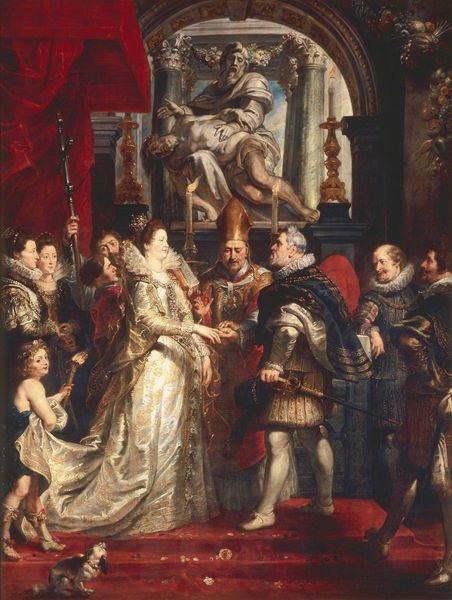
A famous 17th-century painting by Peter Paul Rubens depicts the proxy marriage of Marie de’ Medici in 1600. By the end of the 19th century the practice had largely died out. Wikipedia

From the Middle Ages onward, European monarchs and nobility were sometimes known to by married by proxy. Some of those were 

Mary, Queen of Hungary to Louis I, Duke of Orléans, 1385

Henry IV to Joanna of Navarre, the daughter of Charles d’Évreux, King of Navarre, 1402

Catherine of Aragon to Prince Arthur, 1499

Charles I of England to Henrietta Maria of Francy, 1625 

Marie Antoinette to Louis-Auguste, 1770

Napoleon I of France to Austrian Archduchess Marie Louise, 1810


Other Recent Pieces on Proxy Marriage in the UK and the Laws in Place: 

Immigration Inspector Warns of Rise of Proxy Marriage Misuse

Immigrants Using ‘Proxy’ Marriages to Dodge Britains Visa Laws

Migrants Win Right to Stay in UK with a Wedding They Don’t Even Turn Up For 

Proxy Marriages and EU Law 


Posted in American History, British history, Church of England, Georgian England, Georgian Era, history, Living in the UK, marriage, marriage customs | Tagged , , , , , , , | Comments Off on Proxy Marriages: Valid or Invalid?

Eloping During the Regency and What the Code Napoleon Said About It

Almost every Regency era romance writer has written at least one scene where the hero and heroine elope, racing to Scotland and a place such as Gretna Green.

Yet, when one sets the elopement could change the pair’s destination. What do you know of the Code Napoleon? Also, did you know for a period of time France would have been easier to reach and in a faster time than a race to the Scottish border?

Permit me to make the waters a bit murky for some of you.

As a general rule, the English accepted all marriages as valid that were valid in the country where it was celebrated. However, there were few marriages of English persons in France during the war, except those of soldiers who had a chaplain officiating. A marriage that took place after the war was declared invalid because it was not done in accordance with local law.

There were channel islands, where some people went to be married, but usually these were people who lived in the southwest corner of the country and were accustomed to the sea.

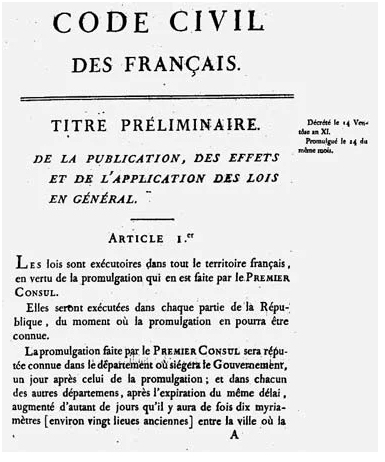
Napoleonic Code
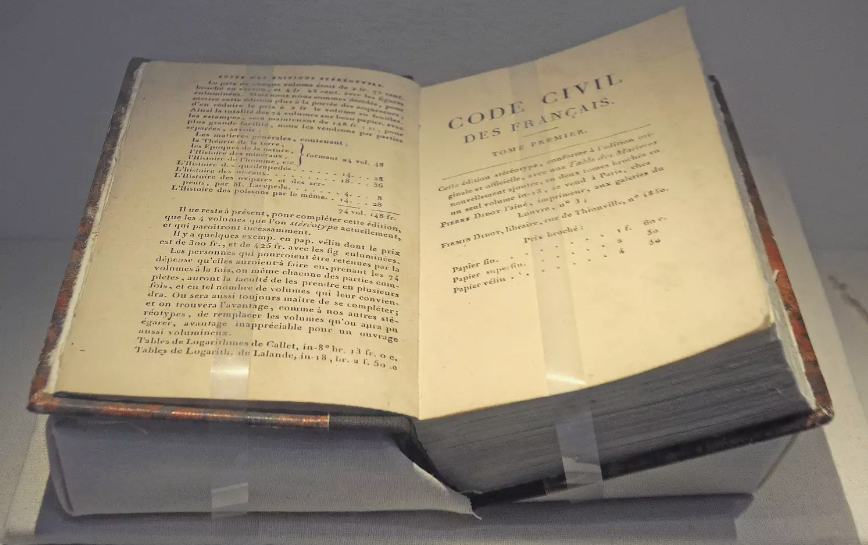
Early version of the Code Civil des Français (“Civil Code of the French”; known as the Napoleonic Code), dated 1803 (year XI of the French republican calendar). The code was promulgated in its entirety in 1804 (year XII) by First Consul Napoleon Bonaparte.
Public Domain Photo ~ https://www.britannica.com/topic/Napoleonic-Code

On 20 September 1789, the age of legal majority was reduced to 21 for both men and women, confirmed in 1804, and parental permission was no longer required. But here is the catch: the Code Napoleon came into effect in the early 1800s, and it automatically repealed all previous laws, including the 1789 one mentioned above.

Back in that 1789 law, women reached their majority for the purposes of marriage at 21 and men at 26. Note, however, that under the Code Napoleon, there were different majority ages for different aspects of the law.

But given that Britain was at war during a good part of the Regency, one would either need to set one’s story AFTER the war had ended, or NOT have one’s couple elope to France. Having them elope to France during the war simply because it is supposedly easier than going north would have me instantly tossing the book aside. An author would need to convey very strong reasons for them to go to France other than it being easier than going to Scotland to have any hope of my continuing to read the book. Even having them elope to France after the war would be a big task of the reader.

BUT – there are other factors one needs to consider before pursuing this course.

In the early 19th century (and throughout the period we call the Regency) family consent was required for most marriages in France. Women who had not attained their 21st birthday, and men who had not attained their 26th birthday, required permission from a parent or guardian, though only the father’s permission was required if the parents were in disagreement.

If the parents refused consent for women aged between 22 and 25, or for men aged between 26 and 30, the couple had to make three written requests, at one-month intervals, seeking permission. If all three requests were denied, then one month after the third denial, a marriage license would be issued. For women over the age of 26 and men over the age of 30, only a single written request and denial was required. These requirements were, I guess, the state’s way of providing the couple an enforced cooling off period.

Both parties had to present birth certificates (or notarised acts in the case of lost or destroyed birth certificates), AND the parents’ death certificates if other relatives were acting as guardians, AND notarised acts of consent if the parents are unable to come to the town hall to give consent in person.

Foreigners in France were subject to the same laws, but with additional restrictions, depending on marriage law within their country of origin.

The French marriage would be legitimate in France, but France did not have reciprocity agreements with its European neighbors, meaning the foreign couple could not return to their own country and expect their marriage would be considered valid. I don’t know if there were reciprocity agreements in place with England, but I very much doubt it given the Code Napoleon was introduced before the Regency era properly began. 

In any event, to avoid issues of foreigners being stuck on French welfare rolls, the French government ordered its officials to ensure that foreigners adhere to all regulations of their country of origin before any marriage service was performed in France.

Napoleonic Code, French Code Napoléon, French civil code enacted on March 21, 1804, and still extant, with revisions. It was the main influence on the 19th-century civil codes of most countries of continental Europe and Latin America.

“After the French Revolution, codification became not only possible but almost necessary. Powerful groups such as the manors and the guilds had been destroyed; the secular power of the church had been suppressed; and the provinces had been transformed into subdivisions of the new national state. Political unification was paired with a growing national consciousness, which, in turn, demanded a new body of law that would be uniform for the entire state. The Napoleonic Code, therefore, was founded on the premise that, for the first time in history, a purely rational law should be created, free from all past prejudices and deriving its content from “sublimated common sense”; its moral justification was to be found not in ancient custom or monarchical paternalism but in its conformity to the dictates of reason.” [Napoleonic Code]

This article on the Napoleonic Code tells us, “The law was composed of scattered laws that sometimes overlapped creating contradictions and problems. It therefore became necessary to create compilations of laws to give it coherence and avoid such contradictions. Sometimes the compilations ended up mixing all kinds of rights such as civil with criminal and administrative. Thus, were born the following compilations of laws:

  • Hammurabi code decreed by King Hammurabi.
  • The law of the twelve tables: It was the law established to eliminate the privileges of the patricians (descendants of the founders of Rome) in ancient Rome and is one of the first to group the regulations by theme. However, they did not include all the legal rules because some were over-understood.
  • Justinian’s Corpus Iuris Civilis: This approached code consideration. However, it was constituted in a compilation because it included legal norms without validity. In addition, it included philosophical elements on the source of law and quotations from classical judges. A scholarly compilation of Roman law and its sources.”

Women had more or less control of their own lives depending on the specific area covered by the Code. For example, a woman could not be forced to marry against her will or marry at all before age 21 – but then not without the permission of her parents or grandparents.

So, having one’s couple eloping to France likely was a bad idea (especially after 1804) because they would not have parental permission. All the rules of the local law had to be followed for the English courts to declare the marriage valid.

Georgette Heyer used that device in Cotillion, but I can’t remember if she brought a time frame into that book. Of course, that’s fiction! I love the impeccable use of various story elements executed in her stories, but Heyer also allowed a man to scratch out the name of the bride on a special license and substitute another, which is absolutely not valid. Trusting Heyer for all historical facts is not always the best choice.

As for the Channel Islands, they were properties of the English Crown, but they had their own legislature and laws. They were not part of France, though their proximity to the French coast made travel there dangerous during the war.  According to my notes, they allowed marriage to anyone 21 or older without any residency requirements.  My notes don’t mention what the rules were for younger people as I wasn’t researching that situation when I made them…

France was (and still is) mainly a Catholic country–not a Church of England one. Also, the Revolution threw out the church, but then Napoleon made up with the Pope, who was all for Napoleon being crowned Emperor, so it was back to Catholic. All this means is it was unlikely for an English couple to think about running away to get married in France. (Scotland is mainly Protestant.) Plus, how did one go about finding a church in which to marry? Most parishes wanted a person to be a resident in the area for a set time before you were permitted to marry (remember Mr. Wickham and Lydia Bennet in Pride and Prejudice and that was a Church of England wedding), and most priests would want to make certain the person was a good Catholic and they could not do that if they did not know the person.

What was an option for a time was the Isle of Man and the Isle of Wight – Check out Rachel Knowles’s article HERE: http://www.regencyhistory.net/2015/11/why-did-regency-lovers-elope-to-gretna.html

Unless the lovers had relatives in France, it is highly unlikely they could marry there. War conditions really make it impossible for any Englishman to be in France from 1793 until 1814 . . . one would have only the brief peace in 1803.

Religion is also a bar with elopements to Spain, Italy, or any other country that is primarily Catholic, unless one of the couple is also Catholic with relatives in that country, and then the residency issue still comes into play. Remember there were restrictions on Protestant/Catholic marriages. The couple had to first be married in the Protestant church for their marriage to be legal (an issue I played with in my Realm series, book 7, A Touch of Honor).

Of course, Mary Godwin and Percy Bysshe Shelley eloped to France in 1814, but they were in no way respectable, and he was still married to Harriet at the time, so I doubt that is best replicated.

DerHexer/Wikimedia Commons/(CC BY-SA 4.0)

Other Resources:

An Alternate Elopement

The History of the Napoleonic Code

Marriage Under the Code Napoleon

Napoleonic Code: Why Was One of the Most Influential Civil Codes Flawed?

Women and Code Napoleon

Posted in British history, Georgian England, Georgian Era, historical fiction, history, marriage, marriage licenses, Uncategorized | Tagged , , , , , , , , , , | Comments Off on Eloping During the Regency and What the Code Napoleon Said About It

Georgian Era Lexicon – Continuing on to the Letter “S”

In the singular form the lexicon of a particular subject is all the terms associated with it. The lexicon of a person or group is all the words they commonly use. As a plural noun, a lexicon is an alphabetical list of the words in a language or the words associated with a particular subject. To distinguish lexicon from a dictionary, it is an alphabetical list of the words in a language or the words associated with a particular subject.

These examples are a mix of what one might hear upon the lips of the aristocracy, as well as examples of Cant used upon London’s streets and those terms used by farmers and like in the country.

s. – the abbreviation for shilling (a shilling is a English silver coin worth twelvepence; 20 shillings = one pound)

Sabbatarians – VERY strict observers of the Sabbath

sack – a dry white wine from Spain

St. Giles – a notorious London slum with a large Irish and Jewish population; a center for prostitution

http://www.royal.gov.uk/ theroyalresidences/ stjamesspalace/ stjamesspalace.aspx
http://www.royal.gov.uk/
theroyalresidences/
stjamesspalace/
stjamesspalace.aspx

St. James Palace – the official residence (until 1837 when Queen Victoria moved the royal residence to Buckingham Palace); St. James’s Palace is the senior Palace of the Sovereign, with a long history as a Royal residence. As the home of several members of the Royal Family and their household offices, it is often in use for official functions and is not open to the public.

“Saint Jane” myth (not necessarily a Regency term, but important to the era) – When Henry Austen wrote his biography of his sister Jane, he presented a “saint” to the world, which is in sharp contrast to the Jane Austen we meet in her letters.

saloon or salon – a large room, such as a drawing room, used for receiving and entertaining guests; this room often doubled as a picture gallery in a fine house

salver – a silver tray which held calling cards; either placed on a table in the hallway or delivered by the head servant to his master/mistress; also used by servants to passing around biscuits during social gatherings

sal volatile – smelling salt (made with ammonium carbonate)

sandals – used by ladies in the early part of the century; slipperlike shoes that fastened over the instep with a strap

sash – worn by little girls as a complement to the muslin frock

sawbones – originally referred to army surgeon who were often called upon to saw off bones; as more and more soldiers returned home the term came to be applied to all doctors and surgeons

schoolroom – where children received their lessons in a wealthier home; large enough for dancing lessons and to accommodate games indoors; “in the schoolroom” meant a young lady had not made her “Come Out”

scout – a man servant at Oxford

Scottish reel – a folk dance with gliding steps and jumps; a quick-stepping dance

scullery – place where dishes were washed and stored

scullery maid – the lowest ranking household servant (also referred to as “scullion”); one assigned to wash the dishes, as well as other unpleasant duties in the kitchen

http://empirepost.com/ XEP/A-US/SFL/Pages/ 1765-1820/USC-1765.htm
http://empirepost.com/
XEP/A-US/SFL/Pages/
1765-1820/USC-1765.htm

sealing wax or sealing wafer – a drop of wax (dropped wet over the fold of a letter and allowed to dry) or a sealing wafer (a thin disk of dried paste used to seal a document) was used to seal a letter (There were NO envelopes.); a signet ring or seal pressed into the wax secured the paper seal; usually made of beeswax; red wax was used only for business; other colors for social correspondence; black wax indicated mourning

seals – small ornament on a watch chain, including a seal to set the wax on a letter; it contained an emblem or the initials cut into the metal surface, which was called “itaglio’; the image was pressed into the metal wax so a raised imprint remained; the image was specific to a particular family name, business, or official title; the seal might also be inset in a signet ring or it could be available it a “stamp” format for a house’s butler to frank letters or the housekeeper to carry one on a chatelaine or fob to mark orders being requesting for the household

sealing wax – a mixture of shellac and turpentine or even beeswax that was melted and used to seal envelopes and/or stamp official documents; the standard was to use red for business, black for mourning, and another color of one’s choice for social letters

sedan Chair – a rickshaw-like enclosed chair with two poles, carried by two men, one at the front of the poles, another at the back of the chair holding the rear poles; the men were called “bearers”; a sedan chair might also be called a “Palanquin”

Season – meaning the social “Season” which began in early spring after Easter, and lasted until the end of June (basically when Parliament was in session). The original idea was to provide amusements and gathering for the families of the members of those in the House of Lords and the House of Commons, but soon it was required for young ladies to be presented to society and to socialize regularly, which was not easily done when in the country’s shires 

seedcake – a sweet cake usually made with caraway seeds

sell up – selling all of a person’s worldly goods to settle his debts

seminary – the most fashionable, educational, and expensive institution for young ladies; girls learned sewing (“work”), reading, writing, mathematics, French, and history, along with dancing, music (instrument and singing), and art (although these fine arts often cost extra)

senior wrangler – in Cambridge’s math honors exams, the top students were called “wranglers”; the highest ranked student was the “senior wrangler”

sennight – a contraction of “seven nights” = one week

sent down – expelled from a university

servants’ hall – a special room where the servants of a household ate and socialized

servants’ quarters – servants (both male and female) had their bedrooms in the manor house’s attic, basement, or a separate wing of the house (The lady’s maid often had a room near her mistress.)

set – the name given to a group of dancers in a dance, as well as the series of dances they perform

settee – an indoor chair on which two people could sit

http://www.stickleymuseum.org/blog/archives/1533/ Columbus Avenue Hall Settle c.1902 Collection of Crab Tree Farm
http://www.stickleymuseum.org/blog/archives/1533/
Columbus Avenue Hall Settle c.1902 Collection of Crab Tree Farm

settle – a wooden bench with a high back on which several people could sit; usually found in taverns and rustic homes; often faced the fireplace

settlement – the legal arrangement of property; marriage settlements involved ensuring that a woman would receive pin money, a jointure and portions for her future children; strict settlements ensured that a landed estate remained entailed against the possibility of a male heir selling or mortgaging it; settlement under the Poor Law meant a person could not receive financial relief in a parish without being born in the parish, been apprenticed in the parish, or being married to a parish resident

Seven Deadly Sins – pride, greed, lust, anger, gluttony, envy, sloth

Seven Dials– an infamous criminal district in London; it was the seven streets that converged upon St. Giles (see above)

sexton – the man who rang the bells and dug the graves at a churchyard

shaking hands – was a sign of real friendship, not generally part of an introduction as it is in current times; occurred less frequently between members of the opposite sex; was considered improper

shawl – worn by women throughout the century

sheriff – in previous centuries the High Sheriff was the king’s representative in the shire (i.e., the Sheriff of Nottingham); by the 1800s, the “sheriff” was a country gentleman who entertained the assize justices when they made their judicial circuit; in some areas, the sheriff also carried out official county business

shift– a long kind of nightgown type of material which women wore as underwear, along with the corset (“drawers” did not become popular until the 1860s); “shift” replaced the word “smock”; eventually, “shift” was replaced by the word “chemise”

shilling number – a monthly installment of a serialized novel (very popular in the mid and later part of the 19th century-more of a Victorian term, rather than a Regency one)

shilly-shallying – taking too long to complete a task; wasting time

ship-of-the-line – a warship usually of 60+ guns; one that could take its place in the “line” of battle

shire – unit of regional government run by the earl and the sheriff (shire reeve) in the monarch’s name; the Normans substituted the word “county” for “shire”; “The shires” in foxhunting groups referred to the Midland shires, including Rutland, Northamptonshire, and Leicestershire

shivaree – a noisy mock serenade (made by banging pans and kettles) to a newly married couple (also referred to as belling, charivari, chivaree, callathump, and callithump in regional areas of the US and UK)

shorts – knee breeches

shuttlecocks and battledores – the forerunner of badminton; popular outdoor game for both sexes; it was played with small racquets (battledores) and netted shuttlecocks

shove-halfpenny– a children’s game similar to shuffleboard, but played on a table and with coins

sideboard – dining room furniture that held extra dishes; later, it became a storage place for plate, silverware, etc.

silhouettes – tracing a person’s profile with the help of a shadow; a popular art form during the reign of George III; it was named after a French artist who perfected the form, Etienne de Silhouette

Cassandra Leigh Austen

Sir – the title by which baronets and knights are addressed

sitting room – used for morning activities (reading, letter writing, cards, painting, sewing, etc.); in smaller manor houses the husband would have his study at one end while the wife had her sitting room

sizar – scholarship students at Cambridge

skittles – similar to bowling (nine pens or skittles)

small clothes – knee breeches; A gentleman wearing shirt and breeches (only) is considered to be undressed. Though modestly covered by modern standards, by 18th Century standards he is considered to be in his ‘small clothes’ – his underwear.

smock frock – an outer garment worn by the agricultural working poor

snob – meant someone of no social standing, the opposite of a “nob”

snuff – an often scented powdered tobacco sniffed into the nose; carried in a decorated snuffbox

snuff rasp – used to grind tight bundles of tobacco leaves into fresh snuff; small to fit into a pocket, made of a variety of materials and often ornate; could be stored with the leaves in a separate snuff box

snuffers – scissor-like instruments used to trim the wicks of tallow candles

Social Season – London’s fashionable high life; ran from February to June and September to pre-Christmas

solicitor – a lawyer or attorney (not usually a gentleman by birth)  who dealt in wills, contracts, deeds, settlements, and estate issues; they could not appear in court; therefore, solicitors would hire a barrister to represent his client in court matters; they took a portion of the gratuity for their fee; considered part of the working class, though they could become quite wealthy depending on who they represented; they might only be accepted by the gentry if they were “part of the family,” as was Mr. Philips to the Bennet family in Pride and Prejudice by Jane Austen.

Somerset House– housed various government offices, most notably the tax office (Board of Inland Revenue); located on the Strand in London

Southwark – the “Borough”; located across the Thames south of London

sovereign – a gold coin worth a pound (first came into circulation in 1817)

Spanish coin – false flattery

spatterdashes – long gaithers to protect the legs from water and mud

special license – call only be obtained from the Archbishop of Canterbury; presents a man and woman to marry at any time or place (home, church, etc.); issued for a three months’ time limit; it could not be left blank, names of the man and woman must appear on the document; only those of the aristocracy and those with great “influence” could obtain a special license

http://www.edelweiss patterns.com/blog/?p=1175
http://www.edelweiss
patterns.com/blog/?p=1175

spencer – a short jacket worn by ladies of the day; for men, a spencer was an overcoat without tails

sponging house – a house run by a sheriff’s officer where debtors were housed while they repaid their debts

Sprezzatura – Though dating from the Renaissance, Castiglione’s sprezzatura remained in place during the Regency. Taught from childhood, “gracefulness” became a way of life. A member of the gentry should speak and act with modest confidence; maintain emotional control; use proper language; and be well educated in literature, the arts, history, and dancing.

squire – a term of courtesy for a member of the gentry whose family lved for generations in an area and who had tenants on his property; often served as the justice of the peace in the area

stagecoach – public transportation, generally for the lower classes; the Royal Mail coaches were quicker and more expensive than the regular stagecoaches (Note: Jane Austen’s house in Chawton was located beside a main stagecoach route; therefore, the noise of the carriages was commonplace for Austen in those days.)

stair rod – metal rods clamped along the base of a riser to hold the carpet in place

stall – metonymy at work; a position a prebendary held (i.e., Dr. Grant in Austen’s “Mansfield Park” succeeds to a stall in Westminster.)

stand up – to dance with someone

Fitzroy Stanhope was a designer of carriages in the late 18th and early 19th centuries. Several vehicles are associated with his name. http://www.caaonline. com/caa_content.asp?PageType=Dept&Key= 15&MCat=9
Fitzroy Stanhope was a designer of carriages in the late 18th and early 19th centuries. Several vehicles are associated with his name. http://www.caaonline.
com/caa_content.asp?PageType=Dept&Key=
15&MCat=9

stanhope – a light carriage with no top; could have 2 or 4 wheels; named for the Honourable and Reverend Fitzroy Stanhope (1784-1864)

Statute of Wills – passed by Henry VIII in 1540, the statute allowed a person to leave his property to anyone he wanted, provided he had stated his desires in a will; unfortunately, Parliament had not abolished the “Statute of Uses” from 1536, which supported the concept of primogeniture, so primogeniture remained the preferred inheritance method

stay – one of the two halves of a corset; used to hold in the waist and lift the bosom; made of a sturdy canvas cloth, which was faced with silk; they could be tightened by laces in the back; reinforced with whalebone (which had a bit of give in it and not be so stiff)

staylace – one of the laces used to tighten a corset

steeplechase – a horseback ride or race across country; originally the gentlemen raced toward a distant steeple; therefore, it was a straight course, but that did not mean the race lacked obstacles

steward – managed the estate for the owner so that the owner did not have to deal directly with tenant farmers; the steward would oversee the estate’s accounts, settle tenant squabbles, purchase seed and animals, etc.

stile – a set of three or four wooden steps built to help people over a wall or fence constructed in a field to keep animals enclosed

stillroom – where preserves and wine were kept in a house; also where coffee and tea was made

stock – a tight, stiff collar worn by men, especially soldiers; it was also the black shirtfront over which the white bit of collar was fastened for clerical dress

stone – a measurement of weight = 14 pounds

strand – shore of a river or ocean

stuck his spoon in the wall – died

stud – horses raised for breeding or racing

stuff – name for different kinds of fabrics, but generally applied to those commonly made of wool

sugarloaf- the hard, crusty form in which sugar was available; usually shaped like a cone

sugarplum – a round piece of flavored candy made chiefly of sugar

surgeon – a man who tended to external injuries (broken bones, wounds, etc.) “Physicians” never bloodied their hands. Physicians were addressed as “doctor,” whereas surgeons were referred to as “mister.”

surtout – a man’s overcoat, very much like a frock coat

swallowtail coat – a man’s coat, which had long tails that tapered down the gentleman’s back

sweetbread – the thymus gland or pancreas of a young animal, especially a calf or lamb, used for food

sweetmeat – a candy, such as a candied fruit

swing glass – a mirror similar to a cheval glass

If Interested, Check Out These Other Resources:

Other Sources: 

Candice Hern

Donna Hatch

18th Century Vocabulary 

Georgette-Heyer: Regency Cant and Expressions 

Jane Austen Organization

Kathleen Baldwin

Messy Nessy Chic

Regency Reader

Sara Ramsey

Sharon Lathan

Posted in British history, etymology, Georgian England, Georgian Era, Great Britain, history, lexicon, Living in the Regency, Living in the UK, reading, Regency era, vocabulary, word origins, word play, writing | Tagged , , , , , , , , , , | 2 Comments

Catholic and Protestants Marrying + “Lord Fearghal’s English Bride” + a Giveaway of “Regency Summer Weddings” Anthology

Book Blurb:

HERS WAS A CONVENIENT ARRANGEMENT 

Lady Claire Waterstone has spent more years out of England than she has enjoying English society. In fact, she feels very odd in making her Come Out with girls four to five years her junior. Claire has never known a “home” of her own. And while several gentlemen are eager to claim her hand, she knows their ardor has more to do with the size of her dowry than true affection. Then she encounters Lord Ainmire Fearghal, an impoverished Irish earl, whose tales of how he sees his land creates in her a desire to share it with him. Claire, therefore, abandons decorum and proposes to Lord Fearghal. However, his roguish charm soon has her wishing for more than a marriage of convenience. 

HE BARGAINED FOR HER FORTUNE, NOT HER HEART

Fearghal has only one purpose in marrying Lady Claire: Save his estate. Melhman Manor reeks from inherited debt, and Fearghal requires a wealthy wife immediately. Originally, he thought to leave Claire in London, but his wife soon puts an end to those thoughts, but when she suggests Ainmire’s cousin could be working against Ainmire’s efforts to save his land, Fearghal and Lady Claire strike a different type of bargain – one based in trust and loyalty and the beginnings of love.

Purchase Links:

Five delightful Regency stories, from USA Today bestselling and Award winning authors, all focused around summer weddings. Lose yourself in the Regency world, and be swept away by love!
***** READ NOW ON KINDLE UNLIMITED *****
This anthology contains:

This anthology contains:
Her Wily Duke by Arietta Richmond ~ A Marquess desperate to protect the Dukedom from his increasingly unstable older brother, a highwayman apparently bent on the destruction of the ducal estates, a young music teacher caught in the middle of it all, a desperate plan which, in the end, leads to love.


Lord Fearghal’s English Bride by Regina Jeffers ~When an Irish Lord, who needs to marry an heiress to save his estates, meets an aristocratic Englishwoman who seeks an interesting life, there is an instant attraction, and a very rapid marriage. But there are those who do not wish them well, and desperate action is called for if they are both to reach their Irish home alive, and save his estate from foreclosure. Will they survive long enough for that attraction to grow into lasting lov


Contradance by Janis Susan May ~ Life looks bleak for Miss Rosemary Coyningham as plans proceed apace for her cousin’s wedding to the Earl she was betrothed to as a child. Once Matilda is married, what will happen to Rosemary? Surely her uncle will no longer wish to have her living in his house? When Matilda’s intended returns from the continent, with a Princely friend, it all gets more complicated… for Rosemary is drawn to Matilda’s betrothed, when she meets him for the first time… and Matilda seems struck with admiration for the Prince… Will there still be a summer weddind?


The Baron Banishes His Rival by Olivia Marwood ~ Lady Anne Calthorpe is delighted when her closest friend and neighbour returns from his studies at Oxford, and even more so when he steps in to protect her from the man who had bullied her as a child – a man who now seems most intent on paying attentions to her. George Marlestone, Lord Houghton, finds his breath stolen when he sees Lady Anne again, and desire for more than friendship fills him. But before he can act on that desire, he will have to overcome the machinations of those who would drive him away from Lady Anne… Will they succeed, between them, in driving off her pursuer, or will their love be torn apart?

Mother of the Bride by Victoria Hinshaw ~ Widowed Amy, Countess of Blakemore is utterly focused on the arrangements for her daughter’s wedding. She needs no distractions, or surely it won’t all get done on time! Then, for the first time, she meets her son-in-law-to-be’s much older half-brother, who proves to be more distracting then she could ever have imagined. William Easton, Baron Hartley, had shown no interest in marrying again, since the mother of his two daughters died. Now, as his half-brother is about to marry, the idea suddenly seems much more appealing. Of course, that might just be because he can’t take his eyes off the beautiful mother of the bride-to-be. But will she accept his suit?

Purchase Link:

Amazon Kindle

Available to Read on Kindle Unlimited

Now, more about my tale…

In Ireland, the question of a legal marriage between a Protestant and a Catholic could often be prompted by whether the couple had married in both churches or simple one, as well as which ceremony came first.

On 25 March 1754, the Hardwicke Act went into effect in England. It was designed to prevent Clandestine Weddings (Read More on Clandestine Weddings HERE) and to force couples marrying in England to follow certain guidelines or have their marriage declared illegal. Under an earlier Statute of King George II (19 Geo. 2. c. 13), any marriage between a Catholic (Popish) and a Protestant or a marriage between two Protestants celebrated by a Catholic priest was null and void, meaning any children conceived would be considered illegitimate.

Prior to the Hardwicke Act, couples simply required a clergyman ordained by the Church of England to administer their vows. We often hear of a Fleet Marriage, which is the best-known example of an irregular or a clandestine marriage taking place in England. These joinings were popular at the end of the late 17th and early 18th Century. The Marriage Duty Act 1695 put an end to irregular marriages at parochial churches by penalizing clergymen who married couples without banns or license. By a legal quirk, however, clergymen operating in the Fleet could not effectively be prosecuted for disobeying the Act, and the clandestine marriage business there carried on. In the 1740s, over half of all London weddings were taking place in the environs of the Fleet Prison.

The Hardwicke Act made marriages more public. A calling of the banns became a requirement, which could only be put aside if the couple obtained an “ordinary”  or “standard” license from the local bishop or a special license from the Archbishop of Canterbury. The standard license came with a bond of £100. This bond was forfeited if the couple lied to the local bishop regarding their fitness to marry. The license named the specific parish church where the exchange of vows would be held. It required a 7-days’ waiting period.

A calling of the banns had to take place over three successive Sundays before the couple could marry before an ordained Church of England clergyman. Two witnesses were required for the ceremony to be legal.

Only Quakers or Jews were exempt from the Hardwicke Act. All others, including Roman Catholics, had to follow the law’s guidelines. NO exceptions! Catholics in England who married only under their own rites were not considered legally married under English law. They had to be married by a Protestant minister legally to be considered married. The Catholics disagreed with this requirement, and many married in the local Catholic church first and then almost immediately in the Protestant church. If they had not married in the Protestant church, their children were illegitimate under the Hardwicke Act. During this time, a Catholic priest faced fines and possible imprisonment for marrying a Protestant to a Catholic unless the couple had already been married by a Protestant clergyman.

In Ireland, where my story takes place, the Catholics did not need to be married by a Protestant at all, but the clergy was still forbidden to celebrate a mixed marriage unless there had already been a Protestant one. All through the 19th Century, the restrictions against other religious groups were eased, and there even was a provision for a civil marriage, but a Catholic and a Protestant still could not marry in the Catholic Church unless they had already married by civil or Protestant ceremony. Any marriage of a Protestant to a Catholic by Catholic ritual alone was considered invalid.

Book Excerpt:

As the music died away, a voice called out before a round of applause had circled among those looking on. “How quaint! Very quaint indeed!”

Ainmire set Claire behind him. “Good day, Uncle,” he responded as the crowd parted to permit Lord Ross Fitzlaud to come to stand before him. 

“I understand you have married, Fearghal—without even the care of a notice of your doing so,” his uncle said. 

“Your son journeyed with me to England,” Ainmire responded. “I suspect you knew my marital state before I even arrived back in Ireland.” 

“Yet, my son did not attend the actual wedding. Is that not correct, Simon?” his uncle demanded. “No one from your family actually stood witness to your joining.” 

Ainmire stated, “I asked Simon to stand witness to my marrying a British . . . well, I shan’t dignify the word Simon called my future wife by repeating such foulness.” 

The crowd buzzed with indignation directed to his uncle for discrediting their new mistress. 

“If no one from the family stood witness to the marriage, how do we know your marriage be legal? If not, then my family still remains as your heirs. An illegitimate child cannot inherit, as you well know.” 

Mr. Connelly stepped between them. “I assure you, sir, Lord and Lady Fearghal’s marriage has been properly recorded in the parish records.”

“How so?” his uncle demanded. “You did not perform the ceremony nor stood as witness to my nephew’s wedding.” 

“I have received a certificate and an official letter from the Archbishop’s office in London so I might include a record of his lordship’s joining in my parish records,” Connelly declared with a great deal of haughtiness. The cleric never appreciated anyone speaking out against his authority. 

“And how often have you received such a document previously? Would you recognize the Archbishop’s signature?” his uncle said with a smile of satisfaction, indicating he had heard of the document previously. 

“Never, but the seal indicated it was from His Grace’s offices at Doctors’ Commons in London,” Connelly argued. 

“Yet, it is possible my nephew is not legally married to Lady Claire Waterstone,” his uncle said in triumph. 

“Lady Claire and I married at St George Hanover Church in Mayfair,” Ainmire growled in displeasure, “and I take great umbrage that you dare to smear my wife’s good name simply because she outmanoeuvred your attempts to prevent the payment of the mortgage you held on Mehlman.” 

“Pardon, my lord,” a voice said from a place off Ainmire’s shoulder. 

He turned his head briefly to note Father Hannigan looking on. “Yes, Father?”

“I thought if you and your wife wished to ‘remarry,’ so to speak, I would be pleased to conduct the ceremony. Mr. Connelly could stand as your witness. In that manner, your marriage to Lady Claire would be sanctioned by both the Protestants in the community, as well as the Catholics. You have tenants of both persuasions and many in the community are present to stand as witnesses to your marriage.”

Giveaway: Comment on any or all of the six posts featuring Regency Summer Weddings Anthology for a chance to win an eBook copy of the book. The giveaway ends on Friday, July 5. Winners will receive their copies of the book then. Good luck to all!

Posted in book excerpts, book release, Church of England, customs and tradiitons, Dreamstone Publishing, eBooks, Georgian England, Georgian Era, giveaway, heroines, historical fiction, Ireland, laws of the land, marriage customs, publishing, Regency era, Regency romance, religion, research, romance, writing | Tagged , , , , , , , , , , , , , , , , , , , | 1 Comment