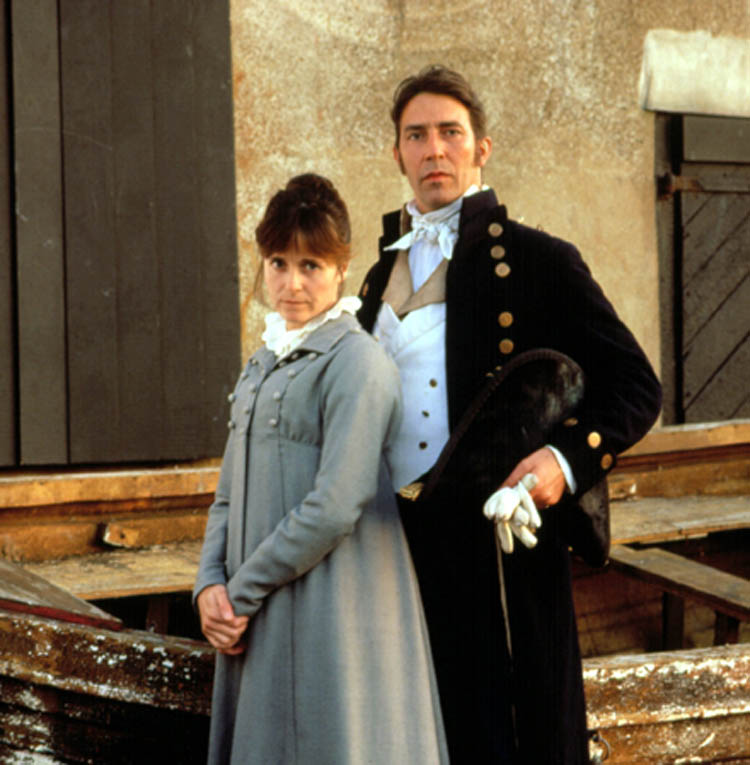
“Pride and Prejudice” 1940 ~ A Screwball Comedy

Pride and Prejudice 1940, a “Screwball” Comedy – Movie Discussion


According to moderntimes.com, the term “screwball comedy” refers to “films where everything was a juxtaposition: educated and uneducated, rich and poor, intelligent and stupid, honest and dishonest, and most of all male and female. When two people fell in love, they did not simply surrender to their feelings, they battled it out. They lied to one another, often assuming indifferent personas toward each other. They often employed hideous tricks on each other, until finally after running out of inventions, fall into each others’ arms. It was fossilized comedy, physical and often painful, but mixed with the highest level of wit and sophistication, depending wholly on elegant and inventive writing.”

The 1940 adaptation of Pride and Prejudice was created in the image of such famous screwball comedies as Mr. Deeds Goes to TownMy Man Godfrey,Bringing Up BabyYou Can’t Take It with You, and It Happened One Night. For the true Janeite, the 1940 film speaks to everything wrong with film adaptations of Austen’s works. It has a systemic problem: four different views of the plot. There’s Austen’s original novel. There’s also Helen Jerome’s 1935 dramatization of Pride and Prejudice, upon which this film was based. Then, there’s the uncommon collaboration between MGM screenwriter Jane Murfin and British novelist Aldous Huxley. It’s no wonder that the audience is given a film that’s 20% Austen and 80% Hollywood.

Laurence Olivier had garnered acclaim in his film roles in both Wuthering Heights and Rebecca. He was a natural choice for Fitzwilliam Darcy. Producers were hesitant to give the role of Elizabeth Bennet to Olivier’s real-life love Vivien Leigh, and so Greer Garson was recruited for the part. Neither gives his/her best performance, but they are both pleasant to look at. Actually, minor characters carry the film. Mary Boland (Mrs. Bennet), Edmund Gwenn (Mr. Bennet), Edna Mae Oliver (Lady Catheine de Bourgh), and Melville Cooper (Mr. Collins) bring life to the film. These characterizations are reminiscent of the Jerome’s farcical play. We all remember Oliver sitting on Kitty’s music box and her enduring the parrot squawking in the background.

Costumer Adrian provided 500 voluminous and anachronistic gowns for the film, and although the opening frame announces, “It happened in OLD ENGLAND,” the film lacks legitimate British aspects. In Jane Austen in Hollywood, Troost and Greenfield say, “Readers of the novel must balk, however, when Darcy calls Elizabeth ‘tolerable,’ and adds, ‘I’m in no humour tonight to give consequence to the middle classes at play.’ Austen is more egregiously misrepresented when Elizabeth speaks of Darcy’s unwillingness to ally himself to ‘a family of such low descent.’ The novel’s Elizabeth, so proud of being ‘a gentleman’s daughter,’ was not quite what Hollywood wanted – any more than an Elizabeth less beautiful than her sister Jane was. Enjoying Greer Garson’s perfect features and glassy composure, the camera persuades us to forget she is a decade or so older than Elizabeth Bennet’s ‘not yet twenty.’ Similarly, we are meant to consider Elizabeth as a daughter of those middle classes that reliably rose up against the aristocracy in Hollywood’s wartime renderings of nineteenth-century novels (cf. Jane Eyre), which portrayed OLD ENGLAND as democratic America’s ancestor. Part of the context that shaped this film was the producers’ aim to get the United States into the war as England’s ally together with the formal constraints of Hollywood comedy, politics was responsible for changing Lady Catherine’s mind about Elizabeth.”

Caroline Bingley wears a black gown to the assembly. This would have been unheard of for a young, unmarried woman of the Regency period. 1939’s Gone with the Wind influenced costumer Adrian’s choices. We find hooped skirts, tight bodices, tight waistlines, high puffy sleeves, and hats, which frame the face. At the garden party, Elizabeth wears a white bouffant dress with a white hat. When Mr. Collins proposes, she has black accents to the gown (bows, zigzags on the sleeve, etc.). The effect is more 1830.

Obviously, the class difference, central to the novel, is greatly reduced in this film version. Darcy’s objection to dancing with Elizabeth at the Meryton assembly rests purely in her being slighted by other men. Olivier’s role is “minor” in this adaptation. His most brilliant performances come in the proposal and the reconciliation scenes. He’s so much better as Heathcliff in Wuthering Heights. Garson is much too old for Elizabeth, and she plays the character as a “modern” woman. The script has her a downright rude at times.

None of the Bennet sisters display consistent manners or decorum. In the film, Jane is openly flirtatious – quite a contrast to the demure creature of Austen’s novel. Kitty and Lydia are shown behaving very badly. Do we not remember the scene on the swings with the officers? Kitty is also quite inebriated at the Netherfield Ball.

The first 16 chapters are reduced to one scene at the Meryton assembly. Darcy finds Elizabeth appalling at the beginning of the assembly. At the assembly’s end, he’s intrigued by her. Wickham dances with both Elizabeth and Lydia during the assembly. Elizabeth refuses Darcy’s request to dance, but then she accepts Wickham (Edward Ashley). Relationships are defined in this one extended scene. The use of the Netherfield garden party also defines personalities. Elizabeth, in a very modern strand, beats Darcy in an archery contest. She later alludes to Darcy having refused an introduction to Wickham. Darcy tells Elizabeth that he would judge each situation individually, and he admonishes her for judging him as anything but a man of honor. They appear to strike up a friendship when Darcy comforts Elizabeth after Caroline Bingley’s (Frieda Inescort) unkindness. However, Mrs. Bennet’s pronouncement regarding Jane’s prospects with Mr. Bingley (Bruce Lester) curtail the relationship.

The time compression is somewhat problematic in the film. Only moments after the audience discovers Lydia has eloped with Wickham, Darcy is on Longbourn’s doorstep to offer his assistance. He confesses Wickham’s attempted seduction of Georgiana. Elizabeth confessing to Jane that she loves Darcy follows. The audience loses the change of heart that Austen’s readers love in the novel.

There are other anachronistic elements. For example, Lady Lucas says of the letting of Netherfield Park is the best news “since the battle of Waterloo.” Of course, Waterloo came two years after the release of Pride and Prejudice. Some of Austen’s most beloved scenes are missing, especially those at Pemberley. We have NO portrait in the gallery, NO praise from Mrs. Reynolds, and NO being discovered at Darcy’s home. Ellen Belton in “Reimagining Jane Austen: The 1940 and 1995 Film Versions of Pride and Prejudice” says, “While the novel concerns itself with the complex psychological processes by which first the hero and then the heroine fall in love with one another, the film visually suggests a mutual attraction that is almost instantaneous. It is obvious from the outset that he is drawn to Elizabeth and makes very little effort to resist succumbing to her charms.”

The film might be summed up when Garson’s character says, “You’re very puzzling, Mr. Darcy. At this moment, it’s difficult to believe that you’re so proud.” To which, Olivier’s Darcy replies, “At this moment, it’s difficult to believe you’re so prejudiced. Shall we not call it quits and start again?” This film garnered both financial and critical success. In fact, when it opened at the Radio City Music Hall, it drew the largest weekly audience during the month of August in the theatre’s history. During its four-week run at RCMH, it grossed $1,849,000.

 
Posted in film, Jane Austen | Tagged , , | 12 Comments

Editing 101: Editing Sticklers!

editing2Editing is one of the least favorite activities for writers, but it is a necessary evil. We all miss items in our writing – no matter how often one revisits the piece. The mind reads what SHOULD be on the page, not necessarily what IS on the page. These are some my favorites…ones I tend to seek out when I am writing/editing.

LAST should not be used before a period of time (week, month, year). Last refers to the final week, month, or year. One should use PAST to refer to the previous week, month, or year.

This one is usually a spelling, rather than a meaning mistake. PASSIBLE refers to being sensitive or capable of feeling (Although I disagree with his politics, I find the candidate is passible.) On the other hand, PASSABLE refers to being able to be passed or to be barely satisfactory/adequate.

FOREGO refers to going before or preceding, while FORGO means to refrain or to give up.

ANY BODY, when written as two words, refers to a body such as a corpse, a body of water, etc. ANYBODY as a single word, refers to a group of people, but not to any particular individual.

This next one drives my “gentleman friend” a bit bonkers. He has been known to point out the mistake to more than one shopkeeper.  EVERYDAY, refers to days in general, without emphasizing any particular day. (Winning the lottery is not an everyday experience.) EVERY DAY emphasizes the individual day, with the word “every” acting as an adjective to describe the noun “day.” One way to know which is correct is to substitute “each” for “every.” (Every day is a learning experience.)

Likewise, EVERYBODY and EVERYONE refer to several or many people, but not to one particular individual, while EVERY BODY refers to a specific body, as in a corpse, body of water, etc., and EVERY ONE refers to a particular individual.

FAMOUS means to be well known for exemplary reasons, while INFAMOUS and NOTORIOUS are for unfavorable reasons.

PRECEDE means to go before, while PROCEED means to go on or to continue.

The past tense of PLEA should be PLEADED, not PLED. [The criminal pleaded guilty (not pled guilty).]

RESPECTFULLY is a dutiful manner. RESPECTIVELY means to refer to two or more people, places, or things in the order in which they are listed.

The same rule applies to both RARELY (or RARELY IF EVER) and to SELDOM (or SELDOM IF EVER). An action may occur rarely or rarely if ever, but rarely ever (or seldom ever) is inaccurate. In fact, it is best to use rarely (seldom) or never. It would be incorrect to say “Editors rarely ever make mistakes.” The sentence should read “Editors rarely make mistakes” or “Editors never make mistakes.”

IRREGARDLESS is not standard English, REGARDLESS of how many times one sees it in print. 

BECAUSE should be used to indicate a cause or a reason, while SINCE refers to time, meaning between then and now. It would be incorrect to say, “Since she knows the truth of the circumstances, the prosecutor sought the death penalty.”

NUMBER refers to a quantity of people or things which can be counted. AMOUNT refers to an indefinite quantity that cannot be counted.

Although I generally use this distinction correctly, for this one, I must always pause to say the rule in my head before I continue to write: IN BEHALF OF means for the benefit of, while ON BEHALF OF means in place of. (The attorney speaks on behalf of his client.)

AMONG is used when the number is three or more, while BETWEEN is used for two people, places, or things.

Finally, for today, this is one I often see misused in many published books: DIFFERENT FROM is the acceptable form, not DIFFERENT THAN.


Posted in editing, language choices, word play, writing | Tagged , , , , | 6 Comments

The Gaulish Coligny Calendar

The Gaulish Coligny calendar was found in Coligny, Ain, France (46°23′N 5°21′E) near Lyon in 1897, along with the head of a bronze statue of a youthful male figure. It is a lunisolar calendar. It is now held at the Gallo-Roman Museum of Lyon.

Overview of the reassembled tablet (This work is in public domain.)

Overview of the reassembled tablet (This work is in public domain.)

It was engraved on a bronze tablet, preserved in 73 fragments, that originally was 1.48 m wide and 0.9 m high (Lambert, Pierre-Yves, La langue gauloise, Editions Errance, 2nd edition, Paris, 2003, p.111) or approximately 5 feet (1.5 m) wide by 3½ feet in height. Based on the style of lettering and the accompanying objects, it probably dates to the end of the 2nd century AD. It is written in Latin inscriptional capitals and is in the Gaulish language (Duval, P.M. and Pinault, G., Recueil des inscriptions gauloises, Tome 3: Les Calendriers (Coligny, Villards d’Heria), CNRS, Paris, 1986, pp. 35-37.). The restored tablet contains sixteen vertical columns, with 62 months distributed over five years.

The French archaeologist, J. Monard, speculated that it was recorded by druids wishing to preserve their tradition of timekeeping in a time when the Julian calendar was being imposed throughout the Roman Empire. However, the general form of the calendar suggests the public peg calendars (or parapegmata) found throughout the Greek and Roman world (Lehoux, D. R. Parapegmata: or Astrology, Weather, and Calendars in the Ancient World. PhD Dissertation, University of Toronto, 2000).

A similar calendar found nearby at Villards d’Heria (46°25′N 5°44′E) is only preserved in eight small fragments. It is now preserved in the Musée d’Archéologie du Jura at Lons-le-Saunier.

System
The Continental Celtic calendar as reconstructed from the calendars of Coligny and Villards d’Heria had the following properties:
**it was a lunisolar calendar, attempting to synchronize the solar year and the lunar month.
**the months were lunar. Scholars disagree as to whether the start of the month was the new moon or the full moon, or per Pliny and Tacitus perhaps even the First Quarter.
**the common lunar year contained 354 or 355 days.
**the calendar year began with Samonios, which is usually assumed to correspond to Old Irish Samhain (October 31st), giving an autumn start to the year. However, as Samon is Gaulish for summer (Lambert, Pierre-Yves (2003). La langue gauloise. Paris, Editions Errance. 2nd edition. ISBN 2-87772-224-4. Chapter 9 is titled “Un calandrier gaulois.”), this assumed start is disputed. Le Contel and Verdier (1997) argue for a summer solstice start of the year. Monard (1999) argues for an autumn equinox start. Bonsing (2007) argues for a May beginning consistent with Irish Beltaine, and Fennian literature, notably Joyce (2000).
**the entry TRINOX[tion] SAMO[nii] SINDIV “three-nights of Samonios today”) on the 17th of Samonios suggests that, like the Irish festival of Samhain, it lasted for three nights. The phrase *trinoxtion Samonii is comparable to a Gaulish festival mentioned in a 1st-century AD Latin inscription from Limoges, France, which mentions a “10 night festival (*decamnoctiacon) of (Apollo) Grannus” (POSTVMVS DV[M]NORIGIS F(ILIVS) VERG(OBRETVS) AQVAM MARTIAM DECAMNOCTIACIS GRANNI D[E] S[VA] P[ECVNIA] D[EDIT] )
**the solar year was approximated by the insertion of a 13th intercalary month every two and a half years. The additional months were intercalated before Samonios in the first year, and between Cutios and Giamonios in the third year. The name of the first intercalary month is not known with certainty, the text being fragmentary; the second intercalary month is Ciallos bis Sonnocingos (Lambert p. 116)
**the months were divided into two halves, the beginning of the second half marked with the term atenoux or “renewal” (cf. Old Irish athnugud “renewal”). The basic unit of the Celtic calendar was thus the fortnight or half-month, as is also suggested in traces in Celtic folklore. The first half was always 15 days, the second half either 14 or 15 days on alternate months (similar to Hindu calendars).
**months of 30 days were marked matus, lucky. Months of 29 days were marked anmatus, unlucky.
**a simple five year cycle would be insufficiently accurate; the sequence of intercalary months is completed every thirty years, after five cycles of 62 lunations with two intercalary months per cycle, and one cycle of 61 lunations, with a single intercalary month, or after a total of 11 intercalary months. This assumes that there are exactly 371 lunations in 30 years, which is accurate to a one day every 20 or 21 years on average (this is less accurate than the Julian calendar, which shifts a day in about 130 years, but which ignores lunar months). It may be assumed that the “30 years cycle” was not prescriptive, and that an extra month would have been omitted as the need arose (i.e. some 300 years after the calendar’s inception).

Gaulish Calendar in Historical Sources
Pliny the Elder

The Natural History of Pliny the Elder states, in a discussion of Druidic gathering of mistletoe (Pliny NH 16.95):
The mistletoe, however, is but rarely found upon the robur (Oak); and when found, is gathered with rites replete with religious awe. This is done more particularly on the sixth day of the moon, the day which is the beginning of their months and years, as also of their ages, which, with them, are but thirty years. This day they select because the moon, though not yet in the middle of her course, has already considerable power and influence; and they call her by a name which signifies, in their language, the all-healing.

This comment supports the grouping of five-year Coligny calendar periods into thirty-year ages, with the loss of one intercalary month per age to more accurately align the solar and lunar cycles.

Julius Caesar
Julius Caesar in The Gallic Wars states (Caesar, DBG 6.18) that days, months, and years start with a dark half followed by a light half.

All the Gauls assert that they are descended from the god Dis, and say that this tradition has been handed down by the Druids. For that reason they compute the divisions of every season, not by the number of days, but of nights; they keep birthdays and the beginnings of months and years in such an order that the day follows the night.

details of mid Samonias

details of mid Samonias

details of mid-Samonios

details of mid-Samonios

This is consistent with a month starting at the dark of the moon, or at the sixth day of the moon per Pliny (Natural History); it is inconsistent with a month starting at full moon.

Months

The following Etymologies, unless otherwise noted, are taken from Xavier Delamarre, Dictionnare de la langue gauloise, 2nd edition, Editions Errance, 2003.
Samonios – “Month Belonging of Summer.” Likely an n-stem derivative (with a suffix of appurtenance, -io-) of the Common Celtic root *samo- “summer” found in Old Irish sam, Welsh haf. Cf. Old Irish Samain “(festival of the) First of November”, “All-Hallows/All-Saints day” and Mithem, Mithemain “Mid-summer, month of June”, Middle Welsh Meheuin “June” (both from Common Celtic *Medi[o]-samVn [V=”vowel”, likely -o- or -u-]-), as well as Old Irish Cétamuin “Month of May”, “First of May”, “May Day” (alternate name for Beltain), Welsh Cyntefin “month of May” (both from Common Celtic *kintu-samonis “beginning of Summer”). An alternate proposal is that the root of the name is Common-Celtic *sem- “one, same, together”, making it the “Month of Assembly.”

Duman(n)(ios) – “Month of (religious) Fumigation”? Cf. Latin fūmus “smoke”, Sanskrit dhūmah “smoke”, Greek θύμος (thūmos) “soul, life, passion; anger, wrath” (also θύμιάω [thūmiaoo] “to burn, as incense”, θύμα [thūma] “sacrificial offering”).

Riuros – “Thick/Fat/Large month”? Possibly cognate with Old Irish remor “stout, thick, fat”, Welsh rhef “thick, stout, great, large” (in which case, the original form may have been *Remros, with later shift of -e- to -i- [compare the alternation between Semi- and Simi- in Semuisonna] and lenition of internal -m-). Some scholars alternately suggest a connection with Old Irish réud, Welsh rhew “cold”.

Anagantios – “Month in which One Does Not Travel”, “Non-itinerant month?” Composed of a Common Celtic negative prefix *an- and an agentive noun *agant- based on the root *ag- “to go, to conduct, to lead”. Cf. Old Irish ag “to go, do, conduct”, Welsh agit “goes”.

Ogron(n)(i)(os) – “Cold Month”. An n-stem derivative of the Common Celtic root *ougros “cold”. Cf. Old Irish úar, Welsh oer. The root *oug- may be compared to Armenian oyc “cold”, Lithanian auksts “cold”, and Latin a(u)ctumnus “autumn”.

Cutios – unknown etymology. Some have compared it to the obscure Greek month name Κοούτιος (Kooutios) in the Lokrian calendar from Chaleion (which may = October–November).

Giamonios “Month belonging to Winter”. An n-stem derivative (suffix of appurtenance -io-) derived from the Common Celtic root *giįamo- “winter”. Cf. Welsh gaeaf, Breton goañv, Old Irish gaim “winter”, Gamain “month of November” (also, a “yearling calf” [a calf that is one winter old]).

Simiuisonna (or Semiuisonna) – unknown etymology. Perhaps Common Celtic *sēmi- “half” plus *ues- “Spring(time)” or a compound containing a feminine form of the word for “sun”, *sonna (see Sonnocingos below).

Equos – etymology unknown. Some scholars have connected it with the word for “horse” in Celtic languages, Common Celtic *ekWos, Old Irish ech, Welsh eb- (found only in ebol “pony”, compound words such as eb-rwydd “fast/quick/ready”, eb-ran “fodder”, and the place name Mynydd Epynt), but there is some disagreement over this, since one would expect the form to be *Epos in a P-Celtic language such as Gaulish, in which personal, divine and place names containing the P-Celtic form *epo- are widely attested (some scholars acknowledge this point, but propose that the Calendar may contain Q-Celtic dialectal features, or archaisms dating to a time before Proto-Celtic -kw- became -p- in Gaulish; yet the Calendar does display P-Celtic words such as prinni, pog-, and peti, which argues against this).

Elembiu – “Month belonging to the Deer”. From the Proto-Indo-European root *elen-bho- “deer”, which gave us English lamb and the Greek έλαφος (elaphos), Έλαφιον / Έλαφιος (Elaphion / Elaphios), “Month belonging to the Deer” (called Έλαφηβολιών [Elaphebolion] “Month of the Deer-hunt” in the Attic Calendar, equivalent to March–April). An alternate form of the PIE root, *elen-, gave us Welsh elain and Old Irish elit, “doe, hind; young deer”.

Aedrini(os) – Bright (or Hot) Month”; cf. Old Irish aed “fire”, “heat”, Greek αἰθήρ (aithēr) “bright sky, upper air, ether”. Ultimately from the Proto-Indo-European root *aidh- which also gave us Latin aestas “Summer”.

Cantlos – perhaps “Song month”; cf. Welsh cathl “song”, Breton keñtel “lesson”, Old Irish cétal.

Intercalary Months
Sonnocingos – “Sun’s march”; cf. Welsh huan “sun” and Old Irish cinged “to walk, march”. May not be the actual name of the intercalary month, but rather some term applied to it (Delamarre suggests perhas “sun’s march = “a year”).

Posted in customs and tradiitons | Tagged , , | Comments Off on The Gaulish Coligny Calendar

Do You Remember? The First of the Late Night TV Talk Shows

With all the changes in the late night TV talk show hosts in U. S. of late, I thought it might be fun to take a look at the original late night host: Stephen Valentine Allen (“Steverino”).

steve-allenBorn to vaudeville parents, Steve Allen’s early life was a bit convoluted. His father died when Allen was a little less than two years of age. According to many reports, the former Belle Montrose, his mother, had mental issues. Allen attended some 18 different schools during his early years, and he was known to run off quite often.

Steve Allen (December 26, 1921 – October 30, 2000) was an American television personality, musician, composer, actor, comedian, and writer. Though he got his start in radio, Allen is best known for his television career. He first gained national attention as a guest host on Arthur Godfrey’s Talent Scouts. He graduated to become the first host of The Tonight Show, where he was instrumental in innovating the concept of the television talk show. Thereafter, he hosted numerous game and variety shows, including The Steve Allen Show, I’ve Got a Secret, The New Steve Allen Show, and was a regular panel member on CBS’ What’s My Line?

Allen was a credible pianist and a prolific composer, having penned over 14,000 songs, one of which was recorded by Perry Como and Margaret Whiting, others by Steve Lawrence and Eydie Gorme, Les Brown, and Gloria Lynne. Allen won a Grammy award in 1963 for best jazz composition, with his song The Gravy Waltz. Allen wrote more than 50 books, has two stars on the Hollywood Walk of Fame and a Hollywood theater named in his honor.

At the age of 16, he ran away from his mother and ended up staying with an aunt. Allen began composing songs, the one talent he claimed. In truth, Steve Allen wrote 4000+ songs; all this is quite ironic because Allen admitted to not being able to read a note of music.

Allen’s first radio job was on station KOY in Phoenix, Arizona, after he left Arizona State Teachers College (now Arizona State University) in Tempe, while still a sophomore. He was hired as an announcer, but he soon took on the additional responsibilities of writing news and commercial copy. He enlisted in the U.S. Army during World War II and was trained as an infantryman. He spent his service time at Camp Roberts, California, and did not serve overseas. Allen returned to Phoenix before deciding to move back to California.

In Los Angeles, he landed a job at KNX as a disc jockey. The show was entitled Breaking All Records. Allen, literally, broke old vinyl records rather than to play them. The concept was hit: Soon Allen had a talk show filled with chatter and lots of fans. Requests for personal appearances followed. People would tour the studio just to watch Allen work. Lucille Ball’s mother was a frequent “visitor.” Fanny Brice, Ethel Barrymore, and Al Jolson were reported to be among Allen’s earliest fans.

From KFAC in Los Angeles, Allen then moved to the Mutual Broadcasting System in 1946, talking the station into airing a five-nights-a-week comedy show, Smile Time, co-starring Wendell Noble. After Allen moved to CBS Radio’s KNX in Los Angeles, his music-and-talk half-hour format gradually changed to include more talk on a full-hour, late-night show, boosting his popularity and creating standing-room-only studio audiences. During one episode of the show reserved primarily for an interview with Doris Day, his guest star failed to appear, so Allen picked up a microphone and went into the audience to ad lib for the first time. His radio show attracted a huge local following, and in 1950 it replaced Our Miss Brooks, exposing Allen to a national audience for the first time.

Allen’s first television experience had come in 1949 when he answered an ad for a TV announcer for professional wrestling. He knew nothing about wrestling, so he watched some shows and discovered that the announcers did not have well-defined names for the holds. When he got the job, he created names for many of the holds, some of which are still used today.

After CBS radio gave Allen a weekly prime time show, CBS television believed it could groom him for national small-screen stardom and gave Allen his first network television show. The Steve Allen Show premiered at 11 A.M. on Christmas Day, 1950, and was later moved into a thirty-minute, early evening slot. This new show required him to uproot his family and move from LA to New York, since at that time a coast to coast program could not originate from LA. The show was only a modest ratings success, and was canceled in 1952, after which CBS tried several shows to showcase Allen’s talent.

Allen achieved national attention when he was pressed into service at the last minute to host Arthur Godfrey’s Talent Scouts because Godfrey was unable to appear. Allen turned one of Godfrey’s live Lipton commercials upside down, preparing tea and instant soup on camera and then pouring both into Godfrey’s ukulele. With the audience (including Godfrey, watching from Miami) uproariously and thoroughly entertained, Allen gained major recognition as a comedian and host.

Tonight Starring Steve Allen was a talk show hosted by Steve Allen. It was the first version of what eventually became known as The Tonight Show. Tonight was the first late-night talk show, as well as the first late night television series of any time to achieve long-term success. Allen’s run as host of the show lasted for two and a half seasons, beginning in fall 1954 and ending with Allen’s dismissal in January 1957. During its run it originated from the Hudson Theatre in New York City.

Tonight_with_Steve_AllenOriginally a 40-minute local program airing from 11:20 P.M. to 12 Midnight on WNBT New York as “The Steve Allen Show,” the program was moved to the full NBC network in the Fall of 1954. The first network episode of Tonight aired on September 27, 1954, and ran for 105 minutes instead of the 60-minute duration of modern talk shows (however, the first ffiteen minutes were shown on very few stations). The announcer of the show was Gene Rayburn, who would eventually become a top-game show emcee, best known for his 22 years at the helm of the Match Game, and the bandleader was Skitch Henderson. Allen’s version of the show originated such talk show staples as an opening monologue, celebrity interviews, audience participation, and comedy bits in which cameras were taken outside the studio, as well as music. The success of the show led to Allen receiving a separate weekly prime time show, which aired on Sunday nights. Allen gave up the Monday and Tuesday shows, with guest hosts taking over for the summer of 1956. Beginning that fall, Ernie Kovacs (who came over from the faltering DuMont Television Network) was the regular Monday and Tuesday host for the 1956–1957 season with his own cast and regulars, including his own announcer (Bill Wendell, who would later work with David Letterman) and bandleader.

A kinescope of the very first episode survives and Allen’s opening monologue has been rebroadcast many times on Tonight Show anniversary specials and in documentaries such as Television. In his opening remarks, Allen makes the prescient statement that Tonight! “is going to go on forever” (an apparent reference to the show’s run time, then clocking in at 105 minutes with commercials). With several hosts over the decades, it has done just that, albeit with a much different meaning than Allen intended.

Jayne Meadows and Steve Allen

Jayne Meadows and Steve Allen

Allen was married to Dorothy Goodman in 1943 and they had three children, Steve Jr., Brian, and David. That marriage ended in divorce in 1952. Allen’s second wife was actress Jayne Meadows, sister to actress Audrey Meadows. The marriage of Allen and Meadows produced one son, Bill Allen. They were married in Waterford, Connecticut on July 31, 1954. They remained married until his death in 2000.

Posted in acting, Do You Remember?, film | Tagged , , , | Comments Off on Do You Remember? The First of the Late Night TV Talk Shows

I Admit It. I’m a Period Drama Junkie!

Confessions of a Period Drama Addict

My name is Regina, and I am a
Period Drama junkie!

Errol Flynn with Bette Davis in The Private Lives of Elizabeth and Essex (1939)

Errol Flynn with Bette Davis in The Private Lives of Elizabeth and Essex (1939)

I admit it: I prefer Period Dramas to all other film genres. Give me men who take pride in their appearances and women who do not, literally, allow it to “all hang out.”

I find as I peruse the many pieces offered each hour and each day on my “fine HD” television, that I can find nothing worth watching. I screen through the many channels (something which used to drive me crazy with my ex-husband, but that is an entirely different post), and I ultimately end up watching a period drama. I go through my cable listing, and then I take a turn with BBC America, Starz, The Movie Channel, Showtime, Sundance, Chiller, Flix, Encore, etc. Today, I watched Great Expectations, Emma, 1918, and Daisy Miller – all of which I have seen multiple times. In addition, I own some 50+ DVDs that could be considered Period Dramas.

220px-Tyrone_Power_in_Marie_Antoinette_trailerI know from where this obsession came. Blame it on my narrow childhood in the 1950s, a time when TV was the latest media phenomena. Not only did we listen to the same music as our parents, but we also actually watched television together. We swooned over the same heroes as our mothers (Tyrone Powers, Jimmy Stewart, Marlon Brando, etc.) and admired the same “manly men” (Clint Eastwood, John Wayne, James Dean, Humphrey Bogart, etc.) as our fathers. I grew up on dramas such as Shogun; The Thornbirds; and Rich Man, Poor Man – on movies such as Von Ryan’s Express, The Adventures of Robin Hood, The Charge of the Light Brigade, Blood and Sand, and Little Women. Be it of a British or Old World or the latest Western, such was the milk of my existence.

Therefore, take a stroll with me down memory lane. I have combined the covers of some of my favorite period dramas in the slideshow below. (There are no Jane Austen covers in this montage.) Tell me which ones were your favorites and maybe add the names of some others to the list by leaving a comment. I will check in regularly to see what you think.

from Little Dorrit

from Little Dorrit

http://pf.kizoa.com/sflite.swf?did=1533944&k=P143187481&hk=1

Posted in Uncategorized | Tagged | 6 Comments

William Henry Fox Talbot, British Inventor and Photography Pioneer

220px-William_Henry_Fox_Talbot,_by_John_Moffat,_1864 William Henry Fox Talbot (11 February 1800 – 17 September 1877) was a British inventor and photography pioneer who invented the calotype process, a precursor to photographic processes of the 19th and 20th centuries. Talbot was also a noted photographer who made major contributions to the development of photography as an artistic medium. His work in the 1840s on photo-mechanical reproduction led to the creation of the photoglyphic engraving process, the precursor to photogravure. Talbot is also remembered as the holder of a patent which, some say, affected the early development of commercial photography in Britain. Additionally, he made some important early photographs of Oxford, Paris, Reading, and York.

Early Life
Talbot was the only child of William Davenport Talbot, of Lacock Abbey, near Chippenham, Wiltshire, and of Lady Elisabeth Fox Strangways, daughter of the 2nd Earl of Ilchester. Talbot was educated at Rottingdean, Harrow School and at Trinity College, Cambridge, where he was awarded the Porson prize in Classics in 1820, and graduated as twelfth wrangler in 1821.

From 1822 to 1872, he communicated papers to the Royal Society, many of them on mathematical subjects. At an early period, he began optical researches, which later bore fruit in connection with photography. To the Edinburgh Journal of Science in 1826 he contributed a paper on “Some Experiments on Coloured Flame”; to the Quarterly Journal of Science in 1827 a paper on “Monochromatic Light”; and to the Philosophical Magazine papers on chemical subjects, including one on “Chemical Changes of Colour.”

Invention of Calotype Process

Latticed window at Lacock Abbey, August 1835. A positive from what may be the oldest camera negative in existence.

Latticed window at Lacock Abbey, August 1835. A positive from what may be the oldest camera negative in existence.

Talbot claimed experiments beginning in early 1834, when Louis Daguerre in 1839 exhibited his pictures taken by the sun. After Daguerre’s discovery was announced, without details, Talbot showed his three-and-a-half-year-old pictures at the Royal Institution on 25 January 1839. Within a fortnight, he communicated the technical details of his photogenic drawing process to the Royal Society; Daguerre revealed details of his process in August.

In 1841, Talbot announced his discovery of the calotype, or talbotype, process. This process reflected the work of many predecessors, most notably John Herschel and Thomas Wedgwood. In August 1841, Talbot licensed Henry Collen, the miniature painter as the first professional calotypist. Talbot’s original contributions included the concept of a negative from which many positive prints can be made (although the terms negative and positive were coined by Herschel), and the use of gallic acid for developing the latent image. In 1842, for his photographic discoveries detailed in his The Pencil of Nature (1844), he received the Rumford Medal of the Royal Society.

Patenting Controversy

London Street, Reading, c. 1845

London Street, Reading, c. 1845

The work on the Daguerre process was taking place at the same time as that of Talbot’s work in England on the calotype process. Daguerre’s agent in England applied for a British patent a matter of days before France, having granted Daguerre a pension, declared his invention “free to the world”. Great Britain therefore became the only country where the payment of license fees was required to use the Daguerre process.

In February 1841, Talbot obtained a patent for the calotype process. At first, he was selling individual patent licences for £20 each, but later he lowered the fee to £4 and waived the payment for those who wished to use the process only as amateurs. Professional photographers, however, had to pay up to £300 annually. In a business climate where many patent holders were attacked for enforcing their rights, Talbot’s behaviour was widely criticised, especially after 1851 when Frederick Scott Archer publicised the collodion process. Talbot declared that anyone using Archer’s process would still be liable to get a license for calotype.

One reason Talbot patented the calotype was that he had spent many thousands of pounds on the development of the calotype process over several years. It is also significant that, although the daguerreotype process was supposed to be free to the world, Daguerre secured a British patent on his own process. Talbot’s negative/positive process eventually succeeded as the basis for almost all 19th and 20th century photography. The daguerreotype was rarely used by photographers after 1860 and had died as a commercial process by 1865.

One person who tried to use the daguerreotype as a method of reproduction without Talbot’s process was Levett Landon Boscawen Ibbetson. But as good as Ibbetson’s attempts were at producing something like a lithograph from the original daguerrotype, the end result could not compete with Talbot’s process. They were simply too expensive. Ibbetson began experimenting with Talbot’s calotype, and in 1842 wrote to Talbot “I have been going on with experiments in the Callotype & have had some very good results as to depth of Colour.” By 1852, Capt. Ibbetson was showing his book using the Talbot calotype process, called “Le Premier Livre Imprimè par le Soleil” at a London Society of Arts exhibition.

The calotype or talbotype (he used these names interchangeably) was Talbot’s improvement of his earlier photogenic drawing process by the use of a different silver salt (silver iodide instead of silver chloride) and a developing agent (gallic acid and silver nitrate) to bring out a latent image on the exposed paper. This reduced the minimum exposure time in the camera from over an hour to only a minute or two. The translucent calotype negative made it possible to produce as many positive prints as desired by simple contact printing; the daguerreotype was an opaque direct positive that could only be reproduced by copying it with a camera. On the other hand, the calotype, despite waxing of the negative to make the image clearer, still was not pin sharp like the metallic daguerreotype, as the paper fibres degraded the image produced.

1853 photo by Talbot

1853 photo by Talbot

The problem was resolved in 1851 (the year of Daguerre’s death) when the wet collodion process enabled glass to be used as a support; the lack of detail often found in calotype negatives was removed, and sharp images, similar in detail to the daguerreotype, were created. The wet collodion negative not only brought about the end of the calotype in commercial use, but also spelled the end of the daguerreotype as a common process for portraiture.

In August 1852, The Times published an open letter by Lord Rosse, the President of the Royal Society, and Charles Lock Eastlake, the president of the Royal Academy, who called on Talbot to relieve his patent pressure that was perceived as stifling the development of photography. In his response, Talbot agreed to waive licensing fees for amateurs, but he continued to pursue professional portrait photographers, having filed several lawsuits.
In 1854, Talbot applied for an extension of the 14-year patent. At that time one of his lawsuits, against a photographer Martin Laroche, was heard by the court. The Talbot v. Laroche case was the pivotal point of the story. Laroche’s side argued that the patent was invalid, as a similar process was invented earlier by Joseph Reade, and that using the collodion process does not infringe the calotype patent anyway, because of significant differences between the two processes. In the verdict, the jury upheld the calotype patent but agreed that Laroche was not infringing upon it by using the collodion process. Disappointed by the outcome, Talbot chose not to extend his patent.

Other Activities
Talbot was active in politics, being a moderate Reformer who generally supported the Whig Ministers. He served as Member of Parliament for Chippenham between 1832 and 1835 when he retired from Parliament. He also held the office of High Sheriff of Wiltshire in 1840.
Whilst engaged in his scientific researches, he devoted much time to archaeology. He published Hermes, or Classical and Antiquarian Researches (1838–39), and Illustrations of the Antiquity of the Book of Genesis (1839). With Sir Henry Rawlinson and Dr Edward Hincks he shares the honour of having been one of the first decipherers of the cuneiform inscriptions of Nineveh. He was also the author of English Etymologies (1846).

In 1843–44, he set up an establishment in Baker Street, Reading, for the purpose of mass-producing salted paper prints from his calotype negatives. The Reading Establishment (as it was known) also produced prints from other calotypist’s negatives and even produced portraits and copy prints at the studio.

He died in Lacock village aged 77 and is buried there along with his wife and children.

Works
Loch Katrine (cir. 1845) Salt print from calotype negative | 8×9 in. Birmingham Museum of Art

Posted in British history, Living in the UK, real life tales, Victorian era | Tagged , , , | 3 Comments

Movie Discussion ~ 1995’s Sense and Sensibility (Part Two)

colbrandonIn December 1995, Columbia/Mirage Pictures released Sense and Sensibility to U.S. theatres. Based on Emma Thompson’s (who won the 1996 Academy Award for Best Screenplay Based on Material from Another Medium) screenplay, this adaptation goes a long way in creating heroes from what are sometimes seen as bland characters. Last month (March 26), we took our first look at the changes made by Thompson. This month, we shall look at those specifically made for Edward and Colonel Brandon. By changing scenes from the novel to portray more sensitive and caring males, Thompson appeals to modern viewers by recasting the novel’s heroes. Let us begin with the “sculpting” of Edward Ferras.

edwardFirst, Edward displays his paternal side with Margaret, who has just lost her father. In the Norland library, it is Edward who engages Elinor in a lively geography lesson to entice an emotional Margaret from her hiding place under the table. Next, we see Edward sword fighting with Margaret. This is another of Thompson’s fabricated scenes. It is used to demonstrate Edward’s playful nature, his self-effacing personality, and his potential as a loving father. Throughout the next few scenes, Edward makes numerous references to the time he has spent playing pirate with Margaret. His estimation grows before our eyes. We learn to like a man, who indulges children rather than ignoring them.
Sense-and-Sensibility-sense-and-sensibility-16178013-1413-2126Additional dialogue and scenes are added by Thompson in which Edward makes an attempt to express his love and devotion to Elinor. In these created scenes he stumbles over his words when they are together in the barn, in the scene where Lucy is in the room with Elinor, and when Elinor speaks of Brandon’s offer of a living. Edward asks for forgiveness but never explains why Elinor should extend it. His lack of speech actually says more than elongated professions of his love. Edward’s emotional discomposure is easily interpreted by the viewer. However, neither the attempts nor Edward’s unexpressed words are found in the novel. Thompson has created an emotionally sensitive hero.

The atlas from the library scene keeps Edward in the audience’s mind even when he does not make the scheduled appearance at Barton Cottage. Therefore, it is disappointing to the viewer when the book arrives in the mail. However, this device helps Thompson tell the story. Elinor can question Edward’s previous attentions to her, and his absence can make Lucy’s story more believable. Thompson speaks of Edward’s betrayal through Lucy’s display of a handkerchief exactly like the one to which Elinor has attached her hopes. In the novel, Edward never gives Elinor any such gift, even in passing. Like the atlas, the handkerchief is a metonymic device to establish Elinor’s emotional turmoil. Remember that Elinor is supposed to represent “good sense.” Emotions attached to the handkerchief or any other gift are not found in the novel.

Likewise, Thompson allows Alan Rickman’s portrayal of Colonel Brandon to express true emotion. The viewer’s introduction to Brandon displays a man mesmerized by Marianne’s performance on the pianoforte. He loves the music and her voice; therefore, we know instantly he feels passionately about her. In contrast, the novel refers to Brandon as “an absolute old bachelor.” He has spent the evening with the Dashwoods at the Middletons. In fact, the novel says Brandon “heard her without being in raptures.”

Austen’s words are quite different from the scene we know. Add the music scene from the film’s end where Brandon sends Marianne a pianoforte of her own, and we have physical signs of love. Ironically, in the novel, it is Willoughby who shares Marianne’s love of music.

Brandon mimics Willoughby’s pursuit of Marianne. Both men carry Marianne home in the rain. This is a way of transferring Willoughby’s natural, open wildness to Brandon. His tender administrations on Marianne’s behalf makes him a believable substitute for Willoughby. As with Edward, objects keep Brandon in the viewer’s mind: a lawnbowling ball, a knife to cut the reeds, flowers, a book of verse, and a pianoforte.

Willoughby gives wildflowers and Brandon hot house roses; Willoughby quotes Shakespeare, and Brandon reads from Spenser. Willoughby and Brandon are no longer polar opposites.

Brandon says, “For there is nothing lost, but may be found, if sought.” We seek a romantic hero and find him in this portrayal. Like Marianne, we are possessed by an emotionally sensitive man we can honestly love. Austen does not give us the same emotional enhancements. Modern audiences demand the “Cinderella” ending, and, in this film, we lose some of Austen’s cautionary tale of the pitfalls of too much or too little sense and sensibility. Emotional sensitivity becomes a substitute for social restraint. With Brandon’s heroic ride and plea for something to do “or I will run mad,” Thompson eliminates the need for Willoughby’s emotional rehabilitation.

Through the minor characters, we learn the local gossip and the developing drama. This device keeps these characters from “disappearing,” as they did in the novel. Characters who fade into the background on the written page help tell the story in the film. Of the two portrayals, I found Alan Rickman’s the superior one. His subtle manner of displaying Brandon’s feelings for Marianne shows how a mask of reticence can hide one’s true emotions. Hugh Grant’s portrayal, on the other hand, was reminiscent of his 1994′s Four Weddings and a Funeral. He still continued to stammer, but Grant does so with less charm this time around. By the film’s end, I wanted to see the classically awkward and a bit-self absorbed Edward with Marianne, and the passionate, long-suffering, and honorable Brandon with Elinor.Sense-and-Sensibility-1995-sense-and-sensibility-2574503-321-399

Posted in film, Jane Austen | Tagged , , , , , | 7 Comments

Stylist Choices (or) Why Would Anyone Choose that Word?

power-of-words1 Recently, I entered an excerpt from my WIP (Work in Progress) in a contest. This is something I do with some degree of regularity, especially if I want an uninterested reader to speak to voice or tension or point of view. Occasionally, one of the anonymous judges makes a comment on word choice. In the contest of which I speak, one particular judge praised my grammatical care, but she/he felt I had missed the mark with my word choices for The Mysterious Death of Mr. Darcy, my last Pride and Prejudice mystery. She felt I had make a genuine effort to sound of Jane Austen, but I had failed in many of my choices. In truth, I have long abandoned the idea of sounding like Austen. “Our Jane” had a unique gift of words few of us could duplicate. I simply use words that may have gone away from current standards. That being said, permit to speak of some of my favorites from the past:

Are you familiar with “armamentarium”? Armamentarium is a collection of resources available or utilized for an undertaking, especially the equipment, methods, and pharmaceuticals used in medicine; in slang, “a bag of tricks” – circa 1860 bagnattricks_1

Have you ever used the word “ineffable”? Ineffable means incapable of being described in words, as in “ineffable joy.” It can also mean something not to be uttered, as in “the ineffable name of Jehovah.” It comes to us from Middle English and its first known use was during the 14th Century.

Did you know that “expectorate” is a euphemism for spit, dating to 1827? Literally, the word means to eject from the throat or lungs by coughing or hawking or spitting. Online dictionaries give the first known use as 1601.

Can you use the word “comport” in a sentence? Most Regency era based writers would use the word to behave in a manner comfortable to what is proper or expected, as in “Lord Townsend comported himself well in the matter.” However, there is also the idea of comport to mean “to be fitting,” as in “Equivocation ill comports with a true act of conscience.” Comport likely comes from Middle French, with its first known use in 1589. the-power-of-words

In modern times we think of “conceit” means excessive appreciation of one’s own worth or virtue, but conceit was one used for a fanciful idea, an elaborate or strained metaphor (especially as used in poetry), or a fancy phrase or expression, as in describing a crowd as a “vast sea of humanity swaying to the music.” The word comes to use from Middle English via the Anglo-French “conceivre.” Its first known use was in the 14th Century.

Have you ever used “illume” instead of “illuminate”? Illume was once used to mean to edify, enlighten, inspire or nurture, as in “A hundred candles illumed the church’s interior.” It likely came to us in the early 1600s.

Have you ever used “presage”? Presage is something that portends or foreshadows the future, as in “A robin a presage of the return of spring.” Its first known use was in the 14th Century.

A like word is “prescient.” What do you know of “prescient”? Prescient is foreknowledge of events, either by divine omniscience or by human anticipation of the course of events (foresight), as in “His novel is a prescient look at the future.” It’s is another word from Middle English.

From the Greek word “hybris,” we find a fancy word for “arrogance.” Hubris came into use in the 1880s. It means “exaggerated pride or self-confidence.”

Although it’s one I have not used in some time, I would suggest another favorite: “cynosure.” Cynosure can mean one who directs or guides; a center of attraction or attention (as in, He turned the slums into a cynosure.); a person or thing that attracts lots of attention or interest. If the word is capitalized, it indicates the northern constellation Ursa Minor or Polaris (the North Star). Despite being slightly obsolete, I find it a highly literary word. Its first known use was in 1565.

Surely, many of you have used “modicum” previously. Modicum is a small portion or a limited quantity, as in a “modicum of skill.” It comes to us from Middle English via the Latin word “modicus.” Its first known use is during the 15th Century.

I would imagine many of you have come across “forthwith,” which is an obsolete means to say “immediately,” but have you ever used “forgather”? Forgather means “to assemble or come together.” It also means “to meet someone, usually by chance.” Its first known use was in 1513.

DP221643Finally, for today, what of the word “chef-d’oeuvre”? Chef-d’oeuvre is a “masterpiece, especially in art or literature.” It comes to us from the French, literally meaning, leading work. Its first known use was in 1619. One thing English writers might consider when using chef-d’oeuvre is its plural: chefs-d’oeuvre, not chef-d’oeuvres.

Do you have favorites we might add to follow up posts? Add your suggestions below.

(Meanings used come from Merriam-Webster.com/dictionary/.)

Posted in language choices, Uncategorized, word play | Tagged , , | 5 Comments

Movie Discussion – 1995’s Persuasion

Persuasion 1995 – Movie Discussion


by Regina Jeffers

In describing Persuasionin his script’s introduction, Nick Dear said, “The story essentially describes an old order fading away into decadence, and a new tribe, a meritocracy, coming to the fore.” Persuasionhas seen four renderings. The first was presented on four consecutive weeks from December 30, 1960, to January 20, 1961. 

Daphne Slater, who incidentally portrayed Elizabeth Bennet in 1952′s Pride and Prejudice, played Anne Elliot, while Paul Daneman took on the role of Frederick Wentworth. ITV presented the second adaptation in five parts from April 18 to May 16, 1971. This adaptation starred Ann Firbank and Bryan Marshall in the main roles. In April 1995, BBC-2 presented the third rendering. This one was later released to theatres. It brought us Amanda Root and Ciarán Hinds. In 2007, Rupert Penry Jones and Sally Hawkins took on the parts of Anne and Wentworth. As cinematic adaptations of Jane Austen’s novels go, the 1995 version of Persuasionhas kept its critics at bay. For me, it is by far the superior film. In 2009, when I wrote Captain Wentworth’s Persuasion, it was Amanda Root and Ciarán Hinds that I saw in my mind’s eye as the book’s characters.

So, these are a hodge podge of my ramblings on this particular film adaptation. I would love to hear your own thoughts on this one, as well as any comments on the other versions of Persuasion. This is, after all, a movie discussion.
  • In the 1971 version, Ann Firbank is always perfectly dressed, but Nick Dear wanted Root’s portrayal to show Anne’s movement from “dowdy” to “blossoming.” It amazes me that some wanted a more more glamorous actress to play Anne. At the time (and even now), I thought Amanda Root the perfect choice.
  • Anne is portrayed as a “servant,” creating sympathy for her character. At Uppercross, she picks up toys and tends to the injured Little Charles. At Kellynch Hall, it is Anne who holds the keys to the house, very much as a housekeeper might. She catalogues the house’s belongings.
  • Roger Michell uses several close ups of Anne, but they often off center. This makes the viewer see her as out of sync with her family.
  • We never see Sir Walter in a natural setting, whereas Wentworth and Croft are.
  • There is a sharp contrast between the sterile Kellynch Hall and the welcoming “home” of the Musgroves.
  • Nick Dear creates a “caustic” Elizabeth Elliot, as she sprawls on her chair, laughs too loudly, and talks with her mouth full. This is one area that is often criticized in the film. This Elizabeth Elliot is less “ladylike” than the one presented by Austen.
  • When Anne travels to Uppercross, she is deglamorized by riding with a pig and a goose in the open cart.
  • Like we noted previously with Colin Firth’s character, Root is often shown staring out windows, essentially distancing herself from the others. She is preoccupied and uncomfortable.
  • The scene where creditors crowd around Mr. Shepherd creates a sense of chaos. This is achieved through hand held tracking shots and a swish pan. Usually movement indicates strength and vitality, but not in this case.
  • Besides establishing the historical context of the film, the “invented” opening sequence with Admiral Croft and the sailors rowing in unison is a powerful contrast to the indolence shown by Sir Walter at Kellynch Hall.
  • The characters remain seated at Kellynch. There is no movement. It is a “dying” culture.
  • We see the same “staleness” in the Elliots’ Bath residence. Hand held tracking shots show them lounging on chaises longues.
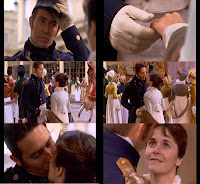
  • Nick Dear describes the scene where Anne, dressed in white and sitting among the sheet-covered furniture at Kellynch, as a “shroud for a dead house.”
  • In the Kellynch dining room, the vast, over-decorated table dwarfs the Elliots.
  • The ship’s ward room is small, dark, and smoky, and it is filled with action-filled officers. A single, tight circling shot relays the cohesiveness of the group. This is in contrast to the previous dining room scene. The ward room’s table is covered with various hats all tossed together, indicating the group’s solidarity. Sir Walter’s table holds the iced-swan sculpture.
  • A lack of real substance is shown in Lady Dalrymple’s caked on makeup and the use of backlighting.
  • Only a “letter folded up into a paper boat” and concealed inside a copy of “the Navy List, 1806″ elicits any emotional response from Anne while she is at Kellynch.
  • The sun lights Anne’s face for the first time when she arrives at Uppercross.
  • The swiftly moving paper boats are bringing Anne to her future. These boats are made for the children by Admiral Croft, a direct connection to Wenworth.
  • The high angle swish pan shot of Wentworth’s desperate attempt to catch Louisa indicates his being out of step on land.
  • Wentworth is separated from Anne by a table and three seated figures when she looks out the window for Mr. Elliot. There is a “gulf” between them.
  • Nick Dear’s Anne is more assertive than the one in Austen’s novels. This plays to the more modern female viewer. She chases Wentworth from the concert room, sharply answers her father’s criticsm of Mrs. Smith, blocks Wentworth’s path in the Octagon Room, snipes at both Lady Russell and Wentworth when they question her marrying Mr. Elliot, and accepts Wentworth’s kiss on the the crowded street.
  • We have a shot of Anne looking backwards at Kellynch. This leads to a lengthy pan shot bringing Uppercross into view. Austen does not give us the feeling of Kellynch being the past. This scene does.
  • The camera shot of Anne’s face at Uppercross Cottage shows her pensiveness. We see her only in the cloudy mirror. This indicates her isolation.
  • To show her leanness and her desperation, Anne is seen early on in loose-fitting dresses and large cloaks. In Bath, Anne wears form-fitting pelisses and spencers.
  • In the 1971 version, Bryan Marshall wears Regency civilian wear, but Ciarán Hinds portrays the rugged, self-made man in his naval attire.
  • William Elliot’s character is more villainous than the Austen version.
  • This adaptation uses pieces of both of Austen’s endings for the novel. 
  • The kissing scene is sometimes criticized, but it summarizes a chapter of reflection from Austen’s novel. It shows the “lovers” making their own way in life. Their hands are clasped. (BTW, in the 1971 version, Anne and Wentworth kiss twice, but it is indoors.)
  • The final scene was filmed at Portsmouth on the HMS Victory.
  • The last shot of a ship silhouetted against a sunset is actually taken from the 1984 film, The Bounty.
Posted in film, Jane Austen, Uncategorized | Tagged , , | 8 Comments

Do You Remember? The Fertile Ground of “Heartache” and An Artificial Heart Implant

Dr. Christiaan Barnard

Dr. Christiaan Barnard

In 1969, 47-year-old Haskell Karp received an artificial heart after Dr. Denton Cooley of the Texas Heart Institute in Houston determined Karp’s damaged heart could no longer pump the life saving blood through Karp’s veins. For 64 hours, this mechanical heart, developed by two of Cooley’s associates, Drs. Domingo Liotta and C. William Hall, kept Karp alive until a donor heart could be transplanted into Karp’s chest.

Dr. Cooley

Dr. Cooley

One must remember that heart transplants had only been possible for less than two years. Dr. Christiaan Barnard of Capetown, South Africa, had performed the first one some 16 months prior. Unfortunately, Karp died of complications of pneumonia two days after the transplant, but an artificial heart had made medical history.

The History of ‘Artificial Hearts’

In 1934, Dr. Michael DeBakey designed a “roller pump” that used two rollers to pump the blood for transfusions. In 1953, Dr. John H. Gibbon used a heart-lung machine, successfully correcting an intracardiac defect. This machine was a major step in such operations for the decades that followed.  In the 1970s, Dr. Robert Jarvik designed a series of artificial hearts at the University of Utah, to which Dr. Barney Clark, a Seattle dentist, came in 1982.

Clark’s heart muscles were pumping only to a 20% efficiency when he arrived in Utah. In addition to his heart, Clark had problems with his lungs, his legs, and his abdomen. He was termed “moribund.” Clark had learned all he could of the Jarvik hearts being produced by Dr. Jarvik.

Clark and the Jarvik-7 Heart

Clark and the Jarvik-7 Heart

On 1 December 1982, Clark underwent the replacement surgery, and the Jarvik-7 was implanted into Clark’s chest. Using compressed air to drive the mechanism, the pump filled itself with blood from Clark’s veins and emptied the fluid into the arteries via the four artificial heart valves. Tethered to the machine, Clark tolerated pneumothorax, severe nosebleeds, kidney failure, and seizures, and after 16 weeks, he lost his battles. However, throughout the ordeal, Clark professed his “pleasure in being able to help people.”

By 1985, DeVries had performed the procedure on three other patients. The first two, William Schroeder and Murray Haydon, each survived for over a year, although they too suffered some of the same type of complications as had Clark. The fourth candidate died after only 10 days, the result of the Jarvik heart being too large for his chest cavity.

Posted in Do You Remember?, medicine, Uncategorized | Tagged , , , , | 2 Comments