The Evolution of Wigs and Hair Pieces

In one of my two Works in Progress (WIP), my main character chooses to wear a disguise. However, as I write in the Regency Period, the use of wigs, as were common in the 18th Century, had gone by the way side. Below, one will discover an interesting sampling of the “evolution of wigs.” A wig is a head covering made from human hair, animal hair, or synthetic fiber that is worn for fashion or other reasons, including cultural tradition and religious observance. The word wig is short for periwig and first appeared in the English language around 1675. Some people wear wigs to disguise baldness; a wig may be used as a less intrusive and less expensive alternative to medical therapies for restoring hair. Wigs may also be used as an article of apparel, or to fulfill a religious obligation. Actors often wear costume wigs in order to portray characters.

History

Ancient Use

The ancient Egyptians wore wigs to shield their shaved, hairless heads from the sun. They also wore the wigs on top of their hair using beeswax and resin to keep the wigs in place. Other ancient cultures, including the Assyrians, Phoenicians, Greeks and Romans, also used wigs as an everyday fashion. 267px-Egypte_louvre_286_couple In Korea, gache were popular among women until it was banned in the late 18th century, while wigs were rarely used in China and Japan except in the traditional theatre.

16th and 17th Centuries

After the fall of the Roman Empire, the use of wigs fell into disuse in the West for a thousand years until they were revived in the 16th century as a means of compensating for hair loss or improving one’s personal appearance. They also served a practical purpose: the unhygienic conditions of the time meant that hair attracted head lice, a problem that could be much reduced if natural hair were shaved and replaced with a more easily de-loused artificial hairpiece. Fur hoods were also used in a similar preventative fashion. Royal patronage was crucial to the revival of the wig. Queen Elizabeth I of England famously wore a red wig, tightly and elaborately curled in a “Roman” style, while among men King Louis XIII of France (1601–1643) started to pioneer wig-wearing in 1624 when he had prematurely begun to bald. This fashion was largely promoted by his son and successor Louis XIV of France (1638–1715) that contributed to its spread in European and European-influenced countries.

Perukes or periwigs for men were introduced into the English-speaking world with other French styles when Charles II was restored to the throne in 1660, following a lengthy exile in France. These wigs were shoulder-length or longer, imitating the long hair that had become fashionable among men since the 1620s. Their use soon became popular in the English court.

The London diarist Samuel Pepys recorded the day in 1665 that a barber had shaved his head and that he tried on his new periwig for the first time, but in a year of plague he was uneasy about wearing it:

“3rd September 1665: Up, and put on my coloured silk suit, very fine, and my new periwig, bought a good while since, but darst not wear it because the plague was in Westminster when I bought it. And it is a wonder what will be the fashion after the plague is done as to periwigs, for nobody will dare to buy any haire for fear of the infection? That it had been cut off the heads of people dead of the plague.”

Wigs were not without other drawbacks, as Pepys noted on March 27, 1663:

“I did go to the Swan; and there sent for Jervas my old periwig-maker and he did bring me a periwig; but it was full of nits, so as I was troubled to see it (it being his old fault) and did send him to make it clean.”

With wigs virtually obligatory garb for men with social rank, wigmakers gained considerable prestige. A wigmakers’ guild was established in France in 1665, a development soon copied elsewhere in Europe. Their job was a skilled one as 17th century wigs were extraordinarily elaborate, covering the back and shoulders and flowing down the chest; not surprisingly, they were also extremely heavy and often uncomfortable to wear. Such wigs were expensive to produce. The best examples were made from natural human hair. The hair of horses and goats was often used as a cheaper alternative.
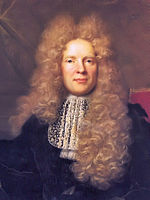
Nicolas de Vermont

Nicolas de Vermont

18th Century

In the 18th century, men’s wigs were powdered in order to give them their distinctive white or off-white color. Women in the 18th century did not wear wigs, but wore a coiffure supplemented by artificial hair or hair from other sources. Women mainly powdered their hair grey, or blue-ish grey, and from the 1770s onwards never bright white like men. Wig powder was made from finely ground starch that was scented with orange flower, lavender, or orris root. Wig powder was occasionally colored violet, blue, pink or yellow, but was most often used as off-white.

Powdered wigs (men) and powdered natural hair with supplemental hairpieces (women) became essential for full dress occasions and continued in use until almost the end of the 18th century.

The elaborate form of wigs worn at the coronation of George III in 1761 was lampooned by William Hogarth in his engraving Five Orders of Periwigs. 220px-William_Hogarth_-_The_Five_Orders_of_Perriwigs

Powdering wigs and extensions were messy and inconvenient, and the development of the naturally white or off-white powderless wig (made of horsehair) for men made the retention of wigs in everyday court dress a practical possibility. By the 1780s, young men were setting a fashion trend by lightly powdering their natural hair, as women had already done from the 1770s onwards.

After 1790, both wigs and powder were reserved for older, more conservative men, and were in use by ladies being presented at court. After 1790 English women seldom powdered their hair.

In 1795, the British government levied a tax on hair powder of one guinea per year. This tax effectively caused the demise of both the fashion for wigs and powder. Granville Leveson-Gower, in Paris during the winter of 1796, noted “The word citoyen seemed but very little in use, and hair powder being very common, the appearance of the people was less democratic than in England.” Among women in the French court of Versailles in the mid-to-late 18th century, large, elaborate and often themed wigs (such as the stereotypical “boat poufs”) were in vogue for women.

These combed-up hair extensions were often very heavy, weighted down with pomades, powders, and other ornamentation. In the late 18th century these coiffures (along with many other indulgences in court life) became symbolic of the decadence of the French nobility, and for that reason quickly became out of fashion from the beginning of the French Revolution in 1789.

During the 18th century, men’s wigs became smaller and more formal with several professions adopting them as part of their official costumes. This tradition survives in a few legal systems. They are routinely worn in various countries of the Commonwealth. Until 1823, bishops of the Church of England and Church of Ireland wore ceremonial wigs. The wigs worn by barristers are in the style favoured in the late eighteenth century. Judges’ wigs, in everyday use as court dress, are short like barristers’ wigs (although in a slightly different style), but for ceremonial occasions judges and also senior barristers (QCs) wear full-bottomed wigs.

Charles-Alexandre de Calonne by Élisabeth-Louise Vigée-Le Brun (1784), London, Royal Collection. The Vicomte de Calonne is shown wearing a powdered wig; the powder that has fallen from the wig is visible on his shoulders.

Charles-Alexandre de Calonne by Élisabeth-Louise Vigée-Le Brun (1784), London, Royal Collection. The Vicomte de Calonne is shown wearing a powdered wig; the powder that has fallen from the wig is visible on his shoulders.

19th and 20th Centuries

The wearing of wigs as a symbol of social status was largely abandoned in the newly created United States and France by the start of the 19th century. In the United States, only the first five Presidents, from George Washington to James Monroe, wore powdered wigs according to the old-fashioned style of the 18th century. The latest-born notable person to be portrayed wearing a powdered wig tied in a queue according to this old fashion was Grand Duke Constantine Pavlovich of Russia (born in 1779, portrayed in 1795).

Women’s wigs developed in a somewhat different way. They were worn from the 18th century onwards, although at first only surreptitiously. Full wigs in the 19th and early 20th century were not fashionable. They were often worn by old ladies who had lost their hair. In the film Mr. Skeffington (1944), when Bette Davis has to wear a wig after a bout of diphtheria, it is a moment of pathos and a symbol of her frailty.

During the late nineteenth and early twentieth century hairdressers in England and France did a brisk business supplying postiches, or pre-made small wiglets, curls, and false buns to be incorporated into the hairstyle.

The use of postiches did not diminish even as women’s hair grew shorter in the decade between 1910 and 1920, but they seem to have gone out of fashion during the 1920s. In the 1960s a new type of synthetic wig was developed using a modacrylic fiber which made wigs more affordable. Reid-Meredith was a pioneer in the sales of these types of wigs.

Military Wigs

From the late 17th to early 19th centuries, European armies wore uniforms more or less imitating the civilian fashions of the time, but with militarized additions. As part of that uniform, officers wore wigs more suited to the drawing rooms of Europe than its battlefields. The late 17th century saw officers wearing full-bottomed natural-coloured wigs, but the civilian change to shorter, powdered styles with pigtails in the early 18th century saw officers adopting similar styles. The elaborate, over-sized court-styles of the late 18th century were not followed by armies in the field however, as they were impractical to withstand the rigours of military life and simpler wigs were worn.

Whilst officers normally wore their own hair short under a powdered wig, the rank and file of the infantry was not afforded such luxury. Instead of wigs, the men grew their hair long and according to the prevailing fashion in a nation’s army, hair was either allowed to grow long with simple modeling, as in the French army of the 1740s, or else was elaborately coiffured as in Prussian and British armies. In the case of British soldiers of the 1740s, contemporary artwork suggests that they cut their hair short, which was not the case. Instead, the men used tallow or other fat to grease the hair, which was then fashioned into pigtails and tied back into the scalp hair to give the impression of short hair. It was then liberally dusted with powdered chalk to give the impression of a powdered wig. Later in the century, hair was likewise tied back, greased and powdered, but false hair pigtails were adopted, kept in a tubular queue and tied back with ribbons to the soldier’s own hair. The overall effect was that of a wig with a long tail and bow. The Prussian army took personal hairstyles to an extreme during the time of Frederick The Great, each soldier commonly having a long pigtail hanging down the back nearly to waist level.

By contrast, in the 1780s Russian General Potemkin abhorred the tight uniforms and uncomfortable wigs and powdered coiffures worn by his soldiers and instigated a complete revision of both. As well as comfortable, practical, well-fitting uniforms, his reforms introduced neat, natural hairstyles for all, with no wigs, powder and grease or hair-tying evident.

Formal military hairstyles lasted until beyond the end of the 18th century and it was the French Revolution which spelled the end of wigs and powdered, greased hairstyles in modern, Western armies. Powdered hair and pigtails made a brief return during Napoleon’s reign, being worn by infantry of his Foot Grenadiers and Foot Chasseurs of the Old Guard and the Horse Grenadiers of the Guard.

Merkin

A merkin is a pubic wig often worn as a decorative item or for theatrical and fashion purposes. They are sometimes viewed as erotic and some designs are meant for entertainment or as a form of comedy.

Current Usage

In Britain, most Commonwealth nations, and the Republic of Ireland special wigs are also worn by barristers, judges, and certain parliamentary and municipal or civic officials as a symbol of the office. Hong Kong barristers and judges continue to wear wigs as part of court dress as an influence from their former jurisdiction of the Commonwealth of Nations. In July 2007, judges in New South Wales, Australia voted to discontinue the wearing of wigs in the NSW Court of Appeal. New Zealand lawyers and judges have ceased to wear wigs except for special ceremonial occasions such as openings of Parliament or the calling of newly qualified barristers to the bar.

A number of celebrities, including Nicki Minaj, Dolly Parton, Lady Gaga, Diana Ross & The Supremes, Tina Turner and Raquel Welch have popularized wigs. Cher has worn all kinds of wigs in the last 40 years- from blonde to black, and curly to straight. They may also be worn for fun as part of fancy dress (costume wearing), when they can be of outlandish colour or made from tinsel. They are quite common at Halloween, when “rubber wigs” (solid bald cap-like hats, shaped like hair), are sold at some stores.

Jewish law requires married women to cover their hair for reasons of modesty (tznius). Some women wear wigs, known as sheitels, for this purpose. Haredi, Orthodox and Modern Orthodox Jewish women will often wear human-hair wigs.

Wigs are used in film, theater, and television. In the Japanese film and television genre Jidaigeki, wigs are used extensively to alter appearance to reflect the Edo Period when most stories take place. Only a few actors starring in big-budgeted films and television series will grow their hair so that it may be cut to the appropriate hair style, and forgo using a wig.

Wigs are worn by some people on a daily or occasional basis in everyday life. This is sometimes done for reasons of convenience, since wigs can be styled ahead of time. They are also worn by individuals who are experiencing hair loss due to medical reasons (most commonly cancer patients who are undergoing chemotherapy, or those who are suffering from alopecia areata).

Manufacture

There are two methods of attaching hair to wigs. The first and oldest is to weave the root ends of the hair onto a warp of three silk threads to form a sort of fringe called a “weft.” The wefts are then sewn to a foundation made of net or other material. In modern times, the wefts can also be made with a specially adapted sewing machine, reducing the amount of hand labour involved. In the 19th century another method came into use. A small hook called a “ventilating needle,” similar to the tambour hooks used for decorating fabric with chain-stitch embroidery at that period, is used to knot a few strands of hair at a time directly to a suitable foundation material. This newer method produces a lighter and more natural looking wig. High quality custom wigs, and those used for film and theatrical productions are usually done this way. It is also possible to combine the two techniques, using weft for the main part of the wig and ventilating hair at the edges and partings to give a fine finish.

Measurement

Making custom wigs starts with measuring the subject’s head. The natural hair is arranged in flat curls against the head as the various measurements are taken. It is often helpful to make a pattern from layers of transparent adhesive tape applied over a piece of plastic wrap, on which the natural hairline can be traced accurately. These measurements are then transferred to the “block,” a wooden or cork-stuffed canvas form the same size and shape as the client’s head.

Foundation

Depending on the style of the wig, a foundation is made of net or other material, different sizes and textures of mesh being used for different parts of the wig. The edges and other places might be trimmed and reinforced with a narrow ribbon called “galloon.” Sometimes flesh colored silk or synthetic material is applied where it will show through the hair at crown and partings, and small bones or elastic are inserted to make the wig fit securely. Theatrical, and some fine custom wigs have a fine, flesh colored net called “hair lace” at the front which is very inconspicuous in wear and allows the hair to look as if it is coming directly from the skin underneath. These are usually referred to as “lace front wigs.”

Hair Preparation

Natural hair, either human or from an animal such as a goat or yak, must be carefully sorted so that the direction of growth is maintained, root to root, and point to point. Because of the scale-like structure of the cortex of a hair shaft, if some hairs get turned the wrong way, they will ride backwards against their neighbors and cause tangles and matting. The highest quality of hair has never been bleached or colored, and has been carefully sorted to ensure the direction is correct. For less expensive wigs, this labour-intensive sorting process is substituted for by “processing” the hair. It is treated with a strongly base solution which partially dissolves the cortex leaving the strands smooth, It is then bleached and dyed to the required shade and given a synthetic resin finish which partially restores the strength and luster of the now damaged hair. Synthetic fiber, of course, is simply manufactured in the required colors, and has no direction.

The wigmaker will choose the type, length and colors of hair required by the design of the wig and blend them by pulling the hair through the upright teeth of a brush-like tool called a “hackle” which also removes tangles and any short or broken strands. The hair is placed on one of a pair of short-bristled brushes called “drawing brushes” with the root ends extending over one edge, and the second brush is pressed down on top of it so that a few strands can be withdrawn at a time, leaving the rest undisturbed.

Adding the Hair

Weft structured wigs can have the wefts sewn to the foundation by hand, while it is on the block or, as is common with mass-produced wigs, sewn to a ready-made base by skilled sewing machine operators. Ventilated (hand knotted) wigs have the hair knotted directly to the foundation, a few strands at a time while the foundation is fastened to the block. With the hair folded over the finger, the wigmaker pulls a loop of hair under the mesh, and then moves the hook forward to catch both sides of the loop. The ends are pulled through the loop and the knot is tightened for a “single knot”, or a second loop is pulled though the first before finishing for a “double knot.” Typically, the bulkier but more secure double knot is used over the majority of the wig and the less obvious single knot at the edges and parting areas. A skilled wigmaker will consider the number of strands of hair used and the direction of each knot to give the most natural effect possible.

It takes generally six heads of hair to make a full human hair wig. Styling At this point, the hair on the wig is all the same length. The wig must be styled into the desired form in much the same manner as a regular stylist.

Fitting

The subject’s natural hair is again knotted tightly against the head and the wig is applied. Any remaining superfluous wiglace is trimmed away. Hairpins can be used to secure the lace to the hair and occasionally, skin-safe adhesives are used to adhere the wig against bald skin and to better hide any exposed lace. Finishing touches are done to the hair styling to achieve the desired effect.

Types of Human Hair Wigs

There are two basic kinds of human hair wigs: lace wigs and non-lace wigs (lace front or full lace.) Lace wigs are made partially (lace front) or entirely (full lace) of various forms of lace. Regular human hair wigs are similar to synthetic wigs in their design. Human hair wigs can also be “hand tied”, where a full lace cap is used and each hair is attached one at a time. Hair type is the distinguishing factor in human hair wigs.

Four main types of hair are used in manufacturing : Chinese or “Malaysian”, Indian, Indonesian or “Brazilian”, and Caucasian or “European.” The majority of human hair wigs are made of Chinese or Indian hair, while European hair is considered the most expensive and rare, as most donors are from Russia or Northern Europe, where there is a smaller portion of hair donors to the market.

Posted in customs and tradiitons, Pop Culture, real life tales, Uncategorized | Tagged , | 3 Comments

Forerunners of Elizabethan Tragedy: Thomas Kyd

Today, I am taking a step away from my beloved Regency England to visit a time period, which also fascinates me. With a minor in theatre, I have studied the development of the drama of the period. With Kyd and Marlowe the Elizabethan tragedy took flight.

5784358_f260Thomas Kyd (baptised 6 November 1558; buried 15 August 1594) was an English dramatist, the author of The Spanish Tragedy, and one of the most important figures in the development of Elizabethan drama.

Although well known in his own time, Kyd fell into obscurity until 1773 when Thomas Hawkins (an early editor of The Spanish Tragedy) discovered that Kyd was named as its author by Thomas Heywood in his Apologie for Actors (1612). A hundred years later, scholars in Germany and England began to shed light on his life and work, including the controversial finding that he may have been the author of a Hamlet play pre-dating Shakespeare’s.

Kyd was the son of a London scrivener. He attended Merchant Taylors’ school, and although there is no evidence of Kyd having a university education, he was well versed in the classics. He was also known to possess an affinity for French and Italian. When The Spanish Tragedy was published (likely in 1586), the play did not carry Kyd’s name. The only other play known to be associated with Kyd is a translation of Garnier’s CornélieThere are, however, other plays thought to be part of Kyd’s writings: Soliman and Perseda (a romantic tragedy involving a murderous Sultan), Arden of Feversham (the oldest and most powerful of the Domestic Tragedies), and Hamlet (upon which Shakespeare’s play is likely founded).

Tragedies had known popularity in England, but they were academic plays of the Senecan school, plays like Gorboduc, or parodies of tragic actions (see Cambises or Horestes). However, true Elizabethan drama began with Kyd and Marlowe.

spanishtragedy2In the last year of Kyd’s life, his papers were seized by the Privy Council, with the PC believing him the author of anti-alien propaganda. One of the documents reportedly denied the divinity of Christ. Under torture, Kyd swore the document was not his, but rather the property of Christopher Marlowe. Marlowe was arrested and later released upon parole, but Thomas Kyd was a ruined man. Kyd wrote a very public letter to the Lord Chancellor, Kyd’s patron, asking the Lord Chancellor to restore his patronage, but no assistance was forthcoming. In poverty, Kyd died the following year.

150px-Spanish-tragedyThe Spanish Tragedy was published before Kyd’s death, coming into print in 1592. The last quarto appeared in 1633. Strange’s company performed the play again and again to packed houses in 1592. The Admiral’s company added it to their repertoire in 1597. Henslowe paid Jonson for additions to the play. The play was known to have a bit of everything: something for the classically taught and something for the general populace. It contains the proud and passionate heroine, Bel-imperia, and the first Machiavellian villain, the lady’s brother, Lorenzo. The most important events of the story are not “reported” and taking place off stage. Instead, Kyd add the action required to entertain those in the audience who lacked an education.

The murder of Horatio is quite graphic, as is the hanging of the tool villain and the murder of a second youth.


Posted in acting, British history, Elizabethan drama, language choices, playwrights, political stance | Tagged , , | 2 Comments

Movie Discussion ~ 2005’s Pride and Prejudice

Pride and Prejudice 2005 – Movie Discussion


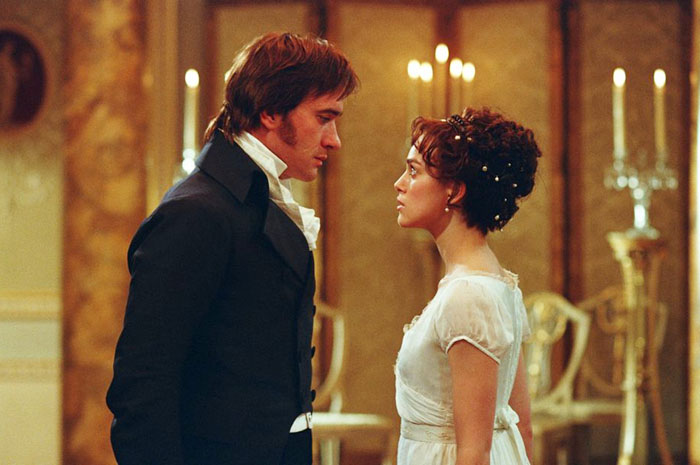
This is a film where the spectator enjoys a lesson in Voyeurism 101. We follow the story as we view the characters through windows, eavesdrop on them through doors, read over their shoulders, stand behind them while they are conversing, etc. From the opening shot to the closing kiss (in the American version), we are drawn into the Bennet family through the character of Elizabeth, portrayed by Keira Knightley. The opening shot establishes Elizabeth as being both “inside” the action, but also an “outside” observer through which the audience will view the story. Joe Wright, the director, uses camera angles and filmography to tell the story of Darcy and Elizabeth’s love. He gives us a story steeped in Romantic elements, which seems a bit odd to those who have been taught that Jane Austen rejected the concept of “self,” emphasized by Romanticism.

In that opening shot, Elizabeth is walking home reading what is thought to be Austen’s First Impressions. In other words, Elizabeth is reading “her story.” Reaching her home, (through the camera’s lens) we follow her around the house. We see that this is a “working” estate, rather than what we sometimes see in the more traditional “Heritage” films. Elizabeth walks behind the sheets hanging on the line. They obstruct our vision, but this also tells the viewer that Elizabeth’s perceptions are  hampered.
In one of my favorite shots in the film, we see Elizabeth most intimately in the “mirror” sequence. Masterly, Wright summarizes three chapters of Austen’s novel with soft lighting and darkness, using both to show the passage of time. We find various blurred medium long shots and medium close-ups of Elizabeth, of Darcy, and of the letter. They provide the viewer with insights into Elizabeth’s internal turmoil. She turns suddenly when she realizes she has misjudged Darcy, but he is gone. To Charlotte’s question of her health, Elizabeth responds, “I hardly know.” Hardly knows what? Herself? Darcy? the Truth?
Another masterly crafted scene is the Netherfield Ball. The camera steps in to refocus the audience’s attention that this is a turning point in Darcy and Elizabeth’s relationship. The camera leaves the traditional set up and follows them in their movements. We whirl and complete the dance steps along with them. Then the camera “crosses the line” by moving more than 180 degrees. I must tell you when I first saw this, I nearly jumped out of my chair. One rarely sees this film technique used so well. The characters’ positioning from right to left in the frame reverses, telling the viewer everything has changed for both of them. It is a leap from spatial reality to a dream. The characters complete each other. This scene forecasts the film’s resolution: Social isolation will ultimately unite them. They dance alone. Before, they were only going through the motions of social performances.
In the “Accomplished Lady” scene, the dialogue mixes idioms with archaic sounding sentence structure. Simon Woods (Bingley) says, “amazing you young ladies” and “you all paint tables….” The script says, “It’s amazing how young ladies…” and “They all paint tables….” Therefore, Caroline’s use of “She must have …” makes her appear more distant and impersonal. A look at the filmography of this scene shows Elizabeth surrounded by emblems of the ornate femininity she rejects: a decorative vase, a framed portrait of a young woman in white, a bowl of flowers, etc. During this scene, both Darcy and Elizabeth remained seated. This gives them visual authority. The change in shot from character to character is often slightly off sync with the beginning and ending of each speech. This creates movement in an otherwise static scene.  The final shot shows Caroline and Elizabeth separating, crossing behind Darcy, and sitting. They represent different potential mates for Darcy. Of course, any student of Austen knows Wright combined two separate incidents from the novel into this one scene.

At Pemberley, Elizabeth sees Darcy’s sensual side. She realizes his true worth through the beauty of his home. There is constant camera movement, which emphasizes the significance of the moment. The camera circles Elizabeth and then Darcy’s statue, showing her emerging feelings for Darcy. Did you notice the right to left tracking shot of (Chatsworth) Pemberley’s facáde? As Elizabeth moves through the house, she touches the various objects, giving her a “true” picture of Darcy. “I hope to afford you more clarity in the future.” Elizabeth peers through the door to see Darcy with Georgiana. His role as a loving brother softens Elizabeth’s opinion of him.
Rosings Park’s murals show men laboring under tyrannical conditions – under the oppressive social order represented by Lady Catherine. The murals at Pemberley depict men and women in a pastoral setting. It is the ideal place for Darcy and Elizabeth’s love to grow.
Wright shows that Elizabeth needs to be in a natural setting. That is where she will bloom. In Derbyshire, Elizabeth stands on the bluff. She is part of the rugged landscape. She belongs in Derbyshire with Darcy. She sits on the roots of a 200+ year old tree (which is really in Nottingham). She must set down roots in this area. The free running deer represent Elizabeth’s new sense of freedom.
Darcy is seen as a social outsider. The film creates him as a Byronic hero. He is a reluctant

social participant. Matthew Macfadyen’s body language and facial expressions suggest discomfort – a true dislike for social practices – an unhappiness rather than hauteur or censure. The film begins in the countryside at dawn. It ends with the second proposal in the same setting. Neither Elizabeth nor Darcy is dressed properly. They will, therefore, live their lives on their own terms.
As one can see, there are many areas of discussion on this film. It is quite different from the more traditional 1995 P&P, but that does not mean that it is not worthy in its own right. Keep in mind, that a 2-hour commercial film should not be compared to a nearly 6-hour “heritage” adaptation. I welcome your comments. I will check in regularly to respond.
Posted in film, Jane Austen, Uncategorized | Tagged , , | 13 Comments

Regency Happenings: The Year Without Summer

tambora_11The Year Without a Summer (also known as the Poverty Year, Year There Was No Summer, and Eighteen Hundred and Froze to Death) was 1816, in which severe summer climate abnormalities resulted in major food shortages. Much of the cause of this anomaly is blamed on the volcanic eruption of Mount Tambora (located on the island of Sumbawa, Indonesia) in April 1815.

Rated a 7 on the Volcanic Explosivity Index, the Tambora eruption had ash falls as far away as Borneo, Sulawesi, Java, and the Maluku islands. Most who died from the eruption came from starvation and disease. 71,000+ people died. Some 12,000 killed from the explosion.

In Europe, people were still recovering from the devastation of the Napoleonic Wars. Food shortages were already prevalent. In the UK and France, food riots were common. Switzerland declared a national emergency because of famine. Abnormal rainfall swelled European rivers. 100,000 Irishmen perished from a combination of a famine and a major typhus epidemic.

In New England, the corn crop failed. Because of supply and demand, the cost of wheat and grains skyrocketed. In Hungary, the population experienced brown snow. Italy had red snow. Volcanic ash is believed to be the cause. The rice crop in China failed due to the summer’s low temperatures. Summer snowfalls occurred in several of China’s provinces. In tropical Taiwan, snow was also reported.

J. M. W. Turner celebrated the spectacular sunsets during this period, likely caused by high levels of ash. People have noted the yellow tinge that is predominant in his paintings, such as Chichester Canal circa 1828.

The crop failures of the “Year without a Summer” may have helped shape the settling of the “American Heartland,” as many thousands of people (particularly farm families who were wiped out by the event) departed New England for what is now western and central New York and the upper Midwest in search of a more profitable land.

Among those who left Vermont were the family of Joseph Smith. This move precipitated a series of events which culminated in the publication of the Book of Mormon and the founding of the Church of Jesus-Christ of Latter-day Saints

In July 1816 “incessant rainfall” during that “wet, ungenial summer” forced Mary Shelley, John William Polidori, Lord Byron and their friends to stay indoors for much of their Swiss holiday.

They decided to have a contest to see who could write the scariest story, leading Shelley to write Frankenstein, the Modern Prometheus and Polidori to write The Vampyre In addition, their host, Lord Byron was inspired to write a poem, “Darkness,” at the same time.

The events of April 1815 play a part in my next novel The Disappearance of Georgiana Darcy (scheduled for release in March 2012), which begins in July 1815, after Wellington vanquishes Napoleon at Waterloo.

Chichester Canal, circa 1828 by J.M.W. Turner

Chichester Canal, circa 1828 by J.M.W. Turner

Among those who left Vermont were the family of Joseph Smith. This move precipitated a series of events which culminated in the publication of the Book of Mormon and the founding of the Church of Jesus-Christ of Latter-day Saints.

In July 1816 “incessant rainfall” during that “wet, ungenial summer” forced Mary Shelley, John William Polidori, Lord Byron and their friends to stay indoors for much of their Swiss holiday.

Shelley

Shelley

Polidori

Polidori

They decided to have a contest to see who could write the scariest story, leading Shelley to write Frankenstein, the Modern Prometheus and Polidori to write The Vampyre In addition, their host, Lord Byron was inspired to write a poem, “Darkness,” at the same time.

The events of April 1815 play a part in my  novel The Disappearance of Georgiana Darcy, which begins in July 1815, after Wellington vanquishes Napoleon at Waterloo. It also plays a role in several other of my works: A Touch of Honor, A Touch of Love, and the upcoming The Prosecution of Mr. Darcy’s Cousin. Those who write in the Regency period (1811-1820) must address the hardships such a disastrous event brought to the wealthy land owners and the tenant farmers.

Information shared on the historical event is tied to Wikipedia.


Posted in British history, Great Britain, Living in the Regency, Living in the UK, mystery, Napoleonic Wars, real life tales, Regency era | Tagged | 1 Comment

The Legend Behind Sir Walter Scott’s “The Bonnets o’ Bonnie Dundee”

The Legend Behind Sir Walter Scott’s “The Bonnets o’ Bonnie Dundee”


by Regina Jeffers

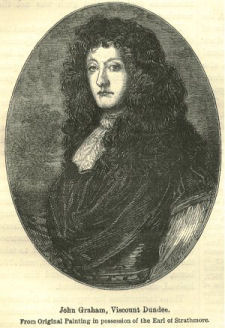
I am currently researching anything and everything Scottish. Being of Scottish descent, this is important to me, but I am also looking for those special “gems” one might add to a story line. Recently, I discovered the “legend” of John Graham of Claverhouse, Viscount Dundee, and John Brown, also known as the Christian Carrier, a Protestant Covenanter from Priesthill. Here is what we do know regarding both men.
Between 1638 and 1688, Scotland was in an almost constant state of civil unrest. Many people refused to accept the Royal decree, which stated that the King was the head of the church. When those who refused this decree signed a Covenant, stating that Jesus Christ was the true head of the church, death warrants were issued for the offenders.
  • The Covenanters were flushed out and hunted down. Any Covenanter, regardless of social class or gender or age, was murdered on the spot – often without trial or evidence.
  • John Graham of Claverhouse (1648-1689), 1st Viscount Dundee (a title bestowed upon him by James VII), was a Scottish nobleman and professional soldier. He was best known for leading the first Jacobite uprising in 1689. He was the eldest son of Sir William Graham and Lady Madeline Carnegie and was educated at St. Andrews in the 1660s.
  • Graham’s military career began in the French army of Louis XIV. He distinguished himself at the Battle of Seneff in Belgium (1674), where he reputedly saved the life of the Prince of Orange.
  • When Graham returned to Scotland in 1678, he was commissioned into Charles II’s army and assigned the task of suppressing conventicles, seditious Presbyterian meetings. His zealousness earned him the nickname of “Bluidy Clavers.”
  • Graham had a meteoric rise to fame. After a decisive victory at the Battle of Bothwell Brig, Charles II made him the Provost of Dundee and appointed Graham to the Scottish Privy Council.
  • In 1689, a Scottish convention decided that James VII had abdicated the throne and the Scottish crown should be awarded to William and Mary. Graham objected vehemently. Eventually, he fled to Edinburgh to gather an army at Blair Castle in support of James VII.
  • Graham was buried in a vault underneath St. Bridge’s Kirk on the grounds of Blair Castle.
  • John Brown’s cottage home, a few miles from Muirkirk in Ayrshire, Scotland, was the center for a society of Covenanters.
As a staunch supporter of the House of Stewart, it was Graham’s responsibility to hunt down Scottish Covenanters. In this role, Graham was often called the “Devil’s servant,” for he was ruthless. In 1685, Graham executed John Brown outside the man’s house and in the presence of Brown’s wife, Isabel, and the man’s two children. Brown had refused to swear not to take up arms against the king and to take the Oath of Abjuration. Unnerving Graham’s men, Brown had shown great courage before the firing squad. Their hesitation led Graham to do the job himself.
However, before the Battle of Killiecrankie, the legend says that a grim visitor came to Graham. The bloody apparition pointed to Claverhouse and said, “Remember Brown of Priesthill!” At the battle the next day, Claverhouse’s forces were outnumbered three to one by the governmental troops. The Jacobites won the day, but at the cost of Graham’s life. He is said to have died while sitting against a standing stone in a field near Killiecrankie. That stone has become known as Claverhouse’s Stone. One must imagine how Claverhouse must have felt that day riding into battle against such odds and with a “curse” hanging over his head. Later, Graham’s story became the subject of a song written by Sir Walter Scott.
“The Bonnets o’ Bonnie Dundee”
1.Tae the lairds i’ convention t’was Claverhouse spoke
E’er the Kings crown go down, there’ll be crowd to be broke;
Then let each cavalier who loves honour and rae
Come follow the bonnets o’ bonnie Dundee.
Chorus: Come fill up my cup, come fill up my can,
Saddle my horses and call out my men.
And it’s Ho! for the west port and let us gae free,
And we’ll follow the bonnets o’ bonnie Dundee.
2.Dundee he is mounted, he rides doon the street,
The bells they ring backwards, the drums they are beat,
But the Provost, (douce man!), says; Just e’en let him be
For the toon is well ride of that de’il o’ Dundee.
[Chorus]
3.There are hills beyond Pentland and lands beyond Forth,

Be there lairds i’ the south, there are chiefs i’ the north!
There are brave Duniewassals, three thousand times three
Will cry “Hoy!” for the bonnets o’ bonnie Dundee.
[Chorus]
4.Then awa’ tae the hills, tae the lea, tae the rocks
E’er I own a usurper, I’ll couch wi’ the fox!
Then tremble, false Whigs, in the midst o’ your glee
Ye hae no seen the last o’ my bonnets and me.
[Chorus]
Posted in book excerpts, excerpt, Great Britain, legends and myths, poetry, real life tales, Scotland | Tagged , | Comments Off on The Legend Behind Sir Walter Scott’s “The Bonnets o’ Bonnie Dundee”

Do You Remember When? America Entered the Space Race…

There was a time when we Americans clung to our TV sets to watch our first astronauts accomplish what we thought no man could. I recall standing in my yard and staring up into the October (1957) sky to look for a pinpoint of moving light,  the Soviet spacecraft Sputnick I, the first artificial Earth satellite.

It was an event, which quite literally, changed my life. As a ten-year-old with a relatively high IQ, it became my role in school “to beat the Soviets,” such was the unspoken new emphasis on academics in the U.S. public classrooms of the time. The U. S. had suffered several failures, including payloads which had went off course or had caught fire upon the launch pad, leading to the premise that we were falling behind the eight ball in science, mathematics, and technology.

However, less than two years later, we were introduced to our first space pioneers: Scott Carpenter, Gordon Cooper, John Glenn, Gus Grissom, Wally Schirra, Alan Shepard, and Deke Slayton. From a list of 540 candidates, these seven had survived the selection process. Each had to be a college graduate, be under the age of 40, and be less than 5 feet 11 inches in height (to squeeze into the Mercury capsule). They also had to excel at both physical tests and psychological screenings. The chosen seven’s IQs were all above 135. The seven were also all Protestants, avid outdoorsmen, and from small town America.

Al Shepard

Al Shepard

The group spent two years in training, and on 5 May 1961, Al Shepard became the first American to travel into space. His Mercury flight was designed to enter space, but not to achieve orbit. (In 1971, Shepard piloted the Apollo 14 mission. He became the fifth and the oldest person [at age 47] to walk on the moon, the only astronaut of the original Mercury 7 to do so.) With repeated delays during the countdown, Shepard is quoted as saying, “Why don’t you fix your little problems and light this candle?” This first American launch came some three weeks after Soviet cosmonaut Yuri Gagarin had made his flight.

Virgil "Gus" Grissom

Virgil “Gus” Grissom

Some three months later on 21 July 1961, Gus Grissom piloted the second Project Mercury flight. Mercury Redstone 4, popularly known as Liberty Bell 7, was a suborbital flight that lasted 15 minutes and 37 seconds. After splashdown, emergency explosive bolts unexpectedly fired and blew the hatch off, causing water to flood into the spacecraft. Quickly exiting through the open hatch and into the ocean, Grissom nearly drowned, as water filled his spacesuit. A recovery helicopter attempted to lift and recover the spacecraft, but it was too heavy. Sinking to the bottom of the ocean, the craft was not recovered until 1999.220px-Grissom_prepares_to_enter_Liberty_Bell_7_61-MR4-76

John Glenn

John Glenn

John Glenn made three orbits of Earth on 20 February 1962 in Friendship 7, but again the American program had come behind the Soviets’. On 6 August 1961, Gherman Titov had become the second man to orbit Earth aboard Vostok 2. Deke Slayton was next up for flight, but he was replaced by Scott Carpenter because Slayton had an erratic heartbeat in pre-flight medical tests.

Carpenter flew into space on 24 May 1962, atop the Mercury-Atlas 7 rocket for a three-orbit science mission that lasted nearly five hours. His Aurora 7 spacecraft attained a maximum altitude of 164 miles (264 km) and an orbital velocity of 17,532 miles per hour (28,215 km/h). Working through five onboard experiments dictated by the flight plan, Carpenter helped, among other things, to identify the mysterious ‘fireflies’ (which he renamed ‘frostflies’, as they were in reality particles of frozen liquid around the craft), first observed by Glenn during MA-6. Carpenter was the first American astronaut to eat solid food in space.

Malcolm Scott Carpenter

Malcolm Scott Carpenter

Carpenter was highly criticized for an “over expenditure of fuel,” which turned out to be an intermittently malfunctioning pitch horizon scanner (PHS). Upon reentry, Carpenter was forced to control his flight manually, and he overshot his splashdown point by 250 miles (400 km).

Wally Schirra became the fifth American to travel into space. On 3 October 1962, Shirra made a six-orbit, nine-hour, 13 minutes, and 11 seconds Mercury-Atlas 8 (Sigma 7) flight. His would said to have been a “textbook” flight, one without incident. The capsule attained a velocity of 17,557 miles per hour (28,255 km/h) and an altitude of 175 statute miles (282 km) and landed within 4 miles (6.4 km) of the main Pacific Ocean recovery ship.

On December 15, 1965, Schirra flew into space a second time as command pilot of Gemini 6A, with pilot Tom Stafford. Gemini 6, originally scheduled to launch on October 25, was planned to perform the first space rendezvous and docking with an unmanned Agena target vehicle launched separately, but the Agena was destroyed in a launch failure. It was decided to defer launch of the alternate mission 6A to after the December launch of Gemini 7, during which Schirra would perform rendezvous, but without docking. During the first rescheduled launch attempt, the booster rocket unexpectedly shut down seconds after ignition and did not launch. Although mission rules called for the crew to eject from the spacecraft in that situation, Schirra used his pilot’s judgement and did not eject, as he had not detected any upwards motion. This turned out to be the correct call for their personal safety. The flight was launched successfully three days later, and Schirra successfully performed the first rendezvous with Gemini 7 containing astronauts Frank Borman and James Lovell, Jr., station-keeping his craft to distances as close as 1 foot (30 cm). Gemini 6 landed in the Atlantic Ocean the next day, while Gemini 7 continued on to set a 14-day manned space record.

Wally Schirra

Wally Schirra

While on the Gemini mission, Schirra played a Christmas practical joke on the flight controllers by first reporting a mock UFO (implying Santa Claus) sighting, then playing “Jingle Bells” on a four-hole Hohner harmonica he had smuggled on board, accompanied by Stafford on sleigh bells. Hohner subsequently produced a “Wally Schirra” commemorative model.

Gordon Cooper

Gordon Cooper

L. Gordon Cooper piloted the longest and final Mercury spaceflight in 1963. He was the first American to sleep in space during that 34-hour mission and was the last American to be launched alone to conduct an entirely solo orbital mission. In 1965, Cooper flew as command pilot of Gemini 5. Cooper was launched into space on 15 May 1963, aboard the Mercury-Atlas 9 (Faith 7) spacecraft, the last Mercury mission. He orbited the Earth 22 times and logged more time in space than all five previous Mercury astronauts combined—34 hours, 19 minutes and 49 seconds—traveling 546,167 miles (878,971 km) at 17,547 mph (28,239 km/h), pulling a maximum of 7.6 g (74.48 m/s²). Cooper achieved an altitude of 165.9 statute miles (267 km) at apogee. He was the first American astronaut to sleep not only in orbit but on the launch pad during a countdown.

Deke Slayton

Deke Slayton

After joining NASA, Donald Kent “Deke” Slayton was selected to pilot the second U.S. manned orbital spaceflight, but was grounded in 1962 by a heart murmur. He then served as NASA’s director of flight crew operations, making him responsible for crew assignments at NASA from November 1963 until March 1972. At that time he was granted medical clearance to fly, and was assigned as the docking module pilot of the 1975 Apollo–Soyuz Test Project, becoming the oldest person to fly in space at age 51. This record was surpassed in 1983 by 53 year old John Young and in 1998 by his fellow Project Mercury astronaut John Glenn, who at the age of 77 flew on Space Shuttle mission STS-95.

After leaving NASA,Slayton retired from NASA in 1982. After retirement, he served as president of Space Services Inc., a Houston-based company earlier founded to develop rockets for small commercial payloads. He served as mission director for a rocket called the Conestoga, which was successfully launched on 9 September 1982, and was the world’s first privately funded rocket to reach space. Slayton also became interested in aviation racing. Shortly after he moved to League City, Texas, in 1992, Slayton was diagnosed with a malignant brain tumor. He died from the illness, at the age of 69, on 13 June 1993.

Wally Schirra later served as a consultant to CBS News during the Apollo missions, joining Walter Cronkite to co-anchor the network’s coverage of the seven Moon landing missions, starting with Apollo 11 (joined by Arthur C. Clarke), including the ill-fated Apollo 13. Schirra died on 3 May 2007 of a heart attack due to malignant mesothelioma at Scripps Green Hospital (currently The Heart Center at Scripps) in La Jolla, California. A memorial service for Schirra was held on 22 May at Fort Rosecrans National Cemetery in California. The ceremony concluded with a three-volley salute and a flyover by three F/A-18s. Schirra was cremated and his ashes were committed to the sea on 11 February 2008. The burial at sea ceremony was held aboard the Nimitz-class aircraft carrier USS Ronald Reagan (CVN-76) and his ashes were released by Commander Lee Axtell, CHC, USN, the command chaplain aboard.

In July 1964 in Bermuda, Scott Carpenter sustained a grounding injury from a motorbike accident while on leave from NASA to train for the Navy’s SEALAB project. In 1965, for SEALAB II, he spent 28 days living on the ocean floor off the coast of California. During the SEALAB II mission, Carpenter’s right index finger was wounded by the toxic spines of a scorpion fish. He returned to work at NASA as Executive Assistant to the Director of the Manned Spacecraft Center, then returned to the Navy’s Deep Submergence Systems Project in 1967, based in Bethesda, Maryland, as a Director of Aquanaut Operations for SEALAB III. In the aftermath of aquanaut Berry L. Cannon’s death while attempting to repair a leak in SEALAB III, Carpenter volunteered to dive down to SEALAB and help return it to the surface, although SEALAB was ultimately salvaged in a less hazardous way. Carpenter retired from the Navy in 1969, after which he founded Sea Sciences, Inc., a corporation for developing programs for utilizing ocean resources and improving environmental health.Carpenter had a stroke and entered The Denver Hospice Inpatient Care Center at Lowry, where he died on 10 October 2013; he was 88.

John Glenn likely achieved the most “public” fame of the original seven Mercury astronauts. Glenn became a U. S. senator from Ohio (1974-1999), a 1976 Vice-Presidential nominee, and a 1984 Democratic Presidential nominee. Glenn helped found the John Glenn Institute for Public Service and Public Policy at the The Ohio State University in 1998 to encourage public service. On 22 July 2006, the institute merged with OSU’s School of Public Policy and Management to become the John Glenn School of Public Affairs. Today he holds an adjunct professorship at both the Glenn School and OSU’s Department of Political Science.

Gus Grissom was killed along with fellow astronauts Ed White and Roger Chaffee during a pre-launch test for the Apollo 1 mission at Cape Canaveral Air Force Station (then known as Cape Kennedy), Florida. He was the first of the Mercury Seven to die. He was also a recipient of the Distinguished Flying Cross and, posthumously, the Congressional Space Medal of Honor.

After leaving NASA, Gordon Cooper served on several corporate boards and as technical consultant for more than a dozen companies in fields ranging from high performance boat design to energy, construction, and aircraft design. During the 1970s, he worked for The Walt Disney Company as a vice-president of research and development for Epcot. Cooper developed Parkinson’s disease late in life. At age 77, he died from heart failure at his home in Ventura, California, on 4 October 2004. His death occurred on the 47th anniversary of the Sputnik 1 launch and the same day that SpaceShipOne made its second official qualifying flight, winning the Ansari X-Prize.

After Alan Shepard left NASA, he served on the boards of many corporations. He also served as president of his umbrella company for several business enterprises, Seven Fourteen Enterprises, Inc. (named for his two flights, Freedom 7 and Apollo 14).

In 1994, he published a book with two journalists, Jay Barbree and Howard Benedict, called Moon Shot: The Inside Story of America’s Race to the Moon. Fellow Mercury astronaut Deke Slayton is also named as an author. The book generated some controversy for use of a staged photo purportedly showing Shepard hitting a golf ball on the Moon. The book was also turned into a TV miniseries in 1994.

Shepard died of leukemia near his home in Pebble Beach, California, on 21 July 1998, two years after being diagnosed with that disease. He was the second person to die who had walked on the Moon (Jim Irwin was the first in 1991). His wife of 53 years, Louise Brewer, died five weeks afterward. Both were cremated, and their ashes were scattered together by a Navy helicopter over Stillwater Cove, in front of their Pebble Beach home.744726main_mercury7

Posted in Do You Remember?, science, Uncategorized | Tagged , , , , , , , , | 6 Comments

During the Reign of George IV: The Red Barn Murders

The scene of the murder, the Red Barn, so called because of its half red clay-tiled roof, which can be seen to the left of the main door in this sketch. The rest of the roof was thatched.

The scene of the murder, the Red Barn, so called because of its half red clay-tiled roof, which can be seen to the left of the main door in this sketch. The rest of the roof was thatched.

The Red Barn Murder was a notorious murder committed in Polstead, Suffolk, England, in 1827. A young woman, Maria Marten, was shot dead by her lover, William Corder. The two had arranged to meet at the Red Barn, a local landmark, before eloping to Ipswich. Maria was never heard from again. Corder fled the scene and, although he sent Marten’s family letters claiming she was in good health, her body was later discovered buried in the barn after her stepmother spoke of having dreamt about the murder.

Corder was tracked down in London, where he had married and started a new life. He was brought back to Suffolk, and after a well-publicised trial, found guilty of murder. He was hanged in Bury St Edmunds in 1828; a huge crowd witnessed Corder’s execution. The story provoked numerous articles in the newspapers, and songs and plays. The village where the crime had taken place became a tourist attraction, and the barn was stripped by souvenir hunters. The plays and ballads remained popular throughout the next century and continue to be performed today.

Murder

Maria Marten. Her sister Ann, who was said to be very similar to Maria, was the model for this sketch which appeared in Curtis' account of the case.

Maria Marten. Her sister Ann, who was said to be very similar to Maria, was the model for this sketch which appeared in Curtis’ account of the case.

Maria Marten (born 24 July 1801) was the daughter of Thomas Marten, a molecatcher from Polstead, Suffolk. In March 1826, when she was 24, she formed a relationship with the 22-year-old William Corder (born 1803). Marten was an attractive woman, and relationships with men from the neighbourhood had already resulted in two children. One, the child of William’s older brother Thomas, died as an infant, but the other, Thomas Henry, was still alive at the time Marten met Corder. Although Thomas Henry’s father wanted nothing more to do with Marten after the birth, he occasionally sent money to provide for the child.

William Corder was the son of a local farmer and had a reputation as something of a fraudster and a ladies’ man. He was known as “Foxey” at school because of his sly manner. He had fraudulently sold his father’s pigs, and, although his father had settled the matter without involving the law, Corder had not changed his behaviour. He later obtained money by passing a forged cheque for £93, and he had helped a local thief, Samuel “Beauty” Smith, steal a pig from a neighbouring village. When Smith was questioned by the local constable over the theft, he made a prophetic statement concerning Corder: “I’ll be damned if he will not be hung some of these days.” Corder had been sent to London in disgrace after his fraudulent sale of the pigs, but he was recalled to Polstead when his brother Thomas drowned attempting to cross a frozen pond. His father and three brothers all died within 18 months of each other, and only William remained to run the farm with his mother.

Although Corder wished to keep his relationship with Marten secret, she gave birth to their child in 1827, at the age of 25, and was apparently keen that she and Corder should marry. The child died (later reports suggested that it may have been murdered), but Corder apparently still intended to marry Marten. That summer, in the presence of her stepmother, Ann Marten, he suggested she meet him at the Red Barn, from where he proposed they elope to Ipswich. Corder claimed he had heard rumours that the parish officers were going to prosecute Maria for having bastard children. He initially suggested they elope on the Wednesday evening, but later decided to delay until Thursday evening. On Thursday he was again delayed: his brother falling ill is mentioned as the reason in some sources, although most claim all his brothers were dead by this time. The next day, Friday, 18 May 1827, he appeared at the Martens’ cottage during the day, and according to Ann Marten, told Maria they must leave at once, as he had heard the local constable had obtained a warrant to prosecute her (no warrant had been obtained, but it is not known if Corder was lying or was mistaken). Maria was worried that she could not leave in broad daylight, but Corder told her she should dress in men’s clothing so as to avert suspicion, and he would carry her things to the barn where she could meet him and change before they continued on to Ipswich.

Shortly after Corder left the house, Maria set out to meet him at the Red Barn, which was situated on Barnfield Hill, about half a mile from the Martens’ cottage. This was the last time she was seen alive. Corder also disappeared, but later turned up and claimed Marten was in Ipswich, Great Yarmouth, or some other place nearby, and he could not yet bring her back as his wife for fear of provoking the anger of his friends and relatives. The pressure on Corder to produce his wife eventually forced him to leave the area. He wrote letters to Marten’s family claiming they were married and living on the Isle of Wight and gave various excuses for her lack of communication: she was unwell, had hurt her hand, or the letter must have been lost.

Suspicion continued to grow, and Maria’s stepmother began talking of dreams that Maria had been murdered and buried in the Red Barn. On 19 April 1828, she persuaded her husband to go to the Red Barn and dig in one of the grain storage bins. He quickly uncovered the remains of his daughter buried in a sack. She was badly decomposed, but still identifiable. An inquest was carried out at the Cock Inn, which still stands today, at Polstead, where Maria was formally identified by her sister Ann from some physical characteristics: her hair and some clothing were recognizable and a tooth she was known to be missing was also missing from the jawbone of the corpse. Evidence was uncovered to implicate Corder in the crime: his green handkerchief was discovered around the body’s neck.

Capture

This "penny dreadful" from 1833 shows Maria's burial and Ayres and Lea arresting Corder.

This “penny dreadful” from 1833 shows Maria’s burial and Ayres and Lea arresting Corder.

Corder was easily discovered; Mr Ayres, the constable in Polstead, was able to obtain his old address from a friend, and with the assistance of James Lea, an officer of the London police force, who would later lead the investigation into Spring Heeled Jack, he tracked Corder to a ladies’ boarding house, Everley Grove House, in Brentford.

Corder was running the boarding house with his new wife, Mary Moore, whom he had met through a newspaper advertisement that he had placed in The Times, which had received more than 100 replies. Lea managed to gain entry under the pretext that he wished to board his daughter there and surprised Corder in the parlour. Thomas Hardy noted the Dorset County Chronicle‘s report of his capture:

…in parlour with 4 ladies at breakfast, in dressing gown & had a watch before him by which he was ‘minuting’ the boiling of some eggs.

Lea took him to one side and informed him of the charges; Corder denied all knowledge of both Maria and the crime. A search of the house uncovered a pair of pistols supposedly bought on the day of the murder; some letters from a Mr. Gardener, which may have contained warnings about the discovery of the crime; and a passport from the French ambassador, evidence which suggested Corder may have been preparing to flee.

Trial

Corder awaiting trial

Corder awaiting trial

Corder was taken back to Suffolk, where he was tried at Shire Hall, Bury St. Edmunds. The trial started on 7 August 1828, having been put back several days because of the interest the case had generated. The hotels in Bury St. Edmunds began to fill up from as early as 21 July and, because of the large numbers that wanted to view the trial, admittance to the court was by ticket only. Despite this the judge and court officials still had to push their way bodily through the crowds that had gathered around the door to gain entry to the court room.

The judge, Chief Baron Alexander, was unhappy with the coverage given to the case by the press “to the manifest detriment of the prisoner at the bar.” The Times, nevertheless, congratulated the public for showing good sense in aligning themselves against Corder.

Corder entered a plea of not guilty. The exact cause of death could not be established. It was thought that a sharp instrument, possibly Corder’s short sword, had been plunged into Marten’s eye socket, but this wound could also have been caused by her father’s spade when he was exhuming the body. Strangulation could not be ruled out as Corder’s handkerchief had been discovered around her neck, and, to add to the confusion, the wounds to her body suggested she had been shot. The indictment charged Corder with “…murdering Maria Marten, by feloniously and wilfully shooting her with a pistol through the body, and likewise stabbing her with a dagger.” To avoid any chance of a mistrial, he was indicted on nine charges, including one of forgery.

Ann Marten was called to give evidence of the events of the day of Maria’s disappearance and her later dreams. Thomas Marten then told the court how he had dug up his daughter, and George Marten, Maria’s 10-year-old brother, revealed he had seen Corder with a loaded pistol before the alleged murder and later had seen him walking from the barn with a pick axe. Lea gave evidence concerning Corder’s arrest and the objects found during the search of his house. The prosecution suggested that Corder had never wanted to marry Maria, but that her knowledge of some of his criminal dealings had given her a hold over him, and that his theft previously of the money sent by her child’s father had been a source of tension between them.

Corder then gave his own version of the events. He admitted to being in the barn with Maria, but said he had left after they argued. He claimed that, while he was walking away, he heard a pistol shot and, running back to the barn, found Maria dead with one of his pistols beside her. He pleaded with the jury to give him the benefit of the doubt, but after they retired, it took them only 35 minutes to return with a guilty verdict. Baron Alexander sentenced him to hang and afterwards be dissected:

That you be taken back to the prison from whence you came, and that you be taken from thence, on Monday next, to a place of Execution, and that you there be hanged by the Neck until you are Dead; and that your body shall afterwards be dissected and anatomized; and may the Lord God Almighty, of his infinite goodness, have mercy on your soul!

Corder spent the next three days in prison agonising over whether to confess to the crime and make a clean breast of his sins before God. After several meetings with the prison chaplain, entreaties from his wife, and pleas from both his warder and John Orridge, the governor of the prison, he finally confessed. He strongly denied stabbing Maria, claiming instead he had accidentally shot her in the eye after they argued while she was changing out of her disguise.

Execution and Dissection
On 11 August 1828, Corder was taken to the gallows in Bury St. Edmunds, apparently too weak to stand without support. He was hanged shortly before noon in front of a huge crowd; one newspaper claimed there were 7,000 spectators, another as many as 20,000. At the prompting of the prison governor, just before the hood was drawn over his head, he weakly asserted:

I am guilty; my sentence is just; I deserve my fate; and, may God have mercy on my soul.

After an hour, his body was cut down by John Foxton, the hangman, who, according to his rights, claimed Corder’s trousers and stockings. The body was taken back to the courtroom at Shire Hall, where it was slit open along the abdomen to expose the muscles. The crowds were allowed to file past until six o’clock when the doors were shut. According to the Norwich and Bury Post, over 5,000 people queued to see the body.

The following day, the dissection and post-mortem were carried out in front of an audience of students from Cambridge University and physicians. A battery was attached to Corder’s limbs to demonstrate the contraction of the muscles, the sternum was opened and the internal organs examined. There was some discussion as to whether the cause of death was suffocation; but, since it was reported that Corder’s chest was seen to rise and fall for several minutes after he had dropped, it was thought probable that pressure on the spinal cord had killed him. Since the skeleton was to be reassembled after the dissection, it was not possible to examine the brain, so instead the surgeons contented themselves with a phrenological examination of the skull. Corder’s skull was asserted to be profoundly developed in the areas of “secretiveness, acquisitiveness, destructiveness, philoprogenitiveness, and imitativeness” with little evidence of “benevolence or veneration”. The bust of Corder held by Moyse’s Hall Museum in Bury St. Edmunds is an original made by Child of Bungay, Suffolk, as a tool for the study of Corder’s phrenology. The skeleton was reassembled, exhibited, and used as a teaching aid in the West Suffolk Hospital. Several copies of his death mask were made, a replica of one is held at Moyse’s Hall Museum. Artifacts from the trial and some which were in Corder’s possession are also held at the museum. Another replica death mask is kept in the dungeons of Norwich Castle. Corder’s skin was tanned by the surgeon George Creed, and used to bind an account of the murder.

Corder’s skeleton was put on display in the Hunterian Museum in the Royal College of Surgeons of England, where it hung beside that of Jonathan Wild. In 2004, Corder’s bones were removed from display and cremated.

Rumours
After the trial, doubts were raised about both the story of the stepmother’s dreams and the fate of Maria and William’s child. The stepmother was only a year older than Maria, and it was suggested that she and Corder had been having an affair, and the two had planned the murder to dispose of Maria so their relationship could continue without hindrance. Since her dreams had started only a few days after Corder married Moore, it was suggested that jealousy was the motive for revealing the body’s resting place and that the dreams were a simple subterfuge.

Further rumours circulated about the death of Corder and Marten’s child. Both claimed that they had taken their dead child to be buried in Sudbury, but no records of this could be discovered and no trace of the burial site of the child was ever found. In his written confession, Corder admitted on the day of the murder, he and Marten had argued over the possibility of the burial site being discovered.

In the 20th century, a new set of rumours appeared when the writer and researcher Donald McCormick wrote The Red Barn Mystery. He brought out some interesting points, including a hitherto unknown connection between Corder and the forger and poisoner Thomas Griffiths Wainewright when Corder was in London, and that an actress Caroline Palmer, who was appearing frequently in the melodrama based on the case and researching the murder, concluded Corder may have not killed Maria, and a local gypsy woman might have been the killer. However, McCormick’s research on other police related and crime related stories has been brought into question, and this information has not been generally accepted.

Popular Interest
The case had all the elements to ignite a fervent popular interest: the wicked squire and the poor girl, the iconic murder scene, the supernatural element of the stepmother’s prophetic dreams, the detective work by Ayres and Lea (who later became the detective Pharos Lee in stage versions of the events) and Corder’s new life which was the result of a lonely hearts advertisement. As a consequence, the case created its own small industry.

Plays were being performed while Corder was still awaiting trial and, after the execution, an anonymous author published a melodramatic version of the murder—a precursor of the Newgate novels—which quickly became a best-seller. Along with the story of Jack Sheppard and other highwaymen, thieves and murderers, the Red Barn Murder was a popular subject for penny gaffs, cheap plays performed for the entertainment of the lower classes in the gin-soaked atmosphere of the back rooms of public houses. After the execution, James Catnach managed to sell over a million broadsides (sensationalist single sheet newspapers).

Catnach’s sheets gave details of Corder’s confession and the execution, and included a sentimental ballad supposedly penned by Corder himself, but more likely to have been the work of Catnach or somebody in his employ. It was one of at least five ballads about the crime that appeared directly following the execution.

Owing to the excitement around the trial and the public demand for entertainments based on the murder, many different versions of the events were set down and distributed, making it hard for modern readers to discern fact from melodramatic embellishment. Good records of the trial exist from the official records, and the best record of the events surrounding the case is generally considered to be that of James Curtis, a journalist who spent time with Corder and two weeks in Polstead interviewing those concerned. Curtis was apparently so connected with the case that, when asked to produce a picture of the accused man, an artist for one of the newspapers drew a likeness of him rather than Corder.

Pieces of the rope which was used to hang Corder sold for a guinea each. Part of Corder’s scalp with an ear still attached was displayed in a shop in Oxford Street. A lock of Maria’s hair sold for two guineas. Polstead became a tourist venue with visitors travelling from as far afield as Ireland; Curtis estimated that 200,000 people visited Polstead in 1828 alone. The Red Barn and the Martens’ cottage excited particular interest. The barn was stripped for souvenirs, down to the planks being removed from the sides, broken up and sold as toothpicks. It was planned to be demolished after the trial, but it was left standing and eventually burnt down in 1842. Even Maria’s gravestone in St Mary’s Church churchyard, Polstead, was eventually chipped away to nothing by souvenir hunters. Pottery models and sketches were sold and songs composed, including one quoted in the Vaughan Williams opera Hugh the Drover and Five Variants of Dives and Lazarus.

Corder’s skeleton was put on display in a glass case in the West Suffolk Hospital, and apparently rigged with a mechanism that made its arm point to the collection box when approached. Eventually, the skull was replaced by a Dr. Kilner, who wanted to add Corder’s skull to his extensive collection of Red Barn memorabilia. After a series of unfortunate events, Kilner became convinced the skull was cursed and handed it on to his friend Hopkins. Further disasters plagued both men, and they finally paid for the skull to be given a Christian burial in an attempt to lift the supposed curse.

Interest in the case did not quickly fade. Maria Marten; or The Murder in the Red Barn, which existed in various anonymous versions, was a sensational hit throughout the mid 19th century and may have been the most performed play of this time; Victorian fairground peepshows were forced to add extra apertures to their viewers when exhibiting their shows of the murder to cope with the demand. The plays of the Victorian era tended to portray Corder as a cold-blooded monster and Maria as the innocent he preyed upon; her reputation and her children by other fathers were airbrushed out, and Corder was made into an older man. Charles Dickens published an account of the murder in his magazine All The Year Round after initially rejecting it because he felt the story to be too well known and the account of the stepmother’s dreams rather far-fetched.

Although diminished, the fascination continued into the 20th century with five film versions, including the 1935 Maria Marten or Murder in the Red Barn, starring Tod Slaughter, which was only released in the US after some scenes were cut, and a 1980 BBC drama, Maria Marten, with Pippa Guard in the title role. A fictionalized account of the murder was produced in 1953 for the CBS radio series Crime Classics. In 1991, a melodramatic stage version, with some political and folk-tale elements, was written by Christopher Bond.

Original dialogue as scripted, was taken from an early Victorian melodramatic retelling of “The Murder in the Red Barn” and used in the first episode of The Wireless Theatre Company’s The Legend Of Springheel’d Jack, and was performed by Matthew Woodcock and Neil Frost. It was released in late 2013.

The crime has inspired a number of contemporary musicians: No Roses by the Albion Country Band, released in 1971, included the traditional song “Murder of Maria Martin”; more recently, “Murder in the Red Barn”, a song by Tom Waits (co-written with his wife Kathleen Brennan) from his 1992 album Bone Machine, and Kathryn Roberts and Sean Lakeman’s “The Red Barn” on the 2004 album 2 have referred to the murder. The song “Maria Martin” included on the folk album White Swans Black Ravens was recorded live in Moyse’s Hall Museum and, in December 2011, the song “Red Barn” was released by Essex folk group The Owl Service.

Posted in British history, buildings and structures, George IV, Great Britain, mystery | Tagged | 2 Comments

UK Real Estate: Brentford, Childhood Residence of Pocahontas, Pamunkey princess, and Much More

220px-Pocahontas_by_Simon_van_de_Passe_1616Brentford is a town in west London, England and part of the London Borough of Hounslow, at the confluence of the River Brent and the Thames, 8 miles (13 km) west-by-southwest of Charing Cross. It was historically part of the ancient parishes of Ealing and Hanwell in the county of Middlesex. After being administratively united with Chiswick in 1927 at a lower level than the overarching county body, it was incorporated as a municipal borough in 1932. It has formed part of Greater London since 1965.

Its economy has diverse company headquarters buildings which mark the start of the M4 corridor; in transport it also has two railway stations and the Boston Manor tube station on its north-east border with Little Ealing. Brentford has a convenience shopping and dining venue grid of streets at its centre. Brentford at the start of its 21st century attracted regeneration of its little-used warehouse premises and docks including the re-modelling of the waterfront to provide more economically active shops, townhouses and apartments, some of which comprises Brentford Dock. A 19th and 20th centuries mixed social and private housing locality: New Brentford is contiguous with the Osterley neighbourhood of Isleworth and Syon Park and the Great West Road which has most of the largest business premises.

History
Toponymy

The name is recorded as Breguntford in 705 in an Anglo-Saxon charter and means ‘ford over the River Brent.’ The name of the river is Celtic and means ‘holy one’ and the ‘-ford’ suffix is Old English. The ford was most likely located where the main road crossed the river. New Brentford is recorded as Newe Braynford in 1521 and was previously known as Westbraynford. Old Brentford is recorded as Old Braynford in 1476 and was previously known as Estbraynford.

Urban Development
The settlement pre-dates the Roman occupation of Britain, and thus pre-dates the founding of London itself. Many pre-Roman artifacts have been excavated in and around the area in Brentford known as ‘Old England.’ Bronze Age pottery and burnt flints have been found in separate sites in Brentford. The quality and quantity of the artefacts suggests that Brentford was a meeting point for pre-Romanic tribes. One well known Iron Age piece from about 100 BC – AD 50 is the Brentford horn-cap – a ceremonial chariot fitting that formed part of local antiquarian Thomas Layton’s collection, now held by the Museum of London. The Celtic knot pattern (the ‘Brentford Knot’) on this item has been copied for use on modern jewelery.

Brentford is the first point which was easily fordable by foot on the tidal portion of the River Thames (this was before dredging took place). Partly for this reason it has been suggested that Julius Cæsar crossed the Thames here during his invasion of Britain in 54 BC. In his own account, he writes that he crossed the river 80 miles (130 km) from the sea and Brentford is also this distance from his supposed landing beach. He further states that the river bank was protected by sharp stakes. During the building of Brentford Dock many such oak stakes were discovered. Dredging the river uncovered so many more that they had to be removed, for they were a hazard to navigation. Although his descriptions are compelling, there is as yet, no archaeological proof that this was indeed the spot where he and his army had to fight to cross. It must also be kept in mind that Julius Cæsar’s own accounts suffered in some part, to his embellishment of the facts. Nevertheless, outside the local County Courts there now stands the Brentford Monument, hewn from solid pink granite, whereupon it is asserted, that a documented battle took place here at this time between Cæsar’s forces and Cassivellaunus. There are, however, two other historically accredited battles of Brentford in 1016 and 1642.

Brentford Dock
The building of Brentford Dock was started in 1855, and it was formally opened in 1859. The dock yard is now a Marina and housing estate.

The Hardwick Family
A notable family from Brentford was the 18th/19th century architectural father and son partnership, the Hardwicks. Thomas Hardwick Senior (1725–1798) and Thomas Hardwick Junior (1752–1829) were both from Brentford and are buried in the old church of St Laurence. Hardwick Senior was the master mason for the Adam Brothers during the construction of Syon House. Hardwick Junior assisted in the building of Somerset House and was known for his designs of churches in the capital. He was also a tutor of J.M.W Turner whom he helped start Turner’s illustrious career in art. Both father and son did a great deal of remodelling and rebuilding on the church of St Laurence.

Timeline
**54 BC Brentford is a likely site of a battle recorded by Julius Cæsar between Julius Cæsar and the local king, Cassivellaunus.
**781 Council of Brentford recording settlement of a dispute between King Offa of Mercia, and the Bishop of Worcester
**1016 Battle of Brentford between the invading Canute and Edmund Ironside
**1431 Relocation of Syon Abbey to Brentford from Twickenham
**1539 Destruction of Syon Abbey by King Henry VIII
**1616 – 1617 Pocahontas (birth name: Matoaka), Pamunkey princess, lived in Brentford.
**1642 Battle of Brentford during the English Civil War
**1682 A very violent storm of rain, accompanied with thunder and lightning, caused a sudden flood, which did great damage to the town of Brentford. The whole place was overflown ; boats rowed up and down the streets, and several houses and other buildings were carried away by the force of the waters.
**1717 Brentford Turnpike Trust founded to maintain the road between Kensington and Hounslow
**1805 Start of operations of the Grand Junction Canal (later the Grand Union Canal)
**1815 – 1817 John Quincy Adams, sixth President of the USA, lived in Brentford.
**1828 William Corder was arrested on Wednesday April 23 at Everley Grove House, Ealing Lane in Brentford, for the notorious Red Barn Murder.
**1841 Brentford was flooded, caused by the Brent Reservoir becoming overfull so that the overflow cut a breach in the earth dam. Several lives lost.
**1849 Start of operations of the Hounslow Loop line, providing service to Kew Bridge, Brentford Central and Syon Lane stations in the Brentford area.
**1859 Start of operations of the Great Western & Brentford Railway company linking Brentford Dock to the Great Western Railway main line at Southall. Additional passenger station named ‘Brentford Town’ later constructed just north of Brentford High Street.
**1884 Start of operations of Boston Manor Underground station (then known as Boston Road).
**1889 Brentford Football Club founded by a rowing club seeking a winter sport.
**30 May 1925 – Great West Road officially opened by King George V. Later the Brentford section became known as the Golden Mile due to the large number of factories that relocated there to take advantage of the good communications. The factories provided high employment and stimulation to the local economy.
**1 January 1929 – Grand Junction Canal bought by the Regent’s Canal and amalgamated with other canals to form the Grand Union Canal.
**1965 Opening of elevated section of M4 motorway

The road which is now Brentford High Street served as the main road to the South West of Britain for many centuries, and even now, the M4 motorway and the Great West Road pass approximately 1 mile (1.6 km) north of the original main road through Brentford.

Local Government
Brentford developed around the ancient boundary between the parishes of Ealing and Hanwell. It was divided between the chapelry of Old Brentford to the east in Ealing and the chapelry of New Brentford in Hanwell to the west. Of the two areas, Old Brentford was significantly larger.

New Brentford was first described as the county town of Middlesex in 1789, on the basis that it was the location of elections of knights for the shire (or Members of Parliament) from 1701. In 1795 New Brentford (as it was then) was “considered as the county-town; but there is no town-hall or other public building” causing confusion that remains to this day.

The borough of Hounslow was formed in 1965, under the London Government Act 1963, by the merger of the area of the former Brentford and Chiswick Urban District, Feltham Urban District and the Heston and Isleworth Urban District (which held borough status as did Brentford and Chiswick) of Middlesex.

The Syon Estate
800px-Syon_House_West_AspectSyon House, the London residence of the Duke of Northumberland is a large mansion and park in Syon ward, described above that has long been shared with Isleworth. Some of its seasonally marshy land is now a public nature reserve. The estate has a hotel, visitor centre and garden centre.

Syon Abbey, razed to the ground, with reworked gatehouses by the newer mansion had the largest abbey church in England in the Middle Ages.

The location of Syon Abbey in the park was unknown until archeological investigations in the grounds in 2003 (by Time Team) and 2004 revealed the foundations of the abbey church. It was larger than Westminster Abbey is now, but no above-ground structure remains. There were complex reasons for its destruction.

The London Butterfly House in Syon Park was an insectarium like a large glasshouse containing a butterfly zoo. Visitors could see butterflies and moths flying about, feeding, and emerging from Chrysalises. There was also a colony of large ants (kept with the butterflies), a small tropical bird aviary, and a small gallery of reptiles, amphibians, insects and spiders. The lease on the current site expired in Oct 07 and the Butterfly House closed on 28 October 2007.

front of Boston Manor

front of Boston Manor

Boston Manor House, built in 1622, is a Jacobean manor house, noted for its fine plasterwork ceilings.

Syon Park House (demolished in 1953), not to be confused with Syon House, housed the ‘Syon Park Academy’ where the poet Shelley was educated between the ages of 10 and 12 before moving on to Eton. A Royal Mail depot stands on the site now. This may also be the site of the dwelling where Pocahontas lived in Brentford End between 1616 and 1617.

On the Periphery
Gunnersbury Park Museum is in Gunnersbury House, narrowly in Gunnersbury (the north-west of Chiswick) containing artifacts and former furnishings of the Rothschild family, who were culturally and financially pre-eminent across France, Germany, the Netherlands, the United Kingdom and North America.

Kew Gardens is visible from the scattering of high rise buildings towering over the town and some of the mid rise ones.

The Weir, public house, formerly ‘The White Horse’ was where the artist J. M. W. Turner lived for one year at the age of ten. He is regarded as having started his interest in painting while living there. Later he lived in Isleworth and Twickenham.

Brentford Dock
Brentford Dock came to single use and engineered enlargement as a freight terminus of the Great Western Railway, built at the confluence of the River Thames and River Brent, designed by Isambard Kingdom Brunel, and built between 1855 and 1859. A spur line from the GWR at Southall was constructed to the Brentford Dock railway station to facilitate easy transferral of freight from lighters and barges on the Thames to GWR-served destinations in the west of the United Kingdom. The dock was redeveloped as residential accommodation from the early 1970s, and little industrial archeology remains. However, Dock Road still retains some of its original fan pattern cobblestone road bed and examples of Brunel’s broad-gauge ‘bridge section’ rail can be seen there.

The Brentford Dock flats (originally named the Tiber Estate) were built alongside formerly important transport infrastructure as Brentford is the terminus of the Grand Union Canal, originally the Grand Junction Canal. This waterway is still in use for leisure traffic as part of the Grand Union Canal.

Others
The 1000 Great West Road Building, of office use in Brentford on the M4 motorway featured in the music video for Hard-Fi’s “Living for the Weekend.”

220px-Carnegie_Library(2),_Brentford,_20050123Brentford Public Library is a Carnegie library, built by the architect Nowell Parr and opened in 1904.

Brentford Baths (1896), also by the architect Nowell Parr, are a listed example of late Victorian architecture, in the starting category of Grade II, thus below two of the town’s churches, for example.

Kew Bridge Steam Museum houses the world’s largest working beam engine and its narrow cuboid tower is an emblem of the town.

The Musical Museum houses a large collection of mechanical musical instruments, such as player pianos and a Wurlitzer organ.

Sports
Griffin Park is home to Brentford Football Club and Chelsea Football Club Reserves (from 2002 until 23 September 2005 it was the home of the London Broncos rugby league club – subsequently they were renamed Harlequins Rugby League and transferred to The Stoop).

Brentford F.C. are a professional English football club based in Brentford in the London Borough of Hounslow. They are currently playing in Football League One. They were founded in 1889 by members of the defunct Brentford Rowing Club and play their home games at Griffin Park, their home stadium since 1904. The club has a long-standing rivalry with near neighbours, Fulham.

Posted in British history, buildings and structures, Great Britain, Victorian era | Tagged , , , | Comments Off on UK Real Estate: Brentford, Childhood Residence of Pocahontas, Pamunkey princess, and Much More

The Wonderful World of the English Language – Inherited Phrases from England

The Wonderful World of the English Language – Part Four

imagesToday we will look at phrases/words we have inherited from England.

Go to the Dickens! (or) What the Dickens!
Believe it or not, neither phrase has anything to do with the Victorian novelist, Charles Dickens. Actually, “dickens” comes to us from William Shakespeare. In The Merry Wives of Windsor (Act III, scene 2), Mrs. Page asks, “Where had you this pretty weathercock?” (in reference to Falstaff’s page, Robin) – to which Robin replies, “I cannot tell what the dickens his name is my husband had him of.” Many experts believe the term was originally “devilkins,” rather than “dickens.”

Chaperon
French nobles of the late Middle Ages wore a hood similar to those worn today in academic gowns for degree programs. This hood resembled the mantle or chape worn by priests of the era. The hood was called a chaperon or little mantle. The chaperon became part the full dress uniform of the Order of the Garter in 1349 (created by Edward III). Men ceased wearing the “hood” (except the Order) after the 15th Century when it became part of a female’s dress, especially ladies of the court. In the 18th Century, the present day meaning came about. Metaphorically, the chaperon shelters her charge much as the hood sheltered the person’s face.

A Drop in the Bucket (or) Sea (or) Water
The phrase first appeared in John Wycliff’s (1382) translation of the Bible. “Lo, Jentiles as a drope of a boket, and as moment of a balaunce ben holden.” (Isaiah, ix, 15) Charles Dickens used the phrase in his 1844’s A Christmas Carol. Marley says to Scrooge, “The dealings of my trade were but a drop of water in the comprehensive ocean of my business.”

To Be Taken Down a Peg
The first written allusion we can find is in Love’s Labor’s Lost (1592) by William Shakespeare. “Master, let me take you a button-hole lower.” (Act V, scene 2) The actual use of the word “peg” appeared in Pappe with an Hatchet (1589) from an uncertain author. The lines read “Now haue at you all my gaffers of the rayling religion, tis I that must take you a peg lower.” Some experts believe the “peg” comes from a reference to “draughts” (checkers) in a game.

To Bell the Cat
This phrase means to undertake an unpleasant or even a hazardous situation. The allusion comes to us from an ancient fable in which the mice mean to hang a brass bell upon the cat that makes their lives miserable. The bell would serve as a warning for the cat’s approach. In Piers Plowman (written ca. 1360-1387), we find “hangen it vp-on the cattes hals (neck) thane here we mowen (we may hear) where he ritt (scratch) or rest.” William Langland, the author, wrote this Middle English allegorical narrative poem in unrhymed alliterative verse divided into sections called “passus” (Latin for step).

Tom and Jerry
In the U. S., a “tom and jerry” is a powerful alcoholic drink. A man named “Jerry Thomas (a nom de plume)” was the first to record the brandy and rum drink. However, its roots are founded in Pierce Egan’s (English journalist and novelist) 1821’s Life in London, or Days and Nights of Jerry Hawthorne and his Elegant Friend Corinthian Tom. The famous George Cruikshank illustrates the book. In the book, there is a “Jerry shop,” another name for a low class beer establishment.

To Trip the Light Fantastic
In John Milton’s “L’Allegro” (1632), we find
Sport that wrinkled Care derides,
And Laughter holding both his sides.
Come, and trip it as ye go
On the light fantastick toe.

To Keep the Wolf from the Door

from cam.ac.uk

from cam.ac.uk

Most of us have the image of a wolf as a symbol of hunger. We have likely said something similar to “He wolfed down his meal.” The phrase “to keep the wolf from the door” comes to us from English chronicler, John Hardyng (1457). In his Chronicle, Hardyng writes, “Endowe hym now, with noble sapience By whiche he maye the wolf were (ward off) frome the gate.”

To Have Bees in One’s Bonnet
Variations of the expression was likely used long John Heywood, best known as a playwright, used the phrase in his 1546’s Dialogue conteining the number in effect of all the prouerbes in the English tongue. Most experts agree Robert Herrick (a poet) added the word “bonnet” to the phrase to replace the word “brain.” In Herrick’s 1648 poem, “Mad Maid’s Song,” we find “Ah! Woe is mee, woe, woe is mee,, Alack and well-a-day! For pitty, sir find out that bee, Which bore my love away. I’le seek him in your bonnet brave, I’le see him in your eyes.”

Junket
Originally this was a rush basket to carry fish. The word came from the Norman-French word “jonket” or “jonquette” from “jone,” which means “rush.” The English had discovered the basket once meant for smelly fish could also be used to prepare cheese. The cheese then came to be called “junket.” In some parts of England, this cheese, which is served with a dressing of scalded cream, is referred to “curds and cream.” Later, “junket” came to mean a lavish meal (carried in the basket). In the U. S., such a basket is used for a picnic.

To Bury the Hatchet
We in the U. S. would claim this phrase to mark the time when hostilities between neighboring tribes of Native Americans would come to an end. However, we must make reference to a similar phrase in English history. “To hang up the hatchet” dates back to the 14th Century. It meant much the same as the Americanism…to take up friendly negotiations. In G. L. Apperson’s English Proverbs and Proverbial Phrases, we find in a 1327’s political song: “Hang up thyn hatchet ant thi knyf.” The word “bury” replaced the word “hang” in about the 18th Century.

Disheveled
I chose this word because it is one of those words I must take time in spelling. When I am writing my books, I must pause to think it out each time. Needless to say, “disheveled” means very untidy. However, in Chaucer’s time, the word meant the state of one’s hair, rather than disorderly clothing. Chaucer used the word to mean bareheaded or baldheaded. He spelled it “discheuel, discheuelee, disshevely” or however he might chose. (It is nice to know I have something in common with Geoffrey Chaucer.) The word comes from the Old French deschevelé, meaning stripped of hair or bald.

from geekdad.com

from geekdad.com

Posted in language choices, word play, writing | Tagged , , , | 5 Comments

Regency Happenings: The Ratcliff Highway Murders ~ WhoDunIt???

The Ratcliff Highway murders (sometimes Ratcliffe Highway murders) were two vicious attacks on two separate families that resulted in seven fatalities. The two attacks occurred within twelve days in December 1811, in homes half a mile apart near Wapping in London.

220px-Ratcliffe_Highway_Murders_Reward_posterFirst Attack
The first attack took place on 7 December 1811, in the living quarters behind a linen draper’s shop at 29 Ratcliffe Highway, on the south side of the street between Cannon Street Road and Artichoke Hill. Ratcliffe Highway is the old name for a road in the East End of London, now called The Highway, then one of three main roads leaving London. It was in a dangerous and run-down area of seedy businesses, dark alleys, and dilapidated tenements.
The victims of the first murders were the Marr family. Timothy Marr, whose age was reported as either 24 or 27, had previously served several years with the East India Company aboard the Dover Castle, and now kept a linen draper’s and hosier’s shop. He had a young wife, Celia, a 14-week old son, Timothy (who had been born on 29 August), an apprentice, James Gowan, and a servant girl, Margaret Jewell. All had been living there since April of that year.

The Marrs were in their shop and residence preparing for the next day’s business when an intruder entered their home. It was just before midnight on a Saturday, then pay day for many working people and the busiest day of the week for shopkeepers. Margaret Jewell had just been sent to purchase oysters as a late-night meal for Marr and a treat for his young wife, who was still recovering from the birth of their only child. Margaret was then to go to a nearby bakery at John Hill and pay an outstanding bill. She thus escaped being among the victims. One report stated that as she opened the shop door, she saw the figure of a man framed in the light. As the entire area was usually busy after normal business hours, she took no notice and went on with her errand. Finding the oyster shop closed, she walked back past the Marrs’ home, where she saw her employer through the window, still at work, and went to pay the baker’s bill. Finding the baker’s closed, she decided to go to another shop in a final attempt to find some oysters, but, after finding that shop shuttered as well, she returned empty-handed.

220px-Ratcliff_Highway_Murders_-_newspaper_sketch_of_the_Marr_mercer_shop_and_residenceArriving at the shop at twenty minutes past midnight, she found the building dark and the door locked. Thinking that the Marrs had forgotten that she was still out, she knocked, but received no answer. She first heard no movement inside, then a noise that sounded like footsteps on the stairs, so she assumed that someone was coming to let her in. She heard the baby upstairs cry out. However, no one came to the door.

Hearing footsteps on the pavement behind her, she became frightened and slammed the knocker against the door “with unintermitting violence,” drawing attention to herself. George Olney, the night watchman who called out the time every half-hour, came to find out who she was. Olney, who knew the Marrs well, knocked at the door and called out, but noticed that the shutters were in place, but were not latched. The noise awakened John Murray, a pawnbroker and Marr’s next-door neighbour.

Alarmed, he jumped over the wall that divided his yard from the Marrs’, and saw a light on and the back door standing open. He entered and went up the back steps, calling to the Marrs that they had neglected to fasten their shutters. He heard nothing.
Returning downstairs and entering the shop, Murray beheld “the carnage of the night stretched out on the floor.” The “narrow premises … so floated with gore that it was hardly possible to escape the pollution of blood in picking out a path to the front door.”

First he saw James Gowan, the apprentice, lying on the floor about five feet from the stairs, just inside the shop door. The bones of the boy’s face were smashed, his blood was dripping onto the floor, and his brains had been pulverised and cast about the walls and across the counters.

Murray went to the front door to let Olney in, but stumbled across another corpse, that of Celia Marr. She lay face down, her head battered, her wounds still emitting blood. Murray let in Olney, and together they searched for Marr. They found him behind the shop counter, battered to death. Murray and Olney rushed to the living quarters, and found the infant dead in his crib, which was covered with blood. One side of his face had been crushed and his throat had been slit so that his head was nearly severed from his body.

By the time they found the infant more people from the neighbourhood had gathered outside, and the River Thames Police were summoned. The first officer on the scene was Charles Horton. As nothing appeared to have been taken, money was in the till and 152 pounds was found in a drawers in the bedroom, there seemed to be no motive. A thief might have been scared off before he finished, but the other possibility was some sort of revenge attack by someone who knew Timothy Marr.

Horton first believed that the weapon used had been a ripping chisel. One was found in the shop, but it was clean. In the bedroom he found a heavy, long-handled shipwright’s hammer, or maul, covered with blood, leaning against a chair. He assumed this was the murder weapon, abandoned when Jewell’s knocking scared the killer away. Human hairs were stuck in the drying blood on the flat, heavy end, and the tapered end, used for driving nails into wood, was chipped.

Two sets of footprints were then discovered at the back of the shop. These appeared to belong to the killers, as they contained both blood and sawdust from carpentry work done inside earlier in the day. A group of citizens followed the tracks to Pennington Street, which ran behind the house, and found a possible witness who reported that he had seen a group of some ten men running away from an empty house in the direction of New Gravel Lane (now Glamis Road) shortly after the alarm had been raised. Speculation now arose that the crime was the work of a gang.

Horton took the bloodstained maul back to his station, to find that three sailors, who had been seen in the area that night, were in custody. One appeared to have spots of blood on his clothing, but all three had convincing alibis and were released. Other men were apprehended in the area on the basis of witnesses’ reports, but the cases against them also fell apart. A reward of 50 guineas was offered for the apprehension of the perpetrator, and, to notify area residents, a handbill was drafted and stuck on church doors.

The bodies, their wounds not sutured and their eyes not closed, were laid out on beds in the house. The penny press ensured that the sensational news spread throughout Britain, and the public came in droves to go through the house and view the corpses. That was not unusual at the time.

Significance
Londoners were familiar with violent attacks in the street at night, and Ratcliffe Highway had a particularly bad reputation for robbery. However, these murders shocked the public because the Marrs had been a hardworking family with no apparent ties to criminal elements. They seemed to be entirely random victims.

Investigation
On 10 December a coroner’s jury heard that someone must have been watching the shop and residence for an opportunity. The crime had been committed between 11:55 P.M., when Margaret Jewell left, and 12:20 A.M., when she returned. Murray stated that he had heard bumping noises around 12:10 A.M., so it was decided that the killers had still been in the home when Margaret Jewell returned and had fled out the back door.

An attempt was made to trace the maul by the chip in its blade. There was no blood on the chisel, but since Margaret Jewell stated that Marr had been looking for one earlier that evening, it was thought that it was brought to be used as a weapon, since if it had been in plain sight, he would have found it. Cornelius Hart, one of the carpenters who had worked in the shop that day, was detained, but no case could be made against him, and he was released. Marr’s brother came under scrutiny, since he was rumoured to have had a disagreement with him, but after being interrogated for forty-eight hours, he was exonerated because he had a firm alibi. A servant girl who had previously been let go was also questioned, but she lacked motive as well as criminal companions, and was too small to have performed the murders by herself.

The four victims were given a memorial service, then buried beneath a monument in the parish church of St George’s in the East, where the infant had been baptised three months earlier.
When the maul was cleaned on Thursday 19 December, it appeared that some initials were carved into the handle, perhaps with a seaman’s coppering punch: “I.P.” or “J.P.”. Those who were working on the case now had a way to try to trace the owner.

Second Attack
The same night the initials were discovered on the maul, and twelve days after the first killings, the second set of murders occurred, at The King’s Arms, a tavern at 81 New Gravel Lane (now Garnet Street). The victims were John Williamson, the 56-year-old publican, who had run the tavern for 15 years, Elizabeth, his 60-year-old wife, and their servant, Bridget Anna Harrington, who was in her late 50s. The King’s Arms was a tall two-storey building, but despite its proximity to the Highway, it was not a rowdy establishment, as the Williamsons liked to retire early.

Earlier that night Williamson had told one of the parish constables that he had seen a man wearing a brown jacket lurking around the place and listening at his door. He asked the officer to keep an eye out for the stranger and arrest him. Not long afterwards the same constable heard a cry of “Murder!” As a crowd gathered outside The King’s Arms, a nearly naked man descended from the upper floor using a rope of knotted sheets. As he dropped to the street, he was crying incoherently. He was John Turner, a lodger and journeyman who had been there for some eight months.

The crowd forced the tavern doors open and saw the body of John Williamson lying face up on the steps leading into the taproom. His head had been beaten and his throat had been cut, and there was an iron crowbar lying at his side. While the crowbar appeared to be the weapon used to beat him, a sharper implement had been used to slit his throat and nearly hack off his hand. Elizabeth Williamson and the maid were found in the parlour, their skulls smashed and their throats cut. The maid’s feet were beneath the grate, as if she had been struck down while preparing the fire for the next morning. Her mistress’s neck had been severed to the bone.

The crowd armed themselves and stormed through the inn in search of possible perpetrators. They then discovered the Williamsons’ 14-year-old granddaughter, Catherine (Kitty) Stillwell, in her bed, alive and untouched. Given what had happened to the Marr family twelve days earlier, it seemed miraculous that she had slept through the entire attack and had no idea what had just occurred downstairs.

The bodies were placed on their beds and the girl was taken to a safer home. Fire bells were rung to call out volunteers, while London Bridge was sealed off. Acting on eyewitness accounts that a tall man had been loitering outside the tavern that night, wearing a flushing coat (a loose-fitting, hooded garment), several Bow Street Runners were assigned to hunt down the murderer. According to one report, John Turner, the lodger who escaped, claimed that he had shouted for help, scaring the killer away. He also reportedly stated that he had seen a tall man in a dark flushing coat near Mrs Williamson’s corpse, but he was also viewed as a suspect, and his report was not given its full weight. Entry to the premises was found to have been gained by forcing open the cellar flap. An open window was discovered, with bloodstains on the sill, indicating the murderer’s escape route, and a footprint in the mud outside seemed to confirm this. The unknown assailant apparently escaped by running along a clay-covered slope, so it was assumed by the police that he would have got clay all over his clothing, making him easy to identify.

It was pointed out that this type of escape route was similar to the one taken by the person who had murdered the Marr family. There were no known connections between the two families, and there was also no apparent motive for this second slaughter. As Mr Williamson’s watch was missing and both crimes had been interrupted, they might still have started off as simple robberies.

A haphazard task force was assembled, composed of constables from various parishes and a group of Bow Street Runners. It quickly arrested a suspect who lived in the area, had recently purchased a gallon of brandy and had recently cleaned trousers to get rid of what a local doctor claimed were bloodstains. No forensic tests existed to test his theory, but the man was detained anyway. Other witnesses claimed that they had seen two men running up Ratcliff Highway that night, a tall man with a limp and a shorter man, but the descriptions were vague and did not result in any clear leads. Local magistrates convened and quickly offered another reward of 100 guineas, double the amount of the reward in the case of the Marrs, for information leading to the capture of the culprit, and handbills were drafted and posted within the hour. Rewards were offered by three different parishes for information, including two other offers of 50 pounds.

Survivor’s Testimony
Richard Ryder, the Home Secretary, responded to public panic and pressure, and appointed Aaron Graham, a Bow Street magistrate, to the enquiry. The city’s newspapers focused on the crimes for some three weeks, and a coroner’s inquest was called at The Black Horse, a tavern across from The King’s Arms. John Turner claimed that he had entered The King’s Arms at about 10:40 that night and had gone to his room on the upper floor. He had heard Mrs Williamson lock the door, then heard the front door bang open “hard” and Bridget shout, “We are all murdered!” Williamson then exclaimed, “I am a dead man.” As he lay in bed listening, Turner heard several blows. He also heard someone walking about, but so quietly that he believed their shoes had no nails. (The shoeprint outside was made by a shoe with nails.)

After a few minutes he left his bed and went to investigate. As he crept down the stairs, he heard three drawn-out sighs and saw that a door stood open, with a light shining on the other side. He peered in and caught a glimpse of a man he estimated was six feet tall, wearing a dark flushing coat, leaning over Mrs Williamson and going through her pockets. Turner saw only one man before going back up the stairs. Rather than become a victim as well, he then tied two sheets together in his bedroom and lowered himself out of the house. He knew that Mr Williamson’s watch was missing and described it, but could not recall there ever being a crowbar in the tavern like the one found next to the corpse. The conclusion was that it must have been brought there by the killer.
Those who had seen the corpses testified, and the surgeon who had examined them also gave his report. The jury returned a verdict of willful murder by a person or persons unknown.

Suspect

williams_000A principal suspect in the murders, John Williams (also known as John Murphy), was a 27-year-old Irish or Scottish seaman, and a lodger at The Pear Tree, a public house on Cinnamon Street off the Highway in Old Wapping. His roommate had noticed that he had returned after midnight on the night of the tavern murders. Thomas de Quincey claimed that Williams had been an acquaintance of Timothy Marr’s and had described him as: “a man of middle stature, slenderly built, rather thin but wiry, tolerably muscular, and clear of all superfluous flesh. His hair was of the most extraordinary and vivid color, viz., a bright yellow, something between an orange and a yellow colour.” The Times was more specific: he was five-foot-nine, slender, had a “pleasing countenance,” and did not limp. He had nursed a grievance against Marr from when they were shipmates, but the subsequent murders at the Kings Arms remain unexplained.

The Shadwell Police Office examined Williams as well as several other suspects. He had two pawn tickets on his person, some silver coins and a pound note. His last voyage had been on the Roxburgh Castle, an East India Company trading ship, and he had narrowly escaped being part of a failed mutiny attempt. He was educated and had a reputation for being honest, as he always paid for his rooms, and was popular with women. Williams had been seen drinking with at least one other man at The King’s Arms shortly before the murders, so he was subjected to an intense interrogation. Williams was of medium height and slight build, so his description in no way matched Turner’s description of a large man in a dark flushing coat. Williams said that he had never denied being at The Kings Arms that evening, but the Williamsons considered him a family friend. Mrs Williamson had even touched his face that night in a motherly gesture. What aroused suspicion was his earlier mention that he had no money, although he was seen to have some after the murders.

Williams claimed that he had pawned articles of clothing afterwards and that the pawn tickets were proof of this. He claimed that after he had left the tavern that evening he had consulted a surgeon about an old wound, as well as a woman with some knowledge of medicine. No one investigated this alibi or checked the dates on the pawn tickets.

Despite his insistence that he was innocent, Williams was remanded to Coldbath Fields Prison, also known as the Clerkenwell Gaol, where another suspect was also incarcerated. The police were still not sure how many men were involved and confined three suspects in all.

Break in the Case
On 24 December, more than two weeks after the Marrs had been murdered and five days after the killing of the Williamsons, the maul was identified as belonging to a sailor named John Petersen, who was away at sea. The information was volunteered by a Mr Vermiloe, the landlord of The Pear Tree, who was incarcerated in Newgate Prison for debt. Constables searched the premises and found Petersen’s trunk, which was missing a maul. Vermiloe recalled that not only had the maul been in the chest, but that he himself had used it and was responsible for chipping it. That was a significant lead. It has been noted that the substantial reward money for information leading to the arrest of the murderers would have cleared Vermiloe’s debts.

Before an open forum of witnesses that day John Turner was asked if he could identify John Williams as the man he had seen standing over Mrs Williamson. Turner could not, but he did state that he knew Williams from earlier visits to the tavern. Williams’s laundress was called to see if she had washed any bloody clothing. She said that two weeks earlier she had noticed that one of his shirts was torn and that another that had blood on the collar, as if from bloody fingers. She assumed that Williams had been in a fight. She had not washed any clothing for him since before the Williamsons were murdered. Williams claimed that the torn and bloodstained shirts were the result of a brawl after a card game, but he was silenced by the magistrates and returned to prison. The next day was Christmas Day.

The facts in evidence against John Williams were that he had had an opportunity to take the maul, that he had money after the murders but not before, that he had returned to his room just after the killer had fled the second crime scene, and that he had had bloody and torn shirts. Although an attempt was made to identify the maul and ascertain whether any of Williams’s shirts had bloodstains on them, the courts could not assess forensic evidence and gave great weight to eyewitnesses’ statements.

Suicide
Williams never went to trial. On 28 December, he used his scarf to hang himself from an iron bar in his cell. No one discovered this until just before he was to be taken for another hearing before the Shadwell magistrates. An officer announced to the court that the accused was dead and that his body was cold. Williams’s suicide surprised everyone who had spoken to him. Several prisoners and a warden said that he had appeared to be in good spirits only the day before, believing that he would soon be exonerated and released. This led to later speculation that Williams was murdered to prevent authorities from looking elsewhere.

The hearing continued despite the dead man’s inability to defend himself. The Times reported that a secret prison correspondence had been discovered between Williams and one of the other suspects, “which clearly connects them with the shocking transactions.” Another man who had shared the room at The Pear Tree with Williams said that he had found his own stockings muddied and hidden behind a chest, and concluded that Williams had worn his stockings out that night and got them dirty. He claimed that after he confronted Williams, he immediately took them into the yard and washed them. Their landlady confirmed these statements and added that, while the stockings were quite muddy, she had also seen blood on them. She explained that she had not told anyone about this before Williams’s death because she feared that he might murder her. A female witness who knew Williams well connected him with a chisel that was proved to have been taken from the same seaman’s chest as the maul.

The court finally declared Williams guilty of the crimes, taking his suicide as a clear statement of his guilt. The cases against other suspects collapsed and, although Williams had not previously been connected with the murders of the Marrs, he was deemed the sole perpetrator of both.

The Home Secretary was more than happy to agree with the opinion of the bench, and decided that the best way to end the matter was to parade Williams’s body through Wapping and Shadwell so that the residents could see that while he had “cheated the hangman,” he was indeed dead and no longer a menace. The Thames Police, the Bow Street Mounted Patrol, and local constables and watchmen were ordered to oversee the event.

On New Year’s Eve Williams’s body was removed from the prison at 11 A.M., with “an immense concourse of persons,” said to total 180,000, taking part in a procession up the Ratcliff Highway. When the cart carrying the body drew opposite the Marrs’ house the procession halted for nearly a quarter of an hour. A drawing was made that shows, not the slender man described in newspaper accounts, but a stocky labourer. In his pocket was a piece of metal that he had apparently ripped from the prison wall to stab himself with, in the event that he was unsuccessful at hanging himself.

When the cart came opposite the late Mr Marr’s house a halt was made for nearly a quarter of an hour. … The procession then advanced to St George’s Turnpike, where the New Road [now Commercial Road] is intersected by Cannon Street. Those who accompanied the procession arrived at a grave already dug six feet down. The remains of John Williams were tumbled out of the cart and lowered into this hole, and then someone hammered a stake through his heart. – Thomas de Quincey

This representation of a stocky laborer was published 4 years after the event and does not match his physical description, that of a slender man. The date of the first murder is also incorrect.

Suicides could not be buried in consecrated ground. The stake was meant to keep the restless soul from wandering, while the crossroads were meant to confuse whatever evil ghost arose from the grave. In addition, the grave was deliberately made too small for the body, so that the murderer would feel uncomfortable even in death. Quicklime was added and the pit was covered over.

The procession also stopped for ten minutes in front of The King’s Arms, where the coachman reportedly whipped the dead man three times across the face.

In August 1886, a gas company began to excavate a trench in the area where Williams had been buried. They accidentally unearthed a skeleton, reportedly buried upside down and with the remains of the wooden stake through its torso. “It was six feet below the surface of the road where Cannon and Cable Streets cross at St George in the East.” The landlord of The Crown and Dolphin, a public house at the corner of Cannon Street, is said to have retained the skull as a souvenir. The pub has since become derelict and the whereabouts of the skull are currently unknown.

Some Alternate Suspects
John Williams’s arrest would have interested two other people involved: Cornelius Hart and William “Long Billy” Ablass.
Hart, who had done carpentry work at the Marrs’ shop on the day of the murders, claimed to have lost a chisel and made several enquiries about its whereabouts to Marr. Margaret Jewell testified that Marr searched his shop that night, but could find no trace of it. When Harriott had visited the shop on the morning after the murders, he found the chisel placed in a prominent position and removed it as evidence. Hart always denied any particular dealings with Williams, although other witnesses provided a link between the two. Following Williams’s arrest Hart enquired at The Pear Tree whether Williams was being retained in custody.

Ablass was a seaman who had sailed with Williams aboard the Roxburgh Castle. He had a history of aggressive behaviour and had been involved in the unsuccessful mutiny aboard the ship, and was placed in confinement afterwards, while Williams was thought to have simply been led astray by his shipmates. He was drinking in company with Williams at the Kings Arms on the night of the murders, and was a far better match for Turner’s description of the killer. He was also lame, matching the earlier eyewitness description of one of the men running up the Highway after the first murders, and was unable to account for some of his time on the nights of both murders. He was detained as a suspect. When evidence emerged that Timothy Marr, John Williams, and William Ablass had all served together as seamen before Marr went into business on his own, it was suggested that there were links, and possibly old scores to settle, between the three.

Puzzling Motivation
The motive for the Ratcliff Murders has remained a mystery, and a cause for speculation for detectives and crime buffs. Colin Wilson theorised that Williams was syphilitic and harbored a grudge against humanity. P.D. James and Critchley, however, believe that the proceedings were conducted quickly in order to close the case and appease the frightened public. An early eyewitness insisted that the two men seen on the road outside The King’s Arms had spoken, and one had called out what sounded like a name, possibly “Mahoney” or “Hughey.” Williams’s name did not sound like that, but once he was in custody the report was ignored. While Williams had misrepresented himself on occasion and could have been using an alias, following a lead about two men walking up the street together, who were not proved to have had anything to do with the murders, ignored the facts about the open tavern window and the footprint in the mud outside. They believe that it was possible someone else had perpetrated the assaults, making Williams merely a tragic and unfortunate pawn.

In January 1812, the authorities still felt a need to prove that Williams had committed the murders. The weapon, either a razor or knife, that was used to cut the throats of the victims, and clearly linked to Williams, became the sought-after piece of evidence. A police officer stated that he had originally found a knife like that in the pocket of Williams’s coat, but had not seen it since. Newspaper accounts of this testimony shifted from calling the weapon a razor, which they took from the surgeon’s reports, to claiming that the wounds had been clearly made with a sharp knife. Eventually a knife was indeed found, and was said to have blood on it, but whether it had actually belonged to Williams or had been planted in his room to confirm his guilt is still unknown.

Media
The thriving cheap newspapers, or “penny press,” spread the news round the country, as the gruesome details of the violence leaked out over the days after the two incidents. This became one of the first national shock stories to circulate in Britain. Speculation on who killed the innocent families, and why, kept the story alive right through to the burial of the eventually accused man.

The murders provided the backdrop for the first two episodes of the third series of British television drama Whitechapel in 2012.

They were also given a fictionalised treatment in Lloyd Shepherd’s first novel, The English Monster, in 2012.

Posted in British history, legends and myths, Living in the Regency, real life tales, Regency era, Regency personalities | Tagged , , , , , , | Comments Off on Regency Happenings: The Ratcliff Highway Murders ~ WhoDunIt???