
If the Shoe Fits… a Guest Post from Best-Selling Author, Lucinda Brant

Lucinda-Brant-Author-Photo-float.png.opt165x233o0,0s165x233Today I welcome LUCINDA BRANT, a New York Times and USA Today bestselling author of Georgian historical romances and mysteries. Her novels have been described as from ‘the Golden Age of romance with a modern voice’ and ‘heart wrenching drama with a happily ever after.’

ARE THEY FOR YOU?
If you love BBC Classic Drama, Jane Austen, Georgette Heyer, 18th Century history, or romances with plenty of wit and adventure then dive right in! You’ll find a world of determined heroines and heroes, an eccentric character or two, and a weave of subplots to keep things interesting.

‘Quizzing glass and quill, into my sedan chair and away! The 1700s rock!’– Lucinda Brant

Ms. Brant has agreed to take us back to an important fashion statement of the Georgian Period: the shoe. We women love shoes. We purchase them even when we do not require a new pair.

If the Shoe fits… But does it? The Shoe—a most trivial subject for study in the 18th Century.

Is there anyone who doesn’t love shoes? I do, especially shoes as an art form, and as an historical artifact because they define a particular era. I can appreciate the fashionable high- heeled shoe, though I have never worn one, and love shoes with exaggerated pointed toes, despite a pair cutting off the circulation to my big toe. I also own a pair of Dr. Martens boots with their heavy rubber sole and flowered canvas tops. They were too tight across the bridge of my foot and took weeks and weeks of “wearing-in” before they were anywhere near comfortable. But I still wore them until they were “worn in,” regardless my eyes watered every time, and I had blisters.

We all do it, men as well as women—often wear shoes that are not healthy for our feet, and all because the shoe looks good, or are the latest fashion, or we want our Size 10s to look smaller than they are. At least today there are alternatives, varieties of shapes and sizes, materials and widths. Healthy feet are an aspiration if not an outcome.

Doc Martens

Doc Martens

The shoes I love most are the high heeled shoes of the 18th Century, introduced by the vertically challenged Louis XIV, who ordained his courtiers, both male and female, wear heels at Versailles. High-heeled metrosexual shoes worn by the 18th century aristocracy, both in France and England, were unobtainable and exotic for the vast majority of the population. Extreme in form and in materials, they were high, pointed and made from leather, silk, damask, wool, etc., embroidered with silver and gold thread, with a two inch heel or higher that sat forward of the heel.
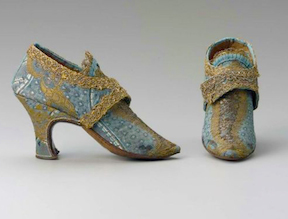
women's-high-heeled-shoes-176070 copy
They were completed with a shoe buckle covered in diamonds, or paste thereof, that offered evidence of the societal position and wealth of the wearer.

But how much thought if any did the Georgian wearer, rich or poor, give to the health of his or her feet in relation to the shoes they were wearing? What discussion, if any, was there about the construction of a shoe in relation to the anatomy of the foot? The answer may surprise you; it did me!

These questions and more about shoes cropped up while I was researching disability in the eighteenth century for my latest novel. I came across a most fascinating little treatise entitled On the Best Form of Shoe, by a remarkable man Petrus Camper (1722-1789) Professor of Medicine, Surgery, and Anatomy, at Amsterdam and Groningen.

On the Best Form of Shoe originated from a jest. Camper wished to prove to his anatomy students that any subject, however trivial, might become interesting if discussed by someone who was knowledgeable of both causes and results. Whether it was Camper or one of his students who gave him his subject matter, the shoe was decided upon as the most trifling of subjects for study. But what Camper discovered from his in-depth research led to some surprising conclusions, some of which are still relevant today.

Camper’s first observation was that while there was much research and debate through the ages on the feet of horses, mules, and oxen and what constituted an appropriate shoe for a beast of burden, humans had almost entirely neglected their own species when it came to knowing anything about the human foot. And while a farrier might know intimately the hoof of a horse, how to care for it and how to correctly place a shoe upon it, a cordwainer (shoemaker) made shoes in ignorance of the anatomy of his own feet.
Shoes were not made for the foot; shoes were made for what Camper described as “the absurdities of fashion and the depraved tastes of the day.” Sound familiar?

Dowie-and-Camper copyJames Dowie, a practical and scientific Scottish cordwainer of the Victorian era, included an English translation of Camper’s treatise on shoes in his own publication The Foot and its Covering, 1861, supporting Camper’s observations of a hundred years earlier—that cordwainers knew so little about their own feet, and nothing about the anatomy of the foot. Dowie was amazed that this was still the case in late Victorian Britain and was forward thinking enough to send the 26 cordwainers in his employ along to a lecture on the anatomy of the foot at the Surgeons Hall in Edinburgh; all came away with a dawning revelation that shoes should be made to fit the foot. Wow! Mind blowing stuff!

Twenty years later, in 1884, Ada Kemply observed in her piece for Popular Science “Fashion and Deformity in the Feet,” that shoes were primarily made to satisfy fashion and with no thought as to the consequences of such fashionable styles on the feet, and that this led to widespread deformities. Kemply concluded that “One cannot treat the deformities of the feet without considering the nature of their covering” and that boots and shoes “cramp, distort, and disable” feet.

But I digress! Let us return to the Eighteenth Century and Professor Camper’s findings on such a “trifling” subject as the shoe…

Camper used the term “victims of fashion” to describe persons wearing a particular shoe form, not for comfort, but because it was the fashionable thing to do. He voiced the hope that enlightened parents would avoid inflicting “torture” (his word) on their children by allowing them to wear shoes that fit their foot for comfort, and he praised those forward-thinking parents who allowed their children to go barefoot in the house, thus allowing their growing feet to form naturally.

You can imagine Camper shaking his head at so called enlightened European society who bestowed compassion on the fate of Chinese women who had their feet dislocated and wholly misshapen by the tradition of foot binding, and who call this practice barbarous, and yet they condemned themselves to a lifetime of discomfort by squeezing into shoes with shapes and sizes wholly inappropriate for their feet.

Upper class women, Camper concluded, were “misled by ridiculous vanity” when it came to shoes, and “cram their feet into smaller than required sized shoes that are tight fitting with high and slender heels” because the fashion is for small feet in high heels. Such shoes “affect walking and constrain the body to walk in unnatural attitudes.” The wealthy, Camper observed, “walk on their toes only” and cannot walk with ease, except on a carpet or smooth pavement. Adding that, “The higher the heels, the greater will be the distortion [to the foot]…and the higher the heel and the smaller the sole, the greater becomes the risk of falls and sprains.”
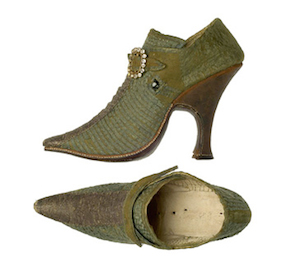
Zapatos-Naples 1730

Zapatos-Naples 1730

Riello in his Ph.D. thesis concurs, saying that in 18th Century France, as in England, the young and fashionable in particular were of the opinion that unless their boots and shoes fit very tight and exact, they were “not proper for any genteel person to wear,” and that the skills of the cordwainer were measured in relation to “his ability to produce shoes that make the feet appear particularly small,” which was the fashion for women of the 1700s.

low-heeled-pointy-1790 copyCamper considered the poor wiser than their social superiors when it came to appropriate footwear. Not dictated to by the whims of fashion, the poor wore sturdy shoes with a low heel that allowed for a firm gait and the ability to walk with ease. However, the stiffened leather, and the fact shoes were made on identical lasts (the template of the foot for shoemaking purposes), meant that many of the poor, too, suffered foot problems such as corns and blisters.

To counter the problems arising from ill-fitting shoes, Camper recommended all shoes be made using a right and left last. A recommendation that today is patently obvious, as both feet are shaped differently. Although there is evidence of shoes being made in pairs specifically for the right and left foot in earlier centuries, cordwainers during the 1700s used identical lasts for both feet. Needing only one last was much more economical, and it was assumed that with wear, the shoe would mold to the wearer’s foot. Yet, in many cases this did not happen, either due to the stiffness of the leather or because it only occurred near the end of the shoe’s usefulness, and by then the health of the feet had deteriorated, sometimes beyond repair.
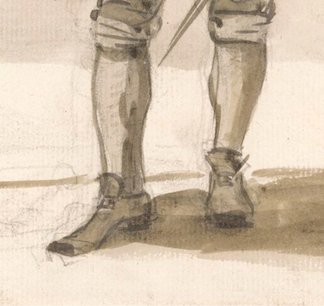
Everyday Shoes for Males

Everyday Shoes for Males

Camper’s treatise included a chapter on club feet and through his scientific observations and findings concluded that such a deformity was unlikely to be corrected by the use of the wooden and steel contraptions of correction available at that time; footwear, like those for the normal foot, should be made specific to the shape of the foot itself.

Professor Camper’s findings were so remarkable for the time that On the Best Form of Shoe was translated from the Dutch almost at once and often, and into several European languages. As stated previously, it was considered worthy of reprint up to as late as 1861, being included in Dowie’s publication The Foot and its Covering.

Shoes of a Cherry Seller

Shoes of a Cherry Seller

Even today, Professor Camper’s scientific study of the shoe makes interesting reading, and much of what he says on the reason particular shoes are worn, not for comfort, but because it is the fashionable thing to do, and the unhealthy consequences on our feet that arise from such choices, can easily be applied to us. 

Hands up all those who wear a particular shoe because it is fashionable. Hands up all those who wear high heels. We are fashion victims one and all, so says Professor Camper.


Meet Lucinda Brant: 

Lucinda Brant is a New York Times and USA Today Bestselling author of GeorgiaDair-Devil-smll copyn historical romances and mysteries. Her latest Georgian historical romance, DAIR DEVIL, Book four in the Roxton Family Saga series, is now available at all eRetailers.
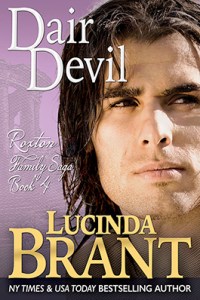
Book Blurb:

Opposites attract.
Appearances can deceive.
A dashing and rugged façade hides the vulnerable man within.
He will gamble with his life, but never his heart.
Always the observer, never the observed, her fragility hides conviction. She will risk everything for love.
One fateful night they collide.
The attraction is immediate, the consequences profound…

London and Hampshire, 1777: The story of Alisdair ‘Dair’ Fitzstuart–nobleman, ex-soldier, and rogue, and Aurora ‘Rory’ Talbot–spinster, pineapple fancier, and granddaughter of England’s Spymaster General, and how they fall in love.

Nook

iBookstore 
Amazon US

Amazon UK

Kobo 

To jump into the 18th Century (there’s a whole board on fabulous shoes!), follow Lucinda on Pinterest.
For more about Lucinda and her books visit her website.

References
**James Dowie, The Foot and its Covering, with Dr. Camper’s Work “On the Best Form of Shoe”, Robert Hardwicke, Piccadilly London, 1861
**Ada H. Keply, “Fashion and Deformity in the Feet,” Popular Science, March 1884. http://en.wikisource.org/wiki/Popular_Science_Monthly/Volume_24/March_1884/ Fashion_and_Deformity_in_the_Feet
**Giorgio Riello, The Boot and Shoe Trades in London and Paris in the Long Eighteenth Century, PhD thesis, University College London, 2002.

Images (Attached but also shown here for ease of referencing the description)

Lucinda Brant’s Dr. Martens 

James Dowie’s The Foot and its Covering, with Dr. Camper’s Work “On the Best Form of Shoe”

Sturdy shoes of a street cherry seller, detail Paul Sandby 1759

Sturdy shoes of the ordinary pedestrian, Paul Sandby (1731-1809) http://siftingthepast.com/

Zapatos—High heeled shoes, Naples,1730. http://www.pinterest.com/pin/278589926920765703/

Pair of women’s high heeled shoes (buckle missing), European, 1760–1770s, MFA, Boston http://www.pinterest.com/pin/278589926923956179/

Low heeled but particularly pointy slippers, c.1790, British, silk. http://www.pinterest.com/pin/ 278589926922824266/

Posted in British history, customs and tradiitons, fashion, Georgian Era, Great Britain, Living in the UK, royalty | Tagged , , , , , , , , , | 9 Comments

British Thoroughbred Racing History

With the onset of the Triple Crown in America, I thought we might take a look at the British thoroughbred racing history. I have used “horses” and “racing” several times as part of story lines, most recently in the novellas “His American Heartsong” from His: Two Regency Novellas. 

a modern Arabian

a modern Arabian

One of the more challenging aspects of writing historical romance is the amount of research one must do. It is not uncommon to spend 8 hours researching a fact that in less than a paragraph in the book. However, one must do it. Recently, I added the element of thoroughbred racing to a novella I was writing. I have always said that if I hit the lottery, I was going to move to KY and raise thoroughbreds. So, finding out about thoroughbreds was time consuming but oh, so exciting. Did you know that the origins of modern racing go back to the Crusades. Between the 12th and 16th centuries, Arab stallions were imported into England and mated with English mares to breed in speed and endurance.

Professional horse racing sprang to life in the reign of Queen Anne (1702-1714). By 1750, racing’s elite formed the Jockey Club at Newmarket. The Jockey Club still exercises complete control of English racing.

Since 1814, five races for 3-year-olds have been designated as “Classics”: The English Triple Crown, which includes the Epsom Derby, the 2000 Guineas, and the St. Leger Stakes, is open to both male and female horses. The Epsom Oaks and the 1000 Guineas is only for fillies.

Volume 6 of the General Stud Book, published in London in 1857

Volume 6 of the General Stud Book, published in London in 1857

Besides writing rules for racing, the Jockey Club designed steps to regulate horse breeding. James Weatherby traced the complete family history (pedigree) of every horse racing in England. In 1791, The Introduction to the General Stud Book was published. By the early 1800s only horses descended from those listed in the General Stud book could be called “thoroughbreds.”

Now this is the amazing fact!!! Thoroughbreds are so inbred that the pedigree of every single horse can be traced back to to one of three stallions, which are referred to as the “foundation sires.” These stallions are Byerley Turk (foaled c.1679); the Darley Arabian (foaled c.1700), and Godolphin Arabian (foaled c. 1724).

The three founding fathers of the turf

Following the family tree of the Godolphin Arabian, the Byerley Turk and the Darley Arabian is rather like compiling a ‘who’s who’ of racing champions!

The Godolphin Arabian

**Foaled about 1724
**Probably exported from Yemen via Syria to the stud of the Bey of Tunis
**Initially given to Louis XV of France in 1730, he was then imported to Britain
**Sired the best racehorse of the day, called Lath
**The Godolphin Arabian’s line hasn’t won the Derby since Santa Claus in 1964, and has recently been overshadowed by the Darley Arabian’s descendants

The Byerley Turk, one of the progenitors of the Thoroughbred breed, may have been a Turkoman horse.

The Byerley Turk, one of the progenitors of the Thoroughbred breed, may have been a Turkoman horse.

The Byerley Turk, one of the progenitors of the Thoroughbred breed, may have been a Turkoman horse.

The Byerley Turk

**Foaled about 1680
**His line includes Herod, foaled in 1758, who was leading sire eight times
**Descendent Highflyer and his sons were champion stallions 23 times in 25 years
**The Byerley Turk’s line now has much less influence than that of the Darley Arabian.

 
The Darley Arabian

**Foaled about 1700

**Amongst others, he sired Bartlett’s Childers whose great grandson was Eclipse

**Over 80% of modern racehorses can trace their descent to Eclipse, including the great Canadian stallion Northern Dancer.
The golden story of Eclipse

A descendent of the Darley Arabian, Eclipse was foaled in 1764, the year of the great eclipse of the sun. He won 18 races, never appearing the least bit stretched. Owners were reluctant to put their horses up against him and eight of his races were declared walkovers!

Eclipse retired to stud in 1771 and sired three Derby winners but his ability to sire offspring that were well adapted to the new shorter races for two and three year olds ensured him a place in the racing history books.

However, due to terrific competition from Herod and the Byerley Turk line, Eclipse was never actually declared champion.

After his death, Eclipse was dissected to try to work out the secret of his success – it was decided that his huge heart pumped blood around the body more effectively, while his back legs gave plenty of leverage. Powerful lungs completed the winning combination. His skeleton is still owned by the Royal Veterinary College and can be seen at the National Horseracing Museum in Newmarket.

Posted in British history, Great Britain, Living in the UK, real life tales | Tagged , , | 5 Comments

Maria Kinnaird, Mid-Victorian Socialite and Hostess

Maria Kinnaird (1810–1891) was born on St. Vincent, but was orphaned by a volcanic eruption and she was adopted by the politician “Conversation Sharp.” (See my March 29 post on Sharp.) Sharp was once considered possibly to be the most popular man in London of his time, and she inherited through him not only a considerable fortune but a wide network of influential friends and contacts, particularly among Whig circles. She became a prominent socialite and leading hostess in London during the mid-Victorian period, being described as an accomplished, attractive, and intelligent woman. In 1835 she married Thomas Drummond, who developed the use of Drummond Light in surveying, and it is said gave him important support during his final years when he was held in high regard as Under-Secretary for Ireland (1835–40).

Thomas Drummond

Thomas Drummond

Biography
Maria Kinnaird was the adopted child of the politician Richard Sharp. Sharp never married, but in about 1812 Maria was orphaned following a catastrophic volcano eruption on the West Indian island of St Vincent where her parents are said to have been planters. The circumstances are unclear, but it became the joint decision of Richard, his brother William, and William’s wife, Anna, that they should bring Maria to their Park Lane home and legally adopt her. By this time, Richard “Conversation” Sharp was a distinguished and wealthy London character, and Maria was given every advantage, educationally, socially and culturally to take her place in society. Sharp moved in the highest Whig circles, and Maria came to know many of the best artists, musicians, politicians and socialites of the time. When her adoptive father died, she moved into a house in Hyde Park Gardens while maintaining the family retreat, Fredley, in Mickleham, Surrey.

As a teenager Maria became very friendly with Dora Wordsworth, a friendship that lasted until Dora’s death and some of their correspondence still exists. Maria is said to have possessed an exceptional singing voice, of which William Wordsworth was particularly enamoured. Among her many friends were Sydney Smith, the artist J.M.W. Turner, John Russell, 1st Earl Russell, Professor Wheatstone, George Meredith, Charles Babbage, Michael Faraday, Austen Henry Layard, Henry Petty-Fitzmaurice, 4th Marquess of Lansdowne, Henry Hart Milman, Richard Westmacott, Sir George Trevelyan, 2nd Baronet, Sir Charles Barry, Archbishop Richard Whately, Edward Bulwer-Lytton, 1st Baron Lytton and Farrer Herschell, 1st Baron Herschell. All of these distinguished men, and many others, were entertained by Mrs Drummond at Hyde Park Gardens and at Fredley between the years 1843 and 1891. For further references to her social circle see ‘Lord Byron and his Times.’ and ‘The Letters of Matthew Arnold.’

At one time there were rumours that Maria would marry the historian Thomas Macaulay, and the son of Samuel Romilly was also thought to have been infatuated with her, but in the end she married Thomas Drummond at Weston House the impressive home of Sir George Philips, 1st Baronet. She became her husband’s mainstay during a particularly stressful period – leading to his death – when he successfully acted as under-Secretary for Ireland (1835-1840).

Maria and Thomas had three daughters, Fanny, Mary (who became the wife of Joseph Kay) and Emily. In her declining years, it is said that Robert Browning frequently visited Maria at Fredley to read her some of his and his wife’s poetry.

Maria Drummond died in 1891, and she is buried in Mickleham churchyard. She left an important self-portrait of Sir Joshua Reynolds to her daughter, Emily Drummond, who eventually gave it to the National Gallery in London. The painting had originally been purchased by her adoptive father, Richard Sharp, from Hester Thrale for just over £128 in 1816.

Her fascinating biography, Maria Drummond – A Sketch was written by the author/publisher, Charles Kegan Paul at the request of two of her daughters.

Maria Jane Kinnaird

Posted in British history, political stance, real life tales, Victorian era | Tagged , , | 3 Comments

The Wonderful World of the English Language – Americanisms

The Wonderful World of the English Language – Part Three

from cam.ac.uk

from cam.ac.uk

People have certainly responded well to the previous two posts regarding how words and phrases have come into the English language. These are some of my favorite Americanisms.

To Play Possum
Some three centuries prior, American hunters discovered the opossum’s ability to literally play dead. When confronted, an opossum will lie with its eyes closed and its limbs limp and unresponsive. Only when the animal is tossed in water will it become active again.

The Whole Kit and Caboodle
The phrase comes to us from “the whole kit and bilin’.” It means to omit nothing. “The whole kit” means the whole lot (either inanimate objects or people). “Bilin’” comes to us from “boiling,” meaning a seething mess, especially of persons. Americans transformed the original phrase into “the whole kit and boodle.” The word “boodle” comes from the Dutch word boedel, meaning property and goods. One thing we find in many Americanisms is the use of alliteration. Therefore, “boodle” was given the “k” sound to match with “kit.” We have “the whole kit and caboodle.” (By the way, “boodle” was later used to mean money gotten from ill ways…by graft or bribery.)

On Easy Street
This American phrase comes from the late 18th or early 19th Century. The Dictionary of American English gives credit to George V. Hobart’s 1902’s It’s Up to You. The line describes a young man “who could walk up and down Easy Street.”

Bats in One’s Belfry
This phrase was coined in the early 20th Century. In 1899, William J. Kountz’s Billy Baxter’s Letters describes a scene from an opera: “The band cut loose something fierce. The leader tore out about $9.00 worth of hair, and acted generally as though he had bats in his belfry. I thought sure the place would be pinched.” Kountz claims the book contains “up-to-date slang.” In Elbert Hubbard’s Little Journeys to the Homes of Eminent Painters, Hubbard quotes painter James Whistler dismissing French artist Gustave Doré by saying, “Doré – Gustave Doré – an artist? Why, the name sounds familiar! Oh, yes, an illustrator. Ah, now I understand; but there is a difference between an artist and an illustrator, you know, my boy. Doré – yes, I knew him – he had bats in his belfry.” English Language and Usage says “This reference is interesting because Hubbard later refers to the phrase as a joke and a bon mot. It’s possible that the joke part is in reference to the bat-like wings of devils portrayed in many of Doré’s works.” In late 1899, a third reference refers back to Hubbard. In The Child Study Monthly, it said, “A parent or teacher who would do this is to our mind ‘born a button short’ or, to use a term from the expressive vernacular of the streets, but dignified by that noble and intensely human literary Philistine, Fra Elbertus, such a person has ‘bats in his belfry’ which, being interpreted, meaneth ‘rats in his garret’ or ‘wheels in his head.’”

To Be in the Hole
This has something to do with a game of poker, but it is not what you might original think. In this phrase we are speaking of a slot cut in the table’s middle. Underneath the table is an attached locked box. John P. Quinn describes the practice of the gambling hall taking a percentage of each pot/hand. In Quinn’s 1892’s Fools of Fortune, he says, “a pair of aces and another pair, and you must go to the hole with a check.”

Lock, Stock, and Barrel
The first literary reference to this phrase comes to us from T. C. Haliburton’s “Sam Slick” stories. Haliburton was a politician, judge, and author in the British Colony of Nova Scotia. He was the first international best-selling author from what is now Canada. He rose to international fame with his Clockmaker serial, which first appeared in the Novascotian and was later published in book form throughout the British Empire. The books recounted the humorous adventures of the character Sam Slick and became popular light reading. The three parts of a gun are named in the phrase = the whole thing. As a point of note, we find The Haliburton Society, still active at King’s College, Halifax, the longest-standing collegial literary society in the Commonwealth of Nations or North America. In addition to “lock, stock, and barrel,” Haliburton is also credited with saying he had enjoyed “playing hurley on the ice,” which is the first know reference to hockey in Canada and is the basis of Windsor, Nova Scotia’s claim to being the town that fathered hockey (as Haliburton was born in Windsor).

I’m from Missouri (Show Me)
Williard D. Vandiver was a representative to Congress from Missouri. According to the Washington Post, at an impromptu address before the Five O’Clock Club of Philadelphia on 31 May 1932, Vandiver defended his home state against a speaker who had portrayed Iowa as the superior state. Vandiver said, “I come from a country that raises corn, cotton, cockleburs, and Democrats. I’m from Missouri, and you’ve got to show me.” Vandiver’s constitutes liked the image the Congressman created of shrewdness. Soon Missouri became known as the “Show Me” State.

None of One’s Funeral
We first find this phrase in print in the Oregon Weekly Times in 1854. “A boy said to an outsider who was making a great ado during some impressive mortuary ceremonies, ‘What are you crying about? It’s none of your funeral.’” Needless to say, the youth likely repeated a phrase he had heard many times, rather than coining a new phrase. The phrase is likely to have traveled from the West to the eastern part of the U.S. It was even heard on the floor of Congress. According to the Bite Size of Amazing Facts, the 49ers and others likely carried the phrase to the East. The phrase was used on the floor of Congress to mean, “to pull wires (or strings). A wirepuller, these days, is one who uses political influence or the like to gain or to win an advantage…. But the original wirepuller was the artist in a marionette show who manipulated the strings or wires that moved the limbs of the puppets.” How the phrase has morphed into a meaning so diverse from the original is hard to say. http://www.bigsiteofamazingfacts.com/what-does-the-phrase-none-of-ones-funeral-mean-and-where-does-it-come-from/

Porterhouse Steak
“Porterhouse” comes to us from porter beer, a heavy dark beer brewed from browned or charred malt. The beer was brewed in England as early as 1750. By the late 1700s, Ireland brewed porter beer as a reaction to increased imports from London. In the mid 1800s, the word “porterhouse” meant a resting place for weary travelers. These places served steak and ale, including porter beer.
One version of the popular steak comes to us from Manhattan’s Pearl Street in 1814. Martin Morrison served large T-bone steaks in his establishment, which was one of the first porterhouses in the U.S.
In another version of the story, the Porter House was an early New York tavern (some say the tavern was in Cambridge, Massachusetts) known for its steaks. One eventful evening, the tavern ran out of the steaks it usually served the patrons. So Mr. Zachariah B. Porter went into his private stock and chose a large piece of sirloin to broil. The steak was declared to be scrumptious. The cut of meat was added to the menu as a “porterhouse steak.” The Porter House, a 19th Century hotel, in Flowery Branch, Georgian, also claims to have first used the phrase to refer to a steak on its fare. Either way, those who love a good steak find the beef tenderloin (filet mignon) combined with a New York strip cut one of the best steaks to be eaten. http://www.mcallenranchbeef.com/rancher/history-of-the-porterhouse-steak/

To Skin the Cat
This means to hang by one’s hands from branch or bar, bring the legs up and through the arms, and to pull oneself onto a seated position upon the branch/bar. Some experts believe this phrase comes to us from Ben Franklin or his cohorts. However, the phrase is not found in print until 1845. To make this move, it was reminiscent of removing the pelt from a cat first from the forelegs and then down the body. Random House Dictionary of Popular Proverbs and Sayings (by Gregory Y. Titelman) mentions a 1678 proverb (also mentioned in John Ray’s collection of English proverbs and first attested in the U. S. in “John Smith’s Letters.” The phrase reads as “There are more ways to kill a cat besides choking him to death.” http://www.phrases.org.uk/bulletin_board/61/messages/1056.html

from geekdad.com

from geekdad.com

Posted in language choices, word play, writing | Tagged , , | 4 Comments

King of Clubs, Whig Conversation Club of the Early Regency Period

Unknown The King of Clubs was a famous Whig conversation club, founded in 1798. In contrast to its mainly Tory forerunner The Club (established by Samuel Johnson, Edmund Burke and Sir Joshua Reynolds), it was a predominantly Whig fraternity of some of the most brilliant minds of the day. For an early description of the club see W.P. Courtney’s description in ‘Lord Byron and his Times.’51dxB7rG-+L._BO2,204,203,200_PIsitb-sticker-v3-big,TopRight,0,-55_SX278_SY278_PIkin4,BottomRight,1,22_AA300_SH20_OU01_

Membership
The original inspiration for its formation came from the Rev. Sydney Smith’s older brother, Robert – nicknamed “Bobus” after gaining the reputation at Eton for being such a clever Latin “versifier.” The founding members were a group of friends who first met at the house of James Mackintosh in February, 1798. As well as Mackintosh, the group comprised Samuel Rogers, James Scarlett, 1st Baron Abinger, Richard “Conversation” Sharp (see my March 29 post on Sharp), the historian John Allen and Robert Smith, and by 1801 what had started as a small clique of friends had become a properly constituted club comprising the following members,

Richard Porson
Smithson Tennant
John Courtney
Bryan Edwards
“Bobus” Smith
Jo. Richardson
John Allen
Samuel Rogers
Charles Butler
Richard Sharp
James Scarlett, 1st Baron Abinger
James Mackintosh
William Dickinson
John Whishaw
Josiah Wedgwood II
Pierre Etienne Louis Dumont
Henry Vassall-Fox, 3rd Baron Holland

Within seven years the club expanded to include such additional illustrious names as

Thomas Moore
John Wedgwood
Henry Brougham
Thomas Creevey
William Smith
Lord Petty
George Philips
Francis Horner
Rev. Peter Elmsley
Samuel Romilly
John Ward, 1st Earl of Dudley
Rev. Sydney Smith
John Hoppner
Samuel Boddington

The King of Clubs had by now become well known throughout London as an exclusive Whig dining club where erudite conversation on all matters pertaining to books, authors and literature took place, but where the discussion of politics was positively excluded. Tom Campbell described the club as “a gathering-place of brilliant talkers, dedicated to the meetings of the reigning wits of London”. The annual subscription had originally been set at 2 guineas but this was reduced to £2 in 1804, raised to 3 guineas in 1808, and finally fixed at £3 in 1810. As a dining club, an additional charge of 10 shillings and 6 pence was made for dinner, a considerable sum in those days, and princely suppers were held in Harley Street and later at the Crown and Anchor, Arundel Street, in the Strand. The Crown and Anchor was the very inn where Samuel Johnson and James Boswell had once enjoyed supping together; and it was especially popular among the Whigs after it had hosted a great banquet in honour of Fox’s birthday in 1798, when an enormous crowd of 2000 Reformers had toasted The People – the Source of Power!

Such was the popularity of the King of Clubs, and so sought after did membership become, that in 1808 a decision was taken to limit membership to a maximum of thirty people who were resident in England. By this time the membership had gained:

Lord Melbourne
Earl Cowper
William Blake
Abercromby (Lord Dunfermline)
Alexander Baring, 1st Baron Ashburton
Charles Kinnaird, 8th Lord Kinnaird
Henry Luttrell
R.P. Knight
Thomas Malthus
Lord John Townshend MP
John Fleming
John Playfair
George Lamb
Lord King
Henry Hallam
David Ricardo
Lord Thomas Denman, 1st Baron Denman

In 1797 Bobus Smith, the originator of the club, accepted a seven year posting in India as Advocate General of Bengal. His move abroad was a great loss to the King of Clubs and while he was away he asked Richard Sharp to perform a number of duties for him:

“…for I bear you the warmest and most sincere regard, and look upon your friendship as one of the greatest pleasures, past and to come, which has fallen in my way these many years.”

Sydney Smith came to London and took his brother’s place at the club in 1803/4, having previously worked with Francis Jeffrey and Henry Brougham on the Edinburgh Review, a renowned Whig literary magazine, which, with Allen, he had helped to initiate. When he arrived in the city, the irrepressible Sydney formed an immediate attachment to the King of Clubs and his unique sense of humour quickly endeared him to other members and gave meetings an added piquancy. The club lost another of its original members when Sir James Mackintosh, recently knighted, accepted the post of Recordership of Bombay in 1804 and followed in Bobus’s footsteps.

A record book of the King of Clubs has been preserved and a typical meeting of about this time (1804) lists the following members in attendance:

Richard Porson
Richard Sharp
James Scarlett
Sir James Mackintosh
Sydney Smith
Samuel Boddington
Hon. William Drummond
George Philips Manchester
Henry Luttrell
David Ricardo
Charles Kinnaird, 8th Lord Kinnaird Lower Grosvenor St

Meetings
Meetings of the King of Clubs did not always take place at the Crown and Anchor, and after 1819 they were held at the Freemasons’ Tavern, at Grillions in Albemarle Street, and latterly at the Clarendon Hotel. A surviving account from one of the club’s early meetings shows that a dinner for twelve members cost a £24, which included two bottles of Madeira, three bottles of Sherry, two bottles of Port and three bottles of Claret. Despite such unashamed conviviality there is no evidence that alcohol in any way impeded the flow or the quality of the conversation that took place, and we may imagine that the reverse was probably the case since the atmosphere was always a happy blend of the jovial and the serious. It was expected that members should give time to the preparation of their bon-mots, witticisms and anecdotes so that in due course these could be woven into the discussion as productively and effectively as possible. Clayden recalls how on one occasion Sharp, in fun, chanced upon Boddington’s notes before a meeting, made a mental note of all his stories and brought them into the conversation before Boddington could relate them himself.

The preparation that members were expected to undertake before attending meetings of the King of Clubs does not seem to have spoiled either the spontaneity of what occurred or the enjoyment of those who attended. Yet when Francis Horner had his first experience of the club, on 10 April 1802, he gained a very mixed impression, finding the conversation less animated than he had anticipated but attributing this to the absence of Sydney Smith:

“This day I dined at the King of Clubs which meets monthly at the Crown and Anchor in the Strand. The company consisted of Mackintosh, Romilly, Whishaw, Abercromby, Sharp, Scarlett, etc. Smith is not yet come to town. The conversation was very pleasing. It consisted chiefly of literary reminiscences, anecdotes of authors, criticisms of books, etc. I had been taught to expect a very different scene – a display of argument, wit and all the flourishes of intellectual gladiatorship, which though less permanently pleasing, is for the time more striking. This expectation was not answered, partly, as I am given to understand, from the absence of Smith, and partly from the presence of Romilly, who evidently received from all an unaffected deference and imposed a certain degree of restraint.”

Horner regretted that there was no discussion of political ideas and complained that Sharp and Mackintosh seemed to be too much in agreement with one another, “as if they belonged to a kind of sect.” In a sense this remark was quite true, but Horner was quite happy to become a member of the sect himself that year and Clayden confirms that by 1804 Mackintosh and Sydney Smith had established “a kind of society” which still held parties “once or twice every week” in their own homes. In effect these were a continuation of the informal meetings which had started in 1798 and which Horner was now happy to attend. As far as the more formal meetings of the club were concerned there was broad agreement by members that James Mackintosh and Sydney Smith were the most brilliant contributors. Tom Moore felt that certain of the group, Mackintosh included, invested so much of their time and energy in club proceedings that their literary and professional careers suffered as a direct consequence, but whatever the risks, the King of Clubs enjoyed immense status as a place where superb conversation might be found and accordingly membership became more keenly sought than ever. In 1809, and mindful of those times when he had been in financial straits, Sydney Smith wrote dryly to Lady Holland:

“…we have admitted a Mr Baring, importer and writer, into the King of Clubs, upon the express promise that he lends £50 to any member of the club when applied to. I proposed this amendment to his introduction which was agreed to without a dissenting voice.”

Smith added pointedly:

“I wish you would speak to [Samuel] Romilly about the levity and impropriety of his conversation – he is becoming an absolute rake and Ward and I talk of leaving the Club if a more chaste line of dialogue is not adhered to.”

At one stage it was proposed by Mackintosh that the conversation and witticisms of their meetings should be recorded in a literary magazine, to be called The Bachelor. It was felt that there existed more than sufficient material to support a twice-weekly publication, but although the idea had the support of Rogers, Robert Smith, Scarlett and Sharp, the project never materialised. Consequently, though the Club’s meetings spanned a quarter of a century, few details hav$e survived of the bonhomie, the magic and the sparkling conversation that went on at them. The reason for the final demise of the club is not known but the poet Thomas Campbell became a frequent guest and in the following letter to a friend he reflects on some of the reasons why he himself gradually became disenchanted:

“Much of the art and erudition of these men please an auditor at the first and second visit; the trial of minds becomes at last fatiguing because it is unnatural and unsatisfactory. Every one of these brilliants goes there to shine, for conversational powers are so much the rage in London that no reputation is higher than his who exhibits them to advantage. Where everyone tries to instruct there is, in fact, but little instruction. Wit, paradox, eccentricities, even absurdity, if delivered rapidly and facetiously, takes priority in these societies of sound reason and delicate taste. I have watched sometimes the devious tide of conversation guided by accidental associations turning from topic to topic and satisfactory upon none. What has one learned? – has been my general question. The mind it is true is electrified and quickened, and the spirits are fiercely exhilarated, but grand fault pervades the whole institution – their enquiries are desultory, and all improvements to be reaped must be accidental.”

Ending
As a creative phenomenon perhaps it was inevitable that the King of Clubs should enjoy an initial period of rapid growth, reach a high point of maturity, and then suffer a final decline. Perhaps the appeal of such a club went out of fashion, or perhaps more likely it simply outgrew itself and became a victim of its own success. As more and more people with diverse personalities and different conversational skills became members, the dynamics of the group must inevitably have changed and in Campbell’s view the club was ultimately consumed in the heat of its own incandescence. But as it came towards its end, the final glowing embers were not easily extinguished in the hearts of members and many warm memories were kept alive. A good number of those who had attended meetings for much of their lives would reflect nostalgically in old age on what wonderfully pleasurable times had been spent at the club. Richard Sharp summed up the sentiment at the very end of his life, when he wrote to Scarlett on the 13th of November, 1834:

“Ah yes! – our King of Club days with Mackintosh, Bobus, Dumont and Romilly, were days that the Gods might envy!”

Posted in British history, George IV, Great Britain, language choices, Living in the Regency, political stance, real life tales, Regency personalities, Victorian era | Tagged , , , , , , , , , , , , , , , | 1 Comment

“Conversation” Sharp – Victorian, Richard Sharp, Doyen of the Conversationalists

Richard Sharp, FRS, FSA (1759 – 30 March 1835), also known as “Conversation” Sharp, was a hat-maker, banker, merchant, poet, critic, British politician, but above all – doyen of the conversationalists.

Family Background
Sharp was born in Newfoundland. His father, also Richard Sharp, came from a well-known family of merchants in Romsey, England, and in 1756 joined the British army as a nineteen-year-old Ensign in His Majesty’s 40th Regiment of Foot – a regiment which would later became known as the “illustrious 40th” after distinguishing itself during the Seven Years’ War against the French in North America (1756–1763). While garrisoned at St. John’s in Newfoundland, Ensign Richard Sharp met and fell in love with Elizabeth Adams, a citizen of St John’s, and they were married in 1759. Richard and Elizabeth’s first son was soon born and, though naming him ‘Richard,’ they could have had little idea when he grew up he would become variously known throughout London society as ‘Hatter Sharp,’ ‘Furrier Sharp,’ ‘Copenhagen Sharp’ (after a famous speech that he gave as an MP castigating the British bombardment of Copenhagen) or, most famously of all, as ‘Conversation Sharp’ Long before this time, and while the Lieutenant was still in North America fighting the war, his grandfather was establishing a highly successful firm of hat-makers on Fish Street Hill in the very heart of London. Thither, in about 1763, the wounded soldier and his family returned from Newfoundland and there he died a few years later at the age of twenty-eight. His grandfather had been a close friend of Isaac Watts, all the family being staunch Dissenters, so Richard was buried in the family vault within the Dissenters’ graveyard at Bunhill Fields (where his tomb-stone is still visible).

In 1769, the widow Elizabeth Sharp married Thomas Cable Davis, a partner in the hatter’s business, and they had further children, while it was not long before Richard Sharp, still in his teens, began to assume a major responsibility for the family business as evidence of his exceptional abilities.

Biography

Isaac Watts

Isaac Watts

Until the age of 13/14, Richard Sharp was educated at Thaxted, Essex, by the Rev. John Fell, a Dissenting minister, and a friendship sprang up between the two which lasted until Fell’s death. At the age of 24, Sharp wrote the “Preface” to Fell’s influential book, An Essay towards an English Grammar (1784), a work which is still acknowledged and quoted to this day. Graduating from Fell’s care, Sharp returned to the family home/business at 6 Fish Street Hill to begin a 7-year apprenticeship to become a master hatter. In this role he excelled, not only rescuing the business from imminent commercial failure but gradually developing his exceptional erudition and powers of conversation in such a way as to enable him to rise from the humble ranks of hatter to reach celebrity status in several different spheres of life. A commentator described Sharp at about the age of thirty as,

…already a figure in society, where his great conversational powers and his unbounded goodness of heart made him universally welcome. His judgement was trusted by all who knew him, and in later years statesmen went to him for counsel and advice. It would scarcely be too much to say that he was the most popular man in London society in his time.

Sharp thought seriously about joining the legal profession and he was admitted to the Inner Temple on 24 January 1786. It seems however that his strict moral conscience could not be reconciled with the prospect of having to defend a guilty man, and in the end he was not called to the Bar. In 1798 he finally retired from the hatter’s business and joined a firm of West India merchants run by his friend Samuel Boddington in Mark Lane, a third partner later becoming Sir George Philips. Sharp made so much money as a merchant, and through his investments and banking connections, that he eventually left an incredible £250,000 in his Will. He was once described as being ‘one of the most considerable merchants in London’ and his acquired knowledge of the shipping business enabled him to give crucial support and advice to Samuel Coleridge in 1804 when the poet was about to leave England for health reasons. Indeed, as a respected London critic, Sharp gave important assistance and encouragement to both Coleridge and Wordsworth, among many others, and although much of their correspondence with Sharp has been sold overseas, some may still be seen within the poets’ collected works.

Powers as a Conversationalist
Despite his modest roots, Richard Sharp’s exceptional cleverness and powers of conversation gained him acceptance in the highest social circles and led to him acquiring his lasting sobriquet. Although he achieved distinction in many areas, he nevertheless seems to have made most impact upon people simply because of his basic human kindness and wisdom, as a few quotes from some of those who knew him well will illustrate:

John William Ward, later Earl of Dudley, was not only a man of immense personal wealth but similarly renowned for being an extremely talented, quick-witted and humorous man with a tenacious memory. He described Richard Sharp as,

Hatter Sharp, alias Copenhagen Sharp, alias Conversation Sharp, he is my particular friend, and I cannot forbear adding in perfect seriousness one of the most thoroughly amiable, good-tempered, well-informed, sensible men that I have ever become acquainted with.

Francis Horner, an original contributor to the Edinburgh Review and a barrister before he turned to politics, met Sharp when he came to London:

This morning spent with Sharp has forced me to attempt again a journal. He is a very extraordinary man; I have seen so much of him lately that I determine every day to see more of him, as much as I possibly can. His great subject is criticism, upon which he always appears to me original and profound; what I have not frequently observed in combination, he is both subtle and feeling. Next to literature, the powers of his understanding, at once ingenious and plain, show themselves in the judgement of characters; he has seen much of the great men of the last generation and he appears to have seen them well. In this particular his conversation is highly interesting; from his talent of painting by incidents and minute ordinary features, he almost carries you back to the society of those great personages and makes you live for a moment in their presence.

Horner later wrote to Lady Mackintosh in 1805 in the same admiring tones, complaining that he simply could not get enough of Sharp’s company and telling her ‘….Sharp I respect and love more and more every day; he has every day new talents and new virtues to show’. Her husband, Sir James Mackintosh, was one of the few people that Sharp felt able to discuss metaphysics with and he expressed the opinion that Richard Sharp had made a greater influence on his thinking than almost any other person. In Byron’s opinion Sharp was one of those who had ‘lived much with the best – Fox, Horne Tooke, Windham, Fitzpatrick and all the agitators of other times and tongues..’ while Macaulay was similarly impressed by Sharp when he commented in a letter to his sister before leaving for India,

….the other day I had a long talk with Sharp about everything and everybody – metaphysics, poetry, politics, scenery and paintings. One thing I have observed in Sharp which is quite peculiar to him among Town wits and diners-out – he never talks scandal. If he can say nothing good of a man he holds his tongue. I do not of course mean that in confidential communications about politics he does not speak freely of public men, but about the follies of individuals I do not believe that – as much as I have talked with him – I ever heard him utter one word. I passed three or four hours very agreeably in his company….

As a young man Sharp met Samuel Johnson and Edmund Burke and dined regularly with Boswell. He was a close friend of the dramatist Richard Cumberland, of Mrs Siddons, and of John Henderson the actor. The latter once asked Sharp to report on the acting ability of an up-and-coming rival, John Kemble, which Sharp did and his accurate account of Kemble may still be read.

Political Reform
By the late 1780s Sharp was at the hub of the Dissenter movement in London at a crucial period in history when Revolution was in the air and when young intellectual Whigs such as he fell under natural suspicion. (See Richard Price and the Revolution Controversy.) He belonged to the Society for Constitutional Information and helped, with other leading Whigs, to establish the Friends of the People society. At about the same time he became one of the Dissenters’ ‘Deputies’ – it being the custom for each dissenting congregation within ten miles of London to be represented by two such deputies and their common aim being to overturn the notorious Test Acts which so discriminated against them. In this latter connection Sharp issued a famous ‘Letter’ in support of repeal which may still be viewed within the British Library records. In 1787 the Society for Effecting the Abolition of the Slave Trade was formed and Thomas Clarkson records that Richard Sharp was elected onto this famous Committee along with David Hartley (the Younger). The Committee produced prints showing the layout of a typical slave ship (Brookes (ship))and how cramped it was, which had a profound effect on all who saw it, significantly helping to change public opinion regarding the slave trade. The print showed each slave being allocated less than 2metres height and .5 metre width for a lengthy sea voyage that could last for 6 months or more, such figures being calculated on the assumption that there were about 400 slaves on a ship when in fact it was known that there were sometimes more than 600.

Friends and Acquaintances
Sharp’s reputation as a critic increased when his close friend, Samuel Rogers, began to emerge as the most eminent and popular poet of that period (his poem “To a Friend” being dedicated to Sharp) and both visited Wordsworth in the Lakes and gave him important ‘city’ support before this new, naturalistic style of poetry became truly fashionable. The Rogers family in Newington Green was a well known one in Dissenting circles, and the names of Joseph Priestley, Samuel Parr, Richard Price, Rev. John Fell, Kippis and Towers were eminently familiar to both men. Apart from a common interest in Unitarianism, both Sharp and Rogers became well known for their good taste at a time when ‘taste’ was one of the most vital commodities that an aspiring young man could acquire. Rogers’ home in St James’s Place was visited by almost every famous person in London and he was a guest of royalty. Both men were habitues at the fashionable Whig salon, Holland House, and considerable correspondence between Sharp and Lord and Lady Holland has survived to this day. When Sharp moved to his house in Park Lane he acquired portraits painted by Reynolds of Johnson, Burke and of Reynolds himself as symbols of those things that he most cherished – language, oratory and art. At his cottage retreat, in Mickleham, Surrey, he received politicians, artists, scientists and some of the cleverest minds of the day including people from abroad such as the intriguing but formidable Mme de Staël. Guests were recorded and included such names as Henry Hallam, Thomas Colley Grattan, Sydney Smith John Stuart Mill, James Mill, Basil Hall, Dugald Stewart, Horne Tooke, Lord Jeffrey, Archbishop Whately, Walter Scott, Tom Moore, George Crabbe, Michael Faraday, Charles Babbage, Richard Porson, Maria Edgeworth, Francis Chantrey, and Sir Thomas Lawrence.

Clubs and Politics
Sharp was a founder member of the intellectual ‘King of Clubs’ conversation club as well as a leading figure in founding the London Institution in 1806, a venue for popular education and a forerunner of London University. He belonged to a great many London Clubs and Societies, such as Brooks’s, the Athenaeum, the ‘Unincreasable,’ the ‘Eumelean’ and the ‘Clifford-street Debating Club.’ An early member of the Literary Society, in 1787 he became a Fellow of the Society of Antiquaries and in 1806 he was elected a Fellow of the Royal Society, his application for the latter being supported by such names as Charles Burney Jnr, James Watt and Humphry Davy. During the period 1810-1812 Sharp was appointed Prime Warden of the Fishmongers’ Company in London and at different times represented the Whig party as a dissenting Member of Parliament for Castle Rising from 1806 to 1812, Portarlington from 1816 to 1819 and Ilchester from 1826 to 1827. In the House of Commons he often sat next to his friend, Samuel Whitbread, and supported his move for popular education.

End of Life
Sharp once considered writing a history of American independence and wrote to his friends, John Adams and John Quincy Adams about this and other matters. He also considered writing a tourist’s guide to Europe after becoming so familiar with continental travel that he was once called ‘the Thomas Cook of his day.’ In the event his only publication was a slim volume of ‘Letters and Essays in Prose and Verse’ published shortly before his death.

Towards the end of his life Sharp liked to spend the winter months at his house in Torquay (Higher Terrace) where he was able to look out to sea and no doubt think fondly of his birthplace in Newfoundland. He had suffered all his life with a cough and a bad chest and Torquay was noted for both its health-giving air and Italianate landscape, but in 1834 the winter was particularly severe and as Sharp succumbed he resolved that he would die in his beloved London. He set off for the city with his family and servants but only got as far as Dorchester before expiring at the coaching inn there. Fearful that a nephew might obtain and subvert his Will, we are told that 70-year-old George Philips, in a final act of kindness, set off on his horse Canon and rode through the night as fast as he could to ensure that this did not occur!

Richard ‘Conversation’ Sharp never married but in about 1812 he adopted an infant, Maria Kinnaird, who had been orphaned by a catastrophic volcano eruption in the West Indies. Maria, as a teenager, knew Wordsworth’s daughter, Dora, very well and in later life she led an interesting and colourful life in London Society. Macaulay and Romilly (son of Samuel Romilly) were among many eligible young men who were said to be enamoured of Maria but in 1835 she married Thomas Drummond, who later became Undersecretary for Ireland. In the same year, Sharp died at Dorchester.

London Institution
220px-London_Institution_at_the_Finsbury_Circus Richard Sharp’sexc eptional shrewdness and eloquence were frequently aimed at bringing about some tangible outcome or change, and nowhere was this more the case than with regard to the formation of the London Institution. One commentator is in no doubt that this man’s particular role was pivotal in the establishment of this important Institution when he wrote that it was…

…chiefly owing to his influences and exertions that the London Institute (sic) for the improvement of Science and Literature has been established.

As a pioneer and champion of adult education, Sharp’s initiative predates that of his better known contemporary, George Birkbeck, whose Mechanics’ Institutes only developed in Glasgow, London and elsewhere from the 1820s onwards. Like Sharp, Birkbeck was from a dissenter background and both were committed to making education more democratically available. Indeed, history would show that many of the founders of the London Institution would be those who joined with Thomas Campbell and Henry Brougham to found a new University for London incorporating Birkbeck’s Mechanics’ Institute as Birkbeck College.

At the very beginning of its life, Richard Sharp was a member of the Institution’s Temporary Management Committee and he remained a Manager for most of his life. In 1810 he served as their Chairman, resigning from this position on 10 September 1812, and for the years 1827 and 1831 he was Vice-President. Throughout his long period of office he was brought into contact with many leading artists, thinkers and men of science, and as his interest in education grew he supported Whitbread’s move for a proper system of state education as well as Henry Brougham’s drive for a fully-fledged city University.

Published Works
In 1828 Sharp’s only book Letters & Essays in Prose and Verse was published (Murray) which the Quarterly Review declared to be remarkable for “wisdom, wit, knowledge of the world and sound criticism.” Several editions, including an American copy, were published: Letters and essays in prose and verse. Carey & Hart. 1835.

Richard Sharp is a sadly forgotten personality of his age and his biography has surely been a glaring omission from any history of the period. This has recently been corrected by a scholarly volume, privately published as Conversation Sharp – The Biography of a London Gentleman, Richard Sharp (1759–1835), in Letters, Prose and Verse (2004), of which a copy is in many leading British Libraries.

A single, contemporary image of Sharp is known to exist, an excellent master drawing which is held in the Bodleian Library, Oxford.

Posted in British history, Great Britain, language choices, political stance, real life tales, Uncategorized, Victorian era | Tagged , | 4 Comments

UK Real Estate: Lacock Abbey, Wiltshire, Backdrop for Harry Potter, Pride and Prejudice, and Robin of Sherwood

Southern view of Lacock Abbey

Southern view of Lacock Abbey

Lacock Abbey in the village of Lacock, Wiltshire, England, was founded in the early 13th century by Ela, Countess of Salisbury, as a nunnery of the Augustinian order.

History
Lacock Abbey, dedicated to St Mary and St Bernard, was founded in 1229 by the widowed Lady Ela the Countess of Salisbury, who laid the abbey’s first stone 16 April 1232, in the reign of King Henry III, and to which she retired in 1238. Her late husband had been William Longespee, an illegitimate son of King Henry II. The abbey was founded in Snail’s Meadow, near the village of Lacock. The first of the nuns were veiled in 1232.

Generally, Lacock Abbey prospered throughout the Middle Ages. The rich farmlands which it had received from Ela ensured it a sizeable income from wool.

The chapter house survives unaltered.

The chapter house survives unaltered.


Following the Dissolution of the Monasteries in the mid-16th century, Henry VIII of England sold it to Sir William Sharington, who converted it into a house starting in 1539, demolishing the abbey church. Few other alterations were made to the monastic buildings themselves: the cloisters, for example, still stand below the living accommodation. About 1550, Sir William added an octagonal tower containing two small chambers, one above the other; the lower one was reached through the main rooms, and was for storing and viewing his treasures; the upper one, for banqueting, only accessible by a walk across the leads of the roof. In each is a central octagonal stone table carved with up-to-date Renaissance ornament. A mid-16th century stone conduit house stands over the spring from which water was conducted to the house. Further additions were made over the centuries, and the house now has various grand reception rooms.

In the 16th and early 17th centuries, Nicholas Cooper has pointed out, bedchambers were often named for individuals who customarily inhabited them when staying at a house. At Lacock, as elsewhere, they were named for individuals “whose recognition in this way advertised the family’s affinities”: the best chamber was “the duke’s chamber,” probably signifying John Dudley, 1st Duke of Northumberland, whom Sharington had served, while “Lady Thynne’s chamber,” identified it with the wife of Sir John Thynne of Longleat, and “Mr Mildmay’s chamber” was reserved for Sharington’s son-in-law Anthony Mildmay of Apethorpe in Northamptonshire.

During the English Civil War the house was garrisoned by Royalists. It was fortified by surrounding it with earthworks. The garrison surrendered (on agreed terms) to Parliamentarian forces under the command of Colonel Devereux, Governor of Malmsbury, within days of Oliver Cromwell’s capture of the nearby town of Devizes in late September 1645.

The Abbey also underwent alterations in the 1750s under the ownership of John Ivory Talbot in the Gothick Revival style. The architect was Sanderson Miller.

The house eventually passed to the Talbot family. It is most often associated with William Henry Fox Talbot (see my Friday, March 24, post on Talbot). In 1835 Talbot made the earliest known surviving example of a photographic negative, a photogenic print of the oriel window in the south gallery of the Abbey. Talbot continued with his experiments at the Abbey and by 1840 had discovered the negative/positive process to record photographic images by chemical means.

The Abbey houses the Fox Talbot Museum devoted to Talbot’s pioneering work in photography and the original photograph of the oriel window he developed.

Lacock Abbey and the surrounding village were given to the National Trust in 1944. The Trust market the abbey and village together as Lacock Abbey, Fox Talbot Museum & Village.

The Abbey in Film

The cloisters of Lacock Abbey

The cloisters of Lacock Abbey

Some interior sequences in Harry Potter and the Chamber of Secrets were filmed at Lacock, including the cloister walk (illustrated, left) where Harry comes out from Professor Lockhart’s room after serving detention and hears the basilisk. During four days in October 2007 Lacock was also used to film some scenes for the sixth Harry Potter film, Harry Potter and the Half-Blood Prince. Warner Bros. announced that the spooky nights of Hogwarts were also filmed here with most of the main characters including Daniel Radcliffe.

The Abbey was one of two major locations for the 2008 film version of the historical novel The Other Boleyn Girl.

Lacock appears in the “Robin Hood and the Sorcerer,” “Cromm Cruac” and “The Pretender” episodes of Robin of Sherwood. It was also used in the 1995 BBC/A&E production of “Pride and Prejudice.”

In the Spring of 2012, it was a filming location of the fantasy adventure movie Mariah Mundi and the Midas Box, which was released in 2013.

Posted in British history, buildings and structures, Living in the UK, religion | Tagged , , | 2 Comments

During the Reign of George IV: The Metropolitan Police Act of 1829

In my current WIP (Work in Progress), I have spent countless hours in studying the working of the law in 1816 London. The difficulty is there was no Metropolitan Police Force to handle the investigations. The fragmented dealings have created a quagmire of legalities for me to decipher, but I am loving the process.

Sir Robert Peel

Sir Robert Peel

The Metropolitan Police Act 1829 (10 Geo.4, C.44) was an Act of Parliament introduced by Sir Robert Peel and passed by the Parliament of the United Kingdom. The Act established the Metropolitan Police of London (with the exception of the City), replacing the previously disorganized system of parish constables and watchmen. The Act was the enabling legislation for what is often considered to be the first modern police force, the “bobbies” or “peelers” (after Peel), which served as the model for modern urban police departments throughout England. The UK’s first Police Act was the Glasgow Police Act of 30 June 1800 and another eleven Scottish cities and burghs established police forces under individual police Acts of Parliament before Peel’s Metropolitan Police was established. Until the Act, the Statute of Winchester of 1285 was cited as the primary legislation regulating the policing of the country since the Norman Conquest.

It is one of the Metropolitan Police Acts 1829 to 1895.

Organization
Section 1 of the Act established a Police Office for the Metropolis, to be under two commissioners who were to be Justices of the Peace.

Section 4, constituted the Metropolitan Police District from the Liberty of Westminster and parts of the counties of Middlesex, Surrey and Kent, and stated that “a sufficient number of fit and able men shall from time to time, by the direction of His Majesty’s Secretaries of State, be appointed as a Police Force for the whole of such district…” The constables were to have power not only within the MPD, but also throughout Middlesex, Surrey, Hertfordshire, Essex and Kent.

Section 6 made it an offence for the owner of a public house to harbour a police officer during his hours of duty.

Section 7 outlined the powers of the new police force. A constable was empowered to apprehend “all loose, idle and disorderly Persons whom he shall find disturbing the public Peace, or whom he shall have just Cause to suspect of any evil Designs, and all Persons whom he shall find between sunset and the Hour of Eight in the Forenoon lying in any Highway, Yard, or other Place, or loitering therein, and not giving a satisfactory Account of themselves…

Section 8 made it an offence to assault or resist a police officer, with the penalty of a fine not exceeding five pounds.

Other sections dealt with arrangements for the handing over of police powers in the various parishes, with existing “watchmen and night police” to continue until the commissioners indicated that the Metropolitan Police were ready to assume responsibility for the area. Overseers in the parishes were to levy a Police Rate on all persons liable to pay the Poor Rate, not to exceed eight pence in the pound.

Section 34 of the Act allowed other parishes to be added to the Metropolitan Police District by Order in Council. Any place in Middlesex, Surrey, Hertfordshire, Essex or Kent within twelve miles of Charing Cross could be added.

Posted in British history, George IV, Great Britain, Living in the UK, political stance | Tagged , | 1 Comment

Do You Remember When? A Pin-Up Became a Princess…

2186In the 1940s and 1950s, there was no one “hotter” that Rita Hayworth. With a reserved striptease in the film Gilda, Hayworth became every man’s fantasy. Who could believe in today’s age of near nudity upon every screen that a simple slow peel of arm-length black gloves could be so enticing? Later, Hayworth was reported as saying, “Every man I’ve ever known has fallen in love with Gilda and awakened with me.” (Do you recall Julia Roberts paraphrasing the quote when she is in bed with Hugh Grant in Notting Hill?) 

Hayworth’s pin up poster – the one of her kneeling on a bed in a black lace negligee – became the mainstay of American servicemen during World War II.

Born Margarita Carmen Cansino (the daughter of flamenco dancers) in Brooklyn, NY, Hayworth joined her father as his dancing partner at age 13. With her hair dyed black to emphasize her Latino roots, Rita and her father in performances in Mexican nightclubs in the Los Angeles area. Her parents neglected Rita’s education, and this lack of knowledge increased her insecurities as she matured.

At age 18, she married for the first time to a man named Edward Judson, a man some 20 years her senior. He was a small time wheeler-dealer and used car salesman. Judson was the one, however, to assist Hayworth with an introduction to Harry Cohn, the head of Columbia Pictures. Cohn signed Hayworth to a 7-year movie contract – a contract which required her to slim down her figure, to lighten her hair, and to change her name from “Margarita” to “Rita,” as well as to take the name “Hayworth” from her Irish mother’s surname. ritacolor2

Her first role of any significance came in a supporting role with Cary Grant in 1939’s Only Angels Have Wings. That role was followed by those of an ingenue in Cover Girl, as a terpsichore in You Were Never Lovelier, and the role which became her film signature, the one of Gilda. Her sensuous “Put the Blame on Mame,” which was dubbed by Anita Ellis, was an instant hit upon the music charts.

with Glenn Ford in "Gilda"

with Glenn Ford in “Gilda”

Her marriage to Judson was dissolved in 1943. That relationship was followed by one with Orson Welles. They wed in the fall of 1943. Welles elevated Hayworth’s image from seductress to leading lady by directing her in Lady from Shanghai. Welles co-starred with his wife; they were dubbed as Beauty and the Brain. However, Hayworth was to discover Welles true love was his work. In 1947, she told the press. “I’m tired of being a 25% wife.” Shortly afterwards, she left for the French Riviera with her daughter Rebecca.

Lady from Shanghai

Lady from Shanghai

There, she was introduced to Prince Aly Khan, a man a bit obsessed with the “Gilda” image. They began an affair, which became the fodder of the tabloids. In May 1948 (after both Hayworth and Khan had divorced), they were to have been married at Chateau de L’Horizon, Khan’s seaside villa in the south of France. In reality, they were married at city hall in Vallauris because French law could not be bent even for a prince. Aly placed a 32-carat diamond upon Hayworth’s hand. L’Horizon hosted the reception.

Hayworth soon gave birth to Princess Yasmin, but in April 1951, the couple separated. As it had been with Welles, Aly’s business and social duties kept the “princess” from knowing happiness. Hayworth said after the separation became final, “I have concluded that a happy and contented home life, which I earnestly desire for my children and myself, is otherwise unattainable.” The couple fought openly for the custody of Yasmin, but in 1953, Aly agreed to a $1.5 million settlement in a default divorce. Seven years later, Aly died in a car accident when his Alfa Romeo piled into a tree. He was dead at age 49.

Two more marriages followed. The first to singer Dick Haymes and then to producer/writer James H. Hill Jr. Her last major role for Columbia Pictures was as a stripper-turned-socialite opposite Frank Sinatra in Pay Joey (1957). That role was followed by critic favorites, Separate Tables (1958) and They Came to Cordura (1959).

Second-rate films peppered her filmography during the 1960s and by the 1970s there were rumors of drunkenness. She was replaced as the lead in the Broadway production of Applause because she could not remember her lines. She walked off sets of movies. Her behavior became quite irrational. Finally, the diagnosis of Alzheimer’s proved the alcoholism a mistaken assumption. Rita Hayworth died at age 68 in May 1987.

dancing with Fred Astaire

dancing with Fred Astaire

Posted in acting, Do You Remember?, film | Tagged , , | 2 Comments

The Princess Royal’s Not So Happy Life

The Princess Royal’s Not So Happy Life

As we watched Kate Middleton marry into the Royal Family, people kept saying things that made the life of a princess seem “ideal,” but we who have studied the Regency Period can name six princesses who knew nothing of the glam and glamour of being named “princess.” The Princess Royal, Charlotte Augusta Matilda, was the oldest of those.

The infant Charlotte in the arms of her mother, Queen Charlotte

George III and Queen Charlotte beget a total of 15 children: nine sons and six daughters. Life in the royal household was anything but ideal. Reportedly, the boys were often beaten for the least infraction, but they also had their “freedom.” So, despite George III’s “whip hand,” the king’s sons were given money and their own residences, some receiving these liberties as early as age eleven. The King’s daughters, however, were kept at home under the watchful eye of both parents. The diarist, Fanny Burney, wrote, “Never in tale or fable were there six sister Princesses more lovely.” However, late marriages and spinsterhood plagued all six.

One of the issues that kept the daughters out of the marriage ring was their parents’ insistence that the girls marry men whose politics aligned with the King and Queen’s. Therefore, the princesses were rarely out in Society. Obviously, the girls could not be seen dancing with someone of the Whigs party. Only the daughters of loyal Tories were ever invited to Windsor. Queen Charlotte remained quite adamant in that matter.

Princess Charlotte in 1769

Most experts agree that Queen Charlotte’s allegiance to her husband doomed the girls. Although King George III loved his daughters, he did not want them to marry. Repots say that before he went mad in 1788 that the King apologized to his daughters for not finding them appropriate husbands. The King’s madness and the French Revolution kept the girls at home until their mother’s watchful eye. Queen Charlotte feared her husband’s illness may have passed to her children, and she watched them carefully for early signs of the disease.

Several hopefuls applied for the girls, but each was turned away. Charlotte Augusta Matilda, the oldest of the daughters and known as the Princess Royal to distinguish her from her mother, was two and twenty when her father displayed signs of his madness in 1788. No talk of marriage was possible during these trying times. However, when the King took a turn for the better in 1789, the royal court received new offers of marriage. Denmark, Brunswick, Wurttemberg, and Orange sent inquiries, but the King continued to turn down all offers.

The Prince of Wales attempted to arrange a marriage for the Princess Royal to the heir to the Duke of Oldenburg, but those plans were thwarted. Finally, when Charlotte was nine and twenty, the Hereditary Prince of Wurttemberg approached her father about a possible match. Immensely fat, the Prince was no great prize. He was forty when they married. He had been married previously, and after bearing an illegitimate child in Russia, his wife had died under “suspicious” circumstances. The former Princess of Wurttemberg had been George III’s niece, daughter to his sister Augusta, Duchess of Brunswick. Therefore, King George insisted on clearing the Prince’s name before he would allow his daughter to marry the man.

Frederick I of Wurttemberg

On 18 May 1797 (after the Prince had been cleared), the Princess Royal, age 30, and her groom, Prince Frederick, who had turned forty, were finally permitted to marry. Princess Charlotte left England, never to see her dear father again. Charlotte was happy in her new home, and although her only child was stillborn, she gladly became stepmother to her husband’s four children. Prince Frederick succeeded his father as the reigning Duke of Wurttemberg on 22 December 1797. Charlotte courageously faced the ravages of the European continent during the Napoleonic era. Having previously fled the French several times, Charlotte received the conquering Napoleon with dignity when he marched into Wurttemberg in 1805. Duke Frederick ceded Montbeliard to France before assuming the titled of Elector of Wurttemberg, but Napoleon named Frederick King of Wurttemberg on 26 December 1805. Electress Charlotte became Queen on 1 January 1806. The action further alienated the former Princess Royal from her English family. Wurttemberg had joined Napoleon’s short-lived Confederation of the Rhine, which made the country an enemy of England and George III.

Queen Charlotte of Wurttemberg

To reciprocate, the new Queen arranged a match between her stepdaughter Catherine and Napoleon’s brother Jerome, which made Catherine queen of the new Kingdom of Westphalia. Toward the end of 1813, with Napoleon’s losses, Wurttemberg changed sides in the continuing conflict. In 1814, George IV invited his sister Charlotte to England for the victory celebrations, but Frederick refused to permit his wife to go. Frederick remained affronted by his wife’s family abandonment. Charlotte pretended an illness rather than to embarrass all involved with her refusal to attend.


When Frederick died in 1816, Charlotte maintained that she had been happy with the man. To honor her marriage vows, she wore black for the rest of her days. The Dowager Queen of Wurttemberg lived out her days in Stuttgart. Occasionally, she hosted visits from her brothers, the Duke of Kent, the Duke of Sussex, and the Duke of Cambridge, as well as Princess Augusta Sophia. By proxy, she was godmother to her niece, Princess Victoria of Kent, the future Queen Victoria. The year before she died in 1828, she returned to England for surgery for dropsy. Unfortunately, for her sisters, Charlotte’s successful marriage did nothing for their own prospects. The King and Queen used the dangers in which Charlotte found herself during the Napoleonic era as reason not to permit her sisters of making an appropriate match.

Posted in British history, George IV, Georgian Era, Great Britain, Living in the Regency, political stance, real life tales, Regency era | Tagged , , , , | 5 Comments