Regency Celebrity: Major-General Sir Isaac Brock, Provisional Lieutenant Governor and Commander of Upper Canadian Forces

220px-Isaac_Brock_portrait_1,_from_The_Story_of_Isaac_Brock_(1908)-2 Major-General Sir Isaac Brock KB (6 October 1769 – 13 October 1812) was a British Army officer and administrator. Brock is featured as a minor character in my Work in Progress, and so I have spent some time researching his efforts upon the American continent during the War of 1812.

Brock was assigned to Lower Canada in 1802. Despite facing desertions and near-mutinies, he commanded his regiment in Upper Canada (present-day Ontario) successfully for many years. He was promoted to major general and became responsible for defending Upper Canada against the United States. While many in Canada and Britain believed war could be averted, Brock began to ready the army and militia for what was to come. When the War of 1812 broke out, the populace was prepared, and quick victories at Fort Mackinac and Detroit defeated American invasion efforts.

Brock’s actions, particularly his success at Detroit, earned him a knighthood, membership in the Order of the Bath, accolades and the sobriquet “The Hero of Upper Canada.” His name is often linked with that of the Native American leader Tecumseh, although the two men collaborated in person only for a few days. Brock died at the Battle of Queenston Heights, which was nevertheless a British victory.

Early Life
Brock was born at St Peter Port on the Channel Island of Guernsey, the eighth son of John Brock (1729–1777), a midshipman in the Royal Navy, and Elizabeth de Lisle, daughter of Daniel de Lisle, then Lieutenant-Bailiff of Guernsey. The Brocks were an English family who had been established in Guernsey since the sixteenth century. Brock earned a reputation during his early education on Guernsey as an assiduous student, as well as an exceptional swimmer and boxer. At age ten, he was sent to school in Southampton, but spent one year in Rotterdam learning French.

Despite his lack of an extensive formal education, Brock appreciated its importance. It seems as an adult he often spent his leisure time sequestered in his room, reading books, in an attempt to improve his education. He read many works on military tactics and science, but he also read ancient history and other less immediately practical topics. At the time of his death he was in possession of a modest library of books, including works by Shakespeare, Voltaire, and Samuel Johnson.

He kept a reputation as an “unusually tall, robust” man throughout his life, with an adult height of about 6 ft 2 in (188 cm). Measurements taken from his uniform show at his death he had a waist size of 47 inches (120 cm) and the inside brim of his hat measured 24 inches (61 cm) in circumference. Though Brock was noted as a handsome man who enjoyed the company of women, he never married.

Military Service
Brock had a successful pre-war military career and a quick rise through the ranks, which many commented on at the time. Some credited luck and others skill in his rapid promotions, and it is fair to say Brock had substantial portions of both on his way to prominence. The fact his promotions occurred in a time of peace and Brock had no special political connections adds to how remarkable a rise it was.

Early Career
At the age of fifteen, Brock joined the 8th (The King’s) Regiment of Foot on 8 March 1785 with the rank of ensign, and was likely given responsibility for the regimental colours. His elder brother John was already an officer in the same regiment. As was usual at the time, Brock’s commission was purchased. On 16 January 1790, he bought the rank of lieutenant and later that year he raised his own company of men. As a result, he was promoted to captain (of an independent company of foot) on 27 January 1791 and transferred to the 49th (Hertfordshire) Regiment of Foot on 15 June 1791.

His nephew and biographer (Ferdinand Brock Tupper) asserts that shortly after joining the regiment, a professional dueller forced a match on him. As the one being challenged, Brock had his choice of terms, and so he insisted they fight with pistols. His friends were shocked as Brock was a large target and his opponent an expert shot. Brock, however, refused to change his mind. When the duellist arrived at the field, he asked Brock to decide how many paces they would take. Brock insisted the duel would take place not at the usual range, but at handkerchief distance (i.e., close range). The duellist declined and subsequently was forced to leave the regiment. This contributed to Brock’s popularity and reputation among his fellow officers, as this duellist had a formidable reputation and was reportedly regarded as a bully in the regiment. During his time with this regiment, Brock served in the Caribbean, where he fell ill with fever and nearly died, only recovering once he had returned to England in 1793.

Once back in Britain, he spent much of his time recruiting, and he was subsequently placed in charge of recruits on Jersey. He purchased his majority on 27 June 1795, and rejoined his regiment in 1796, when the rest of his men returned from the West Indies.

First Command
On 28 October 1797, Brock purchased the rank of lieutenant-colonel and became acting commanding officer of the regiment, assuming substantive command on 22 March 1798 with the retirement of Lieutenant Colonel Frederick Keppel. The rank was apparently bought cheaply; his predecessor from whom he purchased the rank was advised to sell up and leave the army rather than face a court martial and probable dismissal.

In 1799 the 49th was assigned to the Helder Expedition against the Batavian Republic (now known as the Netherlands), to be led by Sir Ralph Abercromby. During the troop landings, Brock saw his first combat on 10 September 1799 under the command of then-Major-General John Moore. Given that the 49th was in poor shape when Brock took command, they saw little of the actual combat. Likely Moore was sparing them and using more experienced troops to establish the beachhead.

Finally on 2 October the 49th was actively involved in heavy combat at the Battle of Alkmaar, where they acquitted themselves well only sustaining thirty-three fatalities. This was remarkable given the circumstances of the fight. The 49th had been ordered to proceed up the beaches of Egmont-op-Zee, a steep climb through sand dunes and poor terrain. The situation was exacerbated by harassment from French sharpshooters, who had excellent cover. After about six hours of heavy fighting, the attack was stopped about a mile (1.6 km) short of their objective. After an hour of close combat the French began to withdraw. Brock himself was injured in the fighting when he was hit by a spent musket ball in the throat. A neck cloth prevented a possibly fatal injury. In his own words, “I got knocked down shortly after the enemy began to retreat, but never quitted the field, and returned to my duty in less than half an hour.”

In 1801 while aboard the 74-gun HMS Ganges (commanded by Captain Thomas Fremantle, a personal friend of Brock’s), Brock was present at the Battle of Copenhagen, where it was intended that his troops would lead an assault on the forts at Copenhagen. Although the outcome of the battle made such an assault unnecessary, Brock observed first-hand the tactical brilliance of Lord Nelson. After the battle, along with Fremantle, he was among those who celebrated the victory with Nelson. In 1802, Brock and the 49th Foot were ordered to Canada.

Transfer to Canada
Brock arrived in Canada along with the rest of the 49th foot and was initially assigned to Montreal. Almost immediately, in 1804 he was faced with one of the primary problems in Canada: desertion. Seven soldiers stole a boat and fled across the border into the United States. Despite having no jurisdiction on American soil, Brock sent a party across the border in pursuit, and the men were captured.

Mutiny

Brock by Hamilton MacCarthy

Brock by Hamilton MacCarthy

A short time later, Brock received a report from Fort George that some of the garrison were planning to imprison the officers and flee to the U.S. Immediately he boarded the schooner that had brought the message and proceeded to Fort George, which was under the command of then-Lieutenant-Colonel Roger Hale Sheaffe. A hastily-assembled honour guard formed to greet Brock’s unexpected arrival. Alone on entering the fort, Brock ordered the sergeant of the guard to disarm and had him confined.

As it was the dinner hour, all the soldiers were in barracks. Brock ordered the drummers to call out the men and sent the first officer on the scene, Lieutenant Williams, to bring him a soldier suspected of being one of the mutiny’s ringleaders. Pinning the man with a sabre Williams took him into custody. The other suspected mutineers were also captured.

Brock sent the twelve mutineers and the seven deserters to Quebec for court martial. The mutineers had planned to jail all the officers (save Sheaffe, who was to be killed) and then cross the Niagara River into the U.S. at Queenston. Seven soldiers were subsequently executed by firing squad. The mutineers testified they were forced to such measures by the severity of Sheaffe and how, had they continued under Brock’s command, they would never have taken such action. Brock was evidently upset by the news the conspirators had been shot. In a botched execution, the firing squad discharged their weapons at too long a distance so the condemned men were not killed instantly.

Interestingly Brock’s younger brother John Savery Brock was compelled to retire from the Royal Navy after his involvement in a mutinous incident; he induced “his brother midshipmen of the fleet at Spithead to sign a round robin against their being subjected to the practice of mast-heading” for which “he was recommended privately to retire from the service.”

Pre-war Preparations
After a period of leave in England over winter 1805–6 and promotion to colonel on 29 October 1805, Brock returned to Canada to find himself temporarily in command of the entire British army there. By 1806 the United States was becoming increasingly hostile to the British Empire; relations between the two nations continued to deteriorate until war finally broke out in 1812. This hostility emerged from three sources: grievances at British violations of American sovereignty, restriction of American trade by Britain, and an American desire to gain territory by invading and annexing the poorly-defended British North American colonies.

American grievances included the impressment of American sailors by the Royal Navy, the blockade of French ports, and a belief the British were inciting American Indians to attack U.S. settlements on the western frontier. War hawks in the U.S. called for an invasion of Canada to punish the British Empire and to lessen the threat to American interests represented by the Native Americans.

At the same time the American states were becoming crowded, and there was a growing attitude—later described by the phrase Manifest Destiny—that the United States was destined to control all of the North American continent. American hawks assumed Canadian colonists would rise up and support the invading U.S. armies as liberators and, as Thomas Jefferson famously wrote, conquering Canada would be “a mere matter of marching.”

In response to this emerging threat Brock moved quickly to bolster Canadian defences. He strengthened the fortifications of Quebec by building walls and an elevated battery. Despite having little formal education, Brock succeeded in creating a formidable defensive position largely due to his reading, which included several volumes on the science of running and setting up artillery. He also rearranged and strengthened the Provincial Marine (responsible for transport on the lakes and rivers), which led to the development of a naval force capable of holding the Great Lakes. This was to be pivotal during the war. Nevertheless, Brock’s appropriation of civilian lands and labour for military use brought him into conflict with the civilian authorities led by Thomas Dunn.

In 1807, Brock was appointed brigadier general by Governor General Sir James Henry Craig, the new commander of Canadian forces. He was to take command of all forces in Upper Canada in 1810. During this time Brock continued to ask for a posting in Europe. In June 1811, he was promoted to Major General and in October of that year Lieutenant Governor Francis Gore left for England. Brock was sent to Upper Canada as Senior Officer Commander of the Troops and Senior Member of the [Executive] Council, putting him fully in charge of both the military and civil authority. He was usually referred to as President of the Council or Administrator of Upper Canada (never as Lieutenant Governor). When permission to leave for Europe finally came in early 1812, Brock declined the offer, seeing it as his duty to defend Canada in war against the United States.

As Upper Canada’s administrator, Brock made a series of changes designed to help Canada in the event of a war. He amended the militia act allowing the use of all available volunteers and ordered enhanced training of these raw recruits, despite opposition from the provincial legislature. Furthermore, he continued strengthening and reinforcing defences. Brock also began seeking out First Nations leaders such as the Shawnee chief Tecumseh to see if they would ally with him against the Americans in the event of war. Although the conventional wisdom of the day was Canada would fall quickly in the event of an invasion, Brock pursued these strategies to give the colony a fighting chance.

Meanwhile back in England Brock’s brother William faced financial difficulties, as the bank in which he was a senior partner failed. Isaac’s commissions had been purchased with a loan entered into the bank’s books by his brother, and the Brocks now faced a demand for payment. Isaac could not meet the £3000 debt, but made over the whole of his salary to another brother, Irving, to be used as Irving saw fit, either to pay the debt or the family’s other bills.

War of 1812
Early War and the Capture of Detroit

Governor General Sir George Prevost, whose approach to the war conflicted with Brock's

Governor General Sir George Prevost, whose approach to the war conflicted with Brock’s

The United States declared war on Britain on 18 June 1812. Brock’s preparations meant Canada was not unprepared for the war; however, Brock felt those preparations would not be enough to keep the colony secure. In Upper Canada, besides the militia, there was only one British infantry regiment, a detachment of veterans and a company of artillery. These had to be dispersed between several widely-separated posts. Brock did have one vital advantage in that the armed vessels of the Provincial Marine controlled the lakes and allowed him to move his reserves rapidly between threatened points.

With war apparently imminent, Brock had continually kept the commanders of his posts informed of all developments. When news of the outbreak of war reached him, he sent a canoe party under the noted trader and voyager William McKay to the British outpost at St. Joseph Island on Lake Huron, with orders which allowed the commander (Captain Charles Roberts) to stand on the defensive or attack the nearby American outpost at Fort Mackinac at his discretion. Roberts immediately launched an attack on Fort Mackinac with a scratch force of regulars, fur traders, and natives. On 17 July, the American garrison was taken by surprise (not being aware that war had been declared) and surrendered. This victory immediately encouraged many natives, who had hitherto been neutral or undecided, to give their active support to the British.

Despite this complete success, Brock felt he needed to go further. He was hampered in these efforts by Governor General George Prevost, who had replaced Craig in late 1811. Prevost’s orders from the government and his own inclinations were to place a strict emphasis on defence. Prevost kept the bulk of his forces in Lower Canada to protect Quebec and opposed any attack into American territory. Brock also considered he was handicapped by inertia and defeatism among the Legislature and other officials. He wrote to Prevost’s Adjutant General,

My situation is most critical, not from anything the enemy can do, but from the disposition of the people – The Population, believe me is essentially bad – A full belief possesses them that this Province must inevitably succumb – This Prepossession is fatal to every exertion – Legislators, Magistrates, Militia Officers, all, have imbibed the idea, and are so sluggish and indifferent in all their respective offices that the artful and active scoundrel is allowed to parade the Country without interruption, and commit all imaginable mischief… What a change an additional regiment would make in this part of the Province! Most of the people have lost all confidence – I however speak loud and look big.

On 12 July, an American army under William Hull had invaded Canada at Sandwich (later known as Windsor). The invasion was quickly halted, and Hull withdrew, but this gave Brock the excuse he needed to abandon Prevost’s orders. Having finally obtained limited support from the Legislature for his measures to defend the Province, Brock prorogued the Assembly and set out on 6 August with a small body of regulars and some volunteers from the York Militia (the “York Volunteers”) to reinforce the garrison at Amherstburg at the western end of Lake Erie, facing Hull’s position at Detroit. Travelling mainly by water in bad weather, Brock reached Amherstburg on 13 August.

Here, Brock met Tecumseh, and was immediately impressed. Brock also read American dispatches captured from Hull’s army and quickly judged Hull to be timid and afraid of the natives in particular and the American force to be demoralised and short of rations. Against the advice of the officers on the spot, Brock immediately prepared to launch an attack on Detroit. He later (3 September) wrote to his brothers,

Some say that nothing could be more desperate than the measure, but I answer that the state of the Province admitted of nothing but desperate remedies. I got possession of the letters my antagonist addressed to the Secretary at War, and also of the sentiments which hundreds of his army uttered to their friends. Confidence in the General was gone, and evident despondency prevailed throughout. I have succeeded beyond expectation. I crossed the river contrary to the opinion of Cols. Procter, St. George etc.; it is therefore no wonder that envy should attribute to good fortune what in justice to my own discernment, I must say, proceeded from a cool calculation of the pours and contres.

At this point, even with his Native American allies, Brock was outnumbered approximately two to one. Brock thus decided to use a series of tricks to intimidate Hull. He dressed his militia contingent in worn-out uniforms discarded by his regulars, making it appear (at a distance) as if his force consisted entirely of British regular infantry. Brock then laid siege to Fort Detroit, from established artillery positions across the river in Sandwich, and through a carefully crafted series of marches, made it appear he had far more natives with him than he actually did. He had Tecumseh’s forces cross in front of the fort several times (doubling back under cover), intimidating Hull with the show of a large, raucous, barely controlled group of natives. Finally, he sent Hull a letter demanding his surrender, in which he stated, in part, “It is far from my inclination to join in a war of extermination, but you must be aware that the numerous body of Indians who have attached themselves to my troops will be beyond my control the moment the contest commences.”

Brock then hammered the fort with cannon fire. On 16 August, the day after receiving Brock’s letter, Hull surrendered. Hull, elderly and without recent military experience, was terrified the civilian population of the fort, including his own daughter and grandson, would face torture at the hands of the natives.

The capture of Detroit and Hull’s army wounded American morale and eliminated the main American force in the area as a threat, while at the same time boosting morale among his own forces. It allowed Brock to take the American supplies at Detroit and use them for his own forces, particularly the ill-equipped militia. Had Brock lived longer, he would probably have been freed from financial worries, since under prize regulations a substantial part of the value of the captured military stores would accrue to him. Brock himself valued the captured ordnance supplies at £30,000. Finally, the victory secured the support of Tecumseh and the other chiefs in his confederation, who took it as both a sign of competence and a willingness to take action.

Tecumseh evidently trusted and respected Brock, reportedly saying, “This is a man” after meeting him for the first time. Although Brock’s correspondence indicates a certain amount of paternal condescension for the natives, he seems to have regarded Tecumseh himself very highly, calling him “the Wellington of the Indians,” and saying “a more sagacious or a more gallant warrior does not, I believe, exist.” In enlisting the help of Tecumseh, Brock made a number of commitments to the Shawnee. He promised to negotiate no peace treaty without addressing the Shawnee’s vision of an independent homeland. Although this was undoubtedly because Brock needed the help of Tecumseh, there is no evidence Brock negotiated in bad faith. Brock’s personal integrity and respect for native peoples has been well documented and suggest that if he had lived, he would have kept his word to the Shawnee.

The capture of Detroit led to British domination over most of Michigan Territory. Brock had planned to continue his campaign into the U.S., but he was thwarted by the negotiation of an armistice by Prevost with American Major General Henry Dearborn. This stalled Brock’s momentum and gave the Americans time to regroup and prepare for an invasion of Canada. Unable to predict the point of invasion, Brock frantically worked to prepare defences throughout Upper Canada.

Death at Battle of Queenston Heights
Meanwhile, American general Stephen Van Rensselaer III, a Federalist political appointee, in command of a sizable army near Lewiston, came under Presidential pressure to invade. Although Van Rensselaer had severe doubts about the quality of his troops, he had no choice but to attack. Making matters worse, Van Rensselaer was an inexperienced militia general, and thus not trusted by the majority of regular army troops. In the early morning of 13 October 1812, he attempted to cross the Niagara River, leading to the Battle of Queenston Heights.

Despite heavy fire from British artillery, the first wave of Americans (under Captain John E. Wool) managed to land, and then follow a fishermen’s path up to the heights. From this point, they attacked and routed the British artillery. Brock himself had arrived from nearby Fort George and moved up to the artillery battery to gain a better view only minutes before Wool attacked. He, his aides and the gunners were forced to beat a hasty retreat, leading their horses down the steep slope.

Fearing that the Americans, with the artillery out of the way, would move the rest of their troops across the river, Brock ordered an immediate attack on their position. True to his philosophy of never ordering men where he would not lead them, he personally led the charge on foot. Brock’s charge was made by Dennis’ and Williams’ two companies of the 49th and two companies of militia. The assault was halted by heavy fire and as he noticed unwounded men dropping to the rear, Brock shouted angrily that “This is the first time I have ever seen the 49th turn their backs! Surely the heroes of Egmont will not tarnish their record!”

At this rebuke, the ranks promptly closed up and were joined by two more companies of militia, those of Cameron and Heward. Brock saw that the militia supports were lagging behind at the foot of the hill and ordered one of his Provincial aides-de-camp, Lieutenant Colonel John Macdonell, to “Push on the York Volunteers” while he led his own party to the right, presumably intending to join his party with that of Williams’ detachment who were beginning to make progress on that flank.

Brock was struck in the wrist of his sword arm by a musket ball, but continued to press home the attack. His height and energetic gestures, together with his officer’s uniform and a gaudy sash given to him eight weeks earlier by Tecumseh after the Siege of Detroit, made him a conspicuous target for the unknown American who stepped forward from a thicket and fired at a range of barely fifty yards. The musketball struck Brock in the chest and he fell. His last words have been reported as “Push on, brave York Volunteers” (in reference to a group of the militia Brock favoured) or “Push on, don’t mind me” or Surgite! (Latin for “rise” or “push on”—now used as a motto by Brock University), and even “a request that his fall might not be noticed or prevent the advance of his brave troops, adding a wish, which could not be distinctly understood, that some token of remembrance should be transmitted to his sister.”

These accounts are considered unlikely, as it is also reported that Brock died almost immediately without speaking, and the hole in his uniform suggests that the bullet entered his heart. His body was carried from the field and secreted in a nearby house at the corner of Queenston Street and Partition Street, diagonally opposite that of Laura Secord.

Following the death of Brock, Lieutenant-Colonel John Macdonell became the senior officer present. Despite being a lawyer by trade and having little military experience, Macdonell led a second attempt to retake the redan. With Williams’ men of the 49th starting from the brush to the right of the line near the escarpment and Macdonell’s anchoring the left, the force of between 70 and 80 men (more than half of whom were militia) advanced toward the redan. Wool had been reinforced by more troops who had just made their way up the path to the top of the Heights, and Macdonell faced some four hundred troops. During the charge, it is reported that the 49th used “Revenge the General” as a battle cry.

Despite the disadvantage in numbers as well as attacking a fixed position, Williams’ and Macdonell’s small force was driving the opposing force to the edge of the gorge on which the redan was situated, and seemed on the verge of success before the Americans were able to regroup and stand firm. The momentum of the battle turned when a musket ball hit Macdonell’s mount (causing it to rear and twist around) and another shot hit him in the small of the back, causing him to fall from the horse.

He was removed from the battlefield and succumbed to his injuries early the next day. Captain Williams was laid low by a wound to the head, and Dennis by a severe wound to the thigh (although he continued to lead his detachment throughout the action). Carrying Macdonnell and the body of Brock, the British fell back through Queenston to Durham’s Farm a mile north near Vrooman’s Point.

In the afternoon, Sheaffe arrived on the battlefield with reinforcements and took command of the British forces. In sharp contrast to his predecessors’ direct attacks, Sheaffe took a more cautious approach. This ultimately proved successful, leading to a total victory over the Americans.

Burial
After the battle, Sheaffe and his staff decided to entrust the funeral arrangements to Captain John Glegg, who had served with Brock for many years. On 16 October, a funeral procession for Brock and Colonel Macdonell went from Government House to Fort George, with soldiers from the British Army, the colonial militia, and Indian tribes on either side of the route. The caskets were then lowered into a freshly dug grave at the northeast corner of Fort George. The British then fired a twenty-one gun salute in three salvos, in a gesture of respect. Later that day, the American garrison at Fort Niagara respectfully fired a similar salute. Over five thousand people attended the funeral, a remarkable number given the population of Upper Canada at that time.

A small cairn at the foot of the Niagara Escarpment marks the spot where Brock fell. In 1824, Brock’s and Macdonell’s remains were moved into Brock’s Monument, which overlooked the Queenston Heights. That original monument was bombed and heavily damaged in 1840 (reputedly by Irish-Canadian terrorist Benjamin Lett although a subsequent Assize failed to confirm this). It was replaced by a larger structure 185 feet (56 m) high, built at public expense that still stands.

Brock was finally buried inside the new Monument on 13 October 1853. An inscription reads: “Upper Canada has dedicated this monument to the memory of the late Major-General Isaac Brock, K.B. provisional lieutenant-governor and commander of the forces in the province whose remains are deposited in the vault beneath. Opposing the invading enemy he fell in action near these heights on 13 October 1812, in the forty-third year of his age. Revered and lamented by the people whom he governed and deplored by the sovereign to whose services his life had been devoted.”

Legacy
On British Leadership

British military leadership, which had been decisive up to Brock’s death, suffered a blow with his loss. His direct successor, Major-General Sheaffe, although successful in his approach at Queenston Heights, was never able to live up to Brock’s reputation. He was criticised by many, including John Strachan, for his retreat at the Battle of York, and was shortly after recalled to England, where he continued a successful, if not brilliant, military career.

Brock’s successor at Detroit, however, fared much worse. Colonel Henry Procter faced an attack from a resurrected American Army of the Northwest under future President William Henry Harrison. Harrison set out to retake Detroit, but a detachment of his army was defeated at Frenchtown on 22 January 1813. Procter, displaying poor judgement, left the prisoners in the custody of his native allies, who proceeded to execute an indeterminate number of them.

Subsequent American victories allowed Harrison to attempt another invasion of Canada, which led to the Battle of the Thames on 5 October 1813. After a successful American charge, Procter’s forces turned and fled, leaving Tecumseh and his American Indian troops to fight alone. They fought on, eventually being defeated. Perhaps of more importance to the British, at this battle Tecumseh died, and their alliance with the American Indians effectively ended.

As for Governor General Prevost, who often clashed with Brock, he remained in command of all British forces until after the Battle of Plattsburgh in 1814. The battle was intended to be a joint naval/infantry attack, but Prevost did not commit his forces until after the naval battle had nearly ended. When he finally did attack, his forces proved unable to cross the Saranac River bridge, which was held by a small group of American regulars under the command of the recently promoted John E. Wool. Despite a heavy advantage in manpower, Prevost finally retreated upon hearing of the failure of the naval attack. For his failure at Plattsburgh, Prevost was recalled to England to face an inquiry, and a naval court martial determined the blame for the loss at Plattsburgh primarily rested with Prevost. Prevost’s health failed him, and he died in early 1816.

In Canada
Canadians regard Brock as one of their greatest military heroes. He was voted #28 on the television show The Greatest Canadian, despite not actually being a Canadian.

Although many Canadians have come to view Brock as one of their own, Brock never really felt at home in Canada. On the whole, he viewed the country as a backwater and earnestly wished to return to Europe to fight against Napoleon. Furthermore, Brock mistrusted the Canadian colonists, many of whom he suspected of being American sympathizers, and he was reluctant to arm them indiscriminately to help defend the colonies, instead favouring the expansion of volunteer forces, as well as the employment of British regulars and Tecumseh’s native fighters.

Since his death, several legends and myths about Brock have arisen. In 1908, the story of Brock’s betrothal to Sophia Shaw, the daughter of General Æneas Shaw, was first published. There is no supporting evidence for the claim, and most biographers consider it apocryphal. Another legend, that of Brock’s horse Alfred, was first published in 1859. The horse was supposedly shot and killed during the battle while being ridden by Macdonell, and it is commemorated in a monument erected in 1976 in Queenston near the cairn marking the spot where Brock fell. However, again there is little supporting evidence. The General’s horse “fully caparisoned, led by four Grooms” is listed as preceding the coffin at the General’s interment at Fort George.

In 1816, a series of private half-penny tokens were issued by an unknown company, which honoured Brock with the title “The Hero of Upper Canada.” Private copper tokens became common in Canada due to initial distrust of “army bills,” which were paper notes issued by Brock in response to a currency shortage caused by economic growth.

Brockville and Brock in Ontario, Brock in Saskatchewan, General Isaac Brock Parkway on Highway 405 and Brock University in St. Catharines, Ontario, are all named in tribute to Brock. Schools named in his honour include one in Winnipeg, and public schools in Toronto, Guelph, Hamilton, London, and Windsor, Ontario. An Ontario Historical Plaque was erected by the province to commemorate Major-General Sir Isaac Brock’s role in Ontario’s heritage.

In September 2012, the Royal Canadian Mint issued a .99999 pure gold coin with a face value of 350 dollars to honor the bicentenary of Brock’s death. The reverse design was taken from a half-penny token issued in 1816 as a memorial to Brock. In addition, there have been two 25¢ circulation coins that have been released, one with a coloured maple leaf and the other with a frosted picture of Brock.

The Bathurst Street Bridge has been referenced by the Friends of Fort York as Sir Isaac Brock Bridge.

In Britain
Although Brock’s achievements were overshadowed by larger-scale fighting in Europe, his death was still widely noted, particularly in Guernsey. In London, he is remembered at a memorial in St Paul’s Cathedral, paid for by £1575 voted by the House of Commons, which also granted pensions of £200 to each of his four surviving brothers. For his actions in the capture of Detroit, Brock was appointed a Knight Companion of the Order of the Bath (KB) on 10 October 1812, though he died at the Battle of Queenston Heights before news of his knighthood reached him. As a mark of esteem, the Prince Regent made special grant to allow the heraldic supporters that would have been incorporated into his coat of arms if he had lived to be incorporated into the arms of Brock’s father’s descendants, and on monuments raised in Brock’s memory. A British naval vessel named in his honour, HMS Sir Isaac Brock, was destroyed while under construction at the Battle of York. The Regimental Depot of the 49th of foot, (later the Royal Berkshire Regt),was established at Reading and named Brock Barracks in his memory. It survives as a Territorial Army Centre.

In Guernsey
Brock’s childhood home on High Street, St Peter Port, Guernsey still stands, and is marked with a memorial plaque. A memorial, paid for by Canada, is fitted into the side of the Town Church, the parish church of St Peter Port.

Brock University provides scholarships to Guernsey students who achieve sufficiently high grades. In 1969, the Guernsey Post Office issued postage stamps to commemorate his life and achievements.

Posted in British history, buildings and structures, Great Britain, Living in the Regency, Napoleonic Wars, real life tales, Regency personalities, War of 1812 | Tagged , , , , , , , | 3 Comments

Victorian Celebrity: Edward Cardwell, 1st Viscount Cardwell, Secretary of State for War

200px-1stViscountCardwell Edward Cardwell, 1st Viscount Cardwell PC, PC (Ire), FRS (24 July 1813 – 15 February 1886) was a prominent British politician in the Peelite and Liberal parties during the middle of the 19th century. He is best remembered for his tenure as Secretary of State for War between 1868 and 1874 and the introduction of the Cardwell Reforms.

Background and Education
Cardwell was the son of John Henry Cardwell, of Liverpool, a merchant, and Elizabeth, daughter of Richard Birley. He was educated at Winchester and Balliol College, Oxford, from where he took a degree in 1835. He was called to the bar, Inner Temple, in 1838.

Political Career
Cardwell was employed in the Colonial Office in the late 1830s, and directly involved in drafting written instructions (sent to Sydney) to Capt Hobson RN, as to how to ‘treat with the natives’ (Maori) of New Zealand; thus he was indirectly involved in what would become the founding document of New Zealand, the Treaty of Waitangi, signed February 6, 1840.

Cardwell was elected Member of Parliament for Clitheroe in Lancashire in 1842. He became a follower and confidante of Sir Robert Peel, the Prime Minister, and held his first office under him as Financial Secretary to the Treasury between 1845 and 1846. When Peel split the Conservative Party in 1846 over the issue of repealing the Corn Laws, Cardwell followed Peel, and became a member of the Peelite faction. When the Peelites came to power in 1852, Cardwell was sworn of the Privy Council and made President of the Board of Trade by Lord Aberdeen, a position he held until 1855. In 1854 he passed the Cardwell Railway Act which stopped the cut-throat competition between Railway Companies which was acting to their and the railusers’ disadvantage.

During these years, Cardwell moved from seat to seat in Parliament. In 1847, he was elected as MP for Liverpool. In 1852, he lost elections for Liverpool and for Ayrshire, but won a seat at Oxford. In 1858, he was defeated for the Oxford seat, but a second election for the seat was held shortly after, which he won (beating William Makepeace Thackeray).

The Peelite faction disintegrated in the late 1850s, and Cardwell officially became a Liberal in 1859,[citation needed] joining Lord Palmerston’s cabinet as Chief Secretary for Ireland. Unhappy in that position, he moved two years later to another cabinet post, Chancellor of the Duchy of Lancaster. A second move within the cabinet came in 1864, when Cardwell became the Secretary of State for the Colonies, a position he kept until the Liberals were turned out of office in 1866.

When the Liberals returned to power under William Ewart Gladstone in the 1868 election, Cardwell reached the peak of his career, as Gladstone’s Secretary of State for War. During his six years in the post, in what became known as “Cardwell reforms,” Cardwell reorganized the British army, introduced professional standards for officers (including advancement by merit rather than purchase), and formed a home reserve force. After Gladstone’s defeat in the 1874 election, Cardwell was raised to the peerage as Viscount Cardwell, of Ellerbeck in the County Palatine of Lancaster. His ennoblement ended his active political career.

Army Reform
Liberal Prime Minister William E. Gladstone paid little attention to military affairs, but he was keen on efficiency. In 1870, he pushed through Parliament major changes in Army organization. Germany’s stunning triumph over France proved that the Prussian system of professional soldiers with up-to-date weapons was far superior to the traditional system of gentlemen-soldiers that Britain used. The reforms were not radical—they had been brewing for years, and Gladstone seized the moment to enact them. The goal was to centralize the power of the War Office, abolish purchase of officers’ commissions, and to create reserve forces stationed in Britain by establishing short terms of service for enlisted men.

Cardwell as Secretary of State for War (1868–1874) designed the reforms Gladstone supported in the name of efficiency and democracy. In 1868 he abolished flogging, raising the private soldier status to more like an honorable career. In 1870, Cardwell abolished “bounty money” for recruits, discharged known bad characters from the ranks. He pulled 20,000 soldiers out of self-governing colonies, like Canada, which learned they had to help defend themselves.

The most radical change, and one that required Gladstone’s political muscle, was to abolish the system of officers obtaining commissions and promotions by purchase, rather than by merit. The system meant the rich landholding families controlled all the middle and senior ranks in the army. Promotion depended on the family’s wealth, not the officer’s talents, and the middle class was shut out almost completely. British officers were expected to be gentlemen and sportsmen; there was no problem if they were entirely wanting in military knowledge or leadership skills.

From the Tory perspective it was essential to keep the officer corps the domain of gentlemen, and not a trade for professional experts. They warned the latter might menace the oligarchy and threaten a military coup; they preferred an inefficient army to an authoritarian state. The rise of Bismarck’s new Germany made this reactionary policy too dangerous for a great empire to risk. The bill, which would have compensated current owners for their cash investments, passed Commons in 1871, but was blocked by the House of Lords.

Gladstone then moved to drop the system without any reimbursements, forcing the Lords to backtrack and approve the original bill. Liberals rallied to Gladstone’s anti-elitism, pointing to the case of Lord Cardigan (1797–1868), who spent £40,000 for his commission and proved utterly incompetent in the Crimean war, where he ordered the disastrous “Charge of the Light Brigade” in 1854.

Cardwell was not powerful enough to install a general staff system; that change had to await the 20th century. He did rearrange the war department. He made the office of Secretary of State for War superior to the Army’s commander in Chief; the commander was His Royal Highness The Duke of Cambridge, the Queen’s first cousin, and an opponent of the reforms.

The surveyor-general of the ordnance, and the financial secretary became key department heads reporting to the Secretary. The militia was reformed as well and integrated into the Army. The term of enlistment was reduced to 6 years, so there was more turnover and a larger pool of trained reservists. The territorial system of recruiting for regiments was standardized and adjusted to the current population. Cardwell reduced the Army budget, yet increased its strength of the army by 25 battalions, 156 field guns, and abundant stores, while the reserves available for foreign service had been raised tenfold from 3,500 to 36,000 men.

Personal Life
Lord Cardwell married Annie, daughter of Charles Stuart Parker, in 1838. They had two children, Margaret and Paul. He died in Torquay, Devon, in February 1886, aged 72. Lady Cardwell only survived him by a year and died in February 1887. The town of Cardwell in Queensland, Australia, was named after Lord Cardwell, and the current branch of the Cardwells married into an Carinthian Austrian family.

Posted in British history, Great Britain, Living in the UK, military, real life tales, Victorian era | Tagged , , , , | Comments Off on Victorian Celebrity: Edward Cardwell, 1st Viscount Cardwell, Secretary of State for War

The Halifax Slasher

Victoria Theatre, Halifax, West Yorkshire 2nd August 2005. Photograph by SpaceMonkey

Victoria Theatre, Halifax, West Yorkshire 2nd August 2005. Photograph by SpaceMonkey

The Halifax Slasher was the supposed attacker in an incident of mass hysteria that occurred in the town of Halifax, England, in November 1938 following a series of reported attacks on local people, mostly women.

The Incident
The week-long scare began after Mary Gledhill and Gertrude Watts claimed to have been attacked by a mysterious man with a mallet and “bright buckles” on his shoes. Five days later, Mary Sutcliffe reported an attack on herself. Reports of attacks by a ‘mysterious man’ with a knife or a razor continued, and the nickname “the Halifax Slasher” stuck. The situation became so serious the Scotland Yard was called in to assist the Halifax police.Vigilante groups were set up on the streets, and several people, mistakenly assumed to have been the attacker, were beaten up; business in the town was all but shut down. Rewards for the capture of the attacker were promised; reports came of more attacks in nearby cities.

In the evening of November 29, Percy Waddington, who had reported an attack, admitted that he had inflicted the damage upon himself. Others soon made similar admissions, and the Scotland Yard investigation concluded there were no “Slasher” attacks. Five local people were subsequently charged with public mischief offences and four were sent to prison.

On 2 December, the Halifax Courier ran this story:

Carry on Halifax! The Slasher scare is over… The theory that a half-crazed, wild-eyed man has been wandering around, attacking helpless women in dark streets, is exploded… There never was, nor is there likely to be, any real danger to the general public. There is no doubt that following certain happenings public feeling has grown, and that many small incidents have been magnified in the public mind until a real state of alarm was caused. This assurance that there is no real cause for alarm, in short, no properly authenticated wholesale attacks by such a person as the bogy man known as the ‘Slasher’, should allay the public fear…

Timeline of purported attacks

16 November – Mary Gledhill and Gertrude Watts claimed to be attacked by a man with a mallet.

21 November – Mary Sutcliffe claimed to have been attacked.

24 November – Clayton Aspinall reported an attack

25 November – Elland Lane, Elland, and Percy Waddington were ‘attacked’

25 November – Hilda Lodge ‘attacked’, also Clifford Edwards attacked by a vigilante mob.

27 November – Beatrice Sorrel reported attack

27 November – Fred Baldwin attacked by a group of drunken vigilantes.

29 November – Margaret Kenny claimed an attack by a ‘well-built man with a broad face, wearing very lightweight shoes and what felt like a dirty macintosh’. Mary Sutcliffe reported a second attack, and Winifred McCall claimed to be attacked. Attacks in Manchester and Bradford were also reported. Percy Waddington, who claimed to have been attacked, admitted he inflicted the damage to himself, effectively ending the scare.

30 November, 1 and 2 December – Claims of attacks in other cities including London were dismissed.

Posted in British history, buildings and structures, gothic and paranormal, Great Britain, Living in the UK, mystery | Tagged , | Comments Off on The Halifax Slasher

UK “Real” Estate: The Strand

Strand, often called the Strand, is a major thoroughfare in the City of

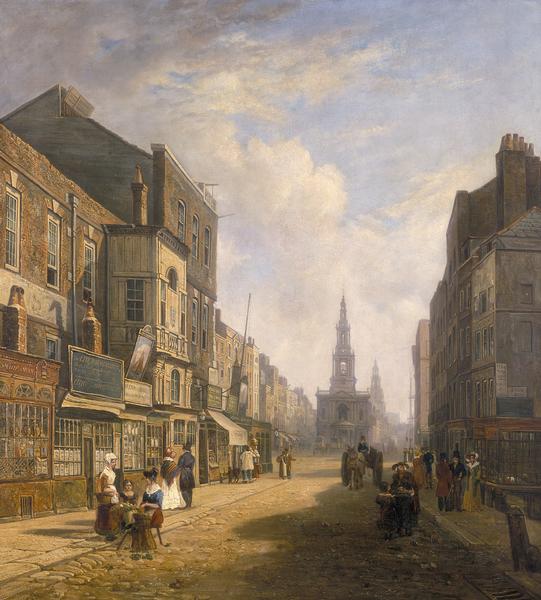
The Strand, Looking Eastwards from Exeter Exchange (1822). The church in the distance is St Mary le Strand with St Clement Danes behind.

The Strand, Looking Eastwards from Exeter Exchange (1822). The church in the distance is St Mary le Strand with St Clement Danes behind.

Westminster in central London that forms part of the A4 road. It is just over three-quarters of a mile in length from its western origin at Trafalgar Square to its eastern end at Temple Bar, where it continues into Fleet Street, marking Westminster’s boundary with the City of London. Its historical length has, however, been longer than this.

At the east end of the street are two historic churches: St Mary le Strand and St Clement Danes, which are both now situated on islands in the middle of the road, owing to widening of the Strand over the years. The length of road from St Mary’s eastwards up to St Clement’s was widened in 1900 and subsumes the former Holywell Street which forked from the Strand and ran parallel with it to the north. Traffic travelling eastbound past the churches follows a short crescent called Aldwych, connected at both ends to the Strand. The Strand marks the southern boundary of the Covent Garden district.

Toponymy
The name was first recorded in 1002 as strondway, later in 1185 as Stronde and in 1220 as la Stranda. It is formed from the Old English word ‘strand,’ meaning shore. Initially it referred to the shallow bank of the once much wider River Thames, before the construction of the Victoria Embankment. The name was later applied to the road itself. Part of its length was known in the 13th century as ‘Densemanestret’ or ‘street of the Danes,’ referring to the community of Danes in the area.

History
The route of the Strand was used during the Roman period as part of a route to Silchester, known as “Iter VIII” on the Antonine Itinerary, and which later became known by the name Akeman Street. It was briefly part of a trading town called Lundenwic that developed around 600 AD, and stretched from Trafalgar Square to Aldwych. Alfred the Great gradually moved the settlement into the old Roman town of Londinium from around 886 AD onwards, leaving no mark of the old town, and the area returned to fields.

In the Middle Ages it became the principal route between the separate settlements of the City of London (the civil and commercial centre) and the royal Palace of Westminster (the national political centre). In the archaeological record, there is considerable evidence of occupation to the north of Aldwych, but much along the former foreshore has been covered by rubble from the demolition of the Tudor Somerset Place, a former royal residence, to create a large platform for the building of the first Somerset House, in the 17th century.

The western part of the Strand was located in the parish of St Martin in the Fields and in the east it extended into the parishes of St Clement Danes and St Mary le Strand. Most of its length was in the Liberty of Westminster, although part of the eastern section in St Clement Danes was in the Ossulstone hundred of Middlesex. The precinct of the Savoy, located approximately where the approach to Waterloo Bridge is now, had the Strand as its northern boundary. All of these parishes and places became part of the Strand District in 1855, except St Martin in the Fields which was governed by a vestry. The Strand District Board of Works was based at No. 22, Tavistock Street. Strand District was abolished in 1900 and became part of the Metropolitan Borough of Westminster. The area had parliamentary representation through the Strand constituency from 1885 to 1918.

Palaces
From the 12th century onwards, large mansions lined the Strand including several palaces and townhouses inhabited by bishops and royal courtiers, mainly located on the south side, with their own ‘river gates’ and landings directly on the Thames.

Those on the south side of the street were, from east to west:
**Essex House, built around 1575 for Robert Dudley, Earl of Leicester, and originally called Leicester House. It was renamed Essex House after being inherited by Robert Devereux, 2nd Earl of Essex, in 1588. It was demolished some time between 1674 and 1679 and Essex Street, leading up to the Strand, was built on the location by property speculator Nicholas Barbon.
**Arundel House, originally the town house of the Bishops of Bath and Wells, later in the possession of the Earls of Arundel. It was demolished in 1678 and Arundel Street, adjoining the Strand, was built on the site. The supposed Roman baths at Strand Lane are in the former grounds of the house and are probably associated with it.
**Somerset House built by Edward Seymour, Duke of Somerset, regent of England from 1547 to 1549, and rebuilt in the 18th century.
**Savoy Palace, the London residence of John of Gaunt, King Richard II’s uncle and the nation’s power broker. In the 14th century the Savoy was the most magnificent nobleman’s mansion in England. However, during the Peasants’ Revolt of 1381, rebels, led by Wat Tyler, inflamed by opposition to the poll tax promoted by John of Gaunt, systematically demolished the Savoy and everything in it. In 1512 it was rebuilt as the Savoy Hospital for the poor. However it gradually fell into dereliction and was divided into multiple tenancies, eventually being demolished in the 19th century. The Savoy Hotel now occupies the site.
**Worcester House, formerly the Inn, or residence, of the Bishop of Carlisle.
**Salisbury House, the site of which is now occupied by Shell Mex House.
**Durham House, the historic London residence of the Bishop of Durham, built circa 1345 and demolished in the mid-17th century, it was once the home of Anne Boleyn. Durham Street and the Adelphi Buildings were built on its site.
**York House, built as the London residence for the Bishop of Norwich not later than 1237. At the time of the Reformation it was acquired by King Henry VIII and came to be known as York House when he granted it to the Archbishop of York in 1556. In the 1620s it was acquired by the royal favourite George Villiers, 1st Duke of Buckingham, and after an interlude during the English Civil War it was returned to George Villiers, 2nd Duke of Buckingham, who sold it to developers in 1672. It was then demolished and new streets and buildings built on the site, including Villiers Street.
**Hungerford House, which was demolished and replaced, in turn, by Hungerford Market and Charing Cross station.
**Northumberland House, a large Jacobean mansion, the historic London residence of the Dukes of Northumberland; built in 1605 and demolished in 1874. Northumberland Avenue now occupies the site.

On the north side of the Strand were…

**Cecil House, also called Exeter House or Burghley House, built in the 16th century by Lord Burghley as an expansion of an existing Tudor house. Exeter House was demolished in 1676 and Exeter Exchange built on the site. It was most famous for the menagerie that occupied its upper floors for over 50 years, from 1773 until 1829, when Exeter Exchange was demolished. It was replaced by Exeter Hall, noted for its Evangelical meetings. This was demolished in 1907 and the site is now occupied by the Strand Palace Hotel.
**Bedford House.
**Wimbledon House.

Apart from the rebuilt Somerset House, all of these grand buildings are now gone, and are overlaid by later streets lined by humbler tenements. These were built by property developers on the sites of the old mansions, from the 17th century onwards. A New Exchange was built on part of the gardens of Durham House, in 1608-9, facing the Strand. This high-class shopping centre enjoyed considerable popularity but was eventually destroyed in 1737.

Decline
After the demolition of most of the grand mansions and departure of their aristocratic residents for the West End the area acquired a dissolute but lively reputation and became notable for its coffee houses, low taverns and cheap women. The Dog and Duck tavern on Strand was famed as a venue for the conspirators involved in the Gunpowder Plot. In the time of the English Civil War, the Nag’s Head tavern was the venue of a meeting between Henry Ireton and some of the Levellers which resulted in the production of a document called the Remonstrance of the Army which demanded the abolition of the monarchy and the trial of King Charles I. In the 19th century the Coal Hole tavern, under the management of Renton Nicholson, was notable for song-and-supper evenings, tableaux vivants of scantily clad women in poses plastiques, and a ribald “Judge and Jury” show.

Churches
The church of St Clement Danes is believed to date from the 9th century, but the present building is a restoration of a 17th-century work by Christopher Wren that was gutted in the Blitz. Harold Harefoot (reigned 1035–40, one of England’s lesser known kings) is buried here. Since 1958 it has served as the central church of the Royal Air Force.

St Mary-le-Strand was designed by James Gibbs and completed in 1717, to replace a previous church demolished by Protector Somerset for building material for his adjacent Somerset House. Essex Street Chapel, the birthplace of British Unitarianism (1774), abuts onto the Strand; the post-Blitz building serves as the denominational headquarters.

Theatre
The Strand was the hub of Victorian theatre and nightlife. However, redevelopment of the East Strand and the construction of the Aldwych and Kingsway roads in the 1890s and early years of the 20th century led to the loss of the Opera Comique, the Globe, the Royal Strand Theatre and the nearby Olympic Theatre. Other lost theatres include the Gaiety (closed 1939, demolished 1957), Terry’s (converted into a cinema 1910, demolished 1923), and the Tivoli (closed 1914 and later demolished; in 1923 the Tivoli Cinema opened on the site but was closed and demolished in 1957 to make way for Peter Robinson’s store).

Surviving theatres include the Adelphi, the Savoy and Vaudeville, and closely adjacent in Wellington Street the Lyceum.

Literary Connections
In the 19th century much of the Strand was rebuilt and the houses to the south no longer backed onto the Thames, separated from the river by the Victoria Embankment constructed in 1865–70. This moved the river some 50 metres (160 ft) further away. The Strand became a newly fashionable address and many avant-garde writers and thinkers gathered here, among them Thomas Carlyle, Charles Dickens, William Makepeace Thackeray, John Stuart Mill, Herbert Spencer and the scientist Thomas Henry Huxley. No. 142 was the home of radical publisher and physician John Chapman, who not only published many of his contemporaries from this house during the 1850s, but also edited the Westminster Review for 42 years. The American poet Ralph Waldo Emerson was also a house guest. A lower grade of publishing was promoted at the east end of the Strand where Holywell Street was the hub of the Victorian pornography trade, until the street was physically eliminated by widening of the Strand in 1900. Virginia Woolf also writes about Strand in several of her essays, including “Street Haunting: A London Adventure,” and her novel, Mrs. Dalloway. T.S. Eliot alludes to the Strand in his 1905 poem “At Graduation” and in his 1922 poem “The Waste Land” (part III, The Fire Sermon, v. 258: “and along the Strand, up Queen Victoria Street”). John Masefield also refers to a “jostling in the Strand” in his well-known poem “On Growing Old.”

Posted in British history, buildings and structures, Great Britain, Living in the UK | Tagged , , | Comments Off on UK “Real” Estate: The Strand

The 19th Century Educational System (or Lack Thereof)

The 19th Century Educational System (or Lack Thereof)
n7061898115t
“Public” schools were founded through generous donations for the male children of the towns of Eton and Harrow, and they were originally open to all. The concept of the “grammar” school came from the fact that Latin and Greek grammar was the basis of the program. Eventually, these public schools began to operate as private schools for the children of rich patrons.

These “public” schools were a social experiment in an era when education was patchwork at best. No national school system existed at the beginning of the 19th Century. The rich hired a governess to teach their female children and a tutor to educate their sons until the boys could go off to Eton, Harrow, Oxford, and Cambridge. Children of the poor were sent off to work the fields, or if fortunate, to an apprenticeship.

From Eton and Harrow of England, we learn,

“Eton College and Harrow School are both all-boy boarding schools. When the boys enter, they are 13 years old, and they spend five years before they graduate when they become 18 years old. Eton was established by King Henry VIII (1491-1541). Harrow started as an exclusive school for boys in 1243, but moved to the present location during the period of Queen Elizabeth I (1533-1603).

Until recently, most of the prime ministers came from Eton or Harrow. These schools used to teach their boys how to run the British empire. These days, they are interested in teaching them how to run international corporations. This does not appear to be an easy transition.”

Women were not taught Latin or Greek. From Making Home Life Attractive, we learn, “Gentlemen should not make use of classical quotations in the presence of ladies, without apologizing for or translating them. Even then, it should only be done when no other phrase can so aptly express their meaning. Much display of learning is pedantic and out of place in a drawing room. All topics especially interesting to gentlemen, such as the turf, the exchange, or the farm, should be excluded from general conversation. Men should also remember that all ladies are not interested in politics, and dwell, of preference, upon such subjects as they are sure to be acquainted with. Never talk upon subjects of which you know nothing, unless it be for the purpose of acquiring information. Many young ladies and gentlemen imagine that, because they play a little, sing a little, draw a little, frequent exhibitions and operas, and so forth, they are qualified judges of art. No mistake is more egregious or universal. The young should never be critical. A young person of either sex can but appear ridiculous when satirizing books, people, or things: opinion, to be worth the consideration of others, should have the advantage of maturity.”

The idea of children not able to read their Bibles spearheaded the movement toward true public education. In 1811, the National Society for Promoting the Education of the Poor in the Principles of the Established Church was formed. By 1839, Parliament took up the cause of these “national” schools. In that year, Parliament granted 30,000 pounds to the running of these open schools.

The “national” schools ran on what was known as a monitorial system, meaning teachers taught monitors (selected students), who then taught the enrolled children. This system evolved into “training colleges,” another term for a teacher’s college.

In 1862, standards were implemented to set a “standardized” program for all children. These standards included the 3R’s.

Posted in British history, customs and tradiitons, Great Britain, Living in the Regency, Living in the UK, real life tales, Regency era | Tagged , , | 4 Comments

From Where Does That Phrase Come? A Bit of Slang

images-1 Slang, consists of a lexicon of non-standard words and phrases in a given language. Use of these words and phrases is typically associated with the subversion of a standard variety (such as Standard English) and is likely to be interpreted by listeners as implying particular attitudes on the part of the speaker. In some contexts a speaker’s selection of slang words or phrases may convey prestige, indicating group membership or distinguishing group members from those who are not a part of the group.

A bad egg
This bit of “slang” did not develop until the mid 1800s. Today, the phrase refers to someone or something that disappoints or does not meet expectations. Shakespeare had used the word “egg” to refer to a young person, as in Macbeth when the murderers seeking Macduff meet up with his young son and kill the boy. “What you egg! Young fry of treachery!” The earliest use of the word to connote “disappointment” comes from the Milwaukee Daily American (September 1856). “Mayor Woods is moving heaven and earth to procure his renomination. One of his dodges is, to get up letters in the newspaper, pretending to emanate from ‘distinguished citizens,’ including merchants, mechanics and working men, soliciting him in the most pathetic terms to present himself to the dear people. There are also on the list a number of notorious blacklegs whom Woods keeps in pay. He is a bad egg.”

To fly the coop
This is another bit of slang, which likely dates back to the nineteenth century. It has come to mean to run off, to escape, or to depart abruptly. “Coop” is criminal cant for prison or jail. The phrase has come to mean an unceremonious departure. “Coop” finds its roots in Middle English coupe for “basket” or Norwegian kaup for “wooden can.”

Iron Curtain
Winston Churchill, Prime Minister of Great Britain, coined this phrase following WWII. On 5 March 1946, he expressed his misgivings regarding European politics at Fulton, Missouri, where he was receiving an honorary degree from Westminster College. He said, “From Stettin in the Baltic to Trieste in the Adriatic, an iron curtain has descended across the continent.” The Iron Curtain symbolizes the ideological conflict and physical boundary diving Europe into two separate areas from the end of World War II in 1945 until the end of the Cold War in 1991.

Cadge
Etymology: Possibly a corruption of cage, from Old French; as a noun cadge it finds meaning in falconry to refer to a circular frame on which cadgers carry hawks for sale. As a verb, it can be used (US, UK, slang) to mean to obtain something by wit or guile; to convince someone to do something they might not normally do or in (UK, Scotland, dialect) meaning too carry, as a burden; To hawk or peddle, as fish, poultry, etc., or To intrude or live on another meanly; to beg.

To Lie in One’s Teeth
This phrase means to lie grossly or maliciously: If she told you exactly the opposite of what she told me, she must be lying in her teeth. Also, lie through one’s teeth. The origin comes to us before 900; (noun) Middle English; Old English lyge; cognate with German Lüge, Old Norse lygi; akin to Gothic liugn; (v.) Middle English lien, Old English lēogan (intransitive); cognate with German lügen, Old Norse ljūga, Gothic liugan. The phrase is thought to have made its way into the language in the early 1300s, as in The Romances of Sir Guy of Warwick: and Remburn His Son. “Thou liest amidward and therefore have thou maugreth (shown ill will).”

On tenterhooks
This phrase means to be in a state of anxious suspense. A “tenter” is a frame or endless track with hooks or clips along two sides that is used for drying and stretching cloth. It comes to us from Middle English teyntur, probably from Medieval Latin tentura, from tenta tent frame or tent. Its first known use was in the 14th century. Because of the tenter’s similarity to the rack in its construction, the term “tenterhooks” became to be known for its suspended tension.

Rope of sand
This phrase means something of no cohesion or stability: a feeble union or tie. It is used ironically to describe a treaty or a contract, meaning a paper with no binding power over the two parties involved. Sir Francis Bacon used the phrase as such, “to knit a rope of sand.” Samuel Butler (in 1712) wrote “I leave to my said children a great chest full of broken promises and cracked oaths; likewise a vast cargo of ropes made of sand.” The Urban Dictionary calls it a running joke used in academic writing. The phrase, purposefully meaningless and ambivalent, is used after a colon to “spice up” a title.
The Collapse of the Ottoman Empire: A Rope of Sand
Organ Transplant Rejection: A Rope of Sand
My Summer Vacation: A Rope of Sand

Unknown Too big for one’s breeches
This one likely dates back to the mid 1100s. It means to assert oneself beyond his authority or ability. It comes from our pride in trying to impress another. The first print version of the phrase comes to us from H. G. Wells in 1905, but it was in wide use in the spoken language long before that time. Other versions of the phrase include “too big for one’s boots,” “he of the swelled buttocks,” and “swellhead.”

To go berserk
This phrase means to behave in a frenzied and violent manner. This term has something in common with ‘run amok’. The two phrases, as well as sounding rather similar, mean virtually the same thing. Their sources though could hardly be further apart. ‘Run amok’ derives from the Far East, whereas ‘go berserk’ is of Viking (Norse) origin. In that tradition a ‘Berserker’ was a warrior of great strength and courage, who fought with wild ferocity. The word is believed to be derived from ‘bear sark’, that is, bear coat. That berserker fighting tradition, in which the warriors took on the spirit (or even in their belief, the shape) of bears whilst foaming at the mouth and gnawing the edges of their shields, is the source of the Vikings’ fierce reputation. It dates back to the first millennium but had died out by the 1100s and thereafter the word berserker didn’t feature widely in the English language until the 19th century. There is a rival, but less widely accepted, version of the derivation. In this the Vikings were supposed to show their bravery by going into battle with their sark jackets open, that is, ‘bare-sark’.
Who better to bring the word to our notice than that inveterate reviver of historical stories, Sir Walter Scott? In his 1822 book ‘Pirate’, he wrote:
“The berserkars were so called from fighting without armour.”
It was quite some time before the word began to be used in the figurative sense, that is, for it to be applied to people who ‘went berserk’ without an allusion to Viking warriors. Rudyard Kipling’s book Diversity of Creatures, 1908 has:
“You went Berserk. I’ve read all about it in Hypatia … you’ll probably be liable to fits of it all your life.”
The first reference to the actual use of the term ‘go berserk’ is in the obscure US newspaper the La Crosse Tribune and Leader-Press, 1919:
“With hungry Russians crowding in from the east, a hungry Germany may shortly toss its new conventions after the old and go berserk in the teeth of the cannon.” (The Phrase Finderimages-1)

Posted in language choices, Pop Culture, word play, writing | Tagged , , , | 2 Comments

UK “Real” Estate: All Hallows-by-the-Tower

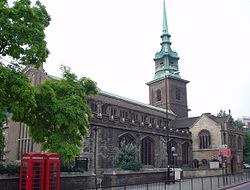
250px-AllHallowsByTheTowerChurchAll Hallows-by-the-Tower, also previously dedicated to St. Mary the Virgin and sometimes known as All Hallows Barking, is an ancient Anglican church on Byward Street in the City of London, overlooking the Tower of London. The church and Tower Hill play a role in the climax of my current Work in Progress (WIP), a cozy mystery.

Founded in 675, it is one of the oldest churches in London and contains, inside, a 7th-century Saxon arch with recycled Roman tiles, the oldest surviving piece of church fabric in the city. (St. Pancras Parish Church in King’s Cross has been a place of Christian worship since the sixth century.)

History
All Hallows-by-the-Tower was first established in 675 by the Saxon Abbey at Barking and was for many years named after the abbey, as All Hallows Barking. The church was built on the site of a former Roman building, traces of which have been discovered in the crypt. It was expanded and rebuilt several times between the 11th and 15th centuries. Its proximity to the Tower of London meant that it acquired royal connections, with Edward IV making one of its chapels a royal chantry and the beheaded victims of Tower executions being sent for temporary burial at All Hallows.

The church was badly damaged by an explosion in 1650 caused when some barrels of gunpowder being stored in the churchyard exploded; its west tower and some 50 nearby houses were destroyed, and there were many fatalities. The tower was rebuilt in 1658, the only example of work carried out on a church during the Commonwealth era of 1649-1660. It only narrowly survived the Great Fire of London in 1666 and owes its survival to Admiral William Penn, father of William Penn of Pennsylvania fame, who had his men from a nearby naval yard demolish the surrounding buildings to create firebreaks. During the Great Fire, Samuel Pepys climbed the church’s spire to watch the progress of the blaze and what he described as “the saddest sight of desolation.”

Restored in the late 19th century, All Hallows was gutted by German bombers during the Blitz in World War II and required extensive reconstruction, only being rededicated in 1957.

Many portions of the old church survived the War and have been sympathetically restored. Its outer walls are 15th-century, with a 7th-century Saxon arch doorway surviving from the original church, which is the oldest piece of church material in London. Many brasses remain in the interior (where one of London’s brass rubbing centres is now located). Three outstanding wooden statues of saints dating from the 15th and 16th centuries can also be found in the church, as can an exquisite Baptismal font cover which was carved in 1682 by Grinling Gibbons for ₤12, and which is regarded as one of the finest pieces of carving in London. In 1999, the AOC Archaeology Group excavated the cemetery and made many significant discoveries.

The church has a museum called the Undercroft Museum, containing portions of a Roman pavement which together with many artefacts was discovered many feet below the church in 1926. The exhibits focus on the history of the church and the City of London, and include Saxon and religious artefacts. Also on display are the church’s registers dating back to the 16th century, and notable entries include the baptism of William Penn, the marriage of John Quincy Adams, and the burial of Archbishop William Laud. Laud remained buried in a vault in the chapel for over 20 years; it was moved during the Restoration to St. John’s College, Oxford.

The altar in the crypt is of plain stone from the castle of Richard I at Athlit in The Holy Land.

All Hallows-by-the-Tower has been the Guild church of Toc H since 1922. The church was designated a Grade I listed building on 4 January 1950.

Notable People Associated with the Church
**John Quincy Adams, sixth president of the United States: married 1797
**Judge Jeffreys, notorious “hanging judge”: married 1667
**William Laud, Archbishop of Canterbury: beheaded at the Tower, buried 1645
**Thomas More, beheaded at the Tower for refusing to sign Henry VIII’s Act of Supremacy: buried 1535
**John Fisher, beheaded at the Tower: buried
**Lancelot Andrewes: baptised 1555
**William Penn, founder of Pennsylvania: baptised 1644
**Albert Schweitzer, made organ recordings at All Hallows
**Philip Clayton, also known as ‘Tubby’, former vicar and founder of Toc H
**Cecil Thomas, a sculptor who provided several funerary figures between the Wars

Vicars
1269 John de S Magnus
1292 William de Gattewicke
1312 Gilbert de Wygeton
1317 Walter Grapynell
1333 Maurice de Jenninge
1351 John Foucher
1352 Nicholas Janing
1365 Thomas de Broke
1376 Thomas de Dalby
1379 Laurence de Kagrer
1387 William Colles
1387 Robert Caton
1390 Nicholas Bremesgrove
– Jo Clerke
1419 John Harlyston
1427 W. Northwold
1431 John Iford
1434 Thomas Virley
1454 John Machen
1454 John Wyne
14- John Walker
1468 Thomas Laas
1475 Robert Segrym
1478 Richard Baldry
1483 William Talbot
1492 Edmund Chaderton
1493 Rad Derlove
1504 William Gedding
1512 William Pattenson
1525 Robert Carter
1530 John Naylor
1542 William Dawes
1565 William Tyewhit
1584 Richard Wood
1591 Thomas Ravis
1598 Robert Tyghe
1616 Edward Abbott
1654 Edward Layfield
1680 George Hickes
1686 John Gaskarth
1732 William Geeke
1767 George Stinton
1783 Samuel Johnes Knight
1852 John Thomas
1884 Arthur James Mason
1895 A.W. Robinson
1917 C.E. Lambert
1922 Philip Byard Clayton
1963 Colin Cuttell
1977 Peter Delaney
2005 Bertrand Olivier

The Organ
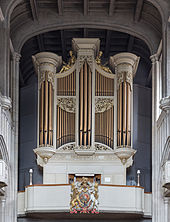
170px-All_Hallows-by-the-Tower_Organ,_London,_UK_-_Diliff The earliest records of an organ in All Hallows is one by Anthony Duddyngton dating from 1521. This was presumably lost during the English Civil War.

An organ was installed in 1675 by Thomas and Renatus Harris. In 1720 a new case was built by Gerard Smith. The organ was restored and improved by George Pike England in 1813, Bunting in 1872 and 1878, and Gray and Davison in 1902. There was further work by Harrison and Harrison in 1909 and 1928. After destruction in 1940, a new organ by Harrison and Harrison was installed in 1957.

Organists
Albertus Bryne II (or Bryan) 1675-1713
Charles Young 1713-1758
Charles John Frederick Lampe 1758-1767
Samuel Bowyer 1767-1770
Charles Knyvett and William Smethergell 1770-1783
William Smethergell 1783-1823
Mary Morrice 1823-1840
Lisetta Rist 1840-1880
Arthur Poyser
Gordon Phillips 1956-1991
Jonathan Melling

Posted in British history, buildings and structures, Great Britain, Living in the UK, real life tales, religion | Tagged , , , , , | Comments Off on UK “Real” Estate: All Hallows-by-the-Tower

“The London Monster” and Piquerism

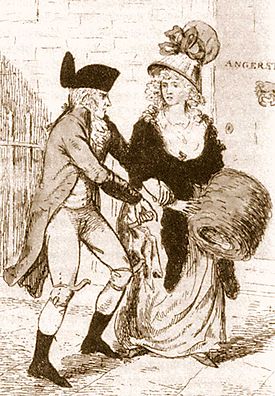
1 May 1790, artist's depiction of the London Monster attacking a woman. The likeness was created from various reports from alleged victims and before the arrest of Rhynwick Williams.

1 May 1790, artist’s depiction of the London Monster attacking a woman. The likeness was created from various reports from alleged victims and before the arrest of Rhynwick Williams.

The London Monster was the name given to an alleged attacker of women in London between 1788 and 1790. The attacker had a signature behavior of piquerism, the pricking or stabbing of victims with a knife, pin or needle.

First reports of the Monster appeared in 1788. According to the victims (most of them from wealthier families), a large man had followed them, shouted obscenities and stabbed them in the buttocks. Some reports claimed an attacker had knives fastened to his knees. Other accounts reported that he would invite prospective victims to smell a fake nosegay and then stab them in the face with the spike hiding within the flowers.

In all cases the alleged assailant would escape before help arrived. Some women were found with their clothes, cut and others had substantial wounds. In two years the number of reported victims amounted to more than 50.

The press soon named the maniac The Monster. However, descriptions of the attacker varied greatly. When people realized the Monster attacked mainly beautiful women, some women began to claim that they had been attacked to gain attention and sympathy. Some of them even faked wounds. Some men, in turn, were afraid to approach a lady in the dark lest they scare her. Some of the reports of the would-be-attacks were likely to be fabrications or results of a lady being afraid of an innocent man who had somehow attracted suspicion. Some men even founded a No Monster Club and began to wear club pins on their lapels to show that they were not the Monster.

Londoners were outraged when the Bow Street Runners, the London police force, failed to capture the man. Philanthropist John Julius Angerstein promised a reward of £100 for capture of the perpetrator. Armed vigilantes began to patrol in the city. Fashionable ladies began to wear copper pans over their petticoats. There were false accusations and attacks against suspicious people. Local pickpockets and other criminals used the panic to their advantage; they picked someone’s valuables, pointed at him, shouted “Monster!”, and escaped during the resulting mayhem.

In 1790 an unemployed 23-year-old man, Rhynwick Williams, was arrested on suspicion of being the Monster. After two trials, he was sentenced to six years in prison, but historians question whether the conviction was sound.

Arrest of Rhynwick Williams
On 13 June 1790, Anne Porter claimed she had spotted her attacker in St. James’s Park. Her admirer, John Coleman, began a slow pursuit of the man, who realised he was being followed. When Rhynwick Williams, an unemployed 23-year-old, reached his house, Coleman confronted him, accusing him of insulting a lady, and challenged him to a duel. He eventually took Williams to meet Porter, who fainted when she saw him.

Williams protested his innocence but, given the climate of panic, it was futile. He admitted that he had once approached Porter but had an alibi for another of the attacks. Magistrates charged Williams with defacing clothing — a crime that in the Bloody Code carried harsher penalty than assault or attempted murder. During the trial, spectators cheered the witnesses for the prosecution and insulted those for the defence. One of the claimed victims confessed that she had not been attacked at all.

Realizing the absurdity of the situation, Williams was granted a retrial. In the new trial Williams’ defence lawyer was Irish poet Theophilus Swift, whose tactic was to accuse Porter of a scheme to collect the reward, Porter having married Coleman, who had received the reward money. Despite the fact a number of alleged victims gave contradictory stories and coworkers testified he had an alibi for the most famous attack, Williams was convicted on three counts and sentenced to two years each, for a total of six years in prison.

Historians have speculated whether Williams was the culprit and have even questioned whether the London Monster existed at all beyond the hysteria. Reports of Monster-like attacks continued to be reported for many years, although they lessened somewhat while Williams was imprisoned.

Posted in British history, Georgian Era, gothic and paranormal, Great Britain, legends and myths, Living in the UK, mystery, real life tales | Tagged , | 2 Comments

The Great Frost of 1709 – An Extraordinary Winter Event

The Great Frost cover The Great Frost (as it was known in England) or Le Grand Hiver (as it was known in France) was an extraordinarily cold winter in Europe in late 1708 and early 1709, and was found to be the coldest European winter during the past 500 years. The severe cold occurred during the time of low sun spot activity known as the Maunder Minimum.

Notability
William Derham recorded in Upminster, near London, a low of −12 °C (10 °F) on the night of 5 January 1709, the lowest he had ever measured since he started taking readings in 1697. His contemporaries in the weather observation field in Europe likewise recorded lows down to −15 °C (5 °F). Derham wrote in Philosophical Transactions: “I believe the Frost was greater (if not more universal also) than any other within the Memory of Man.”

France was particularly hard hit by the winter, with the subsequent famine estimated to have caused 600,000 deaths by the end of 1710. Because the famine occurred during wartime, there were contemporary nationalist claims there were no deaths from starvation in the kingdom of France in 1709.

This winter event has drawn the attention of modern day climatologists in the European Union’s Millennium Project because they are presently unable to correlate the known causes of cold weather in Europe today with weather patterns documented in 1709. According to Dennis Wheeler, a climatologist at the University of Sunderland: “Something unusual seems to have been happening.”

The severity of the winter is thought to be an important factor in the emigration of the German Palatines from Central Europe.

Anecdotal Events
Françoise-Marie de Bourbon, the Duchess of Orleans, is said to have written a letter to her great aunt in Germany describing how she was still shivering from cold and could barely hold her pen despite having a roaring fire next to her, the door shut, and her entire person wrapped in furs. She wrote, “Never in my life have I seen a winter such as this one.”

European Union Millennium Project
One of the key aims of the European Union Millennium Project is climate reconstruction. This objective has gained significance in recent years because scientists are exploring the precise causes for climate variations instead of merely accepting they are within an acceptable historical range. Modern climate models do not appear to be entirely effective for explaining the climate of 1709. great-frost-1709

Posted in British history, Great Britain, Living in the UK, weather | Tagged | Comments Off on The Great Frost of 1709 – An Extraordinary Winter Event

From Where Does That Phrase Come?

images-1 UnknownRecently, I was checking the source of several key phrases within my current WIP (Work in Progress), a cozy mystery, checking to discover whether the word/phrase would have been used in Regency England. Below, are some of those I researched. As one can easily observe, several I kept within the story, others made a quick exit.

A Wild Good Chase…
Noun: wild-goose chase (plural wild-goose chases) (idiomatic); (figuratively) A futile search, a fruitless errand; a useless and often lengthy pursuit; A task whose execution is inordinately complex relative to the value of the outcome.
Etymology:Early recorded use refers to a type of 16th century horse race where everyone had to try to follow the erratic course of the lead horse, like wild geese have to follow their leader in formation. Mentioned in the William Shakespeare play Romeo and Juliet, Act 2, scene 4 by the character Mercutio: “Nay, if our wits run the wild-goose chase, I am done; for thou hast more of the wild goose in one of thy wits than, I am sure, I have in my whole five.” Mentioned in Robert Burton, Anatomy of Melancholy (1621). Common use in the current may be the origin for the sport sense.

Red Herring…
Noun: red herring (plural red herrings):A smoke-cured and salt-brined herring strong enough to turn the flesh red; a type of kipper.
“Up in the morning, and had some red herrings to our breakfast, while my boot-heel was a-mending, by the same token the boy left the hole as big as it was before.” (Samuel Pepys diary entry of 28 February 1660);
(figuratively) A clue or information that is or is intended to be misleading, that diverts attention from a question.
Etymology:Until 2008, the accepted etymology of the idiom was that red herring were used to train dogs to track scents. This has proved to be a false In truth, it originated from a news story by English journalist William Cobbett, c. 1805, in which he claimed that as a boy he used a red herring (a cured and salted herring) to mislead hounds following a trail; the story served as an extended metaphor for the London press, which had earned Cobbett’s ire by publishing false news accounts regarding Napoleon.

The Cake is a Lie…
(Internet slang) The end you are pursuing is unattainable or misguided; the reward you have been promised is false.
Etymology: From the 2007 video game Portal, in which a self-aware computer, GLaDOS, lures the player into participating in dangerous experiments with the promise of cake. As the game progresses, the player discovers graffiti left by previous test subjects, including the warning “the cake is a lie.”

Tilt at Windmills…
Verb (intransitive) To attack imaginary enemies; (intransitive, idiomatic) to persistently engage in a futile activity.
Etymology: From a passage in the novel Don Quixote where the eponymous character tilts at (i.e. joust at) windmills he has mistaken for giants.

A Merry Dance…
Noun:merry dance (plural merry dances); (idiomatic) A useless waste of time resulting from a deception.

Keep It Between the Ditches…
Verb: (idiomatic) To stay out of trouble or follow a righteous (God-fearing) path.
Etymology:
This is a phrase that originated as a popular saying in the State of Alabama, particulary the northern part, to generally emphasize the desire to live a good and clean life. The rock band Drive By Truckers used the phrase in their song “The Rightgeous Path.” Some members of the band are from the northern part of Alabama.

Kill the Fatted Calf…
Verb: (idiomatic) To begin a festive celebration and rejoicing for someone’s long-awaited return.
Etymology:The phrase derives from the parable of the prodigal son in the New Testament.

Knuckle Dragger…
Noun: (plural knuckle draggers); (idiomatic, often derogatory) A large, strong, and rather dimwitted person: Synonyms: Neanderthal
Etymology: An allusion to the practice of less-evolved larger primates of walking upright with their knuckles close to the ground.

Dimber Damber…
Noun: dimber damber upright man (plural dimber damber upright men);
(idiomatic, obsolete, slang) The chief of a gang of male thieves or gypsies: Synonym: arch rogue

Dick Munch…
Noun: (plural dick munches); (vulgar, pejorative, idiomatic) idiot, foolish person.

Cake Walk…
Noun:(plural cake walks):(idiomatic) Something extremely easy.
Etymology: A type of dance originating in the United States in the 19th century. From the mid 1900s, a game at a fair or party in which people walk around a numbered circle along to music. When the music is stopped, the caller draws a number from a jar and whoever is standing on or closest to that number wins a cake.

Arsy Versy…
Adverb: arsy versy (not comparable); (idiomatic, UK, vulgar) Tumbling upside down; head over heels; backwards.
Etymology: Alteration of arsa versa, a blend of an alteration of arse + vice versa, modeled on vicey versey

Head Over Heels… (Although I customarily write ‘Heels Over Head’ for to be upside down, one’s heels are up and the head down.)
Adverb (comparative form, more head over heels, superlative form, most head over heels) Tumbling upside down; At top speed; frantically; Hopelessly smitten.
Etymology: Emerged in the 14th century as “heels over head,” which is more literally accurate, as “head over heels” is the more standard state of being. “Heels over head” evolved into “head over heels” in common use departing its literal meaning, probably for reasons of phrasal elegance.

Greengrocer’s Apostrophe…
Noun: (plural greengrocer’s apostrophes); The incorrect use of an apostrophe to form the plural of a word through ignorance of the use of the apostrophe.
Etymology: The term is believed to have been coined in the middle of the 20th century by a teacher of languages working in Liverpool, at a time when such mistakes were common in the handwritten signs and advertisements of greengrocers (e. g., Apple’s 1/- a pound, Orange’s 1/6d a pound). Some have argued that its use in mass communication by employees of well-known companies has led to the less literate assuming it to be correct and adopting the habit themselves.

Speak of the Devil…
(idiomatic, humorous) An expression sometimes used when a person mentioned in the current conversation happens to arrive on the scene.
Etymology: Variation of “Speak of the devil and he shall appear,” which can be traced back to “Talk of the Devil, and he’s presently at your elbow” attested in 1666.

Sour Grapes…
Noun:sour grapes (uncountable) (plural only); (idiomatic) Things that somebody pretends to despise because he/she cannot possess them.
(idiomatic) A putting down or expression of disdain about something that one desires but cannot have.
Etymology: From the Aesop’s fable The Fox and the Grapes, in which a fox, unable to reach grapes he is seeking, decides that they must have been sour.

Square Away…
Verb: square away, squared away; (idiomatic) To finish, complete, tidy or put in order; (nautical) To square the ships’ yards to make her run before the wind, with the wind blowing straight from the stern.

Rag Bagger…
Noun: rag bagger (plural rag baggers);(idiomatic, disrespectful) A sailor who tends to sail on messy cruising vessels; (idiomatic, disrespectful) A sailboat, usually a cruising sailboat tending to carry and store lots of supplies along the deck, or any sailboat that looks neglected or messy.
Etymology: From rag referring to the sails, and bagger referring to the storage of many items.

And these are for my internet friend, Carol Cork, who asked of them in last month’s phraseology post. I was listening, Carol.

To Call a Spade, a Spade
This means to avoid euphemisms, calling a thing what it really is. The phrase goes back to the time of Plutarch in the 1st Century A.D. It is found in Plutarch’s writing about the life of Philip of Macedon. What many do not know is the Greek work for “spade” is very similar to the one for “boat” or “bowl.” Lucian, a Greek writer of the 2nd Century, supposedly used the phrase also.

The Bee’s Knees
This phrase has come to mean something of good quality, but in the 18th Century the phrase was used to mean something very small. Likely, it came to us from the fact that bees carry pollen back to the hive in sacs on their legs, but there is no proof to that fact. According to Phrase Finder, ‘Bee’s knees’ began to be used in early 20th century America. Initially, it was just a nonsense expression that denoted something that didn’t have any meaningful existence – the
kind of thing that a naive apprentice would be sent to the stores to ask for, like a ‘sky-hook’ or ‘striped paint’. That meaning is apparent in a spoof report in the New Zealand newspaper The West Coast Times in August 1906, which listed the cargo carried by the SS Zealandia as ‘a quantity of post holes, 3 bags of treacle and 7 cases of bees’ knees’. The teasing wasn’t restricted to the southern hemisphere. The US author Zane Grey’s 1909 story, The Shortstop, has a city slicker teasing a yokel by questioning him about make-believe farm products:
“How’s yer ham trees? Wal, dog-gone me! Why, over in Indianer our ham trees is sproutin’ powerful. An’ how about the bee’s knees? Got any bee’s knees this Spring?”
The nonsense expression ‘the bee’s knees’ was taken up by the socialites of Roaring 20s America and added to the list of ‘excellent’ phrases. A printed reference in that context appears in the Ohio newspaper The Newark Advocate, April 1922, in a piece on newly coined phrases entitles ‘What Does It Mean?’:
“That’s what you wonder when you hear a flapper chatter in typical flapper language. ‘Apple Knocker,’ for instance. And ‘Bees Knees.’ That’s flapper talk. This lingo will be explained in the woman’s page under the head of Flapper Dictionary.” [an ‘apple knocker’ is a rustic]

Cat Got Your Tongue
Cat-got-your-tongue The phrase means someone remains inexplicably silent even though someone has implored him for information. From Phrase Finder, once again, we discover “‘Cat got your tongue?’ is the shortened form of the query ‘Has the cat got your tongue?’ and it is the short form that is more often used. It is somewhat archaic now but was in common use until the 1960/70s. It was directed at anyone who was quiet when they were expected to speak, and often to children who were being suspiciously unobtrusive.
There’s no derivation that involves any actual cat or celebrated incident of feline theft. It certainly doesn’t relate to sailors becoming taciturn when punished with the cat o’ nine tails as some have suggested – that’s pure invention. Like the blackbird that ‘pecked off his nose’, the phrase is just an example of the lighthearted imagery that is, or was, directed at children.
The expression sounds as though it might be old but isn’t especially so. It isn’t found in print until 1881, in the US illustrated paper Ballou’s Monthly Magazine, Volume 53:
Has the cat got your tongue, as the children say?
The demarcation of the phrase as being ‘children’s’ suggests that it may be earlier than the 1880s. Children’s language wasn’t written down until it became used by adults, which may be some years after it was common parlance in the playground.”

Marry in Haste, Repent at Leisure
The meaning of this phrase is quite literal. This proverbial saying was first expressed in print by William Congreve in his comedy of manners The Old Batchelour, 1693:
Thus grief still treads upon the heels of pleasure:
Married in haste, we may repent at leisure.

To Take Down a Peg or Two
This phrase means to lower one’s opinion of himself. Phrase Finder says, “Various quantities and qualities have been measured by the use of pegs. It has been suggested that the pegs in question here were those used to regulate the amount of drink taken from a barrel, or those that controlled the hoisting of the colours (flags) of ships. Either of these might be correct although, like the ‘yards’ of ‘the whole nine yards’, ‘pegs’ could relate to many things.
It is interesting though that all the early citations of the phrase have a religious context; for example:
Pappe with An Hatchet, 1589 – ‘Now haue at you all my gaffers of the rayling religion, tis I that must take you a peg lower.’
Joseph Mead’s Letters, 1625 – ‘A-talking of the brave times that would be shortly… when… the Bishop of Chester, that bore himself so high, should be hoisted a peg higher to his little ease.’
Samuel Butler’s Hudibras, 1664 – ‘We still have worsted all your holy Tricks,… And took your Grandees down a peg.'”

Posted in editing, language choices, word play, writing | Tagged , , | 4 Comments