Austen-Homage Literature and the Mystery Genre

Mystery Puzzle Pieces Hole Unknown Uncertainty Guessing Solved S
123RF.com

Although publishers long ago labeled Jane Austen-inspired pieces as “niche” literature, they erred. Austen’s touch can be found in a variety of pieces: women’s literature, romance, variations, historical fiction, paranormal, fantasy, and mystery. Over the years, I have written several cozy mysteries using Austen’s characters. It is easy to concoct a mystery story around her plots. Miss Austen provides us with a variety of starting points.

For example, without good reason, General Tilney sends Catherine Morland from Northanger Abbey. He has no care for her safety upon the road alone. Meanwhile, his eldest son seduces Isabella Thorpe and then abandons her. In Pride and Prejudice, Mr. Wickham produces a multitude of lies that mislead Elizabeth Bennet and others in Meryton. He seduces innocents. He plots with Mrs. Younge. Frank Churchill in Emma pursues one woman while claiming a secret betrothal with another. Mr. Willoughby leads Marianne on in Sense and Sensibility. He abandons his pregnant mistress. Both actions occur because he must marry for money. Henry Crawford blatantly flirts with an engaged woman and then elopes with her. Tom Bertram is responsible for many of the major plot points that dominate the start of Mansfield Park. His gambling debts are part of the reason why his father, Sir Thomas, must go to Antigua to take care of his financial problems. Tom’s debts also mean that Edmund will not be able to move into the Parsonage at Mansfield Park when he is ordained. Mr. Elliot abused Mrs. Smith’s trust in Persuasion and later attempts to claim Anne to wife so he might prevent Sir Walter from remarrying and producing an heir to replace him. Austen offers her readers a “secret,” perhaps not a major crime, but one that can be employed be a skilled contemporary writer. 

As the lady anticipated the modern romance, Austen also added to the mystery genre. The mystery/suspense plot requires the ending to be a restoring of order. Does not each of Austen’s heroines solve a “mystery” of sorts to bring her world to order? And is it not “love” that brings those involved together again and allows them to heal?

So how does one transform an Austen story to a mystery? P. D. James did as such in Death Comes to Pemberley. According to  W. H. Auden  in “The Guilty Vicarage” found in Harper’s Magazine (from a 1948 article), a mystery/detective story requires ” (1) A closed society so that the possibility of an outside murderer (and hence of the society being totally innocent) is excluded; and a closely related society so that all its members are potentially suspect (cf. the thriller, which requires an open society in which any stranger may be a friend or enemy in disguise). Such conditions are met by: (a) the group of blood relatives (the Christmas dinner in the country house); (b) the closely knit geographical group (the old world village); (c) the occupational group (the theatrical company); (d) the group isolated by the neutral place (the Pullman car).

“In this last type the concealment-manifestation formula applies not only to the murder but also to the relations between the members of the group who first appear to be strangers to each other, but are later found to be related. (2) It must appear to be an innocent society in a state of grace, i.e., a society where there is no need of the law, no contradiction between the aesthetic individual and the ethical universal, and where murder, therefore, is the unheard-of act which precipitates a crisis (for it reveals that some member has fallen and is no longer in a state of grace). The law becomes a reality and for a time all must live in its shadow, till the fallen one is identified. With his arrest, innocence is restored, and the law retires forever.The characters in a detective story should, therefore, be eccentric (aesthetically interesting individuals) and good (instinctively ethical) — good, that is, either in appearance, later shown to be false, or in reality, first concealed by an appearance of bad.”

Let us check off the requirements as they relate to Austen’s books: a closed society (✓); a closely related society, that of a village (✓); the appearance of an innocent society (✓); and a society where there is no need of the law (✓). Auden goes on to explain how “rituals” characterize the closed society and that the perpetrator of the “crimes” uses his knowledge of the rituals to take advantage of the community. Auden also suggests that the plot must include an individual of superior intelligence to solve the mystery and reset the harmony within the society. Look at Wickham in Pride and Prejudice. He uses his knowledge of the more lax care of innocents at seaside resorts so he might attempt to seduce Georgiana Darcy (at Ramsgate) and successfully compromise Lydia Bennet (at Brighton). It is only with Fitzwilliam Darcy’s knowledge of Mr. Wickham’s propensity for debauchery and the man’s cohorts that the Bennets’ world is restored. 

Resources: 

Auden, W. H. “The Guilty Vicarage.” 1948. Detective Fiction: A Collection of Critical Essays. Robin W. Winks, Editor. Woodstock Foul Play, 1980. 15-24.

Check out my mysteries based around Jane Austen’s Pride and Prejudice 

41K5KR61S8L._SX319_BO1,204,203,200_.jpg The Phantom of Pemberley: A Pride and Prejudice Mystery

HAPPILY MARRIED for over a year and more in love than ever, Darcy and Elizabeth can’t imagine anything interrupting their bliss-filled days. Then an intense snowstorm strands a group of travelers at Pemberley, and terrifying accidents and mysterious deaths begin to plague the manor. Everyone seems convinced that it is the work of a phantom-a Shadow Man who is haunting the Darcy family’s grand estate.

Darcy and Elizabeth believe the truth is much more menacing and that someone is trying to murder them. But Pemberley is filled with family guests as well as the unexpected travelers-any one of whom could be the culprit-so unraveling the mystery of the murderer’s identity forces the newlyweds to trust each other’s strengths and work together.

Written in the style of the era and including Austen’s romantic playfulness and sardonic humor, this suspense-packed sequel to Pride and Prejudice recasts Darcy and Elizabeth as a husband-and-wife detective team who must solve the mystery at Pemberley and catch the murderer-before it’s too late.

51fjq16cNoL._SX322_BO1,204,203,200_.jpg The Disappearance of Georgiana Darcy: A Pride and Prejudice Mystery

A THRILLING NOVEL OF MALICIOUS VILLAINS, DRAMATIC REVELATIONS, AND HEROIC GESTURES THAT STAYS TRUE TO AUSTEN’S STYLE

SHACKLED IN THE DUNGEON of a macabre castle with no recollection of her past, a young woman finds herself falling in love with her captor-the estate’s master. Trusting him before she regains her memory and unravels the castle’s wicked truths would be a catastrophe.

Far away at Pemberley, the Darcys happily gather to celebrate the marriage of Kitty Bennet. But a dark cloud sweeps through the festivities: Georgiana has disappeared without a trace. Upon receiving word of his sister’s likely demise, Darcy and Elizabeth set off across the English countryside, seeking answers in the unfamiliar and menacing Scottish moors.

How can Darcy keep his sister safe from the most sinister threat she has ever faced when he doesn’t even know if she’s alive? True to Austen’s style and rife with malicious villains, dramatic revelations and heroic gestures, this suspense-packed mystery places Darcy and Elizabeth in the most harrowing situation they have ever faced- finding Georgiana before it’s too late.

 The Mysterious Death of Mr. Darcy: A Pride and Prejudice Mystery

A THRILLING STORY OF MURDER AND BETRAYAL FILLED WITH THE SCANDAL, WIT AND INTRIGUE CHARACTERISTIC OF AUSTEN’S CLASSIC NOVELS

Fitzwilliam Darcy is devastated. The joy of his recent wedding has been cut short by the news of the sudden death of his father’s beloved cousin, Samuel Darcy. Elizabeth and Darcy travel to Dorset, a popular Regency resort area, to pay their respects to the well-traveled and eccentric Samuel. But this is no summer holiday. Danger bubbles beneath Dorset’s peaceful surface as strange and foreboding events begin to occur. Several of Samuel’s ancient treasures go missing, and then his body itself disappears. As Darcy and Elizabeth investigate this mystery and unravel its tangled ties to the haunting legends of Dark Dorset, the legendary couple’s love is put to the test when sinister forces strike close to home. Some secrets should remain secrets, but Darcy will do all he can to find answers-even if it means meeting his own end in the damp depths of a newly dug grave.

With malicious villains, dramatic revelations and heroic gestures, The Mysterious Death of Mr. Darcy will keep Austen fans turning the pages right up until its dramatic conclusion.

51zxcx1ka8l-_sx331_bo1204203200_ The Prosecution of Mr. Darcy’s Cousin: A Pride and Prejudice Mystery (Mystery/Suspense/Thriller; Fiction/Historical Fiction)

Fitzwilliam Darcy is enjoying his marital bliss. His wife, the former Elizabeth Bennet, presented him two sons and a world of contentment. All is well until Darcy receives a note of urgency from his sister Georgiana. In truth, Darcy never fully approved of Georgiana’s joining with their cousin. Major General Edward Fitzwilliam for Darcy assumed the major general held Georgiana at arm’s length, dooming Darcy’s sister to a life of unhappiness.

Forced to seek his cousin in the slews of London’s underbelly, at length, Darcy discovers the major general and returns Fitzwilliam to his family. Even so, the Darcy’s troubles are far from over. During the major general’s absence from home, witnesses note Fitzwilliam’s presence in the area of two horrific murders. When Edward Fitzwilliam is arrested for the crimes, Darcy must discover the real culprit before his cousin is hanged for the crimes and the Fitzwilliam name is marked by shame.

Posted in books, Jane Austen, literature, mystery, Regency era, Regency romance, romance, suspense | Tagged , , , , , , , , , | 7 Comments

Celebrating New Year’s Eve in Regency England

1752 was the first year in England and Wales, in which the civil or legal year began on 1st January. In Scotland, however, the New Year was celebrated on 1st January in 1600 for the first time, creating a discrepancy between the nations of Great Britain during the period 1600-1751.

The University of Nottingham tells us, “The 1st of January was not always recognised as marking the start of the year. In fact, until 1751, the civil (and ecclesiastical and legal) year was considered in England and Wales to begin on Lady Day, the 25th of March. This can create ambiguity, because for dates between the 1st of January and the 25th of March the historical year does not match the civil year.

“Thus, for example, a document dated the 25th of January 1748 (civil year) was actually written on what we would consider the 25th of January 1749 (historical year). The new historical year had begun but the civil year continued until the 25th of March. In order to address this ambiguity, researchers are advised to refer to the date as the 25th January 1748/9. Indeed, many contemporaries actually did the same thing, as in this example of a letter from Thomas Pelham-Holles, 4th Duke of Newcastle upon Tyne [later 1st Duke of Newcastle under Lyne]. The correct date according to the historical year is the latter of the two figures.”

https://www.americangreetings.com/ecards/new-years

In Regency England, New Year’s celebrations were modest compared to Christmas, with a focus on reflection, goodwill, and social connections. While elaborate balls and parties were reserved for Christmas and Twelfth Night, New Year’s Eve and Day still held significance with customs like small gatherings, toasts, and superstitions. 

New Year’s Eve:

  • Small Gatherings: Families and close friends would gather for informal dinners or parties. 
  • Toasts: People would raise a glass to wish for health and prosperity for loved ones. 
  • Reflection: It was a time to reflect on the past year and set intentions for the new one. 
  • Midnight Observances: Church bells might ring, and households might light candles or make noises to ward off evil spirits. 
  • First Footing (in some regions): In the North of England and Scotland, the first person to enter a home in the new year was considered a harbinger of luck, often bringing symbolic gifts like coal, salt, or bread. 

New Year’s Day:

  • Continuation of Celebrations: Some New Year’s Eve gatherings might continue into the day. 
  • Formalities:The Lord Chamberlain’s office would set a deadline for applications to present daughters at court. 
  • Less Emphasis on Feasting: While New Year’s Day was not a major feast day, there was still an emphasis on starting the year fresh. 
  • House Cleaning: Some families would engage in thorough house cleaning, discarding old items and food to symbolize a fresh start. 

Superstitions:

  • First Footing: The first person to enter a home in the new year was believed to bring good or bad luck. 
  • Creaming the Well: In some regions, young women would race to draw the first water from a well, believing it would determine their marriage prospects. 
  • Other Superstitions: There were various other superstitions related to luck and prosperity for the new year, such as opening doors and windows at midnight. 

Significance of the tradition of Creaming the Well:

  • Marital Prospects: The possession of this first drawn water was thought to increase a young woman’s chances of marriage within the coming year. The belief was that if a woman could get the man she wished to marry to drink this water before the end of New Year’s Day, their union was destined.
  • Curative Properties: Some also attributed curative properties to the first water drawn from the well on New Year’s Day.
  • Ensuring Productivity: In certain areas, it was believed that washing the udders of cows with this water would ensure the animals’ productivity throughout the year. 

Other Sources:

Random Bits of Fascination

Holy and Healing Wells

Jane Austen Variations

Posted in British history, Church of England, customs and tradiitons, England, family, Georgian England, Great Britain, history, Ireland, Living in the Regency, Living in the UK, Regency era, religion, research | Tagged , , , , , , , , , , , | Comments Off on Celebrating New Year’s Eve in Regency England

Death of the Archbishop of Canterbury, 29 December 1170

In the Church of England, the archbishop of Canterbury is considered the principal leader. He is also the bishop of the diocese of Canterbury.

The first archbishop was Augustine of Canterbury, who was sent to England by Pope Gregory the Great. Ausgustine arrived in 597. He was to establish Christianity in southern England. He is often referred to as the “Apostle to the English”. Augustine converted King Æthelberht of Kent to Christianity, which led to the establishment of the English Church and the first archbishopric in England. 

The position is currently vacant following the resignation of Justin Welby, the 105th archbishop, effective 7 January 2025. [Orders in Council, 18 December 2024, page 42.] At this time, Stephen Cottrell, the Archbishop of York, is overseeing the majority of the Archibishop’s duties.

The position stayed a Catholic one from the time of Augustine to that of William Warham. Catholic Encyclopedia tells us, “In 1509 he crowned Henry VIII and Katherine of Aragon, and under the new king he enjoyed the same confidence as under Henry VII till he was overshadowed by the growing influence of Wolsey. In 1512 he became involved in a controversy with his suffragans, who considered that he pushed the metropolitan prerogative too far, and the matter was finally settled by a compromise. When Wolsey was created cardinal in 1515 Warham conferred the hat upon him in Westminster Abbey, and thereafter he was forced into the second place. Before Christmas he resigned the office of Lord Chancellor, as he had long wished to do, being out of sympathy with the king’s anti-French policy, and Wolsey received the Great Seal in his stead. Warham’s power was still further diminished in 1517 when Wolsey was appointed papal legate, and from that time forward there were constant official differences between them, though their private relations continued friendly. Wolsey as legate continually interfered with the action of the archbishop as metropolitan of the southern province and not infrequently overruled his decisions. In state affairs, especially in the raising of subsidies, he supported Wolsey, though he incurred the contempt of the cardinal’s enemies for doing so. When the divorce question was first raised in 1527 he was Wolsey’s assessor in the secret inquiry into the validity of the king’s marriage. About this time his health began to fail, and he was no longer equal to taking an effective part in the important affairs that ensued. Being selected as the chief of the counsel appointed to assist Queen Katherine he did nothing on her behalf, but when she appealed to him for advice, replied that he would not meddle in such matters. He steadfastly refused to oppose the king’s wishes, and in the summer of 1530 signed the petition to the pope begging him to allow the divorce. This course he pursued under threats from the king that unless he was complaisant all ecclesiastical authority in England would be destroyed.”

After King Henry VIII broke away from the Catholic Church and proclaimed himself the head of the Church of England, Thomas Cranmer was appointed Archbishop in 1533. He wad the first Archbishop of Canterbury. He was very influential in the development of Anglicanism.

The archbishop is appointed by the British monarch on the advice of the prime minister of the United Kingdom and formally elected by the college of canons of Canterbury.

In addition to supervising the Province of Canterbury, the archbishop has a ceremonial provincial court, consisting of some of the senior bishops of their provinces. Those include London. The Archbishop of Canterbury oversees 30 of the 42 dioceses of the Church of England. The other 12 come under the supervision of the Archbishop of York Up and until 1920 there were also 4 provinces in Wales, but they were transferred to the disestablish Church in Wales in that year.

“The archbishop of Canterbury has a ceremonial provincial curia, or court, consisting of some of the senior bishops of their province. [“Order of Service from the Enthronement of the 104th Archbishop in 2003” (PDF)]. The bishop of London — the most senior cleric of the church with the exception of the two archbishops — serves as Canterbury’s provincial dean, the bishop of Winchester as chancellor, the bishop of Lincoln as vice-chancellor, the bishop of Salisbury as precentor, the bishop of Worcester as chaplain and the bishop of Rochester as cross-bearer.”

The most well-known Archbishop of Canterbury to die in December was Thomas Becket, who was murdered on this day on December 29, 1170. He was assassinated by knights loyal to King Henry II, and his death is a significant event in English history and religious lore according to history.com

Here’s more details about his death:

  • The Conflict: Becket and King Henry II had a strained relationship due to disputes over the power of the Church versus the Crown. 
  • The Murder: Becket was murdered in Canterbury Cathedral by four knights who were believed to be acting on the King’s displeasure. 
  • Consequences: Becket’s death caused outrage across Europe and led to his eventual canonization as a saint. 
  • Commemoration: The anniversary of his death is marked annually with services and commemorations. 
Posted in British history, Church of England, Great Britain, history, Living in the UK, political stance, religion, research | Tagged , , , , , | Comments Off on Death of the Archbishop of Canterbury, 29 December 1170

“Boxing Day,” part of Christmastide in Regency England

“Christmastide” is a season of the liturgical year in most Christian churches. It is sometimes referred to a Twelvetide (for the Twelve Days of Christmas).

For those in the Anglican Church, Catholic Church, Lutheran Church and for many in the Methodist Church, Christmastide begins at sunset (or Vespers) on December 24. Therefore, December 24 is not considered part of Christmastide, but rather part of Advent, the season of the Church Year that precedes Christmastide. Christmastide ends at sunset on January 5 (Twelfth Night) by the related season known as Epiphanytide. It begins on Epiphany Day, and ends at various points as defined by those denominations. The typical liturgical color for the day of Epiphany is white, and the typical color for Epiphany season is green.

Christmastide includes these celebrations: December 25 (Christmas Day); December 26 (St. Stephen’s Day); December 28 (Childermas or Children’s Mass or Holy Innocents’ Day); December 31 (New Year’s Eve); January 1 (the Feast of the Circumcision of Christ or the Solemnity of Mary, Mother of God Day); the Feast of the Holy Family day varies. The Twelve Days of Christmas finish with Epiphany Eve or Twelfth Night on January 5.

December 26 was originally called “Boxing Day” or “St Stephens Day,” which was a Catholic holiday. It was the second day of Christmastide. Originally it was a holiday to give gifts to the poor. However, in the present, it is, generally, a shopping holiday.

Boxing Day originated in Great Britain and is celebrated in a number of countries once part of the British Empire. The bank holiday or public holiday can occur up to December 28, if necessary, to ensure it falls on a weekday.

The origin of “Boxing Day” is not as definitive as we would like. In the Middle Ages, those in Europe were known to give gifts to those “in service” to their families. Alms boxes were placed in the narthex of early Christian churches to collect offerings for the poor. This is where the Feast of Saint Stephen comes in. In the early Christian churches and even today, it is customary in some localities to open the alms boxes and distribute the contributions to the poor.

Boxing Day was traditionally a day off for servants, who would receive “Christmas boxes” – gifts of money or leftovers from the Christmas feast – from their employers. It was also a popular day for fox hunting and informal social gatherings. 

  • Boxing Day: The name “Boxing Day” originated from the tradition of wealthy families giving boxes of gifts and leftovers to their servants and tradespeople on this day. 
  • Servants’ Holiday: Servants, who worked hard on Christmas Day, were typically given Boxing Day off to visit their families and enjoy the day. 
  • Informal Celebrations:.While Christmas Day was a grand affair, Boxing Day was more relaxed, featuring smaller gatherings with neighbors and friends. 
  • Fox Hunting: Fox hunting was a common activity on Boxing Day, particularly for the gentry. 

The Oxford English Dictionary gives the earliest attestations from Britain in the 1830s, defining it as “the first weekday after Christmas day, observed as a holiday on which postmen, errand boys, and servants of various kinds expect to receive a Christmas box”[“Boxing-day, n.”, OED Online, 1st ed. (Oxford: Oxford University Press, 1887).]

The term “Christmas box” dates back to the 17th century, and among other things meant:

A present or gratuity given at Christmas: in Great Britain, usually confined to gratuities given to those who are supposed to have a vague claim upon the donor for services rendered to him as one of the general public by whom they are employed and paid, or as a customer of their legal employer; the undefined theory being that as they have done offices for this person, for which he has not directly paid them, some direct acknowledgement is becoming at Christmas. [Christmas-box, n.”, OED Online, 1st edn (Oxford: Oxford University Press, 1889), sense 3.]

Tradesmen collected “Christmas boxes” of money or fairings on the first weekday after Christmas in reward for their exemplary service through the year. I, for one, still present the trash collectors, my postal carrier, etc., each year with a token of my thanks for their good service.

This giving of “thanks” is mentioned in Samuel Pepys‘ diary entry for 19 December 1663. [“Saturday 19 December 1663 (Pepys’ Diary)”. Pepysdiary.com] This custom is linked to an older British tradition where the servants of the wealthy were allowed the next day to visit their families since they would have had to serve their masters on Christmas Day. The employers would give each servant a box to take home containing gifts, bonuses, and sometimes leftover food. Until the late 20th century there continued to be a tradition among many in the UK to give a Christmas gift, usually cash, to vendors, although not on Boxing Day as many would not work on that day. [“Boxing Day and it’s surprising facts”. shoppersinusa.]

During the Regency, it is said, the church gave out boxes to the poorer families, and landlords presented villagers and tenants and workers boxes. I read somewhere how all the maids in a house, generally, received a length of cloth from which to have a gown made. I also recall how the men received material for shirts or received shirts made up. Pensioners/tenants would receive a goose or a hen. There were no set rules, and each employer/landlord gave as the spirit moved him or not. Some might just present the boxes so as not to lose face in front of neighbors.

Posted in British history, Christmas, Church of England, customs and tradiitons, family, Georgian England, Georgian Era, holidays, Living in the Regency, Regency era, research | Tagged , , , , , , , , , | 1 Comment

Merry Christmas and Happy Holidays!

Merry Christmas and Happy Holidays from my North Carolina Home to Yours. Today, I am watching my favorite Jane Austen movies and writing a new chapter of one of my three works in progress. It will be a quiet day, for my grandchildren are in Ohio visiting their other grandmothers (We celebrated several days prior.), and for both the solitary hours and those I have spent with my family this year I am thankful. I am also thankful for my health, even with the expected conditions, especially at my age, where my steps are sometimes a bit slower, but God still permits me to take them, as well as my good fortune to know people of your caliber.

I encourage each of you to give God what he most wants for Christmas. Not your life: He has no use for it. God bestowed “life” upon you. Instead, consider giving him what he most desires: your sin.

gal_christmas_tree

Posted in holidays | Tagged , , | 4 Comments

Christmas Pudding, Mincemeat Pies, and Christmas Stories

I have debated over the last couple of weeks the nature of this post. Christmas? Something else? A mix? I finally decided we have had enough Christmas (at least, I have, for my decorations are up, presents wrapped, and the anticipation is waning). Something else was not possible as my brain is filled with two novels I am writing simultaneously, which is common for me—that is until one takes dominance over the other. Therefore, I ultimately decided on a mix of the two. 

Did any of you make the Christmas pudding on Stir-Up-Sunday? I did my duty, only this time I cut back on the size of the pudding. With Type II diabetes, too many fruits and too much sugar is not a good idea. However, the occasional bite or two (as long as I am disciplined, which I tend to be by nature) keeps away the cravings, while maintaining my traditions for the holiday. For those of you who know little about Stir-Up-Sunday, it is the last Sunday before Advent begins. This year, it was November 30. GoodtoKnow explains, “The dish known today as ‘Christmas pudding’ began its life as a Christmas porridge called Frumenty, made of beef and mutton with raisins, currants, prunes, wines and spices. This was eaten as a fasting meal in preparation for the Christmas festivities. Like so many British dishes, it has evolved over the centuries from a simple peasant’s meal to a treasured celebration dish and has been adapted to become a sweet pudding rather than a rich meaty meal. 

“When making the cake it is traditional for every member of the family, especially children, to give the mixture a stir, and make a wish while doing so. You are also supposed to stir the mixture from East to West to honour the journey made by the Wise Men. Christmas pudding is traditionally made with 13 ingredients to symbolise Jesus and the 12 Apostles. The ingredients are: sultanas, raisins, demerara sugar, currants, glacé cherries, stout, breadcrumbs, sherry, suet, almonds, orange and lemon peel, cognac and mixed spices. It is still common for people to include small silver coins (traditionally a sixpence) in the pudding mixture. Whoever gets the serving with the coin in the middle gets to keep it and it is believed to bring them wealth in the coming year. This same practice is done with a tiny wishbone (to bring good luck), a silver thimble (for thrift), or an anchor (to symbolise safe harbour). But if you are putting any coins or trinkets into your pudding, make sure they are sterilised and and definitely ensure that those eating are aware there may be something in their pudding. You can wrap them in small pieces of tin foil to make them more visible.” Read more at https://www.goodtoknow.co.uk/food/stir-up-sunday-80612#cqpo114RvZWVdlRr.99


(I do not have an image of this year’s Christmas pudding, but I have included one from the internet for those who still require a visual image.)

I have also scaled back my tradition of preparing small mincemeat pies for the Twelve Days of Christmas. “Mince Pies, like Christmas Puddings, were originally filled with meat, such as lamb, rather than the dried fruits and spices mix as they are today. They were also first made in an oval shape to represent the manger that Jesus slept in as a baby, with the top representing his swaddling clothes. Sometimes they even had a ‘pastry baby Jesus’ on the top! During the Stuart and Georgian times, in the UK, mince pies were a status symbol at Christmas. Very rich people liked to show off at their Christmas parties by having pies made is different shapes (like stars, crescents, hearts, tears, & flowers); the fancy shaped pies could often fit together a bit like a jigsaw! They also looked like the ‘knot gardens’ that were popular during those periods. Having pies like this meant you were rich and could afford to employ the best, and most expensive, pastry cooks. A custom from the Middle Ages says if you eat a mince pie on every day from Christmas to Twelfth Night (evening of the 5th January) you will have happiness for the next 12 months! On Christmas Eve, children in the UK often leave out mince pies with brandy or some similar drink for Father Christmas, and a carrot for the reindeer.” (The History of Mince Pies) This year, I have purchased 6 of the small pies, and I will eat half each of the twelve days of Christmastide. In that manner, I keep my family traditions and not destroy my health. LOL!

Some of my many Christmas stories that might interest you if you are looking for something to read.


Mr. Darcy’s Present: A Pride and Prejudice Vagary 

The Greatest Present He Would Ever Receive is the Gift of Her Love…

What if Mr. Darcy purchased a gift for Elizabeth Bennet to acknowledge the festive days, even though he knows he will never present it to her? What if the gift is posted to the lady by his servants and without his knowledge? What if the enclosed card was meant for another and is more suggestive than a gentleman should share with an unmarried lady? Join Darcy and Elizabeth, for a holiday romp, loaded with delightful twists and turns no one expects, but one in which our favorite couple take a very different path in thwarting George Wickham and Lydia Bennet’s elopement. Can a simple book of poetry be Darcy’s means to win Elizabeth’s love? When we care more for another than ourselves, the seeds of love have an opportunity to blossom. 

Or Read for FREE on Kindle Unlimited. 

Christmas at Pemberley: A Pride and Prejudice Holiday Sequel 

THE DARCYS AND THE BENNETS CORDIALLY INVITE YOU TO CHRISTMAS AT PEMBERLEY: A PRIDE & PREJUDICE HOLIDAY SEQUEL

Darcy has invited the Bennets and the Bingleys to spend the Christmastide’s festive days at Pemberley. But as he and Elizabeth journey to their estate to join the gathered families, a blizzard blankets the English countryside. The Darcys find themselves stranded at a small inn while Pemberley is inundated with refugees seeking shelter from the storm.

Without her brother’s strong presence, Georgiana Darcy tries desperately to manage the chaos surrounding the arrival of six invited guests and eleven unscheduled visitors. But bitter feuds, old jealousies and intimate secrets quickly rise to the surface. Has Lady Catherine returned to Pemberley for forgiveness or revenge? Will the manipulative Caroline Bingley find a soul mate? Shall Kitty Bennet and Georgiana know happiness?

Written in Regency style and including Austen’s romantic entanglements and sardonic humor, Christmas at Pemberley places Jane Austen’s most beloved characters in an exciting yuletide story that speaks to the love, the family spirit and the generosity that remain as the heart of Christmas.

Pemberley’s Christmas Governess: A Holiday Pride and Prejudice Vagary

Two hearts. One kiss. 

Following his wife’s death in childbirth, Fitzwilliam Darcy hopes to ease his way back into society by hosting a house party during Christmastide. He is thrilled when his cousin Colonel Fitzwilliam sends a message saying not only will he attend, but the colonel is bringing a young woman with him of whom he hopes both Darcy and the colonel’s mother, Lady Matlock, will approve. Unfortunately, upon first sight, Darcy falls for the woman: He suspects beneath Miss Elizabeth Bennet’s conservative veneer lies a soul which will match his in every way; yet, she is soon to be the colonel’s wife. 

Elizabeth Bennet lost her position as a governess when Lady Newland accuses Elizabeth of leading her son on. It is Christmastide, and she has no place to go and little money to hold her over until after Twelfth Night; therefore, when Lieutenant Newland’s commanding officer offers her a place at his cousin’s household for the holy days, she accepts in hopes someone at the house party can provide her a lead on a new position. Having endured personal challenges which could easily have embittered a lesser woman, Elizabeth proves herself brave, intelligent, educated in the fine arts of society, and deeply honorable. Unfortunately, she is also vulnerable to the Master of Pemberley, who kindness renews her spirits and whose young daughter steals her heart. The problem is she must leave Pemberley after the holidays, and she does not know if a “memory” of Fitzwilliam Darcy will be enough to sustain her.

A Dance with Mr. Darcy: A Pride and Prejudice Vagary

The reason fairy tales end with a wedding is no one wishes to view what happens next. 

Five years earlier, Darcy had raced to Hertfordshire to soothe Elizabeth Bennet’s qualms after Lady Catherine’s venomous attack, but a devastating carriage accident left him near death for months and cost him his chance at happiness with the lady. Now, they meet again upon the Scottish side of the border, but can they forgive all that has transpired in those years? They are widow and widower; however, that does not mean they can take up where they left off. They are damaged people, and healing is not an easy path. To know happiness they must fall in love with the same person all over again. 

One Minute Past Christmas

One Minute Past Christmas is the story of a Greenbrier County, West Virginia, family in which a grandfather and his granddaughter share a special ability — they call it a gift — that enables them to briefly witness each year a miraculous gathering in the sky. What they see begins at precisely one minute past Christmas and fills them with as much relief as it does wonder. But they worry that the “gift” — which they cannot reveal to anyone else — will die with them because it has been passed to no other relative for forty-four years.

His Christmas Violet: A Second Chance Regency Romance 

Sir Frederick Nolan stayed true to his late wife through all their years of marriage, but now he is widower and has waited the proper mourning period, he sees no reason he should not finally know the happiness of having Lady Violet Graham at his side. He meant to marry Violet when he was fresh from his university years and she was but a young lady; however, the realization she was perfect for him had come too late, and Violet had already accepted the proposal of Lord Graham. 

Lady Violet Graham never strayed from the love she held for Sir Frederick, but she had proven herself a good wife to her late husband, serving dutifully as Lord Giles Graham’s chatelaine and presenting him three sons. Now, her widow’s pension and the use of the dower house will provide her the only freedom she has ever known as a woman. She cannot think to become another man’s “property,” even when that man is the only one she has every loved. Enough is enough when it comes to having no voice in her  future. 

They have been in each others’ pockets, so to speak, since they were children, but how does Sir Frederick convince Lady Violet to marry him, when she is most determined never again to permit any man dominion over her person, even though they both know they would be great together?

Beautified by Love: Two Christmas Novels

“Letters from Home” 

She is the woman whose letters to another man kept Simon alive during the war. He is the English officer her late Scottish husband praised as being incomparable. Even without the spirit of Christmas, she stirs his soul; in her, his heart whispers of being “home.” However, the lady wishes to remain invisible and in her place as her cousin’s companion. Can Major Lord Simon Lanford claim Mrs. Faith Lamont as his wife or will his rise to the earldom and his family’s expectations keep them apart?

“Lady Joy and the Earl” 

They have loved each other since childhood, but life has not been kind to either of them. James Highcliffe’s arranged marriage had been everything but loving, and Lady Joy’s late husband believed a woman’s spirit was meant to be broken. Therefore, convincing Lady Jocelyn Lathrop to abandon her freedom and consider marriage to him after twenty plus years apart may be more than the Earl of Hough can manage.

Bonus Story: “One Minute Past Christmas” (from George T. Arnold and Regina Jeffers) An Appalachian grandfather and his granddaughter are blessed with a special ability—a gift that enables them briefly to witness a miraculous gathering in the sky each year at exactly one minute past Christmas. The experience fills them with wonder, but they worry their secret “gift” will end with them because, in forty-four years, no other relative has displayed an inclination to carry it on to a new generation.

Something in the Air: Two Regency Romances

 Courting Lord Whitmire: A Regency May-December Romance

At the bend of the path, an unexpected meeting.

She is all May.

He is December. But loves knows not time.

Colonel Lord Andrew Whitmire has returned to England after spending fifteen years in service to his country. In truth, he would prefer to be anywhere but home. Before he departed England, his late wife, from an arranged marriage, had cuckolded him in a scandal that had set Society’s tongues wagging. His daughter, Matilda, who was reared by his father, enjoys calling him “Father” in the most annoying ways. Unfortunately, his future is the viscountcy, and Andrew knows his duty to both the title and his child. He imagines himself the last of his line until he encounters Miss Verity Coopersmith, the niece of his dearest friend, the man who had saved Andrew’s life at Waterloo. Miss Coopersmith sets Whitmire’s world spinning out of control. She is truly everything he did not know he required in his life. However, she is twenty-two years his junior, young enough to be his daughter, but all he can think is she is absolute perfection.

Last Woman Standing: A Clean Regency Romance

She is simply his grandmother’s companion.

However, when the Christmas ball ends, the last woman standing wins the marquess.

JACKSON SHAW, the Marquess of Rivens, never considered the “gypsy blessing” presented to his family during the time of Henry VIII truly a blessing. He viewed it more as a curse. According to the “blessing,” in his thirtieth year, at the Christmas ball hosted by his family, he was to choose a wife among the women attending. The catch was he possessed no choice in the matter. His wife was to be the one who proved herself to be his perfect match, according to the gypsy’s provisions: a woman who would bring prosperity to his land by her love of nature and her generous heart. In his opinion, none of the women vying for his hand appeared to care for anything but themselves.

EVELYN HAWTHORNE comes to River’s End to serve as the companion to the Marchioness of Rivens, his lordship’s grandmother. However, Lady Rivens has more than companionship in mind when she employs the girl, whose late father was a renown horticulturalist. The 

marchioness means to gather Gerald Hawthorne’s rare specimens to prevent those with less scrupulous ideas from purchasing Hawthorne’s conservatory, and, thereby, stealing away what little choice her grandson has in naming a wife, for all the potential brides must present the Rivenses with a rare flower to demonstrate the lady’s love of nature. Little does the marchioness know Hawthorne’s daughter might not only know something of nature, but be the person to fulfill the gypsy’s blessing.

Posted in book release, books, British history, Christmas, England, Georgian England, giveaway, holidays, Jane Austen, Living in the Regency, Living in the UK, publishing, reading habits, real life tales, Regency era, Regency romance, tradtions, writing | Tagged , , , , , , , , , , | 10 Comments

An Estate By Any Other Name Would Suit Me Fine

When I write my novels, I keep a “History of …” document that lists the character names with a brief description, a running calendar for the year in which the story is set, including important events from the story itself, and a bulleted chapter by chapter summary of what went on in each. I also keep a list of all the house names of my characters, but when I come to name them, I sometimes have too many “manors” or “halls” or “houses.” So how does one go about naming their estates in a historical story?

Question from a reader: When naming an estate for a book, I have always wondered if there’s a difference between say an abbey, house, manner, park, place, etc.

Is one title better to use than another in terms of title of residents?

Answer: It depends upon the effect you want for the character. Some show origin and others magnificence. 

Devonshire House in Piccadilly, was the London townhouse of the Dukes of Devonshire during the 18th and 19th centuries. Following a fire in 1733 it was rebuilt by William Cavendish, 3rd Duke of Devonshire, in the Palladian style, to designs by William Kent.

Bird’s eye recreation of Devonshire House as it was c. 1896 ~ Public Domain

Still, Devonshire House is a great house in London. Many of the places just called “houses,” or those like Althorp House, have just a “plain” name were the equivalent of private palaces. Even the word “cottage” is deceptive as it can be a two room place or one with eight rooms.

Althorp House, Northamptonshire, UK. ~ CC BY-SA 3.0

I always try to give the house a name that suits the architecture and size. 

I have several books on houses and it does not appear to have any standard nomenclature. The fun comes when one must name the house in London and then the manor at the country estate.

In case you did not know, there a bit in the book called “What Jane Austen Ate and Charles Dickens Knew.” Sure enough, here is what it says:

Court = residence built around a courtyard

Grange = was one a grain storehouse or granary, often originally attached to a monastery

Hall = centered on a great hall in feudal times

House = usually indicated a fairly new residence, at least “new” compared to the ones above

Manor = inhabited by a lord of the manor whose tenants lived on and worked the surrounding land

Park = originally an area which the king permitted the owner to enclose for hunting deer; later, any closed-in, landscaped area

Abbey was not on that list, but I believe it was a property that had once been exactly that and had come to the owner via Henry VIII and the dissolution of the monasteries. 

In truth, all the Abbeys with which I am familiar, like Newstead Abbey [which was in Lord Byron’s hands for a time] had been actual abbeys when England was Catholic. At the time of the Dissolution Henry VIII gave a number of these to loyal nobility to turn into private homes. Byron’s estate at Newstead Abbey, like many others, still has ruins of the original Abbey attached to the mansion, which I believe was built in the Tudor period and actually attached to the Abbey ruins. [Someone may correct me on that one. I have not taught English literature from some 18 years. 

However, sometimes the abbey ruins were physically separate from the “modern” (Tudor period) house. Often, they were just low tumbles of rocks or entire walls, with only the Gothic arches surviving.  But even when they became secular private properties the name Abbey tended to be still used – do not ask me why. Mayhap there was some status associated with owning one since family name had to be close to Henry VIII to qualify for such a gift.

PS: We are told in Jane Austen’s Northanger Abbey that that abbey was once a convent.

Place names for villages and for great houses also show their history in the actual name, often with integration of Danish, Saxon or other influences.

For example, Burghley (as in Burghley House) is derived from the Old English “burhleah,” and then one also has multiple spellings developing over the ages. So you want to look for where you are setting your fictional estate as to what historical influences are within the name.

In England, every name means something.

In one of my Austenesque titles, a plot point was that when Elizabeth Bennet first met George Wickham, his thick Derbyshire accent had her misunderstanding that Wickham was talking about “Kympton,” not the Hertforshire village of “Kimpton.”

In Jane Austen’s Pride and Prejudice, a clerical living (a position as a clergyman) is held for the character of Mr. Wickham in a fictional place called “Kympton”. Interestingly, there is a real village in Hertfordshire named Kimpton, which closely resembles the fictional Kympton in pronunciation. 

Another Source:

www.localhistories.org/names.html

English place names have diverse origins, reflecting the country’s rich history and the succession of peoples who inhabited it. Many names are derived from Celtic, Latin, Old English, Old Norse, and Norman French. These languages have contributed to both the creation of new names and the evolution of existing ones. 

1. Celtic Influences:

  • The earliest place names in England are often traced back to the Celtic tribes who inhabited the region before the Roman invasion. 
  • Many river names, like Avon (meaning “river”), are of Celtic origin. 
  • The prefix “pen,” meaning “hill” or “headland,” is also of Celtic origin, as seen in names like Pendleton or Penrith. 

2. Roman Influences:

  • Following the Roman conquest, Latin place names appeared, often Latinized versions of existing Celtic names or names for Roman settlements. 
  • The suffix “-chester,” “-cester,” or “-caster” indicates a Roman fort (Latin: castra), as seen in Winchester, Lancaster, and Leicester. 
  • The Latin word “vicus” (settlement) is also found in names like Norwich and Sandwich. 

3. Anglo-Saxon Influences:

  • Old English is a major source of English place names, with many names incorporating elements related to the landscape, such as “leah” (woodland clearing), found in names like Barnsley and Henley. 
  • “Ditch” (dïc), “tree” (trëow), and “stone” (stan) are also found in place names. 
  • Settlement names often referred to the original inhabitants, their social activities, or the landscape. 

4. Viking Influences:

  • The Vikings, who invaded and settled in parts of England, also left their mark on place names.
  • For example, York was known as Jorvik under Viking rule. 

5. Modern Place Names:

  • More recent names are often descriptive of a local feature, a building, or commemorate a famous event or person.
  • Some are named after landowners or families. 

In essence, the diverse origins of English place names reflect the complex and fascinating history of the region and its people. A guide to place-name elements suggests is available for further exploration. 

Somewhere to the north of Salisbury (Wiltshire) lie twin villages, Collingbourne Earls and Collingbourne Ducis. The names arose when one of the villages declared for the King during the Civil War, and the other for Parliament (“Ducis” referring to Cromwell, the Leader).There are several villages around that area with Earl or Earls in their name. Presumably it was a fairly Royalist part of the country.

Posted in Always Austen, Anglo-Normans, Anglo-Saxons, aristocracy, British history, Church of England, estates, Georgian England, Georgian Era, Great Britain, historical fiction, Jane Austen, Living in the Regency, Living in the UK, real life tales, Regency era, research, word choices, word origins | Tagged , , , , , , , , , , , , | Comments Off on An Estate By Any Other Name Would Suit Me Fine

It’s HERE!!! Lyon in Disquise Releases Today!

Excerpt from Chapter Two: [This is a scene where Lord Navan Beaufort and Lord Alexander Dutton are standing in line to be admitted to Lord and Lady Godfrey’s masque. In book 2, Lyon’s Obsession, you, the reader, learn what Alexander was thinking, but this book is told from Navan’s point of view. Remember, he is further behind Alexander in the line.]

Navan knew Alexander was ahead of him in the line waiting to be admitted into Lord and Lady Godfrey’s ball. The evening was proving to be quite the “squeeze,” as he had overhead several of those who also waited refer to the event, and it was all because of the rumored presence of the mysterious Marquis of Honfleur at the ball. 

“Could that be him?” Lady Shanley asked from her place behind Navan. The matronly viscountess was dressed as a French aristocrat from the early 1700s. Perhaps the woman thought her garb would bring her to the notice of Lord Honfleur. If Lady Shanley had any notion of what Navan had learned in the last several days, her ladyship would not have gone to such extremes. Lord Honfleur was not a marquis nor was he French. 

Navan turned his attention in the direction of where a middle-aged man was assisting a young lady to the ground from his carriage. Like it or not, and Navan assuredly did not approve of his reaction to the girl, his heart hitched higher and his groin tightened in interest. The girl was reportedly Honfleur’s niece, not the daughter, which meant it would be Alexander’s domain to court the lady, as Navan had been assigned the French lord’s daughter to woo. However, Navan would gladly switch with Marksman. Even so, he found the young woman’s apparent innocence and the lady’s countenance endearing. “She is frightened out of her wits,” he thought as a desire to protect her lodged in his chest.

He overheard several whispers regarding the costume the young woman wore and the elaborate mask she had slipped on over the upper portion of her face when prompted to do so by her uncle. The mask had gold trimming, as did the costume she wore, that is, if one could call what she wore a “costume.” She was dressed as if she had just stepped from a sheik’s tent, rather than a carriage. Part of her midsection was covered with a sheer netting. As English women made the conscious choice not to show an ankle or too much cleavage, this woman’s garb was assuredly a statement being made by her uncle. 

Without a doubt, it had its impact on the men in line. More than one raised an eyebrow in interest. Including him, all the males stood straighter so they might watch the girl’s progress from the coach to the receiving line, though Navan told himself his interest was purely based on the government’s investigation. However, the shortness of his breath said otherwise. 

Customarily, his string of female companions, including Julia, all resembled a British lass, not an Irish one, for he had always felt his homeland was treated as an unwanted half-brother. Foolish as it might sound to many, he never thought of his keeping an English mistress as anything more than a man satisfying a need. He most assuredly never considered it a political protest regarding how the British used and abused his homeland, but, now that the idea had found a footing, Navan was no longer so confident. He knew without a doubt that he could not seduce an Irish girl, though many could use the coin he provided Julia. He simply could not imagine satisfying his base desires with an Irish lass unless he meant to marry the chit. 

“Quite a looker, though scandalous,” Lady Shanley complained. 

For some unknown reason, Navan did not want the girl to be the object of gossip, or should he say, “More gossip than normal.” 

“I have it on good credit that the young woman is not Lord Honfleur’s daughter, who was supposed to accompany the marquis this evening. The girl at his lordship’s side is his niece, a poor relation who serves as a companion to Lady Caroline Moreau, the marquis’s daughter. Lady Caroline’s travel has been delayed and the costume was made for the daughter, though it would be scandalous on many women. Likely it was quickly altered for the niece.” 

“How do you know this?” Lady Shanley asked, though the woman appeared to be delighted to learn something the others gathered about did not possess.

“I still have relatives in France,” he declared, knowing his family name was common among those originating from Norman and French Huguenots. “Like you, my lady, I was curious regarding Lord Honfleur’s arrival. Therefore, I wrote to cousins in St Helier to inquire of what they knew of the man. I was delighted to learn that the marquis’s daughter was a bit shorter than the niece and was dark of head. Black hair, in fact. The girl at the gentleman’s side is his niece, daughter of his half-sister. His lordship raised the girl as a playmate, and, later, companion to his daughter.” 

“I appreciate the information, my lord,” Lady Shanley said. “I shan’t press my daughter to befriend the girl nor my son to call upon her for a possible courtship.” Her ladyship leaned closer to ask, “Do we know when the marquis’s daughter shall arrive?”

Navan tilted his head to the side as if he was sharing a secret. “The young lady is to leave France on Monday.” 

“Much appreciated information, my lord.” 

Lyon in Disguise: Lyon’s Den Connected World 

A handsome rake meets his match in a red-headed enchantress who is his enemy!

They may be on different sides of the law, but Lord Navan Beaufort is not going to permit that to stop him from protecting Miss Audrey Moreau. Navan has never thought truly to love anyone, but when he laid eyes on the red-headed beauty, his world shifted. Unfortunately, the lady appears to prefer Lord Alexander Dutton to him, though Navan has rarely had the opportunity to speak to her privately. That is, until he saves her from a fire one miraculous night. From there forward, she is his hope. His future.

Miss Audrey Moreau depends exclusively on her Uncle Jacobi for a home and protection. The man rescued her from a bayman’s plantation in the West Indies when she was five; yet, she well knows the “Marquis of Honfleur’s” schemes. She thought once Jacobi was caught, all would be well, but even from his jail, the man means to rain down harm upon her.

Can two lost souls find happiness together, when everyone in whom they had previously placed their trust have left them alone in the world?

Tropes You’ll Love:

  • Enemies to lovers
  • Self-declared bachelor
  • Friends to lovers
  • Adversaries
  • Damsel in distress
  • Best friend’s sister
  • Different worlds/experiences
  • Soul mates
  • Emotional scars
  • Fish out of water

Read in Kindle Unlimited!

Enjoy book one in a new series within The Lyon’s Den Connected world by Regina Jeffers.

Book 1 – Lyon in the Way

Book 2 – Lyon’s Obsession

Book 3 – Lyon in Disguise

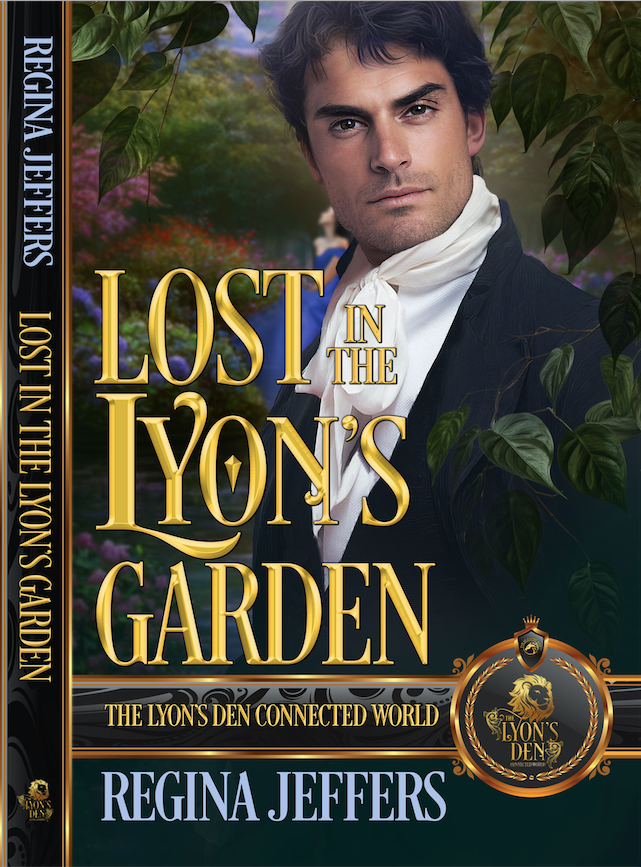
Book 4 – Lost in the Lyon’s Garden

Book 5 – Lyon on the Inside

Amazon https://www.amazon.com/dp/B0G1V963YZ

Please Note: The price of this book will increase to $3.99 on 11/26/2025.

Posted in book release, books, Dragonblade Publishers, eBooks, excerpt, Georgian England, Georgian Era, hero, heroines, historical fiction, mystery, publishing, reading, Regency era, Regency romance, romance, series, suspense, writing | Tagged , , , , , , , , , , , | Comments Off on It’s HERE!!! Lyon in Disquise Releases Today!

The Concept of “Gaslighting” + This Week’s Release of “Lyon in Disguise” from Dragonblade Publishing (Arriving Wednesday, 17 December 2025)

I have been fascinated with the concept of “gaslighting” since I played a major role in a community theatre production of “Angel Street” (originally titled “Gas Light”), a play by British playwright Patrick Hamilton. In 1944, the play was made into a movie starring Charles Boyer, Ingrid Bergman, and Joseph Cotton. Naturally, as I was not born at that time, my introduction to Gaslight was much later. Even a young Angela Lansbury played the maid in this one.

Gaslighting is a form of psychological manipulation where one person tries to make another question their own reality, memory, or sanity. It’s a tactic used to gain power and control over someone, often resulting in the victim feeling confused, anxious, and isolated. 

Here’s a more detailed explanation:

  • Distorting Reality: Gaslighters aim to distort the victim’s perception of events, making them doubt their own thoughts, feelings, and experiences. 
  • Shifting Blame: They often blame the victim for problems, making them feel guilty and responsible for the manipulator’s actions. 
  • Undermining Confidence: Gaslighters may criticize the victim’s abilities, decisions, and judgment, eroding their self-esteem. 
  • Isolation: They may isolate the victim from friends and family, further increasing their dependence on the gaslighter. 
  • Emotional Abuse: Gaslighting is considered a form of emotional abuse, as it can have a significant impact on the victim’s mental health and well-being. 
  • Origin of the term: The term “gaslighting” comes from the 1938 play “Gas Light” (also adapted into a film) where a husband manipulates his wife into believing she is losing her mind. 

In essence, gaslighting is a harmful tactic used to control and manipulate another person by making them doubt their own perception of reality. 

Nowadays, gaslighting falls into 5 types:

AI Overview

Gaslighting can manifest in various ways, but five common types include: outright lying, trivializing, denial, manipulation, and scapegoating. These tactics are used to undermine a person’s reality and sense of self. 

Here’s a breakdown of the five types: 

1. Outright Lies:.This involves fabricating stories or denying events that have actually occurred, often with the intent to confuse and disorient the victim.

2. Trivializing:.This tactic involves downplaying or dismissing the victim’s feelings, experiences, or opinions, making them feel as though their emotions are not valid or important.

3. Denial:.When a gaslighter denies something that is true, or something that they have said or done, despite evidence to the contrary.

4. Manipulation:.This involves using various controlling or harmful tactics to gain an advantage or to confuse and create doubt in the victim’s mind.

5. Scapegoating:.This involves unfairly blaming the victim for something they didn’t do, deflecting responsibility from the gaslighter.

Excerpt from Chapter Five where my heroine, Miss Audrey Moreau, finally realizes she is being manipulated by her Uncle Moreau.

Her uncle did not look up from the papers on his desk when he said, “I saw no reason in paying for services of which I will not benefit. You will remain alone in the house.” 

“Alone?” Audrey asked. Once more, her heart plummeted to her stomach, hiding from the fear filling her chest. “What do you mean by saying I shall be alone in this house?” 

Her uncle and Caroline planned to depart for France early the next morning, and Audrey was just hearing Uncle Jacobi’s full plans for her in his absence. She had spent the last two days coming to terms with being left behind, but she had not known the extent of her abandonment. 

“You have heard me correctly,” her uncle declared in exacting tones. “We will take both Mr. Stark and Mathild with us. Mathild does not wish to remain in England, and I have promised to return her to France. Naturally, Mr. Stark will accompany me: He remains a loyal servant.” 

Audrey heard her uncle’s emphasis on the word “loyal,” meaning this was, yet again, another maneuver to test her allegiance to her Uncle Jacobi. She had experienced more than one such proof of her willingness to follow her uncle’s orders since the initial announcement of his departure, but she had not expected this one because, customarily, Uncle Jacobi spoke of his expectations early and often. This change in tactics had Audrey feeling more off-kilter than usual. 

When she was younger, she did not understand some of the manipulations he practiced. In those days, he also used them against Caroline, but to a lesser extent, likely because Caroline succumbed quicker to her father’s wishes than had Audrey. Certain phrases were used often—phrases she could hear ringing in her head, even now.

“I do not have time to listen to your nonsense. You make little sense, girl.” 

Or . . .

“We spoke of this previously. You never recall our conversations. Sometimes I wonder about your intelligence.”

Or, he would accuse Audrey of confusing his promises. 

“Of what do you speak? I never promised you a new book if you would reorganize the attic. Moreover, why must I bribe you to do the right thing for the family which rescued you when no one else cared whether you lived or died?” 

Or . . . 

“What an avid imagination you possess. It is a sorry fate you suffer, for, obviously, you cannot tolerate living in the reality of the home I have provided you. You are an ungrateful being, but what should I have expected from the likes of your father and mother, who never truly cared what torment they caused the rest of the family?”

Sometimes when Caroline displeased him, Uncle Jacobi would place the blame on Audrey’s shoulders. 

“You must surely be aware, Caroline, how taking Audrey’s advice in such matters displays a weakness in your personality. You should not permit your cousin sway over you. Audrey always leads you astray. A daughter of mine should have a better head on her shoulders than the daughter of Darwood Lisey.” 

Upon occasion, he would encourage Caroline to join him in trivializing Audrey’s arguments. More than once, her cousin had berated Audrey with phrases such as . . . 

“Why must you always be so sensitive? You must know by now how my father only speaks to your faults so you might better yourself. Your father was a thief and perhaps a . . . Well, we assuredly do not know the extent of your father’s sins, but my father only wants the best for your future.” 

Lyon in Disguise: Lyon’s Den Connected World 

A handsome rake meets his match in a red-headed enchantress who is his enemy!

They may be on different sides of the law, but Lord Navan Beaufort is not going to permit that to stop him from protecting Miss Audrey Moreau. Navan has never thought truly to love anyone, but when he laid eyes on the red-headed beauty, his world shifted. Unfortunately, the lady appears to prefer Lord Alexander Dutton to him, though Navan has rarely had the opportunity to speak to her privately. That is, until he saves her from a fire one miraculous night. From there forward, she is his hope. His future.

Miss Audrey Moreau depends exclusively on her Uncle Jacobi for a home and protection. The man rescued her from a bayman’s plantation in the West Indies when she was five; yet, she well knows the “Marquis of Honfleur’s” schemes. She thought once Jacobi was caught, all would be well, but even from his jail, the man means to rain down harm upon her.

Can two lost souls find happiness together, when everyone in whom they had previously placed their trust have left them alone in the world?

Tropes You’ll Love:

  • Enemies to lovers
  • Self-declared bachelor
  • Friends to lovers
  • Adversaries
  • Damsel in distress
  • Best friend’s sister
  • Different worlds/experiences
  • Soul mates
  • Emotional scars
  • Fish out of water

Read in Kindle Unlimited!

Enjoy book one in a new series within The Lyon’s Den Connected world by Regina Jeffers.

Book 1 – Lyon in the Way

Book 2 – Lyon’s Obsession

Book 3 – Lyon in Disguise

Book 4 – Lost in the Lyon’s Garden

Book 5 – Lyon on the Inside

Amazon https://www.amazon.com/dp/B0G1V963YZ

Please Note: The price of this book will increase to $3.99 on 11/26/2025.

Posted in book release, British history, Dragonblade Publishers, eBooks, Georgian, Georgian England, Georgian Era, Great Britain, hero, heroines, historical fiction, history, mystery, publishing, Regency era, Regency romance, research, romance, suspense, writing | Tagged , , , , , , , , , , , , , , , | Comments Off on The Concept of “Gaslighting” + This Week’s Release of “Lyon in Disguise” from Dragonblade Publishing (Arriving Wednesday, 17 December 2025)

The Penalty of “Transportation” in Regency England + the Upcoming Release of “Lyon in Disguise” from Dragonblade Publishing (Arriving 17 December 2025)

Many in England’s history faced the punishment of “transportation” for the crimes they committed. Such is true of those arrested and tried as “Luddites” at the York Castle trials in January 1813. What did “transportation” entail in the Regency ear?

In Regency England, “transportation” as a punishment involved sending convicted criminals to overseas penal colonies, primarily to Australia, as an alternative to the death penalty. This system, established in the 18th and 19th centuries, aimed to relieve prison overcrowding and provide a labor force for British colonies. Sentences ranged from seven years to life, with convicts typically enduring hard labor and harsh conditions. 

  • Origins and Development: Transportation as a form of punishment emerged in the 17th century, initially sending convicts to the American colonies. Following the American Revolution, Australia became the primary destination. 

Transportation removed the offender from society, mostly permanently, but was seen as more merciful than capital punishment. This method was used for criminals, debtors, military prisoners, and political prisoners. Penal transportation was also used as a method of colonization. The individuals subjected to penal transportation were often those convicted of lesser crimes, such as theft, burglary, or forgery, which is a major plot point in Lyon in Disguise. However, political prisoners and those convicted of more serious offenses could also be sentenced to transportation.

Conditions varied depending on the location and time period, but generally, convicts endured harsh conditions during transportation and in the penal colonies. They faced long and arduous voyages, inadequate food and medical care, and brutal treatment by overseers. Once in the colonies, they were often subjected to hard labor in challenging environments.

The system was driven by a combination of factors, including overcrowding (removing large numbers of convicts), fulfilling the need for laborers in the British colonies, especially Australia so as to develop the infrastructure and economy, as well as proving a significant deterrent to crime and satisfying the desire for public retribution, knowing the person being sentenced was being “rightfully punished.”

Generally speaking, the convicts faced difficult and often brutal conditions, including long sea voyages, harsh labor, and the challenge of adapting to a new environment. Sentences varied, depending on the crime, ranging from seven years to life imprisonment. Upon completion of their sentence, some convicts were granted freedom but not a guarantee return to England.

Transportation to Australia gradually declines in the mid-19th century and was formally abolished in 1857 to be replaced by penal servitude.

“Convict transportation is an important, and under-explored, link in the evolution of punishment, and can illuminate the ways that states transform their capacities to exercise penal power. … The increased
penal capacity of the state was made possible by the combination of delegation to commercial actors and the increasing involvement of the national government in the financial, political and regulatory aspects of the administration of transportation. Transportation, unlike imprisonment at hard labor, was not seen as violating traditional English liberties because it ―widened the net‖ without creating new state structures and practices, and it drew on the accepted logic of governing the poor through labor.” [Beyond the Seas: Eighteenth-Century Convict Transportation and the Widening Net of Penal Sanctions]

Other Sources:

Convict Transportation

Crime and Punishment in Industrial England c1750 -1900

Lyon in Disguise: Lyon’s Den Connected World 

A handsome rake meets his match in a red-headed enchantress who is his enemy!

They may be on different sides of the law, but Lord Navan Beaufort is not going to permit that to stop him from protecting Miss Audrey Moreau. Navan has never thought truly to love anyone, but when he laid eyes on the red-headed beauty, his world shifted. Unfortunately, the lady appears to prefer Lord Alexander Dutton to him, though Navan has rarely had the opportunity to speak to her privately. That is, until he saves her from a fire one miraculous night. From there forward, she is his hope. His future.

Miss Audrey Moreau depends exclusively on her Uncle Jacobi for a home and protection. The man rescued her from a bayman’s plantation in the West Indies when she was five; yet, she well knows the “Marquis of Honfleur’s” schemes. She thought once Jacobi was caught, all would be well, but even from his jail, the man means to rain down harm upon her.

Can two lost souls find happiness together, when everyone in whom they had previously placed their trust have left them alone in the world?

Tropes You’ll Love:

  • Enemies to lovers
  • Self-declared bachelor
  • Friends to lovers
  • Adversaries
  • Damsel in distress
  • Best friend’s sister
  • Different worlds/experiences
  • Soul mates
  • Emotional scars
  • Fish out of water

Read in Kindle Unlimited!

Enjoy book one in a new series within The Lyon’s Den Connected world by Regina Jeffers.

Book 1 – Lyon in the Way

Book 2 – Lyon’s Obsession

Book 3 – Lyon in Disguise

Book 4 – Lost in the Lyon’s Garden

Book 5 – Lyon on the Inside

Amazon https://www.amazon.com/dp/B0G1V963YZ

Please Note: The price of this book will increase to $3.99 on 11/26/2025.

Posted in book release, British history, Dragonblade Publishers, eBooks, Georgian England, Georgian Era, Great Britain, hero, heroines, historical fiction, history, laws of the land, Living in the Regency, mystery, publishing, Regency era, Regency romance, research, suspense, writing | Tagged , , , , , , , , , , , , , , , , , , | 2 Comments