
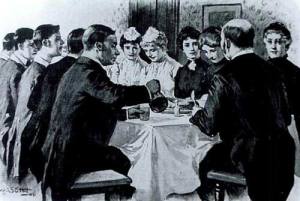
 The English aristocrat often lived beyond his means. Maintaining country houses (often several of them) and a large Georgian town house in Mayfair took its toll on his purse strings. In addition to owning the property, Society forced him to maintain an extensive staff, which would see to his family’s needs.
Rank among the serving class manifested itself in extra bedrooms and workrooms to meet the servant hierarchy. The house steward and the housekeeper were often given a sitting room in which the upper servants could dine. A work space was required for the steward to conduct his business. The butler oversaw an extensive pantry. A stillroom was necessary. Storerooms for groceries. A separate china closet. The scullery. The ladies’ maids required a separate room where they could do their mending and ironing. Don’t forget a knife room. A shoe room. A lamp room. A brushing room. A servants’ hall. Etc. Etc. Etc.
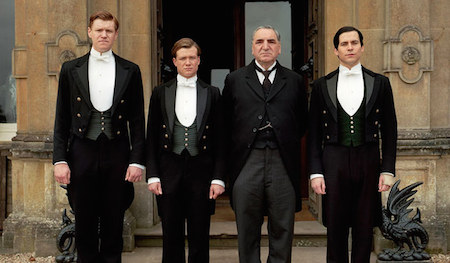 Even a modest staff was costly. Characteristically, a land owner maintained 40-50 servants. A large number of male servants was an indication of a man’s wealth. Employing males, instead of females, created a greater expense because a tax on male servants was introduced by Lord North in 1777. The tax was to be used for the cost of fighting the Americans and the war with the French. It cost a landowner £7 for each male servant if there were eleven or more in the household. Although it was gradually reduced over the years, the tax continued until 1937.
Compounding the issue of keeping powdered footmen increased by the duty placed on the hair powder. That tax remained in place from 1786 to 1869. Is it any wonder that some landowners forced their servants to use ordinary house flour to save on expenses? A smart footman might use the household flour and then claim the reimbursement for the expense of the duty.
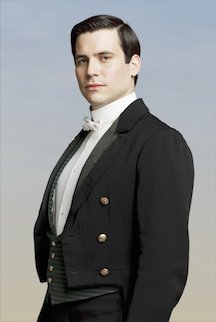 Footmen and other male servants were provided tailored livery. In the mid 1800s, it would cost 3 guineas for a footman’s uniform. Typically, a footman received 2-3 suits per year. Only the wealthiest aristocrat could afford to employ a house steward, groom of the chambers, valet, cook, butler, under-butler, footmen, footboy, usher, page, “tiger,” coachmen, grooms, a man-of-all-work, gardeners, etc.
Footmen were chosen for their height and their handsomeness. Most were at least six feet tall. It was desirable to match the footmen in height (like Radio City Music Hall does with the Rockettes). Most households had 3 footmen. The first footman, who was often called “James,” no matter what was his Christian name, usually acted as the lady’s footman. He would serve her breakfast, clean her shoes, take her dogs for a walk, stand behind her chair when she dined elsewhere, carry packages when she shopped, etc. The second footman served the afternoon meal. Often he completed valet duties for the eldest son. The third footman carried the coals and wood. The first and second footman served meals. They would accompany the carriage whenever it was used by any member of the household. The footmen were responsible for cleaning and polishing the silver. (Frank Hugget, Life Below Stairs, John Murray Publishers (July 14, 1977)
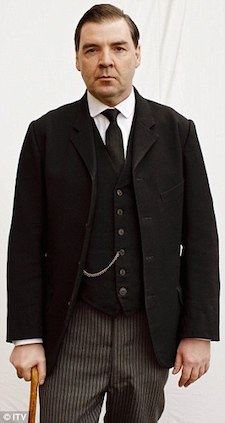 The valet was usually at least 30 years of age. He was expected to have a superficial air of aristocracy about him. He saw to his master’s dress and was expected to be abreast of social gossip to aid his master in social engagements, etc. He did not wear livery. He would rise before his master. The aristocrat’s clothes were prepared, a bath drawn, and everything his master required for his ablutions prepared. He might also be required to dress the master, or he might need to know how to load a gun quickly so that his master could shoot with his friends.
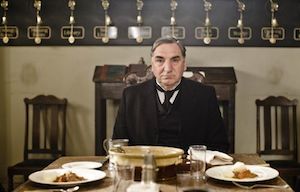
A CARNIVAL FILMS PRODUCTION FOR ITV1. DOWNTON ABBEY. COMING SOON. ITV’s new costume drama series, Downton Abbey, written and created by Oscar-winning writer Julian Fellowes and made by Carnival Films for ITV will star Maggie Smith as Violet, Dowager Countess of Grantham, Hugh Bonneville as Robert, Earl of Grantham and Elizabeth McGovern as Robert’s wife, Cora, Countess of Grantham. They will lead an all-star cast, which also includes: Penelope Wilton, Dan Stevens, Michelle Dockery, Jim Carter, Phyllis Logan, Lesley Nicol, Siobhan Finneran, Rob James Collier, Joanne Froggatt and Rose Leslie. Set in an Edwardian country house in 1912, Downton Abbey will portray the lives of the Crawley family and the servants who work for them. PICTURED: JIM CARTER as Mr Parson. This photograph is (C) ITV Plc/CARNIVAL FILMS and can only be reproduced for editorial purposes directly in connection with the programme or event mentioned above, or ITV plc. Once made available by ITV plc Picture Desk, this photograp
The butler needed similar skills as the valet. He was responsible for the footmen, the custody of the plate, and the contents of the wine cellar. He also oversaw the brewing of the servants’ beer, the arrangement of the dining room, etc. Unlike our perceptions of the haughty butler who ruled a household with an iron hand, the Victorian butler was in a more lowly position. In reality, the valet, the house steward, and the groom of the chambers, all outranked him in the household. They also received higher pay.
The groom of the chambers was the one who attended the main door, opened doors for members of the household, filled inkpots, saw that everything the household members needed was within reach.
The house steward oversaw the transition from country estate to Town when the Season came around. He was responsible for all the servants. He maintained the household accounts.
 During the Regency Period, wealth and social class separated the English citizenry. Beginning with the Royals, citizens found their place based on birthright and wealth. The nobility stood above the gentry, who stood above the clergy, who stood above the working class, etc. As part of the gentry, Jane Austen’s family held certain privileges, but also lacked political power. Although he was a rector, the Reverend George Austen was a “gentleman,” meaning man of the gentry class. Austen’s novels are populated with those of the gentry. Occasionally, her readers encounter the nobility, as in Lady Catherine De Bourgh and the Dowager Viscountess Dalrymple or the clergy as with Mr. Collins or Mr. Elton.
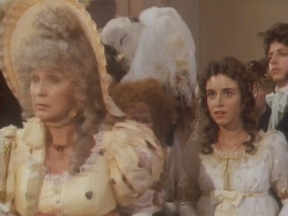 People of lower rank were expected to wait to be introduced to someone of a higher rank. (Do you recall Catherine Morland and Mrs. Allen at Bath? They must wait for an introduction to Henry Tilney, who calls upon the evening’s master of ceremonies to do the deed.) Women of the period were to be obedient to their fathers and husbands, docile and without opinions, have refined qualities, and attendant to their families. Education was not a prerequisite for women. In Austen’s stories, her heroines often shun these predisposed qualities. One must remember that Darcy admires Elizabeth Bennet’s desire to improve her mind by extensive reading.


 Previously, we looked at what a servant in an upper house, or even in a second-class household, of the late Regency Period or early Victorian times, might encounter. We spoke of wages, delineation of duties, and additional compensation. Today, we wish to examine the “snobbery” found among the servant class. As mentioned in the previous’s article, the servants in upper households expected “tips” from the master’s guests. If he did not receive it, he might still exact his revenge on those who paid a second visit to the estate. On his return, a guest might find himself in a one of the draftier bedchambers or he might be met at the train in a cart rather than an estate carriage.
 This situation reminds me of the chauffeur in the play Sabrina Fair (basis of the movie Sabrina, which starred Humphrey Bogart and Audrey Hepburn) who earns a fortune by simply listening to his employer conduct business in the backseat of the car and then buying and selling stocks based on Linus Larrabee’s knowledge of the stock market.







 Congratulations to
  Sin and Sensibility by Suzanne Enoch; An Avon Romantic Treasure Book; Copyright December 2004; ISBN 0-06-054325-6
 Book Blurb: After all, what could be more tantalizing than teaching the beautiful Witfeld sisters all the special ways of driving a man into submission—and marriage? And leading exquisite Caroline Witfeld, the most spirited and least frivolous sister, to temptation would be wildly delicious.
 It was lust at first sight . . .
 Book Blurb: Lust is a Sin . . .
 Book XIII:
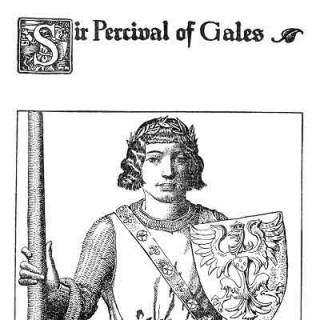 “Outside the ship, they meet Sir Percivale’s sister, who explains the history of the boat and the marvelous sword they will find inside it. The knights encourage Galahad to take the sword, which he does, naturally. The knights and maiden reboard the other ship (the one that bore Percyvale and Bors), which carries them to the Castle of Carteloyse in the Scottish Marches. There, they meet with hostile occupants and kill them all. Then they learn from the priest of the castle that they rescued the castle from three brothers who committed incest with their sister. Next, the knights and maiden come to a desolate forest, where they glimpse four lions led by a white hart. The four lions change into a man, lion, eagle, and ox. They learn that the hart represents Christ, and the lions stand for the four gospel-writers. The company arrives at a castle, where the knights must fight to prevent Percivale’s sister from having to give a basin full of blood. When the fight ends in a draw, the party agrees to lodge in the castle for the night and continue fighting the next day.When Percivale’s sister learns that the custom of the castle that involves bleeding a maiden is to save the life of its lady, she agrees to be bled, but loses her life in the process.” (
 In March of 2010,
  he flood ofwriting continued and the tap hasn’t turned off since. I’ve completed many other novels since Belle Bridge Books published
  My latest adventure has been
  With the popularity of Upstairs, Downstairs and Downtown Abbey, the populace has become more aware of the British servant class. So what do we know of those who lived “below stairs”? First, rank and precedence ruled those of the servant class as much as it did their masters. What was known as the “pugs procession” was commonplace among servants. Instead of the chatty scenes between upper and lower servants on Downtown Abbey, most household were ruled by “silence.” All the servants would take their dinner together in the servants’ hall, but then the upper servants (the house steward, the butler, and the housekeeper) would move to a private sitting room for their dessert.
 Being neither seen nor heard would be the order of the day. It was not unusual for maids to turn and face the wall if she encountered her master or mistress in the passageways. The upper housemaids were responsible for the appearance of the rooms. They addressed the draperies, the floral arrangements, the chair covers, etc. The under housemaids did the physical duties of laying a fire, polishing, cleaning the grates, etc. In Letters from England, Elizabeth Davis Bancroft, the wife of the U.S. Minister to England (1846-49), wrote, “The division of labour, or rather ceremonies, between the butler and the footman I have now mastered, I believe in some degree, but that between the upper and under housemaid is still a profound mystery to me, though the upper has explained to me for the twentieth time that she did only ‘the top of the work.”


 Every Woman Dreams...