
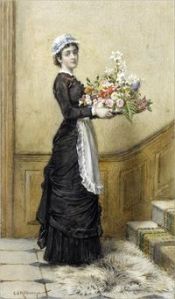
Word Wenches: The Well-dressed Maid.
wordwenches.typepad.com
Up before dawn, the servants of an aristocratic household found the work tedious. Likely, the lower servants worked two hours before he/she was permitted to sit to his own meager breakfast.
The kitchen maid began her day with lighting the cooking fire. To do so in a cast iron stove, she must first rake out the cinders and sweep the bars, the hobs, and the hearth free of dust. She would then clean the stove with a round-headed brush and black lead mixed with some water to make a “paste.” When the black lead dried, it was polished with a special brush, which was designed to get into the groves of the ornamental work. At least one weekly, she also swept away the accumulated soot from the flues. Generally, she was expected to bring the cook the woman’s morning tea.
The housemaids began their days with cleaning the carpets. An unusual ritual included scattering wet sand or damp tea leaves over the carpets before they swept them. They cleaned the main hall and receiving rooms thoroughly and set fires in the hearths (after cleaning the grates). After morning prayers, the housemaids cleaned the bedchambers: changed bed linens, emptied chamberpots and baths, swept the carpets, dusted the furnishings, washed and polished wooden floors, etc. One must recall that there were three mattresses on a Victorian bed. The bottom one was filled with straw and was turned once weekly. The middle one was filled with wool or horsehair. It was turned daily. The top mattress was filled with feathers. Please recall that the housemaids were supposed to finished with their work by mid day.

August | 2012 | M. Louisa Locke
mlouisalocke.com
Upper servants (cook, lady’s maid, governess, parlour maid, and nurse) usually got an extra hour sleep while others began their days as early as 5 A.M. The cook was responsible for 4 meals daily for the master and mistress and their guests, the children, and the other servants. She prepared a different type of meal for each group. All the servants, minus the nursery staff, sat down to breakfast shortly after 8 A.M. They would dine on leftovers of yesterday’s roast or cold meat pie and a slice of bread, along with a weak tea or home brewed beer. A tea break for the servants came at approximately 11 A.M. The cook would meet regularly with the mistress to discuss the menus for the day. The servants had their “dinner” between midday and one o’clock. Generally, it was a roast and vegetables with a rice or suet pudding. Beer was served with the meal. The nursery staff were given a shepherd’s pie or mutton stew. The master and mistress and the older children had a luncheon served by liveried footmen. This was a more formal meal than was breakfast. The course was usual fish, which was followed by hot dishes and then a sweet dessert or fresh fruit. The ladies would be out the door for afternoon social calls.
Parlour maids, which replaced butlers during the Victorian era, set the table in the dining room, as well as to oversee the removal of the leftovers. Occasionally, the parlour maid acted as a valet to the master of the house. Parlour maids, like footmen, were chosen for their height and good looks, and they were often a target for unfaithful husbands. At about 9 each morning, the parlour maid would summon the family, the children, and the other servants to family prayers in the drawing room. (If you recall, Edmund Bertram and Mary Crawford discuss this practice in Jane Austen’s Mansfield Park.) Before she called the household to prayers, the parlour maid had set the table with linen and silverware. She had also placed bread, toast, butter, jam, and honey on the table, along with a cream and sugar for tea. After the prayers, she brought in the covered breakfast dishes. They family would then choose from hot and cold dishes: eggs, bacon, kidneys, kippers, fish, tongue, potted meat, etc.
The ladies’ maid woke her mistress and helped the lady of the house with her ablutions and dress. Remember that women of the Victorian Period wore tightly laced corsets or stays, several petticoats, steel-hooped crinolines, tight pantaloons, and dresses with yards and yards and yards of material.
Nursery maids swept and cleaned the day nursery and lit the hearth for warmth. The governess saw to the children. Upper class ladies rarely visited their children in the nursery for longer than 30 minutes per day. With infants, a wet nurse was engaged. Ladies of quality never breast fed their children. Governesses were occasionally accused of using a bit of laudanum to keep the children in order. The first duty of the day was to bath and feed the babies/children. A mixture of milk and barley water was used for the infants. The governess was also responsible for administering prescribed medicines and purges of castor oil, senna, or peppermint. They took the children out for morning and afternoon excursions. Older children were bathed and dressed. Even little boys wore stays until the age of 7 or 8. Breakfast was a porridge or gruel. It was quite bland when compared to what the parents ate.
 St Michael Paternoster Royal is a church in the London proper. The original building, which was first recorded in the 13th century, was destroyed in the Great Fire in 1666. The church was rebuilt under the aegis of Sir Christopher Wren. However St Michael’s was severely damaged during the London in WWII. It was restored between 1966 and 1968. In 1423 Richard “Dick” Whittington, the fabled Lord Mayor of London, was buried within its precincts; although the tomb is now lost. The earliest record of St Michael’s is as St Michael of Paternosterchierch and is dated 1219. Richard Whittington, four time Lord Mayor of London, founded the College of St Spirit and St Mary within the church, so that St Michael’s became a collegiate church, i.e. it was administered by a college of priests, in this case five, instead of a rector. It was commonly known as Whittington’s College, or Whittington College. Adjacent to the Church, Whittington also founded an almshouse. The College was dissolved by Edward VI in 1548; but was re-established in a new entity a few years later under Queen Mary. The title seems in any case to have persisted for the church, giving the names of College Street, and College Hill. The almshouses moved to Highgate in 1808 and later to their present location in East Grinstead in 1966. (
 From
From  Whittington College is a Gothic almshouse built around three sides of a quadrangle. The chapel is the center point of the structure. The Whittington charity called College Hill home, but eventually moved to the another site near the Whittington Stone in 1822. “St Michael’s is rectangular in plan, with only the west front on College Hill being slightly out of true. Before the Second World War the south front was hemmed in by buildings. Following bomb damage, these buildings were cleared and Whittington Garden laid out on their site, so that St Michael’s main façade is now on the south, along Upper Thames Street. The south front is faced with Portland stone and has six round-headed windows with cherub keystones. The less prominent north and east fronts are of brick. The roof is balustraded.
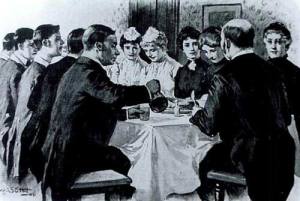 The English aristocrat often lived beyond his means. Maintaining country houses (often several of them) and a large Georgian town house in Mayfair took its toll on his purse strings. In addition to owning the property, Society forced him to maintain an extensive staff, which would see to his family’s needs.
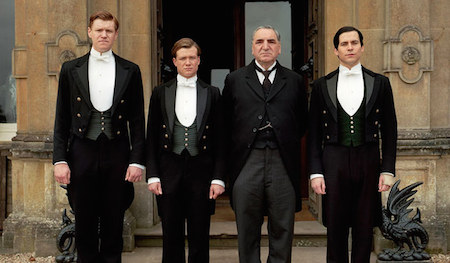 Even a modest staff was costly. Characteristically, a land owner maintained 40-50 servants. A large number of male servants was an indication of a man’s wealth. Employing males, instead of females, created a greater expense because a tax on male servants was introduced by Lord North in 1777. The tax was to be used for the cost of fighting the Americans and the war with the French. It cost a landowner £7 for each male servant if there were eleven or more in the household. Although it was gradually reduced over the years, the tax continued until 1937.
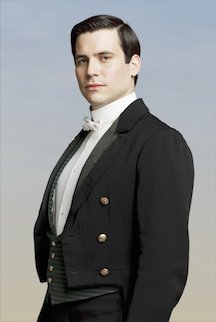 Footmen and other male servants were provided tailored livery. In the mid 1800s, it would cost 3 guineas for a footman’s uniform. Typically, a footman received 2-3 suits per year. Only the wealthiest aristocrat could afford to employ a house steward, groom of the chambers, valet, cook, butler, under-butler, footmen, footboy, usher, page, “tiger,” coachmen, grooms, a man-of-all-work, gardeners, etc.
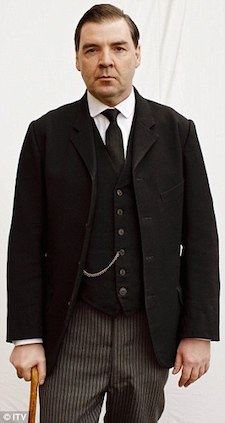 The valet was usually at least 30 years of age. He was expected to have a superficial air of aristocracy about him. He saw to his master’s dress and was expected to be abreast of social gossip to aid his master in social engagements, etc. He did not wear livery. He would rise before his master. The aristocrat’s clothes were prepared, a bath drawn, and everything his master required for his ablutions prepared. He might also be required to dress the master, or he might need to know how to load a gun quickly so that his master could shoot with his friends.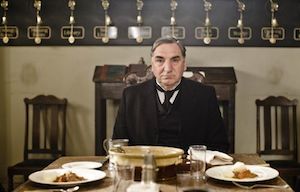
 During the Regency Period, wealth and social class separated the English citizenry. Beginning with the Royals, citizens found their place based on birthright and wealth. The nobility stood above the gentry, who stood above the clergy, who stood above the working class, etc. As part of the gentry, Jane Austen’s family held certain privileges, but also lacked political power. Although he was a rector, the Reverend George Austen was a “gentleman,” meaning man of the gentry class. Austen’s novels are populated with those of the gentry. Occasionally, her readers encounter the nobility, as in Lady Catherine De Bourgh and the Dowager Viscountess Dalrymple or the clergy as with Mr. Collins or Mr. Elton.
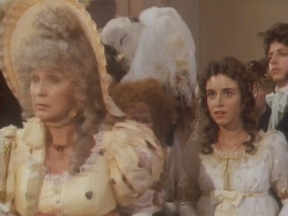 People of lower rank were expected to wait to be introduced to someone of a higher rank. (Do you recall Catherine Morland and Mrs. Allen at Bath? They must wait for an introduction to Henry Tilney, who calls upon the evening’s master of ceremonies to do the deed.) Women of the period were to be obedient to their fathers and husbands, docile and without opinions, have refined qualities, and attendant to their families. Education was not a prerequisite for women. In Austen’s stories, her heroines often shun these predisposed qualities. One must remember that Darcy admires Elizabeth Bennet’s desire to improve her mind by extensive reading.


 Previously, we looked at what a servant in an upper house, or even in a second-class household, of the late Regency Period or early Victorian times, might encounter. We spoke of wages, delineation of duties, and additional compensation. Today, we wish to examine the “snobbery” found among the servant class. As mentioned in the previous’s article, the servants in upper households expected “tips” from the master’s guests. If he did not receive it, he might still exact his revenge on those who paid a second visit to the estate. On his return, a guest might find himself in a one of the draftier bedchambers or he might be met at the train in a cart rather than an estate carriage.
 This situation reminds me of the chauffeur in the play Sabrina Fair (basis of the movie Sabrina, which starred Humphrey Bogart and Audrey Hepburn) who earns a fortune by simply listening to his employer conduct business in the backseat of the car and then buying and selling stocks based on Linus Larrabee’s knowledge of the stock market.







 Congratulations to
  Sin and Sensibility by Suzanne Enoch; An Avon Romantic Treasure Book; Copyright December 2004; ISBN 0-06-054325-6
 Book Blurb: After all, what could be more tantalizing than teaching the beautiful Witfeld sisters all the special ways of driving a man into submission—and marriage? And leading exquisite Caroline Witfeld, the most spirited and least frivolous sister, to temptation would be wildly delicious.
 It was lust at first sight . . .
 Book Blurb: Lust is a Sin . . .
 Book XIII:
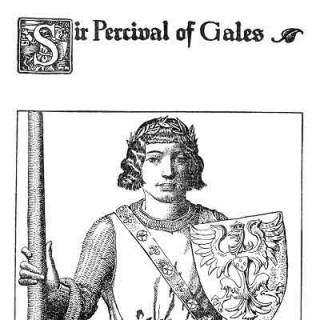 “Outside the ship, they meet Sir Percivale’s sister, who explains the history of the boat and the marvelous sword they will find inside it. The knights encourage Galahad to take the sword, which he does, naturally. The knights and maiden reboard the other ship (the one that bore Percyvale and Bors), which carries them to the Castle of Carteloyse in the Scottish Marches. There, they meet with hostile occupants and kill them all. Then they learn from the priest of the castle that they rescued the castle from three brothers who committed incest with their sister. Next, the knights and maiden come to a desolate forest, where they glimpse four lions led by a white hart. The four lions change into a man, lion, eagle, and ox. They learn that the hart represents Christ, and the lions stand for the four gospel-writers. The company arrives at a castle, where the knights must fight to prevent Percivale’s sister from having to give a basin full of blood. When the fight ends in a draw, the party agrees to lodge in the castle for the night and continue fighting the next day.When Percivale’s sister learns that the custom of the castle that involves bleeding a maiden is to save the life of its lady, she agrees to be bled, but loses her life in the process.” (


 Every Woman Dreams...