Celebrating the Release of “The Pemberley Ball: A Pride and Prejudice Vagary Novella” with an Excerpt + Giveaway

51sa67KvExL._SX327_BO1,204,203,200_ “The Pemberley Ball” originally appeared in The Road to Pemberley: An Anthology of New Pride and Prejudice Stories, published by Ulysses Press in 2011. Each author whose work was included in the anthology received a one time payment (in lieu of royalties). He/she maintained the rights to his/her story. I have chosen to rework my original story and re-release. It is now a 36,000+ word novella rather than a short story.

That being said, you should know that I wrote several versions of this story, and I have made many changes from the one printed in the anthology. For one thing, I am so much wiser about the Regency period than I was in 2011. In other words, the historical elements are more accurate. Secondly, I have added passages and description that I could not include in the original because of the limited word count permitted for each story in the anthology. Finally, I have decided to include three versions of the story’s climax in this new release. Therefore, when the reader reaches Part 5 of the story, he/she will find three passages; the first shows the constantly in command Mr. Darcy. This is the one we all know and love. He anticipates every possible obstacle in his way and perseveres. The second proves Mr. Darcy the consummate Alpha Male. Personally, I liked this Darcy. He goes after what he wants and permits the chips to fall where they may. However, one of my Beta readers was not so enthralled with this characterization. Let me know what you think when you read the story. The third gives our hero the opportunity to proclaim his frustrations with Elizabeth, as well as with Mr. Wickham. This one will likely be the most popular of the offerings for Wickham receives his comeuppance. The reader may choose to read alternate passage #1, #2 or #3 or all of them.

TPB eBook Cover (1) copyBack Cover:

Elizabeth Bennet’s acceptance of his hand in marriage presents FITZWILLIAM DARCY a hope of the world being different. Elizabeth offers warmth and naturalness and a bit of defiance; but there is vulnerability also. With characteristic daring, she boldly withstood Caroline Bingley’s barbs, while displaying undying devotion to her sister Jane. More unpredictably, she verbally fenced with the paragon of crudeness, his aunt, Lady Catherine, and walked away relatively unscathed. One often finds his betrothed self-mockingly entertaining her sisters and friends, and despite Darcy’s best efforts, the woman makes him laugh. She brings lightness to his spirit after so many years of grief.

Unfortunately for ELIZABETH BENNET, what begins gloriously turns to concern for their future. She recognizes her burgeoning fears as unreasonable; yet, she cannot displace them. She refuses to speculate on what Mr. Darcy will say when he learns she is not the brilliant choice he proclaims her to be. Moreover, she does not think she can submit to the gentleman’s staid lifestyle. Not even for love can Elizabeth accept capitulation.

Will Elizabeth set her qualms aside to claim ‘home’ in the form of the man she truly affects or will her courage fail her? Enjoy a bit of mayhem that we commonly call “Happily Ever After,” along with three alternate turning points to this tale of love and loss and love again from Austen-inspired author, Regina Jeffers.

EXCERPT:

(You may read the beginning of Part 1 on Austen Authors HERE.) The excerpt below is a continuation of the scene.)

“I suppose my mother forgets that I, too, have a wedding to plan,” Elizabeth said softly beside him. They sat together in a small Longbourn drawing room.

As was typical, after the evening meal, Mr. Bennet retreated to his study to read. Miss Kitty examined the latest fashion plates, and Miss Mary practiced her music. Mrs. Bennet demanded that Miss Bennet and Bingley join her in her sitting room to finalize plans for their wedding breakfast. So, although others remained in the room, he and Elizabeth were essentially alone.

With a deep sigh, Elizabeth turned to him. “It is abhorrent of me to complain after all your ministrations on my sister’s behalf. Forgive me, Mr. Darcy.”

Darcy watched her features carefully, expecting Elizabeth to turn her moment of envy into another disparagement on her own failings, but she did not perform to expectations. Evidently, this was one of those private moments. Elizabeth would show him a face, which spoke the truth: Her mother’s preference bruised his future wife’s ego.

“I would forgive you anything, Elizabeth, if you could see your way clear to call me something less formal than Mr. Darcy. In private, could you not consider my given name?”

Elizabeth’s smile broke her mouth’s line. “You wish for me to call you Fitzwilliam?”

“If Fitzwilliam does not suit you, the family often calls me ‘William.’ With Fitzwilliam being the family name for my mother’s brother and my cousins, ‘William’ causes less confusion.”

“I would be honored,” she said softly.

“Then say it, Elizabeth,” he whispered hoarsely.

An inexplicable emotion spread through his veins, and Darcy’s breathing suddenly constricted. His gaze slid over her. Elizabeth’s eyes mesmerized him. She looked upon him, her head angled to bare the length of her throat. Darcy noted the pulse point at the base of her neck throbbed as prominently as did his. He wished to touch her, to caress her cheeks, to bury his hand in the thickness of her hair. The effect Elizabeth had on him always took Darcy by surprise. A pleasant surprise! But a surprise nonetheless. Elizabeth leaned in, unaware of what her nearness did to his composure.

“William, did I tell you how pleased I am to become your wife?” she murmured.

Darcy swallowed a shot of desire shooting through him. He planned to kiss Elizabeth this evening–actually dreamed how it would be. His finger now traced a line from her temple to her chin.

“You, my dearest, loveliest Elizabeth, do not know how often I prayed to hear my name upon your lips, and the fact that you express a pleasure in our future joining raises my hopes of our marital felicity.”

Realizing the impropriety they practiced, with a slight blush, Elizabeth leaned back, placing distance between them.

“May we speak of the wedding, Sir?”

Darcy frowned with the return of formality, but he said evenly, “Most assuredly, Miss Elizabeth. What do you wish to settle?”

Elizabeth turned to sit more squarely on.

“It would…it would seem, Sir, that we must agree on the ceremony’s date. Do you favor a long engagement?”

Darcy straightened his shoulders, a posture he instinctively adopted when completing business transactions; after all, among his society, marriage was a business.

“I waited to claim you for a year. I must admit that I am of the persuasion to finalize that claim as quickly as possible, but I am not insensitive to the fact that this is a greater change for you. You must leave your home and family behind to start a new life with me. And although I want none but you on Pemberley’s staircase waiting for my anticipated return from a business journey or from a day in the fields with my tenants, I will understand if you insist on a longer waiting period.”

Elizabeth blushed again. “You thought of me with you at Pemberley, William?” she asked sweetly.

Darcy smiled at her return to flirting with him. “You would be quite shocked, Elizabeth, at how often each day that you enter my mind.”

“How often?” she prompted innocently.

“Too often,” he growled in hushed tones. “And in too many ways,” he purposely said to shock her.

If this conversation continued, he would embarrass himself with an increase in his manhood.

“Oh!” she gasped. An elongated pause followed. Elizabeth glanced toward where her sister sketched changes in a dress pattern.

“Other than my father, I do not believe anyone at Longbourn will realize I am absent,” she mumbled. Elizabeth swallowed her obvious moment of regret and then presented Darcy a fresh smile. “A shorter engagement appears advisable,” she said with more confidence. “Mr. Bingley tells me that the roads to the north can become more hazardous as winter approaches. If we are to Derbyshire, it would be judicious to do so sooner rather than later.”

“Mr. Bingley is correct: Derbyshire winters can be quite cruel. Moreover, I would wish to celebrate the festive days at Pemberley. Georgiana and I spent the last few Christmases in London. It is my dream to bring you to my home and for you to share it with my sister. With your acceptance, I instructed Mrs. Reynolds to set plans for a winter ball. We have not held one at Pemberley for more than a decade. I will introduce my new wife to my close family and the neighborhood. It will make your transition as the estate’s mistress easier.”

Elizabeth attempted to hide her apprehension, but Darcy took due note of it.

“Then after the calling of the banns…how much longer after the vicar makes the third call?” she thought aloud.

Darcy smiled at her. It amazed him how nervous Elizabeth was about the reality of their joining. He held the advantage in that manner, for Darcy long ago began imagining their life together.

“Although I do not know why you insist upon a calling of the banns, when I could easily purchase a standard license, if the choice of dates is to be mine, the day following the third calling.”

“Despite Mr. Bennet being a gentleman who recognizes a calling of banns is, generally, not done among our social class, my father believes the neighborhood that  depends upon his charity deserve to know of Longbourn’s happiness. But more importantly to the issue at hand, my sister and Mr. Bingley chose the Monday after our third Sunday calling for their date. Had you thought of a double wedding? Is that your wish, Mr. Darcy?”

Darcy’s frown lines met. “I never considered a double wedding as a possibility, nor did I foresee our final banns being called so close to Miss Bennet’s chosen day.” In spite of a bit of apprehension, Darcy infused his voice with an encouraging tone. “Notwithstanding my close association with Bingley, I would not be pleased to share the day of your and my joining with him and Miss Bennet. I would have you gloried in your own right as my wife.”

Elizabeth expelled a sigh of relief.

“Thank you for understanding, William,” she whispered. “I love Jane, but the day I am named Mrs. Darcy is not a day I would want to half with another.”

“Then a week after the final calling,” he declared. “That is a month from this Sunday. Is that sufficient time, Elizabeth?”

“It is perfect, William. The first week of November,” she said wistfully.

* * *

“Your hat, Mr. Darcy.” Elizabeth teased him by clinging to Darcy’s arm, and he knew a sense of satisfaction.

“Walk me out,” he said softly as he caught her hand and tugged Elizabeth along behind him. As quickly as they were away from the lights streaming from Longbourn’s windows, Darcy pulled her into his embrace.

“William,” she giggled, but Elizabeth came willingly against him, resting her head on Darcy’s chest. He wrapped his great coat about her to keep her both warm and in his embrace.

He bent his head to speak to her ear. “Elizabeth,” he rasped, “it is my intention to kiss you.” He felt her stiffen with uncertainty. “If you do not wish me to do so at this time, then you should return to the house immediately.”

Darcy waited for her decision. When she remained in his arms, he felt the exhilaration: Elizabeth would accept his kiss. He lifted her chin and lowered his mouth to hers.

He kept one arm about her to steady her. With his other hand, Darcy cupped her chin, tilting her head gently upward. Elizabeth was an innocent, and he moved slowly, permitting her to withdraw if she became frightened.

At length, he brushed his lips across hers before adding a bit of pressure. A slow caress of mouth against mouth. A gentle nip. He skimmed his tongue along the seam of Elizabeth’s lips, and she opened for him. Even then, Darcy did not deepen the kiss–just enjoyed the possibility. After a few moments, he reluctantly ended the pleasure of knowing her intimately.

“You are delicious,” he whispered seductively.

Elizabeth clung to his coat’s lapels, but she breathed the words, “So are you.”

Darcy recognized her blush’s heat when she realized what she had said. He bent to kiss the tip of Elizabeth’s nose.

“We will take my curricle and see some of the countryside tomorrow,” he declared.

“Orders, Mr. Darcy?” Elizabeth taunted as she released her hold on his lapels.

He slid his hands down Elizabeth’s arms, capturing her hands in his. Darcy chuckled. “As you, my dear, are new to courtship, needless to say, you will not object if I issue orders. It is only after we marry that you will voice your opposition.”

Elizabeth stepped back to release his hold on her, her hands fisting at her waist. “Have you learned nothing of my nature, Mr. Darcy? There is a stubbornness about me that never can bear to be frightened at the will of others. My courage always rises with every attempt to intimidate me.”

Darcy laughed warmly. “Now there is the Elizabeth Bennet who plagued my every waking moment for a year.”

He caught her hand again and led Elizabeth to where his horse stood waiting. “I will call for you at eleven.”

“Yes, William,” she said in a coy taunt. “I shall be anticipating it.” Elizabeth emphasized her tone’s sweetness.

With fondness in his gesture, Darcy kissed her forehead.

“Good evening, Elizabeth. I, too, will anticipate the day.”

Purchase Links: 

Amazon    

Kindle        

Nook 

Kobo       

CreateSpace      

NOW, FOR THE GIVEAWAY. I HAVE THREE eBOOKS OF “THE PEMBERLEY BALL” AVAILABLE TO THOSE WHO COMMENT BELOW. RANDOM.ORG WILL CHOOSE THE WINNERS. THE GIVEAWAY WILL END AT MIDNIGHT, EDST, ON WEDNESDAY, APRIL 13, 2016. 

Posted in book excerpts, book release, customs and tradiitons, eBooks, Jane Austen, Living in the Regency, Living in the UK, marriage, marriage customs, marriage licenses, Pride and Prejudice, publishing, Regency era, Regency romance, romance, Uncategorized, Vagary, writing | Tagged , , , , , , , | 15 Comments

Jane Austen’s Love of the British Navy

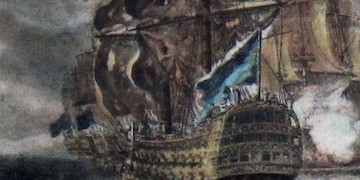
battle_of_trafalgar

Battle of Trafalgar – British Royal Navy: Nelson: Napoleonic Wars http://www.napolun.com

In referring to the cult-like following of those who extolled all things involving Admiral Horatio Nelson, Jane Austen once wrote, “I am sick of Nelson.” Yet, the author always appreciated the lives of men in the Royal Navy. Two of her brothers served thusly. The British Navy at the time of the Napoleonic War was divided into “ships of the line,” those carrying between 60 and 100 guns, and “cruisers,” which were frigates, sloops, and brigs with fewer guns. In 1810, British naval strength was estimated to be 150+ ships of the line and near 400 cruisers. Documents on the naval history sites say that the Navy employed 800+captains, 600+ commanders, and nearly 3300 lieutenants.

During the Napoleonic Wars, the size of the British fleet was greater than all the other sea-faring nations put together.

Namur-Wiki-Commons-578x289

THE REMAINS OF AN 18TH CENTURY SHIP HAVE BEEN IDENTIFIED THROUGH DETECTIVE WORK ON HER TIMBERS AS THE NAMUR, WHOSE CREWS INCLUDED JANE AUSTEN’S SEAFARING BROTHER CHARLES, AND OLAUDAH EQUIANO, THE MOST FAMOUS BLACK WRITER AND ANTI-SLAVERY ACTIVIST OF GEORGIAN ENGLAND. http://www.allempires.com /forum/forum_posts.asp?TID=32226

The British Isles remained safe behind the “Wooden Walls” of the Royal Navy, and Britain was able to continue its world trade and empire building. They controlled English Channel and trading routes with size of their fleet, but Britain also actively sent its vessels out to attack enemy warships. With its strength in numbers and its developing naval industry, Britain could risk losing a ship or two to protect the British people.

In 1797, 1801, and 1807, the British navy sailed to destroy the neutral or French-allied vessels of Holland and Denmark. At Camperdown in 1797, Admiral Duncan pitted his 16 ships against 16 Dutch warships under Admiral de Winter and destroyed the enemy fleet – capturing seven Dutchmen and allowing the rest to flee.

In April 1801, the Admirality sent an expedition against Denmark to break up a northern European agreement, the Armed Neutrality of the North, that threatened British trade and shipbuilding materiel – wood, rope, grain and tar – in the Baltic Sea.

The naval Battle of Copenhagen was a British victory that saw 12 of 18 Danish vessels captured and ended the threat to its trade. In 1807, Britain again moved against Denmark when it became known there was a French move to grab the Danish fleet. Admiral Gambier took 20 ships of the line and an infantry force of some 20,000 men – including Arthur Wellesley (yes, that is the Duke of Wellington) – to prevent the vessels falling into French hands. A two-week siege began and a Danish military move to break the blockade was ended by Wellesley’s infantry. The bombardment of the capital by the Royal Navy forced neutral Denmark to hand over its 18 ships to London.

8da5ca92f9fcf9445f0e93c8db5f79d5

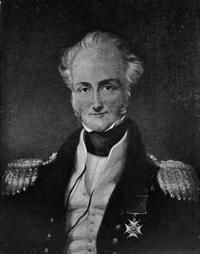
Rear Admiral Charles Austen, youngest of the Austen brothers

Jane Austen’s brothers entered the navy at the age of 12 and first went to sea at age 15. Naval life was a hard one, and many believed it necessary “to toughen up the boys.” Unlike in the army, naval commissions could not be bought. It was necessary to succeed in a naval career to have the patronage of an influential personage. If one knows of Admiral Crawford in Mansfield Park, this makes more sense. A man earned his future in prize money. Do we not recall Captains Wentworth, Benwick, and Harville in Persuasion? The captain would receive one-fourth of the value of the captured ship. His officers would receive graduated proportions, and ordinary seamen divided the final quarter among themselves. InPersuasion, Wentworth has earned 20,000 pounds in his eight years of service. Men learned to look forward to another war so they might continue their winning ways.”

Excerpt from Jane Austen’s Persuasion:

Upon letting Sir Walter’s estate, Mr. Shepherd, who is Sir Walter Elliot’s man of business, ventures a suggestion:

“If a rich Admiral were to come in our way. . . “

“He would be a very lucky man, Shepherd,” replied Sir Walter. “That’s all I have to remark.”

“I presume to observe, Sir Walter, that, in the way of business, gentlemen of the navy are very well to deal with. . .I am free to confess that they have very liberal notions and are as likely to make desirable tenants as any set of people one should meet with.”

Sir Walter only nodded. But soon afterwards, rising and pacing the room, he observed sarcastically, “There are few among the gentlemen of the navy, I imagine, who would not be surprised to find themselves in a house of this description.”

Here Sir Walter’s daughter Anne spoke, “The navy, I think, who have done so much for us, have at least an equal claim with any other set of men, for all the comforts and all the privileges which any home can give. Sailors work hard enough for their comforts, we must all allow.”

“Very true, very true. What Miss Anne says, is very true,’ was Mr. Shepherd’s rejoinder, and “Oh! certainly,” was his daughter’s; but Sir Walter’s remark was, soon afterwards. “The profession has its utility, but I should be sorry to see any friend of mine belonging to it.”

“Indeed!” was the reply, and with a look of surprise.

“Yes; it is in two points offensive to me; I have two strong grounds of objection to it. First, as being the means of bringing persons of obscure birth into undue distinction, and raising men to honours which their fathers and grandfathers never dreamt of; and secondly, as it cuts up a man’s youth and vigour most horribly; a sailor grows old sooner than any other man; I have observed it all my life. A man is in greater danger in the navy of being insulted by the rise of one whose father, his father might have distained to speak to, and of becoming prematurely an object of disgust himself, than in any other line. One day last spring, in town, I was in company with two men, striking instances of what I am talking of, Lord St. Ives, whose father we all know to have been a country curate, without bread to eat; I was to give place to Lord St. Ives, and a certain Admiral Baldwin, the most deplorable looking personage you can imagine, his face the colour of mahogany, rough and rugged to the last degree, all lines and wrinkles, nine grey hairs of a side, and nothing but a dab of powder at top.– ‘Inthe name of heaven, who is that old fellow?’ said I, to a friend of mine who was standing near (Sir Basil Morley). ‘Old fellow!’ cried Sir Basil, ‘it is Admiral Baldwin. What do you take his age to be?’ ‘Sixty,’ said I, ‘or perhaps sixty-two.’ ‘Forty,’ replied Sir Basil, ‘forty, and no more.’ Picture to yourselves my amazement; I shall not easily forget Admiral Baldwin. I never saw quite so wretched an example of what a sea-faring life can do; but to a degree, I know it is the same with them all: they are all knocked about, and exposed to every climate, and every weather, till they are not fit to be seen. It is a pity they are not knocked on the head at once, before they reach Admiral Baldwin’s age.”

It seemed as if Mr. Shepherd, in this anxiety to bespeak Sir Walter’s goodwill towards a naval officer as tenant had been gifted with foresight; for the very first application was from an Admiral Croft. . .

“And who is Admiral Croft?” was Sir Walter’s cold suspicious enquiry.

Mr. Shepherd answered for his being of a gentleman’s family, and mentioned a place; and Anne, after the little pause that followed, added, “He is rear admiral of the white. He was in the Trafalgar action, and has been in the East Indies since; he has been stationed there, I believe, several years.”

“Then I take it for granted,” observed Sir Walter, “that his face is about as orange as the cuffs and capes of my livery.”

Posted in British history, British Navy, Georgian England, Georgian Era, Great Britain, Jane Austen, Living in the Regency, real life tales, Regency era, Regency personalities | Tagged , , , , , , , | 6 Comments

I See Austen’s Influence Everywhere!!!!

anigif_enhanced-buzz-30792-1384199509-0As much as I love Jane Austen, one of my best friends loves Elizabeth Gaskell equally as well. I admit to having read only three Gaskell pieces in my time: CranfordNorth and South, and Mary Barton. Last Christmas Season, I reread Cranford, but it has been many years since I have truly studied Gaskell’s works. However, recently, I agreed I would reread North and South, and my friend Jas and I would have a two-person book discussion. (Unfortunately, I’m a bit behind in my reading for I am working on several new novels). Gaskell’s brilliance lies in her ability to negotiate the relationships between the social classes, while adding Unitarian values of freedom, reason, and tolerance.

That being said, first, permit me to clarify one major misconception regarding North and South. That delicious scene in the mini-series where Margaret Hale (Daniela Denby-Ashe) spies on John Thornton (Richard Armitage) at his factory, and the air is filled with the cotton fibers, is NOT in the book. The director, Brian Percival, and screenwriter, Sandy Welch, have followed in the traditional romantic period dramas of the late 1990s and early 2000s. They have done to John Thornton what Andrew Davies did to Mr. Darcy; they have turned Thornton into a “sex symbol.” And like many women, I APPROVE!!!! 

So, you may ask, why discuss Gaskell’s North and South on a blog, essentially dedicated to the Regency era and Jane Austen? Well, the problem lies in the fact I see Darcy and Elizabeth and Pride and Prejudice‘s influence in Gaskell’s passages. I am not suggesting Ms. Gaskell “borrowed” her ideas from my Miss Jane. On the contrary, the fault lies with me. I see Austen’s influence in story line after story line, most recently in Heyer’s The Quiet Gentleman, as well as a novella that smacked of Persuasion, with a hero sailor removed from his love for eight years and the heroine appearing dowdy looking upon his return. 

As to North and South, take, for example, in Chapter 7, “New Scenes and Faces,” I imagine Darcy realizing Elizabeth’s power over him when I read, “Mr. Thornton was in habits of authority himself, but she seemed to assume some kind of rule over him at once. He had been getting impatient at the loss of his time on a market-day, the moment before she appeared, yet now he calmly took a seat at her bidding.”

tumblr_mibz92jpZi1ql9ebno2_250From the same chapter, Thornton’s first meeting with Miss Hale could easily have been the one that occurred between Darcy and Elizabeth Bennet. “She sat facing him and facing the light; her full beauty met his eye; her round white flexile throat rising out of the full, yet lithe figure; her lips, moving so slightly as she spoke, not breaking the cold serene look of her face with any variation from the one lovely haughty curve; her eyes, with their soft gloom, meeting his with quiet maiden freedom. He almost said to himself that he did not like her, before their conversation ended; he tried so to compensate himself for the mortified feeling, that while he looked upon her with an admiration he could not repress, she looked at him with proud indifference, taking him, he thought, for what, in his irritation, he told himself he was–a great rough fellow, with not a grace or a refinement about him. Her quiet coldness of demeanour he interpreted into contemptuousness, and resented it in his heart to the pitch of almost inclining him to get up and go away, and have nothing more to do with these Hales, and their superciliousness.”

nandsepi2-213danieladenbyasheasmargarethaleatthemastersdinnermar2812raonline1From Chapter 10, “Wrought Iron and Gold,” Thornton and Margaret have a heated discussion over the merits of living in the North versus residing in the South. I was reminded of Darcy and Elizabeth saying, “And your defect is a propensity to hate everybody.”

“And yours,” he replied, with a smile, “is willfully to misunderstand them.”

John Thornton and Miss Hale says, “You do not know anything about the South. If there is less adventure or less progress–I suppose I must not say less excitement–from the gambling spirit of trade, which seems requisite to force out these wonderful inventions, there is less suffering also…. You do not know the South, Mr.Thornton,” she concluded, collapsing into a determined silence, and angry with herself for having said so much.

“And may I say you do not know the North?” said he.

Later on, when Thornton means to shake Margaret’s hand in farewell, but Margaret is unfamiliar with the custom, I am reminded of Elizabeth’s refusal to dance with Darcy at Sir William Lucas’s house, and of Elizabeth’s initial “first impression” of Darcy. “When Mr. Thornton rose up to go away, after shaking hands with Mr. and Mrs. Hale, he made an advance to Margaret to wish her good-bye in a similar manner. It was the frank familiar custom of the place; but Margaret was not prepared for it. She simply bowed her farewell; although the instant she saw the hand, half put out, quickly drawn back, she was sorry she had not been aware of the intention. Mr. Thornton, however, knew nothing of her sorrow, and, drawing himself up to his full height, walked off, muttering as he left the house– ‘A more proud, disagreeable girl I never saw. Even her great beauty is blotted out of one’s memory by her scornful ways.’”

From Chapter 9, Thornton explains to his mother that Miss Hale has not set her sights on him. “‘Well! I only say, take care. Perhaps our Milton girls have too much spirit and good feeling to go angling after husbands; but this Miss Hale comes out of the aristocratic counties, where, if all tales be true, rich husbands are reckoned prizes.’

Mr. Thornton’s brow contracted, and he came a step forward into the room. ‘Mother’ (with a short scornful laugh), ‘you will make me confess. The only time I saw Miss Hale, she treated me with a haughty civility which had a strong flavour of contempt in it. She held herself aloof from me as if she had been a queen, and I her humble, unwashed vassal. Be easy, mother.’”

Although the situation is reversed: Thornton is rich, but of the working class, and Miss Hale is poor, but of the genteel class. Despite her poverty, the lady does not view Mr. Thornton as a possible suitor, but he is enthralled with her with his first glance. In fact, Chapter 11 is entitled “First Impressions.” Must I say more???

Posted in customs and tradiitons, Georgian Era, historical fiction, Jane Austen, Pride and Prejudice, Regency era, Uncategorized, Victorian era | Tagged , , , , , | 7 Comments

Happy April Birthdays to Some of Our Favorite “Austen” Actors

images-1.jpegApril brings us twenty actors who have held roles in Austen-inspired film adaptations. How many of these below are among your favorites?
 

250243.1April 1JJ Feild, who portrayed Henry Tilney in 2007’s Northanger Abbey, as well as Mr Henry Nobley in Austenland


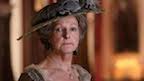
imgres-1April 2Penelope Keith, who portrayed Lady Catherine de Bourgh in Death Comes to Pemberley


Matthew-Goode-on-Death-Comes-to-Pemberley_home_top_storyApril 3 Matthew Goode, who portrayed George Wickham in Death Comes to Pemberley


MV5BMTg0OTEyOTE0NV5BMl5BanBnXkFtZTcwODI3MzcyNA@@._V1_UX214_CR0,0,214,317_AL_April 3Marsha Mason, who portrayed Catherine Darcy in Bride and Prejudice


images-1April 5Hayley Atwell, who portrayed Mary Crawford in 2007’s Mansfield Park 


imgresApril 5Lily James, who portrayed Elizabeth Bennet in Pride and Prejudice and Zombies 


imagesApril 5Tom Riley, who portrayed George Wickham in Lost in Austen


searchApril 6 Paul Rudd, who portrayed Josh in Clueless


Andrew Osborn  Angels One Five (1953)April 9Andrew Osborn, who portrayed Fitzwilliam Darcy in 1938’s Pride and Prejudice (9 April 1912 to 13 March 1985)


PDVD_078-1April 14Michelle Duncan, who portrayed Charlotte Lucas in Lost in Austen 


images-2April 15Emma Thompson, who portrayed Elinor Dashwood in 1995’s Sense and Sensibility 


829full-lucila-soláApril 17Lucila Solá, who portrayed Jane Vasquez in Pride and Prejudice: A Latter Day Comedy 


imgres-2April 19 Hugh O’Conor, who portrayed James Moreland in 2007’s Northanger Abbey


images-3April 21James Mcavoy, who portrayed Tom Lefroy in Becoming Jane


imgres-3April 22Michelle Ryan, who portrayed Maria Bertram in 2007’s Mansfield Park


images-4April 25 Renée Zellweger, who portrayed Bridget Jones in Bridget Jones’ Diary, Bridget Jones: The Edge of Reason, and Bridget Jones’ Baby


images-5April 26 Susannah Harker, who portrayed Jane Bennet in 1995’s Pride and Prejudice 


images-7April 27 – Anna Chancellor, who portrayed Miss Caroline Bingley in 1995’s Pride and Prejudice 


images-8April 27Jenna Coleman, who portrayed Lydia Bennet in Death Comes to Pemberley


images-6April 27Sally Hawkins, who portrayed Anne Elliot in 2007’s Persuasion


Posted in Austen actors, birthdays, Uncategorized | Tagged , , , , , , , , , , , , , , , , , , , , , , | 2 Comments

An Introduction into Anglo-Norman Early Drama

Slide01

The History of Theatre According to Dr Jack: Medieval Theatre I heironimohrkach.blogspot.com

Drama arose in the Tenth Century in certain monasteries when modifications to the mass occurred. Scenes of the Master’s life began to be represented in the churches, especially during the holier holidays. Many could not read and so the use of “plays” told the tales the monks wished to share. It was a means to explain a new religion to the illiterate. Dramatized versions of particular Biblical stories were included to vivify annual celebrations. Using symbolic objects to convey the tale’s meaning, the priests used pantomime to explain the events of Christian ritual celebrations. “These performances developed into liturgical dramas, the earliest of which is the Whom do you Seek (Quem-Quaeritis) Easter trope, dating from ca. 925. Liturgical drama was sung responsively by two groups and did not involve actors impersonating characters. However, sometime between 965 and 975, Æthelwold of Winchester composed the Regularis Concordia (Monastic Agreement), which contains a playlet complete with directions for performance.” (Medieval Theatre)

The plays were performed in or near a church. “Although they had their roots in the Christian liturgy, such plays were not performed as essential parts of a standard church service. The language of the liturgical drama was Latin, and the dialogue was frequently chanted to simple monophonic melodies. Music was also used in the form of incidental dance and processional tunes.” (Liturgical Drama)

Roswitha_of_Gandersheim

Hrosvitha of Gandersheim, the first dramatist of the post-classical era. Wikipedia Public Domain

Among the offerings in what we might call Medieval theatre we have liturgical dramas, mystery plays, morality plays, farces and masques. Hrotsvitha of Gandersheim was the first person to compose drama in the Latin West. She was a 10th Century German secular canoness, dramatist, and poet. The work of those during this period were moral and religious in nature, themes, and stagings. Among the most famous of the plays from this period are the York Mystery Plays, the Chester Mystery Plays, the Wakefield Mystery Plays and the N-Town Plays, as well as the morality play, Everyman

Early on guilds, students, and scholars performed plays based on the Old Testament from Creation to the Last Judgment. By 1300, the religious plays had become guild plays. Simply speaking, a “miracle play” is a dramatic representation of the life of a saint, including the miracles associated with his/her life; while a “mystery play” is one dealing with gospel events concerning any phase of the life of Christ. 

Miracle play, also called Saint’s Play,  one of three principal kinds of vernacular drama the European Middle Ages. A miracle play presents a real or fictitious account of the life, miracles, or martyrdom of a saint. The genre evolved from liturgical offices developed during the 10th and 11th centuries to enhance calendar festivals. By the 13th century they had become vernacularized and filled with unecclesiastical elements. They had been divorced from church services and were performed at public festivals. Almost all surviving miracle plays concern either the Virgin Mary or St. Nicholas, the 4th-century bishop of Myra in Asia Minor. Both Mary and Nicholas had active cults during the Middle Ages, and belief in the healing powers of saintly relics was widespread. In this climate, miracle plays flourished.” (Miracle Play)

800px-ChesterMysteryPlay_300dpi

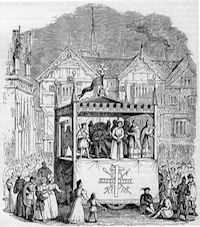
Nineteenth-century engraving of a performance from the Chester mystery play cycle. Wikipedia Public Domain

According to Britannica, mystery plays were “one of three principal kinds of vernacular drama in Europe during the Middle Ages. The mystery plays, usually representing Biblical subjects, developed from plays presented in Latin by churchmen on church premises and depicted such subjects as the Creation, Adam and Eve, the murder of Abel, and the Last Judgment. During the 13th century, various guilds began producing the plays in the vernacular at sites removed from the churches. Under these conditions, the strictly religious nature of the plays declined, and they became filled with irrelevancies and apocryphal elements. Furthermore, satirical elements were introduced to mock physicians, soldiers, judges, and even monks and priests. In England, over the course of decades, groups of 25 to 50 plays were organized into lengthy cycles, such as the Chester plays and the Wakefield plays. In France a single play, The Acts of the Apostles by Arnoul and Simon Gréban, contained 494 speaking parts and 61,908 lines of rhymed verse; it took 40 days to perform. They died out in many areas with the Reformation.”

In their prime, Miracle plays were acted on wooden platforms mounted on wheels. There were two stories to those movable stages, with the upper level used as the stage. In York, once a year, the whole history of the religious world would be viewed by the populace. Each company (trade guild) was assigned a time and place for its pageant. 

Much to the delight of the audience, a comic element crept into the plays occasionally. In the “2nd Shepherd’s Play,” for example, a character named Mak steals a sheep and takes it home to his wife. A knock is heard on the door. The wife puts the sheep in the crib and pretends it is a new born babe. Thus, she fools the shepherds searching for the sheep. They, however, return to give the new born a present only to discover the sheep. 

2012_0708_images_20_yorkplays

The Body of Christ | Humanities http://www.neh.gov Illustration of medieval mystery play.

Morality plays were “an allegorical drama popular in Europe especially during the 15th and 16th centuries, in which the characters personify moral qualities (such as charity or vice) or abstractions (as death or youth) and in which moral lessons are taught. The action of the morality play centres on a hero, such as Mankind, whose inherent weaknesses are assaulted by such personified diabolic forces as the Seven Deadly Sins but who may choose redemption and enlist the aid of such figures as the Four Daughters of God (Mercy, Justice, Temperance, and Truth). Morality plays were an intermediate step in the transition from liturgical to professional secular drama, and combine elements of each. They were performed by quasi-professional groups of actors who relied on public support; thus the plays were usually short, their serious themes tempered by elements of farce.” (Morality Play)

Morality plays gave more scope to the imagination for new plots and incidents and afforded the chance for delineation of characters. They were not confined to scriptures. They were first dull, but with the introduction of Vice, who played pranks similar to those of modern-day clowns, interest was aroused. The morality generally ended in the triumph of virtue, the devil leaping into Hell with Vice on his back. 

Visit History of Theatre for more information. One might also read The Finer Times.


Posted in Anglo-Normans, Church of England, drama, Great Britain, medieval, playwrights, religion, Uncategorized | Tagged , , , , , , | Comments Off on An Introduction into Anglo-Norman Early Drama

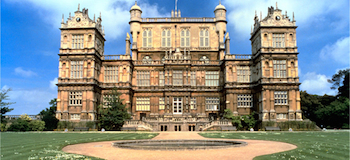
Wollaton Hall in Nottinghamshire, English Renaissance at Its Best, and Home to “The Dark Knight Rises”

Partner56Robert Smythson began work on Wollaton Hall in 1580. The Hall was to be the home of Sir Francis Willoughby. Most experts think Smythson, who also designed Hardwick Hall, in the same area, appears to have used Mount Edgcumbe in Cornwall as his inspiration. Masons from Italy reportedly worked on the house. The Italian connection explains the rather odd series of rings for mooring gondolas affixed to the Hall’s exterior walls. The house is an astounding example of English Renaissance architecture. The interior was remodelled after a fire in 1642 and again in the early 19th century, but the exterior remains essentially as it would have looked when it was finished in 1588. (Britain Express)

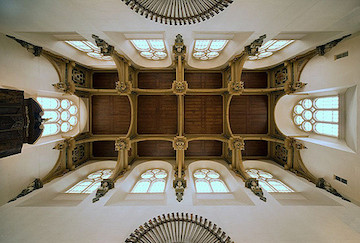
“One of the most interesting historic features is a 17th century pipe organ in the main hall gallery, which has to be worked by hand. The ceiling of this chamber boasts paintings attributed to Antonio Verrio. Above the hall is a Prospect Room, reached by a slender spiral stair and designed to give broad views over the surrounding parkland. One of the most unusual features is a well with a reservoir tank apparently used by a hardy Willoughby for a daily bath.

“The Tudor kitchens have been restored to their original condition, and furnished following a written inventory of 1601. Then there’s the Dining Room, showing how it looked after it was restored by Sir Jeffry Wyatville for the 6th Lord Middleton in the early 19th century. The Regency Salon has been restored to the way it looked in 1832.

“The Willougby family resided at Wollaton until the late 19th century before letting it to a series of tenants. By 1881 the house stood empty before it was purchased by the Nottingham City Council as a venue for the Nottingham Natural History Museum.” (Britain Express)

Back_of_Wollaton_Hall_-_geograph.org.uk_-_334270

Back of Wollaton Hall Back of Wollaton Hall with statue in frame. https://en.wikipedia.org/wiki/ Wollaton_Hall#/media/File: Back_of_Wollaton_Hall_-_geograph.org.uk_-_334270.jpg

The exterior of the house was surrounded by a vast deer park, containing some 1200 deer. The house has some 365 windows and is approached by a three-quarters’ mile long drive, which is bordered by ninety-foot-high lime trees. Statues of a Roman mythology influence can be found about the grounds, many discreetly hidden behind trees. It seems a former Lady Middleton found the displayed “nudity” offensive and had the statues blocked from the view from the terrace. 

The house held two wine cellars: One was 42 feet by 20 feet and the other 36 feet by 12 feet. They houses huge vats of madeira and table wines, each resting upon wooden trestles. Each trestle could hold 1500 gallons of ale. 

At the back of the house, stables with separate stalls capable of accommodating up to sixty hours were reached by crossing through a noble arched gateway. The coach house contained six or seven dark-blue carriages, drags, and the old family coach, whose panels were emblazoned with heraldic bearings and the family motto of “Truth without Fear.” A bakery, the laundry, a separate fowl-plucking house and some of the servants’ bedrooms were located nearby. A walled kitchen garden of nine acres contained 9700 square feet of glass and forcing houses for peaches, grapes, melons, and cucumbers to supply the Middleton’s dining table. 

3379712016_12fd2040de_z

ceiling of Wollaton Hall

“Wollaton is a classic prodigy house, ‘the architectural sensation of its age,’ though its builder was not a leading courtier and its construction stretched the resources he mainly obtained from coal mining; the original family home was at the bottom of the hill. Though much remodeled inside, the “startlingly bold” exterior remains largely intact. The floor plan has been said to derive from Serlio’s drawing (in Book III of his Five Books of Architecture) of Giuliano de Majano’s Villa Poggie Reale near Naples of the late 15th century, with elevations derived from Hans Vredeman de Vries. The architectural historian Mark Girouard  has suggested that the design is in fact derived from Nikolaus de Lyra’s reconstruction, and Josephus’ description, of Solomon’s Temple in Jerusalem.

“The building consists of a central block dominated by a hall three storeys high, with a stone screen at one end and galleries at either end, with the “Prospect Room” above that. From this there are extensive views of the park and surrounding country. There are towers at each corner, projecting out from this top floor. At each corner of the house is a square pavilion of three storeys, with decorative features rising above the roof line. Much of the basement storey is cut from the rock the house sits on.

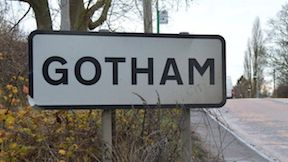
_83799069_dsc_0628-1“In 2011, key scenes from the Batman movie The Dark Knight Rises  were filmed outside Wollaton Hall. The Hall was featured as the latest Wayne Manor. The Hall is five miles north of  Gotham, Nottinghamshire where Gotham City got its name.” (Wollaton Hall)
Posted in architecture, British history, buildings and structures, Uncategorized | Tagged , , , | Comments Off on Wollaton Hall in Nottinghamshire, English Renaissance at Its Best, and Home to “The Dark Knight Rises”

Who Were The “Ton” and the “Beau Monde”?

Le bon ton is a French phrase meaning “the good style” or “good form.” One could be said to have good ton–meaning good style. So one could be part of the Ton, if one had the style for it–which is why Beau Brummell could be a leader of fashion and society despite not having much of a background (very middle class). The term beau monde came into use in the early 1700s; it literally means fine world. It is used for the fashionable world or high society.

Ton (le bon ton) tells us, “The ton” is a term commonly used to refer to Britain’s high society during the late Regency and the reign of George IV,  and later. It is a French word meaning (in this sense) “manners” or “style” and is pronounced as in French. The full phrase is le bon ton meaning “good manners” or “good form” – characteristics held as ideal by the British beau monde. The term le beau monde, literally meaning “the beautiful world” (but here meaning “fashionable people,” or “fashionable society”), was similar to le bon ton during the nineteenth century. “The ton” has also been used to refer to the Upper Ten Thousand of later 19th-century society, including most of the peerage, aristocracy and wealthy merchants or bankers of the City (of London).

The ton might be expanded to include the “upper ten thousand” (not just the upper four hundred). [Upper Ten Thousand, or simply, The Upper Ten, is a phrase coined in 1852 by American poet Nathaniel Parker Willis to describe the upper circles of New York, and hence of other major cities.] All things considered, a duke might have poor ton, while a mere mister might have le bon ton (as in with the Brummel, again, who had no title). Needless to say,  money/wealth could make a difference, but not without a sense of style or good form performed by the individual. And a title could matter, but if one had poor manners with that title, Society might well turn its back for displaying poor form.

John Mullan in a 2013 article for The Guardian tells us, “Toffs have always seemed to know how to keep the best things for themselves, especially when everyone is sure that their power is waning. It has long been conventional to see the 18th century as the period in which Britain passed out of the control of the court and the aristocracy. Commerce became the power in the land; new codes of politeness welded the propertied classes together, and these included more and more of ‘the middling sort.’ The patrons and philanthropists of this self-consciously modern society were the merchants and men of trade whose portraits were painted by Hogarth. Many of its cultural heroes – Samuel Richardson, David Garrick, Hogarth himself – came from humble backgrounds. The ancient régime was gone.

“[The] study of high society in the period corrects this impression. [The] 18th‑century aristocracy used fashion – and the willingness of the classes immediately below them to be dazzled by fashion – to assert their influence anew…. One small triumph of the ever-adaptable English upper class was to get this term, with its unmistakable tone of self-applause, accepted. There was a cluster of other words for those who embodied style and inhabited the rapidly spreading West End of London: ‘people of fashion,’ ‘the great world’ and, best of all, ‘the ton.’ The press stoked the public fascination with the most glittering members of this class.”

The  word ton was not used to refer to people as a whole in the Regency period, but for  discussing people of good taste. I am not certain, but perhaps it was Georgette Heyer who started calling the whole group of aristocrats the Ton.

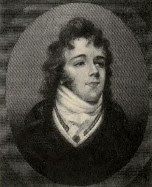
George Brummell from the History of White's 1892v2Although the term referred to fashionable sect, that does mean the actual members of the “ton” used the word to stipulate members of their group. It is more likely that they would speak of those without manners or those who preened too much as the dandy set or fops. Then might consider a person of poor manners as “not of our sort.” Needless to say, they also thought that only the members of the upperclass, the well bred among them, could possess good taste. Beau Brummell, for example, would not have had any influence if he had not been a member of the Prince of Wales’ coterie and taken up by the Whigs. Though Brummell’s downfall is often spoken of as having started with his bad ton of arguing  with and then insulting the Prince Regent, but the timing also coincides with the  Whigs’ disenchantment with the Regent and the switching of sides by many on many issues. [For more on the Rise and Fall of Beau Brummell, visit Rachel Knowles’ Regency History.]
 While the Prince and  the Whigs were aligned, the Whigs castigated Prince George’s wife.  However, when the Whigs discovered that the Prince had gone back  on his promise to them, they started supporting Princess Caroline, while the Tories, who once had supported her now turned their backs on her. Who was in and who was out was not simply a person who broke the unspoken rules. Politics had much more to do with  things than we sometimes assumed.

The Ton were aristocrats and upper level gentry who attended the London Season and Little Season. This was much like an awards program with an A-list of celebrities.  To be on the “list,” one must possess proper family connections, be wealthy, own land, and appear untouched by trade or by the need to earn a living.  Young ladies presented to the Court were A-list, those who were not presented, but otherwise met the criteria to be invited to Almack’s were the B-list, etc. People advanced and grew richer through connections more than anything else at this time.)

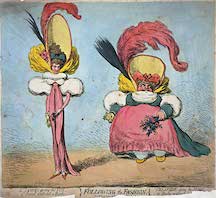
tumblr_mbnx5tU3is1rpvjjio1_1280What do y’all think about using James Gillray’s print “Following the Fashion, St. James’s Giving the Ton a Soul Without a Body” from 1796 as documentation of the ton? (One can find the image at Draw Paint Print)

A quick glance through some of my reference books revealed there are also publications that use bon ton as a descriptor in their titles. The New Bon Ton Magazine (Telescope of the Times) that was published from 1818-1821.

Slang: A Dictionary of the Turf, the Ring, the Chase, the Pit, of Bon Ton and the Varieties of Life by John Bee in 1823. 

Playwright David Garrick’s comedy Bon Ton; or High Life Above Stairs was performed at the Theatre Royal Drury Lane on March 18, 1775.

The Cambridge Companion to British Theatre 1730-1830 documents dramatist Hannah Cowley referencing the bon ton society.

9780199659005I particularly like Hannah Greig’s The Beau Monde: Fashionable Society in Georgian London from Oxford University Press. The book contains…

  • The story of the world’s first fashion-obsessed society in eighteenth century London
  • A tale of dazzling excess, intrigue, vanity and glamour in a world re-made
  • Takes us on a tour from court and Parliament to Georgian London’s parks, pleasure grounds and private homes, meeting a rich and colourful cast of contemporary characters along the way
  • Reveals the secrets of how membership in the new elite was won, maintained – and sometimes lost
  • Shows how being a Fashionable was the key to power and exclusivity in a new social order

Posted in British history, customs and tradiitons, George IV, Georgian, Georgian England, Georgian Era, Great Britain, history, Living in the Regency, Living in the UK, political stance, Victorian era, William IV | Tagged , , , , , , , , | 7 Comments

Do You Know the Origin of These Words and Phrases?

Do You Know The Origin of These Words and Phrases?

I have been editing again, as well as judging a few writing contests. The process had me searching out some of the least common words and phrases I encountered. Check these out. 

Let us begin with “Dwile flonking.” World Wide Words provides this explanation. 

“Pronounced /ˌdwaɪl ˈflɒŋkɪŋ/Help with pronunciation

“When summer comes or charity fund-raising is involved, English pub games often veer from mere eccentricity towards total lunacy. These are the days of marrow dangling, passing the splod, Portuguese sardine racing, conger cuddling, rhubarb thrashing, and dwile flonking.

“The game is officially played by two teams of twelve players, though there is great flexibility in numbers (the terminology and rules also vary from place to place). The fielding team gathers in a circle, called a girter, enclosing a member of the other team, the flonker. He holds a broom handle (usually called the driveller), on top of which is a beer-soaked rag, the dwile or dwyle.

“At a signal, the girter dances around the flonker in a circle. He must flick (or flonk) the dwile with the driveller so it hits a girter team member. His score depends on which part of the body he hits — the usual scoring is three points for a hit on the head (a wanton), two for a hit on the body, (a marther), and just one for a leg strike (a ripple). If after two shots the flonker hasn’t scored he is swadged, or, which means he has to drink a quantity of beer from a chamber pot within a given time. After all the members of one team have flonked, the other team is put in. The winner is the team with the most points after two innings, usually the one with more members still upright.

“There are two schools of thought about its origins. Some say it’s a traditional game that’s known from medieval times, others that it was invented by a group of Suffolk printing apprentices in 1966. The information that we have strongly supports the latter thesis. The first reference to the game that researchers at the Oxford English Dictionary have discovered is in the Beccles and Bungay Journal of Suffolk for June 1966, in reference to a game involving a team from Richard Clay (The Chaucer Press) of Bungay. Among the group that “evolved” the rules of the game were George High, George Davis, Graham Roberts, Bob Devereux and Andrew Leverett, all apprentices either at Richard Clay or at another printers, William Clowes in Beccles, who met weekly on courses at the Technical College in Norwich. Graham Roberts recalls, “We used to sit down during lunch breaks in between rows of type cases and discuss amendments to the rules.”

“Dwile is a real word: an old Suffolk dialect term for a dishcloth; dweil, said the same way, is the Dutch word for a floorcloth, or in defunct slang a drunkard. There were links between parts of East Anglia and the Netherlands, especially in the eighteenth century, and it is conceivable that the Suffolk dialect word was borrowed from Dutch.

“Several other terms seem to be fanciful derivations of obsolete or rare words: girter looks as though it comes from gird, a strap or band; flonk could be based on flong, the name in printing for a paper mould used to create an impression of type; swadge might be another form of the obsolete swage, to pacify or appease, from the same origin as the more common assuage. The rest seem to have been invented.”

____________________

For this one, an editor questioned on the usage. I used it in my American set WIP (Work in Progress). 

“A Daniel come to judgement”is described by Phrases.org as, “Someone who makes a wise judgement about something that has previously proven difficult to resolve.

“Origin: This phrase doubtless alludes to the Biblical character Daniel, who was attributed with having fine powers of judgement.

“In Daniel 5:14 (King James Version) we have: ‘I have even heard of thee, that the spirit of the gods is in thee, and that light and understanding and excellent wisdom is found in thee.’

Drury_Lane_Playbill_of_the_Merchant_of_Venice (Image via Wikipedia)                                                                       The first use of the phrase as we now know it is from Shakespeare’s The Merchant of Venice, 1596: SHYLOCK: A Daniel come to judgment! yea, a Daniel!/O wise young judge, how I do honour thee!”

_______________________

In reading stories based in the Regency, I often encounter the phrase “diamond in the rough” used to indicate a woman coming out in Society that still requires a bit of polish to fit in with her aristocratic acquaintances. However, in a recent piece I came across it used in the following manner, having something to do with lacking respect for authority/law.” 

“Diamond in the Rough” is defined by Phrases.org, as “Someone who is basically good hearted but lacking social graces and respect for the law.”

“Origin: The phrase is a metaphor clearly referring to the original unpolished state of diamond gemstones, especially those that have the potential to become high quality jewels. It is more commonly expressed in the form ‘rough diamond’. The first recorded use in print is in John Fletcher’s A Wife for a Month, 1624: ‘She is very honest, and will be as hard to cut as a rough diamond.’

“The term is often now used to describe people on the edge of the criminal fraternity who, while they may not commit serious crimes themselves, probably know people who do.

8656-3013“The English comic actor, the late Sid James, typified the type both on and off stage and was typecast in such roles; for example, he played Sir Sidney Ruff-Diamond in the Ealing comedy Carry On Up The Khyber. That was particularly appropriate as it turns out – Sid James worked in a diamond mine in South Africa before becoming an actor.”
______________________

“He’s beside himself with rage” is an odd twist of the words. How can one be beside himself? It reminds me of such words in English which make no sense to those who are first learning the language, words such as “pineapple” (that contains neither a “pine” or an “apple”); “groundhog”; how a person’s feet smell and his nose runs, etc. World Wide Words brings us this explanation. 

“The language has changed but the idiom hasn’t. The phrase appears first in the language in 1490. William Caxton, who established the first English printing press in Westminster, published a book with the title Eneydos. We know it better as The Aeneid by Virgil. Caxton records its linguistic travels in its title: ‘translated oute of latyne in to frenshe, and oute of frenshe reduced in to Englysshe by me Wyllm Caxton.’ This is the relevant passage, describing the grief of Dido at the departure of Aeneas.

“‘She sawe the saylles, wyth the flote of the shippes that made good waye. Thenne byganne she, for grete distresse, to bete & smyte thre or four tymes wyth her fyste strongly ayenst her brest & to pulle her fayr heres from her hed, as mad & beside herself.’

“Caxton was translating the French phrase hors de soi, ‘outside oneself.’ He used ‘beside’ because for him the word could mean ‘outside of’ or ‘away from.’ The idea was that powerful emotion had led Dido’s mind to escape her control. Her mind had got away from her and she wasn’t herself.

“We use the phrase rather less now than we used to. When it appears, it is most often related to rage, but it can also refer to delight, grief, amazement, excitement, horror, or any other powerful emotion.”

______________________

I particularly like this next phrase on my list, argy-bargy, for it is a doublet. “Linguists refer to such doublets as reduplication. The second part isn’t always invented, but can be a real word if one is available that fits in meaning and form. English is fond of the trick and the language is full of such pairs. Some are conventional rhymes (super-duper, hoity-toity, namby-pamby, mumbo-jumbo) while others are pairs that modify an internal vowel (dilly-dally, shilly-shally, wishy-washy, zig-zag).” 

World Wide Words explains “the origin of the expression argy-bargy (also written argey-bargey), meaning a relatively amicable, if somewhat heated, argument. 

In truth, “argy-bargies are often not only heated arguments, but also rather bad-tempered ones, amounting to a spat or minor quarrel. But then, the term is mainly a British or Commonwealth one, not that well known in the U .S., and easily misunderstood out of context.

“Argy-bargy was a late nineteenth-century modification of a Scots phrase, which appeared early in the same century in the form argle-bargle. The first part of this older version was a modification of argue. The second parts of the two forms, bargle and bargy, never had any independent existence — they are no more than nonsense rhyming repetitions of the first elements.

“An example in the old spelling from later in the century: ‘Last night ye haggled and argle-bargled like an apple-wife.’ from Kidnapped, by Robert Louis Stevenson, 1886. An apple-wife was a seller of apples from a stall, the female equivalent of a costermonger (who, historically and etymologically, also sold apples, an ancient large ribbed variety called a costard). By repute apple-wives were just as argumentative and foul-tongued as their male counterparts.

“An early example of the modern form, also as a verb: ‘Ten minutes at the least did she stand at the door argy-bargying with that man.’ from Margaret Ogilvy, by J M Barrie, 1896. This autobiographical novel, by an author who is most famous for his play Peter Pan, takes its title from the maiden name of his mother; it deals with his childhood memories of the death in a skating accident of his thirteen-year-old brother David in 1867.”

___________________

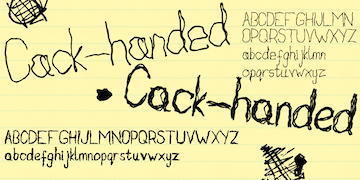
Cack-handed_poster_1 (Image by Kelly Gunn, https://www.elance.com/samples/cack-handed-image-font-pen-ink-fontlab/76521237/) 

Another recent find is cack-handed

Larry Nordell on World Wide Words asked this question: “This is from the Economist so I assume it must be some obscure Briticism: ‘And most recently, Mr Pitt has been stunningly cackhanded over the appointment of William Webster as head of the new Public Company Accounting Oversight Board’. What does cackhanded mean?”

The answer was:  “It’s a well-known British informal term for somebody who is inept or clumsy. By extension, it means somebody left-handed, who does everything “backwards” and so looks clumsy or awkward. It first appeared in the middle of the nineteenth century.

The American Heritage Dictionary suggests it comes from Old Norse keikr, bent backwards, and other American dictionaries also suggest this. British works of reference disagree. The direct association is with cack, another fine Old English term, for excrement or dung. Cachus was Old English for a privy, and both words come from Latin cacare, to defecate.

“It almost certainly comes from the very ancient tradition, which has developed among peoples who were mainly right-handed, that one reserved the left hand for cleaning oneself after defecating and used the right hand for all other purposes. At various times this has been known in most cultures. Some consider it rude even to be given something using the left hand. So to be left-handed was to use the cack hand or be cack-handed.

“There are similar terms in other languages, such as the French main de merde for somebody awkward or butter-fingered.”

Posted in editing, etymology, language choices, vocabulary, word choices, word origins, word play, writing | Tagged , , , , , , , , | 2 Comments

Georgian Architecture: University of London, a Metropolitan, Nonsectarian University


icampll001p1

http://www.britannica. com/biography/Thomas -Campbell-British-poet

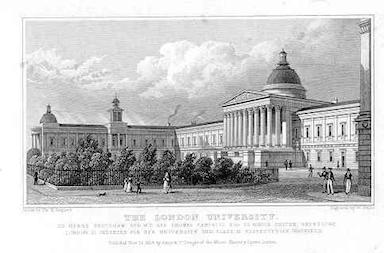
In 1820, the Scottish poet, Thomas Campbell, put forth the idea of a metropolitan, nonsectarian university. With others he launched a movement in 1825 to found the University of London, for students excluded from Oxford or Cambridge by religious tests or lack of funds. With the assistance of Henry Brougham and Jeremy Bentham, a site on Gower Street was found. Bentham advertised for architectural drawings, and William Wilkins’ designs were chosen. The designs held a Continental element: a great assembly hall replacing the chapel; the wings of the structure to house museums and libraries; and four large, semicircular lecture halls. 

According to Georgian London (Summerson, John, Yale University Press, 2003, page 274) we find, “Architecturally, the great feature is the central decastyle portico, raised on a podium and prefacing the assembly hall, behind which is an octagonal vestibule surmounted by a dome. In the execution of this design, a very unfortunate thing happened: the assembly hall was omitted. But its portico and the great steps leading up it it were retained. The result is that the steps and portico now lead to nothing except a disappointing octagon lobby with a lightwell in the centre so that the portico is now, in fact, nothing more than a ‘set piece,’ an architectural charade which reminds one forcibly that Wilkins was very much a man of the theatre. On the site of the missing hall a library was built in 1848.”

Henry Peter Brougham, 1st Baron Brougham and Vaux  (19 September 1778 – 7 May 1868) was a British statesman who became Lord Chancellor of Great Britain. As a young lawyer in Scotland Brougham helped to found the Edinburgh Review in 1802 and contributed many articles to it. He went to London, and was called to the English bar in 1808. In 1810 he entered the House of Commons as a Whig. Brougham took up the fight against the slave trade  and opposed restrictions on trade with continental Europe. In 1820, he won popular renown as chief attorney to Queen Caroline, and in the next decade he became a liberal leader in the House. He not only proposed educational reforms in Parliament but also was one of the founders of the Society for the Diffusion of Useful Knowledge in 1825 and of University College London in 1826. As Lord Chancellor from 1830 to 1834 he effected many legal reforms to speed procedure and established the Central Criminal Court. In later years he spent much of his time in Cannes, which he established as a popular resort.”

Jeremy Bentham  (15 February 1748 [O.S. 4 February 1747]– 6 June 1832) was an English  philosopher, jurist, and social reformer. He is regarded as the founder of modern utilitarianism. On his death in 1832, Bentham left instructions for his body to be first dissected, and then to be permanently preserved as an “auto-icon” (or self-image), which would be his memorial. This was done, and the auto-icon is now on public display at University College London. Because of his arguments in favour of the general availability of education, he has been described as the “spiritual founder” of UCL, although he played only a limited direct part in its foundation.”

grant_of_armsFrom the University of London’s Website, we learn, “The University of London was founded by Royal Charter on 28 November 1836 and is the third oldest university in England. The two founding Colleges of the University, UCL (founded 1826) and King’s College London (founded 1829), both predate the University, as do many other of the University’s constituent institutions. For example, St Bartholomew’s Hospital Medical School (now part of Queen Mary) and St Thomas’ Hospital Medical School (now part of King’s College London) both have twelfth-century origins. The University of London was initially established to act as an examining body for its Colleges and other ‘approved institutions’. It acted solely in this capacity until 1858. The University awarded its first degrees back in 1839 to 29 students.

The_London_University_by_Thomas_Hosmer_Shepherd_1827-28

University College’s main building in the late 1820s, with its classical portico and dome. https://en.wikipedia.org/wiki/History_of_University_College_London#/media/File:The_London_University_by_Thomas_Hosmer_Shepherd_1827-28.JPG

“In 1858, the University opened its degrees to any (male) student, regardless of their location. Towards the end of the 19th century, the University became more than just an examining body and was established as a federal ‘Teaching University’. The University of London Act was passed in 1898, after which the University monitored course content and academic quality in the Colleges through centrally-located faculties and Boards of Studies. In 1878 London became the first university in the UK to admit women to its degrees. In 1880, four women passed the BA examination and in 1881 two women obtained a BSc. By 1895, over 10 per cent of the graduates were women and by 1900 the proportion had increased to 30 per cent. By 1908, the University of London had over 4000 registered students, exceeding the universities of both Oxford and Cambridge, becoming the largest university in the UK and the fifth largest in the world.”

Posted in architecture, British history, buildings and structures, Georgian England, Georgian Era, Great Britain, history, Living in the UK | Tagged , , , , , | Comments Off on Georgian Architecture: University of London, a Metropolitan, Nonsectarian University

14th Century Scottish Writers

Early Scottish literature includes works in English, Scottish Gaelic, Scots, Brythonic, French, Latin, and Norn. The earliest extant literature from what is now Scotland was a 6th Century Brythonic speech. Under the direction of the Catholic Church early literature was written in Latin, while other pieces were brought to the British isles by Angles. These appear in what we refer to as Old English. “As the state of Alba developed into the kingdom of Scotland from the eighth century, there was a flourishing literary elite who regularly produced texts in both Gaelic and Latin, sharing a common literary culture with Ireland and elsewhere. After the Davidian Revolution of the thirteenth century, a flourishing French language culture predominated, while Norse literature was produced from areas of Scandinavian settlements. The first surviving major text in Early Scots is literature in the fourteen century epic Brus, by John Barbour. This was followed by a series of vernacular versions of medieval romances. These were joined in the fifteenth century by Scots prose works.” (Scottish Literature)

John Barbour was an archdeacon who held office under Robert II of Scotland. Evidence of his promotion and movements before Robert Stewart came to power as king tend to suggest that Barbour acted politically on the future king’s behalf. (A.A.M.Duncan (ed.), The Bruce, Canongate Classics, 1999 edition. “Introduction”, pp.2-3) He served at Kirk of St Machar in Aberdeen. He was favored by the government and received pension. Ironically, his epic was quite secular in both tone and themes.His reputation from Brus (The Bruce) that other works of the period are often attributed to Barbour. Unfortunately, several indicated to be his are now lost. Among those we find The Stewartis Oryginalle (Genealogy of the Stewarts) and The Brut (Brutus). 

NTSbannockburn2_750_tcm4-562905

http://www.educationscotland. gov.uk/scotlandshistory/ warsofindependence/ battleofbannockburn

In “The Battle of Bannockburn” by Barbour describes the battle. The Scots kneel to pray before the eventful battle. The Earl of Murref leads a valiant band, which holds its own against a vastly superior force of Englishmen. The English archers wreak havoc on the Scottish forces; therefore, King Robert commands the cavalry, under Marshal Robert of Keth, to charge. King Robert exhorts his men with reminders of the manifold degradation they have suffered at English hands. The English King flees, and most of his followers drown in the river of Bannockburn. 

Although professing to be historical, Brus is really a romance centering about Scotland’s great heroic leader Robert Bruce. The work is a stirring narrative, full of evidence of the author’s patriotism, and full of evidence of his reflective personality. As art, the work is rough and monotonous, but it has many picturesque passages.(History of English Literature: Part I – Early Saxon Through Milton, Hymarx Outline Series, Boston, MA, page 68.)

Robert Henryson Poems > mypoeticside.com

Robert Henryson Poems >
mypoeticside.com

Little is known of Robert Henryson‘s life. “Robert Henryson (or Henrysoun) is one of the great names in medieval literature in general, and Scottish literature in particular. He lived in the second half of the fifteenth century, dying sometime before 1508. He possibly attended the University of Glasgow, and he is later associated with the town of Dunfermline, where he may have been a schoolmaster, or a notary public, or both.

“His poetry supports the image of him as both a teacher and a lawyer. His versions of Aesop’s Fables (‘The Morall Fabillis of Esope the Phrygian’) reveal a writer with a powerful moral purpose and a detailed grasp of the mechanisms of the law. Both are evident in the Prologue to the Fables, a persuasive apology for literature, written in plain Middle Scots:

“The nuttes schell, thocht it be hard and teuch,
Haldis the kirnill, and is delectabill.
Sa lyis thair ane doctrine wyse aneuch,
And full of fruit, under ane fenyeit Fabill.
And Clerkis sayis it is richt profitabill
Amangis ernist to ming ane merie sport,
To light the spreit, and gar the tyme be schort.

“(Although the nut’s shell is hard and tough, it holds the kernel and is delightful. So there lies a wise and fruitful teaching underneath an imagined fable. And learned men say it is very profitable to mingle merry sport among earnest matters, to lighten the spirit and speed the time.)

“Henryson’s major poems, besides the Fables, include ‘The Testament of Cresseid‘, a sequel to Chaucer’s ‘Troilus and Criseyde’; ‘Robene and Makyne’, a comic dialogue; and ‘Orpheus and Eurydice’, a version of the classical tale which was printed by Chepman and Millar in 1508.

“Robert Henryson is sadly little known amongst the majority of Scots today. However, in 1993 the Robert Henryson Society was established in Dunfermline to promote the appreciation of the poet and his works, particularly in the locality with which he is most closely associated.” (Robert Henryson)

In “Robene and Makyne” we have the tale of Robin, the shepherd, and Makin, the shepherdess. Robin scorns the love of Makin, denies that she knows true love, will have none of her when she offers herself. When Makin is gone, Robin has a change of heart. He pursues her and pleads for her love. Now it is she who blithely scorns his advances. 

The thing with Henryson is that he wrote without great passion, yet there is enough feeling in his work to lift it into the realm of poetry. He used old themes for his work, but infused them with originality and his own peculiar good humor. (History of English Literature: Part I – Early Saxon Through Milton, Hymarx Outline Series, Boston, MA, page 68.)

“William Dunbar was a Scottish makar poet active in the late fifteenth century and the early sixteenth century. He was closely associated with the court of King James IV  and produced a large body of work in Scots distinguished by its great variation in themes and literary styles. He was likely a native of  East Lothian, as assumed from a satirical reference in the Flyting of Dunbar and Kennedie.” (William Dunbar)  Likely of noble lineage, Dunbar is known to have been at the University of St Andrews in 1474.

“Details from his later life suggest that he was ordained as a priest at some point, but the date is unknown. In 1491 and 1492 Dunbar accompanied an embassy to Denmark and France in an unknown capacity. In 1501 and 1502 he participated in an embassy to England in the staff of  Andrew Forman, Bishop of Moray. From 1500 the poet was employed at the court of King James in a role for which he received an annual pension. His duties are not recorded; he is referred to only as a servitour or servant; but it is to this period that the bulk of his poetry can be dated. Several of Dunbar’s poems were included in the Chepman and Myllar prints of 1508, the first books to be printed in Scotland.” (William Dunbar)

From Poetry Foundation, we learn, “The poet is regularly described as “Maister William Dunbar” in the Accounts of the Lord High Treasurer of Scotland and in titles and colophons of several poems. To fill in important details about Dunbar’s life upon leaving the university, clues must be sought in the poetry. Some critics, it must be noted, reject this method, either arguing that authorial self-reference in medieval poetry is always conventional, or defining first-person discourse as part of the fictional world of “the text.” Nevertheless, scholars like J. W. Baxter and Matthew P. McDiarmid have found clues in the poetry that can be corroborated by historical facts, and from their work it is possible to formulate a reasonable biography of Dunbar.

“An object of such research is The Flyting of Dunbar and Kennedy (circa 1492-1493), Dunbar’s entry in an energetic poetic duel of verbal abuse with his poetic rival, Walter Kennedy. Kennedy’s many attacks on Dunbar’s family and activities must have had some basis in fact—a barb not strengthened by fact carries no bite. Yet James Kinsley, Dunbar’s most recent editor, advises against giving much heed to the attacks.”

A quick look at some of Dunbar works includes: 

“Lament for the Makers (Poets)” – In this piece, the poet is fearful. Specifically, the fear of death troubles him. The refrain of the poem is “Timor Mortis conturbat me.”  Death takes all. He has taken the likes of Chaucer, Lydgate, and Gower. So, “the fear of death troubles me.”

In “Ballad of Kind Kittock,” Kind Kittock goes to Heaven after death. On her way, she stops at an ale house to refresh herself and she drinks beyond her limits. She steals past St. Peter into heaven. But while there, she steals out for another drink; the ale of heaven was sour. 

“The Dregy of Dunbar” is a verse prayer of deep tenderness and feeling written by Dunbar in Edinburgh for King James V when he was penned in Stirling Castle. 

“How Dunbar was Destined to be a Friar” is a high-spirited refusal to become a friar when he is tempted by Saint Francis in a dream. And when he was refused, Dunbar discovers that it was a fiend who assumed the shape of the Saint. 

“Dunbar is last mentioned in the Accounts for 14 May 1513, the entry showing that he received a partial payment “in his pensioun,” though the records of the Accounts between August 1513 and June 1515 are not extant, a result of the disruption caused by the war with England. In September 1513 James, along with the flower of his nobility, was killed at the Battle of Flodden, a battle which, in his better judgment, he had wished to avoid and fought only to honor a pledge made to his ally France, which recently had been invaded by the armies of Henry VIII. For years James had collected artillery for just such an occasion, artillery sometimes alluded to in Dunbar’s poetry. But when war came James did not use it, and English muskets took their terrible toll.

Title page of Dunbar's The Goldyn Targe in the Chepman and Myllar Prints of 1508. (National Library of Scotland).

Title page of Dunbar’s The Goldyn Targe in the Chepman and Myllar Prints of 1508. (National Library of Scotland).

“It has been suggested that Dunbar lost his life alongside his king. Yet, considering the poet’s age at the time, it seems unlikely. In addition, some poems written after Flodden have been attributed to Dunbar, and at least two are plausible. A poem on the duke of Albany, “Quhen the Governour Past in France,” not at all flattering to the new governor who tried to rule for only three years before leaving for France in June 1517, is assigned to Dunbar in the Maitland collection made a generation later. It has been rejected from the canon of his work on the grounds that it is technically inferior. Yet the poem’s stanzaic pattern and refrain are characteristic of Dunbar’s work, and its plainer style and serious tone seem natural in an older poet, especially one who had recently experienced a traumatic event like Flodden. Another poem, apparently written for the young widowed queen, is untitled and anonymous in the Bannatyne Manuscript but was attributed to Dunbar by the nineteenth-century editor David Laing, and the many correspondences between this poem and others that are indisputably Dunbar’s have persuaded Kinsley to accept the attribution. If Dunbar wrote the poem for the dowager queen, he definitely lived after Flodden; if he wrote the Albany poem, then he was still alive in 1517. But he most certainly is dead by 1530 when Sir David Lindsay speaks of Dunbar as dead in the Testament of the Papyngo.” (Poetry Foundation)

One finds that Dunbar’s poems are short and possess lyrical variety. They were composed with realism and skill. His themes are novel, original, and humorous. He used natural and colloquial language with the technique of a master. Much of his poetry is satiric. He attacked the clergy and court parasites. These satires have a personal quality and often betray the writer’s own resentment and bitterness. 


Posted in British history, Great Britain | Tagged , , , , , , , , , | Comments Off on 14th Century Scottish Writers