Do You Know More Than One City Served as the U. S. Capital?

I recently did one of those mind-dulling quizzes on Facebook. It’s the one where they say they can tell a person’s education based on questions on U. S. history. To demonstrate how reliable the quiz is, I missed one and they concluded I had a high school education. In truth, I have a Bachelors, Masters, and Ph.D. Anyway, one of the questions was which city had not served as the U.S. Capital. The series I did on the signers of the Declaration of Independence helped with this one. The answer was Boston, Massachusetts, but that got me thinking on what were the other cities. So, below, for those of you like me who cannot let research down the rabbit hole go about its merry way, are the cities, other than Washington, D. C., that served as the U.S. Capital. 

vc102

Thomas Jefferson. Plan of the Federal District. 1791.

First, there was no Washington, D. C. when our forefathers signed the Declaration of Independence. In fact, it was not until July 1790 that President George Washington signed what was called the Resident Act, designed to create a permanent capital city upon the banks of the Potomac River. In 1800, Washington, D. C., became the ninth city to serve as the Capital of the United States. According to the Library of Congress, “The Residence Act, officially titled ‘An Act for Establishing the Temporary and Permanent Seat of the Government of the United States,’ was passed on July 16, 1790, and selected a site on the Potomac River as the permanent capital (Washington, D.C.), in ten years times. Also, this act designated Philadelphia as the temporary capital for a period of ten years. The Residence Act was the result of a compromise reached between Thomas Jefferson, Alexander Hamilton and James Madison concerning the permanent location of the Federal capital. In exchange for locating the new capital on the Potomac River, Madison agreed not to block legislation mandating the assumption of the states’ debts by the Federal government.”

Philadelphia, Pennsylvania, had a population of some 40,000. The First Continental Congress met in Philadelphia in September 1774. The signers of the Declaration of Independence met there again in July 1776. But Philadelphia was not the first U. S. Capital. 

Henry Fite House

Henry Fite House Old Congress Hall Baltimore, Maryland December 20, 1776 to February 27, 1777 ~ http://www.unitedstatescapitals.org/p/blog-page_38.html

In 1776, the American delegates had to escape Philadelphia and the British, so they first chose to head south to Maryland. In Baltimore, Maryland, our founding fathers met at the home and tavern of one Henry Fite. “The “Henry Fite House”, located on West Baltimore Street (then known as Market Street), between South Sharp and North Liberty Street (also later known as Hopkins Place), was the meeting site of the Second Continental Congress from December 20, 1776 until February 22, 1777. Built as a tavern in 1770 by Henry Fite (1722–1789), the building became known as ‘Congress Hall’ during its brief use by Congress, and later in local history as ‘Old Congress Hall.’. It was destroyed by the Great Baltimore Fire on Sunday and Monday, February 7–8, 1904, which started a block to the southwest at North Liberty (east of North Howard) and German (later West Redwood) Streets at the John E. Hurst Company building (dry goods) and swept north to Fayette Street and finally to the east to the Jones Falls, burning most of the downtown central business district and waterfront, of which only a few modern “fire-proof” skyscrapers, though burned, had enough structural support left to save, rebuild and restore later.” (Henry Fite House) The house was chosen because it was one of the largest in Baltimore, and it was outside the range of the British Navy’s artillery. Inside the long chamber, the delegates learned of victories and defeats by Washington’s army. Eventually, the delegates returned to Philadelphia in March 1777.

DowntownYorkPAHistory

Historic 1879 Bird’s Eye View Map of York, PA https://springettsapartments.com/2016/04/19/515/


York, Pennsylvania, has also made claims of being the first U. S. Capital. It is true that the delegates to the Continental Congress did meet in York, a town of only 1800 at the time, twice for a period of nine months. The first time was in 1777 and the second in 1778. The delegates had departed Philadelphia in fear of the British troops advancing on the city. The Articles of Confederation were developed during those years at York.

History Stories tells us, Lancaster, Pennsylvania, was also the seat the Capital. “The present-day heart of Amish country was once the heart of the American government—if only for a day. In the late summer of 1777, the Redcoats again advanced on Philadelphia, and after Washington’s disastrous defeat at the Battle of Brandywine on September 11, 1777, the Continental Congress evacuated the city. Delegates fled 65 miles to the west and on September 27, 1777, met inside Lancaster’s county courthouse. Faced with the difficulty of finding suitable lodging and continued concerns about their safety, the delegates’ official business consisted mainly of deciding how quickly they could leave Lancaster. After the legislative equivalent of a cup of coffee, the Continental Congress adjourned its one-day session inside the courthouse, which was destroyed by a fire in the 1780s, and continued to move west.”

2010-Crossroads-Image-Library-083-1280x850-e1357708161377

Nassau Hall, Princeton University ~ One of the largest buildings in the colonies when it was built in 1756, Nassau Hall on the campus of Princeton University (formerly the College of New Jersey) witnessed the final acts of the Battle of Princeton when Alexander Hamilton commanded his artillery to fire upon the building to convince the occupying British soldiers to surrender. Here too, six years later in 1783 Congress received word the war was finally over, the Treaty of Paris had been signed and the assembled delegates tendered the thanks of the nation to General Washington. http://revolutionarynj.org/storyline_photo2/nassau-hall-princeton-university-princeton-nj/

On September 28, 1781, General George Washington, commanding a force of 17,000 French and Continental troops, begins the siege known as the Battle of Yorktown against British General Lord Charles Cornwallis and a contingent of 9,000 British troops at Yorktown, Virginia, ending the American Revolution, but that was not of the last of the retreats by the American government. In 1783, the delegates again fled Philadelphia in order to escape the American Continental Army soldiers demanding payment for their services. The delegates moved 40 miles northeast to the campus of the College of New Jersey (later to be called Princeton University) in Princeton, New Jersey.  The Congress of Confederation met inside Nassau Hall, the nation’s largest academic building, which ironically had been bombarded by patriot troops during the 1777 Battle of Princeton. During its four-month stay inside the enormous stone building, which still stands on the Princeton campus, the United States government received its first foreign minister, a diplomat from the Netherlands, as well as word of the signing of the Treaty of Paris, which formally ended the American Revolution. (History.com)

d013233a

This image of the State House by Charles Willson Peale shows the building soon after its completion. It was published in the Columbian Magazine in February 1789 and is especially notable because it also shows some of the other buildings on State Circle at the time, including the home of John Shaw at the far left. To the right of the State House are the Old Council Chamber and Ball Room, built in 1718 and the octoganal outdoor privy known as the “temple.” At the far right is the Old Treasury Building which was built in 1735 and is still the oldest public building in Annapolis. ~ Copyright Maryland State Archives http://msa.maryland.gov/msa/stagser/s1259/131/html/columbian.html

For a short period, Annapolis, Maryland, also served at the U. S. Capital. Using the Maryland State House for their meeting the delegates first convened on 26 November 1783. At the time, George Washington resigned as commander-in-chief of the Continental Army. The Treaty of Paris was also ratified there on 14 January 1784.  The Maryland State House remains the oldest state capitol in continuous legislative use, and Washington’s personal copy of his resignation speech is on display in its rotunda.

French Arms Tavern

French Arms Tavern, Trenton, New Jersey November 1, 1784 to December 24, 1784 No Longer Standing, 1 West State Street, Trenton, NJ 08608 ~ http://www.unitedstatescapitals.org/p/blog-page.html

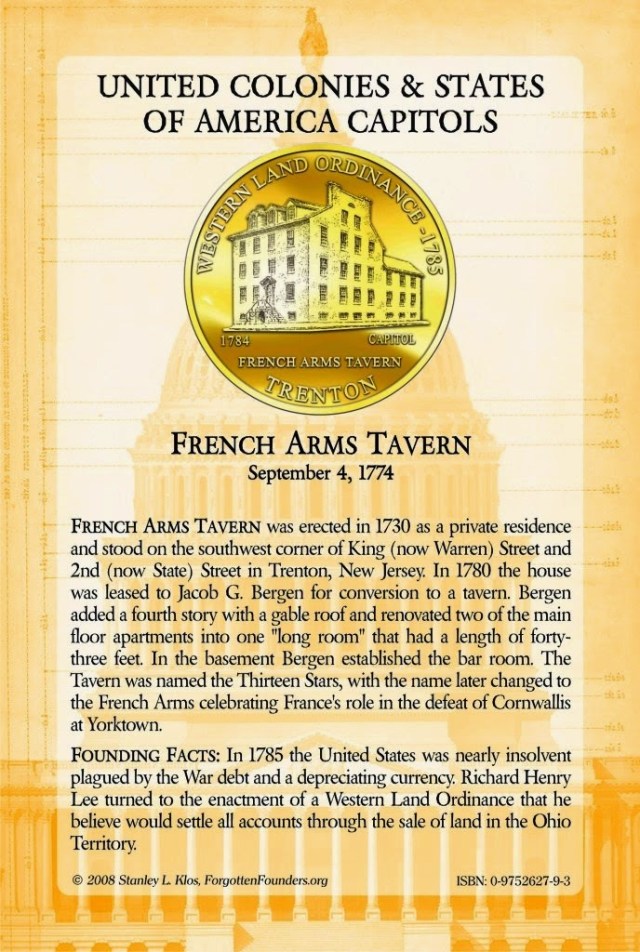
The next stop on the Where Is the Capital? bandwagon was Trenton, New Jersey. Here the Congress of Confederation regularly met in the largest building in the town, the French Arms Tavern. “Delegates first convened in the three-story-high structure, leased by the New Jersey legislature, on November 1, 1784. Beyond a farewell address by the Marquis de Lafayette, little business of note took place before the Congress adjourned on Christmas Eve and decided to move on to New York City. The building returned to its use as a tavern before being razed in 1837 to make room for a bank.” (History.com)

New York City served as the seat of the U. S. Government for five years. The Congress of Confederation meat there for the first time in January 1785. The old City Hall building was renovated to become the first Capitol Building. It was renamed Federal Hall, and it was there that the newly elected first President of the United States, George Washington, took his oath of office on 30 April 1789. A statue of Washington overlooking Wall Street now stands outside a reconstruction of Federal Hall.


Posted in American History, Uncategorized, war | Tagged , , , , , , , , , , , , , , , | 2 Comments

UK “Real” Estate: Coggeshall Abbey in Essex

220px-Coggeshall_Sign

The town’s sign depicts a Cistercian farming sheep at the abbey. On the other side is a weaver by his loom. https://en.wikipedia.org/wiki/Coggeshall

In 1140, Coggeshall Abbey was founded by King Stephen and his wife Matilda as a Sauvignac Abbey.. It was designed to house the monks of the Savigniac order. The earliest English use of bricks as building materials can be found in the remains of Coggeshall Abbey. The Savigniacs were assimilated into the Cistercian order some seven years later. Unfortunately, Coggeshall Abbey did not know the growth of other more well-established abbeys.  By the time of the Dissolution of the Monasteries the number of monks had shrunk to just 6, who were pensioned off by Henry VIII. 

Tension rose between the villagers and the abbey when King Stephen presented the abbot rights over the town. The abbey made several blunders in their negotiations – or should we say, their lack of negotiations – with the village residents. They diverted the course of the river, causing hardships for those who depended upon the land. The monks placed a fence about their lands. In those days, livestock grazed wherever, but not so with the abbey’s land. They also built a small chapel, offering religious services, which competed with the parish church. During the Peasant Revolt in 1381, the villagers broke into the abbey and destroyed the abbey’s archives, as well as attacking the abbot. 
1944531

The Abbey, Coggeshall, an extraordinary medieval building on the banks of the River Blackwater in rural Essex. http://www.theabbeycoggeshall.co.uk/about-us.html

Coggeshall_Abbey_monastic_building

Monastic Building, Little Coggeshall Abbey (Guest House, later Boiler House} ~ via Wikipedia

In 1538, under King Henry VIII’s order, Coggeshall Abbey was closed. “The abbey buildings were sold off and the site robbed for building stones. Sections of the claustral ranges survive at Abbey Farm, at the end of Abbey Lane. Two walls of the dorter stand, and foundations of the chapter house. The abbots lodging survives, as does the guest house. These remains are open to view by arrangement with the owners. Visitors may view the Abbott’s House, Cloisters and and Guest House as well as parts of the 16th century manor house attached to the Abbey. The combination has been called one of the finest medieval buildings in England. 

“The oldest parts of the monastic buldings are the abbot’s house and guest house, dating to 1190. The cloisters are slightly later, around 1215. There is also a restored stew pond (where live fish were kept). The real historical importance of Coggeshall Abbey comes from its extensive use of red brick. Though brick would later gain a reputation as a ubiquitous, rather low-class building material, it was hardly used at all after the Romans left in the 5th century, and when it was reintroduced in the early medieval period it was as a high-status, luxury building material. The quality of the bricks at Coggeshall suggest that they were locally made rather than imported from the European continent.” (Britain Express)

 The Abbey has enjoyed a rich and varied history with many different owners, including Sir Thomas Seymour, brother of King Henry VIII’s favourite wife Jane.  Later owners included the Paycocke family who were wool merchants and a family of great importance in 16th century Coggeshall.  The Abbey, Coggeshall is now in the hands of Roger and Jill Hadlee.
8067253.jpg
coggeshall14abig

The 13th Century Cistercian Abbey Gatehouse Chapel, Goggeshall, Essex. http://www.beenthere-donethat.org.uk/coggeshall14big.html

One of the most popular buildings associated with the abbey is St Nicholas Church. It was originally a small chapel situated next to the entrance to the abbey precinct. “This delightful little church began as a small chapel beside the entrance to the abbey precinct. It dates to the early years of the 13th century. The Cistercians often built a chapel beside the main abbey gates for the use of travellers, or for local residents who could not enter the abbey precinct. St Nicholas was probably not used for regular services, thus it has no font. After the Dissolution the chapel building was used as a barn, but was purchased by the parish church of St Peter ad Vincula in 1860. It was restored in 1896 and once again used for worship. It is a very simple Norman structure, of charming simplicity.
coggeshall13

The oldest surviving timber-framed barn in Europe dates from around 1140 and measures 120 feet long by 45 feet wide and 35 feet high at the apex of the roof. The roof would have originally been thatched but was replaced with tiles around the 14th century. This barn was originally part of the Cistercian Abbey of Coggeshall. http://www.beenthere-donethat.org.uk/coggeshall3.html

“A far more famous remnant of the abbey presence is Grange Barn,  now owned by the National Trust. The barn stands opposite the end of Abbey Lane, off the B1024 (Grange Hill). It was built in the mid-13th century and is one of the oldest surviving timber-framed buildings in Europe. This enormous structure is 130 feet long and 45 feet wide, and when you stand inside and look up it is not hard to see why it is often called ‘cathedral-like’.

800px-Coggeshall-St_Stephens_Bridge

English: St Stephen’s Bridge, Coggeshall, Essex. A three-arch bridge, the closest brick work is from the 13th century original narrow bridge. The butresses and girder, and the brick work on the far side of the bridge are from 20th century widening of the bridge. https://commons.wikimedia.org/wiki/File:Coggeshall-St_Stephens_Bridge.JPG

“South from Market Hill is Bridge street, where a peculiar iron bridge crosses a small stream that marks the original course of the River Blackwater. The bridge marks the traditional boundary between Little and Great Coggeshall (look for the initials LC at the base of the bridge). The main bridge across the Blackwater has 12th century bricks embedded in its arches; this is one of the earliest uses of bricks in post-Roman Britain. By the bridge is Rood House, its name a reminder that a great cross once stood here to mark the boundary of lands owned by Coggeshall Abbey on the south bank. The bridge was built by monks of Coggeshall Abbey when they diverted the river to drive their mill. On the south bank stands Monkwell, one of the 19th century silk mills that once abounded locally.” (Britain Express)
Resources: 
Posted in Age of Chaucer, Anglo-Normans, Anglo-Saxons, British history, buildings and structures, history | Tagged , , , , , , | 2 Comments

Scandal Abounds in Brocket Hall’s History

The official Brocket Hall website tells us, “Brocket Hall has one of the most intriguing of any of the great houses of Britain. Indeed the scent of scandal can be found in the fabric of the building back to its roots in the 13th Century right up to the present day.” If you are a fan of the PBS series “Victoria,” you know something of Brocket Hall. 

The house is located near Hatfield in Hertfordshire. It was built by renowned architect James Paine for the owner, Sir Mathew Lamb in 1760. The grounds were laid out by the most prestigious landscape architect of the time, Capability Brown However, the Hall stands on the site of two predecessors, the original of which was built in 1239. 

800px-George_Stubbs_007_(cropped)

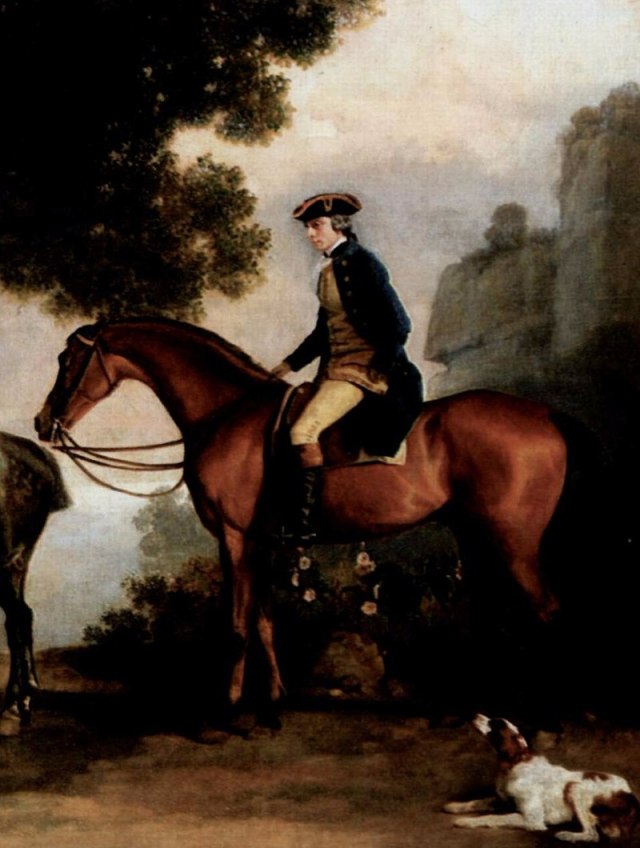
Sir Penistone Lamb ~ Artist George Stubbs – National Gallery, London ~ Public Domain ~ https://en.wikipedia.org/wiki/Peniston_Lamb,_1st_Viscount_Melbourne#/media/File:George_Stubbs_007_(cropped).jpg

Sir Matthew’s son was Peniston Lamb, 1st Viscount Melbourne (29 January 1745 – 22 July 1828), known as Sir Peniston Lamb, 2nd Baronet, from 1768 to 1770. He was a British politician, who sat in the House of Commons from 1768 to 1793.   He succeeded in the baronetcy on his father’s death on 6 November 1768 and inherited Melbourne Hall  in Derbyshire. He married Elizabeth Milbanke, daughter of Sir Ralph Milbanke, She was a young woman of great beauty, intelligence and strong character, who quickly came to dominate her husband completely, and steered them into the centre of polite society.  Lady Melbourne was known for her political influence and her friendships and romantic relationships with other members of the English aristocracy, including Georgiana . Cavendish, Duchess of Devonshire and George, Prince of Wales (later King George IV). Because of her numerous love affairs, the paternity of several of her children is a matter of dispute. Lord Melbourne became Lord of the Bedchamber in 1812. In 1815 he was even further honoured when he was made Baron Melbourne, of Melbourne in the county of Derby, in the Peerage of the United Kingdom, which gave him a seat in the House of Lords. He died on 22 July 1828, aged 83 and was succeeded in his titles by his son William. 

The Prince Regent often stayed at Brocket Hall to visit his mistress. Supposedly, the first Lord Melbourne turned a blind eye to the affair. After all, his extolled position and title was likely a result of his wife’s lustful endeavors. In the ballroom of the house hangs a Joshua Reynolds painting presented to Elizabeth, Lady Melbourne. Prince George also created the Chinese suite of rooms, known as the Prince Regent Suite, still in use today by residential guests. 

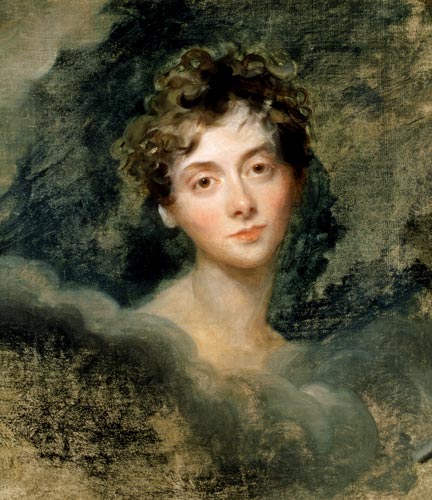
2nd_V_Melbourne.jpg The second Lord Melbourne was the one we know as the Prime Minister for Queen Victoria. William Lamb, 2nd Viscount Melbourne, succeeded his eldest brother Peniston to the title when Peniston died of tuberculosis before their father had passed. William Lamb’s name was often surrounded by scandal. His wife, Caroline (neé Ponsonby) Lamb, had a very public affair with Lord Byron. She coined the famous characterisation of Byron as “mad, bad and dangerous to know”. The resulting scandal was the talk of Britain in 1812. Lady Caroline published a Gothic novel, Glenarvon, in 1816; this portrayed both the marriage and her affair with Byron in a lurid fashion, which caused William even greater embarrassment, while the spiteful caricatures of leading society figures made them several influential enemies. Eventually the two were reconciled, and, though they separated in 1825, her death in 1828 affected him considerably.

 It is said that Caroline introduced the waltz to England, it being performed first at Brocket Hall. Lady Melbourne was known for her scandalous behavior. Supposedly, she emerged from a soup tureen at her husband’s birthday party and danced naked upon a ballroom table, a table still in use today for banquets at the house. Bryon was 24 when he and Caroline began their affair. His fame had increased for he had just published Child Harolde. He attempted to end their affair after only four months, but she would have none of his rejection. In Christopher Winn’s book, I Never Knew That About England (page 130), he tells us, “At Brocket, she (Caroline) gathered together all the local village maidens, dressed them in white and made them dance around a burning funeral pyre on which she had placed a bust of Lord Byron. Then she tore up his letters and cast them into the flames while reciting sad elegies. She turned her bedroom into a shrine to Byron, and her ghost can apparently still be heard in there, playing Chopin, late into the night.” The story becomes sadder when one learns that Lady Melbourne fell from her horse at the shock of seeing Lord Byron’s funeral cortege passing the Brocket estate; she had by all accounts, not known of his death until that moment, for he had died abroad and his body was being returned to his home seat. 

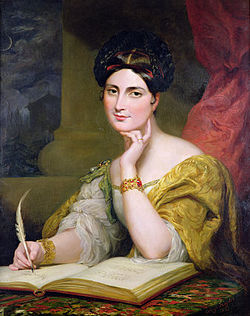
Caroline_Norton_(1808-77)_society_beauty_and_author_by_GH,_Chatsworth_Coll..jpg Lord Melbourne knew more scandal in 1836. This time he was the victim of attempted blackmail from the husband of a close friend, society beauty and author Caroline Norton. The husband demanded £1,400, and when he was turned down he accused Melbourne of having an affair with his wife. At this time such a scandal would be enough to derail a major politician, so it is a measure of the respect contemporaries had for his integrity that Melbourne’s government did not fall. William IV and the Duke of Wellington urged him to stay on as prime minister. After Norton failed in court, Melbourne was vindicated, but he did stop seeing Mrs Norton. Nevertheless, as historian Boyd Hilton concludes, “it is irrefutable that Melbourne’s personal life was problematic. Spanking sessions with aristocratic ladies were harmless, not so the whippings administered to orphan girls taken into his household as objects of charity.” [Boyd Hilton, A Mad, Bad, and Dangerous People? England 1783-1846. 2006, p. 500.]

On the death of Melbourne in 1848, Brocket Hall passed to his sister, who was to marry Lord Palmerston. Palmerston went on to become Prime Minister and was to die in somewhat bizarre circumstances at Brocket Hall, on a billiards table, allegedly involved with a chambermaid at the time. More recently Baroness Thatcher spent time at the Hall where she wrote her memoirs.

The current Lord Brocket is Chales Nall-Cain, 3rd Baronet  Brocket. He, too, has had an interesting past. According to Wikipedia, “He became known as a playboy, and collected classic cars, once owning forty-two Ferraris, which he became known for in the eighties and early 1990s. He was convicted of insurance fraud in 1996 and sentenced to five years in prison, of which he served two and a half years. In 2004, he was a contestant on the third series of I’m a Celebrity…Get Me Out of Here! Finishing in fourth place, his newfound fame made him a popular TV celebrity, making almost £1 million in offers. His autobiography, Call Me Charlie, was published in hardback, coming in the Top 10 Best Sellers list of 2004. He hosted the ITV game show Scream! If You Want to Get Off and presented Privates Exposed, a behind-the-scenes programme for ITV’s Bard Lady Army on ITV2. In 2007, he launched his own Brocket Hall Foods range of groceries. In 2017 an episode of the Channel 5 series Can’t Pay? We’ll Take It Away! featured High Court enforcement officers seeking to recover a debt of £8,000 owed to a firm of accountants from him, although he was out of the country on holiday, and thus not seen on screen.” Brocket Hall was at the time of the 3rd. Baronet’s succession, in a bad state of repair, and he has since converted it into a hotel and conference venue. Today he still owns the hall in Hertfordshire through a trust which leases it to a German consortium and billed as a luxurious hotel and country club. The lease expires after fifty years.

Posted in British history, buildings and structures, George IV, Georgian England, Georgian Era, peerage, real life tales, Victorian era, William IV | Tagged , , , , , , | 2 Comments

A Walk in Jane Austen’s Shoes, a Guest Post from Sophie Turner

This post originally appeared on Austen Authors on February 16, 2018. I thought you might enjoy the lovely images Ms. Turner shares. 

My series on resort towns and my travels has thus far only tangentially touched on Jane Austen, but in today’s post I want to write about her, particularly her health. You might, as was generally the case for me, think of it as being poor. After all, as Kyra Kramer writes in her guest post here, she was plagued by a somewhat bizarre set of maladies, from ongoing conjunctivitis to having whooping cough as an adult, before dying at the age of 41.

Yet other things suggest she had at least periods of very good health. A fondness for dancing in her youth meant country dances and reels, which require a goodly degree of stamina: they winded even professional dancers when the BBC attempted to recreate the Netherfield Ball. And as I discovered when I attempted to walk where she’d walked, she was much nearer Elizabeth Bennet than Fanny Price, when it came to a ramble.

I keep a running Google Map of all of the places I want to visit in the UK, and at some point Bath had acquired a pin for Charlcombe, based on one of the evening walks Austen took during her time in Bath:

I spent Friday evening with the Mapletons, and was obliged to submit to being pleased in spite of my inclination. We took a very charming walk from six to eight up Beacon Hill, and across some fields, to the village of Charlecombe, which is sweetly situated in a little green valley, as a village with such a name ought to be. Marianne is sensible and intelligent; and even Jane, considering how fair she is, is not unpleasant. We had a Miss North and a Mr. Gould of our party; the latter walked home with me after tea. He is a very young man, just entered Oxford, wears spectacles, and has heard that “Evelina” was written by Dr Johnson.

This made it seem like a pleasant after-dinner stroll, so I thought it would be nice at some point to walk to Charlcombe myself, and during this trip fixed on doing it on a Sunday, my last day in Bath. While “up Beacon Hill” does not suggest the exact path taken by Austen, I’d already been hiking up a portion of that hill to indulge my interest in architecture at other points during my time in Bath, and opted for a path that was a little more around the long way, thinking the grade of the hill would be a little less steep.

Map of the city of Bath. Charlcombe is due north.

It didn’t really matter. Either way you have to go a very long way up the large hill that serves as the basis for Bath’s cascading terraces of houses. By this point in the trip temperatures were un-Englishly warm, going into the 80s, and although I had been routinely doing more than 10,000 steps a day and usually more than 15,000 during my trip, and should have been fit for it, I was an exhausted, sweaty mess by the time I reached the top.

Uphill road into Charlcombe. It’s one of those charming village roads where pedestrians and cars are completely expected to share.

This was no after-dinner stroll, and the aplomb with which Austen writes of it indicates that she must have been incredibly fit by modern standards. This makes sense, when you think about it: in her country life, walking would have been her primary means of getting about, for presumably even when Mr. Austen kept a carriage, the young ladies were not constantly ordering it to go about (like at Longbourn, the horses would have often been needed for the farm). And then in Bath, she must have grown used to walking those hilly streets: one cannot imagine the expense of a chair would have been one commonly borne by the Austens.

The walk, however, was rewarding, both for the spectacular view and for the charming little church there, which had another of those holy wells from the old days of belief that such water had a miraculous rather than secular curative nature.

Church of St. Mary in Charlcombe.
Interior of the church of St. Mary.
Holy well on St. Mary’s grounds.

Charlcombe’s claim to fame, of course, is that Jane Austen once walked there, which says something in and of itself:

Quote from Jane Austen’s letter, at Charlcombe.

As for me, I continued on up the hill to the Hare and Hounds pub, where I enjoyed an even better view and consumed the most-earned Sunday roast I’ve ever had in my life.

View from the pub.

I walked more directly down the hill, down Lansdown Road, judging the grade of the hill and what it must have been like to walk all the way up it. This was further evidence – as though I needed it – of Austen’s fitness.

Old turnpike sign on the Lansdown Road.

Evidence of our dear author’s fitness also appears in her pelisse, which was on display at the Willis Museum in Basingstoke as part of the commemoration of Austen’s death. Based on studies of the pelisse, it’s estimated that Austen was 5’7 to 5’8 tall. It’s important to note that this doesn’t necessarily make her any taller at that time among her peers than someone of that height today (I am 5’8 myself). It’s a common fallacy that people were naturally shorter at that time, perpetuated in part because of the height of the decks of naval ships, which were not low because people were short, but instead low due to the needed weight distribution of the heavy guns; tall decks would have put the center of gravity too high on a ship. There certainly were people who were shorter, due to malnutrition – there were people surviving on bread at this time. But among the middle and upper classes, being as tall as Austen would not have been out of the norm.

As I mentioned, I am 5’8 myself, so it was interesting to look at the pelisse through that lens, and Austen was decidedly thinner than myself. I’d go so far as to say she had a light and pleasing figure!

Pelisse thought to have been worn by Jane Austen.
Pelisse from the back.
Aside from Austen’s pelisse, the exhibit featured other fashions, themed around going to a ball.

I went a number of the Jane Austen 200 exhibits, and also made a return to the house museum in Chawton. This was perhaps not the best year to do so, for it was rather crowded. Still, that gave the place a life, particularly since they were letting folks play the pianoforte (I love it when that’s allowed in historic houses) and it’s amazing to think of just how many people are making this particular pilgrimage.

360 view of Jane and Cassandra’s bedroom.

The walk to the great house. Mrs. Austen and Cassandra are buried in the cemetery on the right.
The house’s Elizabethan exterior.
The great hall at Chawton House.

360 view of the dining room at Chawton House.

Chawton House gallery.

It’s very interesting to walk through these rooms in the house Austen visited frequently during her life in the Chawton cottage. If the cottage was the place where she had her most productive output, was the great house the source of much inspiration, both in its spaces and in the rooms themselves? What heroines might she have envisioned peering out of those mullioned windows? What drama might she have imagined within these rooms?

This, we’ll never know, and alas, I must draw this post to an end with the melancholy promise that my next post will bring us to the inevitable end, for Miss Austen. So I shall see you all next time, when we go to Winchester.

Posted in British history, Georgian England, Guest Post, Jane Austen, Living in the Regency, real life tales, Regency era, Regency personalities | Tagged , , , , , | Comments Off on A Walk in Jane Austen’s Shoes, a Guest Post from Sophie Turner

“Very Real” Estate ~ Whitehaven, A Port City on England’s Western Coastline

Whitehaven is a Georgian town situated on the west coast of Cumbria. It was one of the first post-Renaissance planned towns in England. At the end of the 16th Century, Whitehaven consisted of less than a dozen thatched cottages. By the end of the 17th Century, it had a population of 3000 and was the second largest port on England’s western coastline. 

Griffiths'_Guide_to_the_iron_trade_of_Great_Britain_an_elaborate_review_of_the_iron_(and)_coal_trades_for_last_year,_addresses_and_names_of_all_ironmasters,_with_a_list_of_blast_furnaces

Whitehaven 1873 via Wikipedia

The Lowther family were behind Whitehaven’s steady growth and success. The Lowthers were later the Earls of Lonsdale. It was was their vision for the village turned town turned busy port that turned Whitehaven into a port for shipbuilding and the exportation of Cumberland coal.

lowther1

Built on the site of a medieval hall is the imposing country house ruin of Lowther Castle. Constructed of calciferous sandstone ashlar, the Castle was the design of the English architect Sir Robert Smirke. Lowther was built between 1806 and 1814 and designed as a majestic castle viewed from the outside and a luxurious contemporary home on the inside. https://ahistoricalhiatus.com/2015/02/06/lowther-castle/

Sir John Lowther, 2nd Baronet “(9 November 1642 – 17 January 1706) was born at Whitehaven, St Bees, Cumberland, the son of  Sir Christopher Lowther, lst Baronet, and his wife, Frances Lancaster, daughter of Christopher Lancaster of Stockbridge, Westmoreland. He was educated at Ilkley, Yorkshire and Balliol College, Oxford (matriculated 1657) Lowther owned large coal estates near Whitehaven, and worked to develop the mines and the port. He spent over £11,000 in expanding Lowther holdings in the Whitehaven area, concentrating on the acquisition of coal-bearing land, of land which would allow his pits unhampered access to Whitehaven harbour, and land which would hinder the working of others’ pits. This, in turn, allowed him to improve the drainage of his pits, unworried by the thought that he was also draining his neighbours’.  He secured the grant of the right to hold a market and a fair to Whitehaven, and its recognition as a separate customs ‘member-port’ (under the ‘head-port’ of Carlisle) responsible for the Solway coast from Ravenglass to Ellenfoot (later Maryport). He also secured (against a rival grant to the Earl of Carlingford), recognition of his title to the foreshore (land between low-water and high-water) of the manor of St. Bees, containing ‘houses lands staythes & salt pans at Whitehaven’ valued at £400 a year. He oversaw the rise of Whitehaven from a small fishing village (at his birth it consisted of some fifty houses and a population of about 250) to a planned town three times the size of Carlisle. At his death the ‘port of Whitehaven’ had 77 registered vessels, totaling about four thousand tons, and was exporting over 35,000 tons of coal a year.”

Sir John was inspired by Christopher Wren’s designs for the rebuilding of London after the Great Fire of 1666. Wren came up with a plan that laid out the London streets on a grid, rather than have them turn in upon themselves. He also specified the types of houses to be built so that the buildings would not feed each other as they had done in the Great Fire.  Many historians believe that New York’s street system is inspired by Whitehaven’s grid system.

whitehaven-d7-3785.jpg

“On Flatt Walks, looking down Lowther Street is Sir John Lowther’s former home, known as “The Castle”since the beginning of the 18th Century. The building became Whitehaven Hospital in 1926, and is now housing. It was designed by Robert Adam, the most fashionable architect of his period.

“The port development was linked to the exploitation of rich local deposits of coal and iron ore. Some coal mines extended for several miles beneath the sea bed. The first undersea mine in England was constructed in Whitehaven in 1729. By 1931 it was the deepest undersea mine anywhere at the time.

“On 17th June 2005 a sculpture was unveiled near the Beacon, as a memorial to the town’s mining history. By Colin Telfer, it is a unique mix of coal, slate and casting resin, and features a pillar of coal with four figures – a deputy overman, representing mine management; a mines rescue man, representing safety and rescue work; a coal face worker, showing manpower; and a screenlass, to illustrate hardship and poverty.

whitehaven-d7-3776.jpg“Whitehaven was the last place in Britain to be attacked by American naval forces. On 23rd April 1778 during the American War of Independence, John Paul Jones arrived in Britain with the intention of setting the whole merchant fleet on fire. The alarm was raised, and he retreated forthwith. Another American link is that Mildred Warner Gale, the grandmother of the American president George Washington, came from Whitehaven. She was buried in the grounds of St Nicholas’ Church,  on 30th January 1700/1. Visitors may climb a narrow spiral stair in the Clock Tower,  to see the workings of the clock, and to see a small display relating to the Gale family.” (Visit Cumbria)

whitehaven-d2-0050.jpg  whitehaven-f90p3.jpg According to Christopher Winn in I Never Knew That About the English, 1729 saw the extension of the Saltom Coal Pit, which is south of Whitehaven out beneath the sea. It was the first coal pit in the world to hold that distinction. Winn goes on to provide us other tidbits of information. For example John Paul Jones, the American privateer during the American War of Independence, had once served as an apprentice in Whitehaven (1749). The Brocklebank Shipping Lines, founded by Daniel Brocklebank in 1782, was the world’s first shipping lines in Whitehaven. 1798 saw the opening of Jefferson’s Wine Merchants on Lowther Street. The business stood for over 200 years in the same shop. Finally, Mildred Gale, who was George Washington’s paternal grandmother, is buried in the churchyard at St Nicholas. Before Mildred was married to George Gale, a sea merchant, she was married to Lawrence Washington, by whom she had three children. 

Posted in American History, British history, buildings and structures, Living in the UK, real life tales | Tagged , , , , , , , | 3 Comments

Is What We Do JAFF or Something Else? a Guest Post from Don Jacobson

This post originally appeared on Austen Authors on 17 February 2018.

Here I am in the first week of a blog tour for the FIFTH book in a series, and I am now questioning where it can be placed upon the Jane Austen Fan Fiction spectrum. This ultimately begs the question, “what is JAFF?” And, furthermore, as the genre evolves, how might the boundaries of JAFF change the further we move away from the origins of Regency Romance and deeper into the 21st Century?

Stacks of books

There will be those who question if Regency Romance and its subset, Pride and Prejudice Variations, needs to seek out new means of presenting the transcendent themes inherent in the Canonical novels. After all, authors have been composing variations on the ODC stories for over a century with the last 20 years seeing a resurgent popularity rising out of the 1995 film. I cannot agree that the field must remain static and faithful to the highly readable guidelines laid down decades ago. However, I am not arguing that authors must find try to “outdo” the others with something more graphic (yes, sex) and gratuitous (yes, violence) in order to keep the required plot lines “fresh.” That, I believe, is wrong-headed thinking.

In fact, the popularity of our genre offers something else entirely. Well-read observers of the publications being released cannot help but notice that, as more individuals seek to express themselves through the writing of works based upon Austen’s originals, we are seeing what can only be described as natural growth and change. Much as the Classical music embodied in well-established Haydn and Mozart in the late 1700s was transformed by a young Beethoven after the Eroica in 1803 into something new, so, too, the field originally laid down in the 1920s by Heyer now is responding in the second decade of the 21st Century because new voices are taking paths through wildernesses yet unexplored.

This does not make any novel or novella hewing to the traditional modalities a less worthy outing, especially if the author takes care to refresh older plot tropes and adds unique, but not unwarranted, devices that surprise the readers. On the contrary, I can easily list a cavalcade of twenty (or more) writers who consistently produce superb mainstream work that makes me whisper, “I wish I had written that.” However, like the Academy Award winner, rather than try to mention all by name and forget one or two, I will simply say that you know them when you read them.

We are in a glorious period of trial and error. New voices courageously examine different ways of interpreting Austen’s great themes for a 21st Century Millennial audience. New, powerful books and series grapple with questions not only of love and romance, but also of slavery, the relationship between the rulers and the ruled, and the fact that wealth does not automatically confer virtue any more poverty does not suggest an infirmity of character. Likewise, authors are now accepting the challenge of turning many stereotypical side characters into fully three-dimensional heroes and villains.

I am not arguing that to be “new,” one must ignore Elizabeth and Fitzwilliam. On the contrary, I have discovered in my own work that ODC is the center around which the universe revolves. However, there are so many interesting questions to ask and, to those questions, posit answers.

51ix9KqFlQL.jpgAs Rod Serling would say “May I offer for your examination…”

If George Wickham was of an age with Fitzwilliam Darcy, was educated in a like manner, and afforded similar pecuniary resources, why did he turn into a darker mirror image of Darcy? Would this not be contrary to John Locke’s ‘tabula rasa’ found in the ‘Treatise on Human Understanding?’ Are we left to somehow assume that because the adolescent Wickham was still ‘just’ a steward’s son, the offspring of a servant, he could never act like a gentleman?

Actually, he did. In fact, Wickham acted much like many aristocratic scions through his gambling, carousing, and running up of debt. His ultimate sin was that he welched on what he owed unlike the rich boys who got bailed out by Daddy. We are left to wonder if the genteel Austen was commenting about Wickham aping his betters or wielding a sword suggesting that the aristocracy was acting like the crass lower classes.

I attempted to provide an answer for the shaping of Wickham’s personality as it was portrayed in the Canon in this most recent book The Exile: The Countess Visits Longbourn.

I believe that we are observing a change from what has driven our genre for decades to something that can only refresh the field. T’is no longer “fan fiction” except that those who write it have immersed themselves in the universe created by Jane Austen. Likewise, the readers may be “fans” of the themes laid down by Austen, but they are also discriminating readers seeking to find literature that appeals to them in the same motion that it challenges them.

This process is opening up exciting new literary channels that can only demand that readers begin within the space created by Austen. Authors have a different task, I believe, and that is to broaden their work away from hewing so tightly to Austen into being inspired by Austen and using the memes and mores of the modern age.

Jane Austen Fan Fiction implies to a degree, I think, that the work is less serious, the creation of “fans,” when that is the furthest thing from the truth. Yes, each author is a “fan” both of the original Canon as well as the subsequent outpouring of material that carries the ideas and characters along, often to the same destination. Readers, too, are “fans” of the same. There are moments, though, when JAFF becomes a throw-away term to readers of other genres.

So, if the appellation has difficulties, what are we to do? Recall that “science fiction’s” Golden Age (1930s-mid-50s) involved a lot of work that had BEM’s (sorry, Bug-Eyed Monsters) threatening plucky men and submissive women. It had limited appeal to any but teen-aged boys grappling with their own sense of powerlessness. How did it grow past that stage into the “speculative fiction” of today? Simply, it evolved until it was something new and refreshed with offerings by a new generation of writers–women and men–who looked at the world around them and found great material with which to create new fiction. Oh, many of great authors of the Golden Age found a way to change with the times and managed to survive the 1960s and still stand astride the field into the 1980s.

For me, therefore, I find that much as we do not speak of ‘Science Fiction’ anymore, rather naming it ‘Speculative Fiction,’ calling that which we write ‘Jane Austen Fan Fiction’ is exclusionary to those not already reading the works.We, too, can do the same as the SFers, by daring our authors to take a risk and challenge us to rethink our preconceived notions of what we expect from a book growing out of Austen.

And that is why I am suggesting that (as I plan to do) we begin to move away from calling that which we do as JAFF. For instance, my new Twitter handle is “AustenesqueAuth.” I believe that we should change our brand to a term familiar to many of us, but also one that would imply less “tribute band” and more sensibility to creating a broader appeal.

Austenesque Fiction

I would cherish your thoughts on this.

&&&&&

 61alaIstgwL._UX250_.jpg           Please enjoy this excerpt from The Exile: The Countess Visits Longbourn. 

This excerpt is ©2018 by Donald P. Jacobson. All Rights Reserved. Any reproduction of this work through either electronic or mechanical means is strictly prohibited. Published in the United States of America.

Here Wickham, accompanied by a new acquaintance, Captain Richard Sharpe, ponders the reasons he descended so far from the advantages afforded him by Old Mr. Darcy. Corporal Charlie Tomkins and Sergeant Henry Wilson are soon to be detached by Sharpe from the South Essex Regiment into the service of Wickham’s 33rd, “Wellesley’s Own.” Some additional name references are found in Bernard Cornwell’s Richard Sharpe novels. Tomkins and Wilson are new characters who have been seen in my earlier non-Bennet Wardrobe novella, “The Maid and the Footman.”

Chapter XXII

Tomkins walked point while Wilson brought up the rear. The positions suited each well for the attention of an aggressor would be focused upon the two officers walking side-by-side thus leading him to ignore the small, wiry man out front to their certain chagrin. Anyone charging from the rear would immediately run headlong into the broad shoulders and swiveling shako of the redoubtable Sergeant Wilson.

Thus protected from the denizens of London’s alleyways, the Captain and the Lieutenant, greatcoats warmly wrapping them against the chill dampness, continued their conversation.

Sharpe mused at the many parallels between his life and that of George Wickham. Both had moved above their station in the face of resistance if not outright hostility from their betters; Sharpe much further…from the docks and workhouses of London while Wickham had had a comfortable start as the son of the man charged with the day-to-day management of one of Britain’s largest estates. Both were surprisingly well educated, although Wickham had enjoyed a university experience while Sharpe had bent his own mind toward improvement. Finally, both men had discovered some degree of purpose in a martial existence.

Sharpe had peeled back a number of the layers that made up the onion known as George Wickham. Yet, like Aristotle’s hydro-argyros,[i] Wickham proved to be mercurial, refusing to be held in place to be measured, to be weighed. Thus, Sharpe had to channel his own inner Major Hogan, to apply the techniques that worthy used in the service of Wellesley in the pursuit of the Lieutenant’s inner truth.

Much as Hogan would quiz a French captive, Sharpe laid his conclusions before Wickham. Their validity was not the central point for a compliant Wickham would correct him if he was in error, and, in so doing, would provide more information, perhaps much that he sought to conceal.

Beginning at the end was often a way to get at the beginning. Sharpe was seeking an understanding why two men of an age, raised in a similar manner, and given like opportunities would be shaped into such diametrically opposed beings.

Sharpe began his gambit by looking at the critical moment, the crux, which proved to be the point where Wickham’s life swung in a different direction.

He squeezed the sore spot, “From what I can see, your life has had a Vauxhall Gardens way about it…all froth and fizz, full of an unreal quality, but possessing little of substance that would appear worthwhile in the harsh light of day. And, like the excitement of a young girl upon her first trip to the pleasure dome, you soon discovered that all good things must come to an end.

“Thus, the death of old Mr. Darcy put paid to your seemingly endless winning streak. He had covered up your sins for you, as did his son. You discovered that your distance from Pemberley had softened the impact of your behavior upon your godfather; that it had served to allow the old man the chance to deny what he prayed was not true.

“Not so his son, for that young man often had to pick up after you. His patience lasted only as long as the father lived because the youth sought to spare his sire the disappointment of dashed hopes for your elevation from your background.

“You were forced to make your way in the world, but you quickly discovered that you were unprepared to do anything but playact as a rich man’s son.

“Sadly, you were not a pampered fop, were you?”

Each declaration struck a body blow to Wickham, already weakened by days of self-reflection. For a time, the only sound to be heard was a continual scritching as the grit beneath their feet was ground to dust between leather soles and damp cobbles. The group was passing along the boundaries of Hyde Park, following the carriageway, deserted now in the midnight blackness.

Then Wickham sighed, a deeply depressed release of air that carried the freighted feelings that had so borne upon him since he had first tried to explore his emotional motivations. He glanced up, his sight catching the guttering streetlight upon which he focused until all else vanished from his awareness. As his mind drifted away from his conversation with Sharpe, his pace slowed until he stopped, forcing the other three to begin to hold their places until they realized that the fourth member of their little tetrarchy, silently staring at the lantern, was no longer with them.

Wickham’s eyes drifted shut. His breathing became deeper and more regular the further he slid into the trancelike reverie. A sense that another had joined him became stronger. This being/part/portion had always been within, but buried by layers of emotional scar tissue laid on one offense—perceived or real—at a time. Yet, this segment of him had been growing stronger ever since that August morning in St. Clement’s when, in spite of his previous pedigree, he agreed to protect another. Time—both in reality as well as an imagined constraint—vanished as the sentience came closer. Words, communication felt, not heard, initiated the instant an image appeared in Wickham’s mind’s eye.

Posted in book excerpts, book release, British history, George Wickham, Guest Post, Jane Austen, Living in the Regency, Pride and Prejudice, Vagary | Tagged , , , , , , | 2 Comments

Welcoming Jennifer Redlarczyk and Her Release of “A Very Merry Mix-up”

Jen red 1smaller.jpg Today I welcome a dear friend of this blog and of Austen Authors. Jennifer Redlarczyk, who is releasing a novelette as a prelude to her first novel, Darcy’s Melody, which will arrive soon.  Austen fans are in for a real treat. 

Greetings, JAFF Lovers! And thank you, Regina, for hosting me here. Since I am a newly published author, I wanted to take this opportunity to tell you a little about myself and what inspired me to write in this genre.

By trade, I am a performer and private music teacher. For as long as I can remember, I have always loved music. While my parents were not formally trained musicians, it was a rare day that you didn’t hear one of them break out in song. As you might suspect I simply had to join in.

Growing up in Janesville, Wisconsin, my love of music followed me everywhere. In addition to voice, I studied violin and piano. When I attended college at Northwestern University, I majored in Vocal Performance. Currently, I live in Crown Point, Indiana, where I still continue to sing and have a delightful studio of young people who study with me.

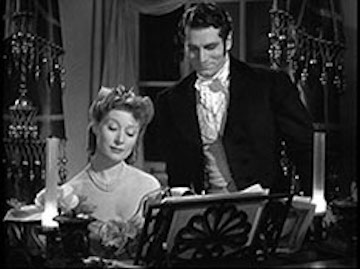
Darcy & Lizzy old 1.jpg I first discovered Jane Austen when I was but a teenager. My mother was a lover of old movies and introduced me and my sister to the 1940 movie version of Pride and Prejudice staring Greer Garson and Lawrence Olivier. What could be better than this old black and white film with lively music and lighthearted banter between our beloved characters, Elizabeth Bennet and Fitzwilliam Darcy?

Little did I know that this old film was just a sneak preview into the world of Jane Austen and the literary works that I would soon come to love and cherish. Following this introduction, I quickly sought out our local used book store to see if I might purchase the original. To my delight, I found a fat anthology containing not only Pride and Prejudice, but six of Jane Austen’s completed novels.

During the summer of 2011 while visiting my local Barnes and Noble Bookstore, I happened to notice a table of Jane Austen Fanfiction books. At the time, I wasn’t big into social media and never realized JAFF existed. Needless to say, I blew my budget and walked out of Barnes with an armload of books. From there I found the JAFF community on Facebook and became a moderator on DarcyandLizzy.com where I am an avid reader and have posted more than twenty short stories and one full-length novel, Darcy’s Melody.

At the time A Very Merry Mix-up was written, the forum had been offering various theme challenges to authors who wished to write short stories or flashes of inspiration. This particular story was written for All Fool’s Day. According to Wikipedia this particular day can be traced back to the days of Geoffrey Chaucer’s The Canterbury Tales (1392). In preparation for publication of Darcy’s Melody, I decided to publish this novelette in an effort to explore more fully the realm of self-publishing. As a first time author, I was astounded to learn how much work goes into preparing one’s manuscript for publication. Consequentially, I have the greatest appreciation for authors such as Regina Jeffers, who have dedicated themselves to a career of writing and have continued to give us so many wonderful stories.

Jennifer Redlarczyk (Jen Red)

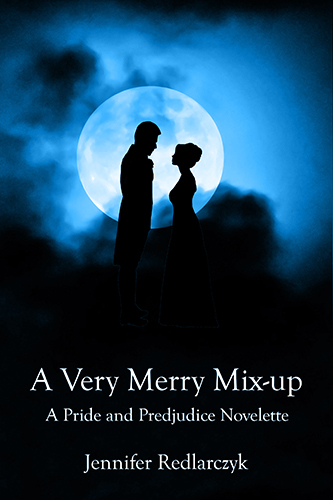
A Very Merry Mix-up small revised  Final.jpg Book Blurb for A Very Merry Mix-up

It all began when Fitzwilliam Darcy and his cousin Colonel Richard Fitzwilliam stopped at the posting station in Bromley on their way to Rosings Park for their annual visit. Looking for some diversion, the good colonel happened upon a local Romani woman who was selling her people’s treasured Moon Wine. Find out what happens to some of our favourite Jane Austen characters when her advice is ignored in A Very Merry Mix-up.

moonflower small

Moonflower

 Teaser

1 April 1811, All Fool’s Day

Quickly rising, Darcy felt a little unsteady and found it necessary to hold on to the bed post while searching for his robe. Catching a glimpse of himself in the mirror, he staggered closer to the glass and groaned in disbelief. Slowly rubbing his stubby fingers across his ruddy cheeks and through his oily hair, he wondered if he had indeed gone mad. Wiping those same fingers on the front of his nightshirt, he could not help but feel his flabby chest and the protrusion of his round stomach through the cloth. Grasping the reality of his predicament, Darcy stared at himself with revulsion.

“Merciful Heaven!” he thundered, turning back to the woman. “It is me, Fitzwilliam Darcy, in the body of that idiot rector! If you are Miss Elizabeth Bennet, as you claim, I fear we have both become the victims of some cruel joke. Will you not come and look for yourself?”

Picking up Charlotte’s dressing gown and quickly wrapping it around herself, Elizabeth guardedly went to the mirror as he requested. “Mr. Darcy?” She paled, realizing what he said was true.

Want to read a Longer Excerpt? Check out the one on Amazon at this LINK. 

Posted in book excerpts, book release, British history, excerpt, film adaptations, Georgian England, Guest Post, historical fiction, Jane Austen, legends and myths, Living in the Regency, music, Pride and Prejudice, Regency era | Tagged , , , , , , , , | 58 Comments

A Closer Look at “Elizabeth Bennet’s Deception: A Pride and Prejudice Vagary”

Although I have written nearly two dozen Austen-inspired retellings, sequels, and mysteries, Elizabeth Bennet’s Deception was my first attempt at what is known as a “variation” in the JAFF (Jane Austen Fan Fiction) community. In a variation, the author changes one of the events in the original Austen story line and creates a new and intriguing twist. 

In this first attempt at a vagary, I was my usual writer self: I added lots of angst and many twists and turns. The book begins with Darcy’s return to Pemberley while Elizabeth and the Gardiners are visiting, but instead of his approaching her, he skitters off to his rooms rather than to speak to her. However, the next day, when Bingley is escorting Georgiana Darcy to Pemberley, he spots Elizabeth in Lambton. That evening he calls on her and her family. During the general course of the conversation, Mrs. Gardiner “casually” tells Mr. Bingley how Jane had been in London for three months and how Bingley’s sister provided Jane a direct cut by not returning a social call. Bingley is furious. He returns to Pemberley. Darcy confesses his part in separating Bingley from Jane. 

The next day, Elizabeth receives the letter from Jane that describes Lydia’s elopement with Mr. Wickham. While Mr. Gardiner rides ahead to meet up with Mr. Bennet, Elizabeth takes it on herself to call on Darcy. She asks his help in finding Wickham. He makes the natural assumption that Wickham has seduced Elizabeth, and she is with child. Saddened by the possibility, Darcy refuses, but Bingley says that if Darcy expects for Bingley to forgive him, he will assist Elizabeth. Along with Mrs. Gardiner, Darcy and Elizabeth set off for London. Obviously, I do not make their journey an easy one. I toss in the hunt for Wickham, a measle outbreak, another major misunderstanding, a secret betrothal, and Darcy’s humbling himself before Meryton’s populace before our dear couple reach their Happily Ever After (HEA). The idea is to have both Darcy and Elizabeth go through some sort of transformation, just as they did in the original tale before bringing them together. 
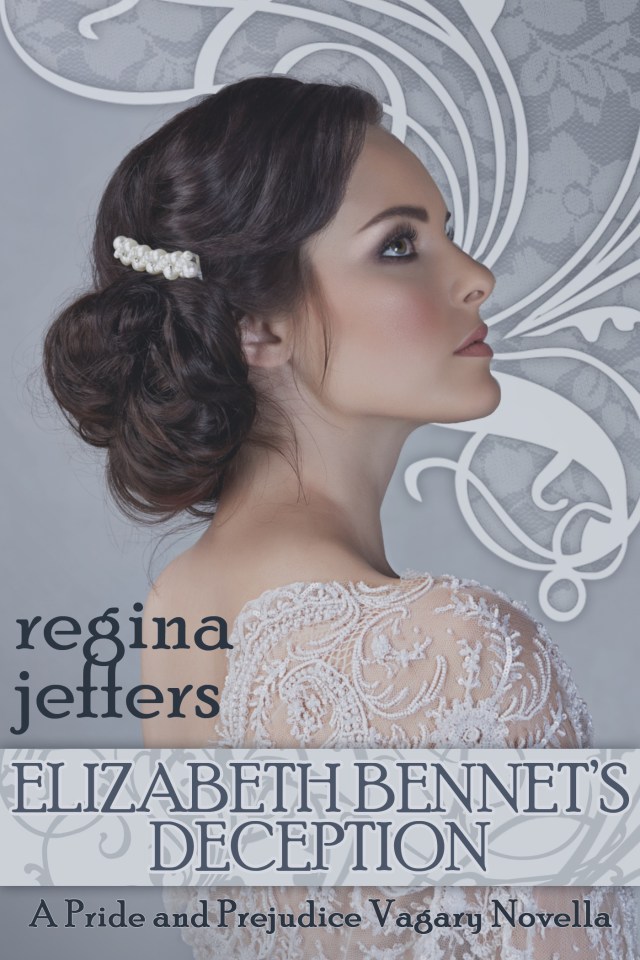
ElizabethBennet  copy.jpgElizabeth Bennet’s Deception: A Pride and Prejudice Vagary

What if Fitzwilliam Darcy refused to approach Elizabeth Bennet when he spots her upon the grounds of Pemberley? What if Elizabeth permits Mr. Darcy to think her the one ruined by Mr. Wickham? What if love is not enough to bring these two souls together?

FITZWILLIAM DARCY’s pride makes the natural leap to ELIZABETH BENNET’s ruination when she appears, without notice, upon Pemberley’s threshold to plead for his assistance in locating Darcy’s long time enemy, George Wickham. Initially, Darcy refuses, but when Charles Bingley demands that Darcy act with honor, Darcy agrees. The idea of delivering Miss Elizabeth into the hands of Mr. Wickham rubs Darcy’s raw. Even so, he does his best to bring Wickham to marry Elizabeth Bennet; but it is not long before Darcy realizes Elizabeth practices a deception, one he permits to continue so he might remain at her side.

Their adventure takes more twists and turns than does the original Pride and Prejudice, but the reader will enjoy the devotion displayed by both Darcy and Elizabeth as they not only bring Wickham to toe the line in Lydia’s defense, but they work their way through new misconstructions. Darcy’s finally wooing of Elizabeth brings them both to a public declaration of their love.

Amazon    http://www.amazon.com/Elizabeth-Bennets-Deception-Prejudice-Vagary/dp/1511632755/ref=sr_1_1?ie=UTF8&qid=1441298147&sr=8-1&keywords=elizabeth+bennet%27s+deception

Kindle     http://www.amazon.com/Elizabeth-Bennets-Deception-Prejudice-Vagary-ebook/dp/B00W3SD46Y/ref=tmm_kin_swatch_0?_encoding=UTF8&qid=1441298147&sr=8-1

CreateSpace    https://www.createspace.com/5421781

Nook    http://www.barnesandnoble.com/w/elizabeth-bennets-deception-regina-jeffers/1121730958?ean=2940151613293

Kobo   https://store.kobobooks.com/en-US/ebook/elizabeth-bennet-s-deception

Excerpt  from Chapter One

Darcy froze in his steps.

“It could not be,” he whispered to his foolish heart. He had returned to Pemberley a day early in order to make the final arrangements for the surprise he meant for his sister. He had left Georgiana in the care of his friend, Charles Bingley, and Bingley’s sisters. More than once, while he had ridden to Pemberley, he had experienced a twinge of guilt at his expecting Georgiana to contend with Caroline Bingley and Louisa Hurst, but Miss Bingley’s effusions had sorely worn on Darcy’s patience, and so he had made his excuses.

Arriving upon the estate grounds, he had cut across Pemberley’s parkland to come forward from the road, which led behind it to the stables. Upon his approach to the manor house, Darcy had noted an unmarked carriage before the front entrance. Recognizing the possibility of visitors in the common rooms, he remained in the shadows, meaning to enter the private quarters through the back entrance; yet, the appearance of a young woman upon the rise leading to the river had brought him to a stumbling halt. From a distance, the woman had the look of Elizabeth Bennet, but he did not approach, but his head denied the possibility that his heart screamed to be true. He had acted the fool previously and refused to be found wanting again.

Perhaps it was a month or so after his disastrous proposal to Miss Elizabeth at Hunsford Cottage, that he had spotted a young lady entering Hatchard’s Books, and without thinking, he had followed her. “Miss Elizabeth,” he said as he came up behind her, but when the woman spun around to greet him, the lady was not the woman whose existence had haunted Darcy’s thoughts for almost a year.

The girl’s forehead furrowed in confusion. “Pardon me, sir. Do we hold an acquaintance?”

Darcy bowed stiffly. “It is I, miss, who begs your pardon. From behind, I thought you a long-standing acquaintance.” He stepped back to widen the distance between them. “I apologize for the inconvenience.”

The girl’s frown line deepened. “Yet, you called me by my Christian name.” The tone of the girl’s voice spoke of her suspicions.

Darcy swallowed the blush of embarrassment rushing to his cheeks. “If you are also an ‘Elizabeth,’ it is purely a coincidence,” he insisted.

“I am.”

Darcy rushed his apologies when he spied a matron marching to the young woman’s rescue. “Then I am doubly apologetic. My actions placed you in an awkward position. Please forgive me.” He held enough experience with Society mamas to know when to make a speedy exit.

During his return to Darcy House that day, he had silently cursed his inanity for stumbling into what was another humiliating situation. Later, in his study, he had admitted to the empty room, if not to himself, that he had missed looking upon Elizabeth Bennet’s animated countenance.  “If it were she,” Darcy warned his conscience, “Miss Elizabeth would have, in all probability, presented me the direct cut. The lady spoke quite elegantly upon her disdain, and you are imprudent to think your letter would have changed Miss Elizabeth’s mind. Accept the fact the woman is not for you.”

And so when Darcy noted another possessing Elizabeth’s likeness upon the streets in the warehouse district of Cheapside a fortnight later, he had turned away with the knowledge that as a gentleman’s daughter, Miss Elizabeth would not be found in Cheapside. He strove to convince himself that he would soon replace Elizabeth Bennet’s charms with that of another.

Belatedly, realizing he studied the woman standing upon the rise longer than was proper, Darcy slipped through an open patio door to escape the vision of Elizabeth Bennet at Pemberley, a thought which so often followed him about as he completed a variety of tasks upon the estate. It was deuced frustrating to look for the woman wherever his steps took him.

“Leave it be,” Darcy chastised as he crossed the drawing room only to be brought up short a second time by the appearance of his housekeeper.

Mrs. Reynolds caught at her chest in obvious surprise. “Mr. Darcy,” she gasped. “I did not realize you had returned, sir.”

Darcy caught her elbow to steady the stance of his long-time servant. Mrs. Reynolds had come to Pemberley when he was but three. She, Mr. Nathan, his butler, and Mr. Sheffield, his valet, all had known the Darcy family’s employ for over twenty years. “I noted visitors, and as I was not dressed properly, I thought to avoid the necessary greetings,” he explained.

“I have just this minute turned them over to the gardener,” Mrs. Reynolds assured.

Darcy swallowed the question rushing to his lips. He would not ask of the nature of those who called upon his house. “Very well. Then I am free to seek the privacy of my quarters.”

“Yes, sir.” Mrs. Reynolds glanced toward the entrance hall. “Should I have a footman bring up bath water, sir?”

Darcy nodded his agreement. Again, he fought the urge to ask of the estate’s visitors, choosing not to punish his pride with false hopes. Instead, he asked, “Has Miss Darcy’s gift arrived?”

“Yes, sir. As you instructed I had the instrument placed in Miss Darcy’s sitting room. It fits perfectly. Miss Georgiana will know such joy.”

He smiled with the woman’s kindness. “My sister deserves a bit of happiness. After my ablutions, I mean to view the arrangement personally.”

“Very good, sir.” Mrs. Reynolds started away to do his bidding. Yet, despite his best efforts, Darcy called out to her. “Yes, Master William. Is there something more?”

Darcy’s eyes searched the staircase where he often imagined Elizabeth Bennet standing. Such yearning swelled his chest that he experienced difficulty breathing. It is best not to know, he cautioned his wayward thoughts.

“Would you tell the footman I will require his assistance in dressing. Mr. Sheffield and my coach will arrive later this evening.”

“Certainly, sir.”

“And you and I should speak before Mr. Bingley’s family arrives. Miss Bingley did not enjoy the vista from her guest room when last the Bingleys were here.”

A scowl of disapproval crossed his housekeeper’s features. Darcy knew many of his servants prayed he would not take up with Caroline Bingley. He expected if he were to act so foolish, he would receive a large number of notices of withdrawal from his staff. 
“Perhaps before supper, sir,” Mrs. Reynolds said stiffly.

Darcy nodded his approval, and the lady strode away; yet, he whispered to her retreating form. “Have no fear. Only one woman knows my approval as the Mistress of Pemberley.” Darcy chuckled in irony. “And it remains unfortunate that even Pemberley’s grandeur could not entice the lady to overlook its master’s shortcomings.”

* * *

Mr. Darcy’s housekeeper consigned Elizabeth and her aunt and uncle over to the gardener, who met them at the hall door. As they followed the man toward the river, Elizabeth turned to look upon the gentleman’s home. For very selfish reasons, she had opposed her aunt’s suggestion of the tour of Mr. Darcy’s estate, but Elizabeth was glad she had come, nevertheless. In her future daydreams, she would picture the gentleman standing upon the grand staircase.

If Elizabeth, when Mr. Darcy gave her the letter he wrote in clarification of his actions, did not expect it to contain a renewal of his offers, she formed no expectation at all of its contents. But such as they were, it might well be supposed how eagerly she went through them and what a contrariety of emotions they had excited. No one observing her progress could have given voice to her feelings. With amazement did she first understand that Mr. Darcy believed any apology to be in his power; and she steadfastly denied that he could possess an explanation, which a just sense of shame would not conceal.

With a strong prejudice against everything he might say, she had examined his account of what occurred at Netherfield. She read with an eagerness, which hardly left her power of comprehension, as well as from an impatience of knowing what the next sentence might bring, so much so she could not attend to the sense of the written lines before her eyes. Mr. Darcy’s belief of Jane’s insensibility Elizabeth instantly resolved to be false, and his account of his real objections to the match brought such anger that she could not declare his actions just. The gentleman expressed no regret for acting upon his beliefs, at least none, which had satisfied her at the time. Elizabeth declared his style lacking in penitence, instead of naming it haughty and prideful and insolence.

But Mr. Darcy’s account of his relationship with Mr. Wickham bore so alarming an affinity to Mr. Wickham’s own narration of the events that astonishment, apprehension, and even horror, oppressed her. Elizabeth had wished to discredit it, but every line had proven that the affair, which she believed beyond the pale, could name the Derbyshire gentleman entirely blameless throughout the whole.

In hindsight, Elizabeth had grown absolutely ashamed of her accusations. Of neither Mr. Darcy nor Mr. Wickham could she think without feeling she had been blind, partial, prejudiced, and absurd. “I acted the harpy,” Elizabeth whispered as she implanted the image of Pemberley upon her mind.

When her relatives had insisted upon touring the estate, Elizabeth had convinced herself that viewing Mr. Darcy’s property would prove just punishment for the pain she had caused the gentleman.

“Of all this, I might be mistress,” she reminded herself with each new discovery of how easily she and Mr. Darcy could suit. They held similar tastes in architecture and décor. “So different from his aunt’s ornate presentation at Rosings.”

And so, although Pemberley’s gallery sported many fine portraits of the Darcy family, Elizabeth had searched for the one face whose features she wished to look upon again. At last, it arrested her, and Elizabeth beheld a striking resemblance to Mr. Darcy, with such a smile upon his lips as she remembered to have sometimes seen when he looked upon her. The viewing brought her instant regret for she recognized the honor of Mr. Darcy, which led her to consider his regard for her with a deeper sentiment of gratitude than she had ever admitted, even to herself.

Elizabeth wished she could tell Mr. Darcy that she found Pemberley “delightful” and “charming,” but she quickly deduced the gentleman would have assumed her opinions mischievously construed: Mr. Darcy would think her praise of Pemberley a device to elicit a renewal of his proposal.

“Better this way,” Elizabeth whispered as she turned to follow her aunt and uncle further into the woods. “I have memories of Pemberley, and no one else is the wiser of my presence under Mr. Darcy’s roof.”

* * *

Unable to quash his curiosity any longer, after supper, Darcy sent for Mrs. Reynolds. 
“Yes, sir?” The lady curtsied from her position inside the open door to his study.
Darcy motioned her forward.

“Would you see that there is a vase of yellow roses placed upon the new instrument in Miss Darcy’s quarters.”

Mrs. Reynolds’ countenance relaxed. “I asked Mr. Brownley for fresh cuttings previously, sir.”

Darcy nodded his approval. “I should not think to instruct you on providing for Georgiana’s pleasure. You have been an exemplary member of Pemberley’s staff for longer than I can remember.”

The woman blushed at Darcy’s kindness, but she kept a business-like tone. “I also aired out the green bedchamber for Miss Bingley’s use. I pray that will serve the lady’s purpose.”

Darcy understood Mrs. Reynolds’ poorly disguised question. “You may inform the staff I hold no intention of seeing Miss Bingley in the family quarters. The green chamber is close enough.”

Mrs. Reynolds closed her eyes in what appeared to be a silent prayer of thanksgiving. 
“Will that be all, sir?”

Darcy’s heart raced, but he managed to pronounce the necessary words. “Did we have more than one set of visitors today? Thanks to your efficiency, I so rarely encounter the estate guests, but I would not have you beset upon. Your first duty is to the running of Pemberley.”

“No, sir. Mr. and Mrs. Gardiner were the only ones we accepted in well over a week. It is no bother: I am proud of Pemberley.”

“Mrs. Gardiner,” Darcy’s mind caught the name and rolled it through his body like a tidal wave striking a ship. If the lady he observed was Elizabeth, had she married? Had she thought to compare what she earned to what she lost? Darcy’s mind retreated from the possibilities, but he could not quite quash his fears. “A young couple then? Perhaps on a holiday?”

Mrs. Reynolds shook her head in denial. “Mr. and Mrs. Gardiner would be the age of your late parents. I overheard Mrs. Gardiner tell her niece a tale of the village oak. It sounded as if the lady spent part of her childhood on the London side of Lambton.”

“Her niece?” Darcy’s mind latched onto the one word in his housekeeper’s tale that rang with hope.

“Yes, sir. A fine young lady. Very kind to her aunt, offering her arm to Mrs. Gardiner’s support. I believe the lady held an acquaintance with you. She and her aunt had a private conversation when they spotted the miniature of Mr. Wickham on your father’s mantelpiece.” Mrs. Reynolds’ shoulders stiffened. “I am sorry to report, sir, I could not give Mrs. Gardiner a civil account when she asked her niece how the young lady liked it. In truth, I quickly turned the conversation to your miniature.”

“I appreciate your loyalty,” Darcy said with a wry smile.

“My respect for the girl increased when she admitted she knew you ‘a little’ and that she found you ‘very handsome,’” Mrs. Reynolds continued.

Darcy’s eyebrow rose with curiosity. He hoped perhaps Mrs. Reynolds described Elizabeth Bennet, but he could not imagine Miss Elizabeth’s declaring him handsome: The woman abhorred him.

“And how did this conversation come about?”

Mrs. Reynolds blushed, but she did not avoid his unspoken accusation, a sign of her long-standing position in his household. “Do not look to place blame, Master William. I respect the late master’s kind heart and his benevolence toward his godson, but I see no reason to display George Wickham’s image in this house. Even the late Mr. Darcy could stare down from Heaven and see Mr. Wickham has turned out very wild.”

“We will discuss the future of Mr. Wickham’s likeness upon another occasion. Speak to me of your conversation with the young lady.”

It was Mrs. Reynolds’ turn to raise an eyebrow in interest; however, she rightly swallowed her questions. “Mrs. Gardiner remarked of your fine countenance when she looked upon the miniature, and then the lady asked her niece whether it was an accurate likeness. I then inquired if the young lady held an acquaintance with you. When she admitted as such, I asked if she found you a handsome man.”

“Then, it was Mrs. Gardiner and you who placed words in the lady’s mouth,” he reasoned. Darcy felt the female likely agreed only to be rid of the conversation.

Mrs. Reynolds blustered. “The girl’s aunt and I stated the obvious,” she declared with a tone commonly found among upper servants. “But neither Mrs. Gardiner nor I instructed the young lady to search out your portrait in the gallery nor did we lead her to it again and again.”

Darcy’s heart hitched higher. “I count no one named Gardiner among my acquaintances. Did you overhear the young lady’s name?”

“Her aunt called her ‘Lizzy’ several times so I would assume it is Miss Elizabeth or Lady Elizabeth.”

“Miss Elizabeth Bennet,” Darcy corrected. Remorse at not having met her today filled his chest. A glance to his housekeeper said Mrs. Reynolds wished an explanation. “The young lady’s parents are neighbors of Mr. Bingley’s estate in Hertfordshire. If it is truly Miss Elizabeth, we met upon several occasions. I believe I stood up with her at the Netherfield’s ball.”

“Then perhaps you might renew the acquaintance,” Mrs. Reynolds suggested. “Mrs. Gardiner was to dine with friends before the family moved on to Matlock. I am certain Mr. Bingley would wish to behold Miss Elizabeth again.”

An invisible hand squeezed Darcy’s heart. Should he risk an encounter with Elizabeth Bennet? Had his letter softened the lady’s disdain for him? “Miss Bingley took a dislike for the Bennets,” Darcy offered in explanation. “Mr. Bingley developed a regard for Miss Bennet. His leaving Netherfield was poorly done.”

“I am sad to hear it, sir, but your confidence explains the halfhearted air, which follows Mr. Bingley about.”

Darcy nodded his acceptance: His housekeeper had given voice to what Darcy’s pride denied. Darcy sorely wounded his friend by acting in partnership with Miss Bingley in separating Bingley from Miss Bennet. With a second nod, he excused his servant. For several long minutes, Darcy stared off into the emptiness, which marked his life.

“I cannot seek out Miss Elizabeth,” he told the rise of expectation climbing up his chest. “Even if the lady might offer her forgiveness, Miss Elizabeth holds no interest in renewing our acquaintance. Furthermore, I do not deserve happiness when I robbed my friend of an opportunity to know it.”

* * *

“You are very quiet this evening, Lizzy.” Her aunt’s friends had invited them to dine in the evening, but once they had returned to their let rooms, Elizabeth preferred to spend time alone with her thoughts of Mr. Darcy.

“Just a bit fatigued.” Elizabeth made herself smile at her dearest aunt.

“Then you should retire early,” her Uncle Edward declared.

Her aunt ignored her husband’s lack of intuitiveness. “Are you certain what the Pemberley housekeeper said of Mr. Wickham did not upset you? I would venture the woman’s loyalty to the Master of Pemberley colored her opinions.”

Elizabeth had expected her aunt to ask of Mr. Darcy, not of Mr. Wickham. “Not in the least,” Elizabeth assured. “While in Kent, I learned more of what actually occurred between Mr. Darcy and Mr. Wickham, enough so to acquit the former of any ill doing.”

Aunt Gardiner’s interest piqued. “Would you care to elaborate?”

“I promised my source secrecy.” Elizabeth would like to confide in her aunt and uncle for she wished someone would give her permission to beg Mr. Darcy’s forgiveness, but she had dug the pit of regret in which she now wallowed. “As I explained in my letter before I departed for Kent, Mr. Wickham bestowed his affections upon Miss King, and I held no loyalty for the man when I arrived on Charlotte’s threshold; therefore, I was free to accept other versions of the events.” Hers was an exaggeration of what had occurred, but it held some truth. “Although I still believe handsome young men must have something to live on, I pity whoever accepts Mr. Wickham’s hand.” If only I did not previously express my opinions to the contrary,” Elizabeth thought.

“That is quite a transformation,” her uncle observed.

“I am only aggrieved that I behaved with foolish disregard for Mr. Darcy. I treated the gentleman poorly.”

Her aunt’s question came quickly. “Is this revelation the source of your reluctance in viewing Mr. Darcy’s home?”

Elizabeth swallowed the bile rushing to her throat. “I rejoiced today when Mr. Darcy’s housekeeper informed us that we missed his return to Derbyshire by a day. I would not wish to encounter the gentleman. Our last exchange of words was far from pleasant.”

“If I had known…” her uncle began.

Elizabeth shook off his regrets. “I asked the inn’s staff of Mr. Darcy’s being at Pemberley before we came to the place.”

“We should be on to Matlock the day after tomorrow,” her aunt declared. “Even with Mr. Darcy’s presence at Pemberley we are not likely to encounter him. My friends do not travel in the same circles as Mr. Darcy. We shall be gone soon, and the gentleman will know nothing of our coming into his part of the shire.”

Posted in book excerpts, book release, books, British history, eBooks, George Wickham, historical fiction, Jane Austen, Living in the Regency, marriage, Pride and Prejudice, Regency era, Regency romance, Vagary, writing | Tagged , , , , , , | 4 Comments

Mrs. Beeton’s Book of Household Management, a Guest Post from Gianna Thomas

This post originally appeared on Austen Authors on October 30, 2017. Enjoy! 

Bless Sharon Lathan. She did a series of blogs about servants of the 18th and 19th centuries and had a reference to Mrs. Beeton’s Book of Household Management. I’m always looking for information about these two centuries mainly for my books: Regency romance and Pride and Prejudice variations. I love knowing a little more about the servants and how they functioned in the households of those time periods as I never know when I might like to incorporate some of that information in my writings.

I found Mrs. Beeton’s original book rather fascinating. Although the latest book contains more than her original, her first writings led the way to a more extensive book later on. As it turned out, the book is more than just a recipe book. It contains information about the servants such as the butler, housekeeper, maids, footman, coachman, groom, stable boy, valet, and lady’s maid.

But it all began with the Mistress of the household much as it does today. She was encouraged not only to set a good example for the servants but also to treat them with dignity. A number of things are mentioned in regard to the hiring and treatment of servants in order to have the household run smoothly and peacefully. In fact, it was recognized that the tone of a household began with its mistress. Whether the household activities ran smoothly, there was peace among the family members as well as the servants, and the house was well maintained all began with the lady of the house. Her duties were not a few and encompassed many aspects of household management and some activities outside the family’s domicile that also included society and social settings. The chapter on the Mistress is quite extensive.

Although Mrs. Beeton’s Book is quite lengthy, only three of the forty-four chapters are concerning the Mistress and servants. The rest of the book covers care of the kitchen and cooking utensils, the various types of food, how to cook them, dinner menus, and numerous recipes. So, there is something for researchers of historical fiction or non-fiction or for readers who just like to cook. 🙂

In fact, the book covers everything from soup, meats, fruits, vegetables, desserts and even beverages going into great detail as to the different types of foods, where they came from, and how to cook them.

I was pleased to note that the entire original book of forty-four chapters is found at Mrs. Beeton’s BookHowever, it is not a single download. All the chapters are listed separately so you will have multiple downloads. What I did was open each chapter and then save each as a Word PDF. If you just want the research for the servants, simply save those three chapters. But if you want the recipes, you’ll need to save the remaining chapters.

All in all, it’s an interesting book, and I look forward to looking at its contents more closely. In the meantime, I hope you will have fun perusing the various chapters as well. Enjoy!

Sorry, if this made any of you hungry. 🙂

NOTE: Later versions of Mrs. Beeton’s book have added chapters so that they now total seventy-four.

References:

Mrs. Beeton’s Book of Household Management

Wikipedia.org

Posted in Austen Authors, British history, buildings and structures, customs and tradiitons, fashion, food, food and drink, Georgian England, Guest Post, herbs, Jane Austen, Living in the Regency, Living in the UK | Tagged , , , , , , | 2 Comments

“Prejudice” Is Not So Predominant in Austen’s “Pride and Prejudice” as One Might Think

Most who have read Jane Austen’s “Pride and Prejudice” assume that Mr. Darcy is the l character and Elizabeth is the one displaying prejudice. However, from the examples below, you will see that is not completely true. 

pride-prejudice-22-copy1We encounter Austen’s first use of the word “prejudice” in Chapter 18 (did you think it was before then), Elizabeth accuses Mr. Darcy of being prejudiced. So, is Elizabeth projecting her prejudice upon the gentleman? I will leave it to you to decide. 

“Yes, always,” she replied, without knowing what she said, for her thoughts had wandered far from the subject, as soon afterwards appeared by her suddenly exclaiming, “I remember hearing you once say, Mr. Darcy, that you hardly ever forgave, that you resentment once created was unappeasable. You are very cautious, I suppose, as to its being created.”

“I am,” said he, with a firm voice.

“And never allow yourself to be blinded by prejudice?”

“I hope not.”

The word is not used again until Chapter 36, when Elizabeth reads Mr. Darcy’s letter of explanation with a bit of prejudice.

“If Elizabeth, when Mr. Darcy gave her the letter, did not expect it to contain a renewal of his offers, she had formed no expectation at all of its contents. But such as they were, it may well be supposed how eagerly she went through them, and what a contrariety of emotion they excited. Her feelings as she read were scarcely to be defined. With amazement did she first understand that he believed any apology to be in his power; and steadfastly was she persuaded, that he could have no explanation to give, which a just sense of shame would not conceal. With a strong prejudice against everything he might say, she began his account of what had happened at Netherfield.”

Also in Chapter 36, after reading Mr. Darcy’s letter multiple times, she realizes how poorly she has treated him. Her feelings are directed inward. 

“She grew absolutely ashamed of herself. Of neither Darcy nor Wickham could she think without feeling she had been blind, partial, prejudiced, absurd.”

In Chapter 40, Elizabeth explains what she learned of Wickham to Jane. 

“Certainly. But the misfortune of speaking with bitterness is a most natural consequence of the prejudices I had been encouraging. There is one point on which I want your advice. I want to be told whether I ought, or ought not, to make our acquaintances in general understand Wickham’s character.”

Miss Bennet paused a little, and then replied, “Surely there can be no occasion for exposing him so dreadfully. What is your opinion?”

“That it ought not to be attempted. Mr. Darcy has not authorised me to make his communication public. On the contrary, every particular relative to his sister was meant to be kept as much as possible to myself; and if I endeavour to undeceive people as to the rest of his conduct, who will believe me? The general prejudice against Mr. Darcy is so violent, that it would be the death of half the good people in Meryton to attempt to place him in an amiable light. I am not equal to it. Wickham will soon be gone; and therefore it will not signify to anyone here what he really is. Some time hence it will be all found out, and then we may laugh at their stupidity in not knowing it before. At present I will say nothing about it.

images-2In Chapter 43, Elizabeth wishes to learn more of Darcy from Mrs. Reynolds. In this example, Mr. Gardiner believes Mrs. Reynolds displays prejudice in her accolades of Darcy.

“Elizabeth listened, wondered, doubted, and was impatient for more. Mrs. Reynolds could interest her on no other point. She related the subjects of the pictures, the dimensions of the rooms, and the price of the furniture, in vain, Mr. Gardiner, highly amused by the kind of family prejudice to which he attributed her excessive commendation of her master, soon led again to the subject; and she dwelt with energy on his many merits as they proceeded together up the great staircase.”

In Chapter 55, Bingley has proposed to Jane. Again, Elizabeth admits to a bit of prejudice, this time directed at Mr. Bingley, for the man was too easily swayed in his opinions. Bingley’s initial abandonment of Jane will have Elizabeth a long time in trusting him again.

“Would you believe it, Lizzy, that when he went to town last November, he really loved me, and nothing but a persuasion of my being indifferent would have prevented his coming down again!”

“He made a little mistake to be sure; but it is to the credit of his modesty.”

This naturally introduced a panegyric from Jane on his diffidence, and the little value he put on his own good qualities. Elizabeth was pleased to find that he had not betrayed the interference of his friend; for, though Jane had the most generous and forgiving heart in the world, she knew it was a circumstance which must prejudice her against him.

images-1In Chapter 58, Darcy has proposed to Elizabeth. They reflect on all that proceeded their happiness.

“Darcy mentioned his letter. ‘Did it,’ said he, ‘did it soon make you think better of me? Did you, on reading it, give any credit to its contents?’

She explained what its effect on her had been, and how gradually all her former prejudices had been removed.”

That is it. Only 8 times is the word “prejudice” used in the entire novel. Not many examples for a book entitled “Pride and Prejudice,” is it? Especially, when we consider that “pride” and “proud” and “prideful” are used 47 times. 


Posted in Austen actors, book excerpts, film, film adaptations, historical fiction, Jane Austen, Living in the Regency, Living in the UK, Pride and Prejudice, quotes, Uncategorized | Tagged , , , , | 6 Comments