In Want of a Wife: A Pride an Prejudice Vagary and “Romance Amnesia”

What we call “amnesia” serves as a major plot device in my latest Jane Austen variation, “In Want of a Wife.” When I began writing the book, I wanted a situation where Darcy and Elizabeth had to learn to trust each other again, without all the hoopla surrounding Lydia’s elopement, Bingley’s abandonment of Jane Bennet, Lady Catherine’s disapproval, etc. I wanted a “clean slate,” so I wiped away Elizabeth’s memory of her family and her relationship with Darcy, including the first five days of their marriage. Oops!!! 

Cover-VintageBookofAmnesia In a day and age where concussion protocol is practiced on sports fields and courts throughout America, the idea of amnesia as a plot point may appear a bit lame, but we all likely know someone who had been knocked out or fainted for a brief second or two, or perhaps minutes, who then wakes and takes a bit of time to recall where they are and what is going on. That is what happens to Elizabeth, but instead of minutes, she waits weeks to get her bearings again. In the meantime, she and Darcy are thrown together as husband and wife. One must remember that in the Regency era, marriage was FOREVER. Death do us part, and all that jazz. Divorces were very public and very expensive and, literally, took an act of Parliament. By making Elizabeth also not remember her family, she can no longer depend on others to right her mistakes. Only on Darcy and on herself.


In fiction, we refer to the use of amnesia to advance the story as a motif. Some refer to it as “global amnesia.” Jonathan Lethem in the introduction to his anthology, The Vintage Book of Amnesia: An Anthology of Writing on the Subject of Memory Loss, says, “Amnesia is a common motif in fiction, despite being extraordinarily rare in reality.


“Real, diagnosable amnesia – people getting knocked on the head and forgetting their names – is mostly just a rumor in the world. It’s a rare condition, and usually a brief one. In books and movies, though, versions of amnesia lurk everywhere, from episodes of  Mission Impossible to metafictional and absurdist masterpieces, with dozens of stops in between. Amnesiacs might not much exist, but amnesiac characters stumble everywhere through comic books, movies, and our dreams. We’ve all met them and been them.


“Lethem traces the roots of literary amnesia to Frank Kafka and Samuel Beckett, among others, fueled in large part by the seeping into popular culture of the work of Sigmund Freud, which also strongly influenced genre films such as film noir. Amnesia is so often used as a plot device in films, that a widely recognized stereotypical dialogue has even developed around it, with the victim melodramatically asking ‘Where am I? Who am I? What am I?’, or sometimes inquiring of his own name, ‘Bill? Who’s Bill?’” [Lethem, Jonathan (ed.) The Vintage Book of Amnesia New York: Vintage, 2000.] 
In movies and television, particularly sitcoms and soap operas, one often sees a second  blow to the head, similar to the first one which caused the amnesia, will then cure it. In reality, however, repeat concussions may cause cumulative deficits including cognitive problems, and in extremely rare cases may even cause deadly swelling of the brain associated with second-impact syndrome.  


******************************************************************
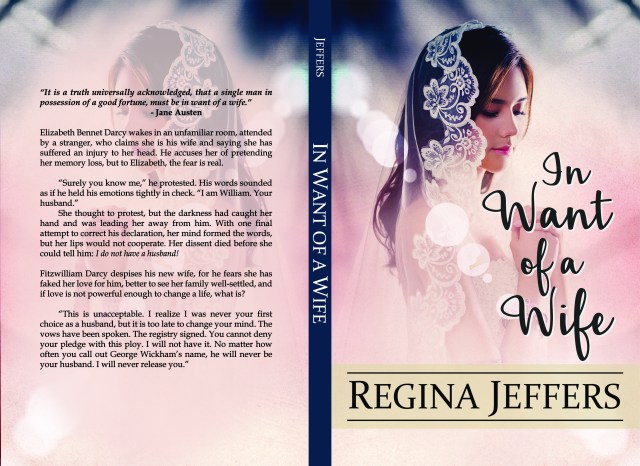
In Want of a Wife: A Pride and Prejudice Vagary 
“It is a truth universally acknowledged, that a single man in possession of a good fortune, must be in want of a wife.” – Jane Austen 

Elizabeth Bennet Darcy wakes in an unfamiliar room, attended by a stranger, who claims she is his wife and saying she has suffered an injury to her head. He accuses her of pretending her memory loss, but to Elizabeth, the fear is real. 

“Surely you know me,” he argued. His words sounded as if he held his emotions tightly in check. “I am William. Your husband.”
She thought to protest, but the darkness had caught her hand and was leading her away from him. With one final attempt to correct his declaration, her mind formed the words, but her lips would not cooperate. Her dissent died before she could tell him: I do not have a husband!


Fitzwilliam Darcy despises his new wife, for he fears she has faked her love for him, better to see her family well-settled, and if love is not powerful enough to change a life, what is? 

“This is unacceptable. I realize I was never your first choice as a husband, but it is too late to change your mind. The vows have been spoken. The registry signed. You cannot deny your pledge with this ploy. I will not have it. No matter how often you call out George Wickham’s name, he will never be your husband. I will never release you.”
MDP eBook Cover


Available On…


Excerpt: 
 
“I plan to enjoy a walk,” Elizabeth told Mr. Nathan. She had been most disappointed when Miss Darcy did not arrive yesterday as planned, and her restlessness had gotten the better of her. Surely Georgiana would make an appearance soon. Elizabeth did not like being alone at Pemberley. Doing so brought on a return of her fears of never recovering her memory.
The butler frowned. “It is not my place to prevent your doing so, but Mr. Darcy charged me and the rest of the staff with your safety, ma’am. Might I add a caution?” Reluctantly, she nodded her acceptance of his warning. “Pemberley is well-tended by the gardeners and groundskeepers, but there is much open land that holds dangerous trails and drop-offs unless one is familiar with the contour of the area.”
Elizabeth wished to remind Mr. Nathan she was the estate’s mistress and she could do as she pleased, but she knew the man was only following Mr. Darcy’s instructions. “I do not mean to go far. Miss Darcy will hopefully arrive soon, and I wish to be here to greet her, but I require a stretch of my legs, or I might go mad.” She added a smile to assure the man she spoke figuratively.
Mr. Nathan nodded his understanding. “Then perhaps you might choose to walk the entrance road. It is wide—properly graveled—nearly a mile to the gatehouse—possesses wonderful views of the parkland and the stream—”
“And I cannot become lost,” Elizabeth finished.
“There is that also,” Mr. Nathan said in practiced tones.
Elizabeth again smiled at the man. “Then fetch my pelisse and my muff, Mr. Nathan.”
“Yes, ma’am.”
Within five minutes, she was crossing the circular drive toward the bend in the road that hid the full grandeur of Pemberley from those who dared to arrive on the property without knowledge of Pemberley House, as well as to those who called upon the estate on a regular basis.
As she walked briskly along, Elizabeth concentrated on each remarkable spot, often turning in place and pausing to admire the great variety of ground. Each step revealed more of the splendor into which she had married. “And of this place, I am to serve as mistress,” she whispered in awe.
Finally, she reached a point where the woods began in earnest. It was a considerable eminence, and Elizabeth turned back to rest her eyes on Pemberley House, which was situated on the opposite side of the valley. Its greatness and its beauty had her swallowing a bit of trepidation rushing to her chest. The manor was a large, handsome stone building, imposing in the simplicity of its architectural lines, standing well on high ground, and backed by a ridge of woody hills, which she now recognized as part of the nature trail at the edge of the lawns. She thought there could be no other place for which nature had done more good.
With a sigh of satisfaction, she set her sights on the wooded area ahead. The walk was easy because she was walking downhill. She recalled when she arrived at Pemberley, Mr. Darcy’s coach entered the park at a low point and slowly climbed to the manor house. “The return will require me to assume a slower pace,” she said with a smile. The crisp air on her cheeks felt good, as did the freedom of the exercise. In spite of her infirmity, the Lord had blessed her. She paused to count God’s favors. She closed her eyes and lifted her chin to speak to Heaven. “Thank you, God, for sparing my life and for bringing William into my world. I possess a loving and faithful husband who promises to protect both me and our family.”
“Does he?”
Elizabeth’s eyes sprang open. She turned frantically in circles, searching the thick woods for any signs of another person.
“Who is there? Show yourself,” she demanded, but there was no movement—no other sound—not even the chirp of birds or the chatter of a squirrel—nothing but the soft snap of a twig and a quick hitch of her breathing.
Suddenly frightened by the unknown, she hiked her skirt and made her feet move in the direction she had come. Constantly looking over her shoulder, she stumbled along the road she had enjoyed until this moment. “Be sensible,” she silently chastised herself, but she did not slow down. The incline she had anticipated earlier caused her to labor, her chest heaving from the exertion. 

Finally, she cleared the heavy woods, but she still did not feel safe. She silently cursed her response, but such did not slow her steps. She was in a strange place, a place she had visited previously, but of which she held no memory. Reaching the spot where she had previously viewed Pemberley in the distance, Elizabeth paused; bent over at the waist and hands braced on her knees, she struggled to capture her breath.
Then she heard it: a loud rumbling coming from the direction she had just fled.  
Posted in Austen Authors, book excerpts, book release, eBooks, Georgian England, Georgian Era, historical fiction, Jane Austen, Living in the Regency, Pride and Prejudice, Regency era, Regency romance, research, Vagary, writing | Tagged , , , , , , , , , , | 3 Comments

Irish Castles in Ruins: Research for My Next Release, “Lady Chandler’s Sister”

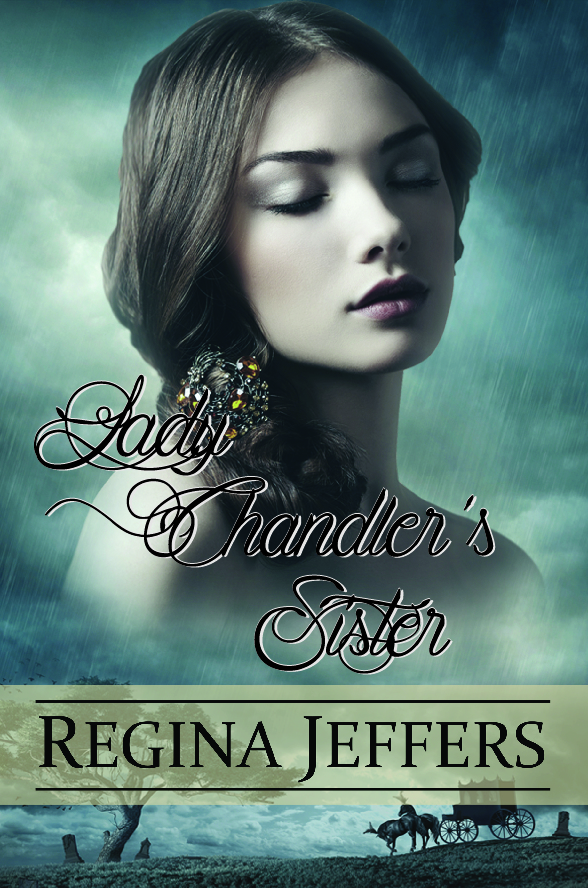
In book 3 of my Twins’ Trilogy, entitled Lady Chandler’s Sister, the ruins of an Irish castle play out in the book’s conclusion. Therefore, I spent time looking for the right image before I wrote those final scenes. As with all these little details required to write an historical piece, some plans work. Others do not. This was a do not. Instead of an actual castle we could still see images of with a Google search, I settled on one that no longer existed, for, in that manner, I could imagine it as I wished. 

Castles_of_Connacht_-_Barnaderg,_Galway_-_geograph.org.uk_-_1953295

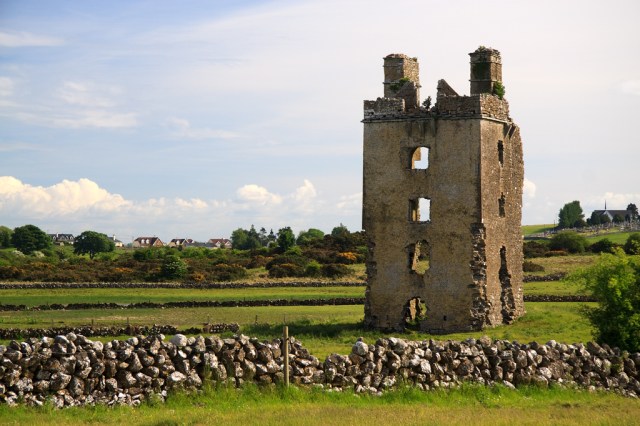
Permission details Creative Commons Attribution Share-alike license 2.0 ~ Castles of Connacht: Barnaderg, Galway, near to Barnaderg and Castlemoyle, Ireland. A five storey O’Kelly tower house dating from the late C16. ~ https://en.wikipedia.org/wiki/Barnaderg#/media/File:Castles_of_Connacht_-_Barnaderg,_Galway_-_geograph.org.uk_-_1953295.jpg

In my mind’s eye, before I began writing the scene, Barnaderg Castle (Irish: Bearna Dhearg, meaning “red gap”) in County Galway (near Tuam) was the perfect image. Five stories high, the castle could supply distance to see one’s enemies approach, but also the element of danger because of its condition. Built by Malachy O’Kelly, Barnaderg Castle was a 16th Century stronghold of the O’Kelly clan. The castle is claimed to have been one of the last castles built in Ireland. Most experts believe it once had a draw bridge, for the area surrounding the castle is saturated throughout much of the year. (Historic Sites of Ireland)

Carrigogunnell

Carrigogunnell Castle is situated 3 km north of Clarina Village, Limerick, Ireland. It was built circa 1450 and was destroyed by gunpowder in 1691. Creative Commons Attribution Share-alike license 2.0 ~ https://en.wikipedia.org/wiki/Carrigogunnell#/media/File:Carrigogunnell.jpg


Digital_Eye–2015–Carrigogunnell_Castle,_Co._Limerick

CC BY-SA 4.0 File:Digital Eye–2015–Carrigogunnell Castle, Co. Limerick.jpg Created: 30 September 2015 ~ https://en.wikipedia.org/wiki/Carrigogunnell#/media/File:Digital_Eye%E2%80%932015%E2%80%93Carrigogunnell_Castle,_Co._Limerick.jpg

Another possible choice was Carrigogunnell, again because of its location and the condition. A medieval Irish fortification, it is attributed to the to the Irish Gaelic tribe of the Dalcassians, “generally accepted by contemporary scholarship as being a branch of the Déisi Muman, that became a powerful group in Ireland during the 10th century. Their genealogies claimed descent from Cormac Cas, who is said to have lived in the 3rd century AD. Their known ancestors are the subject of The Expulsion of the Déisi tale and one branch of their blood-line went on to rule the petty kingdom of Dyfed in Wales during the 4th century; probably in alliance with Roman emperor, Magnus Maximus.” (Dalcassians)

Carrigogunnell Castle is located near the village of Clarina in County Limerick, on the banks of the River Shannon. The structure dates to at least the early 13th century, and was slighted [Slighting is the deliberate destruction, partial or complete, of a fortification without opposition, to render it unusable as a fortress.] in September 1691 after being captured during the second siege of Limerick. Unfortunately, Clarina was not in the part of Limerick I required for my tale. Close, but not close enough. Moreover, by the time I had spent hours research land routes to both Barnaderg and Carrigogunnell, I decided the time required would not fit the story.

castle connell

Engraved for Ferrar’s History of Limerick 1780, North View of Castle Connell ~ http://www.limerickcity.ie/Library/LocalStudies/BooksJournals/FerrarsHistoryofLimerick/ Castleconnells name in Irish is Caislean Ui gConnaing, which means Gunnings castle. This was because the Dal Cais Gunning family built the riverside castle over a thousand years ago, the name was then anglicised to Castleconnell by which the village and parish are still known as today. For more information log onto: http://www.castleconnell.ie (or) http://visitballyhoura.com/index.php/2012/04/16/castleconnell/

Finally, I decided on a castle that no longer stood, one closer to the city of Limerick. The roads in this part of Ireland at the time were horrendous; therefore, I chose a route from Dublin to Limerick, one supposed more passable that those in other parts of southwest Ireland at the time. Castleconnell is situated on the River Shannon some 11 km (6.8 miles) from Limerick City, near the counties Clare and Tipperary. The actual Castle of Connell was built on a rock outcrop, overlooking the bend of the river. It was the seat of the chief of Hy-Cuilean, a territory south-east of Abbeyfeale, in the barony of Upper Connello near the borders of Cork and Kerry. The castle then came into the possession of the O’Briens of Thomond.  The castle was blown up by General Godert de Ginkel during the War of the Two Kings (also called the Williamite War in Ireland or the Jacobite War in Ireland). Ginkel was fighting in support of the Army of William of Orange. A large portion of the castle wall lies some 50 feet from the castle, thrown across the road by siege cannons. 

There you have it. I settled for my imagination, rather than an actual place. 

h2896.jpg

Arriving March 25, 2019 

Lady Chandler’s Sister: Book 3 of the Twins’ Trilogy

LCS eBook Cover-01


Posted in book release, buildings and structures, castles, eBooks, Great Britain, historical fiction, history, Ireland, Living in the Regency, publishing, real life tales, Regency era, Regency romance, romance, Scotland, trilogy | Tagged , , , , , , , , , , , , , , , , | 4 Comments

In Want of a Wife: A Pride and Prejudice Vagary and “Romance Tropes”

Tropes are defined as consistent and recurrent themes or motifs. 

There are many tropes found in romance, whether historical or contemporary. Mindy Klasky  provides a lovely (no pun intended) list HERE

In my latest Austen-inspired piece, In Want a Wife, the book begins after Fitzwilliam Darcy and Elizabeth Bennet are married. “Marriage Tropes” appear when the honeymoon is over. What happens next? TV Tropes says, “What happens when the newlyweds come home from the honeymoon and start living with each other? It’s simultaneously a milestone, a building block for a family, a way to join two older families, a social institution, a public declaration and a very private affair. Many of these tropes are meant to play out over years; others are about the social clout that married status confers; others are about power and in/equality, such as who holds the purse strings.”

TV Tropes also speak of a Marriage of Convenience: “Often, a marriage of convenience is a mutually beneficial agreement, with both parties profiting from the binding – it may even involve a contract – but not always. Sometimes, only one of the partners may be in it for something other than love.

“An expectation is that one or both of the people will fall in love with the other. It is also often a convention used to get two friends who are in love with each other to realise it. Then it may become a Perfectly Arranged Marriage. 

“There are many reasons one may choose to Marry For Convenience, and any instance can be one or more of the following (and others):

  1. Social standing – differs from respect as it is typically someone upper class making a good match
  2. Respect – including when reputation is at stake
  3. Money – including bet winning and to get the partner’s money. 
  4. Green card/citizenship
  5. Political marriage
  6. To play straight/gay
  7. Because the woman is pregnant – frequently “convenient” in the sense of not having that shotgun pointed at your back anymore. 
  8. To help a single parent
  9. For practicalities – when only married couples are eligible for X, and/or to get out of marrying someone else.
  10. As a back-up plan
  11. To get close for ulterior motives
  12. To please parents – this may also be because of any of the above, too.

“The (creators of the) work may show a marriage of convenience in order to fit in with the period of the story being told or for other reasons – commonly characterisation or as a critique of the society which has forced such a marriage to happen, or as a cheap way to get two characters together without any of that dating and love nonsense.”

In my latest release, In Want of a Wife, Mr. Darcy assumes he has married for love, but he begins to question his wife’s motives ,for while recovering from a head injury, his dearest Elizabeth calls out for George Wickham. He fears he has misjudged her, and, like many women who have pursued him, married him only for his money. 

IWoaW Book Cover-01

In Want of a Wife: A Pride and Prejudice Vagary 

“It is a truth universally acknowledged, that a single man in possession of a good fortune, must be in want of a wife.” – Jane Austen

Elizabeth Bennet Darcy wakes in an unfamiliar room, attended by a stranger, who claims she is his wife and saying she has suffered an injury to her head. He accuses her of pretending her memory loss, but to Elizabeth, the fear is real.

“Surely you know me,” he protested. His words sounded as if he held his emotions tightly in check. “I am William. Your husband.”

She thought to protest, but the darkness had caught her hand and was leading her away from him. With one final attempt to correct his declaration, her mind formed the words, but her lips would not cooperate. Her dissent died before she could tell him: I do not have a husband!

Fitzwilliam Darcy despises his new wife, for he fears she has faked her love for him, better to see her family well-settled, and if love is not powerful enough to change a life, what is?

“This is unacceptable. I realize I was never your first choice as a husband, but it is too late to change your mind. The vows have been spoken. The registry signed. You cannot deny your pledge with this ploy. I will not have it. No matter how often you call out George Wickham’s name, he will never be your husband. I will never release you.”

Kindle https://www.amazon.com/dp/B07NFCRL29/ref=sr_1_8?ie=UTF8&qid=1549511383&sr=8-8&keywords=in+want+of+a+wife

Amazon https://www.amazon.com/Want-Wife-Regina-Jeffers/dp/1795770139/ref=sr_1_fkmr0_1?keywords=i+want+of+a+wife+by+regina+jeffers&qid=1549632655&sr=8-1-fkmr0

Nook https://www.barnesandnoble.com/w/books/1130552706?ean=2940161229668

Kobo https://www.kobo.com/us/en/ebook/in-want-of-a-wife-9

Exquisite Excerpt: 

Darcy noted a flicker of uncertainty crossing her features before she hid her thoughts behind a weak smile, plainly meant to pacify him. “Even with my loss of memory?” she asked.

“My affection would remain even if your ‘loss of memory’ was meant to temper my desire for you,” he said softly.

“This is not a farce I practice,” she hissed.

Before he responded, with a flick of his wrist, Darcy gestured his servants from the room. When they were alone, he said, “My remark was not meant as an accusation, rather, as assurance in my belief that we can face any obstacle as long as we are together.” He paused to study her expression. “I feared my previous ardor, when we were alone together at Bath, might have frightened you. I should have had better control of my actions.”

“Would you not have known whether such was true or not?” she instantly protested.

“When we first came together, you appeared to return my desires. I had hoped for a loving relationship,” he admitted. In fact, the night before her accident, Elizabeth had initiated their coming together, tantalizing him with a satin nightgown that left little to the imagination. It was only the next morning while they shared their breakfast and in the carriage to London that she had appeared distracted. At the time, he had thought she had been embarrassed by her boldness in the bedchamber, but since her accident, he had learned of a letter delivered to his wife while he was seeing to their account and checking on the coach’s readiness. Hannah had privately reported that her mistress appeared quite upset by the contents of the letter and had burned it after reading it. Now, he was left to wonder over what it entailed.

She took a second sip of her wine, evidently to provide herself time to formulate a response. “In truth, I possess no means of knowing anything of my previous actions to our intimacies, but I have no reason not to believe you when you describe our devotion to each other. Moreover, in my estimation, I do not think of myself as the timid sort. I believe the manner in which I clung to you after our kiss should be proof of my need for you in my life.”

Darcy wished he could completely ignore his doubts and accept her words for what they were, but there was a part of him that would always doubt that anyone could love him as he needed to be loved. Over more years than he cared to admit, he prayed each day for someone to fill the loneliness that plagued his days. The problem remained: His head told him never to trust anyone. He had trusted George Wickham, and his former friend had betrayed him time and time again. Meanwhile, his heart demanded he simply cherish Elizabeth and ignore her calling Wickham’s name in the mix of her delusions. Which emotion would win out only God knew for certain. “Despite your lack of indifference, I would prefer to be more to you than simply the man who offers his name and his protection.”

It bothered him when she flinched, although the movement was barely perceptible. The action indicated what could only be her vulnerability, which had him again questioning his instincts. When it came to Elizabeth Bennet Darcy, all he would ever want was to is claim all of her as his.

“I wish I could promise you more of myself than I have.” She reached for his hand, interlacing their fingers. He noted the nervousness lurking behind the fine eyes, which had long ago bewitched him body and soul.

Darcy easily recalled his first sight of her. He had been knocked sideways by her exuberance—his initial reaction an unusual stirring of desire. He had thought his response was only one of a male to the sight of a beautiful woman. In hindsight, he wondered why it was Elizabeth Bennet who created such a response in him, for neither her sister nor Miss Bingley, both beautiful women, brought forth a desire to claim them intimately. Yet, even now, after knowing her as his wife, he could not explain why the sight of her had been so thoroughly branded upon his soul, never to be erased.

“Does this sudden hesitation have something to do with my promise to wait to claim you until we reached Pemberley? Did you think it would take longer to be at our home?” Darcy attempted to keep an accusatory tone from coloring his words.

Wariness marked the lines around Elizabeth’s mouth, and she withdrew her hand from his. “I do not fear you, William,” she said softly. Although she held his steady gaze, she stiffened. Something resembling dread crossed her expression.

“Then it is my touch you avoid,” he corrected. He could not name what it was about him that prompted him to provoke her. Darcy suspected it was jealousy. Perhaps it was the continued look of unguarded peril found within her eyes. Or perhaps his negotiation skills had found a point of weakness, and he meant to exploit it. Perhaps he simply needed to learn whether or not her memory loss was an act. Likely, it was only the lust that had marked his days since claiming Elizabeth Bennet’s acquaintance.

“Most women know qualms at the prospect of sharing intimacies for the first time,” she argued in halting tones.

“However, it would not be your first time,” he countered.

She placed her linen serviette upon the table. “I suppose I should ask your pardon for my leaving the table early so I might prepare for your company later.” Outrage laced her tone.

He leaned toward her and noted the quick hitch of her breathing. That damnable inner voice announced she was not immune to him. “I would welcome your agreement. However, I do not want you to lie upon the bed and permit what you name as my ardor. I want the Elizabeth who welcomed me with her encouragements.”

“That woman no longer exists,” she protested.

The unanticipated silence between them was marred by her shoving her chair backward. Her gaze locked with his—her brilliant hazel eyes turning a dark gray. Quickly, she reclaimed her evident indifference to him. “I am your wife, and I will perform my duties to you as the mistress of your house, as well as in the marriage bed.”

Defiantly, he rose and extended his hand to her. She had dared him, what else could he do, but respond, thusly? “An excellent choice.”

Elizabeth placed her fingers into his open palm and stood. He ushered her from the room, instructing Mr. Nathan to have a tray with the remaining courses sent to their joint sitting room. They climbed the stairs in silence. Darcy noted how Elizabeth held herself quite royally, in the likes of Anne Boleyn climbing the stairs to the executioner’s block. Whatever existed between them simmered beneath the surface. Even if his wife’s memory loss was true, she could not deny the awareness they shared of each other.

Reaching the door to her quarters, he paused. She turned to look up at him, confusion skittering across her features. Darcy could not explain what happened next. The voice in his head demanded he reclaim this woman as his wife—as his lover. Surely, she could not forget the perfection of their coming together. Then again, maybe he simply surrendered to the temptation she presented. Mayhap her denials spurred him on. Or, perhaps, some Norman ancestor, whose blood ran through him, demanded that Darcy take control of  his household and his marriage—announcing that Darcy had presented this woman too much power over him. Whatever the reason, he pulled her into his embrace and lowered his head to take her mouth in a kiss of absolute demand.

The spark of recognition he had felt their wedding night reared its head again. He had not mistaken her previous surrender. Knowledge of their rightness flickered briefly and then sank quickly into his gut, growing hotter by the second. The control for which he was well known melted away before it had a chance to offer an objection. Did he possess her, or did she possess him? Did it matter? As long as they remained together.

Posted in Austen Authors, book excerpts, book release, Georgian England, Georgian Era, historical fiction, Jane Austen, Living in the Regency, Pride and Prejudice, Regency era, Regency romance, Vagary, writing | Tagged , , , , , , , , , , , , | Comments Off on In Want of a Wife: A Pride and Prejudice Vagary and “Romance Tropes”

1794: Ratcliffe on Fire and an Act of “Charity”

In 1794, a fire in East London’s Ratcliffe district of London proved to be the largest to occur between the Great Fire of 1666 and the Blitz of 1940.

The Ratcliffe Highway Murders served as a model for my highly acclaimed mystery, The Prosecution of Mr. Darcy’s Cousin. In the years leading up to the fire, Ratcliffe was known for shipbuilding and the industries surrounding that activity. Ratcliff or Ratcliffe is was a hamlet lying by the north bank of the River Thames between Shadwell and Limehouse, due south of Stepney village. The name Ratcliffe derives from the small sandstone cliff that stood above the surrounding marshes, it had a red appearance, hence Red-cliffe. It was far from a being a pristine area. Located on the edge of Narrow Street on the Wapping waterfront it was made up of lodging houses, bars,  brothels, music halls and opium dens. This overcrowded and squalid district acquired an unsavoury reputation with a large transient population.

Ratcliffe in the late 1700s contained warehouses for imported goods, especially those associated with the manufacturing industries lining the Thames. Ratcliffe was reported to have specialized in the storage of combustible cargoes, considered too risky to be bulk-handled in London proper.  Needless to say, that was the area’s downfall in this matter. The conflagration that followed destroyed over 400 homes and 20 warehouses and left 1000 people homeless. Following the fire tents were set up near to St. Dunstan’s Church whilst the area was rebuilt.  

According to Historic UK, at “3pm on 23rd July, an unattended kettle of pitch boiled over at Clovers Barge Yard, Cock Hill setting it on fire. These flames quickly spread to a nearby barge loaded with saltpetre, a substance used to make gunpowder and matches. The barge exploded violently, scattering burning fragments in all directions. Fires spread to the north and the east, consuming timber yards, rope yards and sugar warehouses.”

“Narrow streets and a low tide hampered fire fighting, and within a few hours the fire had destroyed 453 houses leaving 1,400 people homeless and displaced. The government erected tents as temporary shelter near St. Dunstan’s Church, whilst the Corporation of London, Lloyds and the East India Company contributed almost £2,000 to the relief of the homeless.”

 robert-cleverly-1791-ratcliff-Cross-from-the-river-bank-boats-beached-on-the-sand-to-the-right-a-few-boats-on-the-water-to-the-left-e1483895400665.jpgThe Wicked William website adds these details: “It began at Mr Clove’s, a barge-builder at Cock Hill, and was occasioned by the boiling over of a pitch kettle that flood under his warehouse, which was consumed within a very short time. It also set light to a barge (it being low water) lying close to the premises, laden with saltpetre – which subsequently spectacularly exploded. The blowing-up of the saltpetre occasioned large flakes of flame to rain down upon riverside buildings – one of which belonged to the East India Company, from which a store of saltpetre was in the process of removing to the Tower of London – 20 tons of which had been fortunately removed the preceding day. Consequently the fire wrought carnage both on land and river – and very soon all the houses on either side of Brook Street were destroyed as far as Ratcliff Cross, as well as several alleyways – and several large ships, including the East Indiaman Hannah, which was about to depart for Barbados, and other smaller boats were utterly burnt out. The fire found new fuel at Ratcliffe Cross when it over-ran a sugar-house. This new ignition point meant that the adjacent glassworks and a lighter-builders yard were lost. 

“The blaze continued until the following morning and its progress was helped mainly by the narrowness of the streets, which prevented fire engines being of any practical service. The wind blowing strong from the south fanned the flames onwards: it reached the premises of Joseph Hanks, a timber merchants, in London Street and extended on into Butcher Row – the whole of the west, and part of the east side of which was consumed. At Stepney Causeway the fire caught the premises of Mr Shakespeare, a rope-maker, and burnt through to the fields at the other side before dying down. It was only the boundaries of urban development that prevented further progress of the inferno. Almost no property in the vicinity was spared loss or damage, though it was singularly odd that the dwelling house of Mr Bere – a very extensive building – was surrounded by fire but emerged entirely unscathed.”

Interestingly, only one building survived the Ratcliffe Fire of 1794; No. 2 Butcher’s Row, marked its location on the map below. 

staticmap-1.png

Read a full description HERE: Wicked William

Posted in British history, Georgian Era, Uncategorized | Tagged , , | 4 Comments

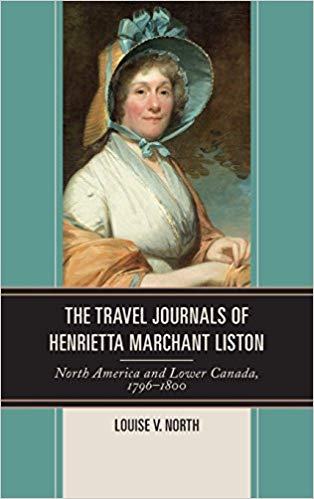
The Letters and Diaries of Henrietta Liston, a Regency Lady with an Extraordinary Life, a Guest Post from Eliza Shearer

(This post originally appeared on the Austen Authors’ blog on November 3, 2018. Enjoy!)

I recently had the pleasure of attending a meeting of the Jane Austen Society of the United Kingdom – Scottish Branch, featuring a fascinating talk by Dora Petherbridge, curator, at the National Library of Scotland. The subject of Ms Petherbridge’s lecture was Henrietta Liston, a keen diarist and letter writer, a contemporary of Jane Austen and a woman destined to become a perceptive witness and reporter of a period of profound transformation.

A Late Bloomer

Henrietta Marchant was born in the West Indies to a Scottish family. Her parents died when she was just a girl, and she and her brothers moved to Glasgow to live with their uncle and aunt. The uncle worked in trade, the family were reasonably comfortable, and the children received a good education, one that would feed Henrietta’s natural gifts of observation and writing.

After reaching the matronly age of 44 unmarried, in 1796 she received a marriage proposal from Robert Liston, a family friend who had had a meteoric career in the British diplomatic service. Robert had just been appointed British Minister to the United States of America, with the mission to help repair the relationship with the former colony.

It was a delicate time for British-American relations. Diplomatic relations between both countries were barely a decade old, and Robert Liston was only the third top-ranking envoy to represent Britain in the US. The position required someone with diplomatic experience and a discerning mind, which Mr Liston undoubtedly possessed. However, there was something else that Robert needed.

henrieta liston robert liston by gilbert stuart

The Perfect Diplomat’s Wife

To paraphrase Jane Austen, a newly-appointed ambassador in possession of a prominent post abroad must be in want of a wife. Robert thought that Henrietta would make the perfect companion, so they married and immediately sailed for New York, from where they would travel extensively, visiting Philadelphia, southern Canada, Virginia and the Carolinas amongst other places (there is a detailed map of their travels here).

Throughout their journeys, while Robert dutifully sent rather dull dispatches to London, Henrietta wrote letters to friends and family and kept several journals describing her impressions of life in the young United States of America. Happily, her words were very different from her husband’s. Informed, spirited and witty, in her writing Henrietta brings to life her new surroundings, with detailed descriptons of landscapes, social customs, food and drink, as well as her encounters with prominent Americans. Her style often brings Austen’s style to mind, and indeed, it is very likely that Henrietta read Austen at some point.

Without a doubt, the Listons’ social talents did much to improve the relations between Britain and its former colony. It probably helped that they were not part of the aristocracy, and therefore more likely to have things in common with the Republican spirit of the Americans they encountered. Robert had grown up a farmer, a common occupation amongst American politicians, and Henrietta was very much a people person, which made her popular in society.

The Listons and the Washingtons

Henrietta met everyone worth knowing at the time in America. Her letters and journals are full of household names, and she provides thorough accounts of her encounters and her impressions on the individuals concerned. For example, she is charmed by Alexander Hamilton, as ladies often were, but does not like Thomas Jefferson much. The Listons also met George Washington and his wife, Martha, and became good friends.

This last relationship is particularly touching. Henrietta writes about Washington extensively in one of her diaries, providing a fascinating, first-hand account of one of the most important figures in the history of the United States. The Listons attended the funeral, and Henrietta paid a ‘melancholy visit’ to a mourning Martha Washington afterwards, of whom she writes:

‘… we found this excellent woman grieving incessantly. She repeatedly told me, during the few days we had it in our power to stay with her, that all comfort had fled with her husband, and that she waited anxiously her dissolution; and indeed it was evident that her health was fast declining and her heart breaking. We parted with much tenderness on all sides, never alass [sic]! to meet again.’

Henrietta Liston Letters

Life After the US

The Listons left the United States in 1800, but their American experience remained with them until the end of their lives. Back in Scotland, Henrietta carefully built an American garden where she planted the botanical specimens she had gathered during her travels in the United States. To this day, the couple are credited with preparing the foundations of the special bond that would develop between the United States and the United Kingdom.

Later, the Listons moved on to Hague, Copenhagen and Constantinople, the seat of the mighty Ottoman empire. Henrietta continued to write letters and journals, leaving a direct and inquisitive account on a world undergoing profound change. She also grew her extensive network and even had an Austen connection: she corresponded with Captain Charles Austen, whom Jane Austen refers to as “our own particular little brother” in a 1799 letter to Cassandra. One of Charles’ missives is part of the Liston archive at the Scottish National Library.  

As significant as Henrietta’s letters and journals are, their study is still very much a work in process. Thanks to an extensive digitisation effort, many of them are already accessible online, but there is still much to be discovered. I very much hope that Ms Petherbridge and her colleagues will continue their invaluable work to disseminate the work of a remarkable woman who lived through extraordinary times, never missing an opportunity to report on what she saw and experienced.

Image credits: Henrietta Liston (Mrs Robert Liston) by Gilbert Stuart and Robert Liston by Gilbert Stuart, both 1800 — National Gallery of Art, Washington; public domain. 

Posted in American History, Austen Authors, British history, customs and tradiitons, Georgian England, Georgian Era, Great Britain, Guest Post, history, Jane Austen, marriage, publishing, reading, reading habits, real life tales, writing | Tagged , , , , , , , , , , , | Comments Off on The Letters and Diaries of Henrietta Liston, a Regency Lady with an Extraordinary Life, a Guest Post from Eliza Shearer

Celebrating the Release of “In Want of a Wife” + a Giveaway


Back in late November, a story was bouncing around in my head, and as any good Muse does, my inner voice kept telling me I needed to write this one. As many of you know, my Pride and Prejudice vagaries generally stay as close to canon as I can get them. Even my vampiric tale incorporated more traditional tales of vampires so that when I was “forced” to abandon the Austen’s original tale, my characters still reacted as one might think Austen would have expected them to perform. So it is with my In Want of a Wife. The premise is simple, although maneuvering Darcy and Elizabeth to respond as I wished them to do was not. 

Elizabeth has had an accident. She has been knocked over by a carriage as she darted across a London street. The result: she has no memory of her marriage to Darcy, of what happened at Netherfield, his first proposal at Rosings Park, nor of her family. She knows nothing of Jane and Bingley or Lydia and Wickham. Her mind is very much a clean slate. She can start over and learn to love Darcy again. Right? Well, not exactly. She is without her former prejudices against him, but her pride, a deep-seated emotion for both her and Darcy, has not abated. Moreover, she cannot just up and leave Darcy. They have been married a week when the accident occurred. The marriage has been consummated. Divorce was a very public and disagreeable business in the Regency era. Testimony for public divorces of the “rich and famous” was published in the newsprints. She has nowhere to go, no money, and despite his distrust of her, Elizabeth realizes Darcy is the one person who will see her through her recovery. 

The first line of Austen’s tale — “It is a truth universally acknowledged, that a single man in possession of a good fortune, must be in want of a wife.” — takes on new meaning in mine. Darcy is “in want of a wife” — his wife. The wife that shared his bed and engendered his hopes for a future for Pemberley and himself. A woman who would drive away his loneliness and isolation behind. Yet, in her delirium, Elizabeth has called out Mr. Wickham’s name, and Darcy’s head, which is singing of betrayal, must permit his heart to lead if they are to know a resolution to the early trials of their marriage. 

BOOK BLURB: 

“It is a truth universally acknowledged, that a single man in possession of a good fortune, must be in want of a wife.” – Jane Austen

Elizabeth Bennet Darcy wakes in an unfamiliar room, attended by a stranger, who claims she is his wife and she has suffered an injury to her head. He accuses her of pretending her memory loss, but to Elizabeth, the fear is real.

“Surely you know me,” he protested. His words sounded as if he held his emotions tightly in check. “I am William. Your husband.”

She thought to protest, but the darkness had caught her other hand and was leading her away from him. With one final attempt to correct him declaration, her mind formed the words, but her lips would not cooperate. Her dissent died before she could tell him: I do not have a husband!

Fitzwilliam Darcy despises his new wife, for he fears she has faked her love for him, and if love is not powerful enough to change a life, what is?

“This is unacceptable. I realize I was never your first choice as a husband, but it is too late to change your mind. The vows have been spoken. The registry signed. You cannot deny your pledge with this ploy. I will not have it. No matter how often you call out George Wickham’s name, he will never be your husband. I will never release you.”

As I am certain some of you recall, I presented you the first part of chapter one with my November 2018 Austen Authors post on turkeys in England. I would encourage you to read it HERE, if you have not done so previously,  before you read what follows. This is the rest of chapter one and the beginning of chapter two. 

It was two more days before she ventured from her bed. With the assistance of her maid—a woman who claimed her name was Hannah and she had been serving her for several weeks—as well as Mr. Darcy’s housekeeper, Mrs. Romberg, Elizabeth was able to have a bath and a proper toilette. She was surprised when Hannah chose a gown and robe she could not imagine she would have owned, for it was satin and lace, and although she knew nothing of her past, she thought herself more likely to choose a more sensible gown.

“A gift from Mr. Darcy,” Hannah explained when Elizabeth’s eyebrow rose in question.

She was settled upon the bench and Hannah was brushing her hair when a soft knock at the door announced her “husband’s” presence. Despite her best efforts, her breath caught in her throat. The sheer power of his demeanor was almost too much to bear. “I am glad to see you from your bed.” He approached slowly, and Elizabeth swallowed hard against the panic rising in her chest. “Might I?” He gestured to the brush Hannah held. The maid quickly handed it over. “Why do you not fetch Mrs. Darcy a shawl? I thought my wife might enjoy a bit of fresh air.”

“That would be lovely,” Elizabeth said softly.

Hannah curtsied and then disappeared into the bowels of the house. He motioned for Elizabeth to turn around, but she waved off the idea. “I would prefer to remain as I am.”

His frown spoke his concern. “Are you still so dizzy?” He crossed behind her and applied the brush to her still damp hair.

“I am not yet steady on my feet, but that is not the reason I do not wish to turn upon the bench.”

His efforts slowed. “Might you trust me enough to explain?” She could hear the caution in his tones. Since the first day they had argued over her loss of memory, they had avoided the subject, instead spending time as do long-time friends, playing cards and his reading to her.

A sad smile claimed her lips. “I cannot bear the looking glass. It is a stranger I see staring back at me.”

He came around to kneel before her, catching her hand in his. “You do not recognize yourself in the glass? Is that what you mean?”

She turned her head to glance into the mirror. “I know nothing of the woman I view before me.”

He caressed her cheek. “I know the woman within and without.” He brushed his lips across hers. “Permit me to chronicle the splendor of the woman I married.”

Before he spoke again, he returned to brushing her hair. “I certainly cannot style your hair as Hannah might, but I believe I can manage a braid.” He divided her hair into three sections. Casually, he began his tale. “I recall the first time I viewed your hair undone. You had walked to Netherfield to visit with your sister, who had taken ill.”

“I have a sister? Does she live at Netherfield?” she asked in eager tones.

“You have four sisters,” he said as he began to overlap the sections of her hair. “You are the second of five. And yes, the former Miss Bennet resides at Netherfield, but, in Hertfordshire, at that time, she had not yet married Netherfield’s master, Mr. Charles Bingley.”

“Then why was my sister in residence at Netherfield? Surely nothing from propriety was practiced? You are not saying my sister is a woman of loose morals?”

“Nothing of the sort,” he assured. “Miss Bennet is your favorite sister. Mr. Bingley’s sisters invited Miss Bennet to tea. Despite an impending storm, your mother sent your sister Jane to Netherfield on horseback.”

“She glanced over her shoulder at him. “You are implying something in your tone.”

He admitted, “Mr. Bingley is quite wealthy and your sister is very comely. I do not know whether it was Mrs. Bennet’s hope for Miss Bennet to take ill or not, but, such is neither here nor there, for Miss Bennet and Mr. Bingley are married, and, for all intents and purposes, quite happy.” He gathered her hair again. “Yet, their marriage was not my intended tale. I planned to describe the first time I viewed you with your hair down. You had walked the some three miles from Longbourn, your father’s estate, to Netherfield because Miss Bennet had taken ill with a fever after her wet ride the previous evening. You were announced into the morning room, where Miss Bingley and I shared the table.” He paused to lean closer to her ear to whisper, “You stole both my breath and my heart in that moment. Your cheeks pink from the exercise. Your lovely eyes sparkling with humor, for, most assuredly you realized Miss Bingley would not approve of either your skirt tails steeped six inches deep in mud or the blowsy arrangement of your hair about your shoulders. I, however, knew my earlier attempts to ignore you were fruitless.”

“Why would you wish to ignore me?” she demanded.

“Such is a long story I will gladly explain in detail over the next few days, but, for now, suffice it to say I acted with misplaced pride. A man in my position and with my wealth is often pursued by families seeking a profitable match for their daughters. I had become accustomed to their deference and built my defenses against their attempts to trap me in a marriage, not of my choice.”

“Surely, you did not think me of that nature?” she accused. His words had her again ill-at-ease. What was she truly like before she had come to this place? Did she practice morals? Possess opinions? Was she shy or did she speak when she should not?

“At the time, I possessed no means of knowing the truth of your character, for our acquaintance was new; yet, such does not matter. My hard-honed logic had lost the battle because the most beautiful woman of my acquaintance had bewitched me: body and soul.”

She found herself sucking in a breath of anticipation. Despite what he said, she could not imagine herself married to such a man. Were they equal in station? Part of what he said implied they were not. Yet, if her sister married a wealthy man who lived in a grand manor, then, most certainly, her family was not destitute. Did not her supposed husband just say her father also owned an estate?

She glanced up to his reflection in the mirror. In spite of her constant feeling of uncertainty, she could easily see how belonging to Fitzwilliam Darcy was something quite special. Comforting even, in an odd sort of way. The man appeared built for protection. At least, he meant to see to her welfare. Yet, an unanswered question, one that danced along the edge of her memory, but did not make an appearance, would not leave her be. It plagued her that she held no memory of the man who stood lovingly behind her, dressing her hair. However, no matter how often she had set her mind to the problem, she held no memory of having fallen in love with the man. Did she love him?

Although she assumed they had shared intimacies, she knew nothing of his touch or the taste of his kiss. “How long have we been married?”

Before he could answer a knock at the the door interrupted them. “Mr. Darcy, the table and chairs you requested placed in the garden are ready, sir.”

“Thank you, Mr. Thacker.” He turned to her. “Permit me, my dear.” And without preamble or her permission, his arms came about her. He lifted her, to cradle her against his chest. With a flutter of butterflies in her stomach, she clung to him, arms laced about his neck. For a brief second, she worried if she might prove too heavy for him, but he appeared sure footed and not from breath as they descended the elegant staircase.

Curious, she glanced about her to discover a stately Town home, one, obviously, belonging to a wealthy man; yet; not a speck of opulence could be viewed. Fine art upon the walls. Polished marble. Thick rugs. And plenty of windows to permit the light to fill the space and to announce to the world how well heeled the house’s owner was. “It is magnificent, William,” she said softly against his neck, as she nestled closer to him.

“I am pleased you approve.” He kissed her forehead, before shifting her weight to turn them through the door of what most certainly was his study to cross the room and exit through open patio doors. “It remains warm for this time of year, but I asked Hannah to provide you a blanket and shawl to be certain you did not take an ague.”

“You are very good to me,” she said obediently.

“You are my wife,” he responded, as if that fact should explain his actions, and, for a brief instant, she considered challenging him; but, then, he added, “I am eternally grateful to our Lord for not stealing you away from me. I would be lost without you in my life, Elizabeth.” And, her heart instinctively called out his name. She remained so confused regarding what she should feel.

He gently placed her in a waiting chair and knelt before her to tuck a blanket across her lap. “Tell me if you become chilly.”

She tilted her hand back to squint up into the weak November sun. “It feels wonderful to be outside.”

He leaned in to whisper. “I recall the sprinkle of freckles across your nose when I met you quite unexpectedly upon Pemberley’s lawn last August.”

She eyed him suspiciously. “Pemberley?”

He smiled and dimples brightened his expression. “My home in Derbyshire.”

Without considering his reaction to her response, she asked, “If I am from Hertfordshire, why was I in Derbyshire?”

The passion that had marked his smile of moments ago disappeared. “If you are marked by forgetfulness, how are you aware of geography?”

Her focus shifted quickly. “You believe I am practicing some farce,” she accused. Since he had entered her quarters a half hour earlier, it had been she who had asked the questions. She had yet to set aside his previous remarks regarding her honestly, and, now, his skepticism had returned.

“Perhaps the sunshine has brought you enlightenment.” He leaned forward to capture her chin in his large palm. “Has your mind cleared? Are you lucid enough to make your explanations to me?”

“How dare you!” she snapped, as she shoved to her feet. “I am suddenly chilled, after all. I shall return to the house.” She would like to say she would pack her belongings and leave, but she had no idea where she might go or how she might manage a journey on her own. Even now, she swayed in place, her vision blurry.

Immediately, he caught her to him to steady her stance. His warmth along her front offered the comfort his words did not. “I beg your forgiveness, Elizabeth,” he whispered as he tightened his embrace. “My infernal pride eats away at my soul as did the eagle eat away at Prometheus’s liver. I truly do not care if you have acted against me this once. I simply wish my Elizabeth—my wife—back.”

She again wished to ask him to prove they were married, but she feared both the return of his anger and the method he might employ as proof. Instead, she chose a different response. “From what little I have observed of your life, I would be fortunate to be called ‘wife’ by you, and I truly understand the chaos you suffer, for I suffer it also. It is quite daunting to wake in an unfamiliar room with a stranger claiming me as his wife. I cannot help but to question our relationship.”

“Why would I name you otherwise, if we were not faithfully married?” he countered. “What could be my purpose? You have observed the quality of my household, and, although it will sound vain to say so, many consider my countenance more than passable. What would be my motive?”

How could she explain her hesitation? He had done nothing that should cause her unease, but she experienced the emotion, nevertheless. She attempted to soften her tone when she responded. “Any woman would know pleasure at calling you ‘husband.’”

“But you do not?” His eyebrow quirked higher in response.

“I seriously do not know what to feel,” she protested. “What is real? You demand I accept your words as truth—to accept your honesty. Honesty from a man who claims to be my husband.”

Claims to be?” he hissed in disapproving tones. “You use that phrase quite often when you speak of our relationship.”

“I would know nothing of my life if you did not tell me what you know of it.” She attempted to explain the unexplainable.

His left hand drifted to the small of her back to nudge her closer. “Perhaps it is time I show you what lies between us. To teach you what to feel so you will no longer doubt the depth of our love.”

“I am not certain—” she began, but a touch of his finger against her lips silenced her completely.

“I am certain,” he said with what sounded of customary assurance in the truth of his words. “I wish to feel my beautiful wife tremble with anticipation and need while in my arms.”

GIVEAWAY: I will present THREE eBook copies of In Want of a Wife to those who comment below. The giveaway will end at midnight EST on Saturday, February 16, 2019. 

Posted in Austen Authors, book excerpts, books, eBooks, Georgian England, Georgian Era, Jane Austen, Living in the Regency, Pride and Prejudice, publishing, Regency era, Regency romance, Vagary, writing | Tagged , , , , , , , , , , | 18 Comments

Victoria, Princess Royal, Becomes a Mother

the_marriage_of_victoria_princess_royal_25_january_1858

Wikipedia ~ the marriage of Victoria and Fredrick

Previously, we spoke of the marriage of Victoria, Princess Royal, to Prince Frederick of Prussia, later Frederick III, German Emperor and King of Prussia. View that article HERE. The princess was only 17 when she married “Fritz,” and she was most certain Queen Victoria’s daughter. Her mother’s influence spelled doom from the beginning for the young princess. From Unofficial Royalty, we learn, ‘It was, and still is, customary for the wedding to be in the bride’s home territory, but Vicky was marrying a future monarch and the wedding was therefore expected to be in Berlin.  However, Queen Victoria had other ideas: “The assumption of it being too much for a Prince Royal of Prussia to come over to marry the Princess Royal of Great Britain in England is too absurd, to say the least…Whatever may be the usual practice of Prussian Princes, it is not every day that one marries the eldest daughter of the Queen of England.  The question must therefore be considered as settled and closed…’  Queen Victoria got her way and the wedding was scheduled for Monday, January 25, 1858, in the Chapel Royal of St. James’ Palace in London, England, where the bride’s parents had been married.”

The problems between Frederick and Vicky rested in her inability to assimilate to her new home. She still thought of herself as “English” and superior to her husband’s family and people. Vicky filled long letters to her mother where she described the ignorance of those in the Prussian court. Though her estimations were likely “astute” in many ways, her impetuous judgments caused Princess Victoria to lose the support of those she required, while she foolish made intimates of those who did not hold her best interest to heart. The princess wished to please her mother, and so she listened to Queen Victoria’s rebukes to operate in a Prussian court as if she were still in an English one. In justice to Vicky, the princess had spent a lifetime attempting to please a difficult and exacting mother. At such a young age she could not be expected to break the ties that bound her to the British Queen. 

Vicky became pregnant shortly after her marriage. This did not please her mother who thought the pair should have waited before becoming with child. Queen Victoria expressed her “disappointment” to Fritz, saying “you men are far too selfish!” 

For her 18th birthday, Vicky and Fritz moved into the newly refurbished Crown Prince’s Palace, where they escaped the “drab weariness” of the Royal Palace. The pair also, with the permission of Fritz’s father, Wilhelm I, took possession of the 200-rooms and three storied mansion known as Neues Palais. It was to become their true “home” throughout their marriage. Princess Victoria spent many years making Neues Palais a showplace. 

With the approach of the princess’s baby, Queen Victoria further opened wounds, in her daughter’s name, that were never healed. The Queen demanded that her daughter be attended by those who had attended the Queen during her later pregnancies. She sent her personal physician, Doctor James Clark, and a midwife, Mrs. Innocent, to tend the princess. Clark brought with him a bottle of chloroform, an accepted anesthetic in British childbirths, but not in Prussian ones. 

On 26 January 1859, the princess went into hard labor. Doctor Wegner, the German physician attending her, sent for a colleague, Doctor Edward Martin. By this time, Princess Victoria had been in labor eleven hours. Martin’s examination of her showed the baby in a breech position. If the child could not be turned, forceps would be used to pull it out. Some within the court privately sent an announcement of the demise of the princess and the child to the German press. 

Over Wegner’s objections, Martin requested that Clark administer the chloroform to the princess. Martin then manipulated the baby into a proper position. In Victoria’s Daughters by Jerrold M. Packard (St. Martin’s, 1998, page 74), we learn, “At 2:45 on the afternoon of the 27th – nearly fifteen hours into labor – the baby started to emerge. First its rear end appeared, and then the legs, which had been folded up against its stomach and chest. Following another dose of chloroform, the doctor surgically stretched Vicky’s uterus, after which the baby finished descending through with its left arm folded up behind its head. During the enormously difficult birth, the considerable force used to pull this arm free severely damaged the limb – whether from the application of forceps is unclear. The newborn baby did not immediately seem to be breathing. What is very likely, and would go far in explaining the future personality of the infant, was that long moments – perhaps some minutes – were passed until its first breath was taken, with some brain damage plausibly the result of the delay. The attendants rubbed the baby, possibly causing yet further unintentional damage to the already injured arm; the doctors evidently believed that a perfect baby had been born despite the horrifying circumstances of the delivery, and the severity of the injury to the limb was no even realized until three days later.”

victoria_and_frederick

29 January 1858 ~ Princess Victoria and Prince Frederick ~ Wikipedia

The child Wilhelm or “Willy” would spend a lifetime suffering first one medical experiment and gadget meant to FIX his deformed hand and shorter arm. Obviously, Princess Victoria was appalled to know she brought a less than perfect child into the world. Despite Willy’s disabilities, she was determined to mold her son into the future King of Prussia, a course that would destroy their relationship.

Posted in acting, British history, Great Britain, Living in the UK, marriage, medieval, royalty, Victorian era | Tagged , , , , , , , | 7 Comments

Gretna Green: Secret Engagements, Elopements and the World’s Most Famous Anvil, a Guest Post from Eliza Shearer

(This post originally appeared on the Austen Authors’ blog on December 1, 2017. Enjoy!)


After many years in my “to visit” list, I finally had the chance to make it to Gretna Green recently, as part of a family trip to England. The actual place we stayed at was Gretna, which is right alongside but couldn’t be more different. Whereas Gretna Green conjures images of forbidden romance, runaway brides and clandestine weddings, Gretna’s main claim to fame is mostly utilitarian: it was built during the Great War to provide homes for the 30,000 employees of what was the biggest munitions factory in the world at the time.

But back to Gretna Green. A pretty village, it is just over 10 miles from Carlisle, the last English town along the road, and it sits right on the border. An ideal location, therefore, for anybody desperate to reach the safety of Scotland. And why Scotland?

Relative Laws

Those of you familiar with the British Isles will know that Scots law is different from English law. A law in England does not a law in Scotland make, and this is precisely what happened with the Hardwicke Act of 1753. The new law made it compulsory for young people under 21 to obtain parental consent prior to their marriage, and for marriage ceremonies to be preceded by a publication of the banns, performed in a public ceremony in the parish of those getting married and presided by a Church official with the necessary license.

However, the Hardwicke Act applied to England and Wales only. Scotland maintained the old customs, which allowed boys over the age of 14 and girls over the age of 12 to marry without parental consent, provided they were not close relatives or in a relationship with a third party. All that brides and grooms had to do was make a public declaration. No surprise, then, that from 1753 onwards, a steady stream of Romeos and Juliets began the dash for Scotland to marry without parental approval.

A Very Convenient Location

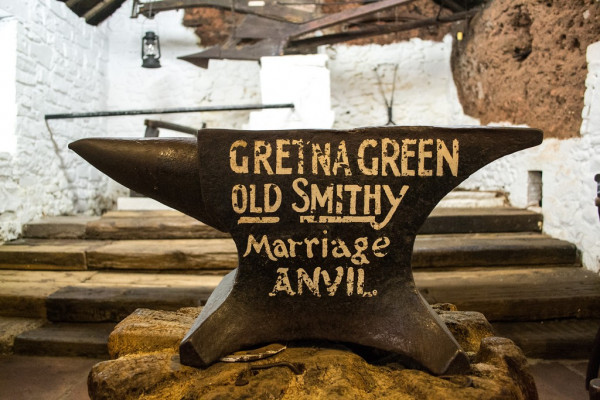
To begin with, those eloping weren’t aiming for a particular place, other than somewhere north of the border, but in the 1770s a new toll road made Gretna Green the most accessible Scottish village for those travelling from the south. It quickly became thedestination for those aiming for a secret wedding, because as well as fast access, ceremonies in the village had the added charm of being presided by the local blacksmith over an anvil.

Some say that the blacksmith’s shop was right next to the coaching inn, and he was so regularly asked to marry young couples that he ended up making a career out of it. However, I prefer an alternative explanation, which says that English couples, in spite of their eagerness to be married without the legal constraints of their country, were keen for their ceremony to be presided by someone in a position of authority in order to give it a more legitimate feel.

The Gretna Green blacksmith was happy to oblige, and added some theatricals to the ceremony by way of hammering on the anvil to symbolise the joining of new couples “in the heat of the moment but binding for eternity”. Genius!

Elopements to Scotland in Austen’s Novels

Whatever the actual reason behind the blacksmith’s story, the combination of the convenience of the toll road and the romance of the legendary anvil proved irresistible, and many couples of star-crossed lovers made Gretna Green their destination. By Jane Austen’s time, elopements to Scotland, mainly with Gretna Green as destination, were so established that they are mentioned in several of her works.

In Love and Freindship, Laura and Sophia convince young Janetta, who is to marry a man her father has chosen for her, that she is in love with Captain M’Kenzie. They manage to do the same with the gentleman, and they end up running away to “Gretna-Green”.

In Mansfield Park, Julia Bertram and Mr Yates elope to Scotland to marry. In Pride and Prejudice, Lydia and Wickham are thought to have run away to Scotland when word gets out of their escape, and the bride herself declares Gretna Green to be their destination in the infamous letter she leaves to her friend, Mrs Foster:

”MY DEAR HARRIET,

“You will laugh when you know where I am gone, and I cannot help laughing myself at your surprise tomorrow morning, as soon as I am missed. I am going to Gretna Green, and if you cannot guess with who, I shall think you a simpleton, for there is but one man in the world I love, and he is an angel. I should never be happy without hi, so think it no harm to be off. You need not send word at Longbourn of my going, if you do not like it, for it will make the surprise the greater, when i write to them and sign my name “Lydia Wickham.” What a good joke it will be!”

Pride and Prejudice, Chapter 47

And who does not remember the tragic love story between a young Colonel Brandon and Eliza, his father’s guard, in Sense and Sensibility? Before Eliza is forced to marry Brandon’s brother, the doomed couple plan to elope and get married in Gretna Green, but they are betrayed by “the treachery, or the folly” of Eliza’s maid.

In any case, the Gretna Green legend remains, so much so that the town has quite successfully marketed itself as a romantic wedding destination. And, I should add, rightly so, for who can resist the lure and romance of Scotland and of a marriage over the world’s most famous anvil, whether parental permission has been granted or not?

What do you think of Gretna Green’s reputation in history? Where should it feature in a list of Janeite locations in the UK?

Posted in British history, buildings and structures, Church of England, customs and tradiitons, Georgian England, Georgian Era, Great Britain, Gretna Green, Guest Post, history, Jane Austen, legends, Living in the Regency, marriage, marriage customs, marriage licenses, Pride and Prejudice | Tagged , , , , , , , , , , | Comments Off on Gretna Green: Secret Engagements, Elopements and the World’s Most Famous Anvil, a Guest Post from Eliza Shearer

Pre-Elizabethan Drama: Morality Plays

220px-mundas-et-infans-frontispiece-1522

The 1522 cover of “Mundus et Infans,” a morality play ~ Wikipedia

Previously, I did a piece on Liturgical Drama. Today I would like to look at Moralities. As compared to the Miracle or Liturgical dramas, the morality play was one where the playwright had to come up with an original story line, which many consider to be a major step forward in the history of drama. No longer did the playwright use the scripture for his plots. He did, however, employ a well-known allegory, popular for several centuries in England and upon the European continent, but which had rarely been celebrated as the central issue of a tale, as it was in the moralities. 

A morality play was defined as “an allegorical drama popular in Europe especially during the 15th and 16th centuries, in which the characters personify moral qualities (such as charity or vice) or abstractions (as death or youth) and in which moral lessons are taught.” (Britannica) The issue was the struggle between good and evil in claiming the soul of man. Vice and Virtue became the central characters. In these plays, mankind always desired to chase after the vice, but he is well aware that if he does he will face eternal damnation. Evidently, the medieval mind thought much upon the dichotomy presented in the plays. 

mummers2.jpgThe characters in the plays were personified abstractions. In moralities we find Friendship, Riches, Good, Evil, Knowledge, Mankind, etc. The action of the morality play centers on a hero whose inherent weaknesses are assaulted by such personified diabolic forces as the Seven Deadly Sins, but who may choose redemption and enlist the aid of such figures as the Four Daughters of God (Mercy, Justice, Temperance, and Truth). Customarily, the play began with Man being summoned to the Grave. The action that followed involved the conflict for the possession of Man’s spirit.
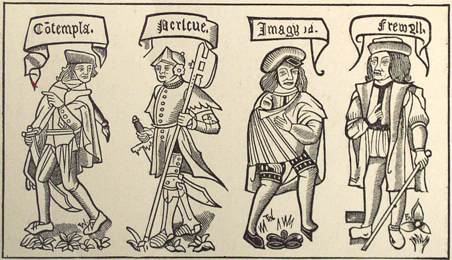
The purpose of the Moralities was didactic. In Everyman, for example, the protagonist is made acquainted with the entire Catholic scheme of salvation. In the play, Man dons the jewel of Penance and later, the robe of contrition. He also consumes the seven “blessed sacraments.” Through the action, the play teaches its audience that all men must adhere to the tenets of the church. The play ends with the Doctor or Expositor reemphasizing the moral of the story. He shows the audience how Pride, Beauty, Wealth, and other worldly aspirations abandon “Everyman” at death. Only Good Deeds will accompany him to the underworld. These early plays were solemn personifications of church sermons. 

MoralityFigures.JPGAmong the oldest of morality plays surviving in English is The Castle of Perseverance (c. 1425), about the battle for the soul of Humanum Genus. A plan for the staging of one performance has survived that depicts an outdoor theatre-in-the-round with the castle of the title at the centre. Everyman was published in 1500. They both were from the York Paternoster Plays, which date back to 1378. These plays were similar to the early moralities. They took their names from the belief that each clause of the Lord Prayer could counter one of the seven deadly sins. 

The character of Vice became the first element of comedy in 16th Century Moralities. Vice’s purpose was to irritate and arouse the ire of the Devil. Vice prodded the Devil with sticks. He taunted him. He baited him into arguments. The character of the Devil was a crossover from the Miracle plays. He “excited” the audience for they anticipated his antics. Both characters met the demand of the latter audiences for action rather than sore sermons. 

“Morality plays were an intermediate step in the transition from liturgical to professional secular drama, and combine elements of each. They were performed by quasi-professional groups of actors who relied on public support; thus the plays were usually short, their serious themes tempered by elements of farce. In the Dutch play Het esbatement den appelboom (“The Miraculous Apple Tree”), for example, a pious couple, Staunch Goodfellow and Steadfast Faith, are rewarded when God creates for them an everbearing apple tree with the property that whoever touches it without permission becomes stuck fast. This leads to predictable and humorous consequences.” (Britannica)

Resources: 

History of Morality Plays 

Luminarium 

New Advent: Catholic Encyclopedia 

Wikipedia 

Posted in acting, Age of Chaucer, Anglo-Normans, Anglo-Saxons, British history, drama, medieval, playwrights, Vagary | Tagged , , , , , | Comments Off on Pre-Elizabethan Drama: Morality Plays

Testing the Money: The Trial of Pyx

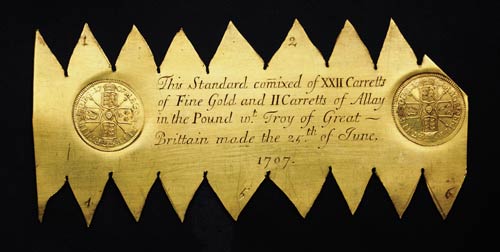
The Trial of Pyx is a near-800 year old ceremony to test Britain’s coinage. The Trial of the Pyx dates as far back as 1249. The Queen’s Remembrancer oversees the ceremony. Until the 19th century this duty was undertaken at the Court of Exchequer, but is now held at Goldsmiths’ Hall in the City of London. The ceremony puts the Royal Mint on trial. Over a four-month period, nearly 100,000 are scrutinized. During the process, the coins are tested for imperfections or impurities in the metals used, therefore, confirming their value. 

Historic UK tells us, “The Trial of Pyx is a rather interesting one. Every day the Royal Mint collect samples of the coins they produce: this amounts to around 88,000 coins a year. These coins are then placed in boxes (or pyxes) and every February they are brought to Goldsmiths Hall. The Queen’s Remembrancer swears in a jury of 26 goldsmiths whose job it is to count, measure, weigh and assay the coins. In April or May he or she returns to hear the jurers’ verdict.”

Coins from the commemorative £1,000 coin (worth £49,995) made from a kilo of solid gold to the 20p piece, all denominations of coins are tested. According to Coin Books, 2017 saw the Trial this year was the new £1 coin, which has 12 sides and will be released to the public later this year. It is considered to be the most secure coin ever developed.

32668549976_6f9061d0a9

This one kilo gold coin celebrates the Queen’s 90th birthday. via Coin Books http://www.coinbooks.org/v20/esylum_v20n06a21.html

The Royal Mint provides these insights: “As one of the nation’s longest-established judicial ceremonies, the Trial of the Pyx has a rich and fascinating history. It brings together some of the United Kingdom’s oldest organisations and offices with the purpose of ensuring the quality and accuracy of the nation’s coinage. 

“The ceremony involves the Chancellor of the Exchequer (or nominated representative), financial leaders, representatives of The Royal Mint and freemen of the Worshipful Company of Goldsmiths, commonly known as The Goldsmiths’ Company.”

“The word ‘pyx’ comes from the Latin word ‘pyxis’ or small box. In this case, it refers to the chests used to transport the coins. Throughout the year, in a procedure that has barely changed since the reign of Henry III, coins are randomly selected from every batch of each denomination struck, sealed in bags of 50 and locked away in the Pyx boxes for testing at the Trial.”


Business Insider describes the 2016 ceremony. “The opening of this year’s trial was on February 2nd was full of pomp and circumstance. It’s carried out by the Queen’s Remembrancer, a judge, who swears in the 16-strong jury who have the job of counting the coins sent for testing by the Royal Mint. While it’s mostly ceremonial, the Trial of the Pyx has an important message – merchants, not the state or the monarchy, must have power over the country’s currency. To allow the state to have power over the currency, risks eroding its credibility. Permission for the City of London to test the coins produced by the Royal Mint was granted by the Crown in the 13th century. Before that, the reigning monarch had a monopoly on producing and testing Britain’s coinage and would periodically alter the standards for the coins to finance wars. 

“‘There was the inherent danger of inflation and currency corruption,’ the Queen’s Remembrancer, Barbara Fontaine, said in her speech to open proceedings. The Trial was ‘a key stage of development of the international trust in our coinage.'”

these-are-the-pyx-reinforced-boxes-of-currency-ready-to-be-assayed-or-tested-the-word-pyx-comes-from-the-greek-for-wooden-box-in-them-are-hundreds-of-envelopes-containing-thousands-of-co

These are the Pyx, reinforced boxes of currency ready to be assayed or tested. The word Pyx comes from the Greek for wooden box. In them are hundreds of envelopes containing thousands of coins. via Business Insider

Coin Books also gives us these other sources: 

To read the complete article, see:
Take a tour around the Trial of the Pyx — the 800-year-old ceremony to test the UK’s coins(www.businessinsider.com/inside-the-trial-of-the-pyx-2017-1/#the-ceremony-takes-place-in-the-opulent-goldsmiths-hall-in-the-city-of-london-members-of-the-public-and-invited-dignitaries-are-sat-on-one-side-of-the-room-the-queens-remembrancer-a-judge-sits-at-the-head-of-the-table-to-give-her-address-and-start-the-trial-she-isnt-actually-present-when-counting-process-happens-1)

For more information, see:
The History of the Trial of the Pyx (www.royalmint.com/discover/uk-coins/history-of-the-trial-of-the-pyx)

The History of the Trial of Pyx (The Goldsmiths’ Company) 

The Business Insider site has some magnificent images of the process, the room, etc. Check them out HERE

Check out all the Royal Mint has to share on the topic. 

Posted in British history, commerce, customs and tradiitons, Living in the UK | Tagged , , , , , , | 3 Comments